


Traffic signsBelgium
 Traffic rules
 Belgium
 Priority signs
 Warning signs
 Prohibitory signs
 Mandatory signs
 Information signs
 Additional signs
Traffic signs
A traffic sign is a standardised visual symbol placed along roads to guide, warn, or regulate drivers, cyclists, and pedestrians. These signs provide essential information about road conditions, rules, directions, and potential hazards, helping to ensure safety and smooth traffic flow. They come in various shapes and colours—such as triangular warning signs, circular prohibitory or mandatory signs, and rectangular information signs—each designed for quick recognition and clear understanding.
What are Belgian A-series traffic signs?
The A series mainly consists of warning signs. They warn road users of a danger ahead, such as dangerous curves, road narrowing, slippery roads, pedestrian crossings or railway crossings.
 Warning for a danger with no specific traffic sign.
Signal routier A51 • Danger non défini par un symbole spécial. Un panneau additionnel indique la nature du danger.
Verkeersbord A51 • Gevaar dat niet door een speciaal symbool wordt bepaald. Een onderbord duidt de aard van het gevaar aan.
 Warning for a movable bridge.
Signal routier A9 • Pont mobile.
Verkeersbord A9 • Beweegbare brug.
What are Belgian B-series traffic signs?
The B series contains priority signs. These signs regulate matters such as giving way, stopping, priority roads, priority from the right and priority at narrow passages.
 Stop and give way.
Signal routier B5 • Marquer l’arrêt et céder la priorité.
Verkeersbord B5 • Stoppen en voorrang verlenen.
 Give way.
Signal routier B1 • Céder la priorité.
Verkeersbord B1 • Voorrang verlenen.
What are Belgian C-series traffic signs?
The C series contains prohibition and restriction signs. They can prohibit access, restrict particular categories of vehicles, impose a maximum speed or prohibit certain manoeuvres.
 No entry.
Signal routier C1 • Sens interdit à tout conducteur.
Verkeersbord C1 • Verboden richting voor iedere bestuurder.
 Access prohibited in both directions.
Signal routier C3 • Accès interdit, dans les deux sens, à tout conducteur.
Verkeersbord C3 • Verboden toegang, in beide richtingen, voor iedere bestuurder.
What are Belgian D-series traffic signs?
The D series contains mandatory signs. They can require drivers to follow a particular direction or require certain road users to use a designated part of the public road.
 Driving straight ahead mandatory.
Signal routier D1 • Obligation de suivre la direction indiquée par la flèche. La disposition des lieux détermine la position de la flèche. Si le signal présentant une flèche non coudée, est placé sur un obstacle, il signifie obligation de passer du côté indiqué par la flèche.
Verkeersbord D1 • Verplichting de door de pijl aangeduide richting te volgen. De plaatsgesteldheid bepaalt de stand van de pijl. Wanneer het verkeersbord dat een niet-gebogen pijl voorstelt, op een hindernis geplaatst is, betekent het dat langs de door de pijl aangeduide richting moet voorbijgereden worden.
What are Belgian E-series traffic signs?
The E series contains signs concerning stopping and parking. They can prohibit stopping or parking or indicate and regulate parking places.
 Parking prohibited.
Signal routier E1 • Stationnement interdit.
Verkeersbord E1 • Parkeerverbod.
What are Belgian F-series traffic signs?
The F series mainly contains indication signs and signs establishing particular traffic situations, such as motorways, built-up areas, one-way roads, bus lanes, pedestrian crossings and dead-end roads.
 Start of a built-up area.
Signal routier F1b • Commencement d'une agglomération. Ce signal est placé à droite, à chaque accès d'une agglomération; il peut être répété à gauche.
Verkeersbord F1b • Begin van een bebouwde kom. Dit verkeersbord wordt rechts geplaatst op elke toegangsweg tot een bebouwde kom; het mag links herhaald worden.
Are Belgian traffic signs legally binding?
Yes. Road users must obey Belgian traffic signs when they are regular in form, sufficiently visible and installed in accordance with the applicable rules.
What takes priority if Belgian traffic instructions, signs and rules conflict?
Instructions given by authorised persons take priority over traffic signs and the ordinary traffic rules. Traffic signs take priority over the ordinary traffic rules. When traffic lights are operating at a location, priority signs placed on the same road do not apply there.
Are traffic lights and road markings also traffic signs?
No. Belgian law distinguishes between traffic lights, traffic signs and road markings. Together they form the traffic-signalling system that road users must follow.
How are Belgian traffic signs currently classified?
Under the current Belgian Road Code, traffic signs are divided into six categories: warning signs, priority signs, prohibitory signs, mandatory signs, signs concerning stopping and parking, and information signs.
Can an additional sign change the meaning of a Belgian traffic sign?
Yes. An additional sign placed below a traffic sign can supplement, specify or limit its meaning. It may indicate matters such as a distance, the length of a regulation, a period, a particular vehicle category or an exception.
Can Belgian traffic signs be displayed electronically?
Yes. Traffic signs can be displayed using dynamic or variable signalling. Their colours may be adapted for the electronic display, but red remains red and the legal meaning of the sign does not change.
Who is allowed to place traffic signs on Belgian public roads?
Traffic signs may normally only be placed by the legally competent authorities. Temporary signalling may also be used in specific circumstances, such as roadworks, traffic obstructions or emergencies, in accordance with the applicable rules.
Why is Belgium introducing new traffic signs?
Belgium’s new Code of the Public Road modernises and reorganises the traffic-sign system. Many signs have been adapted to use simpler and more internationally harmonised symbols, while obsolete signs are removed and several situations receive their own dedicated signs instead of relying on combinations of existing signs and additional panels.
How will Belgian traffic signs look different under the new Road Code?
Many signs receive modernised and simplified symbols. Warning and prohibitory signs receive a white contrast border, additional contrast is introduced between blue and red areas on certain signs, and the current blue additional signs are replaced by white panels with black symbols or text.
How are traffic signs classified under Belgium’s new Road Code?
The new Code keeps the familiar A, B, C, D, E and F series and adds a clearer structure with R-series signs for special regulations, Z-series signs for zonal regulations and M-series additional signs.
When do Belgium’s new traffic signs become valid?
Belgium’s new Code of the Public Road takes effect on 1 June 2027. The new traffic signs may not be used before that date.
Must all current Belgian traffic signs be replaced on 1 June 2027?
No. Most current Belgian traffic signs may remain in use during a long transition period and do not have to be replaced immediately. Most old models remain valid until 1 January 2045.
Are there Belgian traffic signs that must be replaced earlier?
Yes. Traffic signs E5, E7 and E11 lose their meaning on 1 June 2027. The current F17 and F18 bus-lane signs and associated markings lose their meaning on 1 June 2030, while certain current F111 and F113 cycling-zone signs lose their meaning on 1 January 2035.
Can an old Belgian traffic sign remain in place but receive the meaning of the new Road Code?
Yes. Many current signs may physically remain in place during the transition period. From 1 June 2027, they are interpreted according to the new Code of the Public Road unless a specific transitional provision provides otherwise.
Should drivers learn both the current and new Belgian traffic signs?
Yes. The current traffic signs remain relevant until the new Code takes effect, and many old designs will remain on Belgian roads for years afterwards. During the transition period, drivers should therefore be able to recognise both current and new traffic signs.

201. Mandatory for class B and P mopeds
This supplementary sign indicates that the mandatory rule shown by the main traffic sign also applies to class B and class P mopeds. Class P mopeds include speed pedelecs where that classification applies.
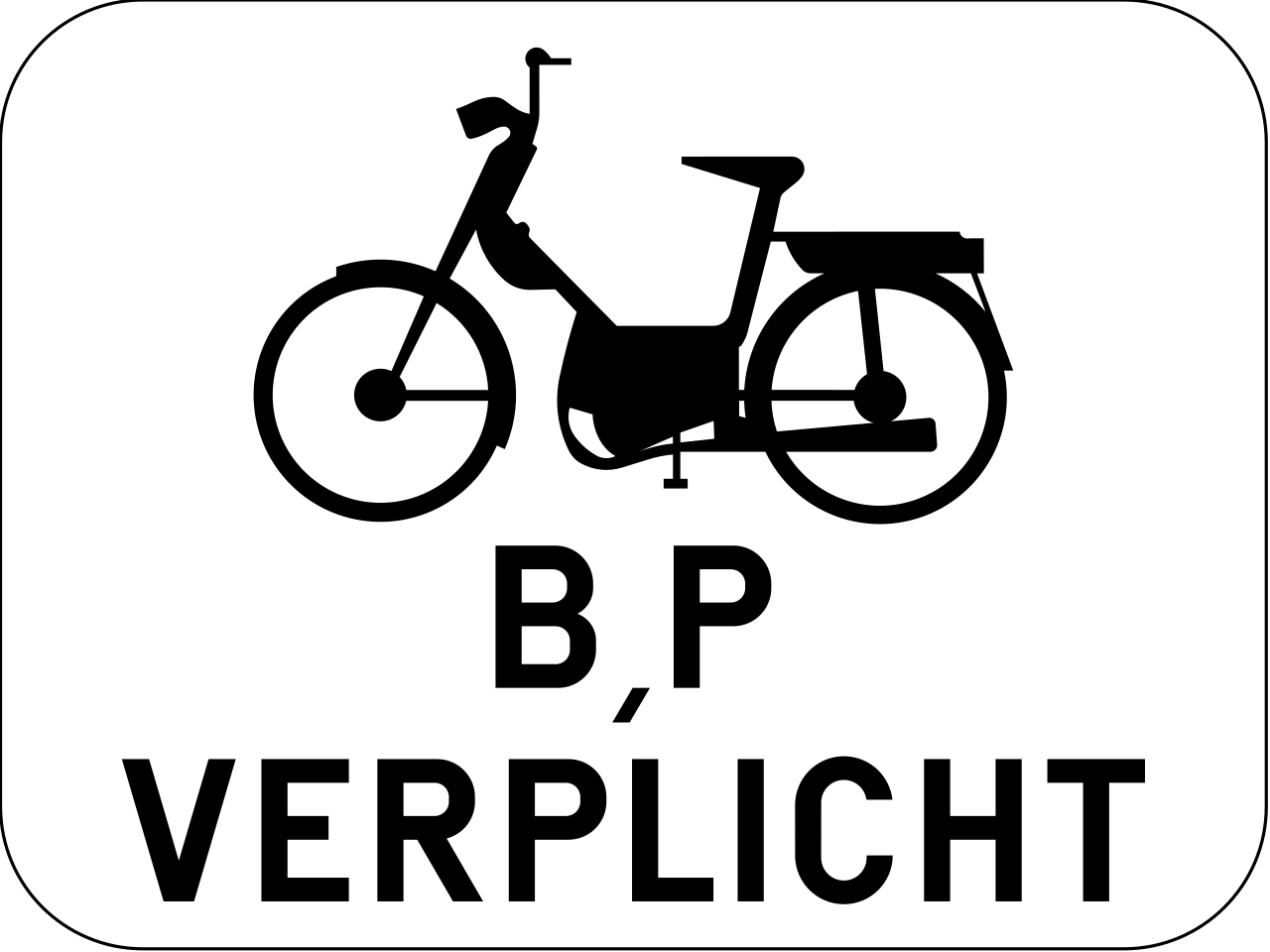
Signal routier M14 • Panonceau utilisé avec le signal D7 lorsque la piste cyclable doit être empruntée par les conducteurs de cyclomoteurs de classe B et de speed pedelecs.
Verkeersbord M14 • Onderbord gebruikt samen met D7 als het fietspad gevolgd moet worden door bestuurders van bromfietsen klasse B en speedpedelecs.
202. Mandatory for class B mopeds
This supplementary sign indicates that the mandatory rule shown by the main traffic sign also applies to class B mopeds. Class B moped riders must follow the indicated requirement.
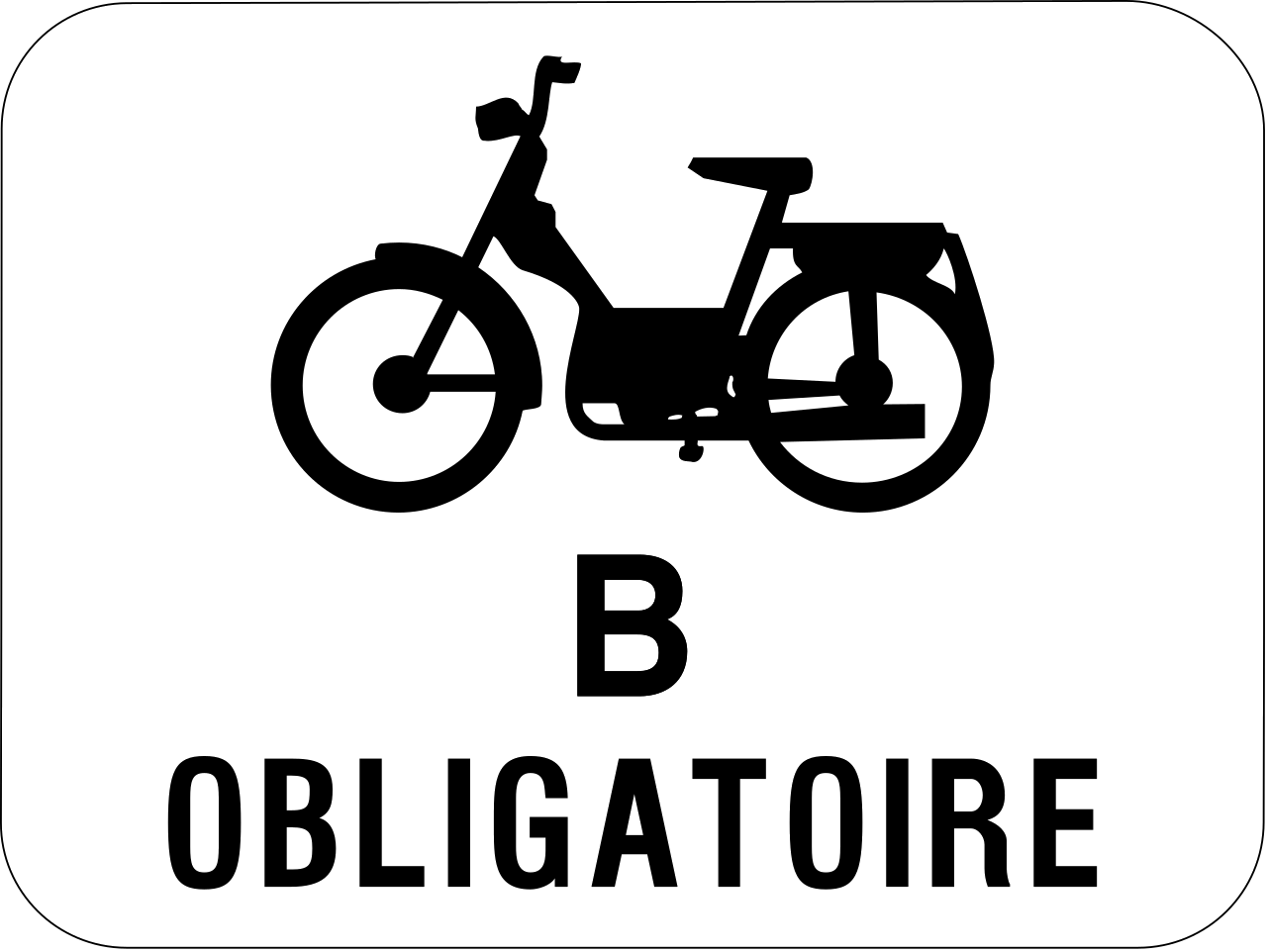
Signal routier M6 • Panonceau utilisé avec le signal D7 lorsque la piste cyclable doit également être empruntée par les conducteurs de cyclomoteurs de classe B.
Verkeersbord M6 • Onderbord gebruikt samen met D7 als het fietspad gevolgd moet worden door bestuurders van bromfietsen klasse B.
203. Prohibited for class B mopeds
This supplementary sign indicates that the prohibition shown by the main traffic sign applies specifically to class B mopeds.
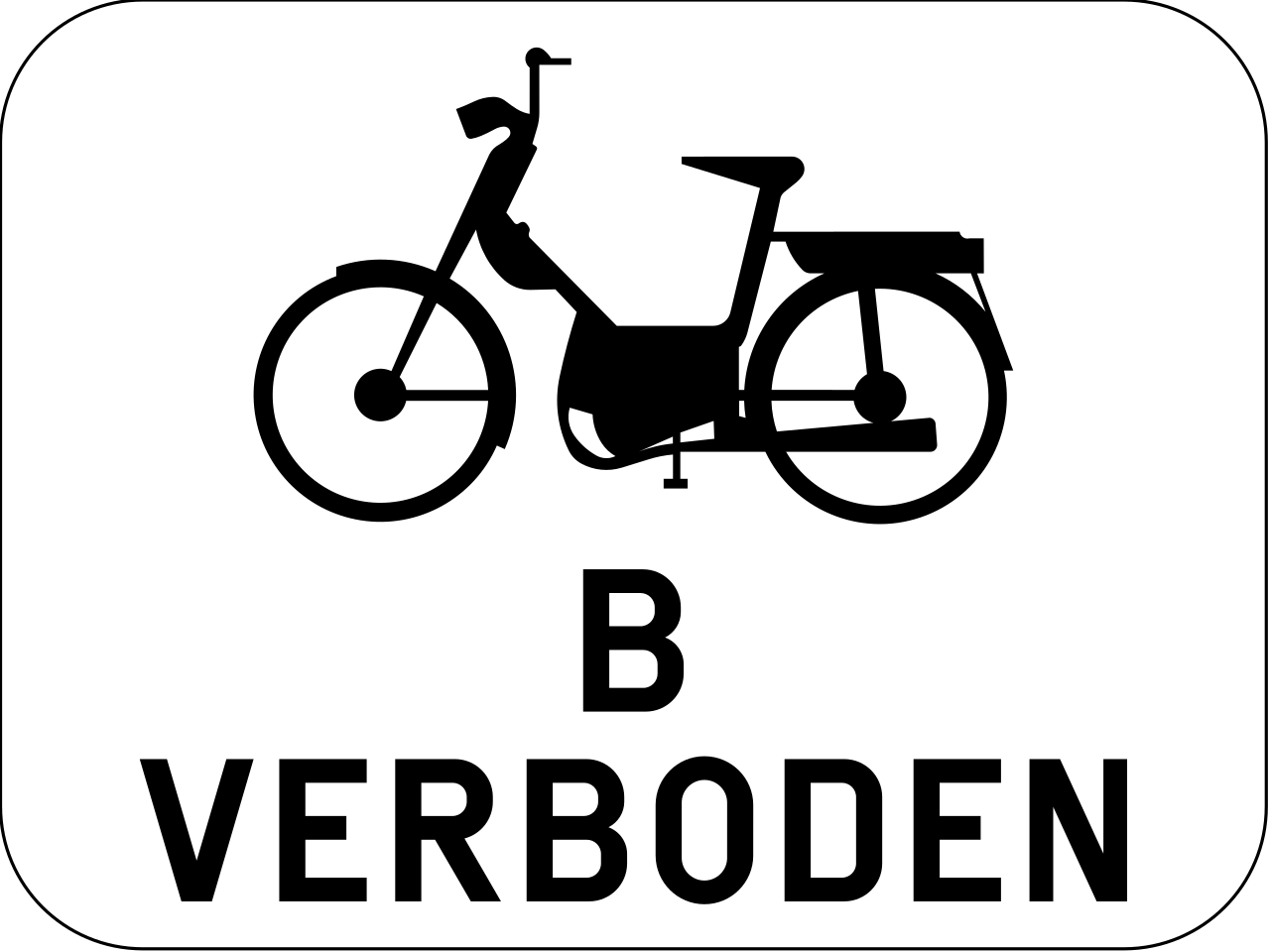
Signal routier M7 • Panonceau utilisé avec le signal D7 lorsque la piste cyclable ne peut pas être empruntée par les conducteurs de cyclomoteurs de classe B.
Verkeersbord M7 • Onderbord gebruikt samen met D7 als het fietspad niet mag gevolgd worden door bestuurders van bromfietsen klasse B.
204. Prohibited for class P mopeds
This supplementary sign indicates that the prohibition shown by the main traffic sign applies specifically to class P mopeds (speed pedelecs).
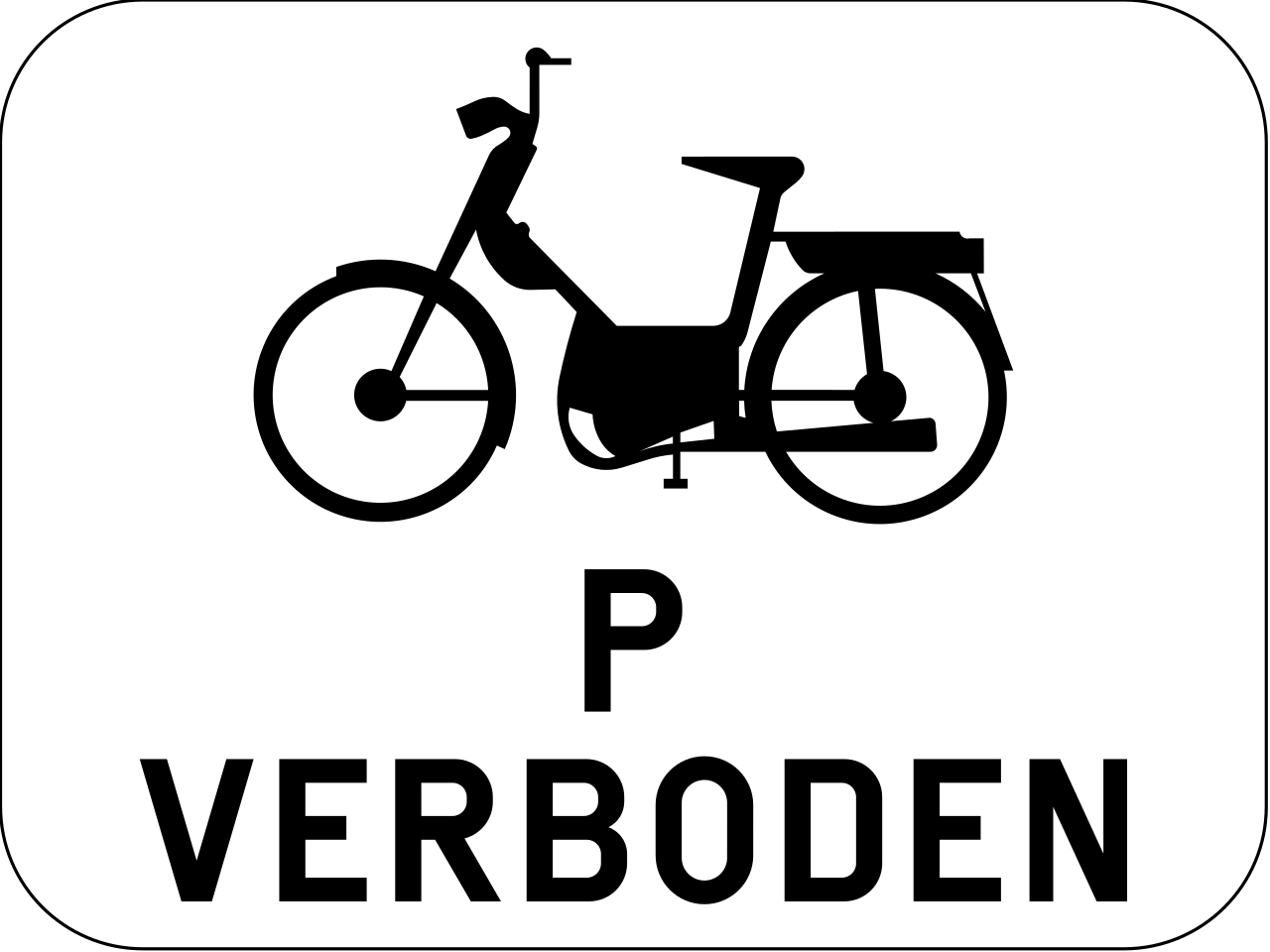
Signal routier M15 • Panonceau utilisé avec le signal D7 lorsque la piste cyclable ne peut pas être empruntée par les conducteurs de speed pedelecs.
Verkeersbord M15 • Onderbord gebruikt samen met D7 als het fietspad niet mag gevolgd worden door bestuurders van speedpedelecs.
205. Prohibited for class B and P mopeds
This supplementary sign indicates that the prohibition shown by the main traffic sign applies specifically to class B and P mopeds. Class P mopeds include speed pedelecs where that classification applies.
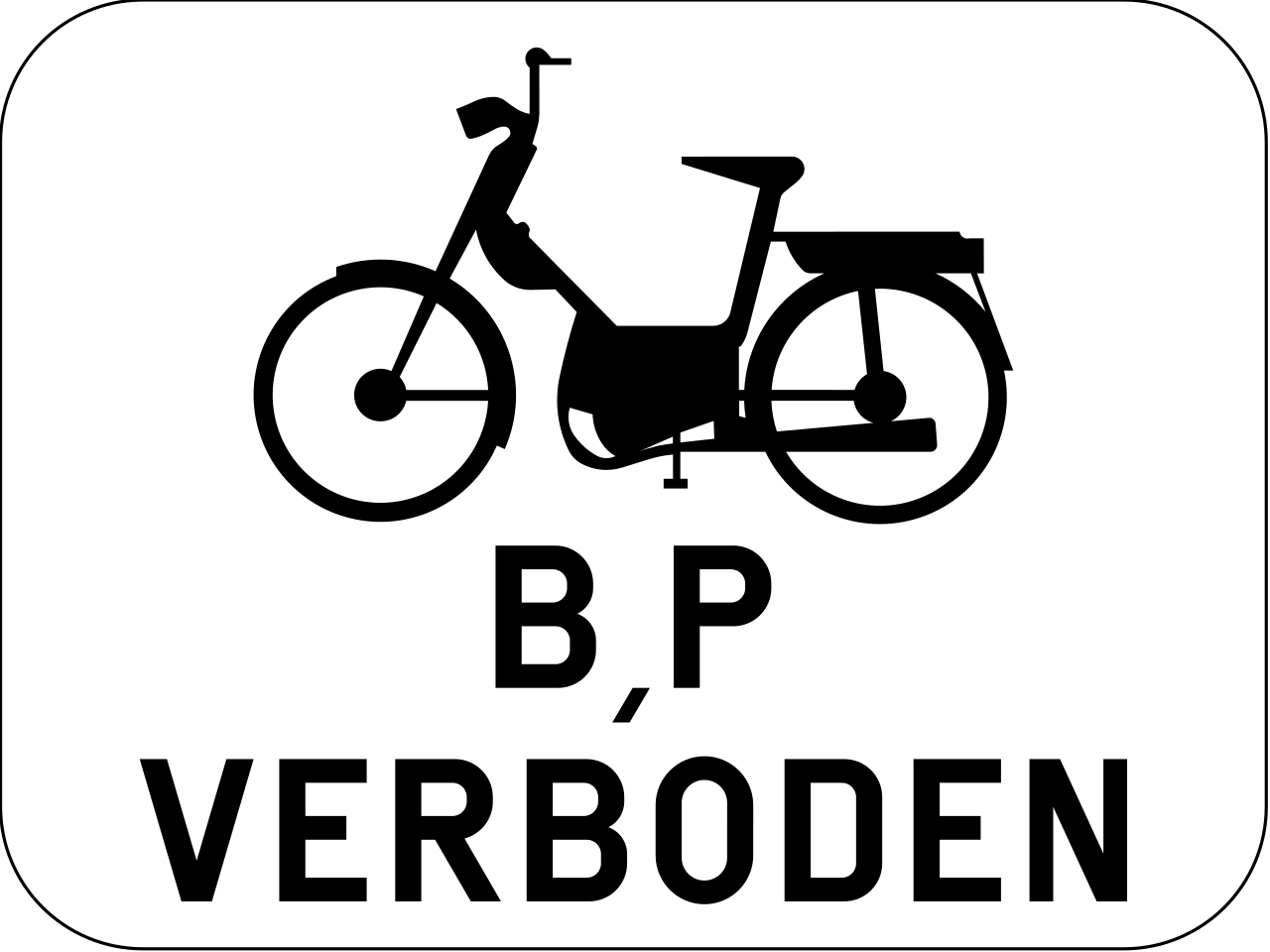
Signal routier M16 • Panonceau utilisé avec le signal D7 lorsque la piste cyclable ne peut pas être empruntée par les conducteurs de cyclomoteurs de classe B ni par les conducteurs de speed pedelecs.
Verkeersbord M16 • Onderbord gebruikt samen met D7 als het fietspad niet mag gevolgd worden door bestuurders van bromfietsen klasse B en speedpedelecs.
206. Prohibited for class B mopeds
This supplementary sign indicates that the prohibition shown by the main traffic sign applies specifically to class B mopeds.
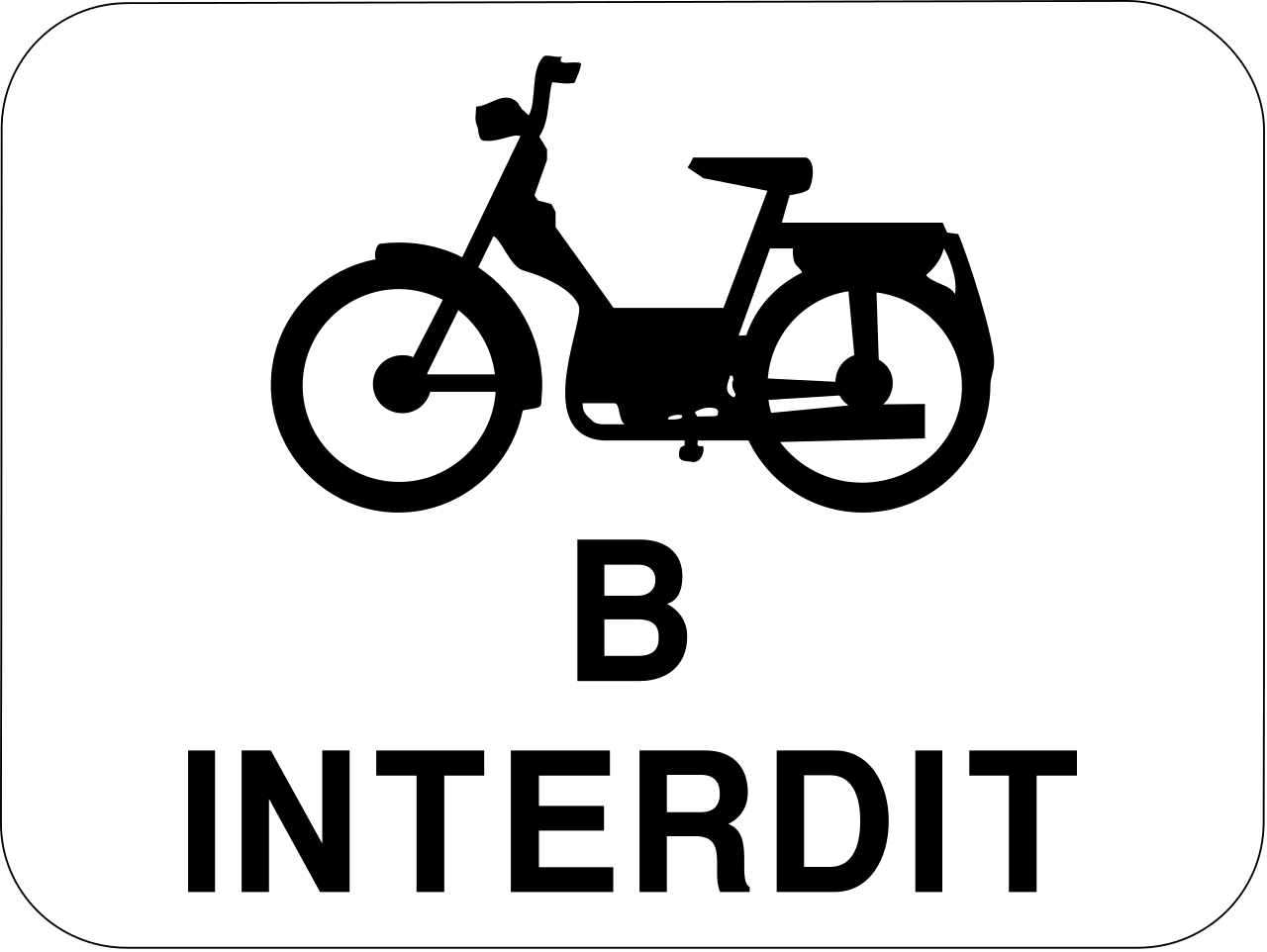
Signal routier M7 • Panonceau utilisé avec le signal D7 lorsque la piste cyclable ne peut pas être empruntée par les conducteurs de cyclomoteurs de classe B.
Verkeersbord M7 • Onderbord gebruikt samen met D7 als het fietspad niet mag gevolgd worden door bestuurders van bromfietsen klasse B.
207. Cyclists from both directions
This supplementary sign indicates that cyclists may approach from both directions on the road or cycle path concerned by the main sign.
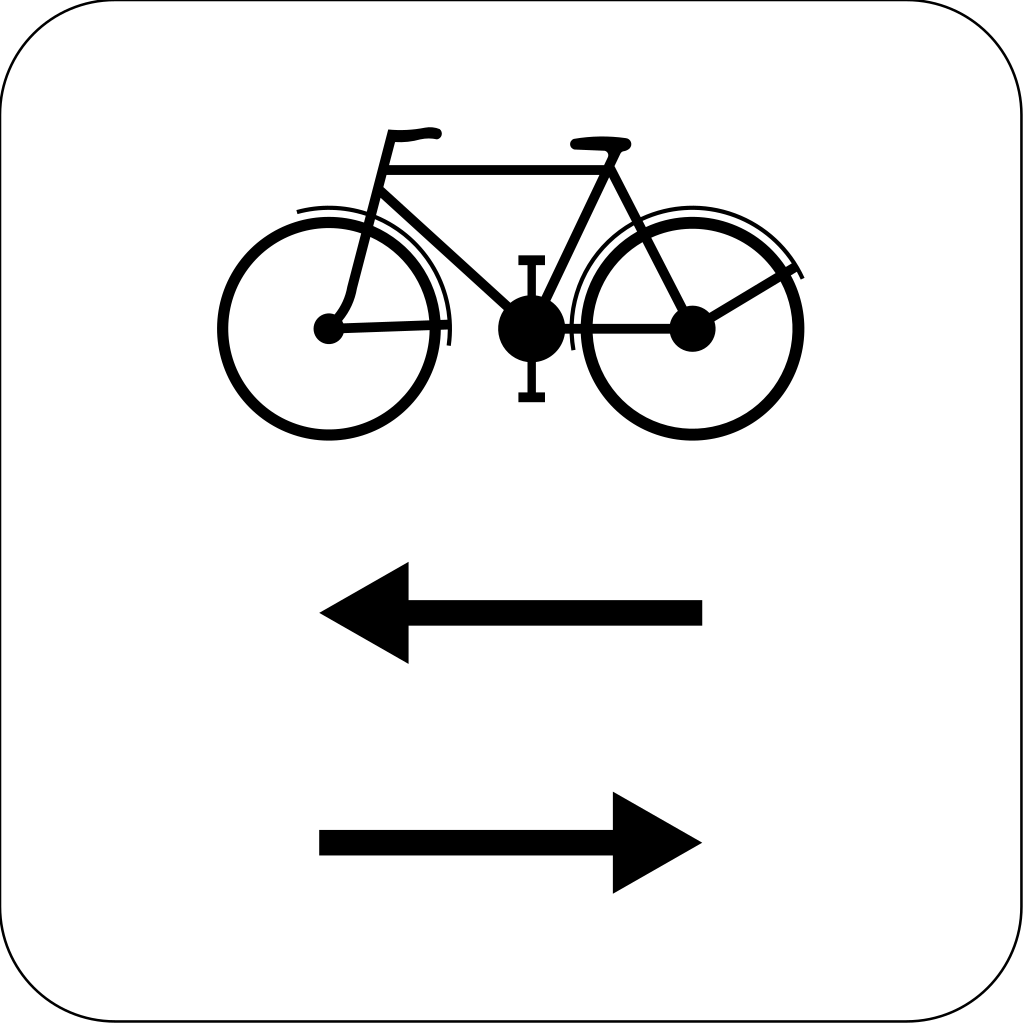
Signal routier M9 • Panonceau utilisé avec les signaux B1, B5 et B17 pour indiquer que les cyclistes circulent dans les deux sens sur la voie publique transversale dans laquelle on va s'engager.
Verkeersbord M9 • Onderbord gebruikt samen met B1, B5 en B17 om te duiden dat fietsers in de twee rijrichtingen rijden op de dwarslopende openbare weg die men gaat oprijden.
208. Cyclists and mopeds from both directions
This supplementary sign indicates that cyclists and mopeds may approach from both directions on the road or path concerned by the main sign.
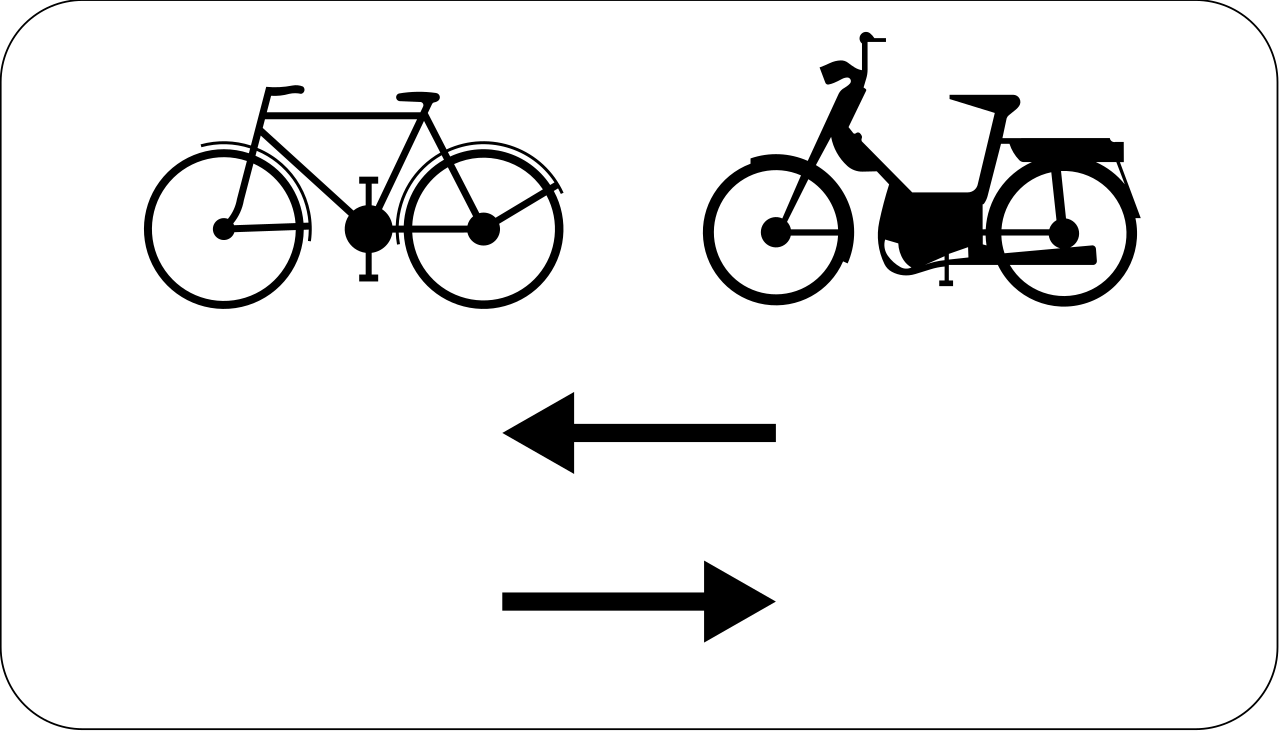
Signal routier M10 • Panonceau utilisé avec les signaux B1, B5 et B17 pour indiquer que les cyclistes et les conducteurs de cyclomoteurs à deux roues circulent dans les deux sens sur la voie publique transversale dans laquelle on va s'engager.
Verkeersbord M10 • Onderbord gebruikt samen met B1, B5 en B17 om te duiden dat fietsers en bestuurders van tweewielige bromfietsen in de twee rijrichtingen rijden op de dwarslopende openbare weg die men gaat oprijden.
209. Cyclists in both directions
This supplementary sign indicates that cyclists travel in both directions on the road, lane or cycle path concerned by the main sign.
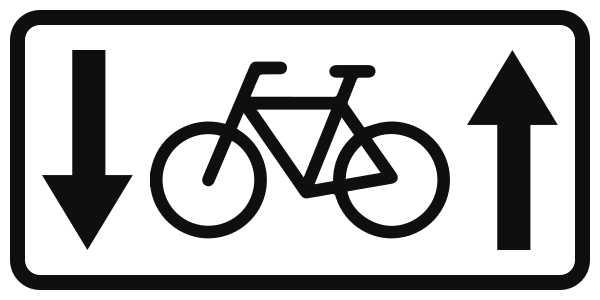
Verkeersbord M53 • Fietsers in twee richtingen.
210. Cyclists and mopeds in both directions
This supplementary sign indicates that cyclists and mopeds travel in both directions on the road, lane or path concerned by the main sign.
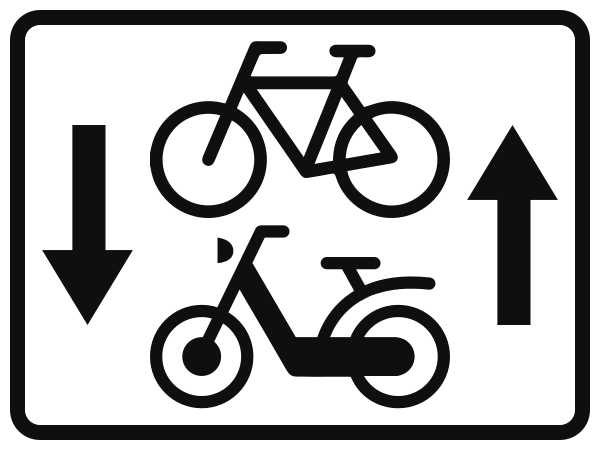
Verkeersbord M53 • Fietsers en bestuurders van tweewielige bromfietsen in twee richtingen.
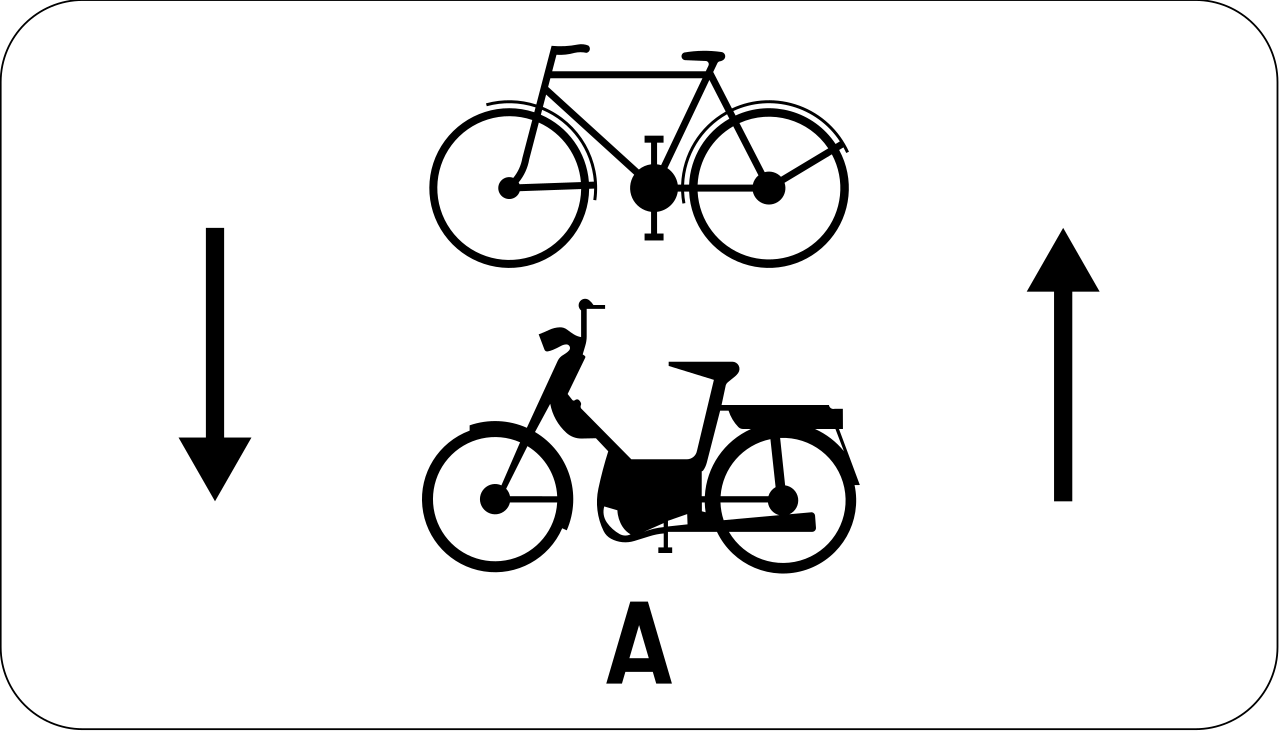
211. Cyclists and class A mopeds in both directions
This supplementary sign indicates that cyclists and class A mopeds travel in both directions on the road, lane or path concerned by the main sign.
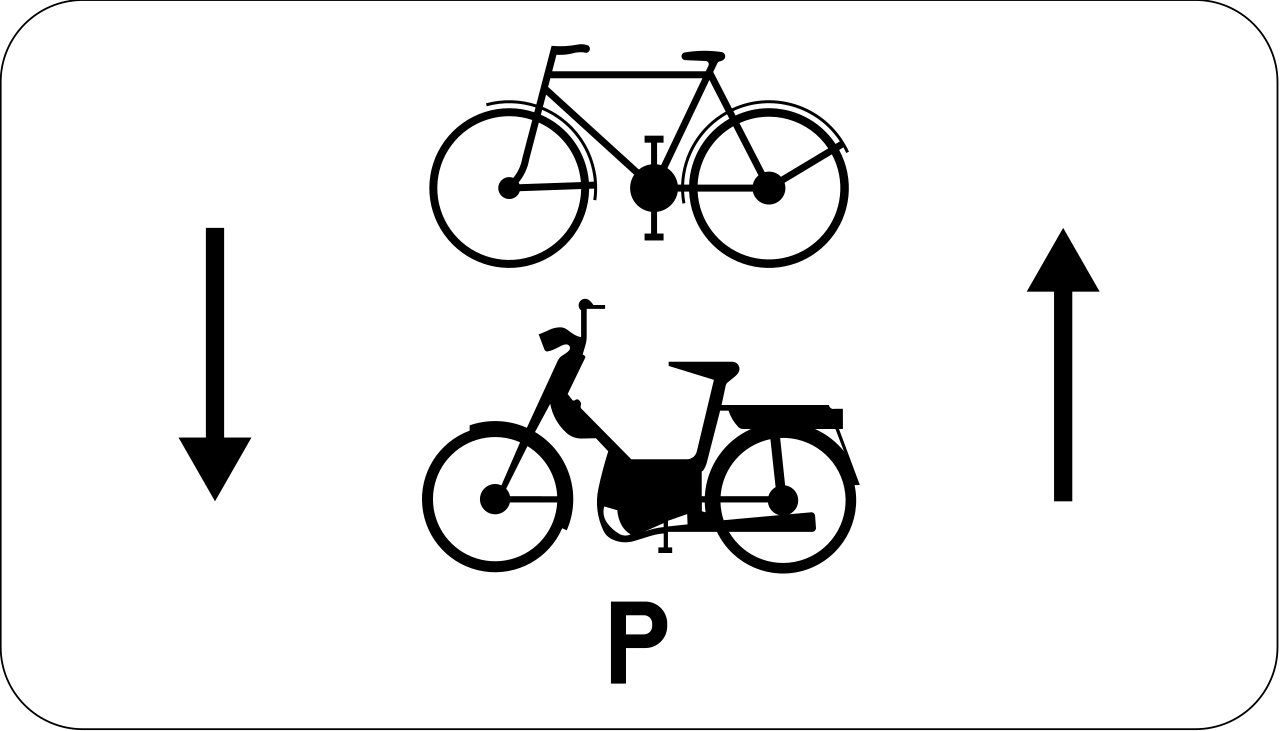
212. Cyclists and class P mopeds in both directions
This supplementary sign indicates that cyclists and class P mopeds (speed pedelecs) travel in both directions on the road, lane or path concerned by the main sign.
213. Cyclists and class A and P mopeds in both directions
This supplementary sign indicates that cyclists and class A and P mopeds travel in both directions on the road, lane or path concerned by the main sign.
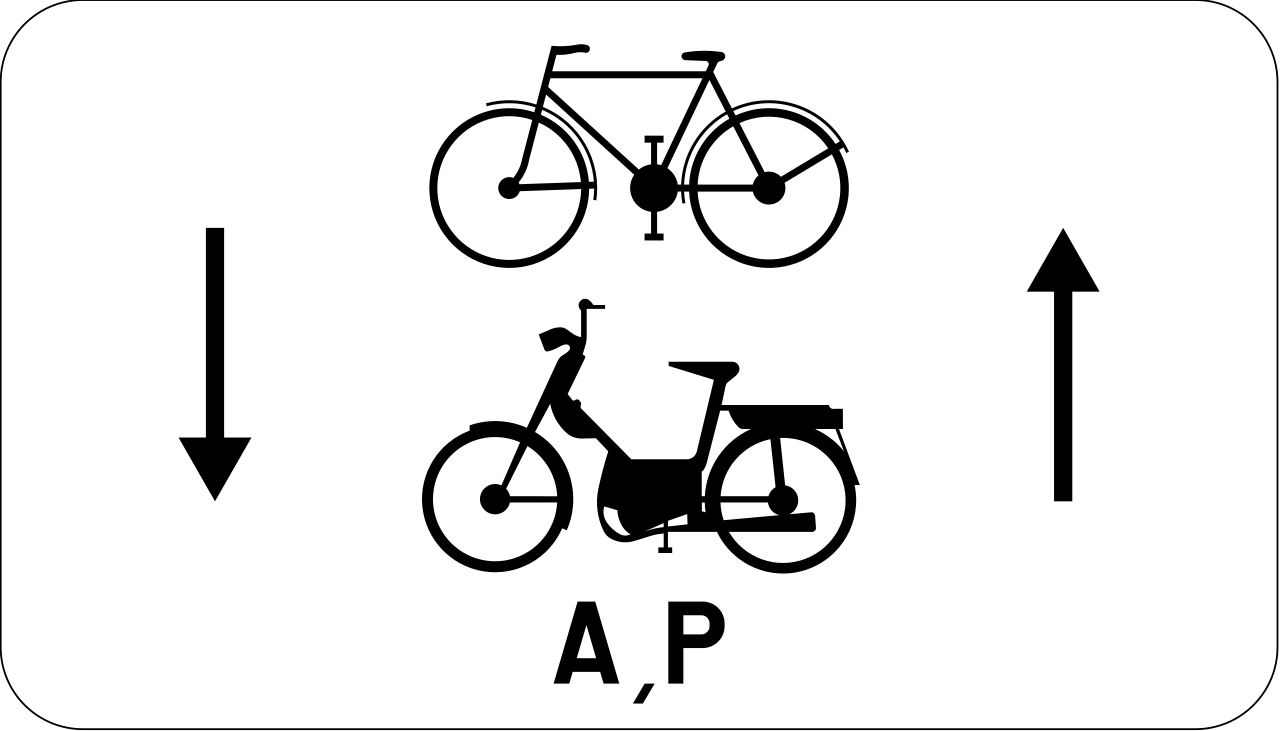
214. Start of regulation for metres
This supplementary sign indicates that the regulation shown by the main traffic sign starts here and applies for the indicated distance.
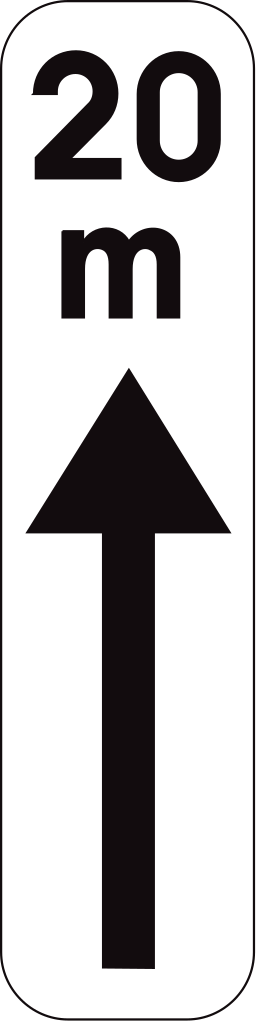
Réglementation sur une courte distance (≤ 30 m).
Reglementering over een korte afstand (≤ 30m).
215. Start of regulation
This supplementary sign indicates the start of the regulation shown by the main traffic sign. The regulation begins at this point.

Début de la réglementation.
Begin van de reglementering.
216. Continuation of regulation
This supplementary sign indicates the continuation or reminder of the regulation shown by the main traffic sign.

Réglementation sur une longue distance (rappel).
Reglementering over een lange afstand (herhaling).
217. End of regulation
This supplementary sign indicates the end of the regulation shown by the main traffic sign. The regulation ends at this point.

Fin de la réglementation.
Einde van de reglementering.
218. metres ahead
This supplementary sign indicates the distance from the main traffic sign to the point where the indicated danger, regulation or information begins. The distance is shown in metres.

Panonceau utilisé pour indiquer une distance supérieure ou inférieure à la distance standard de 150 m jusqu'au danger.
Onderbord gebruikt om een afstand groter of kleiner dan de standaard 150m tot het gevaar aan te duiden.
219. Stop metres ahead
This supplementary sign announces a STOP sign at the indicated distance ahead. The displayed value shows the distance to the upcoming STOP sign.

Panonceau utilisé avec le signal B1 pour annoncer le signal B5.
Onderbord gebruikt samen met B1 om bord B5 aan te kondigen.
220. For kilometres
This supplementary sign indicates the length of the section to which the main traffic sign applies. The length is shown in kilometres.
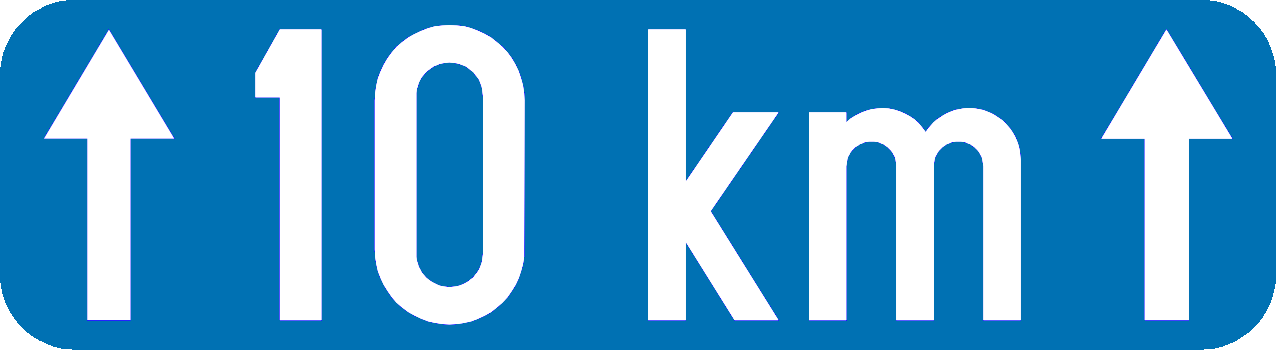
Panonceau utilisé pour indiquer la longueur d'une section dangereuse de la voie publique.
Onderbord gebruikt om de lengte van een gevaarlijk gedeelte van de openbare weg aan te duiden.
221. Indicated mass
This supplementary sign shows an indicated vehicle mass. Read it together with the main traffic sign to determine how the mass value affects the applicable rule or restriction.

Panonceau utilisé avec le signal C23 pour limiter l'interdiction aux conducteurs de véhicules dont la masse en charge est supérieure à celle indiquée.
Onderbord gebruikt samen met C23 om het verbod te beperken tot de bestuurders van voertuigen waarvan de massa in beladen toestand hoger is dan het aangeduide.
222. Indicated mass
This supplementary sign shows an indicated vehicle mass. Read it together with the main traffic sign to determine how the mass value affects the applicable rule or restriction.

Panonceau utilisé avec le signal C23 pour limiter l'interdiction aux conducteurs de véhicules dont la masse en charge est supérieure à celle indiquée.
Onderbord gebruikt samen met C23 om het verbod te beperken tot de bestuurders van voertuigen waarvan de massa in beladen toestand hoger is dan het aangeduide.
223. Indicated mass
This supplementary sign shows an indicated vehicle mass. Read it together with the main traffic sign to determine how the mass value affects the applicable rule or restriction.

Panonceau utilisé avec le signal C23 pour limiter l'interdiction aux conducteurs de véhicules dont la masse en charge est supérieure à celle indiquée.
Onderbord gebruikt samen met C23 om het verbod te beperken tot de bestuurders van voertuigen waarvan de massa in beladen toestand hoger is dan het aangeduide.
224. Junction shape
This supplementary sign shows the shape or layout of the upcoming junction.

Panonceau utilisé pour indiquer la courbe de la route.
Onderbord om de curve van de weg aan te geven.
225. Park and ride
This supplementary sign indicates a park and ride facility, where drivers can park and continue their journey by public transport.
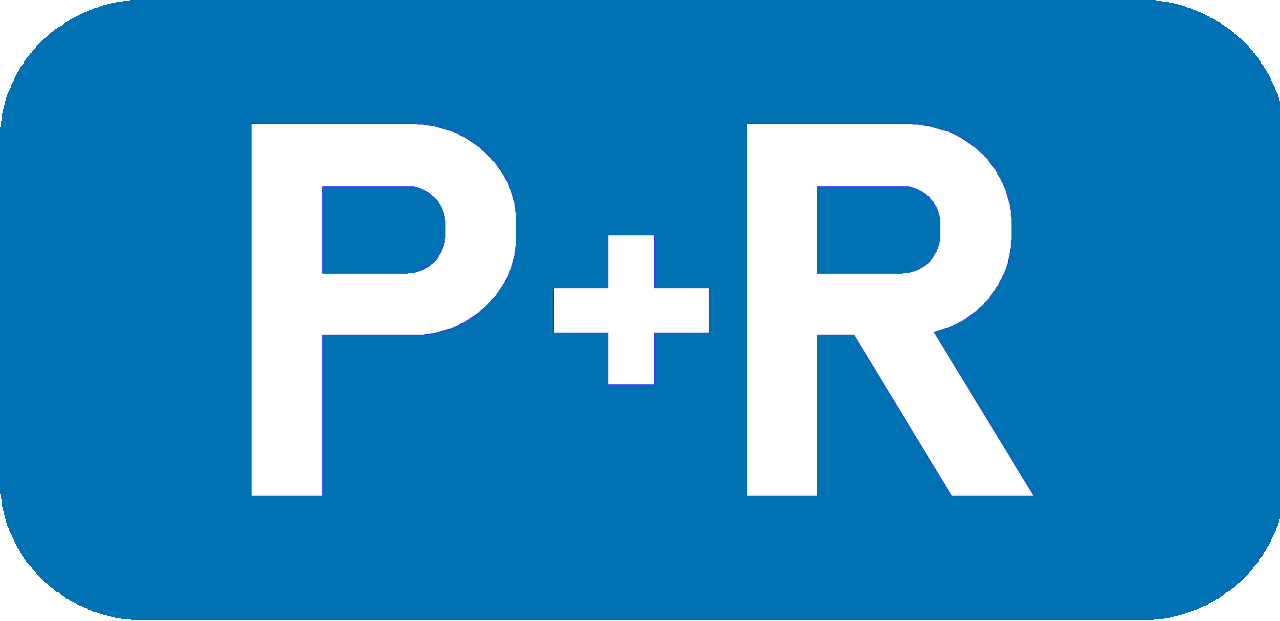
226. Parking disc required
This supplementary sign indicates that a parking disc must be used when parking where the sign applies.

Panonceau utilisé avec les signaux E5, E7 et ceux de la série E9 pour indiquer que la durée du stationnement est limitée et qu'un disque de stationnement doit être utilisé.
Onderbord gebruikt samen met E5, E7 en de E9-reeks dat aanduidt dat de parkeertijd beperkt is en dat een parkeerschijf moet gebruikt worden.
227. During the time shown
This supplementary sign indicates that the main traffic sign applies during the time shown.
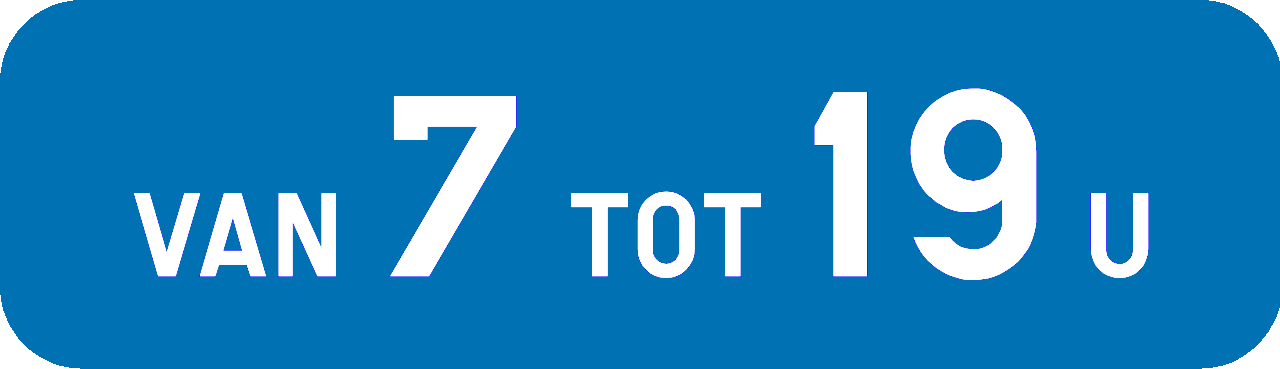
Panonceau utilisé avec les signaux E1, E3 et ceux de la série E9 pour indiquer une période.
Onderbord gebruikt samen met E1, E3 en de E9-reeks dat een periode aanduidt.
228. For the number of minutes shown
This supplementary sign indicates that the main traffic sign applies for the number of minutes shown.

Panonceau utilisé avec les signaux de la série E9 pour indiquer que la durée du stationnement est limitée.
Onderbord gebruikt samen met de E9-reeks dat aanduidt dat de parkeertijd beperkt is.
229. On the days shown
This supplementary sign indicates that the main traffic sign applies on the days shown.
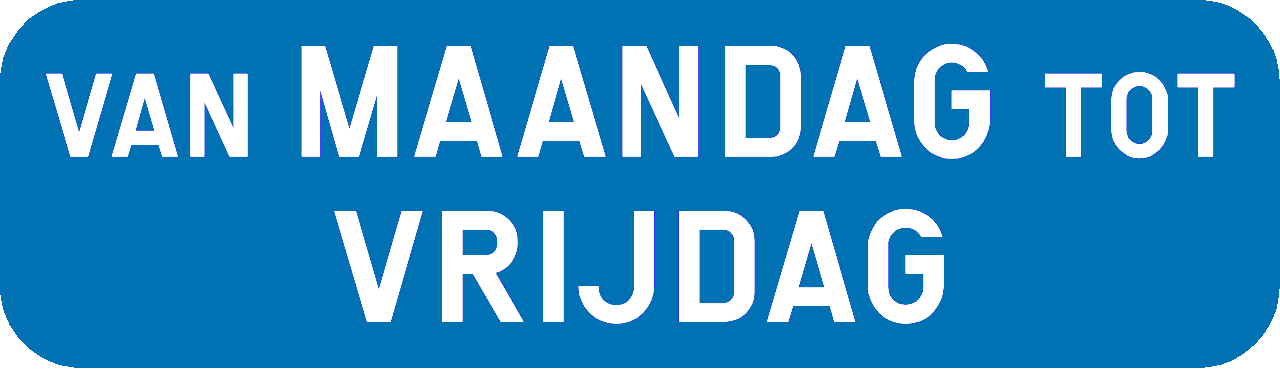
Panonceau utilisé avec les signaux E1, E3 et ceux de la série E9 pour indiquer une période.
Onderbord gebruikt samen met E1, E3 en de E9-reeks dat een periode aanduidt.
230. School street
This supplementary sign indicates that the main traffic sign applies to a school street.
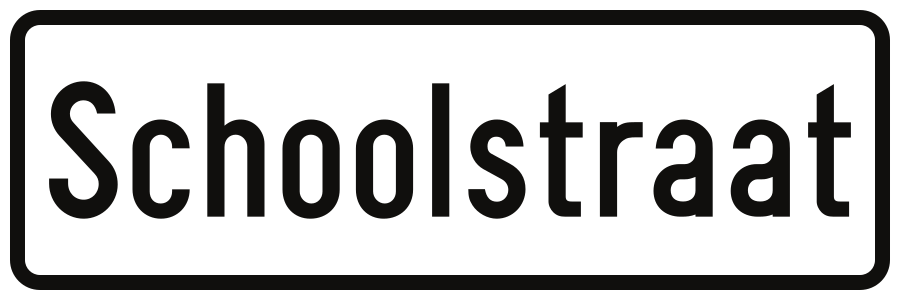
Verkeersbord M65 • Dit onderbord aangebracht onder het verkeersbord C3 duidt een schoolstraat aan.
231. Emergency telephone and fire extinguisher
This supplementary sign indicates that the facility or emergency stopping place shown by the main traffic sign is equipped with an emergency telephone and a fire extinguisher.
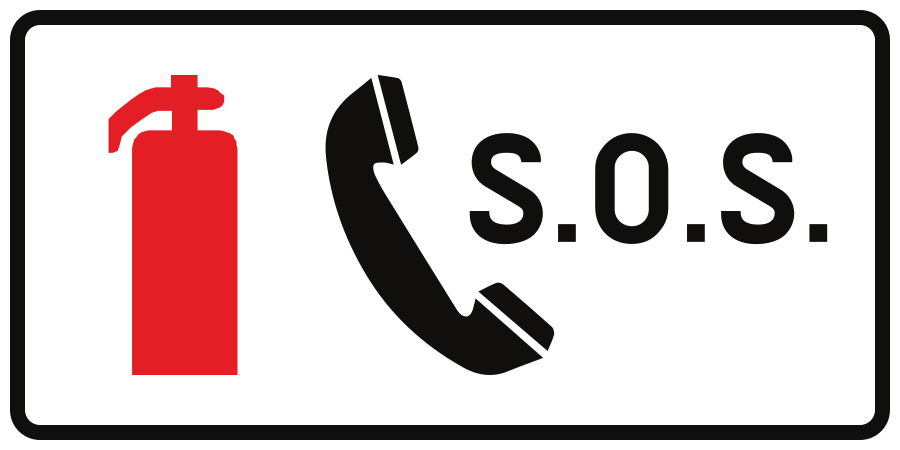
Verkeersbord M67 • Dit onderbord aangebracht onder het verkeersbord F98 duidt een vluchthaven aan die is uitgerust met een noodtelefoon en een brandblusser.
232. Queues
This supplementary sign warns that queues or slow-moving traffic may be encountered ahead.

233. Reminder
This supplementary sign indicates that the main traffic sign repeats a rule or restriction already in force.

Panonceau utilisé avec le signal C43 pour répéter une interdiction.
Onderbord gebruikt samen met C43 om een verbod te herhalen.
234. Damaged roadway
This supplementary sign warns of a damaged or uneven road surface.

Panonceau utilisé avec le signal A51 pour indiquer la nature du danger. D'autres mentions possibles sont ornières, brouillard, accotement meuble, carrière, etc.
Onderbord gebruikt samen met A51 om de aard van het gevaar aan te duiden. Andere mogelijke opschriften zijn spoorvorming, mist, zachte berm, steengroeve, ...
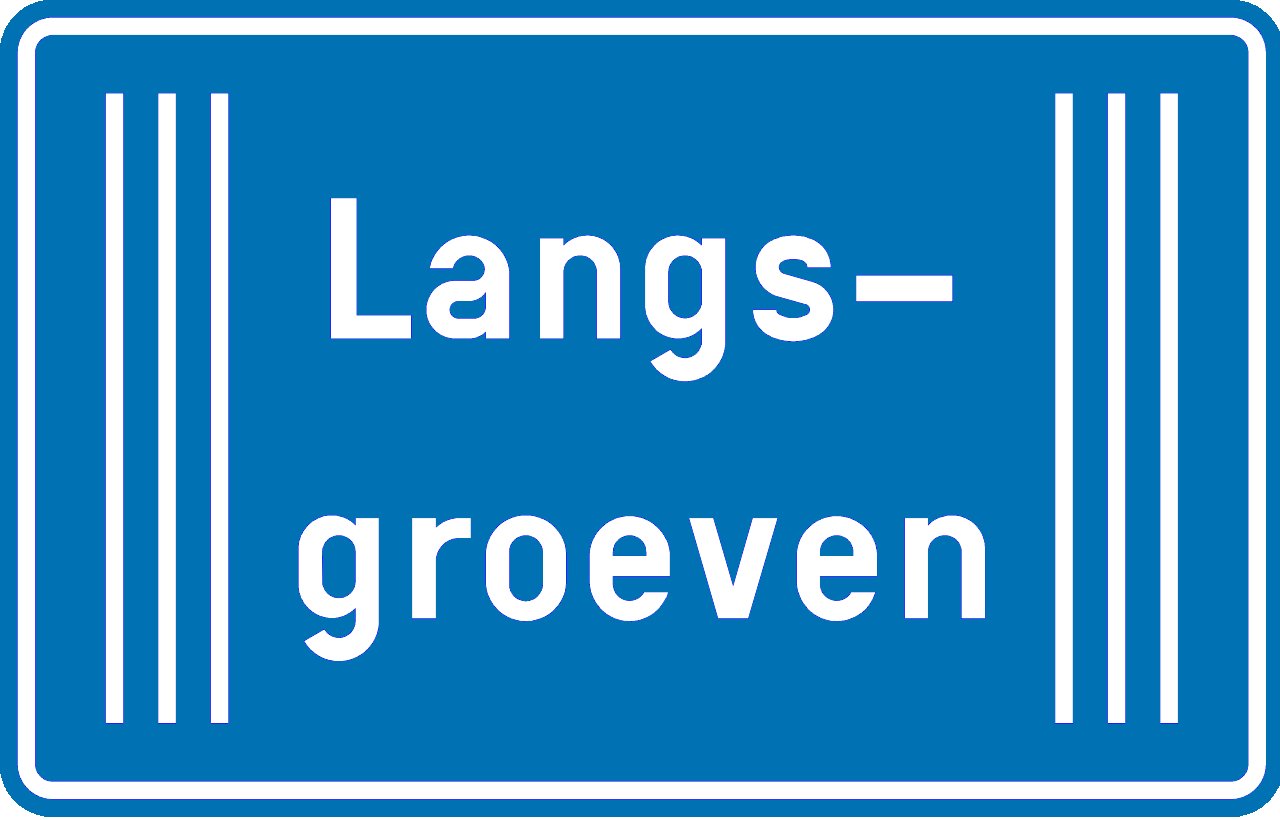
235. Grooves
This supplementary sign warns of grooves or ridges in the road surface that may affect vehicle handling.
236. Soft verge
This supplementary sign warns that the verge beside the roadway is soft or unstable.

237. Ruts
This supplementary sign warns of ruts or longitudinal depressions in the road surface.

238. Fog
This supplementary sign warns that fog may reduce visibility on the road section ahead.

239. Ice
This supplementary sign warns that the road surface may be icy.

Panonceau utilisé avec le signal A15 pour indiquer dans quelles circonstances la chaussée est glissante.
Onderbord gebruikt samen met A15 om te duiden in welke omstandigheden de weg glibberig is.
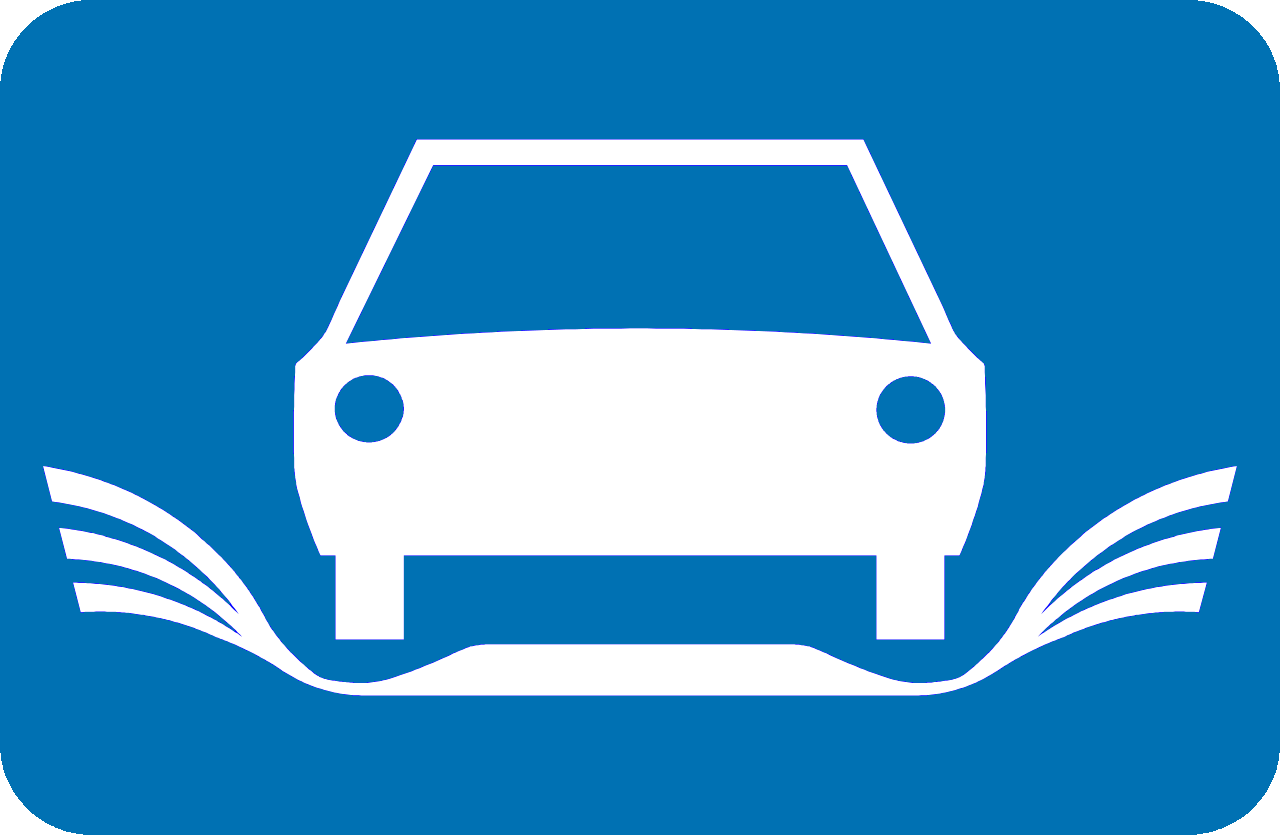
240. Aquaplaning
This supplementary sign warns of a risk of aquaplaning, where tyres lose contact with the road surface because of water.
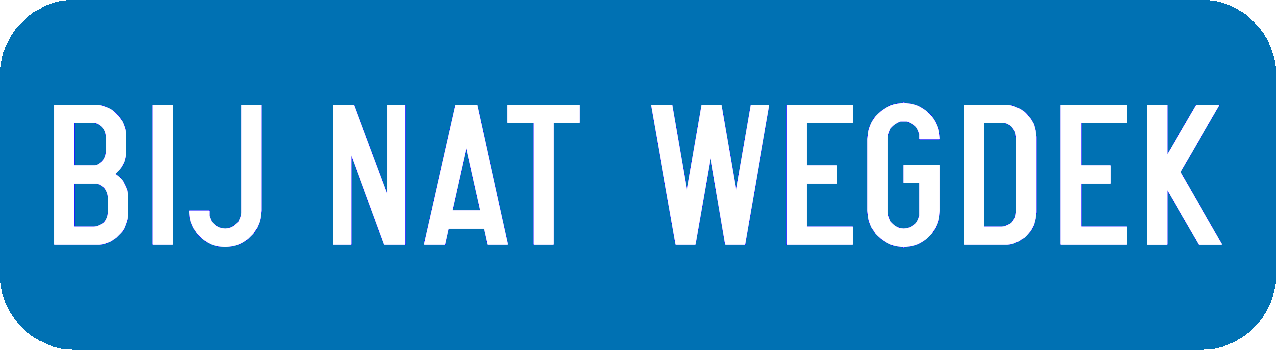
241. Wet
This supplementary sign warns that the road surface may be wet and slippery.
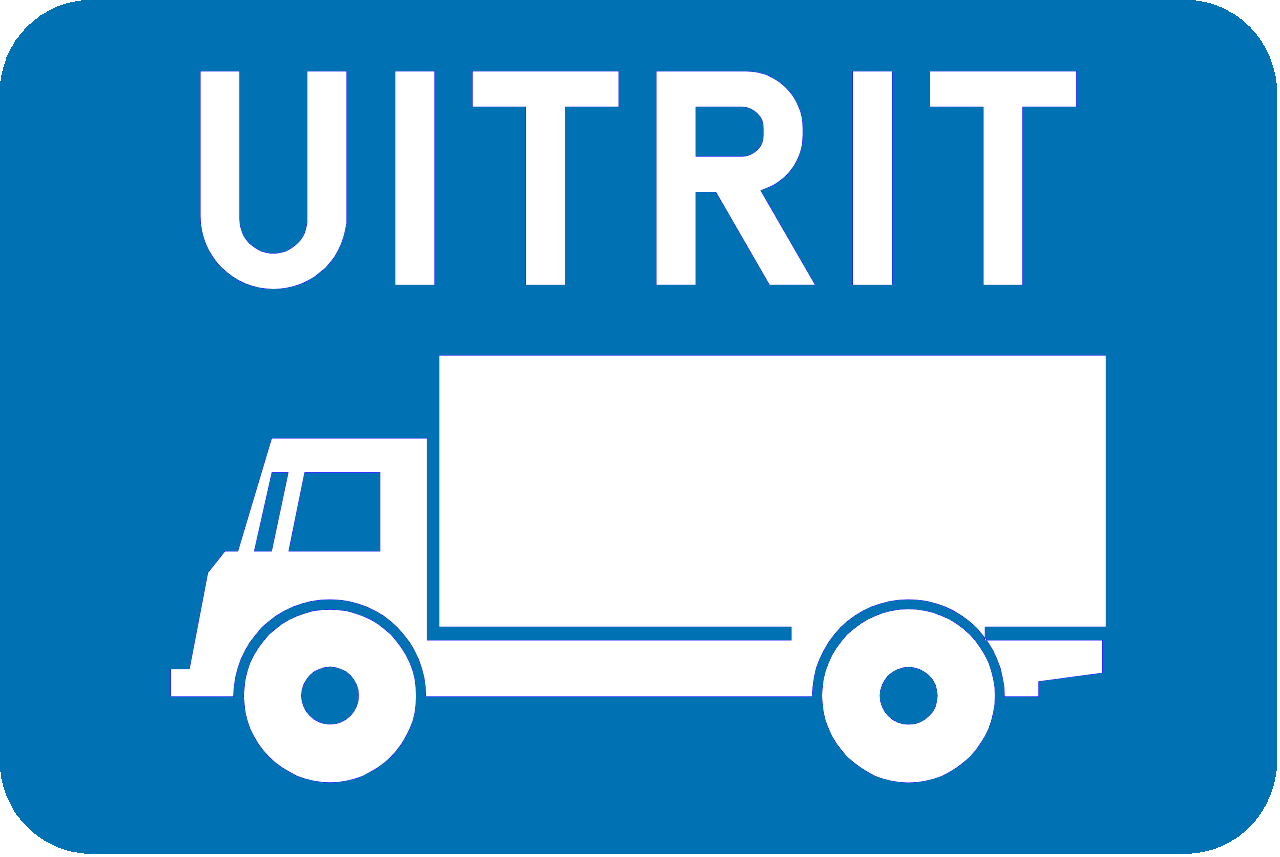
242. Truck exit
This supplementary sign warns of an exit used by trucks or other heavy vehicles.
243. Industrial area
This supplementary sign indicates that the main traffic sign applies in or near an industrial area.

244. Tunnel category B
This supplementary sign indicates that the main traffic sign applies to vehicles carrying dangerous goods for which access to category B road tunnels is prohibited under ADR.
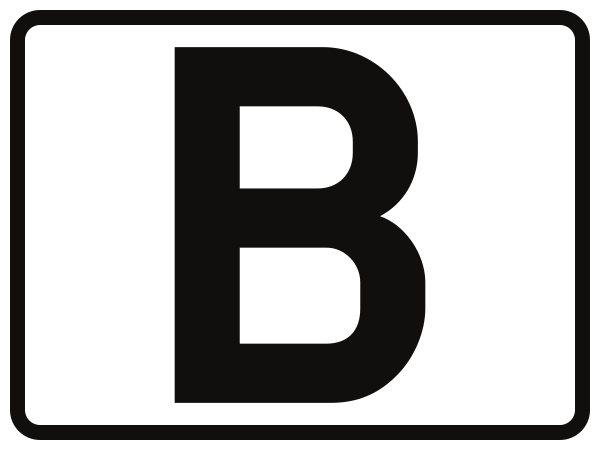
Verkeersbord M69 • Een onderbord met vermelding van de letter B, C, D of E duidt aan dat het verkeersbord geldt voor alle voertuigen die gevaarlijke goederen vervoeren waarvoor de toegang tot wegtunnels van respectievelijk categorie B, C, D of E verboden is, zoals deze categorieën voorzien zijn in artikel 1.9.5.2 van bijlage A van het Europees verdrag betreffende het internationaal vervoer van gevaarlijke goederen over de weg (ADR), ondertekend te Genève op 30 september 1957.
245. Tunnel category C
This supplementary sign indicates that the main traffic sign applies to vehicles carrying dangerous goods for which access to category C road tunnels is prohibited under ADR.
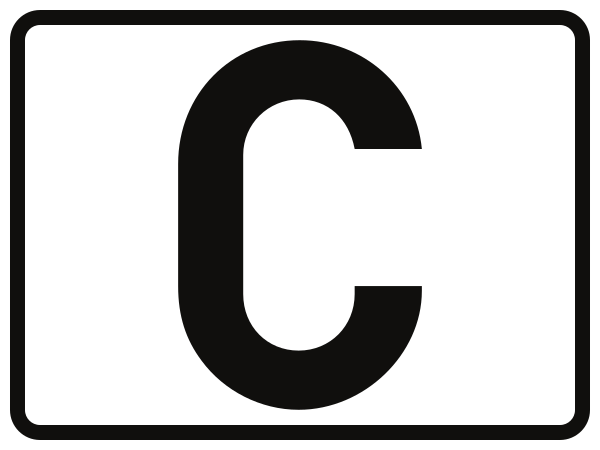
Verkeersbord M69 • Een onderbord met vermelding van de letter B, C, D of E duidt aan dat het verkeersbord geldt voor alle voertuigen die gevaarlijke goederen vervoeren waarvoor de toegang tot wegtunnels van respectievelijk categorie B, C, D of E verboden is, zoals deze categorieën voorzien zijn in artikel 1.9.5.2 van bijlage A van het Europees verdrag betreffende het internationaal vervoer van gevaarlijke goederen over de weg (ADR), ondertekend te Genève op 30 september 1957.
246. Tunnel category D
This supplementary sign indicates that the main traffic sign applies to vehicles carrying dangerous goods for which access to category D road tunnels is prohibited under ADR.
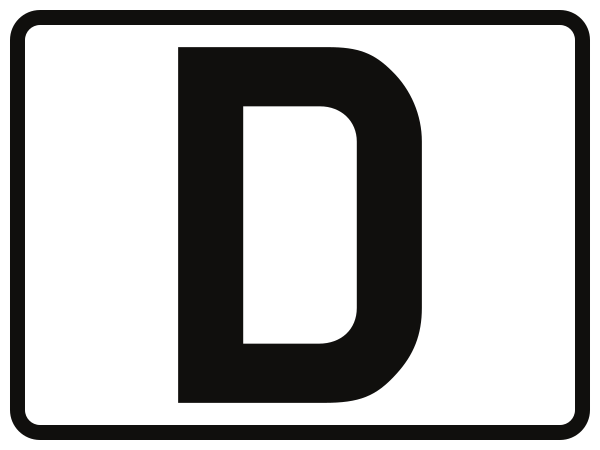
Verkeersbord M69 • Een onderbord met vermelding van de letter B, C, D of E duidt aan dat het verkeersbord geldt voor alle voertuigen die gevaarlijke goederen vervoeren waarvoor de toegang tot wegtunnels van respectievelijk categorie B, C, D of E verboden is, zoals deze categorieën voorzien zijn in artikel 1.9.5.2 van bijlage A van het Europees verdrag betreffende het internationaal vervoer van gevaarlijke goederen over de weg (ADR), ondertekend te Genève op 30 september 1957.
247. Tunnel category E
This supplementary sign indicates that the main traffic sign applies to vehicles carrying dangerous goods for which access to category E road tunnels is prohibited under ADR.
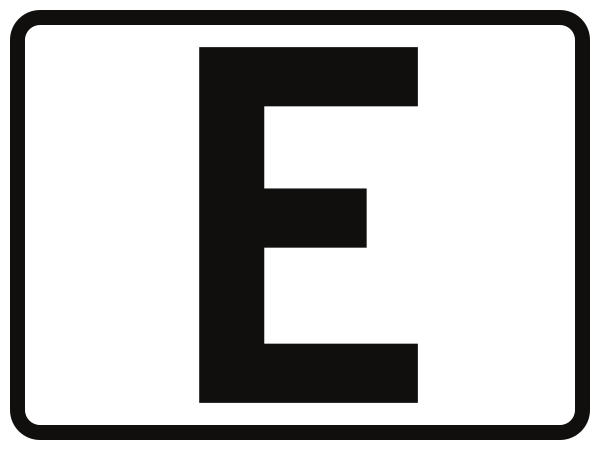
Verkeersbord M69 • Een onderbord met vermelding van de letter B, C, D of E duidt aan dat het verkeersbord geldt voor alle voertuigen die gevaarlijke goederen vervoeren waarvoor de toegang tot wegtunnels van respectievelijk categorie B, C, D of E verboden is, zoals deze categorieën voorzien zijn in artikel 1.9.5.2 van bijlage A van het Europees verdrag betreffende het internationaal vervoer van gevaarlijke goederen over de weg (ADR), ondertekend te Genève op 30 september 1957.
