

Traffic signsFlanders
 Traffic rules
 Flanders
176. Traction control system
Traction Control System (TCS) is an active safety system that helps prevent the driven wheels from spinning excessively during acceleration. When the system detects loss of traction, it can reduce engine power, apply braking to one or more wheels or use a combination of both.
Traction control is particularly useful when accelerating on wet, icy, snowy or loose surfaces. It helps the vehicle use the available tyre grip more effectively but cannot create grip where little or none is available.

Wikimedia.org • Chris828 • CC0
What does traction control do on a vehicle in Belgium?
Traction control helps prevent excessive wheel spin when accelerating. If a driven wheel begins to lose grip, the system can reduce engine power or apply braking to help restore traction.
What does it mean when the traction-control light flashes?
A flashing traction-control indicator generally means that the system is actively intervening because one or more driven wheels are losing grip. The driver should accelerate smoothly and adapt speed to the road conditions.
Does traction control make slippery roads safe?
No. Traction control can only work with the grip available between the tyres and the road. Drivers must still reduce speed, accelerate gently and maintain appropriate distances on wet, snowy or icy roads.

177. Helmet
A helmet is protective headgear designed to reduce the risk and severity of head injuries during a collision or fall. Different types of helmets are designed for motorcycles, mopeds, bicycles and other activities and may be subject to specific safety standards.
Whether wearing a helmet is compulsory depends on the country, vehicle category, rider and sometimes age. A helmet should be suitable for its intended use, correctly fitted and securely worn so that it can provide the protection for which it was designed.

Wikimedia.org • Stefania Anghelea • CC BY-SA
Must motorcyclists wear a helmet in Belgium?
Yes. Motorcycle riders and passengers must wear an approved protective helmet, subject to limited exceptions for vehicles with a passenger compartment and appropriate restraint systems.
Must moped riders wear a helmet in Belgium?
Yes. Riders and passengers of mopeds without a passenger compartment must wear a protective helmet. This applies to both class A and class B mopeds.
Must speed-pedelec riders wear a helmet in Belgium?
Yes. Both the rider and passenger of a speed pedelec must wear either a moped helmet or an appropriate bicycle helmet.
What bicycle helmet may be used on a Belgian speed pedelec?
A bicycle helmet used on a speed pedelec must satisfy the applicable approval requirements and provide additional protection to the temples and the back of the head. Belgian federal guidance specifies an EN 1078-approved bicycle helmet with this additional protection.
Is a helmet compulsory on an ordinary bicycle in Belgium?
No. There is currently no general Belgian requirement for riders of ordinary bicycles to wear a helmet, although wearing one is recommended for additional protection.
Is a helmet compulsory on an ordinary electric bicycle?
No for an ordinary electrically assisted bicycle that remains legally classified as a bicycle. The helmet requirement changes when the vehicle is legally classified as a speed pedelec or another category for which helmets are compulsory.
Is a helmet compulsory on a motorised bicycle limited to 25 km/h?
No general helmet requirement applies when the vehicle remains within the Belgian motorised-cycle category. This should not be confused with a speed pedelec, for which a helmet is compulsory.
Must a motorcycle passenger wear a helmet in Belgium?
Yes. The helmet requirement applies to both the driver and passenger of a motorcycle, subject only to the specific legal exceptions for certain vehicles with a passenger compartment and restraint system.
Must a moped passenger wear a helmet in Belgium?
Yes. A passenger on a moped without a passenger compartment must wear a protective helmet just like the driver.
Can you wear a bicycle helmet on an ordinary Belgian motorcycle?
No. An ordinary motorcycle requires the appropriate approved protective helmet. The special option to use a qualifying bicycle helmet applies to speed pedelecs, not ordinary motorcycles.
Does wearing a helmet satisfy all Belgian motorcycle clothing requirements?
No. Motorcycle riders and passengers must additionally wear gloves, a long-sleeved jacket, long trousers or an overall and boots or ankle boots that protect the ankles.
Do motorised three- and four-wheelers require helmets in Belgium?
Riders and passengers of motorised three- and four-wheelers without a passenger compartment generally have to wear a protective helmet. Belgian law provides specific exceptions for certain agricultural vehicles and particular vehicles using approved restraint systems.
178. Bicycle helmet
Abicycle helmet is protective headgear designed to reduce the risk and severity of head injuries if a cyclist falls or is involved in a collision. It normally consists of an impact-absorbing liner, an outer shell and a retention strap that keeps the helmet securely on the head.
A bicycle helmet should fit correctly, sit level on the head and be securely fastened. A damaged helmet should be replaced because its protective performance may have been reduced even when the damage is not immediately visible.

Wikimedia.org • Ildar Sagdejev • CC BY-SA
Is a bicycle helmet compulsory for ordinary cyclists in Belgium?
No. Cyclists using an ordinary bicycle or standard electric bicycle are not generally required to wear a bicycle helmet in Belgium, although wearing one is strongly recommended for additional head protection.
Is a helmet compulsory on a speed pedelec in Belgium?
Yes. Drivers and passengers of speed pedelecs must wear either a moped helmet or a suitable bicycle helmet. A bicycle helmet used for this purpose must comply with the applicable standard and protect the temples and the back of the head.
Does a normal bicycle helmet automatically qualify for use on a Belgian speed pedelec?
No. When a bicycle helmet is used instead of a moped helmet on a speed pedelec, it must meet the required approval standard and provide protection for the temples and the back of the head.
179. Hands-free
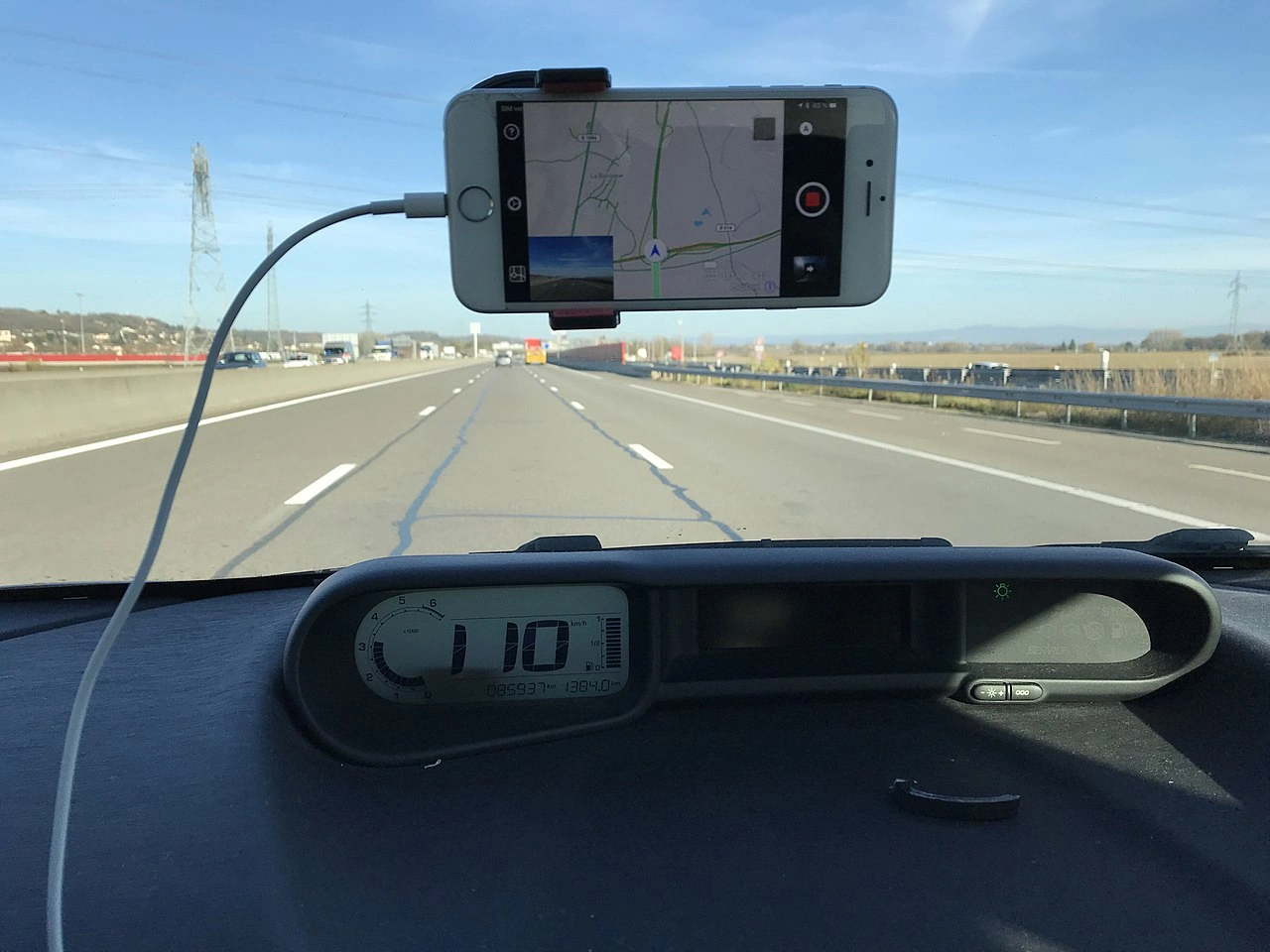
Hands-free refers to using a telephone or communication system without holding the device in the hand. Hands-free operation can use the vehicle's built-in system, a headset, earphones, voice control or a phone secured in an appropriate holder.
Hands-free operation reduces the need to physically handle a device, but a conversation or interaction can still distract the driver. Drivers should therefore minimise device use and keep their attention on the road.
Wikimedia.org • Benoît Prieur • CC0
Is hands-free calling allowed while driving in Belgium?
Yes. Hands-free calling is allowed provided the driver does not hold or improperly use the phone. For example, calling through earphones is permitted when the phone is not held in the hand.
Can you use a phone mounted in a holder while driving in Belgium?
Yes. A mobile electronic device with a screen may be used when it is properly secured in a holder designed for that purpose. However, interacting with the screen can still distract the driver and should be kept to a minimum.
Is using speakerphone while holding the phone considered hands-free in Belgium?
No. Holding the phone remains prohibited even when the loudspeaker or another hands-free function is active. A phone resting on the driver's lap or held between the shoulder and ear is also prohibited.
180. Smartphone
A smartphone is a mobile electronic device that combines telephone, messaging, internet, navigation, camera and application functions. When used in traffic, a smartphone can provide useful functions such as navigation or hands-free communication but can also create significant visual, manual and mental distraction.
Drivers should avoid handling or looking at a smartphone while driving. Where its use is permitted, the device should be positioned and operated in accordance with local traffic rules and without interfering with safe control of the vehicle.

Wikimedia.org • D'Vaughn Bell • CC BY-SA
Can you hold a smartphone while driving in Belgium?
No. While driving, you may not use, hold or manipulate a smartphone unless it is secured in a holder designed for that purpose. Holding it in your hand, placing it on your lap or otherwise handling it while driving is prohibited.
Can you use a mounted smartphone for navigation in Belgium?
Yes. A smartphone may be used when it is properly secured in a holder designed for that purpose. The driver must nevertheless remain attentive and should minimise interaction with the device while driving.
Does the Belgian smartphone rule also apply while waiting in traffic?
Yes. The exception applies when the vehicle is legally stopped or parked, not simply because it is temporarily motionless in normal traffic. Drivers should therefore not handle a smartphone while waiting in a traffic queue or at traffic controls unless the legal conditions for being stopped or parked are met.
181. GPS
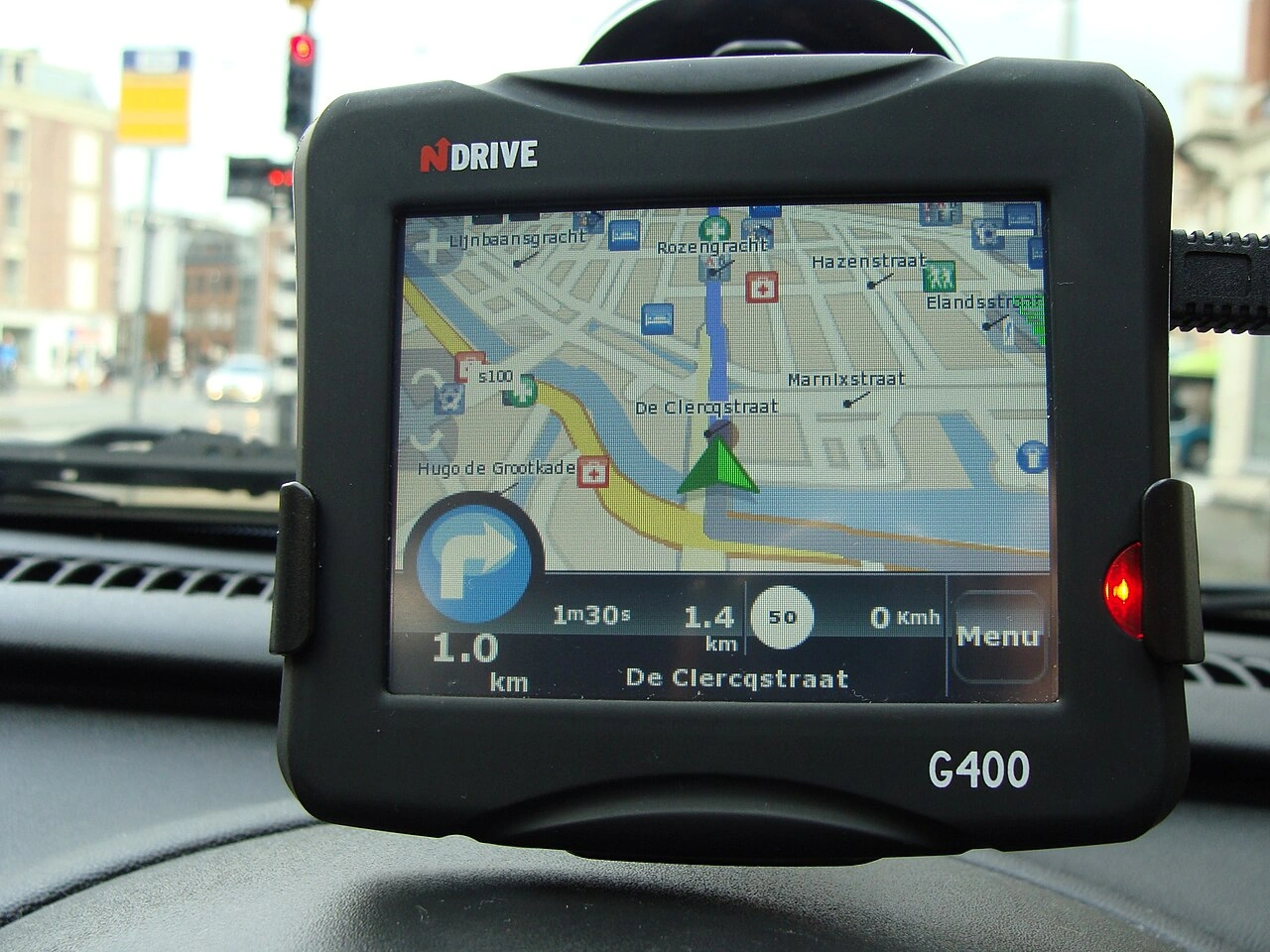
GPS (Global Positioning System) is a satellite-based positioning and navigation system that allows a compatible device to determine its location. In vehicles, GPS navigation can combine positioning information with digital maps to calculate routes and provide visual or spoken directions.
Drivers should preferably set their destination before starting the journey and avoid unnecessary interaction with the navigation system while driving. GPS directions are advisory and should never be followed when they conflict with traffic signs, road rules or actual road conditions.
Wikimedia.org • ines s. • CC BY
Can you use GPS navigation while driving in Belgium?
Yes. GPS navigation may be used while driving, but a mobile navigation device or smartphone with a screen must be properly secured in a holder designed for that purpose when the rules for mobile electronic devices apply.
Can you hold a smartphone to use GPS navigation in Belgium?
No. A driver may not hold or manipulate a smartphone while driving. When a smartphone is used for navigation, it must be secured in an appropriate holder.
Can you operate a mounted GPS or smartphone while driving in Belgium?
Using the screen of a device that is correctly secured in an appropriate holder is not specifically prohibited by the mobile-device rule, but it is strongly discouraged because looking at or operating the screen can distract the driver. Destinations and major route changes should preferably be entered before driving or while safely stopped.
182. Brake
A brake is a vehicle system used to reduce speed, bring the vehicle to a stop or keep it stationary. Most road vehicles use friction brakes at the wheels, while electric and hybrid vehicles may also use regenerative braking to recover energy while slowing down.
The braking system must remain in good working condition. Worn brake components, overheating, mechanical faults or reduced tyre grip can increase braking distance and reduce the driver's ability to control the vehicle safely.

Wikimedia.org • Andrea Volpato • CC BY-SA
What braking systems are required on vehicles in Belgium?
Belgian technical regulations distinguish between a service braking system for normal braking, an emergency braking system that can stop the vehicle if part of the normal system fails, and a parking braking system that keeps the vehicle stationary.
Must the normal brakes operate on all axles in Belgium?
For vehicles covered by the applicable technical requirements, the service braking system must operate on all axles and its braking action must be appropriately distributed between the axles and symmetrically between the wheels of the same axle.
Are brakes checked during Belgian technical inspection?
Yes. Braking systems are part of vehicle roadworthiness requirements and can be checked during technical inspection. Defective or insufficient braking performance can therefore result in a defect being recorded.
183. Handbrake
A handbrake, commonly called the parking brake, is a braking system used to keep a stationary vehicle from moving after it has been parked. Traditional systems use a hand-operated lever, while modern vehicles may use a foot-operated or electronic parking brake.
The parking brake should be applied securely whenever the vehicle is parked, particularly on a slope. It operates separately from the normal service brake so that the vehicle can remain stationary even when the driver is absent.
Wikimedia.org • CC BY-SA
What is the purpose of the handbrake in Belgium?
The handbrake or parking brake is used to keep a parked vehicle securely stationary. It must be capable of holding the vehicle on both an uphill and downhill gradient, even when the driver is no longer in the vehicle.
Does a Belgian car need a traditional hand-operated handbrake?
No. The legal requirement concerns the parking-brake function rather than a traditional hand lever. A vehicle may therefore use another approved system, such as an electronic parking brake.
How strong must a parking brake be in Belgium?
For vehicles covered by the applicable technical requirements, the parking brake must be capable of holding the loaded vehicle stationary on an uphill or downhill gradient of 18%.
184. Brake fluid
Brake fluid is a hydraulic fluid used in many vehicle braking systems to transmit force from the brake pedal through the hydraulic system to the brakes at the wheels. It must withstand high temperatures and maintain suitable hydraulic properties for reliable braking.
The brake-fluid level and condition should be checked according to the vehicle manufacturer's instructions. Only the specified type of brake fluid should be used, because incompatible or contaminated fluid can impair braking-system performance.

Wikimedia.org • Frettie • CC BY
Is brake fluid important for the Belgian technical inspection?
Yes. The braking system is checked during technical inspection, and problems with the brake fluid can be treated as defects. The fluid should therefore be at the correct level and in suitable condition.
What happens if brake fluid is too low in Belgium?
An insufficient brake-fluid level can indicate a problem with the braking system and should not be ignored. The cause should be investigated and repaired rather than simply repeatedly adding fluid.
Should Belgian drivers know where the brake-fluid reservoir is?
Yes. Drivers should know how to locate the brake-fluid reservoir or the vehicle's electronic brake-fluid level indication. During the Belgian category B practical driving examination, candidates may be asked to identify where the brake-fluid level is checked.
185. Tyres
Tyres are the rubber components fitted around a vehicle's wheels that provide contact with the road. They transmit braking, acceleration and steering forces and play an important role in vehicle stability and road holding.
Tyres should have sufficient tread depth, correct pressure and no serious damage or excessive wear. Drivers should use tyres that are suitable for the vehicle and regularly check their condition, particularly before long journeys or driving in difficult weather.

Wikimedia.org • Ambiguous • CC BY
What is the minimum tyre tread depth in Belgium?
For cars, the principal tread grooves must be at least 1.6 mm deep. The principal grooves are the broad grooves in the central part of the tread covering approximately three quarters of its width.
Are tyres checked during Belgian technical inspection?
Yes. Tyres are checked as part of the vehicle's wheels, tyres and suspension inspection. Checks include tread wear, damage and whether the tyres meet the applicable technical requirements.
Must tyres on the same axle match in Belgium?
During technical inspection, tyres on the same axle must have the same dimensions and the same construction type, such as radial or diagonal. Using matching tyres on the same axle is also recommended for predictable handling.
186. Tyre code
A tyre code is the series of letters and numbers marked on a tyre's sidewall that identifies important characteristics such as tyre width, aspect ratio, construction, wheel diameter, load capacity and speed rating. A typical example is 205/55 R16 91V.
Drivers should use tyres whose specifications are suitable for the vehicle. The required tyre sizes and ratings can normally be found in the vehicle handbook, certificate of conformity or other manufacturer information.

Wikimedia.org • F l a n k e r • CC BY
What tyre-code information is important in Belgium?
Important markings include the tyre size, construction type, load index and speed rating. These characteristics must be suitable for the vehicle and its approved technical specifications.
Are tyre codes checked during technical inspection in Belgium?
Yes. Tyre characteristics are part of the technical inspection. Depending on the applicable requirements, inspectors can check characteristics such as tyre size, construction, load capacity, approval marking and speed category.
Must tyres on the same axle have matching specifications in Belgium?
Yes. During technical inspection, tyres on the same axle must have compatible specifications. In particular, their dimensions and construction type must match according to the applicable inspection requirements.
187. Winter tyres
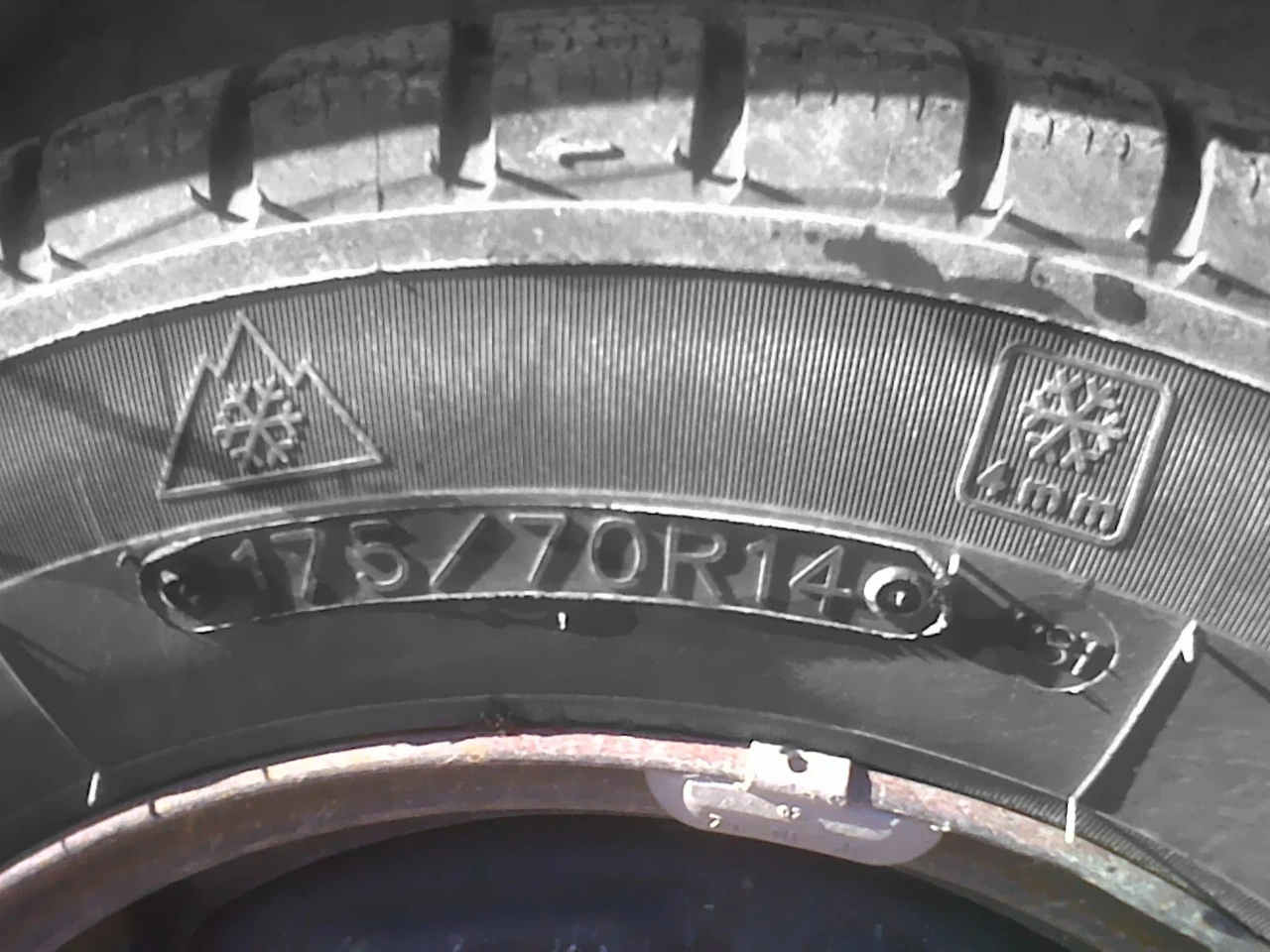
Winter tyres are tyres designed to provide improved traction and braking performance in cold weather, snow and other winter conditions. Their tread pattern and rubber compound are designed to remain effective at lower temperatures and provide better grip than ordinary summer tyres in appropriate winter conditions.
Winter tyres can be identified by markings on the sidewall. The 3PMSF symbol, showing a snowflake inside a three-peaked mountain, indicates that the tyre has met specified performance requirements for severe snow conditions.
Wikimedia.org • A7N8X • CC BY-SA
Are winter tyres compulsory in Belgium?
No. Belgium does not currently impose a general requirement for passenger cars to use winter tyres during the winter months. Drivers may nevertheless choose them for improved performance in cold, snowy or icy conditions.
What minimum tread depth applies to winter tyres in Belgium?
The normal legal minimum tread depth for passenger-car tyres also applies to winter tyres: the principal tread grooves must be at least 1.6 mm deep. For effective winter performance, replacing tyres before they reach the legal minimum may be advisable.
Should Belgian drivers check winter-tyre rules before travelling abroad?
Yes. Several countries bordering or near Belgium impose winter-tyre requirements under certain conditions or during specified periods. Drivers should therefore check the rules for every country they intend to enter before travelling.
188. Tyre pressure
Tyre pressure is the amount of air pressure inside a vehicle's tyre. Correct tyre pressure helps the tyre maintain its intended shape and contact with the road and is important for handling, braking, tyre wear and fuel consumption.
Tyre pressure should be checked regularly and adjusted to the pressure specified by the vehicle manufacturer. The recommended pressure can vary according to the vehicle, tyre size and load, and the front and rear tyres may require different pressures.
Wikimedia.org • JEG14 • CC0
How often should tyre pressure be checked in Belgium?
Belgian federal mobility guidance recommends checking tyre pressure at least once a month because tyres naturally lose air over time.
Which tyre pressure should you use in Belgium?
Use the pressure prescribed by the vehicle manufacturer. The correct pressure can differ between vehicles and may also vary according to tyre size, axle and vehicle load.
Why should Belgian drivers maintain correct tyre pressure?
Correct tyre pressure supports safe and predictable vehicle behaviour and helps limit unnecessary tyre wear and fuel consumption. An underinflated or otherwise incorrectly inflated tyre should be adjusted to the manufacturer's specified pressure.
189. Snow chains
Snow chains are traction devices fitted around vehicle tyres to improve grip on roads covered with snow or ice. They are especially useful on steep or mountainous roads where ordinary tyres may not provide sufficient traction.
Snow chains should be fitted according to the vehicle and chain manufacturer's instructions, normally on the driven wheels. They should be removed when they are no longer needed because driving with chains on clear roads can damage the tyres, chains and road surface.

Wikimedia.org • Domitori • CC BY-SA
Are snow chains compulsory in Belgium?
No general Belgian rule requires passenger cars to carry or use snow chains. They are optional equipment intended for appropriate winter conditions.
When may snow chains be used in Belgium?
Snow chains may only be used when there is snow or ice. They should therefore be removed when road conditions no longer justify their use.
Should Belgian drivers carry snow chains when travelling abroad?
It may be necessary. Several European countries have their own winter-equipment rules, and snow chains can be compulsory on particular roads or in certain weather conditions. Drivers should check the requirements for every country on their route.
190. Bicycle tyre
A bicycle tyre is the rubber tyre fitted around a bicycle wheel and provides contact between the bicycle and the road or other riding surface. Its tread, pressure, width and construction affect grip, rolling resistance, comfort and handling.
Bicycle tyres should be properly inflated and regularly checked for wear, cuts, cracks, embedded objects or other damage. The appropriate tyre type and pressure depend on the bicycle, rider, load and riding conditions.

Wikimedia.org • Ivan Radic • CC BY
Is there a minimum tread depth for bicycle tyres in Belgium?
The current Belgian rules for bicycle equipment do not specify a general numerical minimum tread depth for ordinary bicycle tyres. Cyclists should nevertheless replace tyres that are excessively worn or damaged because their condition directly affects grip and safety.
Can Belgian bicycle tyres provide the required side reflectors?
Yes. A bicycle can satisfy the side-reflector requirement by having a continuous white retro-reflective strip on each side of both the front and rear tyre. Alternatively, suitable yellow or orange reflectors can be fitted to the spokes.
Does tyre width affect how some bicycles are classified in Belgium?
Yes. Tyre dimensions form part of the definitions used for certain bicycle categories. For example, a racing bicycle can have tyres with a cross-section of no more than 25 mm, while specified mountain-bike categories use wider minimum tyre sections.
191. Continuous track
Continuous track is a vehicle propulsion system in which a continuous belt or chain runs around a series of wheels or rollers instead of the vehicle travelling on conventional road wheels. It is commonly used on construction machinery, agricultural vehicles, military vehicles and other machines that need good traction on soft or uneven ground.
Continuous tracks spread the vehicle's weight over a relatively large contact area, which can improve traction and reduce ground pressure. Tracks may be made from metal, rubber or a combination of materials, and their suitability for use on public roads depends on the vehicle and applicable regulations.

Wikimedia.org • Ingolfson • CC0
Are tracked vehicles recognised in Belgium?
Yes. Belgian vehicle rules recognise certain vehicles equipped with continuous tracks. Agricultural and forestry tractors, for example, can be constructed with wheels or tracks.
Can a tracked vehicle use a public road in Belgium?
It can when the vehicle satisfies the applicable registration, approval, technical and road-use requirements. The exact conditions depend on the vehicle type, its use and its technical characteristics.
Does a tracked agricultural vehicle automatically fall under driving-licence category G in Belgium?
No. Category G depends on the vehicle being an agricultural or forestry tractor used for agricultural or forestry activities. When the same vehicle is used for another activity, the appropriate driving-licence category is determined according to the vehicle's characteristics rather than simply because it has tracks.
192. Gross Vehicle Weight
Gross Vehicle Weight (GVW) is the actual total weight of a vehicle at a particular moment, including the vehicle itself, driver, passengers, fuel, luggage and other cargo. It changes as people or goods are added or removed.
GVW should not be confused with Gross Vehicle Weight Rating (GVWR) or Maximum Authorised Mass (MAM), which is the maximum permitted total weight specified for the vehicle. The actual gross vehicle weight must not exceed that permitted maximum.
What is Gross Vehicle Weight called in Belgium?
Belgian regulations generally distinguish the vehicle's actual laden mass from its maximum authorised mass. The maximum authorised mass is commonly abbreviated as MTM in Dutch and MMA in French.
Is Gross Vehicle Weight the same as MTM in Belgium?
No. Gross Vehicle Weight refers to what the vehicle actually weighs when loaded at a particular moment. MTM is the maximum authorised mass that the vehicle is permitted to have when loaded.
Why does MTM matter for Belgian driving licences?
The maximum authorised mass is used to determine which driving-licence category is required. For example, category B normally covers passenger vehicles with an MTM of no more than 3500 kg, subject to the applicable passenger and trailer rules.
193. Gross Vehicle Weight Rating
Gross Vehicle Weight Rating (GVWR) is the maximum total weight at which a vehicle is designed or approved to operate when fully loaded. It includes the vehicle itself together with the driver, passengers, fuel, luggage, cargo and other equipment carried by the vehicle.
GVWR is a fixed maximum value and should not be confused with Gross Vehicle Weight (GVW), which is the vehicle's actual weight at a particular moment. The actual loaded weight of the vehicle must not exceed its permitted maximum.
What is the Belgian equivalent of GVWR?
The closest commonly used Belgian term is maximum authorised mass, abbreviated MTM in Dutch and MMA in French. It represents the maximum total mass at which the vehicle is authorised to operate.
Is MTM the same as the vehicle's actual weight?
No. MTM is a fixed maximum permitted mass. The vehicle's actual laden mass changes according to its passengers, cargo and other load and must remain within the applicable maximum.
Why is the maximum authorised mass important in Belgium?
It is used for matters such as vehicle classification and determining the required driving-licence category. For example, an ordinary category B licence generally covers a passenger vehicle with a maximum authorised mass of no more than 3500 kg.
194. Cargo
Cargo is the goods, materials, equipment or other items carried by a vehicle or trailer. Cargo can range from personal luggage and bicycles to commercial goods, machinery or bulk materials.
Cargo must be positioned and secured so that it cannot shift, fall from the vehicle, interfere with the driver's visibility or affect vehicle stability. The total load must also remain within the vehicle's permitted weight and axle-load limits.
How must cargo be carried in Belgium?
Cargo must be positioned and secured so that it cannot endanger the driver, passengers or other road users, fall or drag on the road, affect vehicle stability or obstruct the driver's visibility.
May cargo cover a vehicle's lights or number plate in Belgium?
No. Cargo must not make the vehicle's lights, reflectors or registration number invisible.
Must cargo-securing equipment be in good condition in Belgium?
Yes. Equipment used to secure or cover cargo, such as straps, chains, nets or tarpaulins, must be in good condition, used correctly and fitted closely enough to secure the load effectively.
195. Car body
A car body, also called bodywork, is the outer structure of a car that surrounds the passenger and luggage compartments and gives the vehicle its shape. It includes components such as the roof, doors, bonnet, boot lid, wings, body panels and, on many modern cars, load-bearing structural sections.
The car body helps protect occupants and supports components such as doors, windows, lights and bumpers. Damage, corrosion or poorly repaired structural sections can reduce the vehicle's safety and should be repaired correctly.

Wikimedia.org • Cjp24 • CC BY-SA
Is the car body checked during technical inspection in Belgium?
Vehicle structural condition forms part of roadworthiness inspection. In Flanders, the chassis is specifically included among the components examined during the technical inspection.
Can damaged bodywork cause a problem at a Belgian technical inspection?
Yes. Structural damage, dangerous looseness or defects affecting the safe attachment of vehicle components can result in a defect being recorded. Cosmetic damage that does not affect safety is different from damage affecting the vehicle's structure or secure assembly.
Is the car body always separate from the chassis?
No. Many modern passenger cars have a self-supporting body in which the body structure itself carries much of the vehicle's load. Other vehicles can have a separate chassis with the body mounted on it.
196. Trunk
A trunk, also called a boot or luggage compartment, is the enclosed storage area of a car used for carrying luggage, tools, shopping and other cargo. It is usually located at the rear of the vehicle, although some vehicles have a front storage compartment.
Items carried in the trunk should be positioned securely so that they cannot shift dangerously during braking, acceleration or cornering. Heavy objects should be placed carefully and the vehicle's permitted load and axle limits must not be exceeded.

Wikimedia.org • Atomic Taco • CC BY-SA
Can luggage be carried in the trunk of a car in Belgium?
Yes. The trunk is the normal place for carrying luggage and other cargo, provided the load is arranged safely and the vehicle's permitted weight limits are respected.
Must cargo in a Belgian car trunk be secured?
Cargo must be arranged so that under normal road conditions it cannot create danger, fall from the vehicle, affect vehicle stability or interfere with the driver's visibility. Heavy or movable items should therefore be positioned and secured appropriately.
Can cargo extending from an open trunk hide the number plate or lights in Belgium?
No. A vehicle's load must not make its lights, reflectors or registration number invisible. Projecting loads must also comply with the applicable rules concerning dimensions and marking.
197. Roof rack
A roof rack is a load-carrying system attached to the roof of a vehicle. It can be used to transport items such as luggage, bicycles, skis, surfboards or a roof box when they cannot conveniently be carried inside the vehicle.
A roof rack and its cargo must be securely attached and must remain within the vehicle manufacturer's permitted roof-load limit. Roof-mounted loads raise the vehicle's centre of gravity and can affect handling, stability, fuel consumption and overall vehicle height.
Wikimedia.org • Matti Blume • CC BY-SA
Is a roof rack allowed on a car in Belgium?
Yes. A roof rack may be used provided it is suitable for the vehicle, securely fitted and the load complies with the applicable rules concerning securing, weight and vehicle dimensions.
How high may a car with a roof load be in Belgium?
The total height of a loaded vehicle may generally not exceed 4 metres. Objects carried on a roof rack or in a roof box count towards this overall loaded height.
How must a roof-rack load be secured in Belgium?
The load must be secured so that it cannot fall, drag, endanger other road users, affect vehicle stability or obstruct required lights or the registration number. Drivers must also respect the vehicle and roof rack manufacturer's permitted load limits.
198. Windscreen
A windscreen, also called a windshield, is the transparent front window of a vehicle through which the driver views the road ahead. It also helps protect occupants from wind, rain, debris and other external elements.
The windscreen must provide the driver with a clear and sufficiently undistorted view. Cracks, chips, dirt, stickers or other objects can reduce visibility, particularly when they are located within the area swept by the windscreen wipers.
Wikimedia.org • Vcx • CC BY-SA
Is the windscreen checked during technical inspection in Belgium?
Yes. The windscreen is checked for damage, deterioration and anything that significantly obstructs the driver's view.
Can a cracked windscreen cause a vehicle to fail inspection in Belgium?
Yes. Certain cracks, deformation or discoloration can result in a negative inspection result, particularly when the damage lies within the area cleaned by the windscreen wipers or significantly affects visibility.
Can objects or stickers obstruct the windscreen in Belgium?
No object may significantly obstruct the driver's view forward or to the side. Legally required windscreen stickers are not treated as prohibited visibility obstructions simply because they are attached to the glass.
199. Emergency hammer
An emergency hammer is a safety tool designed to break certain vehicle windows when normal doors or exits cannot be used during an emergency. It is commonly found in buses, coaches and other passenger vehicles near windows designated as emergency exits.
An emergency hammer should only be used when evacuation through the normal exits is impossible or unsafe. The tool must remain accessible and, where provided for an emergency window, should be used according to the instructions displayed in the vehicle.

Wikimedia.org • Santeri Viinamäki • CC BY-SA
Is an emergency hammer compulsory in an ordinary car in Belgium?
No. An emergency hammer is not part of the standard compulsory safety equipment required for an ordinary passenger car. Specific requirements do apply to certain vehicles equipped with breakable emergency windows.
Do Belgian buses and coaches have emergency hammers?
Where an emergency window is designed to be opened by breaking the glass, an emergency hammer may be installed inside the vehicle immediately next to that emergency window. The window must be made from material that can be broken appropriately for this purpose.
Can an emergency hammer be required in a Belgian motorhome?
Yes. If the emergency exit from the living area of a motorhome can only be opened by breaking the glass, an emergency hammer must be fixed to the wall immediately beside that exit.
200. Car battery
A car battery is an electrical energy-storage device that supplies power to a vehicle's electrical system. In conventional petrol and diesel cars, the 12-volt starter battery provides the high current needed to start the engine and supplies electrical equipment when the engine or charging system is not providing enough power.
Car batteries gradually lose charge and capacity with age and use. A weak battery can cause slow or unsuccessful starting, electrical problems or warning messages, and the replacement battery should have specifications suitable for the vehicle.
Wikimedia.org • Filipograf • CC BY-SA
Is the car battery relevant to technical inspection in Belgium?
Yes. The battery and electrical system form part of vehicle roadworthiness. A battery that is insecure, improperly attached, leaking or presents a risk of short circuit can constitute a technical defect.
Does every Belgian car use the same type of battery?
No. The required battery depends on the vehicle's electrical system and equipment. Vehicles with start-stop systems commonly require batteries specifically designed for frequent charging and starting cycles, such as EFB or AGM types.
Should you replace a car battery with one of the correct specification?
Yes. The replacement battery should meet the vehicle manufacturer's requirements for characteristics such as voltage, capacity, starting performance, dimensions and battery technology.