Panneaux de signalisationBelgique

Apprenez les règles de circulation avec des explications claires et des exemples visuels dans notre livre illustré, simple et agréable à étudier.


51. Stationnement interdit

Stationnement interdit signifie que les véhicules ne peuvent pas être laissés en stationnement à l’endroit ou sur la section couverte par la restriction. Selon la loi locale, un conducteur peut encore être autorisé à s’arrêter brièvement pour faire monter ou descendre des passagers ou pour charger ou décharger des marchandises, à condition que l’arrêt lui-même ne soit pas interdit.

Une interdiction de stationner peut s’appliquer en permanence ou seulement à des horaires, jours, catégories de véhicules ou sections de route déterminés. Son étendue exacte et ses exceptions sont définies par le panneau, les panneaux additionnels, les marquages et la réglementation locale.

Stationnement interdit
Which sign means no parking in Belgium?

The Belgian E1 sign, a blue circular sign with a red border and a single red diagonal bar, means parking prohibited. It must not be confused with the E3 sign, which prohibits both stopping and parking.

Stationnement interdit. Stationnement interdit.

Signal routier E1 • Stationnement interdit.

Verkeersbord E1 • Parkeerverbod.

Arrêt et stationnement interdits. Arrêt et stationnement interdits.

Signal routier E3 • Arrêt et stationnement interdits.

Verkeersbord E3 • Stilstaan en parkeren verboden.

May you stop where an E1 no-parking sign applies?

Yes, if stopping is otherwise permitted. Under Belgian law, a vehicle that remains stationary only for the time necessary for passengers to get in or out or for goods to be loaded or unloaded is considered stopped rather than parked.

May you pick up or drop off passengers beside an E1 sign?

Yes, provided you remain there only for the time necessary for passengers to get in or out and stopping is not prohibited for another reason. Waiting for passengers beyond that necessary time constitutes parking.

May you load or unload goods beside an E1 sign?

Yes, genuine loading or unloading is considered stopping rather than parking when the vehicle remains stationary only for the time necessary to perform it. Other stopping prohibitions must still be respected.

Can you wait in the car beside an E1 sign?

Simply remaining behind the wheel does not make parking legal. If the vehicle stays stationary for longer than necessary for passengers to board or leave or for goods to be loaded or unloaded, it is considered parked.

May you refuel or charge a vehicle where parking is prohibited?

No, where the E1 prohibition applies. Belgian law specifically considers both refuelling and charging the battery of an electric or hybrid-electric vehicle to be parking.

How far does an E1 sign apply in Belgium?

An ordinary E1 sign applies on the side of the public road where it is placed, from the sign to the next intersection. Supplementary signs can indicate that the restriction begins or ends at another point or applies over a specified distance.

Does an E1 sign apply to the verge in Belgium?

Yes. The E1 parking prohibition normally applies to both the carriageway and the verge on the side where the sign is placed. Specific supplementary signs can also extend its effect to the pavement for the road-user categories indicated.

Can an E1 prohibition apply only during certain hours?

Yes. A supplementary inscription may specify the period during which the parking prohibition applies, such as particular hours or days. Outside that period, the E1 restriction does not apply, although other parking rules still do.

Can an E1 sign apply only to certain vehicles?

Yes. A supplementary inscription or authorised symbol may indicate the vehicle category to which the parking prohibition applies.

What do arrows below an E1 sign mean?

Supplementary arrow signs can indicate the beginning or end of the parking restriction. Another type of supplementary sign can indicate that the restriction applies over a stated distance or that the sign is repeating an existing restriction.

What does a zonal no-parking sign mean in Belgium?

A zonal parking prohibition applies throughout the entire area between the zone-entry and zone-exit signs. Unlike an ordinary E1 sign, it is not automatically terminated by each intersection. A specifically signposted different parking arrangement can apply at particular places within the zone.

52. Dépose-minute

Une zone de dépose-minute est un emplacement désigné où les conducteurs peuvent s’arrêter brièvement pour déposer ou prendre des passagers. Ces zones sont couramment aménagées près des écoles, gares, aéroports et autres destinations très fréquentées afin de permettre aux passagers de monter ou descendre sans occuper des places de stationnement ordinaires.

Une zone de dépose-minute est destinée aux arrêts très courts plutôt qu’à l’attente ou au stationnement. Les conducteurs ne doivent y rester que le temps nécessaire à la montée ou à la descente des passagers et doivent respecter les panneaux, limites de temps, marquages ou règlements locaux applicables.
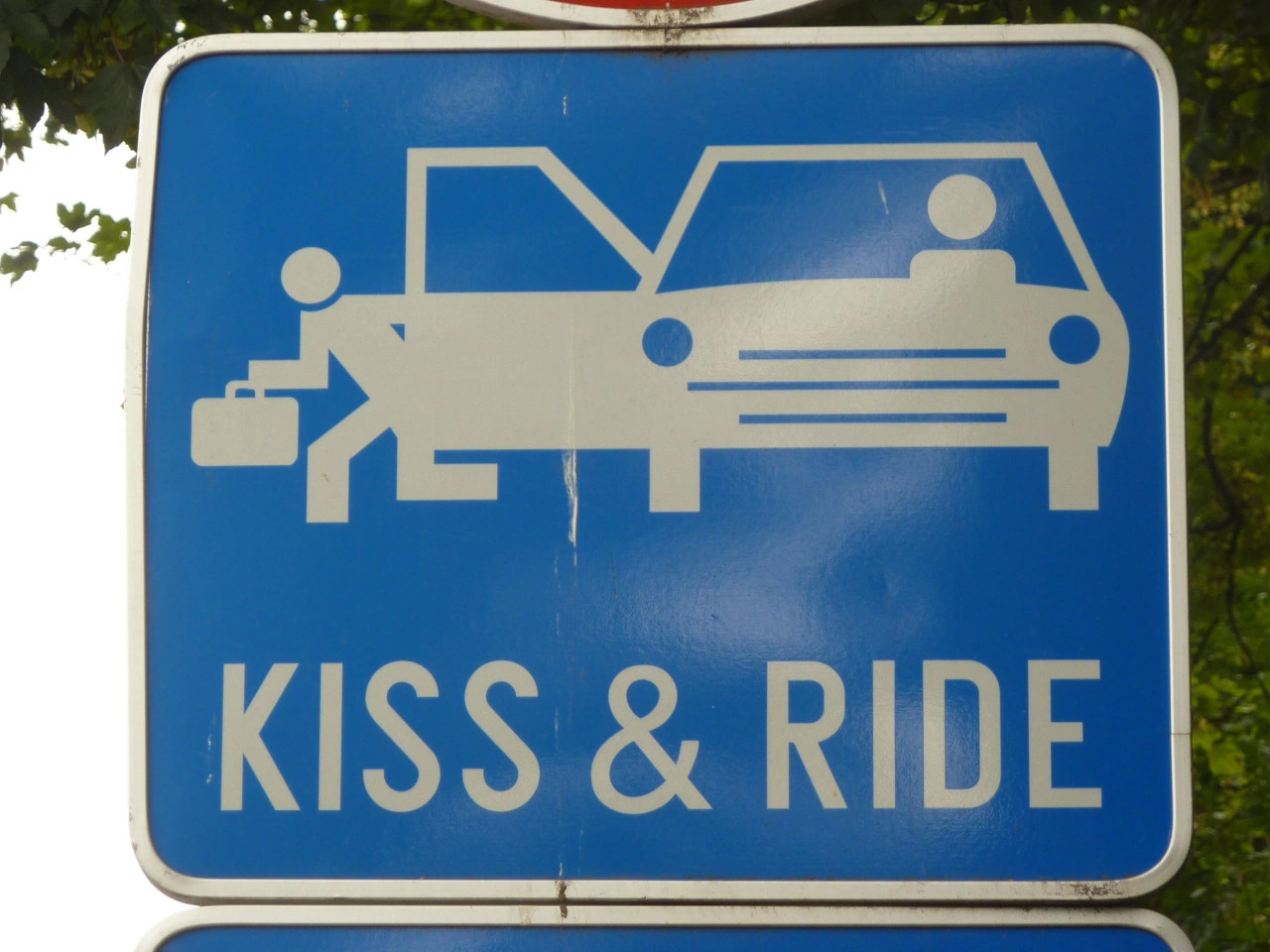
Dépose-minute
What is a Kiss and Ride zone in Belgium?

A Kiss and Ride zone is an area intended for drivers to stop briefly while passengers get into or out of the vehicle. Such areas are commonly used near schools, railway stations and other locations where many passengers are dropped off or collected.

Is Kiss and Ride an official Belgian traffic sign?

There is currently no dedicated national Kiss and Ride traffic sign with its own separate legal regime in the Belgian Road Code. The enforceable conditions at a particular Kiss and Ride area therefore depend on the official traffic signs, road markings and local regulations used to organise it.

May you park in a Belgian Kiss and Ride zone?

A Kiss and Ride zone is intended for passenger drop-off and pick-up rather than parking. If official signs prohibit or restrict parking, those rules must be followed. Drivers who need to remain longer should use a normal parking space.

When is dropping off a passenger considered stopping rather than parking in Belgium?

A vehicle is considered stopped when it remains stationary only for the time necessary for passengers to get in or out or for goods to be loaded or unloaded. Remaining stationary for longer than necessary is considered parking.

May you wait for your child in a Belgian Kiss and Ride zone?

You should not occupy the zone while waiting for a child who is not yet ready to enter the vehicle. Such waiting can constitute parking rather than stopping. Use an ordinary parking place and enter the Kiss and Ride area when the passenger is ready.

Should you remain behind the wheel in a Kiss and Ride zone?

Where possible, yes. Remaining ready to leave immediately helps keep the area available for other drivers. Belgian police guidance for school Kiss and Ride zones specifically recommends remaining behind the wheel where practical.

May you leave the car to accompany your child to school?

A Kiss and Ride zone is generally not intended for this purpose. If you need to leave the vehicle and accompany the child, use a suitable parking place instead so that the Kiss and Ride area remains available for immediate drop-off and pick-up.

How long may you stay in a Belgian Kiss and Ride zone?

There is no single nationwide Kiss and Ride time limit. The applicable limit depends on the signs and local regulations at the location. Where the area is intended solely for immediate passenger transfer, you should remain only for the time necessary for passengers to get in or out.

Can a Belgian municipality impose specific Kiss and Ride rules?

Yes. Local authorities can organise the area using official parking or stopping signs, supplementary indications, road markings and local traffic regulations. The precise conditions can therefore differ between locations.

Are Kiss and Ride zones commonly used near Belgian schools?

Yes. They are used at many schools to organise short passenger drop-offs and collections and to reduce vehicles waiting or parking immediately beside the school entrance.

Which side should children use when leaving the car?

Whenever possible, passengers should leave the vehicle on the safest side, away from moving traffic, typically directly towards the pavement. Drivers should make sure that opening the doors does not endanger cyclists, pedestrians or other road users.

What should you do if the Kiss and Ride area is full?

Do not stop in a dangerous or prohibited position or block the traffic while waiting. Continue to a legal parking or waiting place and return when space becomes available or when the passenger is ready.

53. Parcmètre

Un parcmètre est un appareil utilisé pour réglementer et généralement faire payer le stationnement dans un emplacement ou une zone désignée. Il peut obliger les conducteurs à payer pour une durée de stationnement donnée, à saisir un numéro d’immatriculation ou à obtenir un ticket à afficher dans le véhicule.

Les parcmètres peuvent accepter des pièces, cartes de paiement, paiements sans contact ou moyens électroniques, selon le système local. Les conducteurs doivent respecter les instructions, heures de fonctionnement, durée maximale et tarifs indiqués sur l’appareil, les panneaux voisins ou les autres informations officielles.

Parcmètre
How does a parking meter work in Belgium?

At a Belgian parking meter or parking machine, parking must take place according to the method and conditions indicated on the device. These conditions may include the tariff, operating period, maximum parking duration and required payment procedure.

Do you always need a paper parking ticket in Belgium?

No. Some parking systems require a ticket or parking card to be displayed visibly, while others register the parking session electronically using the vehicle's registration number or another authorised system.

Can Belgian paid parking use a mobile application?

Yes. Belgian rules allow paid parking to be organised using other methods and conditions that are communicated locally. This can include authorised mobile or electronic payment systems.

What should you do if a Belgian parking meter is out of order?

If the parking meter or parking machine is out of service, you must use a parking disc according to the applicable Belgian blue-zone rules, unless another valid local arrangement applies.

How should you set the parking disc when the parking meter is broken?

The arrow of the parking disc must be set to the mark immediately following your arrival time. Unless different conditions are indicated, the standard blue-zone rules apply from 09:00 to 18:00 on working days and allow a maximum parking period of two hours.

Do you also need a parking disc when a working parking meter is present?

Normally no. Where parking meters or parking machines are operating, the parking disc is not additionally required merely because the area is also within a limited-parking zone. The disc becomes relevant when the meter or machine is out of service or when signs specifically require it.

Can a Belgian parking meter impose a maximum parking time?

Yes. Drivers must respect the maximum parking duration indicated by the meter, parking machine or local parking rules. Using another permitted payment method does not allow the maximum authorised period to be exceeded.

Can you use a paid parking card instead of a Belgian parking meter?

Where the system permits it, the use of a paid parking card may replace use of the parking meter or parking machine. The permitted parking time may not exceed the maximum duration imposed by the meter or machine.

Do parking conditions differ between Belgian municipalities?

Yes. Tariffs, operating hours, maximum parking periods and authorised payment methods can be determined locally. Drivers should therefore follow the information displayed on the parking machine, traffic signs and other official parking instructions at the location.

Do two motorcycles in one Belgian car parking space each have to pay?

When more than one motorcycle is parked within a marked parking space intended for one car, payment for that parking space only has to be made once.

Can parking enforcement in Belgium use the registration number?

Yes. Parking arrangements can use electronic supervision based on the vehicle's registration number. Where such a system applies, a physical parking card does not necessarily have to be displayed behind the windscreen.

Does paying a Belgian parking meter allow you to park where parking is otherwise prohibited?

No. Payment only satisfies the applicable paid-parking requirement. All other Belgian stopping and parking rules remain in force, including restrictions concerning crossings, intersections, driveways, reserved spaces and places where a vehicle would create an obstruction or danger.

54. Gestion du trafic

La gestion du trafic est le contrôle, la réglementation et le guidage organisés des usagers afin d’améliorer la sécurité, la fluidité et l’utilisation efficace des routes. Elle peut inclure les feux de circulation, panneaux, marquages, contrôles de voie, limitations variables, déviations et instructions données par des personnes habilitées.

La gestion du trafic peut être permanente ou temporaire. Des mesures temporaires sont couramment mises en place lors de travaux, embouteillages, collisions, événements publics ou autres incidents. Les conducteurs et autres usagers doivent respecter les panneaux, signaux et instructions applicables sur place, même s’ils diffèrent de l’organisation habituelle.
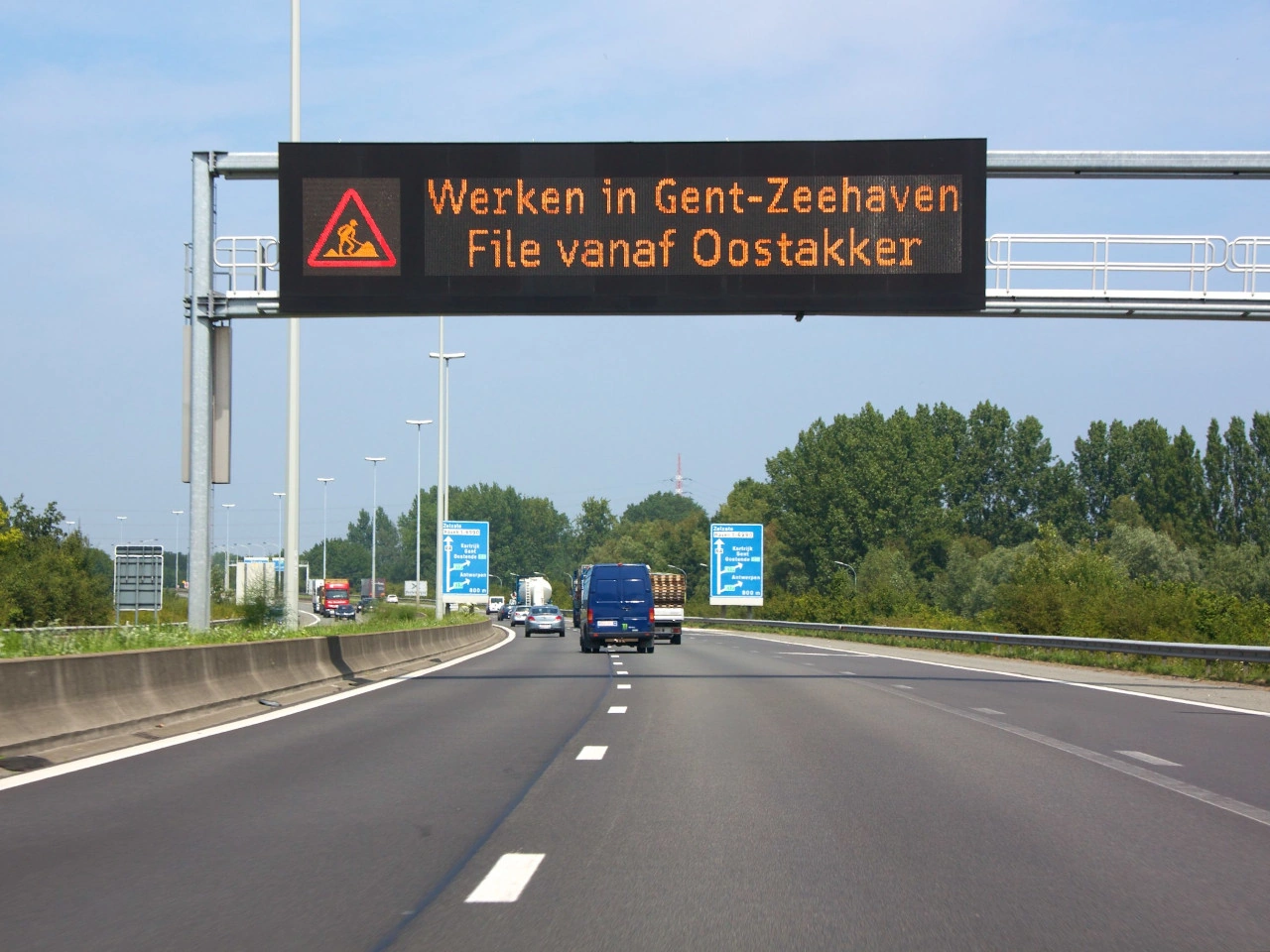
Gestion du trafic
How is traffic managed in Belgium?

Belgian traffic can be managed using traffic lights, road signs, road markings, lane-control signals, temporary traffic arrangements and instructions from authorised persons. Different measures may be used depending on traffic conditions, roadworks or incidents.

Must you obey traffic-management signs in Belgium?

Yes. Road users must obey official traffic lights, road signs and road markings when they comply with the prescribed form, are sufficiently visible and have been installed according to the applicable rules.

Which instruction has priority in Belgian traffic?

The orders of an authorised person take precedence over traffic signs and over the ordinary traffic rules. Traffic signs in turn take precedence over the general traffic rules.

What should you do if a police officer gives an instruction that conflicts with a traffic light?

You must follow the police officer's instruction. Orders given by an authorised person have a higher legal priority than traffic lights, road signs, road markings and the normal traffic rules.

Do traffic lights take precedence over priority signs in Belgium?

When traffic lights are operating at a location, the priority signs on the same road normally do not apply. There are specific exceptions, including flashing amber lights, lane-control signals and the B22 and B23 signs for cyclists and certain other riders.

What does a red cross above a Belgian traffic lane mean?

A red cross above a lane means that traffic is prohibited from using that lane or part of the road. Drivers must leave or avoid the closed lane as directed by the traffic-management signals.

What does a green arrow above a Belgian traffic lane mean?

A green downward-pointing arrow indicates that traffic may use the lane or part of the public road beneath it.

What does an orange diagonal arrow above a Belgian traffic lane mean?

An orange diagonal arrow, whether flashing or not, indicates that the lane must be left in the direction shown by the arrow. Drivers should change lane safely before reaching the closure.

What does a flashing amber traffic light mean in Belgium?

A flashing amber light means that road users may pass the signal but must proceed with increased caution. The flashing amber light does not change the normal priority rules.

What do temporary orange road markings mean in Belgium?

At roadworks, orange temporary lane markings may be used to guide traffic. They have the same meaning as the corresponding white continuous or broken lines and make white longitudinal markings at the same location temporarily inapplicable.

Can traffic be temporarily diverted in Belgium?

Yes. Traffic may be diverted or channelled because of roadworks, incidents or other obstructions. Temporary signs, barriers, markings and other traffic-management measures indicate the route that road users must follow.

Can police temporarily change the traffic arrangement during an emergency?

Yes. In urgent situations where traffic is obstructed, the police may use temporary traffic signs to divert or channel traffic. Such temporary signs must be removed when normal traffic conditions have been restored.

55. Marche arrière

La marche arrière consiste à conduire un véhicule vers l’arrière. Elle est couramment utilisée pour stationner, quitter un espace restreint ou repositionner un véhicule lorsque le mouvement vers l’avant n’est pas pratique.

Avant de reculer, le conducteur doit vérifier les rétroviseurs et angles morts, observer attentivement les alentours du véhicule et s’assurer que l’espace derrière est libre. La marche arrière doit être effectuée lentement et uniquement aussi longtemps que nécessaire, car la visibilité derrière le véhicule est souvent limitée.
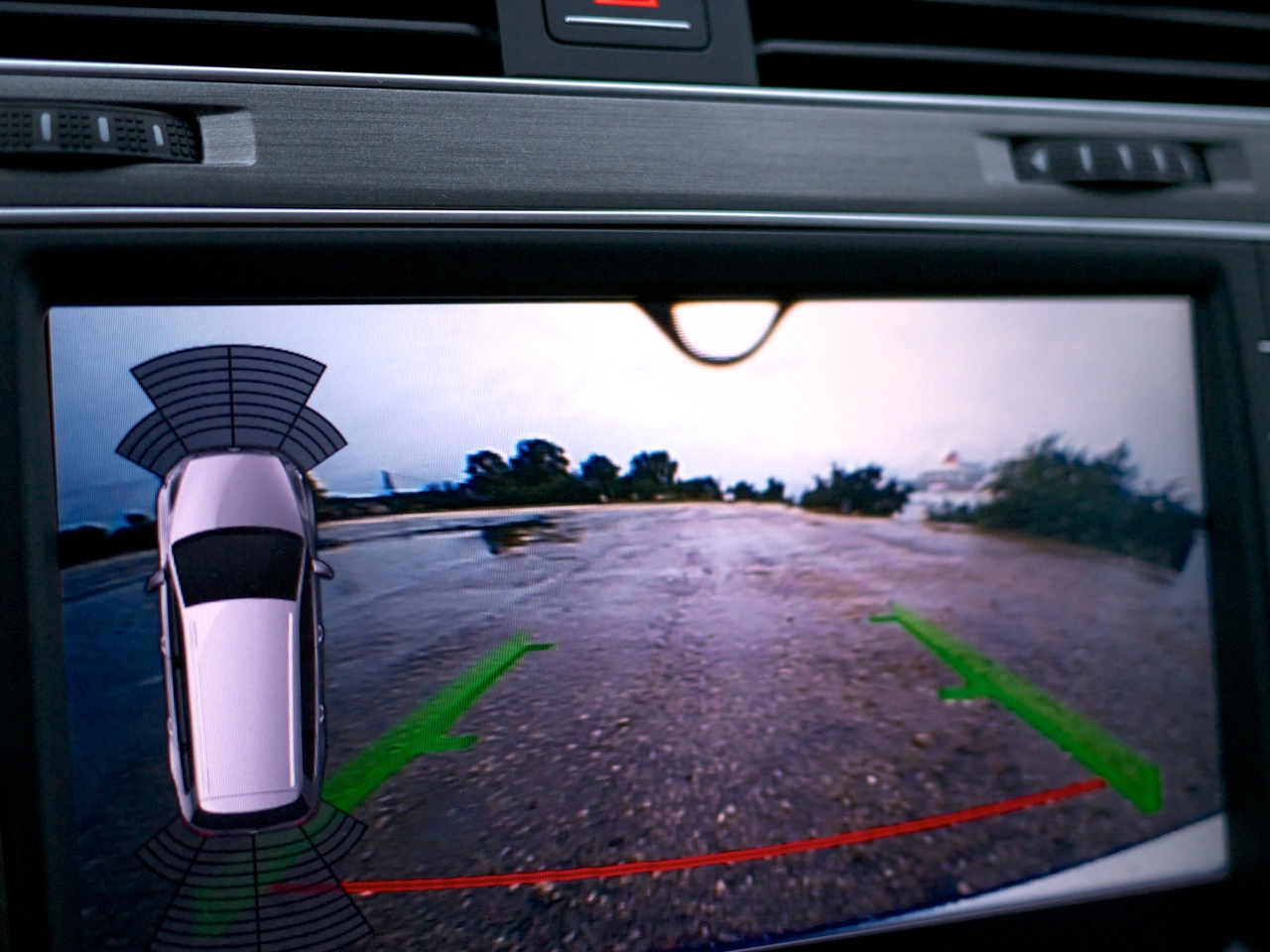
Marche arrière
Must you give way when reversing in Belgium?

Yes. Reversing is considered a manoeuvre, so the reversing driver must give way to other road users and may only continue when the movement can be carried out safely.

Is reversing allowed on Belgian motorways?

No. Reversing is prohibited on motorways, even if a driver has missed an exit or needs to return to an earlier point.

Is reversing allowed on Belgian autowegen?

No. The prohibition on reversing that applies to motorways also applies to autowegen. A driver who misses an exit or turning must continue and find a legal route back.

56. Carrefour non réglementé

Un carrefour non réglementé est une intersection où la priorité n’est pas spécifiquement réglée par des feux de circulation, une personne habilitée ou des panneaux attribuant la priorité à certaines branches. Les conducteurs doivent donc déterminer qui est prioritaire au moyen des règles générales applicables dans le pays.

La règle applicable varie selon les pays et peut être la priorité à droite, la priorité à gauche ou une autre règle générale de priorité. Les conducteurs doivent approcher un carrefour non réglementé avec prudence, observer le trafic de toutes les directions et ne jamais supposer qu’une route plus large ou plus fréquentée est automatiquement prioritaire.
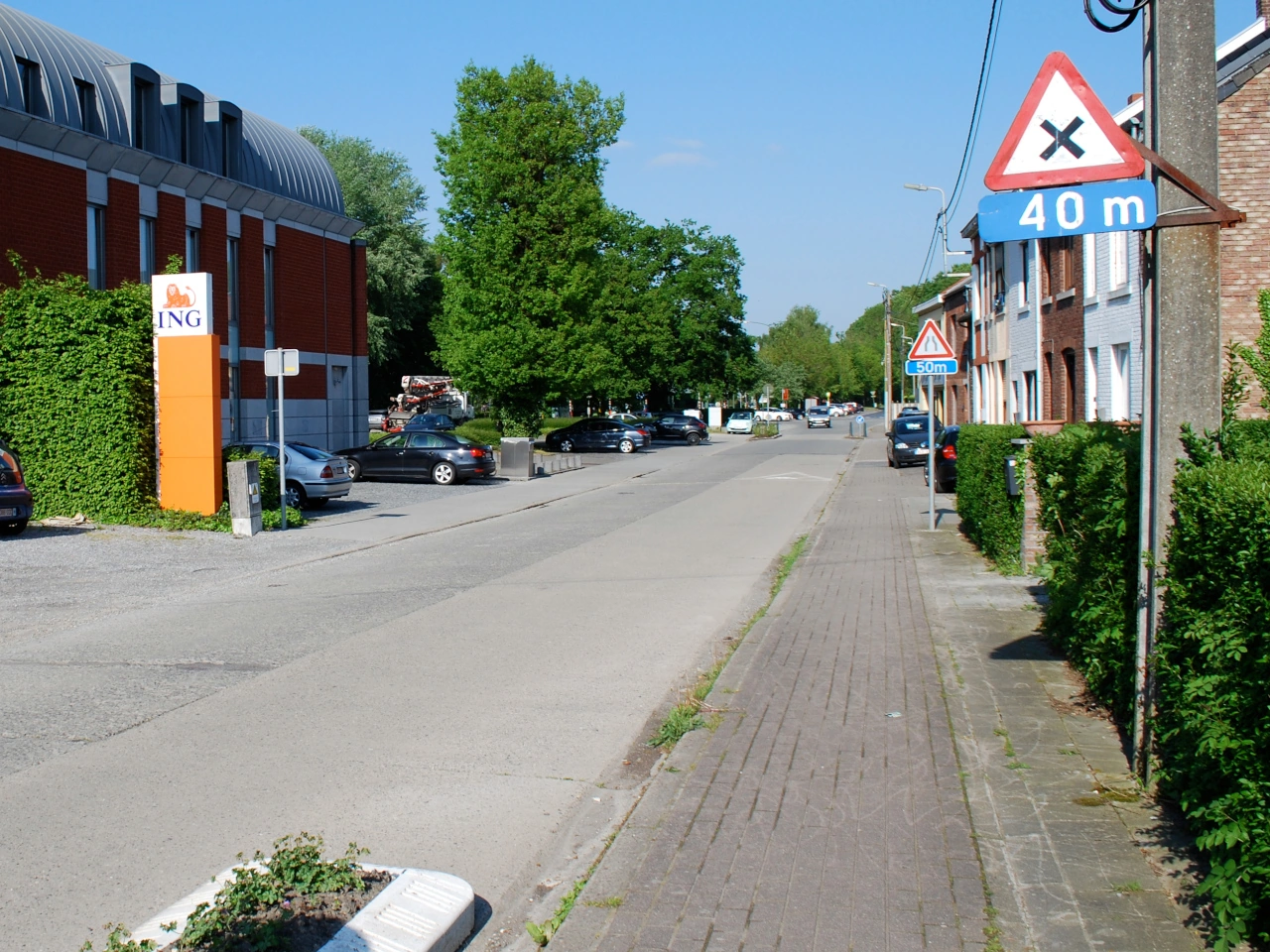
Carrefour non réglementé
Who has priority at an uncontrolled crossroad in Belgium?

At a Belgian crossroad where no other priority rule applies, every driver must give way to a driver approaching from the right.

Attention à un carrefour non contrôlé. Attention à un carrefour non contrôlé.

Signal routier B17 • Carrefour où la priorité de droite est applicable.

Verkeersbord B17 • Kruispunt waar de voorrang van rechts geldt.

How should you approach an uncontrolled crossroad in Belgium?

You must approach the intersection with particular caution and be able to give way when required. Check carefully for traffic approaching from the right as well as for other road users who may have priority.

Does the wider road have priority in Belgium?

No. A wider, busier or apparently more important road does not automatically have priority. If no signs or special rules establish another priority arrangement, the priority-from-the-right rule applies.

Does a vehicle coming from the right still have priority if it stops?

Yes. Merely slowing down or stopping does not by itself remove the driver's priority from the right. You should not assume that the driver has surrendered priority simply because the vehicle has stopped.

Do cyclists coming from the right have priority in Belgium?

Yes, when the normal priority-from-the-right rule applies. A cyclist is a driver and can therefore have priority when approaching from the right, unless another traffic rule or sign changes the situation.

Does traffic coming from a prohibited direction have priority from the right?

No. Belgian law specifically provides that you do not have to give priority under the priority-from-the-right rule to a driver approaching from a direction in which that driver is prohibited from travelling.

Does a driver coming from an earth road or path have priority from the right?

No. A driver entering a public road with a carriageway from an earth road or path must give way to drivers travelling on the road being entered.

Does priority from the right apply on a Belgian roundabout?

No. A driver already travelling on a roundabout does not have to give way under the ordinary priority-from-the-right rule to traffic entering from the right. Drivers entering the roundabout must follow the applicable signs and priority rules.

Does a vehicle leaving a driveway have priority if it comes from the right?

No. Leaving an adjoining property or driveway is considered a manoeuvre. A driver performing a manoeuvre must give way to the other road users.

What if you cross a cycle path at an uncontrolled crossroad?

A driver crossing a cycle path or pavement must give way to the road users who are lawfully using that cycle path or pavement. This obligation applies independently of the ordinary priority-from-the-right rule.

Do trams have to follow priority from the right?

No. Belgian road users must give way to rail vehicles such as trams. This special rule takes precedence over the ordinary priority-from-the-right rule.

What does the Belgian B17 sign mean?

The B17 sign warns that you are approaching a crossroad where priority from the right applies. Drivers should therefore be particularly alert for vehicles approaching from the right.

57. État de la chaussée

Un avertissement concernant l’état de la chaussée indique que la route plus loin peut être irrégulière, endommagée ou en mauvais état et affecter la stabilité, la direction ou le freinage du véhicule. Le danger peut comprendre des bosses, affaissements, nids-de-poule, revêtement dégradé ou autres irrégularités.

Les conducteurs doivent réduire leur vitesse si nécessaire, maintenir une distance de sécurité et éviter les mouvements brusques de direction ou de freinage sur une surface irrégulière. La signification et l’apparence exactes du panneau varient selon les pays ; les conducteurs doivent donc respecter la signalisation et la réglementation locales.
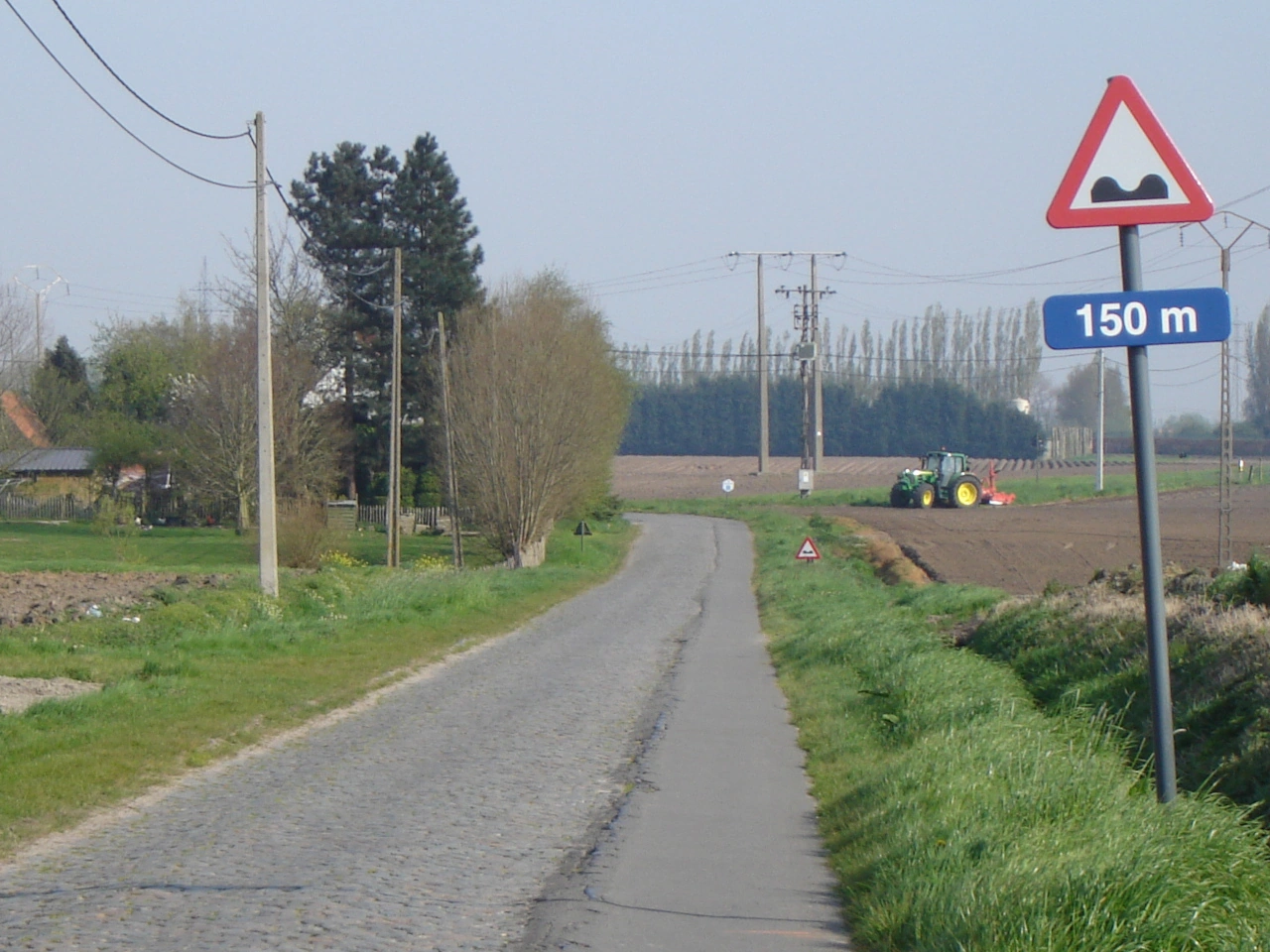
État de la chaussée
Which Belgian sign warns about an uneven road surface?

The Belgian A13 warning sign currently warns of a transverse depression or hump in the carriageway that may require drivers to reduce speed significantly.

Attention, chaussée en mauvais état. Attention, chaussée en mauvais état.

Signal routier A13 • Cassis ou dos d'âne.

Verkeersbord A13 • Uitholling overdwars of ezelsrug.

What should you do when you see an A13 sign in Belgium?

Observe the road ahead carefully and adapt your speed to the condition of the road. You should approach at a speed that allows you to pass the irregularity safely without losing control or causing danger.

Does the Belgian A13 sign impose a specific speed limit?

No. A13 is a warning sign and does not itself establish a numerical speed limit. Drivers must nevertheless adapt their speed to the road condition, and a separate speed-limit sign may impose a lower maximum speed.

Does A13 currently mean any damaged road surface in Belgium?

Not yet. Under the Road Code currently in force, A13 specifically refers to a transverse depression or hump. Its meaning will become broader when the new Code of the Public Road enters into force.

When will the meaning of the Belgian A13 sign change?

From 1 June 2027, A13 will warn of an uneven road surface or a road surface in poor condition. This broader meaning will replace the current definition referring specifically to a transverse depression or hump.

Is A13 the same as the Belgian raised-road warning sign?

No. A14 warns of an officially constructed raised traffic-calming feature on the public road. A13 currently warns of a transverse depression or hump that represents a road-surface hazard.

Is A13 the same as the slippery-road sign?

No. The Belgian A15 sign warns of a slippery carriageway. A13 concerns an irregularity in the shape or condition of the road surface rather than reduced grip.

Is there a special speed rule for an A13 road-surface warning?

There is no special fixed speed attached to A13. Belgian drivers must always adapt their speed to the condition of the road, visibility, traffic and other circumstances and must be able to stop for a foreseeable obstacle.

Can a supplementary sign indicate how long the hazard continues?

Yes. A supplementary sign may indicate the length of the dangerous section. Warning signs can also be accompanied by information indicating the distance to the hazard where appropriate.

Where are Belgian warning signs normally placed?

In Brussels and Flanders, warning signs are generally placed approximately 150 metres before the danger. If special circumstances require a different distance, a supplementary sign indicates the approximate distance to the hazard.

Should motorcyclists and cyclists take extra care at an A13 warning?

Yes. Depressions, humps and other surface irregularities can disturb the balance and direction of two-wheeled vehicles. Riders should approach at an appropriate speed and avoid abrupt steering or braking where possible.

58. Rocade

Une rocade est une route ou un ensemble de routes reliées qui contourne totalement ou partiellement une ville, une agglomération ou une zone urbaine. Elle sert à répartir le trafic entre différentes parties de la zone et à permettre au trafic de transit d’éviter les rues centrales encombrées.

Une rocade n’est pas nécessairement une autoroute ou une voie rapide. Elle peut être composée d’autoroutes, de routes à chaussées séparées, de routes ordinaires ou d’une combinaison de différents types de routes. Les limitations de vitesse, restrictions d’accès, règles de priorité et règles de voie dépendent donc de chaque section et de la signalisation et réglementation locales.

Rocade
What is a ring road in Belgium?

A Belgian ring road is a route that runs around or partly around a city or urban area and connects different roads and destinations. Belgian rings are commonly identified by a ring route number.

Which Belgian sign identifies the number of a ring?

The F23d sign indicates the number of a ring. Ring-route information can also appear on direction and advance-direction signs.

Numéro de rocade. Numéro de rocade.

Verkeersbord F23d • Nummer van een ring.

Direction de la rocade. Direction de la rocade.

Verkeersbord F33a • Wegwijzer op afstand: luchthaven, beurs- of tentoonstellingshal, haven, car-ferry, zone met economische activiteiten, ziekenhuis.

Is every Belgian ring road a motorway?

No. Being part of a ring does not itself make a road a motorway. A ring may contain motorway sections and other types of roads, so drivers must follow the signs and rules applying to each section.

When do Belgian motorway rules apply on a ring?

The special motorway rules apply from the point where the road is indicated by the F5 motorway sign and continue until the applicable end-of-motorway indication. A ring-route number by itself does not establish motorway status.

Is there a special Belgian speed limit for ring roads?

No. There is no single speed limit that applies simply because a road is a ring. The maximum speed depends on the road type, region, vehicle category and traffic signs applying to the particular section.

Can the speed limit change while following the same Belgian ring?

Yes. Different sections of a ring may have different road characteristics and speed limits. Drivers must follow the speed-limit signs and the general limit applicable to the road they are currently using.

Can a Belgian ring have ordinary intersections?

Yes. A ring does not have to consist entirely of grade-separated roads. Depending on the route, sections may include ordinary intersections, traffic lights, roundabouts or motorway-style interchanges.

Can cyclists use a Belgian ring road?

This depends on the individual section. Cyclists may use roads where they are legally permitted, but they may not use motorway sections or other sections where their access is prohibited by traffic signs or regulations.

Can pedestrians use a Belgian ring road?

This also depends on the road type. Pedestrians may be permitted along appropriate ordinary-road sections but are prohibited on motorways and wherever signs or other rules exclude them.

How should you choose a lane on a Belgian ring?

Follow the normal Belgian keep-right rule together with lane-direction signs and road markings. When approaching a major interchange, choose the lane for your destination in good time without making sudden lane changes.

How are destinations indicated on Belgian ring roads?

Belgian advance-direction and direction signs can indicate destinations reached by following the ring. The signing rules contain specific provisions for displaying road numbers and destinations when the route concerned is a ring.

What should you do if you miss an exit on a Belgian motorway ring?

Continue to the next suitable exit or interchange and find a safe legal route back. Never reverse, make a U-turn, drive against the direction of traffic or use connections through the central reservation on a motorway.

59. Autoroute cyclable

Une autoroute cyclable est un itinéraire cyclable continu et de grande qualité conçu pour assurer des déplacements rapides, directs et confortables sur de plus longues distances. Elle relie souvent des villes, quartiers résidentiels, lieux de travail, écoles, pôles de transports publics et autres destinations importantes.

Une autoroute cyclable peut comprendre des pistes cyclables séparées, chemins partagés, routes calmes, ponts, tunnels ou autres infrastructures cyclables. Elle ne constitue donc pas nécessairement un seul type continu de voie. Les règles d’accès, de priorité, de vitesse et les usagers autorisés dépendent de chaque section ainsi que de la signalisation et réglementation locales.

Autoroute cyclable
What is a cycle highway in Belgium?

A Belgian cycle highway, particularly known in Flanders as a fietssnelweg or fietsostrade, is a continuous cycling route intended to connect cities and important destinations using high-quality cycling infrastructure.

How can you recognise a Flemish cycle highway?

Flemish cycle highways are recognisable by the F-logo and an F route number. These route indications help cyclists follow the cycle-highway network between destinations.

Is the F-logo an ordinary regulatory traffic sign?

No. The F-logo primarily identifies and guides cyclists along the cycle-highway network. The traffic rules applying on the route are determined by the official traffic signs, road markings and type of infrastructure used on each section.

Is a Belgian cycle highway the same as a cycle path?

No. A cycle highway is an entire route. Individual sections may legally be cycle paths, separate paths, towpaths, low-traffic roads or other types of public road, each with its own applicable rules.

Must cyclists use a cycle highway in Belgium?

The fact that a route is designated as a cycle highway does not by itself make its use compulsory. However, an individual section may contain a compulsory cycle path or another road arrangement that cyclists must use according to the applicable traffic signs and rules.

Do cyclists have priority on a Belgian cycle highway?

Not automatically. Being on a cycle highway does not itself give cyclists priority at every intersection. Priority depends on the traffic signs, road markings, traffic lights and other Belgian priority rules applying at each crossing.

Are cars prohibited from Belgian cycle highways?

Not on every section. Many cycle-highway sections are separated from motor traffic, but others may follow roads shared with motor vehicles. The applicable access signs determine whether motor vehicles are permitted.

Can pedestrians use Belgian cycle highways?

This depends on the individual section. A cycle highway may include infrastructure that is also available to pedestrians, while other sections may be reserved for cyclists or other specified road users. The local signs determine how the section may be used.

Can speed pedelecs use Belgian cycle highways?

Whether a speed pedelec may use a particular section depends on the type of infrastructure and the applicable traffic signs. Special rules apply because speed pedelecs are legally classified differently from ordinary bicycles.

Can speed pedelecs use towpaths that form part of a cycle highway?

Yes, under the applicable Belgian rules. Speed pedelecs may use towpaths when they form part of a cycle highway or where their access is expressly permitted by a supplementary sign. Specific speed rules can apply on these paths.

Is there one speed limit for all Belgian cycle highways?

No. The cycle-highway designation does not create one nationwide speed limit. Drivers and riders must respect the rules and speed restrictions applying to the particular road or path and adapt their speed to other users and local conditions.

Are all planned Flemish cycle highways already fully completed?

No. A cycle highway is a route within a wider network, and individual sections may be completed, improved, temporarily diverted or still under development. The quality and type of infrastructure can therefore change along the same route.

60. Plaque d’immatriculation

Une plaque d’immatriculation, également appelée plaque minéralogique ou plaque de numéro, est une plaque affichant un identifiant unique attribué à un véhicule par l’autorité compétente. Elle permet d’identifier le véhicule à des fins telles que l’immatriculation, le contrôle routier, la fiscalité, l’assurance et le contrôle du stationnement.

L’apparence, le format, l’emplacement et le nombre de plaques exigées varient selon les pays et catégories de véhicules. Les conducteurs doivent veiller à ce que les plaques requises soient correctement fixées, clairement visibles et lisibles et respecter les règles locales en cas de perte, vol, détérioration ou remplacement.
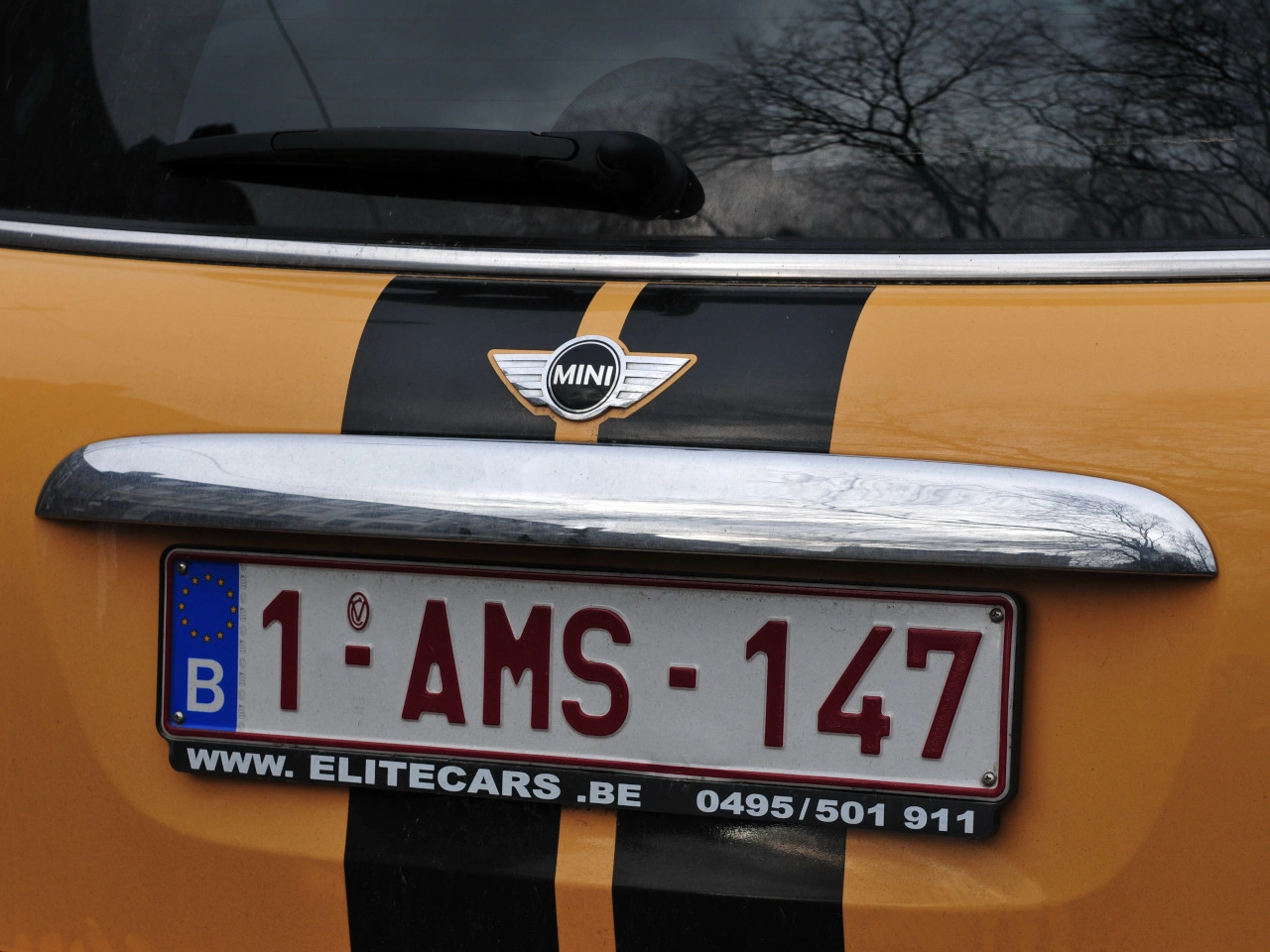
Plaque d’immatriculation
Who issues Belgian licence plates?

Belgian registration plates are issued through the Vehicle Registration Service (DIV) of the Federal Public Service Mobility and Transport when a vehicle is registered.

Must a vehicle be registered before it can be driven in Belgium?

Yes, as a general rule. A vehicle may only be put into circulation once it has been registered and carries the registration plate assigned to that registration, subject to the specific legal exemptions for certain vehicle categories.

Which plate is the official Belgian registration plate?

For an ordinary car, the rear plate bearing the official DIV mark is the official registration plate issued by the DIV. The plate at the front is a reproduction of the registration number.

Do Belgian cars need a front licence plate?

Yes. A reproduction of the registration plate must be fitted to the front of the vehicle. Motorcycles, mopeds, speed pedelecs and trailers are among the vehicle categories that do not require such a front plate.

Where is the front registration plate fitted in Belgium?

For vehicles required to carry one, the front reproduction is fitted in the centre of the vehicle or to the left of the centre.

What does a normal Belgian licence plate look like?

A standard Belgian registration plate has a white background with ruby-red characters and border. European-format plates also have a blue band containing the European stars and the white country identifier B.

Must a Belgian licence plate remain visible and readable?

Yes. The registration plate and its reproduction must be securely attached, remain visible at all times and normally be readable in clear daylight from at least 40 metres, with shorter prescribed distances for certain smaller plate formats.

May you cover a Belgian registration plate with a transparent protector?

No. Belgian rules state that a registration plate or its reproduction may not be covered, even with a transparent material. Alterations that could create confusion about its characters are also prohibited.

What if a bicycle rack covers the rear licence plate?

If a rear-mounted bicycle rack covers the registration plate, a reproduction of the plate must also be fitted to the bicycle rack so that the registration number remains visible.

What plate does a Belgian trailer under 750 kg display?

A trailer with a maximum authorised mass not exceeding 750 kg is generally not separately registered and must display a reproduction of the towing vehicle's official registration plate at the rear.

Can you keep your Belgian plate when changing vehicles?

Yes, in certain circumstances. When changing vehicle, you currently have four months to register another vehicle under the same plate number when the new vehicle falls within the same plate category.

What should you do if you no longer need your Belgian registration plate?

If you are not keeping it for another eligible vehicle, the official rear plate bearing the DIV mark must be returned to the DIV for deregistration. The front reproduction is not the official plate used for deregistration.

What should you do if your Belgian licence plate is lost or stolen?

You must report the loss or theft to the police. The police record the involuntary loss and the registration plate is deregistered. The appropriate re-registration or replacement procedure must then be followed.

Can you have a personalised licence plate in Belgium?

Yes. Personalised registration plates are available for several vehicle categories. The chosen combination is subject to Belgian formatting rules and may contain a maximum of eight characters in addition to the mandatory DIV seal position.

61. Station de recharge

Une station de recharge est un emplacement équipé d’un ou plusieurs points de recharge où la batterie d’un véhicule électrique ou hybride rechargeable peut être raccordée à une alimentation électrique et rechargée. Les stations peuvent se trouver le long des voies publiques, dans des parkings, des aires de service ou sur des propriétés privées.

Les places de recharge peuvent être réservées aux véhicules en cours de recharge et soumises à des restrictions de stationnement, durées maximales, obligations de paiement ou autres conditions. Les conducteurs doivent respecter les panneaux, règles de stationnement et instructions de recharge applicables sur place.

Station de recharge
How is an electric-vehicle charging space indicated in Belgium?

A Belgian parking space may be indicated by an E9 parking sign combined with the electric-vehicle symbol. This reserves the parking for electric or hybrid-electric vehicles.

Stationnement autorisé. Stationnement autorisé.

Signal routier E9a • Stationnement autorisé.

Verkeersbord E9a • Parkeren toegelaten.

Pour les voitures électriques. Pour les voitures électriques.

Panonceau utilisé avec les signaux de la série E9 pour indiquer que l'emplacement de stationnement est réservé aux véhicules électriques.

Onderbord gebruikt samen met de E9-reeks dat aanduidt dat de parkeerplaats voorbehouden is voor elektrische voertuigen.

Which vehicles may use a Belgian parking space reserved for electric vehicles?

The reservation applies to electric and hybrid-electric vehicles. The sign may also indicate one or more specific vehicle categories to which the reservation applies.

Must an electric vehicle be connected to the charger in Belgium?

Yes. When a reserved parking place is equipped with public charging infrastructure, an electric or hybrid-electric vehicle parked there must be connected to that charging infrastructure.

Can an electric vehicle simply park beside a Belgian public charger without plugging in?

No when the space is reserved for electric or hybrid-electric vehicles and provided with public charging infrastructure. The vehicle must be connected to the charger while parked there.

Can a plug-in hybrid use a Belgian charging space?

Yes. Belgian parking rules specifically include hybrid-electric vehicles in the category that may use parking spaces reserved with the electric-vehicle symbol.

Can a petrol or diesel vehicle park in a Belgian space reserved for electric vehicles?

No. Where the parking space is officially reserved for electric or hybrid-electric vehicles, vehicles that do not belong to that category may not park there.

Does charging an electric vehicle count as parking in Belgium?

Yes. Belgian law expressly states that charging the battery of an electric or hybrid-electric vehicle is considered parking.

Can you charge a vehicle where parking is prohibited?

No. Because charging is legally considered parking, connecting a vehicle to a charger does not override a parking prohibition or another restriction applying at that location.

Does connecting to a Belgian public charger mean charging must actually be in progress?

The Belgian Road Code specifically requires the vehicle to be connected to the public charging infrastructure. Additional conditions concerning an active charging session may be imposed by local parking rules or by the charging operator.

Can a Belgian charging space also be subject to paid parking?

Yes. Reservation for electric vehicles does not automatically make parking free. Drivers must also comply with any paid-parking conditions indicated for the location.

Can a Belgian charging space have a maximum parking duration?

Yes. Parking signs and supplementary information may impose a maximum parking duration or other restrictions. Being connected to the charger does not exempt the driver from those conditions.

Must you move your vehicle when charging is complete in Belgium?

Follow the parking signs, time limits and charging conditions at the location. The Road Code requires connection to public charging infrastructure where the charging-space rule applies, while additional rules may limit how long the vehicle may remain there.

62. Dangers

Un panneau de danger général avertit les usagers d’un danger à venir qui n’est pas représenté par un panneau d’avertissement plus spécifique. Le danger particulier peut être précisé par un panneau additionnel, un texte, un symbole ou une autre indication accompagnant le panneau.

Les conducteurs doivent redoubler d’attention, observer la route devant eux et adapter leur vitesse à la nature du danger et aux conditions environnantes. L’apparence exacte du panneau et la manière d’identifier le danger varient selon les pays ; les usagers doivent donc respecter la signalisation et la réglementation locales.

Dangers
Which Belgian sign warns of a danger without a specific warning symbol?

The Belgian A51 sign warns of a danger that is not represented by a specific warning symbol.

Attention, danger sans panneau spécifique. Attention, danger sans panneau spécifique.

Signal routier A51 • Danger non défini par un symbole spécial. Un panneau additionnel indique la nature du danger.

Verkeersbord A51 • Gevaar dat niet door een speciaal symbool wordt bepaald. Een onderbord duidt de aard van het gevaar aan.

Embouteillages. Embouteillages.

What does the supplementary panel below an A51 sign mean?

The supplementary panel identifies the nature of the danger for which the A51 sign has been placed.

When may an A51 sign be used in Belgium?

A51 is used when no other Belgian warning sign can appropriately indicate the danger. If a specific warning sign exists for the hazard, that sign should normally be used instead.

What should you do when you see an A51 sign?

Increase your attention, read the supplementary information and observe the road and surroundings carefully. Adapt your speed where necessary to deal safely with the indicated danger.

Does an A51 sign impose a speed limit?

No. A51 is a warning sign and does not itself impose a numerical speed limit. A separate C43 speed-limit sign may be used when a specific maximum speed is required.

Must you slow down when approaching an A51 danger?

You must adapt your speed to the circumstances. Belgian drivers must take account of factors such as visibility, traffic, road conditions, local conditions and foreseeable obstacles, so a reduction in speed may be necessary depending on the danger.

Does A51 give priority to other road users?

No. A51 warns of danger but does not itself change the priority rules. Any applicable priority signs, traffic lights and general priority rules remain in force.

Can A51 warn about a temporary danger?

Yes. A51 can be used where an unusual temporary danger needs to be signalled and no more specific warning sign is suitable.

Can A51 warn about a permanent or recurring danger?

Yes. The sign is not limited to temporary hazards. It can also identify another unusual or recurring danger when no dedicated warning symbol appropriately represents it.

Can additional information show where the danger begins?

Yes. Supplementary information can be used in accordance with Belgian signing rules to provide details such as the location or distance of a hazard.

Can A51 be used instead of a slippery-road or roadworks sign?

Normally no when the specific sign accurately represents the hazard. Belgium already has dedicated warning signs for hazards such as slippery roads, roadworks, traffic lights, falling rocks and pedestrians. A51 is reserved for dangers that cannot be represented by another suitable warning sign.

Will the general danger sign still exist under the new Belgian Road Code?

Yes. The new Code of the Public Road, which is scheduled to apply from 1 June 2027, retains the A51 sign for a danger not represented by a specific symbol and continues to use a supplementary panel to identify the nature of the danger.

63. Tourner au feu rouge

Tourner au feu rouge est une règle ou un dispositif de signalisation qui permet à certains usagers de poursuivre dans une direction déterminée malgré un feu rouge. Le plus souvent, il autorise un virage après que le conducteur s’est arrêté ou a cédé le passage, mais la procédure précise varie selon les pays.

Tourner au rouge n’est pas autorisé partout. Cela peut être permis de manière générale, uniquement lorsqu’un panneau ou signal spécifique est présent, ou être totalement interdit. Les conducteurs doivent toujours respecter les feux, panneaux, règles de priorité et passages pour piétons ou cyclistes locaux avant de s’engager.

Tourner au feu rouge
May motorists normally turn right on red in Belgium?

No. Belgium does not have a general rule allowing ordinary motorists to turn right simply because the way is clear. A red traffic light normally prohibits passing the stop line or traffic light.

Can a Belgian driver proceed while the main traffic light is red?

Yes, when a specific additional green arrow permits it. If a green arrow is illuminated together with the red or orange-yellow light, drivers may proceed only in the direction indicated by the arrow.

Do you have priority when following a green arrow beside a red light?

No. A driver proceeding under an additional green arrow must give way to drivers lawfully approaching from other directions and to pedestrians.

Can cyclists turn right on red in Belgium?

Yes, where a B22 sign is installed. Cyclists and speed-pedelec riders may pass a red or orange-yellow traffic light to turn right, provided they give way to the other road users who have priority.

Does every Belgian red light allow cyclists to turn right?

No. The exception applies only where the appropriate B22 sign or another authorised signal specifically permits the movement.

What does the Belgian B22 sign mean?

The B22 sign allows cyclists and speed-pedelec riders to pass a red or orange-yellow traffic light in order to turn right, while giving way to other road users.

What does the Belgian B23 sign mean?

The B23 sign allows cyclists and speed-pedelec riders to pass a red or orange-yellow traffic light and continue straight ahead, while giving way to other road users.

May a B23 sign be installed at every intersection?

No. Under the current Belgian rules, B23 may only be used where cyclists proceeding straight ahead do not have to cross another traffic stream.

Must cyclists come to a complete stop at B22 or B23?

The current B22 and B23 rules do not impose a separate general requirement to make a complete stop. However, cyclists and speed-pedelec riders must give way to other road users and may proceed only when this can be done safely.

Can ordinary cars use the B22 or B23 exception?

No. B22 and B23 are specifically intended for cyclists and speed-pedelec riders. They do not allow cars, motorcycles or other ordinary motor vehicles to pass the red light.

Can Belgian cyclists also receive a special flashing signal at a red light?

Yes. An additional flashing orange-yellow bicycle signal with an arrow can permit cyclists and certain two-wheeled riders to proceed in the direction indicated while the main signal is red or orange-yellow, provided they give way as required.

Will the Belgian turn-on-red rules change in 2027?

Yes. From 1 June 2027, the new Code of the Public Road will use a single B22 system with one or more arrows. It will allow cyclists and speed-pedelec riders to pass a prohibiting traffic light in the direction or directions shown, including right, straight ahead or left where indicated, while giving way to other road users.

64. Carte d’identité

Une carte d’identité est un document officiel servant à prouver l’identité d’une personne. Elle est normalement délivrée par un gouvernement ou une autre autorité compétente et contient des informations telles que le nom, la date de naissance, la photographie et un numéro unique de document ou d’identification.

Une carte d’identité peut être exigée pour des contrôles d’identité, procédures administratives, voyages ou accès à des services. L’obligation d’en posséder ou d’en porter une, les informations qu’elle contient et son utilisation éventuelle comme document de voyage varient selon les pays.
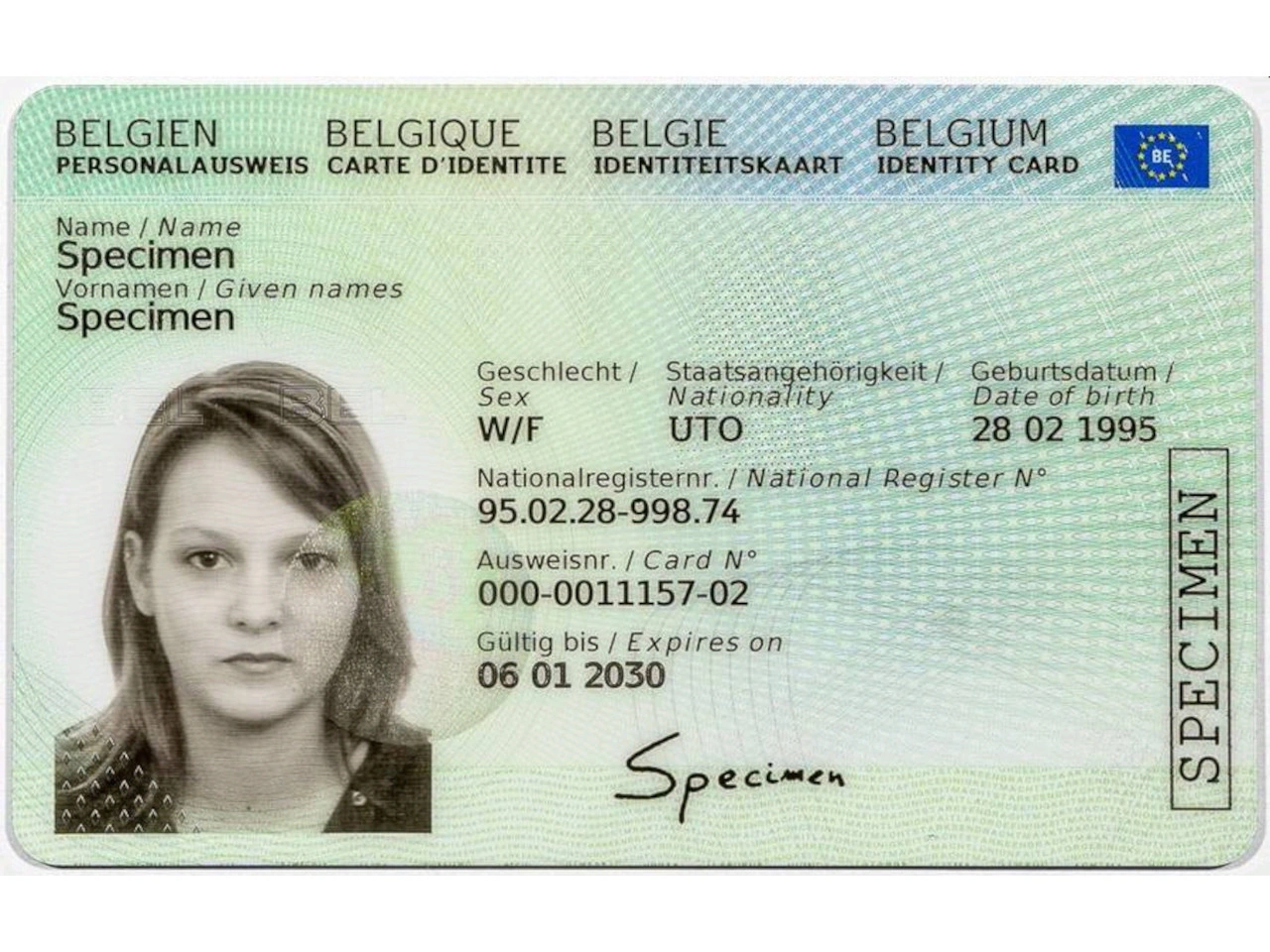
Carte d’identité
What is the Belgian eID?

The Belgian eID is the electronic identity card issued to Belgian citizens from the age at which the ordinary Belgian identity-card system applies. It proves the holder's identity and contains an electronic chip that can also be used for electronic identification.

At what age do Belgians receive an identity card?

The Belgian eID is issued from the age of 12. Belgian children younger than 12 can instead have a Kids-ID.

From what age must you carry an identity card in Belgium?

Every Belgian must normally carry their identity card from the age of 15. In the event of loss, theft or destruction, the recognised temporary proof of the declaration can serve as identification in the circumstances provided by law.

Must a driver carry an identity card in Belgium?

A Belgian who is subject to the general obligation to carry an identity card must continue to do so while driving. The identity card and driving licence are separate documents and serve different purposes.

Is a Belgian identity card the same as a driving licence?

No. The identity card proves the person's identity. A driving licence proves that the person is authorised to drive the vehicle category concerned.

Can a Belgian identity card replace your driving licence?

No. A person driving a motor vehicle for which a driving licence is required must hold and carry the appropriate valid driving licence. Carrying an identity card does not replace this requirement.

Can the police ask for your identity card after a traffic offence?

Yes. A person over 15 must show their identity card or equivalent proof when requested by an authorised person following an offence against Belgian road-traffic legislation.

Must you show your identity card after a traffic accident?

Yes, when required. A person over 15 involved in a road accident must show their identity card or equivalent proof to other persons involved who request it. An authorised person may also require identification.

Why is identification important after a traffic accident?

Identification allows the people involved and the authorities to establish the identity of the parties so that the accident can be properly recorded and the necessary information exchanged.

Can a Belgian eID be used as a travel document?

Yes. A valid Belgian eID can be used as an identity and travel document within the European Union and in certain other destinations that accept it. Entry requirements should always be checked before travelling.

What should you do if your Belgian identity card is lost or stolen?

Report the loss or theft as quickly as possible through DOC STOP so that the document can be blocked. You must then follow the applicable procedure to obtain temporary identification and request a new identity card.

Can you receive temporary identification after losing your Belgian eID?

Yes. After the loss, theft or destruction has been reported, the municipality or police can issue an Annex 12 in the applicable circumstances. It serves as temporary proof of identity within Belgium.

65. Risque d’incendie

Un panneau de risque d’incendie avertit les usagers qu’il existe un danger accru d’incendie dans la zone ou à proximité. Il peut être utilisé lorsque la végétation sèche, des matières inflammables ou d’autres conditions augmentent le risque ou exigent une prudence supplémentaire.

L’apparence et le statut juridique de ces panneaux varient selon les pays. Les conducteurs doivent éviter toute action susceptible de déclencher un incendie, respecter les restrictions associées et rester attentifs à la fumée, aux flammes ou aux activités des services d’urgence.

Risque d’incendie
Is there a specific fire risk traffic sign in Belgium?

No dedicated standard Belgian traffic sign is specifically assigned to fire risk. A general warning sign or other local safety signage may instead be used to warn road users where a particular fire hazard exists.

Can Belgium use a general warning sign for fire risk?

Yes. Belgian sign A51 indicates a danger for which no specific warning symbol exists, and a supplementary panel states the nature of the danger. A fire-related hazard could therefore be indicated in this way when appropriate.

What should you do when warned of fire danger in Belgium?

Take extra care, respect any access restrictions or instructions and avoid behaviour that could start a fire. During periods of high fire danger, additional restrictions can apply in forests and nature areas.

66. Piéton

Un piéton est une personne se déplaçant à pied le long ou à travers une route, rue, chemin ou autre espace public. Selon le droit routier local, les personnes poussant un vélo, un fauteuil roulant, une poussette ou certains autres petits dispositifs peuvent également être considérées comme des piétons.

Les piétons utilisent normalement les trottoirs, chemins piétons et zones piétonnes lorsqu’ils existent. Lorsqu’ils traversent une route ou marchent là où aucun aménagement adapté n’est disponible, ils doivent respecter les règles de traversée, feux de circulation et autres règles locales.

Piéton
Who is considered a pedestrian in Belgium?

A Belgian pedestrian is a person travelling on foot. Certain people pushing small vehicles or mobility devices are also legally treated as pedestrians.

Piétons interdits. Piétons interdits.

Signal routier C19 • Accès interdit aux piétons.

Verkeersbord C19 • Verboden toegang voor voetgangers.

Chemin obligatoire pour les piétons. Chemin obligatoire pour les piétons.

Signal routier D11 • Chemin obligatoire pour les piétons.

Verkeersbord D11 • Verplichte weg voor voetgangers.

Passage pour piétons. Passage pour piétons.

Signal routier F49 • Passage pour piétons.

Verkeersbord F49 • Oversteekplaats voor voetgangers.

Direction d’un passage souterrain. Direction d’un passage souterrain.

Verkeersbord F51 • Ondergrondse of bovengrondse toegang voor voetgangers.

Début d'une zone pour piétons. Début d'une zone pour piétons.

Signal routier F103 • Commencement d'une zone piétonne. Ce signal est placé à droite, à chaque accès d'une zone piétonne; il peut être répété à gauche.

Verkeersbord F103 • Begin van een voetgangerszone. Dit verkeersbord wordt rechts geplaatst aan elke toegang tot een voetgangerszone; het mag links herhaald worden.

Fin de la zone pour piétons. Fin de la zone pour piétons.

Signal routier F105 • Fin d'une zone piétonne. Ce signal est placé à droite, à chaque sortie d'une zone piétonne; il peut être répété à gauche.

Verkeersbord F105 • Einde van een voetgangerszone. Dit verkeersbord wordt rechts geplaatst aan elke uitgang van een voetgangerszone; het mag links herhaald worden.

Route réservée aux usagers indiqués. Route réservée aux usagers indiqués.

Verkeersbord R9 • Begin van een weg of van wegen voorbehouden voor het verkeer van de aangeduide weggebruikers (voorbeelden). Het verkeersbord kan aangepast zijn volgens de categorieën van weggebruikers. Op dit bord zijn ten minste 2 categorieën van weggebruikers aangeduid. De maximale snelheid die er geldt, kan als aanwijzing rechtsonder op het verkeersbord aangeduid zijn.

Fin de la route réservée. Fin de la route réservée.

Verkeersbord R11 • Einde van een weg of van wegen voorbehouden voor het verkeer van de aangeduide weggebruikers (voorbeelden).

Is someone walking a bicycle considered a pedestrian in Belgium?

Yes. A person who leads a bicycle by hand is legally treated as a pedestrian. The same applies to someone walking a motorised bicycle or two-wheeled moped by hand.

Are wheelchair users considered pedestrians in Belgium?

People using certain mobility devices at walking speed can be treated as pedestrians. Belgian rules specifically include persons with reduced mobility using a motorised device intended exclusively for them when travelling no faster than walking pace.

Where must pedestrians walk in Belgium?

Pedestrians must use the available and passable parts of the public road in a prescribed order, starting with the pavement or designated pedestrian facility, followed where necessary by suitable verges and other permitted parts of the road.

May pedestrians walk on the carriageway in Belgium?

Yes, when the more appropriate pedestrian facilities are unavailable or unusable. When pedestrians use the carriageway, they must remain as close as possible to its edge.

Which side of the road should Belgian pedestrians walk on?

When walking on the carriageway or lateral strip, pedestrians normally walk on the left relative to their direction of travel so that they face approaching traffic. They may walk on the right when safety reasons justify it.

Must pedestrians use a pedestrian crossing in Belgium?

Yes, when a pedestrian crossing is less than approximately 20 metres away. Pedestrians must then use that crossing rather than cross elsewhere.

Do pedestrians have priority on an uncontrolled pedestrian crossing in Belgium?

Yes. Where traffic is not controlled by traffic lights or an authorised person, drivers must approach a pedestrian crossing at moderate speed and give way to pedestrians who are on the crossing or about to enter it.

Can a pedestrian step onto a Belgian crossing without looking?

No. At locations without traffic lights or an authorised person, pedestrians may enter the carriageway only with caution and while taking account of approaching vehicles.

What does a red pedestrian light mean in Belgium?

A red pedestrian light means that pedestrians may not enter the carriageway. A green pedestrian light means that they may enter it.

Must turning drivers give way to pedestrians in Belgium?

Yes. A driver changing direction must give way to pedestrians crossing the carriageway that the driver is about to enter.

How much distance must a driver leave when passing a pedestrian on the carriageway?

A driver must leave at least 1 metre between the vehicle and a pedestrian lawfully using the carriageway. Outside a built-up area, the minimum distance is 1.5 metres. If that distance cannot be maintained, the driver must travel at walking speed and stop if necessary.

67. Cyclomoteur

Un cyclomoteur est un véhicule motorisé léger, généralement à deux ou trois roues, dont la puissance, la cylindrée ou la vitesse maximale par construction est limitée par la loi. Les cyclomoteurs se situent généralement dans une catégorie juridique entre les vélos et les motos, même si leur classification précise varie selon les pays.

Des règles particulières peuvent s’appliquer concernant l’âge minimal, le permis, le casque, l’immatriculation, l’assurance, la vitesse maximale et l’utilisation des pistes cyclables ou chaussées. Les conducteurs doivent donc respecter la classification et les règles en vigueur dans le pays où ils circulent.

Cyclomoteur
What is a moped in Belgium?

Belgian law distinguishes mainly between class A and class B mopeds. Their classification depends on characteristics including maximum design speed, engine capacity and motor power.

Interdiction de cyclomoteurs. Interdiction de cyclomoteurs.

Signal routier C9 • Accès interdit aux conducteurs de cyclomoteurs.

Verkeersbord C9 • Verboden toegang voor bestuurders van bromfietsen.

What is a Belgian class A moped?

A class A moped is a two- or three-wheeled moped with a maximum design speed of 25 km/h. For an internal-combustion engine, the cylinder capacity is generally limited to 50 cm³, while applicable power limits also apply.

What is a Belgian class B moped?

A class B moped is a moped that does not belong to class A and has a maximum design speed of no more than 45 km/h. For many two- and three-wheeled models, the engine capacity is limited to 50 cm³ or the applicable electric-motor power limit.

How old must you be to ride a moped in Belgium?

You must normally be at least 16 years old to ride a moped on the public road.

Do you need a licence for a class A moped in Belgium?

No. A driving licence is not required for a Belgian class A moped, although the rider must satisfy the applicable minimum-age and traffic rules.

Which licence is required for a class B moped?

A class B moped normally requires a category AM driving licence. Holders of a Belgian licence valid for category A1, A2, A or B automatically have access to category AM. Specific exemptions also exist for certain older drivers.

Must moped riders wear a helmet in Belgium?

Yes. Drivers and passengers of mopeds without a passenger compartment must wear an approved protective helmet. Specific helmet rules apply to speed pedelecs.

What is the maximum speed of a Belgian moped?

A class A moped is limited to 25 km/h, while a class B moped is limited to 45 km/h. A lower speed limit applying to the road must still be respected.

Must a class A moped use the cycle path in Belgium?

Where a suitable cycle path is provided and indicated in the manner prescribed by Belgian law, a two-wheeled class A moped must normally use it in the applicable direction.

Can a class B moped use a Belgian cycle path?

Under the rules currently in force, where the speed limit is 50 km/h or lower, a two-wheeled class B moped may use an applicable cycle path provided it does not endanger other users. Where the speed limit is higher than 50 km/h, it must normally use an available and usable applicable cycle path. Traffic signs can impose different requirements.

Can you carry a passenger on a moped in Belgium?

Yes, if the moped is designed with a passenger seat and the other applicable conditions are satisfied. A moped rider must be at least 18 years old to carry a passenger, and the vehicle may not carry more people than the number of seats for which it is designed.

Must a Belgian moped be registered?

Yes. Mopeds must normally be registered and display a registration plate. Belgian plates identify class A mopeds with S-A and class B mopeds with S-B.

Does a Belgian moped need insurance?

Yes. Class A and class B mopeds are subject to compulsory motor-vehicle liability insurance before they are used on the public road.

Can a moped use a Belgian motorway?

No. Mopeds are expressly prohibited from Belgian motorways. They are also excluded from roads legally designated as autowegen.

Is a speed pedelec legally related to mopeds in Belgium?

Yes. Belgian legislation places the speed pedelec within the broader legal definition of a moped, but speed pedelecs are identified separately and are subject to several specific rules concerning equipment, cycle-path use, helmets and insurance.

68. Voiture

Une voiture est un véhicule à moteur principalement conçu pour transporter un petit nombre de personnes et leurs bagages sur les routes. Les voitures peuvent fonctionner à l’essence, au diesel, à l’électricité, à l’hydrogène ou avec une combinaison de différentes sources d’énergie.

Les conducteurs doivent respecter les exigences applicables concernant le permis de conduire, l’immatriculation, l’assurance, l’état technique, les ceintures et la sécurité des passagers. Les limitations de vitesse, exigences d’équipement, accès aux routes et autres règles varient selon les pays ; il faut donc respecter la signalisation et réglementation locales.

Voiture
What is considered a car in Belgium?

In everyday use, a car usually means a passenger motor vehicle. The Belgian Road Code uses the broader legal term auto for motor vehicles that do not fall within the definitions of a moped, motorcycle or motorised three- or four-wheeler.

Which driving licence do you normally need for a car in Belgium?

An ordinary passenger car normally requires a category B driving licence.

What vehicles can you drive with a Belgian category B licence?

Category B covers vehicles with a maximum authorised mass of no more than 3500 kg that are designed and constructed to carry no more than eight passengers in addition to the driver.

How old must you be to obtain a full category B licence in Belgium?

The category B practical driving test can be taken from the age of 18. The theory test can be taken from the age of 17.

Must a Belgian car be registered?

Yes. As a general rule, a vehicle may only be put into circulation once it has been registered and carries the registration plate assigned to that registration.

Does a Belgian car need insurance?

Yes. Motor-vehicle third-party liability insurance, commonly called BA auto, is compulsory. It covers the civil liability for damage caused to third parties under the applicable rules.

Must people wear seat belts in a Belgian car?

Yes. Drivers and passengers must wear the seat belts provided at their seating positions, subject to the limited exemptions specified by law.

What child-restraint rule applies in Belgian cars?

Children under 18 years old and shorter than 135 cm must normally be transported in a suitable approved child-restraint system. Specific exceptions apply in certain circumstances and vehicle types.

How many people may travel in a Belgian car?

The number of occupants may not exceed the number of authorised seating positions equipped with seat belts or approved child-restraint systems, together with any seating positions that are legally exempt from having them.

What safety equipment must a Belgian car carry?

Belgian cars must carry the prescribed safety equipment, including a warning triangle, fire extinguisher and first-aid kit or case. Other equipment requirements may apply depending on the vehicle and circumstances.

What is the minimum tyre tread depth for a Belgian car?

The main grooves of ordinary car tyres must have a tread depth of at least 1.6 mm. Tyres must also remain in a safe and serviceable condition.

Can a Belgian category B car tow a trailer?

Yes. A category B vehicle may normally tow a trailer with an MTM of up to 750 kg. Heavier trailers or combinations may require category B with code 96 or a category BE licence, depending on the authorised masses involved.

69. Camion

Un camion est un véhicule à moteur conçu principalement pour transporter des marchandises. Les camions vont des petits véhicules de livraison aux grands poids lourds et ensembles articulés utilisés pour le transport de fret sur longue distance.

Comme les camions sont généralement plus grands, plus lourds et moins maniables que les voitures particulières, ils ont besoin de davantage d’espace pour tourner et freiner et possèdent souvent des angles morts plus importants. Des règles particulières de vitesse, d’utilisation des voies, de dépassement et d’accès peuvent s’appliquer selon le poids du véhicule et le pays.
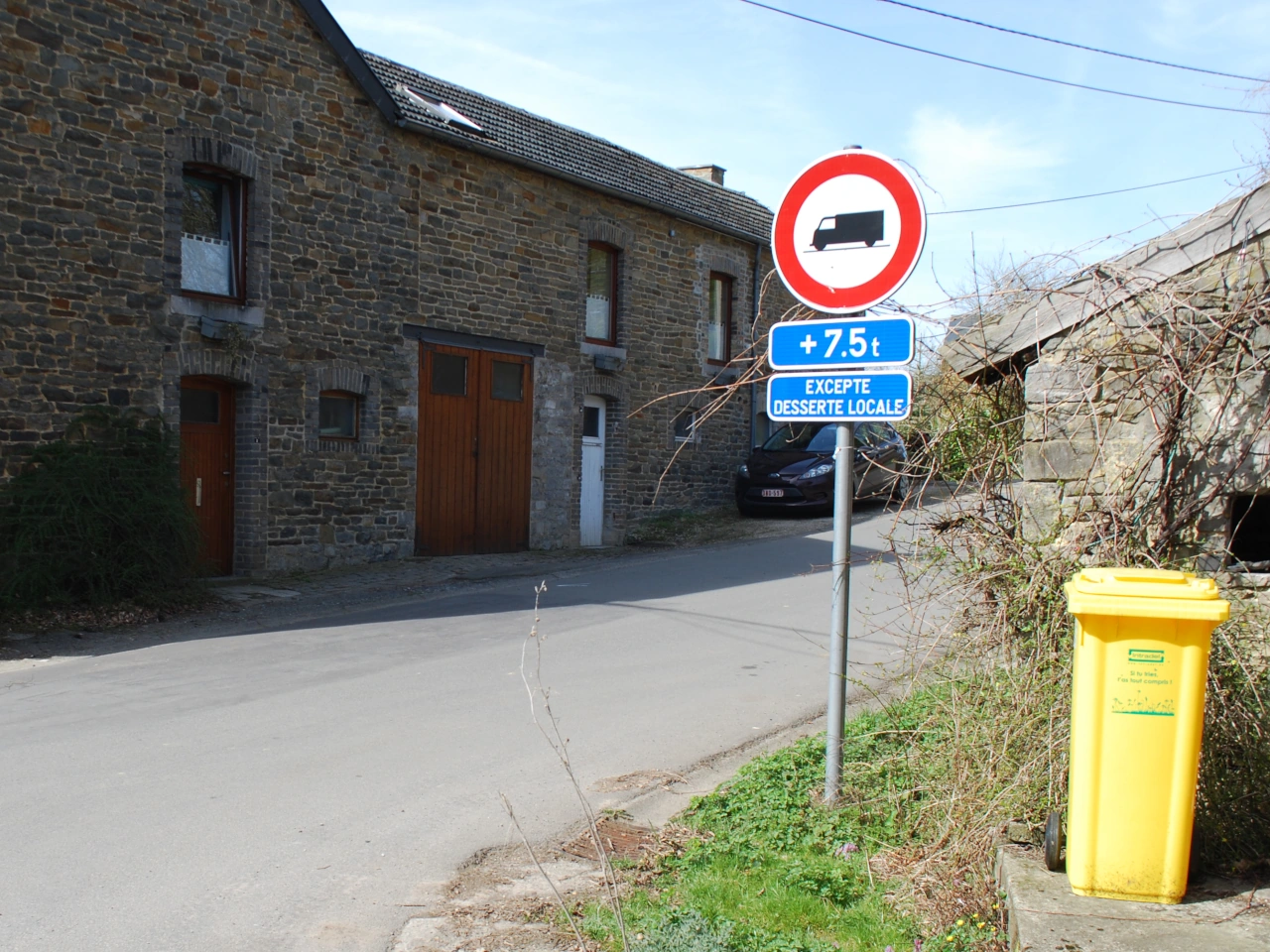
Camion
How is a truck defined in Belgium?

A Belgian truck is a motor vehicle of category N1, N2 or N3 that is designed and built exclusively or mainly for transporting goods.

What is the maximum motorway speed for heavier trucks in Belgium?

Vehicles and combinations with a maximum authorised mass of more than 3.5 tonnes are limited to a maximum of 90 km/h on Belgian motorways, unless a lower speed limit applies.

Can trucks use every lane on a Belgian motorway?

No. On a motorway with three or more lanes in the same direction, vehicles and combinations with a maximum authorised mass of more than 3.5 tonnes may normally use only the two right-hand lanes, except where specific lane-direction signs indicate otherwise.

70. Autobus

Un autobus est un véhicule à moteur conçu pour transporter plusieurs passagers, généralement sur route dans le cadre des transports publics, scolaires, privés ou d’un autre service de transport de personnes. Les autobus ont généralement une capacité supérieure aux voitures et peuvent être conçus pour des passagers assis, debout ou les deux.

Des règles particulières peuvent s’appliquer concernant le permis, la capacité, les limitations de vitesse, les ceintures, les voies de bus, les arrêts et l’embarquement des passagers. La classification juridique des autobus et autocars et les règles applicables varient selon les pays ; conducteurs et passagers doivent donc respecter la réglementation locale.

Autobus
What is legally considered a bus in Belgium?

A Belgian autobus is a motor vehicle designed and constructed to carry seated and standing passengers and having more than eight passenger seats, excluding the driver's seat.

What is the difference between a bus and a coach in Belgium?

An autobus is designed for both seated and standing passengers, while an autocar is designed for passengers who are exclusively seated. Both have more than eight passenger seats, excluding the driver.

Which driving licence is required to drive a bus in Belgium?

A bus normally requires a category D1 or D driving licence. D1 permits vehicles carrying up to 16 passengers excluding the driver and measuring no more than 8 metres. Category D covers vehicles designed for more than eight passengers without those D1 limits.

Do professional Belgian bus drivers need Code 95?

Yes, in most cases. Professional drivers using category D-group vehicles generally need the professional-competence qualification identified by Code 95, although specific exemptions exist.

Can passengers stand in a Belgian bus?

Yes, if the vehicle is designed and approved for standing passengers. The Belgian legal definition of an autobus specifically includes vehicles constructed for both seated and standing passengers. An autocar, by contrast, is designed exclusively for seated passengers.

Must passengers wear seat belts on Belgian buses?

Where a passenger seat is equipped with a seat belt, the applicable seat-belt requirement must be followed. In vehicles with more than eight passenger seats, passengers must also be informed of the obligation to wear available seat belts by the driver, another responsible person, audiovisual information or notices at the seats.

What is the maximum speed of a Belgian bus on a motorway?

An autobus is limited to 90 km/h on Belgian motorways, even though the general motorway limit for many passenger cars is 120 km/h. Different rules can apply to qualifying coaches.

Does a bus leaving a stop have priority in Belgium?

Inside a built-up area, yes in the specified circumstances. A driver travelling in the same direction must allow an autobus or trolleybus to leave its stop when its driver indicates the intention to move off with the direction indicators. The approaching driver must slow down and stop if necessary.

Does a Belgian bus have the same priority when leaving a stop outside a built-up area?

No special priority under this rule applies outside the built-up area. The specific Belgian obligation to let an autobus or trolleybus leave its stop applies within built-up areas.

What should you do when passing a stopped bus in Belgium?

You must reduce your speed when passing a bus, coach, trolleybus, minibus or rail vehicle that is stopped for passengers to board or leave. Be especially alert for passengers moving between the vehicle and the pavement or verge.

What if passengers must cross your path to reach a Belgian bus stop?

If there is no refuge island and you are travelling on the side where passengers are boarding or leaving a public-transport vehicle, you must allow them to reach the vehicle, pavement or verge safely. You must stop when necessary and may resume driving only at moderate speed.

Can every bus use a Belgian bus lane?

No. A bus lane is primarily reserved for vehicles operating scheduled public passenger services. Other passenger vehicles with more than eight passenger seats may use it only when the appropriate symbol or indication on the F17 sign or a supplementary panel permits them.

Can other vehicles use a Belgian bus lane?

Only in the circumstances allowed by Belgian rules or the signs. Supplementary indications can permit categories such as taxis, bicycles, mopeds, motorcycles or school-transport vehicles. Other drivers may also enter or cross a bus lane in specific situations such as turning near an intersection.

May you park close to a Belgian bus stop?

No. Parking is prohibited within 15 metres on either side of a sign indicating a bus, trolleybus or tram stop.

71. Police

La police regroupe les autorités publiques chargées de faire respecter les lois, maintenir la sécurité publique et gérer les situations pouvant affecter la circulation. Sur la route, les agents peuvent contrôler les véhicules, faire respecter les règles, enquêter sur les collisions, diriger la circulation et intervenir en urgence.

Les usagers doivent respecter les instructions légales données par la police ou d’autres personnes habilitées à contrôler la circulation. Selon la loi locale, les instructions de la police peuvent temporairement primer sur les feux de circulation, panneaux ou organisation habituelle.

Must you obey a police officer directing traffic in Belgium?

Yes. Road users must immediately obey the orders of an authorised person, including police officers acting within their authority.

Do police instructions take priority over Belgian traffic lights and signs?

Yes. Orders from authorised persons take precedence over traffic lights, traffic signs, road markings and the ordinary traffic rules.

What does a Belgian police officer with one arm raised vertically mean?

An arm raised vertically means stop for all road users, except those already within an intersection who must continue sufficiently to clear it.

What do horizontally extended arms mean when police direct Belgian traffic?

A police officer holding one or both arms horizontally extended requires road users approaching from directions that cross the direction indicated by the arms to stop.

What does a police officer waving a red light mean?

A red light waved transversely means that the drivers towards whom the light is directed must stop.

Can Belgian police order you to move a parked vehicle?

Yes. The driver of a stopped or parked vehicle must move it when instructed by an authorised person. If the driver refuses or is absent, the authorised person may arrange for the vehicle to be moved.

Must you show identification to Belgian police after a traffic offence?

Yes. A person over 15 years old must show their identity card or equivalent identification when requested by an authorised person following a road-traffic offence or traffic accident.

Must a Belgian driver carry a driving licence?

Yes. A person driving a motor vehicle for which a driving licence is required must hold the appropriate valid licence and normally carry it while driving so that it can be presented when lawfully required.

Can Belgian police carry out alcohol checks?

Yes. Authorised officers may require drivers and other persons covered by the traffic legislation to undergo the prescribed breath test and, where applicable, breath analysis.

Can Belgian police test drivers for drugs?

Yes. Belgian traffic legislation provides for a procedure involving observations or a checklist followed, where applicable, by a saliva test and saliva analysis.

What should you do when a Belgian police vehicle approaches with its siren?

When the special audible warning announces the approach of a priority vehicle, every road user must immediately make way and give priority. You must stop if necessary.

Do blue flashing lights alone always mean you must stop?

Not by themselves. Priority vehicles use blue flashing lights during urgent missions, while the specific obligation for every road user to immediately clear the way and give priority is linked to the special audible warning.

Can a Belgian priority police vehicle pass a red light?

Yes, during an urgent mission under the applicable conditions. A priority vehicle using its special audible warning may pass a red traffic light at moderate speed provided this does not create danger for other road users.

72. Ambulance

Une ambulance est un véhicule équipé et utilisé pour fournir une assistance médicale d’urgence ou transporter des patients vers ou entre des établissements de santé. Elle peut transporter du matériel médical et du personnel formé pouvant prodiguer des soins pendant le transport.

Lors d’une intervention urgente, une ambulance peut utiliser des feux d’avertissement et une sirène et bénéficier d’une priorité spéciale ou d’exemptions à certaines règles. Les autres usagers doivent respecter les règles locales applicables aux véhicules d’urgence, laisser suffisamment d’espace et ne pas gêner leur passage.

Ambulance
Is an ambulance a priority vehicle in Belgium?

An ambulance or other vehicle used for urgent medical assistance can operate as a priority vehicle when it satisfies the applicable requirements for priority vehicles, including the prescribed blue warning lights and special audible warning device.

What should you do when a Belgian ambulance approaches with its siren?

You must immediately clear the way and give priority. You must stop if necessary so that the ambulance can pass safely.

Must an ambulance use its blue flashing lights during an urgent mission?

Yes. Belgian priority vehicles must use their blue flashing lights when carrying out an urgent mission.

Must a Belgian ambulance use its siren throughout an urgent mission?

No. The special audible warning device may only be used during an urgent mission, but Belgian law does not require it to sound continuously throughout every urgent journey.

What if an ambulance is using blue lights but no siren?

The specific Belgian obligation requiring every road user to immediately clear the way and give priority is triggered when the special audible warning announces the approach of the priority vehicle. Drivers should nevertheless remain alert and avoid obstructing an ambulance displaying blue warning lights.

Can a Belgian ambulance pass a red traffic light?

Yes, under specific conditions. A priority vehicle using its special audible warning may pass a red traffic light at moderate speed, provided doing so does not create danger for other road users.

Can a Belgian ambulance depart from normal traffic rules during an emergency?

Yes. The driver of a vehicle used for urgent medical assistance may depart from many ordinary Road Code provisions while carrying out an urgent mission. Certain rules specifically listed in the Road Code continue to apply.

Can a Belgian ambulance exceed the normal speed limit?

During an urgent mission, the driver of an emergency medical vehicle can benefit from exemptions from many normal traffic rules, including ordinary speed provisions. The driver must nevertheless operate the vehicle in a manner compatible with the applicable safety obligations.

Should you enter an intersection to make room for an ambulance?

Do not make a manoeuvre that creates a new danger. You must clear the way as quickly and safely as possible, stopping where necessary and following any directions from police or other authorised persons.

What should you do in congestion when an ambulance approaches?

Create as much safe space as possible and keep the required emergency corridor clear. Do not use the corridor yourself or move into a position that prevents the ambulance from passing.

Does an ambulance have special traffic exemptions when it is not on an urgent mission?

Not simply because it is an ambulance. The broad Belgian exemptions for emergency medical vehicles apply when the priority vehicle is carrying out an urgent mission. Outside such circumstances, the normal traffic rules apply except where another specific provision provides otherwise.

What should you do when passing a stationary ambulance at an incident?

Reduce speed, leave sufficient space and remain especially alert for medical personnel, patients and other emergency workers. Follow any temporary traffic control or instructions given by police or authorised persons.

73. Feux de tram

Les feux de tram sont des signaux spéciaux utilisés pour contrôler les mouvements des trams et, dans certains pays, d’autres véhicules de transport public. Ils sont souvent conçus différemment des feux rouges, orange et verts ordinaires afin que les conducteurs des transports publics distinguent clairement les signaux qui leur sont destinés.

Ils peuvent indiquer arrêt, préparation à l’arrêt, passage autorisé ou passage uniquement dans une direction déterminée. Leur forme, couleur et signification varient selon les pays ; les usagers doivent donc respecter le système local de signalisation lumineuse et la réglementation.

Feux de tram
What are tram lights in Belgium?

Belgian tram lights are special traffic signals for vehicles used in regular public passenger transport. They use white bars, circles and triangles on a black background instead of ordinary red, amber and green lenses.

What does a horizontal white bar mean?

A horizontal white bar means stop. It has the same meaning for the vehicles concerned as an ordinary red traffic light.

What does a white circle mean?

A steady white circle has the same meaning as a steady orange-yellow traffic light: the vehicle must stop unless it is already so close to the signal that it cannot stop safely.

What does an inverted white triangle mean?

An inverted white triangle has the same meaning as a green traffic light and permits the vehicle concerned to pass the signal.

What does a vertical white bar mean?

A vertical white bar permits the vehicle to proceed straight ahead only.

What does a diagonal white bar mean?

A white bar inclined approximately 45 degrees to the left or right permits the vehicle to proceed only in the direction indicated by the bar.

What does a flashing white circle mean?

A flashing white circle has the same meaning as a flashing orange-yellow traffic light. The signal may be passed with increased caution and it does not by itself change the applicable priority rules.

Do ordinary car drivers follow Belgian tram lights?

No. These special signals are intended for vehicles used in regular public passenger transport. Ordinary drivers must follow the traffic lights, signs and markings that apply to their own traffic stream.

Are Belgian tram lights used only for trams?

No. Although commonly associated with trams, Belgian law defines them more broadly as special signals for vehicles of regular public passenger transport services.

Can cyclists have to follow these special public-transport lights?

Yes, in certain situations. Cyclists using a special traversable reserved lane controlled by these public-transport signals must follow the special signals applying there.

Can a tram receive permission to move while cars remain stopped?

Yes. The special public-transport signals can separately control tram or public-transport movements, so a tram may be permitted to proceed while ordinary road traffic remains stopped by its own signal.

Should motorists enter an intersection simply because a tram receives a proceed signal?

No. Motorists must obey the traffic signals applying to them. A white public-transport signal giving permission to a tram does not authorise ordinary traffic to proceed.

74. Norme européenne d’émissions

Une norme européenne d’émissions, couramment appelée norme Euro, est une classification européenne des véhicules fondée sur les limites de polluants émis par les véhicules et leurs moteurs. Les normes successives, telles qu’Euro 4, Euro 5 et Euro 6, ont introduit des exigences de plus en plus strictes pour des polluants tels que les oxydes d’azote, les particules, le monoxyde de carbone et les hydrocarbures.

La norme Euro d’un véhicule est déterminée dans le cadre de son homologation de type et dépend notamment de la catégorie, du carburant et de la législation sur les émissions applicable lors de l’homologation. Les normes Euro peuvent également être utilisées pour déterminer l’accès aux zones de basses émissions, mais les règles locales varient selon les pays et villes.

Norme européenne d’émissions
What is a Euro emission standard in Belgium?

The Euro emission standard, often called the euronorm in Belgium, indicates the European emissions requirements that a vehicle satisfies. It is used as an official vehicle characteristic and can influence access to low-emission zones.

Where can you find the Euro standard of a Belgian vehicle?

The Euro standard is normally indicated in field V.9 of the registration certificate.

What if the Euro standard is not shown on the Belgian registration certificate?

It may be determined using information such as the date of first registration, homologation code or European Certificate of Conformity. The Euro standard may also appear on the vehicle's Car-Pass.

Does a higher Euro number mean a cleaner vehicle?

In general, a higher Euro standard represents stricter pollutant-emission requirements. However, the exact limits depend on the vehicle category, fuel type and applicable version of the standard.

Does the Euro standard determine whether a vehicle may enter a Belgian low-emission zone?

It is one of the main factors. Belgian low-emission zones can use the vehicle category, fuel type and Euro standard to determine access. The exact requirements depend on the particular low-emission zone.

Are low-emission-zone requirements the same everywhere in Belgium?

No. Low-emission zones are governed by regional and local rules, so the required Euro standard, exemptions, registration procedures and temporary access arrangements can differ between locations.

What Euro standard is currently required in the Brussels Low Emission Zone?

As of 2026, most diesel cars, vans, buses and lorries must meet at least Euro 6 to enter the Brussels LEZ normally, while petrol, CNG and LPG vehicles concerned by the rules generally need at least Euro 3. Exemptions and day-pass arrangements exist for certain vehicles.

Does a particulate-filter retrofit change a vehicle's Euro standard in Belgium?

No. Installing a particulate filter does not change the vehicle's official Euro standard for Belgian low-emission-zone purposes.

Can engine modifications change the Euro standard for Brussels LEZ purposes?

No. The Brussels LEZ rules state that modifications to the vehicle's engine do not change its official Euro standard.

Do hybrid vehicles also have a Euro standard?

Yes. Hybrid and plug-in hybrid vehicles with a combustion engine can have a Euro standard. For Brussels LEZ purposes, petrol hybrids follow the petrol criteria and diesel hybrids follow the diesel criteria.

Do fully electric vehicles have the same Euro-standard restrictions?

Fully electric vehicles do not produce combustion-engine exhaust emissions. In the Brussels LEZ they are currently automatically authorised, as are hydrogen-powered vehicles under the applicable rules.

What should you do if the Euro standard recorded for your vehicle is incorrect?

You should request a correction of the vehicle data through the competent authority and provide supporting evidence, such as the European Certificate of Conformity, where required.

75. Nid-de-poule

Un nid-de-poule est un trou ou un creux dans la chaussée causé par l’usure, les intempéries, l’eau, les charges répétées du trafic ou la détérioration du revêtement. Les nids-de-poule peuvent varier fortement en taille et profondeur et se développer progressivement ou s’aggraver après le gel, de fortes pluies ou le passage répété des véhicules.

Ils peuvent affecter la direction, le freinage et la stabilité du véhicule et endommager les pneus, roues ou éléments de suspension. Les conducteurs et cyclistes doivent observer la route, adapter leur vitesse et éviter les manœuvres brusques ou dangereuses lorsqu’ils rencontrent un revêtement endommagé.

Nid-de-poule
What is a pothole?

A pothole is a local hole or depression in the road surface caused by deterioration or damage to the pavement.

What should you do when approaching a pothole in Belgium?

Adapt your speed and remain in control of the vehicle. Observe surrounding traffic carefully and avoid sudden braking or steering that could endanger other road users.

Must Belgian drivers adapt their speed to damaged road surfaces?

Yes. Belgian drivers must adapt their speed to circumstances including the condition of the road, visibility, traffic conditions and foreseeable obstacles.

Should you cross into another lane to avoid a pothole?

Only when this can be done safely and legally. Check surrounding traffic, mirrors and blind spots where necessary and do not force another road user to brake or change direction.

Should you suddenly brake for a pothole?

A sudden braking manoeuvre should be avoided unless required for safety. When the hazard can be seen in advance, reduce speed progressively before reaching it.

Are Belgian cyclists especially vulnerable to potholes?

Yes. Deep holes, broken pavement and sharp edges can affect bicycle steering and balance and can damage tyres or wheels.

Are potholes dangerous for motorcyclists?

Yes. A pothole can disturb the direction and stability of a motorcycle, particularly when encountered at speed or while the motorcycle is leaning.

Is there currently a specific Belgian pothole warning sign?

No. The current Belgian warning-sign system does not contain a sign whose specific legal meaning is simply 'pothole'. An appropriate road-surface or general-danger warning may be used depending on the situation.

Does the current Belgian A13 sign mean potholes?

Not specifically. Under the Road Code currently in force, A13 means a transverse depression or hump. It should therefore not be described simply as a universal pothole sign.

Can the Belgian A51 general-danger sign be used for an unusual road hazard?

Yes. A51 warns of a danger that is not represented by a specific warning symbol. A supplementary panel indicates the nature of the danger.

Will Belgium's A13 sign have a broader meaning from 2027?

Yes. From 1 June 2027, the new Code of the Public Road defines A13 as warning of an uneven road surface or a road surface in poor condition, which is broad enough to cover road deterioration such as potholes.

What should you do after hitting a serious pothole?

Check whether the vehicle still behaves normally and inspect the tyres and wheels when this can be done safely. If you suspect serious damage, stop at a safe location and arrange assistance rather than continuing with an unsafe vehicle.