


Shared-use pathDenmark
 Traffic rules
 Denmark
1. Shared-use path
A shared-use path is a path or part of a road intended for use by both pedestrians and cyclists. Unlike facilities where pedestrians and cyclists have clearly separated sections, users of a shared-use path normally travel within the same general space.
Because users may travel at very different speeds, cyclists should approach pedestrians carefully, adapt their speed and leave sufficient space when passing. The permitted users, priority rules and any speed restrictions depend on the local traffic signs and regulations.
What does Denmark call a shared-use path?
The official sign name is Fællessti. Its symbols show the groups that must use the path and are permitted there. Where walking and cycling symbols appear together, those users share the designated surface.
🔗 retsinformation.dk • Danish signing order BEK 425/2023 — operative sign and marking descriptions
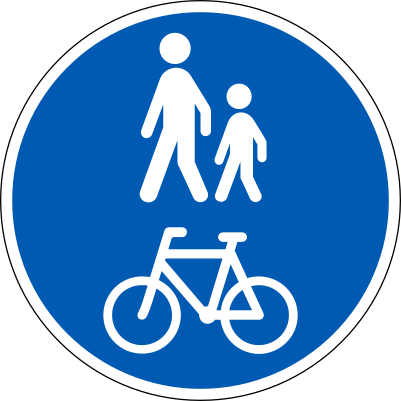 Mandatory shared pedestrian and cycle path.
English • Traffic sign D 27 • Shared path. The road-user categories shown must use the path, which is reserved for them. Users must show mutual consideration under section 3(1) of the Road Traffic Act.
Dansk • Tavle D 27 • Fællessti. Tavlen angiver bane, som skal benyttes af flere færdselsarter og kun må benyttes af disse. Arterne angives ved symbol. Trafikanter på fællessti skal udvise gensidig hensynsfuldhed, jf. færdselslovens § 3, stk. 1.
Sources
🔗 Commons.wikimedia.org
🔗 Retsinformation.dk • Bekendtgørelse nr. 425/2023, § 23
SVG source: Gigillo83, drawn by original of Vejdirektoratet • Public domain • Original revision 2013-06-10. Wikimedia original unmodified.
How does a Danish shared path differ from a divided path?
A Delt sti allocates a separate part to each group shown on the sign. A Fællessti allows the depicted groups to share the path. Follow the actual sign rather than assuming every combined walking and cycling route is undivided.
🔗 retsinformation.dk • Danish signing order BEK 425/2023 — operative sign and marking descriptions
Do Danish shared-path rules give cyclists unrestricted priority over walkers?
No. The official sign rules require users of a shared path to show mutual consideration. Cyclists should adjust speed and passing distance to the people using it. Do not treat a shared surface as an exclusive cycling lane.
🔗 retsinformation.dk • Danish signing order BEK 425/2023 — operative sign and marking descriptions

