


Traffic signsFrance
 Traffic rules
 France
51. Radar speed sign
A radar speed sign warns drivers that vehicle speeds may be monitored by a fixed camera, mobile radar, lidar or average-speed enforcement system. It reminds drivers to check and respect the applicable speed limit.
The sign does not normally establish the speed limit itself. Drivers must follow the general, posted or variable speed limit applying to the road and must not brake suddenly merely because speed enforcement is indicated.
Wikimedia.org • KiwiNeko14 • CC BY-SA
What should a driver understand from a radar or speed-camera warning in France?
It is an indication that speed may be checked or monitored at a point or along a section. Speed monitoring may use different equipment and signs, and any legal obligation to warn drivers depends on the authority and applicable law. It is not, by itself, a new numerical speed limit.
🔗 equipementsdelaroute.cerema.fr • French road-sign order, Article 5-8, signs EB10 and EB20
🔗 service-public.gouv.fr • French Government, national and built-up-area speed limits
Which speed limit applies when a radar warning is displayed in France?
Follow the speed-limit sign, applicable speed zone or statutory road and vehicle limit. A camera symbol or enforcement notice must not be mistaken for a sign raising or ending that limit.
🔗 equipementsdelaroute.cerema.fr • French road-sign order, Article 5-8, signs EB10 and EB20
🔗 service-public.gouv.fr • French Government, national and built-up-area speed limits

52. Selective barriers
Selective barriers are physical access-control devices that allow certain road users or authorised vehicles to pass while restricting other traffic. They may include fixed, removable, folding or retractable bollards, gates, barriers and width-filtering installations.
The permitted users are determined by traffic signs, access conditions and local regulations, not by the barrier alone. Drivers should approach slowly, verify that they are authorised and wait until any moving barrier is fully open or retracted before continuing.
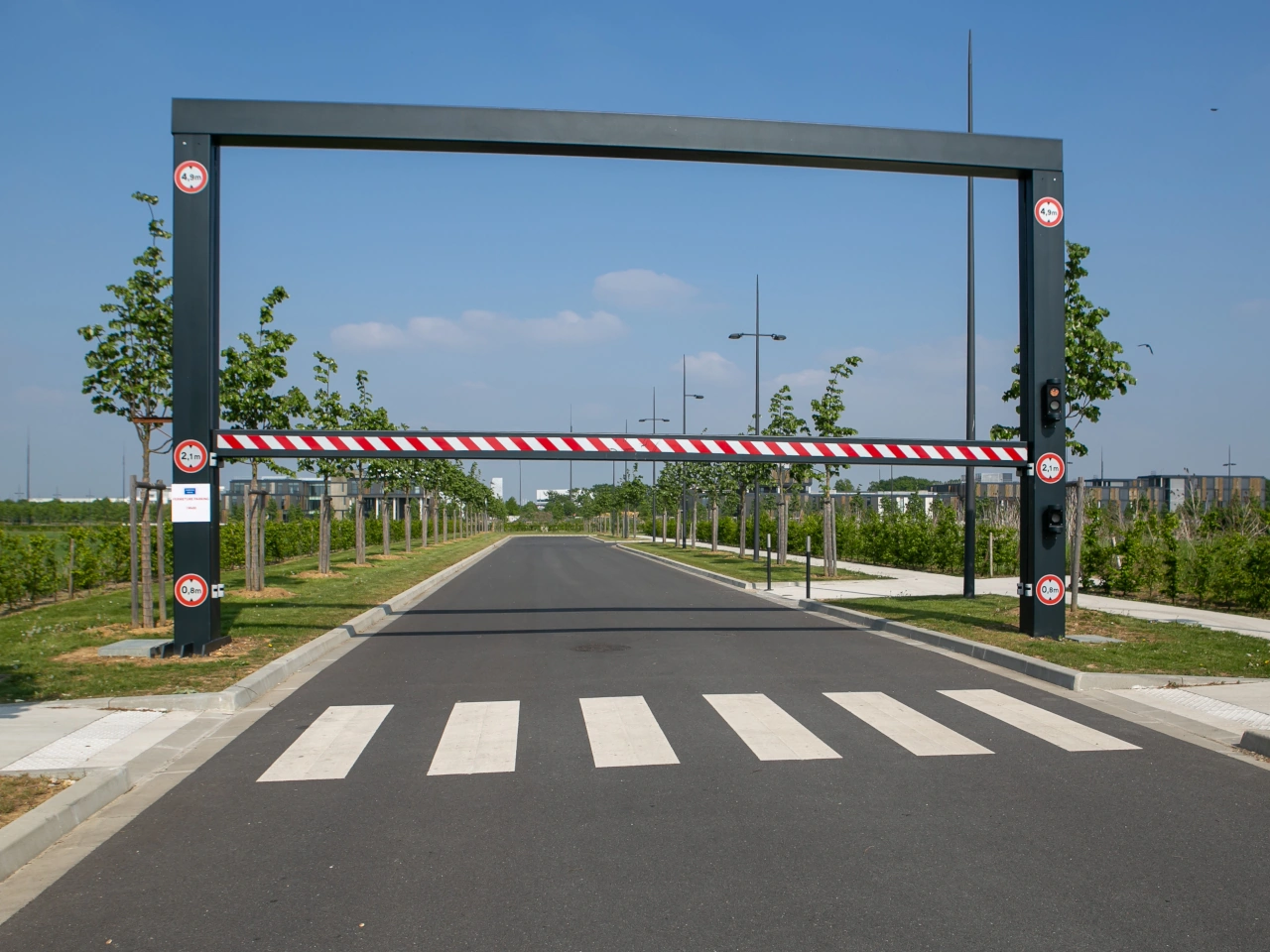
Wikimedia.org • Poudou99 • CC BY
What does a selective barrier control in France?
A bollard, gate, bus filter or other physical access-control device can admit some users and exclude others. It is not a universal traffic-sign category. In France, the relevant sign or local traffic order must be checked.
🔗 sig.strasbourg.eu • Strasbourg Eurometropolis, official circulation access classifications
May a cyclist or motorcycle rider use a gap beside a selective barrier in France?
Only if the applicable access rule permits that road user and the opening is safe and intended for them. A gap designed for pedestrians or cyclists is not permission for an unauthorised motorcycle or car.
🔗 sig.strasbourg.eu • Strasbourg Eurometropolis, official circulation access classifications
53. Low-emission zone
A low-emission zone, or LEZ, is a defined area where access by more polluting vehicles is restricted in order to reduce traffic-related air pollution. Vehicles that do not satisfy the required emission criteria may be prohibited from entering or may require a temporary permit, exemption or day pass.
Access rules commonly depend on factors such as the vehicle category, fuel type and Euro emission standard. Low-emission-zone requirements vary between countries and cities, so drivers should check the applicable rules before entering the zone.
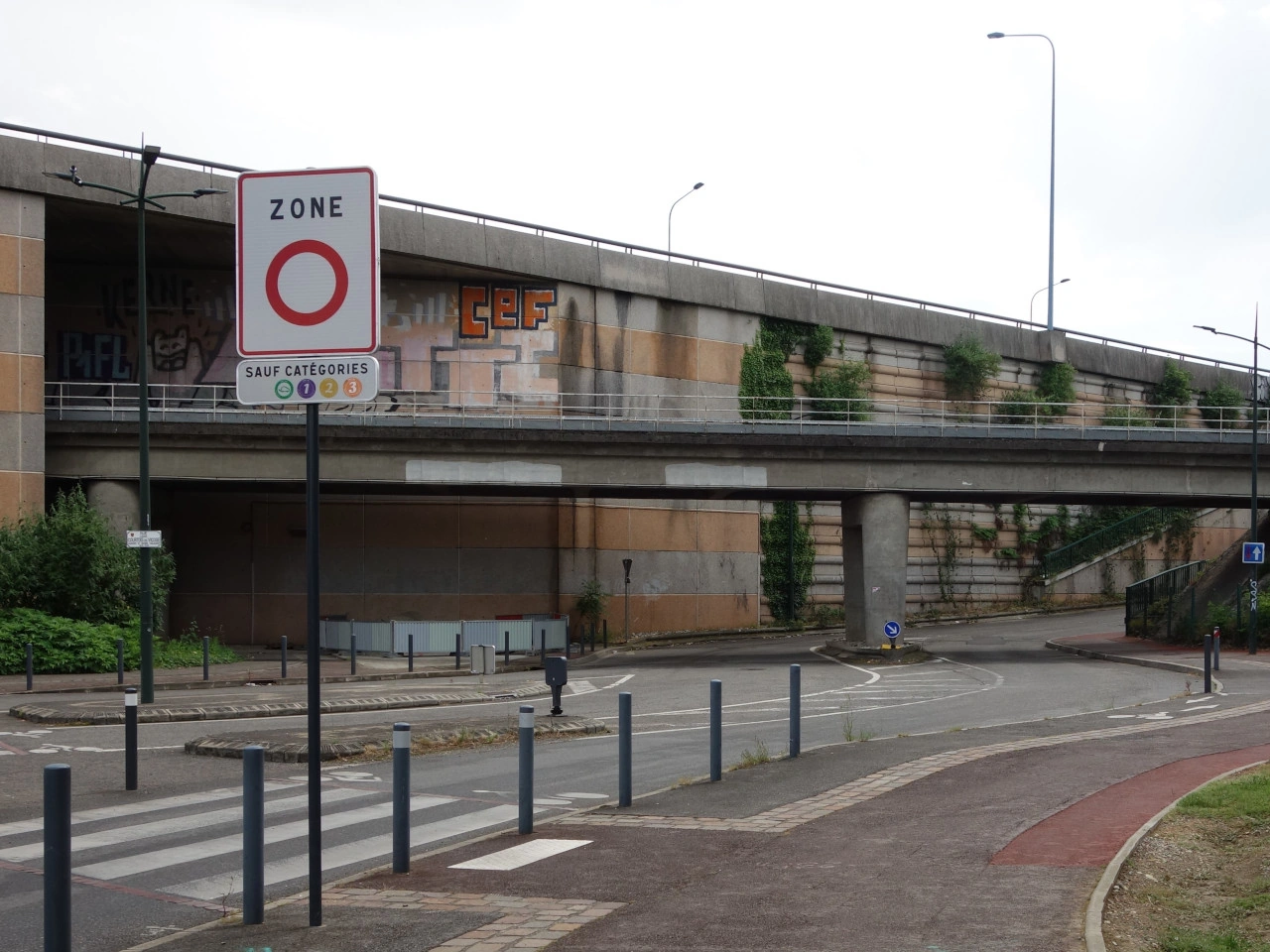
Wikimedia.org • Abdoucondorcet • CC BY-SA
How are low-emission access restrictions applied in France?
French zones à faibles émissions mobilité (ZFE-m) can limit access by vehicle class and pollution category. A suitable Crit’Air certificate is normally required within an operating ZFE-m; check that city’s current rules.
Does a French Crit’Air certificate guarantee access to every ZFE-m?
No. Crit’Air identifies the emission classification, but a city’s active ban, hours and exemptions determine whether that particular vehicle may enter.
Does entering an emissions-restricted area change the speed limit in France?
No, not solely because of its emissions designation. Obey the separately applicable speed signs, vehicle restrictions and priority rules. A permit or emissions exemption does not override the normal traffic rules.
54. Priority at the next junction
Priority at the next junction means that drivers travelling on a particular road have priority over traffic entering from intersecting roads at the next junction. The priority arrangement is normally indicated by signs facing both the priority traffic and the traffic that must give way.
Unlike a continuing priority road, this priority applies only at the indicated intersection. Drivers must still approach cautiously and obey traffic lights, authorised officers, crossings, turning rules and other applicable signs.
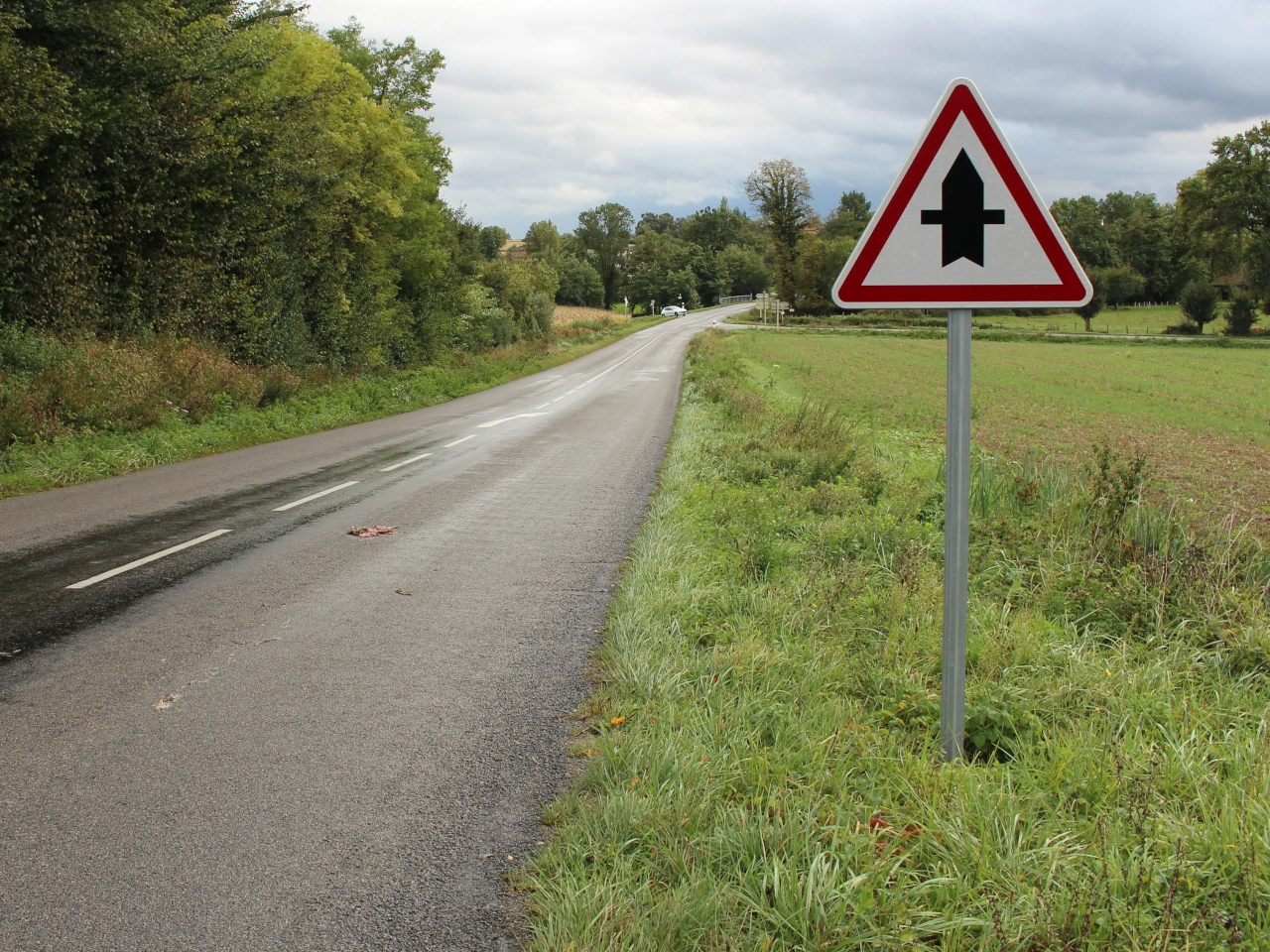
Wikimedia.org • Chabe01 • CC BY-SA
How is priority at the next junction determined in France?
The French AB2 sign indicates priority at the next junction. The AB6 sign identifies a continuing priority road. Read any supplementary junction-layout panel and obey the controls actually present; the two signs have different scopes.
🔗 equipementsdelaroute.cerema.fr • Cerema current IISR part 3 consolidation
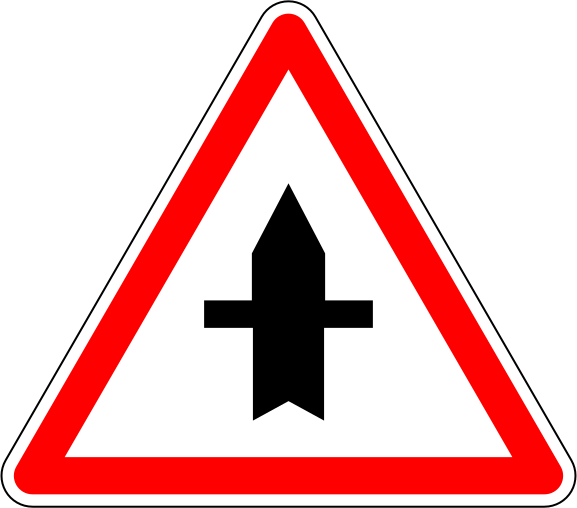 Priority at the junction.
English • Traffic sign AB2 • Junction with a road whose users must give way, where sign AB 6 cannot be used.
Français • Panneau AB2 • Intersection avec une route dont les usagers doivent céder le passage dans le cas où un panneau AB 6 ne peut être utilisé.
Sources
🔗 Commons.wikimedia.org
🔗 Equipementsdelaroute.cerema.fr • Arrêté du 24 novembre 1967
© Roulex 45 et les contributeurs Wikimedia • CC BY-SA 3.0 • SVG original non modifié.
Image via Commons.wikimedia.org
Roulex 45 • CC BY-SA 3.0 • Source revision 2013-07-05. Wikimedia original unmodified.
 Start of a priority road.
English • Traffic sign AB6 • Indication that a road has priority.
Français • Panneau AB6 • Indication du caractère prioritaire d'une route.
Sources
🔗 Commons.wikimedia.org
🔗 Equipementsdelaroute.cerema.fr • Arrêté du 24 novembre 1967
© Roulex 45 et les contributeurs Wikimedia • CC BY-SA 3.0 • SVG original non modifié.
Image via Commons.wikimedia.org
Roulex 45 • CC BY-SA 3.0 • Source revision 2007-09-18. Wikimedia original unmodified.
Does priority at one junction automatically continue along the entire road in France?
No. One-junction priority and continuing priority-road status are distinct concepts. Check the local signs at each following junction, including any end-of-priority marker, traffic signal or new Give Way or Stop sign.
🔗 legifrance.gouv.fr • French Road Code — R411-25, R415-5–7; 1967 order AB2/AB6/AB7 and M7
May a driver with priority ignore pedestrians or another safety obligation at the next junction in France?
No. Junction priority does not cancel duties towards pedestrians, traffic signals, emergency vehicles or other road users where the law gives them precedence. Approach at a speed allowing you to stop safely.
🔗 legifrance.gouv.fr • French Road Code — R411-25, R415-5–7; 1967 order AB2/AB6/AB7 and M7
55. Traffic lights
Traffic lights use coloured lights, arrows or symbols to regulate when road users may proceed, must prepare to stop or must remain stopped. Separate signals may apply to particular directions, lanes, pedestrians, cyclists or public-transport vehicles.
A green light permits movement only when the route is clear and the movement is otherwise legal. Road users must still follow priority rules, turning restrictions, lane markings and instructions from authorised traffic controllers.
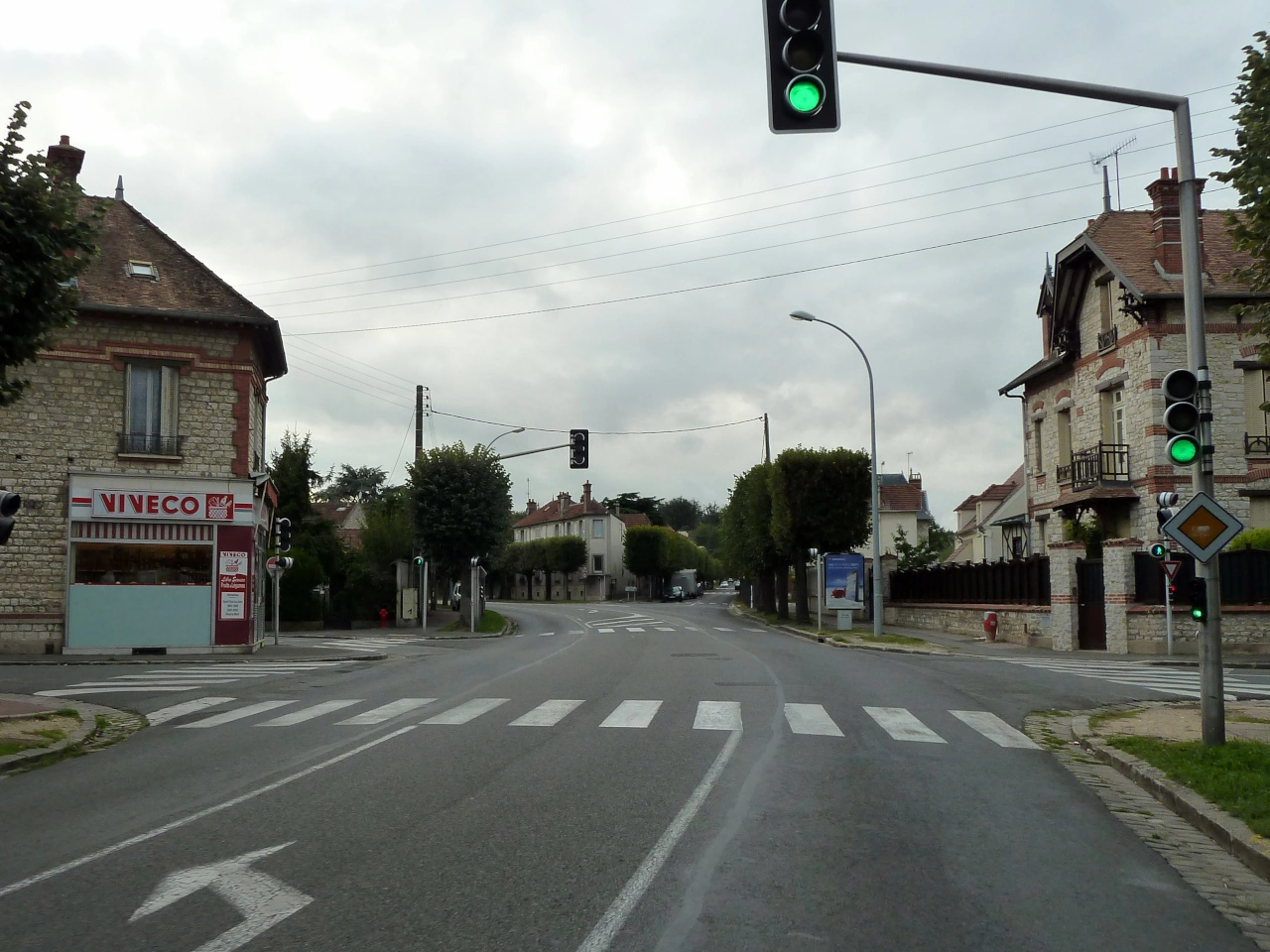
Wikimedia.org • dflegmatic • CC BY
What must a driver do at red, amber and green signals in France?
Red means stop at the applicable line. Amber generally warns that the signal is changing and calls for a stop where it can be made safely; do not accelerate to beat it. Green allows movement only when the way is clear. Observe local arrow, flashing-signal and stop-line rules.
🔗 legifrance.gouv.fr • France, Road Code, articles R412-29–R412-33; 🔗 legifrance.gouv.fr • France, Road Code article R412-33, green lights
May you turn at a red traffic light in France?
An ordinary car must stop at a red signal; stopping and finding an empty road does not itself authorise a turn. Follow any separate permissive signal that applies to your movement. An M12 exemption is limited to its eligible road users and indicated directions, and does not give ordinary cars permission to pass the red light.
🔗 legifrance.gouv.fr • France, Road Code, articles R412-29–R412-33; 🔗 legifrance.gouv.fr • France, Road Code article R412-33, green lights; 🔗 cerema.fr • France, Cerema, signed exemptions at red lights
Can a green light remove the need to give way to pedestrians in France?
No. A green signal is not a guarantee that the junction is empty. Check for people already crossing, vehicles completing a movement and any separate pedestrian, bicycle or turning signals. Do not enter if you cannot clear the junction safely.
🔗 legifrance.gouv.fr • France, Road Code, articles R412-29–R412-33; 🔗 legifrance.gouv.fr • France, Road Code article R412-33, green lights; 🔗 legifrance.gouv.fr • France, Road Code article R415-11, pedestrians
56. Traffic lights warning
A traffic lights warning is a warning sign that alerts drivers that traffic signals are located ahead. It is commonly used where the signals may be unexpected, difficult to see from a distance or located on a road where drivers need additional time to prepare to stop.
Drivers approaching a traffic lights warning should reduce speed when necessary, watch for the signals ahead and be prepared to stop if the traffic light changes or traffic is waiting at the intersection.
Wikimedia.org • Marc Mongenet • CC BY-SA
How are traffic lights ahead warned of in France?
The warning-sign system commonly uses a red-bordered triangular sign with a traffic-light symbol. The precise design and placement depend on the national traffic-sign schedule. This warns of a signal ahead; it is not itself a red traffic light.
🔗 legifrance.gouv.fr • French Road Code — R411-25, R412-30, R413-1, R413-17; 1967 order articles 3–5
Does a traffic-lights-ahead warning require an immediate stop in France?
No. A warning sign is not an automatic STOP instruction and does not create a new numerical speed limit. Reduce speed when necessary, look for a queue or a concealed signal, and obey the traffic lights and any separate speed or stop signs.
🔗 legifrance.gouv.fr • French Road Code — R411-25, R412-30, R413-1, R413-17; 1967 order articles 3–5
What should you check if the next traffic lights are difficult to see in France?
Allow enough distance to stop before the marked line, watch for vehicles braking suddenly and be ready for a pedestrian or cyclist crossing. If the signals are out of order or flashing, follow the applicable local failure and priority rules rather than guessing from the warning sign.
🔗 legifrance.gouv.fr • French Road Code — R411-25, R412-30, R413-1, R413-17; 1967 order articles 3–5
57. Pedestrian lights
Pedestrian lights are traffic signals that regulate when pedestrians may begin crossing a road. They normally display a red standing figure to prohibit starting and a green walking figure to permit crossing.
A flashing signal or countdown may warn that the permitted crossing period is ending. Pedestrians should cross without unnecessary delay, while turning drivers must remain alert and allow pedestrians who entered lawfully to finish crossing safely.
Wikimedia.org • Chabe01 • CC BY-SA
What do pedestrian traffic signals mean in France?
Where fitted, a green walking-person symbol indicates when pedestrians may begin to cross, and a red standing-person symbol means do not begin. Check that traffic has stopped and follow the exact locally displayed symbol or audible instruction.
🔗 equipementsdelaroute.cerema.fr • Cerema current IISR part 6 consolidation
What if the pedestrian signal changes while you are crossing in France?
Begin crossing only when the pedestrian signal permits it. If you started lawfully and the signal changes, continue carefully to a safe place. Drivers must still give way to pedestrians already on the carriageway; a changed light does not make it safe to drive into them.
🔗 paris.fr • City of Paris, pedestrian priority and signal safety, updated February 2026
May turning drivers ignore pedestrians on a signal-controlled crossing in France?
No. Drivers must watch for pedestrians still on the crossing and obey the local rules on giving way when turning. A signal for vehicles does not justify driving into someone who has not yet reached a safe place.
🔗 paris.fr • City of Paris, pedestrian priority and signal safety, updated February 2026
58. Road markings
Road markings are lines, symbols, arrows, words or other markings applied to the road surface to regulate, guide or inform road users. They can separate traffic lanes and opposing directions, indicate where vehicles must stop or give way, mark pedestrian and cyclist crossings and identify areas reserved for particular road users.
Road users should observe the meaning of each road marking and combine it with the applicable traffic signs, signals and traffic rules. Colours, patterns and legal meanings can differ between countries.

Wikimedia.org • Art Anderson • CC BY-SA
Which road markings are important to recognise in France?
Recognise stop and give-way lines, lane-divider markings, continuous lines, directional arrows and pedestrian-crossing markings. Their colour, shape and exact legal effect come from the local traffic rules; do not assume an overseas convention applies unchanged.
🔗 legifrance.gouv.fr • French Road Code — R412-19–20, R412-30, R415-2, R415-15; IISR part 7
May drivers cross a solid road line in France?
In France, a continuous centre or lane-separating line generally must not be crossed or straddled. Article R412-19 specifically permits straddling it to overtake a cycle, motorised personal-mobility device or light cyclomobile under the safety conditions in Article R414-4. That exception permits straddling, rather than fully crossing, the line.
🔗 legifrance.gouv.fr • French Road Code — R412-19–20, R412-30, R415-2, R415-15; IISR part 7
Can painted arrows or stop lines be ignored when signs are not obvious in France?
No. Lane arrows, stop lines and give-way markings can direct where to wait or which movement a lane permits. Read them together with traffic lights, vertical signs and directions from authorised traffic controllers; temporary changes may also apply.
🔗 legifrance.gouv.fr • French Road Code — R412-19–20, R412-30, R415-2, R415-15; IISR part 7
59. Junction layout
A junction layout is a schematic representation of the layout of an upcoming intersection or junction. It can show how roads branch, cross or continue and may help drivers understand which direction to follow before reaching the intersection.
Crossroad-shape diagrams are commonly used on advance direction signs. Depending on the country's sign system, the diagram may also distinguish the main road, side roads, route numbers or destinations.
Wikimedia.org • Marc Mongenet • CC BY-SA
What can a junction-layout diagram tell you in France?
French supplementary M7 junction-layout panels may clarify the direction of a priority route. The layout must be read with the priority sign to which it is attached.
🔗 equipementsdelaroute.cerema.fr • Cerema current IISR part 3 consolidation
🔗 equipementsdelaroute.cerema.fr • Cerema current IISR part 6 consolidation
Does a junction-layout picture itself give priority at a junction in France?
A supplementary diagram helps identify the course of the priority route, but its meaning depends on the accompanying priority sign and local rules. It does not cancel traffic signals or obligations to drive safely.
🔗 equipementsdelaroute.cerema.fr • Cerema current IISR part 3 consolidation
🔗 equipementsdelaroute.cerema.fr • Cerema current IISR part 6 consolidation
Should the drawing be treated as an exact map of the junction in France?
No. A schematic diagram can omit islands, turning lanes, cycle facilities and minor road details. Slow down, check the actual road layout, and follow lane arrows, signs and signals when you reach the intersection.
🔗 legifrance.gouv.fr • French Road Code — R411-25, R415-5–7; 1967 order AB2/AB6/AB7 and M7
60. Bike box
A bike box, also called an advanced stop area, is a marked space at a signal-controlled intersection where cyclists can wait ahead of motor vehicles while the traffic light is red. It is usually positioned between two stop lines and may display a bicycle symbol.
A bike box helps increase cyclist visibility and allows cyclists to position themselves clearly before traffic starts moving. The exact users, markings and traffic-light rules vary between countries.
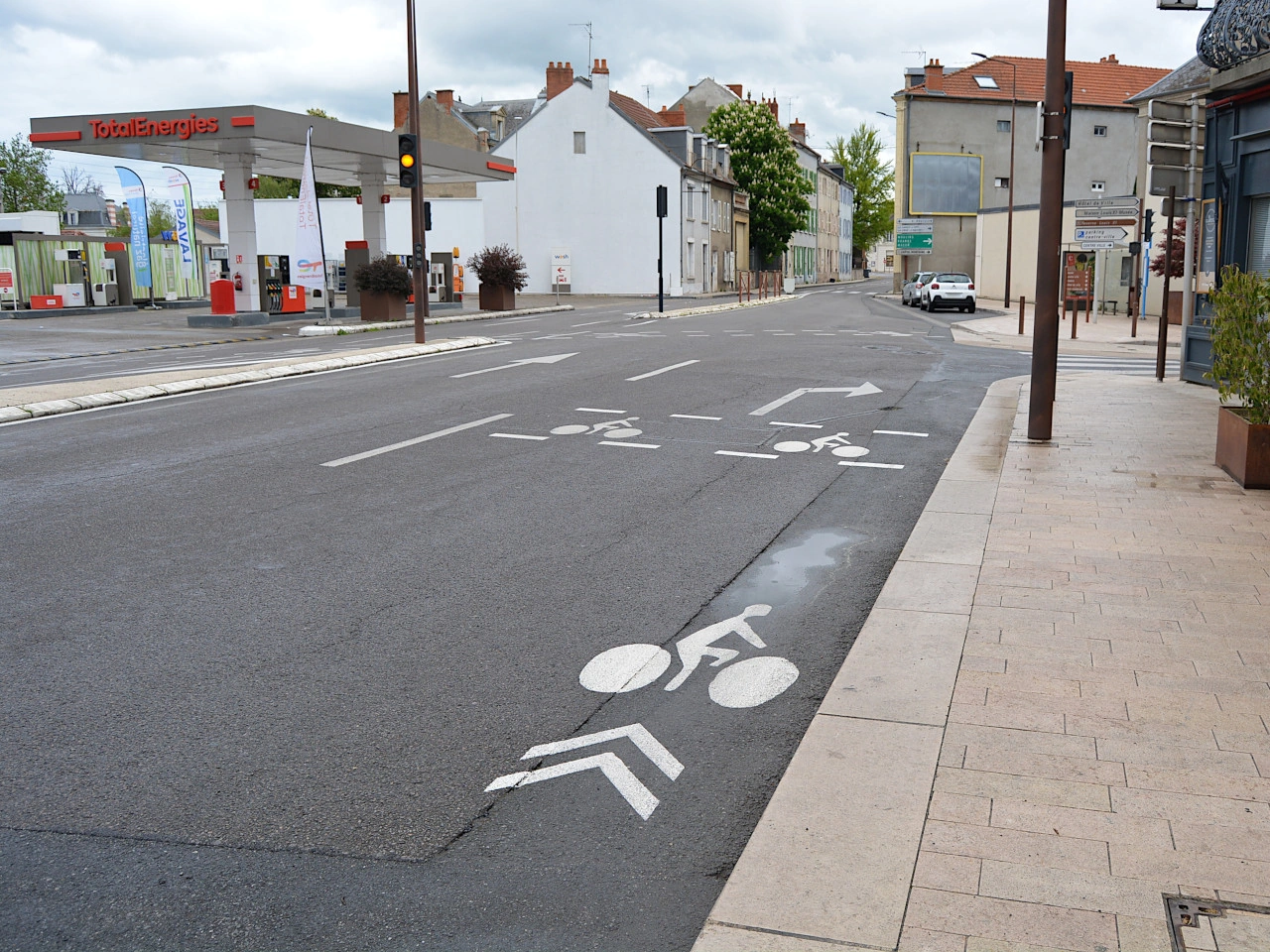
Wikimedia.org • Tabl-trai • CC BY-SA
What is a bike box or advanced stop area in France?
French law allows authorities to mark a sas vélo using two separate stop lines at certain signalised junctions. It is intended for cycles and specified small mobility devices; the authority may also permit mopeds.
🔗 legifrance.gouv.fr • French Road Code — R412-19–20, R412-30, R415-2, R415-15; IISR part 7
Where should a car wait when a marked bike box has a red light in France?
At a French junction with a lawful sas vélo, other vehicles should stop at their own earlier stop line rather than occupying the space reserved for cycles and any other authorised road users. Obey the signal and local markings.
🔗 legifrance.gouv.fr • French Road Code — R412-19–20, R412-30, R415-2, R415-15; IISR part 7
Does a bike box let cyclists ignore a red signal in France?
No. A bike box is a positioning facility, not a general exemption from red traffic lights. Cyclists must obey their applicable lights and any specially authorised turn indications. Turning drivers must check for cyclists moving off when signals change.
🔗 legifrance.gouv.fr • French Road Code — R412-19–20, R412-30, R415-2, R415-15; IISR part 7
61. Speed feedback
Speed feedback is a traffic-safety system that measures an approaching vehicle's speed and displays it back to the driver. The display may show the measured speed together with a message, colour or symbol indicating whether the vehicle is travelling within the applicable speed limit.
Speed feedback displays are intended primarily to make drivers aware of their speed and encourage them to slow down when necessary. They normally serve a preventive or educational purpose rather than establishing a new speed limit.

Wikimedia.org • Julien Bertrand • CC0
What does a speed-feedback display show drivers in France?
A French speed-feedback display can show the approaching vehicle’s measured speed. When the permitted speed is exceeded, the prescribed display gives an alert, which may be accompanied by that speed or a danger warning. The reading is indicative: check your own speed and obey the applicable legal limit.
🔗 equipementsdelaroute.cerema.fr • Cerema current IISR part 9 consolidation
🔗 doc.cerema.fr • Cerema, radar pédagogique definition, permitted displays and no sanction role
Does the number on a speed-feedback board set the legal speed limit in France?
Normally no. A reading showing your measured speed is not itself a new regulatory limit. The limit comes from applicable laws and legally prescribed fixed or variable speed-limit signs; a separate enforceable speed sign must still be obeyed.
🔗 equipementsdelaroute.cerema.fr • Cerema current IISR part 9 consolidation
🔗 doc.cerema.fr • Cerema, radar pédagogique definition, permitted displays and no sanction role
Is every speed-feedback board an enforcement camera in France?
No. Many feedback signs are installed for education and speed awareness. Speed enforcement may occur separately or nearby, so do not assume there is no enforcement; observe the legal limit regardless of whether you see a camera.
🔗 equipementsdelaroute.cerema.fr • Cerema current IISR part 9 consolidation
🔗 doc.cerema.fr • Cerema, radar pédagogique definition, permitted displays and no sanction role
62. Driving licence
A driving licence is an official document authorising a person to drive one or more specified categories of motor vehicle. It may contain conditions, restrictions, category codes and expiry dates that determine which vehicles the holder may drive.
Drivers must hold a licence that is valid for the vehicle category and jurisdiction concerned. A licence may be provisional, full, restricted, suspended or withdrawn, and additional qualifications may be required for professional driving.
Wikimedia.org • Celestin92 • CC BY-SA
Which driving-licence entitlement is needed for an ordinary car in France?
In France, category B is the usual entitlement for an ordinary passenger car (subject to vehicle-mass, seat and other licence conditions). A different entitlement may be needed for motorcycles, heavy vehicles, trailers or passenger transport.
Can a visitor drive in France using a driving licence issued abroad?
A valid, full driving licence issued by another EU country is recognised for the vehicle categories it authorises, subject to the local minimum age. A learner licence or temporary replacement certificate is not automatically recognised across borders. For licences issued outside the EU, check national recognition rules.
Does an International Driving Permit replace the original licence in France?
No. A valid full EU driving licence is normally sufficient for driving elsewhere in the EU; an IDP does not replace it. Non-EU licence holders should check national requirements and carry the underlying licence with any recognised permit.
63. Location marker
A location marker is a roadside reference showing a measured position along a road. It normally identifies a kilometre, mile or smaller interval measured from an established starting point on that route.
Kilometre and hectometre markers help road users, emergency services, road authorities and maintenance crews identify an exact section of road. They do not impose a speed limit, priority rule or access restriction.
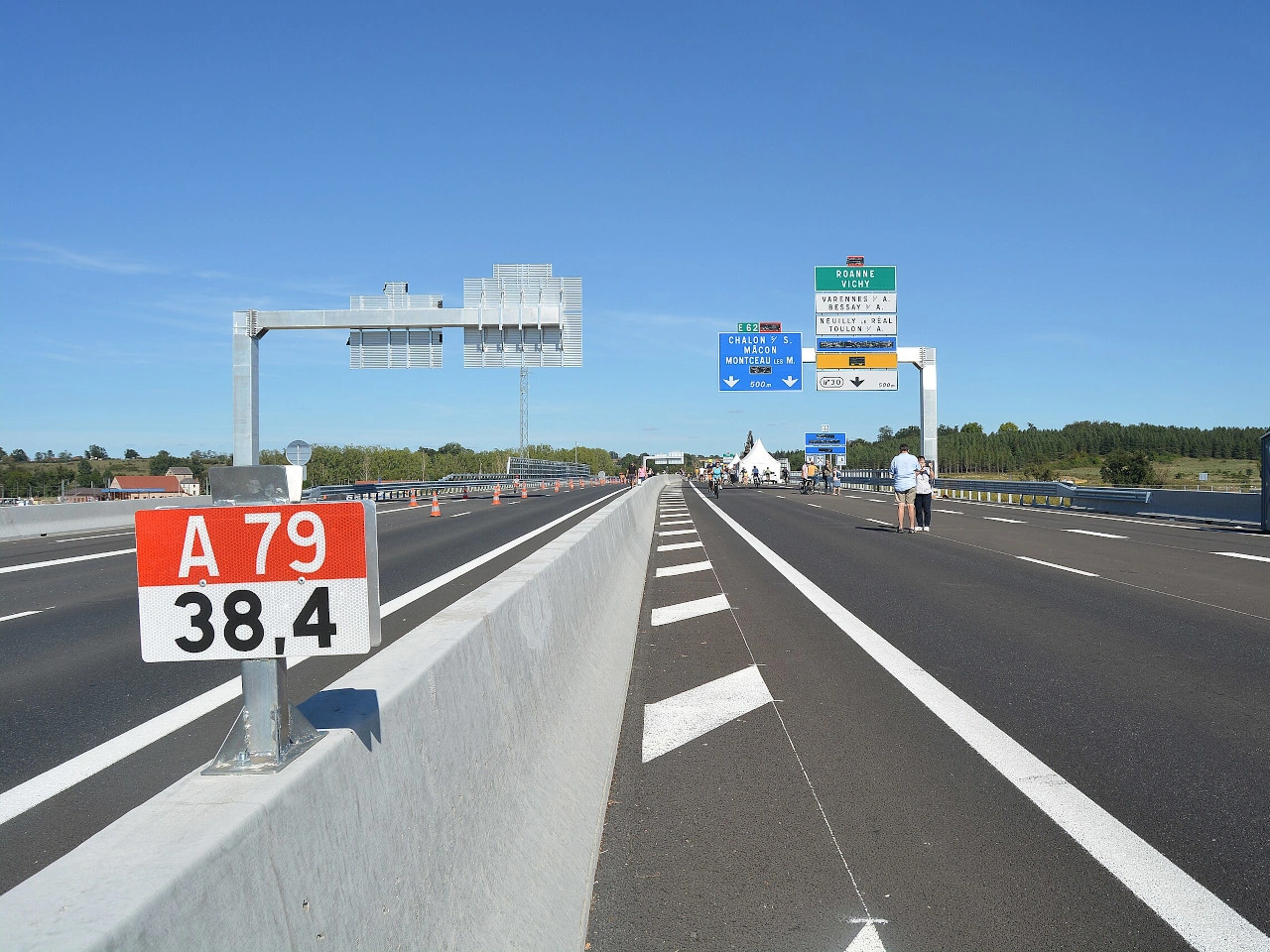
Wikimedia.org • Tabl-trai • CC BY-SA
What does a roadside location marker tell you in France?
French roadside markers can identify the road and a point de repère (PR) or other reference position. They help locate a position on the route; they are different from signs giving the distance to a town. A reference-point number should not automatically be read as an exact kilometre distance.
🔗 equipementsdelaroute.cerema.fr • French road-sign order, Article 5-8, signs EB10 and EB20
🔗 service-public.gouv.fr • French public service portal, motorway breakdown recovery
How can a location marker help in an emergency in France?
If you can see a marker safely, give the emergency operator the route number or road name, travel direction and marker reading. Additional landmarks, exits and GPS position can help. Do not leave a safe place or enter traffic to read a post.
🔗 equipementsdelaroute.cerema.fr • French road-sign order, Article 5-8, signs EB10 and EB20
🔗 service-public.gouv.fr • French public service portal, motorway breakdown recovery
Does a location marker set a speed limit or permit stopping in France?
No. A location marker is for orientation and road management; it does not itself set a speed limit, change priority or permit parking. Follow the actual traffic signs and stop only where the law and safety allow.
🔗 equipementsdelaroute.cerema.fr • French road-sign order, Article 5-8, signs EB10 and EB20
🔗 service-public.gouv.fr • French public service portal, motorway breakdown recovery
64. Road number
A road number is a number or combination of letters and numbers used to identify a particular road or route within a road network. Road numbers help drivers follow routes, distinguish between different types of roads and navigate between cities, regions and countries.
Road numbers are commonly displayed on route markers and direction signs. Their format, colour and prefixes vary between countries and may indicate whether a route is a motorway, national road, regional road or international route.

Wikimedia.org • Tabl-trai • CC BY-SA
How are road or route numbers identified in France?
Common examples include A motorways, N national roads and D departmental roads. Follow the route shield and destination signs, because some routes share a section of road or change designation at a border.
🔗 equipementsdelaroute.cerema.fr • French road-sign order, Article 5-8, signs EB10 and EB20
🔗 service-public.gouv.fr • French Government, national and built-up-area speed limits
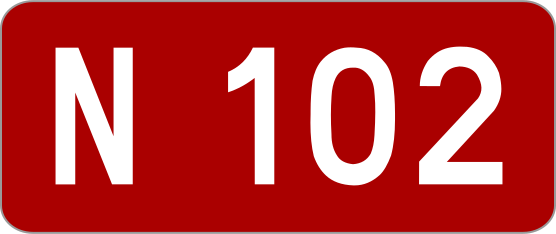 Ordinary road number.
English • Traffic sign E42 • Red route number panel identifying roads and motorways in the national network. Example shown: N 102, a national road; this is not a motorway number.
Français • Panneau E42 • Cartouche à fond rouge caractérisant les routes et autoroutes du réseau national. Exemple représenté : N 102, une route nationale ; ce n’est pas un numéro d’autoroute.
Sources
🔗 Commons.wikimedia.org
🔗 Legifrance.gouv.fr • Arrêté du 24 novembre 1967 • article 5-7 Source : Roulex 45 • Domaine public • SVG original non modifié.
Image via Commons.wikimedia.org
Roulex 45 • Public domain • Source revision 2014-05-05. Wikimedia original unmodified.
Does a route number by itself establish a speed limit in France?
No. A route number is an identification and navigation reference. Legal speed limits and other restrictions come from the applicable road category, vehicle rules and regulatory signs; the same route number may include sections with different limits.
🔗 equipementsdelaroute.cerema.fr • French road-sign order, Article 5-8, signs EB10 and EB20
🔗 service-public.gouv.fr • French Government, national and built-up-area speed limits
What should you check when following a numbered route in France?
Check the route number, destination, direction and junction or exit signs. If the route shares the road with another number or continues onto a different road class, follow the signs rather than relying solely on a navigation app.
🔗 equipementsdelaroute.cerema.fr • French road-sign order, Article 5-8, signs EB10 and EB20
🔗 service-public.gouv.fr • French Government, national and built-up-area speed limits
65. Countdown markers
Countdown markers are a sequence of roadside signs that indicate that a particular point, such as a motorway exit, junction or railway crossing, is getting closer. They commonly use a decreasing number of bars or other symbols so drivers can judge their progress toward the upcoming location.
The markers are normally positioned at successively shorter distances from the point ahead. Their design, spacing and meaning vary between countries, so drivers should not assume that each bar always represents the same distance.
Wikimedia.org • Marc Mongenet • CC BY-SA
What do countdown or exit-approach markers mean in France?
French motorway advance direction signs identify approaching exits and interchanges. Read the exit or destination information and any displayed distance, and prepare for the correct lane in good time.
What should you do if you are too late to take a motorway exit in France?
Continue safely to the next lawful exit or junction. Do not stop, reverse, make a U-turn or cross the median to reach a missed exit. Plan lane changes early and follow any lane-control signals.
66. Public toilet
A public toilet is a toilet facility available for use by travellers or the general public. Along roads, public toilets are commonly found at service areas, rest areas, filling stations, parking facilities and tourist locations.
Public toilets may be indicated by a facility or service symbol showing a toilet pictogram. The exact sign design and whether the facility is free, paid or accessible at particular times depend on the country and location.
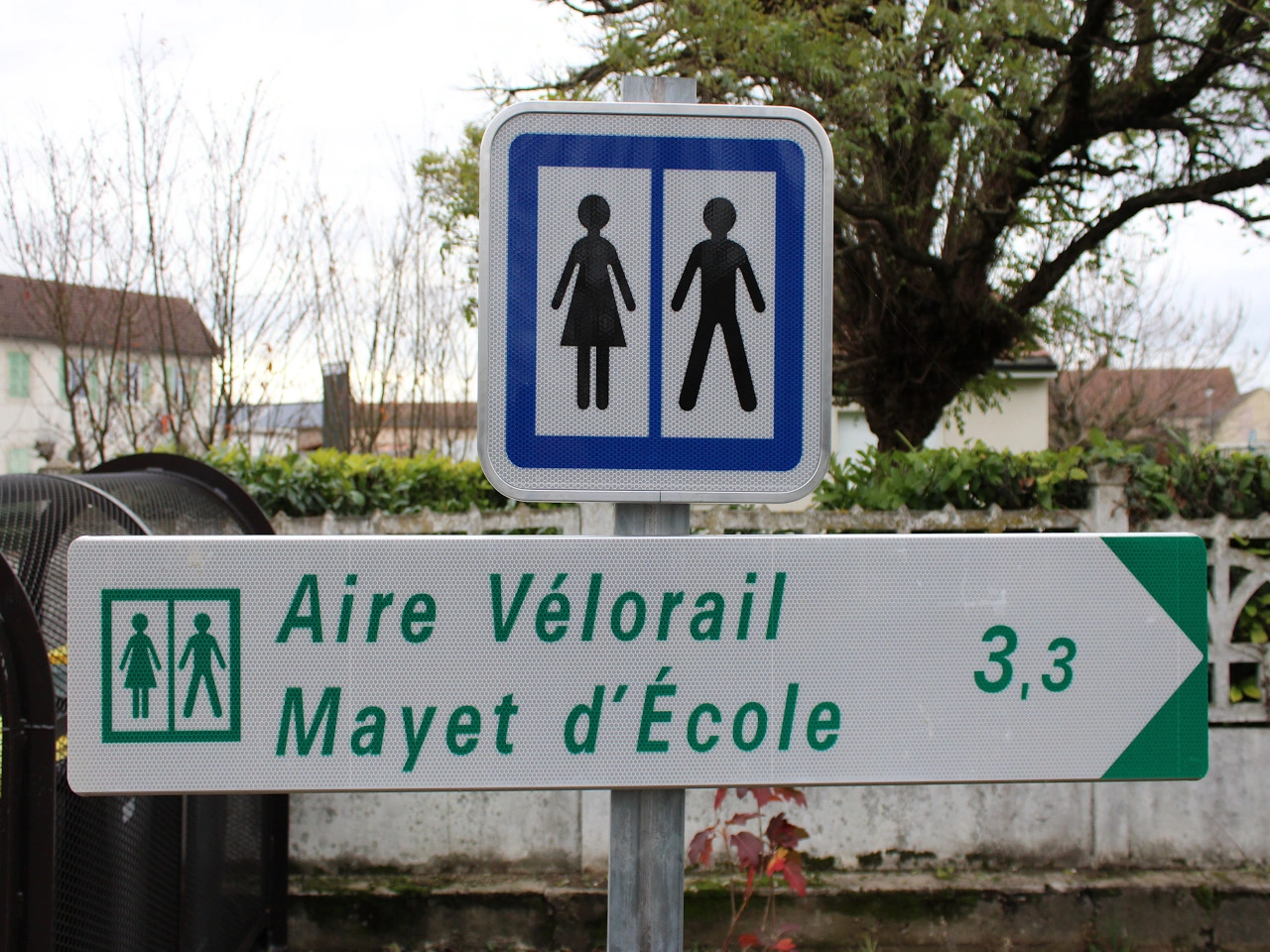
Wikimedia.org • Tabl-trai • CC BY-SA
Where can road users find public toilets in France?
Motorway aires de service are a useful place to look. French Economy Ministry guidance describes these service areas as generally providing free toilets. Check the signs, the facilities listed for the particular area and any current closure notices before relying on it.
🔗 economie.gouv.fr • French Economy Ministry, motorway service-area facilities
What does a toilet pictogram on a road sign mean in France?
It is an information or service-facility symbol, pointing to a location where toilets are indicated. It does not by itself impose a speed limit, priority rule or driving restriction; designs differ by sign system.
67. Rest area
A rest area is a designated place beside a road or motorway where drivers can leave the main traffic flow and stop for a break. Rest areas may provide parking spaces and, depending on the location, facilities such as toilets, picnic areas, food, fuel or charging stations.
Rest areas allow drivers and passengers to pause their journey in a safer location away from moving traffic. The facilities available and the signs used to indicate them vary between countries.

Wikimedia.org • Marc Mongenet • CC BY-SA
Why are rest areas important?
Rest areas give drivers a suitable place to stop, rest and reduce fatigue without stopping on the main traffic lanes or roadside.
🔗 gov.uk • Great Britain Highway Code, Rule 262, motorway rest stops; national guidance example
68. Traffic mirror
A traffic mirror is a convex mirror installed near an intersection, driveway, bend or other location with restricted visibility. Its curved surface provides a wider view of approaching road users than an ordinary flat mirror.
A traffic mirror is only a visibility aid. It may distort distance, speed and direction and may be affected by darkness, weather, dirt or damage. Drivers must continue to observe the road directly, obey all priority rules and proceed only when it is safe.
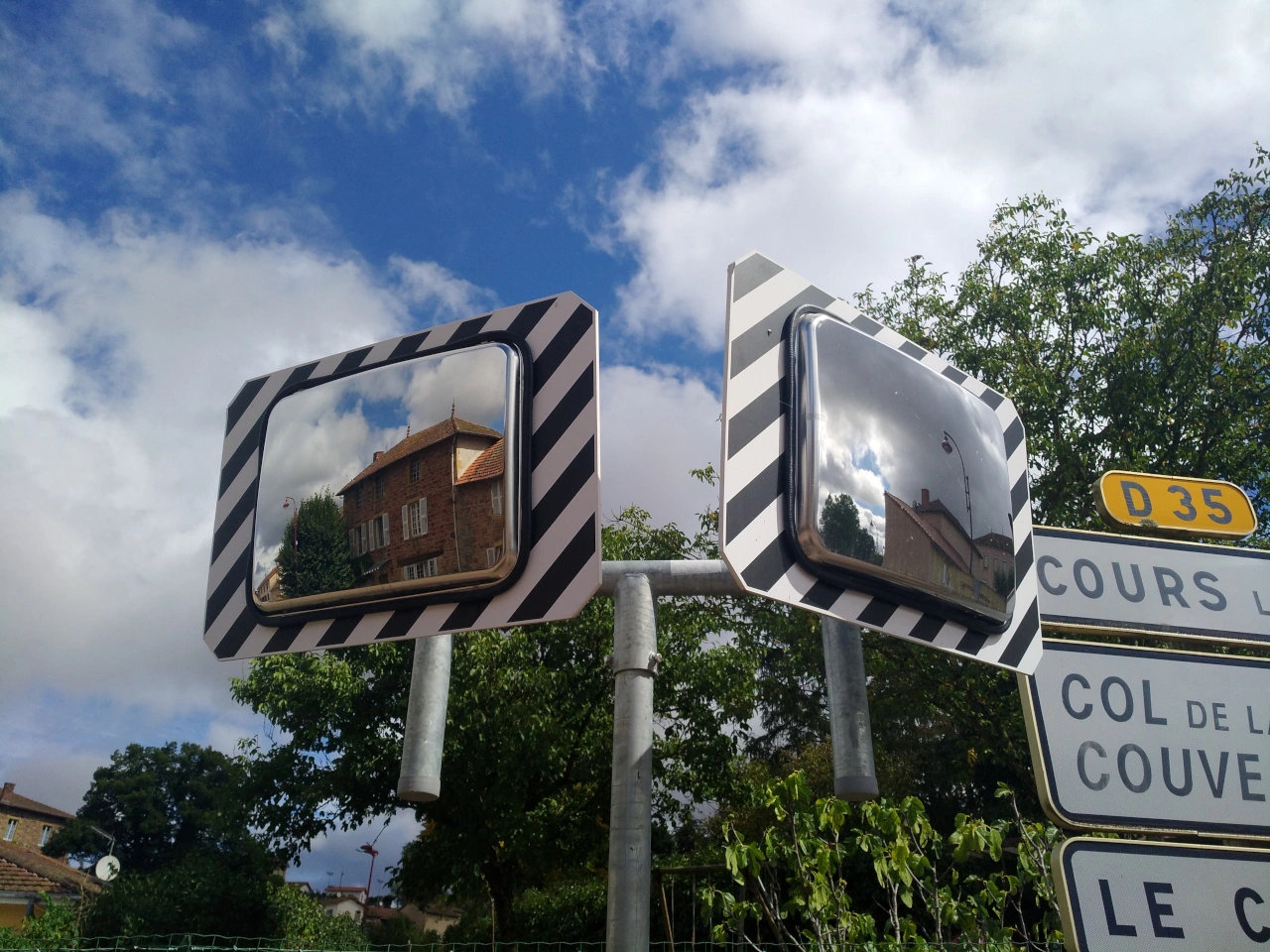
Wikimedia.org • Sebleouf • CC BY-SA
What is a traffic mirror?
A traffic mirror is a roadside visibility aid that can help users see around a blind corner or obstruction. It gives an indirect view, which may be restricted or distorted; it does not replace checking whether it is safe to proceed.
🔗 monmouthshire.gov.uk • Monmouthshire Council, roadside visibility mirrors
🔗 devon.gov.uk • Devon County Council, mirrors on the highway
Does a traffic mirror show an exact image?
No. The reflected image can be distorted, and glare, bad weather or dirt can restrict the view. Judging an approaching vehicle’s speed from a mirror can be difficult. Do not rely on the mirror alone.
🔗 monmouthshire.gov.uk • Monmouthshire Council, roadside visibility mirrors
🔗 devon.gov.uk • Devon County Council, mirrors on the highway
Does seeing an empty mirror mean the road is clear?
No. Another road user may be outside the reflected area, hidden by glare or too small to notice. Always check the road directly before proceeding.
🔗 monmouthshire.gov.uk • Monmouthshire Council, roadside visibility mirrors
🔗 devon.gov.uk • Devon County Council, mirrors on the highway
69. Emergency telephone
An emergency telephone is a dedicated roadside or tunnel telephone that connects road users directly with an emergency, traffic-control or roadside-assistance centre. Emergency telephones are commonly installed in tunnels, along motorways or at other locations where quickly reporting an accident, breakdown or fire is important. They can provide operators with useful information about the caller’s location and may remain available where mobile-phone reception is poor.
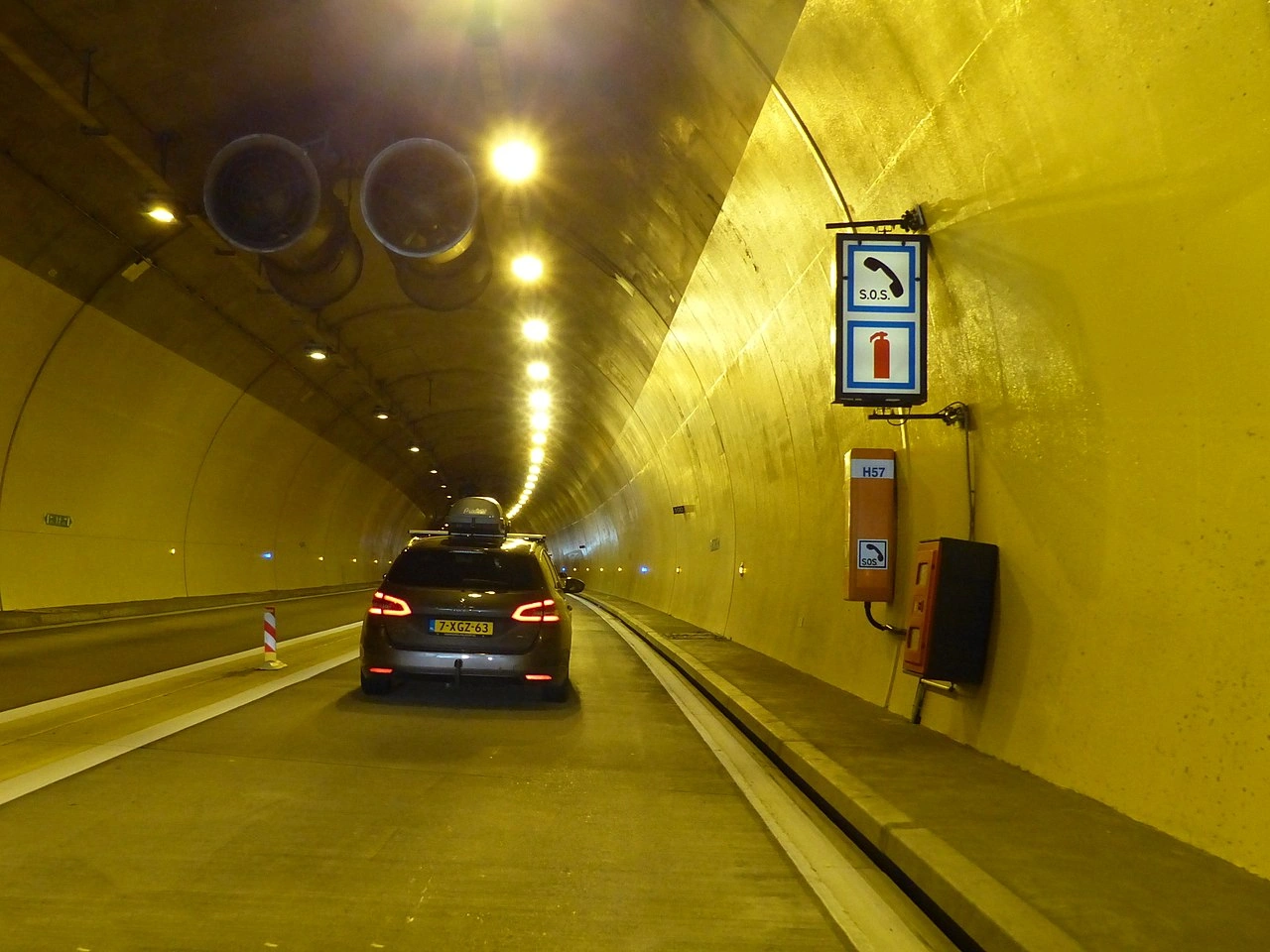
Wikimedia.org • Marc Mongenet • CC BY-SA
What is an emergency telephone?
An emergency telephone is a dedicated telephone used to contact emergency services, a traffic-control centre or roadside assistance from the road.
🔗 gov.uk • Great Britain Highway Code, Rules 275–279; national guidance example
🔗 gov.uk • Great Britain Highway Code, Rules 270–274; national guidance example
Where are emergency telephones commonly found?
They are commonly installed in road tunnels, motorway emergency areas and other locations where rapid assistance may be needed.
🔗 gov.uk • Great Britain Highway Code, Rules 275–279; national guidance example
🔗 gov.uk • Great Britain Highway Code, Rules 270–274; national guidance example
When should you use an emergency telephone?
Use an emergency telephone to report situations such as a breakdown, accident, fire or other serious road emergency when assistance is required.
🔗 gov.uk • Great Britain Highway Code, Rules 275–279; national guidance example
🔗 gov.uk • Great Britain Highway Code, Rules 270–274; national guidance example
70. International border
An international border is the legal boundary between two countries. A border sign may identify the country being entered and remind drivers that different traffic laws, speed limits, road signs, vehicle requirements and document rules may apply.
The border sign itself does not normally require drivers to stop. Passport, immigration or customs controls may take place at a checkpoint, but some international borders can be crossed without routine controls under regional agreements.
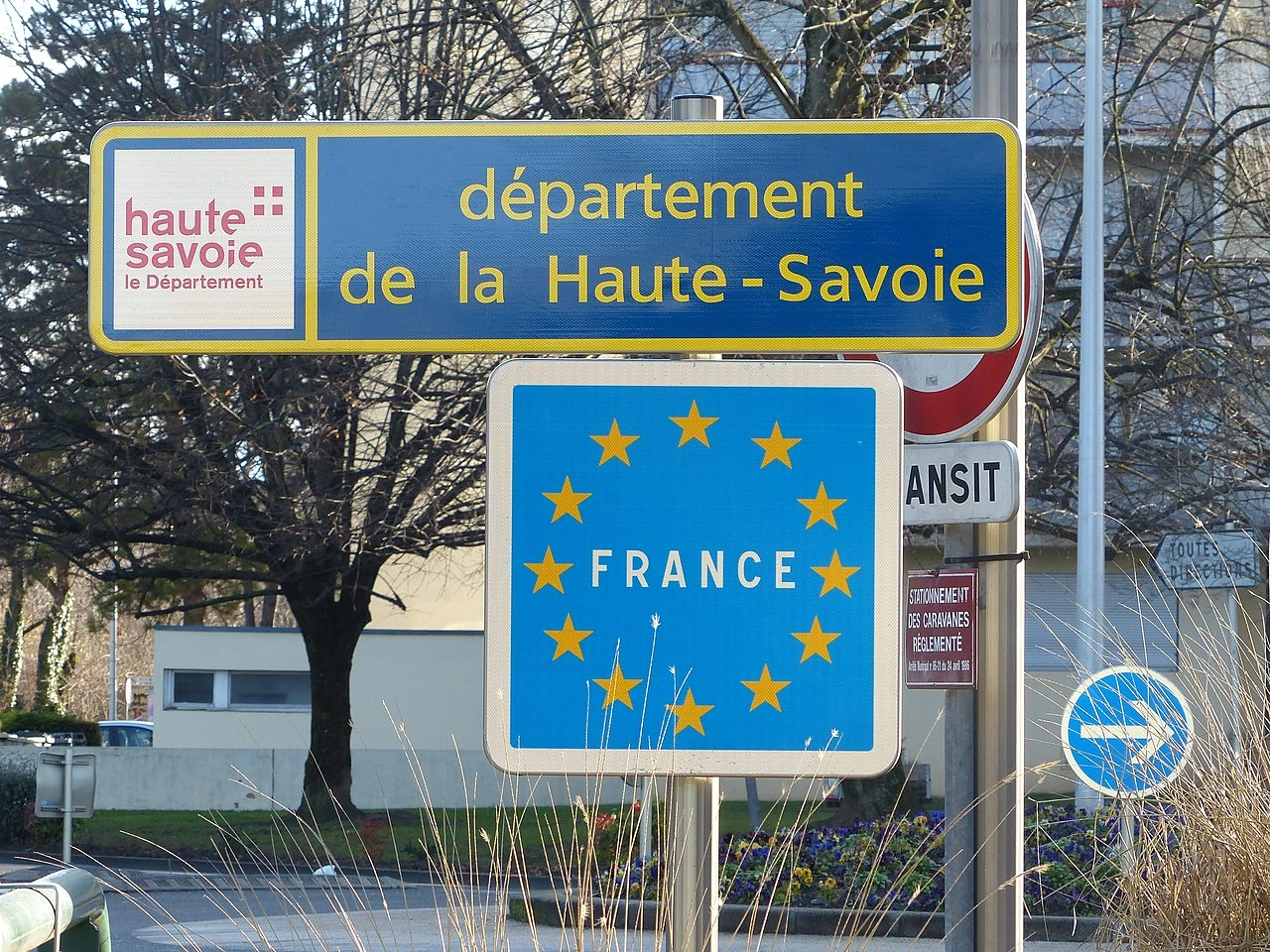
Wikimedia.org • Marc Mongenet • CC BY-SA
What is an international border?
An international border is the legal boundary between two countries.
🔗 dictionary.cambridge.org • Cambridge Dictionary, international border definition
Does a border sign require you to stop?
Not normally. Stop only when required by traffic lights, barriers, officers, customs signs, passport controls or another instruction.
🔗 europa.eu • Your Europe, travel documents for EU nationals; EU example
Can speed limits change at the border?
Yes. The destination country may have different general limits for motorways, built-up areas, rural roads and particular vehicle categories.
🔗 europa.eu • Your Europe, travel documents for EU nationals; EU example
71. Cycling route
A cycling route is a planned or signposted route intended to guide cyclists between places or through a particular area. It may follow cycle paths, quiet streets, shared roads, greenways or other routes considered suitable for cycling.
A cycling route does not necessarily give cyclists exclusive use of the road or path and should not be confused with a cycle path or cycle lane. The traffic rules, priority rules and permitted road users depend on the individual roads and paths that form the route and on the local signs and regulations.
Wikimedia.org • Chabe01 • CC BY-SA
How can you recognise a cycling route?
Cycling routes are commonly indicated by direction signs, bicycle symbols, route numbers, colours or destination markers. The design of the signs and route-numbering system varies between countries and regions.
Do cyclists have priority on a cycling route?
Not automatically. Being on a designated cycling route does not normally change the priority rules. Cyclists must continue to obey traffic lights, give-way and stop signs, crossing rules and other applicable traffic regulations.
What should you do when a cycling-route sign conflicts with a traffic sign?
Always follow the official traffic signs, signals and road markings. A route marker provides navigation and does not override a prohibition, mandatory direction, road closure or other traffic regulation.
72. End of restriction
End of restriction means the end of one or more local traffic restrictions that applied to vehicles on the preceding section of road. It may be indicated by a specific end-of-restriction sign, by the crossed-out version of an earlier restriction sign or by another sign that establishes a new rule.
After a de-restriction sign, drivers must follow the normal traffic rules and any new restrictions that apply. It does not mean that there are no speed limits or traffic rules beyond the sign.

Wikimedia.org • Tabl-trai • CC BY-SA
What does French sign B31 mean?
B31 marks the end of all previously signed prohibitions applicable to moving vehicles. It should not be read as permission to ignore normal speed limits or unrelated traffic restrictions.
🔗 equipementsdelaroute.cerema.fr • Cerema current IISR part 4 consolidation
🔗 service-public.gouv.fr • French Government, national and built-up-area speed limits
How is the end of only a French speed restriction shown?
The B33 sign ends a previously indicated maximum-speed restriction; B31 has a broader end-of-prohibitions meaning. After either sign, obey the speed limit that applies to the road and circumstances.
🔗 equipementsdelaroute.cerema.fr • Cerema current IISR part 4 consolidation
🔗 service-public.gouv.fr • French Government, national and built-up-area speed limits
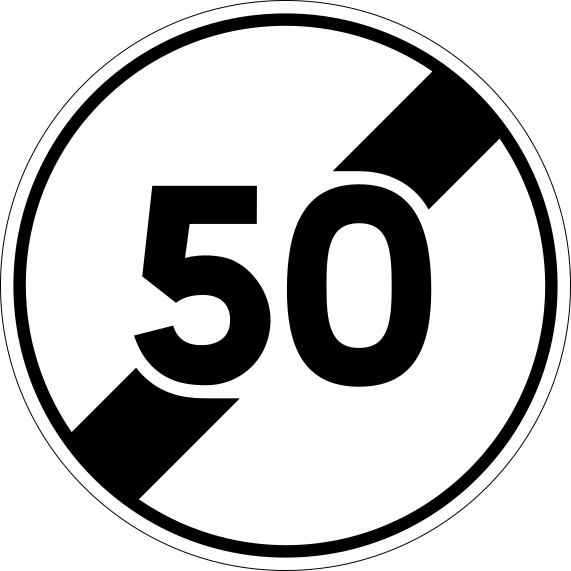 End of the speed limit.
English • Traffic sign B33 • End of speed limit.
Français • Panneau B33 • Fin de limitation de vitesse.
Sources
🔗 Commons.wikimedia.org
🔗 Equipementsdelaroute.cerema.fr • Arrêté du 24 novembre 1967
© Roulex 45 et les contributeurs Wikimedia • CC BY-SA 4.0 • SVG original non modifié.
Image via Commons.wikimedia.org
Roulex 45 • CC BY-SA 4.0 • Source revision 2022-12-22. Wikimedia original unmodified.
73. Parking
Parking means leaving a vehicle stationary at a place for a period of time rather than stopping only briefly because of traffic conditions or another immediate necessity. Many countries distinguish parking from a short stop made to pick up or drop off passengers or to load or unload goods, although the exact legal definition varies.
Parking may be permitted, restricted, reserved, time-limited or prohibited by traffic signs, road markings, parking zones and local regulations. Drivers must park without creating a danger or unnecessary obstruction and must comply with any conditions concerning payment, permits, vehicle categories or maximum parking duration.
Wikimedia.org • Marc Mongenet • CC BY-SA
May you park on either side of a two-way street in France?
In built-up areas, the general rule on a two-way carriageway is to stop or park on the right, except where a local rule provides otherwise. On a one-way street, either side may be used unless restricted.
🔗 legifrance.gouv.fr • France, Road Code, article R417-1, built-up areas
Can you leave a car in the same public-road space indefinitely in France?
No. More than seven days in the same place is abusive parking. A municipal order can impose a shorter period.
Does every short wait count as a legal stop in France?
No. A stop is limited to necessary boarding, alighting, loading or unloading, with the driver at the controls or nearby to move the vehicle. Other immobilisation is parking.
🔗 legifrance.gouv.fr • France, Road Code, article R110-2, definitions
74. No parking
No parking indicates that vehicles may not be left parked at the location or along the section of road covered by the restriction. Depending on local law, a driver may still be allowed to stop briefly to pick up or drop off passengers or to load or unload goods, provided stopping itself is not prohibited.
A no-parking restriction may apply continuously or only during specified times, days, vehicle categories or sections of road. Its exact extent and exceptions are determined by the traffic sign, supplementary panels, road markings and local traffic regulations.
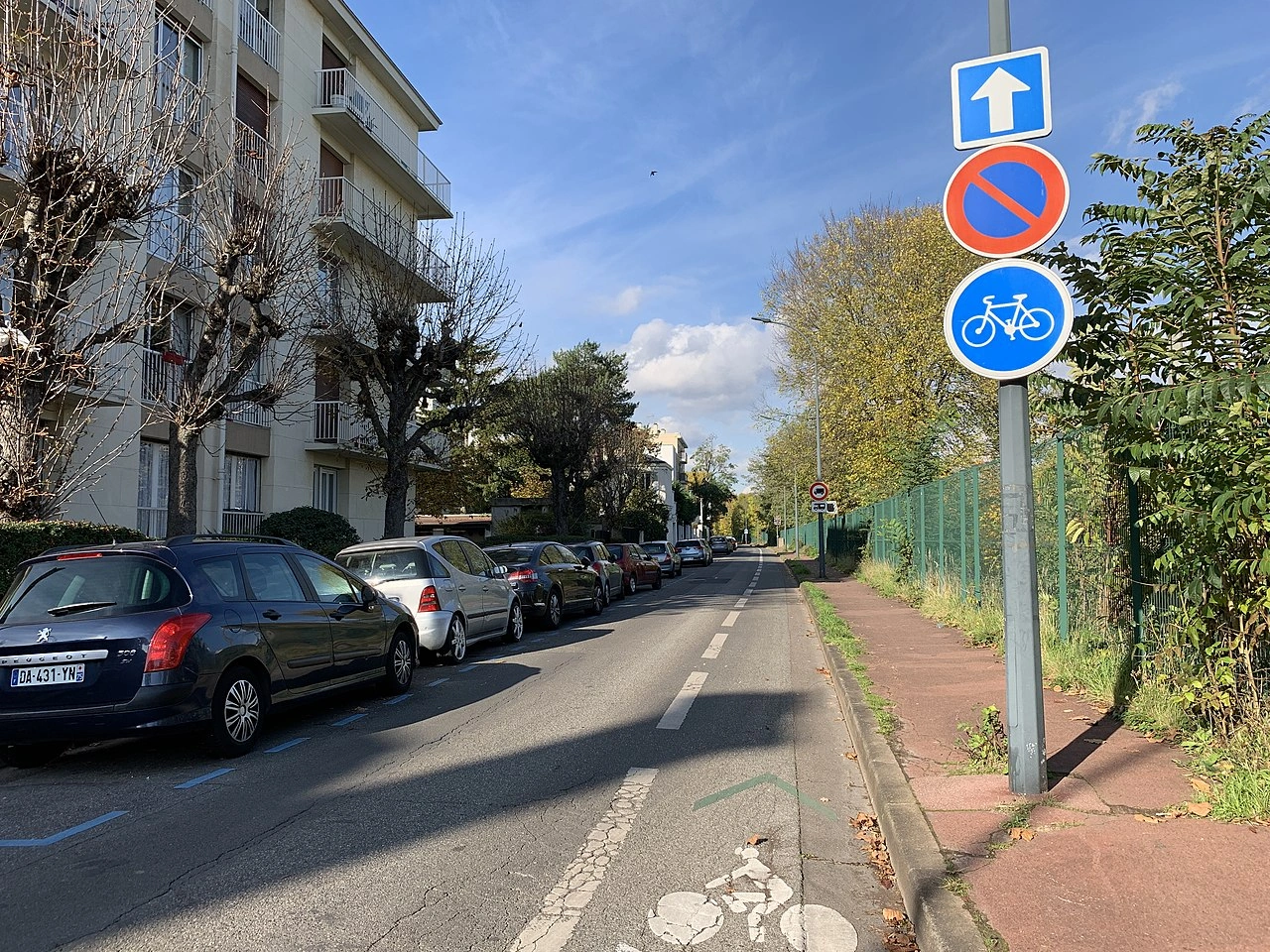
Wikimedia.org • Chabe01 • CC BY-SA
Which French sign prohibits parking without automatically prohibiting every brief stop?
The French B6a1 sign is the ordinary no-parking prohibition. The B6d sign prohibits both stopping and parking. Check any supplementary time, category or zone panel.
🔗 cerema.fr • Cerema, vertical signs B6a1 and B6d
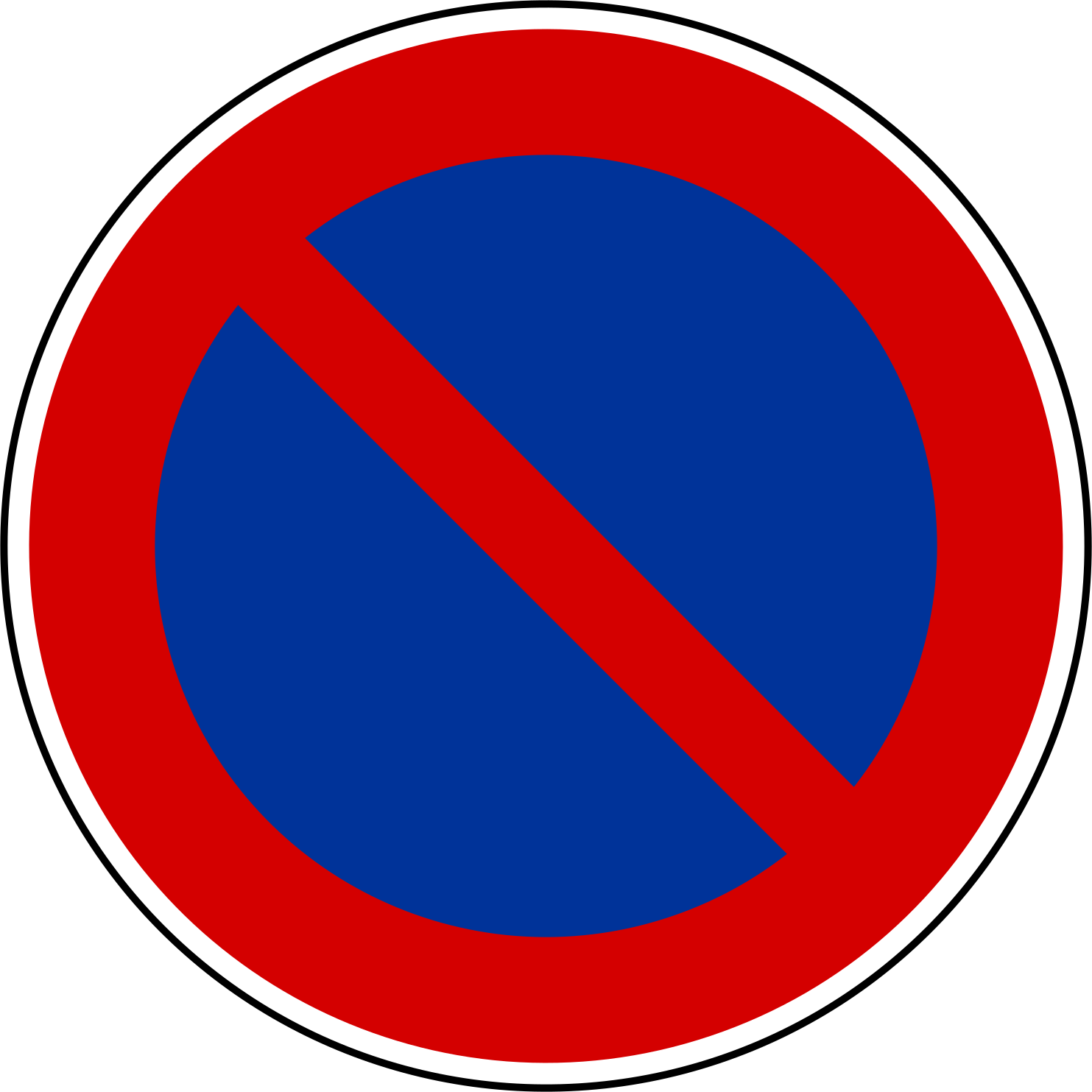 Parking prohibited.
English • Traffic sign B6a1 • No parking.
Français • Panneau B6a1 • Stationnement interdit.
Sources
🔗 Commons.wikimedia.org
🔗 Equipementsdelaroute.cerema.fr • Arrêté du 24 novembre 1967
© Roulex 45 et les contributeurs Wikimedia • CC BY-SA 4.0 • SVG original non modifié.
Image via Commons.wikimedia.org
Roulex 45 • CC BY-SA 4.0 • Source revision 2013-01-23. Wikimedia original unmodified.
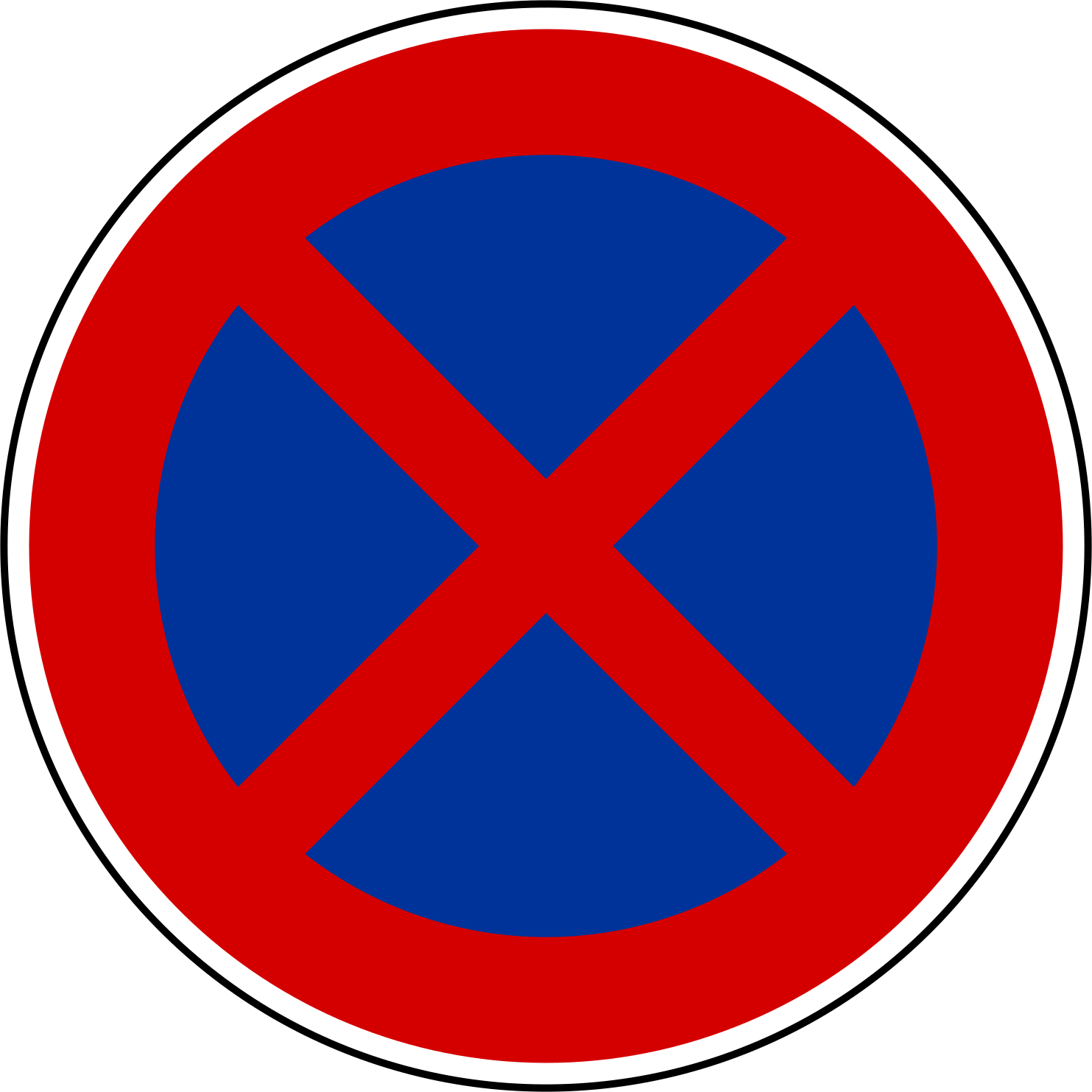 Parking and stopping prohibited.
English • Traffic sign B6d • No stopping or parking.
Français • Panneau B6d • Arrêt et stationnement interdit.
Sources
🔗 Commons.wikimedia.org
🔗 Equipementsdelaroute.cerema.fr • Arrêté du 24 novembre 1967
© Roulex 45 et les contributeurs Wikimedia • CC BY-SA 4.0 • SVG original non modifié.
Image via Commons.wikimedia.org
Roulex 45 • CC BY-SA 4.0 • Source revision 2013-01-23. Wikimedia original unmodified.
Can you park in a French delivery bay after deliveries have finished?
Only if the local rules permit parking at that time. Delivery bays are not automatically available simply because no delivery is taking place.
75. No stopping
No stopping means that vehicles are not permitted to stop voluntarily at the indicated location, even briefly for picking up or dropping off passengers or loading or unloading goods. It is a stricter restriction than a no-parking rule.
A no-stopping restriction may be indicated by a traffic sign, road marking or local traffic regulation. Drivers should continue to a place where stopping is permitted unless they are forced to stop by traffic conditions, an emergency or another legal requirement.
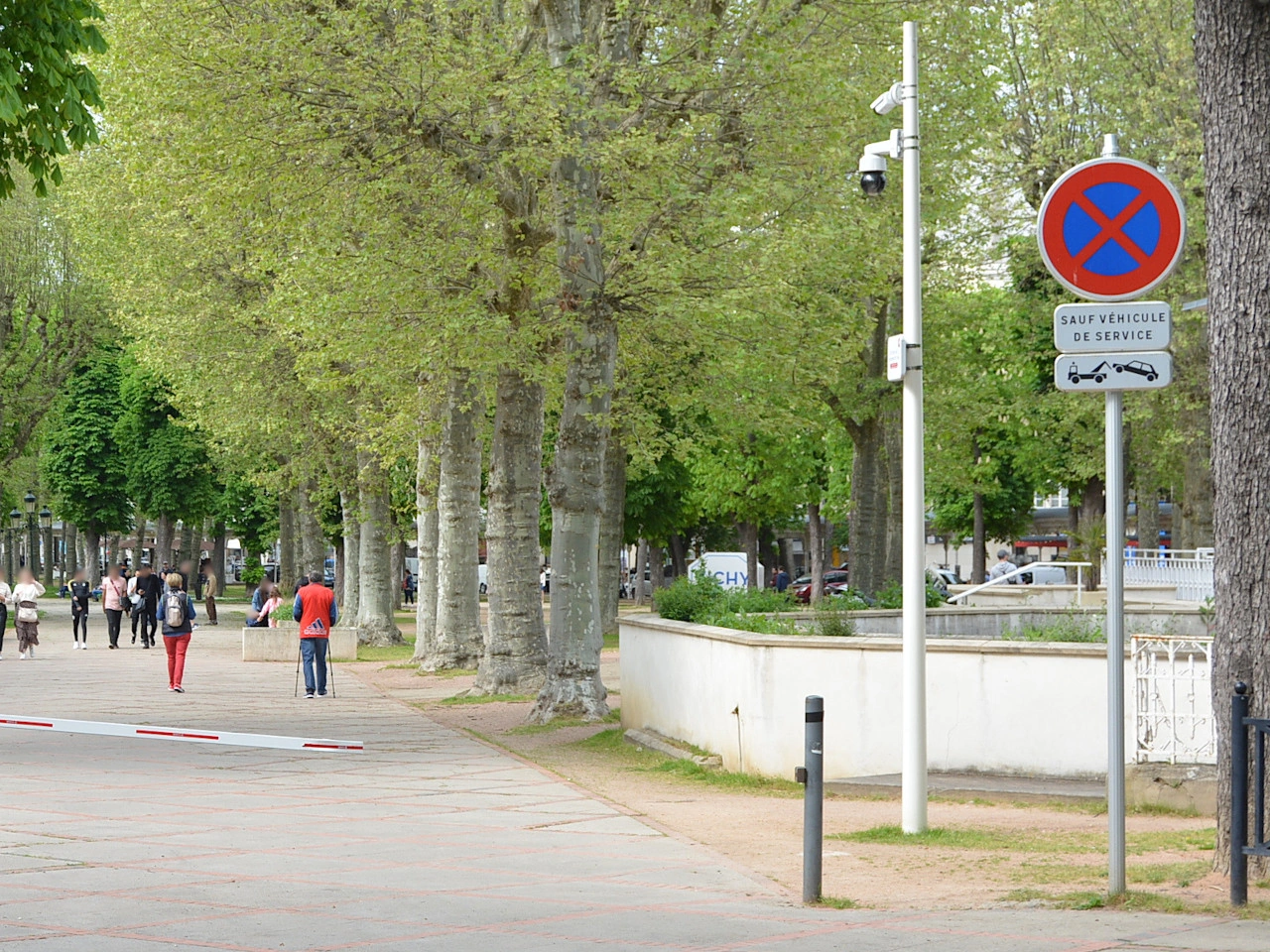
Wikimedia.org • Tabl-trai • CC BY-SA
Which French sign bans both stopping and parking?
Sign B6d prohibits both arrêt (stopping) and stationnement (parking). The parking-only B6a1 restriction is different; check supplementary panels and local exceptions.
🔗 cerema.fr • Cerema, vertical signs B6a1 and B6d
Parking and stopping prohibited.
English • Traffic sign B6d • No stopping or parking.
Français • Panneau B6d • Arrêt et stationnement interdit.
Sources
🔗 Commons.wikimedia.org
🔗 Equipementsdelaroute.cerema.fr • Arrêté du 24 novembre 1967
© Roulex 45 et les contributeurs Wikimedia • CC BY-SA 4.0 • SVG original non modifié.
Image via Commons.wikimedia.org
Roulex 45 • CC BY-SA 4.0 • Source revision 2013-01-23. Wikimedia original unmodified.
Parking prohibited.
English • Traffic sign B6a1 • No parking.
Français • Panneau B6a1 • Stationnement interdit.
Sources
🔗 Commons.wikimedia.org
🔗 Equipementsdelaroute.cerema.fr • Arrêté du 24 novembre 1967
© Roulex 45 et les contributeurs Wikimedia • CC BY-SA 4.0 • SVG original non modifié.
Image via Commons.wikimedia.org
Roulex 45 • CC BY-SA 4.0 • Source revision 2013-01-23. Wikimedia original unmodified.
May an ordinary car stop on a French cycle lane to let a passenger out?
No. Stopping or parking on cycle lanes and cycle tracks is classified as very obstructive. A brief passenger drop-off does not create an exemption.