


Traffic rulesFrance
 Traffic rules
 France
1. France
France is a large country in Western Europe, bordered by Belgium, Luxembourg, Germany, Switzerland, Italy, Monaco, Spain and Andorra. Traffic drives on the right, and driving conditions range from dense urban traffic to long rural journeys and mountain roads in areas such as the Alps and Pyrenees. France has an extensive autoroute network, and many motorway sections are tolled rather than covered by a national vignette. Drivers should also remember that maximum speeds are reduced in rain and other poor-weather conditions.
French is the official language and is the main language used for text on traffic signs and destination signs. Regional languages may also appear alongside French on some local signage; French-Breton bilingual road signs, for example, can be encountered in Brittany. Drivers entering some urban areas should also check whether a Crit'Air environmental sticker is required, while winter equipment rules apply seasonally in designated mountainous areas.
AI-generated by Traffic-rules.com • WCIT • CC BY-SA
Which number can you call in an emergency in France?
Call 112 for urgent emergency assistance. Give the operator your location and explain what happened.
🔗 service-public.gouv.fr • French Government, emergency numbers
What is the legal alcohol limit for drivers in France?
For most drivers, driving is prohibited with a blood-alcohol concentration at or above 0.5 g/l. For probationary drivers, the threshold is 0.2 g/l. These are offence thresholds, not permitted target levels; additional lower-threshold categories also exist.
What speed limits apply to passenger cars in France?
Built-up areas: The general maximum is 50 km/h unless another limit applies. Ordinary roads outside built-up areas: The general maximum is 80 km/h. On sections with at least two lanes assigned to the same direction, the national maximum is 90 km/h on those lanes; the local authority may also set 90 km/h on qualifying two-way sections without a central separator. Divided roads: The general maximum is 110 km/h. Motorways: The general maximum is 130 km/h. Precipitation: The maximum falls to 110 km/h on motorway sections normally limited to 130 km/h, 100 km/h on divided roads and 80 km/h on other roads outside built-up areas; any additional lower applicable limit still governs. Visibility below 50 metres: The maximum is 50 km/h on every road. Probationary drivers: The maxima are 110 km/h on motorway sections normally limited to 130 km/h, 100 km/h on other motorway sections and divided roads, and 80 km/h on other roads outside built-up areas. Always obey a lower applicable limit.
What are the seat-belt and child-restraint rules in France?
Seat belts are mandatory for drivers and passengers on seats equipped with them, subject to specific legal exemptions.
Children under 10 must normally travel on a rear seat in an approved child restraint suited to their size and weight. A child-restraint exemption applies where the child is already large enough for the adult seat belt, has the prescribed medical exemption, or travels in a taxi or public-transport vehicle.
Front-seat travel under 10 is allowed only in specified cases, including a suitable rear-facing child seat with the airbag deactivated, no rear seats or rear belts, temporarily unusable rear seats, or all rear seats already occupied by children under 10. From age 10, use the fitted seat belt.
🔗 europa.eu • Your Europe / national authorities, France road rules, Seat belts and child restraints; 🔗 service-public.gouv.fr • French Government, seat belts, child restraints and front-seat exceptions
Can you use a mobile phone while driving in France?
Holding a mobile phone while driving is prohibited. Drivers are also prohibited from wearing headphones, earphones or similar devices that emit sound, except approved hearing-assistance devices.
🔗 europa.eu • Your Europe / national authorities, France road rules, Mobile telephone
When is winter equipment required in France?
From 1 November to 31 March, designated mountain municipalities require specified winter equipment. For an ordinary car, the main alternatives are four qualifying 3PMSF winter tyres or carrying removable snow chains or snow socks suitable for at least two driven wheels. Other vehicle categories and vehicles towing trailers can have different requirements. Check the signed zone and local rules before travelling.
What safety equipment must you carry in a car in France?
Cars must carry a high-visibility safety vest and warning triangle. The vest should be accessible from inside the vehicle. A spare wheel and breathalyser are not generally mandatory.
Can a visitor use a driving licence issued in another EU country in France?
Yes. A valid, full EU driving licence is recognised for the vehicle categories it covers. You must meet the applicable minimum age. A learner licence or a temporary replacement certificate does not have the same automatic recognition.
When must children use a child seat in France?
Children under 10 normally travel in the rear seats in an approved restraint suited to their size and weight. Specific exceptions allow front-seat travel, including a rear-facing seat with the front airbag disabled. The official rules also provide limited restraint exemptions.
🔗 service-public.gouv.fr • French Government, child seats and seat belts

2. Motorway
A motorway is a road specially designed and signposted for motor traffic. Motorways normally have separate carriageways for opposing traffic, controlled access through designated entrances and exits, no direct access to neighbouring properties, and no level crossings with other roads, railways or paths.
Special traffic rules apply on motorways. The permitted road users, speed limits, lane rules, tolls and emergency procedures vary between countries, so drivers must follow the local traffic signs and regulations.
Wikimedia.org • Tabl-trai • CC BY-SA
How do people refer to a motorway in France?
The French term is autoroute. A divided road is not automatically an autoroute; the motorway designation determines which special rules apply.
🔗 legifrance.gouv.fr • French Road Code — R413-2, R413-4–5, R421-1–9
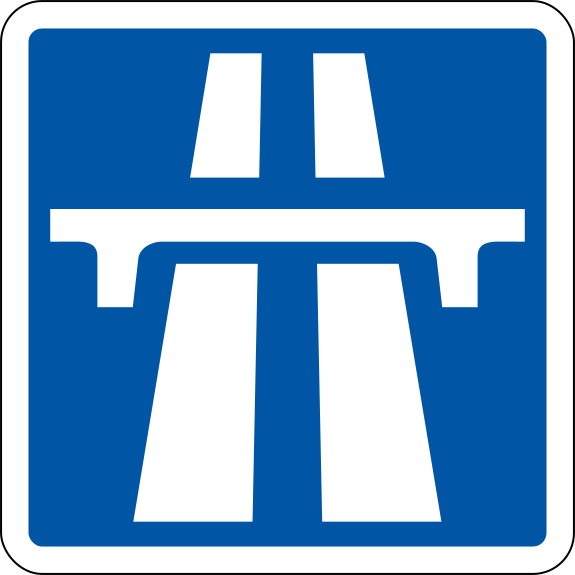 Start of a motorway.
English • Traffic sign C207 • Beginning of a motorway section. This sign marks the start of the special motorway traffic rules.
Français • Panneau C207 • Début d'une section d'autoroute. Ce panneau annonce le début de l'application des règles particulières de circulation sur autoroute.
Sources
🔗 Commons.wikimedia.org
🔗 Equipementsdelaroute.cerema.fr • Arrêté du 24 novembre 1967
© Roulex 45 et les contributeurs Wikimedia • CC BY-SA 3.0 • SVG original non modifié.
Image via Commons.wikimedia.org
Roulex 45 self-made from source above • CC BY-SA 3.0 • Source revision 2024-10-04. Wikimedia original unmodified.
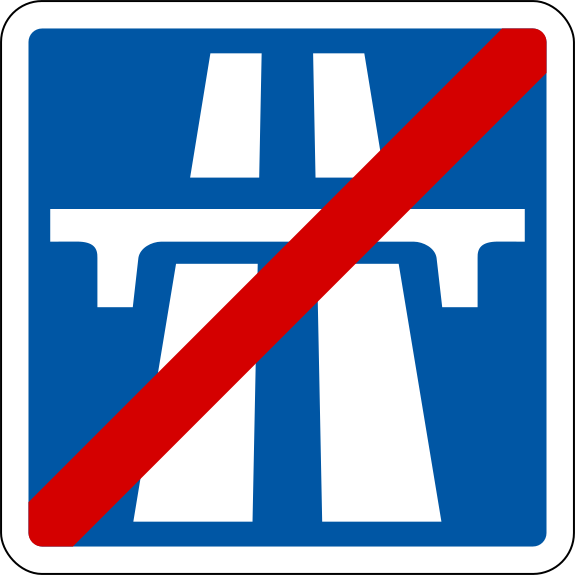 End of the motorway.
English • Traffic sign C208 • End of a motorway section. This sign marks the end of the special motorway traffic rules.
Français • Panneau C208 • Fin d'une section d'autoroute. Ce panneau annonce la fin de l'application des règles particulières de circulation sur autoroute.
Sources
🔗 Commons.wikimedia.org
🔗 Equipementsdelaroute.cerema.fr • Arrêté du 24 novembre 1967
© Roulex 45 et les contributeurs Wikimedia • CC BY-SA 3.0 • SVG original non modifié.
Image via Commons.wikimedia.org
Roulex 45 self-made from source above • CC BY-SA 3.0 • Source revision 2024-10-04. Wikimedia original unmodified.
What speed limit applies to cars on a motorway in France?
For an ordinary car, the normal maximum is 130 km/h, reduced to 110 km/h during rain or other precipitation. Probationary drivers are also limited to 110 km/h. When visibility is below 50 metres, the maximum is 50 km/h. Obey lower signs and adjust speed to conditions.
🔗 legifrance.gouv.fr • French Road Code — R413-2, R413-4–5, R421-1–9
Who may use a motorway in France?
Pedestrians, bicycles, mopeds, motor quadricycles, tractors and agricultural machinery are among the road users excluded from motorways. Other categories are also excluded. Public-works machinery may be admitted only under the specified official authorisation; being motorised does not by itself give motorway access.
🔗 legifrance.gouv.fr • French Road Code — R413-2, R413-4–5, R421-1–9
What should I do if I miss a motorway exit in France?
Continue to the next exit and choose a safe onward route. Do not reverse, make a U-turn or cross the central reservation to return to a missed exit.
🔗 legifrance.gouv.fr • French Road Code — R413-2, R413-4–5, R421-1–9
Who should recover a broken-down vehicle on a French motorway?
On a concession motorway (autoroute concédée), recovery must be handled by an approved motorway recovery operator. Contact the motorway operator through its emergency system and follow its instructions.
3. Expressway
An expressway is a road intended to carry through traffic efficiently, usually at higher speeds than ordinary roads. Expressways often have limited access, multiple lanes, separated carriageways or grade-separated junctions, but their design and legal status vary between countries.
An expressway is not always a motorway. It may have intersections, traffic lights or direct access, and the permitted road users, speed limits and special rules depend on local signs and regulations.
Wikimedia.org • Marc Mongenet • CC BY-SA
How do people refer to an expressway in France?
The legal French term is route à accès réglementé. Access is restricted to designated entry points. The legal classification can also exclude particular categories of road user or vehicle; check the restrictions on the road you enter.
🔗 legifrance.gouv.fr • Légifrance, Road Infrastructure Code, Articles L151-1 and L151-2
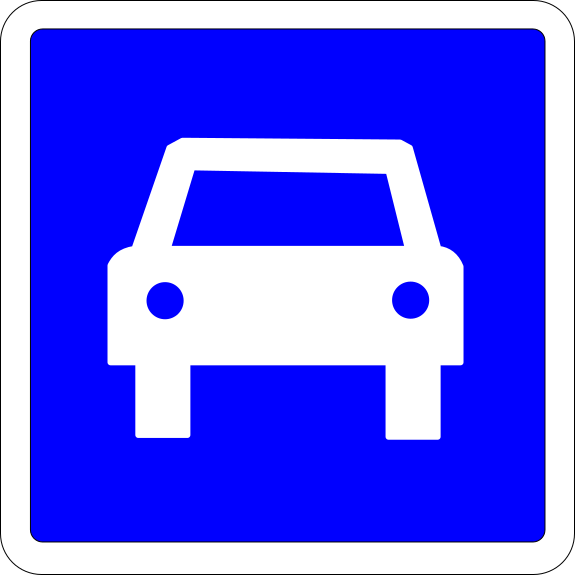 Start of an expressway.
English • Traffic sign C107 • Road with regulated access.
Français • Panneau C107 • Route à accès réglementé.
Sources
🔗 Commons.wikimedia.org
🔗 Equipementsdelaroute.cerema.fr • Arrêté du 24 novembre 1967
© Gigillo83 et les contributeurs Wikimedia • CC BY-SA 4.0 • SVG original non modifié.
Image via Commons.wikimedia.org
Gigillo83 • CC BY-SA 4.0 • Source revision 2010-07-10. Wikimedia original unmodified.
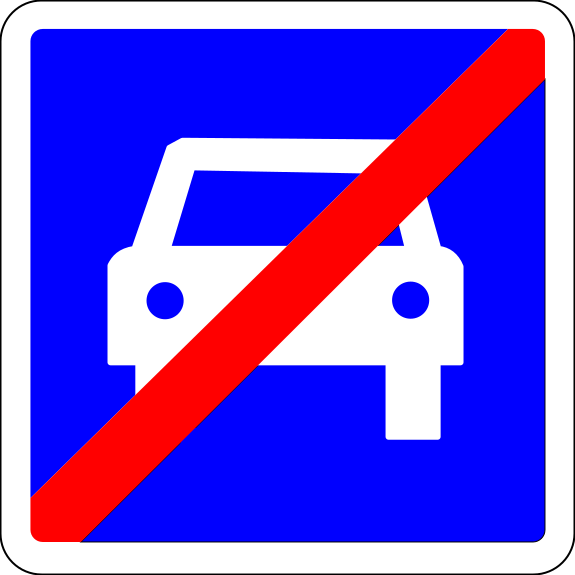 End of the expressway.
English • Traffic sign C108 • End of road with regulated access. This sign marks the end of the corresponding requirements.
Français • Panneau C108 • Fin de route à accès réglementé. Ce panneau indique la fin des prescriptions correspondantes.
Sources
🔗 Commons.wikimedia.org
🔗 Equipementsdelaroute.cerema.fr • Arrêté du 24 novembre 1967
© Roulex 45 et les contributeurs Wikimedia • CC BY-SA 3.0 • SVG original non modifié.
Image via Commons.wikimedia.org
Roulex 45 self-made from source above • CC BY-SA 3.0 • Source revision 2011-08-06. Wikimedia original unmodified.
What speed limit applies to cars on an expressway in France?
On a non-motorway road with physically separated carriageways, the usual car maximum outside built-up areas is 110 km/h, reduced to 100 km/h in rain. Other layouts have different limits. Follow signs and any lower novice-driver or vehicle limit.
🔗 legifrance.gouv.fr • French Road Code — Code de la voirie routière L151-1–2; R413-2
Who may use an expressway in France?
Check the restrictions for the particular road. Under Article R151-2, the order conferring expressway status lists the categories of vehicles or users permanently prohibited on all or part of that route. Follow the applicable entry controls.
4. Residential area
A residential area is a street or group of streets where housing and access to local properties are the main functions. Drivers should expect pedestrians, cyclists, children, parked vehicles and vehicles entering or leaving driveways.
Some countries identify particular residential areas with traffic signs and apply special low-speed and residential-area rules. The speed limit, pedestrian rights, parking rules and permitted road users therefore depend on local signs and regulations.
Wikimedia.org • Tabl-trai • CC BY-SA
How do people refer to a residential area in France?
The official French term for the specially signposted 20 km/h category is zone de rencontre. A zone 30 is a different category and does not automatically give pedestrians the same whole-road rights.
🔗 legifrance.gouv.fr • French Road Code — R110-2–3, R412-35, R415-11, R417-10
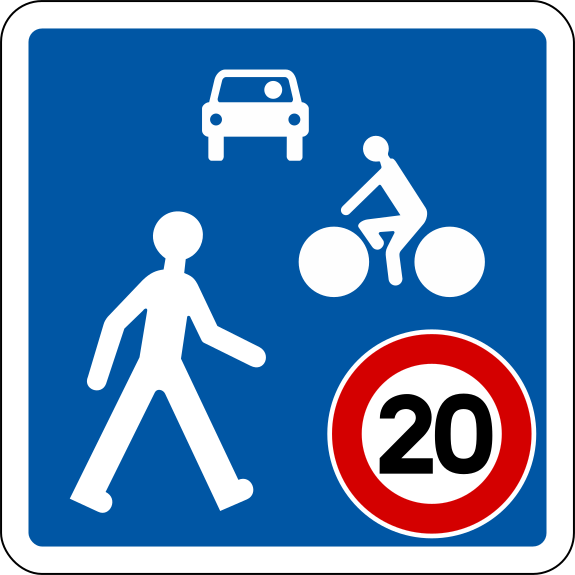 Start of a residential area.
English • Traffic sign B52 • Beginning of a residential area (zone de rencontre).
Français • Panneau B52 • Entrée d'une zone de rencontre.
Sources
🔗 Commons.wikimedia.org
🔗 Equipementsdelaroute.cerema.fr • Arrêté du 24 novembre 1967 Source : Roulex 45 • Domaine public • SVG original non modifié.
Image via Commons.wikimedia.org
Roulex 45 self-made from source above • Public domain • Source revision 2024-10-06. Wikimedia original unmodified.
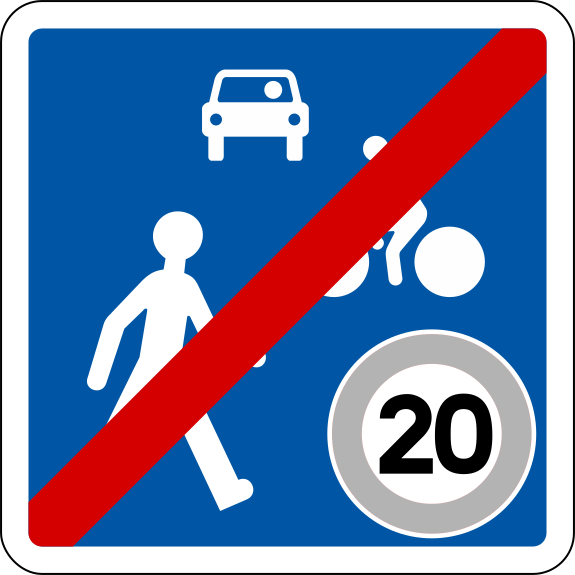 End of the residential area.
English • Traffic sign B53 • End of a residential area (zone de rencontre).
Français • Panneau B53 • Sortie d'une zone de rencontre.
Sources
🔗 Commons.wikimedia.org
🔗 Equipementsdelaroute.cerema.fr • Arrêté du 24 novembre 1967 Source : Roulex 45 • Domaine public • SVG original non modifié.
Image via Commons.wikimedia.org
Roulex 45 self-made from source above • Public domain • Source revision 2024-10-06. Wikimedia original unmodified.
What speed limit applies in a residential area in France?
In the specially signposted pedestrian-priority category, the maximum is 20 km/h. An ordinary residential street follows its posted limit or the applicable built-up-area rules.
🔗 legifrance.gouv.fr • French Road Code — R110-2–3, R412-35, R415-11, R417-10
What rights do pedestrians have in a signposted residential area in France?
In a signed zone de rencontre, pedestrians may move along the whole carriageway and have priority over ordinary vehicle traffic, except trams. They must not remain stationary on the carriageway. A painted pedestrian crossing is not required for this priority. Drivers must give way safely.
🔗 legifrance.gouv.fr • French Road Code — R110-2–3, R412-35, R415-11, R417-10
Where may I park in a residential area in France?
In a signed zone de rencontre, park a motor vehicle only in the spaces laid out for parking. Follow any further parking signs and keep pedestrian access clear.
🔗 legifrance.gouv.fr • French Road Code — R110-2–3, R412-35, R415-11, R417-10
5. Zone
A traffic zone is an area in which a traffic rule applies throughout all included roads or road sections. The rule normally begins at a zone-entry sign and remains applicable until the corresponding end-of-zone sign is passed.
Zones may regulate speed, parking, access, vehicle categories, emissions or other traffic behaviour. The signs used, the roads covered and the effect of intersections or local exceptions depend on local traffic law.
Wikimedia.org • Tabl-trai • CC BY-SA
How do people refer to traffic zones in France?
A French zone 30 is a road or group of roads with a maximum speed of 30 km/h. A pedestrian zone and a zone with a 20 km/h limit are separate categories; their rules cannot be inferred from the word zone alone.
🔗 legifrance.gouv.fr • French Road Code — R110-2, R411-25, R417-10–11
Where does a zone rule apply in France?
A zone 30 covers the signed road or set of roads between its entrance and exit boundaries. Continue observing the 30 km/h maximum on included streets after junctions, as well as any other applicable signs.
🔗 legifrance.gouv.fr • French Road Code — R110-2, R411-25, R417-10–11
Does a French speed zone automatically give permission to park anywhere?
No. A zone 30 regulates speed and has its own traffic arrangements, but does not cancel parking prohibitions. Check parking signs and markings at the place where you intend to stop.
🔗 legifrance.gouv.fr • French Road Code — R110-2, R411-25, R417-10–11
How do you know when a traffic zone ends in France?
The zone’s entrances and exits are signposted. Follow the appropriate exit sign and any rule for the area or road beyond it, rather than assuming that a junction or a change in building density ends the zone.
🔗 legifrance.gouv.fr • French Road Code — R110-2, R411-25, R417-10–11
6. Speed limit
A speed limit is the maximum legal speed permitted on a road, lane or within a designated area. It may be established by general traffic law or indicated by fixed, variable or temporary traffic signs.
A speed limit is a maximum, not a target speed. Drivers must travel more slowly whenever traffic, visibility, weather, road conditions, vulnerable road users or the condition of the vehicle make the maximum permitted speed unsafe.
Wikimedia.org • Tabl-trai • CC BY-SA
Which general speed limits should car drivers know in France?
For an ordinary car, the general maxima are 50 km/h in built-up areas, 80 km/h on ordinary two-way roads without a central separator, 110 km/h on divided roads and 130 km/h on motorways. Certain qualifying ordinary-road sections may permit 90 km/h. Signed restrictions, precipitation, poor visibility and probationary-licence rules can reduce these maxima.
🔗 legifrance.gouv.fr • French Road Code — R413-1–5, R413-17–19; 1967 order article 5 C4a/C4b
How does rain change the French speed limit?
During rain or other precipitation, the general maximum is 110 km/h on motorway sections normally limited to 130 km/h, but 100 km/h on motorway sections whose normal limit is lower than 130 km/h, as well as on roads with carriageways separated by a central reservation. On other roads outside built-up areas, the general maximum is 80 km/h. A lower applicable restriction still governs, and grip or visibility can require an even lower speed.
🔗 legifrance.gouv.fr • French Road Code — R413-1–5, R413-17–19; 1967 order article 5 C4a/C4b
What is the French limit when visibility is below 50 metres?
The maximum is 50 km/h on every road, including motorways, when visibility is below 50 metres. That is still a ceiling: dense fog or another hazard may require an even lower speed.
🔗 legifrance.gouv.fr • French Road Code — R413-1–5, R413-17–19; 1967 order article 5 C4a/C4b
Do French probationary drivers have lower high-speed limits?
Yes. Drivers subject to probationary-licence limits must not exceed 110 km/h on motorway sections normally limited to 130 km/h, 100 km/h on motorway sections whose normal limit is lower than 130 km/h and on divided roads, and 80 km/h on other roads outside built-up areas. A lower road or weather limit still applies.
🔗 legifrance.gouv.fr • French Road Code — R413-1–5, R413-17–19; 1967 order article 5 C4a/C4b
7. Minimum speed
A minimum speed is the lowest speed that vehicles are required to maintain on a particular road or under specified conditions. Minimum-speed rules are intended to prevent vehicles travelling unnecessarily slowly from disrupting traffic or creating large speed differences between road users.
A minimum speed does not require drivers to maintain that speed when traffic, weather, visibility, road conditions or safety require them to slow down. The way minimum speeds are indicated and enforced varies between countries.

Wikimedia.org • Marc Mongenet • CC BY-SA
Is 80 km/h the minimum in every French motorway lane?
No. The 80 km/h rule concerns the leftmost lane, and applies when traffic is flowing freely and weather, visibility and grip are satisfactory. It is not a blanket minimum for every motorway lane.
🔗 legifrance.gouv.fr • French Road Code — R413-1–5, R413-17–19; 1967 order article 5 C4a/C4b
Can I remain below 80 km/h in France’s leftmost motorway lane during a queue?
Yes. The 80 km/h condition applies to free-flowing traffic in satisfactory conditions. Congestion or unsafe conditions require a suitable lower speed. Do not accelerate towards slower traffic to meet the figure.
🔗 legifrance.gouv.fr • French Road Code — R413-1–5, R413-17–19; 1967 order article 5 C4a/C4b
Can unjustifiably slow driving be an offence in France without a numerical minimum?
Yes. The Road Code prohibits obstructing normal traffic by travelling abnormally slowly without a valid reason. Necessary slowing for traffic or safety is different from needlessly blocking the road.
🔗 legifrance.gouv.fr • French Road Code — R413-1–5, R413-17–19; 1967 order article 5 C4a/C4b
8. Advisory speed
An advisory speed is a recommended speed for a particular road section or hazard rather than a legally imposed maximum speed. It may be shown near bends, junctions, steep gradients, roadworks or other locations where a lower speed can help drivers negotiate the road safely.
Drivers should treat an advisory speed as guidance for safe driving conditions and should travel even more slowly when weather, visibility, traffic or road conditions require it. A separate legally binding speed limit must still be obeyed.
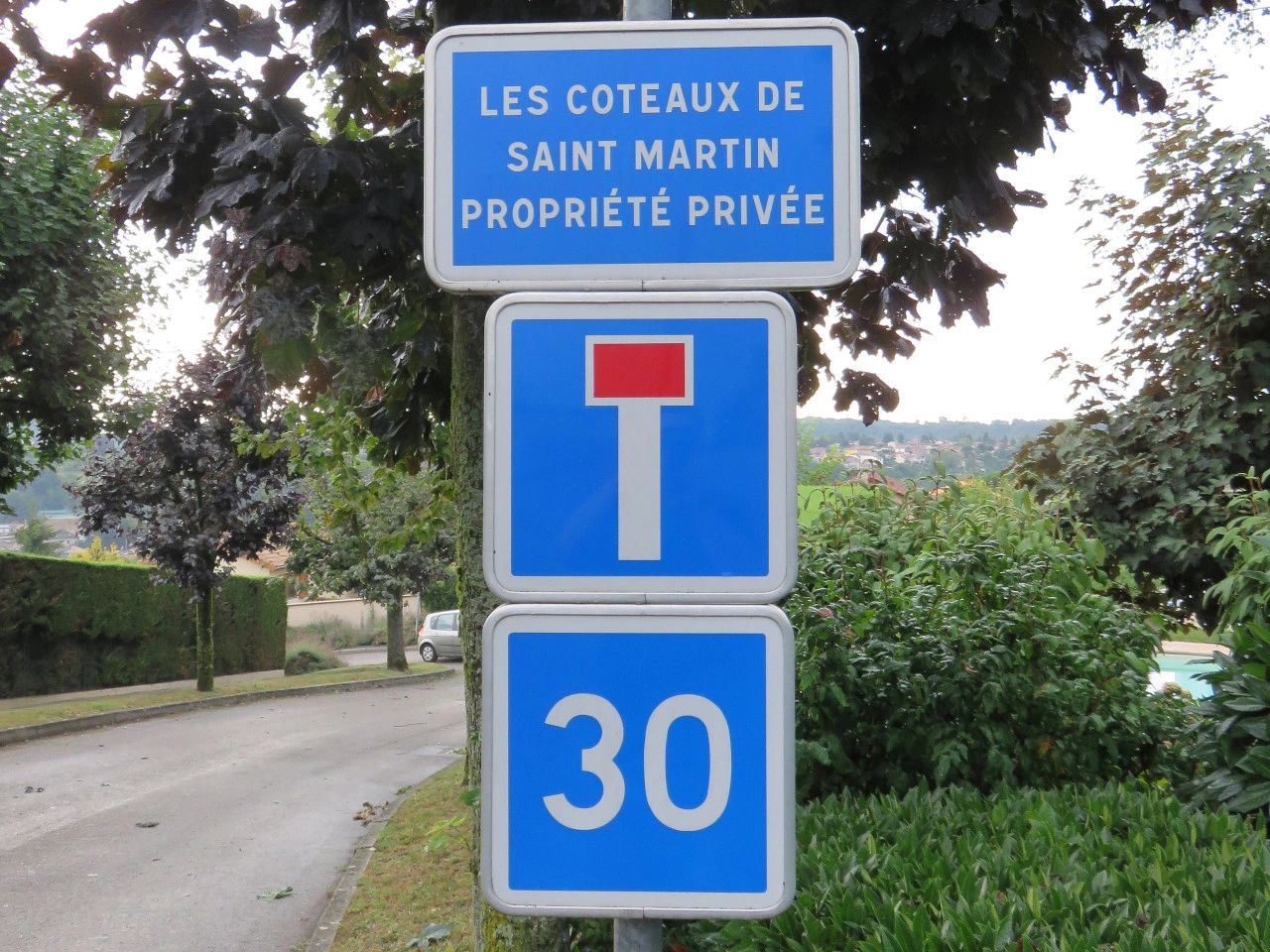
Wikimedia.org • Sebleouf • CC BY-SA
What does an advisory-speed sign mean in France?
The blue square sign indicates a recommended speed in km/h. Official French wording is Vitesse conseillée. It differs from the circular red-bordered sign imposing a maximum.
🔗 equipementsdelaroute.cerema.fr • French road-sign order, Article 5-8, signs EB10 and EB20
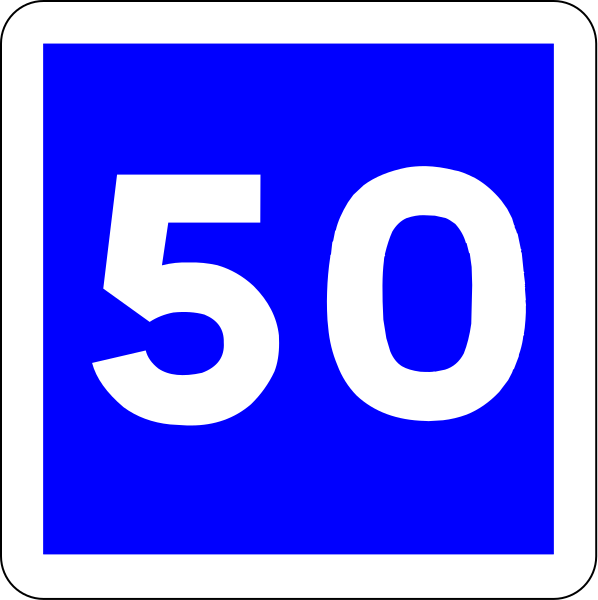 Advisory speed limit.
English • Traffic sign C4a • Recommended speed. This sign indicates the advised speed where conditions permit and no lower limit applies to the vehicle category. Drivers must remain in control of their speed in all circumstances, in accordance with article R. 413-17 of the Highway Code.
Français • Panneau C4a • Vitesse conseillée. Ce panneau indique la vitesse à laquelle il est conseillé de circuler si les circonstances le permettent et si l'usager n'est pas tenu de respecter une vitesse inférieure spécifique à la catégorie de véhicule qu'il conduit. En toutes circonstances, l'usager doit rester maître de sa vitesse, conformément à l'article R. 413-17 du code de la route.
Sources
🔗 Commons.wikimedia.org
🔗 Equipementsdelaroute.cerema.fr • Arrêté du 24 novembre 1967
© Roulex 45 et les contributeurs Wikimedia • CC BY-SA 3.0 • SVG original non modifié.
Image via Commons.wikimedia.org
Roulex 45 self-made from source above • CC BY-SA 3.0 • Source revision 2013-04-27. Wikimedia original unmodified.
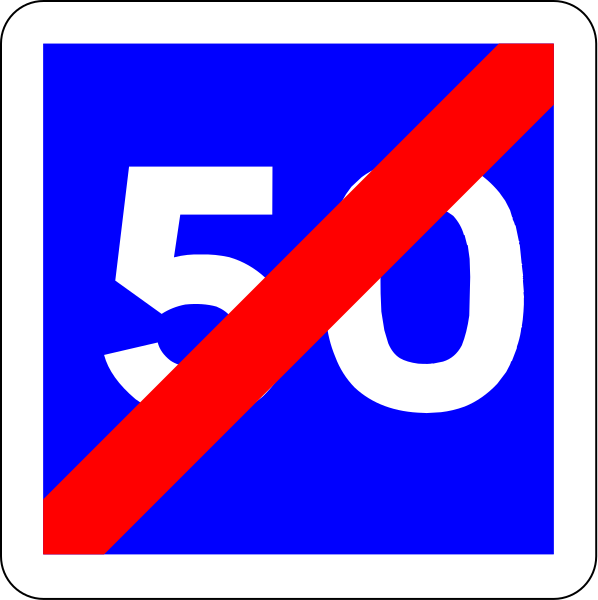 End of the advisory speed limit.
English • Traffic sign C4b • End of recommended speed.
Français • Panneau C4b • Fin de vitesse conseillée.
Sources
🔗 Commons.wikimedia.org
🔗 Equipementsdelaroute.cerema.fr • Arrêté du 24 novembre 1967
© Roulex 45 et les contributeurs Wikimedia • CC BY-SA 3.0 • SVG original non modifié.
Image via Commons.wikimedia.org
Roulex 45 self-made from source above • CC BY-SA 3.0 • Source revision 2013-04-27. Wikimedia original unmodified.
Can an advisory speed override a lower legal limit in France?
No. A recommendation does not authorise exceeding an applicable legal maximum, including a lower vehicle-specific limit. Follow the binding restriction and use a still lower speed if the hazard or conditions require it.
🔗 legifrance.gouv.fr • French Road Code — R413-1–5, R413-17–19; 1967 order article 5 C4a/C4b
Must I maintain an advisory speed in poor conditions in France?
No. A recommendation is not a compulsory minimum or a guarantee that its number is safe in all conditions. Reduce speed for poor grip, restricted visibility, traffic or another hazard, and retain control of the vehicle.
🔗 legifrance.gouv.fr • French Road Code — R413-1–5, R413-17–19; 1967 order article 5 C4a/C4b
What does France’s end-of-advisory-speed sign mean?
The official wording is Fin de vitesse conseillée. It ends the indicated recommendation, rather than a regulatory speed limit. Continue to obey any applicable maximum and choose a speed suitable for the road.
🔗 equipementsdelaroute.cerema.fr • French road-sign order, Article 5-8, signs EB10 and EB20
9. Footpath
A footpath is a path or part of a road intended primarily for pedestrian traffic. It may run alongside a road, through a park or residential area, or independently from roads used by motor vehicles.
A footpath may be reserved exclusively for pedestrians or may form part of a shared route with cyclists or other permitted users. Access, priority and permitted users depend on the traffic signs and local regulations applying to the path.
Wikimedia.org • Marc Mongenet • CC BY-SA
Must pedestrians use an available pavement in France?
Yes. Where a pavement, trottoir, or a verge is normally usable by pedestrians, they must use it. Walking along the carriageway is permitted only in the circumstances provided by the Road Code, rather than simply as an alternative to a usable pavement.
🔗 legifrance.gouv.fr • French Road Code — R412-7, R412-34–36
Can children cycle on French pavements?
Children under eight may cycle on pavements at walking pace, unless the competent authority has made a contrary rule, and must not inconvenience pedestrians. Ordinary adult cycling on pavements is prohibited. An adult accompanying a child must walk or use a permitted cycling route.
🔗 legifrance.gouv.fr • French Road Code — R412-7, R412-34–36
Is pushing a bicycle treated differently from cycling on a French pavement?
Yes. A person walking while pushing a bicycle is treated as a pedestrian. Use the pedestrian route without obstructing others. If walking on the carriageway becomes necessary, the Road Code provides specific positioning rules, including for people pushing a bicycle.
🔗 legifrance.gouv.fr • French Road Code — R412-7, R412-34–36
10. Bike path
A bike path is a part of a road or a separate route intended primarily or exclusively for people riding bicycles. It may be physically separated from motor traffic, marked on the road surface or identified by traffic signs.
Bike paths may be one-way, two-way or shared with other road users. The permitted users, direction of travel, priority rules and obligation to use the path depend on local traffic signs and regulations.
Wikimedia.org • Marc Mongenet • CC BY-SA
How does France distinguish a cycle track from a cycle lane?
A piste cyclable is a separate cycling carriageway; a bande cyclable is a reserved lane within a carriageway with several lanes. Both differ from an ordinary pedestrian pavement.
🔗 legifrance.gouv.fr • French Road Code — R110-2, R411-3-2, R412-7, R412-34, R431-9
Must cyclists use every French cycle track or lane?
No. A compulsory-use obligation must be established by the competent authority. The round blue bicycle sign indicates compulsory use; the square bicycle sign identifies a recommended and reserved facility. Check the sign rather than assuming all cycling facilities are compulsory.
🔗 equipementsdelaroute.cerema.fr • Cerema current IISR part 4 consolidation
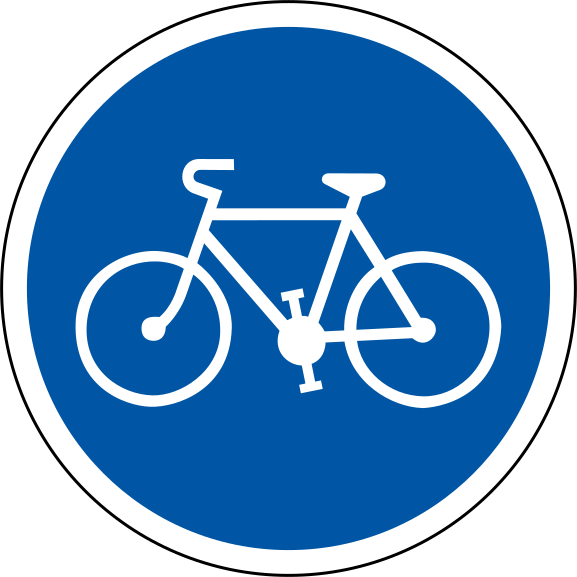 Mandatory path for cyclists.
English • Traffic sign B22a • Compulsory cycle track or lane for cycles without sidecars or trailers, reserved for two- or three-wheeled cycles.
Français • Panneau B22a • Piste ou bande obligatoire pour les cycles sans side-car ou remorque et réservée aux cycles à deux ou trois roues.
Sources
🔗 Commons.wikimedia.org
🔗 Equipementsdelaroute.cerema.fr • Arrêté du 24 novembre 1967
© Roulex 45 et les contributeurs Wikimedia • CC BY-SA 4.0 • SVG original non modifié.
Image via Commons.wikimedia.org
Roulex 45 • CC BY-SA 4.0 • Source revision 2023-08-13. Wikimedia original unmodified.
May mopeds use French cycle tracks?
Two-wheeled mopeds without a sidecar or trailer may use them only where the competent authority has authorised that use. This is a specific exception. The existence of a cycle track does not open it to ordinary motorcycle or car traffic.
🔗 legifrance.gouv.fr • French Road Code — R110-2, R411-3-2, R412-7, R412-34, R431-9
11. Pedestrian warning
A pedestrian warning is a traffic warning indicating that pedestrians may be crossing or entering the roadway ahead. It is commonly used near pedestrian crossings or other locations where drivers need advance notice of frequent pedestrian activity.
Drivers approaching a pedestrian warning should reduce speed when necessary, watch carefully for pedestrians and be prepared to stop. The design of the warning sign and the priority rules at the crossing vary between countries.

Wikimedia.org • KiwiNeko14 • CC BY-SA
How should I react to a pedestrian warning in France?
Reduce speed, look along both sides of the road and be ready to stop. The warning identifies a pedestrian hazard ahead; children, people with limited mobility or others may enter the road unexpectedly.
🔗 legifrance.gouv.fr • French Road Code — R413-17, R415-11; IISR part 2 article 28-1
Does a pedestrian warning in France identify the crossing itself?
Not necessarily. An advance warning alerts you to danger ahead. The actual crossing is identified by its own signs, markings or signals. Apply the crossing rules when you reach it, and follow any supplementary distance information.
🔗 legifrance.gouv.fr • French Road Code — R413-17, R415-11; IISR part 2 article 28-1
What should drivers know about pedestrian crossings in France?
Give way, stopping if necessary, to a pedestrian lawfully crossing or clearly showing an intention to cross. This duty is broader than merely recognising a warning sign or painted crossing.
🔗 legifrance.gouv.fr • French Road Code — R413-17, R415-11; IISR part 2 article 28-1
12. Tunnel
A tunnel is a covered passage that carries a road through or beneath an obstacle such as a hill, mountain, building, waterway or another transport route. Road tunnels may contain one or more traffic lanes and can carry traffic in one or both directions.
Driving in a tunnel requires particular attention because visibility, available escape routes and space for avoiding hazards are limited. Drivers should follow the applicable lighting, speed, lane and following-distance rules and pay attention to emergency exits, traffic signals and variable-message signs.
Wikimedia.org • Marc Mongenet • CC BY-SA
Does a tunnel sign in France set a universal speed limit?
No single speed can be read from the tunnel pictogram. Apply the road’s relevant limit and any permanent or electronic speed restriction, and drive more slowly when visibility, queues or another hazard require it.
 Start of a tunnel.
English • Traffic sign C111 • Tunnel entrance. In this tunnel, U-turns, stopping and parking are prohibited outside the designated emergency stopping places under article R. 417-10 of the Highway Code, and dipped headlights are compulsory.
Français • Panneau C111 • Entrée d'un tunnel. Ce panneau indique l'entrée d'un tunnel où il est interdit de faire demi-tour, de s'arrêter et de stationner en dehors des emplacements d'arrêt d'urgence prévus à cet effet en application de l'article R. 417-10 du code de la route et où l'allumage des feux de croisement est obligatoire.
Sources
🔗 Commons.wikimedia.org
🔗 Equipementsdelaroute.cerema.fr • Arrêté du 24 novembre 1967 Source : Roulex 45 • Domaine public • SVG original non modifié.
Image via Commons.wikimedia.org
Roulex 45 self-made from source above • Public domain • Source revision 2009-07-26. Wikimedia original unmodified.
Is every tunnel in France open to pedestrians and cyclists?
No. Check the road category and access signs before entering. A motorway tunnel, a vehicle-restricted tunnel and a purpose-built walking or cycling underpass have different access arrangements. Emergency evacuation routes do not establish ordinary public access.
13. Bridge
A bridge is a structure that carries a road, path or railway over an obstacle such as a river, valley, railway line or another road. A road bridge may carry one or more roadways together with pedestrian or cycling facilities.
Drivers should follow any speed, weight, height, width or vehicle-access restrictions applying to the bridge. Particular care may be necessary on narrow, exposed or movable bridges and when weather conditions such as wind, rain or ice affect the road surface.
Wikimedia.org • KiwiNeko14 • CC BY-SA
What should I check before crossing a bridge in France?
Check the applicable weight, axle-load, width and height restrictions before committing to the crossing. Include the load, trailer and roof equipment when relevant. A bridge warning and a vehicle restriction serve different purposes; comply with both.
Who goes first on a narrow bridge in France?
Follow any traffic lights, give-way controls or signs allocating priority over oncoming traffic. Do not force your way onto a bridge that cannot accommodate both directions safely. A bridge warning alone does not give your direction priority.
May I stop or park on a bridge in France?
France generally prohibits voluntary stopping and parking on bridges under Article R417-10(II)(6), unless the competent traffic authority provides otherwise. Do not use a bridge carriageway as a viewpoint or passenger drop-off point. A stop required by traffic or an emergency must be distinguished from choosing to stop there.
14. Cycling street
A cycling street is a street designed or legally designated to give cyclists a prominent position in mixed traffic. Motor vehicles may usually enter, but they must adapt their speed and driving behaviour to the presence of cyclists.
Depending on the country, cyclists may be permitted to use more of the carriageway and motor vehicles may be prohibited from overtaking them. The speed limit, priority rules, permitted vehicles and beginning and end of the street depend on local traffic signs and regulations.
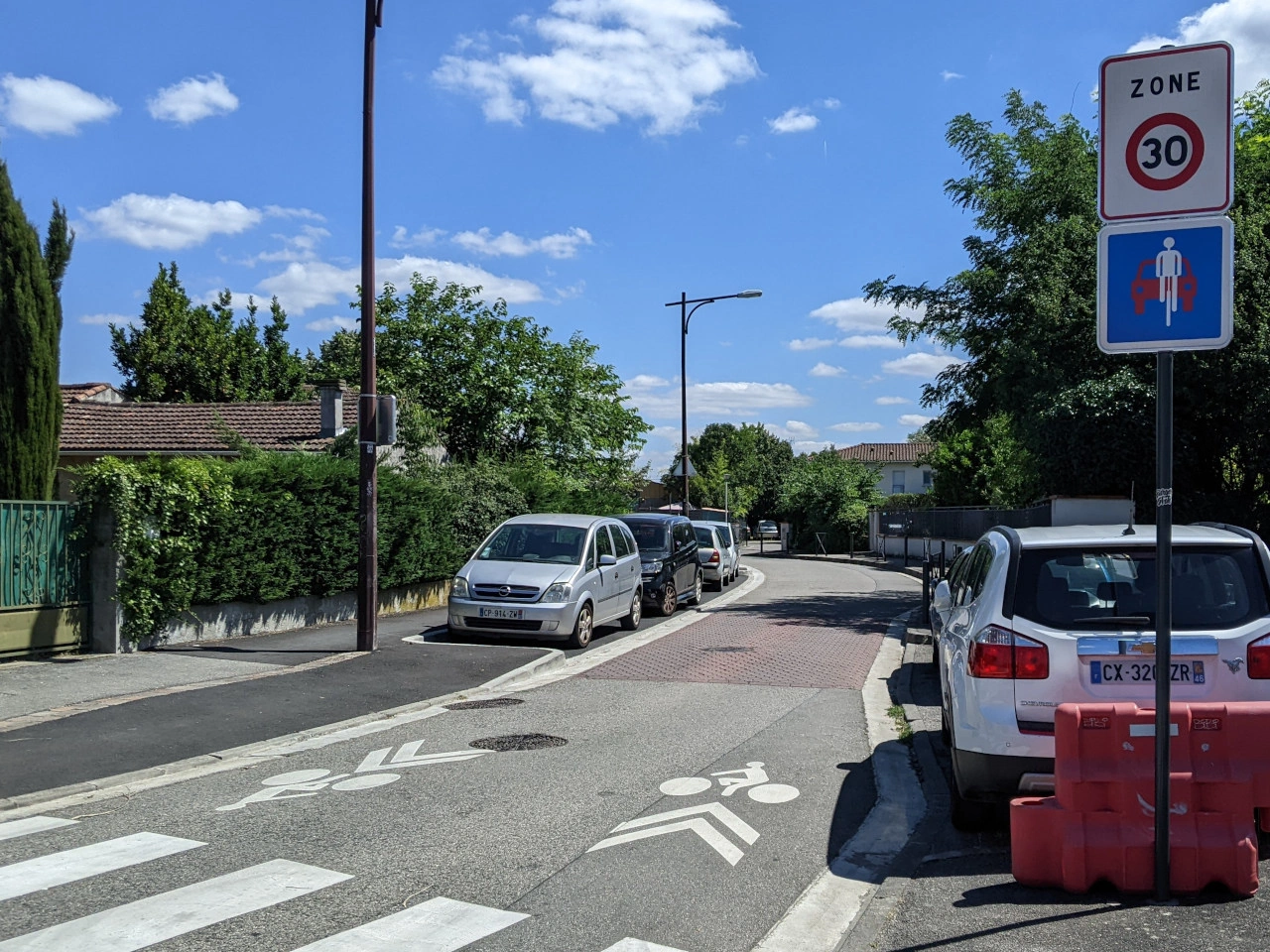
Wikimedia.org • Abdoucondorcet • CC BY-SA
How should I interpret a cycling-priority street in France?
A vélorue is a local cycling-oriented street arrangement. For example, Toulouse describes shared road space encouraging cycling, with motor traffic limited to local access. Its local signs and the national Road Code determine the enforceable traffic rules.
🔗 metropole.toulouse.fr • Toulouse Métropole — local vélorues and urban passing clearance
🔗 legifrance.gouv.fr • Road Code — R412-9 and R414-4; national duties remain applicable
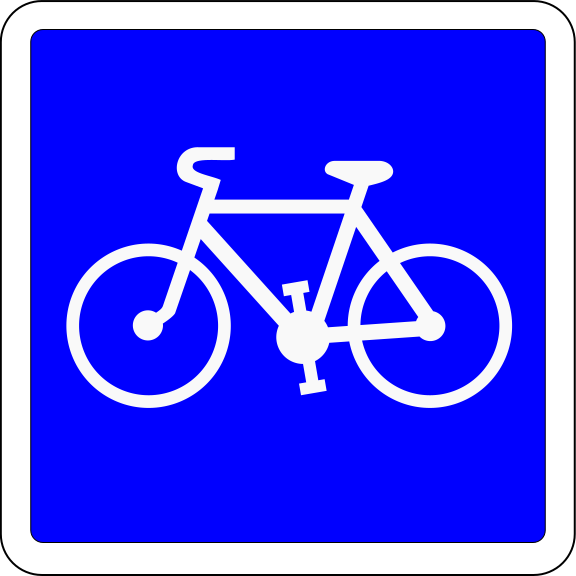 Lane for cyclists.
English • Traffic sign C113 • Recommended cycle track or lane reserved for two- or three-wheeled cycles. This sign indicates that use of the facility is recommended and reserved for two- or three-wheeled cycles; pedestrians and drivers of other vehicles must not use it or stop on it. However, powered personal mobility devices and light motorised cycles must use it under articles R. 412-43-1 and R. 412-43-4 of the Highway Code, unless a different decision by the traffic authority is duly signposted. An accompanying M4d2 plate indicates that the competent authority has also permitted mopeds to use the facility.
Français • Panneau C113 • Piste ou bande cyclable conseillée et réservée aux cycles à deux ou trois roues. Ce panneau indique que l'accès à une piste ou à une bande cyclable est conseillé et réservé aux cycles à deux ou trois roues et indique aux piétons et aux conducteurs des autres véhicules qu'ils n'ont pas le droit d'emprunter cet aménagement ni de s'y arrêter. Toutefois les engins de déplacement personnel motorisés et des cyclomobiles légers sont tenus d'y circuler conformément aux articles R. 412-43-1 et R. 412-43-4 du code de la route, sauf décision différente de l'autorité de police de la circulation dûment signalée. Le panonceau M4d2 qui peut compléter le panneau indique que, par décision de l'autorité compétente, cet aménagement est accessible aux cyclomoteurs.
Sources
🔗 Commons.wikimedia.org
🔗 Equipementsdelaroute.cerema.fr • Arrêté du 24 novembre 1967
© Roulex 45 et les contributeurs Wikimedia • CC BY-SA 3.0 • SVG original non modifié.
Image via Commons.wikimedia.org
Roulex 45 self-made from source above • CC BY-SA 3.0 • Source revision 2019-10-04. Wikimedia original unmodified.
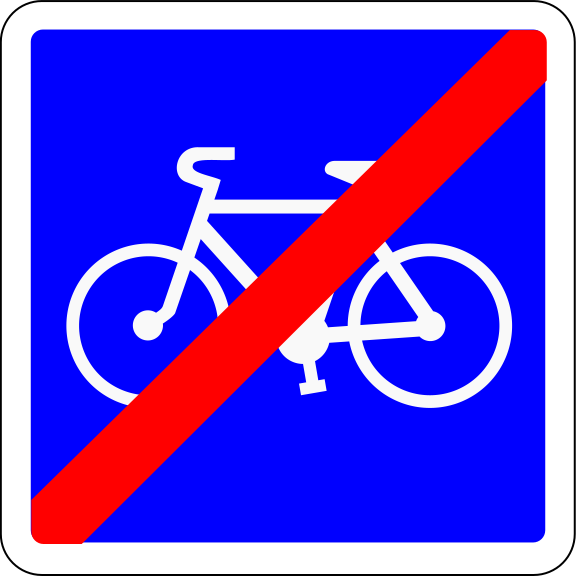 End of the lane for cyclists.
English • Traffic sign C114 • End of a recommended cycle track or lane reserved for two- or three-wheeled cycles. This sign ends the rules imposed by sign C113.
Français • Panneau C114 • Fin d'une piste ou d'une bande cyclable conseillée et réservée aux cycles à deux ou trois roues. Ce panneau indique la fin de la réglementation édictée par le panneau C113.
Sources
🔗 Commons.wikimedia.org
🔗 Equipementsdelaroute.cerema.fr • Arrêté du 24 novembre 1967
© Roulex 45 et les contributeurs Wikimedia • CC BY-SA 3.0 • SVG original non modifié.
Image via Commons.wikimedia.org
Roulex 45 self-made from source above • CC BY-SA 3.0 • Source revision 2019-10-04. Wikimedia original unmodified.
Which driving rules matter on a mixed cycling street in France?
In Toulouse’s example, a motorist must keep the required one-metre urban passing clearance when overtaking a cyclist. If there is insufficient space, wait. A vélorue label alone does not establish Belgium’s nationwide overtaking ban.
🔗 metropole.toulouse.fr • Toulouse Métropole — local vélorues and urban passing clearance
🔗 legifrance.gouv.fr • Road Code — R412-9 and R414-4; national duties remain applicable
Which priority rules apply on cycling streets in France?
Apply the junction’s signs, signals and ordinary priority rules. A local vélorue identity is not a promise of automatic cyclist priority at every crossing road. Check whether the route also has separate traffic or access restrictions.
🔗 metropole.toulouse.fr • Toulouse Métropole — local vélorues and urban passing clearance
🔗 legifrance.gouv.fr • Road Code — R412-9 and R414-4; national duties remain applicable
15. Pedestrian zone
A pedestrian zone is an area consisting of one or more streets that are reserved primarily for pedestrians. Motor-vehicle access is normally prohibited or restricted to authorised users, particular purposes or specified times.
Pedestrians may usually use the full width of the available road space. Rules concerning cyclists, deliveries, public transport, vehicle speed, stopping and parking depend on local traffic signs and regulations.
Wikimedia.org • Ralf Roletschek • CC BY-SA
How should I recognise pedestrian-only access in France?
An aire piétonne is an area reserved for pedestrians, permanently or during specified periods. Subject to the Code’s specified exceptions, including permitted cycles, only vehicles necessary to serve the area may enter under the permitted arrangements, at walking pace.
🔗 legifrance.gouv.fr • French Road Code — R110-2, R411-3, R412-7, R431-9
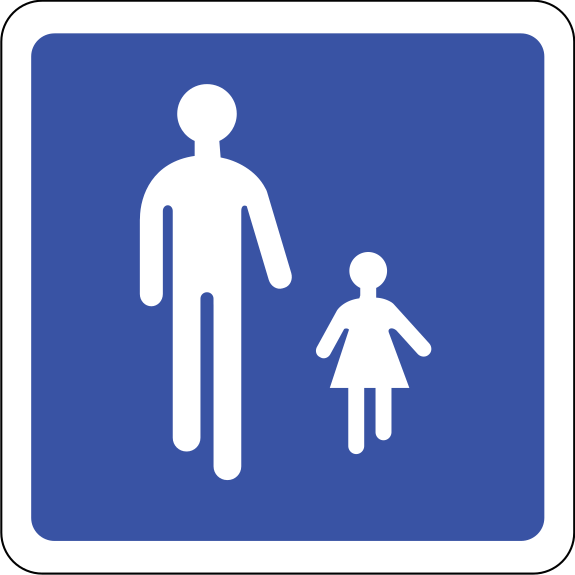 Start of a zone for pedestrians.
English • Traffic sign B54 • Beginning of a pedestrian area.
Français • Panneau B54 • Entrée d'aire piétonne.
Sources
🔗 Commons.wikimedia.org
🔗 Equipementsdelaroute.cerema.fr • Arrêté du 24 novembre 1967 Source : Roulex 45 • Domaine public • SVG original non modifié.
Image via Commons.wikimedia.org
Roulex 45 self-made from source above • Public domain • Source revision 2019-10-04. Wikimedia original unmodified.
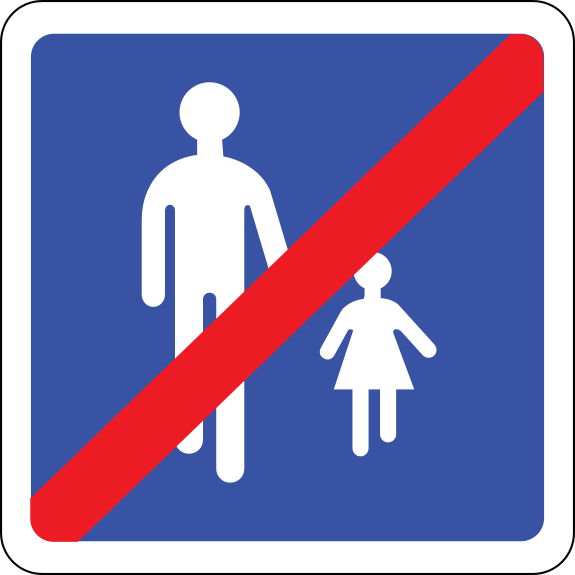 End of the zone for pedestrians.
English • Traffic sign B55 • End of a pedestrian area.
Français • Panneau B55 • Sortie d'aire piétonne.
Sources
🔗 Commons.wikimedia.org
🔗 Equipementsdelaroute.cerema.fr • Arrêté du 24 novembre 1967 Source : Roulex 45 • Domaine public • SVG original non modifié.
Image via Commons.wikimedia.org
Roulex 45 self-made from source above • Public domain • Source revision 2019-10-04. Wikimedia original unmodified.
May cyclists ride in pedestrian areas in France?
Cycles may use pedestrian areas unless the competent authority provides otherwise. Riders must travel at walking pace and must not inconvenience pedestrians. Check local signs rather than treating the area as a cycle track.
🔗 legifrance.gouv.fr • French Road Code — R110-2, R411-3, R412-7, R431-9
Which rules apply to vehicles admitted to pedestrian areas in France?
Admitted vehicles travel at walking pace. A zone de rencontre, with its 20 km/h limit and broader mixed use, is a different legal category; do not apply that limit as a target in an aire piétonne.
🔗 legifrance.gouv.fr • French Road Code — R110-2, R411-3, R412-7, R431-9
16. Speed bump
A speed bump is a raised traffic-calming device placed across all or part of a road to make drivers reduce their speed. It is commonly used near homes, schools, crossings, parking areas and other places where low vehicle speeds are important.
Speed bumps vary in shape, height and legal status. Drivers should approach them at a low, controlled speed and follow any warning signs or speed limits that apply.
Wikimedia.org • Tabl-trai • CC BY-SA
How should I recognise and approach a speed bump in France?
French guidance distinguishes ralentisseurs, including dos d’âne, from cushions and raised tables. A raised crossing or junction may be incorporated into a table, so look beyond the shape of the hump.
🔗 legifrance.gouv.fr • French Road Code — R413-17, R415-11; IISR part 2 article 28-1
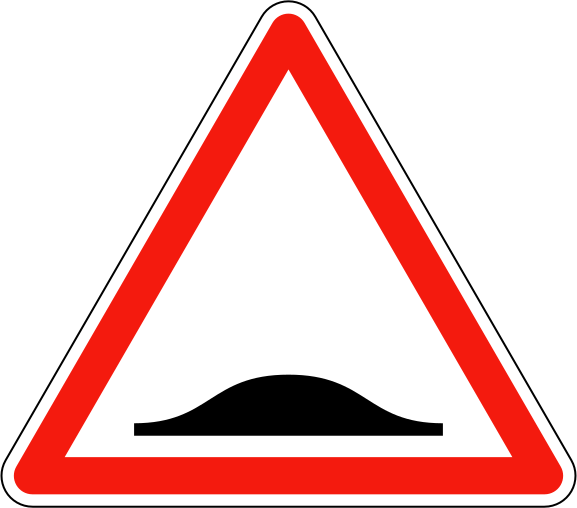 Warning for a speed bump.
English • Traffic sign A2b • Road hump used for traffic calming.
Français • Panneau A2b • Ralentisseur de type dos-d'âne.
Sources
🔗 Commons.wikimedia.org
🔗 Equipementsdelaroute.cerema.fr • Arrêté du 24 novembre 1967
© Roulex 45 et les contributeurs Wikimedia • CC BY-SA 3.0 • SVG original non modifié.
Image via Commons.wikimedia.org
Roulex 45 • CC BY-SA 3.0 • Source revision 2022-04-30. Wikimedia original unmodified.
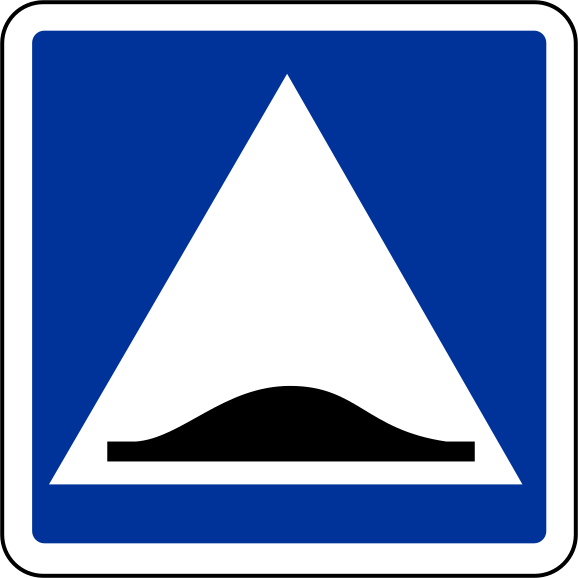 Speed bump.
English • Traffic sign C27 • Raised carriageway.
Français • Panneau C27 • Surélévation de chaussée.
Sources
🔗 Commons.wikimedia.org
🔗 Equipementsdelaroute.cerema.fr • Arrêté du 24 novembre 1967
© Jcrovetti et les contributeurs Wikimedia • CC BY-SA 3.0 • SVG original non modifié.
Image via Commons.wikimedia.org
Jcrovetti • CC BY-SA 3.0 • Source revision 2017-08-20. Wikimedia original unmodified.
Which speed should I use at a raised device in France?
Outside a Zone 30 or a residential area (zone de rencontre), French official guidance provides for an advance hump warning together with a 30 km/h restriction. Follow the applicable signs and zone rules. The device or conditions may require a speed below the legal maximum.
🔗 cerema.fr • Cerema, raised-device signing guidance, IISR Articles 28-1 and 72-6
Does a raised road surface give pedestrians priority in France?
A raised device alone does not identify pedestrian priority. If it incorporates a crossing, apply the crossing’s controls and the national rules. Give way, stopping if necessary, to a pedestrian lawfully crossing or clearly showing an intention to cross. This duty is broader than merely recognising a warning sign or painted crossing.
🔗 legifrance.gouv.fr • French Road Code — R413-17, R415-11; IISR part 2 article 28-1
17. Toll road
A toll road is a road, motorway, bridge, tunnel or other route for which users must pay a charge. The toll may apply to all vehicles or only to particular vehicle categories, and the amount can depend on factors such as distance travelled, vehicle type, weight or emissions.
Tolls may be collected at toll booths, electronically or through a vignette or distance-based charging system. Drivers should check the applicable payment rules before using a toll road, especially when travelling in another country.
Wikimedia.org • KiwiNeko14 • CC BY-SA
Which road-charging system should I check in France?
French motorway tolls can use conventional plazas or péage en flux libre, where cameras and gantries replace the barriers. The lack of a booth does not mean the charged section is free.
What should I check before using a charged road in France?
For free-flow sections, use the responsible motorway company’s payment service or an accepted automatic-payment arrangement. Check the published payment deadline; do not wait for a barrier or a paper ticket that the system does not provide.
Does the absence of a toll booth prove that a road is free in France?
The absence of a payment booth is not proof that a charged road is free. A vignette, electronic account, vehicle-registration record or another payment procedure may be used where the actual scheme provides for it. Follow the responsible authority or operator’s instructions for that road.
18. Customs
Customs is the government authority responsible for controlling goods entering or leaving a country or customs territory. In road traffic, a customs checkpoint is a place where drivers may be required to stop so officers can inspect the vehicle, luggage, cargo and relevant documents.
Customs controls may take place at borders, ports, ferry terminals, airports or inland control locations. Drivers must follow all traffic signs, lane signals, barriers and instructions from customs officers. Declaration requirements depend on the countries involved and on the type, value, quantity and intended use of the goods being carried.
Wikimedia.org • Marc Mongenet • CC BY-SA
Which customs authority should drivers consult for travel to France?
Consult the French Directorate-General of Customs and Indirect Taxes, commonly called la douane for the goods, luggage and vehicle-related customs requirements of the journey. Customs controls concern goods and declarations; they must be distinguished from passport checks, a road toll or ordinary traffic control.
🔗 douane.gouv.fr • French Customs — official traveller guidance and applicable declaration checks
Do customs requirements depend on the route and goods when entering France?
Yes. Travel within the EU customs territory is treated differently from bringing goods from outside it. Personal use, commercial use, restricted goods and tax or customs special territories can change the requirements. Schengen passport arrangements do not replace customs rules.
🔗 douane.gouv.fr • French Customs — official traveller guidance and applicable declaration checks
What should motorists check before declaring goods in France?
Check the official declaration requirements for goods over your applicable allowance, commercial goods, controlled articles and cash or other monetary instruments. These categories have different rules and thresholds. Declare as required and ask customs if unsure; do not assume a duty-free purchase is exempt from all controls.
🔗 douane.gouv.fr • French Customs — official traveller guidance and applicable declaration checks
19. One-way traffic
One-way traffic means that vehicles on a road or carriageway may travel only in one designated direction. The permitted direction is normally indicated by traffic signs, lane arrows or road markings.
Some road users, such as cyclists or public-transport vehicles, may be allowed to travel in the opposite direction when signs expressly permit it. A one-way road does not by itself determine the speed limit, priority or parking rules.

Wikimedia.org • Tabl-trai • CC BY-SA
How should I read a one-way restriction in France?
The usual term is sens unique. Follow the street’s designated direction and entry controls; a mandatory direction at one junction does not necessarily describe the whole street.
🔗 legifrance.gouv.fr • French Road Code — R412-28–28-1, R411-25
May cyclists travel against the general traffic direction in France?
On roads limited to 30 km/h or less, the Road Code generally provides two-way movement for cyclists and specified light personal-mobility users unless the traffic authority decides otherwise. Check the local restriction and arrangement rather than assuming all one-way streets or all vehicle categories are exempt.
🔗 legifrance.gouv.fr • French Road Code — R412-28–28-1, R411-25
Does one-way traffic give me priority or a different speed limit in France?
A one-way restriction concerns direction. Continue to follow the applicable speed limit, signals, give-way or stop controls and junction-priority rules. Where authorised counterflow traffic exists, check for it before turning or crossing; your permitted direction is not automatic junction priority.
🔗 legifrance.gouv.fr • French Road Code — R412-28–28-1, R411-25
20. Quay
A quay is a constructed area beside a river, canal, harbour or other body of water, commonly used for loading, unloading, mooring vessels or providing waterside access. A road may run alongside the water or lead directly towards the quay edge.
In road traffic, a quay warning indicates a risk that a vehicle could leave the road and enter the water. Drivers should reduce speed, observe the road layout carefully and keep a safe distance from the waterside edge.

Wikimedia.org • Jpbazard • CC BY-SA
What should I watch for near a quay or waterside road in France?
A French waterside warning concerns a road leading towards or bordering water with a risk of leaving the carriageway. A quay, ferry terminal and movable bridge are different layouts; observe the actual bend, edge and barriers.
🔗 legifrance.gouv.fr • French Road Code — R413-17, R414-1–4, R414-11; 1967 order article 3
How should I choose a safe speed beside water in France?
Use the applicable road or local speed limit and slow further for the foreseeable waterside danger. A hazard warning is not a promise that driving at the maximum is safe. Keep enough visibility and control to avoid the edge, pedestrians, loading activity or a blocked route.
🔗 legifrance.gouv.fr • French Road Code — R413-17, R414-1–4, R414-11; 1967 order article 3
Does a quay warning allow me to enter or park beside the water in France?
Check the actual access and parking restrictions, including any port or dock controls. A waterside warning does not provide permission to enter a restricted facility or park on the edge. Keep the required passage clear and use a permitted place without endangering traffic or people beside the water.
🔗 legifrance.gouv.fr • French Road Code — R413-17, R414-1–4, R414-11; 1967 order article 3
21. Slope
A slope is a section of road that rises or descends noticeably. A steep slope can affect vehicle speed, braking distance, traction, visibility and the ability of heavy or low-powered vehicles to maintain a steady speed.
Warning signs may indicate a steep ascent or dangerous descent and may show the gradient as a percentage. Drivers should adjust their speed early, select a suitable gear and remain prepared for slow vehicles, bends and changing road conditions.

Wikimedia.org • Tabl-trai • CC BY-SA
What does a steep-slope warning mean in France?
French warnings distinguish a dangerous descent from a steep ascent. The gradient is a hazard description; it does not replace a separate speed restriction or the duty to adapt speed to the conditions.
🔗 equipementsdelaroute.cerema.fr • French road-sign order, Article 5-8, signs EB10 and EB20
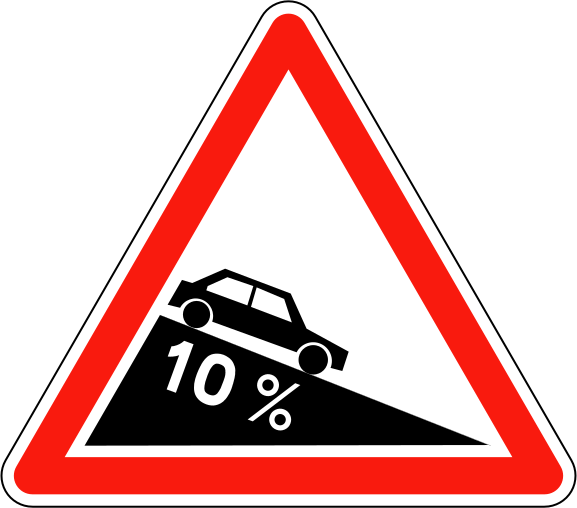 Warning for a steep descent.
English • Traffic sign A16 • Dangerous descent.
Français • Panneau A16 • Descente dangereuse.
Sources
🔗 Commons.wikimedia.org
🔗 Equipementsdelaroute.cerema.fr • Arrêté du 24 novembre 1967
© Roulex 45 et les contributeurs Wikimedia • CC BY-SA 3.0 • SVG original non modifié.
Image via Commons.wikimedia.org
Roulex_45 • CC BY-SA 3.0 • Source revision 2013-07-05. Wikimedia original unmodified.
How should I approach a steep descent in France?
Reduce speed before the descent and select a suitable gear to help control the vehicle. Keep enough following distance and avoid building up speed that requires continuous heavy braking. A warning gives no fixed safe descent speed: the gradient, surface, visibility, load and vehicle can require a speed well below the legal maximum.
🔗 legifrance.gouv.fr • French Road Code — R413-17, R414-1–4, R414-11; 1967 order article 3
What should I check when meeting or overtaking on a slope in France?
On a mountain road or a steep road where meeting is difficult, the descending vehicle must stop first in time. If reversing is necessary, the Road Code also considers combinations, vehicle weight and buses; between equal classes, the downhill vehicle normally reverses unless the uphill vehicle can clearly do so more easily.
🔗 legifrance.gouv.fr • French Road Code — R413-17, R414-1–4, R414-11; 1967 order article 3
22. Bus lane
A bus lane is a traffic lane reserved primarily for buses or other authorised public-transport vehicles. It is intended to improve the reliability and flow of public transport by allowing authorised vehicles to avoid general traffic congestion.
Other road users, such as taxis, cyclists, motorcycles or vehicles carrying several occupants, may also be permitted when signs expressly allow them. The operating hours, permitted vehicles, direction of travel and rules for entering or crossing the lane depend on local traffic signs and regulations.
Wikimedia.org • Marc Mongenet • CC BY-SA
Which vehicles may use a bus lane in France?
A lane reserved for a stated vehicle category may be used by that category and by users expressly authorised under the applicable arrangement. Read the bus-lane signs and any local authorisation for taxis or other vehicles.
🔗 legifrance.gouv.fr • French Road Code — R412-7, R417-11(I)(1)
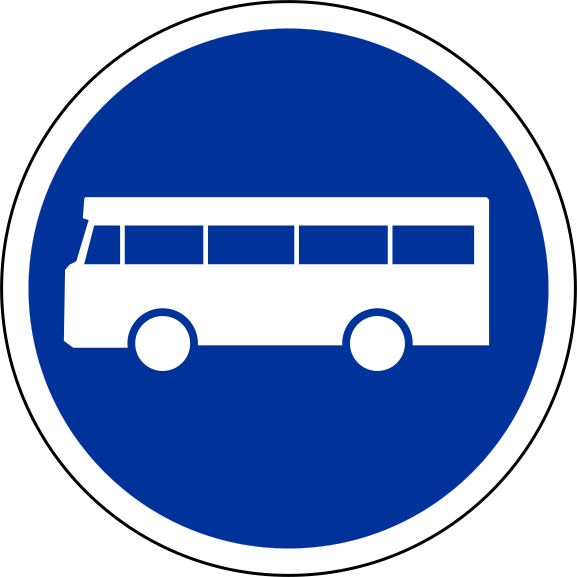 Mandatory lane for buses.
English • Traffic sign B27a • Lane reserved for vehicles operating scheduled public transport services duly authorised by the authority responsible for traffic regulation.
Français • Panneau B27a • Voie réservée aux véhicules de transports en commun des lignes régulières dûment autorisées par l'autorité détentrice du pouvoir de police de la circulation.
Sources
🔗 Commons.wikimedia.org
🔗 Equipementsdelaroute.cerema.fr • Arrêté du 24 novembre 1967
© Roulex 45 et les contributeurs Wikimedia • CC BY-SA 4.0 • SVG original non modifié.
Image via Commons.wikimedia.org
Roulex 45 • CC BY-SA 4.0 • Source revision 2013-01-23. Wikimedia original unmodified.
May bicycles and motorcycles use a bus lane in France?
Cyclists may use a bus lane where the applicable arrangement authorises them. The presence of buses, or cycle access in a neighbouring street, is not sufficient by itself.
🔗 legifrance.gouv.fr • French Road Code — R412-7, R417-11(I)(1)
Does bus-lane access also allow stopping or parking in France?
Stopping and parking on a lane reserved for public transport are prohibited under the Road Code, subject to its applicable exceptions. An authorisation to use the lane is not a general loading or parking exemption.
🔗 legifrance.gouv.fr • French Road Code — R412-7, R417-11(I)(1)
23. Bus stop
A bus stop is a designated place where buses stop to allow passengers to board or leave. It may be identified by a sign, shelter, raised platform, road marking or other public-transport infrastructure and can be located beside the road or in a specially constructed stopping area.
Drivers approaching a bus stop should watch carefully for buses, pedestrians and passengers crossing or entering the roadway. Parking or stopping restrictions may apply around bus stops to keep the area accessible and visible.

Wikimedia.org • B. Brassoud • CC BY-SA
What stopping or parking restrictions apply at bus stops in France?
Stopping and parking in places reserved for public-transport vehicles are prohibited under the Road Code, subject to the applicable provisions and local controls.
🔗 legifrance.gouv.fr • French Road Code — R412-11, R417-10(II)(2)
May I briefly drop off a passenger at a bus stop in France?
Do not assume that immediately dropping off a passenger exempts a car from a reserved public-transport stopping prohibition. Use a lawful place outside the protected facility.
🔗 legifrance.gouv.fr • French Road Code — R412-11, R417-10(II)(2)
What should I do near a stopped bus in France?
Within a built-up area, slow down and stop if necessary to allow a public-transport vehicle to leave its marked stop. Watch for passengers crossing near the bus.
🔗 legifrance.gouv.fr • French Road Code — R412-11, R417-10(II)(2)
24. Dead end
A dead-end road is a road that does not provide a through route for some or all vehicles. It may end completely, terminate at a barrier or continue as a path that only certain road users may use.
Drivers may normally enter a dead-end road to reach homes, businesses, parking places or other destinations, but they must be prepared to turn around or leave by the same route. Signs may indicate that pedestrians or cyclists can continue beyond the point where motor traffic cannot.
Wikimedia.org • Chabe01 • CC BY-SA
What does a dead-end indication mean in France?
France uses impasse information for a dead-end road. A no-through indication is different from a sign prohibiting entry to the road.
🔗 equipementsdelaroute.cerema.fr • French road-sign order, Article 5-8, signs EB10 and EB20
 Dead end street.
English • Traffic sign C13a • No through road.
Français • Panneau C13a • Impasse.
Sources
🔗 Commons.wikimedia.org
🔗 Equipementsdelaroute.cerema.fr • Arrêté du 24 novembre 1967
© Roulex 45 et les contributeurs Wikimedia • CC BY-SA 3.0 • SVG original non modifié.
Image via Commons.wikimedia.org
Roulex 45 self-made from source above • CC BY-SA 3.0 • Source revision 2011-08-06. Wikimedia original unmodified.
Can pedestrians or cyclists continue beyond a motor-traffic dead end in France?
French variants can indicate a continuation for pedestrians or for pedestrians and cyclists. Read the symbols and the actual route; a motor-traffic dead end does not necessarily end a walking or cycling journey.
🔗 equipementsdelaroute.cerema.fr • French road-sign order, Article 5-8, signs EB10 and EB20
Does a dead-end indication change speed or priority rules in France?
The no-through information itself does not assign junction priority or a numerical speed limit. Continue to obey the actual speed, access, parking and priority controls. If you need to turn around, use a suitable lawful place, check for pedestrians and cyclists, and do not obstruct the space needed for other vehicles to turn.
🔗 legifrance.gouv.fr • French Road Code — 1967 order article 5 C13 variants; R411-25
25. Stop sign
A stop sign requires drivers to bring their vehicle to a complete stop and give way before entering or crossing the road ahead. The stop must be made at the stop line or another legally prescribed position.
After stopping, the driver may continue only when this can be done safely and without interfering with traffic that has priority. The sign does not create priority for the driver who has stopped.
Wikimedia.org • Marc Mongenet • CC BY-SA
Must I stop completely at a stop sign in France?
Yes. Come to a complete stop when the applicable stop sign controls your approach, even when you cannot see another road user. Slowing to a crawl is not a stop. The stopping duty is separate from the duty to give way before continuing.
🔗 legifrance.gouv.fr • French Road Code — R415-5–7; 1967 order AB3a/AB4
 Stop and give way.
English • Traffic sign AB4 • Stop at the junction under the conditions defined in article R 415-6 of the Highway Code. Sign at the stopping point.
Français • Panneau AB4 • Arrêt à l'intersection dans les conditions définies à l'article R 415-6 du code de la route. Signal de position.
Sources
🔗 Commons.wikimedia.org
🔗 Equipementsdelaroute.cerema.fr • Arrêté du 24 novembre 1967
© Roulex 45 et les contributeurs Wikimedia • CC BY-SA 3.0 • SVG original non modifié.
Image via Commons.wikimedia.org
Roulex 45 • CC BY-SA 3.0 • Source revision 2022-07-28. Wikimedia original unmodified.
Where must I stop at a stop-controlled junction in France?
Stop at the prescribed line or boundary before joining the other carriageway. If that position does not provide enough visibility, advance only cautiously and without interfering with the road users to whom you must give way.
🔗 legifrance.gouv.fr • French Road Code — R415-5–7; 1967 order AB3a/AB4
Does stopping first give me priority at a stop sign in France?
A complete stop does not, by itself, give you priority. Give way to the road users entitled to pass under the junction’s signs and rules, check pedestrians and cyclists, and proceed only when the gap is safe. Do not follow another stopped vehicle through without satisfying your own stopping and yielding duties.
🔗 legifrance.gouv.fr • French Road Code — R415-5–7; 1967 order AB3a/AB4