


IcelandIceland
 Traffic rules
 Iceland
1. Iceland
Iceland is a Nordic island country in the North Atlantic, close to the Arctic Circle and geographically separated from mainland Europe. Traffic drives on the right, but driving conditions can change quickly because of strong winds, snow, ice and rapidly changing weather. Outside Reykjavík and other towns, drivers may encounter long stretches of open road, gravel surfaces, narrow roads and single-lane bridges. The mountainous interior is reached by seasonal highland routes, including rough F-roads that may require four-wheel-drive vehicles and can remain closed well into summer.
Icelandic is the official language and is used for place names and most text on road signs. The Icelandic alphabet includes distinctive letters such as ð, þ and æ, which foreign drivers may notice on destination signs. Two rules are particularly important when exploring the country: legally required driving lights must remain on whenever a motor vehicle is being driven, and driving away from authorised roads or tracks is generally prohibited because off-road driving can cause lasting damage to Iceland's fragile landscape.
AI-generated by Traffic-rules.com • WCIT • CC BY-SA
Which side of the road do you drive on in Iceland?
Drive on the right and normally overtake on the left.
Which emergency number should you call in Iceland?
Call 112 for police, ambulance, fire, search-and-rescue or other emergency assistance.
What is the legal alcohol limit for drivers in Iceland?
Icelandic traffic law considers a driver with a blood-alcohol concentration of 0.2‰ (0.2 g/l) or more unable to drive safely. The safest rule is therefore not to drink any alcohol before driving.
What is the general speed limit in Icelandic built-up areas?
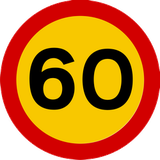
The general maximum speed in built-up areas is 50 km/h, unless signs indicate another limit. Lower limits are common in residential areas.
What is the general speed limit on gravel roads outside built-up areas in Iceland?
The general maximum speed on gravel roads outside built-up areas is 80 km/h, unless signs indicate another limit.
What is the general speed limit on paved roads outside built-up areas in Iceland?
The general maximum speed on paved roads outside built-up areas is 90 km/h, unless signs indicate another limit. Icelandic law allows higher signed limits of up to 110 km/h on suitable roads where opposing traffic directions are separated.
Do you need a motorway vignette or pay road tolls in Iceland?
Iceland has no nationwide motorway vignette and most roads are toll-free. The Vaðlaheiði Tunnel is tolled, and the Ring Road through Hornafjörður has also been subject to a toll since 1 September 2026.
Must cars use lights during the day in Iceland?
Yes. The legally required driving lights must always be switched on while a motor vehicle is being driven, including during daylight.
When may studded tyres be used in Iceland?
Studded tyres are generally permitted from 1 November to 15 April. They may also be used outside that period when road conditions require them. Drivers are responsible for ensuring that their vehicle and tyres are suitable for the conditions.
Are seat belts mandatory in Iceland?
Seat belts are mandatory for everyone occupying a seat equipped with one while the vehicle is moving.
When must children use a child restraint in Iceland?
A child shorter than 135 cm must use an approved child seat, booster or other suitable restraint appropriate for the child's size.
Can a child sit in front of an active airbag in Iceland?
A child shorter than 150 cm may not sit in a front seat with an active frontal airbag. The airbag must be deactivated before the child may use that seat.
Who must wear a helmet in Iceland?
Motorcycle and off-road-vehicle riders and passengers must wear an approved protective helmet. Children younger than 16 must also wear a helmet when cycling or using a small powered personal vehicle.
Can you use a mobile phone while driving in Iceland?
A driver may not use a mobile phone, smart device or other distracting electronic equipment while driving without hands-free equipment.
When must you give way to traffic approaching from the right in Iceland?
At an intersection where priority is not otherwise regulated, a driver must generally give way to traffic approaching from the right. Signs and other specific priority rules can override this rule.
Who has priority at roundabouts in Iceland?
Drivers entering a roundabout must give way to traffic already circulating. In a two-lane roundabout, a driver taking the first exit should use the outer lane, and a driver in the outer lane must give way to a driver leaving the roundabout from the inner lane. Drivers may not change between the inner and outer lanes while circulating in the roundabout.
What must drivers do at pedestrian crossings in Iceland?
At an uncontrolled pedestrian crossing, drivers must give pedestrians who are on or entering the crossing the opportunity to cross safely and must stop when necessary.
How much space must drivers leave when overtaking cyclists in Iceland?
When overtaking a cyclist or light moped, drivers must leave a lateral distance of at least 1.5 metres.
What is the speed limit in an Icelandic residential street?
In a designated vistgata, or residential traffic-calmed street, the maximum speed is 15 km/h. Drivers must give particular consideration and priority to pedestrians.
Who has priority on a narrow Icelandic road or single-lane bridge?
Where a road is too narrow for two vehicles to pass safely, the driver who arrives first generally has priority. The later-arriving driver should stop, pull aside or reverse where possible. Drivers should still follow any signs controlling priority at a particular bridge or narrow section.
Can you drive an ordinary car on Icelandic F-roads?
It depends on the road. Some highland routes can be used by general traffic during summer, but many are extremely rough and may include unbridged rivers. Roads classified as F2 require suitable four-wheel-drive vehicles, while F3 routes are intended only for large, well-equipped four-wheel-drive vehicles or superjeeps. Always check current road conditions and vehicle-rental restrictions before entering the highlands.
When do Icelandic highland roads open?
There is no fixed opening date. Mountain roads remain closed until snow, thawing ground and other conditions allow them to carry traffic without damage. Some routes do not open until late June or July and may be accessible for only a short part of the year.
Is off-road driving allowed in Iceland?
Driving off authorised roads and tracks is generally prohibited. Iceland's vegetation and volcanic surfaces can be extremely fragile, and vehicle tracks may cause long-lasting damage.
What do red and amber traffic lights mean in Iceland?
Red means stop. A steady amber light also means stop unless the vehicle is already so close to the signal that stopping would create a danger.
What should you do if your vehicle breaks down on an Icelandic road?
If a vehicle stops involuntarily on the carriageway, use the hazard warning lights where possible and always place a warning triangle to warn approaching traffic.

