


Traffic signsUnited States
 Traffic rules
 United States
26. School area
A school area is a road or group of roads near a school where large numbers of children may walk, cycle, cross the road or enter and leave vehicles. It may be identified by warning signs, zone signs, road markings, traffic-calming measures or flashing lights.
Special speed limits, parking restrictions or access rules may apply permanently or only during school arrival and departure times. Drivers should reduce speed, watch carefully for children and be prepared to stop.
Wikimedia.org • Tdorante10 • CC BY-SA
What speed rules apply around schools in the United States?
School-zone speeds and their hours are set at state or local level. Some restrictions apply only when signs or flashing beacons indicate, while others operate at specified times.
🔗 highways.dot.gov • FHWA — statutory, posted, advisory and special-condition speed limits
Does a school warning sign in the United States automatically set the speed limit?
A children or school warning alerts you to a potential hazard; the enforceable numerical speed limit depends on the applicable law, regulatory signs and any time or variable display. Slow further if children are near the road.
🔗 highways.dot.gov • FHWA — statutory, posted, advisory and special-condition speed limits
How should you pass a school entrance in the United States?
Watch for children stepping out from between parked vehicles, obey crossings and any school patrol, and follow stopping or parking restrictions. Do not obstruct visibility near a crossing or school entrance; approach at a speed that permits a safe stop.
🔗 highways.dot.gov • FHWA — statutory, posted, advisory and special-condition speed limits

27. Crossing animals
An animals-crossing warning indicates a place or road section where wild animals, livestock or ridden animals may enter or cross the road. Animals may appear suddenly, move unpredictably or be difficult to see in darkness, vegetation or poor weather.
Drivers should reduce speed, scan both sides of the road and remain prepared to stop. The warning sign does not itself give animals priority or impose a numerical speed limit, but drivers must avoid frightening, endangering or colliding with them.
Wikimedia.org • Davric • CC BY-SA
Which animals might drivers encounter on roads in the United States?
Depending on the locality, drivers may meet deer, elk, moose and other wildlife depending on the state. Roadside animal-warning signs and local hazard information indicate where extra care may be needed; do not assume the hazard ends immediately after a sign.
 Warning for cattle on the road.
English • W11-4 • Cattle. Warns that cattle may enter or cross the road. Slow down and be prepared to stop.
Sources
🔗 Commons.wikimedia.org
🔗 Mutcd.fhwa.dot.gov • FHWA: MUTCD, 11th Edition with Revision1, PDF page234
SVG source: Author not stated on source page • Public domain • Original revision 2024-05-23. Wikimedia original unmodified.
 Warning for crossing deer.
English • W11-3 • Deer. Warns that deer may enter or cross the road. Slow down and be prepared to stop.
Sources
🔗 Commons.wikimedia.org
🔗 Mutcd.fhwa.dot.gov • FHWA: MUTCD, 11th Edition with Revision1, PDF page234
SVG source: Author not stated on source page • Public domain • Original revision 2024-05-23. Wikimedia original unmodified.
Does an animal-crossing warning sign in the United States set a new speed limit?
A warning of animals is not, by itself, a numerical speed-limit sign. Continue to obey the applicable speed limit, but slow down whenever animals could enter the road or visibility is poor. A separate regulatory speed sign must also be obeyed.
What should you do if an animal enters the road in the United States?
Ease off the accelerator, assess the traffic behind and brake smoothly if necessary. Avoid abrupt swerving into opposing traffic or off the road. Give farm animals and ridden animals room, avoid frightening them with unnecessary horn use, and be alert for more animals following.
28. Slippery road
A slippery road has reduced tyre grip and can make steering, braking and acceleration less effective. Roads may become slippery because of rain, ice, snow, mud, oil, loose material or other substances on the surface. Drivers should reduce speed, increase their following distance and avoid sudden steering, braking or acceleration. Extra caution is needed in bends, on bridges and wherever the road surface changes unexpectedly.
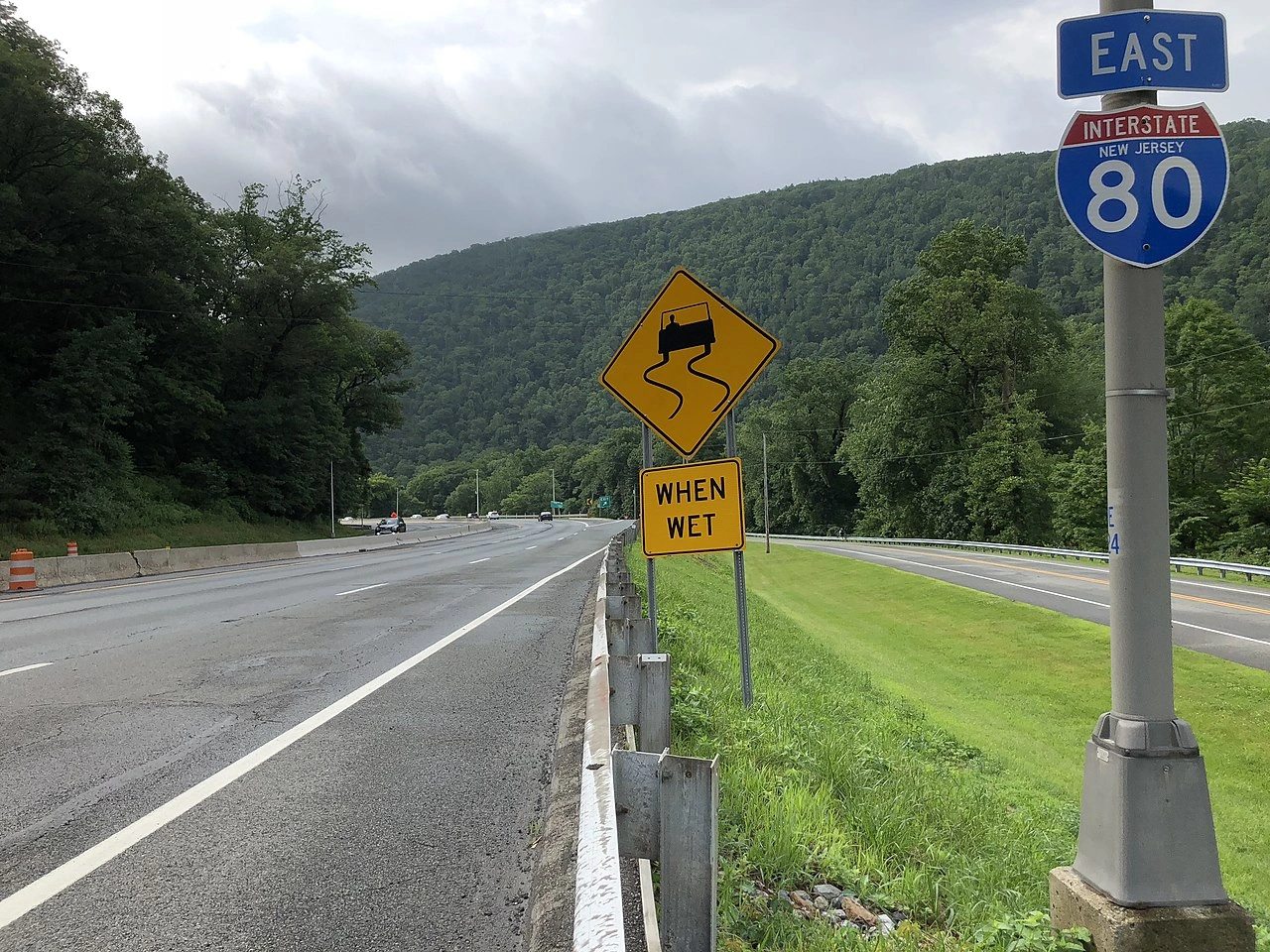
Wikimedia.org • Famartin • CC BY-SA
What can make roads slippery in the United States?
Be prepared for rain, snow or freezing rain in colder states and loose gravel elsewhere. A surface can become slippery even if it looks clear, and different parts of the road may have very different grip.
How should you drive on a slippery road in the United States?
Reduce speed early, increase the gap to the vehicle ahead and use smooth steering, braking and acceleration. Do not rely on the posted maximum as a safe target when grip is poor.
Does a slippery-road warning sign in the United States automatically impose a lower number?
The warning sign highlights a reduced-grip risk; it normally does not itself prescribe a new numerical speed limit. A separate speed-limit sign, temporary restriction or local condition may still apply. Travel below the legal maximum when necessary for safety.
 Warning for a slippery road surface.
English • W8-5 • Slippery surface. Warns of a road surface that may be slippery. Reduce speed and avoid sudden manoeuvres.
Sources
🔗 Commons.wikimedia.org
🔗 Mutcd.fhwa.dot.gov • FHWA: MUTCD, 11th Edition with Revision1, PDF page215
SVG source: Federal Highway Administration • Public domain • Original revision 2024-05-23. Wikimedia original unmodified.
29. Rockfall
A rockfall warning indicates a road section where rocks or stones may fall from a cliff, cutting or steep slope, or where fallen material may already be present on the road. The danger may affect the full carriageway and can appear suddenly.
Drivers should reduce speed, scan the road and slopes ahead, increase their following distance and remain prepared to stop. They should avoid unnecessary stopping in the exposed section and never attempt to move unstable rocks themselves.

Wikimedia.org • cogdogblog • CC BY
Where might falling rocks be a hazard on roads in the United States?
Pay extra attention around canyon roads, mountain passes and steep rock cuttings. After heavy rain, freeze–thaw cycles or work on a steep slope, the hazard may increase depending on local conditions.
Does a falling-rocks warning sign in the United States impose a speed limit?
A falling-rocks sign is a hazard warning, not normally a numerical speed-limit sign. Follow any separate speed or closure signs, slow down to match visibility and conditions, and watch for material already on the road.
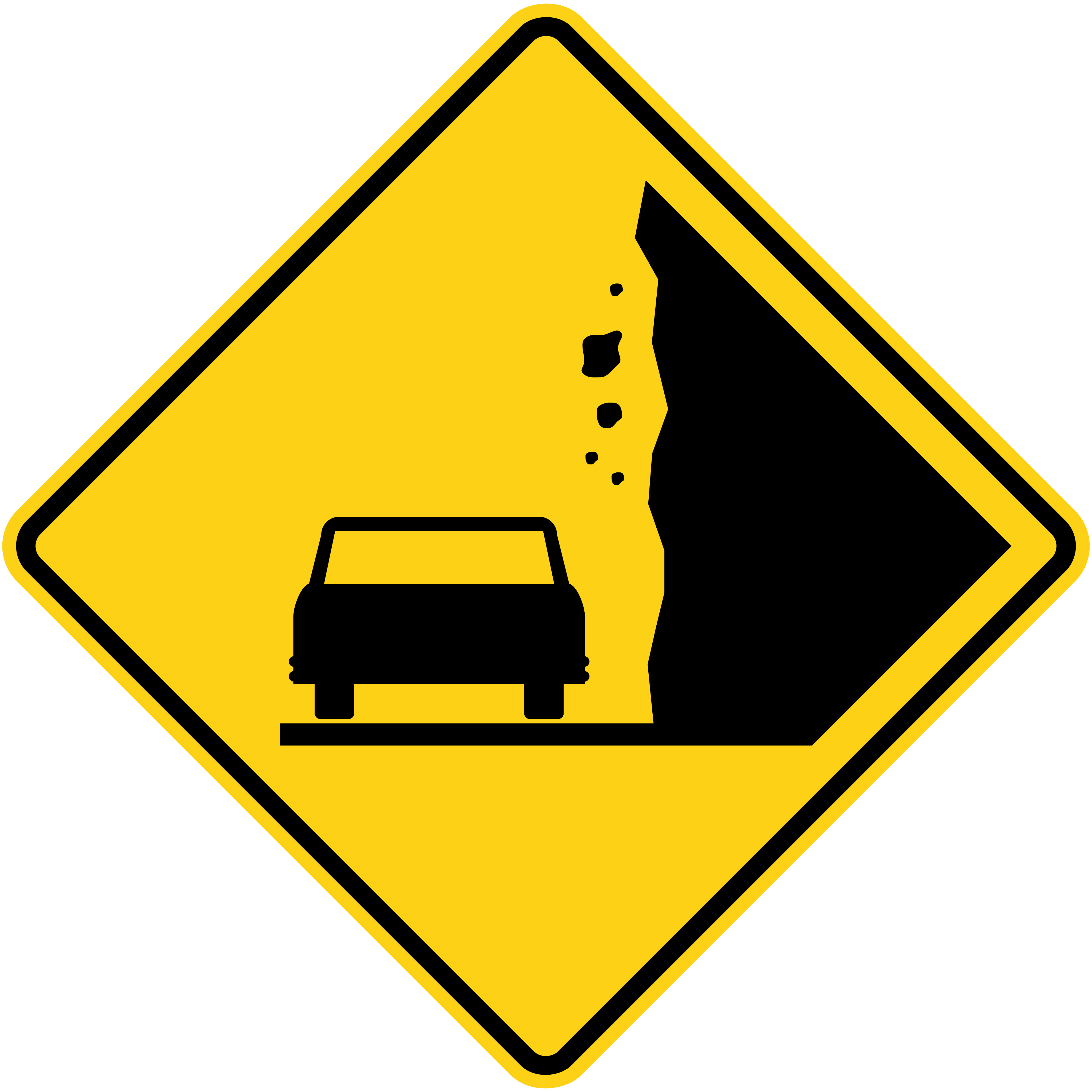 Warning for falling rocks.
English • W50-1(CA) • Rock-slide area. Warns that rocks may fall or slide onto the road. Reduce speed and watch for debris. California design, documented as W50-1(CA) in the Caltrans sign specifications.
Sources
🔗 Commons.wikimedia.org
🔗 Dot.ca.gov • Caltrans: W50-1(CA) specification
SVG source: California Department of Transportation • Public domain • Original revision 2024-05-22. Wikimedia original unmodified.
What should you do if rocks are blocking the road in the United States?
Slow or stop in a safe place away from the exposed slope if possible. Do not drive over unstable debris or stop beneath a cliff unnecessarily. Follow any closure or traffic-control instructions and report a dangerous obstruction through the appropriate road authority or emergency channel.
30. Aircraft
An aircraft warning is a traffic warning indicating that aircraft may pass at low altitude above or close to the road, usually near an airport, airfield or flight path. The warning is intended to prepare drivers for the sudden appearance or noise of low-flying aircraft.
Drivers should remain focused on the road and avoid sudden braking or steering movements if an aircraft passes overhead. The design and use of aircraft warning signs vary between countries.
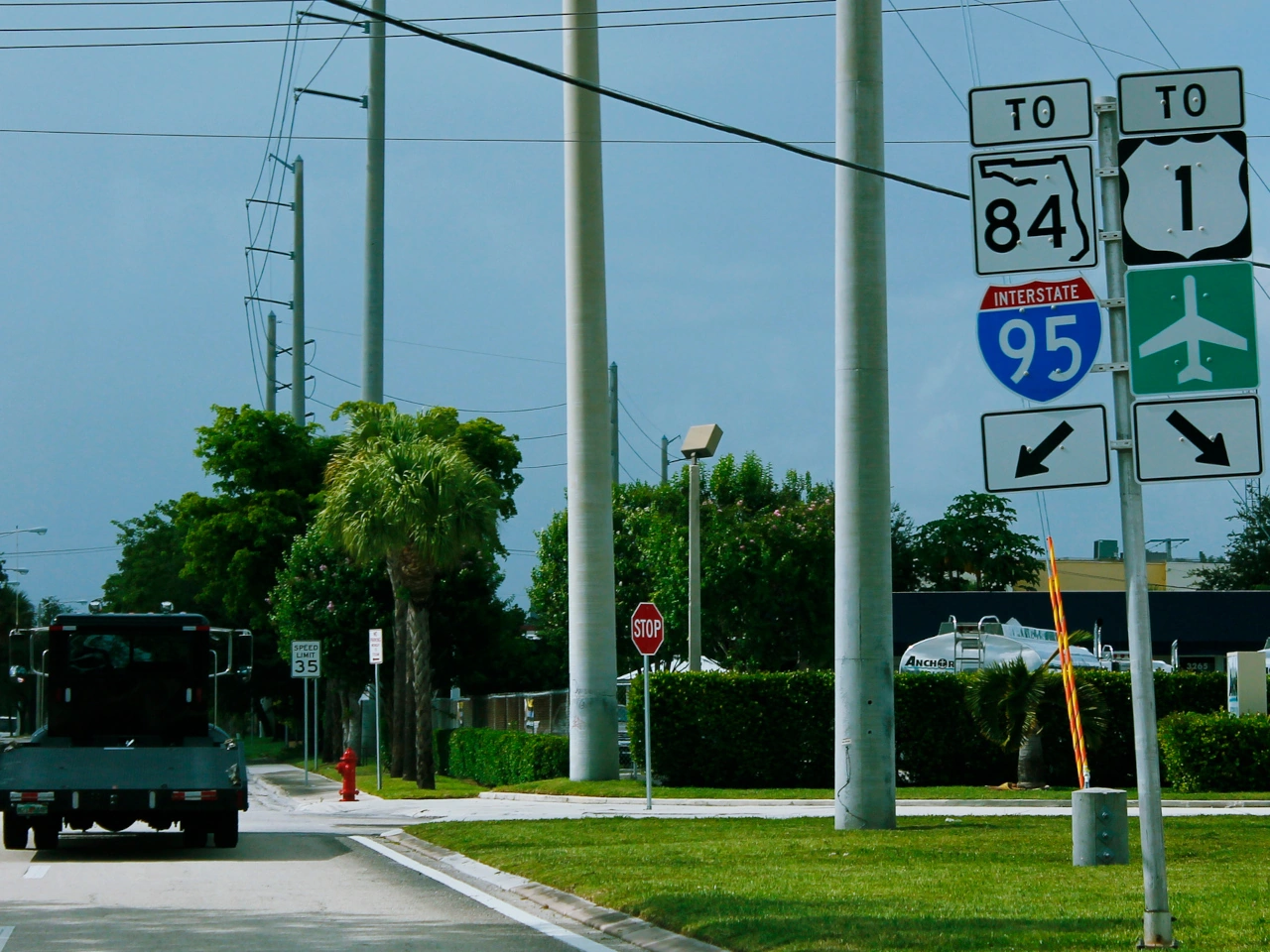
Wikimedia.org • formulanone • CC BY-SA
What should an aircraft-warning sign tell drivers in the United States?
Where an aircraft warning is installed, it alerts drivers to low-flying aircraft or sudden aircraft noise near an airfield or flight path. US warnings follow federal MUTCD principles as adopted or adapted by the relevant state. Do not confuse an airport-direction sign with a hazard warning.
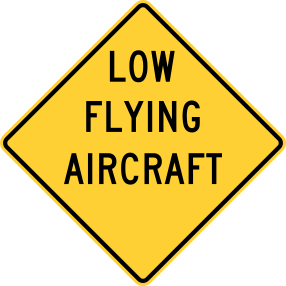 Warning for low-flying aircraft.
English • W11-23-DE • Low-flying aircraft. Warns of low-flying aircraft near the road. Remain attentive and maintain control of the vehicle. Delaware design, documented in the 2018 DelDOT sign book.
Sources
🔗 Commons.wikimedia.org
🔗 Deldot.gov • DelDOT: 2018 sign book, printed page44
Image via Commons.wikimedia.org
No machine-readable author provided. Overpush~commonswiki assumed (based on copyright claims). • Public domain • Source revision 2013-05-04. Wikimedia original unmodified.
Does an aircraft warning automatically reduce the speed limit in the United States?
No, not by itself. A hazard warning is not a numerical speed-limit sign. Obey any separately displayed speed restriction and adjust speed if actual conditions make this necessary.
What if a low-flying aircraft distracts you while driving in the United States?
Keep your eyes on the road, maintain your lane and avoid sudden braking or steering simply to watch the aircraft. If you need to stop, find a safe and permitted stopping place.
31. Curve
A curve is a section of road that changes direction to the left or right. A sharp, unexpected or poorly visible curve can reduce a driver’s view of approaching traffic, stopped vehicles, pedestrians and other hazards.
Drivers should reduce speed before entering the curve, remain within their lane and use smooth steering, braking and acceleration. Warning signs may indicate the direction of the first curve or a series of successive curves.

Wikimedia.org • Famartin • CC BY-SA
What makes a bend dangerous in the United States?
Curves shorten your view of the road ahead and can reduce the margin for correcting a mistake. Drivers may encounter mountain highways and urban ramps where the signed advisory speed may be lower than the limit; the safe speed can be well below the posted maximum. In the US, a separate advisory-speed plaque may accompany a curve-warning sign; distinguish advice from a regulatory speed limit.
 Warning for a curve to the right.
English • W1-2R • Curve to the right. Warns of a curve to the right. Reduce speed as necessary before the curve.
Sources
🔗 Commons.wikimedia.org
🔗 Mutcd.fhwa.dot.gov • FHWA: MUTCD, 11th Edition with Revision1, PDF page194
SVG source: MUTCD_W1-2L.svg: derivative work: Fry1989 • Public domain • Original revision 2024-05-23. Wikimedia original unmodified.
How should you approach a sharp curve in the United States?
Slow down before the bend, select the correct lane position, look through the curve and steer smoothly. Keep enough grip and visible stopping distance for the road and weather conditions.
Is overtaking safe on a blind bend in the United States?
No. Do not start overtaking where your view of oncoming traffic is obstructed or where signs or road markings prohibit it. Wait until there is a lawful, clear and sufficiently long view ahead.
32. Chevron
A chevron is a V-shaped or arrow-shaped road marker used to show a sharp change in the direction of a road. Chevron boards are normally placed along the outside of a curve so that their points indicate the direction in which the road continues.
Chevrons improve the visibility and alignment of a curve, especially in darkness or poor weather. They do not normally impose a speed limit or determine priority, so drivers must reduce speed before the curve and follow all other signs and road markings.
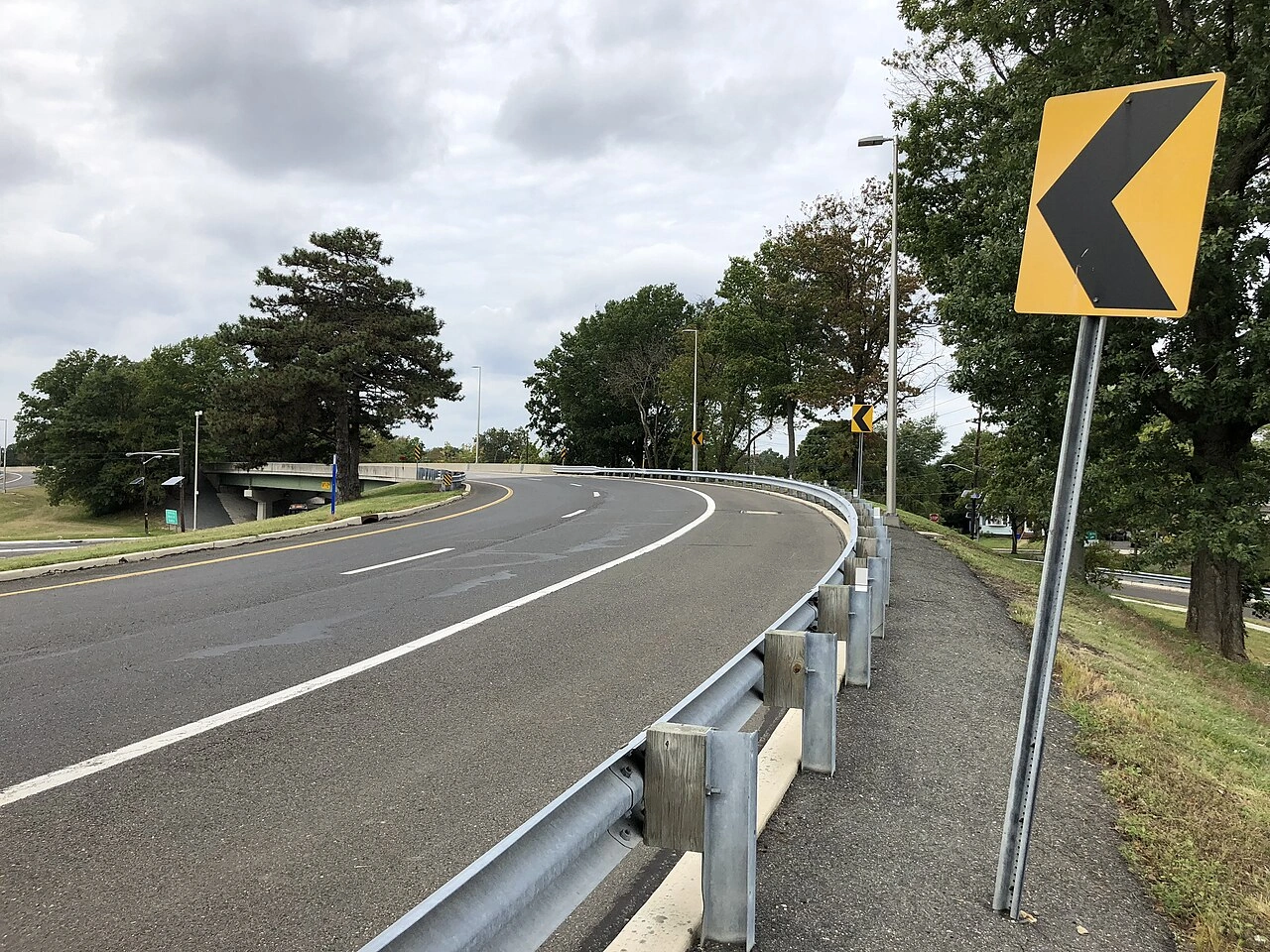
Wikimedia.org • Famartin • CC BY-SA
What is the purpose of chevron boards on a road in the United States?
Chevron alignment boards help drivers see which way a sharp bend continues, especially in darkness or poor visibility. In US guidance, W1-8 Chevron Alignment signs mark horizontal alignment through a bend.
Do chevron boards give priority or order a turn at junctions in the United States?
Not ordinary curve-alignment chevrons. They guide you around a bend. Give-way, no-entry, keep-direction and other mandatory traffic signs must be read separately; similar-looking arrows can have different legal meanings.
Is the speed shown by a chevron in the United States a compulsory maximum?
A chevron alone does not set a numerical maximum speed. If an advisory-speed panel or a regulatory speed-limit sign is displayed alongside it, identify which type it is and follow the binding speed rules.
33. Wrong-way driving
Wrong-way driving occurs when a driver travels against the legally permitted direction of traffic. It may happen on a one-way road, divided road, motorway entrance or exit, or another road section reserved for traffic travelling in one direction.
Wrong-way driving creates an extreme risk of a head-on collision. Drivers must follow direction signs, no-entry signs, lane arrows and road markings. Anyone who accidentally enters a road in the wrong direction should slow down, warn other traffic, stop in the safest available place and contact the emergency services.
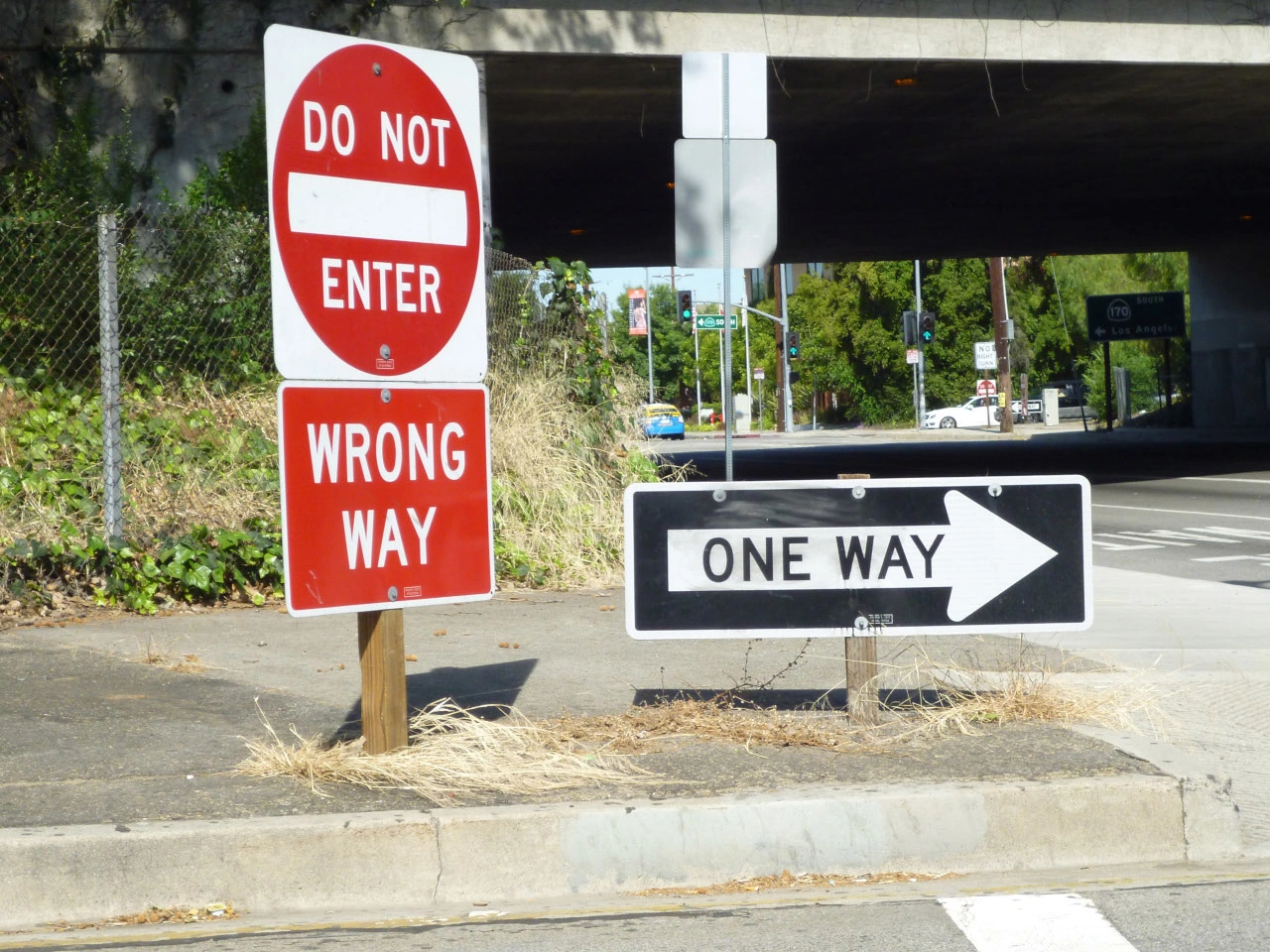
Wikimedia.org • Coolcaesar • CC BY-SA
How can you avoid driving the wrong way in the United States?
Traffic normally keeps right here. Keep to the correct side of the road and use no-entry and one-way signs to identify prohibited approaches; do not enter an exit ramp against its permitted direction.
🔗 mutcd.fhwa.dot.gov • FHWA MUTCD11th Edition Revision1 — relevant traffic controls
What signs can prevent wrong-way driving in the United States?
At some US ramps, the words DO NOT ENTER and WRONG WAY are displayed to traffic approaching in the prohibited direction. Before entering a motorway, expressway, one-way street or slip road, check the permitted direction rather than relying only on a navigation app.
🔗 mutcd.fhwa.dot.gov • FHWA MUTCD11th Edition Revision1 — relevant traffic controls
34. Roadworks
Roadworks are construction, maintenance, repair or inspection activities carried out on or beside a road. They may temporarily change the road layout, lane widths, speed limits, priority, permitted directions and facilities for pedestrians or cyclists.
Drivers must follow the temporary signs, traffic lights, barriers, road markings and instructions from authorised personnel. They should reduce speed, increase their following distance and remain prepared for narrow lanes, stopped traffic, workers, machinery and sudden changes in the route.
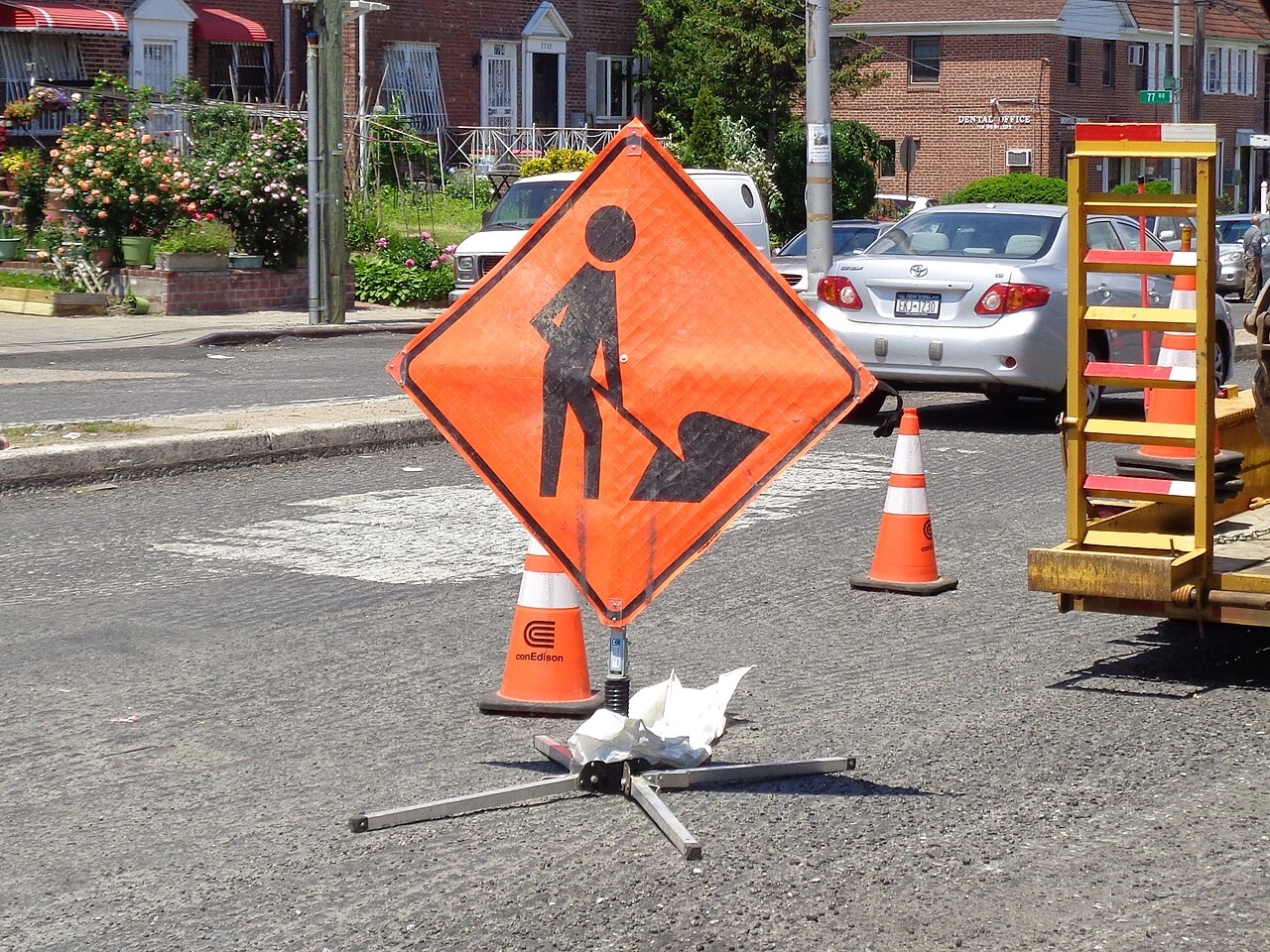
Wikimedia.org • Tdorante10 • CC BY-SA
What should you watch for when approaching roadworks in the United States?
Look for temporary warnings, cones, barriers, narrow lanes and construction vehicles. The MUTCD uses temporary traffic-control devices including orange work-zone signs; traffic-control arrangements and penalties are also governed by state law. Expect workers and slow or stationary traffic near the worksite.
🔗 mutcd.fhwa.dot.gov • FHWA MUTCD11th Edition Revision1 — relevant traffic controls
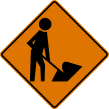 Warning for roadworks.
English • W21-1 • Workers. Warns of workers in or near the road. Slow down and follow the temporary traffic controls.
Sources
🔗 Commons.wikimedia.org
🔗 Mutcd.fhwa.dot.gov • FHWA: MUTCD, 11th Edition with Revision1, PDF page842
SVG source: Federal Highway Administration - MUTCD • Public domain • Original revision 2024-05-23. Wikimedia original unmodified.
Is a temporary speed limit at roadworks binding in the United States?
Where an authorised temporary regulatory speed limit is in force, you must obey it. A roadworks warning alone should not be mistaken for a new numerical limit, but conditions may require driving more slowly.
🔗 mutcd.fhwa.dot.gov • FHWA MUTCD11th Edition Revision1 — relevant traffic controls
What if only one lane remains open through roadworks in the United States?
Follow the temporary signals, stop/go instructions, lane arrows and priority signs. Do not enter an opposing traffic lane until permitted, and give vulnerable road users and road workers extra room.
🔗 mutcd.fhwa.dot.gov • FHWA MUTCD11th Edition Revision1 — relevant traffic controls
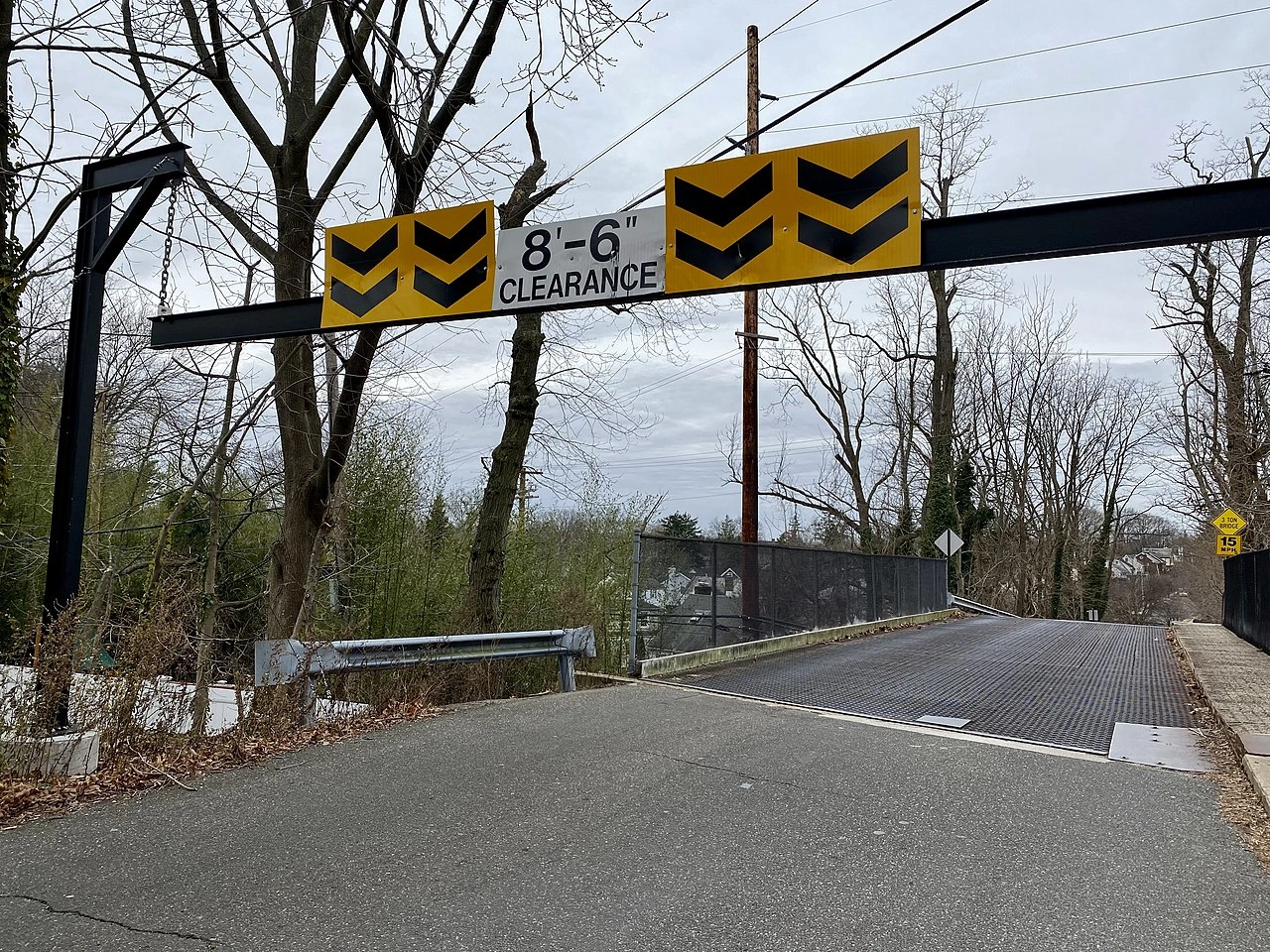
35. Height limit
A height limit prohibits vehicles whose total height exceeds the value shown from entering or passing a road section, bridge, tunnel, gateway or other structure. The vehicle’s height includes its load and any equipment attached above it.
Drivers of high vehicles must know their exact height, observe advance warnings and use an alternative route when necessary. They should never rely only on visual judgement or attempt to pass beneath a structure when safe clearance is uncertain.
Wikimedia.org • Washuotaku • CC BY-SA
How should you read a low-bridge height restriction in the United States?
Low-clearance warnings in the United States commonly use feet and inches. Do not confuse a clearance warning with a legally posted vehicle restriction, and never drive beneath a structure unless the vehicle has sufficient actual headroom.
Does a roof load count when checking vehicle height in the United States?
Yes for practical clearance: measure the vehicle at its highest point with its load and fitted accessories, such as a roof box, bicycle or roof rack. Check the local legal measurement rules as well; an empty vehicle’s registered height is not enough when equipment has been added.
What should you do if your vehicle is too high for a bridge or tunnel in the United States?
Do not try to squeeze under the structure. Use the signed alternative route and, if you are already close to the obstruction, stop where safe and seek traffic-control assistance rather than reversing unpredictably into moving traffic.
36. Weight limit
A weight limit prohibits vehicles or vehicle combinations whose mass exceeds the value shown from entering or passing a road section, bridge, tunnel or other structure. Depending on local law, the restriction may concern the vehicle’s actual loaded mass, maximum authorised mass or load on an individual axle.
Drivers must know which type of mass the sign refers to and must include the vehicle, passengers, cargo and any trailer where required. A vehicle that exceeds the limit must use another suitable route.
Wikimedia.org • formulanone • CC BY-SA
Does every weight-limit sign measure the same kind of vehicle weight in the United States?
No. US weight-limit signs can restrict gross vehicle weight, weight per axle or a class of vehicle. Check the actual units and sign text, and the applicable state or local rule for a particular bridge or road.
Do cargo and trailers matter for a posted weight restriction in the United States?
Yes, whenever the rule is based on actual loaded mass or the total mass of a combination. Cargo, passengers and the trailer affect that figure; weight on individual axles may be limited separately. If the sign instead uses authorised maximum mass, an empty vehicle may still be prohibited.
What should you do if your vehicle exceeds a bridge weight limit in the United States?
Do not drive onto the bridge. Follow the signed alternative route and check the vehicle’s gross and axle loads as applicable. A general heavy-vehicle permit does not automatically authorise crossing every restricted bridge.
37. Radar speed sign
A radar speed sign warns drivers that vehicle speeds may be monitored by a fixed camera, mobile radar, lidar or average-speed enforcement system. It reminds drivers to check and respect the applicable speed limit.
The sign does not normally establish the speed limit itself. Drivers must follow the general, posted or variable speed limit applying to the road and must not brake suddenly merely because speed enforcement is indicated.
Wikimedia.org • Hallows AG • CC BY-SA
Is a radar speed-feedback display the same as an enforcement-camera warning in the United States?
No. A radar speed-feedback display can show the approaching vehicle’s speed; a photo-enforcement warning refers to an enforcement arrangement. Both are distinct from a regulatory SPEED LIMIT sign.
Does a radar speed sign set a new speed limit in the United States?
Not by itself. Obey the posted regulatory speed limit and any legally effective temporary or school-zone limit. An advisory or speed-feedback display does not cancel the applicable restriction.
Can a driver assume there is no speed enforcement where no camera sign is displayed in the United States?
No. Enforcement methods and notification requirements vary by state and locality. Do not infer that exceeding the posted limit is permitted when a camera-warning sign is absent.
38. Selective barriers
Selective barriers are physical access-control devices that allow certain road users or authorised vehicles to pass while restricting other traffic. They may include fixed, removable, folding or retractable bollards, gates, barriers and width-filtering installations.
The permitted users are determined by traffic signs, access conditions and local regulations, not by the barrier alone. Drivers should approach slowly, verify that they are authorised and wait until any moving barrier is fully open or retracted before continuing.
Wikimedia.org • LINYperson615 • CC BY-SA
What does a selective barrier control in the United States?
A bollard, gate, bus filter or other physical access-control device can admit some users and exclude others. It is not a universal traffic-sign category. In United States, the relevant sign or local traffic order must be checked.
🔗 mutcd.fhwa.dot.gov • FHWA MUTCD11th Edition Revision1 — actual applicable control/guide devices
May a cyclist or motorcycle rider use a gap beside a selective barrier in the United States?
Only if the applicable access rule permits that road user and the opening is safe and intended for them. A gap designed for pedestrians or cyclists is not permission for an unauthorised motorcycle or car.
🔗 mutcd.fhwa.dot.gov • FHWA MUTCD11th Edition Revision1 — actual applicable control/guide devices
Can you drive through a movable barrier while it is opening in the United States?
Wait until the barrier is fully open or lowered and a permitted signal or authorisation allows movement. Do not follow an authorised bus or emergency vehicle through a closing gate.
🔗 mutcd.fhwa.dot.gov • FHWA MUTCD11th Edition Revision1 — actual applicable control/guide devices
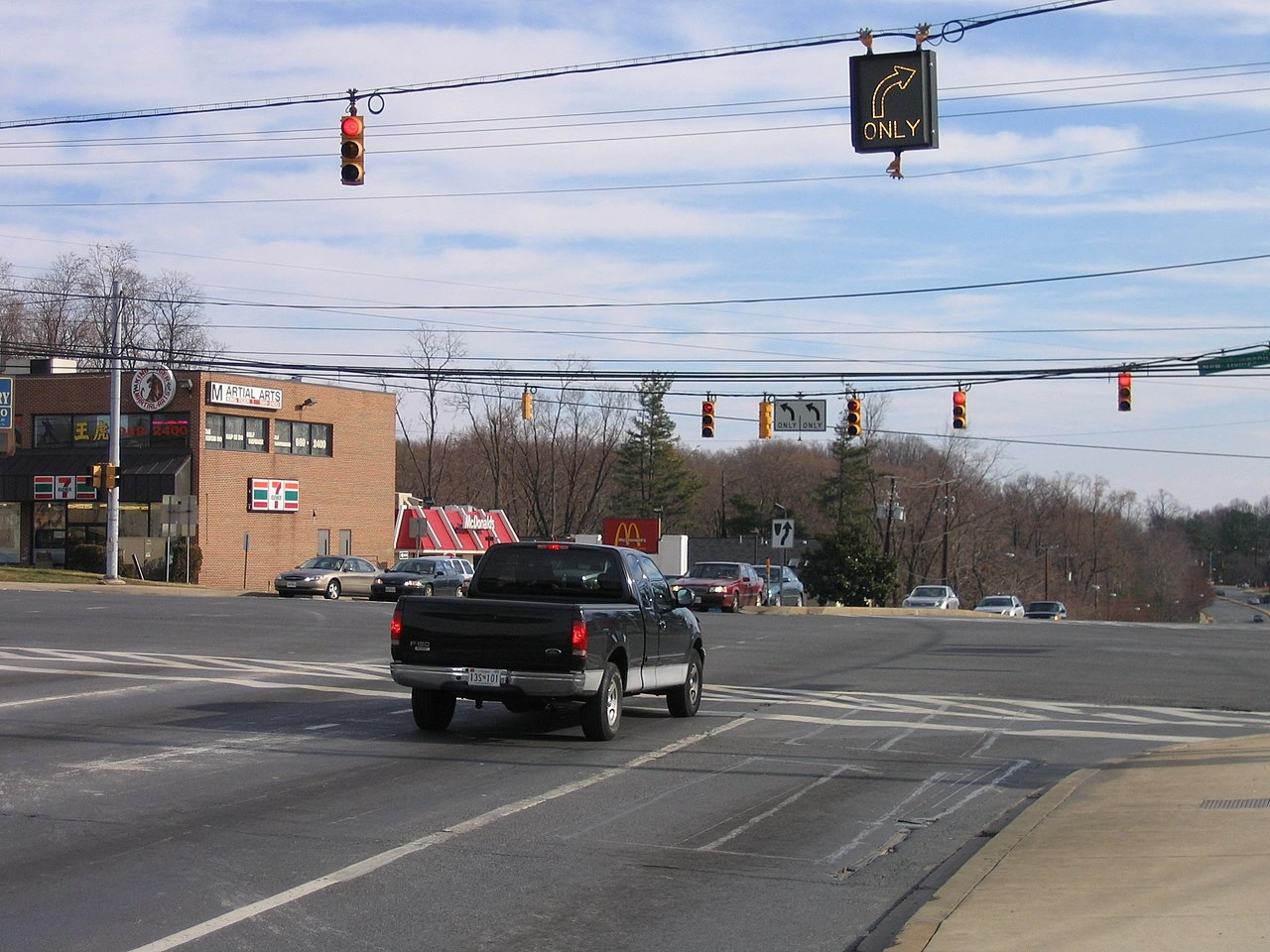
39. Traffic lights
Traffic lights use coloured lights, arrows or symbols to regulate when road users may proceed, must prepare to stop or must remain stopped. Separate signals may apply to particular directions, lanes, pedestrians, cyclists or public-transport vehicles.
A green light permits movement only when the route is clear and the movement is otherwise legal. Road users must still follow priority rules, turning restrictions, lane markings and instructions from authorised traffic controllers.
Wikimedia.org • Andrew Bossi • CC BY-SA
What must a driver do at red, amber and green signals in the United States?
Signal rules are set by the state or local jurisdiction. In California, steady red means stop, steady yellow means stop if you can do so safely, and green permits proceeding when safe. Flashing red requires stopping before proceeding when safe; flashing yellow means slow down and proceed cautiously. Do not confuse a flashing signal with an ordinary green light.
🔗 dmv.ca.gov • California DMV, Driver Handbook, traffic signals
May you turn at a red traffic light in the United States?
Rules vary by state and city. California generally permits a right turn on a circular red after a complete stop and yielding, unless a sign prohibits it; it prohibits turning against a red arrow. In New York City, turning on red is prohibited unless a sign expressly permits it. Always check the applicable signs, signals and local rules.
🔗 dmv.ca.gov • California DMV, Driver Handbook, traffic signals; 🔗 dmv.ny.gov • New York DMV, Driver Manual, traffic control
Can a green light remove the need to give way to pedestrians in the United States?
No. A green signal is not a guarantee that the junction is empty. Check for people already crossing, vehicles completing a movement and any separate pedestrian, bicycle or turning signals. Do not enter if you cannot clear the junction safely.
🔗 dmv.ca.gov • California DMV, traffic-control rules; state rules vary
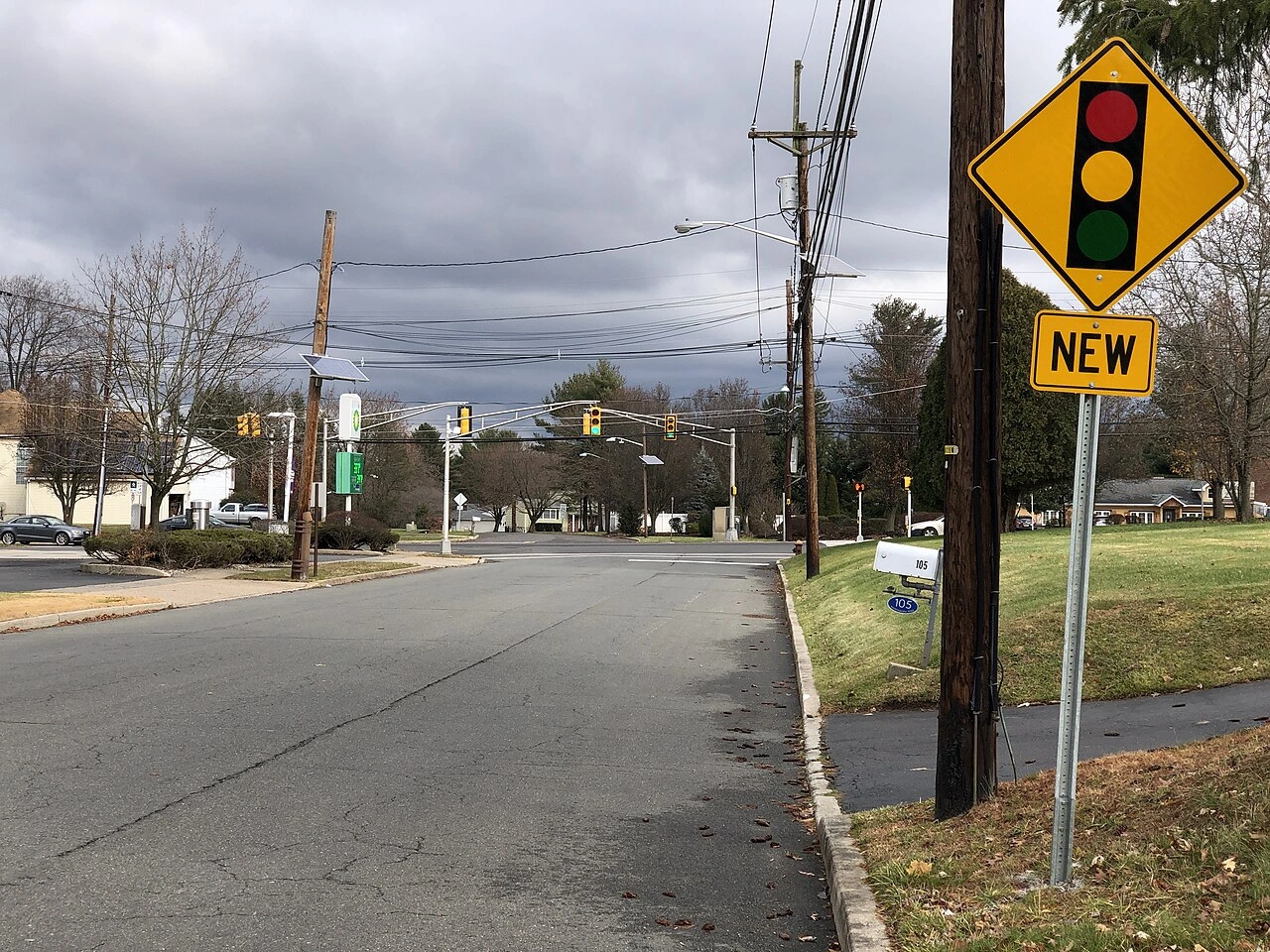
40. Traffic lights warning
A traffic lights warning is a warning sign that alerts drivers that traffic signals are located ahead. It is commonly used where the signals may be unexpected, difficult to see from a distance or located on a road where drivers need additional time to prepare to stop.
Drivers approaching a traffic lights warning should reduce speed when necessary, watch for the signals ahead and be prepared to stop if the traffic light changes or traffic is waiting at the intersection.
Wikimedia.org • Famartin • CC BY-SA
How are traffic lights ahead warned of in the United States?
The US MUTCD identifies a yellow diamond-shaped Signal Ahead (W3-3) sign. It is installed where a signal cannot be seen soon enough for a driver to respond, and may also be used for extra emphasis. It does not itself order a stop.
Does a traffic-lights-ahead warning require an immediate stop in the United States?
No. A warning sign is not an automatic STOP instruction and does not create a new numerical speed limit. Reduce speed when necessary, look for a queue or a concealed signal, and obey the traffic lights and any separate speed or stop signs.
What should you check if the next traffic lights are difficult to see in the United States?
The Signal Ahead warning is especially relevant where signal visibility is restricted by a bend, a crest or another obstruction. Scan for queued traffic and a red light; follow the actual signal and posted speed restrictions.
41. Pedestrian lights
Pedestrian lights are traffic signals that regulate when pedestrians may begin crossing a road. They normally display a red standing figure to prohibit starting and a green walking figure to permit crossing.
A flashing signal or countdown may warn that the permitted crossing period is ending. Pedestrians should cross without unnecessary delay, while turning drivers must remain alert and allow pedestrians who entered lawfully to finish crossing safely.
Wikimedia.org • Tdorante10 • CC BY-SA
What do pedestrian traffic signals mean in the United States?
The standard symbols include a white walking person and an orange raised hand. WALK permits starting; a steady DON’T WALK or raised hand prohibits a new start. Check the applicable state law for flashing-hand and countdown rules rather than assuming they are identical throughout the United States.
🔗 dmv.ca.gov • California DMV section 7 and California MUTCD 2026 chapter 4I; state-law scope
What if the pedestrian signal changes while you are crossing in the United States?
If you entered lawfully during WALK, continue towards the pavement or safety refuge without unnecessary delay. A countdown indicates the remaining clearance time. Rules on starting during a flashing-hand phase depend on the applicable state law; do not assume a single national rule.
🔗 dmv.ca.gov • California DMV section 7 and California MUTCD 2026 chapter 4I; state-law scope
May turning drivers ignore pedestrians on a signal-controlled crossing in the United States?
No. For example, California’s official handbook requires drivers to give way to pedestrians, including people still crossing while the pedestrian hand flashes. Follow the applicable state’s turning and pedestrian-priority rules.
🔗 dmv.ca.gov • California DMV section 7 and California MUTCD 2026 chapter 4I; state-law scope
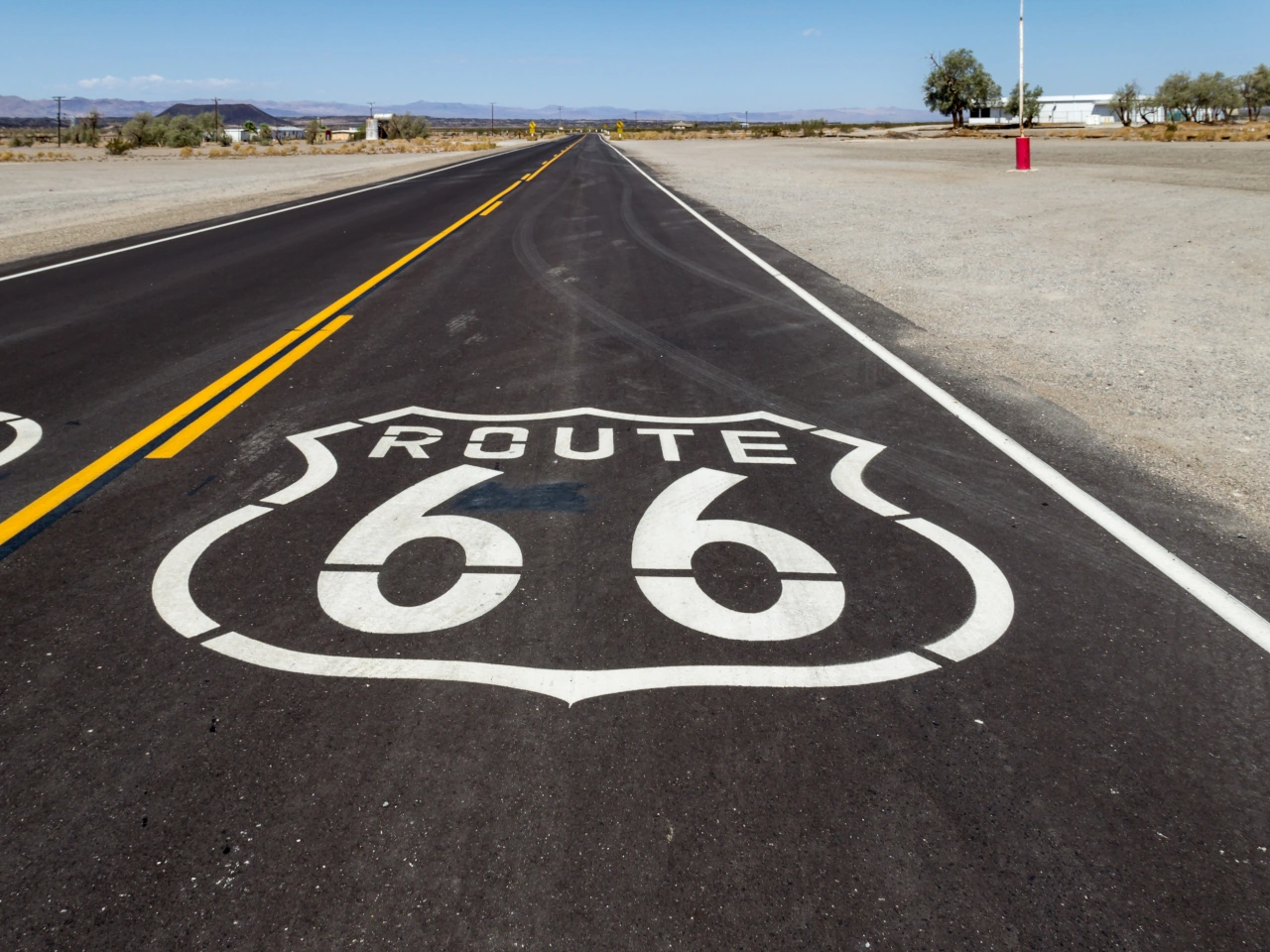
42. Road markings
Road markings are lines, symbols, arrows, words or other markings applied to the road surface to regulate, guide or inform road users. They can separate traffic lanes and opposing directions, indicate where vehicles must stop or give way, mark pedestrian and cyclist crossings and identify areas reserved for particular road users.
Road users should observe the meaning of each road marking and combine it with the applicable traffic signs, signals and traffic rules. Colours, patterns and legal meanings can differ between countries.
Wikimedia.org • Dietmar Rabich • CC BY-SA
Which road markings are important to recognise in the United States?
In the US system, yellow centre lines generally separate opposing traffic and white lane lines separate traffic travelling in the same direction. Their solid or broken form affects the permitted movements.
May drivers cross a solid road line in the United States?
The legal effect depends on whether the line is solid, double solid or broken, its colour, and the state or territory. Do not cross a prohibited no-passing or lane-control marking; look up permitted turning exceptions locally.
Can painted arrows or stop lines be ignored when signs are not obvious in the United States?
No. Lane arrows, stop lines and give-way markings can direct where to wait or which movement a lane permits. Read them together with traffic lights, vertical signs and directions from authorised traffic controllers; temporary changes may also apply.
43. Bike box
A bike box, also called an advanced stop area, is a marked space at a signal-controlled intersection where cyclists can wait ahead of motor vehicles while the traffic light is red. It is usually positioned between two stop lines and may display a bicycle symbol.
A bike box helps increase cyclist visibility and allows cyclists to position themselves clearly before traffic starts moving. The exact users, markings and traffic-light rules vary between countries.
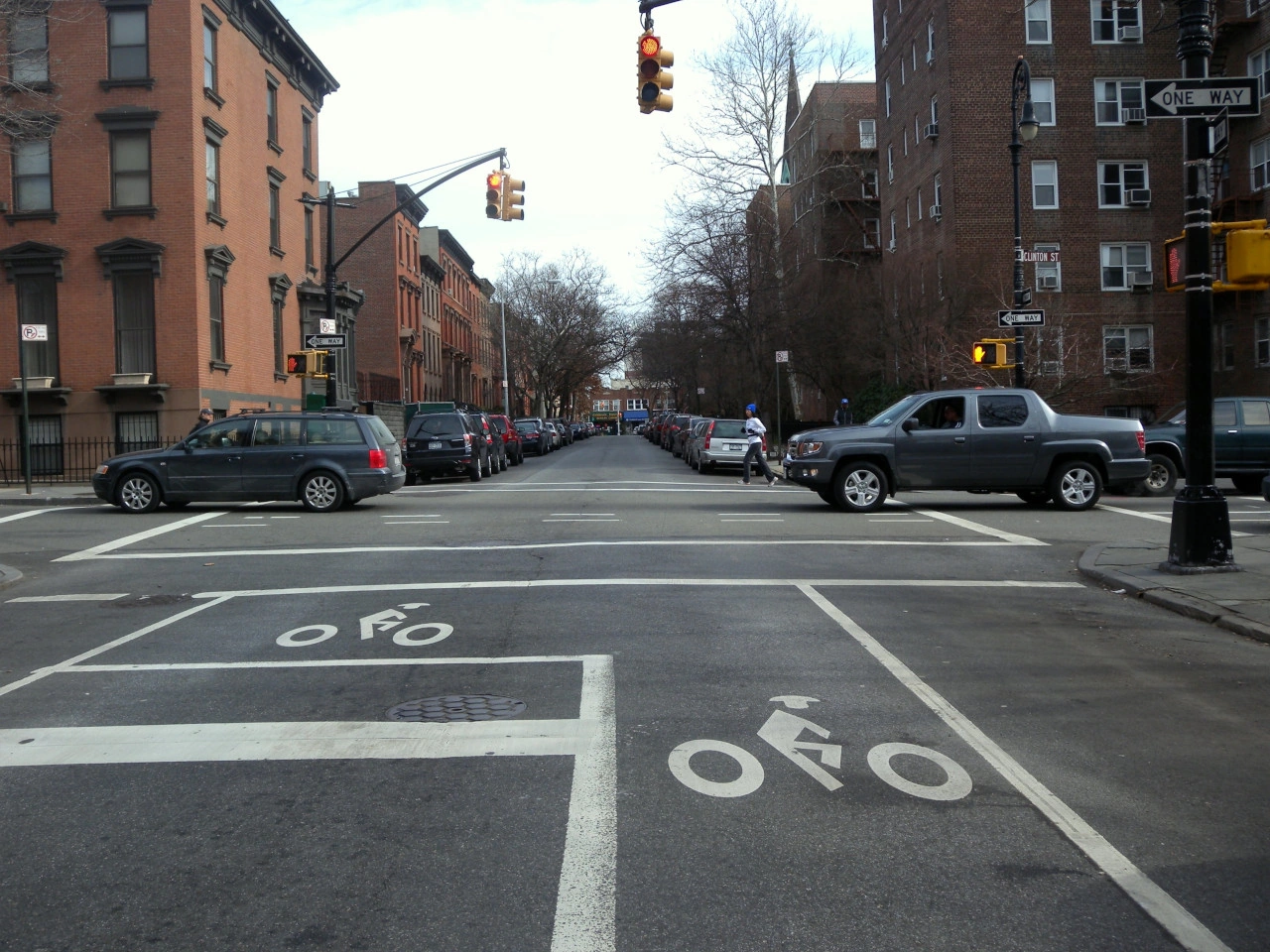
Wikimedia.org • Jim.henderson • CC0
What is a bike box or advanced stop area in the United States?
A bike box may be installed at a US signal-controlled intersection to put cyclists visibly ahead of motor vehicles. The layout and enforceable stopping rule depend on the relevant state and local traffic regulations.
🔗 mutcd.fhwa.dot.gov • FHWA MUTCD11th Edition Revision1, section9E.12 — bicycle boxes
Where should a car wait when a marked bike box has a red light in the United States?
Where the box is reserved for cyclists, stop at the motor-vehicle stop line before the box when the signal requires a stop. Follow any separate vehicle-category signals, local exceptions and direction from a traffic officer.
🔗 mutcd.fhwa.dot.gov • FHWA MUTCD11th Edition Revision1, section9E.12 — bicycle boxes
Does a bike box let cyclists ignore a red signal in the United States?
No. A bike box is a positioning facility, not a general exemption from red traffic lights. Cyclists must obey their applicable lights and any specially authorised turn indications. Turning drivers must check for cyclists moving off when signals change.
🔗 mutcd.fhwa.dot.gov • FHWA MUTCD11th Edition Revision1, section9E.12 — bicycle boxes
44. Speed feedback
Speed feedback is a traffic-safety system that measures an approaching vehicle's speed and displays it back to the driver. The display may show the measured speed together with a message, colour or symbol indicating whether the vehicle is travelling within the applicable speed limit.
Speed feedback displays are intended primarily to make drivers aware of their speed and encourage them to slow down when necessary. They normally serve a preventive or educational purpose rather than establishing a new speed limit.
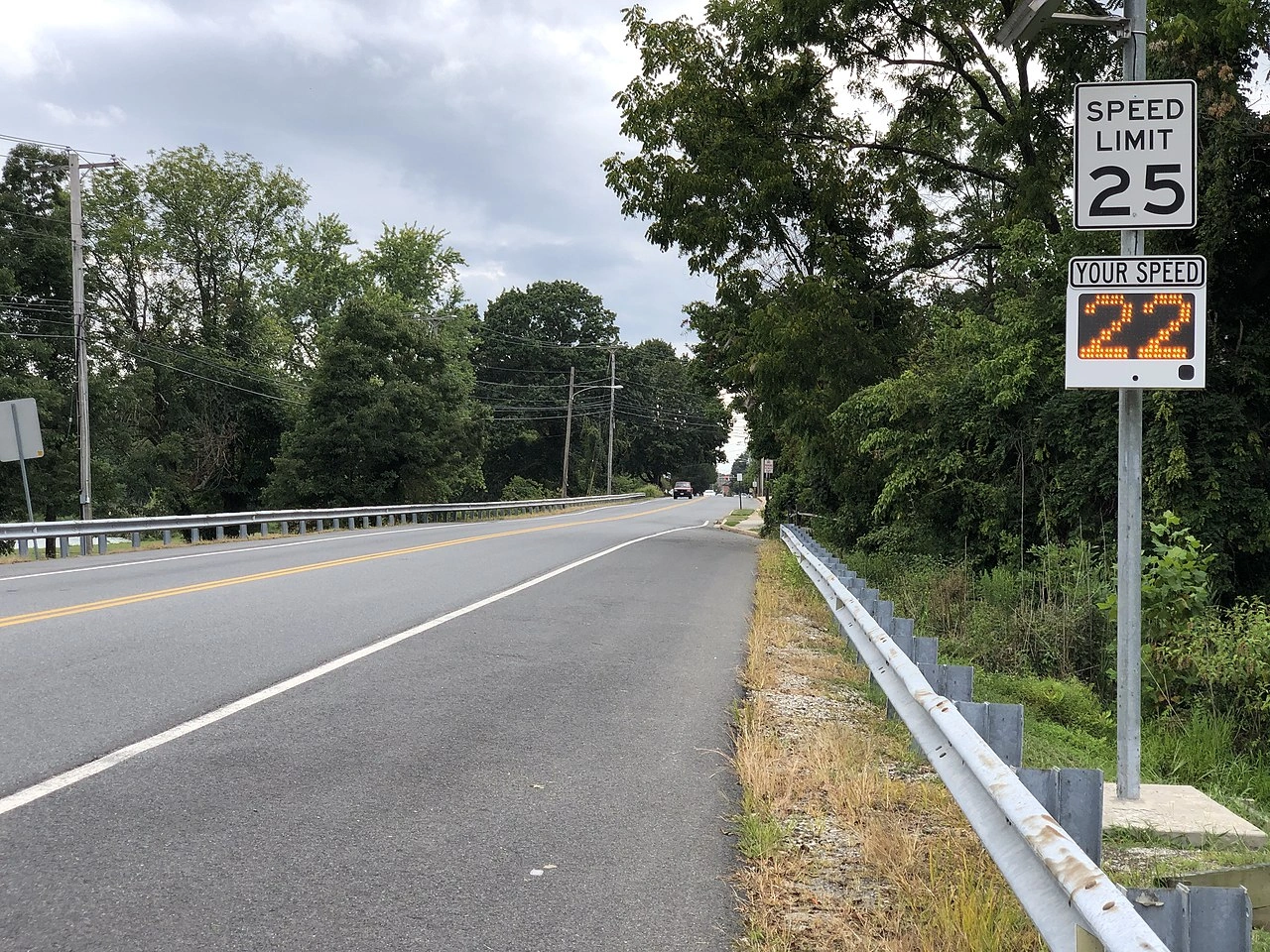
Wikimedia.org • Famartin • CC BY-SA
What does a speed-feedback display show drivers in the United States?
US radar speed-feedback signs may display a driver’s measured speed, usually in mph, often beside an official SPEED LIMIT sign. FHWA MUTCD guidance distinguishes such feedback from the regulatory speed-limit indication.
Does the number on a speed-feedback board set the legal speed limit in the United States?
Normally no. A reading showing your measured speed is not itself a new regulatory limit. The limit comes from applicable laws and legally prescribed fixed or variable speed-limit signs; a separate enforceable speed sign must still be obeyed.
Is every speed-feedback board an enforcement camera in the United States?
No. The FHWA describes radar speed-feedback signs as displays informing approaching drivers of their speed. Their existence does not by itself establish whether a separate camera or police speed-enforcement system operates nearby.
45. Driving licence
A driving licence is an official document authorising a person to drive one or more specified categories of motor vehicle. It may contain conditions, restrictions, category codes and expiry dates that determine which vehicles the holder may drive.
Drivers must hold a licence that is valid for the vehicle category and jurisdiction concerned. A licence may be provisional, full, restricted, suspended or withdrawn, and additional qualifications may be required for professional driving.
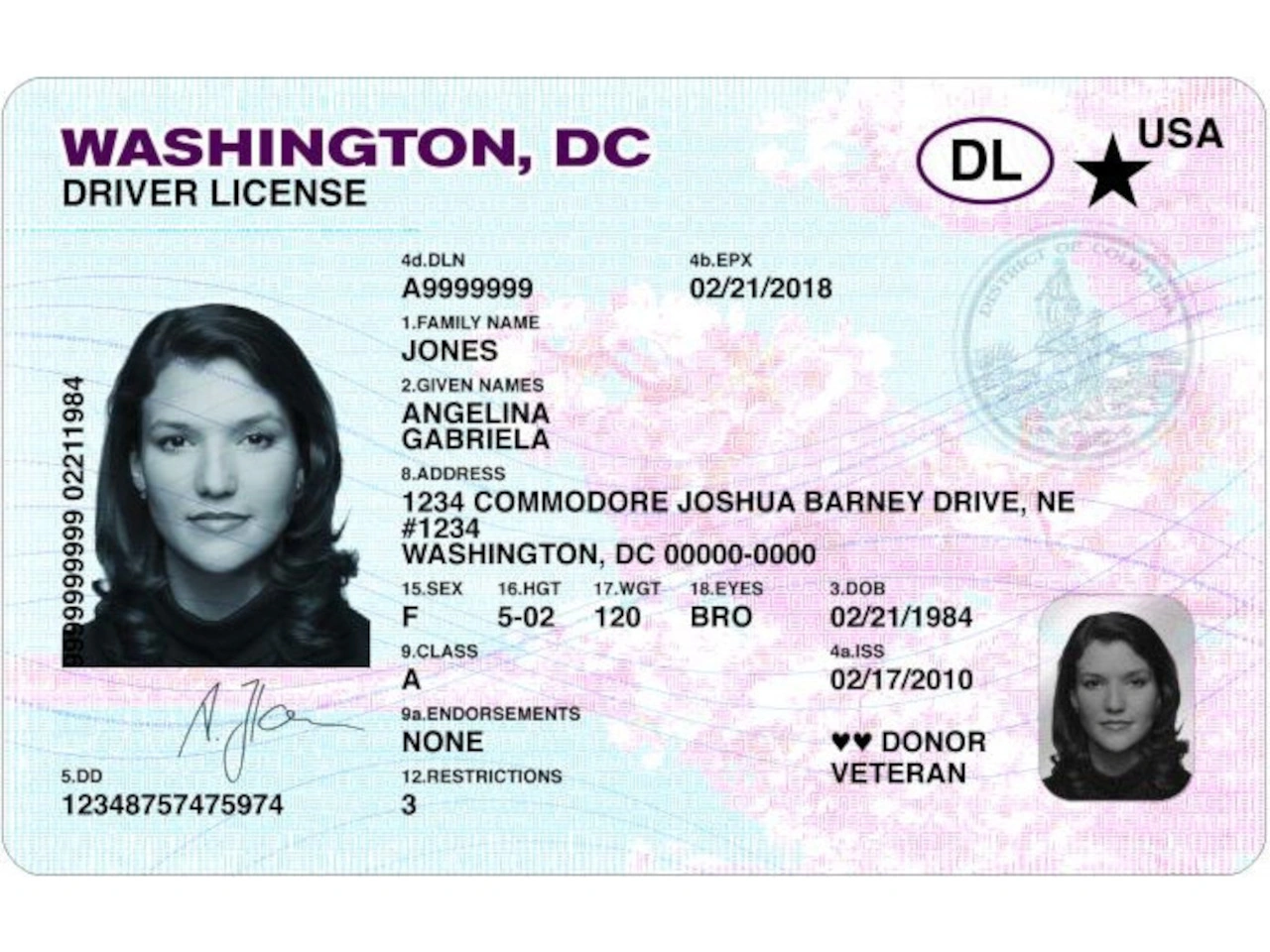
Wikimedia.org • District of Columbia DMV • CC0
Which driving-licence entitlement is needed for an ordinary car in the United States?
In the United States, ordinary car licensing classes vary by state, so a single national class letter should not be assumed. A different entitlement may be needed for motorcycles, heavy vehicles, trailers or passenger transport.
Can a visitor drive in the United States using a driving licence issued abroad?
The rules are set by the individual state. Some visitors may drive on a valid foreign licence, while some states require an IDP as well. Check the state motor-vehicle agency for recognition, vehicle class and duration.
Does an International Driving Permit replace the original licence in the United States?
No. An International Driving Permit (IDP) is not a standalone driving licence. Where it is recognised or required, carry the underlying valid licence as well and check the accepted convention or translation requirements. An IDP cannot override a suspension, unsuitable vehicle category or local minimum age.
46. Traffic mirror
A traffic mirror is a convex mirror installed near an intersection, driveway, bend or other location with restricted visibility. Its curved surface provides a wider view of approaching road users than an ordinary flat mirror.
A traffic mirror is only a visibility aid. It may distort distance, speed and direction and may be affected by darkness, weather, dirt or damage. Drivers must continue to observe the road directly, obey all priority rules and proceed only when it is safe.
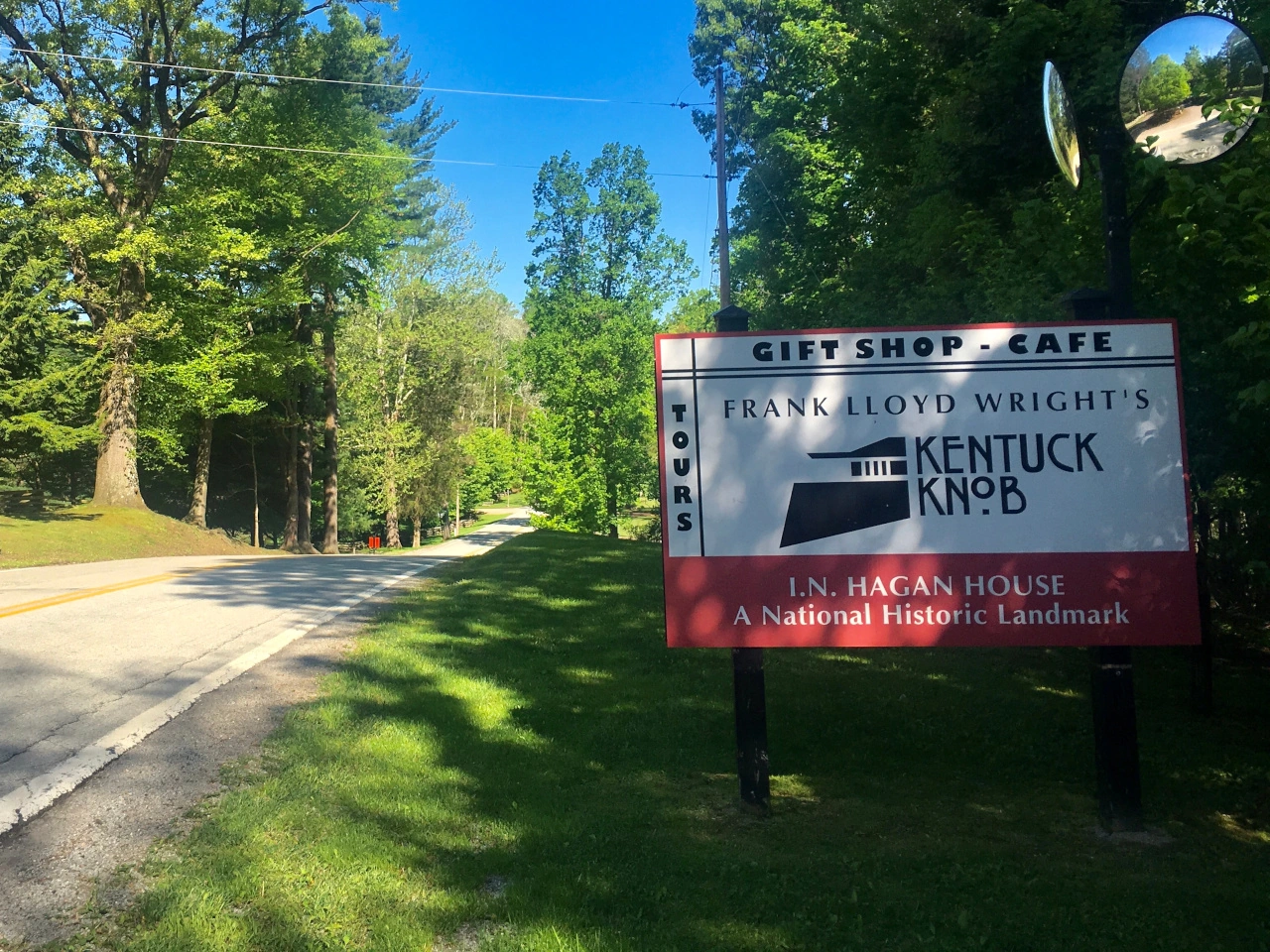
Wikimedia.org • Andre_Carrotflower • CC BY-SA
What is a traffic mirror?
A traffic mirror is a roadside visibility aid that can help users see around a blind corner or obstruction. It gives an indirect view, which may be restricted or distorted; it does not replace checking whether it is safe to proceed.
🔗 monmouthshire.gov.uk • Monmouthshire Council, roadside visibility mirrors
🔗 devon.gov.uk • Devon County Council, mirrors on the highway
Does a traffic mirror show an exact image?
No. The reflected image can be distorted, and glare, bad weather or dirt can restrict the view. Judging an approaching vehicle’s speed from a mirror can be difficult. Do not rely on the mirror alone.
🔗 monmouthshire.gov.uk • Monmouthshire Council, roadside visibility mirrors
🔗 devon.gov.uk • Devon County Council, mirrors on the highway
Does seeing an empty mirror mean the road is clear?
No. Another road user may be outside the reflected area, hidden by glare or too small to notice. Always check the road directly before proceeding.
🔗 monmouthshire.gov.uk • Monmouthshire Council, roadside visibility mirrors
🔗 devon.gov.uk • Devon County Council, mirrors on the highway
47. Emergency telephone
An emergency telephone is a dedicated roadside or tunnel telephone that connects road users directly with an emergency, traffic-control or roadside-assistance centre. Emergency telephones are commonly installed in tunnels, along motorways or at other locations where quickly reporting an accident, breakdown or fire is important. They can provide operators with useful information about the caller’s location and may remain available where mobile-phone reception is poor.
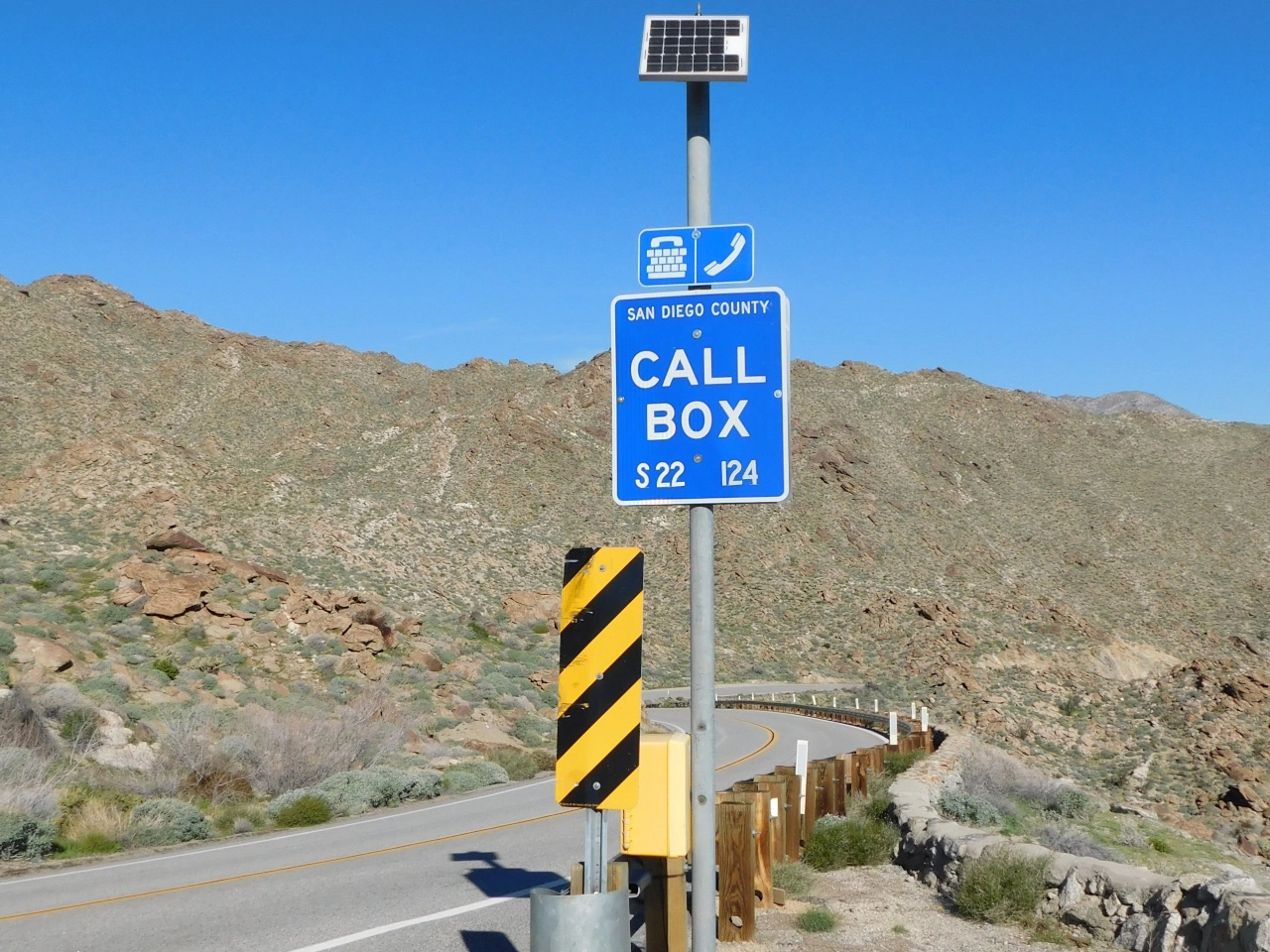
Wikimedia.org • CC0
What is an emergency telephone?
An emergency telephone is a dedicated telephone used to contact emergency services, a traffic-control centre or roadside assistance from the road.
🔗 gov.uk • Great Britain Highway Code, Rules 275–279; national guidance example
🔗 gov.uk • Great Britain Highway Code, Rules 270–274; national guidance example
Where are emergency telephones commonly found?
They are commonly installed in road tunnels, motorway emergency areas and other locations where rapid assistance may be needed.
🔗 gov.uk • Great Britain Highway Code, Rules 275–279; national guidance example
🔗 gov.uk • Great Britain Highway Code, Rules 270–274; national guidance example
When should you use an emergency telephone?
Use an emergency telephone to report situations such as a breakdown, accident, fire or other serious road emergency when assistance is required.
🔗 gov.uk • Great Britain Highway Code, Rules 275–279; national guidance example
🔗 gov.uk • Great Britain Highway Code, Rules 270–274; national guidance example
48. Cycling route
A cycling route is a planned or signposted route intended to guide cyclists between places or through a particular area. It may follow cycle paths, quiet streets, shared roads, greenways or other routes considered suitable for cycling.
A cycling route does not necessarily give cyclists exclusive use of the road or path and should not be confused with a cycle path or cycle lane. The traffic rules, priority rules and permitted road users depend on the individual roads and paths that form the route and on the local signs and regulations.
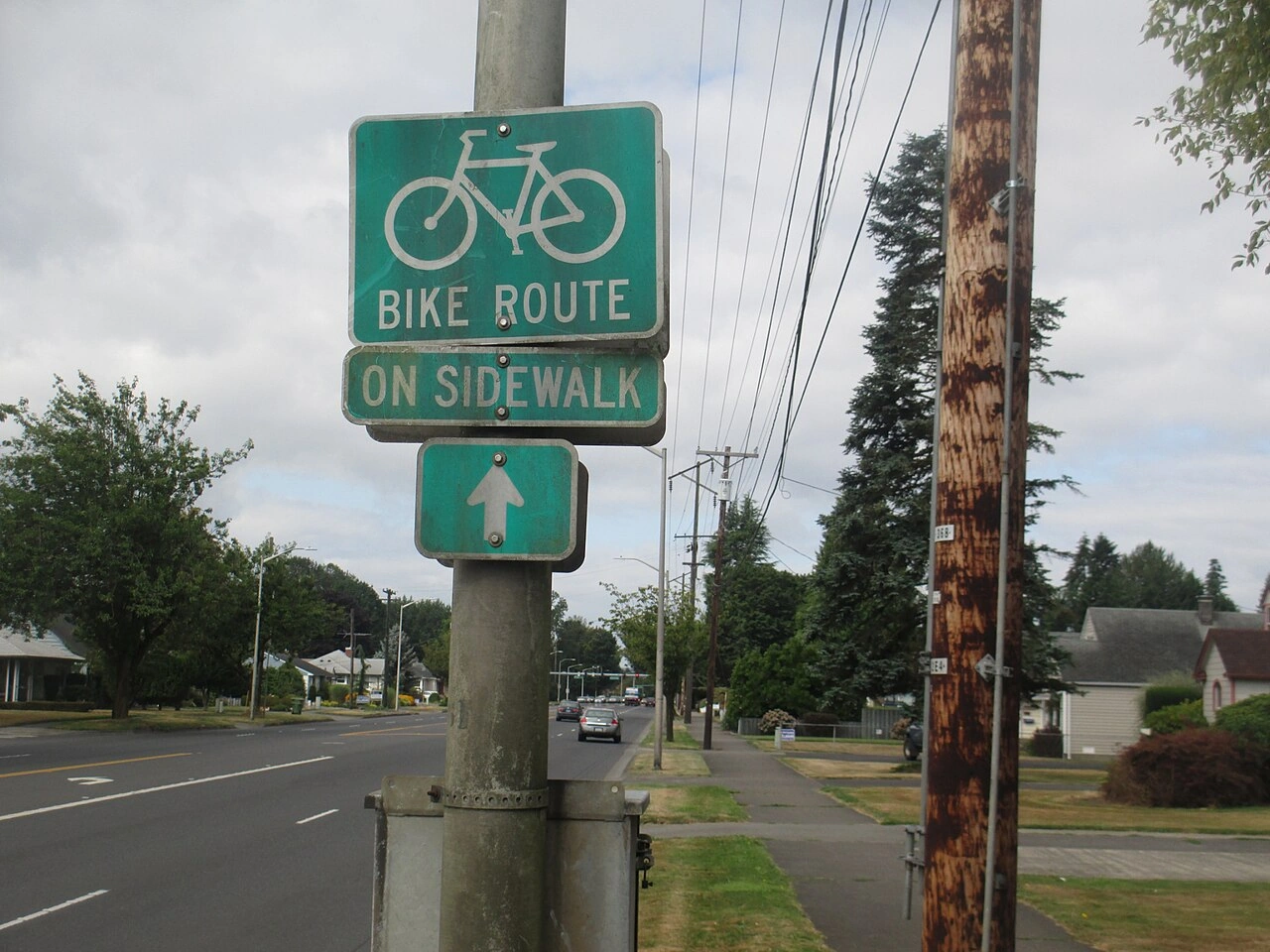
Wikimedia.org • Robert Ashworth • CC BY
How can you recognise a cycling route?
Cycling routes are commonly indicated by direction signs, bicycle symbols, route numbers, colours or destination markers. The design of the signs and route-numbering system varies between countries and regions.
Do cyclists have priority on a cycling route?
Not automatically. Being on a designated cycling route does not normally change the priority rules. Cyclists must continue to obey traffic lights, give-way and stop signs, crossing rules and other applicable traffic regulations.
What should you do when a cycling-route sign conflicts with a traffic sign?
Always follow the official traffic signs, signals and road markings. A route marker provides navigation and does not override a prohibition, mandatory direction, road closure or other traffic regulation.
49. Parking
Parking means leaving a vehicle stationary at a place for a period of time rather than stopping only briefly because of traffic conditions or another immediate necessity. Many countries distinguish parking from a short stop made to pick up or drop off passengers or to load or unload goods, although the exact legal definition varies.
Parking may be permitted, restricted, reserved, time-limited or prohibited by traffic signs, road markings, parking zones and local regulations. Drivers must park without creating a danger or unnecessary obstruction and must comply with any conditions concerning payment, permits, vehicle categories or maximum parking duration.
Wikimedia.org • Russ Allison Loar • CC BY-SA
Are parking regulations the same throughout the United States?
No. Parking is regulated by state and local law. For example, New York City distinguishes no-parking, no-standing and no-stopping signs, each allowing different activities. Read every applicable sign rather than assuming a nationwide curb rule.
🔗 home4.nyc.gov • New York City Department of Transportation, parking restrictions
Does sitting in the car make parking legal at a restricted New York City kerb?
No. Under New York City rules, a no-parking sign does not permit waiting simply because the driver remains in the vehicle. Only the specifically permitted immediate passenger or loading activity may take place.
🔗 home4.nyc.gov • New York City Department of Transportation, parking restrictions
What does a white kerb mean in California?
Stop only for the time needed to pick up or drop off passengers.
What does a green kerb mean in California?
It permits time-limited parking. Read the sign or the limit painted on the kerb.
What may you do at a yellow kerb in California?
Load or unload passengers or freight within the posted time. Non-commercial drivers are usually required to remain with the vehicle.
50. No parking
No parking indicates that vehicles may not be left parked at the location or along the section of road covered by the restriction. Depending on local law, a driver may still be allowed to stop briefly to pick up or drop off passengers or to load or unload goods, provided stopping itself is not prohibited.
A no-parking restriction may apply continuously or only during specified times, days, vehicle categories or sections of road. Its exact extent and exceptions are determined by the traffic sign, supplementary panels, road markings and local traffic regulations.
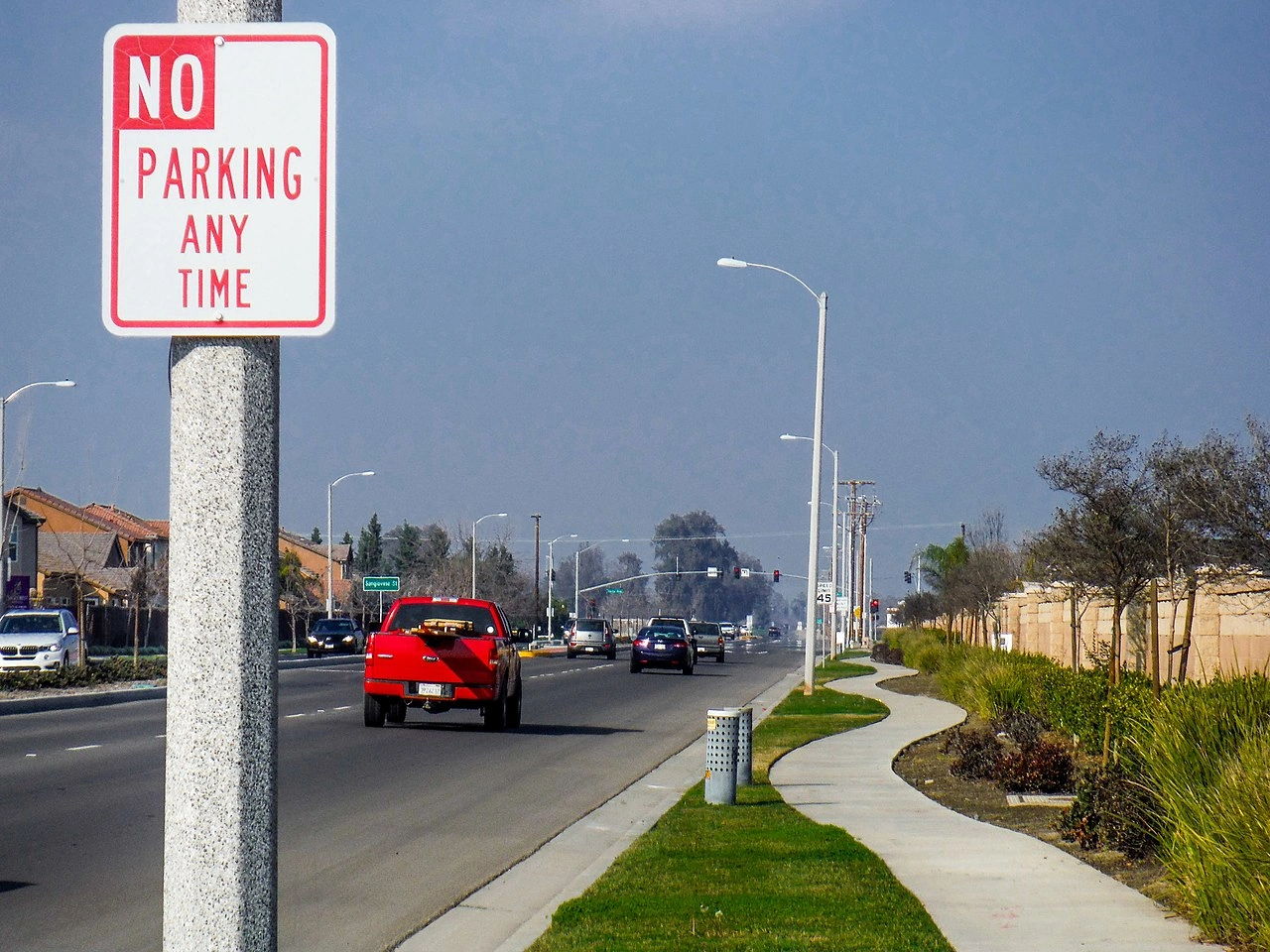
Wikimedia.org • David Prasad • CC BY-SA
What may you do at a No Parking sign in New York City?
You may make an immediate passenger pickup or drop-off or load or unload goods, but may not wait at the kerb. A No Standing sign does not allow loading goods, and a No Stopping sign is stricter still. These are New York City rules, not a uniform US code.
🔗 home4.nyc.gov • New York City Department of Transportation, parking restrictions
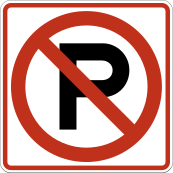 Parking prohibited.
English • R8-3 • No parking. Prohibits parking in the indicated area. This sign alone is not a no-stopping instruction.
Sources
🔗 Commons.wikimedia.org
🔗 Mutcd.fhwa.dot.gov • FHWA: MUTCD, 11th Edition with Revision1, PDF page165
SVG source: Author not stated on source page • Public domain • Original revision 2025-08-10. Wikimedia original unmodified.
How far from a fire hydrant must you keep clear in California?
Do not park within 15 feet of a fire hydrant.