

Traffic signsWallonia
 Traffic rules
 Wallonia
251. Breath analysis
A breath analysis is a precise measurement of the alcohol concentration in a person’s exhaled breath. Unlike a preliminary breath test, which is mainly used for screening, a breath analysis is performed with an approved evidential device and produces a measured result that can be used for enforcement. The result is commonly expressed in milligrams of alcohol per litre of exhaled breath, although procedures and legal thresholds vary between countries.
What is a breath analysis in Belgium?
A Belgian breath analysis is performed with an approved device that measures the exact concentration of alcohol in the exhaled alveolar air.
When is a breath analysis performed in Belgium?
For ordinary drivers, a breath analysis is performed when the preliminary breath test indicates at least 0.22 mg/l. For drivers subject to the stricter professional limit, the threshold is 0.09 mg/l. Police may also require a breath analysis without first performing a breath test.
What alcohol concentration is punishable for ordinary drivers in Belgium?
An ordinary driver is punishable when the breath analysis measures at least 0.22 mg/l of alcohol in exhaled alveolar air, corresponding to approximately 0.5‰ in the blood.

252. Blood alcohol content
Blood alcohol content (BAC), more precisely called blood alcohol concentration, indicates the amount of alcohol present in a person’s blood. It is commonly expressed as a percentage, grams per litre or parts per thousand (‰). Alcohol can impair judgement, reaction time, coordination and vision even before the legal BAC limit is reached. Legal limits vary between countries and may be lower for professional, novice or young drivers.
What is the legal blood alcohol limit for ordinary drivers in Belgium?
For most drivers, the legal threshold is 0.5‰ alcohol in the blood. A driver is punishable from this concentration, corresponding to 0.22 mg/l of alcohol in exhaled alveolar air.
Is the Belgian BAC limit lower for young or inexperienced drivers?
No. The standard 0.5‰ BAC limit also applies to young and inexperienced drivers in Belgium.
Does being below 0.5‰ mean you are safe to drive in Belgium?
No. Alcohol can affect driving before the legal limit is reached. The safest approach is not to drink alcohol when you plan to drive.
253. Blood test
A blood test can be used to measure the concentration of alcohol in a person’s blood. A healthcare professional takes a blood sample, which is then analysed in a laboratory to determine the blood alcohol concentration (BAC). In traffic enforcement, blood testing may be used when breath testing is impossible or unsuitable, after an accident or as a counter-analysis to a breath result. The circumstances in which a blood test can be required and the legal alcohol limits vary between countries.
When can the police require a blood test for alcohol in Belgium?
A blood test can be ordered when a breath test reaches the applicable alcohol threshold but a breath analysis cannot be performed, or when neither a breath test nor breath analysis can be carried out and there are clear signs of alcohol consumption or intoxication.
Who takes the blood sample in Belgium?
The blood sample is taken by a doctor requested for that purpose and is then analysed to determine the alcohol concentration in the blood.
Can a blood test be required after a traffic accident in Belgium?
Yes. If neither a breath test nor a breath analysis can be performed on a person who may have caused or contributed to an accident, a blood sample can be required, including when it is impossible to determine whether signs of alcohol consumption are present.
254. Saliva test
A saliva test is a roadside screening test used to detect recent use of certain drugs that can affect driving ability. A sample of saliva is collected from the mouth and tested with a portable device for specified substances. The test is generally used as an initial screening rather than as the final evidential analysis. If the result is positive, a more precise saliva analysis or, in some circumstances, a blood test may follow.
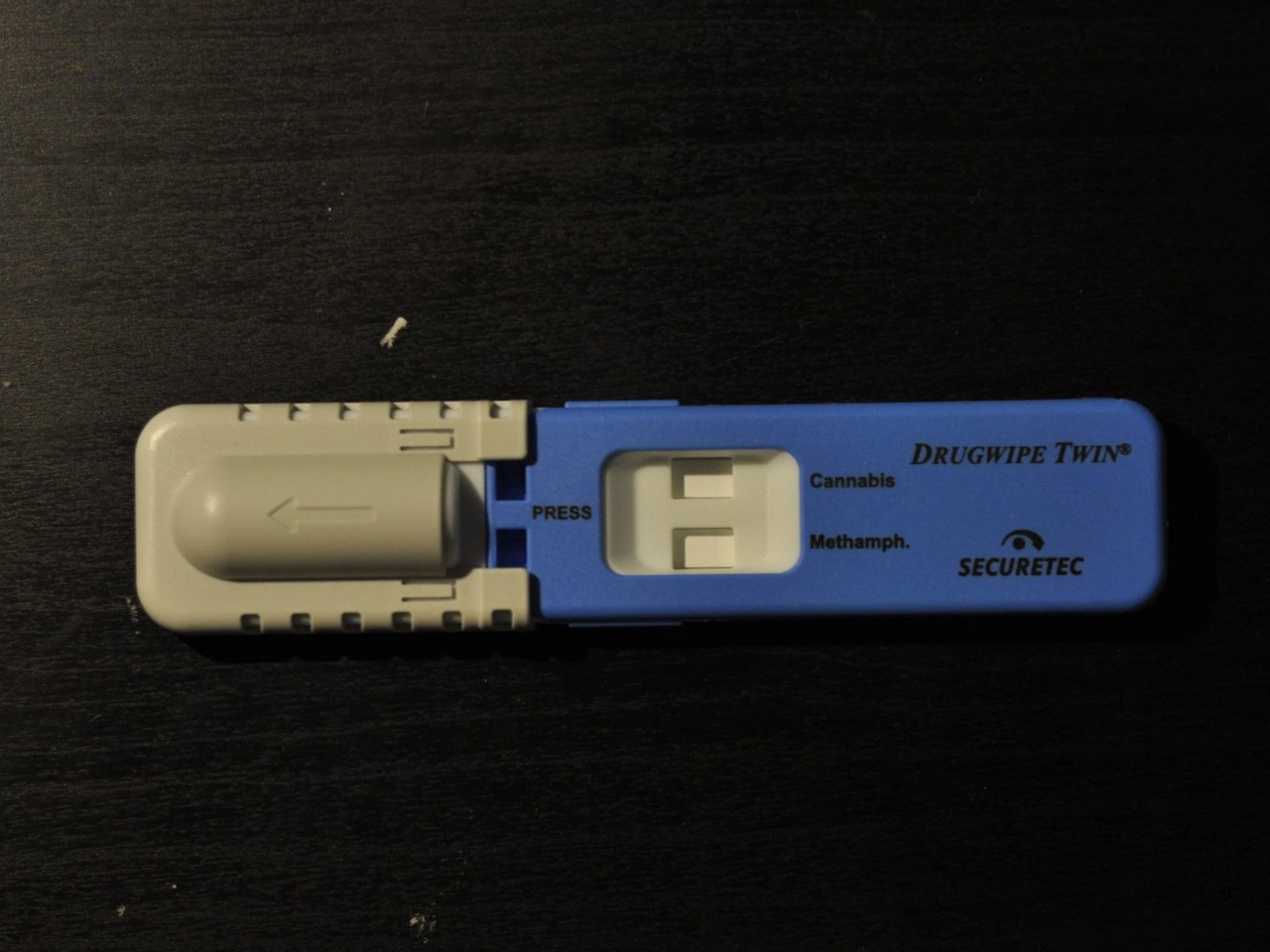
Wikimedia.org • Zapacit • CC BY-SA
What is a saliva test in Belgium?
A Belgian saliva test is a roadside screening test used to detect recent use of specified drugs that can impair driving ability.
When can the police perform a saliva test in Belgium?
Police normally assess signs of recent drug use using a standardised checklist and take a saliva test when it indicates such use. For a person suspected of causing or contributing to a road accident, the law also allows an immediate saliva test without first completing that checklist.
🔗 codex.vlaanderen.be • Vlaamse Codex, Road Traffic Act, Article 61bis
How long are you prohibited from driving after a positive saliva test in Belgium?
A positive saliva test results in an immediate 12-hour driving prohibition. Before driving again, a new saliva test is required. If that test is still positive, the prohibition is renewed for another 12 hours.
255. Drugs
Drugs can seriously affect driving by changing perception, concentration, reaction time, coordination and judgement. Stimulants, cannabis, opioids and other psychoactive substances can each impair driving in different ways, and combining drugs with alcohol or other substances can increase the risk further. The effects may continue even after a person no longer feels intoxicated. Drug-driving laws vary between countries, but drivers should never drive when a substance affects their ability to control the vehicle safely.
Is driving after using drugs illegal in Belgium?
Yes. Belgian law prohibits driving when specified drugs are present at or above the legal concentration thresholds established for saliva or blood analysis.
Which drugs are currently included in Belgian roadside drug controls?
The current system covers THC, amphetamine, MDMA, morphine or 6-acetylmorphine, and cocaine or benzoylecgonine. These substances are detected using saliva testing and confirmed by saliva or blood analysis.
How does a Belgian roadside drug control work?
Police normally use a standardised checklist for signs of recent drug use, followed by a saliva test when indicated. After a positive saliva test, a laboratory saliva analysis is normally used to confirm the offence.
256. Medication
Medication can affect driving ability even when it is legally prescribed or available without a prescription. Some medicines can cause drowsiness, dizziness, blurred vision, reduced concentration, slower reactions or impaired coordination and judgement. Drivers should read the patient information leaflet, follow the prescribed dose and ask a doctor or pharmacist if they are unsure whether it is safe to drive. Extra care is needed when starting a new medicine, changing the dose or combining several medicines or medication with alcohol.
Can medication affect your fitness to drive in Belgium?
Yes. Belgian driving-fitness standards recognise that certain medicines can increase the risk of an accident. A driver must remain medically fit and capable of driving safely.
How can you check whether a medicine affects driving in Belgium?
Read the patient information leaflet, particularly the section on driving and using machines. The Belgian medicines authority also recommends asking your doctor or pharmacist when you are unsure.
Can medicine bought without a prescription affect driving in Belgium?
Yes. A medicine does not have to require a prescription to affect driving. Some antihistamines, cough medicines and other commonly used medicines can reduce alertness or reaction ability.
257. Penalties
Penalties are legal consequences imposed for breaking traffic laws. Depending on the offence and country, penalties can include warnings, fines, penalty points, licence suspension, driving bans, vehicle immobilisation or court proceedings. The severity of the penalty usually depends on factors such as the danger created, previous offences and how serious the violation was. Some offences may be handled directly by the police, while more serious cases must be decided by a court.
What types of traffic penalties can be imposed in Belgium?
Belgian traffic offences can lead to immediate collections, settlements, orders to pay, court fines and disqualification from driving. The applicable sanction depends on the offence and how the case is handled.
Can repeat offenders receive heavier penalties in Belgium?
Yes. Repeat offences can result in heavier sanctions, including longer driving bans, higher fines or additional measures depending on the type of offence and previous convictions.
Are speeding penalties handled through the four-degree system in Belgium?
No. Speeding has its own penalty system. The amount depends on how far the speed limit was exceeded and whether the offence occurred in areas such as a built-up area, zone 30, residential area.
258. Speeding
Speeding means driving faster than the maximum speed allowed by traffic law or a posted speed-limit sign. Higher speeds reduce the time available to react, increase stopping distance and make collisions more severe. Drivers must also adapt their speed to traffic, visibility, weather and road conditions, so even driving at the legal speed limit can sometimes be too fast for the situation. Speeding penalties vary between countries and may depend on how far the limit was exceeded and where the offence occurred.
How are speeding fines calculated in Belgium?
For an immediate collection, the first 10 km/h above the speed limit costs €58. Above the first 10 km/h, the amount increases for every additional kilometre per hour.
When can serious speeding lead to court proceedings in Belgium?
For Belgian residents, an immediate collection is generally no longer possible when the speed limit is exceeded by more than 30 km/h in a built-up area, zone 30, school environment, residential area, or by more than 40 km/h on other roads. The case is normally referred to court.
Does the posted speed limit always mean that speed is safe in Belgium?
No. Drivers must still adapt their speed to traffic, visibility, weather and road conditions. A lower speed may therefore be required even when the posted limit is higher.
259. Smoking
Smoking while driving can distract the driver by occupying a hand, taking attention away from the road and creating smoke, ash or dropped objects inside the vehicle. Tobacco smoke can also reduce air quality and expose passengers to second-hand smoke. Some countries restrict or prohibit smoking in vehicles, particularly when children are present. Drivers should always remain in full control of the vehicle and avoid any activity that interferes with safe driving.

Wikimedia.org • TBEC Review • CC BY
Can you smoke while driving in Belgium?
The passenger-related smoking ban does not generally prevent an adult from smoking while driving alone. The driver must still remain in control and drive safely. Separate restrictions apply in vehicles carrying minors and in professional passenger transport.
🔗 health.belgium.be • FPS Health, tobacco law
🔗 vlaanderen.be • Vlaanderen, smoking prohibition
🔗 codex.vlaanderen.be • Vlaamse Codex, Road Code, applicable article versions through 31 May 2027
Can you smoke in a car with children in Belgium?
No smoking is allowed in a wholly or partly enclosed vehicle when someone under 18 is present, including when the windows are open. The published guidance makes an exception when the roof is completely stowed away. Electronic cigarettes are also covered.
🔗 health.belgium.be • FPS Health, tobacco law
🔗 vlaanderen.be • Vlaanderen, smoking prohibition
🔗 codex.vlaanderen.be • Vlaamse Codex, Road Code, applicable article versions through 31 May 2027
Does the Belgian smoking ban also apply to electronic cigarettes?
Yes. The prohibition includes electronic cigarettes and vaping when a minor under 18 is present in the vehicle.
260. Traffic enforcement camera
A traffic enforcement camera is an automated or remotely operated camera system used to detect traffic violations. Depending on the system, cameras may measure speed, detect vehicles passing a red light, read number plates or monitor other prohibited behaviour. Some cameras measure a vehicle at one specific location, while systems such as section control measure average speed over a longer distance. The types of cameras used, offences they can detect and enforcement procedures vary between countries.
Are traffic enforcement cameras used in Belgium?
Yes. Belgium uses different types of traffic enforcement cameras, including speed cameras, red-light cameras, section-control systems and cameras for certain other traffic offences.
🔗 politie.be • Local Police Rode, fixed-camera speed and red-light enforcement
🔗 vlaanderen.be • Flemish Government, section-control operation
What do fixed speed cameras detect in Belgium?
A fixed speed camera measures speed at a particular point to enforce the speed limit. This differs from section control, which measures average speed over a longer road section.
🔗 vias.be • Vias Institute, original research briefing comparing fixed cameras and section control
🔗 vlaanderen.be • Flemish Government, average-speed section control
What do red-light cameras detect in Belgium?
Some fixed red-light cameras also record speeding. Police Zone Rode has published results showing both types of offence from its fixed red-light camera. Do not assume a camera at a junction checks only whether the light is red.
🔗 politie.be • Local Police Rode, fixed-camera speed and red-light enforcement
🔗 vlaanderen.be • Flemish Government, section-control operation
261. Double curve
A double curve is a road section containing two successive curves in opposite directions. The first curve may turn left and then right, or right and then left.
The same warning sign may also indicate a longer succession of curves. Drivers should reduce speed before the first curve, remain within their lane and be prepared for the following curves to differ in direction, sharpness and length.
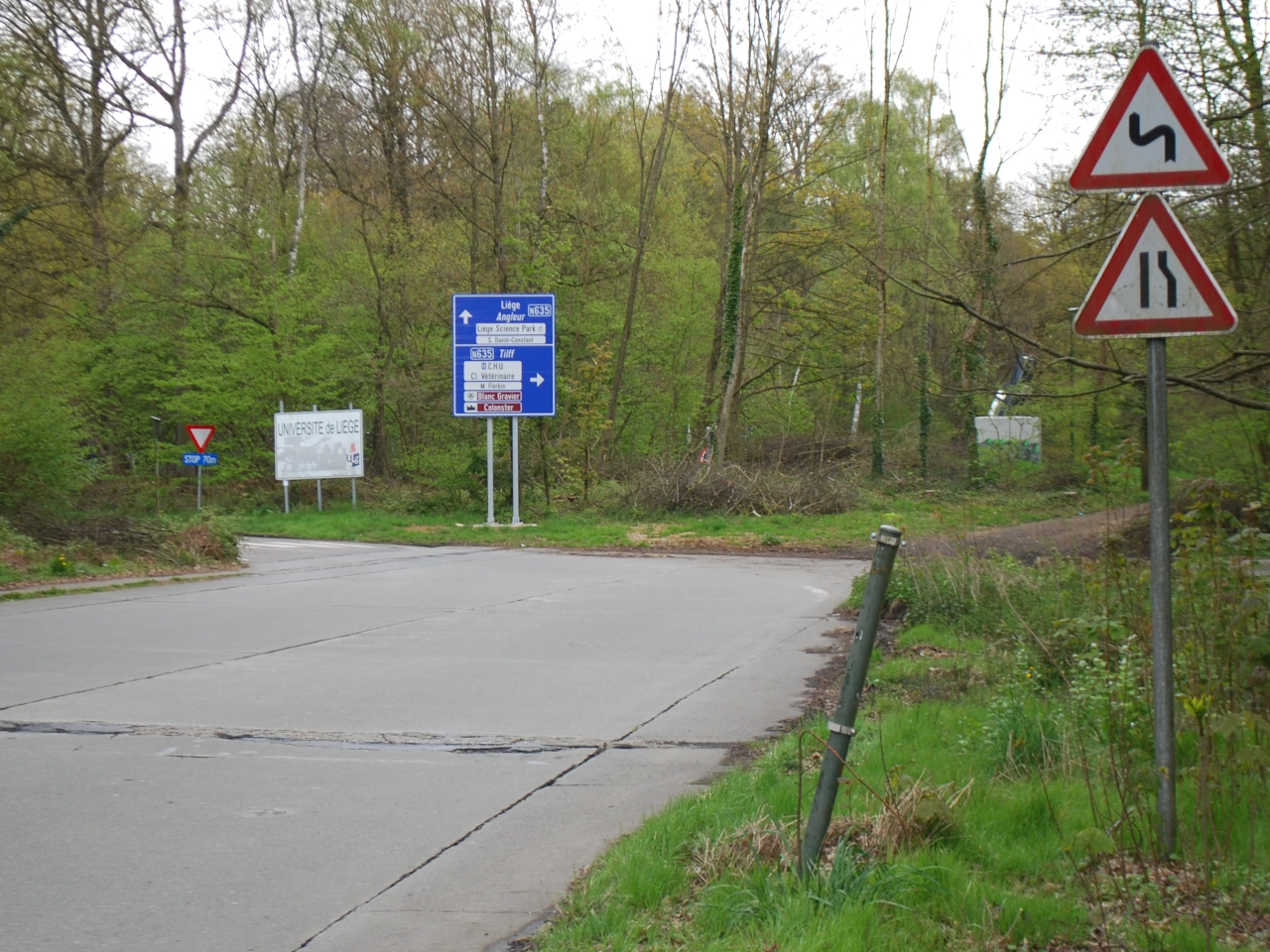
Wikimedia.org • Jean Housen • CC BY-SA
Which Belgian signs warn of a double curve?
Traffic signs A1c and A1d warn of a double curve or a succession of more than two curves.
 Warning for a double curve, first left then right.
English • Traffic sign A1c • Dangerous bend. Double bend or a series of more than two bends, the first to the left.
Français • Signal routier A1c • Virage dangereux. Double virage ou succession de plus de deux virages, le premier à gauche.
Nederlands • Verkeersbord A1c • Gevaarlijke bocht. Dubbele bocht of opeenvolging van meer dan twee bochten, de eerste naar links.
Sources
SVG source: Commons.wikimedia.org
Vascer • Public domain. Original SVG unmodified.
🔗 Wegcode.be • Artikel 66. Gevaarsborden (NL)
🔗 Codedelaroute.be • Article 66. Signaux de danger (FR)
 Warning for a double curve, first right then left.
English • Traffic sign A1d • Dangerous bend. Double bend or a series of more than two bends, the first to the right.
Français • Signal routier A1d • Virage dangereux. Double virage ou succession de plus de deux virages, le premier à droite.
Nederlands • Verkeersbord A1d • Gevaarlijke bocht. Dubbele bocht of opeenvolging van meer dan twee bochten, de eerste naar rechts.
Sources
SVG source: Commons.wikimedia.org
Vascer • Public domain. Original SVG unmodified.
🔗 Wegcode.be • Artikel 66. Gevaarsborden (NL)
🔗 Codedelaroute.be • Article 66. Signaux de danger (FR)
Can a panel indicate the distance to the first curve?
Yes. A supplementary distance panel may indicate approximately how far ahead the dangerous section begins.
Does a Belgian double-curve warning sign impose a speed limit?
No. The applicable regional, zonal, posted and vehicle-specific speed limits remain in force.
Must you sometimes drive below the permitted speed?
Yes. Drivers must adapt their speed to the curves, visibility, weather, traffic, road surface and condition and load of the vehicle.
Must you be able to stop within the visible distance?
Yes. Drivers must remain able to stop before a foreseeable obstruction, including one hidden beyond either curve.
262. Accident
An accident is an unexpected event involving one or more road users that causes damage, injury or both. After a traffic accident, the first priority is safety: stop, protect the scene, assist injured people when possible and contact the emergency services when necessary. Drivers should avoid creating additional danger, exchange the required information and follow local rules for reporting the accident. Serious crashes may require the vehicles to remain in place until the police arrive.
Wikimedia.org • W. Robert Howell • CC BY-SA
What must you do after a traffic accident in Belgium?
Everyone involved in an accident must take the necessary measures to ensure safety and keep traffic moving where possible. The driver must also correctly signal a vehicle that creates a danger or obstruction.
Should you move the vehicle after a minor accident in Belgium?
If an accident causes only material damage, vehicles that obstruct traffic should normally be moved when this can be done safely. The current Road Code does not require a vehicle to be moved when the accident caused bodily injury.
Do you have to stay at the scene of an accident in Belgium?
Yes. People involved in an accident must generally remain at the scene to make the necessary findings or allow the police to do so. Leaving in order to avoid those responsibilities can constitute hit-and-run.
263. Injuries
Injuries after a traffic accident can range from minor cuts and bruises to serious or life-threatening trauma. The first priority is to prevent further danger, contact the emergency services when necessary and provide appropriate assistance within your abilities. Avoid moving a seriously injured person unless leaving them in place creates an immediate danger, and follow the instructions of emergency operators or trained responders. Even when injuries initially appear minor, medical assessment may be necessary because some symptoms can develop later.

Wikimedia.org • Hillelfrei • CC BY-SA
What must you do if someone is injured in a traffic accident in Belgium?
A person involved in an accident that caused bodily injury must, when necessary, provide assistance to the injured and remain at the scene so that the required findings can be made.
What emergency number should you call for an injured person in Belgium?
Call 112 when urgent medical assistance is needed. Tell the operator where the accident happened, what happened and how many people are injured or in danger.
Should vehicles be moved after an accident with injuries in Belgium?
Under the current Road Code, a vehicle does not have to be moved when the accident caused bodily injury. The people involved must nevertheless take the necessary measures to protect safety and traffic.
264. Nosebleed
A nosebleed is bleeding from one or both nostrils and is usually caused by small blood vessels inside the nose. Most nosebleeds are minor, but they can distract a driver and may make it unsafe to continue driving. If a nosebleed starts while driving, stop at a safe place when possible. Sit upright, lean slightly forward and pinch the soft part of the nose continuously for about 10–15 minutes. Do not tilt the head backwards because blood can run into the throat. Seek medical help if the bleeding is severe, follows a serious injury or does not stop.
What should you do if you get a nosebleed while driving in Belgium?
If the nosebleed interferes with safe driving, stop at a safe and permitted place. Belgian traffic rules require every driver to remain physically fit, able to perform the necessary manoeuvres and continuously in control of the vehicle.
When should you call emergency services for a nosebleed in Belgium?
Call 112 when there is severe or uncontrolled bleeding, breathing difficulty, loss of consciousness or another serious emergency. After a significant traffic accident or head injury, professional medical assessment may also be necessary.
265. Damage
Damage after a traffic accident can affect vehicles, road infrastructure or other property. Damage may be minor, such as scratches or dents, or serious enough to make a vehicle unsafe to drive. After an accident involving only material damage, drivers should make the scene safe, exchange the required information, document the circumstances and notify the insurer when necessary. A damaged vehicle should not be driven if faults involving lights, tyres, steering, brakes, windows or other safety-related parts make continued driving unsafe.

Wikimedia.org • FlyByFire • CC BY-SA
What must you do after an accident with only material damage in Belgium?
Everyone involved must take the necessary measures to ensure safety and keep traffic moving. People over 15 must show their identity document to another involved person who asks for it and remain long enough to make the necessary findings.
Do you have to call the police after an accident with only material damage in Belgium?
Not necessarily. If nobody is injured and the parties agree on the circumstances, they can normally complete an accident report themselves. If there is disagreement or another problem, involving the police is advisable.
Should vehicles be moved after an accident with only material damage in Belgium?
Yes, when necessary and safe to do so. Those involved must protect safety and traffic flow, so vehicles that unnecessarily obstruct traffic should be moved when possible.
266. Breakdown
A breakdown occurs when a vehicle can no longer continue safely because of a mechanical, electrical or other technical problem. If possible, move the vehicle away from moving traffic, switch on the hazard warning lights and warn other road users. On high-speed roads, leave the vehicle only when it is safe to do so and wait in a protected place away from traffic. Contact roadside assistance or emergency services when necessary, and do not attempt repairs that put you or others in danger.
What should you do if your vehicle breaks down in Belgium?
If possible, move the vehicle off the carriageway or to a place where stopping and parking are permitted. Warn other road users and arrange assistance when the vehicle cannot continue safely.
When must you use the warning triangle after a breakdown in Belgium?
If the vehicle cannot be moved or can only be left where stopping or parking is prohibited, it must be signalled with the warning triangle. Under the current rules, the triangle is placed at least 100 metres away on a motorway and at least 30 metres away on other roads, where possible.
Do you have to wear a reflective vest after a breakdown in Belgium?
Yes. When a vehicle breaks down on a motorway or road for motor vehicles at a place where stopping or parking is prohibited, the driver must wear a retro-reflective safety vest when leaving the vehicle.
267. Warning triangle
A warning triangle is a portable reflective safety device used to warn approaching traffic about a stopped, broken-down or crashed vehicle or another obstruction on the road. It should be placed far enough from the hazard to give other drivers time to react and should remain clearly visible. The required distance and situations in which a warning triangle must be used vary between countries, so drivers should know the local rules and keep the triangle easily accessible in the vehicle.
Wikimedia.org • Roulex 45 • CC BY-SA
Is a warning triangle mandatory in a car in Belgium?
Yes. Applicable motor vehicles must carry a warning triangle so that a stopped or broken-down vehicle can be signalled when required.
When must you use the warning triangle in Belgium?
Under the current rules, the triangle must be used when a vehicle or trailer cannot be moved or can only be left where stopping or parking is prohibited. It must also be used in certain cases when the vehicle’s lighting or signalling equipment is defective and the vehicle cannot be clearly seen from about 100 metres away.
Will the warning-triangle distances change under Belgium’s new Road Code?
Slightly. From 1 June 2027, the triangle should be placed approximately 100 metres away on divided roads with at least two lanes in each direction and approximately 30 metres away on other roads. These are no longer strict minimum distances, and the triangle may be placed closer when necessary for safety.
🔗 wegcode.be • Belgian current Road Code51 — presently operative triangle distances
268. Traffic rules
Traffic rules are laws and regulations that govern how road users behave on public roads. They cover subjects such as speed, priority, overtaking, parking, traffic lights, road signs, lane use and the responsibilities of drivers, cyclists and pedestrians. Traffic rules are designed to organise traffic, reduce conflicts and improve road safety. Rules differ between countries and sometimes between regions, so road users should know the regulations that apply where they are travelling.
Which traffic rules currently apply in Belgium?
Until 1 June 2027, Belgium mainly uses the Road Code established by the Royal Decree of 1 December 1975, together with other applicable federal and regional traffic regulations.
Where do the Belgian traffic rules apply?
The current Belgian Road Code regulates traffic on public roads and the use of those roads by pedestrians, vehicles and certain animals.
Are traffic rules the same throughout Belgium?
Many core traffic rules are currently federal, but the regions already have powers over subjects such as speed limits, technical inspection, road management and certain enforcement matters. This means some rules and procedures can differ between Flanders, Brussels and Wallonia.
269. Driving school
A driving school is an organisation that provides professional theory and practical training for learner drivers. Qualified instructors teach traffic rules, vehicle control, observation, manoeuvres and safe driving in real traffic. Depending on the country and licence category, driving-school lessons may be optional, required before obtaining a provisional licence or compulsory after repeated exam failures. Driving schools prepare candidates for the official exams, but the exams themselves are normally conducted by an independent exam centre or licensing authority.
Do driving schools have to be recognised in Belgium?
Yes. Driving schools that provide regulated professional driver training must be officially recognised or accredited. Driver training is a regional responsibility, so Flanders, Brussels and Wallonia supervise driving schools within their own systems.
🔗 wegcode.be • Belgian current Driving Licence Decree — regional provisions/annexes
Are driving-school lessons mandatory for category B in Belgium?
Not always. Learners can follow different training routes depending on the region. Private practice with a supervisor is possible in certain routes, while professional lessons are compulsory for other routes or after repeated exam failures.
🔗 wegcode.be • Belgian current Driving Licence Decree — regional provisions/annexes
How many driving-school lessons are needed for an M18 provisional licence in Flanders?
In Flanders, a learner who wants an M18 provisional licence without a supervisor must complete at least 20 hours of practical lessons at a recognised driving school and receive a certificate confirming that independent practice is permitted.
🔗 wegcode.be • Belgian current Driving Licence Decree — regional provisions/annexes
270. Traffic signs
A traffic sign is a standardised visual symbol placed along roads to guide, warn, or regulate drivers, cyclists, and pedestrians. These signs provide essential information about road conditions, rules, directions, and potential hazards, helping to ensure safety and smooth traffic flow. They come in various shapes and colours—such as triangular warning signs, circular prohibitory or mandatory signs, and rectangular information signs—each designed for quick recognition and clear understanding.
How are current Belgian traffic signs classified?
The A series mainly consists of warning signs. They warn road users of a danger ahead, such as dangerous curves, road narrowing, slippery roads, pedestrian crossings or railway crossings.
The B series contains priority signs. These signs regulate matters such as giving way, stopping, priority roads, priority from the right and priority at narrow passages.
The C series contains prohibition and restriction signs. They can prohibit access, restrict particular categories of vehicles, impose a maximum speed or prohibit certain manoeuvres.
The D series contains mandatory signs. They can require drivers to follow a particular direction or require certain road users to use a designated part of the public road.
The E series contains signs concerning stopping and parking. They can prohibit stopping or parking or indicate and regulate parking places.
The F series mainly contains indication signs and signs establishing particular traffic situations, such as motorways, built-up areas, one-way roads, bus lanes, pedestrian crossings and dead-end roads.
Are Belgian traffic signs legally binding?
Yes. Road users must obey Belgian traffic signs when they are regular in form, sufficiently visible and installed in accordance with the applicable rules.
What takes priority if Belgian traffic instructions, signs and rules conflict?
Instructions from authorised persons take priority over traffic signs and ordinary traffic rules. Traffic signs take priority over ordinary rules. Operating traffic lights normally displace priority signs on the same road at that location, but this does not apply to flashing amber lights, overhead lane-control lights or B22/B23 exceptions for the authorised cycle movements.
Can an additional sign change the meaning of a Belgian traffic sign?
Yes. An additional sign placed below a traffic sign can supplement, specify or limit its meaning. It may indicate matters such as a distance, the length of a regulation, a period, a particular vehicle category or an exception.
When do Belgium’s new traffic signs become valid?
Belgium’s new Code of the Public Road and its sign meanings are scheduled to take effect on 1 June 2027. Until then, follow the current Road Code. Existing signs have transition arrangements under the new Code; the applicable deadline depends on the sign.
🔗 wegcode.be • Code of the Public Road (from 1 June 2027), Provisions applicable from 1 June 2027
🔗 mobilit.belgium.be • Belgian Federal Mobility Service, commencement date
🔗 wegcode.be • Vias/Wegcode,2027 federal and regional transition overview
Are temporary traffic signs legally binding in Belgium?
Yes. Temporary traffic signs installed by the competent authority or in accordance with the applicable roadworks rules must be obeyed just like other applicable traffic signs.
