Panneaux de signalisationBelgique

Apprenez les règles de circulation avec des explications claires et des exemples visuels dans notre livre illustré, simple et agréable à étudier.


26. Passage à niveau

Un passage à niveau est un endroit où une route ou un chemin croise des voies ferrées au même niveau. Il peut être protégé par des barrières, des feux d’avertissement, des sonneries, des panneaux de signalisation ou une combinaison de ces dispositifs.

Les usagers doivent approcher avec prudence et ne jamais s’engager lorsqu’un train approche, que les signaux d’avertissement sont actifs ou que la sortie est bloquée. Ils doivent traverser sans délai et ne jamais s’arrêter, attendre ou se retrouver immobilisés sur les voies.

Which Belgian traffic signs are used at a railway crossing?

Belgian railway crossings can be indicated by several traffic signs depending on the type of crossing. Warning sign A41 warns of a railway crossing with barriers or half-barriers, while warning sign A43 warns of a railway crossing without barriers. At the crossing itself, traffic signs A45 and A47 indicate a railway crossing with one or more tracks.

Avertissement pour un passage à niveau avec barrières. Avertissement pour un passage à niveau avec barrières.

Signal routier A41 • Passage à niveau avec barrières.

Verkeersbord A41 • Overweg met slagbomen.

Avertissement pour un passage à niveau sans barrières. Avertissement pour un passage à niveau sans barrières.

Signal routier A43 • Passage à niveau sans barrières.

Verkeersbord A43 • Overweg zonder slagbomen.

Avertissement pour un passage à niveau avec une voie ferrée. Avertissement pour un passage à niveau avec une voie ferrée.

Signal routier A45 • Passage à niveau à voie unique.

Verkeersbord A45 • Overweg voor enkel spoor.

Passage à niveau à plusieurs voies. Passage à niveau à plusieurs voies.

Signal routier A47 • Passage à niveau à deux ou plusieurs voies.

Verkeersbord A47 • Overweg voor twee of meer sporen.

What is legally considered a railway crossing in Belgium?

A Belgian overweg is the complete or partial crossing of a public road by one or more railway tracks laid outside the carriageway.

Which Belgian sign warns of a railway crossing with barriers?

Traffic sign A41 warns of a railway crossing equipped with barriers.

Which Belgian sign warns of a railway crossing without barriers?

Traffic sign A43 warns of a railway crossing without barriers.

What does Belgian traffic sign A45 mean?

Traffic sign A45 indicates a railway crossing with a single track.

What does Belgian traffic sign A47 mean?

Traffic sign A47 indicates a railway crossing with two or more tracks.

What does Belgian traffic sign A49 mean?

Traffic sign A49 warns that the public road is crossed by one or more tracks laid in the carriageway. It is distinct from the A41 to A47 railway-crossing signs.

How must you approach a Belgian railway crossing?

Every road user must approach with extra caution and take all necessary measures to avoid an accident.

What do the alternating red lights mean?

Two alternating flashing red lights mean that every road user must stop and may not pass the stop line or, when there is no stop line, the traffic signal itself.

What does the flashing moon-white light mean?

A flashing moon-white light means that the signal may be passed. You must still check that no other prohibition applies and that the crossing can be cleared safely.

Where must you stop for the red lights?

Stop before the stop line. When no stop line is present, stop before the railway-crossing signal without entering the tracks.

May you enter while the barriers are moving?

No. It is prohibited to enter while the barriers are moving, whether they are lowering or rising.

May you enter while the barriers are closed?

No. You must remain behind the barrier and may not drive, cycle or walk around it.

May you enter while the bell or audible signal is operating?

No. Entry is prohibited while the railway-crossing sound signal is operating.

May you cross when the red lights stop but the barrier is still moving?

No. You must wait until the barrier has stopped moving and is fully open and no other warning signal prohibits entry.

May you cross immediately after one train passes?

No, unless the crossing signals permit it. Another train may approach on a second track. Wait until the red lights and audible signal stop and the barriers are fully open.

What should you do at a crossing without barriers?

You may enter only after making sure that no rail vehicle is approaching. Slow down, look and listen carefully in both directions.

What should you do at a crossing without traffic lights?

You may cross only after verifying that no rail vehicle is approaching. The absence of active warning lights does not give you automatic permission to proceed.

What if the railway-crossing lights are not working?

Treat the crossing as unprotected. Proceed only after making sure that no rail vehicle is approaching and report the defect when it is safe to do so.

May you enter when traffic is queued beyond the tracks?

No. A driver may not enter when traffic is so obstructed that the vehicle would probably have to stop on the railway crossing.

Do the Belgian railway-crossing rules apply to cyclists and pedestrians?

Yes. The red lights, barriers and audible signals apply to every road user, including pedestrians and cyclists.

May a cyclist or pedestrian go around a closed barrier?

No. They must remain behind the barrier and wait until the crossing is fully open and the warning signals have stopped.

May you overtake on a Belgian railway crossing?

Certain left-side overtaking is prohibited on a crossing indicated by A45 or A47. The statutory exception applies when the crossing has barriers or when traffic is controlled by traffic lights.

May you stop or park on a Belgian railway crossing?

No. Both stopping and parking on a railway crossing are prohibited.

May you stop before a crossing when the exit is clear?

You may stop before the crossing when required by traffic, signals or safety. You must leave the tracks themselves completely clear.

What should you do if your vehicle becomes stuck on a Belgian railway crossing?

Leave the vehicle and railway tracks immediately, move everyone to safety and call Infrabel on 1711 so railway traffic can be stopped. You may also call the emergency services on 112.

How can you identify the exact crossing in an emergency?

Belgian railway-crossing poles carry a location sticker. Give the information on that sticker to Infrabel or the emergency services.

Should you attempt to recover belongings from a trapped vehicle?

No. Personal safety comes first. Leave the tracks immediately and do not return to the vehicle when a train may be approaching.

What should drivers of high vehicles check?

Respect every displayed height restriction and make sure the vehicle and load remain within the legal dimensions. Electrified crossings may have overhead wires and protective height structures.

Will these rules remain under Belgium’s new road code?

Yes. The Code of the Public Road taking effect on 1 June 2027 retains signs A41, A43, A45 and A47 and the prohibitions concerning moving or closed barriers, flashing red lights, audible signals and blocked crossings.

27. Direction obligatoire

Un panneau de direction obligatoire impose aux conducteurs de circuler uniquement dans la direction ou l’une des directions indiquées par sa ou ses flèches. Il peut obliger à continuer tout droit, à tourner ou à contourner un obstacle par un côté déterminé.

Le panneau ne détermine pas à lui seul la priorité ou la vitesse. Les conducteurs doivent toujours utiliser la voie appropriée, signaler lorsque cela est requis et céder le passage conformément à la signalisation et à la réglementation locales.

Which Belgian sign indicates a mandatory direction?

Traffic sign D1 requires drivers to follow the direction indicated by its arrow.

Circulation tout droit obligatoire. Circulation tout droit obligatoire.

Signal routier D1 • Obligation de suivre la direction indiquée par la flèche. La disposition des lieux détermine la position de la flèche. Si le signal présentant une flèche non coudée, est placé sur un obstacle, il signifie obligation de passer du côté indiqué par la flèche.

Verkeersbord D1 • Verplichting de door de pijl aangeduide richting te volgen. De plaatsgesteldheid bepaalt de stand van de pijl. Wanneer het verkeersbord dat een niet-gebogen pijl voorstelt, op een hindernis geplaatst is, betekent het dat langs de door de pijl aangeduide richting moet voorbijgereden worden.

What does Belgian traffic sign D3 mean?

Traffic sign D3 requires drivers to follow one of the directions indicated by its arrows. Any direction not displayed is prohibited.

What determines the direction of a D1 or D3 arrow?

The arrow or arrows are positioned to correspond with the actual road layout and permitted movement.

What does a straight upward D1 arrow mean?

It requires drivers to continue straight ahead. Turning left or right at that location is not permitted.

What does a curved D1 arrow mean?

It requires drivers to turn or follow the road in the direction indicated by the arrow.

What does D1 mean when placed on an obstacle?

When a D1 sign with a straight arrow is placed on a traffic island, barrier or other obstacle, drivers must pass the obstacle on the side indicated by the arrow.

What is the difference between D1 and D3?

D1 permits only one indicated direction. D3 permits the driver to choose one of two or more displayed directions.

What is the difference between D1 and C31?

D1 prescribes the direction that must be followed. C31 prohibits turning in the direction indicated by its crossed arrow.

Can D1 and C31 be used together for the same rule?

No. Belgian placement rules prohibit using D1 and C31 together to impose the same direction requirement.

What sign is used when both left and right turns are prohibited?

A D1 sign with an upward arrow is used to require drivers to continue straight ahead.

Does D1 create one-way traffic?

No. D1 prescribes a direction at its location. Belgian one-way traffic is indicated separately by F19 and prohibited entry from the opposite direction by C1.

Does D1 or D3 impose a speed limit?

No. The applicable regional, zonal, posted and vehicle-specific speed limits remain in force.

Does a mandatory direction give you priority?

No. Drivers must still comply with priority signs, traffic lights and the normal rules concerning turning, crossing and manoeuvres.

Must you use an indicator when following D1?

Yes, when the required direction involves turning. Signal in time and stop signalling after the movement has been completed.

Must you signal when passing an obstacle?

Use the indicators when passing the obstacle requires a lateral movement that should be communicated to other road users.

Does using an indicator give you priority?

No. You must still give way to oncoming traffic, users continuing along the same public road and pedestrians crossing the road you enter where the applicable rules require it.

Can D1 apply only to one traffic lane?

Yes. When a mandatory sign is positioned above a traffic lane or another part of the public road, it applies only to that lane or part.

Must you follow lane arrows as well?

Yes. White lane-selection arrows indicate which lane must be used for a particular direction. At the intersection, drivers must follow one of the directions displayed in their lane.

Can a Belgian mandatory-direction sign be announced in advance?

Yes. A similar sign with a supplementary distance panel may announce approximately where the obligation begins.

May cyclists be exempted from D1?

Yes. Supplementary panel M2 indicates that the D1 obligation does not apply to cyclists.

May class A mopeds also be exempted?

Yes. Supplementary panel M3 indicates that the exception applies to cyclists and riders of two-wheeled class A mopeds.

May speed pedelecs be exempted?

Yes. Panel M11 exempts speed-pedelec riders, while M12 exempts cyclists, class A moped riders and speed-pedelec riders from the D1 obligation.

Do these cyclist exceptions automatically apply to D3?

No. The current rules specifically provide these supplementary-panel exceptions for D1. Where an exception is needed for a movement otherwise regulated by D3, another sign arrangement may be required.

Can public-transport vehicles be exempted?

Yes, in specifically permitted situations. Belgian placement rules allow a D1 exception for vehicles operating scheduled public-transport services where the road layout permits it.

Can D1 or D3 regulate entry to a bus lane?

Yes. Where D1 or D3 regulates access to a bus lane or special traversable public-transport site, supplementary panels may indicate the categories permitted to use it.

What does Belgian traffic sign D4 mean?

D4 requires vehicles carrying specified dangerous goods to follow the direction indicated by the arrow.

Does D4 apply to every vehicle?

No. It applies to vehicles carrying dangerous goods covered by the relevant transport rules. A supplementary letter B, C, D or E may connect the prescribed route to the corresponding tunnel category.

Do traffic lights cancel D1 or D3?

No. Traffic lights determine when you may move. D1 or D3 still determines which direction you must follow once movement is permitted.

What if an authorised person directs you differently?

Follow the authorised person’s instructions. Those instructions take precedence over traffic lights, signs, road markings and ordinary traffic rules.

What should you do after entering the wrong lane?

Do not make a sudden or prohibited movement. Follow the direction permitted from your lane and choose another lawful route afterwards.

What changes under Belgium’s new road code?

From 1 June 2027, the D1 family is divided into signs D1a to D1g for mandatory intersection directions, passing obstacles and other required directions. D3 becomes D3a to D3c for combinations of permitted directions. D4 remains the mandatory route sign for dangerous-goods vehicles.

28. Interdiction de tourner

Une interdiction de tourner empêche les conducteurs de tourner dans la direction indiquée par un panneau de signalisation. Elle peut interdire de tourner à gauche, à droite ou de faire demi-tour à une intersection ou sur une section de route déterminée.

Les conducteurs doivent poursuivre par un itinéraire autorisé et respecter les flèches de voie ou panneaux de direction obligatoire. Une interdiction de tourner ne détermine pas à elle seule la priorité ou la vitesse, et toute exemption concernant les cyclistes, transports publics ou autres usagers doit être expressément indiquée.

Which Belgian signs prohibit turning?

Traffic signs C31a and C31b prohibit drivers from turning at the next intersection in the direction shown by the crossed arrow.

Interdiction de tourner à gauche. Interdiction de tourner à gauche.

Signal routier C31a • Au prochain carrefour, interdiction de tourner dans le sens indiqué par la flèche.

Verkeersbord C31a • Verbod aan het volgend kruispunt af te slaan in de richting door de pijl aangegeven.

Interdiction de tourner à droite. Interdiction de tourner à droite.

Signal routier C31b • Au prochain carrefour, interdiction de tourner dans le sens indiqué par la flèche.

Verkeersbord C31b • Verbod aan het volgend kruispunt af te slaan in de richting door de pijl aangegeven.

What does Belgian sign C31a mean?

Traffic sign C31a prohibits drivers from turning left at the next intersection.

What does Belgian sign C31b mean?

Traffic sign C31b prohibits drivers from turning right at the next intersection.

When does a Belgian C31 prohibition apply?

The prohibition applies at the next intersection encountered after the sign.

Does C31 apply at every later intersection?

No. It applies to the next intersection only. A new sign is required to prohibit the same turn at a later intersection.

May C31 be announced before the intersection?

Yes. The sign may be placed in advance of the intersection so drivers can choose the correct lane or another route in time.

Does C31 apply to a driveway before the intersection?

Not normally. C31 prohibits the indicated turn at the next intersection. An entrance to private property is not itself an intersection between public roads, although another sign or marking may prohibit access.

What if both left and right turns are prohibited?

Belgian placement rules require an upward-pointing D1 mandatory-direction sign instructing drivers to continue straight ahead. Separate C31 signs are not used to prohibit both turns at the same intersection.

May C31 and D1 be used together for the same restriction?

No. They may not be combined merely to impose the same direction requirement twice.

Does a Belgian green light permit a prohibited turn?

No. A green light allows you to proceed, but you must still follow C31 and may travel only in a permitted direction.

Does C31 determine priority?

No. When continuing or making another permitted turn, drivers must still follow traffic lights, priority signs and the ordinary priority rules.

Does C31 impose a speed limit?

No. The applicable regional, zonal, posted and vehicle-specific speed limits remain in force.

Can C31 apply to only one traffic lane?

Yes. When the sign is positioned above a lane or another clearly defined part of the public road, the prohibition applies only to that lane or part.

Must you obey lane arrows as well as C31?

Yes. Drivers must choose a lane that permits their intended direction and follow one of the directions indicated by the lane-selection arrows.

May cyclists be exempted from C31?

Yes. Supplementary panel M2 indicates that the prohibition does not apply to cyclists.

May class A mopeds also be exempted?

Yes. Supplementary panel M3 may indicate that the prohibition does not apply to cyclists and riders of two-wheeled class A mopeds.

May speed pedelecs be exempted?

Yes. Panel M11 exempts speed-pedelec riders, while M12 exempts cyclists, class A moped riders and speed-pedelec riders.

Can cyclists follow a direction prohibited to motor vehicles?

Yes, when the supplementary sign expressly exempts them. Motorists must therefore check for cyclists approaching or turning from a direction closed to general traffic.

Can C31 be used instead of a mandatory-direction sign because of a cyclist exception?

Yes. Where only cyclists or specified moped riders are exempted, Belgian placement rules may require or permit C31 instead of D1 or D3 so the exception can be displayed clearly.

Can C31 have zonal validity?

No. Belgian placement rules exclude C31 from the prohibition signs that may be given zonal validity.

Which Belgian sign prohibits U-turns?

Traffic sign C33 prohibits drivers from turning around.

Where does a C33 U-turn prohibition apply?

The prohibition begins at the sign and continues up to and including the next intersection.

May you make a U-turn before reaching the next intersection?

No. C33 prohibits turning around anywhere in the section from the sign through the next intersection.

Does C31 automatically prohibit a U-turn?

No. C31 regulates turning at the next intersection, while C33 separately prohibits turning around. A U-turn may nevertheless be illegal because of another sign, a continuous line, the road type or unsafe conditions.

Can C33 be used to indicate one-way traffic?

No. Belgian placement rules expressly prohibit using C33 to indicate that a carriageway carries one-way traffic.

Can C33 have zonal validity?

No. C33 is excluded from the signs that may be used as zonal prohibitions.

Is making a U-turn a manoeuvre in Belgium?

Yes. Turning around is legally classified as a manoeuvre. The driver must therefore give way to every other road user before performing it where it is permitted.

May you cross a broken centre line to turn?

Yes, where the movement is otherwise permitted and safe. A broken line may be crossed to turn left or make a U-turn.

May you cross a continuous line to turn?

No. Drivers may not cross a continuous white line or drive to its left when it separates opposing traffic.

What duties apply when making a permitted right turn?

The driver must signal in time, normally remain close to the right-hand edge, turn at moderate speed and give way to road users and pedestrians who have priority.

What duties apply when making a permitted left turn?

The driver must signal in time, position the vehicle correctly, give way to oncoming drivers, turn at moderate speed and enter the new road correctly.

Must turning drivers give way to cyclists and pedestrians?

Yes. A driver changing direction must give way to drivers and pedestrians continuing along other parts of the same public road and to pedestrians crossing the road being entered.

Does using an indicator give you priority?

No. It only communicates your intention. You must still respect all applicable priority and crossing rules.

What if an authorised person directs you to turn?

Follow the authorised person’s instruction. Such instructions take precedence over traffic lights, signs, road markings and ordinary traffic rules.

What changes under Belgium’s new road code?

From 1 June 2027, the no-turn signs are renumbered C32a and C32b. The number C31 will instead identify prohibited access for motorhomes. Sign C33 remains the prohibition on turning around from the sign through the next intersection.

29. Zone scolaire

Une zone scolaire est une route ou un ensemble de routes proches d’une école où de nombreux enfants peuvent marcher, faire du vélo, traverser la route ou monter et descendre de véhicules. Elle peut être indiquée par des panneaux d’avertissement, panneaux de zone, marquages routiers, dispositifs de modération de la circulation ou feux clignotants.

Des limitations de vitesse particulières, restrictions de stationnement ou règles d’accès peuvent s’appliquer en permanence ou seulement aux heures d’arrivée et de sortie de l’école. Les conducteurs doivent réduire leur vitesse, surveiller attentivement les enfants et être prêts à s’arrêter.

Zone scolaire
What is legally considered a school area in Belgium?

A Belgian schoolomgeving is a zone consisting of one or more public roads or road sections that includes an entrance to a school and is marked by the legally prescribed entrance and exit signs.

Avertissement pour enfants. Avertissement pour enfants.

Signal routier A23 • Endroit spécialement fréquenté par des enfants.

Verkeersbord A23 • Plaats waar speciaal veel kinderen komen.

Début d'une zone à vitesse limitée. Début d'une zone à vitesse limitée.

Signal routier F4a • Commencement d'une zone dans laquelle la vitesse est limitée à 30 km à l'heure. Ce signal est placé à droite de chaque accès à une zone dans laquelle la vitesse est limitée à 30 km à l'heure; il peut être répété à gauche.

Verkeersbord F4a • Begin van een zone met een snelheidsbeperking van 30 km per uur. Dit verkeersbord wordt rechts geplaatst aan elke toegang tot een zone met een snelheidsbeperking van 30 km per uur; het mag links herhaald worden.

Fin de la zone avec limitation de vitesse. Fin de la zone avec limitation de vitesse.

Signal routier F4b • Fin d'une zone dans laquelle la vitesse est limitée à 30 km à l'heure. Ce signal est placé à droite de chaque sortie d'une zone dans laquelle la vitesse est limitée à 30 km à l'heure; il peut être répété à gauche.

Verkeersbord F4b • Einde van een zone met een snelheidsbeperking van 30 km per uur. Dit verkeersbord wordt rechts geplaatst aan elke uitgang van een zone met een snelheidsbeperking van 30 km per uur; het mag links herhaald worden.

How can you recognise a Belgian school area?

It currently begins with traffic sign F4a combined with warning sign A23 and ends with traffic sign F4b.

What does Belgian traffic sign A23 mean?

Traffic sign A23 warns of a place where children are especially likely to be present.

Does A23 alone create a school area?

No. A23 alone is a warning sign. A legally marked school environment currently uses A23 together with F4a and is ended by F4b.

What is the speed limit in a Belgian school area?

The maximum speed between F4a and F4b is 30 km/h.

Does the 30 km/h limit apply to every driver?

Yes. Every driver must respect the maximum speed, although a lower vehicle-specific or locally imposed limit may still apply.

Must you always drive at 30 km/h?

No. Thirty kilometres per hour is the maximum. Drivers must slow down further when children, congestion, visibility, weather or other circumstances require it.

Can a Belgian school-area limit be permanent?

Yes. When the F4a school-area sign is permanently displayed, the 30 km/h limit applies at all times, including outside ordinary school hours.

Can the 30 km/h limit be displayed by a variable sign?

Yes. Belgium permits F4a school-area signage with variable information. It may be activated during the periods when children arrive at or leave the school.

What applies when the variable school sign is inactive?

When the variable restriction is not displayed, the otherwise applicable road, regional, zonal or signed speed limit applies.

Does an intersection end a Belgian school area?

No. The school-area rules continue through intersections until the driver passes F4b.

When does the Belgian school area end?

It ends at traffic sign F4b. The speed limit applying to the surrounding road or zone then resumes.

What speed applies after leaving a school area inside another speed zone?

The speed limit of the surrounding larger speed zone resumes after F4b without its original zone sign normally having to be repeated.

Is a Belgian school area the same as an ordinary Zone 30?

No. Both impose a maximum speed of 30 km/h, but a school environment specifically includes a school entrance and is identified by A23 together with F4a.

Is a school area the same as a Belgian school street?

No. A school area is principally a signed 30 km/h environment. A schoolstraat temporarily restricts motor-vehicle access during specified periods.

How is a Belgian school street indicated?

A school street is currently indicated by traffic sign C3 with a supplementary panel displaying the word Schoolstraat.

Who may normally use a Belgian school street?

The road is reserved for pedestrians, bicycles and speed pedelecs. Priority vehicles carrying out an appropriate assignment and vehicles holding a permit from the road authority may also enter.

How fast may authorised vehicles travel in a school street?

Authorised drivers must travel at walking pace, leave pedestrians and cyclists free passage, give way to them and stop when necessary.

Must drivers take special care around children?

Yes. Belgian drivers must be especially cautious around children, reduce speed and stop when necessary.

Does a school area give children priority at every location?

No. The ordinary pedestrian, cyclist, crossing and priority rules remain applicable. Drivers still have a heightened duty of caution around children.

Does entering a school area change intersection priority?

No. Drivers must continue to follow traffic lights, priority signs and the ordinary priority rules.

Must you obey an authorised crossing supervisor?

Yes. Road users must follow instructions given by an authorised supervisor protecting children, pupils, older people or persons with disabilities while crossing.

How does a crossing supervisor stop traffic?

The authorised supervisor uses a hand-held disc displaying traffic sign C3. Road users must stop when directed.

May you drive through a supervised group of children?

No. Road users may not break through a group of children or pupils walking in rows with a leader or crossing under the control of a leader, youth traffic brigade or authorised supervisor.

What must you do near a Belgian school-transport vehicle?

Approach with extra caution. When the marked school-transport vehicle operates all its direction indicators to show that children are boarding or leaving, drivers must reduce speed considerably and stop when necessary.

Does the school-area sign create a pedestrian crossing?

No. A pedestrian crossing must be indicated separately by its road markings and, where used, its traffic signs or signals.

May you stop or park in a Belgian school area?

The school-area signs do not create a general parking prohibition. Drivers must follow all ordinary stopping and parking rules and any local signs or markings.

May you stop on a pedestrian crossing while dropping off a child?

No. Stopping and parking are prohibited on a pedestrian crossing and on the carriageway within five metres before it.

May you stop on a bike path or pavement?

No. Stopping or parking on a bike path or pavement is prohibited and can force children into moving traffic.

Does a school area prohibit overtaking?

No general overtaking prohibition is created solely by the school-area signs. Drivers must still respect crossing-related prohibitions, road markings and the general requirement not to overtake dangerously.

Must most Belgian school environments be signposted?

Yes. Belgian placement rules state that, except in exceptional cases justified by local conditions, each school environment should be marked by A23 with F4a and by F4b at its exit.

What changes on 1 June 2027?

Belgium’s new Code of the Public Road introduces traffic signs R1 and R3 for the beginning and end of a school environment. The current F4a, A23 and F4b signs remain legally recognised during the general transitional period, normally until 1 January 2045.

30. Traversée d’animaux

Un avertissement de traversée d’animaux indique un endroit ou une section où des animaux sauvages, du bétail ou des animaux montés peuvent pénétrer sur la route ou la traverser. Les animaux peuvent apparaître soudainement, se déplacer de manière imprévisible ou être difficiles à voir dans l’obscurité, la végétation ou par mauvais temps.

Les conducteurs doivent réduire leur vitesse, surveiller les deux côtés de la route et rester prêts à s’arrêter. Le panneau d’avertissement ne donne pas à lui seul la priorité aux animaux et n’impose pas une limitation numérique, mais les conducteurs doivent éviter de les effrayer, de les mettre en danger ou de les heurter.

Traversée d’animaux
Which Belgian signs warn of animals crossing?

Under the current Belgian Highway Code, traffic sign A27 warns of large wild animals and traffic sign A29 warns of livestock crossing.

Avertissement pour bétail sur la route. Avertissement pour bétail sur la route.

Signal routier A29 • Traversée de bétail.

Verkeersbord A29 • Doortocht van vee.

Avertissement pour traversée de cerfs. Avertissement pour traversée de cerfs.

Signal routier A27 • Traversée de gros gibier.

Verkeersbord A27 • Doortocht van groot wild.

What does Belgian sign A27 mean?

Traffic sign A27 warns of a road section where large wild animals may cross.

Which animals does A27 commonly concern?

Belgian placement rules specifically refer to road sections regularly crossed by animals such as deer, roe deer and wild boar.

What does Belgian sign A29 mean?

Traffic sign A29 warns that livestock may cross or travel on the road.

Which animals may be considered livestock?

The sign may warn of controlled farm animals such as cattle, sheep, goats or other livestock being moved across or along the public road.

Does A27 or A29 impose a speed limit?

No. They are warning signs. The applicable regional, zonal, posted and vehicle-specific speed limits remain in force.

Must you drive below the speed limit?

Yes, when necessary. Belgian drivers must adapt their speed to visibility, traffic, road conditions and foreseeable hazards and remain able to stop before an obstruction.

Must you slow down when approaching livestock or horses?

Yes. A driver must slow down when approaching draft, load or riding animals or livestock on the public road.

When must you stop near controlled animals?

You must stop when the animals show signs of fear.

Does the same specific stopping rule apply to wild animals?

The express rule concerning frightened animals applies to draft, load and riding animals and livestock. A driver encountering wild animals must still reduce speed or stop whenever necessary to avoid danger.

Do animals have legal priority because A27 or A29 is displayed?

No. The signs warn of danger but do not create a separate priority rule. Drivers must nevertheless avoid striking, frightening or trapping animals already on the road.

Is the person leading livestock considered a driver?

Yes. A person riding, leading or supervising draft, load or riding animals or livestock is considered a driver under Belgian traffic law.

Must animals on the road be supervised?

Yes. Moving animals and livestock must have a driver, whether they travel individually or in a herd.

Must handlers remain near their animals?

Yes. Drivers and assistants must remain close enough to control the animals and prevent them from obstructing traffic or causing an accident.

Can additional handlers be required?

Yes. The person controlling draft, load or riding animals or livestock must be assisted by enough handlers when this is necessary for traffic safety.

May animals use the carriageway?

Animals being ridden, led or supervised generally follow the applicable rules for drivers. Outside built-up areas, certain animals or livestock may use the right-hand level verge when this does not endanger other road users.

May ridden or harnessed animals gallop inside a built-up area?

No. Under the current Belgian Highway Code, harnessed or ridden animals may not be allowed to gallop inside built-up areas.

Should you sound the horn near animals?

Avoid unnecessary horn use because it may frighten them. In a built-up area, the horn may generally be used only to provide a necessary warning to prevent an immediate accident.

How should you pass a horse in Belgium?

Reduce speed considerably, leave as much lateral space as reasonably possible and pass quietly. Stop if the horse shows signs of fear.

How should you approach a herd crossing the road?

Slow down early, stop when necessary and follow the handler’s directions. Do not attempt to drive through the herd or separate the animals.

May you overtake animals on the road?

Only when the manoeuvre can be completed safely, quietly and with sufficient space. The A27 or A29 sign itself does not create a specific overtaking prohibition.

May you stop or park near an animal-crossing sign?

The signs do not create an automatic stopping or parking prohibition. A vehicle may still not be stopped or parked where it creates danger, reduces visibility or obstructs animals and their handlers.

What should you do if a wild animal is standing on the road?

Reduce speed smoothly, stop at a safe distance and allow it to leave. Expect another animal to follow and avoid approaching or trying to move it yourself.

What should you do after colliding with an animal?

Stop safely, activate the hazard warning lights, protect the scene and check whether anyone is injured. Contact the police or emergency services when the animal, vehicle or debris creates danger.

Should you approach a wounded wild animal?

No. Keep your distance because an injured animal may react defensively. Let the police, a wildlife rescue centre or another competent service handle it.

What if the injured animal runs away?

Do not follow it into woodland or fields. Record the location and direction in which it travelled and provide that information to the police or wildlife professionals.

Does the absence of A27 or A29 mean animals will not cross?

No. Animals can appear on any road. Drivers must remain attentive and adapt their speed even where no warning sign is installed.

What changes on 1 June 2027?

Belgium’s new Code of the Public Road uses a single traffic sign A27 for animals crossing. The animal symbol displayed on the sign identifies the species concerned.

What happens to the separate livestock sign?

Under the new sign system, the adaptable A27 animal sign replaces the current distinction between A27 for large wild animals and A29 for livestock. Existing signs remain recognised during the applicable transitional period.

31. Chutes de pierres

Un avertissement de chutes de pierres signale une section où des rochers ou pierres peuvent tomber d’une falaise, d’une tranchée ou d’un versant abrupt, ou où des matériaux tombés peuvent déjà se trouver sur la chaussée. Le danger peut concerner toute la chaussée et apparaître soudainement.

Les conducteurs doivent réduire leur vitesse, surveiller la route et les pentes devant eux, augmenter leur distance de sécurité et rester prêts à s’arrêter. Ils doivent éviter les arrêts inutiles dans la section exposée et ne jamais tenter de déplacer eux-mêmes des rochers instables.

Chutes de pierres
Which Belgian sign warns of falling rocks?

Traffic sign A19 warns drivers of falling rocks.

Avertissement pour chutes de pierres. Avertissement pour chutes de pierres.

Signal routier A19 • Chutes de pierres.

Verkeersbord A19 • Vallende stenen.

How can you recognise Belgian sign A19?

A19 is a triangular warning sign showing rocks falling from a steep slope.

Does A19 mean that rocks are currently falling?

No. It warns that falling rocks are a foreseeable danger in the road section ahead.

Can stones already be present on the road?

Yes. Drivers should watch both the slope and the carriageway because material from an earlier rockfall may remain on the road.

Does A19 impose a speed limit?

No. A19 is a warning sign. The applicable regional, zonal, posted and vehicle-specific speed limits remain in force.

Must you drive below the applicable speed limit?

Yes, when necessary. Belgian drivers must adapt their speed to the road layout, visibility, weather, road condition and foreseeable obstructions.

Must you be able to stop before a fallen rock?

Yes. Drivers must always remain able to stop before an obstruction that can reasonably be foreseen.

How far before the danger is A19 placed?

In Brussels and Flanders, warning signs are normally placed approximately 150 metres before the dangerous location. A supplementary panel indicates another approximate distance where necessary.

Can a supplementary panel show the length of the danger?

Yes. A supplementary panel may indicate the length of the hazardous road section.

Does A19 determine priority?

No. Drivers must continue to obey traffic lights, priority signs and the ordinary priority rules.

Does A19 prohibit overtaking?

No automatic overtaking prohibition is created by A19. Overtaking is permitted only when visibility, road width, markings and conditions allow it to be completed safely.

May you stop or park after A19?

A19 does not create an automatic stopping or parking prohibition. Drivers may nevertheless not stop or park where doing so creates danger or unnecessarily obstructs traffic.

Should you park beside the affected slope?

No, when this exposes the vehicle to danger. Choose a safer authorised location away from loose rocks, unstable slopes and fallen material.

How should you approach an A19 road section?

Reduce speed, increase your following distance and scan the carriageway, verge and slope. Be prepared for vehicles ahead to brake or change position suddenly.

What should you do when a small stone lies on the road?

Slow down without sudden steering. Pass only when there is sufficient clear space and no cyclist, pedestrian, approaching vehicle or other obstacle would be endangered.

What if a large rock blocks your lane?

Stop at a safe distance and do not enter the opposing lane unless the road is clearly visible and the movement can be made legally and safely. Report the obstruction when necessary.

Who must give way when the obstruction is on your side?

A driver whose passage is obstructed must slow down and, when necessary, stop to allow approaching road users to pass.

Must you use an indicator when driving around a rock?

Yes, when the movement involves a lateral displacement. Check mirrors and blind spots, signal in time and give way where required.

May cyclists leave a bike path to avoid fallen rocks?

Yes. Cyclists and permitted moped riders may leave a bike path to travel around an obstruction. They must check traffic and make the movement safely.

What should motorcyclists and cyclists do?

Reduce speed considerably and avoid sudden braking or steering. Loose or sharp stones can cause loss of balance, punctures or wheel damage.

Should you attempt to remove rocks yourself?

No, when doing so would expose you to traffic or further rockfall. Stop safely and contact the police, road authority or emergency services instead.

What should you do during an active rockfall?

Do not enter the affected section. Stop before the danger where possible, activate the hazard warning lights when appropriate and follow any temporary closure or instructions from authorised personnel.

What should you do after hitting a rock?

Keep the vehicle under control and stop at a safe location. Activate the hazard warning lights and check for damage only when you can do so without standing in traffic or beneath an unstable slope.

Should dangerous stones be reported?

Yes. Report rocks that obstruct traffic or create an immediate danger to the police, emergency services or responsible road authority.

What changes on 1 June 2027?

Belgium’s new Code of the Public Road retains traffic sign A19 but expands its official meaning to falling rocks or the presence of stones.

Why is the meaning being expanded?

The new wording makes clear that the principal danger drivers encounter may be stones already lying on the road, not only rocks falling at that moment.

32. Virage

Un virage est une section de route qui change de direction vers la gauche ou la droite. Un virage serré, inattendu ou peu visible peut réduire la vue du conducteur sur les véhicules approchant, les véhicules arrêtés, les piétons et d’autres dangers.

Les conducteurs doivent réduire leur vitesse avant d’entrer dans le virage, rester dans leur voie et utiliser une direction, un freinage et une accélération progressifs. Des panneaux d’avertissement peuvent indiquer la direction du premier virage ou une série de virages successifs.

Virage
Which Belgian signs warn of dangerous curves?

Belgian traffic signs A1a, A1b, A1c and A1d warn of dangerous curves.

Attention, virage à gauche. Attention, virage à gauche.

Signal routier A1a • Virage dangereux. Virage à gauche.

Verkeersbord A1a • Gevaarlijke bocht. Bocht naar links.

Attention, virage à droite. Attention, virage à droite.

Signal routier A1b • Virage dangereux. Virage à droite.

Verkeersbord A1b • Gevaarlijke bocht. Bocht naar rechts.

Attention, double virage, d'abord à gauche puis à droite. Attention, double virage, d'abord à gauche puis à droite.

Signal routier A1c • Virage dangereux. Double virage ou succession de plus de deux virages, le premier à gauche.

Verkeersbord A1c • Gevaarlijke bocht. Dubbele bocht of opeenvolging van meer dan twee bochten, de eerste naar links.

Attention, double virage, d'abord à droite puis à gauche. Attention, double virage, d'abord à droite puis à gauche.

Signal routier A1d • Virage dangereux. Double virage ou succession de plus de deux virages, le premier à droite.

Verkeersbord A1d • Gevaarlijke bocht. Dubbele bocht of opeenvolging van meer dan twee bochten, de eerste naar rechts.

What does Belgian sign A1a mean?

Traffic sign A1a warns of a dangerous curve to the left.

What does Belgian sign A1b mean?

Traffic sign A1b warns of a dangerous curve to the right.

What does Belgian sign A1c mean?

Traffic sign A1c warns of a double curve or a succession of more than two curves, with the first curve turning left.

What does Belgian sign A1d mean?

Traffic sign A1d warns of a double curve or a succession of more than two curves, with the first curve turning right.

Does the sign show every curve in the sequence?

No. A1c and A1d primarily indicate the direction of the first curve. The following curves may differ in shape, length and sharpness.

When may Belgian A1 signs be installed?

Belgian placement rules reserve them for curves that appear unexpectedly or must be negotiated with a significant reduction in speed.

How is a longer winding section indicated?

For successive curves, the warning sign is normally placed before the first curve. A supplementary panel may indicate the length of the winding road section.

Can a panel indicate the distance to the curve?

Yes. A supplementary distance panel may indicate approximately how far ahead the dangerous curve begins.

Does an A1 sign impose a speed limit?

No. The applicable regional, zonal, posted and vehicle-specific speed limits remain in force.

Must you sometimes drive below the speed limit?

Yes. Belgian drivers must adapt their speed to the road layout, visibility, weather, traffic and vehicle condition and remain able to stop before a foreseeable obstruction.

When should you brake for a Belgian curve?

Reduce speed before entering the curve. Use smooth steering and avoid harsh braking or acceleration while the vehicle is cornering.

Must you remain on the right side of the carriageway?

Yes. Drivers must normally remain as close as possible to the right-hand side and may not cut across the part intended for oncoming traffic.

May you cross a continuous centre line in a curve?

No. Drivers may not cross a continuous white line or drive to its left when it separates opposing directions of traffic.

May you overtake in a Belgian curve?

The specified left-side overtaking is prohibited in a curve when visibility is insufficient. An exception applies when the manoeuvre can be completed without crossing the continuous white line separating opposing traffic.

Does every A1 sign automatically prohibit overtaking?

No. The prohibition depends on insufficient visibility and the applicable overtaking and road-marking rules, not solely on the presence of the warning sign.

May you stop or park in a Belgian curve?

Stopping and parking on the carriageway are prohibited in a curve when visibility is insufficient.

May you park in a clearly visible gentle curve?

The curve-specific prohibition applies where visibility is insufficient. All other stopping and parking rules, signs and safety requirements must still be respected.

Does a curve sign change priority?

No. Drivers must continue to follow traffic lights, priority signs and the ordinary priority rules.

What if an intersection is located in or after the curve?

Reduce speed and observe the priority signs carefully. The bend may hide crossing traffic, cyclists or pedestrians until the driver is close to the intersection.

How should you pass a cyclist in a curve?

Wait until there is sufficient visibility and room to leave at least one metre inside a built-up area or 1.5 metres outside a built-up area. Do not cross a continuous line or enter the path of approaching traffic.

What should motorcyclists consider?

Motorcyclists must remain within their part of the carriageway and ensure that neither they nor their motorcycle enters the section intended for oncoming traffic while leaning through the curve.

What if the road is wet or icy?

Reduce speed before the curve, increase following distance and use the steering, brakes and accelerator smoothly. Painted markings and metal surfaces may be especially slippery.

Will the A1 signs remain under Belgium’s new road code?

Yes. From 1 June 2027, A1a and A1b continue to indicate dangerous left and right curves, while A1c and A1d continue to indicate double or successive curves according to the direction of the first curve.

33. Chevron

Un chevron est un repère routier en forme de V ou de flèche utilisé pour indiquer un changement marqué de direction de la route. Les panneaux à chevrons sont normalement placés à l’extérieur d’un virage de manière à ce que leurs pointes indiquent la direction dans laquelle la route continue.

Les chevrons améliorent la visibilité et l’alignement d’un virage, surtout dans l’obscurité ou par mauvais temps. Ils n’imposent normalement pas de limitation de vitesse et ne déterminent pas la priorité ; les conducteurs doivent donc réduire leur vitesse avant le virage et respecter tous les autres panneaux et marquages routiers.
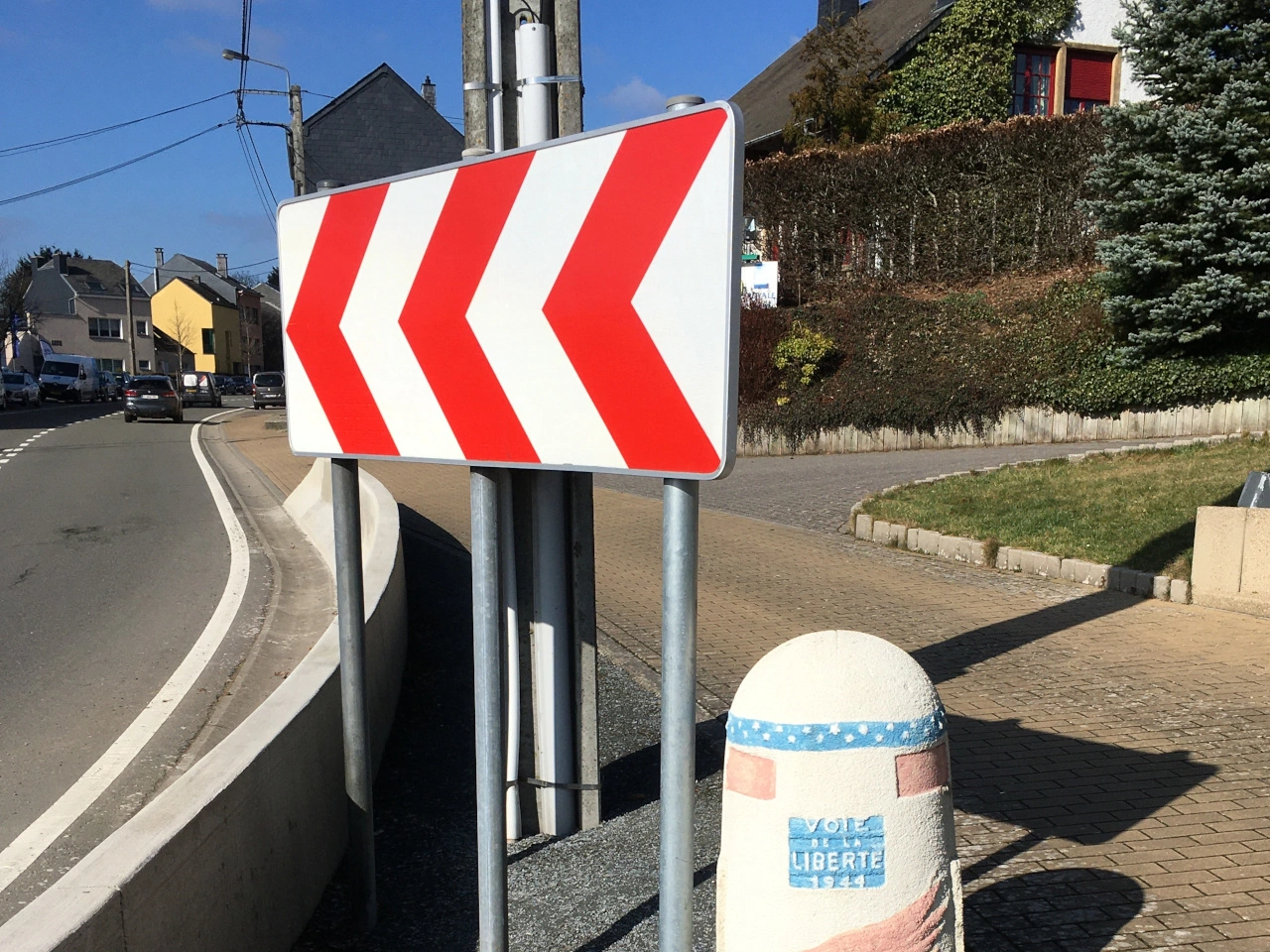
Chevron
What is a chevron board in Belgium?

A Belgian chevron board is a rectangular road-alignment panel displaying a large red chevron on a contrasting light background. It helps drivers follow the direction of a curve.

Which direction does a Belgian chevron point?

The point of the red chevron indicates the direction in which the curve continues. A left-pointing chevron marks a curve to the left and a right-pointing chevron marks a curve to the right.

Is a Belgian chevron an official A1 curve-warning sign?

No. The official dangerous-curve warning signs are A1a, A1b, A1c and A1d. Chevron boards are road-alignment devices used to make the curve itself more visible.

What is the difference between A1 and chevron boards?

An A1 sign warns before the dangerous curve. Chevron boards are placed in or around the curve to show its alignment and guide drivers while they negotiate it.

Do Belgian chevrons have a traffic-sign number?

No separate Highway Code number is assigned to them like A1a or A1b. They are technical road-signing and delineation equipment installed by the road authority.

Where are Belgian chevrons placed?

They are normally positioned along the outside of the curve so that approaching drivers can clearly see the direction of the road.

Must the first chevrons be visible before the curve?

Yes. Belgian regional guidance recommends that the first chevrons be visible while drivers are still approaching the curve.

Are chevrons normally repeated throughout the curve?

Yes. They generally guide drivers along the full length of the curve and continue towards its exit, unless the danger is limited to only part of it.

What is a single-chevron board?

A single-chevron board displays one large chevron. Several individual boards may be spaced along the curve to trace its alignment.

What is a multiple-chevron board?

A multiple-chevron board displays several chevrons on one longer panel. In Belgian regional practice, these are used less frequently than separate single-chevron boards.

When may a multiple-chevron board be useful?

It may be useful at a short curve, beside a particular obstacle or immediately before a critical tightening of the curve.

Does the spacing between Belgian chevrons remain constant?

Not always. Their spacing depends on the radius and layout of the curve. Sharper curves may require the boards to be placed closer together.

How large are Belgian single-chevron boards?

The normal basic format used in Walloon technical guidance is approximately 900 × 900 mm. Smaller formats may be used on lower-speed roads, inside built-up areas or where available space is limited.

Can Belgian chevrons have a fluorescent border?

Yes. On a particularly high-risk curve, a fluorescent yellow surround may be used to increase their visibility.

Can Belgian chevrons be illuminated?

Yes. Illuminated chevrons may be used as an additional measure at curves with a significant safety risk.

Do Belgian chevrons impose a speed limit?

No. They guide drivers through the curve. Only an applicable C43 sign, speed zone or general road rule establishes the legal maximum speed.

Must you still reduce speed?

Yes, when necessary. Belgian drivers must adapt their speed to the road layout, visibility, weather, traffic and vehicle condition and remain able to stop before a foreseeable obstruction.

Do chevrons give you priority?

No. They do not change priority at an intersection or against oncoming traffic.

May you cross a continuous centre line beside chevrons?

No. Drivers may not cross a continuous white line or drive to its left when it separates opposing directions of traffic.

May you overtake in a curve marked by chevrons?

Specified left-side overtaking is prohibited when visibility in the curve is insufficient. The chevrons themselves do not create the prohibition, but they often identify a location where overtaking would be unsafe.

May you stop or park in a chevron-marked curve?

Stopping and parking on the carriageway are prohibited where visibility in the curve is insufficient. A vehicle may also not create danger or unnecessary obstruction.

How should motorcyclists follow Belgian chevrons?

Look through the curve, select a suitable speed beforehand and maintain a stable line. Both the rider and motorcycle must remain within the correct part of the carriageway.

Does a chevron show the exact shape of the curve?

No. It provides directional guidance. Drivers must still observe the road because the curve may tighten, open out or change gradient.

Will Belgium’s new road code change the meaning of chevrons?

Chevron boards remain road-alignment equipment rather than a separate numbered regulatory sign. The general obligations to adapt speed, remain within the correct road position and obey curve signs and markings continue to apply.

34. Circulation à contresens

La circulation à contresens se produit lorsqu’un conducteur roule dans le sens opposé au sens de circulation légalement autorisé. Cela peut arriver sur une route à sens unique, une route à chaussées séparées, une entrée ou sortie d’autoroute ou une autre section réservée à une seule direction.

La circulation à contresens crée un risque extrême de collision frontale. Les conducteurs doivent respecter les panneaux directionnels, les sens interdits, les flèches de voie et les marquages routiers. Toute personne s’engageant accidentellement à contresens doit ralentir, avertir les autres usagers, s’arrêter à l’endroit le plus sûr disponible et contacter les services d’urgence.

Circulation à contresens
What is wrong-way driving called in Belgium?

The Dutch term is spookrijden. In Belgian road-safety usage, it normally refers specifically to driving in the wrong direction on a motorway.

Which Belgian sign prohibits entry from one direction?

Traffic sign C1 means that entry in that direction is prohibited for every driver, unless a supplementary sign expressly provides an exception.

Sens interdit. Sens interdit.

Signal routier C1 • Sens interdit à tout conducteur.

Verkeersbord C1 • Verboden richting voor iedere bestuurder.

Chaussée à sens unique. Chaussée à sens unique.

Signal routier F19 • Voie publique à sens unique.

Verkeersbord F19 • Openbare weg met eenrichtingsverkeer.

Which Belgian sign indicates one-way traffic?

Traffic sign F19 indicates a public road with one-way traffic. Drivers may travel only in the direction shown.

How are C1 and F19 normally used together?

C1 is placed at the prohibited entrance, while F19 is normally placed at the opposite end to indicate the legally permitted direction.

Does passing C1 always make someone a wrong-way driver?

Normally, yes. A driver entering past C1 travels in a prohibited direction unless the vehicle category is expressly exempted by a supplementary sign.

May cyclists travel in the opposite direction on a Belgian one-way road?

Yes, when supplementary signs permit it. Drivers must therefore check for authorised contraflow cyclists even though general motor traffic travels in only one direction.

May class A mopeds or speed pedelecs use the contraflow direction?

They may do so when the appropriate supplementary signs expressly include their vehicle category.

Is an authorised contraflow cyclist a wrong-way driver?

No. When the signs permit two-way cycling, the cyclist is travelling legally and retains the rights and duties applying to that direction.

What does Belgian traffic sign F85 mean?

Traffic sign F85 indicates that traffic is temporarily permitted in both directions on part of a carriageway that normally carries one-way traffic.

Can roadworks send traffic onto the opposite carriageway?

Yes. Temporary signs and markings may guide traffic through a central-reservation crossing or onto another carriageway. This is legal when drivers follow the temporary arrangement.

Is driving against the direction prohibited on Belgian motorways?

Yes. Belgian motorway rules expressly prohibit driving in the opposite direction.

May you reverse on a Belgian motorway?

No. Reversing on a motorway is prohibited.

May you make a U-turn on a Belgian motorway?

No. Turning around is prohibited, even when you have missed an exit or entered the wrong route.

May you use a central-reservation connection to turn around?

No. Ordinary drivers may not use motorway connections through the central reservation.

Do the same prohibitions apply on Belgian expressways?

Yes. The current motorway prohibitions concerning turning around, reversing and driving in the opposite direction also apply on Belgian autowegen.

What should you do when a wrong-way driver is reported?

Reduce speed and keep as far right as safely possible. Stop overtaking, create additional distance and follow electronic signs, radio warnings and police instructions.

May you use the emergency lane to avoid a wrong-way driver?

Belgian road-safety guidance advises moving extremely far right and, when necessary to avoid the immediate danger, using the emergency lane. Do so cautiously and only for the emergency.

Should you flash your headlights at the wrong-way driver?

You may briefly flash them when actually passing the vehicle, but avoid doing so far in advance because the driver could panic or react unpredictably.

Whom should you notify?

Notify the police as soon as possible. A passenger should make the call where possible; otherwise, stop safely before using a handheld telephone.

What should you do if you enter a Belgian motorway in the wrong direction?

Slow down immediately, switch on the dipped headlights and hazard warning lights and do not accelerate towards another entrance or exit.

Where should you stop?

When there is no approaching traffic, move to the emergency lane and stop. When oncoming vehicles are present, remain as far right as possible so they have more room to avoid you.

Should you attempt to turn around yourself?

No. Do not make a U-turn, reverse or cross the central reservation. Stop and contact the police, who can help return the vehicle to the correct direction safely.

What location information should you give the police?

Provide the motorway number, direction normally shown on signs, kilometre marker, nearby exit, tunnel, bridge or service area and a description of the vehicle involved.

Does C1 prohibit pedestrians?

C1 applies to drivers. Pedestrian access is governed separately by the road layout and any pedestrian prohibition signs.

Does wrong-way driving change priority rules?

No. A person travelling illegally in the wrong direction does not acquire priority. Other road users must nevertheless take every reasonable action to avoid a collision.

Does a green traffic light allow entry past C1?

No. A green light permits movement only in a direction that is otherwise legally allowed. C1 and mandatory-direction signs remain applicable.

Can police instructions permit a movement that signs normally prohibit?

Yes. Instructions from an authorised person take precedence over traffic lights, signs, markings and ordinary traffic rules.

Will C1 and F19 remain under Belgium’s new road code?

Yes. The Code of the Public Road taking effect on 1 June 2027 retains C1 for a prohibited direction and F19 for a one-way public road.

35. Travaux routiers

Les travaux routiers sont des activités de construction, d’entretien, de réparation ou d’inspection effectuées sur ou à côté d’une route. Ils peuvent modifier temporairement la configuration de la route, la largeur des voies, les limitations de vitesse, la priorité, les directions autorisées et les aménagements destinés aux piétons ou cyclistes.

Les conducteurs doivent respecter les panneaux temporaires, feux de circulation, barrières, marquages et instructions du personnel autorisé. Ils doivent réduire leur vitesse, augmenter la distance de sécurité et rester prêts à rencontrer des voies étroites, des véhicules arrêtés, des travailleurs, des engins et des changements soudains d’itinéraire.

Travaux routiers
Which Belgian sign warns of roadworks?

Traffic sign A31 warns that roadworks are being carried out on or beside the public road.

Attention aux travaux routiers. Attention aux travaux routiers.

Signal routier A31 • Travaux.

Verkeersbord A31 • Werken.

Does Belgian sign A31 impose a speed limit?

No. A31 is a warning sign. A temporary C43 sign or another applicable rule establishes the maximum speed.

Must you reduce speed after A31?

Yes, when necessary. Drivers must adapt their speed to the temporary layout, traffic, workers, machinery, visibility and condition of the road.

Are temporary Belgian traffic signs binding?

Yes. Lawfully placed temporary priority, prohibition, mandatory-direction, speed and parking signs must be obeyed.

May roadworks begin before the required signs are installed?

No. The applicable Belgian roadworks-signalling rules require the necessary signalling to be installed before the work begins.

Must roadworks signs remain visible?

Yes. Worksite signalling must be maintained so that it remains clean, recognisable and effective throughout the works.

Which markings should you follow at current Belgian roadworks?

Temporary orange longitudinal markings or orange road studs may guide traffic through the works. They have the same meaning as corresponding continuous or broken white lane lines.

What happens to conflicting white lane markings?

The temporary orange markings make the white longitudinal markings at the same location invalid. Follow the temporary orange route.

May you cross a continuous orange line?

No. A continuous orange line has the same meaning as a continuous white line and may not be crossed.

May you cross a broken orange line?

It has the same meaning as a broken white line and may be crossed only for legally permitted movements such as changing lanes or overtaking where safe.

Must you obey temporary traffic lights?

Yes. A red light prohibits passing the stop line or, where there is no line, the signal itself.

What does a fixed orange-yellow light mean?

You must stop unless you are already so close that stopping safely is no longer possible. If you continue, you may not endanger other road users.

May temporary lights allow alternating traffic?

Yes. They may control one direction at a time through a narrow or single-lane section.

Must you obey a Belgian worksite supervisor?

Yes. Road users must follow indications given by an authorised worksite supervisor to protect personnel working on the public road.

How may a worksite supervisor stop traffic?

The supervisor uses a hand-held disc displaying traffic sign C3. Road users must stop when directed.

Do police instructions take precedence?

Yes. Orders from competent authorised persons take precedence over traffic lights, signs, markings and ordinary traffic rules.

What if your lane ends at Belgian roadworks?

Observe the lane-reduction signs and markings. In flowing traffic, changing lanes is a manoeuvre and you must give way to drivers already using the target lane.

When does zipper merging apply?

It applies during strongly slowed traffic when a lane ends or further travel in that lane is prevented.

Where must you merge when zipper merging?

Continue using the lane until immediately before the narrowing and then merge into the adjacent continuing lane.

What must drivers in the continuing lane do?

They must alternately allow one driver from the ending or blocked lane to merge immediately before the narrowing.

What if lanes are blocked on both sides?

The continuing lane first allows one vehicle from the right-hand lane to merge and then one from the left-hand lane.

Who gives way when an obstruction is on your side?

A driver whose route is obstructed must slow down and, when necessary, stop to allow approaching road users to pass, unless signs or signals establish another arrangement.

Can B19 and B21 regulate a roadworks narrowing?

Yes. B19 may require one direction to give way to oncoming traffic, while B21 gives the opposite direction priority.

May you enter a roadworks section when traffic beyond it is blocked?

No. Do not enter when congestion is likely to force you to stop in an intersection, crossing or other location that must remain clear.

May you drive through a closed lane?

No. A red lane-control cross, C3 sign, barrier, cone arrangement or other lawful closure prohibits use of that lane or road section.

May you move a Belgian roadworks barrier or cone?

No. Traffic-control equipment may be moved only by authorised persons. Do not create your own route through the worksite.

May you overtake in Belgian roadworks?

A31 does not itself prohibit overtaking, but temporary C35 signs, continuous markings, narrow lanes or limited visibility may prohibit or make the manoeuvre unsafe.

May you stop or park near Belgian roadworks?

A31 creates no automatic prohibition. Temporary E1 or E3 signs, barriers and general safety rules may prohibit stopping or parking where vehicles would obstruct the work or traffic.

How should you pass road workers and machinery?

Reduce speed considerably, leave sufficient lateral space and expect workers or machinery to enter the road unexpectedly. Stop when directed or when safe passage is impossible.

What should cyclists do when a bike path is closed?

Follow the signed temporary route. When leaving an obstructed bike path, check traffic carefully and make the lateral movement safely.

What should pedestrians do when the pavement is closed?

Use the protected temporary walkway or crossing. Do not enter the carriageway merely because the normal pavement is blocked when another signed route is provided.

Must you form an emergency corridor in roadworks congestion?

Yes, where the road has at least two lanes in the same direction. Vehicles in the leftmost lane move left and vehicles in the other lanes move right as soon as congestion forms.

What changes on 1 June 2027?

Belgium’s new Code of the Public Road retains traffic sign A31 for roadworks. Temporary yellow road markings will be permitted to replace white markings during works and will make the white markings at the same location invalid.

Will temporary yellow markings cover more than traffic lanes?

Yes. Under the new code, yellow may be used for different types of temporary markings, including lane markings, pedestrian crossings and cycle facilities.

36. Limitation de hauteur

Une limitation de hauteur interdit l’accès ou le passage aux véhicules dont la hauteur totale dépasse la valeur indiquée sur une section de route, un pont, un tunnel, un portail ou un autre ouvrage. La hauteur du véhicule comprend son chargement et tout équipement fixé au-dessus.

Les conducteurs de véhicules hauts doivent connaître leur hauteur exacte, tenir compte des avertissements en amont et emprunter un autre itinéraire si nécessaire. Ils ne doivent jamais se fier uniquement à leur appréciation visuelle ni tenter de passer sous un ouvrage lorsque la hauteur libre disponible est incertaine.

Limitation de hauteur
Which Belgian sign indicates a height limit?

Traffic sign C29 prohibits access for vehicles whose height, including their load, exceeds the height displayed on the sign.

Véhicules de plus de la hauteur indiquée interdits. Véhicules de plus de la hauteur indiquée interdits.

Signal routier C29 • Accès interdit aux conducteurs de véhicules ayant, chargement compris, une hauteur supérieure à celle indiquée.

Verkeersbord C29 • Verboden toegang voor bestuurders van voertuigen waarvan de hoogte, lading inbegrepen, groter is dan de aangeduide.

How can you recognise Belgian sign C29?

C29 is a circular prohibition sign showing the maximum permitted height between two vertical arrowheads.

Does C29 include the vehicle’s load?

Yes. The complete height of the vehicle and its load must be considered.

Do roof-mounted objects count?

Yes. Roof boxes, bicycles, machinery and other equipment form part of the vehicle’s total travelling height.

May a vehicle higher than the C29 value continue?

No. It must take another route and may not pass the sign.

May a vehicle exactly as high as the displayed value pass?

C29 prohibits vehicles whose height is greater than the displayed value. In practice, a driver should not attempt passage without sufficient additional clearance because the measured vehicle height and available space can vary.

Does C29 display the structure’s exact clearance?

No. The displayed value includes a safety deduction from the measured free clearance.

How is the displayed Belgian height calculated?

For a passage with a free clearance of at least 2.50 metres, the displayed limit is normally the measured clearance minus 0.30 metres.

How is the value calculated below 2.50 metres?

When the free clearance is below 2.50 metres, the displayed limit is normally the measured clearance minus 0.15 metres.

Which Belgian passages must be marked with C29?

Under the current placement rules, passages with a free clearance below 4.30 metres must be indicated by C29.

What if the clearance varies across the passage?

The sign must display the lowest available clearance.

What if different lanes have different clearances?

The lowest clearance for each lane must be indicated using lane-specific signs, including the applicable F89 or F91 lane arrangement.

Must C29 be placed where another route is still available?

Yes. Belgian placement rules require the restriction to be indicated at a location where affected drivers can still choose an alternative route.

What if no alternative remains at the actual restriction?

A similar advance sign with a supplementary distance panel must be installed earlier at a point where the driver can still choose another route.

Does C29 apply only to trucks?

No. It applies to every vehicle that exceeds the displayed height, including buses, motorhomes, vans, cars with high roof loads and other vehicles.

What is the normal maximum vehicle height in Belgium?

The general maximum height of a loaded vehicle is 4 metres.

Are there exceptions to the Belgian four-metre rule?

In Flanders and Wallonia, a loaded vehicle carrying compressed flax bales may reach 4.30 metres. This exception does not remove the obligation to respect a lower C29 restriction.

What is the maximum height of a non-motorised bicycle with its load?

Under the current Belgian Highway Code, the maximum height is 2.50 metres.

Which rule applies when C29 is lower than the general vehicle limit?

The lower C29 value must be respected. A vehicle may comply with the general four-metre limit and still be too high for a particular passage.

Does C29 impose a speed limit?

No. The applicable regional, zonal, posted and vehicle-specific speed limits remain in force.

Does C29 change priority?

No. Drivers must continue to obey traffic lights, priority signs and the ordinary priority rules.

Can C29 apply to only one lane?

Yes. When the sign is placed above a particular lane or incorporated into lane-control signage, it applies to that lane.

May you change lanes to use a higher part of the passage?

Only when the signs and markings authorise it and the lane change can be completed safely. Never ignore a lane-specific restriction.

Should a truck driver rely on the height stated in vehicle documents?

Not exclusively. The actual travelling height may change with the load, suspension and attached equipment. The driver should know the vehicle’s current maximum height.

What should you do after reaching C29 with an oversized vehicle?

Do not pass the sign. Stop where safe and follow the indicated diversion. Contact the police or road authority when turning or reversing cannot be done safely.

May you reverse away from the restriction?

Reversing is a manoeuvre, so the driver must give way to every other road user. Use assistance where necessary, particularly with a long or high vehicle.

What should you do after striking a Belgian bridge or tunnel?

Stop safely, activate the hazard warning lights and call the emergency services on 112. Do not continue until the vehicle, load and structure have been assessed.

Do priority vehicles have to respect C29?

Yes. Belgium’s new Code of the Public Road expressly retains C29 among the restrictions that priority vehicles may not disregard merely because they are carrying out a priority assignment.

What changes on 1 June 2027?

The new Belgian Code of the Public Road retains traffic sign C29 and expressly applies it to vehicles or vehicle combinations whose height, including the load, exceeds the displayed value.

37. Limitation de largeur

Une limitation de largeur interdit l’accès ou le passage aux véhicules ou ensembles de véhicules dont la largeur totale dépasse la valeur indiquée sur une section de route, un pont, un tunnel, un portail ou un autre passage étroit. La largeur comprend le chargement du véhicule ainsi que tout équipement ou objet dépassant sur les côtés.

Les conducteurs doivent connaître la largeur maximale en circulation de leur véhicule et de leur chargement, tenir compte des avertissements en amont et emprunter un autre itinéraire si nécessaire. Ils ne doivent jamais s’engager lorsque le dégagement latéral suffisant est incertain.

Limitation de largeur
Which Belgian sign indicates a width limit?

Traffic sign C27 prohibits access for drivers of vehicles whose width, including their load, exceeds the width displayed on the sign.

Véhicules de plus de la largeur indiquée interdits. Véhicules de plus de la largeur indiquée interdits.

Signal routier C27 • Accès interdit aux conducteurs de véhicules ayant, chargement compris, une largeur supérieure à celle indiquée.

Verkeersbord C27 • Verboden toegang voor bestuurders van voertuigen waarvan de breedte, lading inbegrepen, groter is dan de aangeduide.

How can you recognise Belgian sign C27?

C27 is a circular prohibition sign showing the maximum permitted width between two horizontal arrowheads.

Does C27 include the vehicle’s load?

Yes. The vehicle and everything carried by it must remain within the displayed width.

Do objects extending from the sides count?

Yes. Loads, equipment, securing devices and other projecting parts that increase the travelling width must be taken into account.

May a vehicle wider than the C27 value continue?

No. The driver must choose another route and may not pass the sign.

May a vehicle exactly as wide as the displayed value pass?

C27 prohibits vehicles whose width is greater than the displayed value. A driver should nevertheless maintain sufficient practical clearance and should not continue when safe passage is uncertain.

Does C27 show the exact physical width of the road?

No. It displays the maximum legally permitted vehicle width. Drivers must not interpret the number as a guarantee that no additional obstacles or narrow points exist.

What is the general maximum width of a loaded vehicle in Belgium?

For a motor vehicle, horse-drawn vehicle or trailer, the general maximum width is 2.55 metres, or 2.60 metres when the vehicle is legally constructed with that width under the technical regulations.

Can certain agricultural loads be wider?

Yes. Specific loose loads such as grain, flax, straw or animal feed may reach 2.75 metres. Under prescribed local-distance conditions, they may reach 3 metres.

Does an agricultural exception allow the driver to ignore C27?

No. A load may comply with a general dimensional exception and still be too wide for a road restricted by C27.

What is the maximum loaded width of a bicycle or two-wheeled moped?

The bicycle, two-wheeled moped or its trailer may have a maximum loaded width of 1 metre.

What is the maximum width of an ordinary bicycle itself?

Under the current Belgian Highway Code, the maximum width of an ordinary bicycle is 0.75 metres.

What is the maximum loaded width of a motorcycle without a sidecar?

The maximum loaded width of a motorcycle without a sidecar, or its trailer, is 1.25 metres.

Which rule applies when C27 shows a lower value?

The lower C27 restriction must be respected, even when the vehicle complies with the general maximum dimensions.

Does C27 apply only to trucks?

No. It applies to every vehicle exceeding the displayed width, including buses, agricultural vehicles, motorhomes, vans, cars with wide loads and trailers.

Can C27 apply to only one lane?

Yes. When the sign is placed above or clearly associated with a particular lane, it applies only to that lane or indicated part of the public road.

Can a C27 restriction apply throughout a zone?

Yes. Under the current Belgian rules, C27 may be given zonal validity. The restriction then applies throughout the signed zone until the corresponding end-zone sign.

Must C27 be placed where another route is available?

Yes. Belgian placement rules require C27 to be installed where affected drivers can still choose an alternative route.

What if no alternative route remains at the restriction itself?

A similar advance C27 sign with a supplementary distance panel must be placed earlier at a location where the driver can still choose another route.

Can roadworks introduce a temporary C27 restriction?

Yes. Temporary barriers or narrowed lanes may require a lower width limit. The temporary sign is legally binding.

Does C27 impose a speed limit?

No. The applicable regional, zonal, posted and vehicle-specific speed limits remain in force.

Does C27 change priority?

No. Drivers must continue to obey traffic lights, priority signs and the ordinary priority rules.

What should you do when you reach C27 with an oversized vehicle?

Do not pass the sign. Stop where safe and follow the indicated diversion. Contact the police or road authority when turning or reversing cannot be completed safely.

May you reverse away from the restriction?

Reversing is a manoeuvre, so the driver must give way to every other road user. Use assistance when necessary, especially with a long or wide vehicle combination.

May you partly use another lane to fit through?

Only where the road markings, signs and traffic conditions legally permit it. C27 does not authorise driving in a closed lane, crossing a continuous line or obstructing oncoming traffic.

Should folding or removable equipment be retracted?

Yes. Movable or easily removable outer parts should be folded or removed where required to reduce the vehicle’s width during travel.

What should you do after striking a Belgian bridge, barrier or tunnel wall?

Stop safely, activate the hazard warning lights and call the emergency services on 112 when the collision creates danger or may have damaged the structure.

What changes on 1 June 2027?

The new Belgian Code of the Public Road retains traffic sign C27 and expressly prohibits access for vehicles or vehicle combinations whose width, including the load, exceeds the displayed value.

Will the existing C27 sign remain recognisable?

Yes. C27 retains its essential symbol and meaning under the new Code of the Public Road.

38. Limitation de poids

Une limitation de poids interdit l’accès ou le passage aux véhicules ou ensembles de véhicules dont la masse dépasse la valeur indiquée sur une section de route, un pont, un tunnel ou un autre ouvrage. Selon la législation locale, la restriction peut concerner la masse réelle en charge du véhicule, sa masse maximale autorisée ou la charge sur un essieu particulier.

Les conducteurs doivent savoir à quel type de masse le panneau fait référence et inclure, lorsque cela est requis, le véhicule, les passagers, le chargement et toute remorque. Un véhicule dépassant la limite doit emprunter un autre itinéraire approprié.
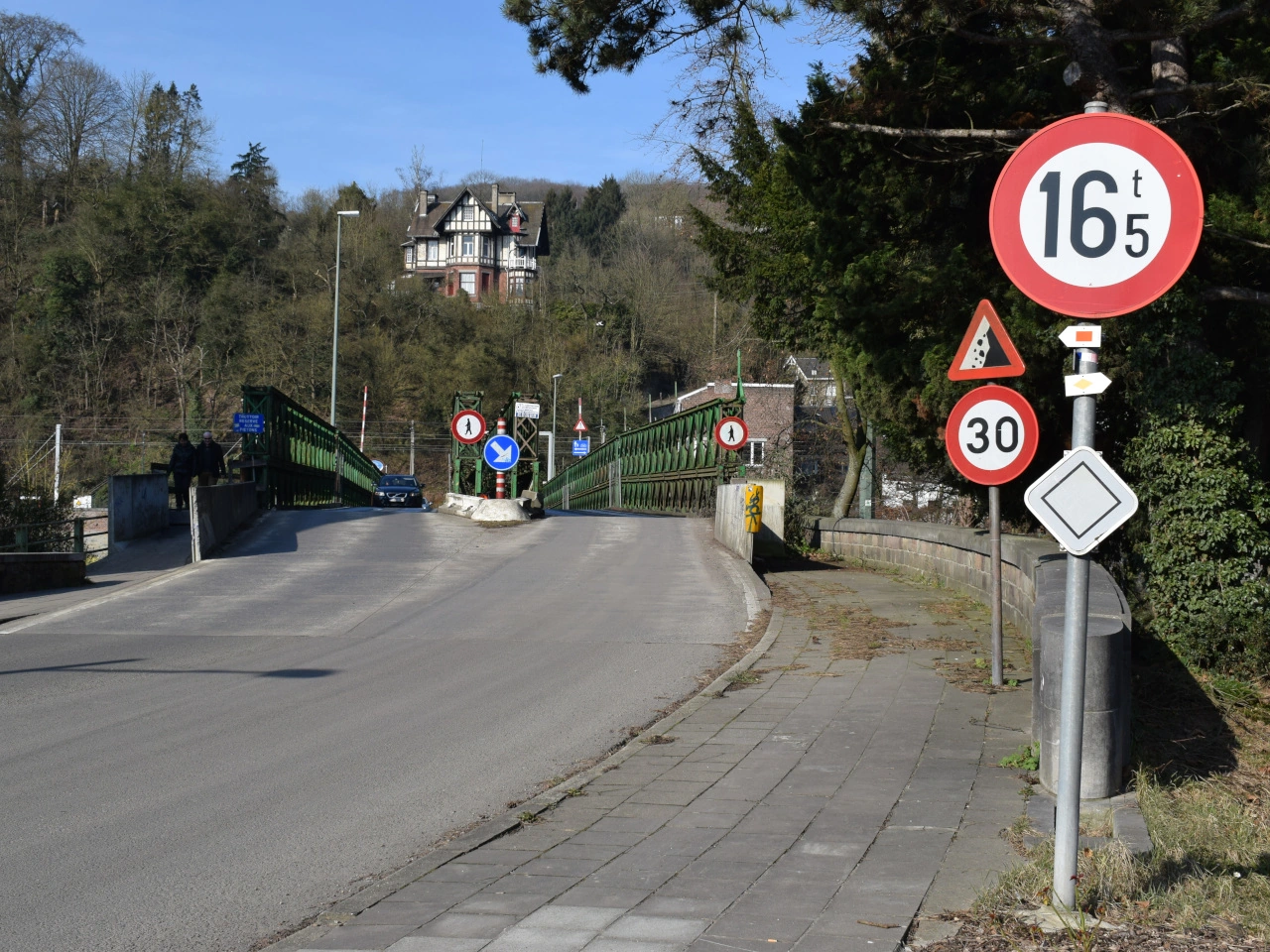
Limitation de poids
Which Belgian sign indicates a weight limit?

Traffic sign C21 prohibits access for drivers of vehicles whose actual loaded mass exceeds the mass displayed on the sign.

Véhicules de plus du poids indiqué interdits. Véhicules de plus du poids indiqué interdits.

Signal routier C21 • Accès interdit aux conducteurs de véhicules dont la masse en charge dépasse la masse indiquée.

Verkeersbord C21 • Verboden toegang voor bestuurders van voertuigen waarvan de massa in beladen toestand hoger is dan de aangeduide massa.

How can you recognise Belgian sign C21?

C21 is a circular prohibition sign displaying a maximum mass, normally expressed in tonnes.

What does actual loaded mass mean in Belgium?

The massa in beladen toestand is the combined mass of the vehicle itself, its load, the driver and every other person being transported.

Does the driver’s mass count for C21?

Yes. The driver and all passengers are included in the vehicle’s actual loaded mass.

Does cargo count for C21?

Yes. All goods, equipment and other load carried by the vehicle contribute to its actual loaded mass.

Is C21 based on the maximum authorised mass in the vehicle documents?

No. C21 concerns the vehicle’s actual mass while loaded, which may be lower than its maximum authorised mass.

What is the difference between actual mass and maximum authorised mass?

Actual loaded mass is what the vehicle currently weighs. Maximum authorised mass is the highest total mass for which the vehicle is legally approved.

Can an empty heavy truck pass a C21 sign?

It may pass when its actual loaded mass does not exceed the displayed value, unless another sign separately prohibits its vehicle category.

Can a small vehicle be prohibited by C21?

Yes. C21 applies to every vehicle whose actual loaded mass exceeds the displayed limit, not only to trucks.

Does the current C21 expressly refer to vehicle combinations?

The current sign description refers to vehicles. From 1 June 2027, the wording expressly includes vehicles and vehicle combinations.

What if a towing vehicle and trailer are used together?

The driver must consider how the applicable restriction treats the vehicle combination and must not continue when the relevant loaded mass exceeds the displayed limit.

What is the difference between C21 and C23?

C21 restricts every vehicle according to its actual loaded mass. C23 prohibits goods vehicles and combinations as a category and may use a supplementary mass inscription based on their maximum authorised mass.

Can a lightly loaded goods vehicle still be prohibited by C23?

Yes. Where C23 applies according to vehicle category or maximum authorised mass, reducing the current load may not remove the prohibition.

Does Belgium currently have a separate axle-load sign?

Under the current Highway Code, C22 is the sign prohibiting coaches, not an axle-load sign. A separate C22 axle-load restriction is introduced by the new Code of the Public Road from 1 June 2027.

What will the new Belgian C22 mean?

From 1 June 2027, C22 prohibits vehicles or vehicle combinations whose actual loaded mass per axle exceeds the value displayed.

Why can an axle-load restriction apply?

It may protect a bridge, road surface or other structure from a load concentrated too heavily on one axle, even when the vehicle’s total mass is otherwise permitted.

May a vehicle exactly equal to the C21 value pass?

C21 prohibits vehicles whose actual loaded mass is higher than the displayed mass. The driver must be certain that the limit is not exceeded.

How can a Belgian driver determine the actual mass?

The vehicle can be weighed on a suitable weighbridge. Registration documents normally provide technical and authorised limits rather than the current mass of the loaded vehicle.

Can redistributing cargo make a vehicle comply with C21?

Redistributing cargo does not reduce the vehicle’s total loaded mass. It may, however, change individual axle loads and become relevant to the new C22 axle restriction.

Can unloading cargo make the vehicle comply?

Yes. The vehicle may continue only after sufficient weight has been removed, the remaining load is secured and all other legal requirements are respected.

May an overloaded vehicle be required to unload?

Yes. When legal loading or technical mass requirements are violated, the driver may be required to unload, uncouple or move the vehicle to the nearest suitable place. The vehicle may otherwise be detained.

Does C21 apply only to permanent restrictions?

No. C21 may also be installed temporarily to protect a damaged bridge, weakened road or temporary roadworks structure.

Can C21 have zonal validity?

Yes. A zonal C21 restriction may prohibit vehicles above the displayed actual loaded mass throughout the signed area until the corresponding end-zone sign.

Does an intersection end a zonal C21 restriction?

No. The restriction continues across intersections until the end-zone sign is passed.

Must C21 be placed where another route is available?

Yes. Belgian placement rules require C21 to be installed at a location where affected drivers can still choose an alternative route.

What if no alternative route remains at the restriction itself?

A similar advance C21 sign with a supplementary distance panel must be placed earlier where the driver can still select another route.

Can C21 apply only to one lane?

Yes. A prohibition sign placed above or clearly associated with a particular lane applies to that lane or indicated part of the public road.

Does C21 impose a speed limit?

No. The applicable regional, zonal, posted and vehicle-specific speed limits remain in force.

Does C21 change priority?

No. Drivers must continue to obey traffic lights, priority signs and the ordinary priority rules.

What should you do when your vehicle exceeds C21?

Do not pass the sign. Stop where safe and use the indicated diversion or another route suitable for the vehicle’s actual loaded mass.

May you reverse away from C21?

Reversing is a manoeuvre, so the driver must give way to every other road user. Assistance may be necessary for a long or heavy vehicle combination.

Do priority vehicles have to respect the new C21 and C22 restrictions?

Yes. The Code of the Public Road retains C21 and the new axle-load sign C22 among the restrictions that priority vehicles may not disregard merely because they are carrying out a priority assignment.

What changes on 1 June 2027?

The new Belgian code expressly applies C21 to vehicles and vehicle combinations according to their actual loaded mass and introduces C22 for actual loaded mass per axle.

39. Panneau de contrôle radar

Un panneau de contrôle radar avertit les conducteurs que la vitesse des véhicules peut être contrôlée par une caméra fixe, un radar mobile, un lidar ou un système de contrôle de vitesse moyenne. Il rappelle aux conducteurs de vérifier et de respecter la limitation applicable.

Le panneau ne fixe normalement pas lui-même la limitation de vitesse. Les conducteurs doivent respecter la limitation générale, affichée ou variable applicable à la route et ne doivent pas freiner brusquement simplement parce qu’un contrôle de vitesse est signalé.

Is there an official national radar traffic sign in Belgium?

No. The Belgian Highway Code does not currently include a numbered national traffic sign specifically indicating speed radar enforcement.

Does Wallonia use a radar warning sign?

Yes. Wallonia uses a blue information board displaying a radar symbol and the word RADAR. It is a regional information sign and is not included among the numbered signs of the Belgian Highway Code.

Does the Walloon radar board impose a speed limit?

No. It announces speed enforcement but does not establish a numerical limit. Drivers must follow the applicable C43 sign, speed zone or general speed limit.

Is the Walloon radar board a prohibition sign?

No. It is an informational warning board. The legal obligation not to exceed the speed limit exists independently of the radar board.

Are permanent radars announced in Wallonia?

Yes. Walloon policy provides road signage announcing permanent automatic speed-enforcement systems.

Can speed checks occur without that Walloon radar board?

Yes. Mobile police controls and other lawful speed checks may occur without the regional radar-information board.

What is a fixed radar in Wallonia?

A fixed radar performs a continuous speed check at one particular location.

What is a red-light radar?

A red-light radar can monitor vehicles passing a red traffic light and may also measure their speed.

What is section control?

Section control, also called average-speed enforcement, records vehicles at different points and calculates their average speed over the controlled road section.

How long can a Walloon average-speed section be?

Walloon guidance describes controlled sections ranging from approximately 500 metres to several kilometres.

Does slowing at the final camera guarantee compliance?

No. The system calculates average speed across the complete controlled section.

What is a temporary lidar control?

A lidar is a temporary automatic speed-control installation that may be placed beside the road, including near roadworks.

How is lidar at Walloon roadworks announced?

Wallonia uses a temporary orange board displaying the words RADAR CHANTIER and a radar symbol to announce certain worksite controls.

Does the RADAR CHANTIER board create the roadworks speed limit?

No. The applicable temporary C43 sign or another speed rule creates the limit. The radar board only warns that it may be enforced.

What is a preventive radar display?

A preventive radar measures an approaching vehicle and displays its detected speed to encourage the driver to respect the limit.

Does a preventive radar normally issue a fine?

No. Its primary function is awareness and prevention rather than enforcement.

Can a preventive display collect information?

Yes. It may collect statistical information about measured vehicle speeds to help authorities assess speeding problems.

Does the speed shown by the display replace your speedometer?

No. It provides information, but drivers remain responsible for monitoring their own speed and respecting the legal limit.

What should you do when the display shows that you are too fast?

Release the accelerator and reduce speed smoothly and safely. Do not brake suddenly when another vehicle is close behind.

Does passing the radar end a Belgian speed restriction?

No. A speed limit ends only according to the applicable signs and road rules, not because the camera has been passed.

Can Belgium use mobile radar without permanent roadside equipment?

Yes. Police may use mobile speed-measuring equipment at temporary control locations.

Can Belgian cameras monitor several offences?

Yes. Certain systems can combine speed enforcement with red-light enforcement or automatic number-plate recognition.

Is a navigation-system radar warning legally authoritative?

No. Navigation and mobile applications may contain incomplete or outdated information. Traffic signs and the actual speed rules always take precedence.

Can the legal limit differ by vehicle category?

Yes. A truck, bus, coach or vehicle combination may have a lower maximum speed than a passenger car even when using the same road.

Are speeding penalties based directly on the roadside display?

No. Enforcement requires approved measuring equipment and the legally prescribed procedure. A preventive display is not itself proof of an offence.

Will Belgium’s new road code introduce a national radar sign?

The published Code of the Public Road taking effect on 1 June 2027 does not list a numbered national radar-warning sign. The Walloon board remains separate from the national traffic-sign catalogue unless the regional rules are changed.

40. Barrières sélectives

Les barrières sélectives sont des dispositifs physiques de contrôle d’accès qui permettent le passage de certains usagers ou véhicules autorisés tout en limitant les autres. Elles peuvent comprendre des bornes fixes, amovibles, rabattables ou escamotables, des portails, des barrières et des dispositifs de filtrage par largeur.

Les usagers autorisés sont déterminés par les panneaux de signalisation, les conditions d’accès et la réglementation locale, et non par la barrière seule. Les conducteurs doivent approcher lentement, vérifier qu’ils sont autorisés et attendre que toute barrière mobile soit entièrement ouverte ou escamotée avant de continuer.
Barrières sélectives
Are selective barriers a separate legal road category in Belgium?

No. The current Belgian Highway Code does not define selective barriers as a separate road category. Access is determined by the applicable traffic signs, permits and local regulations.

Which Belgian sign may prohibit access at a selective barrier?

Traffic sign C3 prohibits access in both directions for every driver. Supplementary signs may exempt particular categories.

Does a closed barrier replace traffic sign C3?

No. The physical installation controls access, while the traffic sign establishes the legal restriction. Both must be respected.

May cyclists be exempted from C3?

Yes. Supplementary panel M2 indicates that the C3 prohibition does not apply to cyclists.

May class A moped riders also be exempted?

Yes. Panel M3 may exempt cyclists and riders of two-wheeled class A mopeds. The applicable symbols must be checked carefully.

May speed-pedelec riders be exempted?

Yes. Panel M11 may exempt speed-pedelec riders, while M12 may exempt cyclists, class A moped riders and speed-pedelec riders.

May a motorcyclist pass between bollards when C3 applies?

No. Being physically able to pass does not create an exception. The rider may enter only when a sign or permit authorises that vehicle category.

Can a selective barrier protect a reserved road?

Yes. Roads reserved for indicated pedestrians, cyclists, riders or speed-pedelec users are currently marked by F99 signs. Physical barriers may help prevent unauthorised motor traffic from entering.

Who may use a Belgian road marked by F99?

The road is principally reserved for the categories shown on the entrance sign. Priority vehicles on an appropriate assignment and certain authorised maintenance, resident, supplier and refuse-collection vehicles may also enter under the prescribed conditions.

What is the speed limit on a current Belgian F99 reserved road?

The maximum speed is 30 km/h.

Does a bollard alone turn a road into a cycle path?

No. A cycle path or reserved road must be identified by its legally prescribed signs or markings. The bollard is only a physical traffic-control device.

Does a lowered bollard cancel the access restriction?

No. Drivers must continue to obey C3, F99 or any other applicable sign even when the device is temporarily lowered.

May you follow an authorised Belgian vehicle through?

No, unless you are independently authorised. The bollard or gate may close immediately behind the first vehicle.

May residents receive access?

Yes, where the road authority or local access rules provide it. Access may use a permit, badge, number-plate recognition or another controlled system.

May delivery vehicles receive access?

They may receive access under the applicable signs, permits and time restrictions. A general delivery purpose does not automatically override a C3 prohibition.

May emergency services pass a selective barrier?

Yes, when their assignment and the applicable rules permit access. The installation may be removable, breakable, remotely controlled or automatically recognised for emergency use.

May you park in front of a Belgian selective barrier?

No, when this blocks authorised traffic or creates danger or unnecessary obstruction. Emergency and service access must remain available.

May you move a fixed or removable bollard?

No, unless you are authorised by the road authority or operator. Road users may not create their own passage through a restricted road.

What should cyclists do at Belgian access bollards?

Reduce speed and pass through the intended opening without unnecessary swerving. Cyclists should avoid overtaking one another where the available space is limited.

What if the opening is too narrow for a cargo bike?

Do not force the bicycle through or enter a pedestrian-only space. Use another authorised opening or contact the road authority when a permitted user cannot pass safely.

Does a retractable bollard currently have its own Belgian warning sign?

No. The current Highway Code in force before 1 June 2027 does not contain a dedicated numbered warning sign for retractable bollards.

How may retractable bollards currently be warned?

They may be indicated by local information, warning lights, road markings or traffic sign A51 with a supplementary panel describing the danger.

What should you do when a retractable bollard is rising or lowering?

Stop and wait until the installation has completed its movement. Proceed only when authorised and when the bollard is fully lowered.

Does a green access light override a prohibition sign?

No. A green access signal permits passage only for road users who are legally authorised to enter.

What changes on 1 June 2027?

Belgium’s new Code of the Public Road introduces warning sign A53 specifically for retractable bollards.

What will Belgian sign A53 mean?

A53 warns drivers that retractable bollards are present ahead. It warns of the physical danger but does not itself grant access.

Does A53 replace C3 or another access sign?

No. A53 is a warning sign. C3, a reserved-road sign or another access regulation still determines who may enter.

What will replace the current F99 reserved-road signs?

From 1 June 2027, traffic signs R9 and R11 indicate the beginning and end of roads reserved for the road users displayed on the sign.

Who will have additional access to an R9 reserved road?

The new code also permits specified residents and visitors, delivery vehicles, vehicles serving adjoining properties, road-work and medical vehicles and holders of a free-passage card, subject to the detailed rules.

Will the physical barrier determine access after 1 June 2027?

No. The traffic signs and legal access rules remain decisive. A bollard or gate is the physical means used to enforce or manage that access.

41. Panneau directionnel de carrefour

Un panneau directionnel de carrefour indique les destinations et itinéraires disponibles à un carrefour approchant ou actuel. Des flèches, numéros de route, symboles et noms de lieux aident les conducteurs à choisir la bonne direction et, lorsqu’elle est indiquée, la bonne voie.

Le panneau fournit un guidage d’itinéraire, mais ne détermine normalement ni la priorité, ni l’autorisation de tourner, ni une limitation de vitesse. Les conducteurs doivent toujours respecter les feux de circulation, panneaux réglementaires, flèches de voie, marquages routiers et règles locales de circulation.

Which Belgian signs guide drivers before an intersection?

Traffic signs F25 and F27 are Belgian advance direction signs, legally called voorwegwijzers.

Information sur les directions du carrefour. Information sur les directions du carrefour.

Signal routier F25 • Signal de préavis.

Verkeersbord F25 • Voorwegwijzer.

Information sur les directions du carrefour. Information sur les directions du carrefour.

Signal routier F27 • Signal de préavis.

Verkeersbord F27 • Voorwegwijzer.

Which Belgian sign points towards a destination at the intersection?

Traffic sign F29 is a direction sign, legally called a wegwijzer.

What does Belgian sign F25 show?

F25 shows the approaching intersection in a simplified schematic form, with the available road directions represented by lines or arrows.

Does F25 show every traffic island and verge?

No. Details such as traffic islands, medians and verges are normally omitted so the main road directions remain easy to understand.

How does F25 show the priority road?

The road that has priority at the intersection is represented by a wider line.

Does the wider line itself give you priority?

No. It communicates the existing priority-road layout. Drivers must still follow the actual B1, B5, B9, B15 or other applicable priority signs.

Can F25 show road numbers?

Yes. The appropriate road number or numbers may be displayed within the corresponding route arrow.

What does Belgian sign F27 show?

F27 lists destinations in separate groups according to whether the route continues straight ahead, to the left or to the right.

How are directions ordered on F27?

The sections are normally arranged from top to bottom as straight ahead, left and right.

Where are the arrows placed on F27?

The straight-ahead and left arrows are placed on the left side of their sections, while the right arrow is placed on the right.

What is the difference between F25 and F27?

F25 uses a schematic drawing of the intersection. F27 groups destinations in separate text-and-arrow sections without reproducing the junction as a road diagram.

What is the difference between F25 or F27 and F29?

F25 and F27 provide advance information before the intersection. F29 is a direction sign pointing towards a destination at or near the point where the driver must turn.

Can F25 or F27 display the distance in kilometres?

No. Under the current Belgian placement rules, F25 and F27 do not display kilometre distances.

Can F29 display a distance?

Yes. The distance in kilometres may be displayed on an F29 direction sign.

How many destinations may be shown for each direction?

Belgian placement rules currently limit F25 and F27 to a maximum of three destination inscriptions per direction.

How are destinations ordered?

For each direction, destinations are normally arranged from top to bottom in decreasing order of distance, with the more distant destination appearing first.

How far before an intersection is F25 or F27 placed?

The signs are normally installed approximately 200 metres before the intersection outside a built-up area and approximately 100 metres before it inside a built-up area.

Can the sign be placed farther away?

Yes. The distance may be increased because of traffic speed, traffic density, road layout or the need to choose a lane at an important intersection.

Can a Belgian direction sign show a motorway symbol?

Yes. The F5 motorway symbol may be incorporated to indicate that the displayed route continues over a motorway.

Can it show an expressway route?

Yes. The F9 expressway symbol may be displayed to indicate that the signed route continues over a Belgian autoweg.

Does a destination shown on F25 or F27 make the turn legal?

No. Drivers must still comply with traffic lights, turn prohibitions, mandatory-direction signs and lane markings.

Does an F25 or F27 sign impose a lane choice?

Not necessarily. It provides route guidance. A separate F13 or F15 sign and the road arrows may prescribe the lane or direction that must be followed.

What does Belgian sign F13 mean?

F13 announces directional arrows on the road and prescribes the choice of a traffic lane.

What does Belgian sign F15 mean?

F15 prescribes the choice of direction for the displayed lanes. The number of arrows represents the number of traffic lanes.

Must you follow road arrows after choosing a lane?

Yes. At the intersection, drivers using a lane marked with selection arrows must follow one of the directions indicated for that lane.

What if you enter the wrong lane?

Follow the legally permitted direction from that lane and choose another route afterwards. Do not cross a continuous line or make a sudden movement across traffic.

Does a guide sign change the speed limit?

No. The applicable regional, zonal, posted and vehicle-specific speed limits remain in force.

Does a guide sign change priority?

No. The route diagram may show the priority road, but legal priority is determined by the actual priority signs, traffic lights and road rules.

What changes on 1 June 2027?

Belgium’s new Code of the Public Road retains F25 and F27 as advance direction signs and F29 as a direction sign. F29 may continue to display the distance in kilometres.

42. Priorité au prochain carrefour

La priorité au prochain carrefour signifie que les conducteurs circulant sur une route déterminée ont priorité sur le trafic arrivant des routes qui la croisent au prochain carrefour. Le régime de priorité est normalement indiqué par des panneaux faisant face à la fois au trafic prioritaire et à celui qui doit céder le passage.

Contrairement à une route prioritaire continue, cette priorité ne s’applique qu’à l’intersection indiquée. Les conducteurs doivent néanmoins approcher avec prudence et respecter les feux de circulation, agents habilités, passages, règles de changement de direction et autres panneaux applicables.
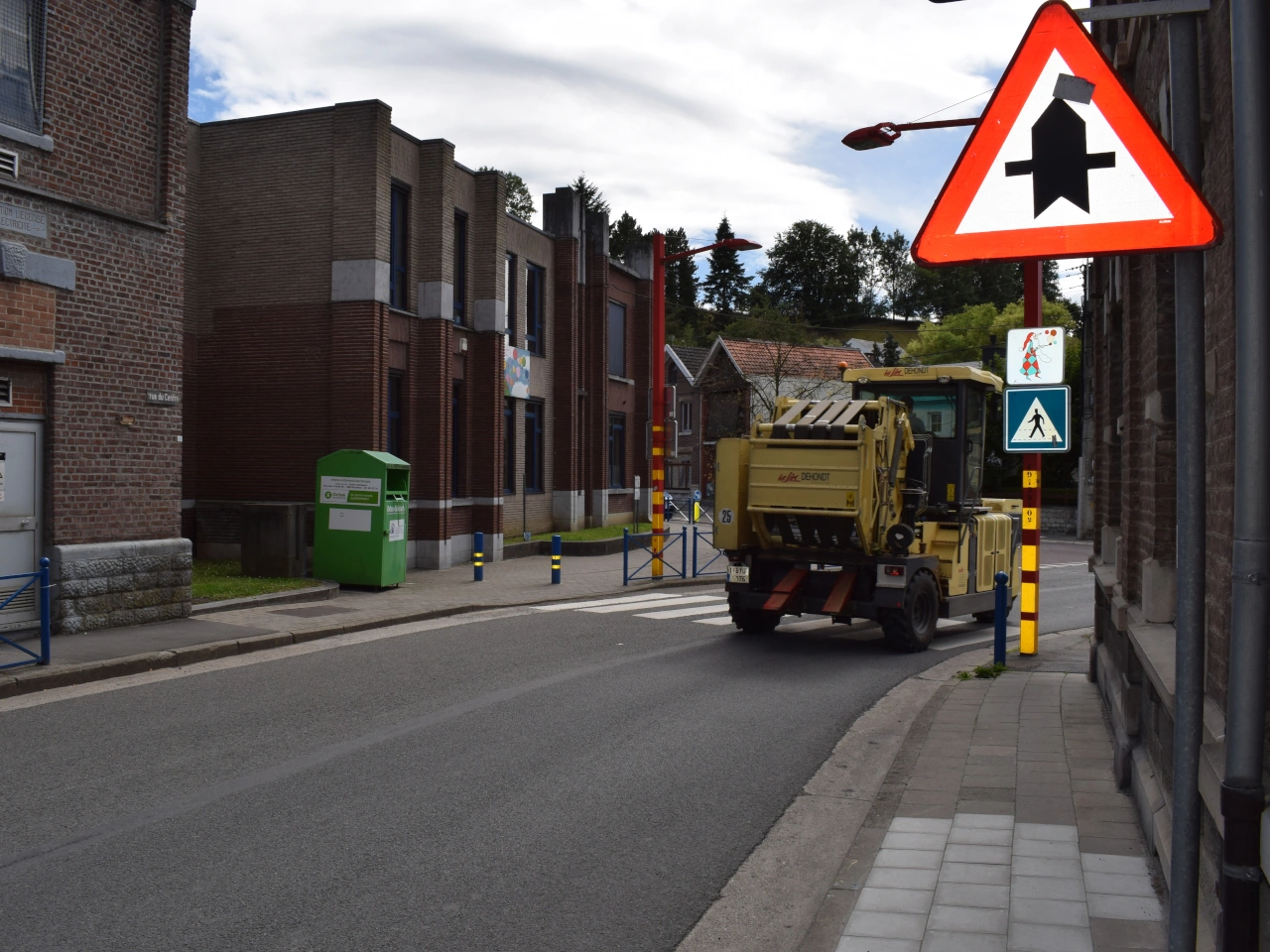
Priorité au prochain carrefour
Which Belgian sign gives priority at the next junction?

Traffic sign B15 indicates that drivers have priority at the next junction.

Priorité au carrefour. Priorité au carrefour.

Signal routier B15 • Priorité de passage. La barre horizontale du symbole peut être modifiée de façon à représenter plus clairement la disposition des lieux.

Verkeersbord B15 • Voorrang. De horizontale streep van het symbool mag worden gewijzigd om duidelijker plaatsgesteldheid weer te geven.

Priorité au carrefour. Priorité au carrefour.

Signal routier B15 • Priorité de passage. La barre horizontale du symbole peut être modifiée de façon à représenter plus clairement la disposition des lieux.

Verkeersbord B15 • Voorrang. De horizontale streep van het symbool mag worden gewijzigd om duidelijker plaatsgesteldheid weer te geven.

Priorité au carrefour. Priorité au carrefour.

Signal routier B15 • Priorité de passage. La barre horizontale du symbole peut être modifiée de façon à représenter plus clairement la disposition des lieux.

Verkeersbord B15 • Voorrang. De horizontale streep van het symbool mag worden gewijzigd om duidelijker plaatsgesteldheid weer te geven.

What is the difference between B15 and B9?

B15 gives priority at one junction. B9 indicates a continuing priority road whose status remains in force until sign B11.

Is a road marked with B15 legally a priority road?

No. It has priority at the indicated junction but is not a continuing B9 priority road.

Can B9 and B15 be used along the same priority route?

Belgian placement rules distinguish the two systems. B9 is used for a continuing priority road, while B15 is used for priority at an individual junction.

How can you recognise Belgian sign B15?

B15 is a triangular priority sign showing a thick vertical line crossed by one or more thinner lines. The thick line represents the route with priority.

Can the B15 diagram be adapted to the junction?

Yes. The horizontal or side lines may be modified so that the symbol more clearly represents the actual road layout.

Does B15 always mean the priority route continues straight ahead?

No. A supplementary diagram may indicate that the route with priority turns left or right at the junction.

What signs do drivers on the side roads normally face?

Drivers who must give way normally face traffic sign B1 or B5.

What does B1 require?

B1 requires drivers to give way. They must stop only when necessary.

What does B5 require?

B5 requires drivers to stop completely and give way.

Must B15 be paired with B1 or B5?

Normally, yes. Belgian placement rules require B1 or B5 on the road followed by drivers who must give way, except where traffic from that road is prohibited in the relevant direction.

Where is B15 placed?

B15 is placed in the immediate vicinity of the junction where its drivers have priority.

Does B15 give priority at later junctions?

No. Its effect concerns the next junction only. Priority at a later junction must be established separately.

Does a junction end the effect of B15?

Yes. Once the indicated junction has been passed, the B15 priority arrangement has been completed.

Does priority from the right apply to side-road traffic?

No. Drivers facing B1 or B5 must give way to traffic on the B15 road, including traffic approaching from their left.

Does B15 give you priority over traffic from both sides?

Yes. Drivers entering from the controlled side roads must give way regardless of whether they approach from the left or right.

Does B15 give you priority over oncoming traffic when turning left?

No. A driver turning left must still give way to oncoming drivers travelling straight ahead or turning right, unless another traffic control provides otherwise.

Must you signal when the B15 priority route turns?

Yes, when your movement constitutes a change of direction. Signal in time even though you retain priority over traffic entering from the side roads.

Does using the indicator give you priority?

No. You must still complete the movement safely and respect oncoming traffic, pedestrians, cyclists and other road users with priority.

Does B15 give priority over pedestrians?

No. Drivers must still respect pedestrian crossings and give way to pedestrians crossing the road they enter when turning.

What if a bike path continues across a side road?

A driver crossing a continuing bike path must give way to its lawful users. B15 does not remove that duty.

Can a B15 panel warn of two-way cycle traffic?

Yes. A supplementary panel may indicate the route of the priority road or warn that cyclists and certain mopeds may approach in both directions.

Must cyclists obey B15?

Yes. Cyclists travelling on the road controlled by B15 benefit from its priority arrangement, subject to all other applicable cycle-path, crossing and turning rules.

Does B15 impose a speed limit?

No. The applicable regional, zonal, posted and vehicle-specific speed limits remain in force.

May you approach B15 at the maximum speed without slowing?

Only when that remains safe. Drivers must adapt their speed to visibility, traffic, road layout and foreseeable hazards and remain able to stop before an obstruction.

May you enter the junction when it is blocked?

No. Having priority does not allow a driver to enter when congestion would probably leave the vehicle stopped inside the junction.

Does B15 prohibit overtaking?

No. The ordinary overtaking rules, road markings and separate prohibition signs remain applicable.

Does B15 prohibit parking?

No. Unlike the specific rule for B9 roads outside built-up areas, B15 itself does not create a general parking prohibition.

Does B15 apply while traffic lights are operating?

No, when functioning traffic lights control the same road at that junction. Drivers must then follow the traffic signals.

What if the traffic light flashes orange-yellow?

An orange-yellow flashing light requires additional caution but does not change the priority arrangement. The B15 sign remains applicable.

What if an authorised person directs traffic?

Follow the authorised person’s instructions. These take precedence over traffic lights, signs, road markings and ordinary traffic rules.

What is the difference between B15 and B17?

B15 gives priority at the next junction. B17 warns that priority from the right applies at the next junction.

Why is B15 used?

Belgian placement rules allow B15 where retaining priority from the right would interfere with the safe or efficient flow of traffic because of traffic conditions or the road layout.

Will B15 remain under Belgium’s new road code?

Yes. From 1 June 2027, B15 retains the meaning priority at the next junction.

43. Feux de circulation

Les feux de circulation utilisent des lumières colorées, des flèches ou des symboles pour indiquer quand les usagers peuvent avancer, doivent se préparer à s’arrêter ou doivent rester arrêtés. Des signaux distincts peuvent s’appliquer à certaines directions, voies, aux piétons, cyclistes ou véhicules de transport public.

Un feu vert autorise le mouvement uniquement lorsque le passage est libre et que la manœuvre est par ailleurs légale. Les usagers doivent toujours respecter les règles de priorité, interdictions de tourner, marquages de voie et instructions des agents habilités.

Feux de circulation
Which Belgian sign warns that traffic lights are ahead?

Traffic sign A33 warns drivers that they are approaching traffic lights.

Attention à un feu de signalisation. Attention à un feu de signalisation.

Signal routier A33 • Signaux lumineux de circulation.

Verkeersbord A33 • Verkeerslichten.

What does a red traffic light mean in Belgium?

A red light means that it is prohibited to pass the stop line or, where there is no stop line, the traffic light itself.

What does a steady orange-yellow light mean?

You must stop before the stop line or signal unless, when the light appears, you are already so close that you can no longer stop safely.

May you accelerate through an orange-yellow light?

No. You may continue only when stopping safely is no longer possible. When continuing through an intersection, you may not endanger other road users.

What does a green traffic light mean?

A green light means that you may pass the traffic light. You may proceed only when your movement remains legal and the route can be entered safely.

Does green give you absolute priority?

No. You must still give way when turning across pedestrians, cyclists or oncoming traffic where the applicable rules require it.

May you enter a blocked intersection on green?

No. You may not enter when congestion is likely to force you to stop inside the intersection and obstruct or prevent crossing traffic.

Where must you stop?

Stop before the white continuous stop line. When no stop line is present, stop before the traffic light itself.

What if a bicycle waiting area is provided?

Motor vehicles must stop before the first stop line. The space between the two stop lines is reserved for cyclists where the road markings establish a bicycle waiting area.

May you stop on a pedestrian crossing?

No. Do not pass the applicable stop line or enter the crossing when the light requires you to stop.

What do Belgian arrow-shaped traffic lights mean?

Red, orange-yellow and green arrows have the same meanings as circular lights, but only for the direction or directions indicated.

What does an additional green arrow displayed with red or orange-yellow mean?

You may proceed only in the direction shown, provided you give way to drivers lawfully approaching from other directions and to pedestrians.

May ordinary drivers turn right on red in Belgium?

No. Belgium has no general right-on-red rule for motor vehicles. The movement requires a specific applicable arrow or another lawful instruction.

What does an orange-yellow flashing light mean?

You may pass with extra caution. The flashing light does not change the existing priority arrangement.

Which priority rule applies when the normal lights flash orange-yellow?

Follow the priority signs at the intersection or, where no sign establishes priority, the ordinary Belgian priority rules.

Do priority signs apply while normal traffic lights are working?

No. Priority signs placed on the same road at that location do not apply while the normal traffic lights are operating.

Which exceptions remain applicable with traffic lights?

The rule suspending priority signs does not apply to an orange-yellow flashing light, lane-control lights or signs B22 and B23.

What does Belgian sign B22 permit?

B22 permits cyclists and speed-pedelec riders to pass a red or orange-yellow light to turn right, provided they give way to every other road user.

What does Belgian sign B23 permit?

B23 permits cyclists and speed-pedelec riders to pass a red or orange-yellow light to continue straight ahead, provided they give way to other road users. It may be used only where they do not cross another traffic stream.

Do B22 and B23 permit cars to pass red?

No. They apply only to cyclists and speed-pedelec riders.

What does a flashing bicycle arrow beside a red or orange-yellow light mean?

Cyclists and riders of two-wheeled mopeds may proceed in the direction indicated by the flashing arrow, but must give way to pedestrians and to drivers lawfully approaching from other directions.

Who must follow bicycle-symbol traffic lights?

They apply to cyclists and riders of two-wheeled mopeds covered by that signal. These users must follow their dedicated signal rather than the general circular light.

What do combined pedestrian-and-bicycle lights mean?

They apply only to pedestrians, cyclists and riders of two-wheeled mopeds who are legally permitted to use the relevant crossing or bike path.

What does a red pedestrian light mean?

Pedestrians may not begin crossing the carriageway.

What does a green pedestrian light mean?

Pedestrians may begin crossing. A flashing green figure may warn that this permission is about to end.

What if there are no pedestrian lights?

Pedestrians must follow the traffic lights controlling vehicle traffic or the instructions of an authorised person.

What does a red cross above a Belgian lane mean?

The lane or indicated part of the road is closed to traffic, subject only to specific statutory exceptions.

What does a green downward arrow above a lane mean?

Traffic is permitted to use that lane or indicated part of the road.

What does a diagonal orange lane arrow mean?

The lane is prohibited except for leaving it in the direction indicated by the arrow. Move into the adjacent lane safely.

Which signals apply to buses and trams?

Scheduled public-transport vehicles may be controlled by white bars, circles and triangles on a black background. A horizontal bar means stop, a circle corresponds to orange-yellow and an inverted triangle corresponds to green.

What does a vertical white bar mean?

It permits an authorised public-transport vehicle to proceed straight ahead only.

What does a slanted white bar mean?

It permits the authorised public-transport vehicle to proceed only in the direction indicated by the bar.

What is the green clearance arrow for left-turning traffic?

A separate left-pointing green arrow at the exit of an intersection indicates that opposing traffic is held by red so left-turning drivers can clear the intersection.

May you leave an intersection after your light changes?

Yes. A driver who entered the intersection lawfully may clear it without waiting for the signal in the intended direction to become green, unless another red light on the right prohibits the movement.

What if a police officer gives a different instruction?

Follow the officer’s instruction immediately. Orders from authorised persons take precedence over traffic lights, signs, road markings and ordinary rules.

May an emergency vehicle pass a red light?

A priority vehicle using its special audible warning device may pass red at a moderate speed when doing so creates no danger for other road users.

What should ordinary drivers do for an approaching emergency vehicle at red?

Create passage where possible without entering the intersection illegally or creating another danger. Follow instructions from police or other authorised persons.

What changes on 1 June 2027?

The new Belgian Code of the Public Road retains the basic meanings of red, steady orange-yellow and green. Arrow-shaped signals will expressly take precedence over circular signals for drivers travelling in the indicated direction.

What happens to B22 and B23 under the new code?

The new code uses a single sign numbered B22, on which one or more arrows indicate the directions in which cyclists and speed-pedelec riders may pass a prohibiting light after giving way.

What changes for the left-turn clearance arrow?

The new code adds an orange-yellow flashing left arrow indicating that opposing traffic is not held by red, while the green left arrow indicates that opposing traffic is stopped.

Will combined pedestrian-and-cycle lights change?

The new code expressly allows a combined signal with red, orange-yellow and green phases, although a two-colour red-and-green version may also be used.

Will warning sign A33 remain?

Yes. A33 remains the warning sign for traffic lights under the Code of the Public Road.

44. Feux pour piétons

Les feux pour piétons sont des signaux qui règlent le moment où les piétons peuvent commencer à traverser une route. Ils affichent normalement une silhouette rouge immobile pour interdire de commencer la traversée et une silhouette verte en marche pour l’autoriser.

Un signal clignotant ou un compte à rebours peut avertir que la période autorisée se termine. Les piétons doivent traverser sans retard inutile, tandis que les conducteurs qui tournent doivent rester attentifs et permettre aux piétons engagés légalement de terminer leur traversée en sécurité.

How many colours do Belgian pedestrian lights currently have?

Belgian pedestrian lights are currently two-coloured: red and green.

What does a red pedestrian light mean in Belgium?

A red pedestrian light means that pedestrians are not permitted to enter the carriageway.

What does a green pedestrian light mean?

A green pedestrian light means that pedestrians are permitted to enter the carriageway and cross.

What do the Belgian pedestrian symbols look like?

The red light displays the illuminated silhouette of a stationary pedestrian, while the green light displays a pedestrian in motion.

Where are the red and green lights positioned?

The red light is positioned above the green light.

What does a flashing green pedestrian light mean?

It warns that permission to cross is about to end. The red light will appear shortly.

May you begin crossing while the green figure is flashing?

The flashing figure remains a green signal but warns that the phase is ending. Begin only when you can cross safely and without unnecessary delay; otherwise, wait for the next green phase.

What if the light turns red while you are already crossing?

Continue crossing at a normal pace. The red light prohibits beginning the crossing; it does not require a pedestrian already lawfully on the carriageway to turn back.

Must drivers allow you to finish crossing?

Yes. Even when traffic in their direction is permitted to proceed, drivers must allow pedestrians who entered the carriageway lawfully to finish crossing at a normal pace.

May a turning driver cross your path while your pedestrian light is green?

Yes, at some intersections. A driver changing direction must give way to pedestrians crossing the carriageway the driver is entering.

Does green guarantee a conflict-free crossing?

No. Pedestrians must remain alert for turning vehicles, priority vehicles and other lawful traffic movements.

Must pedestrians still look for traffic on green?

Yes. They should verify that vehicles are stopping and should cross without unnecessarily lingering or remaining on the carriageway.

What if there are no separate pedestrian lights?

Pedestrians must follow the traffic lights controlling vehicle traffic or the instructions of an authorised person.

May pedestrians cross when the vehicle light is red but no pedestrian light is present?

They must follow the vehicle signals applying at that location. They should not enter merely because vehicles appear to be stopped for another reason.

What do arrows around a Belgian pedestrian figure mean?

Under the current Highway Code, they indicate that the same green or red signal also applies simultaneously to pedestrians crossing in the transverse direction.

Do pedestrian lights apply to cyclists?

No. Ordinary pedestrian lights apply only to pedestrians. Cyclists who remain mounted must follow the applicable bicycle or vehicle signal.

Is a person walking beside a bicycle a pedestrian?

Yes. A person leading a bicycle, motorised bicycle or two-wheeled moped by hand is currently treated as a pedestrian.

What are combined pedestrian-and-cycle lights?

They display the illuminated silhouettes of a pedestrian and a bicycle and apply only to pedestrians, cyclists and two-wheeled moped riders who may legally use the relevant bike path.

What does red mean on a current combined signal?

It means that the indicated pedestrians, cyclists and permitted moped riders may not begin crossing.

What does green mean on a combined signal?

It permits the indicated road users to cross. A flashing green signal warns that this permission is about to end.

May a cyclist follow an ordinary pedestrian green light?

No. A mounted cyclist may follow it only when the signal is a legally applicable combined pedestrian-and-cycle light.

May a cyclist dismount and use the pedestrian signal?

Yes. Once walking beside the bicycle, the person is treated as a pedestrian and may follow the pedestrian signal.

What if a Belgian pedestrian push button has been pressed?

Pressing the button requests a crossing phase but does not permit immediate crossing. Pedestrians must wait for the green figure.

Must pedestrians use the marked crossing?

When a pedestrian crossing is located within approximately 20 metres, pedestrians must use it.

May pedestrians cross diagonally during an ordinary green phase?

No, unless the signal arrangement specifically permits crossing in all directions. Pedestrians must normally cross approximately perpendicular to the centre line.

May pedestrians stop or linger on the carriageway?

No. They may not linger or remain on the carriageway without necessity.

What if a tram approaches a signal-controlled crossing?

Pedestrians must follow the applicable lights. Without permission from traffic lights, they may not enter a pedestrian crossing over tram tracks or a reserved tram site when a tram is approaching.

Do instructions from a police officer override pedestrian lights?

Yes. Orders from an authorised person take precedence over traffic lights, traffic signs, road markings and ordinary traffic rules.

What changes on 1 June 2027?

The new Belgian Code of the Public Road states more explicitly that red prohibits beginning the crossing and that flashing green warns that the permission is ending and red will appear shortly.

What will arrows around the pedestrian figure mean after 1 June 2027?

They will indicate that pedestrians simultaneously receive the same green or red signal for all directions.

Will combined pedestrian-and-cycle lights change?

Yes. The new code permits combined signals with red, orange-yellow and green phases, although a two-colour red-and-green version may still be used.

What will orange-yellow mean on a combined signal?

It means that crossing is prohibited. A cyclist or two-wheeled moped rider already too close to stop safely may continue, but a pedestrian may not begin crossing.

Who will the new combined signals apply to?

They will apply only to pedestrians, cyclists and riders of two-wheeled mopeds.

45. Permis de conduire

Un permis de conduire est un document officiel autorisant une personne à conduire une ou plusieurs catégories déterminées de véhicules à moteur. Il peut comporter des conditions, restrictions, codes de catégorie et dates d’expiration déterminant les véhicules que son titulaire peut conduire.

Les conducteurs doivent posséder un permis valide pour la catégorie de véhicule et la juridiction concernées. Un permis peut être provisoire, définitif, restreint, suspendu ou retiré, et des qualifications supplémentaires peuvent être exigées pour la conduite professionnelle.

Must you have a driving licence to drive in Belgium?

Yes. Anyone driving a motor vehicle on a Belgian public road must hold and carry a valid Belgian or legally recognised foreign licence for the vehicle category concerned, unless a specific legal training or examination exception applies.

Must you carry the driving licence while driving?

Yes. The driver must carry the valid licence or legally equivalent document while driving on a public road.

Which driving-licence categories exist in Belgium?

The principal Belgian categories include AM, A1, A2, A, B, BE, C1, C, C1E, CE, D1, D, D1E, DE and G.

What may you drive with category AM?

Category AM principally covers certain mopeds, speed pedelecs and light motorised quadricycles, subject to their legal vehicle classification.

Which categories apply to motorcycles?

Belgium uses categories A1, A2 and A, with different age, power and training requirements.

What may you drive with category B?

Category B covers a motor vehicle with a maximum authorised mass of no more than 3500 kg, designed and constructed to carry no more than eight passengers in addition to the driver.

May category B include a trailer?

Yes. It generally permits a trailer with a maximum authorised mass of no more than 750 kg. A heavier trailer is also permitted when the combined maximum authorised mass remains no more than 3500 kg.

When is code 96 required?

Category B with code 96 is required for certain combinations exceeding 3500 kg but not exceeding a combined maximum authorised mass of 4250 kg.

When is category BE required?

Category BE is required for certain category-B vehicle and trailer combinations exceeding the limits of ordinary category B or code 96.

Which categories apply to trucks?

Categories C1, C, C1E and CE apply to heavier goods vehicles and their combinations.

Which categories apply to buses and coaches?

Categories D1, D, D1E and DE apply to minibuses, buses, coaches and combinations with trailers.

What is category G?

Category G is the Belgian category for specified agricultural and forestry vehicles.

At what age may you take the Belgian category-B theory test?

The category-B theory test may be taken from the age of 17.

At what age may you take the category-B practical test?

The practical category-B test may be taken from the age of 18.

How long is the category-B theory-test result valid?

A successful theory-test result is valid for three years. A valid theory result and provisional licence are both required when taking the practical test.

Which provisional category-B licences exist?

Belgium currently has provisional category-B licences M36, M18 and M12.

What is the provisional licence M36?

M36 may be obtained from age 17, requires one or two registered supervisors and is valid for 36 months. It is not renewable.

May an M36 learner drive alone?

No. The learner may drive only while accompanied by one of the supervisors registered for that provisional licence.

What is the provisional licence M18?

M18 may be obtained from age 18, is valid for 18 months and allows independent practice after the applicant has obtained the required certificate of competence.

Does the M18 competence requirement differ by region?

Yes. The qualifying training or test procedure differs between Flanders, Brussels and Wallonia.

What is the provisional licence M12?

M12 is a one-time provisional licence that may be requested within three years after an M36 or M18 has expired. It requires a valid theory result, six hours of approved driving-school instruction and a supervisor and is valid for 12 months.

May you drive abroad with a Belgian provisional licence?

No. Belgian provisional category-B licences M36, M18 and M12 may be used only in Belgium.

When may a provisional-licence holder not drive?

A category-B provisional-licence holder may not drive from 22:00 until 06:00 on Fridays, Saturdays, Sundays, the evenings before public holidays and public holidays themselves.

Can additional regional learner requirements apply?

Yes. Driver training and examinations are regional competences, so Flanders, Wallonia and Brussels may impose additional training, minimum-practice or test requirements.

How long is a Belgian bank-card driving licence valid?

The bank-card-format Belgian driving licence has an administrative validity of no more than 10 years. A category or medical authorisation may have a shorter validity.

When should a bank-card licence be renewed?

The holder should request renewal during the three months before its expiry date.

Are old Belgian paper licences still valid?

Yes, subject to their condition and legal validity. All old paper licences must ultimately be replaced by bank-card-format licences by 2033.

When must a paper licence be replaced earlier?

It must be replaced when it is lost, stolen, damaged or unreadable or when the holder no longer resembles the photograph.

Where is a Belgian driving licence requested?

The application is normally made through the municipality where the applicant is registered. Eligible category-A and category-B applications or renewals may also be available through BelDrive.

Who may receive a Belgian national driving licence?

Eligible applicants generally include persons with normal residence in Belgium, normally demonstrated by registration for at least 185 days during the previous 12 months, qualifying students and holders of certain diplomatic or special identity cards.

What should you do if a Belgian licence is lost?

Apply for a replacement through the competent municipal or online procedure. The licence should also be replaced when it is damaged or unreadable.

What should you do if a Belgian licence is stolen?

First report the theft to the police and then apply through the municipality. A stolen licence cannot currently be replaced through the ordinary BelDrive procedure.

May you drive while disqualified?

No. A person who has been disqualified from driving may not drive the affected categories and must surrender the licence as legally required.

Can medical fitness limit a Belgian licence?

Yes. A medical-fitness assessment may impose a shorter validity period, vehicle adaptations or conditions recorded on the licence.

What is code 95?

Code 95 proves professional competence and is required for most professional drivers using categories in groups C and D.

How long is Belgian code 95 valid?

Professional competence is valid for five years and is normally renewed after 35 hours of periodic training, subject to the applicable requirements and exemptions.

May you drive in Belgium with an EU or EEA licence?

Yes. A valid national licence issued by an EU or EEA country may normally be used in Belgium while it remains valid.

Must an EU or EEA licence immediately be exchanged after moving to Belgium?

Usually not. Exchange becomes required in specified circumstances, including expiry, loss, theft or damage and where a licence without an administrative expiry date has been held for two years after Belgian registration.

May one person hold two European driving licences?

No. A person may hold only one European national driving licence.

Can a non-European licence be used in Belgium?

A valid recognised non-European national or international licence may be used under the applicable recognition and residence conditions. Residents should verify whether and when it must be exchanged.

Can every non-European licence be exchanged?

No. The licence model must be recognised, valid and authentic and must satisfy the Belgian residence and issue conditions. Otherwise, Belgian theory and practical tests may be required.

Can an international licence be exchanged for a Belgian licence?

No. Only the original qualifying national licence is considered for exchange; a provisional or international licence is not sufficient.

What is a Belgian international driving licence?

It is a standardised translation of a valid national licence intended for use in countries that recognise it.

Must the national licence accompany the international licence?

Yes. The holder must also be able to present the valid national driving licence.

Is an international licence needed within the EEA?

No. A valid Belgian national licence is normally sufficient in EU and EEA countries.

Is a Belgian international licence valid in Belgium?

It is not intended for use in the country where it was issued or in the country where its holder resides. Belgian residents must use their valid national licence in Belgium.

46. Repère de localisation

Un repère de localisation est une référence placée au bord de la route indiquant une position mesurée le long d’un itinéraire. Il identifie normalement un kilomètre, un mile ou un intervalle plus petit mesuré à partir d’un point de départ établi sur cette route.

Les bornes kilométriques et hectométriques aident les usagers, services d’urgence, autorités routières et équipes d’entretien à identifier une section précise de la route. Elles n’imposent ni limitation de vitesse, ni règle de priorité, ni restriction d’accès.

Repère de localisation
What is a location marker in Belgium?

A Belgian road location marker is a kilometre or hectometre reference point indicating a measured position along a numbered motorway or regional road.

What is a Belgian hectometre point?

It represents a position measured in increments of 100 metres along the road.

What is a Belgian kilometre point?

It identifies the number of complete kilometres measured from the official reference origin of that road.

Where are reference points used in Flanders?

They are used along Flemish motorways and numbered regional roads to provide a simple method of identifying locations.

How frequently are Flemish reference points placed?

They are positioned approximately every 100 metres, although an allowed physical deviation of up to approximately 20 metres may occur.

How is a Flemish road location described administratively?

A location can be described using the road identification, reference point and an additional distance, such as reference point 16.2 plus 15 metres.

Can Belgian reference numbers be painted on the road?

Yes. In Flanders, kilometre and hectometre references may be marked on the road beside the edge line.

How are Flemish kilometre and hectometre numbers displayed on the road?

The kilometre number is displayed in smaller figures above a short line, while the hectometre digit is displayed below or beside it in larger figures.

What does a Flemish marking with 14 and 7 mean?

It indicates reference point 14.7 kilometres: kilometre 14 and the seventh hectometre, or 700 metres, after it.

Where is the road-surface reference marking placed?

Flemish guidance places it approximately 0.10 metres from the carriageway edge or edge line.

Are roadside posts also used?

Yes. Reference information may be displayed on posts, plates or other roadside markers, depending on the road and regional system.

How are markers used in Wallonia?

Walloon regional roads use kilometre and hectometre reference markers to identify road positions for road management, incidents and other events.

How frequently are Walloon hectometre markers provided?

They represent points at intervals of 100 metres, while kilometre markers represent each complete kilometre.

On which side are Walloon markers normally positioned?

They are materialised along the right side of the carriageway in the direction in which the route measurement increases.

What forms can a Walloon marker take?

It may be a roadside sign, small plate or a number painted on the ground, depending on the type of road and available space.

Which Walloon marker gives the most precise physical point?

The number painted on the ground is located at the exact metric point and is therefore the principal reference for precise positioning.

Can a roadside post be displaced from the exact measured point?

Yes. Where a post cannot be installed at the exact point, it may be placed nearby. The displayed reference and the exact measured position can therefore differ slightly.

Why are kilometre and hectometre markers useful?

They help locate collisions, breakdowns, hazards, road equipment and maintenance work along the network.

What should you report after an accident or breakdown?

Report the road number, nearest kilometre or hectometre marker, direction of travel and nearby exit where possible.

Is the marker number alone sufficient?

No. The same value may exist on several roads and on separate carriageways. Always include the road number and direction.

Which emergency numbers can be called in Belgium?

Call 112 for urgent medical, fire or police assistance, or 101 when police assistance is required without another emergency service.

Should you cross a Belgian motorway to read a marker?

No. Never cross the motorway or central reservation. Use a marker visible from your safe position or report other nearby reference information.

Should you remain inside a broken-down vehicle?

When the vehicle is stopped dangerously on a motorway, leave it safely where possible and wait behind the safety barrier, away from moving traffic.

May you stop on the motorway merely to inspect a marker?

No. Stopping on a motorway is permitted only in legally allowed places or because of traffic, an emergency or another unavoidable situation.

Does a Belgian location marker impose a speed limit?

No. It is a reference indication and does not replace a C43 speed sign, speed zone or general speed rule.

Does it establish priority?

No. It has no effect on intersection priority, overtaking, parking or permitted directions.

Is it an official numbered Belgian traffic sign?

No. Kilometre and hectometre markers are road-reference equipment rather than regulatory signs from the numbered national traffic-sign catalogue.

Can a kilometre marker help locate road equipment?

Yes. Belgian road managers record signs, bridges, barriers and other assets by reference to the road and its kilometre or hectometre position.

Will Belgium’s new road code change the marker’s meaning?

No major change is expected. These markers remain infrastructure reference points rather than signs imposing rules on road users.

47. Miroir routier

Un miroir routier est un miroir convexe installé près d’un carrefour, d’une sortie, d’un virage ou d’un autre endroit offrant une visibilité limitée. Sa surface courbe offre une vue plus large des usagers approchant qu’un miroir plat ordinaire.

Un miroir routier n’est qu’une aide à la visibilité. Il peut déformer la distance, la vitesse et la direction et être affecté par l’obscurité, la météo, la saleté ou les dommages. Les conducteurs doivent continuer à observer directement la route, respecter toutes les règles de priorité et ne s’engager que lorsque cela est sûr.

Miroir routier
Is a traffic mirror an official Belgian traffic sign?

No. A traffic mirror is roadside equipment and does not have its own numbered sign or regulatory meaning in the Belgian Highway Code.

Does Belgium’s new road code introduce a traffic-mirror sign?

No dedicated traffic-mirror sign is included. Traffic mirrors remain visibility equipment rather than regulatory traffic signs.

Does a Belgian traffic mirror change priority?

No. Drivers must continue to follow B1, B5, traffic lights, priority from the right and every other applicable priority rule.

Must you stop at B5 even when a mirror is provided?

Yes. Sign B5 requires a complete stop. The mirror may be consulted only as an additional aid after the mandatory stop.

Must you give way after using the mirror?

Yes. A driver subject to B1 or B5 may proceed only when this can be done without danger to road users who have priority.

Does an empty mirror guarantee that the Belgian road is clear?

No. A cyclist, pedestrian, moped, motorcycle or vehicle may be outside the reflected area or hidden by distortion, weather or glare.

May you enter an intersection based only on the mirror?

No. Drivers must exercise extra caution when entering an intersection and should check the road directly as far as the road layout permits.

Does the mirror establish a recommended speed?

No. The applicable speed limit remains in force, but drivers must adapt their speed to the restricted visibility and remain able to stop safely.

Who decides whether a mirror may be installed beside a Belgian public road?

The road authority responsible for that road decides whether the installation is authorised and appropriate.

Is the municipality always the responsible authority?

No. Responsibility may lie with the municipality or the relevant regional road authority, depending on who manages the road.

Can a person freely install a mirror on private property?

A person may install a mirror within their own private property, subject to property and local planning rules, provided it does not obstruct or endanger public-road users.

What if the mirror must be attached to a wall beside the public road?

Prior permission from the responsible road authority is required when the installation occupies or affects the public road or its roadside equipment.

May a private mirror be placed on the opposite side of the public road?

Not without authorisation. Placement on or across the public road requires approval from its managing authority.

Are Belgian traffic mirrors recommended at every poorly visible intersection?

No. Walloon technical guidance treats their installation as exceptional and recommends first considering more reliable measures that improve direct visibility.

Which alternatives should be considered first?

Possible measures include trimming vegetation, removing or relocating visual obstructions, changing parking arrangements, adapting traffic directions or redesigning the intersection.

Under which conditions may Wallonia allow a mirror at an intersection?

Walloon guidance allows it only in restricted circumstances, including a branch controlled by B5, severely limited visibility, no better available solution and a short distance between the stop line and the mirror.

How far may the mirror be from the stop line under Walloon guidance?

The recommended distance between the stop line and the mirror is less than 15 metres.

How high should a Walloon roadside mirror be installed?

The guidance specifies a free height of at least 2.20 metres beneath the mirror so it does not obstruct pedestrians.

Must pedestrian space remain available?

Yes. The installation may not hinder pedestrian movement. Walloon guidance generally refers to approximately 1.50 metres of unobstructed passage, depending on the location and pedestrian use.

What colours are recommended around a Walloon traffic mirror?

The mirror is provided with a clearly visible frame using alternating red and white bands so it can be distinguished from the background.

May vehicles park beside the mirror?

Parking near the mirror should be avoided where a parked vehicle could block its reflected view, particularly when the vehicle is high.

Must a Belgian traffic mirror be maintained?

Yes. It should be cleaned, inspected and correctly aligned. A shifted, damaged or obscured mirror can provide misleading information.

Who maintains a mirror installed for a private access?

Where a public-road mirror is exceptionally authorised for a private access, the applicant may be responsible for the installation and maintenance under the authority’s conditions.

Why is distance difficult to estimate in the mirror?

The convex surface makes vehicles appear smaller and farther away. Drivers should assume that approaching traffic may be closer and faster than it appears.

Why can a mirror be misleading at night?

Headlights reflected in the mirror may make a vehicle appear to approach from another direction or make its speed and distance difficult to assess.

What if rain, dew or frost covers the mirror?

Treat it as unavailable. Stop or give way as required and proceed only after obtaining enough direct visibility to enter safely.

What if the mirror appears incorrectly aimed?

Do not rely on the image. Report the problem to the municipality, regional road authority or other responsible manager.

Do authorised-person instructions override what you see in the mirror?

Yes. Drivers must immediately follow lawful instructions from police or another authorised person, regardless of the reflected traffic image.

Will the basic driver responsibility change on 1 June 2027?

No. Drivers will continue to be responsible for adapting their behaviour to visibility, road conditions and other road users and for obeying the applicable priority rules.

48. Frontière internationale

Une frontière internationale est la limite juridique entre deux pays. Un panneau de frontière peut identifier le pays dans lequel on entre et rappeler aux conducteurs que des règles de circulation, limitations de vitesse, panneaux, exigences relatives aux véhicules et documents différents peuvent s’appliquer.

Le panneau de frontière n’oblige normalement pas à s’arrêter. Des contrôles de passeport, d’immigration ou de douane peuvent avoir lieu à un poste de contrôle, mais certaines frontières internationales peuvent être franchies sans contrôle systématique en vertu d’accords régionaux.

Frontière internationale
Which countries share a land border with Belgium?

Belgium shares land borders with France, Luxembourg, Germany and the Netherlands.

Are Belgium’s land borders inside the Schengen area?

Yes. Belgium and all four neighbouring countries participate in the Schengen area.

Are there normally passport checkpoints at Belgium’s land borders?

No. Routine checks on people are normally absent at internal Schengen borders.

Can temporary border checks still occur?

Yes. A Schengen country may temporarily reintroduce internal border controls under the conditions established by the Schengen rules.

Should travellers still carry an identity document?

Yes. Travellers should carry the valid passport or identity card required for their nationality and journey, particularly because police checks or temporary border controls may occur.

Are Belgium and its neighbouring countries in the EU customs union?

Yes. Goods normally move between them without internal customs duties or routine customs formalities.

Can Belgian customs still conduct checks near an internal border?

Yes. Customs and police may still check excise goods, commercial transport, restricted products, fraud and other legal requirements.

Is Schengen the same as the EU customs union?

No. Schengen concerns controls on people crossing borders. The customs union concerns goods, tariffs and customs procedures.

Does Belgium currently have an official numbered border sign?

Under the Highway Code in force before 1 June 2027, there is no numbered national traffic sign specifically identifying entry into Belgium. Border-identification boards may nevertheless already be used in practice.

Which Belgian border sign takes effect on 1 June 2027?

The new Code of the Public Road introduces traffic sign F100 to indicate the border and entry into Belgium.

How can you recognise Belgian sign F100?

F100 is a blue rectangular indication sign displaying the name of Belgium surrounded by the yellow stars associated with Europe.

Does F100 require drivers to stop?

No. It is an indication sign identifying entry into Belgium. A separate signal, barrier or officer must require a stop.

Does F100 function as a customs sign?

No. It identifies the national border and does not itself introduce a customs declaration or inspection requirement.

Does F100 function as passport control?

No. The sign identifies the country. Any passport or identity check is conducted separately by the competent authorities.

When do Belgian traffic rules begin to apply?

Belgian traffic law applies from the moment a road user crosses into Belgian territory, whether or not F100 or a control point is present.

Does the F100 sign impose a Belgian speed limit?

No. The applicable Belgian regional, road-category, zonal, posted and vehicle-specific speed rules apply independently of F100.

Do general speed limits differ within Belgium?

Yes. Some general limits differ between the Brussels-Capital, Flemish and Walloon Regions. Drivers must therefore check the region and all applicable signs.

Does crossing into Belgium change the driving side?

No. Belgium and all its neighbouring countries use right-hand traffic.

Which vehicle documents should a driver carry in Belgium?

A driver should carry the required driving licence, vehicle-registration documents and legally required insurance evidence, together with the travel documents required for the journey.

Does a foreign driving licence automatically remain valid in Belgium?

This depends on the issuing country, licence type, validity, residence status and applicable recognition rules. EU and EEA licences are generally recognised while valid.

Can Belgium require specific vehicle equipment?

Yes. Belgian requirements concerning items such as the warning triangle and retro-reflective safety vest apply independently of the rules in the country from which the vehicle arrived.

Must foreign vehicles obey Belgian low-emission zones?

Yes. Foreign registration does not automatically exempt a vehicle from applicable low-emission-zone access and registration requirements.

Can road toll or charging rules change after entering Belgium?

Yes. Drivers of certain vehicles may be subject to Belgian road-charging, low-emission or local access systems even when no payment was required in the neighbouring country.

May police or customs officers stop a vehicle after it crosses an open border?

Yes. The absence of a permanent checkpoint does not prevent lawful roadside police, customs or transport controls.

Must you obey temporary border signs and barriers?

Yes. Follow every temporary lane sign, traffic light, barrier and instruction from police or customs personnel.

Does an international border change priority?

No. The boundary itself does not determine priority. Drivers must follow the traffic lights, priority signs and Belgian priority rules applying to the road.

Does it change the road category?

Not automatically. The same physical road may continue across the border, but its legal classification and applicable rules may differ after entering Belgium.

Can pedestrians and cyclists cross Belgium’s internal land borders?

Generally, yes, where the road or path permits them. They must still respect all access restrictions, motorway prohibitions and temporary controls.

What should you do if a border crossing is closed?

Do not pass the closure. Follow the signed diversion or instructions from the authorities and use another authorised crossing.

Will F100 replace customs or country-information boards?

No. F100 identifies the border. Separate signs may still provide information about customs, traffic rules, environmental zones or other national requirements.

49. Itinéraire cyclable

Un itinéraire cyclable est un itinéraire planifié ou balisé destiné à guider les cyclistes entre différents lieux ou à travers une zone. Il peut emprunter des pistes cyclables, rues calmes, routes partagées, voies vertes ou autres itinéraires considérés comme adaptés au vélo.

Un itinéraire cyclable n’accorde pas nécessairement l’usage exclusif de la route ou du chemin aux cyclistes et ne doit pas être confondu avec une piste ou une bande cyclable. Les règles de circulation, de priorité et les usagers autorisés dépendent de chaque route ou chemin composant l’itinéraire et de la signalisation et réglementation locales.

How can you recognise a cycling route in Belgium?

Cycling routes may be indicated by direction signs carrying a bicycle symbol, as well as by regional or local route markers. Belgian traffic signs can indicate a recommended route for particular categories of road users, including cyclists.

Is a signed cycling route mandatory in Belgium?

No. A sign indicating a recommended cycling route provides route guidance. It does not by itself require cyclists to follow that route. Separate mandatory traffic signs may nevertheless require cyclists to use a particular part of the public road.

Is a cycling route the same as a Belgian cycle path?

No. A cycling route is an itinerary that may extend over many different roads and paths. A Belgian cycle path is a specific part of the public road identified by the applicable traffic signs or road markings and is subject to specific rules.

Do cyclists have priority because they are following a cycling route?

No. A cycling-route designation does not itself give cyclists priority. At intersections and crossings, cyclists must obey the normal priority signs, traffic lights, road markings and other applicable rules.

Does a Belgian cycling route have to consist entirely of cycle paths?

No. A route may use dedicated cycle paths, ordinary streets, roads with mixed traffic and other suitable infrastructure. Cyclists must adapt to the rules applying to each section of the route.

May motorists drive on a Belgian cycling route?

Yes, where the roads forming the route are open to motor traffic. A cycling-route sign by itself does not exclude motor vehicles. Any prohibition or restriction must follow from the applicable traffic signs or regulations.

What do Belgian cycling-route direction signs mean?

Belgian directional signs may indicate a recommended route for particular categories of road users. When the route is intended for cyclists, the bicycle symbol identifies the relevant category. Similar signs can also indicate recommended routes towards tourist destinations.

Can a cycling route pass through a one-way street?

Yes, but cyclists may travel against the normal direction only where this is specifically permitted. The fact that a street forms part of a cycling route does not by itself authorise cycling in a prohibited direction.

Can speed pedelecs use a Belgian cycling route?

The cycling-route designation alone does not determine whether a speed pedelec may use every part of the route. Its access depends on the type of road or cycle facility, the applicable speed limit and the traffic signs on each section.

Who is responsible for cycling routes and cycling infrastructure in Belgium?

The development and maintenance of cycling infrastructure are mainly responsibilities of the regions and municipalities. As a result, cycling-route networks, signage and infrastructure can differ between Flanders, Brussels and Wallonia.

50. Stationnement

Le stationnement consiste à laisser un véhicule immobile à un endroit pendant un certain temps, plutôt que de s’arrêter brièvement en raison de la circulation ou d’une nécessité immédiate. De nombreux pays distinguent le stationnement d’un arrêt bref effectué pour faire monter ou descendre des passagers ou pour charger ou décharger des marchandises, même si la définition juridique précise varie.

Le stationnement peut être autorisé, limité, réservé, soumis à une durée maximale ou interdit par des panneaux, marquages, zones de stationnement et règlements locaux. Les conducteurs doivent stationner sans créer de danger ni de gêne inutile et respecter toute condition concernant le paiement, les permis, les catégories de véhicules ou la durée maximale.
Stationnement
When is a vehicle considered parked in Belgium?

A vehicle is considered parked when it remains stationary for longer than necessary for passengers to get in or out or for goods to be loaded or unloaded. Refuelling a vehicle or charging the battery of an electric or hybrid vehicle is also considered parking.

What is the difference between stopping and parking in Belgium?

A vehicle is considered stopped when it remains stationary only for the time necessary for passengers to get in or out or for goods to be loaded or unloaded. If it remains there longer, it is considered parked. Being forced to stop by traffic conditions is treated separately from voluntary stopping or parking.

On which side of the road should you park in Belgium?

A parked vehicle must normally be positioned on the right-hand side relative to its direction of travel. On a one-way carriageway, it may be positioned on either side. A vehicle parked wholly or partly on the carriageway must normally be placed as far as possible from the centre, parallel with the edge and in a single line.

May you park on the pavement in Belgium?

As a general rule, ordinary motor vehicles may not park on a pavement. Parking on raised verges within built-up areas is also prohibited unless local regulations permit it. Where a usable verge must be used by pedestrians, a passable strip of at least 1.5 metres must normally remain available.

How close may you park to a pedestrian or cyclist crossing in Belgium?

You may not stop or park on a pedestrian or cyclist crossing or on the carriageway within 5 metres before the crossing. This rule helps preserve visibility between approaching traffic and people using the crossing.

How close may you park to an intersection in Belgium?

Stopping and parking are generally prohibited within 5 metres of the extension of the nearest edge of the transverse carriageway at an intersection, unless local regulations provide otherwise.

May you park near a bus or tram stop in Belgium?

Parking is prohibited within 15 metres on either side of a sign indicating a bus, trolleybus or tram stop. This is a parking prohibition, so the rules concerning a brief legal stop must be distinguished from leaving the vehicle parked.

How much road space must remain when parking in Belgium?

You may not park where doing so would leave less than 3 metres of free passage on the carriageway. Parking is also prohibited where your vehicle would prevent another parked vehicle from being entered or moved or would obstruct access to parking places located outside the carriageway.

How does a Belgian blue parking zone work?

Where the parking-disc rules apply, the driver must place an approved parking disc visibly in the vehicle and set the arrow to the mark immediately following the arrival time. Unless the signs specify different conditions, the system applies from 09:00 to 18:00 on working days and allows a maximum parking period of two hours.

How does paid parking work in Belgium?

At parking metres or ticket machines, drivers must comply with the conditions displayed at the location. Other authorised payment methods may also be provided. Where paid parking applies, the local signs and payment system determine the applicable period, price and maximum parking duration.

May you park in a space reserved for people with disabilities in Belgium?

Only vehicles used by persons entitled to the recognised parking card for people with disabilities may use spaces specifically reserved for them. The card or recognised equivalent must be displayed as required when the vehicle is parked there.

May you park in front of a driveway in Belgium?

Parking in front of an entrance or driveway to a property is prohibited. An exception applies to a vehicle whose registration number is legibly displayed on that entrance, allowing the vehicle associated with the property to park there.