
Traffic rulesArgentina
Learn the traffic rules of Argentina with lots of pictures, clear traffic signs and interactive quizzes. Simple, visual and easy to follow.


The National Driving Licence system
What is the Argentine National Driving Licence?
The National Driving Licence is the driving entitlement issued by an authorised provincial, municipal or Buenos Aires City authority under standards established by the National Road Safety Agency.
A licence issued by an authorised centre is valid throughout Argentina for the vehicle classes shown on it.
Are driving-licence procedures identical throughout Argentina?
No. National law establishes the main classes, minimum standards, examinations and validity rules, but provinces, municipalities and the City of Buenos Aires administer the procedure.
Appointment systems, local fees, approved training providers and some administrative requirements can therefore differ. Always check the authorised licensing centre responsible for your address.
Which authority issues private classes A, B and G?
Classes A, B and G are issued by an authorised jurisdictional authority linked to the applicant’s address.
The authority must be authorised by the National Road Safety Agency and must verify that the applicant is not suspended or disqualified elsewhere.
Can a person hold more than one National Driving Licence?
No. Only one National Driving Licence may be issued to each person.
The licence records all vehicle classes for which the holder is authorised.
Is the National Driving Licence valid in every province?
Yes. A valid National Driving Licence issued by an authorised centre permits driving throughout the Argentine Republic for the classes shown.
Local traffic rules, access restrictions and enforcement procedures must still be respected.
Must you apply in the jurisdiction shown on your identity document?
For private classes A, B and G, the issuing authority must normally correspond to the address shown on the applicant’s DNI.
A move or unreported change of data can affect the validity and administration of the licence.
What is the National Road Safety Agency’s role?
The National Road Safety Agency sets national standards, authorises licence-issuing centres, defines course and examination content and maintains national driving-licence and traffic-background systems.
It also coordinates recognition, digital validation, professional licensing arrangements and the national points framework.
What is ReNAT?
The National Traffic Background Register, or ReNAT, records relevant traffic history, suspensions, disqualifications and final sanctions.
Before a National Driving Licence is issued, the authority must confirm through the national background system that the applicant is not disqualified in another jurisdiction.
What is CENAT?
CENAT is the National Traffic Background Certificate commonly required for driving-licence procedures.
Applicants generate and pay the relevant certificate or payment slip according to the current procedure and the issuing jurisdiction.
Must final unpaid traffic fines be settled before a licence procedure?
Jurisdictions using the national infringement-payment system may require payment of final outstanding traffic sanctions before completing a licence procedure.
The exact payment and objection procedure depends on the authority responsible for the offence and the licensing jurisdiction.
Can public and private providers conduct licence training and examinations?
Yes. Under the current national framework, authorised public or private providers may conduct theoretical-practical training and certain medical, theory, vehicle-safety and practical assessments.
Providers must meet National Road Safety Agency standards and registration requirements.
Can national rules change through provincial or municipal legislation?
Argentina has a federal system, and the National Traffic Law operates together with provincial and local adhesion and implementation rules.
A national rule may apply directly on national roads or through adhering jurisdictions, while local authorities can establish additional administrative requirements within their powers.
Obtaining a first private car licence
Which licence is normally required to drive a private car?
A private car, utility vehicle, pickup, privately used van or motorhome with a total weight of no more than 3,500 kg normally requires class B1.
Class B1 also includes the entitlement for class A3 cabin-equipped three- or four-wheeled vehicles with steering wheels.
What is the minimum age for class B1?
The national minimum age for class B1 is 17 years.
An applicant who is still a minor must satisfy the parental or legal-authorisation requirements imposed by the competent jurisdiction.
How much does a first driving licence cost in Argentina?
There is no single national total price.
The amount can include local licence fees, the CENAT payment, medical or training-provider costs, photographs, physical-card charges and any additional local services.
Which documents are normally required for a first licence?
Applicants normally need a valid DNI with an updated address, proof of completing the required road-safety course, the national traffic-background documentation and any locally required appointment or payment records.
Minors and applicants with special circumstances may need additional documents.
Must a first-time applicant complete a road-safety course?
Yes. A first-time applicant must complete the required national road-safety education or theoretical-practical course through an authorised format or provider.
The course is intended to prepare the applicant for the knowledge and competence examinations.
What is Mi Primera Licencia?
Mi Primera Licencia is an official online theoretical course for young people aged 16 to 21 who are applying for their first National Driving Licence.
The course supports preparation for the licensing process but does not replace the other required examinations.
Can an applicant learn without attending a traditional driving school?
The national framework allows the required training to be delivered by authorised public or private providers and in approved formats.
Local authorities determine which providers and practical-training arrangements are accepted in their jurisdiction.
Must the applicant know how to read and write?
National law requires applicants to be able to read, and professional applicants must also be able to write.
Applicants who do not read or write Spanish may request an examination in an available authorised language or follow an approved exception procedure with a certified translator.
Must the applicant submit a health declaration?
Yes. The applicant must complete a sworn declaration covering physical, cardiac, neurological, psychological and sensory conditions that could affect safe driving.
Providing false or incomplete information can affect the validity of the licence and lead to further action.
Is a psychophysical examination required?
Yes. The applicant must pass a psychophysical fitness examination.
The assessment includes physical, visual, hearing and psychological fitness relevant to the requested vehicle class.
Can the psychophysical certificate be issued by a registered doctor?
Yes. A qualified doctor who can reliably assess the required abilities may issue the certificate if the doctor meets the registration and National Road Safety Agency requirements.
The authority may require further evidence where the examination identifies restrictions or doubts.
Is a biometric photograph required?
The issuing authority may require a current photograph or capture the applicant’s image as part of the licence process.
The exact method depends on the local centre and whether a physical card is requested.
Can a first licence be issued while the applicant is suspended or disqualified?
No. A licence cannot be issued while the applicant is suspended, disqualified or otherwise legally prevented from driving.
The issuing authority checks the national traffic-background information before granting the licence.
Can applicants take the examinations in a language other than Spanish?
The national regulation provides for examinations in English, French, German, Italian and Portuguese where available.
For another language, an exception procedure and a registered translator may be required. Local availability and arrangements must be confirmed in advance.
Does the application have to be completed personally?
Identity verification, medical assessment and driving examinations are personal procedures.
Digital pre-registration and document submission may be available, but the applicant must personally complete all assessments that verify identity, health and driving competence.
Training and examinations
Which examinations are required for a National Driving Licence?
The national process includes a psychophysical examination, a theory examination, a theoretical-practical vehicle-safety examination and a practical driving examination.
The prescribed assessments are eliminatory and are taken in the required order.
What does the theory examination cover?
The theory examination covers road-safety education, civic responsibility, driving principles, road signs and traffic legislation.
The National Road Safety Agency defines the required content, while the format and appointment procedure are administered by the authorised provider or jurisdiction.
Is there a fixed national number of theory questions?
No single question count applies in every jurisdiction.
The national framework sets the subjects and standards, while authorised centres may use different approved examination systems and question formats.
Can the theory examination be taken remotely?
Yes. Current national rules allow the theory examination to be conducted remotely or in person.
The licensing jurisdiction or authorised provider determines the available format and identity-verification procedure.
What is the vehicle-safety examination?
The theoretical-practical vehicle-safety examination checks whether the applicant can identify faults in safety equipment and understand the vehicle’s controls, instruments and functions.
It must be conducted using a vehicle corresponding to the class requested.
What does the practical driving examination assess?
The practical examination assesses driving competence, reactions and defensive responses to unexpected situations.
It also includes stopping and starting on slopes, parking and safe control of a vehicle in the requested class.
Must the examination vehicle match the requested class?
Yes. The practical and vehicle-safety assessments must use a vehicle appropriate to the requested licence class.
The vehicle must comply with the legal safety and documentation requirements.
Can the practical examination be outsourced to an authorised provider?
Yes. Authorised issuing bodies may use registered public or private providers for training and examinations where permitted.
The provider must comply with the content and quality standards established by the National Road Safety Agency.
Are the examinations eliminatory?
Yes. Failure at an eliminatory stage prevents the applicant from completing the licence process until the failed requirement has been successfully repeated.
The local authority determines rebooking, waiting periods and additional fees.
What happens if you fail the theory examination?
You must repeat the examination according to the procedure of the authorised licensing centre.
The jurisdiction may impose a new appointment, additional study requirements or another fee.
What happens if you fail the practical examination?
The practical examination must be repeated before the licence can be granted.
Additional practical training may be advisable or required by the local authority before another attempt.
Is there a universal national waiting period after a failed examination?
No universal waiting period is stated for every issuing jurisdiction.
The centre responsible for the application determines when and how a failed assessment may be repeated.
Can an applicant use a privately owned vehicle for the practical test?
This depends on the authorised centre and local procedure.
Any vehicle used must correspond to the requested class and meet all safety, insurance, registration and technical-inspection requirements.
Can a licence be issued if one examination has not been completed?
No. All required examinations and checks must be successfully completed before the driving entitlement is granted.
The authority must also confirm that the applicant is not disqualified or suspended.
Beginner drivers
Who is considered a beginner driver in Argentina?
A person who obtains a driving licence for the first time is treated as a beginner driver under the national framework.
Special rules apply during the first six months, and serious offences during the first two years can lead to additional consequences.
How long must a beginner display the beginner sign?
For the first six months, the driver must display a clearly visible sign identifying the beginner status.
The national law requires the sign to be visible at both the front and rear of the vehicle.
May a beginner drive in central urban zones?
During the first six months, the national regulation prohibits beginner drivers from driving in central urban zones.
Because the precise boundaries depend on local designation, the driver should check the rules of the relevant city or municipality.
May a beginner drive on motorways or semi-motorways?
No, during the first six months.
The beginner restriction prohibits driving on motorways and semi-motorways, and this limitation must be stated on the reverse of the beginner signs.
Must the beginner sign be displayed on every vehicle used?
Yes. The sign identifies the status of the driver, so it must be displayed on the vehicle being driven during the required period.
It should be positioned so that it is clearly visible without obstructing the driver’s view or the vehicle’s lights and registration plate.
What happens if a beginner commits a serious offence during the first two years?
The licence is subject to suspension when the beginner commits serious offences during the first two years after the licence is granted.
The driver may be required to pass the theoretical-practical examination again before being authorised to drive.
Does beginner status end after six months?
The special sign and road restrictions end after the first six months.
However, the enhanced consequences for serious offences continue during the first two years after the licence was granted.
Can local jurisdictions impose additional beginner restrictions?
Yes. Provinces and municipalities may establish additional local conditions within their powers.
Beginner drivers should check the rules of the jurisdiction in which they obtained the licence and the roads on which they intend to drive.
Digital licence and documents
Is the Argentine National Driving Licence issued digitally?
Yes. Under the current national framework, the National Driving Licence is issued in digital format.
It appears in the Mi Argentina application when the holder has a valid licence, an active account and verified identity.
Is a physical driving-licence card still available?
Yes. The digital licence may be replicated as an optional physical card.
The physical card can involve an additional cost and remains valid only while the digital licence remains valid.
Do the digital and physical licences have the same legal validity?
Yes. Both formats have the same legal validity.
The physical card does not create a separate entitlement and cannot remain valid after the digital licence has become invalid.
Can you drive with only the digital licence?
Yes. The digital National Driving Licence is valid for driving throughout Argentina without presenting the physical card.
The licence must be displayed through the official Mi Argentina application so that its current status and QR code can be checked.
How do you access the digital licence?
Download the Mi Argentina application, create an account and complete the identity-validation process.
A current National Driving Licence should then appear in the account when the issuing jurisdiction and national systems have successfully synchronised the information.
How is the digital licence verified?
The digital licence contains a QR code that allows traffic and security officers to check its status.
Authorised officers can use the official validation system to confirm whether the licence is valid, retained, suspended or disqualified.
How often does the digital QR code update?
The licence QR code updates every 24 hours.
The code remains usable offline for that period, allowing the licence to be shown temporarily when no internet connection is available.
Is a screenshot of the digital licence sufficient?
A screenshot does not provide the same live verification as the official application.
The authorised licence view and current QR code in Mi Argentina should be used. The QR code has a limited 24-hour validity for offline checking.
Why might a valid licence not appear in Mi Argentina?
Possible reasons include an unverified identity, failure to add the service, data-synchronisation delays or an issuing jurisdiction that has not fully integrated with the digital system.
The holder should check the Mi Argentina account and contact the issuing authority if the licence remains unavailable.
What does 'disqualified' mean in the digital licence?
It means that a final decision by a competent authority currently prevents the person from driving.
The person must not drive until the disqualification has ended and the licence status has been legally restored.
What does 'retained' mean in the digital licence?
It means that an authorised officer has preventively retained the licence under a legal ground.
The holder must follow the procedure indicated by the enforcement or judicial authority before driving again.
Can another person view your digital licence in their Mi Argentina account?
No. The Mi Argentina account is personal and requires identity validation.
A licence is shown only to the verified account holder.
Renewal, validity and replacement
How long is a private National Driving Licence valid?
Under the current national framework, private licences are generally valid for up to five years for holders up to age 65.
The authority may grant a shorter period when the psychophysical assessment or another legal condition requires it.
How long are classes A, B and G valid after age 65?
For holders over 65, classes A, B and G require psychophysical revalidation every three years.
The issuing authority may set a shorter period based on the medical assessment.
How often must drivers over 70 revalidate the licence?
From age 70, the holder must confirm psychophysical fitness every year.
The competent authority may also require further assessments according to the requested class and the applicant’s condition.
Can renewal be completed online?
Remote renewal and class-extension procedures are available through the national online system in participating jurisdictions.
Applicants use their Mi Argentina account, upload or validate the required information, pay the applicable charges and submit the psychophysical certificate from a registered professional.
Can renewal still be completed in person?
Yes. Applicants who prefer or need an in-person procedure may use the authorised licence-issuing centre responsible for their address.
Appointment systems and local documentation requirements vary by jurisdiction.
Is a new road-safety course required for every renewal?
The full first-time National Road Safety Course is not normally repeated solely because the licence is being renewed.
The jurisdiction may nevertheless require revalidation of particular knowledge or additional training.
Is a psychophysical assessment required for renewal?
Yes. Renewal of licence validity requires confirmation of psychophysical fitness.
The certificate must be issued in accordance with National Road Safety Agency standards by an authorised or registered professional or provider.
When must theory and practical knowledge be revalidated at renewal?
Revalidation can be required when the holder has serious traffic history or the quantity of serious offences specified by the regulations.
The current framework provides that a person with five or more serious offences may be required to pass the relevant examinations again.
Can you drive with an expired licence?
No. An expired licence does not authorise driving.
The holder must complete the renewal or revalidation procedure before driving again.
What should you do if the licence is lost or stolen?
Report the loss or theft as required and apply for a replacement or updated physical card through the competent authority.
The digital licence remains the primary record, but its status and the local replacement procedure must be confirmed before driving.
What should you do if the physical card is damaged?
A damaged or unreadable physical card should be replaced if the holder wishes to continue using the physical format.
The authority may require surrender of the damaged card and will issue the replacement for the remaining period of validity.
What happens after a change of address or other licence data?
The holder must report any change to the information recorded on the licence as soon as possible so that the digital licence can be updated.
If a physical card is requested, the old card is exchanged for an updated one covering the remaining validity period.
When does an unreported data change affect validity?
The licence loses validity 90 days after an unreported change to the recorded information.
It becomes enabled again once the updated information has been reported and processed.
Does the optional physical card show an expiry date?
Under the current system, the physical card itself does not have a separate expiry date.
It remains legally valid only while the corresponding digital licence and driving entitlement remain valid.
Can a renewed licence be issued for less than the normal period?
Yes. The issuing authority may reduce the period according to the psychophysical examination, the holder’s age, the licence class or other legal restrictions.
The digital record shows the actual period and conditions granted.
Private vehicle classes and trailers
What vehicles does class B1 cover?
Class B1 covers cars, utility vehicles, pickups, privately used vans and motorhomes with a total weight of no more than 3,500 kg.
It also includes class A3 for cabin-equipped three- or four-wheeled vehicles with steering wheels.
Does class B1 allow a trailer?
Class B1 does not provide the full B2 trailer entitlement.
For the trailer combinations described under the national classes, class B2 is required.
What vehicles does class B2 cover?
Class B2 covers private cars, pickups, vans and motorhomes up to 3,500 kg with a trailer of up to 750 kg or a non-motorised caravan.
It includes class B1.
What experience is required before obtaining class B2?
An applicant must normally have held class B1 for at least one year before obtaining class B2.
The applicant must also complete the required assessments for the additional vehicle combination.
Can class B1 be used for a motorhome?
Yes. A motorhome is included when its total weight does not exceed 3,500 kg.
A heavier motorhome requires the appropriate class C entitlement.
Can class B1 be used for a private van?
Yes. A privately used van falls within class B1 when it remains within the 3,500 kg total-weight limit.
Passenger-service or commercial professional use can require a different professional class.
Does the 3,500 kg limit refer to empty weight?
No. The class description refers to the vehicle’s total authorised or regulated weight, not merely the empty weight.
The vehicle documents must be checked before driving.
Must the trailer comply with the towing vehicle’s technical limits?
Yes. The driving-licence class does not override the towing limits, coupling limits or safety requirements shown in the vehicle documents.
The trailer, tyres, lights, brakes and registration must also comply with the applicable rules.
Can a B2 holder tow more than one trailer?
Class B2 is defined for the authorised private vehicle and trailer combinations within its limits.
Multiple-trailer or articulated combinations generally fall under the professional class E framework rather than ordinary private class B2.
Can a class B licence be used for paid passenger transport?
Ordinary private class B does not by itself authorise professional passenger services.
The appropriate class D licence and any additional local or service-specific authorisation are required.
Can a class B licence be used for commercial goods transport?
A class B vehicle may carry goods when the vehicle and activity remain within the class and other legal requirements.
Professional or interjurisdictional transport can require class C, E or additional operational authorisation.
Does class B1 include motorcycles?
Class B1 does not generally include ordinary two-wheeled motorcycles.
It includes class A3 only, covering cabin-equipped three- or four-wheeled vehicles with steering wheels.
Motorcycle, adapted and agricultural classes
Which class is required for motorcycles in Argentina?
Motorcycles, mopeds and motorised tricycles generally require a class A licence.
The exact subclass depends on engine capacity, electric power, vehicle design and the applicant’s previous experience.
What does class A1.1 cover?
Class A1.1 covers mopeds up to 50 cm³ or electric vehicles with up to 4 kW of continuous rated power.
The national minimum age is 16, and a rider under 18 may not carry a passenger where the relevant rule applies.
What does class A1.2 cover?
Class A1.2 covers motorcycles up to 150 cm³ or electric motorcycles with up to 11 kW of continuous rated power.
It includes class A1.1 and is available from age 17 under the national framework.
What does class A1.3 cover?
Class A1.3 covers motorcycles above 150 cm³ and up to 300 cm³, or electric motorcycles above 11 kW and up to 20 kW.
The applicant normally needs two years of class A1.2 experience, except that applicants over 21 may obtain it without that two-year requirement.
What does class A1.4 cover?
Class A1.4 covers motorcycles above 300 cm³ or electric motorcycles above 20 kW.
The applicant normally needs two years of A1.3 experience. Applicants over 21 must instead prove at least one year of motorcycle experience in any engine-capacity class.
What does class A2.1 cover?
Class A2.1 covers open three- and four-wheeled vehicles with handlebars up to 300 cm³ or 20 kW for electric propulsion.
The minimum age is 17.
What does class A2.2 cover?
Class A2.2 covers open three- and four-wheeled vehicles with handlebars above 300 cm³ or 20 kW.
The applicant normally needs two years of A2.1 experience, while applicants over 21 must prove at least one year of relevant three- or four-wheeled vehicle experience.
What does class A3 cover?
Class A3 covers cabin-equipped three- and four-wheeled vehicles of any engine capacity or electric power with a steering wheel.
Class A3 is included in class B1.
What is class F?
Class F is for a motor vehicle specially adapted to the physical condition of its holder.
The licence must describe the required adaptation and must be accompanied by the corresponding vehicle class.
What does class G1 cover?
Class G1 covers agricultural tractors.
The applicant must complete the training and assessments appropriate to the vehicle.
What does class G2 cover?
Class G2 covers special agricultural machinery.
Local operating, road-access and occupational rules may impose further conditions.
What does class G3 cover?
Class G3 covers an agricultural train or combination and must be accompanied by class B1 or G1 as applicable.
The applicant must prove at least one year of previous experience in the corresponding underlying class.
Professional classes C, D and E
Who is considered a professional driver?
Holders of National Driving Licence classes C, D and E are treated as professional drivers.
They are subject to additional experience, background, medical, course and examination requirements.
What experience is required before obtaining a professional licence?
An applicant must have been authorised in class B for at least one year before obtaining a professional class.
The applicant must then satisfy the requirements of the requested C, D or E subclass.
What is the minimum age for professional classes?
The national framework generally requires professional applicants to be at least 21 years old under the current class table.
Applicants must also meet the prior class B experience and fitness requirements.
What does class C1 cover?
Class C1 covers rigid trucks, vehicles and motorhomes over 3,500 kg and up to 12,000 kg, without a trailer, semi-trailer or articulation.
It includes class B1.
What does class C2 cover?
Class C2 covers rigid vehicles above 12,000 kg and up to 24,000 kg, without a trailer, semi-trailer or articulation.
It includes class C1.
What does class C3 cover?
Class C3 covers rigid trucks, vehicles and motorhomes above 24,000 kg, without a trailer, semi-trailer or articulation.
It includes class C2.
What does class D1 cover?
Class D1 covers motor vehicles used for passenger services with up to eight passenger seats, excluding the driver.
It includes class B1.
What does class D2 cover?
Class D2 covers passenger-service vehicles with more than eight and up to 20 passenger seats, excluding the driver.
The applicant must meet the professional passenger-transport requirements.
What does class D3 cover?
Class D3 covers passenger-service vehicles with more than 20 passenger seats, excluding the driver.
It includes class D2.
What does class D4 cover?
Class D4 covers vehicles used for emergency, urgent and similar services.
It must be combined with the appropriate A, B, C, D or E subclass for the vehicle itself.
What does class E1 cover?
Class E1 covers class C or D motor vehicles with one or more trailers or articulations.
It includes class B2.
What does class E2 cover?
Class E2 covers special non-agricultural machinery.
The licence holder must also comply with operational and road-use restrictions applicable to the machinery.
Are criminal-background checks required for professional passenger licences?
Yes. The issuing authority must check whether the applicant has disqualifying criminal history for class D passenger-service licences.
Relevant offences include specified crimes against persons, sexual integrity, individual liberty and offences involving vehicles or public services.
What special rule applies to a new professional driver?
A person obtaining classes C, D or E for the first time is treated as a professional learner.
For emergency and similar vehicles, the learner must be accompanied by an experienced and competent professional driver.
How often must professional drivers over 65 revalidate fitness?
For classes C, D and E, holders over 65 must confirm psychophysical fitness every two years and pass any examinations required by the authority.
From age 70, annual revalidation applies.
Foreign licences and driving abroad
Can a visitor drive in Argentina with a foreign licence?
A visitor may generally drive with a valid foreign national licence when the licence is recognised under an applicable international agreement or national rule.
The driver must carry the original licence and comply with the vehicle class, age, insurance and entry-period conditions.
How long may a recognised foreign licence be used in Argentina?
Licences issued by states covered by the relevant international driving conventions are generally recognised for up to one year from entry.
The exact period and documentation can depend on the issuing country, immigration status and applicable agreement.
Is an international driving permit valid by itself?
No. An international driving permit normally serves as a translation and supplementary document.
It must be used together with the corresponding valid national driving licence.
When should a visitor carry an international driving permit?
An international driving permit is advisable or required when the national licence is not readily understandable, does not follow a recognised international format or the issuing country is not covered by a simpler recognition arrangement.
The visitor should confirm the requirements before travelling and renting a vehicle.
Can a resident use a foreign licence indefinitely?
No. A person who establishes residence in Argentina must follow the recognition, exchange or new-licence procedure determined by the National Road Safety Agency and the competent jurisdiction.
A visitor rule should not be relied upon after the person has become ordinarily resident.
Can every foreign licence be exchanged directly?
No. Exchange depends on the issuing country, the type of licence and any agreement or recognition procedure in force.
The competent authority may require translation, proof of validity, legalisation and some or all Argentine examinations.
Which authority handles recognition of a foreign licence?
The National Road Safety Agency establishes the national recognition procedure, while the authorised jurisdictional licensing authority processes the individual application.
Applicants should begin with the centre responsible for their Argentine address.
Is the Argentine National Driving Licence valid abroad?
The Argentine National Driving Licence is accepted in many countries because its format uses international nomenclature and convention standards.
Recognition is not universal, and the destination country may require an international driving permit, a translation or additional documents.
What is an International Legality Certificate?
The International Legality Certificate confirms information relating to an Argentine National Driving Licence for use in procedures abroad.
It can be requested online through the official national service when a foreign authority requires proof of the licence record.
Should Argentine drivers check destination-country rules before travelling?
Yes. Each country can impose its own minimum age, document, insurance, vehicle and international-permit requirements.
Rental companies may also impose conditions stricter than the legal minimum.
National points system and traffic sanctions
How many points does a National Driving Licence start with?
The national scoring system assigns an initial balance of 20 points to the National Driving Licence.
Points are deducted when qualifying traffic sanctions become final.
Are points deducted immediately after an allegation?
Points are normally deducted for final sanctions, not merely because an allegation has been recorded.
The responsible driver must be properly identified, subject to the specific rules for automated enforcement.
What happens when several offences are committed together?
For concurrent offences, the points deduction is normally capped at 15 points or the lower sum of the applicable deductions.
Some individual extremely serious offences can themselves carry the loss of all 20 points.
What happens the first time all 20 points are lost?
The driver is disqualified for 60 days.
The driver must also complete and pass an authorised road-safety course before the point balance is restored.
What happens the second time all points are lost?
The second total loss results in a 120-day disqualification.
An authorised road-safety course is also required.
What happens after a third total loss of points?
The third total loss results in a 180-day disqualification.
For later total losses, the disqualification period is successively doubled.
Are professional-driver disqualification periods different?
Yes. The national scoring rules reduce the first and second total-loss disqualification periods by half for professional licences.
Professional drivers must still complete the required road-safety course.
When are the 20 points restored after total loss?
After the disqualification period has been completed and the required course has been passed, the driver receives the applicable full point balance again.
Driving before legal rehabilitation is prohibited.
Can a driver with a positive balance recover points?
Yes. A driver with more than zero points may recover points through approved road-safety courses under the national framework.
A course may restore up to four points, and this type of recovery may not be used more frequently than once every two years.
Can one offence remove all 20 points?
Yes. Certain exceptionally serious conduct can carry a 20-point deduction.
An example under the national sanction schedule is organising or participating in an unauthorised speed or skill competition on a public road.
How many points can be deducted for alcohol or drug-impaired driving?
The national sanction schedule provides a deduction of 10 points for driving above the permitted alcohol limit or under the effects of drugs or medicines that impair safe driving.
Fines, vehicle retention, licence suspension and other criminal or administrative consequences may also apply.
How many points can be deducted for running a red light?
Failing to stop at a red light can result in a deduction of five points under the national schedule.
The fine and other consequences depend on the final sanction and jurisdiction.
How many points can be deducted for dangerous overtaking?
Dangerous overtaking without sufficient visibility near a junction, bend, bridge, crest or other hazardous place can carry a deduction of 10 points.
Other overtaking violations can carry different deductions.
Is the points system implemented identically everywhere?
The national scoring framework requires jurisdictional implementation and coordination.
The practical enforcement and consultation systems can differ between provinces and municipalities, so drivers should check their local authority and national records.
Can a licence procedure be blocked by final unpaid sanctions?
Yes, in participating jurisdictions. Final unpaid traffic sanctions can have to be settled before a licence application, renewal or extension is completed.
The driver retains the right to use the applicable objection or judicial procedure before a sanction becomes final.
Alcohol, drugs and medical fitness
What is the national alcohol limit for driving?
National law prohibits driving any vehicle with an alcohol level above zero.
The zero-alcohol rule applies on national roads, while provinces and municipalities apply their own adopted rules on roads within their jurisdiction.
Does zero alcohol apply to private drivers as well as professionals?
Yes. The national rule prohibits any alcohol above zero for all vehicle drivers.
Professional and motorcycle drivers are also subject to the zero limit.
Can local alcohol rules differ?
Argentina’s federal structure means that provincial and local adoption and enforcement can differ.
Drivers should follow the strictest rule applicable to the road and jurisdiction and should not consume alcohol before driving.
Can you drive after taking drugs or impairing medicines?
No. Driving under the effects of narcotics or medicines that alter the normal parameters needed for safe driving is prohibited.
A legal prescription does not permit driving while impaired.
What should you do if medicine may affect driving?
Read the medicine information, follow professional advice and do not drive if reaction, alertness, vision, balance or judgement may be impaired.
Ask a doctor or pharmacist when the effect on driving is uncertain.
Can the authority suspend a licence for psychophysical unfitness?
Yes. The issuing authority must suspend the licence when inadequate psychophysical fitness is established and continued driving creates a serious road-safety danger or clearly harms the public interest.
The suspension can be initiated by the jurisdiction or at the request of the National Road Safety Agency.
How quickly must a suspended driver undergo a new medical examination?
A driver suspended for unfitness must undergo and pass a new psychophysical examination within five working days of the suspension.
If the examination confirms fitness, the driver may request rehabilitation.
What happens if the driver does not undergo the required new examination?
The issuing authority may impose a preventive disqualification when the driver fails to attend the required psychophysical reassessment within the specified period.
Other sanctions for any related traffic offence can also apply.
What additional requirements apply to suspended professional drivers?
A professional holder of classes C, D or E must pass the required psychophysical reassessment.
The driver must also pass the courses and examinations applicable to the professional class before rehabilitation.
Can a licence include medical restrictions or vehicle adaptations?
Yes. Where fitness depends on conditions or adaptations, the licence may identify the required limitation.
Class F is used together with the underlying vehicle class for specially adapted vehicles.
Can a shorter licence validity be imposed for medical reasons?
Yes. The issuing authority may grant a shorter period than the general maximum according to the psychophysical examination.
The holder must comply with the stated revalidation date and any medical conditions.
Must the holder report a significant change in health?
A licence holder must not continue driving when a physical, sensory or psychological change makes safe driving doubtful.
Medical advice should be obtained, and the issuing authority may need to be informed where the condition affects the licence requirements.
Documents and obligations while driving
Which personal documents must a driver carry?
A driver must be able to present a valid DNI and National Driving Licence.
The digital licence in Mi Argentina is valid throughout the country when displayed through the official application.
Which vehicle documents must be available?
The driver must have the vehicle identification card, proof of valid compulsory insurance and the applicable RTO or VTV technical-inspection record.
The registration plates must be legible, standardised and free from unauthorised additions.
Is compulsory motor insurance required?
Yes. The vehicle must have valid compulsory liability insurance.
The official proof of coverage is sufficient for the stated coverage period; a separate premium-payment receipt is not itself required merely to prove compliance.
What is RTO or VTV?
RTO and VTV are compulsory technical-inspection systems used to verify that a vehicle meets the required safety and operating standards.
The applicable inspection system, frequency and proof depend on the vehicle and jurisdiction.
Can you drive if the licence is marked retained or disqualified?
No. A retained, suspended or disqualified licence does not provide an unrestricted right to drive.
The holder must follow the procedure of the competent authority before resuming driving.
Must a driver obey traffic officers and controls?
Yes. Every licence holder must comply with lawful controls and orders issued by traffic authorities in the exercise of their duties.
Refusing required checks can lead to sanctions and preventive measures.
Can a vehicle owner allow an unlicensed person to drive?
No. Giving or allowing control of a vehicle to a person who lacks the necessary driving entitlement is an offence.
The owner or person in control of the vehicle can face fines and points consequences.
Does the licence class have to match the vehicle?
Yes. The driver must hold the precise class or subclass required for the vehicle, trailer, passenger service or professional use.
Driving outside the authorised class can be treated as driving without the proper licence.
Must a beginner carry the beginner signs while driving?
Yes, during the first six months. The signs must be visible at the front and rear of the vehicle.
They also communicate the restrictions on central zones, motorways and semi-motorways.
Should drivers verify local rules before a long journey?
Yes. Argentina’s provinces and municipalities can have different enforcement procedures, urban restrictions, inspection requirements and administrative rules.
National road rules, posted signs and the requirements of the jurisdiction being entered must all be respected.
Sources and methodology
When was this page last reviewed?
This page was last reviewed on .
Which sources were used to compile this page?
This page was compiled using information published by official Argentine national authorities and current national legislation.
Because Argentina has a federal system, national rules were distinguished from provincial, municipal and Buenos Aires City procedures.
How was the information researched and prepared?
The official information was reorganised and rewritten into a concise question-and-answer format. AI-assisted tools were used to help research, structure and draft the content.
The information was then reviewed against the official sources listed below.
Can driving-licence rules, procedures and fees change?
Driving-licence rules, examination procedures, fees, digital services and local administrative requirements can change.
Always confirm important requirements with the authorised licensing centre responsible for your address before applying, booking an examination or making a payment.
Which official sources can I consult?
Principal official sources
- Argentina National Traffic Law No. 24,449 — updated text
- Regulatory Decree No. 779/1995 — updated text
- Decree No. 196/2025 — current driving-licence reforms
- National Driving Licence classes and subclasses
- How to obtain the National Driving Licence
- National Road Safety Course
- Mi Primera Licencia
- CENAT traffic-background certificate
- Digital National Driving Licence — frequently asked questions
- National scoring system
- Zero alcohol while driving
- Mandatory documents for driving
- Driving abroad with an Argentine licence
- International Legality Certificate
Is this website affiliated with the Argentine government?
This website is an independent educational resource and is not affiliated with an Argentine government authority, licensing centre or examination provider.
The information is provided for general guidance and does not replace official instructions or legislation.

1. What does this traffic sign mean?
This traffic sign indicates a mandatory path for motorcycles. Motorcyclists must use the designated path or route where the sign applies. Other road users may use it only where the applicable signs or local rules permit them to do so.
English • Traffic sign R-18(b) • Motorcycles and mopeds only. Marks a road or lane exclusively for motorcycles and mopeds.
Español • R-18(b) • Circulación exclusiva para motos y ciclomotores. Indica una vía o carril de uso exclusivo para motocicletas y ciclomotores.
Sources
🔗 Commons.wikimedia.org
🔗 Servicios.infoleg.gob.ar • Anexo L vigente, sustituido por Decreto 196/2025, R.18
🔗 Servicios.infoleg.gob.ar • Anexo L 2025, lámina 03 • ANSV, manual de señales, PDF p. 3
🔗 Argentina.gob.ar • DNV, Manual de Señalamiento Vertical 2017, PDF p. 111
SVG source: Gobierno de la República Argentina • Public domain • Original revision 2014-01-16. Wikimedia original unmodified.

2. What does this traffic sign mean?
This traffic sign indicates the start of a minimum speed. Road users covered by the sign must travel at or above the indicated speed when conditions allow. Driving more slowly may still be necessary because of traffic, weather, road conditions or another safety-related reason.
English • Traffic sign R-16 • Minimum speed: 35 km/h. Sets a 35 km/h minimum. Always adapt driving to safety conditions.
Español • R-16 • Velocidad mínima: 35 km/h. Establece una velocidad mínima de 35 kilómetros por hora para la vía señalizada. Adapta siempre la conducción a las condiciones de seguridad.
Sources
🔗 Commons.wikimedia.org
🔗 Servicios.infoleg.gob.ar • Anexo L vigente, sustituido por Decreto 196/2025, R.16
🔗 Servicios.infoleg.gob.ar • Anexo L 2025, lámina 02 • ANSV, manual de señales, PDF p. 3
SVG source: Commons.wikimedia.org • Original SVG
Gobierno de la República Argentina • Public domain • Original revision 2014-01-16. Wikimedia original unmodified.
Artwork individually reviewed against current Argentinian Argentina.gob.ar • Annex L, substituted by Decreto 196/2025:
🔗 Argentina.gob.ar • Annex III plate 02, R-16. Supporting ANSV manual, PDF page 3. Intentional educational illustration update from the previous PNG; original SVG unmodified.

3. What does this traffic sign mean?
This traffic sign indicates the start of a mandatory path for pedestrians. Pedestrians must use the designated path, while other road users may use it only where the applicable signs or local rules permit them to do so.
English • Traffic sign R-18(e) • Pedestrians only. Marks a road or path exclusively for pedestrians.
Español • R-18(e) • Circulación exclusiva para peatones. Indica una vía o senda de uso exclusivo para peatones.
Sources
🔗 Commons.wikimedia.org
🔗 Servicios.infoleg.gob.ar • Anexo L vigente, sustituido por Decreto 196/2025, R.18
🔗 Servicios.infoleg.gob.ar • Anexo L 2025, lámina 03 • ANSV, manual de señales, PDF p. 4
🔗 Argentina.gob.ar • DNV, Manual de Señalamiento Vertical 2017, PDF p. 114
SVG source: Gobierno de la República Argentina • Public domain • Original revision 2014-01-16. Wikimedia original unmodified.

4. What does this traffic sign mean?
This traffic sign indicates a mandatory direction to the left. Traffic must proceed to the left at the sign and may not continue straight ahead or to the right.
English • Traffic sign R-21(b) • Direction of travel to the left. Travel in the leftward direction shown by the arrow is compulsory.
Español • R-21(b) • Sentido de circulación hacia la izquierda. Establece la obligación de circular en el sentido hacia la izquierda indicado por la flecha.
Sources
🔗 Commons.wikimedia.org
🔗 Servicios.infoleg.gob.ar • Anexo L vigente, sustituido por Decreto 196/2025, R.21/22
🔗 Servicios.infoleg.gob.ar • Anexo L 2025, lámina 03 • ANSV, manual de señales, PDF p. 4
SVG source: Commons.wikimedia.org • Original SVG
Gobierno de la República Argentina • Public domain • Original revision 2023-04-30. Wikimedia original unmodified.
Artwork individually reviewed against current Argentinian Argentina.gob.ar • Annex L, substituted by Decreto 196/2025:
🔗 Argentina.gob.ar • Annex III plate 03, R-21(b). Supporting ANSV manual, PDF page 4. Intentional educational illustration update from the previous PNG; original SVG unmodified.

5. What does this traffic sign mean?
This traffic sign indicates a mandatory path for equestrians. Equestrians must use the designated path where the sign applies. Other road users may use it only where the applicable signs or local rules permit them to do so.
English • Traffic sign R-18(d) • Horse riders only. Marks a road or path exclusively for people on horseback.
Español • R-18(d) • Circulación exclusiva para jinetes. Indica una vía o senda de uso exclusivo para personas montadas a caballo.
Sources
🔗 Commons.wikimedia.org
🔗 Servicios.infoleg.gob.ar • Anexo L vigente, sustituido por Decreto 196/2025, R.18
🔗 Servicios.infoleg.gob.ar • Anexo L 2025, lámina 03 • ANSV, manual de señales, PDF p. 3
SVG source: Commons.wikimedia.org • Original SVG
Gobierno de la República Argentina • Public domain • Original revision 2014-01-16. Wikimedia original unmodified.
Artwork individually reviewed against current Argentinian Argentina.gob.ar • Annex L, substituted by Decreto 196/2025:
🔗 Argentina.gob.ar • Annex III plate 03, R-18(d). Supporting ANSV manual, PDF page 3. Intentional educational illustration update from the previous PNG; original SVG unmodified.
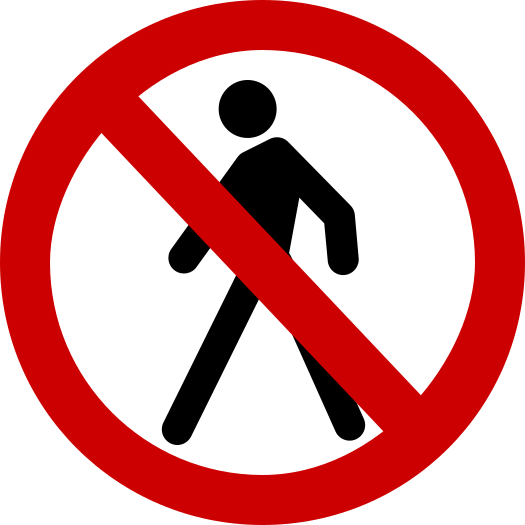
6. What does this traffic sign mean?
This traffic sign indicates that pedestrians are prohibited. Pedestrians may not enter or continue beyond the sign. Other road users may still be permitted unless another restriction applies.
English • Traffic sign R-3(6) • No pedestrians. Pedestrian traffic is prohibited on the signed road.
Español • R-3(6) • No circular peatones. Prohíbe el tránsito de peatones por la vía señalizada.
Sources
🔗 Commons.wikimedia.org
🔗 Servicios.infoleg.gob.ar • Anexo L vigente, sustituido por Decreto 196/2025, R.3
🔗 Servicios.infoleg.gob.ar • Anexo L 2025, lámina 01 • ANSV, manual de señales, PDF p. 2
SVG source: Commons.wikimedia.org • Original SVG
Gobierno de la República Argentina • Public domain • Original revision 2012-07-25. Wikimedia original unmodified.
Artwork individually reviewed against current Argentinian Argentina.gob.ar • Annex L, substituted by Decreto 196/2025:
🔗 Argentina.gob.ar • Annex III plate 01, R-3(6). Supporting ANSV manual, PDF page 2. Intentional educational illustration update from the previous PNG; original SVG unmodified.

7. What does this traffic sign mean?
This traffic sign indicates that parking is prohibited. Vehicles may not be parked in the area covered by the sign unless an exception applies. Brief stopping to pick up or drop off passengers or to load or unload goods may still be permitted where local rules allow it.
English • Traffic sign R-8 • No parking. Applies on the indicated side and section. Check the supplementary plate for hours and other conditions.
Español • R-8 • No estacionar. Prohíbe estacionar en el costado y tramo señalados. Comprueba los horarios u otras condiciones indicados en la placa complementaria.
Sources
🔗 Commons.wikimedia.org
🔗 Servicios.infoleg.gob.ar • Anexo L vigente, sustituido por Decreto 196/2025, R.8
🔗 Servicios.infoleg.gob.ar • Anexo L 2025, lámina 02 • ANSV, manual de señales, PDF p. 2
SVG source: Commons.wikimedia.org • Original SVG
Gobierno de la República Argentina • Public domain • Original revision 2014-01-16. Wikimedia original unmodified.
Artwork individually reviewed against current Argentinian Argentina.gob.ar • Annex L, substituted by Decreto 196/2025:
🔗 Argentina.gob.ar • Annex III plate 02, R-8. Supporting ANSV manual, PDF page 2. Intentional educational illustration update from the previous PNG; original SVG unmodified.

8. What does this traffic sign mean?
This traffic sign indicates that vehicles wider than indicated are prohibited. A vehicle or vehicle combination whose overall width, including its load, exceeds the displayed limit may not continue beyond the sign.
English • Traffic sign R-13 • Width limit: 3 m. Vehicles wider than 3 m overall must not pass.
Español • R-13 • Limitación de ancho: 3 m. Prohíbe el paso de vehículos cuyo ancho total supere 3 metros.
Sources
🔗 Commons.wikimedia.org
🔗 Servicios.infoleg.gob.ar • Anexo L vigente, sustituido por Decreto 196/2025, R.12/13
🔗 Servicios.infoleg.gob.ar • Anexo L 2025, lámina 02 • ANSV, manual de señales, PDF p. 3
SVG source: Commons.wikimedia.org • Original SVG
Gobierno de la República Argentina • Public domain • Original revision 2014-01-16. Wikimedia original unmodified.
Artwork individually reviewed against current Argentinian Argentina.gob.ar • Annex L, substituted by Decreto 196/2025:
🔗 Argentina.gob.ar • Annex III plate 02, R-13. Supporting ANSV manual, PDF page 3. Intentional educational illustration update from the previous PNG; original SVG unmodified.
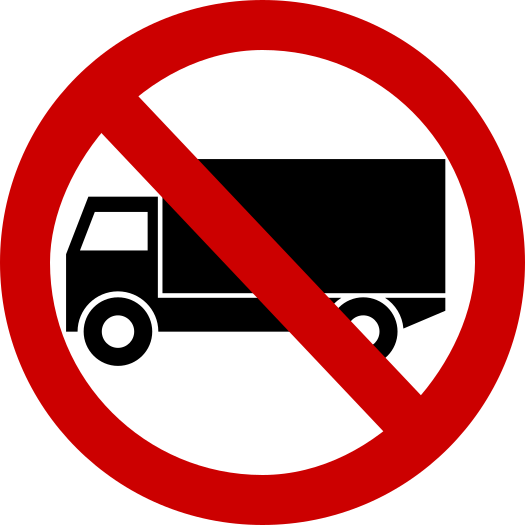
9. What does this traffic sign mean?
This traffic sign indicates that trucks are prohibited. Trucks covered by the sign may not enter or continue beyond it. Any applicable weight threshold or vehicle-category limitation is determined by the sign, supplementary information and local rules.
English • Traffic sign R-3(4) • No lorries. Lorries are prohibited on the signed road.
Español • R-3(4) • No circular camiones. Prohíbe el tránsito de camiones por la vía señalizada.
Sources
🔗 Commons.wikimedia.org
🔗 Servicios.infoleg.gob.ar • Anexo L vigente, sustituido por Decreto 196/2025, R.3
🔗 Servicios.infoleg.gob.ar • Anexo L 2025, lámina 01 • ANSV, manual de señales, PDF p. 2
SVG source: Commons.wikimedia.org • Original SVG
Gobierno de la República Argentina • Public domain • Original revision 2012-07-25. Wikimedia original unmodified.
Artwork individually reviewed against current Argentinian Argentina.gob.ar • Annex L, substituted by Decreto 196/2025:
🔗 Argentina.gob.ar • Annex III plate 01, R-3(4). Supporting ANSV manual, PDF page 2. Intentional educational illustration update from the previous PNG; original SVG unmodified.
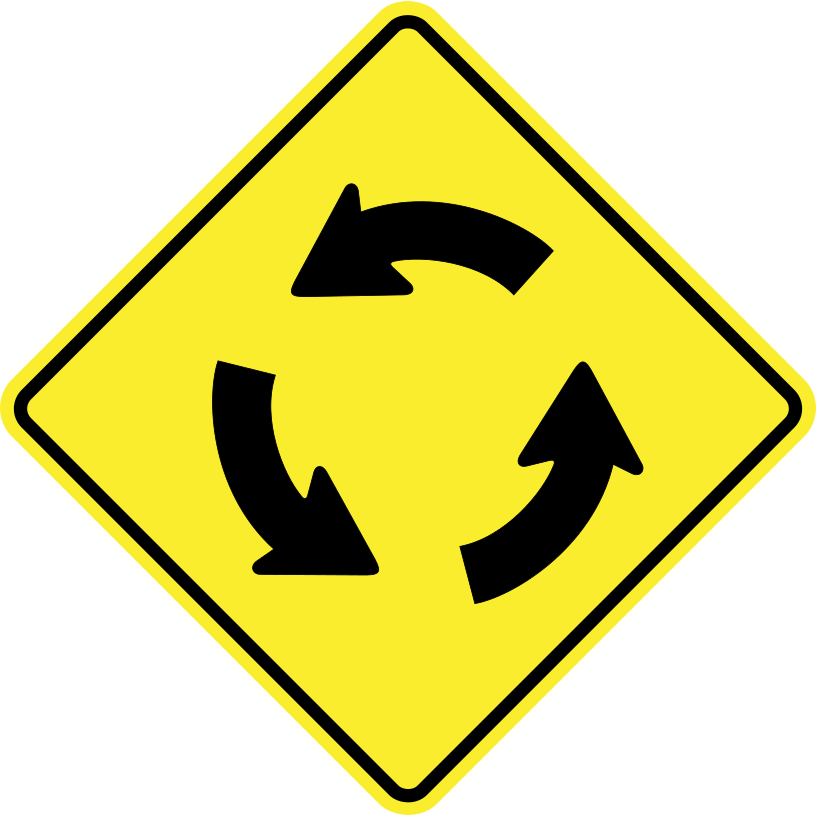
10. What does this traffic sign mean?
This traffic sign indicates a warning for a roundabout. A roundabout lies ahead. Reduce speed and follow the applicable priority signs, traffic signals and local roundabout rules when approaching and entering it.
English • Traffic sign P-21 • Roundabout. Keep the centre on your left and observe the applicable priorities.
Español • P-21 • Rotonda. Advierte la proximidad de una rotonda. Circula dejando la parte central a tu izquierda y respeta las prioridades aplicables.
Sources
🔗 Commons.wikimedia.org
🔗 Servicios.infoleg.gob.ar • Anexo L vigente, sustituido por Decreto 196/2025, P.21
🔗 Servicios.infoleg.gob.ar • Anexo L 2025, lámina 07 • ANSV, manual de señales, PDF p. 8
SVG source: Original: Vialidad Nacional - Ministerio de Transporte - Presidencia de la Nación Vectorization: Civitas13 • Public domain • Original revision 2022-08-06. Wikimedia original unmodified.
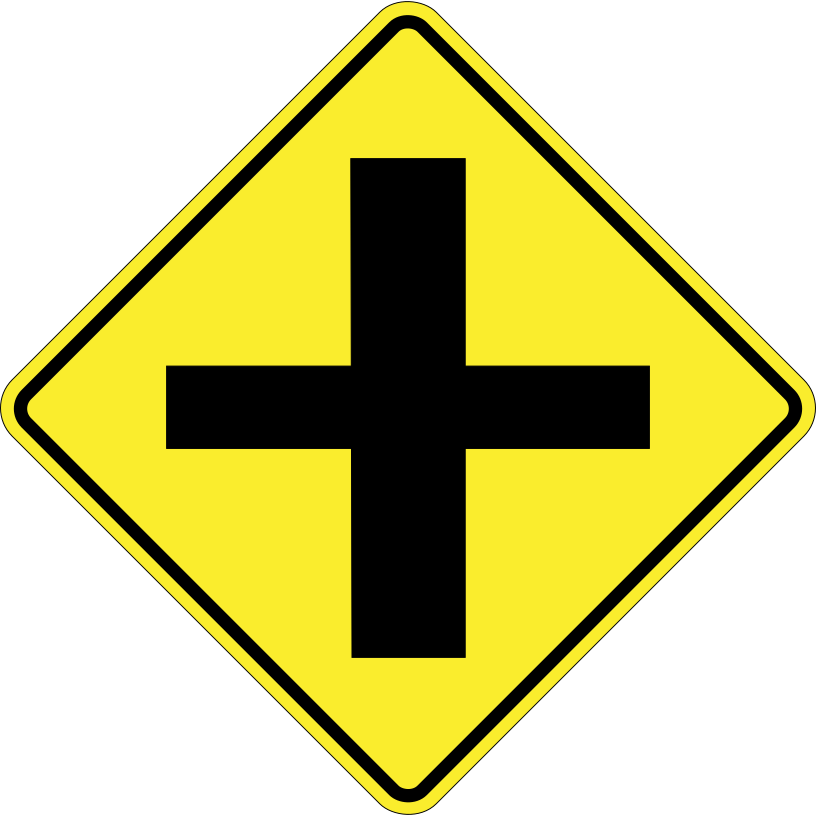
11. What does this traffic sign mean?
This traffic sign indicates a warning for an uncontrolled crossroad. An intersection without traffic signals or signs assigning priority lies ahead. Reduce speed, watch for traffic approaching from other directions and follow the applicable local priority rules.
English • Traffic sign P-24(a) • Crossroads. Warns of a four-arm junction. Reduce speed and watch crossing traffic.
Español • P-24(a) • Encrucijada: cruce. Advierte una intersección de cuatro ramales. Reduce la velocidad y observa el tránsito transversal.
Sources
🔗 Commons.wikimedia.org
🔗 Servicios.infoleg.gob.ar • Anexo L vigente, sustituido por Decreto 196/2025, P.24
🔗 Servicios.infoleg.gob.ar • Anexo L 2025, lámina 07 • ANSV, manual de señales, PDF p. 8
SVG source: Original: Vialidad Nacional - Ministerio de Transporte - Presidencia de la Nación Vectorization: Civitas13 • Public domain • Original revision 2020-01-14. Wikimedia original unmodified.

12. What does this traffic sign mean?
This traffic sign indicates a dead end street. The road has no through route for vehicles, although access to properties or other destinations along the road may still be possible.
English • Traffic sign I-15(a) • Dead-end road or street. The road ends without a through exit.
Español • I-15(a) • Camino o calle sin salida. Indica que la vía por la que se circula termina sin una salida para continuar el recorrido.
Sources
🔗 Commons.wikimedia.org
🔗 Servicios.infoleg.gob.ar • Anexo L vigente, sustituido por Decreto 196/2025, I.15
🔗 Servicios.infoleg.gob.ar • Anexo L 2025, lámina 10 • ANSV, manual de señales, PDF p. 12
SVG source: Commons.wikimedia.org • Original SVG
Municipio de Morón • Public domain • Original revision 2014-01-16. Wikimedia original unmodified.
Artwork individually reviewed against current Argentinian Argentina.gob.ar • Annex L, substituted by Decreto 196/2025:
🔗 Argentina.gob.ar • Annex III plate 10, I-15(a). Supporting ANSV manual, PDF page 12. Intentional educational illustration update from the previous PNG; original SVG unmodified.
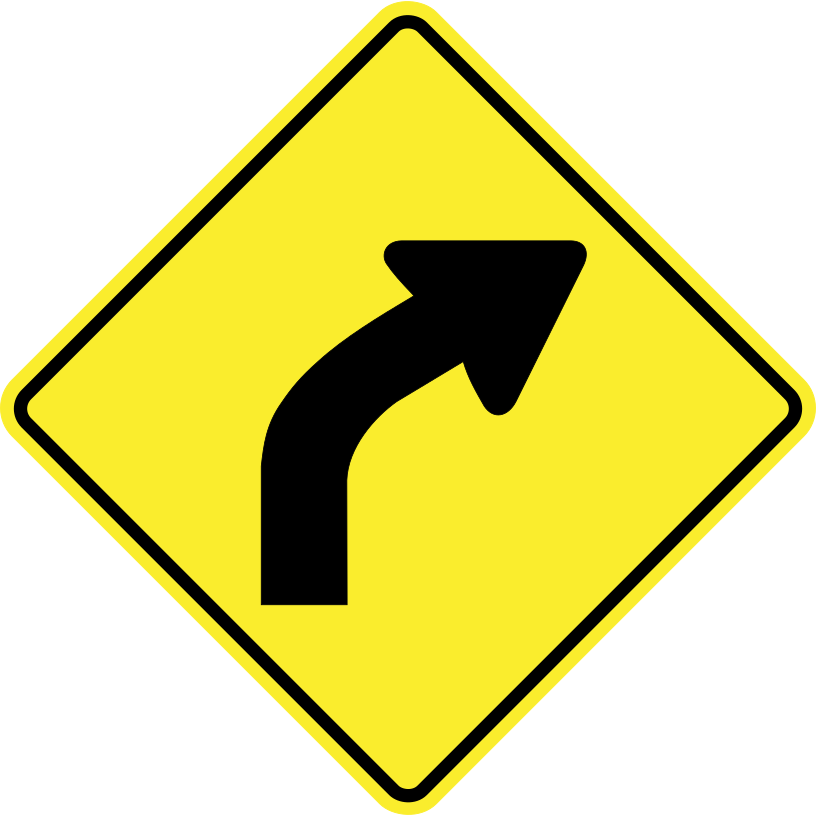
13. What does this traffic sign mean?
This traffic sign indicates a warning for a curve to the right. A right-hand bend lies ahead. Reduce speed before entering the curve, maintain your lane position and use smooth steering.
English • Traffic sign P-7(a) • Right-hand bend. Adjust speed before entering.
Español • P-7(a) • Curva a la derecha. Advierte una curva hacia la derecha. Ajusta la velocidad antes de entrar en ella.
Sources
🔗 Commons.wikimedia.org
🔗 Servicios.infoleg.gob.ar • Anexo L vigente, sustituido por Decreto 196/2025, P.7
🔗 Servicios.infoleg.gob.ar • Anexo L 2025, lámina 05 • ANSV, manual de señales, PDF p. 9
SVG source: Original: Vialidad Nacional - Ministerio de Transporte - Presidencia de la Nación Vectorization: Civitas13 • Public domain • Original revision 2020-01-31. Wikimedia original unmodified.

14. What does this traffic sign mean?
This traffic sign indicates that parking and stopping are prohibited. Vehicles may not stop or park voluntarily where the restriction applies, except where an applicable rule provides an exemption or stopping is required by traffic conditions.
English • Traffic sign R-9 • No parking or stopping. Parking and voluntary stopping are prohibited on the indicated side and section.
Español • R-9 • No estacionar ni detenerse. Prohíbe estacionar y detener voluntariamente el vehículo en el costado y tramo señalados.
Sources
🔗 Commons.wikimedia.org
🔗 Servicios.infoleg.gob.ar • Anexo L vigente, sustituido por Decreto 196/2025, R.9
🔗 Servicios.infoleg.gob.ar • Anexo L 2025, lámina 02 • ANSV, manual de señales, PDF p. 2
SVG source: Commons.wikimedia.org • Original SVG
Gobierno de la República Argentina • Public domain • Original revision 2014-01-16. Wikimedia original unmodified.
Artwork individually reviewed against current Argentinian Argentina.gob.ar • Annex L, substituted by Decreto 196/2025:
🔗 Argentina.gob.ar • Annex III plate 02, R-9. Supporting ANSV manual, PDF page 2. Intentional educational illustration update from the previous PNG; original SVG unmodified.
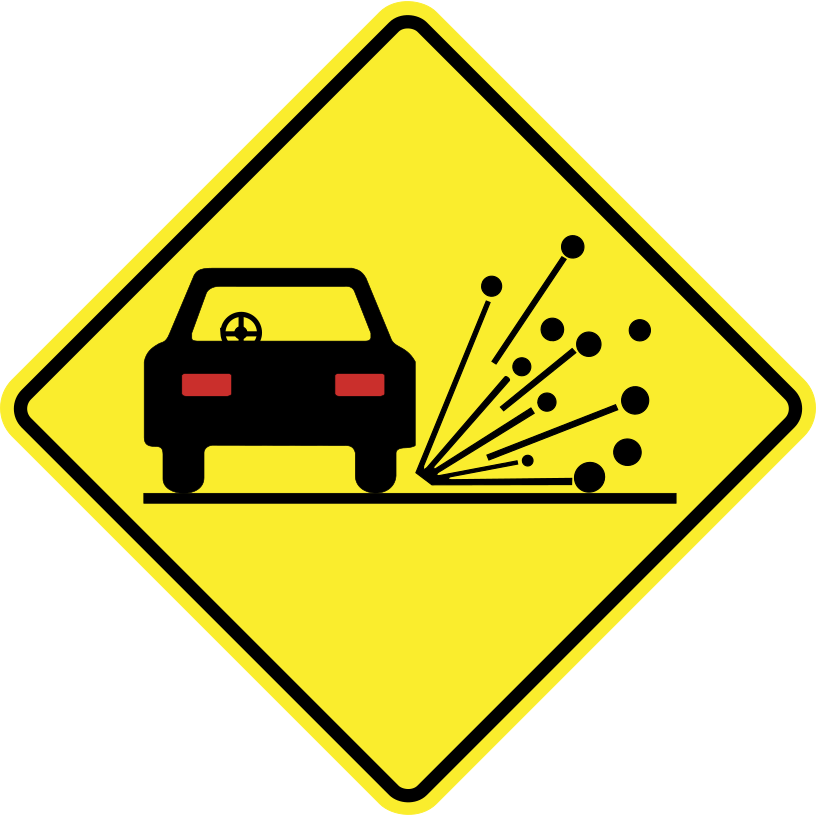
15. What does this traffic sign mean?
This traffic sign indicates a warning for loose chippings. Loose stones or gravel may reduce tyre grip and can be thrown up by passing vehicles. Reduce speed, increase your following distance and avoid sudden braking, acceleration or steering movements.
English • Traffic sign P-13 • Flying stones. Stones on the carriageway may be thrown up by vehicles. Reduce speed and increase separation.
Español • P-13 • Proyección de piedras. Advierte piedras sobre la calzada que pueden ser proyectadas por los vehículos. Reduce la velocidad y aumenta la separación.
Sources
🔗 Commons.wikimedia.org
🔗 Servicios.infoleg.gob.ar • Anexo L vigente, sustituido por Decreto 196/2025, P.13
🔗 Servicios.infoleg.gob.ar • Anexo L 2025, lámina 06 • ANSV, manual de señales, PDF p. 9
SVG source: Original: Vialidad Nacional - Ministerio de Transporte - Presidencia de la Nación Vectorization: Civitas13 • Public domain • Original revision 2020-01-14. Wikimedia original unmodified.

16. What does this traffic sign mean?
This traffic sign indicates that horsecarts are prohibited. Horse-drawn vehicles may not enter or continue beyond the sign. Other road users may still be permitted unless another restriction applies.
English • Traffic sign R-3(7) • No animal-drawn vehicles. Carts and other animal-drawn vehicles are prohibited on the signed road.
Español • R-3(7) • No circular vehículos de tracción animal. Prohíbe el tránsito de carros y otros vehículos de tracción animal por la vía señalizada.
Sources
🔗 Commons.wikimedia.org
🔗 Servicios.infoleg.gob.ar • Anexo L vigente, sustituido por Decreto 196/2025, R.3
🔗 Servicios.infoleg.gob.ar • Anexo L 2025, lámina 01 • ANSV, manual de señales, PDF p. 2
SVG source: Gobierno de la República Argentina • Public domain • Original revision 2014-01-16. Wikimedia original unmodified.

17. What does this traffic sign mean?
This traffic sign indicates that drivers may not enter the road from either direction.
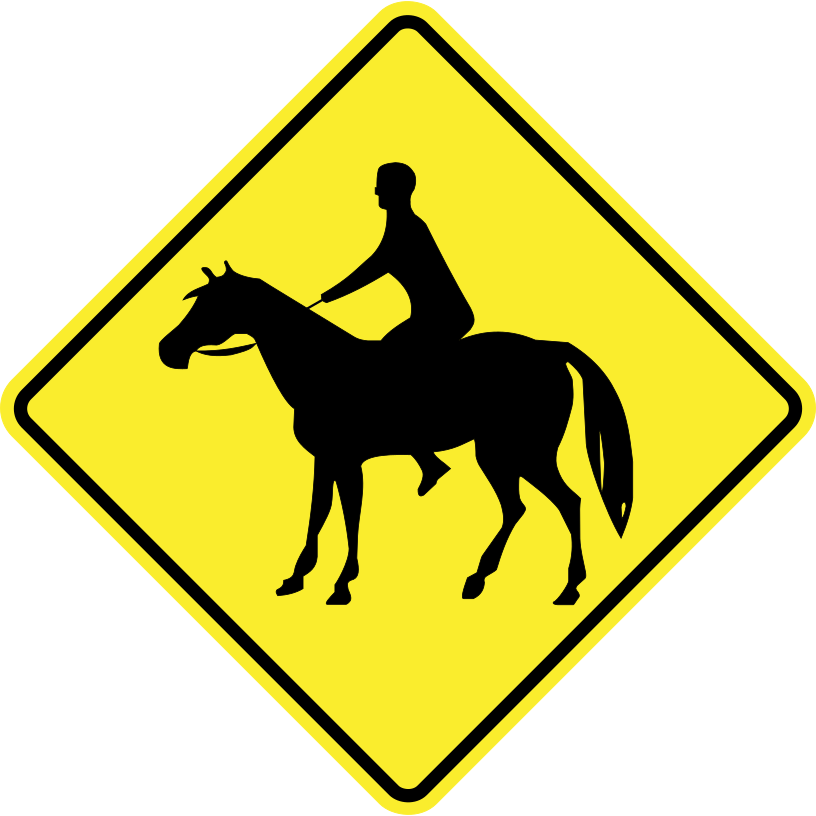
18. What does this traffic sign mean?
This traffic sign indicates a warning for equestrians. Horse riders may be on or near the road ahead. Reduce speed, allow plenty of space and avoid unnecessary use of the horn or sudden movements that could startle a horse.
English • Traffic sign P-26(b) • Horse riders. People on horseback may be on the road.
Español • P-26(b) • Jinetes. Advierte la posible presencia de personas montadas a caballo sobre la vía.
Sources
🔗 Commons.wikimedia.org
🔗 Servicios.infoleg.gob.ar • Anexo L vigente, sustituido por Decreto 196/2025, P.26
🔗 Servicios.infoleg.gob.ar • Anexo L 2025, lámina 08 • ANSV, manual de señales, PDF p. 7
SVG source: Original: Vialidad Nacional - Ministerio de Transporte - Presidencia de la Nación Vectorization: Civitas13 • Public domain • Original revision 2020-02-27. Wikimedia original unmodified.

19. What does this traffic sign mean?
This traffic sign indicates that vehicles longer than indicated are prohibited. A vehicle or vehicle combination whose overall length, including its load, exceeds the displayed limit may not continue beyond the sign.
English • Traffic sign R-14 • Length limit: 20 m. Vehicles or combinations longer than 20 m overall must not pass.
Español • R-14 • Limitación de largo: 20 m. Prohíbe el paso de vehículos o conjuntos cuya longitud total supere 20 metros.
Sources
🔗 Commons.wikimedia.org
🔗 Servicios.infoleg.gob.ar • Anexo L vigente, sustituido por Decreto 196/2025, R.14
🔗 Servicios.infoleg.gob.ar • Anexo L 2025, lámina 02 • ANSV, manual de señales, PDF p. 3
SVG source: Commons.wikimedia.org • Original SVG
Gobierno de la República Argentina • Public domain • Original revision 2014-01-16. Wikimedia original unmodified.
Artwork individually reviewed against current Argentinian Argentina.gob.ar • Annex L, substituted by Decreto 196/2025:
🔗 Argentina.gob.ar • Annex III plate 02, R-14. Supporting ANSV manual, PDF page 3. Intentional educational illustration update from the previous PNG; original SVG unmodified.

20. What does this traffic sign mean?
This traffic sign indicates that traffic must pass an obstacle on the left. Keep to the left of the obstacle and follow any accompanying signs or road markings.
English • Traffic sign R-22(b) • Pass on the left. Pass to the left of the obstacle or traffic divider.
Español • R-22(b) • Paso obligado por la izquierda. Indica el paso por el lado izquierdo del obstáculo o canalizador de tránsito.
Sources
🔗 Commons.wikimedia.org
🔗 Servicios.infoleg.gob.ar • Anexo L vigente, sustituido por Decreto 196/2025, R.21/22
🔗 Servicios.infoleg.gob.ar • Anexo L 2025, lámina 03 • ANSV, manual de señales, PDF p. 4
SVG source: Commons.wikimedia.org • Original SVG
Gobierno de la República Argentina • Public domain • Original revision 2023-04-30. Wikimedia original unmodified.
Artwork individually reviewed against current Argentinian Argentina.gob.ar • Annex L, substituted by Decreto 196/2025:
🔗 Argentina.gob.ar • Annex III plate 03, R-22(b). Supporting ANSV manual, PDF page 4. Intentional educational illustration update from the previous PNG; original SVG unmodified.

21. What does this traffic sign mean?
This traffic sign indicates that equestrians are prohibited. Equestrians may not enter or continue beyond the sign. Other road users may still be permitted unless another restriction applies.
English • Traffic sign R-3(8) • No herds or groups of animals. The animal symbol prohibits driving herds or groups of animals along the signed road.
Español • R-3(8) • No circular animales en arreos o manadas. La figura de animal identifica la prohibición de circular con arreos o manadas de animales por la vía señalizada.
Sources
🔗 Commons.wikimedia.org
🔗 Servicios.infoleg.gob.ar • Anexo L vigente, sustituido por Decreto 196/2025, R.3
🔗 Servicios.infoleg.gob.ar • Anexo L 2025, lámina 01 • ANSV, manual de señales, PDF p. 2
SVG source: Commons.wikimedia.org • Original SVG
Gobierno de la República Argentina • Public domain • Original revision 2014-01-16. Wikimedia original unmodified.
Artwork individually reviewed against current Argentinian Argentina.gob.ar • Annex L, substituted by Decreto 196/2025:
🔗 Argentina.gob.ar • Annex III plate 01, R-3(8). Supporting ANSV manual, PDF page 2. Intentional educational illustration update from the previous PNG; original SVG unmodified.

22. What does this traffic sign mean?
This traffic sign indicates the route to use for a left turn. Follow the indicated route instead of turning left directly at this point.
English • Traffic sign I-18 • Route diagram. Shows a special route along the indicated streets to continue towards the left.
Español • I-18 • Esquema de recorrido. Orienta sobre el itinerario que debe seguirse para continuar hacia la izquierda mediante un recorrido especial por las calles indicadas.
Sources
🔗 Commons.wikimedia.org
🔗 Servicios.infoleg.gob.ar • Anexo L vigente, sustituido por Decreto 196/2025, 1.18
🔗 Servicios.infoleg.gob.ar • Anexo L 2025, lámina 11 • ANSV, manual de señales, PDF p. 12
SVG source: Commons.wikimedia.org • Original SVG
Municipio de Morón • Public domain • Original revision 2014-01-17. Wikimedia original unmodified.
Artwork individually reviewed against current Argentinian Argentina.gob.ar • Annex L, substituted by Decreto 196/2025:
🔗 Argentina.gob.ar • Annex III plate 11, I-18. Supporting ANSV manual, PDF page 12. Intentional educational illustration update from the previous PNG; original SVG unmodified.
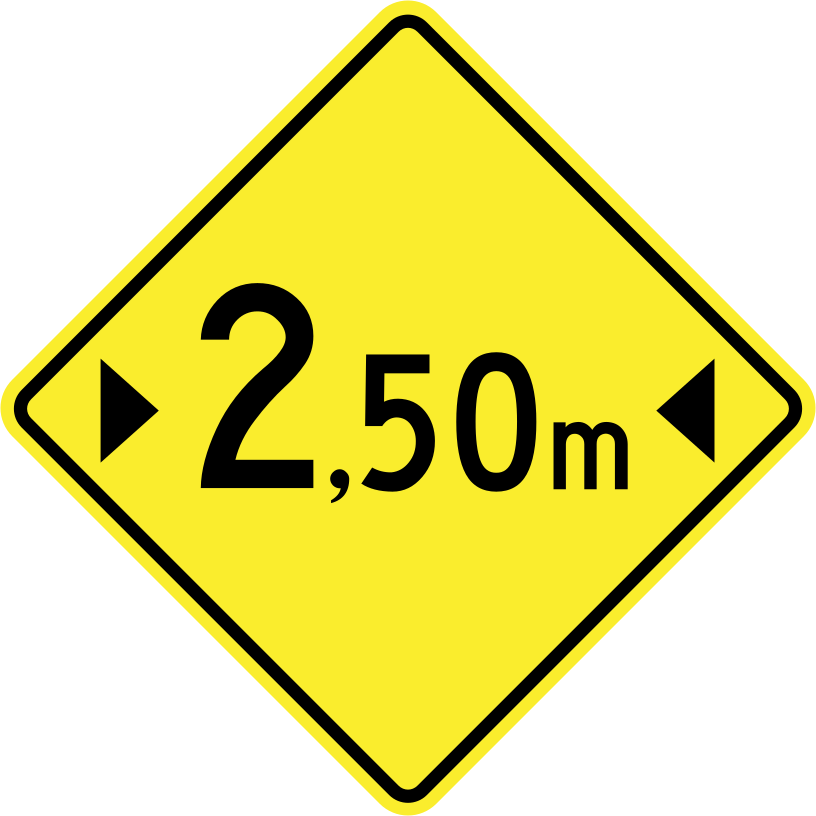
23. What does this traffic sign mean?
This traffic sign indicates a warning for a width restriction. The available passage ahead is limited in width. Drivers of wide vehicles should check their vehicle width and use another route if the vehicle cannot pass safely.
English • Traffic sign P-19 • Indicated vehicle width limit: 2.50 m. Warns of a passage with an indicated vehicle width of 2.50 m. Check overall width before proceeding.
Español • P-19 • Ancho limitado indicado: 2,50 m. Advierte un paso con un ancho indicado para el vehículo de 2,50 metros. Comprueba el ancho total antes de continuar.
Sources
🔗 Commons.wikimedia.org (มองโกเลีย๔๔ • CC BY-SA 4.0)
🔗 Servicios.infoleg.gob.ar • Anexo L vigente, sustituido por Decreto 196/2025, P.18/19
🔗 Servicios.infoleg.gob.ar • Anexo L 2025, lámina 07 • ANSV, manual de señales, PDF p. 8
SVG source: มองโกเลีย๔๔ • CC BY-SA 4.0 • Original revision 2023-09-13. Wikimedia original unmodified.
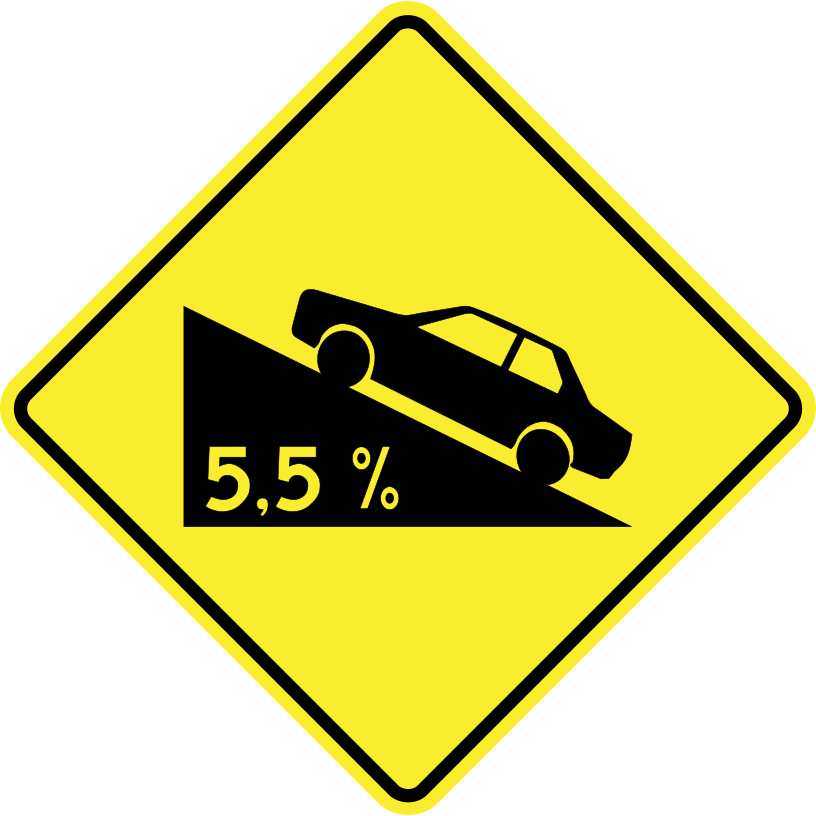
24. What does this traffic sign mean?
This traffic sign indicates a warning for a steep ascent. A steep uphill gradient lies ahead and may cause heavy or low-powered vehicles to lose speed. Select a suitable gear, maintain a safe following distance and be prepared for slower traffic.
English • Traffic sign P-9(a) • Downhill gradient: 5.5%. Control speed and use a suitable gear.
Español • P-9(a) • Pendiente descendente: 5,5 %. Advierte una bajada con pendiente del 5,5 %. Controla la velocidad y utiliza una marcha adecuada.
Sources
🔗 Commons.wikimedia.org
🔗 Servicios.infoleg.gob.ar • Anexo L vigente, sustituido por Decreto 196/2025, P.9
🔗 Servicios.infoleg.gob.ar • Anexo L 2025, lámina 06 • ANSV, manual de señales, PDF p. 9
SVG source: Original: Vialidad Nacional - Ministerio de Transporte - Presidencia de la Nación Vectorization: Civitas13 • Public domain • Original revision 2020-01-16. Wikimedia original unmodified.
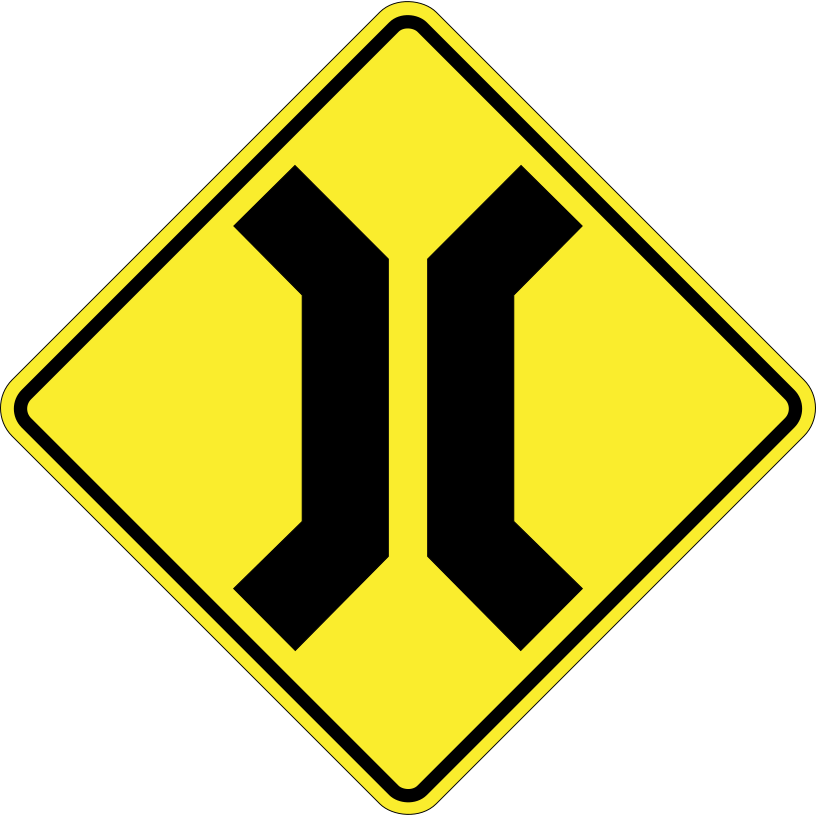
25. What does this traffic sign mean?
This traffic sign indicates a warning for a narrowing ahead. The available road width decreases ahead. Reduce speed when necessary and be prepared for less lateral space between vehicles, obstacles or the road edge.
English • Traffic sign P-16 • Narrow bridge. The bridge is narrower than the approach carriageway. Reduce speed before entering.
Español • P-16 • Puente angosto. Advierte un puente más estrecho que la calzada de acceso. Reduce la velocidad antes de entrar.
Sources
🔗 Commons.wikimedia.org
🔗 Servicios.infoleg.gob.ar • Anexo L vigente, sustituido por Decreto 196/2025, P.16
🔗 Servicios.infoleg.gob.ar • Anexo L 2025, lámina 06 • ANSV, manual de señales, PDF p. 9
SVG source: Original: Vialidad Nacional - Ministerio de Transporte - Presidencia de la Nación Vectorization: Civitas13 • Public domain • Original revision 2020-01-14. Wikimedia original unmodified.
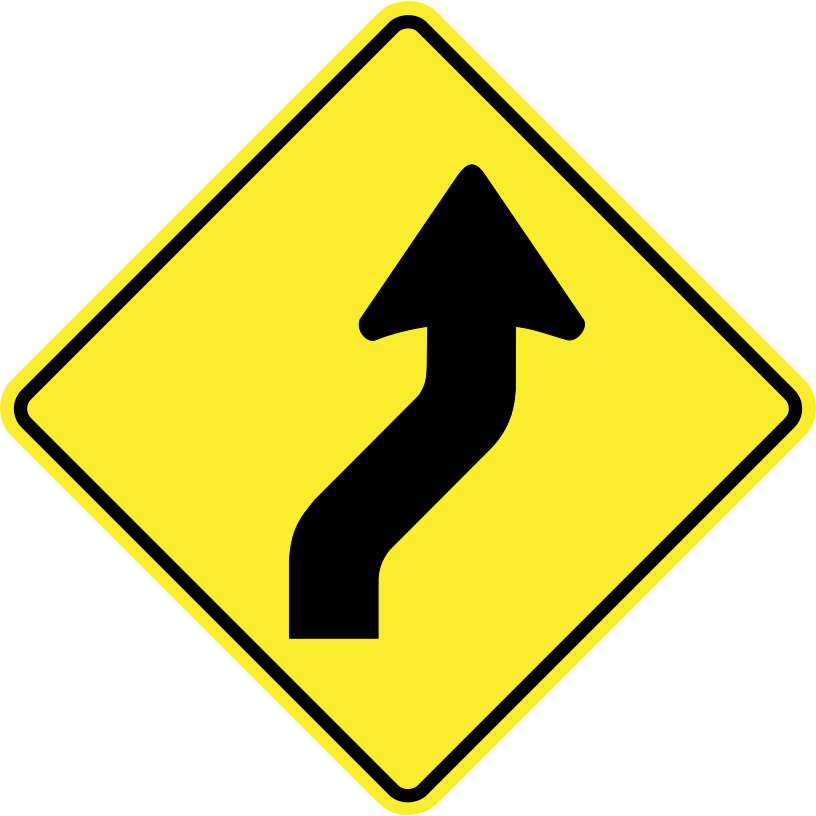
26. What does this traffic sign mean?
This traffic sign indicates a warning for successive curves, with the first curve to the right. Reduce speed before entering the winding section, maintain your lane position and be prepared for further changes in direction.
English • Traffic sign P-7(b) • Double bend. Warns of successive bends in opposite directions, first to the right.
Español • P-7(b) • Curva y contracurva. Advierte dos curvas sucesivas de sentido contrario; la primera es hacia la derecha.
Sources
🔗 Commons.wikimedia.org
🔗 Servicios.infoleg.gob.ar • Anexo L vigente, sustituido por Decreto 196/2025, P.7
🔗 Servicios.infoleg.gob.ar • Anexo L 2025, lámina 05 • ANSV, manual de señales, PDF p. 9
SVG source: Original: Vialidad Nacional - Ministerio de Transporte - Presidencia de la Nación Vectorization: Civitas13 • Public domain • Original revision 2020-01-31. Wikimedia original unmodified.
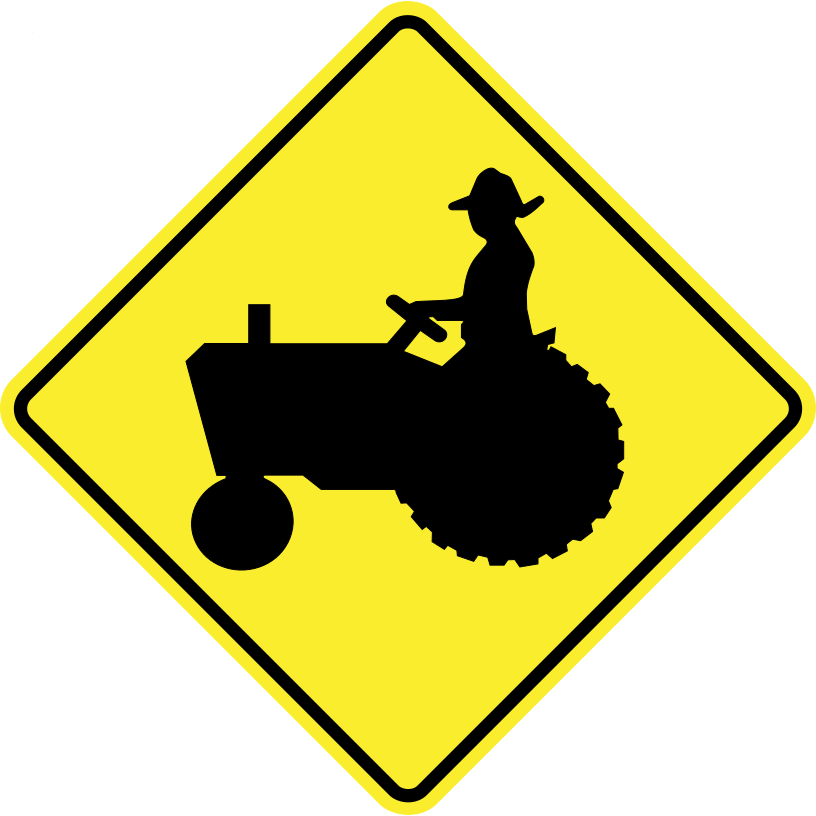
27. What does this traffic sign mean?
This traffic sign indicates a warning for tractors or other agricultural vehicles. Slow-moving agricultural vehicles may enter, cross or travel along the road ahead. Reduce speed and overtake only where it is permitted and clearly safe.
English • Traffic sign P-29(b) • Agricultural machinery. Machinery regularly operates in the area. Watch its movements and lower speed.
Español • P-29(b) • Maquinaria agrícola. Advierte la circulación habitual de maquinaria agrícola en la zona. Presta atención a sus movimientos y a su menor velocidad.
Sources
🔗 Commons.wikimedia.org
🔗 Servicios.infoleg.gob.ar • Anexo L vigente, sustituido por Decreto 196/2025, P.29
🔗 Servicios.infoleg.gob.ar • Anexo L 2025, lámina 08 • ANSV, manual de señales, PDF p. 7
SVG source: Original: Vialidad Nacional - Ministerio de Transporte - Presidencia de la Nación Vectorization: Civitas13 • Public domain • Original revision 2020-02-02. Wikimedia original unmodified.

28. What does this traffic sign mean?
This traffic sign indicates that cyclists are prohibited. Cyclists may not enter or continue beyond the sign. Other road users may still be permitted unless another restriction applies.
English • Traffic sign R-3(3) • No bicycles. Bicycle traffic is prohibited on the signed road.
Español • R-3(3) • No circular bicicletas. Prohíbe el tránsito de bicicletas por la vía señalizada.
Sources
🔗 Commons.wikimedia.org
🔗 Servicios.infoleg.gob.ar • Anexo L vigente, sustituido por Decreto 196/2025, R.3
🔗 Servicios.infoleg.gob.ar • Anexo L 2025, lámina 01 • ANSV, manual de señales, PDF p. 2
SVG source: Commons.wikimedia.org • Original SVG
Gobierno de la República Argentina • Public domain • Original revision 2014-01-16. Wikimedia original unmodified.
Artwork individually reviewed against current Argentinian Argentina.gob.ar • Annex L, substituted by Decreto 196/2025:
🔗 Argentina.gob.ar • Annex III plate 01, R-3(3). Supporting ANSV manual, PDF page 2. Intentional educational illustration update from the previous PNG; original SVG unmodified.

29. What does this traffic sign mean?
This traffic sign indicates that parking is permitted. Vehicles may park in the area covered by the sign, subject to any conditions shown on supplementary signs or road markings.
English • Traffic sign I-20 • Parking permitted. Park on the road in the indicated manner. Check hours, position and other supplementary conditions.
Español • I-20 • Estacionamiento permitido. Permite estacionar sobre la vía en la forma indicada. Comprueba los horarios, la posición de estacionamiento y otras condiciones complementarias.
Sources
🔗 Commons.wikimedia.org
🔗 Servicios.infoleg.gob.ar • Anexo L vigente, sustituido por Decreto 196/2025, 1.20
🔗 Servicios.infoleg.gob.ar • Anexo L 2025, lámina 11 • ANSV, manual de señales, PDF p. 13
SVG source: Commons.wikimedia.org • Original SVG
Argentina_-_NO_symbol.svg: Fry1989 Argentina road sign R27.svg: unknown (vector graphics image by Fma12) derivative work: Fry1989 • Public domain • Original revision 2014-01-16. Wikimedia original unmodified.
Artwork individually reviewed against current Argentinian Argentina.gob.ar • Annex L, substituted by Decreto 196/2025:
🔗 Argentina.gob.ar • Annex III plate 11, I-20. Supporting ANSV manual, PDF page 13. Intentional educational illustration update from the previous PNG; original SVG unmodified.
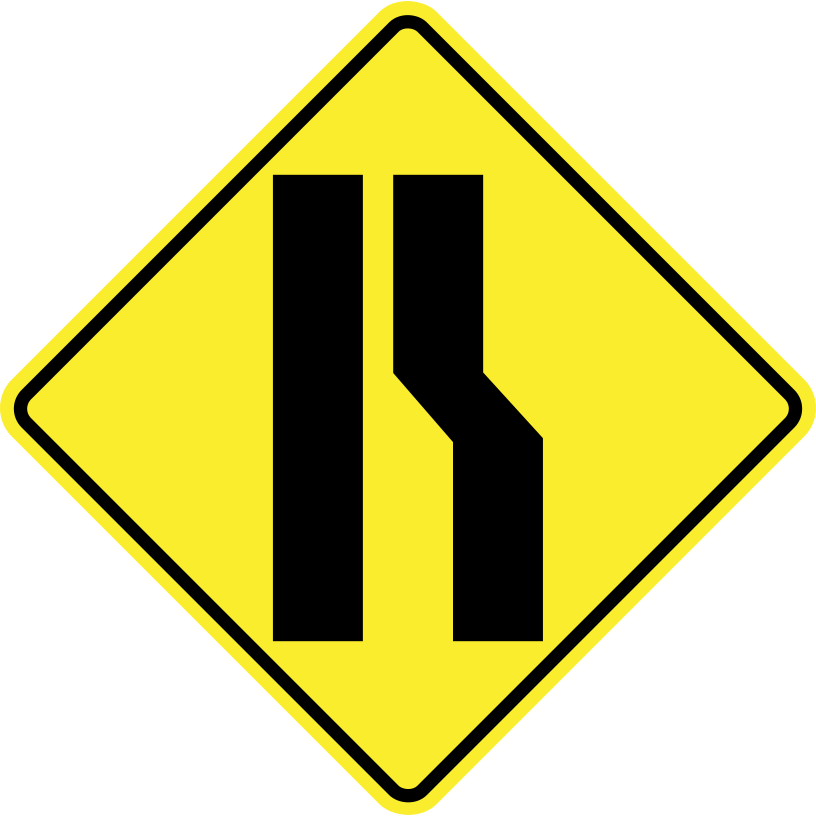
30. What does this traffic sign mean?
This traffic sign indicates a warning for a road narrowing on the right. The available road width decreases from the right side ahead. Reduce speed, follow the lane markings and maintain sufficient clearance from other traffic and the road edge.
English • Traffic sign P-10(b) • Road narrows on the right. Available width decreases on the right.
Español • P-10(b) • Estrechamiento por la derecha. Advierte que disminuye el ancho disponible por el lado derecho de la calzada.
Sources
🔗 Commons.wikimedia.org
🔗 Servicios.infoleg.gob.ar • Anexo L vigente, sustituido por Decreto 196/2025, P.10
🔗 Servicios.infoleg.gob.ar • Anexo L 2025, lámina 06 • ANSV, manual de señales, PDF p. 9
SVG source: Original: Vialidad Nacional - Ministerio de Transporte - Presidencia de la Nación Vectorization: Civitas13 • Public domain • Original revision 2020-01-14. Wikimedia original unmodified.

31. What does this traffic sign mean?
This traffic sign gives general information about road directions. The arrows, destinations and route information show which direction to follow.
English • Traffic sign I-6 • Directions on primary and secondary roads. Shows destinations and routes to them. Follow the appropriate arrow.
Español • I-6 • Orientación en caminos primarios y secundarios. Indica destinos y las direcciones para llegar a ellos. Sigue la flecha correspondiente a tu destino.
Sources
🔗 Commons.wikimedia.org
🔗 Servicios.infoleg.gob.ar • Anexo L vigente, sustituido por Decreto 196/2025, I.6/7
🔗 Servicios.infoleg.gob.ar • Anexo L 2025, lámina 10 • ANSV, manual de señales, PDF p. 11
Image via Commons.wikimedia.org
Municipio de Morón • Public domain • Source revision 2014-01-17. Wikimedia original unmodified.
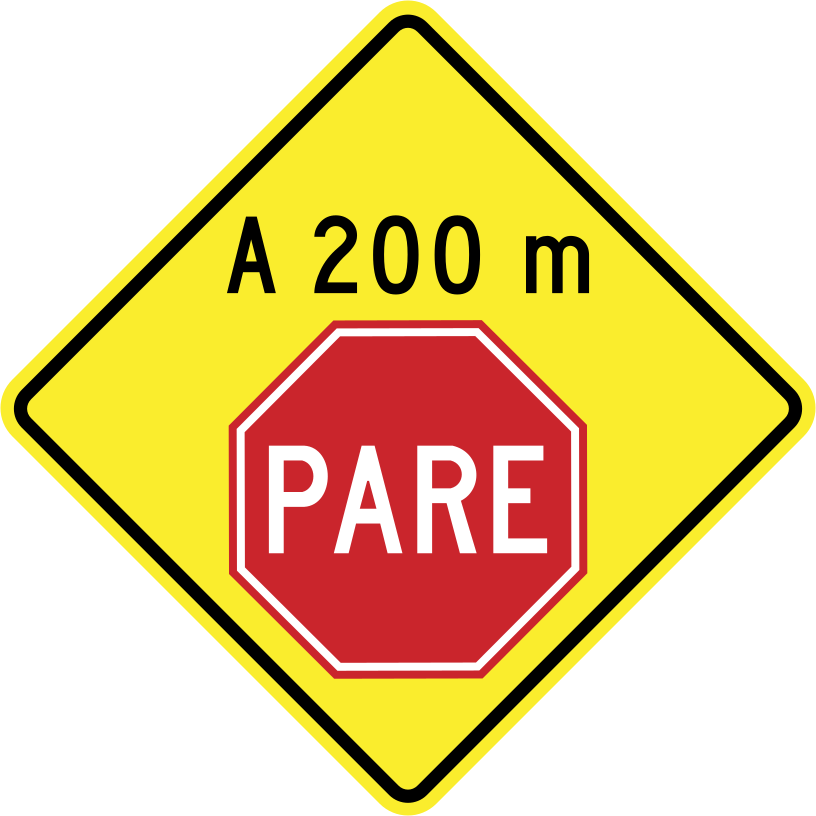
32. What does this traffic sign mean?
This traffic sign indicates stop and give way ahead. A stop sign applies at the location ahead. Reduce speed in good time and be prepared to come to a complete stop.
English • Traffic sign P-33(a) • Stop in 200 m. Prepare to stop the vehicle completely at that sign.
Español • P-33(a) • Pare a 200 m. Advierte que a 200 metros hay una señal Pare. Prepárate para detener completamente el vehículo ante esa señal.
Sources
🔗 Commons.wikimedia.org (มองโกเลีย๔๔ • CC BY-SA 4.0)
🔗 Servicios.infoleg.gob.ar • Anexo L vigente, sustituido por Decreto 196/2025, P.33
🔗 Servicios.infoleg.gob.ar • Anexo L 2025, lámina 08 • ANSV, manual de señales, PDF p. 10
SVG source: มองโกเลีย๔๔ • CC BY-SA 4.0 • Original revision 2023-09-13. Wikimedia original unmodified.

33. What does this traffic sign mean?
This traffic sign indicates the start of a speed limit. The displayed value is the maximum permitted speed from this point. The limit remains in force until it ends or is replaced according to the applicable traffic signs and local rules.
English • Traffic sign R-15 • Maximum speed: 90 km/h. Do not exceed 90 km/h. Reduce speed further when safety conditions require.
Español • R-15 • Velocidad máxima: 90 km/h. No superes los 90 kilómetros por hora. Reduce más la velocidad cuando las condiciones de seguridad lo exijan.
Sources
🔗 Commons.wikimedia.org
🔗 Servicios.infoleg.gob.ar • Anexo L vigente, sustituido por Decreto 196/2025, R.15
🔗 Servicios.infoleg.gob.ar • Anexo L 2025, lámina 02 • ANSV, manual de señales, PDF p. 3
SVG source: Commons.wikimedia.org • Original SVG
Gobierno de la República Argentina • Public domain • Original revision 2014-01-16. Wikimedia original unmodified.
Artwork individually reviewed against current Argentinian Argentina.gob.ar • Annex L, substituted by Decreto 196/2025:
🔗 Argentina.gob.ar • Annex III plate 02, R-15. Supporting ANSV manual, PDF page 3. Intentional educational illustration update from the previous PNG; original SVG unmodified.

34. What does this traffic sign mean?
This traffic sign indicates a mandatory path for cyclists. Cyclists must use the designated path where the sign applies. Other road users may use the path only where the applicable signs or local rules permit them to do so.
English • Traffic sign R-18(c) • Bicycles only. Marks a road or lane exclusively for bicycles.
Español • R-18(c) • Circulación exclusiva para bicicletas. Indica una vía o carril de uso exclusivo para bicicletas.
Sources
🔗 Commons.wikimedia.org
🔗 Servicios.infoleg.gob.ar • Anexo L vigente, sustituido por Decreto 196/2025, R.18
🔗 Servicios.infoleg.gob.ar • Anexo L 2025, lámina 03 • ANSV, manual de señales, PDF p. 3
SVG source: Commons.wikimedia.org • Original SVG
Gobierno de la República Argentina • Public domain • Original revision 2014-01-16. Wikimedia original unmodified.
Artwork individually reviewed against current Argentinian Argentina.gob.ar • Annex L, substituted by Decreto 196/2025:
🔗 Argentina.gob.ar • Annex III plate 03, R-18(c). Supporting ANSV manual, PDF page 3. Intentional educational illustration update from the previous PNG; original SVG unmodified.

35. What does this traffic sign mean?
This traffic sign indicates that turning right is prohibited. A right turn may not be made where the sign applies. Other movements may still be permitted unless another restriction applies.
English • Traffic sign R-4(b) • No right turn. Turning right at the indicated location is prohibited.
Español • R-4(b) • No girar a la derecha. Prohíbe girar a la derecha en el lugar señalado.
Sources
🔗 Commons.wikimedia.org
🔗 Servicios.infoleg.gob.ar • Anexo L vigente, sustituido por Decreto 196/2025, R.4
🔗 Servicios.infoleg.gob.ar • Anexo L 2025, lámina 02 • ANSV, manual de señales, PDF p. 2
SVG source: Commons.wikimedia.org • Original SVG
Gobierno de la República Argentina • Public domain • Original revision 2014-01-16. Wikimedia original unmodified.
Artwork individually reviewed against current Argentinian Argentina.gob.ar • Annex L, substituted by Decreto 196/2025:
🔗 Argentina.gob.ar • Annex III plate 02, R-4(b). Supporting ANSV manual, PDF page 2. Intentional educational illustration update from the previous PNG; original SVG unmodified.

36. What does this traffic sign mean?
This traffic sign indicates that trailers are prohibited. Vehicles towing trailers covered by the sign may not enter or continue beyond it. Vehicles without a trailer may still be permitted unless another restriction applies.
English • Traffic sign R-3(5) • No trailers. Cars or lorries towing trailers are prohibited on the signed road.
Español • R-3(5) • No circular acoplados. Prohíbe el tránsito de vehículos con acoplados de automóvil o camión por la vía señalizada.
Sources
🔗 Commons.wikimedia.org
🔗 Servicios.infoleg.gob.ar • Anexo L vigente, sustituido por Decreto 196/2025, R.3
🔗 Servicios.infoleg.gob.ar • Anexo L 2025, lámina 01 • ANSV, manual de señales, PDF p. 2
SVG source: Commons.wikimedia.org • Original SVG
Gobierno de la República Argentina • Public domain • Original revision 2014-01-16. Wikimedia original unmodified.
Artwork individually reviewed against current Argentinian Argentina.gob.ar • Annex L, substituted by Decreto 196/2025:
🔗 Argentina.gob.ar • Annex III plate 01, R-3(5). Supporting ANSV manual, PDF page 2. Intentional educational illustration update from the previous PNG; original SVG unmodified.

37. What does this traffic sign mean?
This traffic sign indicates that vehicles higher than indicated are prohibited. A vehicle or vehicle combination whose overall height, including its load, exceeds the displayed limit may not continue beyond the sign.
English • Traffic sign R-12 • Height limit: 4.10 m. Vehicles exceeding 4.10 m overall height including the load must not pass.
Español • R-12 • Limitación de altura: 4,10 m. Prohíbe el paso de vehículos cuya altura total, incluida la carga, supere 4,10 metros.
Sources
🔗 Commons.wikimedia.org
🔗 Servicios.infoleg.gob.ar • Anexo L vigente, sustituido por Decreto 196/2025, R.12/13
🔗 Servicios.infoleg.gob.ar • Anexo L 2025, lámina 02 • ANSV, manual de señales, PDF p. 3
SVG source: Commons.wikimedia.org • Original SVG
Gobierno de la República Argentina • Public domain • Original revision 2014-01-16. Wikimedia original unmodified.
Artwork individually reviewed against current Argentinian Argentina.gob.ar • Annex L, substituted by Decreto 196/2025:
🔗 Argentina.gob.ar • Annex III plate 02, R-12. Supporting ANSV manual, PDF page 3. Intentional educational illustration update from the previous PNG; original SVG unmodified.
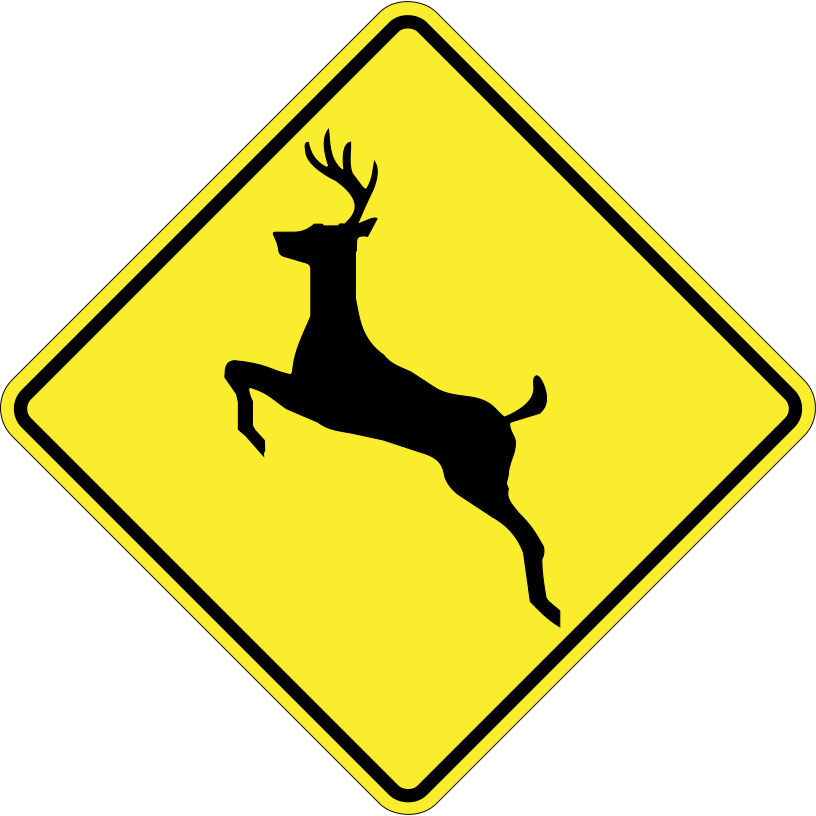
38. What does this traffic sign mean?
This traffic sign indicates a warning for crossing deer. Deer or other wild animals may enter the road unexpectedly, especially around dawn or dusk. Reduce speed, watch the roadside carefully and be prepared for more than one animal to cross.
English • Traffic sign P-27(b) • Loose animals — deer. Deer or other wild animals may be on the road.
Español • P-27(b) • Animales sueltos: ciervos. Advierte la posible presencia de ciervos u otros animales salvajes sobre la vía.
Sources
🔗 Commons.wikimedia.org
🔗 Servicios.infoleg.gob.ar • Anexo L vigente, sustituido por Decreto 196/2025, P.27
🔗 Servicios.infoleg.gob.ar • Anexo L 2025, lámina 08 • ANSV, manual de señales, PDF p. 7
SVG source: Original: Vialidad Nacional - Ministerio de Transporte - Presidencia de la Nación Vectorization: Civitas13 • Public domain • Original revision 2022-08-28. Wikimedia original unmodified.

39. What does this traffic sign mean?
This traffic sign indicates that turning right is mandatory at the junction ahead. Traffic must turn right and may not continue straight ahead or turn left.
English • Traffic sign R-20(a) • Compulsory right turn. Turn right as shown by the arrow.
Español • R-20(a) • Giro obligatorio a la derecha. Obliga a efectuar el giro a la derecha indicado por la flecha.
Sources
🔗 Commons.wikimedia.org
🔗 Servicios.infoleg.gob.ar • Anexo L vigente, sustituido por Decreto 196/2025, R.20
🔗 Servicios.infoleg.gob.ar • Anexo L 2025, lámina 03 • ANSV, manual de señales, PDF p. 4
SVG source: Commons.wikimedia.org • Original SVG
Gobierno de la República Argentina • Public domain • Original revision 2014-01-16. Wikimedia original unmodified.
Artwork individually reviewed against current Argentinian Argentina.gob.ar • Annex L, substituted by Decreto 196/2025:
🔗 Argentina.gob.ar • Annex III plate 03, R-20(a). Supporting ANSV manual, PDF page 4. Intentional educational illustration update from the previous PNG; original SVG unmodified.
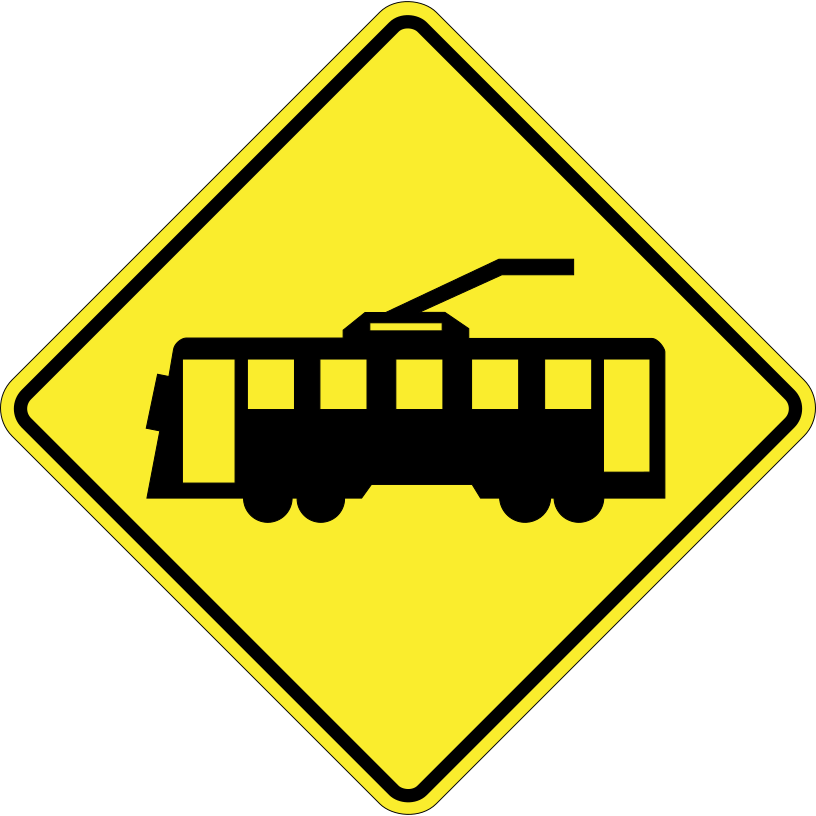
40. What does this traffic sign mean?
This traffic sign indicates a warning for trams. Tram tracks cross or run along the road ahead, and trams may enter the traffic path. Reduce speed, watch carefully for approaching trams and follow the applicable traffic signals, priority signs and local rules.
English • Traffic sign P-29(a) • Trams. Trams regularly operate in the area. Watch their movements and local signs.
Español • P-29(a) • Tranvías. Advierte la operación habitual de tranvías en la zona. Observa sus movimientos y la señalización del lugar.
Sources
🔗 Commons.wikimedia.org
🔗 Servicios.infoleg.gob.ar • Anexo L vigente, sustituido por Decreto 196/2025, P.29
🔗 Servicios.infoleg.gob.ar • Anexo L 2025, lámina 08 • ANSV, manual de señales, PDF p. 7
SVG source: Original: Vialidad Nacional - Ministerio de Transporte - Presidencia de la Nación Vectorization: Civitas13 • Public domain • Original revision 2020-01-14. Wikimedia original unmodified.
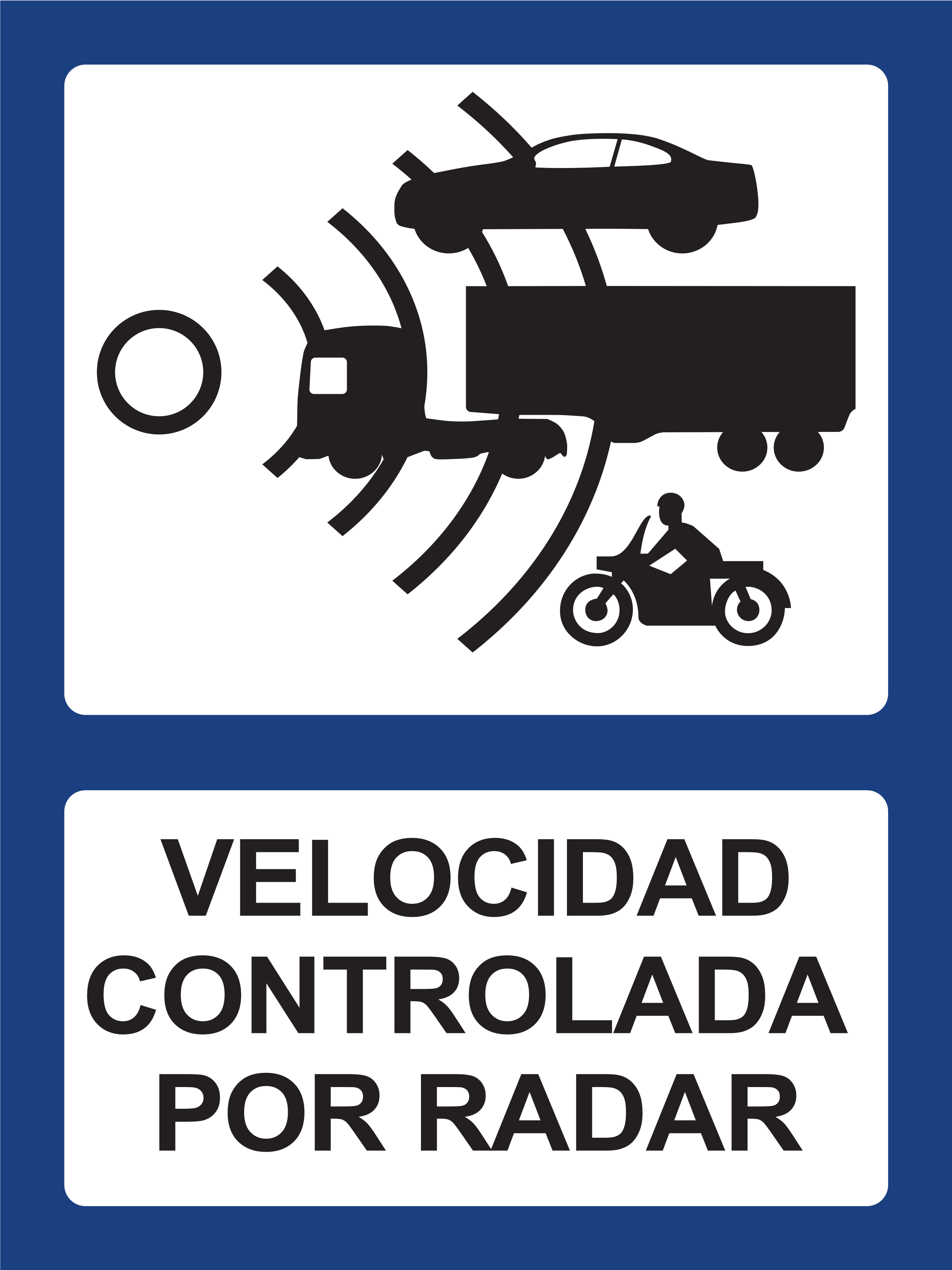
41. What does this traffic sign mean?
This traffic sign indicates section control, also called average-speed enforcement. A vehicle’s average speed is measured over a defined section of road and compared with the applicable speed limit.
English • Traffic sign DNV · radar notice • Speed controlled by radar. Observe the applicable speed limit. Functionally identified as a radar notice. The DNV diagram uses a different layout and wording; no national sign code or exact reproduction of that model is claimed for this drawing.
Español • DNV · aviso de radar • Velocidad controlada por radar. Informa de un control de velocidad mediante radar. Respeta el límite de velocidad aplicable en la vía. Identificación funcional de un aviso de radar. El esquema DNV usa una composición y una leyenda diferentes; no se atribuye a este dibujo un código nacional de señal ni una reproducción exacta de aquel modelo.
Sources
🔗 Commons.wikimedia.org (Dirección Nacional de Vialidad Argentina. Verctor graphics by Gustavo Brys / Marcelo Celestino. • CC BY 4.0)
🔗 Argentina.gob.ar • DNV, Manual de Señalamiento Vertical 2017, PDF p. 288
SVG source: Dirección Nacional de Vialidad Argentina. Verctor graphics by Gustavo Brys / Marcelo Celestino. • CC BY 4.0 • Original revision 2016-12-19. Wikimedia original unmodified.

42. What does this traffic sign mean?
This traffic sign indicates a checkpoint with restricted entry. Road users may not proceed beyond the checkpoint unless they are authorised or permitted to continue according to the applicable rules and instructions.
English • Traffic sign R-25 • Checkpoint. Stop at the indicated checkpoint, such as police, customs, plant-health or toll control.
Español • R-25 • Puesto de control. Exige detener el vehículo en el puesto de control señalado, como un control policial, aduanero, fitosanitario o de peaje.
Sources
🔗 Commons.wikimedia.org
🔗 Servicios.infoleg.gob.ar • Anexo L vigente, sustituido por Decreto 196/2025, R.25
🔗 Servicios.infoleg.gob.ar • Anexo L 2025, lámina 04 • ANSV, manual de señales, PDF p. 4
SVG source: Commons.wikimedia.org • Original SVG
Gobierno de la República Argentina • Public domain • Original revision 2012-09-07. Wikimedia original unmodified.
Artwork individually reviewed against current Argentinian Argentina.gob.ar • Annex L, substituted by Decreto 196/2025:
🔗 Argentina.gob.ar • Annex III plate 04, R-25. Supporting ANSV manual, PDF page 4. Intentional educational illustration update from the previous PNG; original SVG unmodified.
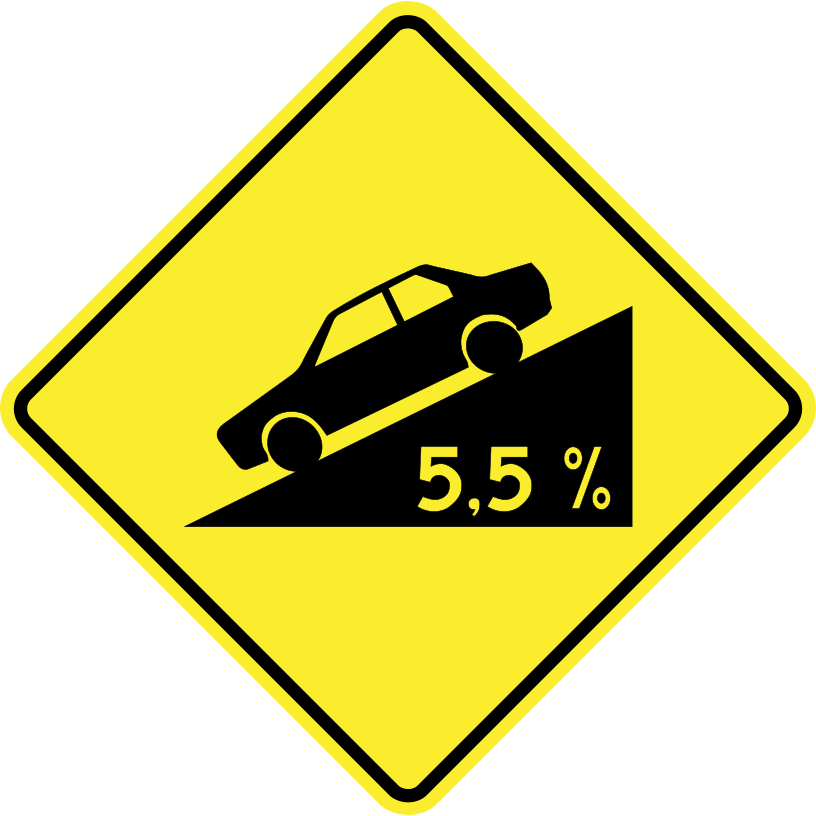
43. What does this traffic sign mean?
This traffic sign indicates a warning for a steep descent. A steep downhill gradient lies ahead and the vehicle may gain speed quickly. Reduce speed before the descent, select a suitable gear and use engine braking where appropriate. Allow extra distance for heavy or towing vehicles.
English • Traffic sign P-9(b) • Uphill gradient: 5.5%. Select a suitable gear and adapt driving to the gradient.
Español • P-9(b) • Pendiente ascendente: 5,5 %. Advierte una subida con pendiente del 5,5 %. Selecciona una marcha adecuada y adapta la conducción a la pendiente.
Sources
🔗 Commons.wikimedia.org
🔗 Servicios.infoleg.gob.ar • Anexo L vigente, sustituido por Decreto 196/2025, P.9
🔗 Servicios.infoleg.gob.ar • Anexo L 2025, lámina 06 • ANSV, manual de señales, PDF p. 9
SVG source: Original: Vialidad Nacional - Ministerio de Transporte - Presidencia de la Nación Vectorization: Civitas13 • Public domain • Original revision 2020-01-16. Wikimedia original unmodified.

44. What does this traffic sign mean?
This traffic sign indicates a warning for a dip in the road. A sudden depression in the road surface lies ahead and may affect vehicle stability or visibility. Reduce speed before reaching the dip and be prepared for water or other hazards that may collect in the lowered section.
English • Traffic sign P-11(b) • Dip. Warns of a transverse depression in the carriageway. Reduce speed before crossing it.
Español • P-11(b) • Badén. Advierte una depresión transversal de la calzada. Reduce la velocidad antes de atravesarla.
Sources
🔗 Commons.wikimedia.org
🔗 Servicios.infoleg.gob.ar • Anexo L vigente, sustituido por Decreto 196/2025, P.11
🔗 Servicios.infoleg.gob.ar • Anexo L 2025, lámina 06 • ANSV, manual de señales, PDF p. 9
SVG source: Original: Vialidad Nacional - Ministerio de Transporte - Presidencia de la Nación Vectorization: Civitas13 • Public domain • Original revision 2020-01-14. Wikimedia original unmodified.
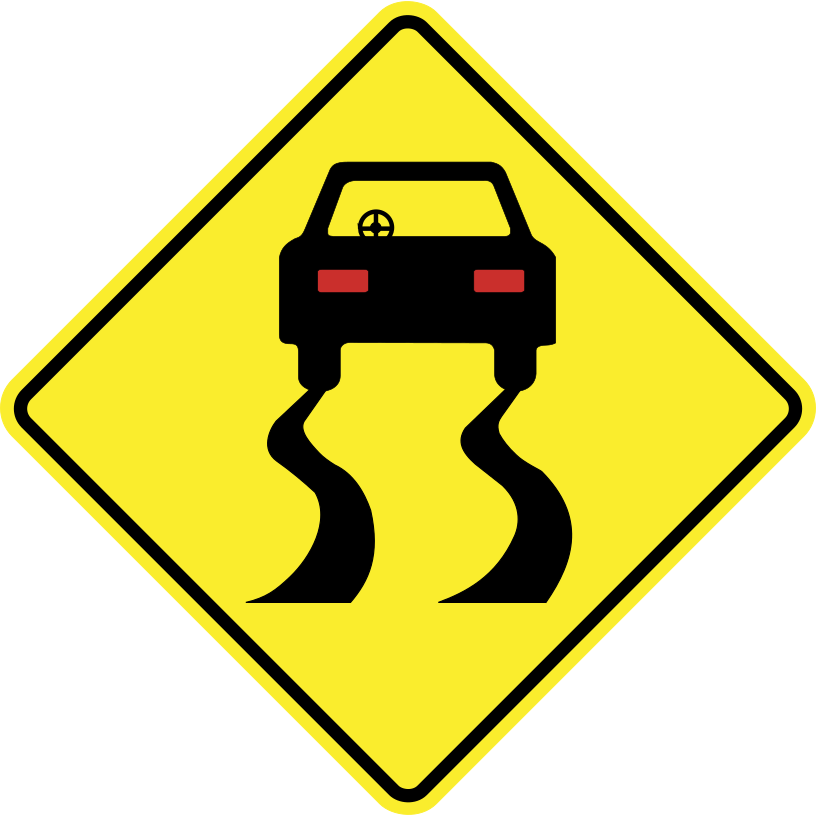
45. What does this traffic sign mean?
This traffic sign indicates a warning for a slippery road surface. The road ahead may provide reduced tyre grip because of water, ice, mud, oil or another surface condition. Reduce speed and avoid sudden braking, acceleration or steering movements.
English • Traffic sign P-12 • Slippery carriageway. Avoid harsh braking or steering changes.
Español • P-12 • Calzada resbaladiza. Advierte una superficie que puede resultar resbaladiza. Evita frenadas y cambios de dirección bruscos.
Sources
🔗 Commons.wikimedia.org
🔗 Servicios.infoleg.gob.ar • Anexo L vigente, sustituido por Decreto 196/2025, P.12
🔗 Servicios.infoleg.gob.ar • Anexo L 2025, lámina 06 • ANSV, manual de señales, PDF p. 9
SVG source: Original: Vialidad Nacional - Ministerio de Transporte - Presidencia de la Nación Vectorization: Civitas13 • Public domain • Original revision 2020-01-14. Wikimedia original unmodified.

46. What does this traffic sign mean?
This traffic sign indicates that cars are prohibited. Cars may not enter or continue beyond the sign. Other road users may still be permitted unless another restriction applies.
English • Traffic sign R-3(1) • No passenger cars. Passenger cars are prohibited on the signed road.
Español • R-3(1) • No circular autos. Prohíbe el tránsito de automóviles por la vía señalizada.
Sources
🔗 Commons.wikimedia.org
🔗 Servicios.infoleg.gob.ar • Anexo L vigente, sustituido por Decreto 196/2025, R.3
🔗 Servicios.infoleg.gob.ar • Anexo L 2025, lámina 01 • ANSV, manual de señales, PDF p. 2
SVG source: Commons.wikimedia.org • Original SVG
Gobierno de la República Argentina • Public domain • Original revision 2014-01-16. Wikimedia original unmodified.
Artwork individually reviewed against current Argentinian Argentina.gob.ar • Annex L, substituted by Decreto 196/2025:
🔗 Argentina.gob.ar • Annex III plate 01, R-3(1). Supporting ANSV manual, PDF page 2. Intentional educational illustration update from the previous PNG; original SVG unmodified.

47. What does this traffic sign mean?
This traffic sign indicates that turning around (making a U-turn) is prohibited. A U-turn may not be made where the prohibition applies. Other movements may still be permitted unless another restriction applies.
English • Traffic sign R-5 • No U-turns. Turning around to travel in the opposite direction on the same road is prohibited.
Español • R-5 • No girar en U. Prohíbe efectuar un giro de retorno para circular en sentido contrario por la misma vía.
Sources
🔗 Commons.wikimedia.org
🔗 Servicios.infoleg.gob.ar • Anexo L vigente, sustituido por Decreto 196/2025, R.5
🔗 Servicios.infoleg.gob.ar • Anexo L 2025, lámina 02 • ANSV, manual de señales, PDF p. 2
SVG source: Commons.wikimedia.org • Original SVG
Gobierno de la República Argentina • Public domain • Original revision 2023-04-30. Wikimedia original unmodified.
Artwork individually reviewed against current Argentinian Argentina.gob.ar • Annex L, substituted by Decreto 196/2025:
🔗 Argentina.gob.ar • Annex III plate 02, R-5. Supporting ANSV manual, PDF page 2. Intentional educational illustration update from the previous PNG; original SVG unmodified.
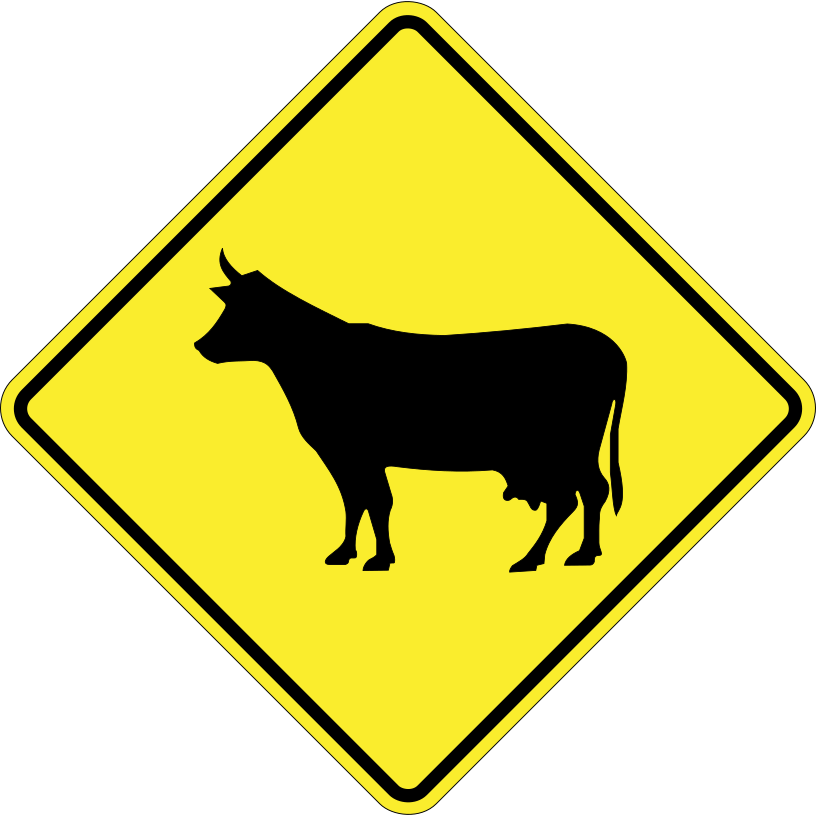
48. What does this traffic sign mean?
This traffic sign indicates a warning for cattle. Cattle or other livestock may be crossing, walking along or standing near the road. Reduce speed, be prepared to stop and avoid sudden movements or unnecessary use of the horn that could startle the animals.
English • Traffic sign P-27(a) • Loose animals — livestock. Livestock may be on the road individually or in groups. Reduce speed and remain alert.
Español • P-27(a) • Animales sueltos: ganado. Advierte la posible presencia de ganado sobre la vía, individualmente o en grupos. Reduce la velocidad y mantente atento.
Sources
🔗 Commons.wikimedia.org
🔗 Servicios.infoleg.gob.ar • Anexo L vigente, sustituido por Decreto 196/2025, P.27
🔗 Servicios.infoleg.gob.ar • Anexo L 2025, lámina 08 • ANSV, manual de señales, PDF p. 7
SVG source: Original: Vialidad Nacional - Ministerio de Transporte - Presidencia de la Nación Vectorization: Civitas13 • Public domain • Original revision 2020-01-14. Wikimedia original unmodified.

49. What does this traffic sign mean?
This traffic sign indicates a warning for low-flying aircraft. Aircraft may pass over the road at low altitude and can create sudden noise or visual distraction. Keep your attention on the road and maintain control of the vehicle.
English • Traffic sign P-28 • Flight path. Aircraft may fly low over the road near an airfield or airport.
Español • P-28 • Corredor aéreo. Advierte posibles vuelos a baja altura sobre la vía debido a la proximidad de un aeródromo o aeropuerto.
Sources
🔗 Commons.wikimedia.org
🔗 Servicios.infoleg.gob.ar • Anexo L vigente, sustituido por Decreto 196/2025, P.28
🔗 Servicios.infoleg.gob.ar • Anexo L 2025, lámina 08 • ANSV, manual de señales, PDF p. 7
SVG source: Original: Vialidad Nacional - Ministerio de Transporte - Presidencia de la Nación Vectorization: Civitas13 • Public domain • Original revision 2020-02-02. Wikimedia original unmodified.

50. What does this traffic sign mean?
This traffic sign indicates a mandatory direction to the right. Traffic must proceed to the right at the sign and may not continue straight ahead or to the left.
English • Traffic sign R-21(a) • Direction of travel to the right. Travel in the rightward direction shown by the arrow is compulsory.
Español • R-21(a) • Sentido de circulación hacia la derecha. Establece la obligación de circular en el sentido hacia la derecha indicado por la flecha.
Sources
🔗 Commons.wikimedia.org
🔗 Servicios.infoleg.gob.ar • Anexo L vigente, sustituido por Decreto 196/2025, R.21/22
🔗 Servicios.infoleg.gob.ar • Anexo L 2025, lámina 03 • ANSV, manual de señales, PDF p. 4
SVG source: Commons.wikimedia.org • Original SVG
Gobierno de la República Argentina • Public domain • Original revision 2023-04-30. Wikimedia original unmodified.
Artwork individually reviewed against current Argentinian Argentina.gob.ar • Annex L, substituted by Decreto 196/2025:
🔗 Argentina.gob.ar • Annex III plate 03, R-21(a). Supporting ANSV manual, PDF page 4. Intentional educational illustration update from the previous PNG; original SVG unmodified.