


Traffic signsFinland
 Traffic rules
 Finland
26. Radar speed sign
A radar speed sign warns drivers that vehicle speeds may be monitored by a fixed camera, mobile radar, lidar or average-speed enforcement system. It reminds drivers to check and respect the applicable speed limit.
The sign does not normally establish the speed limit itself. Drivers must follow the general, posted or variable speed limit applying to the road and must not brake suddenly merely because speed enforcement is indicated.
Wikimedia.org • Santeri Viinamäki • CC BY-SA
What should a driver understand from a radar or speed-camera warning in Finland?
It is an indication that speed may be checked or monitored at a point or along a section. Speed monitoring may use different equipment and signs, and any legal obligation to warn drivers depends on the authority and applicable law. It is not, by itself, a new numerical speed limit.
Which speed limit applies when a radar warning is displayed in Finland?
Follow the speed-limit sign, applicable speed zone or statutory road and vehicle limit. A camera symbol or enforcement notice must not be mistaken for a sign raising or ending that limit.
Should you brake abruptly when you notice a radar sign in Finland?
No. Adjust to the lawful and safe speed smoothly, leaving adequate space behind and ahead. Enforcement information does not authorise sudden unsafe manoeuvres or stopping to inspect the camera.

27. Priority at the next junction
Priority at the next junction means that drivers travelling on a particular road have priority over traffic entering from intersecting roads at the next junction. The priority arrangement is normally indicated by signs facing both the priority traffic and the traffic that must give way.
Unlike a continuing priority road, this priority applies only at the indicated intersection. Drivers must still approach cautiously and obey traffic lights, authorised officers, crossings, turning rules and other applicable signs.
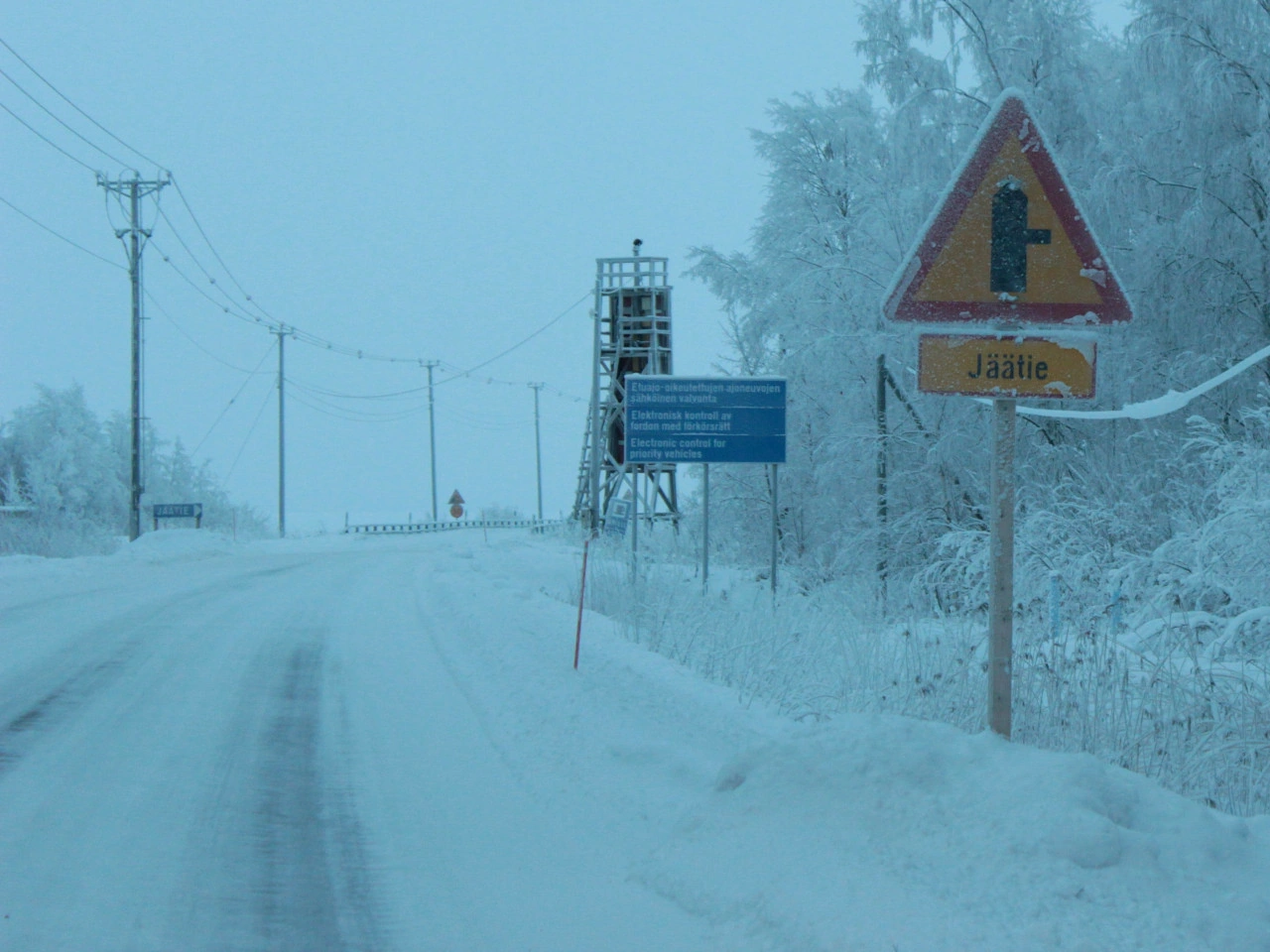
Wikimedia.org • Estormiz • CC0
How is priority at the next junction determined in Finland?
In mainland Finland, warning sign A22 identifies a side-road junction where the crossing traffic has a give-way duty established by a sign or by section 24(3). Read the actual controls: this junction warning differs from the continuing priority-road designation B1. Keep observing duties towards turning traffic, pedestrians and cyclists.
🔗 finlex.fi • Finlex, Finnish Road Traffic Act 729/2018 — 8, 24; Annex 3 A22, B1/B2, H22, F1–F3
🔗 finlex.fi • Finlex — corresponding current Finnish statutory text
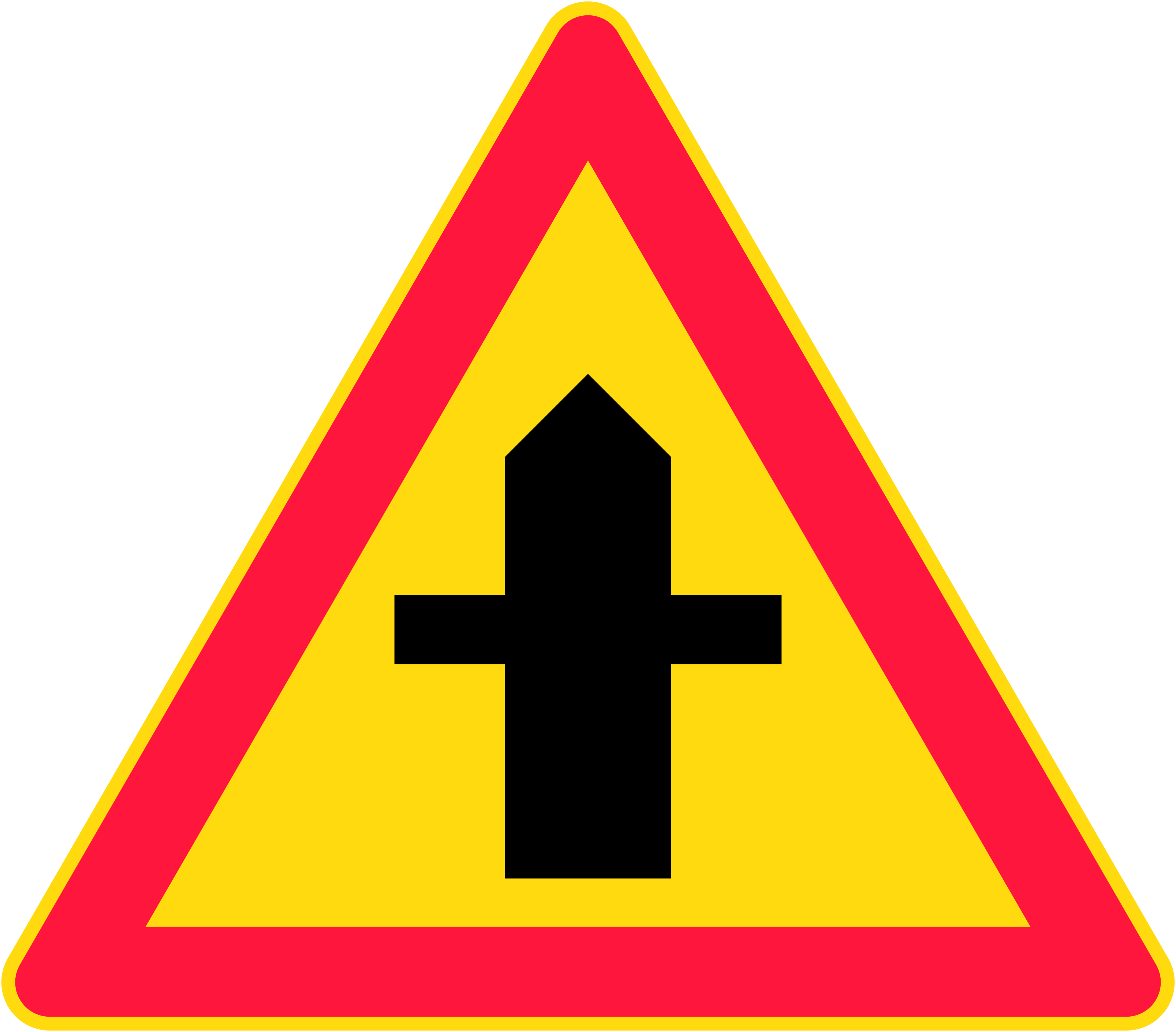 Priority at the junction.
English • Traffic sign A22 • Side-road junction. May warn of a junction where traffic on the intersecting road must give way under traffic signs or section 24(3). The arrow diagram may be adapted to conditions.
Suomi • Liikennemerkki A22 • Sivutien risteys. Merkillä voidaan varoittaa risteyksestä, jossa risteävää tietä kulkevalla on liikennemerkein osoitettu taikka 24 §:n 3 momentin mukainen väistämisvelvollisuus. Merkin nuolikuviota voidaan muuttaa olosuhteiden mukaan.
Svenska • Vägmärke A22 • Korsning med sidoväg. Med märket kan det varnas för en korsning i vilken den som trafikerar den korsande vägen genom ett vägmärke har ålagts eller i enlighet med 24 § 3 mom. har väjningsplikt. Märkets pilfigurer kan vara anpassade efter förhållandena på platsen.
Sources
🔗 Commons.wikimedia.org
🔗 Finlex.fi • Tieliikennelaki 729/2018 • liite 3.1 (FI)
🔗 Commons.wikimedia.org
🔗 Finlex.fi • Vägtrafiklag 729/2018 • bilaga 3.1 (SV)
SVG source: Republic of Finland • Public domain • Original revision 2020-06-15. Wikimedia original unmodified.
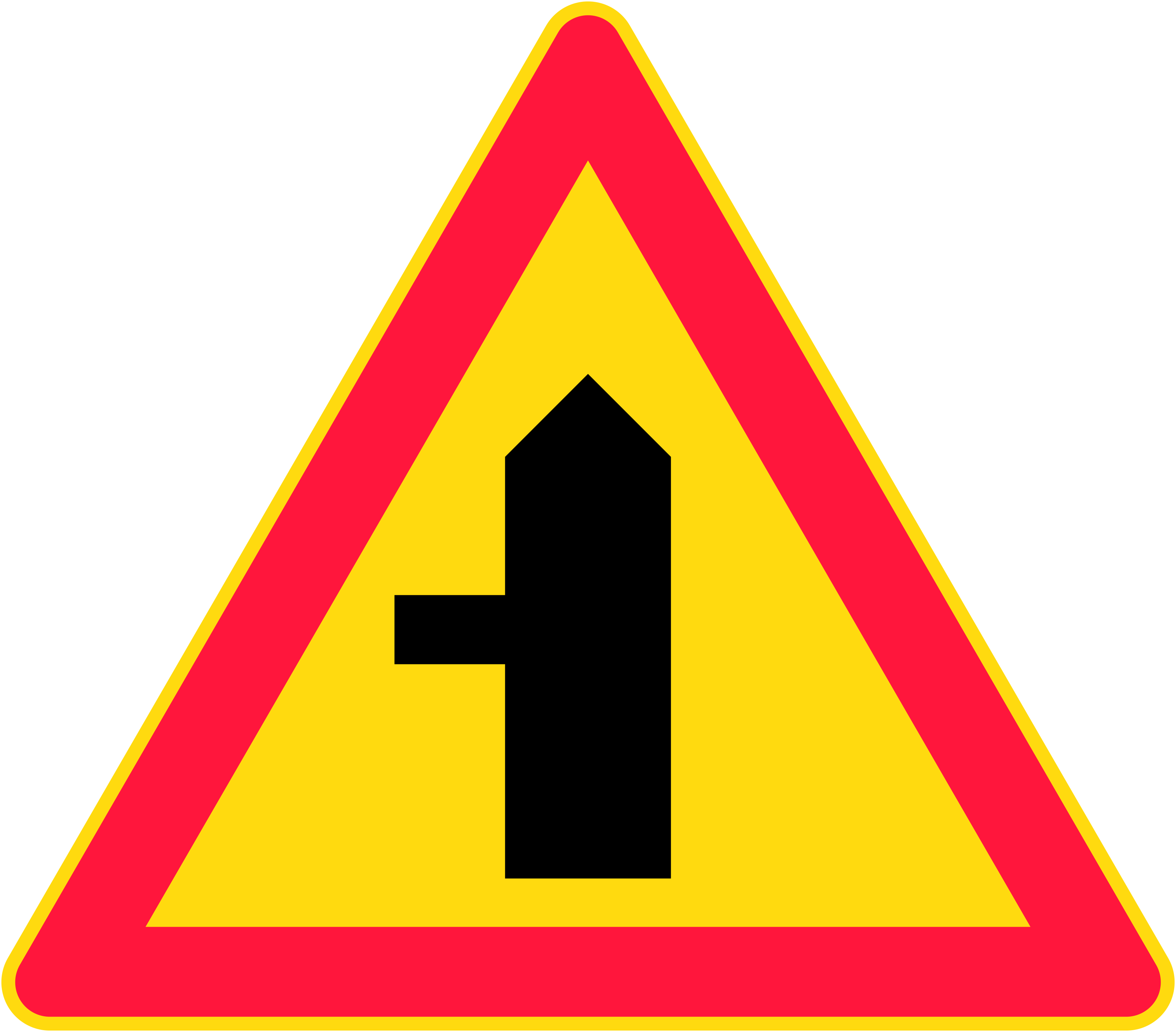 Priority at the junction.
English • Traffic sign A22 • Side-road junction. May warn of a junction where traffic on the intersecting road must give way under traffic signs or section 24(3). The arrow diagram may be adapted to conditions.
Suomi • Liikennemerkki A22 • Sivutien risteys. Merkillä voidaan varoittaa risteyksestä, jossa risteävää tietä kulkevalla on liikennemerkein osoitettu taikka 24 §:n 3 momentin mukainen väistämisvelvollisuus. Merkin nuolikuviota voidaan muuttaa olosuhteiden mukaan.
Svenska • Vägmärke A22 • Korsning med sidoväg. Med märket kan det varnas för en korsning i vilken den som trafikerar den korsande vägen genom ett vägmärke har ålagts eller i enlighet med 24 § 3 mom. har väjningsplikt. Märkets pilfigurer kan vara anpassade efter förhållandena på platsen.
Sources
🔗 Commons.wikimedia.org
🔗 Finlex.fi • Tieliikennelaki 729/2018 • liite 3.1 (FI)
🔗 Commons.wikimedia.org
🔗 Finlex.fi • Vägtrafiklag 729/2018 • bilaga 3.1 (SV)
SVG source: Republic of Finland • Public domain • Original revision 2020-06-15. Wikimedia original unmodified.
 Start of a priority road.
English • Traffic sign B1 • Priority road. Vehicles and trams from intersecting roads must give way to vehicles and trams on this road. The duty is signposted unless based on section 24(3) or (4). Placed at the road's beginning and where needed along it. With H22.1 or H22.2, may show a turning priority route.
Suomi • Liikennemerkki B1 • Etuajo-oikeutettu tie. Merkillä osoitetaan tie, jolla kulkevaa ajoneuvoa ja raitiovaunua risteävältä tieltä tulevalla ajoneuvolla ja raitiovaunulla on väistettävä. Väistämisvelvollisuus on osoitettu liikennemerkillä, jollei se perustu 24 §:n 3 tai 4 momentin säännökseen. Merkki sijoitetaan tällaisen tien alkuun ja tarpeellisiin kohtiin sen varrelle. Lisäkilvellä H22.1 tai H22.2 varustettuna merkillä voidaan osoittaa kääntyvä etuajo-oikeutettu suunta.
Svenska • Vägmärke B1 • Väg med förkörsrätt. Märket anger en väg där fordon och spårvagnar har förkörsrätt så att fordon och spårvagnar som kommer in från en korsande väg ska väja för dem. Väjningsplikten är angiven med ett vägmärke, om den inte grundar sig på bestämmelsen i 24 § 3 eller 4 mom. Märket placeras i början av en väg med förkörsrätt och vid behövliga ställen utmed den. Försett med tilläggsskylt H22.1 eller H22.2 kan märket ange den svängande förkörsberättigade riktningen.
Sources
🔗 Commons.wikimedia.org
🔗 Finlex.fi • Tieliikennelaki 729/2018 • liite 3.2 (FI)
🔗 Commons.wikimedia.org
🔗 Finlex.fi • Vägtrafiklag 729/2018 • bilaga 3.2 (SV)
SVG source: Republic of Finland • Public domain • Original revision 2020-06-01. Wikimedia original unmodified.
Does priority at one junction automatically continue along the entire road in Finland?
No. One-junction priority and continuing priority-road status are distinct concepts. Check the local signs at each following junction, including any end-of-priority marker, traffic signal or new Give Way or Stop sign.
🔗 finlex.fi • Finlex, Finnish Road Traffic Act 729/2018 — 8, 24; Annex 3 A22, B1/B2, H22, F1–F3
🔗 finlex.fi • Finlex — corresponding current Finnish statutory text
May a driver with priority ignore pedestrians or another safety obligation at the next junction in Finland?
No. Junction priority does not cancel duties towards pedestrians, traffic signals, emergency vehicles or other road users where the law gives them precedence. Approach at a speed allowing you to stop safely.
🔗 finlex.fi • Finlex, Finnish Road Traffic Act 729/2018 — 8, 24; Annex 3 A22, B1/B2, H22, F1–F3
🔗 finlex.fi • Finlex — corresponding current Finnish statutory text
28. Traffic lights
Traffic lights use coloured lights, arrows or symbols to regulate when road users may proceed, must prepare to stop or must remain stopped. Separate signals may apply to particular directions, lanes, pedestrians, cyclists or public-transport vehicles.
A green light permits movement only when the route is clear and the movement is otherwise legal. Road users must still follow priority rules, turning restrictions, lane markings and instructions from authorised traffic controllers.
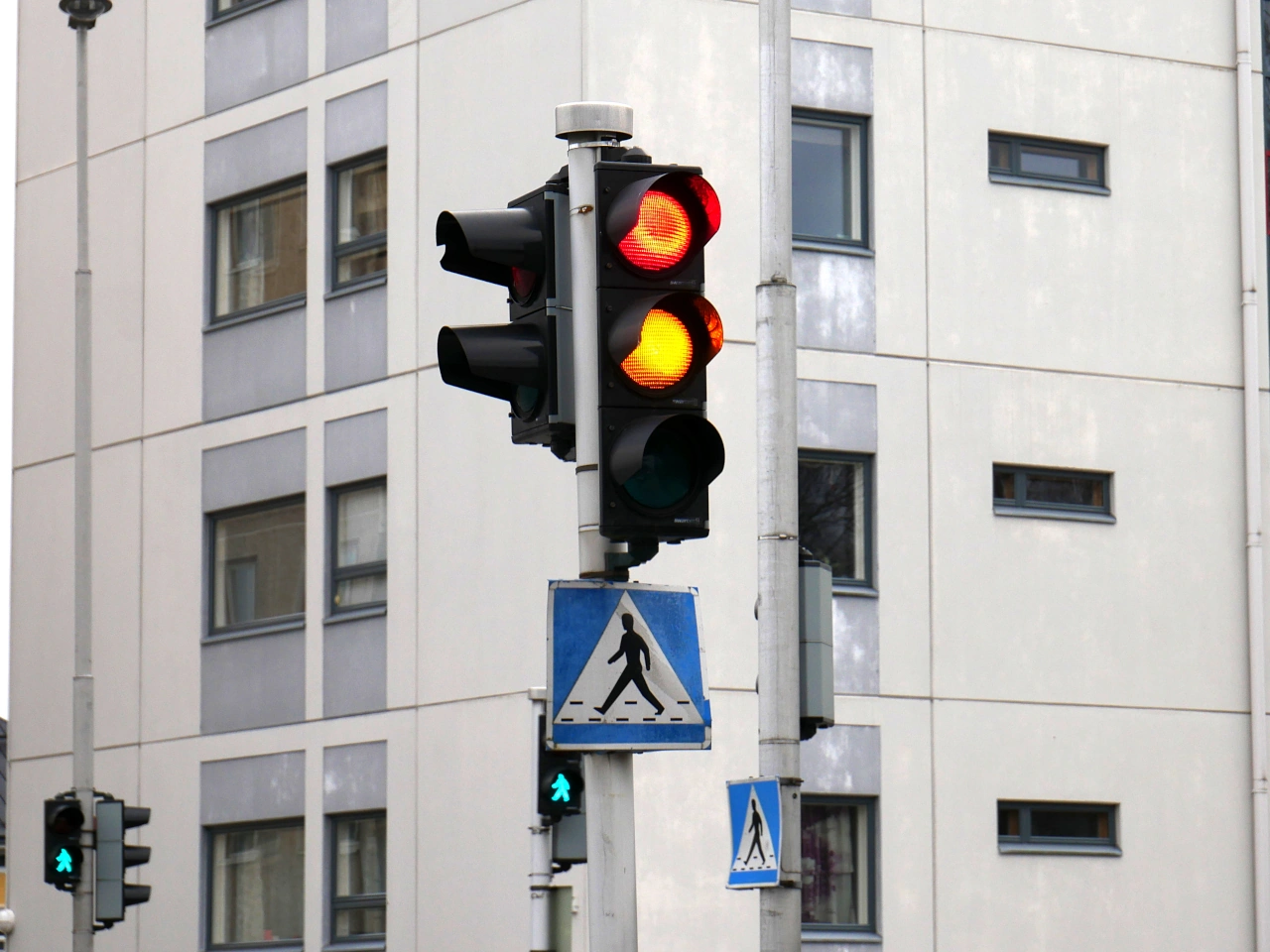
Wikimedia.org • Santeri Viinamäki • CC BY-SA
What must a driver do at red, amber and green signals in Finland?
Red means stop at the applicable line. Amber generally warns that the signal is changing and calls for a stop where it can be made safely; do not accelerate to beat it. Green allows movement only when the way is clear. Observe local arrow, flashing-signal and stop-line rules.
May you turn at a red traffic light in Finland?
A red signal means stop; there is no general permission to turn merely because you have stopped or the road looks clear. Follow any directional signal that applies to your movement: a green arrow authorises its direction, while a red arrow prohibits that direction.
Can a green light remove the need to give way to pedestrians in Finland?
No. A green signal is not a guarantee that the junction is empty. Check for people already crossing, vehicles completing a movement and any separate pedestrian, bicycle or turning signals. Do not enter if you cannot clear the junction safely.
29. Driving licence
A driving licence is an official document authorising a person to drive one or more specified categories of motor vehicle. It may contain conditions, restrictions, category codes and expiry dates that determine which vehicles the holder may drive.
Drivers must hold a licence that is valid for the vehicle category and jurisdiction concerned. A licence may be provisional, full, restricted, suspended or withdrawn, and additional qualifications may be required for professional driving.
Wikimedia.org • Finnish Transport and Communications Agency • CC BY-SA
Which driving-licence entitlement is needed for an ordinary car in Finland?
In Finland, category B is the usual entitlement for an ordinary passenger car (subject to vehicle-mass, seat and other licence conditions). A different entitlement may be needed for motorcycles, heavy vehicles, trailers or passenger transport.
🔗 europa.eu • Your Europe — cars category B/BE; national category conditions remain applicable
Can a visitor drive in Finland using a driving licence issued abroad?
A valid, full driving licence issued by another EU country is recognised for the vehicle categories it authorises, subject to the local minimum age. A learner licence or temporary replacement certificate is not automatically recognised across borders. For licences issued outside the EU, check national recognition rules.
🔗 europa.eu • Your Europe — cars category B/BE; national category conditions remain applicable
Does an International Driving Permit replace the original licence in Finland?
No. A valid full EU driving licence is normally sufficient for driving elsewhere in the EU; an IDP does not replace it. Non-EU licence holders should check national requirements and carry the underlying licence with any recognised permit.
🔗 europa.eu • Your Europe — cars category B/BE; national category conditions remain applicable
30. Countdown markers
Countdown markers are a sequence of roadside signs that indicate that a particular point, such as a motorway exit, junction or railway crossing, is getting closer. They commonly use a decreasing number of bars or other symbols so drivers can judge their progress toward the upcoming location.
The markers are normally positioned at successively shorter distances from the point ahead. Their design, spacing and meaning vary between countries, so drivers should not assume that each bar always represents the same distance.
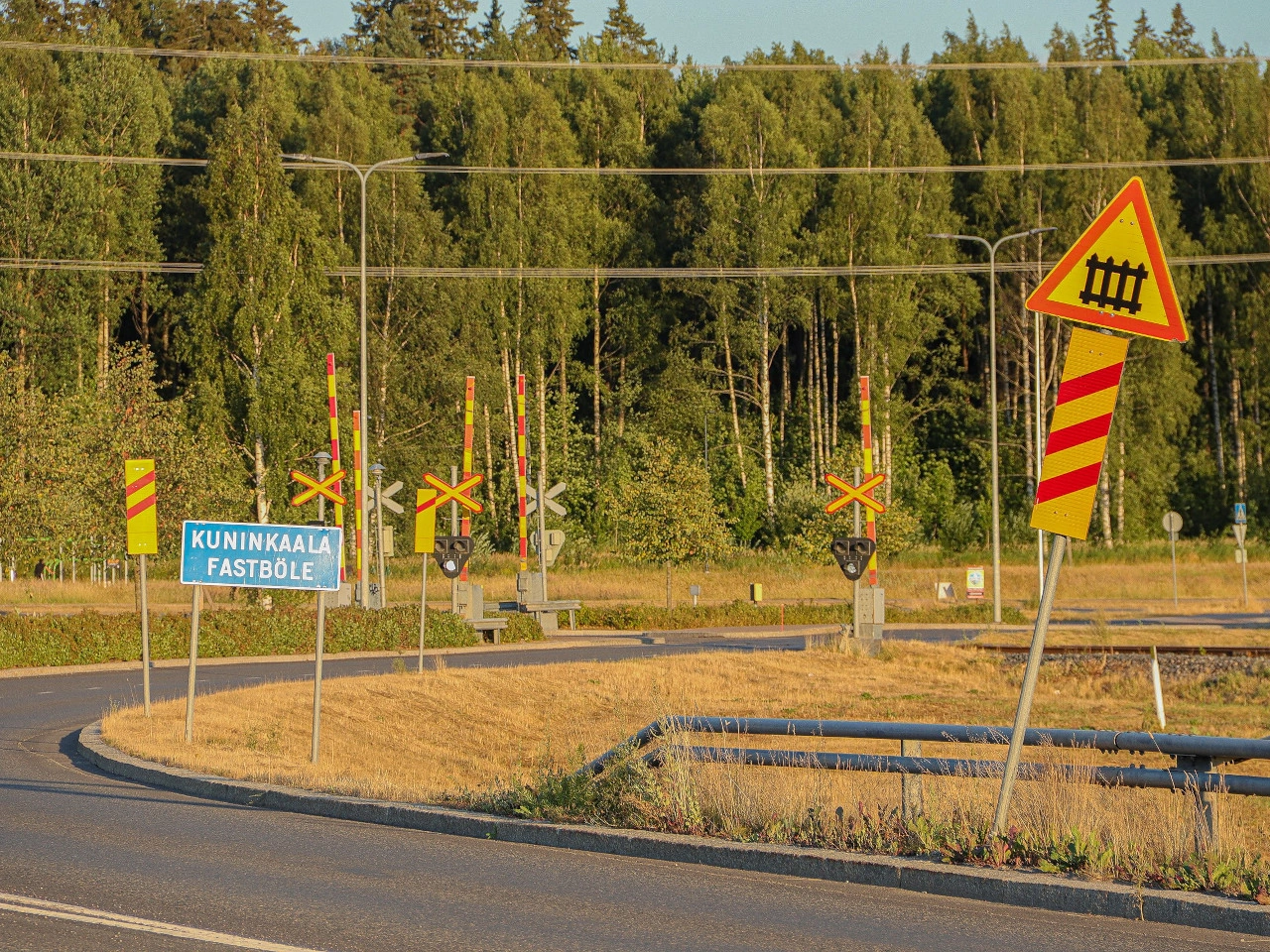
Wikimedia.org • Coen • CC BY-SA
What do countdown or exit-approach markers mean in Finland?
Finnish roads may use advance exit and junction signs, while their exact design and spacing follow Finnish standards.
🔗 finlex.fi • Finlex, Finnish Road Traffic Act 729/2018 — 8, 35, 59–61; Annex 3 A28, F1–F3, F8–F14
🔗 finlex.fi • Finlex — corresponding current Finnish statutory text
Does each countdown bar always represent the same distance in Finland?
No universal distance can be assumed. Follow the local sign standard and any printed distance; bars used for an exit may not have the same spacing or function as markers approaching a railway crossing.
🔗 finlex.fi • Finlex, Finnish Road Traffic Act 729/2018 — 8, 35, 59–61; Annex 3 A28, F1–F3, F8–F14
🔗 finlex.fi • Finlex — corresponding current Finnish statutory text
What should you do if you are too late to take a motorway exit in Finland?
Continue safely to the next lawful exit or junction. Do not stop, reverse, make a U-turn or cross the median to reach a missed exit. Plan lane changes early and follow any lane-control signals.
🔗 finlex.fi • Finlex, Finnish Road Traffic Act 729/2018 — 8, 35, 59–61; Annex 3 A28, F1–F3, F8–F14
🔗 finlex.fi • Finlex — corresponding current Finnish statutory text
31. International border
An international border is the legal boundary between two countries. A border sign may identify the country being entered and remind drivers that different traffic laws, speed limits, road signs, vehicle requirements and document rules may apply.
The border sign itself does not normally require drivers to stop. Passport, immigration or customs controls may take place at a checkpoint, but some international borders can be crossed without routine controls under regional agreements.
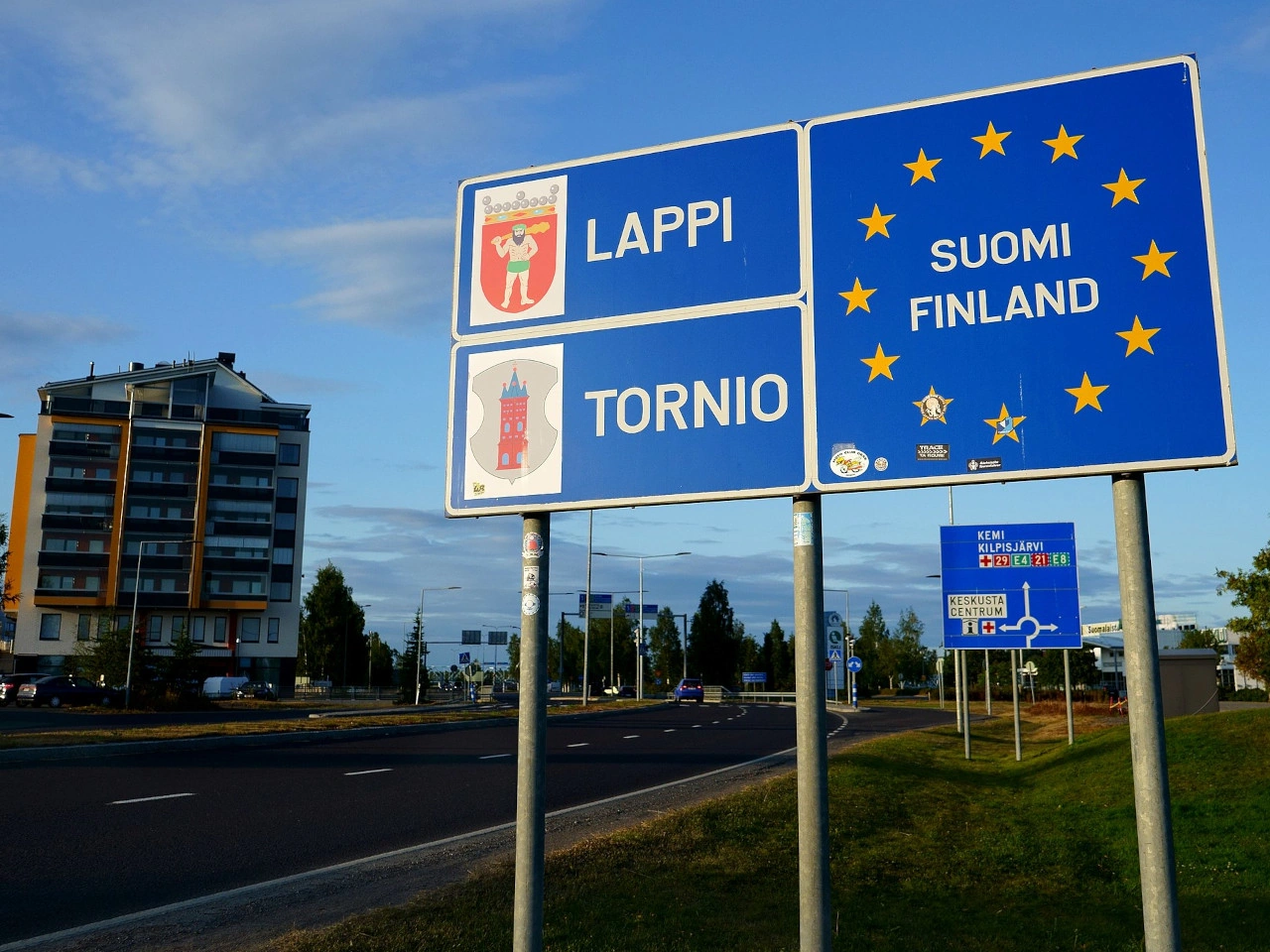
Wikimedia.org • Santeri Viinamäki • CC BY-SA
What is an international border?
An international border is the legal boundary between two countries.
🔗 dictionary.cambridge.org • Cambridge Dictionary, international border definition
Does a border sign require you to stop?
Not normally. Stop only when required by traffic lights, barriers, officers, customs signs, passport controls or another instruction.
🔗 europa.eu • Your Europe, travel documents for EU nationals; EU example
Can speed limits change at the border?
Yes. The destination country may have different general limits for motorways, built-up areas, rural roads and particular vehicle categories.
🔗 europa.eu • Your Europe, travel documents for EU nationals; EU example
32. Cycling route
A cycling route is a planned or signposted route intended to guide cyclists between places or through a particular area. It may follow cycle paths, quiet streets, shared roads, greenways or other routes considered suitable for cycling.
A cycling route does not necessarily give cyclists exclusive use of the road or path and should not be confused with a cycle path or cycle lane. The traffic rules, priority rules and permitted road users depend on the individual roads and paths that form the route and on the local signs and regulations.
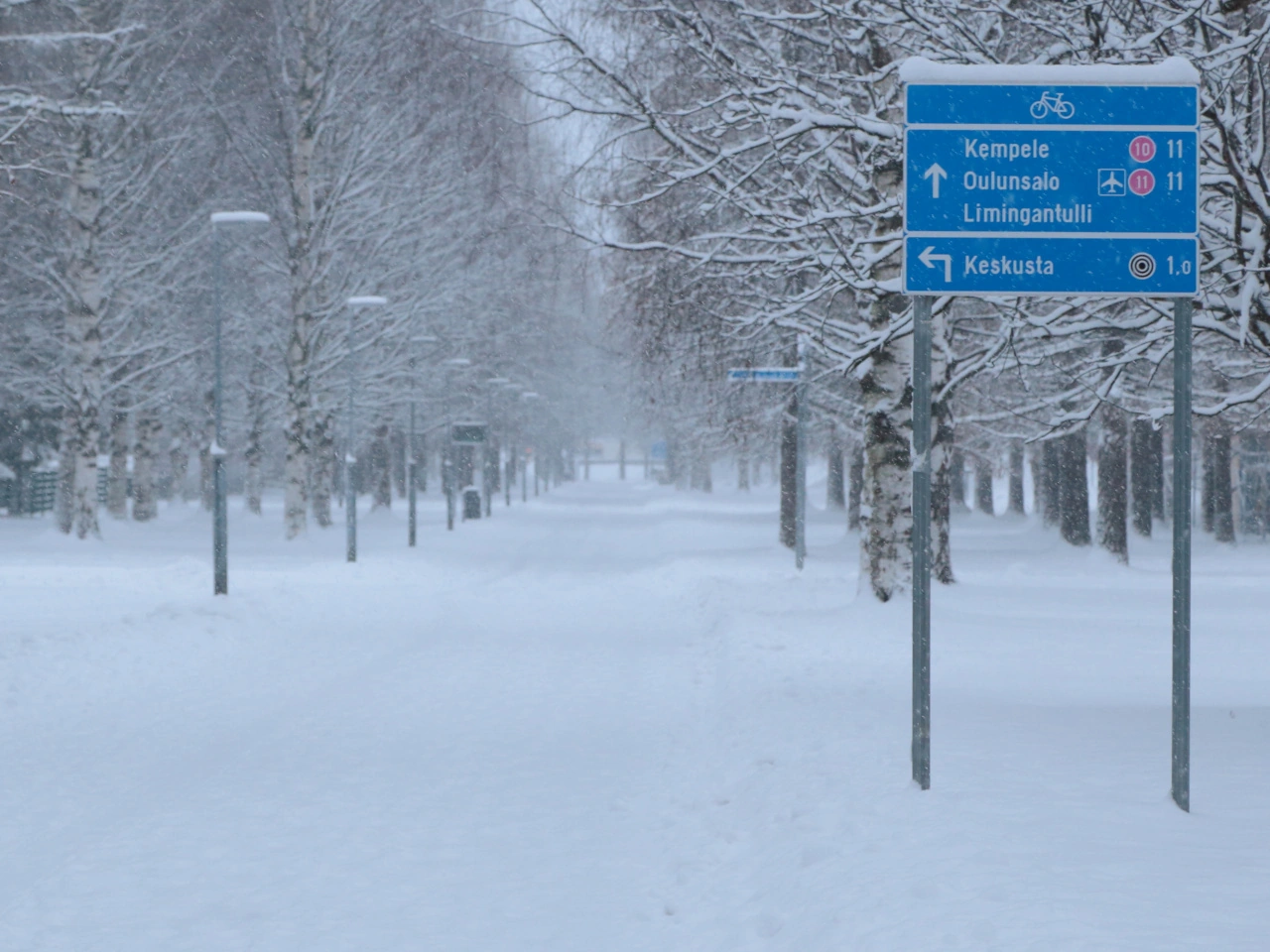
Wikimedia.org • Estormiz • CC0
How can you recognise a cycling route?
Cycling routes are commonly indicated by direction signs, bicycle symbols, route numbers, colours or destination markers. The design of the signs and route-numbering system varies between countries and regions.
Do cyclists have priority on a cycling route?
Not automatically. Being on a designated cycling route does not normally change the priority rules. Cyclists must continue to obey traffic lights, give-way and stop signs, crossing rules and other applicable traffic regulations.
What should you do when a cycling-route sign conflicts with a traffic sign?
Always follow the official traffic signs, signals and road markings. A route marker provides navigation and does not override a prohibition, mandatory direction, road closure or other traffic regulation.
33. Parking
Parking means leaving a vehicle stationary at a place for a period of time rather than stopping only briefly because of traffic conditions or another immediate necessity. Many countries distinguish parking from a short stop made to pick up or drop off passengers or to load or unload goods, although the exact legal definition varies.
Parking may be permitted, restricted, reserved, time-limited or prohibited by traffic signs, road markings, parking zones and local regulations. Drivers must park without creating a danger or unnecessary obstruction and must comply with any conditions concerning payment, permits, vehicle categories or maximum parking duration.
Wikimedia.org • Olaf Kosinsky • CC BY-SA
Is a traditional plastic parking disc always necessary in Finland?
No. Where the law requires the start of parking to be indicated, it may be shown in a clearly visible way, not necessarily with a particular cardboard or plastic disc. The time may be set to the next full or half-hour, whichever comes first.
🔗 finlex.fi • Finlex, Finnish Road Traffic Act 729/2018, consolidated text
May you park on the left side of a two-way street in Finland?
Yes, in built-up areas when safe. It must not endanger or inconvenience others. Give way properly when leaving and respect crossing clearances.
🔗 liikenneturva.fi • Finnish Road Safety Council, parking safely
34. No parking
No parking indicates that vehicles may not be left parked at the location or along the section of road covered by the restriction. Depending on local law, a driver may still be allowed to stop briefly to pick up or drop off passengers or to load or unload goods, provided stopping itself is not prohibited.
A no-parking restriction may apply continuously or only during specified times, days, vehicle categories or sections of road. Its exact extent and exceptions are determined by the traffic sign, supplementary panels, road markings and local traffic regulations.
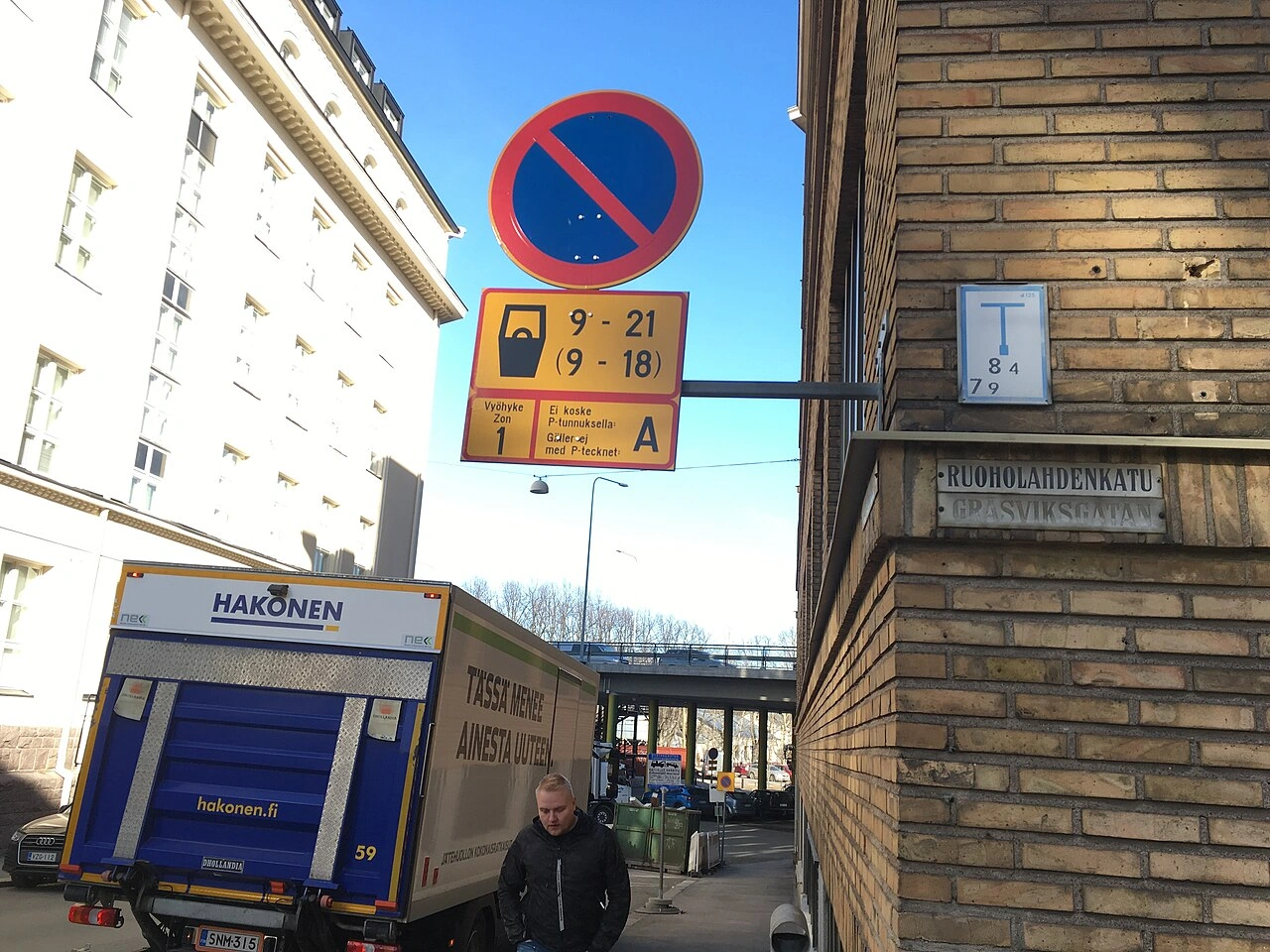
Wikimedia.org • Eric Fischer • CC BY
Which sign prohibits parking in Finland?
Finland uses sign C38 for no parking and sign C39 to begin a parking-prohibited zone. A separate sign, C37, means no stopping; exceptions differ by restriction.
🔗 finlex.fi • Finlex, Finnish Road Traffic Act 729/2018, consolidated text
 Parking prohibited.
English • Traffic sign C38 • No parking. Applies on the side where the sign stands, with the same extent as C37. A plate may indicate permitted parking duration. Does not affect bicycle or moped parking on pavements and cycle paths permitted under section 37(4).
Suomi • Liikennemerkki C38 • Pysäköinti kielletty. Merkillä kielletään ajoneuvon pysäköinti tien sillä puolella, jolle merkki on pystytetty. Merkin vaikutusalue on sama kuin merkin C37. Merkin yhteydessä voidaan sallittu pysäköintiaika osoittaa lisäkilvellä. Merkki ei koske 37 §:n 4 momentissa sallittua polkupyörän ja mopon pysäköintiä jalkakäytävälle ja pyörätielle.
Svenska • Vägmärke C38 • Parkering förbjuden. Märket förbjuder parkering av fordon på den sida av vägen där märket är uppsatt. Märket har samma verkningsområde som märke C37. I samband med märket kan den tillåtna parkeringstiden anges med en tilläggsskylt. Märket gäller inte sådan parkering av cyklar och mopeder på gång- och cykelbanor som är tillåten enligt 37 § 4 mom.
Sources
🔗 Commons.wikimedia.org
🔗 Finlex.fi • Tieliikennelaki 729/2018 • liite 3.3 (FI)
🔗 Commons.wikimedia.org
🔗 Finlex.fi • Vägtrafiklag 729/2018 • bilaga 3.3 (SV)
SVG source: Commons.wikimedia.org • Wikimedia original
Republic of Finland • Public domain • Original revision 2020-05-29. Wikimedia original unmodified.
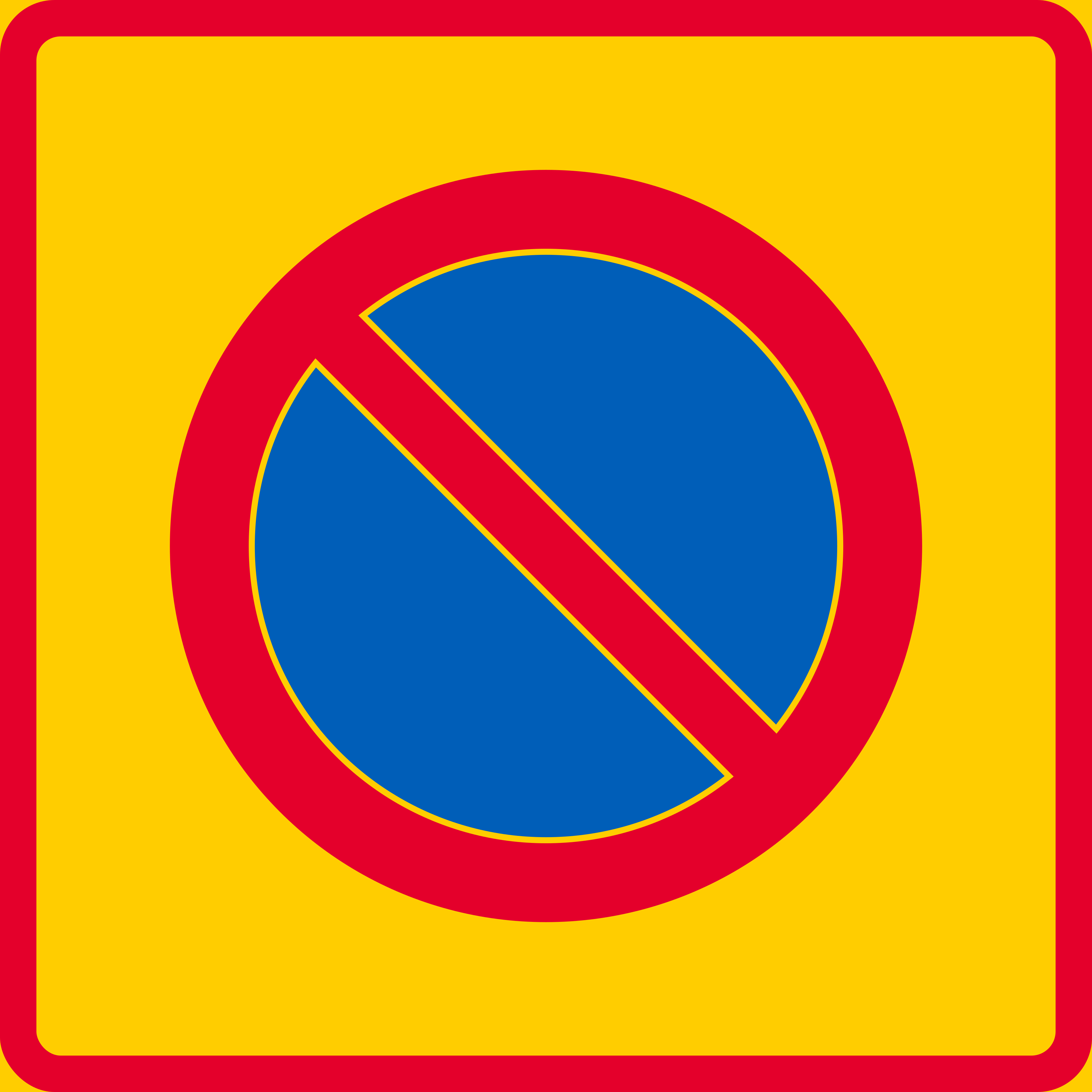 Start of no-parking zone.
English • Traffic sign C39 • No-parking zone. Parking is prohibited within the area bounded by C39 and C40. Separate signs may specify different parking rules inside. Does not affect bicycle or moped parking on pavements permitted under section 37(4).
Suomi • Liikennemerkki C39 • Pysäköintikieltoalue. Merkkien C39 ja C40 rajoittamalla alueella on ajoneuvon pysäköinti kielletty. Alueen sisällä voidaan pysäköinnistä määrätä muuta erillisellä liikennemerkillä. Merkki ei koske 37 §:n 4 momentissa sallittua polkupyörän ja mopon pysäköintiä jalkakäytävälle.
Svenska • Vägmärke C39 • Parkeringsförbudszon. Parkering av fordon är förbjuden på ett område som begränsas av märkena C39 och C40. Med ett särskilt vägmärke kan det inom området bestämmas något annat om parkering. Märket gäller inte sådan parkering av cyklar och mopeder på gångbanor som är tillåten enligt 37 § 4 mom.
Sources
🔗 Commons.wikimedia.org
🔗 Finlex.fi • Tieliikennelaki 729/2018 • liite 3.3 (FI)
🔗 Commons.wikimedia.org
🔗 Finlex.fi • Vägtrafiklag 729/2018 • bilaga 3.3 (SV)
SVG source: Commons.wikimedia.org • Wikimedia original
Republic of Finland • Public domain • Original revision 2020-06-01. Wikimedia original unmodified.
 Parking and stopping prohibited.
English • Traffic sign C37 • No stopping. Prohibits stopping except for an unavoidable traffic obstruction on the side where the sign stands. Applies until the next public-road or street junction, C37–C44, or a parking place marked by E2 or E3, unless a plate limits it sooner. Does not affect stopping on pavements, cycle paths, bus stops or tram stops permitted by the Act.
Suomi • Liikennemerkki C37 • Pysäyttäminen kielletty. Merkillä kielletään ajoneuvon pysäyttäminen muusta syystä kuin pakollisen liikenne-esteen takia tien sillä puolella, jolle merkki on pystytetty. Merkki on voimassa seuraavan maantien tai kadun risteykseen, merkkiin C37–C44 taikka merkillä E2 tai E3 osoitettuun pysäköintipaikkaan asti, jollei lyhyempää vaikutusaluetta ole osoitettu lisäkilvellä. Merkki ei koske tässä laissa sallittua pysäyttämistä jalkakäytävälle, pyörätielle, linja-auton pysäkille ja raitiovaunun pysäkille.
Svenska • Vägmärke C37 • Förbjudet att stanna fordon. Märket förbjuder att av någon annan orsak än tvingande trafikhinder stanna ett fordon på den sida av vägen där märket är uppsatt. Märket gäller fram till följande korsning med landsväg eller gata, fram till något av märkena C37–C44 eller fram till en parkeringsplats som anges med märke E2 eller E3, om inte ett annat kortare verkningsområde har angetts med en tilläggsskylt. Märket avser inte stannande som enligt denna lag är tillåtet på gång- eller cykelbanor eller buss- eller spårvagnshållplatser.
Sources
🔗 Commons.wikimedia.org
🔗 Finlex.fi • Tieliikennelaki 729/2018 • liite 3.3 (FI)
🔗 Commons.wikimedia.org
🔗 Finlex.fi • Vägtrafiklag 729/2018 • bilaga 3.3 (SV)
SVG source: Commons.wikimedia.org • Wikimedia original
Republic of Finland • Public domain • Original revision 2020-05-29. Wikimedia original unmodified.
Does a Finnish no-parking zone end at the next street corner?
No. The zone continues until its end sign. Separate signs within the zone may specify where parking is permitted.
🔗 liikenneturva.fi • Finnish Road Safety Council, parking safely
35. Parallel parking
Parallel parking is a method of parking a vehicle parallel to the edge of the road, usually in a space between two parked vehicles. It is commonly used where parking spaces are arranged along the side of a street.
Parallel parking normally involves positioning the vehicle beside the available space and reversing into it while carefully checking mirrors, blind spots and surrounding traffic. The vehicle should finish within the permitted parking area and close enough to the road edge without obstructing other road users.
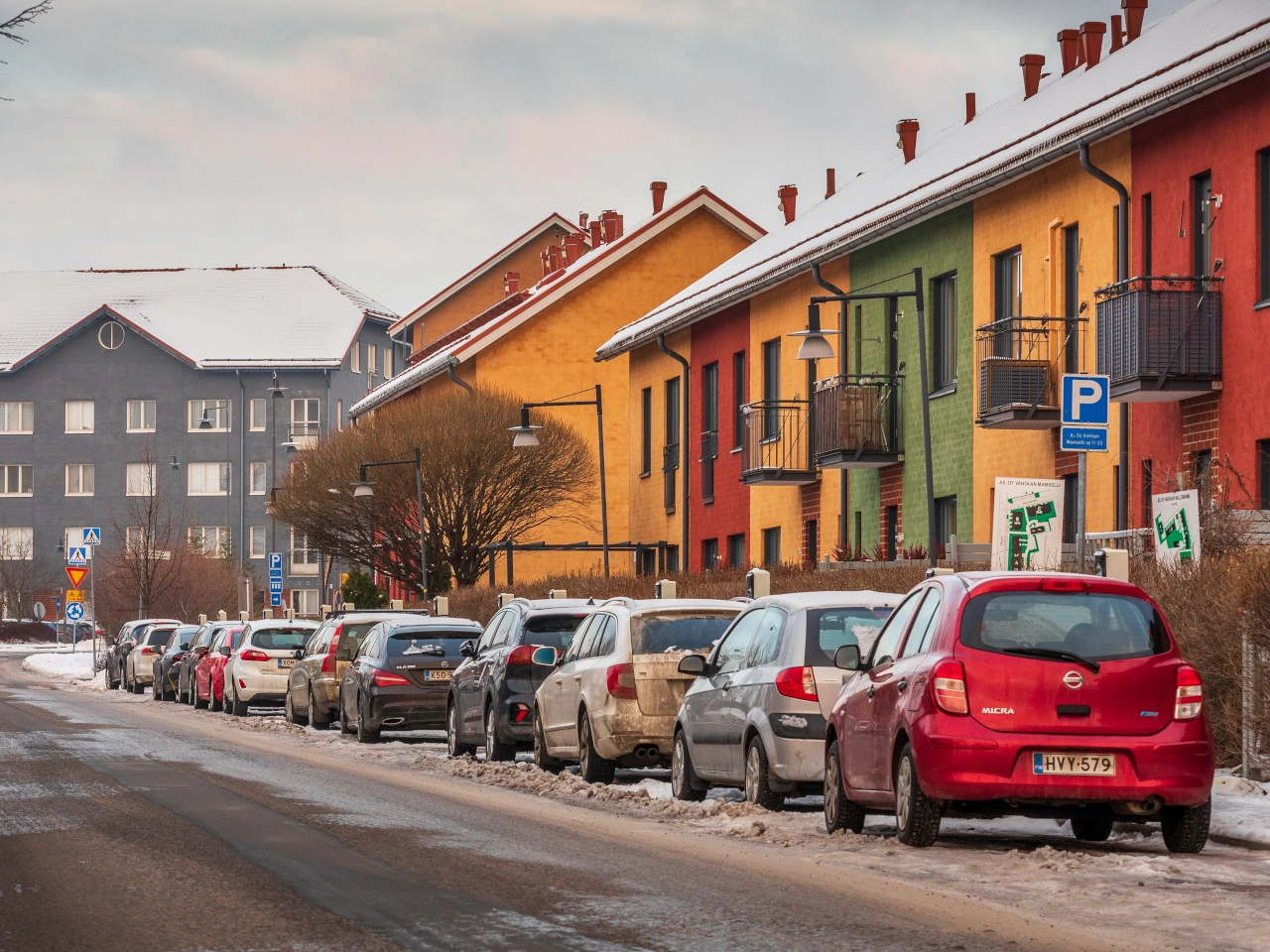
Wikimedia.org • Simo Räsänen • CC BY
How should a vehicle be positioned after parallel parking?
The vehicle should be completely within the permitted parking area, reasonably close to the road edge and positioned so that it does not unnecessarily obstruct traffic or access to other vehicles.
🔗 ris.bka.gv.at • Austria, StVO sections 2, 23–24 and 52
🔗 gov.uk • Great Britain Highway Code, Rules 238–252; national guidance example
🔗 gov.uk • UK Department for Transport, parking-control signs and road markings
🔗 wegcode.be • Belgium, 1975 Road Code, Articles 2 and 23–27
36. Parking disc
A parking disc is a device used to indicate the time a vehicle was parked in an area where parking duration is limited. The driver sets the disc to the required arrival time and displays it clearly inside the vehicle.
Parking-disc systems are commonly used in blue zones or other time-limited parking areas. The permitted parking duration, operating hours and method for setting the disc depend on national or local rules and the traffic signs in place.

Wikimedia.org • Santeri Viinamäki • CC BY-SA
Must the parking start time always be shown with a plastic disc in Finland?
No. Finland requires the start time to be indicated visibly where sign H19 applies; a conventional disc is not the only acceptable way to communicate the time.
🔗 finlex.fi • Finlex, Finnish Road Traffic Act 729/2018, consolidated text
How may the arrival time be rounded in Finland?
You may show the actual arrival time or round it to the next full or half-hour, whichever occurs first. You must not change the recorded start time during the same parking event.
🔗 finlex.fi • Finlex, Finnish Road Traffic Act 729/2018, consolidated text
Do motorcycles need to display a parking start time in Finland?
No. Motorcycles are exempt from indicating the parking start time, but the same parking-duration limits still apply.
🔗 liikenneturva.fi • Finnish Road Safety Council, parking safely
Must you indicate an arrival time when parked entirely outside Finnish disc-control hours?
No. Arrival-time indication is unnecessary if the whole parking period falls outside the signed period requiring it.
🔗 liikenneturva.fi • Finnish Road Safety Council, parking safely
37. Reversing
Reversing means driving a vehicle backwards. It is commonly used when parking, leaving a confined space or repositioning a vehicle where forward movement is not practical.
Before reversing, the driver should check mirrors and blind spots, look carefully around the vehicle and make sure the area behind is clear. Reversing should be performed slowly and only for as long as necessary because visibility behind the vehicle is often limited.
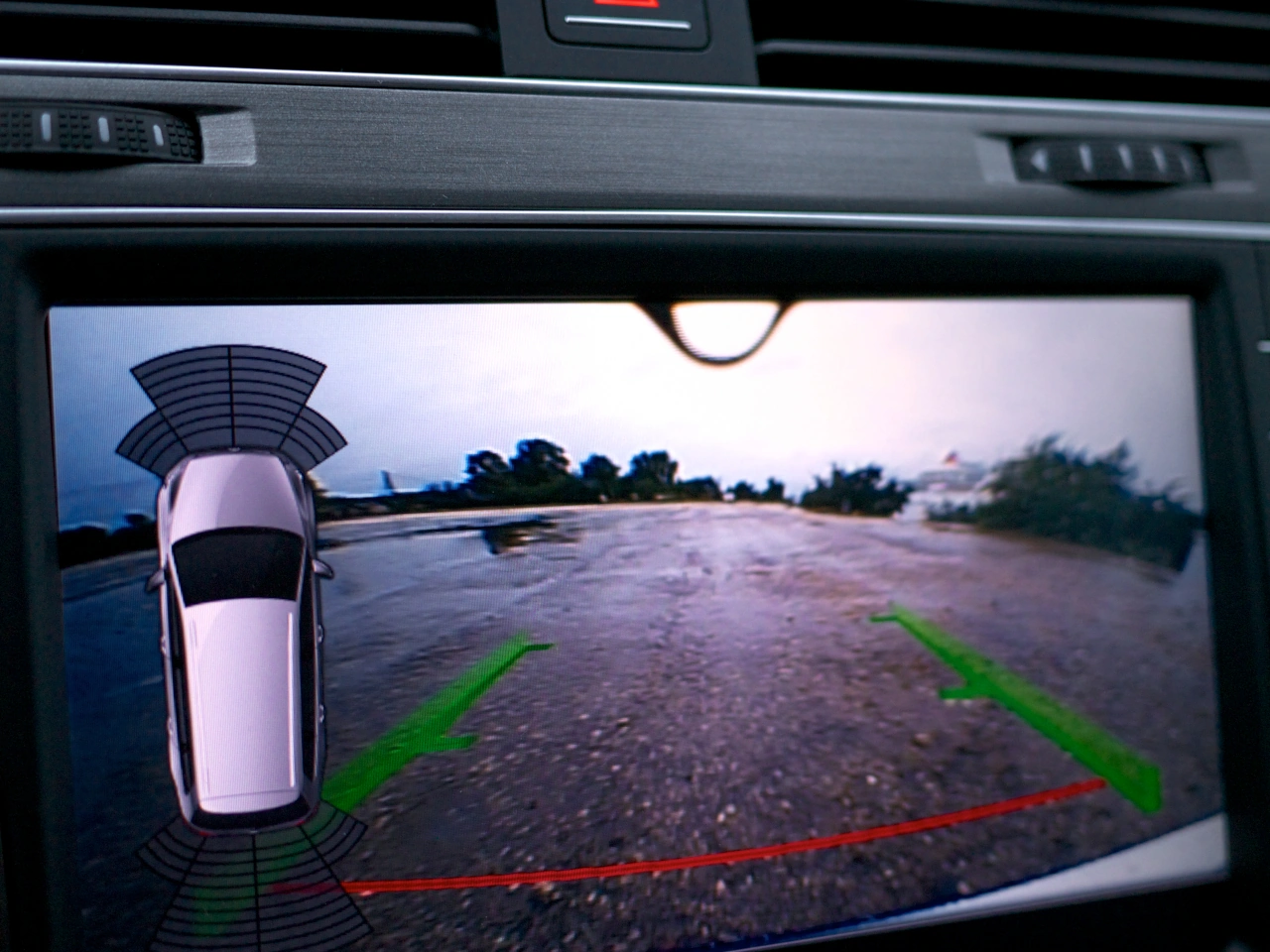
Wikimedia.org • Kārlis Dambrāns • CC BY
When may Finnish drivers reverse or turn around?
Only without endangering safety or unnecessarily obstructing other traffic.
Can you reverse on Finnish motorways?
No. Reversing and U-turns are prohibited on motorways and motor-traffic roads.
38. Uncontrolled crossroad
An uncontrolled crossroad is an intersection where traffic priority is not specifically regulated by traffic lights, an authorised person or signs assigning priority to particular approaches. Drivers must therefore determine who has priority using the default traffic rules that apply in that country.
The applicable rule varies between countries and may include priority from the right, priority from the left or another default right-of-way rule. Drivers should approach an uncontrolled crossroad carefully, observe traffic from every direction and never assume that a wider or busier road automatically has priority.
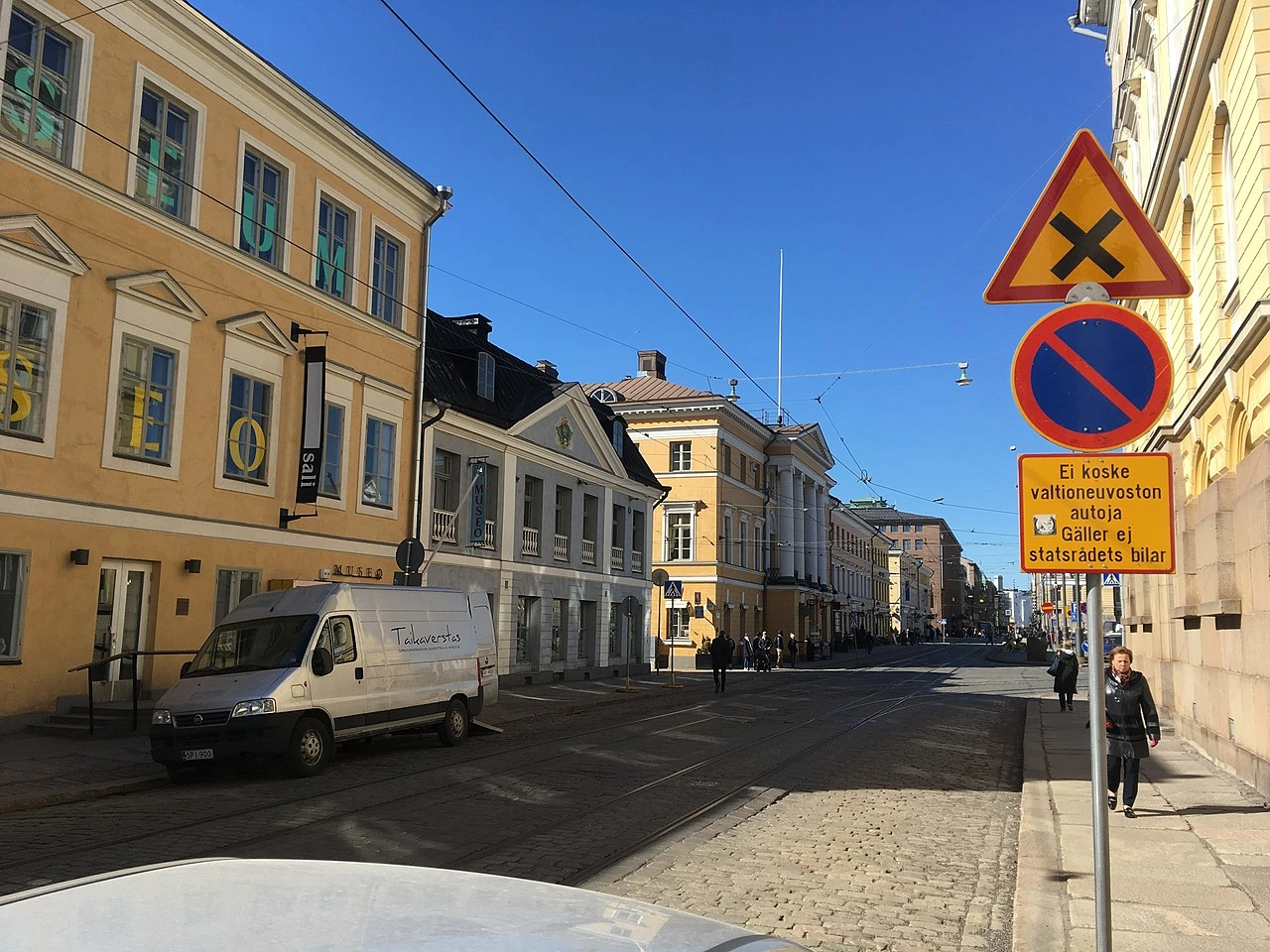
Wikimedia.org • Eric Fischer • CC BY
What is an uncontrolled crossroad?
An uncontrolled crossroad is an intersection where priority is not specifically assigned by traffic lights, an authorised person or priority signs. Drivers must use the default priority rules of the country.
Who has priority at an uncontrolled crossroad?
This depends on the local traffic law. Some countries use priority from the right, while others use different rules. Drivers should know the default intersection rule of the country in which they are driving.
What should you do if you are unsure who has priority?
Reduce speed and be prepared to stop. Never force your way through an intersection simply because the priority situation is unclear.
39. Verge
A verge is the strip of land alongside a roadway, situated between the roadway and features such as a ditch, embankment, property boundary or other roadside area. A verge may be level with the roadway or raised above it and may consist of grass, gravel, soil or another surface.
A verge is normally separate from the roadway, pavement and cycle path. Depending on local traffic law, pedestrians, cyclists or vehicles may be permitted to use a verge in particular circumstances, and specific rules may apply to stopping and parking on it.
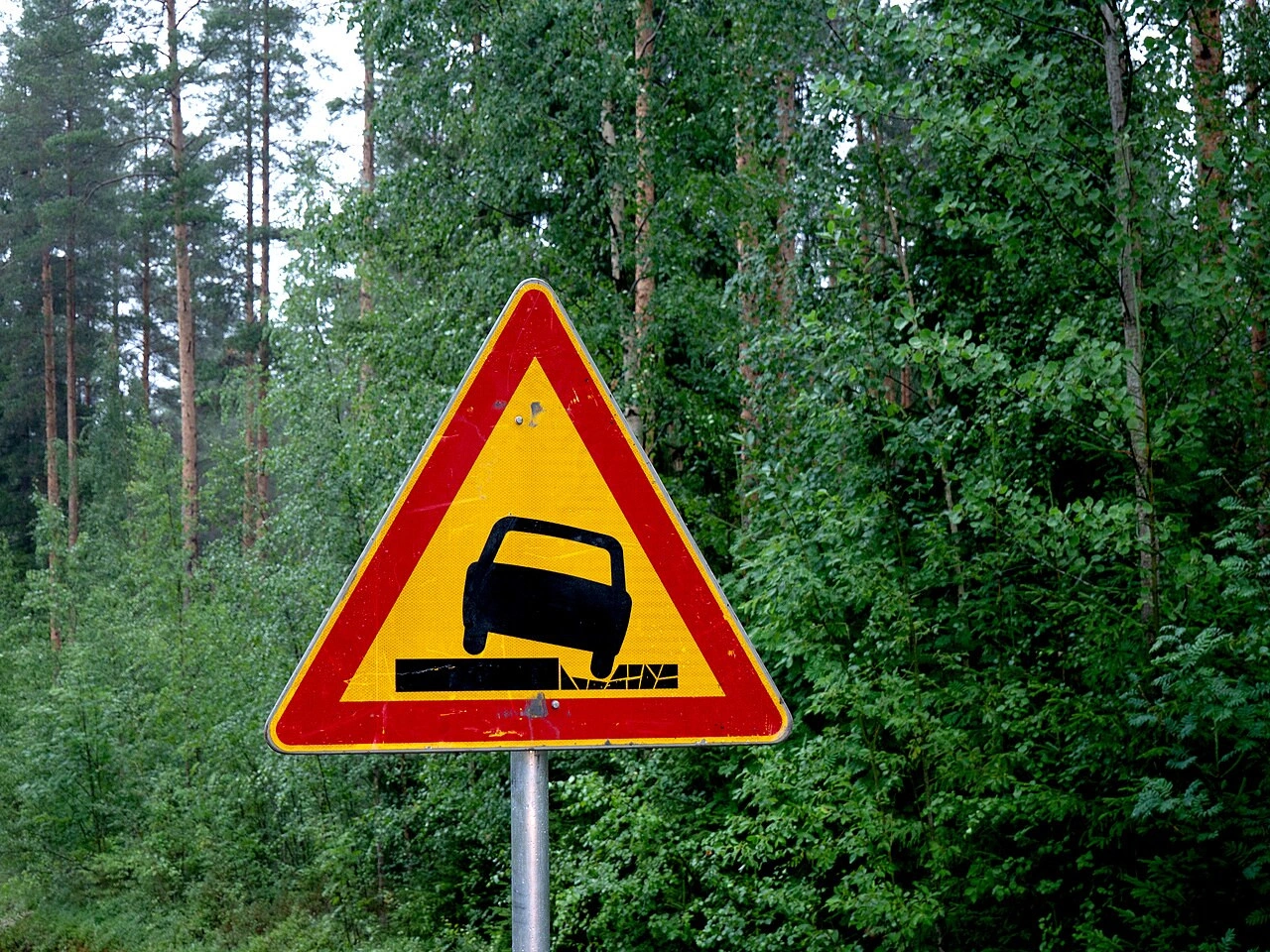
Wikimedia.org • Santeri Viinamäki • CC BY-SA
What is a verge?
A verge is an area alongside a roadway, generally between the roadway and a ditch, embankment, property boundary or other roadside feature.
Can pedestrians walk on a verge?
Yes, where local rules permit or require it. A verge may provide a walking route where no suitable pavement or dedicated pedestrian facility is available.
Should you drive onto a soft verge at high speed?
No. A soft or uneven verge can provide significantly less grip than the roadway and may affect steering or vehicle stability. Reduce speed and return to the roadway safely when possible.
40. City limit
A city limit is a boundary or roadside indication showing that a driver is entering or leaving a named city, town, village, locality or municipality. It is commonly marked by a place-name or boundary sign.
The meaning of these signs varies between countries. A city-limit or locality sign may identify an administrative boundary, a named settlement or a traffic-related boundary. It does not necessarily mark the beginning or end of a legally defined built-up area, and passing the sign does not always change the applicable speed limit or other traffic rules.

Wikimedia.org • Powerresethdd • CC BY-SA
What is a city limit?
A city limit identifies the boundary of a named city, town or municipality. A roadside place-name or boundary sign may identify that boundary, a locality or a legally defined built-up area; its exact meaning depends on the sign system.
🔗 gov.uk • UK Department for Transport, Know Your Traffic Signs, boundary signs
 City limit.
 End of city limit.
Does a city-limit sign always mark a built-up area?
No. A city-limit or locality sign may simply identify a place or administrative boundary. A legally defined built-up area can use a different sign or definition.
🔗 gov.uk • UK Department for Transport, Know Your Traffic Signs, boundary signs
What is the difference between a city limit and a built-up area?
A city limit identifies the boundary of a named place or administrative area. A built-up area is a traffic-law concept that may affect rules such as default speed limits. The two boundaries can coincide, but they do not have to.
🔗 gov.uk • UK Department for Transport, Know Your Traffic Signs, boundary signs
41. Licence plate
A licence plate, also called a registration plate or number plate, is a plate displaying a unique registration identifier assigned to a vehicle by the competent registration authority. It allows the vehicle to be identified for purposes such as registration, traffic enforcement, taxation, insurance and parking control.
The appearance, format, placement and number of plates required vary between countries and vehicle categories. Drivers must ensure that required licence plates are correctly fitted, clearly visible and legible and must follow the local rules when a plate is lost, stolen, damaged or replaced.

Wikimedia.org • Markus Säynevirta • CC BY-SA
What is a licence plate?
A licence plate is a plate displaying the registration identifier assigned to a vehicle. It allows authorities and other authorised systems to identify the vehicle's registration.
Is a licence plate the same as a registration plate?
Yes. Licence plate, registration plate and number plate are different terms commonly used for the plate displaying a vehicle's official registration number.
What should you do if a licence plate is lost or stolen?
Follow the local reporting and replacement procedure. For example, UK guidance says stolen plates should be reported to the police and DVLA, and replacement plates are needed before driving. Check the registration authority’s procedure for a lost plate; it may differ from the theft process.
42. Charging station
A charging station is a location equipped with one or more charging points where the battery of an electric or plug-in hybrid vehicle can be connected to an electricity supply and recharged. Charging stations may be located along public roads, in car parks, at service areas or on private property.
Charging spaces may be reserved for vehicles that are charging and can be subject to parking restrictions, time limits, payment requirements or other conditions. Drivers must follow the traffic signs, parking regulations and charging instructions applying at the location.
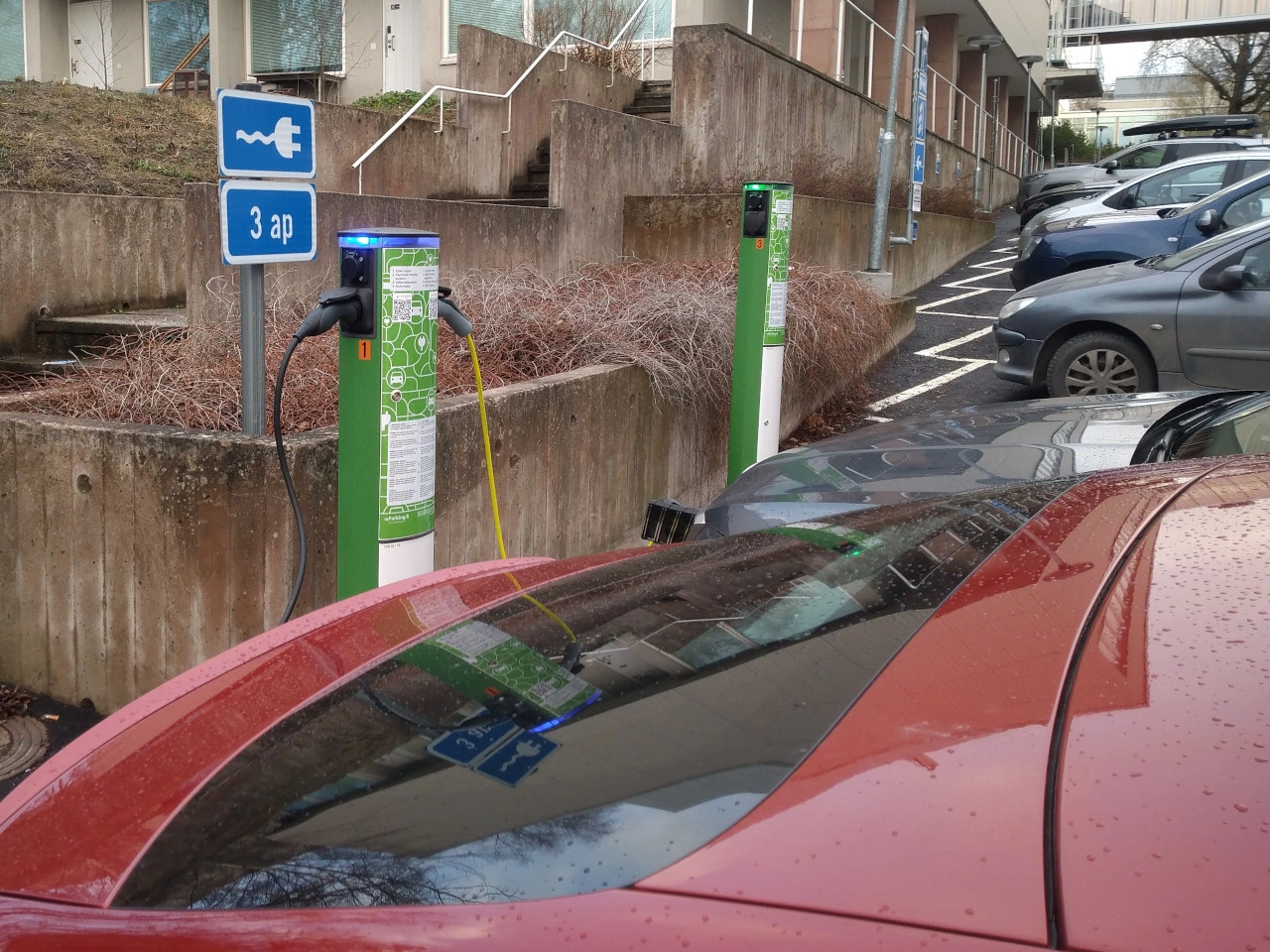
Wikimedia.org • LPfi • CC BY-SA
What is a charging station?
A charging station is a location where electric vehicles can be connected to an electricity supply to recharge their batteries. A station may contain one or several individual charging points.
🔗 tfl.gov.uk • Transport for London, electric vehicles and charging points; London example
Who can use an electric-vehicle charging station?
Charging stations are intended for vehicles that can be externally charged, such as battery-electric vehicles and plug-in hybrid vehicles. The exact vehicle categories permitted may be indicated by local signs or operator conditions.
🔗 tfl.gov.uk • Transport for London, electric vehicles and charging points; London example
Can a charging station have a maximum parking time?
Yes. Traffic signs, parking regulations or charging conditions may establish a maximum duration to encourage drivers to move their vehicles and make the charger available to others.
🔗 tfl.gov.uk • Transport for London, electric vehicles and charging points; London example
43. Dangers
A general danger warning sign warns road users of a hazard ahead that is not represented by a more specific warning sign. The particular danger may be explained by a supplementary panel, text, symbol or other indication placed with the warning sign.
Drivers should increase their attention, observe the road ahead and adapt their speed to the nature of the hazard and surrounding conditions. The exact appearance of the sign and the way the danger is identified vary between countries, so road users must follow the local traffic signs and regulations.
Wikimedia.org • JIP • CC BY-SA
What does a general danger warning sign mean?
A general danger warning sign indicates that there is a hazard ahead that is not represented by a more specific warning sign in the local traffic-sign system.
 Warning for a danger with no specific traffic sign.
What should you do when you see a general danger warning sign?
Increase your attention, observe the road and surroundings carefully and adapt your speed where necessary so that you can respond safely to the hazard.
Does the sign impose a specific speed limit?
Not normally. A warning sign alerts road users to danger rather than establishing a numerical speed limit. A separate speed-limit sign may be provided where a specific maximum speed is required.
44. Pedestrian
A pedestrian is a person travelling on foot along or across a road, street, path or other public space. Depending on local traffic law, people pushing bicycles, wheelchairs, prams or certain other small devices may also be treated as pedestrians.
Pedestrians normally use pavements, sidewalks, footpaths and pedestrian areas where these are available. When crossing a road or walking where no suitable pedestrian facility exists, they must follow the applicable crossing rules, traffic lights and other local traffic regulations.
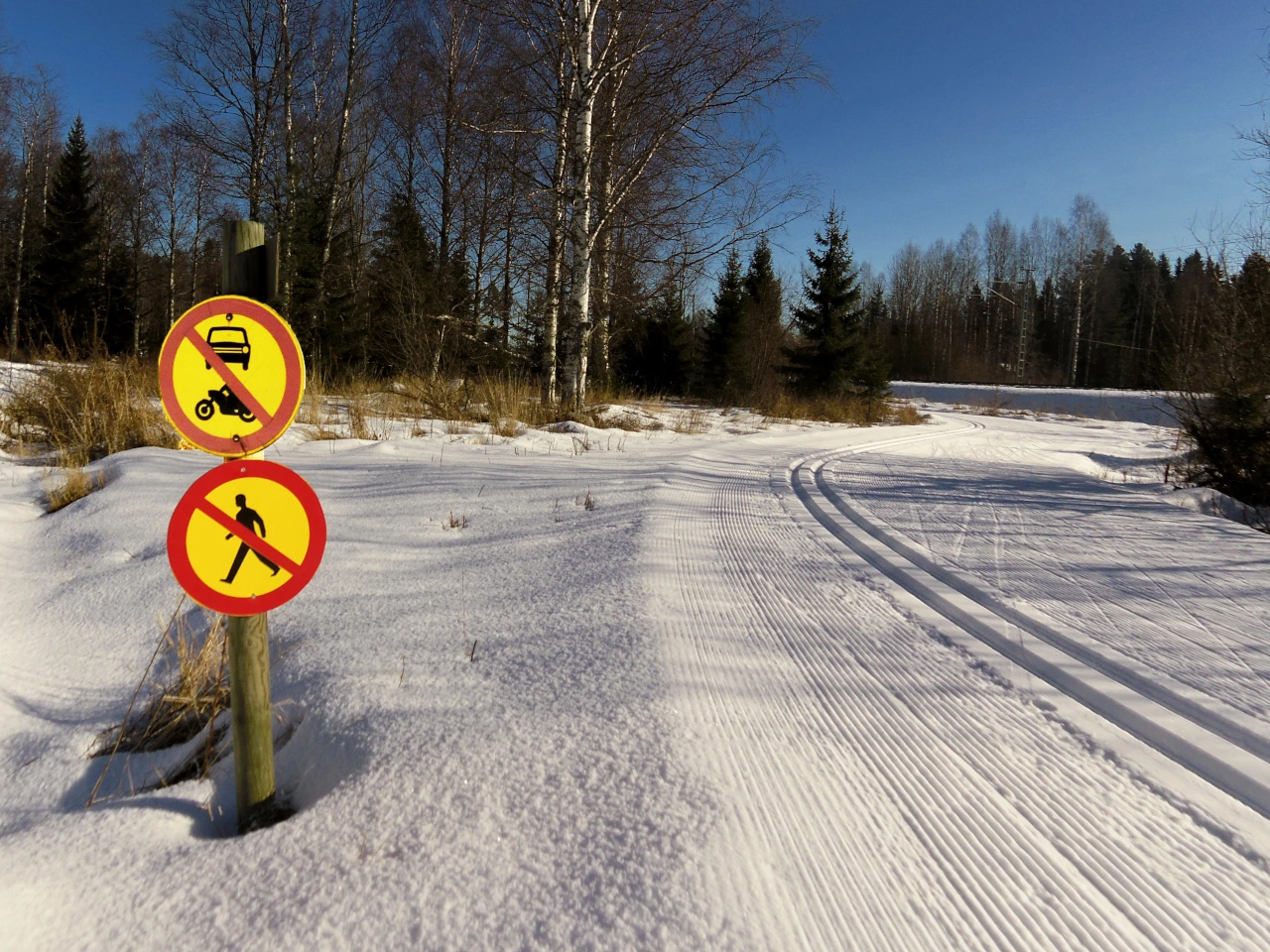
Wikimedia.org • Tiia Monto • CC BY-SA
What is a pedestrian?
A pedestrian is primarily a person travelling on foot. Local traffic laws may also treat people pushing bicycles, wheelchairs, prams or certain other devices as pedestrians.
Which side of the road should pedestrians walk on when there is no pavement?
This depends on the country's traffic rules. Many countries require or recommend pedestrians to face approaching traffic, but the exact rule varies.
Do pedestrians always have priority at a pedestrian crossing?
The exact priority rule varies between countries. Drivers are commonly required to give way to pedestrians using or entering designated crossings, but pedestrians must still obey traffic lights and avoid entering the road dangerously.
45. Cyclist
A cyclist is a person who rides and controls a bicycle. Cyclists are road users and, in many countries, bicycles are legally treated as vehicles, meaning cyclists must follow many of the same traffic rules that apply to other drivers together with rules specifically intended for cycling.
Cyclists should use designated cycling facilities where required, obey traffic signs and signals and ride in a predictable and safe manner. The exact rules governing road position, priority, equipment and permitted cycling areas vary between countries.
Wikimedia.org • Eric Fischer • CC BY
Where should cyclists ride?
This depends on local rules. Cyclists may be required to use a cycle path or designated cycling facility, while in other situations they may ride on the carriageway.
46. Moped
A moped is a lightweight motor vehicle, usually with two or three wheels, whose power, engine capacity or maximum design speed is limited by law. Mopeds generally occupy a legal category between bicycles and motorcycles, although their exact classification varies between countries.
Special rules may apply concerning the minimum riding age, driving licence, helmet, registration, insurance, maximum speed and use of cycle paths or roadways. Riders must therefore follow the classification and traffic regulations applying in the country where they are travelling.
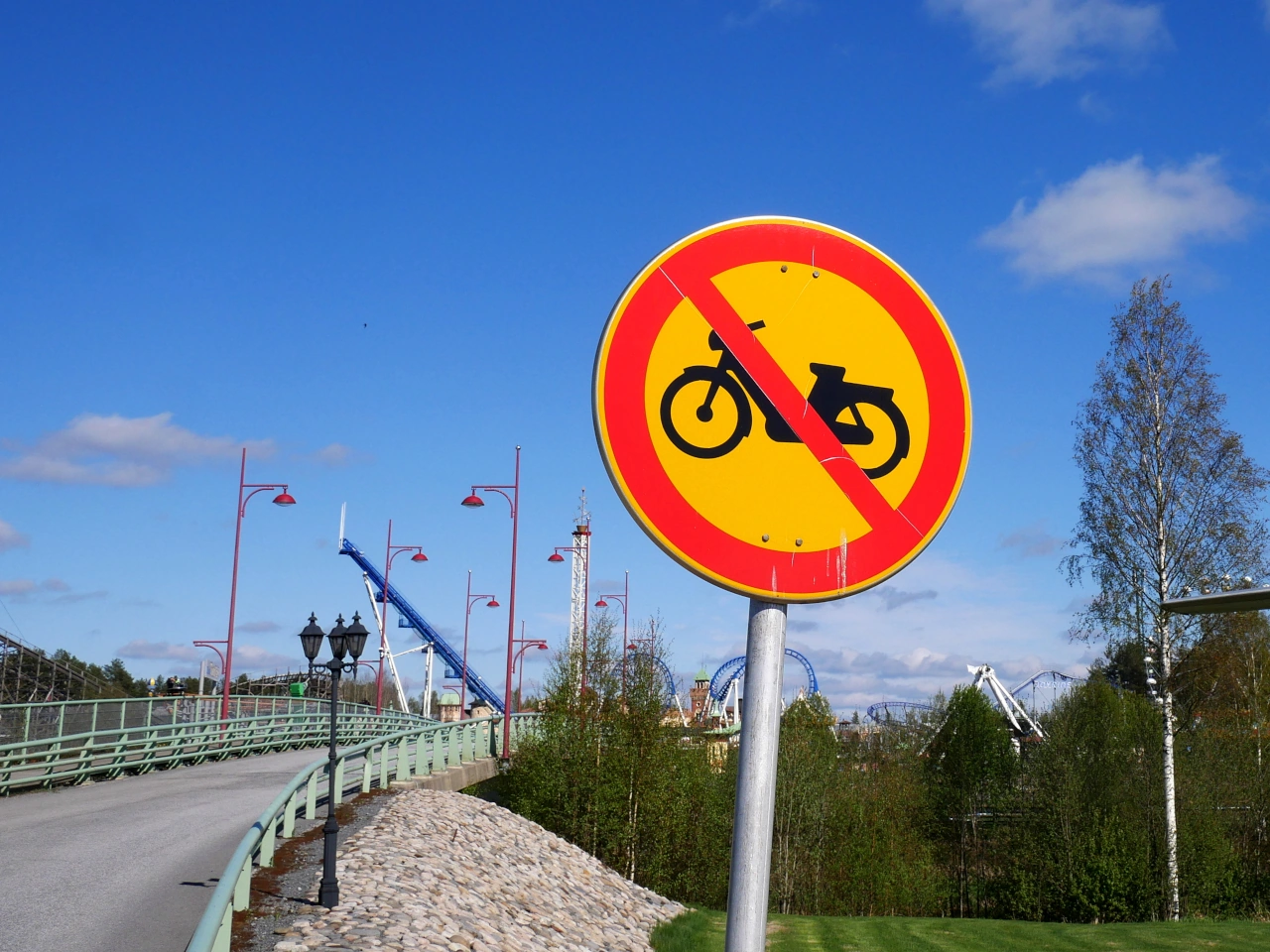
Wikimedia.org • Santeri Viinamäki • CC BY-SA
What is a moped?
A moped is a lightweight motor vehicle whose engine power, capacity or maximum design speed is restricted by law. The precise technical definition differs between countries.
🔗 gov.uk • Great Britain Highway Code, Rules 83–88; national guidance example
🔗 gov.uk • Great Britain Highway Code, Rules 221–223; national guidance example
Is a moped the same as a motorcycle?
Mopeds commonly form a lower-speed or lower-power vehicle category, but their legal relationship to motorcycles varies. Some traffic laws treat certain mopeds as motorcycles or apply other special rules. Check the local technical, access and licensing definitions.
🔗 gov.uk • Great Britain Highway Code, Rules 83–88; national guidance example
🔗 gov.uk • Great Britain Highway Code, Rules 221–223; national guidance example
Do moped riders have to wear a helmet?
Helmet requirements vary between countries, but an approved protective helmet is compulsory for moped riders in many jurisdictions. Passengers may also be required to wear one.
🔗 gov.uk • Great Britain Highway Code, Rules 83–88; national guidance example
🔗 gov.uk • Great Britain Highway Code, Rules 221–223; national guidance example
47. Bus
A bus is a motor vehicle designed to transport multiple passengers, usually along roads as part of public transport, school transport, private transport or another passenger service. Buses generally have more passenger capacity than cars and may be designed to carry seated passengers, standing passengers or both.
Special rules may apply to buses concerning the driving licence, passenger capacity, speed limits, seat belts, bus lanes, stops and passenger boarding. The legal classification of buses and coaches and the rules applying to them vary between countries, so drivers and passengers must follow the local traffic regulations.
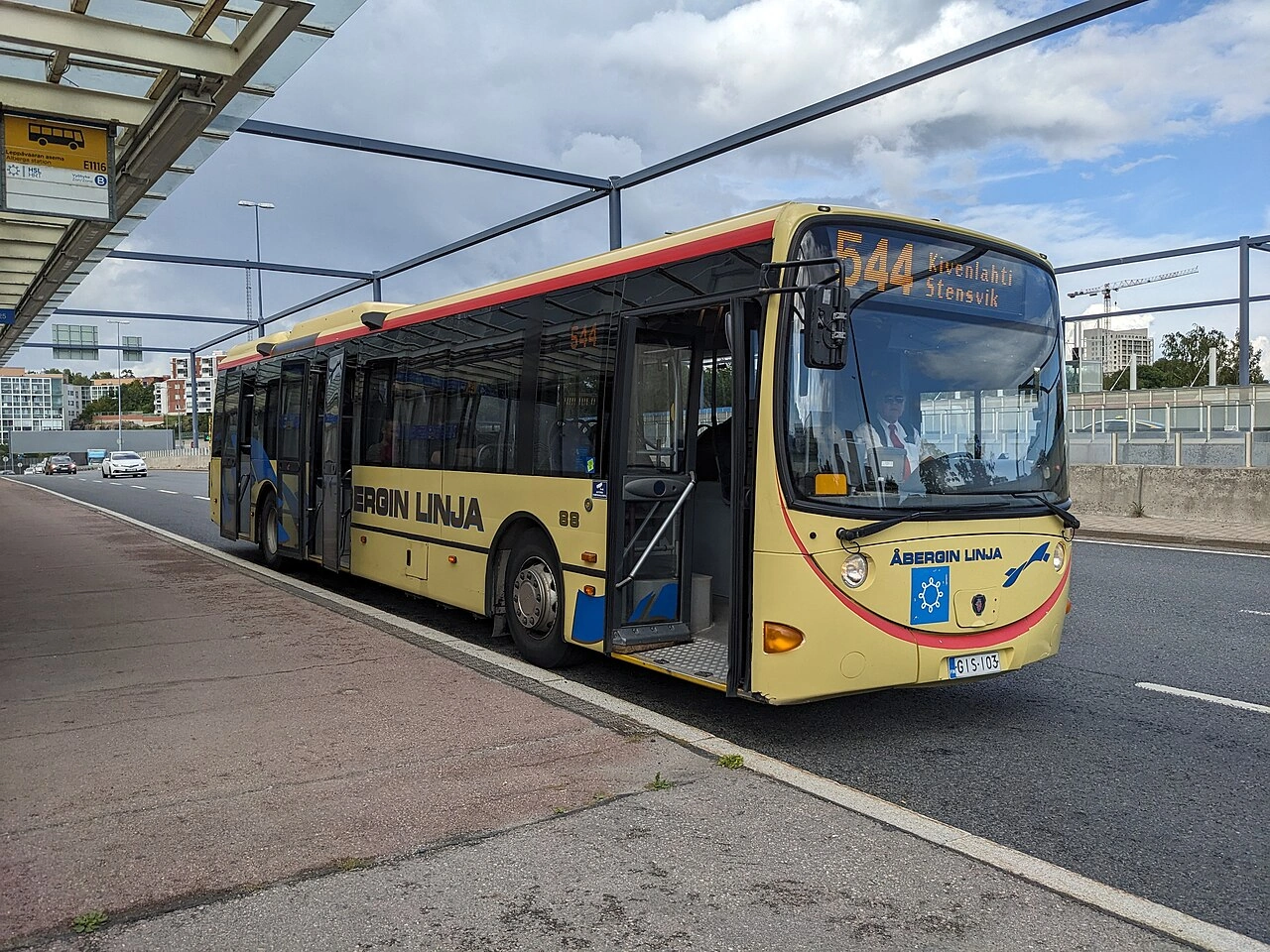
Wikimedia.org • Asematunneli2 • CC0
What is a bus?
A bus is a motor vehicle designed to transport a relatively large number of passengers. It may be used for public transport, school transport, private services or other passenger transport.
🔗 gov.uk • Great Britain Highway Code, Rules 83–88; national guidance example
🔗 gov.uk • Great Britain Highway Code, Rules 221–223; national guidance example
Do buses always have priority when leaving a bus stop?
No. Some countries require other drivers to give way to buses leaving designated stops, particularly in urban areas, while others apply the normal merging rules.
🔗 gov.uk • Great Britain Highway Code, Rules 83–88; national guidance example
🔗 gov.uk • Great Britain Highway Code, Rules 221–223; national guidance example
Do buses have special speed limits?
They can. Some countries impose lower maximum speeds on buses than on passenger cars, particularly on high-speed roads. Different limits may apply to buses and coaches.
🔗 gov.uk • Great Britain Highway Code, Rules 83–88; national guidance example
🔗 gov.uk • Great Britain Highway Code, Rules 221–223; national guidance example
48. Police
Police are public authorities responsible for enforcing laws, maintaining public safety and managing situations that may affect road traffic. In traffic, police officers may control vehicles, enforce traffic rules, investigate collisions, direct traffic and respond to emergencies.
Road users must follow lawful instructions given by police officers or other authorised traffic-control personnel. Police directions may temporarily override traffic lights, road signs or normal traffic arrangements, depending on local law.
Wikimedia.org • Dickelbers • CC BY-SA
What is the role of police in road traffic?
Police help enforce traffic law, investigate collisions and respond to risks on the road. For example, Greater Manchester Police describe targeted road enforcement, a round-the-clock roads-policing response and specialist serious-collision investigation. Exact responsibilities and powers vary by jurisdiction.
🔗 gmp.police.uk • Greater Manchester Police, Roads Policing Strategy2024–2026
Must you obey a police officer directing traffic?
Yes. Lawful directions given by an authorised police officer must be followed. In many countries, those directions take precedence over traffic lights, road signs and normal priority rules.
What should you do if police signal you to stop?
Slow down, follow the officer's directions and stop at a safe location as instructed. Do not make sudden movements or continue driving unless directed to do so.
49. Ambulance
An ambulance is a vehicle equipped and used to provide emergency medical assistance or transport patients to or between healthcare facilities. Ambulances may carry medical equipment and trained personnel who can provide treatment during transport.
During an emergency response, an ambulance may use warning lights and a siren and may receive special priority or exemptions from certain traffic rules. Other road users must follow the local rules for emergency vehicles, make sufficient space and avoid obstructing their passage.
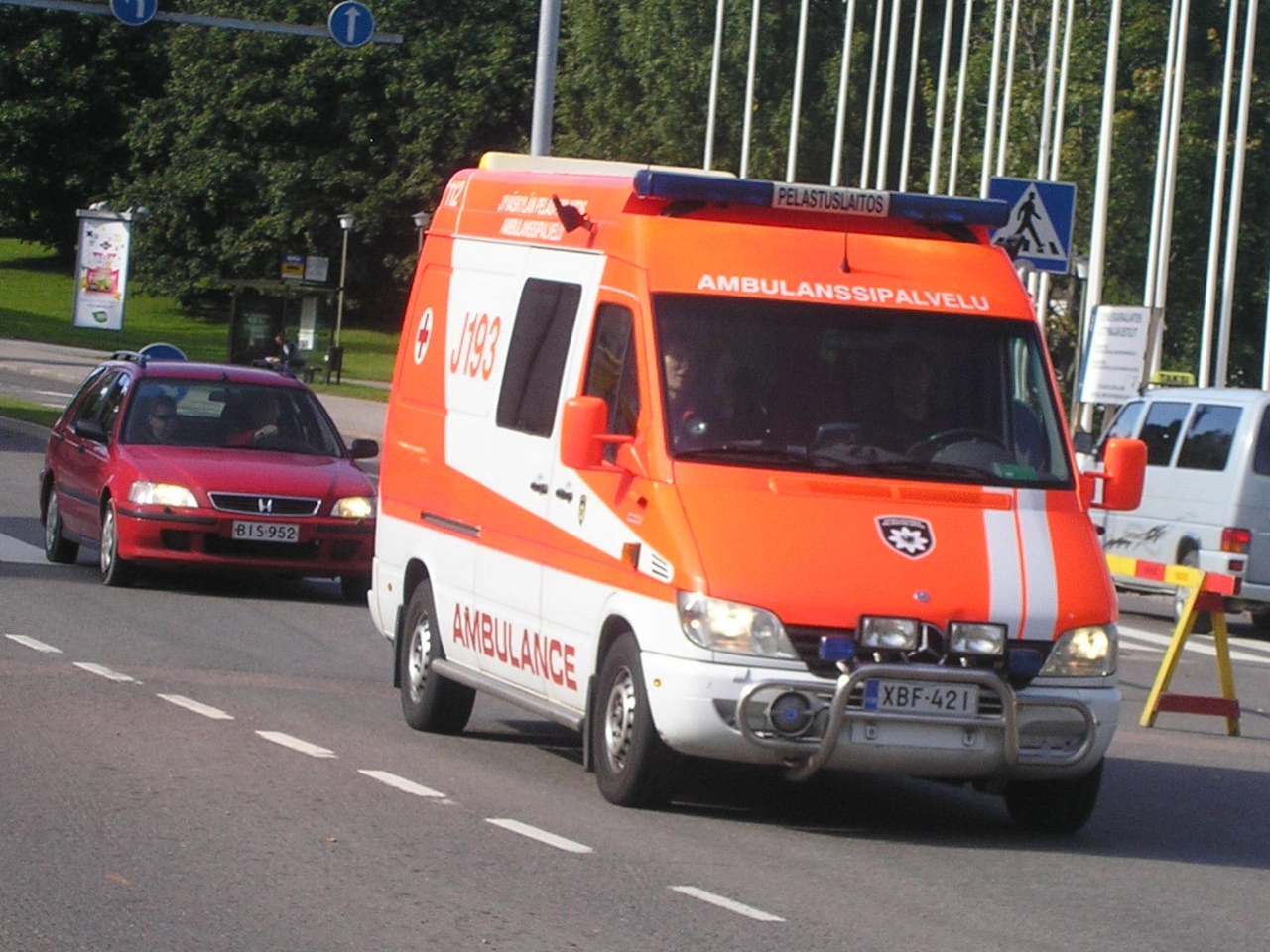
Wikimedia.org • Antti Leppänen • CC BY-SA
What is an ambulance?
An ambulance is a specially equipped vehicle used to provide emergency medical assistance and transport sick or injured people.
🔗 gov.uk • Great Britain Highway Code, Rule 219, emergency vehicles; national guidance example
What should you do when an ambulance approaches?
Make space safely for an ambulance on an emergency response, following the local rules and any lawful directions. Slow down or stop where necessary without sudden or dangerous movements. Do not assume that its emergency status allows you to pass a red light or disregard another traffic control.
🔗 gov.uk • Great Britain Highway Code, Rule 219, emergency vehicles; national guidance example
Can an ambulance exceed the speed limit?
Many countries permit emergency vehicles to depart from certain normal speed rules during an urgent mission, subject to safety requirements and national legislation.
🔗 gov.uk • Great Britain Highway Code, Rule 219, emergency vehicles; national guidance example
50. Tram lights
Tram lights are special traffic signals used to control the movement of trams and, in some countries, other public-transport vehicles. They are often designed differently from ordinary red, amber and green traffic lights so that public-transport drivers can clearly distinguish the signals intended for them.
The signals may indicate stop, prepare to stop, proceed or proceed only in a specified direction. Their shapes, colours and meanings vary between countries, so road users must follow the local traffic-signal system and regulations.
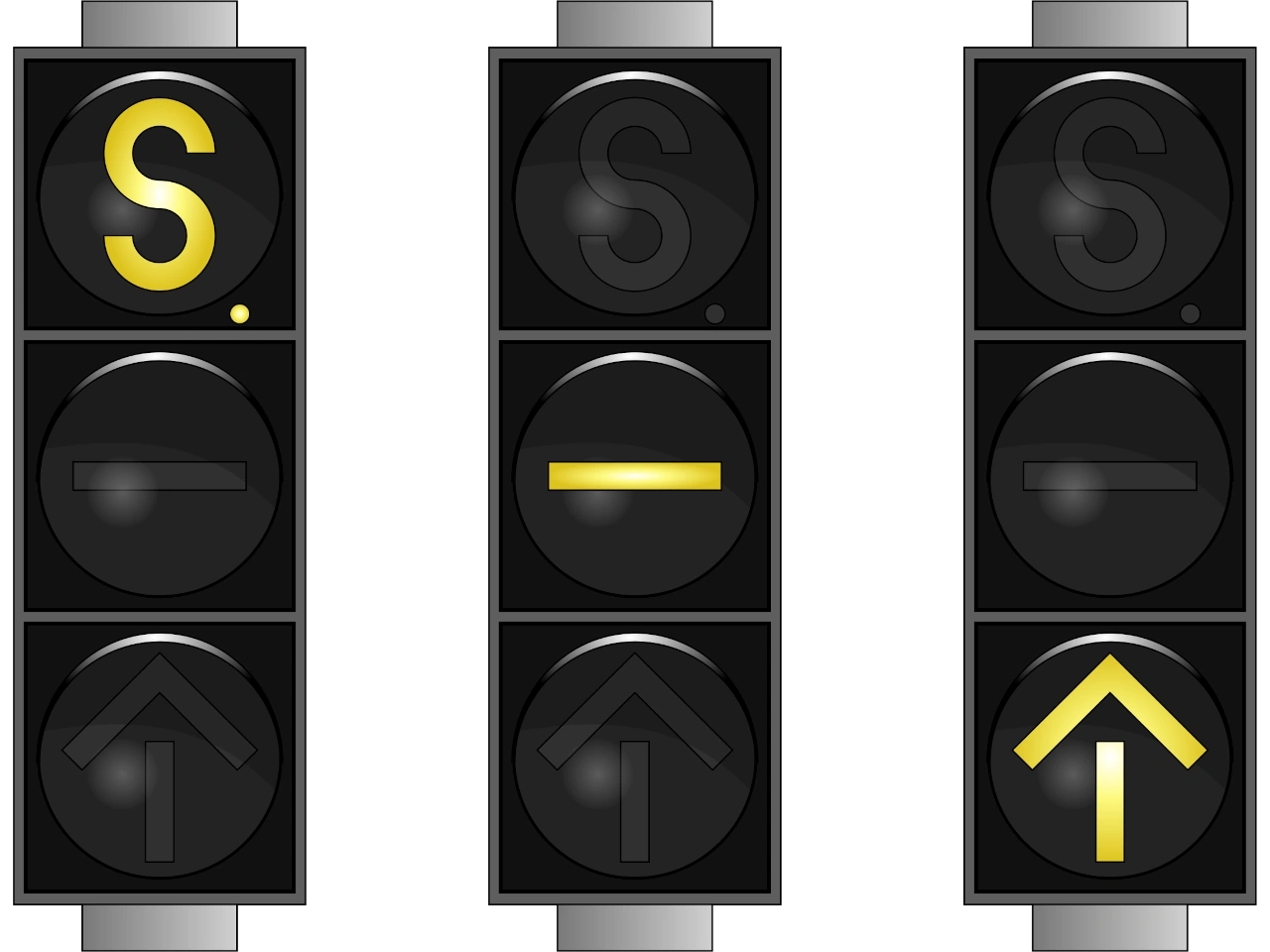
Wikimedia.org • Mysid • CC0
What are tram lights?
Tram lights are special traffic signals used to control trams and sometimes other authorised public-transport vehicles.
🔗 gov.uk • Great Britain Highway Code, Rules 300–307; national guidance example
Can cyclists ever have to follow tram lights?
In some road layouts, cyclists or other authorised users may share infrastructure controlled by public-transport signals. Whether those signals apply to them depends on local traffic law and signage.
🔗 gov.uk • Great Britain Highway Code, Rules 300–307; national guidance example
Do tram lights replace normal priority rules for everyone?
No. They primarily regulate the vehicles to which they apply. Other road users must continue to obey their own traffic lights, signs and applicable priority rules.
🔗 gov.uk • Great Britain Highway Code, Rules 300–307; national guidance example