


Priority signsFrance
 Traffic rules
 France
 Priority signs
 Warning signs
 Prohibitory signs
 Mandatory signs
 Information signs
 Additional signs
Priority signs
A priority sign is a traffic sign that indicates the order in which vehicles shall pass intersection points. Vehicles often come into conflict with other vehicles and pedestrians because their intended courses of travel intersect, and thus interfere with each other's routes. The general principle that establishes who has the right to go first is called 'right of way' or 'priority'. It establishes who has the right to use the conflicting part of the road and who has to wait until the other does so. The vehicle that does not need to wait is said to 'have the right of way' or to 'have priority.'


What should I know about priority signs in France?
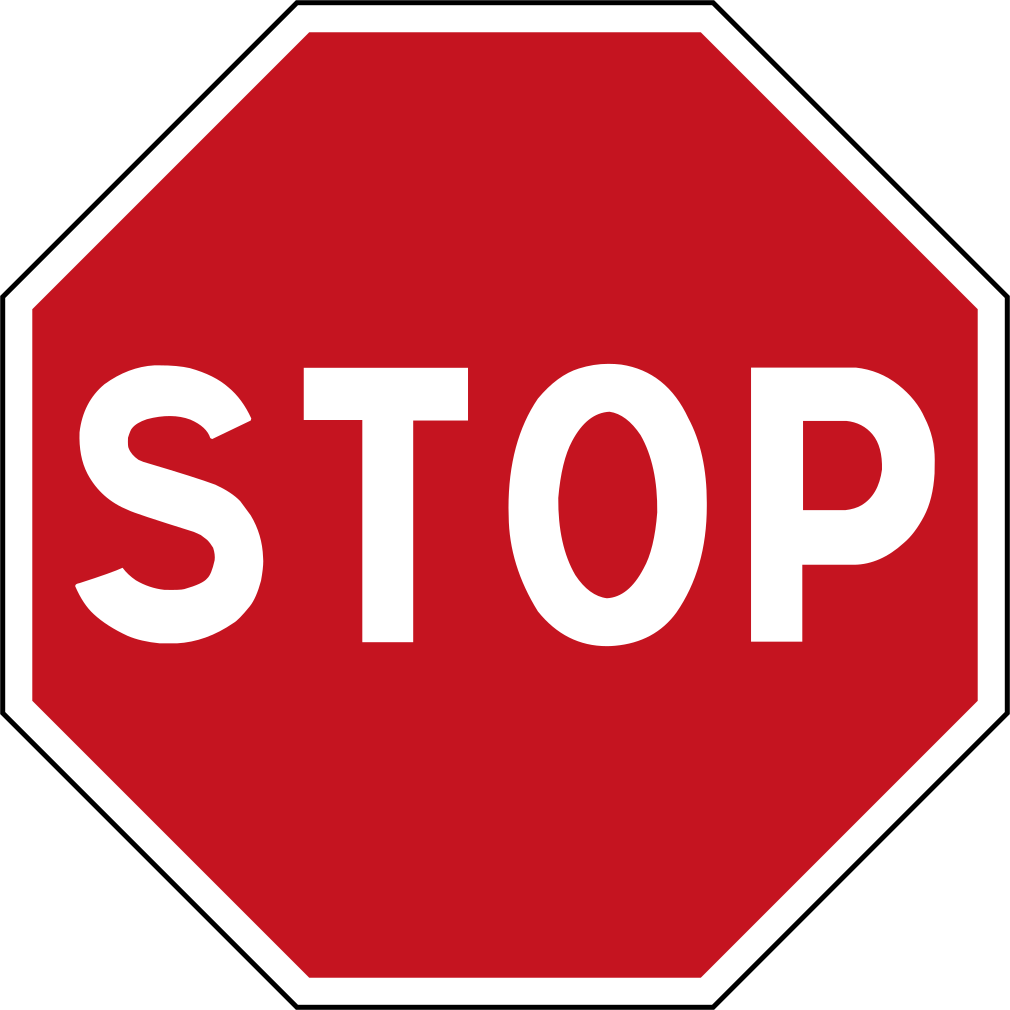
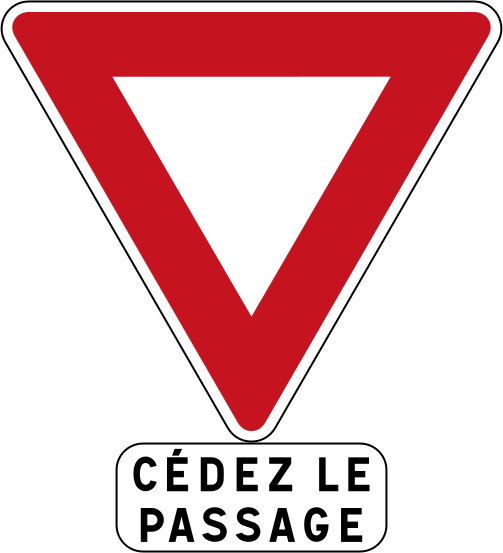
AB signs cover priority: AB3a is give way and AB4 is STOP. Apply the specific stopping or yielding duty.
🔗 equipementsdelaroute.cerema.fr • Cerema current IISR part 3 consolidation
Give way.
English • Traffic sign AB3a • Give way at the junction. Sign at the junction. Supplementary plate M9c • Bearing the inscription ‘Give way’.
Français • Panneau AB3a • Cédez le passage à l'intersection. Signal de position. Panonceau M9c • Portant l'inscription " Cédez le passage ".
Sources
🔗 Commons.wikimedia.org
🔗 Equipementsdelaroute.cerema.fr • Arrêté du 24 novembre 1967
© Roulex 45 et les contributeurs Wikimedia • CC BY-SA 3.0 • SVG original non modifié.
Image via Commons.wikimedia.org
Roulex 45 • CC BY-SA 3.0 • Source revision 2014-02-21. Wikimedia original unmodified.
Stop and give way.
English • Traffic sign AB4 • Stop at the junction under the conditions defined in article R 415-6 of the Highway Code. Sign at the stopping point.
Français • Panneau AB4 • Arrêt à l'intersection dans les conditions définies à l'article R 415-6 du code de la route. Signal de position.
Sources
🔗 Commons.wikimedia.org
🔗 Equipementsdelaroute.cerema.fr • Arrêté du 24 novembre 1967
© Roulex 45 et les contributeurs Wikimedia • CC BY-SA 3.0 • SVG original non modifié.
Image via Commons.wikimedia.org
Roulex 45 • CC BY-SA 3.0 • Source revision 2022-07-28. Wikimedia original unmodified.
Must you always stop when giving way in France?
No. A give-way control requires stopping when necessary to yield or obtain a safe view. A stop sign requires a complete stop even if the road appears empty.
🔗 legifrance.gouv.fr • French Road Code — R415-5–7; 1967 order AB3a/AB4

1. Stop and give way
This traffic sign means stop and give way. You must come to a complete stop before entering the intersection and give way to traffic that has priority. Proceed only when it is safe.
English • Traffic sign AB4 • Stop at the junction under the conditions defined in article R 415-6 of the Highway Code. Sign at the stopping point.
Français • Panneau AB4 • Arrêt à l'intersection dans les conditions définies à l'article R 415-6 du code de la route. Signal de position.
Sources
🔗 Commons.wikimedia.org
🔗 Equipementsdelaroute.cerema.fr • Arrêté du 24 novembre 1967
© Roulex 45 et les contributeurs Wikimedia • CC BY-SA 3.0 • SVG original non modifié.
Image via Commons.wikimedia.org
Roulex 45 • CC BY-SA 3.0 • Source revision 2022-07-28. Wikimedia original unmodified.
2. Give way
This traffic sign means give way. Slow down and give way to traffic that has priority. Stop if necessary and proceed only when it is safe.
English • Traffic sign AB3a • Give way at the junction. Sign at the junction. Supplementary plate M9c • Bearing the inscription ‘Give way’.
Français • Panneau AB3a • Cédez le passage à l'intersection. Signal de position. Panonceau M9c • Portant l'inscription " Cédez le passage ".
Sources
🔗 Commons.wikimedia.org
🔗 Equipementsdelaroute.cerema.fr • Arrêté du 24 novembre 1967
© Roulex 45 et les contributeurs Wikimedia • CC BY-SA 3.0 • SVG original non modifié.
Image via Commons.wikimedia.org
Roulex 45 • CC BY-SA 3.0 • Source revision 2014-02-21. Wikimedia original unmodified.
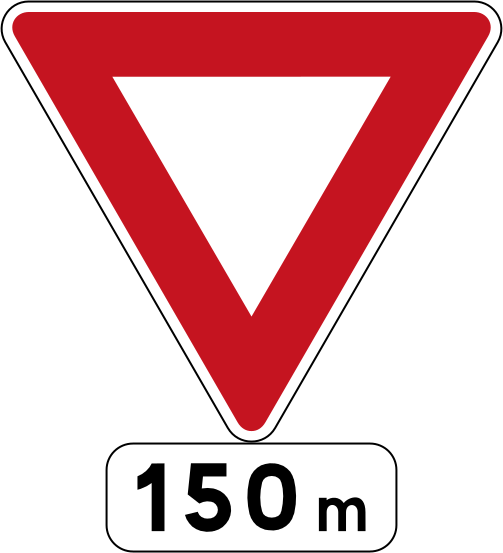
3. Give way ahead
This traffic sign indicates give way ahead. A give-way requirement applies at the location ahead. Reduce speed in good time and be prepared to stop if necessary.
English • Traffic sign AB3b • Give way at the junction. Advance warning. Example shown: in 150 m.
Français • Panneau AB3b • Cédez le passage à l’intersection. Signalisation avancée. Exemple représenté : à 150 m.
Sources
🔗 Commons.wikimedia.org
🔗 Legifrance.gouv.fr • Arrêté du 24 novembre 1967 • article 3 Source : Roulex 45 • CC BY-SA 3.0 • SVG original non modifié.
Image via Commons.wikimedia.org
Roulex 45 • CC BY-SA 3.0 • Source revision 2014-02-21. Wikimedia original unmodified.
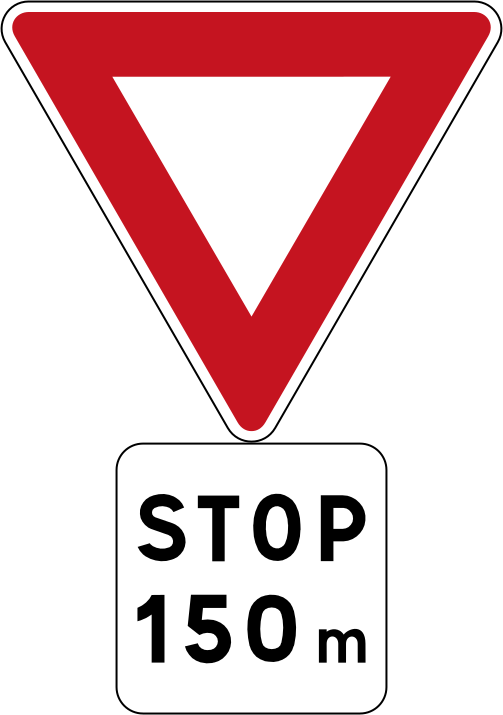
4. Stop and give way ahead
This traffic sign indicates stop and give way ahead. A stop sign applies at the location ahead. Reduce speed in good time and be prepared to come to a complete stop.
English • Traffic sign AB5 • Advance warning of a STOP sign. Used with supplementary plate M5. Example shown: STOP in 150 m.
Français • Panneau AB5 • Annonce du panneau STOP. Signalisation avancée avec panonceau M5. Exemple représenté : STOP à 150 m.
Sources
🔗 Commons.wikimedia.org
🔗 Legifrance.gouv.fr • Arrêté du 24 novembre 1967 • article 3 Source : Roulex 45 • CC BY-SA 3.0 • SVG original non modifié.
Image via Commons.wikimedia.org
Roulex 45 • CC BY-SA 3.0 • Source revision 2014-02-21. Wikimedia original unmodified.
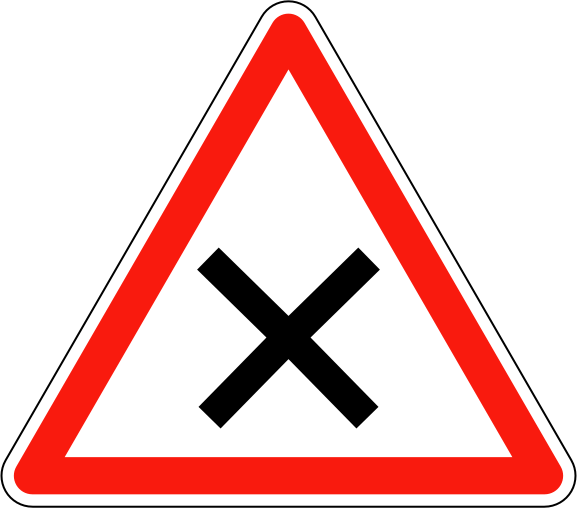
5. Warning for an uncontrolled crossroad
This traffic sign indicates a warning for an uncontrolled crossroad. An intersection without traffic signals or signs assigning priority lies ahead. Reduce speed, watch for traffic approaching from other directions and follow the applicable local priority rules.
English • Traffic sign AB1 • Junction where drivers must give way to vehicles emerging from the road or roads on their right.
Français • Panneau AB1 • Intersection où le conducteur est tenu de céder le passage aux véhicules débouchant de la ou des routes situées à sa droite.
Sources
🔗 Commons.wikimedia.org
🔗 Equipementsdelaroute.cerema.fr • Arrêté du 24 novembre 1967
© Roulex 45 et les contributeurs Wikimedia • CC BY-SA 3.0 • SVG original non modifié.
Image via Commons.wikimedia.org
Roulex 45 • CC BY-SA 3.0 • Source revision 2013-07-05. Wikimedia original unmodified.
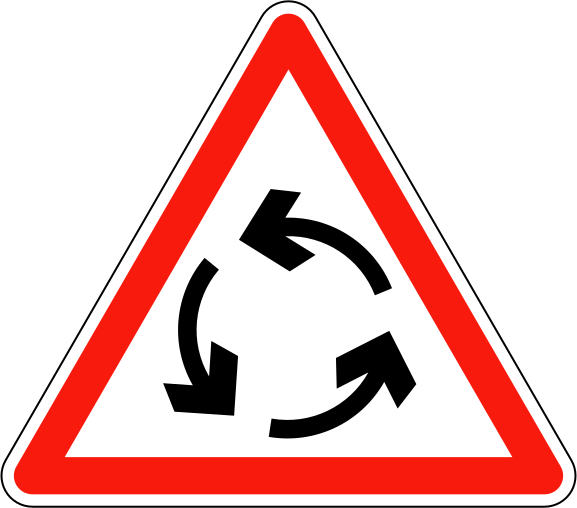
6. Warning for a roundabout
This traffic sign indicates a warning for a roundabout. A roundabout lies ahead. Reduce speed and follow the applicable priority signs, traffic signals and local roundabout rules when approaching and entering it.
English • Traffic sign AB25 • Roundabout. This is the specific sign referred to in article R. 110-2 of the Highway Code.
Français • Panneau AB25 • Carrefour à sens giratoire. Ce panneau constitue la signalisation spécifique mentionnée à l'article R. 110-2 du code de la route.
Sources
🔗 Commons.wikimedia.org
🔗 Equipementsdelaroute.cerema.fr • Arrêté du 24 novembre 1967
© Roulex 45 et les contributeurs Wikimedia • CC BY-SA 3.0 • SVG original non modifié.
Image via Commons.wikimedia.org
Roulex 45 • CC BY-SA 3.0 • Source revision 2013-07-05. Wikimedia original unmodified.
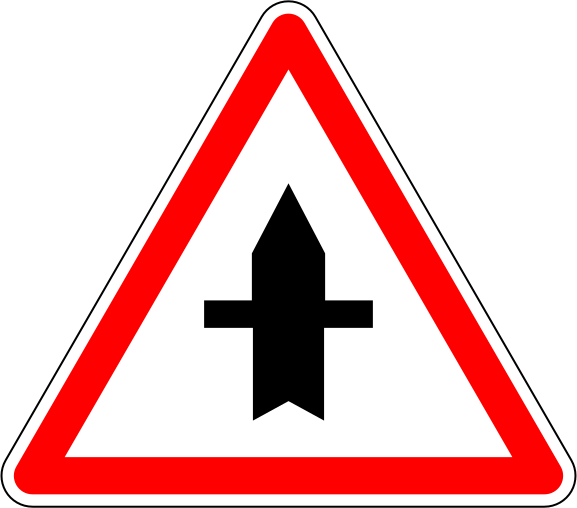
7. Priority at the junction
This traffic sign indicates that you have priority at the next intersection. A side road joins from the left, and traffic entering from that side road must give way.
English • Traffic sign AB2 • Junction with a road whose users must give way, where sign AB 6 cannot be used.
Français • Panneau AB2 • Intersection avec une route dont les usagers doivent céder le passage dans le cas où un panneau AB 6 ne peut être utilisé.
Sources
🔗 Commons.wikimedia.org
🔗 Equipementsdelaroute.cerema.fr • Arrêté du 24 novembre 1967
© Roulex 45 et les contributeurs Wikimedia • CC BY-SA 3.0 • SVG original non modifié.
Image via Commons.wikimedia.org
Roulex 45 • CC BY-SA 3.0 • Source revision 2013-07-05. Wikimedia original unmodified.
8. Road narrowing, give way to oncoming drivers
This traffic sign indicates a road narrowing where you must give way to oncoming traffic. Allow approaching traffic to pass before entering or continuing through the narrow section when required.
English • Traffic sign B15 • Give way to oncoming traffic.
Français • Panneau B15 • Cédez le passage à la circulation venant en sens inverse.
Sources
🔗 Commons.wikimedia.org
🔗 Equipementsdelaroute.cerema.fr • Arrêté du 24 novembre 1967
© Roulex 45 et les contributeurs Wikimedia • CC BY-SA 4.0 • SVG original non modifié.
Image via Commons.wikimedia.org
Roulex 45 • CC BY-SA 4.0 • Source revision 2009-04-24. Wikimedia original unmodified.
9. Start of a priority road
This traffic sign indicates the start of a priority road. Drivers on the priority road normally have priority over traffic entering from side roads until the priority road ends, unless traffic lights, other signs or applicable traffic rules indicate otherwise.
English • Traffic sign AB6 • Indication that a road has priority.
Français • Panneau AB6 • Indication du caractère prioritaire d'une route.
Sources
🔗 Commons.wikimedia.org
🔗 Equipementsdelaroute.cerema.fr • Arrêté du 24 novembre 1967
© Roulex 45 et les contributeurs Wikimedia • CC BY-SA 3.0 • SVG original non modifié.
Image via Commons.wikimedia.org
Roulex 45 • CC BY-SA 3.0 • Source revision 2007-09-18. Wikimedia original unmodified.
10. End of the priority road
This traffic sign indicates the end of the priority road. The road no longer has continuing priority at subsequent intersections. Follow the applicable traffic lights, priority signs and default priority rules.
English • Traffic sign AB7 • End of a road's priority status.
Français • Panneau AB7 • Fin du caractère prioritaire d'une route.
Sources
🔗 Commons.wikimedia.org
🔗 Equipementsdelaroute.cerema.fr • Arrêté du 24 novembre 1967
© Roulex 45 et les contributeurs Wikimedia • CC BY-SA 3.0 • SVG original non modifié.
Image via Commons.wikimedia.org
Roulex 45 • CC BY-SA 3.0 • Source revision 2007-09-18. Wikimedia original unmodified.
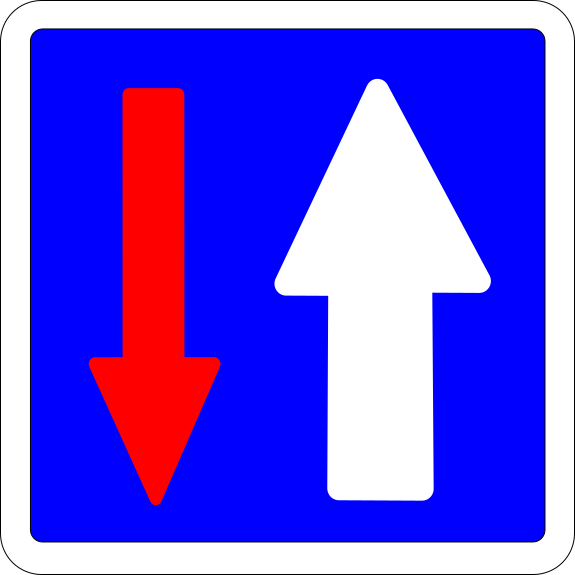
11. Road narrowing, oncoming drivers have to give way
This traffic sign indicates a road narrowing where oncoming drivers have to give way.
English • Traffic sign C18 • Priority over oncoming traffic.
Français • Panneau C18 • Priorité par rapport à la circulation venant en sens inverse.
Sources
🔗 Commons.wikimedia.org
🔗 Equipementsdelaroute.cerema.fr • Arrêté du 24 novembre 1967
© Gigillo83 et les contributeurs Wikimedia • CC BY-SA 4.0 • SVG original non modifié.
Image via Commons.wikimedia.org
Gigillo83 • CC BY-SA 4.0 • Source revision 2010-07-10. Wikimedia original unmodified.
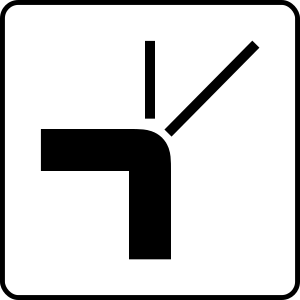
12. Crossroad shape
This traffic sign shows the shape or layout of an upcoming junction. The diagram indicates how the approaching road and connecting roads are arranged.
English • Supplementary plate M7 • Diagram of the approaching junction showing the priority branches with a thick line. The vertical branch in the lower half represents the road on which the plate is installed.
Français • Panonceau M7 • Il représente par un schéma l'intersection qui va être abordée et indique par un trait large les branches prioritaires. La branche verticale dans la moitié inférieure du panonceau représente la route sur laquelle il est implanté.
Sources
🔗 Commons.wikimedia.org
🔗 Equipementsdelaroute.cerema.fr • Arrêté du 24 novembre 1967 Source : Mathgb • CC0 1.0 • SVG original non modifié.
Image via Commons.wikimedia.org
Mathgb • CC0 • Source revision 2014-02-15. Wikimedia original unmodified.
