


Speed bumpFrance
An introduction to the traffic rules and road signs of France. Learn about driving, road safety and much more in our illustrated book, with answers to frequently asked questions.
For informational purposes only. Always follow official regulations. Some content and images were created with AI assistance.
 Traffic rules
 France
16. Speed bump
A speed bump is a raised traffic-calming device placed across all or part of a road to make drivers reduce their speed. It is commonly used near homes, schools, crossings, parking areas and other places where low vehicle speeds are important.
Speed bumps vary in shape, height and legal status. Drivers should approach them at a low, controlled speed and follow any warning signs or speed limits that apply.
Wikimedia.org • Tabl-trai • CC BY-SA
How should I recognise and approach a speed bump in France?
French guidance distinguishes ralentisseurs, including dos d’âne, from cushions and raised tables. A raised crossing or junction may be incorporated into a table, so look beyond the shape of the hump.
🔗 legifrance.gouv.fr • French Road Code — R413-17, R415-11; IISR part 2 article 28-1
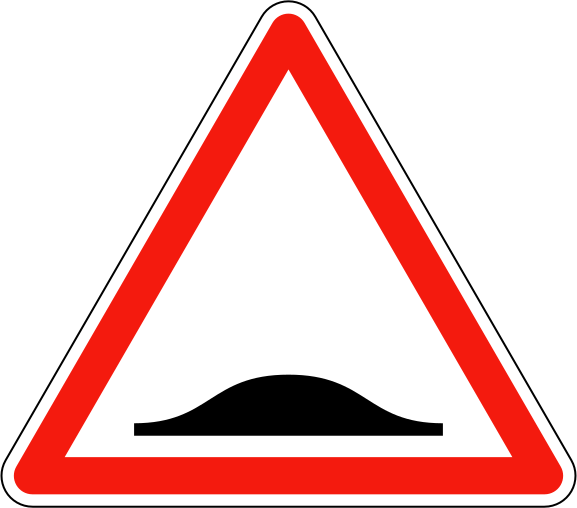 Warning for a speed bump.
English • Traffic sign A2b • Road hump used for traffic calming.
Français • Panneau A2b • Ralentisseur de type dos-d'âne.
🔗 Sources
🔗 Commons.wikimedia.org
🔗 Equipementsdelaroute.cerema.fr • Arrêté du 24 novembre 1967
© Roulex 45 et les contributeurs Wikimedia • CC BY-SA 3.0 • SVG original non modifié.
Image via Commons.wikimedia.org
Roulex 45 • CC BY-SA 3.0 • Source revision 2022-04-30. Wikimedia original unmodified.
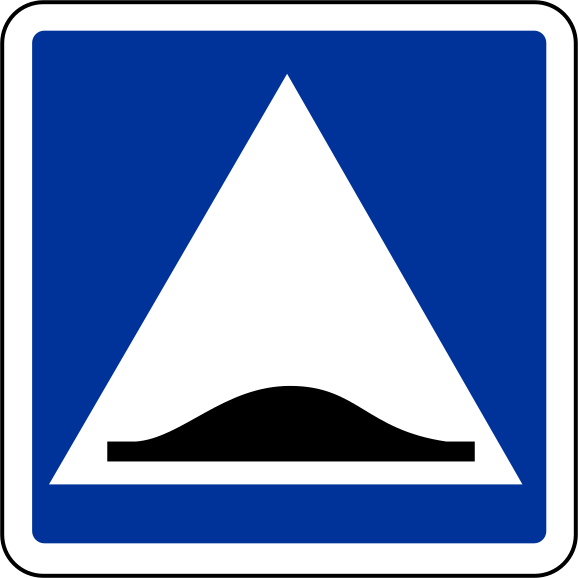 Speed bump.
English • Traffic sign C27 • Raised carriageway.
Français • Panneau C27 • Surélévation de chaussée.
🔗 Sources
🔗 Commons.wikimedia.org
🔗 Equipementsdelaroute.cerema.fr • Arrêté du 24 novembre 1967
© Jcrovetti et les contributeurs Wikimedia • CC BY-SA 3.0 • SVG original non modifié.
Image via Commons.wikimedia.org
Jcrovetti • CC BY-SA 3.0 • Source revision 2017-08-20. Wikimedia original unmodified.
Which speed should I use at a raised device in France?
Outside a Zone 30 or a residential area (zone de rencontre), French official guidance provides for an advance hump warning together with a 30 km/h restriction. Follow the applicable signs and zone rules. The device or conditions may require a speed below the legal maximum.
🔗 cerema.fr • Cerema, raised-device signing guidance, IISR Articles 28-1 and 72-6
Does a raised road surface give pedestrians priority in France?
A raised device alone does not identify pedestrian priority. If it incorporates a crossing, apply the crossing’s controls and the national rules. Give way, stopping if necessary, to a pedestrian lawfully crossing or clearly showing an intention to cross. This duty is broader than merely recognising a warning sign or painted crossing.
🔗 legifrance.gouv.fr • French Road Code — R413-17, R415-11; IISR part 2 article 28-1


