


Traffic signsFrance
 Traffic rules
 France
26. Give way
A give-way sign requires drivers to allow traffic with priority to proceed before entering, crossing or joining a road. Drivers must reduce speed, observe approaching traffic and stop when necessary.
Unlike a stop sign, a give-way sign does not always require a complete stop. The driver may continue without stopping only when the route is clearly safe and no road user with priority is forced to change speed or direction.

Wikimedia.org • Marc Mongenet • CC BY-SA
What does giving way mean in France?
The French expression is cédez le passage. Yield to vehicles on the road you are joining and enter only when the manoeuvre can be completed without danger.
🔗 legifrance.gouv.fr • French Road Code — R415-5–7; 1967 order AB3a/AB4
Must you always stop when giving way in France?
No. A give-way control requires stopping when necessary to yield or obtain a safe view. A stop sign requires a complete stop even if the road appears empty.
🔗 legifrance.gouv.fr • French Road Code — R415-5–7; 1967 order AB3a/AB4
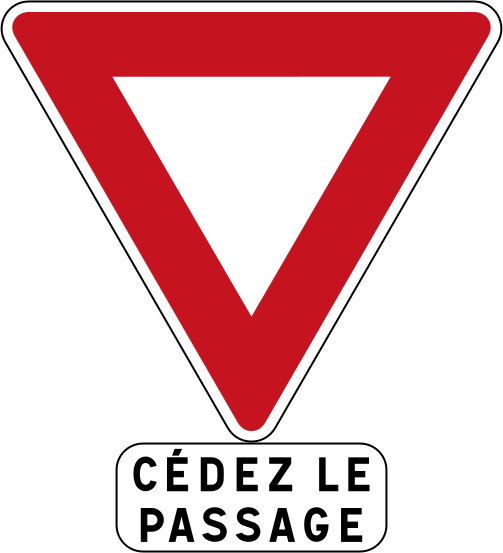 Give way.
English • Traffic sign AB3a • Give way at the junction. Sign at the junction. Supplementary plate M9c • Bearing the inscription ‘Give way’.
Français • Panneau AB3a • Cédez le passage à l'intersection. Signal de position. Panonceau M9c • Portant l'inscription " Cédez le passage ".
Sources
🔗 Commons.wikimedia.org
🔗 Equipementsdelaroute.cerema.fr • Arrêté du 24 novembre 1967
© Roulex 45 et les contributeurs Wikimedia • CC BY-SA 3.0 • SVG original non modifié.
Image via Commons.wikimedia.org
Roulex 45 • CC BY-SA 3.0 • Source revision 2014-02-21. Wikimedia original unmodified.
What should you check before proceeding after giving way in France?
Wait until the manoeuvre is safe. Check the priority traffic, the view in both directions and enough space to complete the entry. Giving way to one vehicle does not remove duties towards another driver, a cyclist or a pedestrian.
🔗 legifrance.gouv.fr • French Road Code — R415-5–7; 1967 order AB3a/AB4

27. Roundabout
A roundabout is a circular road arrangement in which traffic travels around a central island in one designated direction. Vehicles enter and leave through connecting roads, and traffic signs or local rules determine who has priority.
Drivers should reduce speed, choose a suitable lane, observe all road users and signal as required when leaving. The direction of travel, entry priority, lane use and rules for cyclists and pedestrians depend on local traffic signs and regulations.
Wikimedia.org • Florian Pépellin • CC BY-SA
Who has priority at a roundabout in France?
At a legally defined carrefour à sens giratoire, entering drivers must yield to traffic circulating around the junction. A circular layout described informally as a rond-point is not enough to settle priority: check the signs and applicable junction rules.
🔗 legifrance.gouv.fr • French Road Code — R110-2, R412-9–10, R415-10–11
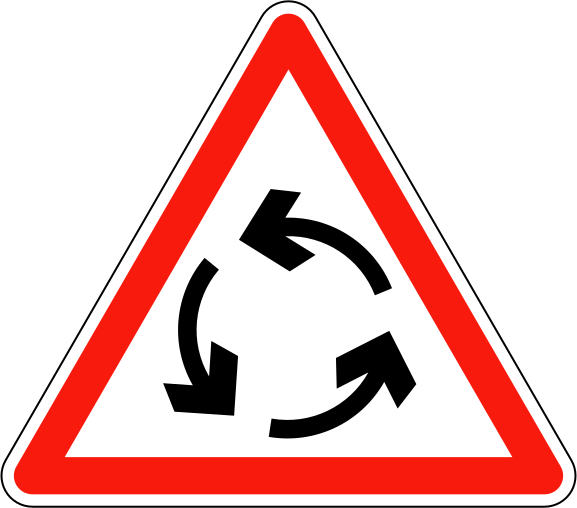 Warning for a roundabout.
English • Traffic sign AB25 • Roundabout. This is the specific sign referred to in article R. 110-2 of the Highway Code.
Français • Panneau AB25 • Carrefour à sens giratoire. Ce panneau constitue la signalisation spécifique mentionnée à l'article R. 110-2 du code de la route.
Sources
🔗 Commons.wikimedia.org
🔗 Equipementsdelaroute.cerema.fr • Arrêté du 24 novembre 1967
© Roulex 45 et les contributeurs Wikimedia • CC BY-SA 3.0 • SVG original non modifié.
Image via Commons.wikimedia.org
Roulex 45 • CC BY-SA 3.0 • Source revision 2013-07-05. Wikimedia original unmodified.
How should you choose a roundabout lane in France?
Choose your intended exit before entering and follow the lane arrows and destination signs. Keep to the marked route and make any permitted lane change only when safe; having priority over entering traffic does not give you priority to change lanes.
🔗 legifrance.gouv.fr • French Road Code — R110-2, R412-9–10, R415-10–11
What should you check when leaving a roundabout in France?
Check the lane you will cross or enter, signal the manoeuvre as required and look for cyclists and pedestrians at the exit. Obey any separate crossing controls and do not force an exit across another vehicle’s path.
🔗 legifrance.gouv.fr • French Road Code — R110-2, R412-9–10, R415-10–11
28. Priority road
A priority road is a road whose traffic is given priority over traffic entering from intersecting roads. It is normally identified by a priority-road sign, while an end sign indicates where that continuing priority status stops.
Drivers on a priority road must still obey traffic lights, authorised officers, speed limits, crossings and turning rules. Having priority never allows a driver to proceed when doing so would create danger or block an intersection.
Wikimedia.org • F123 • CC BY-SA
How does priority-road status work in France?
France uses route à caractère prioritaire for a road with continuing signed priority. This is different from a sign giving priority only at the next junction; read any supplementary route diagram.
🔗 legifrance.gouv.fr • French Road Code — R411-25, R415-5–7; 1967 order AB2/AB6/AB7 and M7
 Start of a priority road.
English • Traffic sign AB6 • Indication that a road has priority.
Français • Panneau AB6 • Indication du caractère prioritaire d'une route.
Sources
🔗 Commons.wikimedia.org
🔗 Equipementsdelaroute.cerema.fr • Arrêté du 24 novembre 1967
© Roulex 45 et les contributeurs Wikimedia • CC BY-SA 3.0 • SVG original non modifié.
Image via Commons.wikimedia.org
Roulex 45 • CC BY-SA 3.0 • Source revision 2007-09-18. Wikimedia original unmodified.
 End of the priority road.
English • Traffic sign AB7 • End of a road's priority status.
Français • Panneau AB7 • Fin du caractère prioritaire d'une route.
Sources
🔗 Commons.wikimedia.org
🔗 Equipementsdelaroute.cerema.fr • Arrêté du 24 novembre 1967
© Roulex 45 et les contributeurs Wikimedia • CC BY-SA 3.0 • SVG original non modifié.
Image via Commons.wikimedia.org
Roulex 45 • CC BY-SA 3.0 • Source revision 2007-09-18. Wikimedia original unmodified.
How can you tell where a priority road applies in France?
Read the priority-road sign, the corresponding end indication and any supplementary junction diagram. Distinguish a continuing road designation from a sign that regulates only one junction. If a diagram shows the priority route turning, follow that diagram rather than assuming the straight-ahead road has priority.
🔗 legifrance.gouv.fr • French Road Code — R411-25, R415-5–7; 1967 order AB2/AB6/AB7 and M7
Does having road priority let you ignore other controls in France?
No. Obey the applicable traffic signals and authorised directions, speed limits and crossing rules. Turning or changing lanes can require yielding, and having priority never permits entering a conflict that cannot be crossed safely.
🔗 legifrance.gouv.fr • French Road Code — R411-25, R415-5–7; 1967 order AB2/AB6/AB7 and M7
29. Road narrowing
A road narrowing is a section where the available width of the road or carriageway becomes smaller. The narrowing may occur on both sides, on one side only, or because one or more traffic lanes end.
Drivers should reduce speed, observe approaching and adjacent traffic, maintain sufficient lateral clearance and merge when necessary. Warning signs do not always determine priority, so drivers must follow any priority signs, lane markings and local traffic rules.
Wikimedia.org • Marc Mongenet • CC BY-SA
What does a road-narrowing warning mean in France?
French narrowing warnings identify a reduction of road width on both sides or on one side. They warn of the hazard; any alternating-flow priority or signal arrangement must be read separately.
🔗 legifrance.gouv.fr • French Road Code — R412-9–10, R414-1–3, R421-3
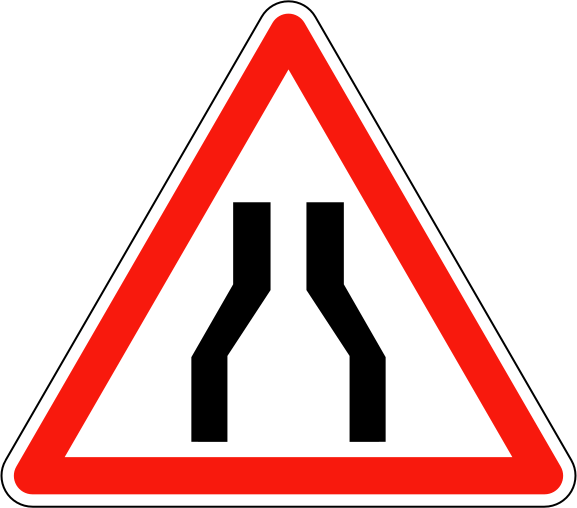 Warning for a road narrowing.
English • Traffic sign A3 • Road narrows.
Français • Panneau A3 • Chaussée rétrécie.
Sources
🔗 Commons.wikimedia.org
🔗 Equipementsdelaroute.cerema.fr • Arrêté du 24 novembre 1967
© Roulex 45 et les contributeurs Wikimedia • CC BY-SA 3.0 • SVG original non modifié.
Image via Commons.wikimedia.org
Roulex_45 • CC BY-SA 3.0 • Source revision 2013-07-05. Wikimedia original unmodified.
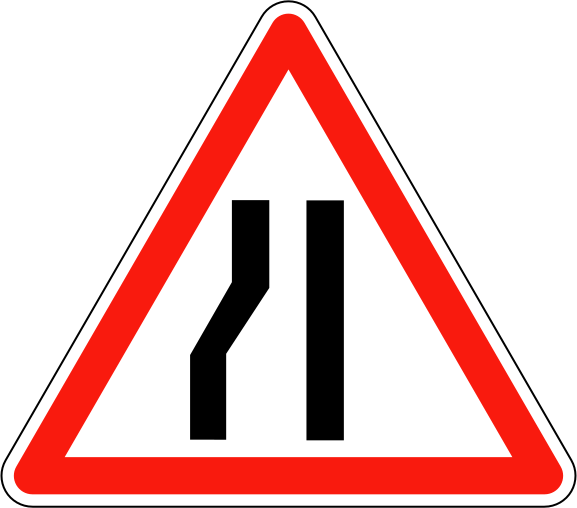 Warning for a road narrowing on the left.
English • Traffic sign A3b • Road narrows on the left.
Français • Panneau A3b • Chaussée rétrécie par la gauche.
Sources
🔗 Commons.wikimedia.org
🔗 Equipementsdelaroute.cerema.fr • Arrêté du 24 novembre 1967
© Roulex 45 et les contributeurs Wikimedia • CC BY-SA 3.0 • SVG original non modifié.
Image via Commons.wikimedia.org
Roulex 45 • CC BY-SA 3.0 • Source revision 2013-07-05. Wikimedia original unmodified.
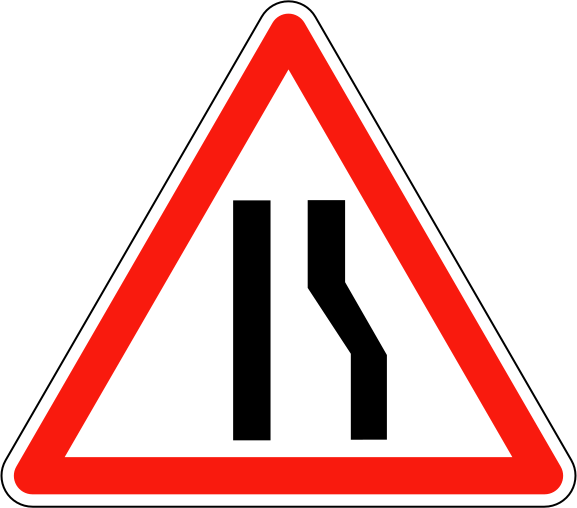 Warning for a road narrowing on the right.
English • Traffic sign A3a • Road narrows on the right.
Français • Panneau A3a • Chaussée rétrécie par la droite.
Sources
🔗 Commons.wikimedia.org
🔗 Equipementsdelaroute.cerema.fr • Arrêté du 24 novembre 1967
© Roulex 45 et les contributeurs Wikimedia • CC BY-SA 3.0 • SVG original non modifié.
Image via Commons.wikimedia.org
Roulex 45 • CC BY-SA 3.0 • Source revision 2013-07-05. Wikimedia original unmodified.
Does a narrowing warning give you priority in France?
No. A warning describes the reduced width, rather than allocating priority or setting a numerical speed limit. Follow any separate priority signs, signals and meeting rules, and slow enough to pass safely or wait before entering.
🔗 legifrance.gouv.fr • French Road Code — R412-9–10, R414-1–3, R421-3
What should you do if traffic lanes merge at a narrowing in France?
Read the lane-ending signs and markings, check surrounding traffic and signal any lane change as required. Apply the local merging rule and enter only when safe. Do not assume the driver in an ending lane always has priority, or confuse merging with meeting oncoming traffic.
🔗 legifrance.gouv.fr • French Road Code — R412-9–10, R414-1–3, R421-3
30. Priority over oncoming traffic
Priority over oncoming traffic means that drivers travelling in one direction have priority through a narrow section of road over drivers approaching from the opposite direction. The rule is normally indicated by a priority sign facing one direction and a corresponding give-way sign facing the other.
Drivers with priority must still approach cautiously and must not force their way through when the passage is blocked or already occupied. The signs regulate priority through the narrow section, not speed, parking or priority at nearby intersections.

Wikimedia.org • Marc Mongenet • CC BY-SA
How is priority over oncoming traffic controlled in France?
France’s priority-over-oncoming indication applies to the particular narrow section, with an opposing give-way control for the other direction. Read it separately from a road-narrowing warning and from junction-priority signs.
🔗 legifrance.gouv.fr • French Road Code — R414-1–3, R411-25; 1967 order B15/C18
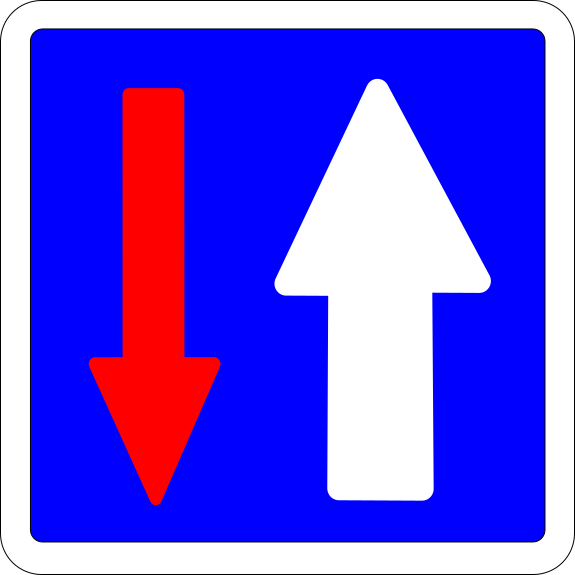 Road narrowing, oncoming drivers have to give way.
English • Traffic sign C18 • Priority over oncoming traffic.
Français • Panneau C18 • Priorité par rapport à la circulation venant en sens inverse.
Sources
🔗 Commons.wikimedia.org
🔗 Equipementsdelaroute.cerema.fr • Arrêté du 24 novembre 1967
© Gigillo83 et les contributeurs Wikimedia • CC BY-SA 4.0 • SVG original non modifié.
Image via Commons.wikimedia.org
Gigillo83 • CC BY-SA 4.0 • Source revision 2010-07-10. Wikimedia original unmodified.
Can you enter an occupied narrow passage when you have priority in France?
Do not force a conflict. Check the full available width and let a vehicle already committed to the passage clear it when both vehicles cannot pass safely. A priority control does not permit creating danger or disregarding a red signal or authorised instruction.
🔗 legifrance.gouv.fr • French Road Code — R414-1–3, R411-25; 1967 order B15/C18
Does priority through a narrow passage extend to nearby junctions in France?
No. A control releasing your direction or giving priority over opposing traffic concerns that passage. Junction priority, speed limits, crossings and any later restriction must be assessed separately from their own signs and rules.
🔗 legifrance.gouv.fr • French Road Code — R414-1–3, R411-25; 1967 order B15/C18
31. Give way to oncoming traffic
Give way to oncoming traffic means that drivers must allow vehicles approaching from the opposite direction to pass first through a narrow section of road. The rule is normally indicated by a sign facing the direction that must yield and a corresponding priority sign facing oncoming traffic.
Drivers must reduce speed and stop when necessary before entering the narrow passage. They may continue only when they can do so safely and without obstructing oncoming traffic that has priority.

Wikimedia.org • Chabe01 • CC BY-SA
When must I give way to oncoming traffic in France?
A French cédez le passage à la circulation venant en sens inverse sign assigns priority to the opposing direction at the narrowed part. Do not confuse it with a simple road-narrows warning.
🔗 legifrance.gouv.fr • French Road Code — R414-1–3, R411-25; 1967 order B15/C18
 Road narrowing, give way to oncoming drivers.
English • Traffic sign B15 • Give way to oncoming traffic.
Français • Panneau B15 • Cédez le passage à la circulation venant en sens inverse.
Sources
🔗 Commons.wikimedia.org
🔗 Equipementsdelaroute.cerema.fr • Arrêté du 24 novembre 1967
© Roulex 45 et les contributeurs Wikimedia • CC BY-SA 4.0 • SVG original non modifié.
Image via Commons.wikimedia.org
Roulex 45 • CC BY-SA 4.0 • Source revision 2009-04-24. Wikimedia original unmodified.
Does a road-narrows warning automatically give oncoming traffic priority in France?
Not necessarily. A warning of a narrow carriageway is not itself the same as an instruction to give way. Check whether there is a separate priority sign, signal or temporary traffic control, and take account of any rules for an obstruction on your side.
🔗 legifrance.gouv.fr • French Road Code — R414-1–3, R411-25; 1967 order B15/C18
What if an oncoming vehicle is already entering a narrow passage in France?
Reduce speed and wait where you can do so safely rather than forcing two vehicles into insufficient space. Even if a sign gives your approach priority, that does not justify a collision or endangering another road user.
🔗 legifrance.gouv.fr • French Road Code — R414-1–3, R411-25; 1967 order B15/C18
32. Pedestrian crossing
A pedestrian crossing is a designated place where pedestrians may cross a road. It is commonly indicated by road markings, traffic signs, signals or a combination of these measures.
Drivers must approach with appropriate caution and give way when required by local law. Pedestrians must also observe approaching traffic and follow any pedestrian signals or instructions from authorised traffic controllers.
Wikimedia.org • Tabl-trai • CC BY-SA
When must drivers give way at a pedestrian crossing in France?
In France, drivers must give way, stopping when necessary, to pedestrians legally crossing or clearly showing their intention to cross. Article R415-11 also covers pedestrians in pedestrian and meeting zones.
Are all pedestrian crossings controlled the same way in France?
A crossing controlled by lights or an authorised officer is different from an uncontrolled zebra crossing. Follow the signals, but do not endanger anyone still crossing.
🔗 legifrance.gouv.fr • France, Road Code article R415-11, version effective from 19 September 2018; 🔗 legifrance.gouv.fr • France, Road Code article R412-38, pedestrian controls
May I enter a pedestrian crossing if the road beyond it is blocked in France?
Keep the crossing clear so pedestrians can use it safely. Before overtaking near a pedestrian crossing, make sure no pedestrian is already on it, and respect the pedestrian give-way duty.
🔗 legifrance.gouv.fr • France, Road Code article R415-11, version effective from 19 September 2018; 🔗 legifrance.gouv.fr • France, Road Code article R414-5, pedestrians and overtaking
How close must a French pedestrian crossing be before pedestrians must use it?
Normally, less than 50 metres away. Article R412-37 exempts pedestrian areas and zones de rencontre.
🔗 legifrance.gouv.fr • France, Code de la route, article R412-37, Légifrance
Where should French pedestrians cross at a junction without a nearby pedestrian crossing?
Along the continuation of the pavement across the carriageway. This particular rule does not apply in pedestrian areas or zones de rencontre.
🔗 legifrance.gouv.fr • France, Road Code article R412-37, version effective from 17 November 2010
May French pedestrians cross diagonally away from an intersection?
No. They must cross perpendicular to the road’s axis; pedestrian areas and zones de rencontre are excepted.
🔗 legifrance.gouv.fr • France, Code de la route, article R412-39, Légifrance
Does reaching a French refuge island authorise crossing the next carriageway immediately?
No. Reapply the pedestrian crossing rules before entering each following section.
🔗 legifrance.gouv.fr • France, Code de la route, article R412-40, Légifrance
33. Railway crossing
A railway crossing, also called a level crossing or railroad crossing, is a place where a road or path crosses railway tracks at the same level. It may be protected by barriers, warning lights, bells, traffic signs or a combination of these measures.
Road users must approach carefully and never enter when a train is approaching, warning signals are active or the exit is blocked. They should cross promptly and must never stop, wait or become trapped on the tracks.
Wikimedia.org • Poudou99 • CC BY-SA
When must drivers stop at a railway level crossing in France?
Stop for red warning lights and obey the crossing guard’s instructions. Do not enter while barriers are closed, closing or opening. Give trains priority and enter only when you can clear the crossing completely.
🔗 legifrance.gouv.fr • France, Road Code article R422-3, version effective from 12 June 2024; 🔗 legifrance.gouv.fr • France, Road Code article R412-30, steady and flashing red lights
Must I stop at every unguarded railway crossing in France?
Not solely because barriers are absent. Where there are no barriers, half-barriers or warning lights, first make sure no train is approaching. Obey any STOP sign and crossing guard, and enter only when you can clear the tracks.
🔗 legifrance.gouv.fr • France, Road Code article R422-3, version effective from 12 June 2024
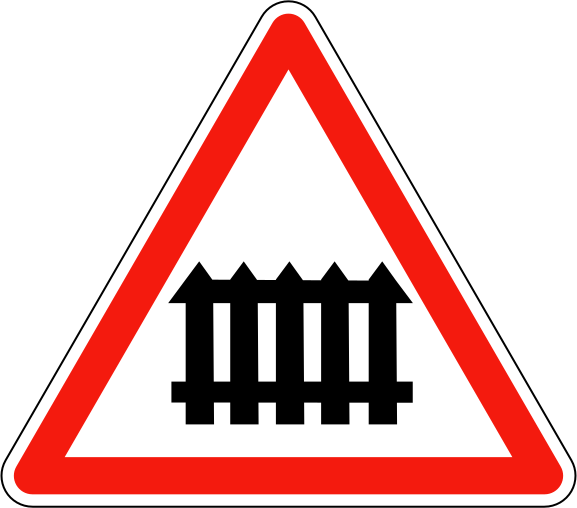 Warning for a railway crossing with barriers.
English • Traffic sign A7 • Level crossing with manually operated barriers or automatic half-barriers when trains pass.
Français • Panneau A7 • Passage à niveau muni de barrières à fonctionnement manuel ou demi-barrières automatiques lors du passage des trains.
Sources
🔗 Commons.wikimedia.org
🔗 Equipementsdelaroute.cerema.fr • Arrêté du 24 novembre 1967
© Roulex 45 et les contributeurs Wikimedia • CC BY-SA 3.0 • SVG original non modifié.
Image via Commons.wikimedia.org
Roulex 45 • CC BY-SA 3.0 • Source revision 2013-07-05. Wikimedia original unmodified.
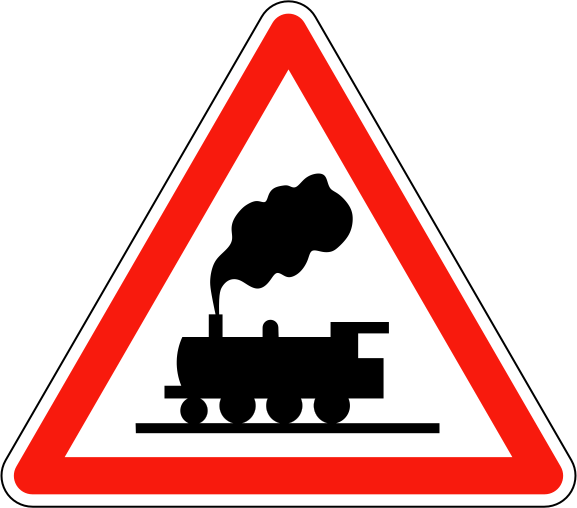 Warning for a railway crossing without barriers.
English • Traffic sign A8 • Level crossing without barriers or half-barriers.
Français • Panneau A8 • Passage à niveau sans barrière ni demi-barrière.
Sources
🔗 Commons.wikimedia.org
🔗 Equipementsdelaroute.cerema.fr • Arrêté du 24 novembre 1967
© Roulex 45 et les contributeurs Wikimedia • CC BY-SA 3.0 • SVG original non modifié.
Image via Commons.wikimedia.org
Roulex_45 • CC BY-SA 3.0 • Source revision 2013-07-05. Wikimedia original unmodified.
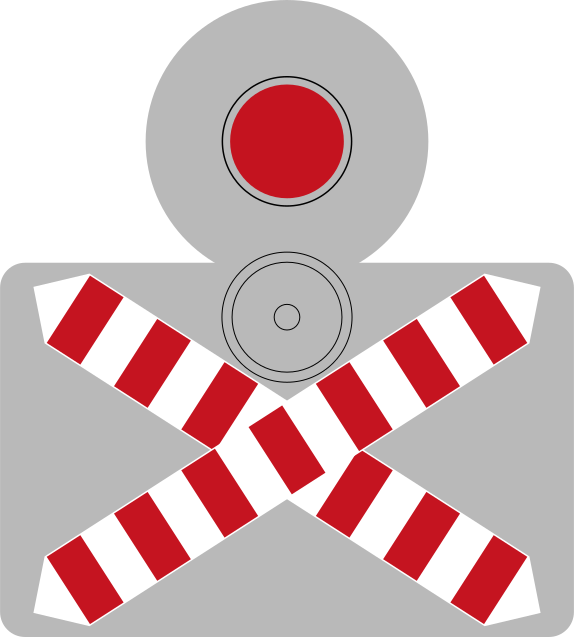 Warning for a railway crossing with one track.
English • Traffic sign G1bis • Sign at a single-track level crossing with automatic light and sound signals but no barriers or half-barriers.
Français • Signal G1bis • Signalisation de position des passages à niveau à une voie munis d'une signalisation automatique lumineuse et sonore sans barrière ni demi-barrière.
Sources
🔗 Commons.wikimedia.org
🔗 Equipementsdelaroute.cerema.fr • Arrêté du 24 novembre 1967
© Roulex 45 et les contributeurs Wikimedia • CC BY-SA 3.0 • SVG original non modifié.
Image via Commons.wikimedia.org
Roulex 45 • CC BY-SA 3.0 • Source revision 2014-02-21. Wikimedia original unmodified.
What if road traffic is queued beyond a railway crossing in France?
Wait before the tracks until there is room to take your entire vehicle off the crossing. Do not follow another vehicle onto the tracks without checking the exit. Keep the tracks clear even if no train is visible.
🔗 legifrance.gouv.fr • France, Road Code article R422-3, version effective from 12 June 2024
34. Mandatory direction
A mandatory-direction sign requires drivers to travel only in the direction or one of the directions indicated by its arrow or arrows. It may require traffic to continue straight ahead, turn, or pass an obstacle on a specified side.
The sign does not itself determine priority or speed. Drivers must still use the appropriate lane, signal when required and give way according to local traffic signs and regulations.
Wikimedia.org • Roehrensee • CC BY-SA
What does a mandatory-direction sign require in France?
Where a compulsory-direction sign is installed in France, follow only the arrow direction or permitted combination of directions. The restriction applies at the location or movement it regulates; it is not an instruction to ignore other traffic controls.
🔗 legifrance.gouv.fr • French Road Code — R411-25, R412-10, R415-11; 1967 order article 4
Can I choose another turn if the mandatory-direction arrow is inconvenient in France?
No, unless another applicable sign, lane instruction or authorised traffic direction lawfully permits it. Plan a permitted alternative route; do not make an abrupt or prohibited turn to reach your destination.
🔗 legifrance.gouv.fr • French Road Code — R411-25, R412-10, R415-11; 1967 order article 4
Does a mandatory-direction sign give me priority over pedestrians in France?
No. It tells you which way to move, not who goes first. Check traffic lights, other priority signs, pedestrians and cyclists, and give way when required before completing the manoeuvre.
🔗 legifrance.gouv.fr • French Road Code — R411-25, R412-10, R415-11; 1967 order article 4
35. Turn prohibition
A turn prohibition prevents drivers from turning in the direction indicated by a traffic sign. It may prohibit a left turn, a right turn or a U-turn at an intersection or along a specified section of road.
Drivers must continue along a permitted route and follow any lane arrows or mandatory-direction signs. A turn prohibition does not itself determine priority or speed, and any exemption for cyclists, public transport or other road users must be expressly indicated.
Wikimedia.org • Marc Mongenet • CC BY-SA
What does a no-turn sign prohibit in France?
It prohibits the left, right or other turn shown at the junction or position controlled by the sign in France. Follow any supplementary panel or authorised direction and choose another legal route.
🔗 legifrance.gouv.fr • French Road Code — R411-25, R412-10, R415-11; 1967 order article 4
Does a no-left-turn sign always prohibit a U-turn in France?
The French B2a sign prohibits turning left at the next junction. The separate B2c sign prohibits U-turns on the road up to the next junction. Check all applicable signs and road controls before considering a U-turn; a left-turn restriction alone is not a complete statement of the controls that apply.
🔗 equipementsdelaroute.cerema.fr • Cerema current IISR part 4 consolidation
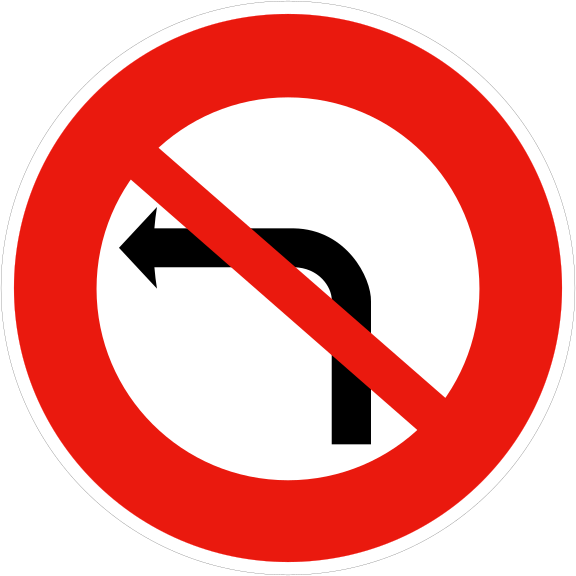 Turning left prohibited.
English • Traffic sign B2a • No left turn at the next junction.
Français • Panneau B2a • Interdiction de tourner à gauche à la prochaine intersection.
Sources
🔗 Commons.wikimedia.org
🔗 Equipementsdelaroute.cerema.fr • Arrêté du 24 novembre 1967
© Roulex 45 et les contributeurs Wikimedia • CC BY-SA 3.0 • SVG original non modifié.
Image via Commons.wikimedia.org
Roulex 45 • CC BY-SA 3.0 • Source revision 2019-10-04. Wikimedia original unmodified.
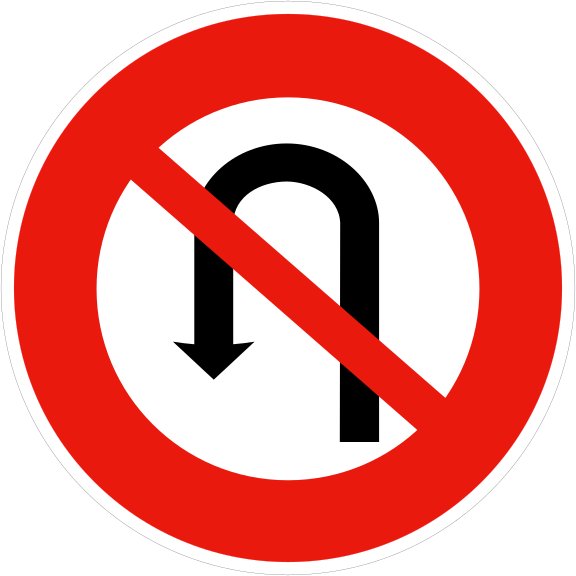 Turning around prohibited (U-turn).
English • Traffic sign B2c • No U-turns on the road being followed until the next junction.
Français • Panneau B2c • Interdiction de faire demi-tour sur la route suivie jusqu'à la prochaine intersection.
Sources
🔗 Commons.wikimedia.org
🔗 Equipementsdelaroute.cerema.fr • Arrêté du 24 novembre 1967
© Roulex 45 et les contributeurs Wikimedia • CC BY-SA 4.0 • SVG original non modifié.
Image via Commons.wikimedia.org
Roulex 45 • CC BY-SA 4.0 • Source revision 2019-10-04. Wikimedia original unmodified.
Can a no-turn restriction apply only to certain vehicles or hours in France?
Yes, where the local sign system provides a supplementary condition or exemption, such as a vehicle class, time or authorised access. Without a valid exception, comply with the prohibited movement shown.
🔗 legifrance.gouv.fr • French Road Code — R411-25, R412-10, R415-11; 1967 order article 4
36. School area
A school area is a road or group of roads near a school where large numbers of children may walk, cycle, cross the road or enter and leave vehicles. It may be identified by warning signs, zone signs, road markings, traffic-calming measures or flashing lights.
Special speed limits, parking restrictions or access rules may apply permanently or only during school arrival and departure times. Drivers should reduce speed, watch carefully for children and be prepared to stop.
Wikimedia.org • Marc Mongenet • CC BY-SA
What speed rules apply around schools in France?
A school approach may be inside a signed zone 30 or a zone de rencontre; a children-warning sign on its own is not a new numerical limit.
🔗 legifrance.gouv.fr • French Road Code — R413-17, R414-1–4, R414-11; 1967 order article 3
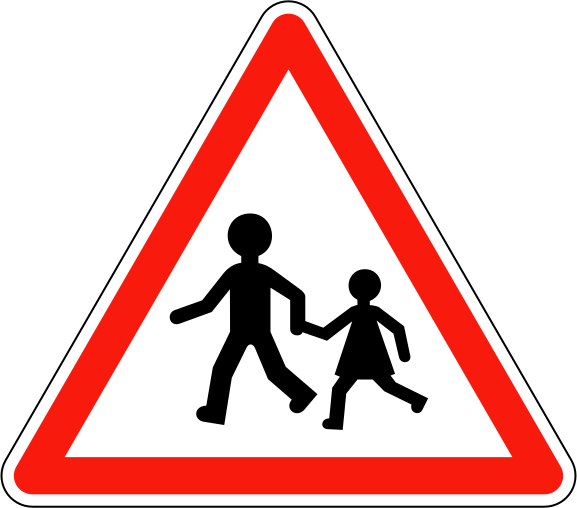 Warning for children.
English • Traffic sign A13a • Place frequented by children.
Français • Panneau A13a • Endroit fréquenté par les enfants.
Sources
🔗 Commons.wikimedia.org
🔗 Equipementsdelaroute.cerema.fr • Arrêté du 24 novembre 1967
© Roulex 45 et les contributeurs Wikimedia • CC BY-SA 3.0 • SVG original non modifié.
Image via Commons.wikimedia.org
Roulex 45 • CC BY-SA 3.0 • Source revision 2023-08-14. Wikimedia original unmodified.
Does a school warning sign in France automatically set the speed limit?
A children or school warning alerts you to a potential hazard; the enforceable numerical speed limit depends on the applicable law, regulatory signs and any time or variable display. Slow further if children are near the road.
🔗 legifrance.gouv.fr • French Road Code — R413-17, R414-1–4, R414-11; 1967 order article 3
How should you pass a school entrance in France?
Watch for children stepping out from between parked vehicles, obey crossings and any school patrol, and follow stopping or parking restrictions. Do not obstruct visibility near a crossing or school entrance; approach at a speed that permits a safe stop.
🔗 legifrance.gouv.fr • French Road Code — R413-17, R414-1–4, R414-11; 1967 order article 3
37. Overtaking
Overtaking is the act of passing another road user travelling in the same direction. It normally involves moving to another position or lane, passing the slower road user and returning to the appropriate position when it is safe.
Before overtaking, a driver should make sure there is sufficient visibility and space, check mirrors and blind spots, signal when required and ensure that no other road user is already overtaking. The manoeuvre must be completed without exceeding the speed limit or endangering other road users.
Wikimedia.org • Tabl-trai • CC BY
On which side do drivers normally overtake in France?
As traffic normally keeps right, drivers ordinarily overtake on the left. This is the general rule, not permission to pass wherever a lane is available; exceptions and restrictions depend on the local law.
When should you avoid overtaking in France?
Do not begin if approaching traffic, restricted visibility, road markings, an intersection, a crossing or another road user makes the manoeuvre unsafe or unlawful. Check behind and ahead, allow enough space and never exceed the speed limit to complete the pass.
What extra care is needed when overtaking slower road users in France?
In France, when overtaking a cyclist, pedestrian, horse rider, animal or another road user covered by Article R414-4(IV), leave at least 1 metre in a built-up area and 1.5 metres outside it. Allow more space when necessary and wait if a safe, lawful pass is impossible.
38. Crossing animals
An animals-crossing warning indicates a place or road section where wild animals, livestock or ridden animals may enter or cross the road. Animals may appear suddenly, move unpredictably or be difficult to see in darkness, vegetation or poor weather.
Drivers should reduce speed, scan both sides of the road and remain prepared to stop. The warning sign does not itself give animals priority or impose a numerical speed limit, but drivers must avoid frightening, endangering or colliding with them.
Wikimedia.org • Marc Mongenet • CC BY-SA
Which animals might drivers encounter on roads in France?
Depending on the locality, drivers may meet deer, wild boar and livestock in rural or wooded areas. Roadside animal-warning signs and local hazard information indicate where extra care may be needed; do not assume the hazard ends immediately after a sign.
🔗 legifrance.gouv.fr • French Road Code — R413-17, R414-1–4, R414-11; 1967 order article 3
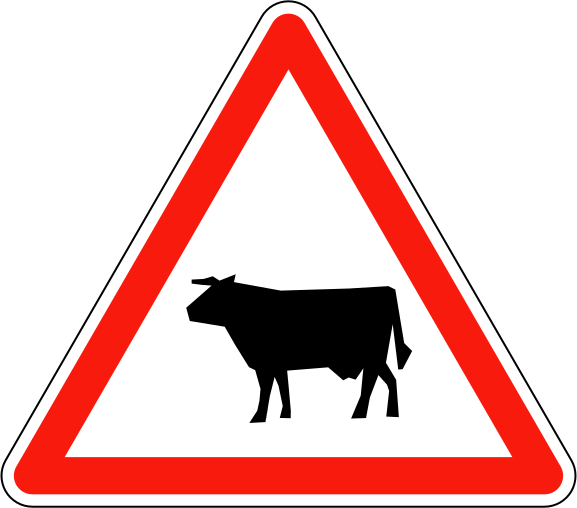 Warning for cattle on the road.
English • Traffic sign A15a1 • Domestic animals crossing.
Français • Panneau A15a1 • Passage d'animaux domestiques.
Sources
🔗 Commons.wikimedia.org
🔗 Equipementsdelaroute.cerema.fr • Arrêté du 24 novembre 1967
© Roulex 45 et les contributeurs Wikimedia • CC BY-SA 3.0 • SVG original non modifié.
Image via Commons.wikimedia.org
Roulex_45 • CC BY-SA 3.0 • Source revision 2013-07-05. Wikimedia original unmodified.
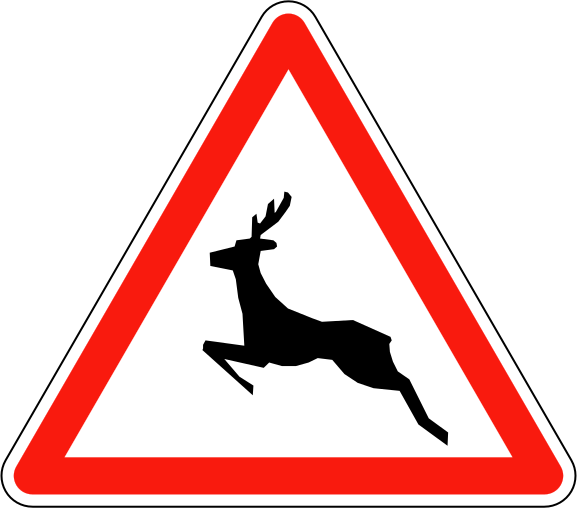 Warning for crossing deer.
English • Traffic sign A15b • Wild animals crossing.
Français • Panneau A15b • Passage d'animaux sauvages.
Sources
🔗 Commons.wikimedia.org
🔗 Equipementsdelaroute.cerema.fr • Arrêté du 24 novembre 1967
© Roulex 45 et les contributeurs Wikimedia • CC BY-SA 3.0 • SVG original non modifié.
Image via Commons.wikimedia.org
Roulex_45 • CC BY-SA 3.0 • Source revision 2013-07-05. Wikimedia original unmodified.
Does an animal-crossing warning sign in France set a new speed limit?
A warning of animals is not, by itself, a numerical speed-limit sign. Continue to obey the applicable speed limit, but slow down whenever animals could enter the road or visibility is poor. A separate regulatory speed sign must also be obeyed.
🔗 legifrance.gouv.fr • French Road Code — R413-17, R414-1–4, R414-11; 1967 order article 3
What should you do if an animal enters the road in France?
Ease off the accelerator, assess the traffic behind and brake smoothly if necessary. Avoid abrupt swerving into opposing traffic or off the road. Give farm animals and ridden animals room, avoid frightening them with unnecessary horn use, and be alert for more animals following.
🔗 legifrance.gouv.fr • French Road Code — R413-17, R414-1–4, R414-11; 1967 order article 3
39. Slippery road
A slippery road has reduced tyre grip and can make steering, braking and acceleration less effective. Roads may become slippery because of rain, ice, snow, mud, oil, loose material or other substances on the surface. Drivers should reduce speed, increase their following distance and avoid sudden steering, braking or acceleration. Extra caution is needed in bends, on bridges and wherever the road surface changes unexpectedly.
Wikimedia.org • Tabl-trai • CC BY-SA
What can make roads slippery in France?
Be prepared for rain, mountain snow and patches of black ice. A surface can become slippery even if it looks clear, and different parts of the road may have very different grip.
🔗 legifrance.gouv.fr • French Road Code — R413-17, R414-1–4, R414-11; 1967 order article 3
How should you drive on a slippery road in France?
Reduce speed early, increase the gap to the vehicle ahead and use smooth steering, braking and acceleration. Do not rely on the posted maximum as a safe target when grip is poor.
🔗 legifrance.gouv.fr • French Road Code — R413-17, R414-1–4, R414-11; 1967 order article 3
Are special winter tyres or equipment required in France?
In designated French mountain areas, qualifying vehicles must have prescribed winter equipment from 1 November to 31 March. The driver must still adapt speed to actual conditions.
🔗 legifrance.gouv.fr • French Road Code — R413-17, R414-1–4, R414-11; 1967 order article 3
40. Rockfall
A rockfall warning indicates a road section where rocks or stones may fall from a cliff, cutting or steep slope, or where fallen material may already be present on the road. The danger may affect the full carriageway and can appear suddenly.
Drivers should reduce speed, scan the road and slopes ahead, increase their following distance and remain prepared to stop. They should avoid unnecessary stopping in the exposed section and never attempt to move unstable rocks themselves.
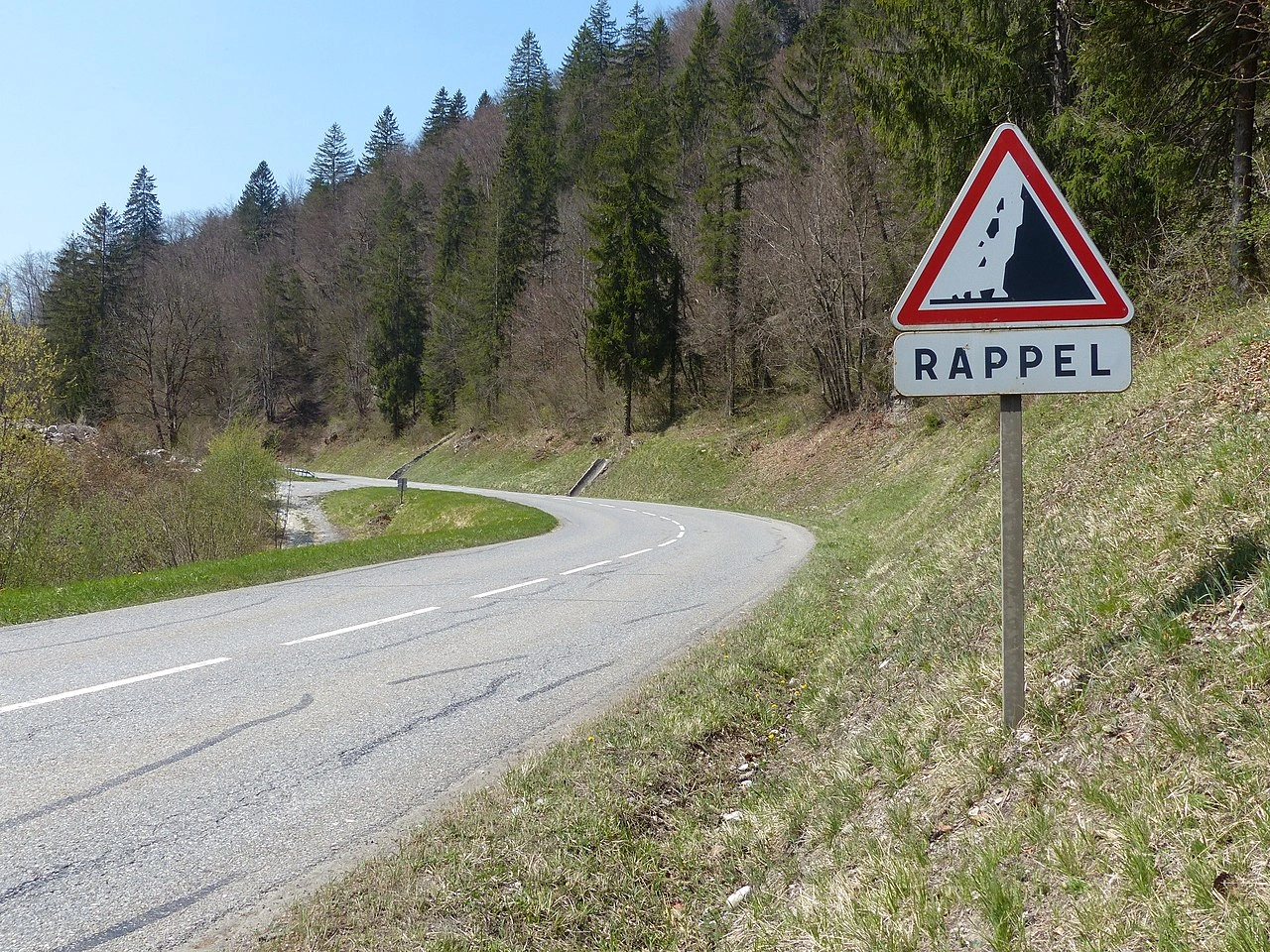
Wikimedia.org • Marc Mongenet • CC BY-SA
Where might falling rocks be a hazard on roads in France?
Pay extra attention around Alpine and Pyrenean routes and roads below rocky cliffs. After heavy rain, freeze–thaw cycles or work on a steep slope, the hazard may increase depending on local conditions.
🔗 legifrance.gouv.fr • French Road Code — R413-17, R414-1–4, R414-11; 1967 order article 3
Does a falling-rocks warning sign in France impose a speed limit?
A falling-rocks sign is a hazard warning, not normally a numerical speed-limit sign. Follow any separate speed or closure signs, slow down to match visibility and conditions, and watch for material already on the road.
🔗 legifrance.gouv.fr • French Road Code — R413-17, R414-1–4, R414-11; 1967 order article 3
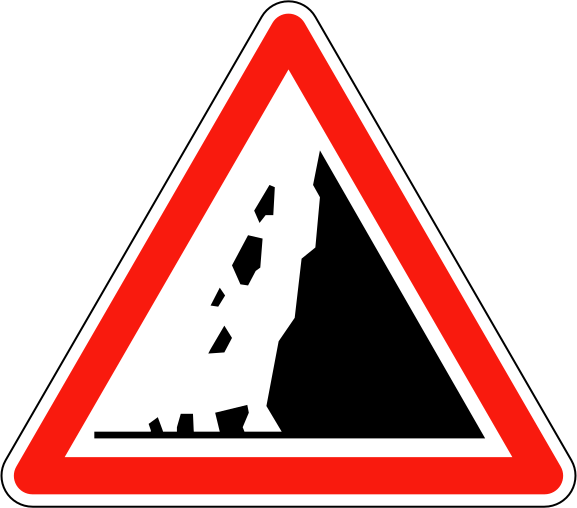 Warning for falling rocks.
English • Traffic sign A19 • Risk of falling rocks or fallen rocks on the road.
Français • Panneau A19 • Risque de chute de pierres ou de présence sur la route de pierres tombées.
Sources
🔗 Commons.wikimedia.org
🔗 Equipementsdelaroute.cerema.fr • Arrêté du 24 novembre 1967
© Roulex 45 et les contributeurs Wikimedia • CC BY-SA 3.0 • SVG original non modifié.
Image via Commons.wikimedia.org
Roulex_45 • CC BY-SA 3.0 • Source revision 2013-07-05. Wikimedia original unmodified.
What should you do if rocks are blocking the road in France?
Slow or stop in a safe place away from the exposed slope if possible. Do not drive over unstable debris or stop beneath a cliff unnecessarily. Follow any closure or traffic-control instructions and report a dangerous obstruction through the appropriate road authority or emergency channel.
🔗 legifrance.gouv.fr • French Road Code — R413-17, R414-1–4, R414-11; 1967 order article 3
41. Aircraft
An aircraft warning is a traffic warning indicating that aircraft may pass at low altitude above or close to the road, usually near an airport, airfield or flight path. The warning is intended to prepare drivers for the sudden appearance or noise of low-flying aircraft.
Drivers should remain focused on the road and avoid sudden braking or steering movements if an aircraft passes overhead. The design and use of aircraft warning signs vary between countries.

Wikimedia.org • Marc Mongenet • CC BY-SA
What should an aircraft-warning sign tell drivers in France?
The French A23 warning indicates an air-traffic danger area. It warns of a hazard associated with aircraft near the road; it is different from direction guidance to an airport. Keep your attention on the road and obey any associated signals or barriers.
🔗 equipementsdelaroute.cerema.fr • Cerema current IISR part 2 consolidation
🔗 service-public.gouv.fr • French Government, national and built-up-area speed limits
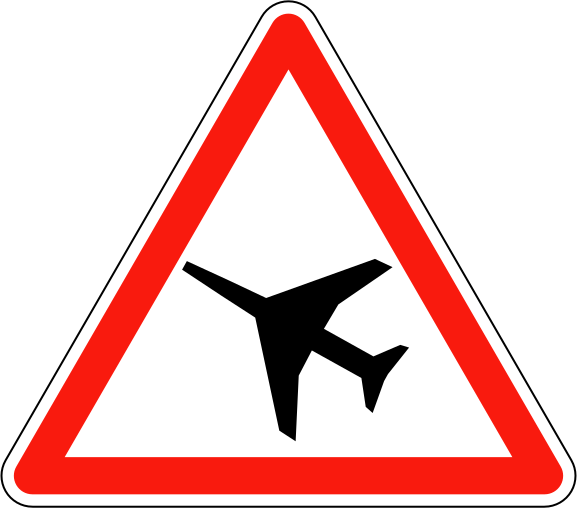 Warning for low-flying aircraft.
English • Traffic sign A23 • Crossing an area of aircraft-related danger.
Français • Panneau A23 • Traversée d'une aire de danger aérien.
Sources
🔗 Commons.wikimedia.org
🔗 Equipementsdelaroute.cerema.fr • Arrêté du 24 novembre 1967
© Roulex 45 et les contributeurs Wikimedia • CC BY-SA 3.0 • SVG original non modifié.
Image via Commons.wikimedia.org
Roulex_45 • CC BY-SA 3.0 • Source revision 2013-07-05. Wikimedia original unmodified.
Does an aircraft warning automatically reduce the speed limit in France?
No, not by itself. A hazard warning is not a numerical speed-limit sign. Obey any separately displayed speed restriction and adjust speed if actual conditions make this necessary.
🔗 equipementsdelaroute.cerema.fr • Cerema current IISR part 2 consolidation
🔗 service-public.gouv.fr • French Government, national and built-up-area speed limits
42. Curve
A curve is a section of road that changes direction to the left or right. A sharp, unexpected or poorly visible curve can reduce a driver’s view of approaching traffic, stopped vehicles, pedestrians and other hazards.
Drivers should reduce speed before entering the curve, remain within their lane and use smooth steering, braking and acceleration. Warning signs may indicate the direction of the first curve or a series of successive curves.

Wikimedia.org • Marc Mongenet • CC BY-SA
What makes a bend dangerous in France?
Curves shorten your view of the road ahead and can reduce the margin for correcting a mistake. Drivers may encounter winding routes in the Alps, Pyrenees and rural areas; the safe speed can be well below the posted maximum. Watch for changing road surfaces and people or vehicles hidden beyond the curve.
🔗 legifrance.gouv.fr • French Road Code — R413-17, R414-1–4, R414-11; 1967 order article 3
How should you approach a sharp curve in France?
Slow down before the bend, select the correct lane position, look through the curve and steer smoothly. Keep enough grip and visible stopping distance for the road and weather conditions.
🔗 legifrance.gouv.fr • French Road Code — R413-17, R414-1–4, R414-11; 1967 order article 3
Is overtaking safe on a blind bend in France?
No. Do not start overtaking where your view of oncoming traffic is obstructed or where signs or road markings prohibit it. Wait until there is a lawful, clear and sufficiently long view ahead.
🔗 legifrance.gouv.fr • French Road Code — R413-17, R414-1–4, R414-11; 1967 order article 3
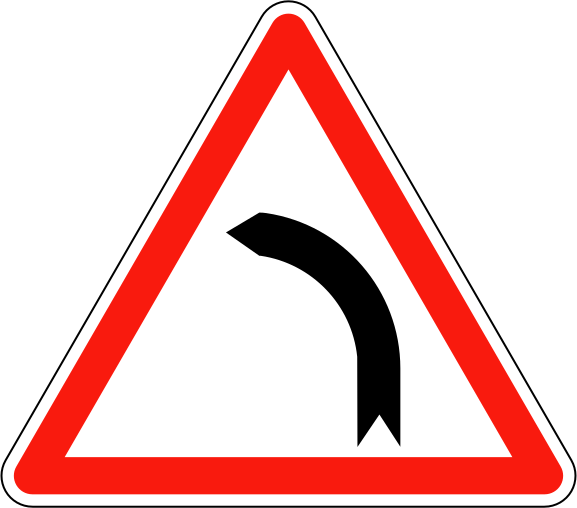 Warning for a curve to the left.
English • Traffic sign A1b • Left-hand bend.
Français • Panneau A1b • Virage à gauche.
Sources
🔗 Commons.wikimedia.org
🔗 Equipementsdelaroute.cerema.fr • Arrêté du 24 novembre 1967
© Roulex 45 et les contributeurs Wikimedia • CC BY-SA 3.0 • SVG original non modifié.
Image via Commons.wikimedia.org
Roulex 45 • CC BY-SA 3.0 • Source revision 2013-07-05. Wikimedia original unmodified.
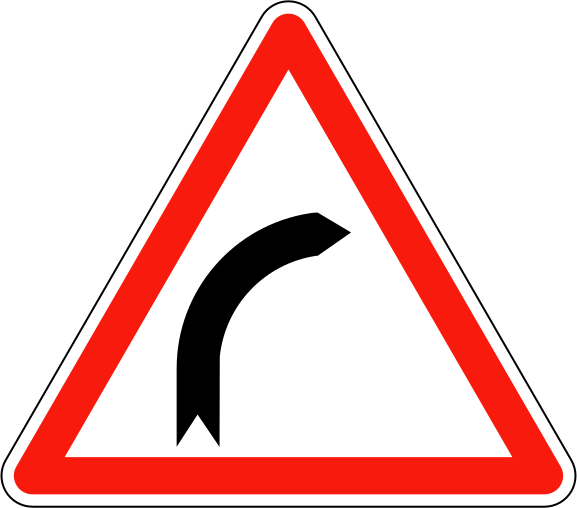 Warning for a curve to the right.
English • Traffic sign A1a • Right-hand bend.
Français • Panneau A1a • Virage à droite.
Sources
🔗 Commons.wikimedia.org
🔗 Equipementsdelaroute.cerema.fr • Arrêté du 24 novembre 1967
© Roulex 45 et les contributeurs Wikimedia • CC BY-SA 3.0 • SVG original non modifié.
Image via Commons.wikimedia.org
Roulex 45 • CC BY-SA 3.0 • Source revision 2013-07-05. Wikimedia original unmodified.
43. Chevron
A chevron is a V-shaped or arrow-shaped road marker used to show a sharp change in the direction of a road. Chevron boards are normally placed along the outside of a curve so that their points indicate the direction in which the road continues.
Chevrons improve the visibility and alignment of a curve, especially in darkness or poor weather. They do not normally impose a speed limit or determine priority, so drivers must reduce speed before the curve and follow all other signs and road markings.

Wikimedia.org • Brostoler • CC BY-SA
What is the purpose of chevron boards on a road in France?
French J4 boards use white chevrons on a blue background to show the course of a bend. They may have one chevron or several. Follow the indicated alignment and adapt your approach to the bend and visibility.
🔗 equipementsdelaroute.cerema.fr • Cerema current IISR part 2 consolidation
Do chevron boards give priority or order a turn at junctions in France?
Not ordinary curve-alignment chevrons. They guide you around a bend. Give-way, no-entry, keep-direction and other mandatory traffic signs must be read separately; similar-looking arrows can have different legal meanings.
🔗 legifrance.gouv.fr • French Road Code — R413-17; 1967 order J4; IISR part 1 article 9-2
Is the speed shown by a chevron in France a compulsory maximum?
A chevron alone does not set a numerical maximum speed. If an advisory-speed panel or a regulatory speed-limit sign is displayed alongside it, identify which type it is and follow the binding speed rules.
🔗 legifrance.gouv.fr • French Road Code — R413-17; 1967 order J4; IISR part 1 article 9-2
44. Wrong-way driving
Wrong-way driving occurs when a driver travels against the legally permitted direction of traffic. It may happen on a one-way road, divided road, motorway entrance or exit, or another road section reserved for traffic travelling in one direction.
Wrong-way driving creates an extreme risk of a head-on collision. Drivers must follow direction signs, no-entry signs, lane arrows and road markings. Anyone who accidentally enters a road in the wrong direction should slow down, warn other traffic, stop in the safest available place and contact the emergency services.

Wikimedia.org • Marc Mongenet • CC BY-SA
How can you avoid driving the wrong way in France?
Traffic normally keeps right here. Keep to the correct side of the road and use no-entry and one-way signs to identify prohibited approaches; do not enter an exit ramp against its permitted direction.
🔗 legifrance.gouv.fr • French Road Code — R412-28, R421-6, R411-25
What signs can prevent wrong-way driving in France?
Read no-entry signs, one-way signs, lane arrows and temporary directions together; a wide road is not automatically two-way. Before entering a motorway, expressway, one-way street or slip road, check the permitted direction rather than relying only on a navigation app.
🔗 legifrance.gouv.fr • French Road Code — R412-28, R421-6, R411-25
What should you do if you enter a road against traffic in France?
Do not continue along the wrong-way lane or try to reverse or make a U-turn across a high-speed road. Reduce speed, warn other traffic if safe, get to a protected stopping place away from moving traffic when possible and contact the police or road operator for assistance.
🔗 legifrance.gouv.fr • French Road Code — R412-28, R421-6, R411-25
45. Roadworks
Roadworks are construction, maintenance, repair or inspection activities carried out on or beside a road. They may temporarily change the road layout, lane widths, speed limits, priority, permitted directions and facilities for pedestrians or cyclists.
Drivers must follow the temporary signs, traffic lights, barriers, road markings and instructions from authorised personnel. They should reduce speed, increase their following distance and remain prepared for narrow lanes, stopped traffic, workers, machinery and sudden changes in the route.
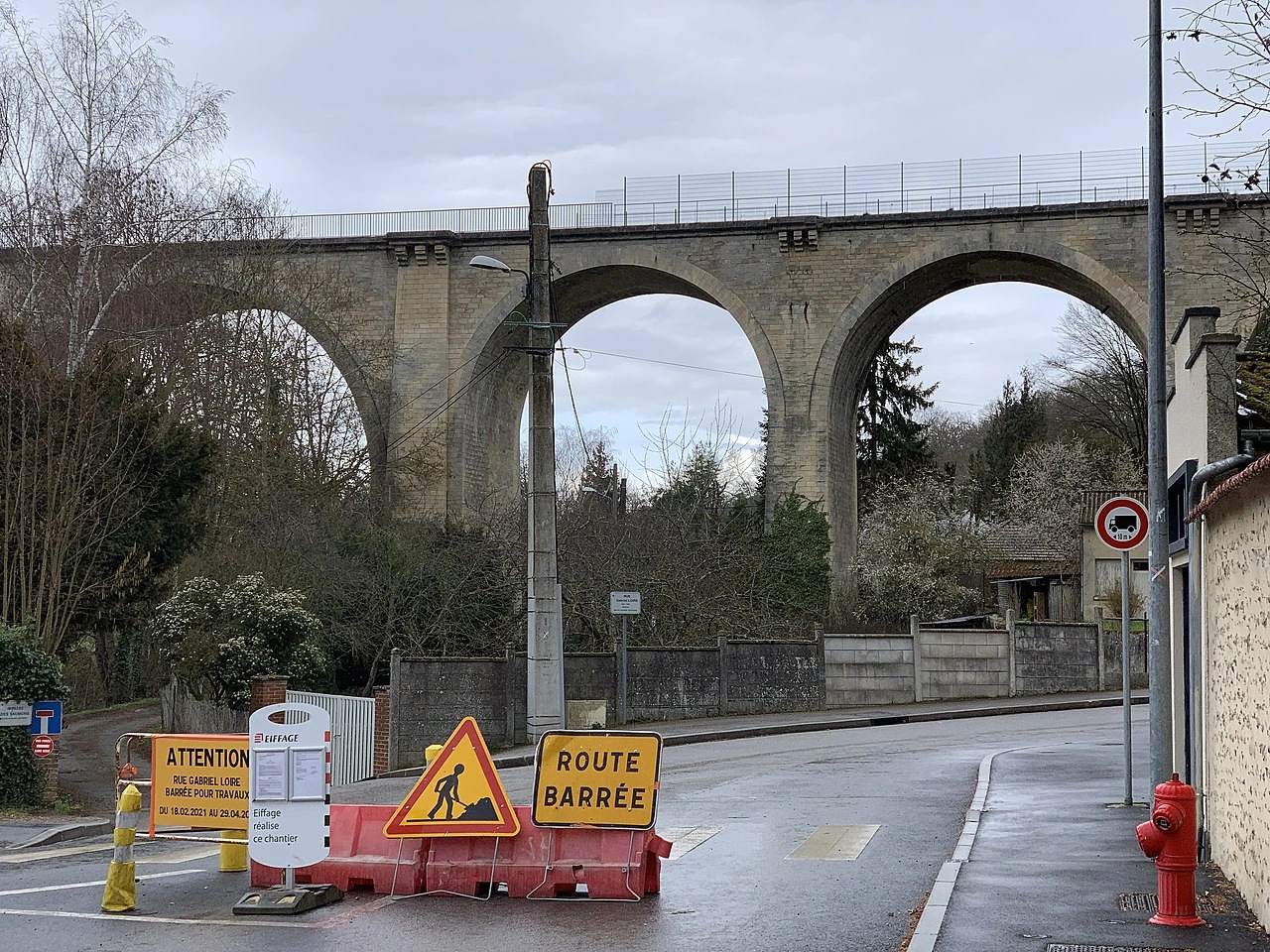
Wikimedia.org • Chabe01 • CC BY-SA
What should you watch for when approaching roadworks in France?
Look for temporary warnings, cones, barriers, narrow lanes and construction vehicles. Road layouts can change temporarily, including lane shifts, traffic-light control and short one-way sections. Expect workers and slow or stationary traffic near the worksite.
🔗 legifrance.gouv.fr • French Road Code — R411-25, R412-30, R413-1, R413-17; 1967 order articles 3–5
Is a temporary speed limit at roadworks binding in France?
Where an authorised temporary regulatory speed limit is in force, you must obey it. A roadworks warning alone should not be mistaken for a new numerical limit, but conditions may require driving more slowly.
🔗 legifrance.gouv.fr • French Road Code — R411-25, R412-30, R413-1, R413-17; 1967 order articles 3–5
What if only one lane remains open through roadworks in France?
Follow the temporary signals, stop/go instructions, lane arrows and priority signs. Do not enter an opposing traffic lane until permitted, and give vulnerable road users and road workers extra room.
🔗 legifrance.gouv.fr • French Road Code — R411-25, R412-30, R413-1, R413-17; 1967 order articles 3–5
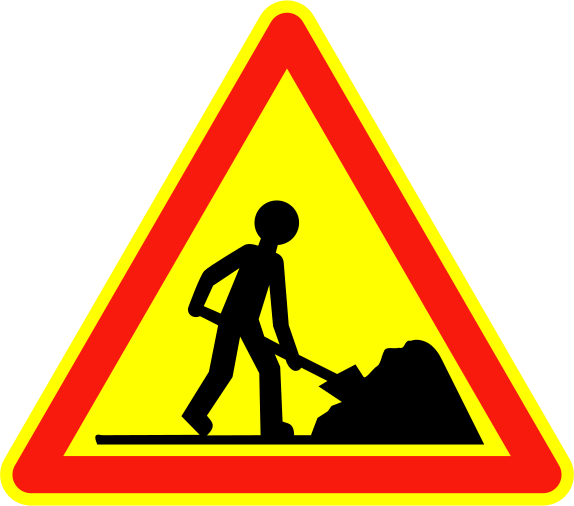 Warning for roadworks.
English • Traffic sign AK5 • Roadworks. Temporary sign.
Français • Panneau AK5 • Travaux. Signalisation temporaire.
Sources
🔗 Commons.wikimedia.org
🔗 Legifrance.gouv.fr • Arrêté du 24 novembre 1967 • article 9 Source : Roulex 45 • CC BY-SA 3.0 • SVG original non modifié.
Image via Commons.wikimedia.org
Roulex 45 • CC BY-SA 3.0 • Source revision 2014-09-04. Wikimedia original unmodified.
46. Crosswind
Crosswind is wind blowing across the direction of travel and can push a vehicle sideways or affect its stability. Strong or sudden gusts are especially dangerous for motorcycles, bicycles, caravans, trailers and high-sided vehicles. Drivers should reduce speed, keep a firm but relaxed grip on the steering wheel and allow extra space from other road users. Particular care is needed on bridges, exposed roads and when passing large vehicles or leaving sheltered areas, where a sudden change in wind force can move the vehicle unexpectedly.

Wikimedia.org • Marc Mongenet • CC BY-SA
Where can crosswinds be especially hazardous in France?
Watch for sudden gusts on Atlantic coastal routes, exposed viaducts and Alpine passes. Winds can be stronger as you leave a sheltered section or pass a large vehicle, so make allowance for changes in steering force.
🔗 legifrance.gouv.fr • French Road Code — R413-17, R414-1–4, R414-11; 1967 order article 3
Does a crosswind warning automatically impose a speed limit in France?
A crosswind warning does not itself set a numerical speed limit. Obey any separate speed restriction or electronic message, and choose a lower speed whenever gusts could affect control.
🔗 legifrance.gouv.fr • French Road Code — R413-17, R414-1–4, R414-11; 1967 order article 3
How should you drive a motorcycle, van or vehicle towing a caravan in strong winds in France?
These vehicles may react sharply to gusts. Reduce speed smoothly, leave more room from traffic, hold the controls steadily and take extra care when passing a lorry or emerging from shelter. Follow any temporary restriction for high-sided vehicles.
🔗 legifrance.gouv.fr • French Road Code — R413-17, R414-1–4, R414-11; 1967 order article 3
47. Height limit
A height limit prohibits vehicles whose total height exceeds the value shown from entering or passing a road section, bridge, tunnel, gateway or other structure. The vehicle’s height includes its load and any equipment attached above it.
Drivers of high vehicles must know their exact height, observe advance warnings and use an alternative route when necessary. They should never rely only on visual judgement or attempt to pass beneath a structure when safe clearance is uncertain.
Wikimedia.org • Marc Mongenet • CC BY-SA
How should you read a low-bridge height restriction in France?
Look for the locally prescribed height restriction or clearance warning near historic centres, tunnels and older bridges. The displayed clearance is normally in metres. A warning may describe a hazard ahead; a prohibitory sign indicates a route you cannot enter if your vehicle exceeds the limit.
🔗 legifrance.gouv.fr • French Road Code — R411-25; 1967 order B11–B13
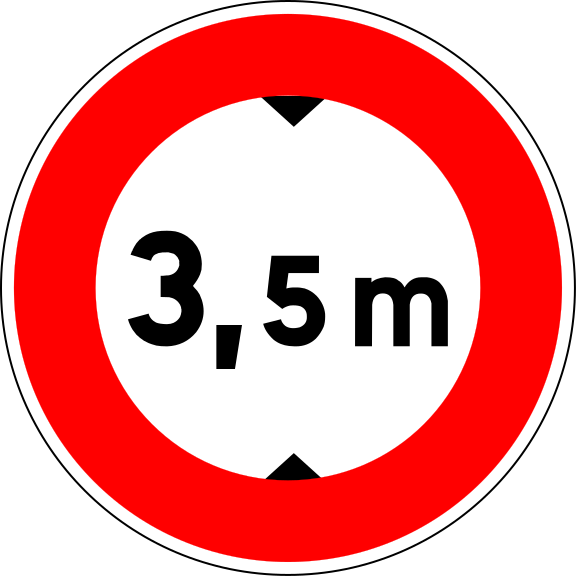 Vehicles higher than indicated prohibited.
English • Traffic sign B12 • No vehicles higher than indicated, including their load.
Français • Panneau B12 • Accès interdit aux véhicules dont la hauteur, chargement compris, est supérieure au nombre indiqué.
Sources
🔗 Commons.wikimedia.org
🔗 Equipementsdelaroute.cerema.fr • Arrêté du 24 novembre 1967
© Roulex 45 et les contributeurs Wikimedia • CC BY-SA 4.0 • SVG original non modifié.
Image via Commons.wikimedia.org
Roulex 45 • CC BY-SA 4.0 • Source revision 2019-10-03. Wikimedia original unmodified.
Does a roof load count when checking vehicle height in France?
Yes for practical clearance: measure the vehicle at its highest point with its load and fitted accessories, such as a roof box, bicycle or roof rack. Check the local legal measurement rules as well; an empty vehicle’s registered height is not enough when equipment has been added.
🔗 legifrance.gouv.fr • French Road Code — R411-25; 1967 order B11–B13
What should you do if your vehicle is too high for a bridge or tunnel in France?
Do not try to squeeze under the structure. Use the signed alternative route and, if you are already close to the obstruction, stop where safe and seek traffic-control assistance rather than reversing unpredictably into moving traffic.
🔗 legifrance.gouv.fr • French Road Code — R411-25; 1967 order B11–B13
48. Width limit
A width limit prohibits vehicles or vehicle combinations whose total width exceeds the value shown from entering or passing a road section, bridge, tunnel, gateway or other narrow passage. The width includes the vehicle’s load and any equipment or objects extending from its sides.
Drivers must know the maximum travelling width of their vehicle and load, observe advance warnings and use an alternative route when necessary. They should never enter when sufficient lateral clearance is uncertain.

Wikimedia.org • Tabl-trai • CC BY-SA
What does a posted vehicle-width restriction mean in France?
A width restriction limits entry to a passage that cannot legally accommodate vehicles above the indicated width. Look for the local sign near historic centres, tunnels and older bridges and read any advance warning or exception plate. Measurements are generally given in metres.
🔗 legifrance.gouv.fr • French Road Code — R411-25; 1967 order B11–B13
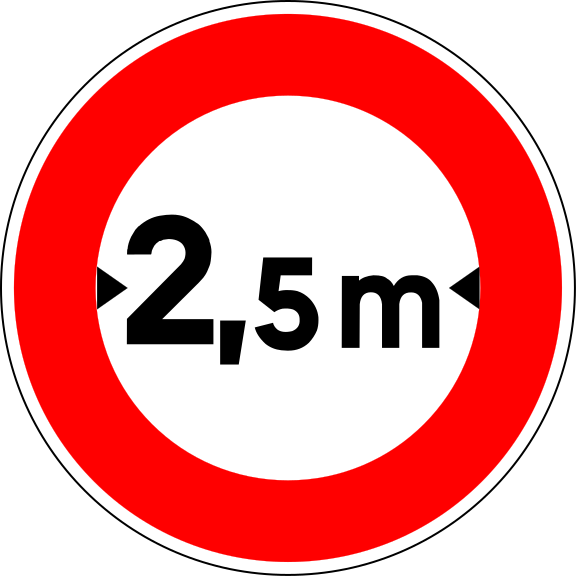 Vehicles wider than indicated prohibited.
English • Traffic sign B11 • No vehicles wider than indicated, including their load.
Français • Panneau B11 • Accès interdit aux véhicules dont la largeur, chargement compris, est supérieure au nombre indiqué.
Sources
🔗 Commons.wikimedia.org
🔗 Equipementsdelaroute.cerema.fr • Arrêté du 24 novembre 1967
© Roulex 45 et les contributeurs Wikimedia • CC BY-SA 4.0 • SVG original non modifié.
Image via Commons.wikimedia.org
Roulex 45 • CC BY-SA 4.0 • Source revision 2013-04-26. Wikimedia original unmodified.
How should you check the width of a loaded vehicle in France?
Check the vehicle and any projecting load or equipment. The legal measurement may exclude particular fittings such as mirrors, depending on local rules, but those fittings still need physical space to pass safely. Never assume the statutory measurement guarantees sufficient real-world clearance.
🔗 legifrance.gouv.fr • French Road Code — R411-25; 1967 order B11–B13
Can a driver ignore a width restriction if the road looks wide enough in France?
No. A regulatory width limit must be obeyed unless an applicable exemption or authorised arrangement permits entry. Check your route before driving a wide van, trailer or load through a narrow town, bridge or roadworks section.
🔗 legifrance.gouv.fr • French Road Code — R411-25; 1967 order B11–B13
49. Length limit
A length limit is a restriction that prohibits vehicles or vehicle combinations longer than a specified maximum length from entering a road or area. The stated length normally includes the complete vehicle combination and any load where national rules specify this.
Length restrictions are commonly used where long vehicles cannot safely negotiate narrow streets, tight bends, bridges, tunnels or other constrained road layouts. Drivers whose vehicle exceeds the indicated limit must use another permitted route.
Wikimedia.org • Marc Mongenet • CC BY-SA
Why might a road have a vehicle-length restriction in France?
A limit may protect tight bends, bridges or streets where a long combination cannot turn or pass safely, including around historic centres, tunnels and older bridges. Read the actual sign; a length prohibition is different from a general warning about a narrow road.
🔗 legifrance.gouv.fr • French Road Code — R411-25; 1967 order B11–B13
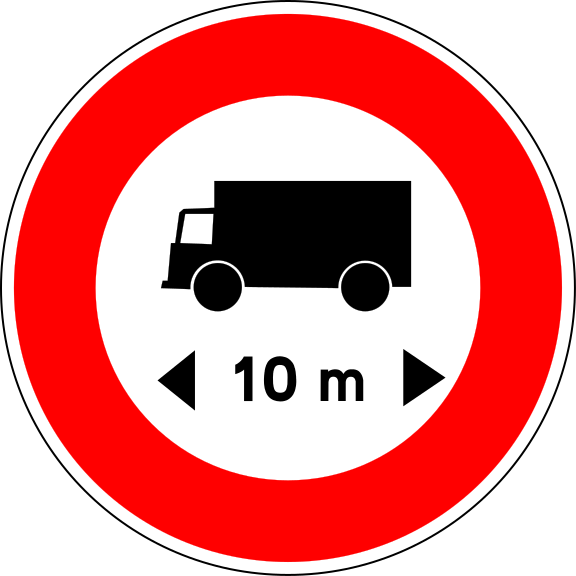 Vehicles longer than indicated prohibited.
English • Traffic sign B10a • No vehicles, articulated vehicles, double road trains or vehicle combinations longer than indicated.
Français • Panneau B10a • Accès interdit aux véhicules, véhicules articulés, trains doubles ou ensemble de véhicules dont la longueur est supérieure au nombre indiqué.
Sources
🔗 Commons.wikimedia.org
🔗 Equipementsdelaroute.cerema.fr • Arrêté du 24 novembre 1967
© Roulex 45 et les contributeurs Wikimedia • CC BY-SA 4.0 • SVG original non modifié.
Image via Commons.wikimedia.org
Roulex 45 • CC BY-SA 4.0 • Source revision 2013-04-26. Wikimedia original unmodified.
Is a trailer included in the signed length restriction in France?
Where the sign restricts the length of a vehicle combination, measure the complete combination rather than just the towing vehicle. Any protruding load may also matter under the local legal measurement rules. Check the wording and vehicle class covered by the sign.
🔗 legifrance.gouv.fr • French Road Code — R411-25; 1967 order B11–B13
What if your vehicle combination exceeds a signed length limit in France?
Choose another permitted route before entering the restricted section. Do not assume a wide carriageway is suitable: long vehicles need room for their swept path, particularly at sharp bends, junctions and roundabouts.
🔗 legifrance.gouv.fr • French Road Code — R411-25; 1967 order B11–B13
50. Weight limit
A weight limit prohibits vehicles or vehicle combinations whose mass exceeds the value shown from entering or passing a road section, bridge, tunnel or other structure. Depending on local law, the restriction may concern the vehicle’s actual loaded mass, maximum authorised mass or load on an individual axle.
Drivers must know which type of mass the sign refers to and must include the vehicle, passengers, cargo and any trailer where required. A vehicle that exceeds the limit must use another suitable route.
Wikimedia.org • Marc Mongenet • CC BY-SA
Does every weight-limit sign measure the same kind of vehicle weight in France?
No. Check whether the particular sign concerns actual loaded mass, authorised maximum mass, axle load or another specified vehicle class. These are different measurements; do not interpret every weight-restriction sign as the same type of limit.
🔗 legifrance.gouv.fr • French Road Code — R411-25; 1967 order B11–B13
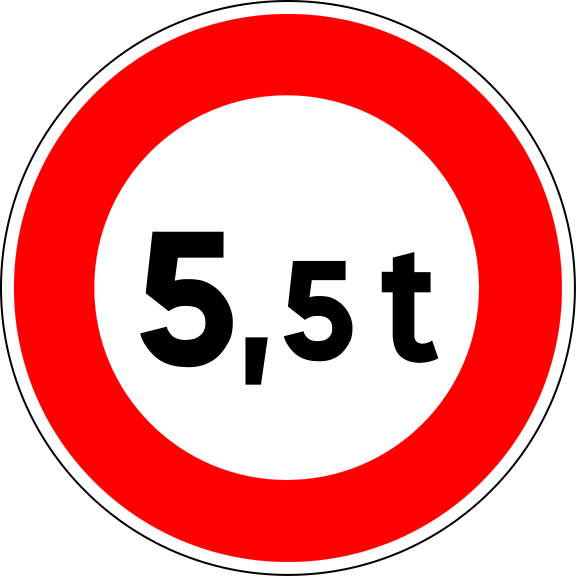 Vehicles heavier than indicated prohibited.
English • Traffic sign B13 • No vehicles, articulated vehicles, double road trains or vehicle combinations whose maximum authorised laden mass or maximum authorised combination mass exceeds the indicated value.
Français • Panneau B13 • Accès interdit aux véhicules, véhicules articulés, trains doubles ou ensemble de véhicules dont le poids total autorisé en charge ou le poids total roulant autorisé excède le nombre indiqué.
Sources
🔗 Commons.wikimedia.org
🔗 Equipementsdelaroute.cerema.fr • Arrêté du 24 novembre 1967
© Roulex 45 et les contributeurs Wikimedia • CC BY-SA 4.0 • SVG original non modifié.
Image via Commons.wikimedia.org
Roulex 45 • CC BY-SA 4.0 • Source revision 2013-04-26. Wikimedia original unmodified.
Do cargo and trailers matter for a posted weight restriction in France?
Yes, whenever the rule is based on actual loaded mass or the total mass of a combination. Cargo, passengers and the trailer affect that figure; weight on individual axles may be limited separately. If the sign instead uses authorised maximum mass, an empty vehicle may still be prohibited.
🔗 legifrance.gouv.fr • French Road Code — R411-25; 1967 order B11–B13
What should you do if your vehicle exceeds a bridge weight limit in France?
Do not drive onto the bridge. Follow the signed alternative route and check the vehicle’s gross and axle loads as applicable. A general heavy-vehicle permit does not automatically authorise crossing every restricted bridge.
🔗 legifrance.gouv.fr • French Road Code — R411-25; 1967 order B11–B13