


Traffic signsUnited Kingdom
 Traffic rules
 United Kingdom
151. Car insurance
Car insurance is financial protection for risks associated with owning or using a motor vehicle. Depending on the policy, it can cover liability for injury or damage caused to other people, as well as damage to, theft of or other losses involving the insured vehicle.
The minimum insurance required by law varies between countries. Drivers can often purchase additional cover beyond the compulsory minimum, such as collision, comprehensive, theft, fire or roadside-assistance protection.

Wikimedia.org • Charles Edward Miller • CC BY-SA
What does car insurance cover?
Coverage depends on the policy. Liability insurance generally covers injury or damage caused to other people, while optional forms of insurance may also cover damage to the insured vehicle, theft, fire or other risks.
Is car insurance compulsory?
Many countries require at least a minimum level of motor liability insurance before a vehicle may be used on public roads. The exact requirements and exemptions depend on national law.
What is the difference between liability and comprehensive insurance?
Liability insurance primarily covers damage or injury for which the insured driver is legally responsible toward others. Comprehensive or similar optional cover can also protect the insured vehicle against risks such as theft, fire, vandalism or accidental damage, depending on the policy.

152. First aid kit
A first aid kit is a collection of medical supplies intended for providing immediate basic care after an injury or accident. A vehicle first aid kit commonly contains items such as sterile dressings, bandages, adhesive plasters and other basic wound-care materials.
Some countries require certain vehicles to carry a first aid kit, while in others it is only recommended. The kit should be stored where it can be reached when needed, and its contents should be checked regularly so that required items remain complete and usable.

Wikimedia.org • Red Cross • CC0
Why should a first aid kit be carried in a vehicle?
A first aid kit provides basic materials that can be used to treat injuries or control bleeding while waiting for professional medical assistance.
Is a first aid kit compulsory in every country?
No. Requirements vary between countries and vehicle types. Some countries require motorists to carry an approved first aid kit, while others only recommend having one.
Should a vehicle first aid kit be checked regularly?
Yes. Its contents should remain complete, clean and usable. Used items should be replaced, and products with expiry dates should be checked periodically.
153. Fire extinguisher
A fire extinguisher is a portable safety device used to control or extinguish a small fire. Vehicle fire extinguishers are designed for fires that may involve materials, fuel, electrical equipment or other components, depending on the extinguisher type.
Some countries require certain vehicles to carry a fire extinguisher, while in others it is only recommended. An extinguisher should be securely mounted, readily accessible, suitable for vehicle use and kept in working condition.

Wikimedia.org • Senado Federal • CC BY
Why carry a fire extinguisher in a vehicle?
A fire extinguisher can help control a small fire before it spreads, provided it is safe to use. If a fire is already large or spreading rapidly, occupants should move away from the vehicle and contact the emergency services.
Is a fire extinguisher compulsory in every vehicle?
No. Requirements vary between countries and vehicle types. Some countries require extinguishers in passenger cars or particular commercial vehicles, while others only recommend carrying one.
Where should a vehicle fire extinguisher be kept?
It should be securely mounted in an accessible location and protected from damage. Drivers should also check its condition, seal and expiry or service information according to the applicable requirements.
154. High-visibility clothing
High-visibility clothing is clothing designed to make a person easier for other road users to see. It commonly uses bright fluorescent material combined with retro-reflective strips that reflect light from vehicle headlights.
High-visibility clothing is especially useful when a driver or passenger must leave a vehicle after a breakdown or emergency. Requirements vary between countries, so drivers should check whether a reflective safety vest must be carried or worn.

Wikimedia.org • Kecko • CC BY
What is high-visibility clothing?
High-visibility clothing is designed to make the wearer more noticeable to other road users. Safety vests typically combine fluorescent material for daytime visibility with retro-reflective material that becomes particularly visible when illuminated at night.
When should a high-visibility vest be worn?
It should be worn whenever leaving a vehicle in a situation where approaching traffic could present a danger, particularly after a breakdown or emergency and in conditions of poor visibility.
Is high-visibility clothing compulsory for drivers?
This depends on the country. Some countries require a reflective vest to be carried in the vehicle and worn in specified breakdown or emergency situations, while others only recommend it.
155. Towing rope
A towing rope is a strong flexible rope, strap or cable used to connect a disabled vehicle to another vehicle so that it can be towed. It should only be attached to towing points designed for this purpose and must be suitable for the weight of the vehicle.
Towing with a rope requires careful coordination between both drivers because the towed vehicle may have reduced steering and braking assistance. National rules can restrict where and how a vehicle may be towed, and professional recovery is safer when the vehicle cannot be controlled normally.

Wikimedia.org • Stephen West • CC BY
What is a towing rope used for?
A towing rope is used to connect a disabled vehicle to a towing vehicle so that it can be moved when ordinary towing is legally and safely permitted.
Where should a towing rope be attached?
It should be attached only to the towing points specified by the vehicle manufacturer. Attaching it to bumpers, suspension parts or other unsuitable components can cause damage or create a dangerous failure.
Can a vehicle always be towed with a rope?
No. Some vehicles cannot safely be rope-towed because of their transmission, steering, braking system or drivetrain, and national traffic rules may prohibit rope towing on certain roads. The vehicle manufacturer's instructions and local rules should therefore be checked first.
156. First aid
First aid is the immediate assistance given to a person who is injured or suddenly becomes ill before professional medical help is available. Its purpose is to preserve life, prevent the condition from becoming worse and support recovery.
At a road accident, first aid begins with making sure the scene is safe, assessing the casualty and contacting the emergency services when necessary. Assistance should be limited to actions the helper knows how to perform safely.

Wikimedia.org • Cory H Jones • CC BY-SA
What is the purpose of first aid?
First aid aims to preserve life, prevent an injury or illness from becoming worse and provide appropriate immediate care until professional medical assistance becomes available.
What should you do first when giving first aid after a road accident?
First check that it is safe to approach. Assess the casualty, contact the emergency services when necessary and provide appropriate assistance within your level of knowledge and training.
Should an injured person always be moved?
No. An injured person should generally not be moved unnecessarily because movement can worsen certain injuries. Moving the casualty may be necessary when remaining in the location creates an immediate danger, such as fire or approaching traffic.
157. Concrete step barrier
A concrete step barrier is a concrete vehicle-restraint barrier with a stepped or sloping face profile. It is used along roads or in central reservations to contain and redirect vehicles that leave their intended path and to reduce the risk of entering opposing traffic or reaching dangerous roadside hazards.
Concrete step barriers may be cast in place or made from connected prefabricated sections. Their containment level, impact behaviour and permitted movement depend on the particular barrier system and installation.

Wikimedia.org • Pushcreativity • CC BY-SA
What is the purpose of a concrete step barrier?
A concrete step barrier is designed to contain or redirect a vehicle that leaves its intended path. It can be used to separate opposing traffic or protect road users from dangerous areas beside the roadway.
How is a concrete step barrier different from a Jersey barrier?
Both are concrete vehicle-restraint barriers, but they use different cross-sectional profiles. A step barrier has a stepped-profile face, while a Jersey barrier uses the characteristic Jersey-shaped sloping profile. Their actual safety performance depends on the tested barrier system rather than simply on its shape.
Are concrete step barriers always permanently cast into the road?
No. Step barriers can be constructed as continuous cast-in-place barriers or as prefabricated concrete sections, depending on the particular road-restraint system and installation.
158. Barriers
Barriers are physical devices used to block, restrict, guide or separate traffic. They can protect road users, close roads or lanes, control access, separate opposing traffic or shield people and work areas from moving vehicles.
Road barriers may be permanent or temporary and can include gates, boom barriers, concrete barriers, movable barriers and other restraint or closure systems. Drivers must respect barriers and must not pass them when they indicate that a road or area is closed.
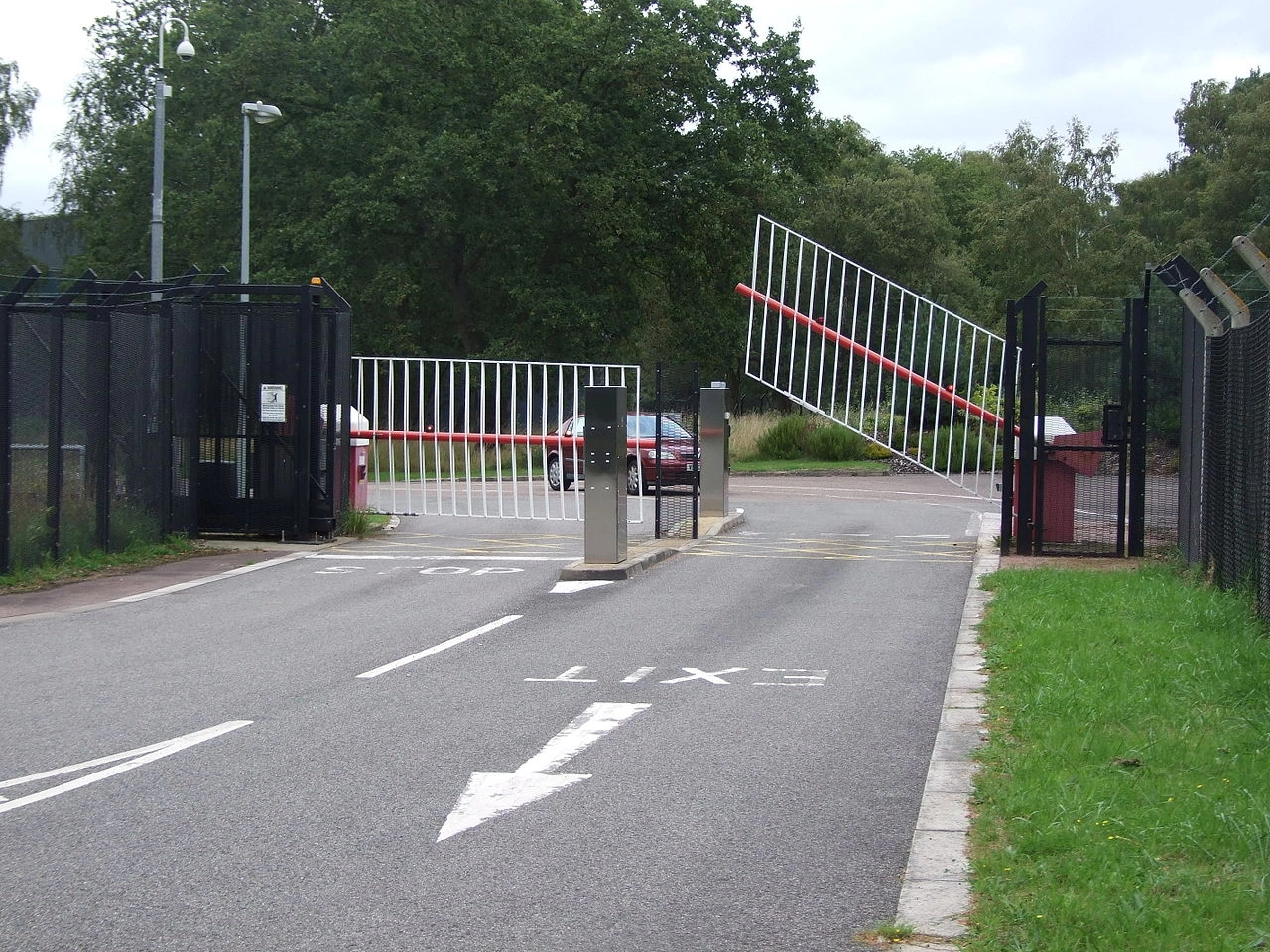
Wikimedia.org • Gaius_Cornelius • CC BY-SA
What are road barriers used for?
Road barriers can close roads or lanes, control access, separate traffic streams, protect work zones and prevent vehicles from entering hazardous or restricted areas.
Can road barriers be temporary?
Yes. Temporary barriers are commonly used during roadworks, emergencies and special traffic arrangements, while permanent barriers may be installed for access control or long-term protection.
May you drive past a closed traffic barrier?
No. A closed barrier normally indicates that access is prohibited or unsafe. Drivers should stop and follow any accompanying signs, signals or instructions rather than attempting to drive around it.
159. Vehicle lights
Vehicle lights are lighting and signalling devices fitted to a vehicle to help the driver see, make the vehicle visible and communicate intentions to other road users. They include dipped-beam and main-beam headlights, position lights, daytime running lights, rear lights, brake lights, direction indicators, reversing lights, fog lights and hazard warning lights.
Drivers should use the appropriate lights for the visibility, weather and traffic conditions. Lights must be kept clean and in working condition, and lights that can dazzle other road users should only be used when permitted.
Wikimedia.org • Christopher Ziemnowicz • CC BY-SA
What are the main types of vehicle lights?
Common vehicle lights include dipped-beam and main-beam headlights, position lights, daytime running lights, rear lights, brake lights, direction indicators, reversing lights, fog lights and hazard warning lights.
When should dipped-beam headlights be used?
Dipped-beam headlights are normally used at night and whenever visibility is poor. Unlike main beams, they are designed to illuminate the road while reducing glare for other road users.
When should main-beam headlights not be used?
Main beams should be changed to dipped beams whenever they could dazzle approaching or preceding road users. The precise requirements and distances vary between countries.
160. Street lights
Street lights are fixed lighting installations used to illuminate roads, intersections, crossings, footpaths and other public traffic areas during darkness. They improve visibility of the roadway, road users and potential hazards.
Street lighting does not replace a driver's responsibility to use the vehicle's required lights or to adapt speed to visibility. Lighting levels can vary considerably between roads, and some roads may be only partly illuminated or completely unlit.

Wikimedia.org • Exploringlife • CC BY-SA
What is the purpose of street lights?
Street lights improve visibility during darkness and can help road users see the road layout, intersections, pedestrians, cyclists, obstacles and other traffic more clearly.
Do you still need vehicle lights on a street with street lighting?
Usually yes. Street lighting does not normally replace the vehicle-lighting requirements that apply at night or in poor visibility. Drivers must follow the lighting rules of the country in which they are driving.
Should you use main-beam headlights on a well-lit street?
Main beam should not be used when it could dazzle other road users, and many countries require dipped beam instead on sufficiently illuminated roads. Drivers should use the appropriate lighting for the road and traffic conditions.
161. Dipped beam
Dipped beam is the low-beam setting of a vehicle's headlights. It illuminates the road ahead while directing the light downward so that it is less likely to dazzle drivers and other road users.
Dipped-beam headlights are normally used at night, in poor visibility and whenever main beam could dazzle another road user. They provide less illumination than main beam but are suitable for normal driving when other traffic is nearby.

Wikimedia.org • Ehsnils • CC BY-SA
What is dipped beam?
Dipped beam is the normal low-beam headlight setting. It illuminates the road in front of the vehicle while limiting glare towards approaching and preceding road users.
When should dipped beam be used?
Dipped beam is generally used during darkness, in reduced visibility and whenever main-beam headlights could dazzle another road user. Exact requirements vary between countries.
What is the difference between dipped beam and main beam?
Dipped beam directs light lower and is suitable when other traffic is present. Main beam projects light farther ahead but must be switched off when it could dazzle other road users.
162. High beam
High beam, also called main beam, is the headlight setting designed to illuminate the road a long distance ahead. It provides stronger and farther-reaching illumination than dipped beam but can dazzle other road users if used incorrectly.
High beam is mainly useful on dark roads where there is no nearby traffic that could be dazzled. Drivers must switch to dipped beam whenever required by traffic conditions or national rules.

Wikimedia.org • Ehsnils • CC BY-SA
What is high beam used for?
High beam provides long-range illumination and can help a driver see farther ahead on dark roads where there is little or no other traffic.
When should you switch from high beam to dipped beam?
You should switch to dipped beam whenever high beam could dazzle approaching or preceding road users. Exact requirements and distances vary between countries.
Can high beam be used on a well-lit road?
Often not when the existing road lighting already provides sufficient visibility. National traffic rules may specifically require dipped beam instead in adequately illuminated areas.
163. Fog lights
Fog lights are vehicle lights designed for use in conditions where visibility is seriously reduced by fog, snow or other severe weather. Front fog lights illuminate the road ahead at a low level, while rear fog lights make the vehicle more visible to road users approaching from behind.
Fog lights should only be used in the conditions permitted by local traffic rules. Rear fog lights are particularly bright and can dazzle or distract following drivers when visibility is good.
Wikimedia.org • Ehsnils • CC BY-SA
What are front fog lights used for?
Front fog lights provide additional low-level illumination in poor visibility such as fog, snowfall or heavy rain. Their design helps illuminate the road close to the vehicle.
What are rear fog lights used for?
Rear fog lights produce an intense red light that makes a vehicle easier to see from behind when visibility is seriously reduced.
Should fog lights be used in normal weather?
No. Fog lights should only be used when the applicable traffic rules and weather conditions justify them. Rear fog lights in particular can cause unnecessary glare when visibility is good.
164. Front fog lights
Front fog lights are low-mounted vehicle lights designed to improve illumination of the road immediately ahead when visibility is reduced by fog, snow or heavy rain. Their beam is generally wide and directed low towards the road surface.
Front fog lights should only be used in the weather conditions permitted by local traffic rules. They are supplementary lights and should not be used unnecessarily in normal visibility.

Wikimedia.org • Ehsnils • CC BY-SA
What are front fog lights used for?
Front fog lights provide additional low-level illumination when fog, snow, heavy rain or similar conditions make it difficult to see the road ahead.
Where are front fog lights located?
They are normally mounted relatively low at the front of the vehicle so that their wide beam illuminates the road surface without projecting as much light directly into fog or precipitation.
Should front fog lights be used in normal weather?
No. Front fog lights should only be used when conditions and local traffic rules permit them. Unnecessary use can create glare or distraction for other road users.
165. Rear fog lights
Rear fog lights are bright red lights at the rear of a vehicle that make it easier for following road users to see the vehicle when visibility is severely reduced. They are much brighter than normal rear position lights.
Because rear fog lights can dazzle or distract drivers behind, they should only be used in the weather conditions permitted by local traffic rules and should be switched off when visibility improves.

Wikimedia.org • Ehsnils • CC BY-SA
What are rear fog lights used for?
Rear fog lights make a vehicle more visible from behind when fog, snow, heavy rain or other severe weather significantly reduces visibility.
Why are rear fog lights so bright?
They are designed to remain clearly visible through poor weather. Because of their high intensity, they can cause glare when visibility is normal.
Should rear fog lights be switched off when visibility improves?
Yes. They should only remain on while the conditions that justify their use continue. Exact legal requirements vary between countries.
166. Side lights
Side lights, also called position lights, are low-intensity vehicle lights used to make a vehicle visible and indicate its presence and approximate width. Unlike dipped-beam or high-beam headlights, they are not designed to illuminate the road far enough for normal driving at night.
Side lights are commonly used together with other vehicle lighting and may also be used to make a stationary or parked vehicle visible in darkness. Their required use depends on national traffic rules.

Wikimedia.org • Chris828 • CC0
What are side lights used for?
Side lights make a vehicle easier to see and indicate its position and width. They provide much less road illumination than dipped-beam or high-beam headlights.
Are side lights the same as dipped-beam headlights?
No. Side lights mainly make the vehicle visible, while dipped-beam headlights illuminate the road ahead sufficiently for driving without unnecessarily dazzling other road users.
Can side lights be used when a vehicle is parked?
Yes. In some countries, position or parking lights must be used when a vehicle is parked on the road at night or in poor visibility. The exact requirements depend on local traffic rules.
167. Turn signals
Turn signals, also called direction indicators, are flashing lights used to communicate a driver's intention to turn or move laterally, such as when changing lanes. They normally flash on the side towards which the vehicle intends to move.
Turn signals should be activated early enough to give other road users useful warning and should be cancelled once the intended movement has been completed. Signalling does not itself give the driver priority or make an unsafe manoeuvre permissible.

Wikimedia.org • Ehsnils • CC BY-SA
When should turn signals be used?
Turn signals should be used when turning, changing lanes or making another lateral movement where signalling is required. The signal should be given early enough for other road users to understand the driver's intention.
Does using a turn signal give you priority?
No. A turn signal only communicates an intended movement. The driver must still follow the applicable priority rules and make sure the movement can be completed safely.
When should a turn signal be switched off?
The signal should be cancelled once the turn, lane change or other indicated movement has been completed so that it does not mislead other road users.
168. Hazard lights
Hazard lights, also called hazard warning lights, make all of a vehicle's direction indicators flash simultaneously. They are used to warn other road users that the vehicle or traffic situation presents an unusual or immediate danger.
Hazard lights may be appropriate after a breakdown, collision or when warning following traffic of a sudden hazard. They should not normally be used as a substitute for proper parking, signalling or vehicle lighting.

Wikimedia.org • Ehsnils • CC BY-SA
What are hazard lights used for?
Hazard lights warn other road users of an unusual or potentially dangerous situation involving the vehicle or traffic ahead. Common examples include breakdowns, collisions and sudden obstructions.
Do hazard lights give a driver permission to park anywhere?
No. Switching on hazard lights does not normally make prohibited stopping or parking legal. The driver must still comply with the applicable stopping and parking rules.
Can hazard lights be used to warn drivers behind of sudden congestion?
In many countries they may be used briefly to warn following traffic of an immediate danger such as a sudden queue. The exact rules governing their use vary between countries.
169. Dashboard lights
Dashboard lights are illuminated symbols and indicators on a vehicle's instrument panel that provide information about the vehicle's operation, systems and possible faults. They can show functions such as headlights, turn signals, fuel level, engine condition, tyre pressure, braking systems and safety equipment.
Dashboard lights commonly use different colours to indicate importance. Green or blue usually shows that a system is operating, amber or yellow generally indicates that attention may be required, and red often warns of a serious condition requiring prompt action.
Wikimedia.org • Wiki LIC • CC BY-SA
What do dashboard warning lights mean?
Dashboard warning lights communicate information about vehicle systems. Their exact meaning depends on the symbol, colour and vehicle, so drivers should consult the vehicle handbook when a warning is unfamiliar.
What does a red dashboard warning light usually mean?
A red warning light generally indicates a serious problem or a condition requiring immediate attention. Depending on the warning, the driver may need to stop the vehicle safely and switch off the engine.
What does an amber or yellow dashboard light mean?
An amber or yellow light usually indicates a fault, maintenance requirement or condition that should be checked soon. The vehicle may still be driveable, but the warning should not be ignored.
170. Bicycle lighting
Bicycle lighting refers to lights and reflectors fitted to a bicycle to help the rider see and be seen, especially in darkness or reduced visibility. Required equipment and the circumstances in which bicycle lights must be used vary by country, so riders should follow the applicable local rules.

Wikimedia.org • Santeri Viinamäki • CC BY-SA
171. Bicycle bell
A bicycle bell is a small audible warning device fitted to a bicycle, usually on the handlebars, and used to alert pedestrians, cyclists or other road users when necessary. Requirements to fit or use a bell vary by country and road environment. Riders should use it as a warning device without causing unnecessary disturbance.

Wikimedia.org • Vaikoovery • CC BY
172. Headlight flashing
Headlight flashing means briefly flashing a vehicle's headlights to attract another road user's attention. Its permitted use and meaning vary by country and situation, so drivers should not assume that a flash grants priority or authorises a manoeuvre. Headlights should not be flashed in a way that dazzles or distracts other road users.

Wikimedia.org • A. Bailey • CC BY-SA
173. Seat belt
A seat belt is a restraint system designed to hold a vehicle occupant securely in their seat during sudden braking or a collision. It helps reduce the risk of the occupant striking the vehicle interior or being thrown from the vehicle.
A seat belt should fit firmly across the body, with the lap section positioned low across the hips and the shoulder section across the chest. It should not be twisted, placed behind the back or used in a way that reduces its protective effect.

Wikimedia.org • Jusmar • CC0
Why is wearing a seat belt important?
A seat belt restrains the occupant during sudden deceleration or a collision, helping prevent contact with the vehicle interior and reducing the risk of being thrown from the vehicle.
How should a seat belt be worn?
The belt should fit securely without twists. The lap section should lie low across the hips and the shoulder section should pass across the chest and shoulder rather than behind the back or under the arm.
Do airbags replace the need for a seat belt?
No. Seat belts and airbags are designed to work together. An airbag does not replace the restraint provided by a correctly worn seat belt.
174. Child restraints
Child restraints are safety systems designed to protect children travelling in vehicles. They include rear-facing and forward-facing child seats and booster seats that position and restrain a child according to their size and the restraint system's specifications.
A child restraint should be suitable for the child and vehicle, installed according to the manufacturer's instructions and secured correctly on every journey. Rear-facing restraints must never be placed in front of an active frontal airbag.
Wikimedia.org • Pieter Kuiper • CC BY-SA
What is a child restraint system?
A child restraint system is a safety device designed to secure a child in a vehicle. Depending on the child's size and the system, it can include a child seat, harness or booster seat used together with the vehicle's seat belt or dedicated anchorage system.
How should you choose a child restraint?
The restraint should be approved for the child's size and compatible with the vehicle. The manufacturer's instructions should be followed carefully when selecting, installing and using it.
Can a rear-facing child seat be placed in front of an active airbag?
No. A rear-facing child restraint must not be used on a seat with an active frontal airbag because deployment of the airbag can seriously endanger the child.
175. Head restraints
Head restraints, also called headrests, are vehicle safety devices designed to limit the rearward movement of an occupant's head relative to the body during a collision. They help reduce the risk of injuries to the neck and cervical spine, particularly in rear impacts.
An adjustable head restraint should be positioned so that it supports the back of the head rather than the neck and is as close to the head as practical. Drivers and passengers should adjust the restraint to their body size before travelling.
Wikimedia.org • BrendelSignature • CC BY-SA
What is the purpose of a head restraint?
A head restraint limits excessive rearward movement of the head during a collision, helping reduce the forces acting on the neck and cervical spine.
How should a head restraint be adjusted?
It should be adjusted to support the back of the head rather than the neck and positioned as close to the head as practical. The seat and head restraint should be adjusted together to provide a comfortable and protective driving position.
Are head restraints part of passive safety?
Yes. Head restraints are passive safety devices because their main purpose is to reduce injury when a collision occurs rather than to prevent the collision itself.