


Traffic rulesUnited Kingdom
 Traffic rules
 Argentina
 Australia
 Austria
 Bangladesh
 Belgium
 Bosnia and Herzegovina
 Brazil
 Canada
 Chile
 China
 Colombia
 Czechia
 Denmark
 Finland
 France
 Germany
 Greece
 Hungary
 Iceland
 India
 Indonesia
 Ireland
 Italy
 Japan
 Malaysia
 Mexico
 Nepal
 Netherlands
 New Zealand
 Norway
 Panama
 Peru
 Philippines
 Poland
 Portugal
 Romania
 Russia
 Serbia
 Slovakia
 Slovenia
 South Africa
 Spain
 Sweden
 Switzerland
 Thailand
 Turkey
 Ukraine
 United Kingdom
 United States
 Uruguay
 Worldwide
1. United Kingdom
The United Kingdom is in north-western Europe and is made up of England, Scotland, Wales and Northern Ireland. Traffic drives on the left, making the UK one of the European countries where drivers approaching from right-hand-traffic countries need to make a significant adjustment. Speed limits and distances on road signs are normally expressed in miles and miles per hour (mph). Although many traffic rules are shared across the UK, important differences exist between its constituent countries, including built-up-area speed limits and drink-driving limits.
English is the main language used on road signs, but the linguistic landscape changes in parts of the UK. In Wales, drivers commonly encounter bilingual Welsh-English traffic signs, with Welsh displayed above English on signs produced under current Welsh standards. Some routes in Scotland also use bilingual Gaelic-English direction signs. The UK has no nationwide motorway vignette, although individual roads, bridges, tunnels and urban areas may have tolls, congestion charges or emission-zone restrictions.
AI-generated by Traffic-rules.com • WCIT • CC BY-SA
What is the legal alcohol limit for drivers in the United Kingdom?
The blood-alcohol limit is 80 mg of alcohol per 100 ml of blood in England, Wales and Northern Ireland. Scotland has a lower limit of 50 mg per 100 ml of blood.
🔗 gov.uk • UK Government, drink-drive limits, Limits in Scotland and the rest of the UK
What speed limits apply to passenger cars in the United Kingdom?
Built-up areas: On roads with street lighting, the general limit is 30 mph in England, Scotland and Northern Ireland, unless signs indicate otherwise. In Wales, the default limit on restricted roads is 20 mph, although some roads have different signed limits.
Single carriageways: For cars and motorcycles, the national speed limit on a single carriageway is generally 60 mph, unless signs indicate a lower limit. Lower limits apply to certain other vehicle types.
Dual carriageways: For cars and motorcycles, the national speed limit on a dual carriageway is generally 70 mph, unless signs indicate a lower limit.
Motorways: For cars and motorcycles, the general maximum speed on motorways is 70 mph, unless a lower limit is displayed. Different limits apply to some vehicle types and vehicles towing trailers.
🔗 gov.uk • UK Government, speed limits, Default limits, including Wales
What are the seat-belt and child-restraint rules in the United Kingdom?
Seat belts must generally be worn where they are fitted, subject to specific legal exemptions. Drivers are responsible for ensuring that children under 14 are correctly restrained.
Children normally need an appropriate child car seat until their 12th birthday or until they reach 135 cm, whichever comes first. They must then use the fitted seat belt. A rear-facing child seat must not be used in front of an active frontal airbag.
If a taxi or minicab has no suitable child seat, the child may travel on a rear seat: those aged 3 or older use an adult belt, while those under 3 travel without one under this exception. Separate limited exceptions cover an unexpected, necessary short journey for a child aged 3 or older and lack of room for a third child seat.
🔗 gov.uk • UK Government, seat belts and child restraints; 🔗 gov.uk • UK Government, child car seats: the law; 🔗 gov.uk • UK Government, child-seat exceptions
Can you use a handheld mobile phone while driving in the United Kingdom?
No. It is illegal to hold and use a phone, sat-nav, tablet or other device that can send or receive data while driving. The restriction also applies when stopped in traffic, except for specific legal exemptions.
🔗 gov.uk • UK Government, using a mobile phone while driving
When must children use a child car seat in the United Kingdom?
Children must normally use an appropriate child car seat until they are 12 years old or 135 cm tall, whichever comes first. After that, they must use an adult seat belt where one is fitted.
Are motorcycle helmets compulsory in the United Kingdom?
Yes. Motorcycle riders and passengers must normally wear a helmet meeting the required safety standard, securely fastened. The Highway Code identifies an exemption for a follower of the Sikh religion wearing a turban.

2. Motorway
A motorway is a road specially designed and signposted for motor traffic. Motorways normally have separate carriageways for opposing traffic, controlled access through designated entrances and exits, no direct access to neighbouring properties, and no level crossings with other roads, railways or paths.
Special traffic rules apply on motorways. The permitted road users, speed limits, lane rules, tolls and emergency procedures vary between countries, so drivers must follow the local traffic signs and regulations.
Wikimedia.org • Andrew Abbott • CC BY-SA
How can I distinguish a UK motorway from an ordinary dual carriageway?
Motorway regulations begin at the motorway sign with the white bridge-and-carriageways symbol on a blue background. A dual carriageway has separated carriageways but does not acquire motorway restrictions merely because of that layout.
🔗 gov.uk • Great Britain Highway Code: Rules 253,258,261,263–264,269
🔗 gov.uk • DfT Know Your Traffic Signs: motorway signs signals and road markings (Great Britain)
🔗 gov.uk • GOV.UK: national speed limits, including the Welsh default
What speed limit applies to cars on a motorway in the United Kingdom?
For an ordinary car without a trailer, the motorway maximum is normally 70 mph. Follow lower posted or variable limits. Cars towing a trailer and some other vehicle classes have lower limits; UK speed limits are expressed in mph.
🔗 gov.uk • Great Britain Highway Code: Rules 253,258,261,263–264,269
🔗 gov.uk • DfT Know Your Traffic Signs: motorway signs signals and road markings (Great Britain)
🔗 gov.uk • GOV.UK: national speed limits, including the Welsh default
Which lane should I normally use on a UK motorway?
In Great Britain, keep to the left-hand lane unless overtaking or following signs directing you into another lane. After overtaking, return left when safe. Do not remain in a middle lane unnecessarily.
🔗 gov.uk • Great Britain Highway Code: Rules 253,258,261,263–264,269
🔗 gov.uk • DfT Know Your Traffic Signs: motorway signs signals and road markings (Great Britain)
🔗 gov.uk • GOV.UK: national speed limits, including the Welsh default
Can I use the hard shoulder to pass a queue on a UK motorway?
In Great Britain, use a hard shoulder as a traffic lane only when signs specifically open it or an authorised officer directs you to do so. A red cross means the lane is closed. Never use a closed lane or shoulder to bypass a queue.
🔗 gov.uk • Great Britain Highway Code: Rules 253,258,261,263–264,269
🔗 gov.uk • DfT Know Your Traffic Signs: motorway signs signals and road markings (Great Britain)
🔗 gov.uk • GOV.UK: national speed limits, including the Welsh default
3. Speed limit
A speed limit is the maximum legal speed permitted on a road, lane or within a designated area. It may be established by general traffic law or indicated by fixed, variable or temporary traffic signs.
A speed limit is a maximum, not a target speed. Drivers must travel more slowly whenever traffic, visibility, weather, road conditions, vulnerable road users or the condition of the vehicle make the maximum permitted speed unsafe.
Wikimedia.org • CC BY-SA
Which general speed limits should car drivers know in the United Kingdom?
UK speed limits use mph. For cars without trailers, national limits are generally 60 mph on single carriageways and 70 mph on dual carriageways and motorways. On restricted roads with street lighting, the default is 30 mph in England, Scotland and Northern Ireland, and 20 mph in Wales, unless otherwise signed. Other vehicle classes can have lower limits.
🔗 gov.uk • Great Britain Highway Code: Rules 124–126 and vehicle speed table
🔗 gov.uk • DfT Know Your Traffic Signs: speed limit signs (Great Britain)
🔗 gov.uk • GOV.UK: national speed limits, including the Welsh default
What does the UK national speed-limit sign mean for my car?
The white circular sign with a black diagonal stripe applies the national limit for your road type and vehicle. For a car without a trailer, this is normally 60 mph on a single carriageway and 70 mph on a dual carriageway. It does not mean unlimited speed.
🔗 gov.uk • Great Britain Highway Code: Rules 124–126 and vehicle speed table
🔗 gov.uk • DfT Know Your Traffic Signs: speed limit signs (Great Britain)
🔗 gov.uk • GOV.UK: national speed limits, including the Welsh default
Do UK car limits change when towing a trailer or caravan?
Yes. A car towing a trailer or caravan is generally limited to 50 mph on single carriageways and 60 mph on dual carriageways and motorways. Lower road-specific limits remain binding. These towing limits differ from the ordinary car limits.
🔗 gov.uk • Great Britain Highway Code: Rules 124–126 and vehicle speed table
🔗 gov.uk • DfT Know Your Traffic Signs: speed limit signs (Great Britain)
🔗 gov.uk • GOV.UK: national speed limits, including the Welsh default
4. Bike path
A bike path is a part of a road or a separate route intended primarily or exclusively for people riding bicycles. It may be physically separated from motor traffic, marked on the road surface or identified by traffic signs.
Bike paths may be one-way, two-way or shared with other road users. The permitted users, direction of travel, priority rules and obligation to use the path depend on local traffic signs and regulations.
Wikimedia.org • Spsmiler • CC0
Must cyclists use every cycle lane or track in Great Britain?
No. The Highway Code allows cyclists to use their judgement and does not oblige them to use these facilities. Use them where they make the journey safer and easier, considering your skills and the conditions. This answer concerns the Great Britain Highway Code.
🔗 gov.uk • Great Britain Highway Code: Rules 61–64: facilities and segregated tracks
🔗 gov.uk • DfT Know Your Traffic Signs: bus and cycle signs and road markings (Great Britain)
How does the British Highway Code distinguish a cycle lane from a cycle track?
A cycle lane is marked along the carriageway by a white line. A cycle track is protected from or located away from motor traffic. A track may run beside a pavement or may be shared with pedestrians.
🔗 gov.uk • Great Britain Highway Code: Rules 61–64: facilities and segregated tracks
🔗 gov.uk • DfT Know Your Traffic Signs: bus and cycle signs and road markings (Great Britain)
Which part of a divided British walking and cycling track must I use?
Cyclists must keep to the part intended for cycling; the pedestrian part remains a pavement or footpath. On an undivided shared route, give pedestrians plenty of room and be prepared to slow down or stop.
🔗 gov.uk • Great Britain Highway Code: Rules 61–64: facilities and segregated tracks
🔗 gov.uk • DfT Know Your Traffic Signs: bus and cycle signs and road markings (Great Britain)
5. Pedestrian warning
A pedestrian warning is a traffic warning indicating that pedestrians may be crossing or entering the roadway ahead. It is commonly used near pedestrian crossings or other locations where drivers need advance notice of frequent pedestrian activity.
Drivers approaching a pedestrian warning should reduce speed when necessary, watch carefully for pedestrians and be prepared to stop. The design of the warning sign and the priority rules at the crossing vary between countries.

Wikimedia.org • Ethan Prater • CC BY
How should I react to a pedestrian warning in the United Kingdom?
Reduce speed, look along both sides of the road and be ready to stop. The warning identifies a pedestrian hazard ahead; children, people with limited mobility or others may enter the road unexpectedly.
🔗 gov.uk • Great Britain Highway Code: Rules 170,191–199; pedestrians and crossings
🔗 gov.uk • DfT Know Your Traffic Signs: warning signs (Great Britain)
Does a pedestrian warning in the United Kingdom identify the crossing itself?
Not necessarily. An advance warning alerts you to danger ahead. The actual crossing is identified by its own signs, markings or signals. Apply the crossing rules when you reach it, and follow any supplementary distance information.
🔗 gov.uk • Great Britain Highway Code: Rules 170,191–199; pedestrians and crossings
🔗 gov.uk • DfT Know Your Traffic Signs: warning signs (Great Britain)
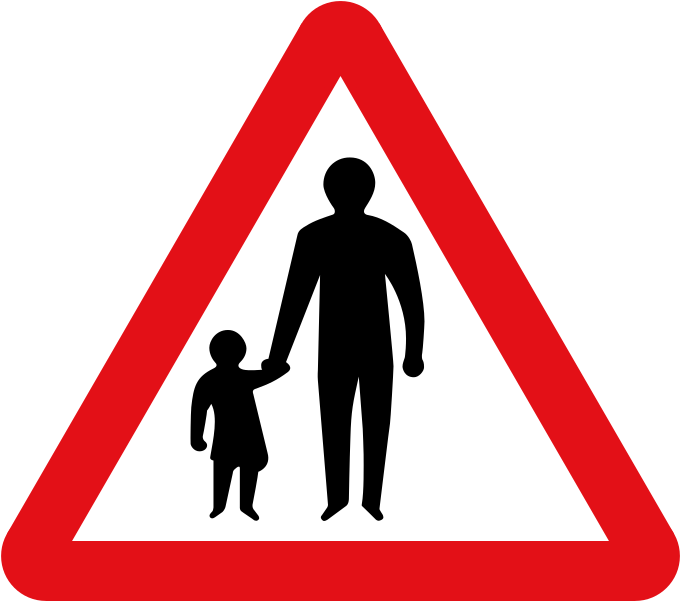 Warning for pedestrians.
English • GB diagram 544.1 • Pedestrians in road. Pedestrians may be walking in the road ahead, particularly where there is no footway.
Sources
🔗 Commons.wikimedia.org (Government of the United Kingdom – Department for Transport • Crown copyright • OGL v1.0)
🔗 Legislation.gov.uk • Traffic Signs Regulations and General Directions • Great Britain
🔗 Gov.uk • Department for Transport • Know your traffic signs
SVG source: Government of the United Kingdom – Department for Transport • OGL v1.0 • Original revision 2022-02-13. Wikimedia original unmodified. © Crown copyright. Traffic signs are Crown copyright. You may reproduce traffic signs free of charge and without having to seek permission, but you must reproduce them accurately and not in a misleading context (e.g. not on roadside billboards where they could mislead drivers). (ref [1])
Artwork verified against Gov.uk • official published diagram 544.1.
Current design and permitted variants verified against Legislation.gov.uk • TSRGD, current text.
What should drivers know about pedestrian crossings in the United Kingdom?
In Great Britain, you should give way to pedestrians waiting at a zebra crossing and must give way once they have moved onto it. At junctions, you should give way to people crossing or waiting to cross the road you turn into or out of.
🔗 gov.uk • Great Britain Highway Code: Rules 170,191–199; pedestrians and crossings
🔗 gov.uk • DfT Know Your Traffic Signs: warning signs (Great Britain)
6. Bridge
A bridge is a structure that carries a road, path or railway over an obstacle such as a river, valley, railway line or another road. A road bridge may carry one or more roadways together with pedestrian or cycling facilities.
Drivers should follow any speed, weight, height, width or vehicle-access restrictions applying to the bridge. Particular care may be necessary on narrow, exposed or movable bridges and when weather conditions such as wind, rain or ice affect the road surface.
Wikimedia.org • Albert Bridge • CC BY-SA
What should I check before crossing a bridge in the United Kingdom?
In Great Britain, read weight restrictions and low-bridge clearance signs carefully. A circular height-restriction sign prohibits vehicles above the stated height; an arched bridge may use warning signs because clearance varies across the road. Know your vehicle’s loaded height.
🔗 gov.uk • Great Britain Highway Code: Rules 242–243; bridge clearance and opposing traffic
🔗 gov.uk • DfT Know Your Traffic Signs: low bridge signs (Great Britain)
Who goes first on a narrow bridge in the United Kingdom?
Follow any traffic lights, give-way controls or signs allocating priority over oncoming traffic. Do not force your way onto a bridge that cannot accommodate both directions safely. A bridge warning alone does not give your direction priority.
🔗 gov.uk • Great Britain Highway Code: Rules 242–243; bridge clearance and opposing traffic
🔗 gov.uk • DfT Know Your Traffic Signs: low bridge signs (Great Britain)
May I stop or park on a bridge in the United Kingdom?
In Great Britain, do not stop or park where it would endanger, obstruct or inconvenience others, or where signs prohibit it. Bridges and approaches can be narrow or have poor visibility; use a lawful parking place off the route.
🔗 gov.uk • Great Britain Highway Code: Rules 242–243; bridge clearance and opposing traffic
🔗 gov.uk • DfT Know Your Traffic Signs: low bridge signs (Great Britain)
7. Speed bump
A speed bump is a raised traffic-calming device placed across all or part of a road to make drivers reduce their speed. It is commonly used near homes, schools, crossings, parking areas and other places where low vehicle speeds are important.
Speed bumps vary in shape, height and legal status. Drivers should approach them at a low, controlled speed and follow any warning signs or speed limits that apply.

Wikimedia.org • LepoRello • CC BY-SA
How should I recognise and approach a speed bump in the United Kingdom?
In Great Britain, the Highway Code uses road humps as an example of traffic-calming measures. Reduce speed through the whole area and watch for pedestrians, cyclists and other vulnerable road users. Northern Ireland has its own Highway Code.
🔗 gov.uk • Great Britain Highway Code: Rules 152–153; crossing Rules 170,195
🔗 gov.uk • DfT Know Your Traffic Signs: traffic calming (Great Britain)
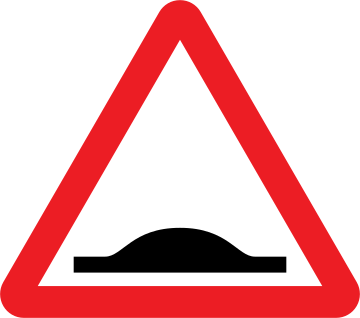 Warning for a speed bump.
English • GB diagram 557.1 • Road humps. A road hump or series of road humps is ahead. Reduce speed; an accompanying plate may show their extent or direction.
Sources
🔗 Commons.wikimedia.org
🔗 Legislation.gov.uk • Traffic Signs Regulations and General Directions • Great Britain
🔗 Gov.uk • Department for Transport • Know your traffic signs
SVG source: UK Government • Public domain • Original revision 2014-08-03. Wikimedia original unmodified.
Which speed should I use at a raised device in the United Kingdom?
Use a low speed through traffic-calming areas and obey the applicable limit. The Highway Code advises maintaining a reduced speed through a sequence of measures rather than accelerating and braking between individual humps.
🔗 gov.uk • Great Britain Highway Code: Rules 152–153; crossing Rules 170,195
🔗 gov.uk • DfT Know Your Traffic Signs: traffic calming (Great Britain)
Does a raised road surface give pedestrians priority in the United Kingdom?
A raised device alone does not identify pedestrian priority. If it incorporates a crossing, apply the crossing’s controls and the national rules. In Great Britain, you should give way to pedestrians waiting at a zebra crossing and must give way once they have moved onto it. At junctions, you should give way to people crossing or waiting to cross the road you turn into or out of.
🔗 gov.uk • Great Britain Highway Code: Rules 152–153; crossing Rules 170,195
🔗 gov.uk • DfT Know Your Traffic Signs: traffic calming (Great Britain)
8. Toll road
A toll road is a road, motorway, bridge, tunnel or other route for which users must pay a charge. The toll may apply to all vehicles or only to particular vehicle categories, and the amount can depend on factors such as distance travelled, vehicle type, weight or emissions.
Tolls may be collected at toll booths, electronically or through a vignette or distance-based charging system. Drivers should check the applicable payment rules before using a toll road, especially when travelling in another country.
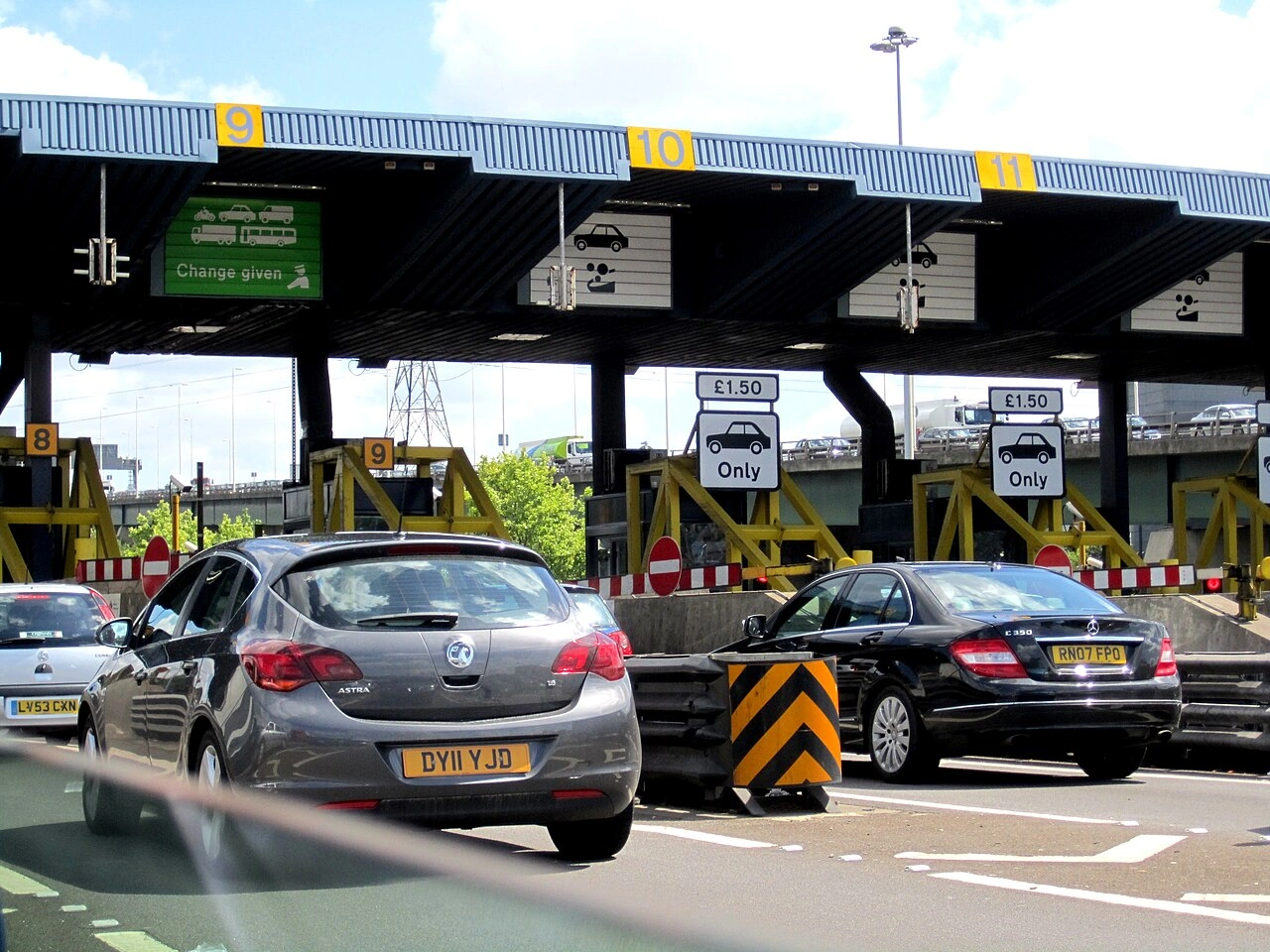
Wikimedia.org • Darren Meacher • CC BY-SA
Which road-charging system should I check in the United Kingdom?
The United Kingdom has charges on particular roads, bridges and tunnels rather than one passenger-car motorway vignette. The government’s list identifies individual facilities; local congestion and environmental charges are separate.
🔗 gov.uk • UK Government — toll roads, bridges and tunnels; operator-specific charges
What should I check before using a charged road in the United Kingdom?
Check the actual crossing or road’s operator, hours, vehicle class and payment procedure. Some charges use online or automatic payment; a toll payment does not automatically cover a city congestion or clean-air charge.
🔗 gov.uk • UK Government — toll roads, bridges and tunnels; operator-specific charges
Does the absence of a toll booth prove that a road is free in the United Kingdom?
The absence of a payment booth is not proof that a charged road is free. A vignette, electronic account, vehicle-registration record or another payment procedure may be used where the actual scheme provides for it. Follow the responsible authority or operator’s instructions for that road.
🔗 gov.uk • UK Government — toll roads, bridges and tunnels; operator-specific charges
9. One-way traffic
One-way traffic means that vehicles on a road or carriageway may travel only in one designated direction. The permitted direction is normally indicated by traffic signs, lane arrows or road markings.
Some road users, such as cyclists or public-transport vehicles, may be allowed to travel in the opposite direction when signs expressly permit it. A one-way road does not by itself determine the speed limit, priority or parking rules.

Wikimedia.org • Ardfern • CC BY-SA
How should I read a one-way restriction in the United Kingdom?
In Great Britain, follow one-way signs, no-entry signs and lane arrows. The Highway Code distinguishes the road’s traffic direction from a separate contraflow facility. Northern Ireland has its own Highway Code.
🔗 gov.uk • Great Britain Highway Code: Rules 109,143; cyclist Rule 69 and counterflow facilities
🔗 gov.uk • DfT Know Your Traffic Signs: regulatory signs (Great Britain)
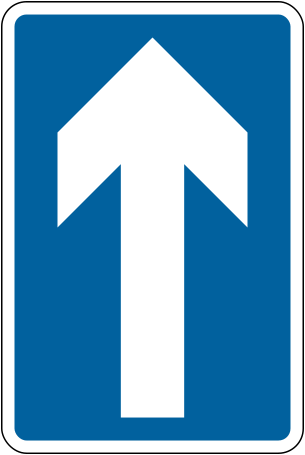 Road with one-way traffic.
English • GB diagram 652 • One-way traffic. Traffic on the road travels in the direction shown. This rectangular sign identifies one-way traffic.
Sources
🔗 Commons.wikimedia.org (Government of the United Kingdom – Department for Transport • Crown copyright • OGL v1.0)
🔗 Legislation.gov.uk • Traffic Signs Regulations and General Directions • Great Britain
🔗 Gov.uk • Department for Transport • Know your traffic signs
SVG source: Government of the United Kingdom – Department for Transport • OGL v1.0 • Original revision 2022-01-12. Wikimedia original unmodified. © Crown copyright. Traffic signs are Crown copyright. You may reproduce traffic signs free of charge and without having to seek permission, but you must reproduce them accurately and not in a misleading context (e.g. not on roadside billboards where they could mislead drivers). (ref [1])
Artwork verified against Gov.uk • official published diagram 652.
Current design and permitted variants verified against Legislation.gov.uk • TSRGD, current text.
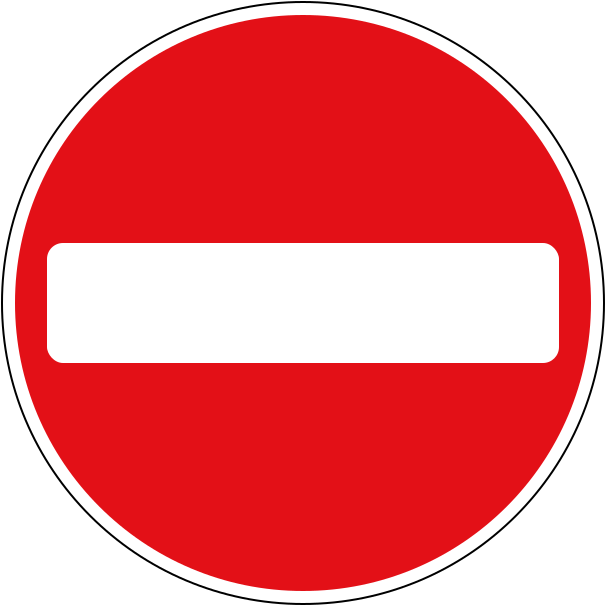 No entry.
English • GB diagram 616 • No entry. Vehicular traffic must not enter from this direction. Read any permitted exception plate.
Sources
🔗 Commons.wikimedia.org (Government of the United Kingdom – Department for Transport • Crown copyright • OGL v1.0)
🔗 Legislation.gov.uk • Traffic Signs Regulations and General Directions • Great Britain
🔗 Gov.uk • Department for Transport • Know your traffic signs
SVG source: Government of the United Kingdom – Department for Transport • OGL v1.0 • Original revision 2024-11-14. Wikimedia original unmodified. © Crown copyright. Traffic signs are Crown copyright. You may reproduce traffic signs free of charge and without having to seek permission, but you must reproduce them accurately and not in a misleading context (e.g. not on roadside billboards where they could mislead drivers). (ref [1])
Artwork verified against Gov.uk • official published diagram 616.
Current design and permitted variants verified against Legislation.gov.uk • TSRGD, current text.
May cyclists travel against the general traffic direction in the United Kingdom?
The Highway Code requires cyclists to obey one-way restrictions unless signs indicate an exemption or a designated contraflow cycle arrangement applies. Drivers must look for authorised oncoming cycle or bus movements instead of assuming every lane serves their direction.
🔗 gov.uk • Great Britain Highway Code: Rules 109,143; cyclist Rule 69 and counterflow facilities
🔗 gov.uk • DfT Know Your Traffic Signs: regulatory signs (Great Britain)
Does one-way traffic give me priority or a different speed limit in the United Kingdom?
A one-way restriction concerns direction. Continue to follow the applicable speed limit, signals, give-way or stop controls and junction-priority rules. Where authorised counterflow traffic exists, check for it before turning or crossing; your permitted direction is not automatic junction priority.
🔗 gov.uk • Great Britain Highway Code: Rules 109,143; cyclist Rule 69 and counterflow facilities
🔗 gov.uk • DfT Know Your Traffic Signs: regulatory signs (Great Britain)
10. Quay
A quay is a constructed area beside a river, canal, harbour or other body of water, commonly used for loading, unloading, mooring vessels or providing waterside access. A road may run alongside the water or lead directly towards the quay edge.
In road traffic, a quay warning indicates a risk that a vehicle could leave the road and enter the water. Drivers should reduce speed, observe the road layout carefully and keep a safe distance from the waterside edge.

Wikimedia.org • John Allan • CC BY-SA
What should I watch for near a quay or waterside road in the United Kingdom?
In Great Britain, the traffic-sign guide distinguishes a quayside or river bank warning from an opening bridge or ferry indication. The warning concerns the risk beside water, not permission to drive onto a ferry or dock.
🔗 gov.uk • Great Britain Highway Code: Rules 109,125–126; parking Rules 242–243
🔗 gov.uk • DfT Know Your Traffic Signs: warning signs (Great Britain)
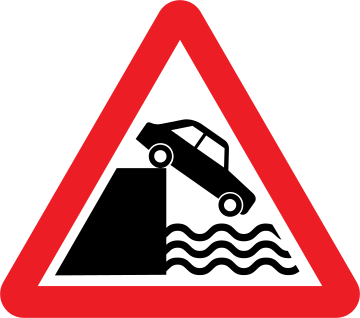 Warning for a quayside or riverbank.
English • GB diagram 555 • Quayside or river bank. An unprotected quayside or river bank is ahead.
Sources
🔗 Commons.wikimedia.org
🔗 Legislation.gov.uk • Traffic Signs Regulations and General Directions • Great Britain
🔗 Gov.uk • Department for Transport • Know your traffic signs
SVG source: UK Government • Public domain • Original revision 2014-07-27. Wikimedia original unmodified.
How should I choose a safe speed beside water in the United Kingdom?
Use the applicable road or local speed limit and slow further for the foreseeable waterside danger. A hazard warning is not a promise that driving at the maximum is safe. Keep enough visibility and control to avoid the edge, pedestrians, loading activity or a blocked route.
🔗 gov.uk • Great Britain Highway Code: Rules 109,125–126; parking Rules 242–243
🔗 gov.uk • DfT Know Your Traffic Signs: warning signs (Great Britain)
Does a quay warning allow me to enter or park beside the water in the United Kingdom?
Check the actual access and parking restrictions, including any port or dock controls. A waterside warning does not provide permission to enter a restricted facility or park on the edge. Keep the required passage clear and use a permitted place without endangering traffic or people beside the water.
🔗 gov.uk • Great Britain Highway Code: Rules 109,125–126; parking Rules 242–243
🔗 gov.uk • DfT Know Your Traffic Signs: warning signs (Great Britain)
11. Slope
A slope is a section of road that rises or descends noticeably. A steep slope can affect vehicle speed, braking distance, traction, visibility and the ability of heavy or low-powered vehicles to maintain a steady speed.
Warning signs may indicate a steep ascent or dangerous descent and may show the gradient as a percentage. Drivers should adjust their speed early, select a suitable gear and remain prepared for slow vehicles, bends and changing road conditions.
Wikimedia.org • grumpylumixuser • CC BY
What does a steep-slope warning mean in the United Kingdom?
In Great Britain, steep-hill warnings and their gradient information warn of a hazard. The Highway Code also warns against coasting because it reduces vehicle control and engine braking. Northern Ireland has its own Highway Code.
🔗 gov.uk • Great Britain Highway Code: Rules 122,125–126,155–156; steep-hill warnings
🔗 gov.uk • DfT Know Your Traffic Signs: warning signs (Great Britain)
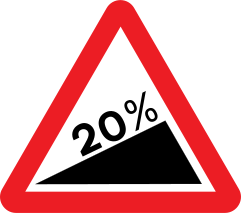 Warning for a steep ascent.
English • GB diagram 524.1 • Steep hill upwards. A steep uphill gradient is ahead; the example shows 20%.
Sources
🔗 Commons.wikimedia.org
🔗 Legislation.gov.uk • Traffic Signs Regulations and General Directions • Great Britain
🔗 Gov.uk • Department for Transport • Know your traffic signs
SVG source: UK Government • Public domain • Original revision 2011-11-12. Wikimedia original unmodified.
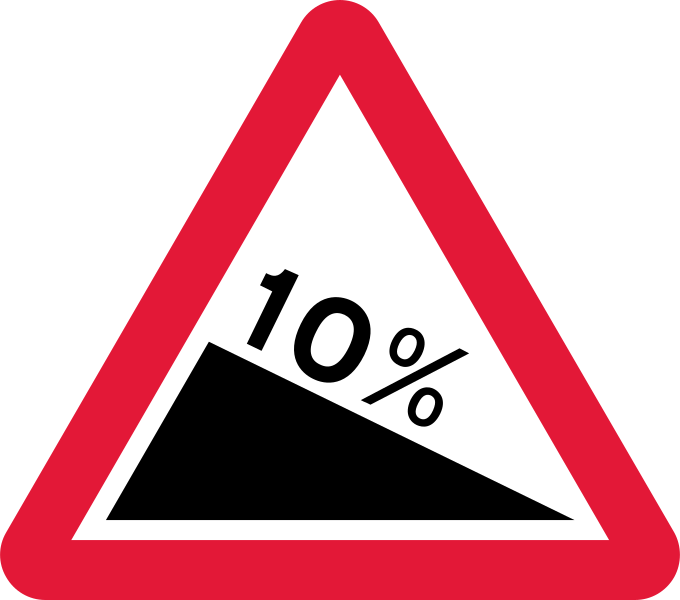 Warning for a steep descent.
English • GB diagram 523.1 • Steep hill downwards. A steep downhill gradient is ahead; the example shows 10%. Select a suitable gear and control your speed.
Sources
🔗 Commons.wikimedia.org
🔗 Legislation.gov.uk • Traffic Signs Regulations and General Directions • Great Britain
🔗 Gov.uk • Department for Transport • Know your traffic signs
SVG source: UK Government • Public domain • Original revision 2019-05-22. Wikimedia original unmodified.
How should I approach a steep descent in the United Kingdom?
Reduce speed before the descent and select a suitable gear to help control the vehicle. Keep enough following distance and avoid building up speed that requires continuous heavy braking. A warning gives no fixed safe descent speed: the gradient, surface, visibility, load and vehicle can require a speed well below the legal maximum.
🔗 gov.uk • Great Britain Highway Code: Rules 122,125–126,155–156; steep-hill warnings
🔗 gov.uk • DfT Know Your Traffic Signs: warning signs (Great Britain)
What should I check when meeting or overtaking on a slope in the United Kingdom?
On a single-track road, the Highway Code advises giving way to vehicles coming uphill whenever you can. Use passing places and reverse to one if necessary; do not park in a passing place or assume that a hill warning overrides a priority sign.
🔗 gov.uk • Great Britain Highway Code: Rules 122,125–126,155–156; steep-hill warnings
🔗 gov.uk • DfT Know Your Traffic Signs: warning signs (Great Britain)
12. Bus lane
A bus lane is a traffic lane reserved primarily for buses or other authorised public-transport vehicles. It is intended to improve the reliability and flow of public transport by allowing authorised vehicles to avoid general traffic congestion.
Other road users, such as taxis, cyclists, motorcycles or vehicles carrying several occupants, may also be permitted when signs expressly allow them. The operating hours, permitted vehicles, direction of travel and rules for entering or crossing the lane depend on local traffic signs and regulations.

Wikimedia.org • Geof_Sheppard • CC BY-SA
Which vehicles may use a bus lane in the United Kingdom?
In Great Britain, bus-lane signs and markings show the permitted vehicles and operating times. The Highway Code says not to drive in a bus lane during operation unless the indications allow it. Northern Ireland has its own Highway Code.
🔗 gov.uk • Great Britain Highway Code: Rules 141–142; bus-lane categories and operating times
🔗 gov.uk • DfT Know Your Traffic Signs: bus and cycle signs and road markings (Great Britain)
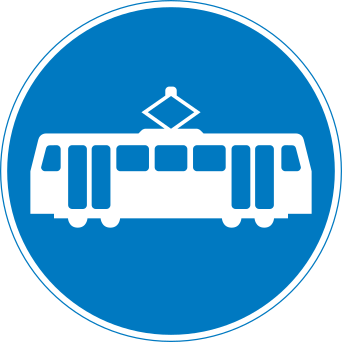 Mandatory lane for buses.
English • GB diagram 953.1 • Tramcars only. This route is for tramcars only, subject to any authorised and signed exception.
Sources
🔗 Commons.wikimedia.org (UK Government • Crown copyright • OGL v1.0)
🔗 Legislation.gov.uk • Traffic Signs Regulations and General Directions • Great Britain
🔗 Gov.uk • Department for Transport • Know your traffic signs
SVG source: UK Government • OGL v1.0 • Original revision 2011-11-13. Wikimedia original unmodified. © Crown copyright. Traffic signs are Crown copyright. You may reproduce traffic signs free of charge and without having to seek permission, but you must reproduce them accurately and not in a misleading context (e.g. not on roadside billboards where they could mislead drivers). (ref [1])
Artwork verified against Gov.uk • official published diagram 953.1.
Current design and permitted variants verified against Legislation.gov.uk • TSRGD, current text.
May bicycles and motorcycles use a bus lane in the United Kingdom?
Check the cycle, taxi or motorcycle symbol on the actual sign. Access for these users varies; the words BUS LANE do not automatically include all of them.
🔗 gov.uk • Great Britain Highway Code: Rules 141–142; bus-lane categories and operating times
🔗 gov.uk • DfT Know Your Traffic Signs: bus and cycle signs and road markings (Great Britain)
Does bus-lane access also allow stopping or parking in the United Kingdom?
The Highway Code allows entry to stop, load or unload where that is not prohibited. Separate waiting, loading, clearway and bus-stop restrictions still apply, so do not assume that either an active or inactive bus lane permits parking.
🔗 gov.uk • Great Britain Highway Code: Rules 141–142; bus-lane categories and operating times
🔗 gov.uk • DfT Know Your Traffic Signs: bus and cycle signs and road markings (Great Britain)
13. Bus stop
A bus stop is a designated place where buses stop to allow passengers to board or leave. It may be identified by a sign, shelter, raised platform, road marking or other public-transport infrastructure and can be located beside the road or in a specially constructed stopping area.
Drivers approaching a bus stop should watch carefully for buses, pedestrians and passengers crossing or entering the roadway. Parking or stopping restrictions may apply around bus stops to keep the area accessible and visible.
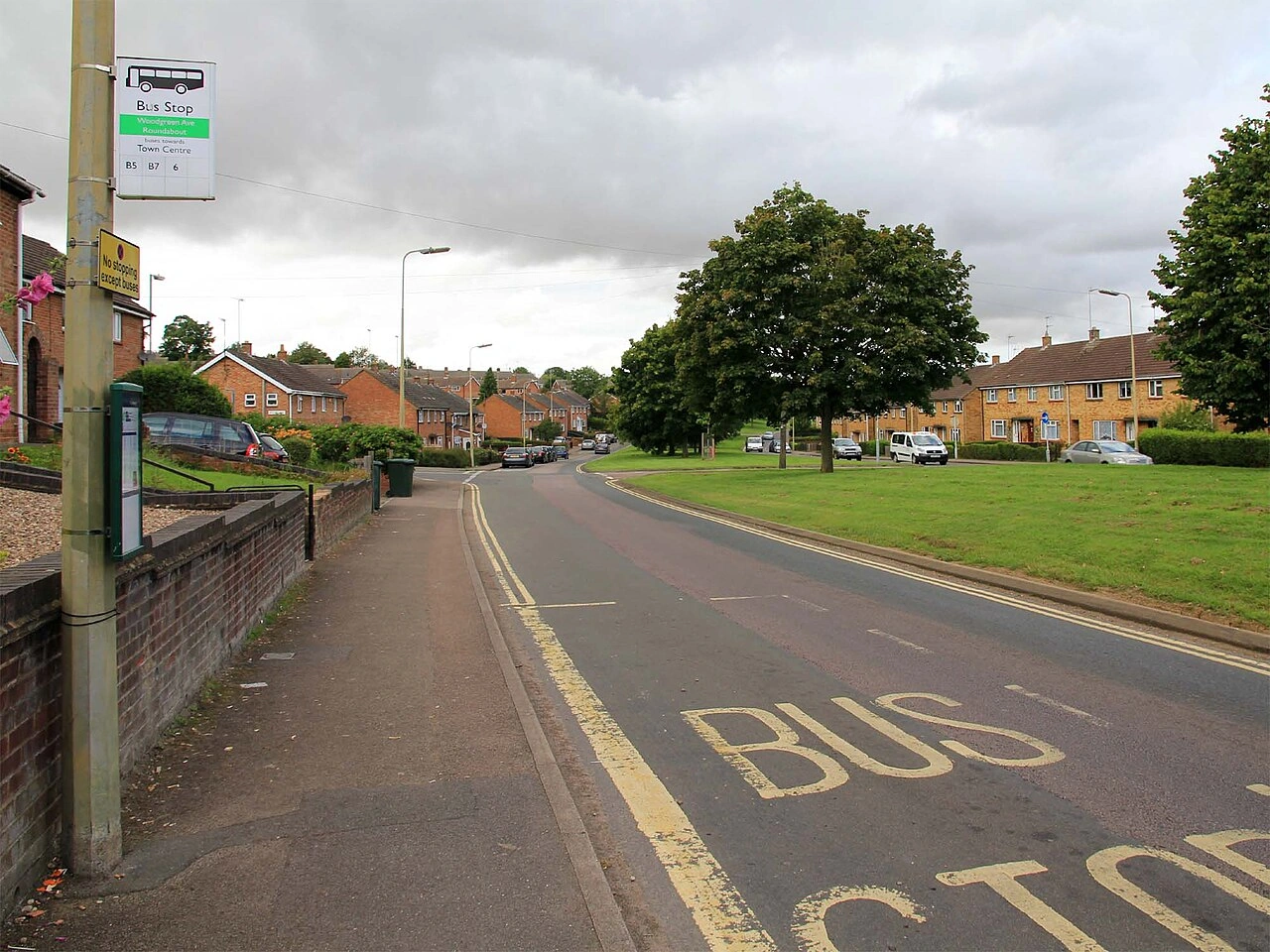
Wikimedia.org • David P Howard • CC BY-SA
What stopping or parking restrictions apply at bus stops in the United Kingdom?
In Great Britain, the Highway Code advises against stopping or parking at or near a bus stop. A bus-stop clearway imposes the applicable mandatory no-stopping restriction during its indicated period. Northern Ireland has its own Highway Code.
🔗 gov.uk • Great Britain Highway Code: Rules 240,243; Rule 223 bus-departure advice
🔗 gov.uk • DfT Know Your Traffic Signs: bus and cycle signs and road markings (Great Britain)
🔗 gov.uk • Great Britain Highway Code, Rule 223: bus-departure advice
May I briefly drop off a passenger at a bus stop in the United Kingdom?
A brief drop-off is not a general exemption from an operating bus-stop clearway. Choose a lawful place and obey the actual signs and markings.
🔗 gov.uk • Great Britain Highway Code: Rules 240,243; Rule 223 bus-departure advice
🔗 gov.uk • DfT Know Your Traffic Signs: bus and cycle signs and road markings (Great Britain)
🔗 gov.uk • Great Britain Highway Code, Rule 223: bus-departure advice
What should I do near a stopped bus in the United Kingdom?
Give priority to buses when you can do so safely, especially when they signal departure. This Highway Code advice should not be described as an unconditional priority that allows a bus to move into danger.
🔗 gov.uk • Great Britain Highway Code: Rules 240,243; Rule 223 bus-departure advice
🔗 gov.uk • DfT Know Your Traffic Signs: bus and cycle signs and road markings (Great Britain)
🔗 gov.uk • Great Britain Highway Code, Rule 223: bus-departure advice
14. Dead end
A dead-end road is a road that does not provide a through route for some or all vehicles. It may end completely, terminate at a barrier or continue as a path that only certain road users may use.
Drivers may normally enter a dead-end road to reach homes, businesses, parking places or other destinations, but they must be prepared to turn around or leave by the same route. Signs may indicate that pedestrians or cyclists can continue beyond the point where motor traffic cannot.

Wikimedia.org • Nigel Brown • CC BY-SA
What does a dead-end indication mean in the United Kingdom?
In Great Britain, a No through road sign describes the route. It is different from No entry or a prohibition applying to a vehicle class. Northern Ireland has its own Highway Code.
🔗 gov.uk • Great Britain Highway Code: Rules 109,124–126; no-through-road information
🔗 gov.uk • DfT Know Your Traffic Signs: information signs (Great Britain)
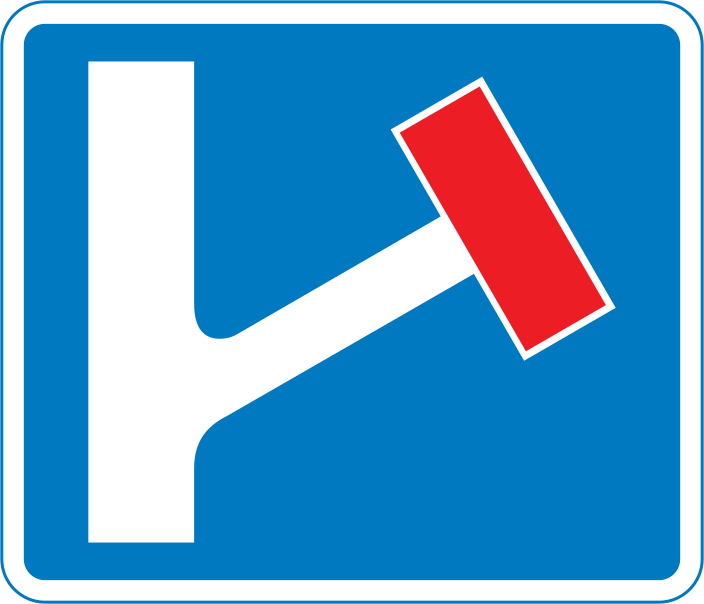 Dead end street.
English • GB diagram 816 • No through road. The road indicated is a no-through road; the pictured arrangement shows a side road that does not continue through.
Sources
🔗 Commons.wikimedia.org (UK Government • Crown copyright • OGL v1.0)
🔗 Legislation.gov.uk • Traffic Signs Regulations and General Directions • Great Britain
🔗 Gov.uk • Department for Transport • Know your traffic signs
SVG source: UK Government • OGL v1.0 • Original revision 2014-08-11. Wikimedia original unmodified. © Crown copyright. Traffic signs are Crown copyright. You may reproduce traffic signs free of charge and without having to seek permission, but you must reproduce them accurately and not in a misleading context (e.g. not on roadside billboards where they could mislead drivers). (ref [1])
Artwork verified against Gov.uk • official published diagram 817R.
Current design and permitted variants verified against Legislation.gov.uk • TSRGD, current text.
Can pedestrians or cyclists continue beyond a motor-traffic dead end in the United Kingdom?
Check any indication of a pedestrian or cycle continuation and the signs on that route. The no-through information alone does not make every footpath a cycle route.
🔗 gov.uk • Great Britain Highway Code: Rules 109,124–126; no-through-road information
🔗 gov.uk • DfT Know Your Traffic Signs: information signs (Great Britain)
Does a dead-end indication change speed or priority rules in the United Kingdom?
The no-through information itself does not assign junction priority or a numerical speed limit. Continue to obey the actual speed, access, parking and priority controls. If you need to turn around, use a suitable lawful place, check for pedestrians and cyclists, and do not obstruct the space needed for other vehicles to turn.
🔗 gov.uk • Great Britain Highway Code: Rules 109,124–126; no-through-road information
🔗 gov.uk • DfT Know Your Traffic Signs: information signs (Great Britain)
15. Stop sign
A stop sign requires drivers to bring their vehicle to a complete stop and give way before entering or crossing the road ahead. The stop must be made at the stop line or another legally prescribed position.
After stopping, the driver may continue only when this can be done safely and without interfering with traffic that has priority. The sign does not create priority for the driver who has stopped.

Wikimedia.org • Andrew Tryon • CC BY-SA
Must I stop completely at a stop sign in the United Kingdom?
In Great Britain, yes. Come to a complete stop when the applicable stop sign controls your approach, even when you cannot see another road user. Slowing to a crawl is not a stop. The stopping duty is separate from the duty to give way before continuing. Northern Ireland has its own Highway Code.
🔗 gov.uk • Great Britain Highway Code: Rules 170–172: complete stop and safe entry
🔗 gov.uk • DfT Know Your Traffic Signs: regulatory signs (Great Britain)
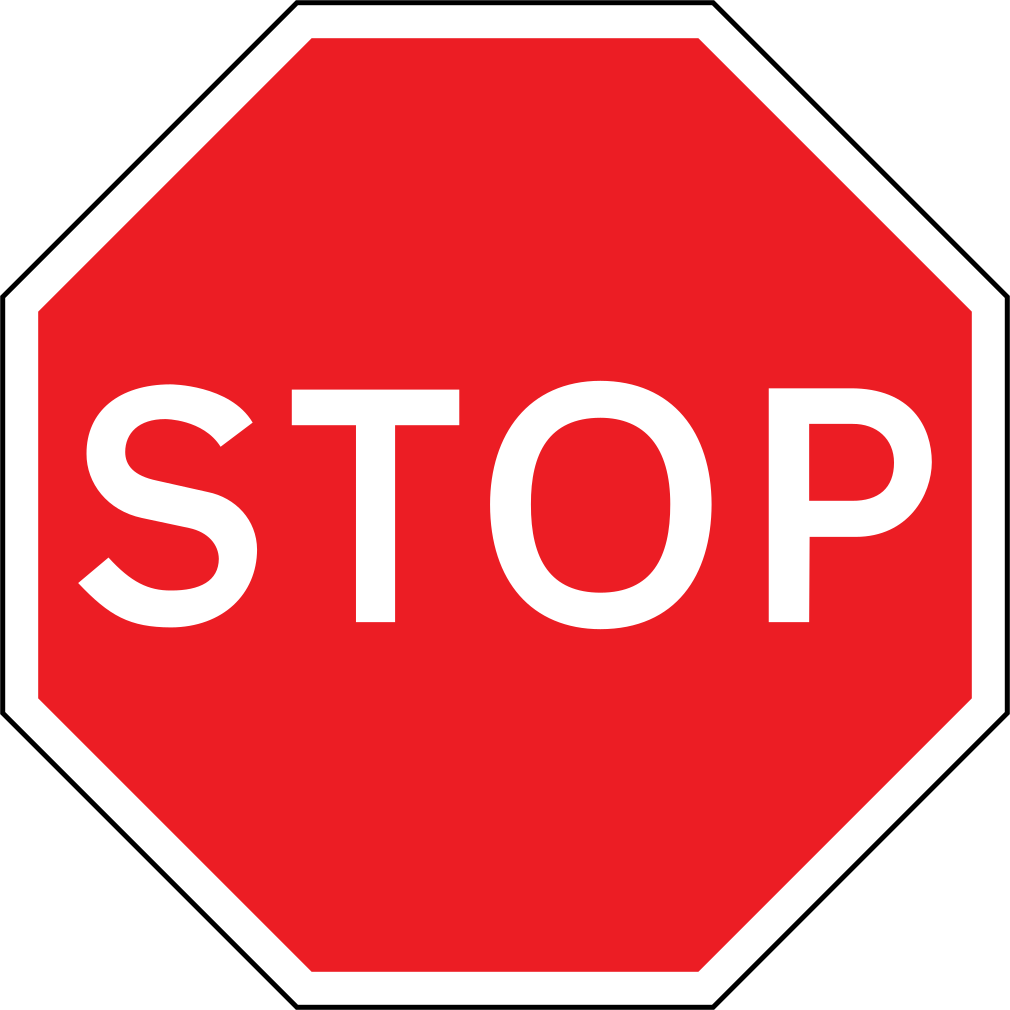 Stop and give way.
English • GB diagram 601.1 • Stop and give way. You must stop at the stop line and give way to traffic on the major road. If the line is not clearly visible, stop before entering the major road.
Sources
🔗 Commons.wikimedia.org
🔗 Legislation.gov.uk • Traffic Signs Regulations and General Directions • Great Britain
🔗 Gov.uk • Department for Transport • Know your traffic signs
SVG source: UK Department of Transport • Public domain • Original revision 2022-10-02. Wikimedia original unmodified.
Artwork verified against Legislation.gov.uk • official published diagram 601.1.
Where must I stop at a stop-controlled junction in the United Kingdom?
In Great Britain, stop behind the solid white line at a junction with a stop sign. Wait for a safe gap before moving off. If the view is restricted, a completed stop does not authorise entry into another road user’s path.
🔗 gov.uk • Great Britain Highway Code: Rules 170–172: complete stop and safe entry
🔗 gov.uk • DfT Know Your Traffic Signs: regulatory signs (Great Britain)
Does stopping first give me priority at a stop sign in the United Kingdom?
A complete stop does not, by itself, give you priority. Give way to the road users entitled to pass under the junction’s signs and rules, check pedestrians and cyclists, and proceed only when the gap is safe. Do not follow another stopped vehicle through without satisfying your own stopping and yielding duties.
🔗 gov.uk • Great Britain Highway Code: Rules 170–172: complete stop and safe entry
🔗 gov.uk • DfT Know Your Traffic Signs: regulatory signs (Great Britain)
16. Give way
A give-way sign requires drivers to allow traffic with priority to proceed before entering, crossing or joining a road. Drivers must reduce speed, observe approaching traffic and stop when necessary.
Unlike a stop sign, a give-way sign does not always require a complete stop. The driver may continue without stopping only when the route is clearly safe and no road user with priority is forced to change speed or direction.

Wikimedia.org • Geof_Sheppard • CC BY-SA
What does giving way mean in the United Kingdom?
In Great Britain, Give Way signs and the transverse broken white lines require yielding to traffic on the main road. Northern Ireland has its own Highway Code; use the applicable local signs and rules.
🔗 gov.uk • Great Britain Highway Code: Rules 170–172: main-road traffic and safe entry
🔗 gov.uk • DfT Know Your Traffic Signs: regulatory signs (Great Britain)
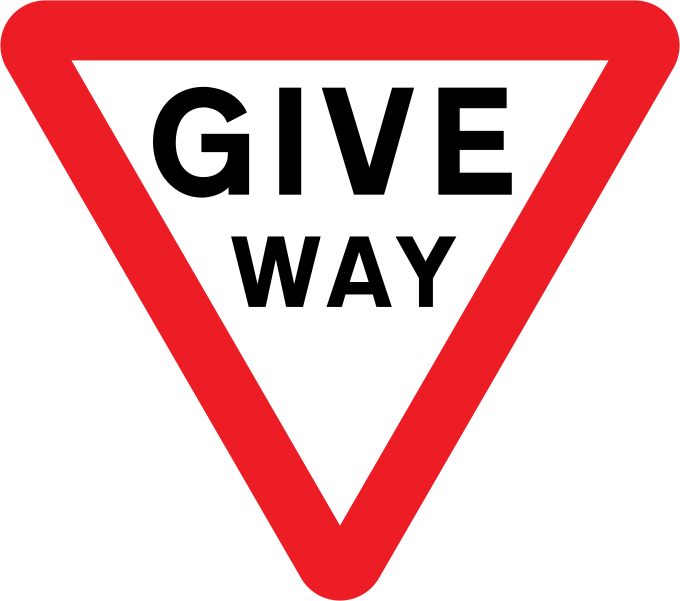 Give way.
English • GB diagram 602 • Give way. Give way to traffic on the major road. Stop if necessary before proceeding safely.
Sources
🔗 Commons.wikimedia.org (Government of the United Kingdom • Crown copyright • OGL v1.0)
🔗 Legislation.gov.uk • Traffic Signs Regulations and General Directions • Great Britain
🔗 Gov.uk • Department for Transport • Know your traffic signs
SVG source: Government of the United Kingdom • OGL v1.0 • Original revision 2016-07-03. Wikimedia original unmodified. © Crown copyright. Traffic signs are Crown copyright. You may reproduce traffic signs free of charge and without having to seek permission, but you must reproduce them accurately and not in a misleading context (e.g. not on roadside billboards where they could mislead drivers). (ref [1])
Artwork verified against Gov.uk • official published diagram 602.
Current design and permitted variants verified against Legislation.gov.uk • TSRGD, current text.
Must you always stop when giving way in the United Kingdom?
In Great Britain, Give Way requires yielding to the main-road traffic; stop if necessary. A Stop sign and its stop line require a complete stop. Northern Ireland has a separate Highway Code.
🔗 gov.uk • Great Britain Highway Code: Rules 170–172: main-road traffic and safe entry
🔗 gov.uk • DfT Know Your Traffic Signs: regulatory signs (Great Britain)
What should you check before proceeding after giving way in the United Kingdom?
Wait until the manoeuvre is safe. Check the priority traffic, the view in both directions and enough space to complete the entry. Giving way to one vehicle does not remove duties towards another driver, a cyclist or a pedestrian.
🔗 gov.uk • Great Britain Highway Code: Rules 170–172: main-road traffic and safe entry
🔗 gov.uk • DfT Know Your Traffic Signs: regulatory signs (Great Britain)
17. Roundabout
A roundabout is a circular road arrangement in which traffic travels around a central island in one designated direction. Vehicles enter and leave through connecting roads, and traffic signs or local rules determine who has priority.
Drivers should reduce speed, choose a suitable lane, observe all road users and signal as required when leaving. The direction of travel, entry priority, lane use and rules for cyclists and pedestrians depend on local traffic signs and regulations.
Wikimedia.org • Dickbauch • CC0
Who has priority at a roundabout in the United Kingdom?
In Great Britain, the Highway Code says to give priority to traffic approaching from the right unless signs, markings or signals direct otherwise. Watch for traffic already circulating; Northern Ireland has its own Highway Code.
🔗 gov.uk • Great Britain Highway Code: Rules 184–190: priority, lanes and signalling
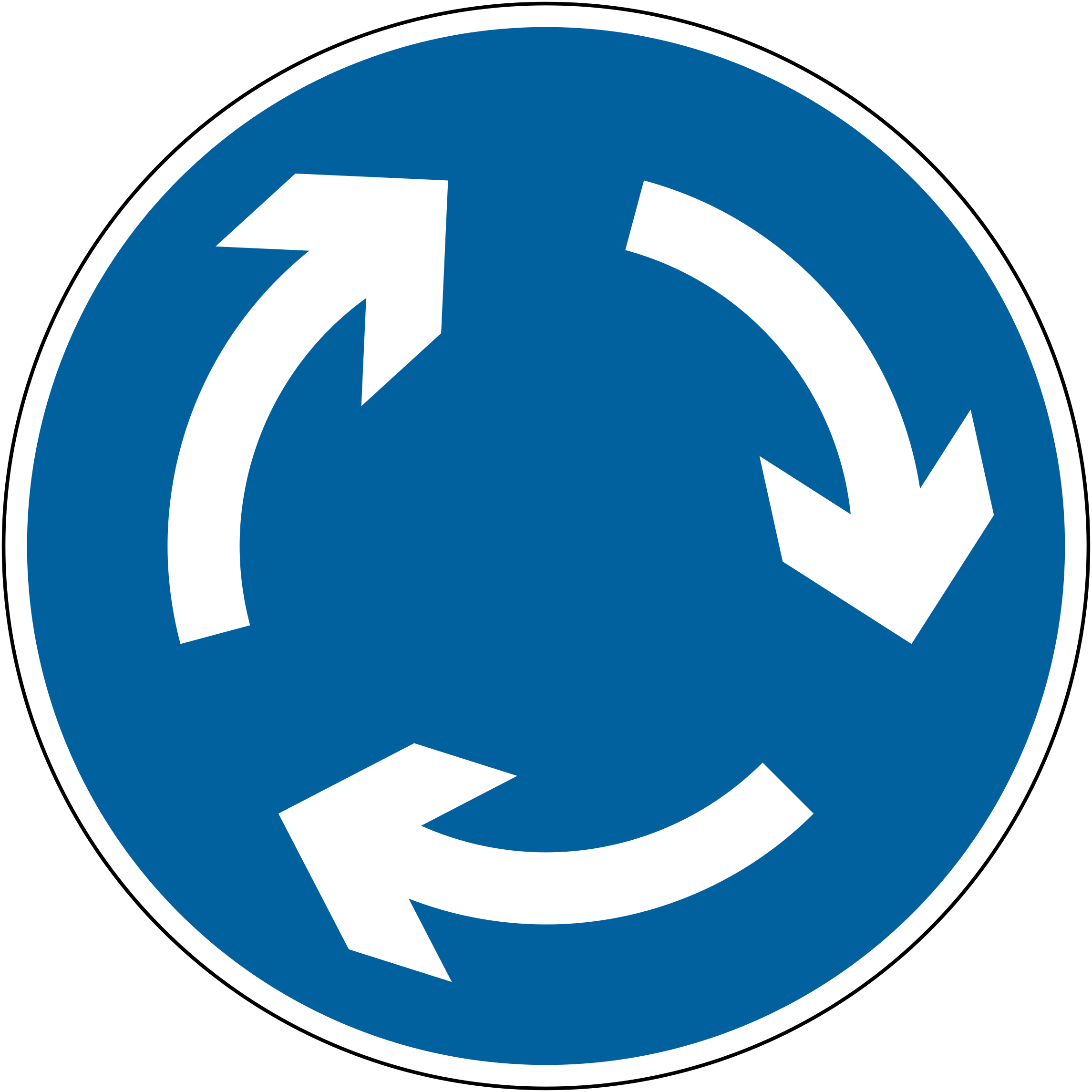 Mandatory roundabout direction.
English • GB diagram 611.1 • Mini-roundabout. Give priority to traffic from the right at the give-way markings. Pass to the left of the central white circle and circulate clockwise, unless the size of the vehicle or layout makes passing to the left impracticable.
Sources
🔗 Commons.wikimedia.org (Government of the United Kingdom – Department for Transport • Crown copyright • OGL v1.0)
🔗 Legislation.gov.uk • Traffic Signs Regulations and General Directions • Great Britain
🔗 Gov.uk • Department for Transport • Know your traffic signs
SVG source: Government of the United Kingdom – Department for Transport • OGL v1.0 • Original revision 2021-12-21. Wikimedia original unmodified. © Crown copyright. Traffic signs are Crown copyright. You may reproduce traffic signs free of charge and without having to seek permission, but you must reproduce them accurately and not in a misleading context (e.g. not on roadside billboards where they could mislead drivers). (ref [1])
Artwork verified against Gov.uk • official published diagram 611.1.
Current design and permitted variants verified against Legislation.gov.uk • TSRGD, current text.
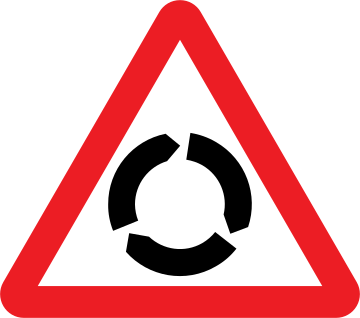 Warning for a roundabout.
English • GB diagram 510 • Roundabout ahead. A roundabout is ahead. Reduce speed and prepare to give way as required by the signs and markings at the junction.
Sources
🔗 Commons.wikimedia.org
🔗 Legislation.gov.uk • Traffic Signs Regulations and General Directions • Great Britain
🔗 Gov.uk • Department for Transport • Know your traffic signs
SVG source: UK Government • Public domain • Original revision 2013-12-13. Wikimedia original unmodified.
How should you choose a roundabout lane in the United Kingdom?
In Great Britain, the approach lane and signal depend on the exit: normally left for the first exit, right for an exit to the right or a full circle, and the appropriate marked lane for an intermediate exit. Signs and markings can direct otherwise.
🔗 gov.uk • Great Britain Highway Code: Rules 184–190: priority, lanes and signalling
What should you check when leaving a roundabout in the United Kingdom?
In Great Britain, use the approach signal for your intended exit and normally signal left after passing the exit before yours. Check cyclists, horse riders and pedestrians; do not cut across a road user continuing around.
🔗 gov.uk • Great Britain Highway Code: Rules 184–190: priority, lanes and signalling
18. Road narrowing
A road narrowing is a section where the available width of the road or carriageway becomes smaller. The narrowing may occur on both sides, on one side only, or because one or more traffic lanes end.
Drivers should reduce speed, observe approaching and adjacent traffic, maintain sufficient lateral clearance and merge when necessary. Warning signs do not always determine priority, so drivers must follow any priority signs, lane markings and local traffic rules.

Wikimedia.org • Kolforn • CC BY-SA
What does a road-narrowing warning mean in the United Kingdom?
In Great Britain, narrowing warnings show which side or sides narrow. The Highway Code warns against overtaking where the road narrows and requires yielding before passing an obstruction on your side. Northern Ireland has a separate Code.
🔗 gov.uk • Great Britain Highway Code: Rules 133–134,153; using-road Rules 163,167
🔗 gov.uk • DfT Know Your Traffic Signs: warning signs (Great Britain)
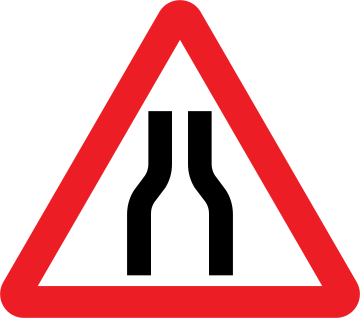 Warning for a road narrowing.
English • GB diagram 516 • Road narrows on both sides. The carriageway narrows on both sides ahead.
Sources
🔗 Commons.wikimedia.org
🔗 Legislation.gov.uk • Traffic Signs Regulations and General Directions • Great Britain
🔗 Gov.uk • Department for Transport • Know your traffic signs
SVG source: UK Government • Public domain • Original revision 2014-07-24. Wikimedia original unmodified.
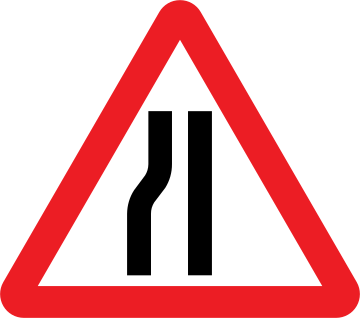 Warning for a road narrowing on the left.
English • GB diagram 517 • Road narrows on one side. The carriageway narrows on the left ahead.
Sources
🔗 Commons.wikimedia.org
🔗 Legislation.gov.uk • Traffic Signs Regulations and General Directions • Great Britain
🔗 Gov.uk • Department for Transport • Know your traffic signs
SVG source: UK Government • Public domain • Original revision 2014-07-24. Wikimedia original unmodified.
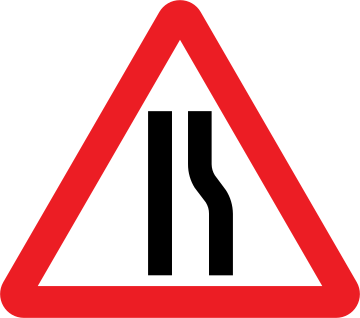 Warning for a road narrowing on the right.
English • GB diagram 517 • Road narrows on one side. The carriageway narrows on the right ahead.
Sources
🔗 Commons.wikimedia.org
🔗 Legislation.gov.uk • Traffic Signs Regulations and General Directions • Great Britain
🔗 Gov.uk • Department for Transport • Know your traffic signs
SVG source: UK Government • Public domain • Original revision 2014-07-24. Wikimedia original unmodified.
Does a narrowing warning give you priority in the United Kingdom?
No. A warning describes the reduced width, rather than allocating priority or setting a numerical speed limit. Follow any separate priority signs, signals and meeting rules, and slow enough to pass safely or wait before entering.
🔗 gov.uk • Great Britain Highway Code: Rules 133–134,153; using-road Rules 163,167
🔗 gov.uk • DfT Know Your Traffic Signs: warning signs (Great Britain)
What should you do if traffic lanes merge at a narrowing in the United Kingdom?
In Great Britain, the Highway Code recommends merging in turn only when safe and appropriate at very low speed, such as at roadworks or an incident. It does not recommend doing so at high speed; check mirrors, signal and avoid forcing another vehicle to brake.
🔗 gov.uk • Great Britain Highway Code: Rules 133–134,153; using-road Rules 163,167
🔗 gov.uk • DfT Know Your Traffic Signs: warning signs (Great Britain)
19. Priority over oncoming traffic
Priority over oncoming traffic means that drivers travelling in one direction have priority through a narrow section of road over drivers approaching from the opposite direction. The rule is normally indicated by a priority sign facing one direction and a corresponding give-way sign facing the other.
Drivers with priority must still approach cautiously and must not force their way through when the passage is blocked or already occupied. The signs regulate priority through the narrow section, not speed, parking or priority at nearby intersections.

Wikimedia.org • M J Richardson • CC BY-SA
How is priority over oncoming traffic controlled in the United Kingdom?
In Great Britain, a priority-over-oncoming sign gives your direction priority through the controlled section. The opposite direction faces the corresponding give-way instruction. Northern Ireland has a separate Highway Code.
🔗 gov.uk • Great Britain Highway Code: Rule 163; Rule 109 and narrow-road controls
🔗 gov.uk • DfT Know Your Traffic Signs: information signs (Great Britain)
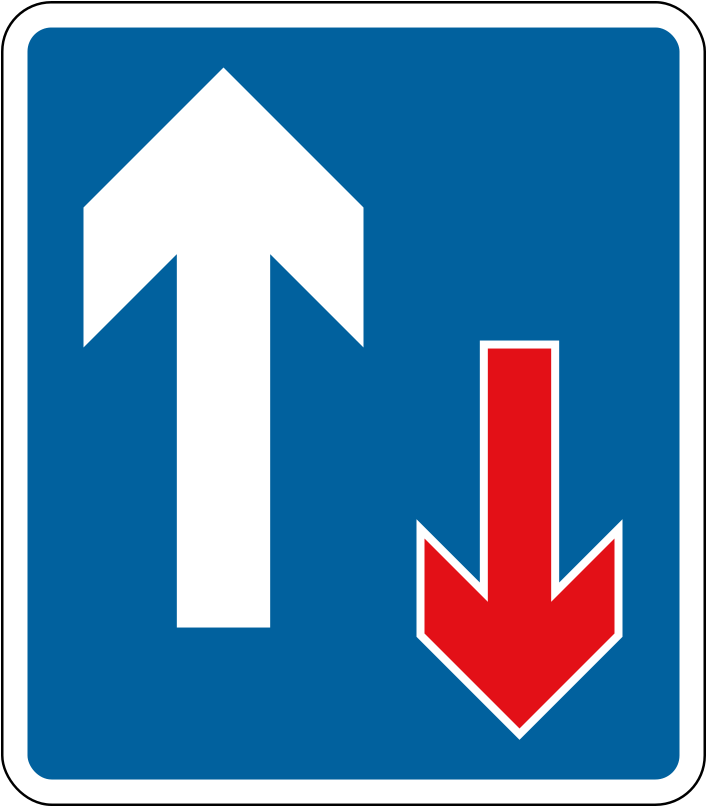 Road narrowing, oncoming drivers have to give way.
English • GB diagram 811A • Priority over oncoming vehicles. You have priority over vehicles approaching from the opposite direction at the narrow section. Proceed only when it is safe.
Sources
🔗 Commons.wikimedia.org (Government of the United Kingdom – Department for Transport • Crown copyright • OGL v1.0)
🔗 Legislation.gov.uk • Traffic Signs Regulations and General Directions • Great Britain
🔗 Gov.uk • Department for Transport • Know your traffic signs
SVG source: Government of the United Kingdom – Department for Transport • OGL v1.0 • Original revision 2022-01-10. Wikimedia original unmodified. © Crown copyright. Traffic signs are Crown copyright. You may reproduce traffic signs free of charge and without having to seek permission, but you must reproduce them accurately and not in a misleading context (e.g. not on roadside billboards where they could mislead drivers). (ref [1])
Artwork verified against Gov.uk • official published diagram 811.
Current design and permitted variants verified against Legislation.gov.uk • TSRGD, current text.
Can you enter an occupied narrow passage when you have priority in the United Kingdom?
Do not force a conflict. Check the full available width and let a vehicle already committed to the passage clear it when both vehicles cannot pass safely. A priority control does not permit creating danger or disregarding a red signal or authorised instruction.
🔗 gov.uk • Great Britain Highway Code: Rule 163; Rule 109 and narrow-road controls
🔗 gov.uk • DfT Know Your Traffic Signs: information signs (Great Britain)
Does priority through a narrow passage extend to nearby junctions in the United Kingdom?
No. A control releasing your direction or giving priority over opposing traffic concerns that passage. Junction priority, speed limits, crossings and any later restriction must be assessed separately from their own signs and rules.
🔗 gov.uk • Great Britain Highway Code: Rule 163; Rule 109 and narrow-road controls
🔗 gov.uk • DfT Know Your Traffic Signs: information signs (Great Britain)
20. Give way to oncoming traffic
Give way to oncoming traffic means that drivers must allow vehicles approaching from the opposite direction to pass first through a narrow section of road. The rule is normally indicated by a sign facing the direction that must yield and a corresponding priority sign facing oncoming traffic.
Drivers must reduce speed and stop when necessary before entering the narrow passage. They may continue only when they can do so safely and without obstructing oncoming traffic that has priority.

Wikimedia.org • Geof Sheppard • CC BY-SA
When must I give way to oncoming traffic in United Kingdom?
Where the UK Give way to oncoming vehicles sign controls a narrow section, drivers facing it must let opposing traffic pass first. The sign giving priority to your own direction is different.
🔗 gov.uk • Great Britain Highway Code: Rule 163; Rule 109 and narrow-road controls
🔗 gov.uk • DfT Know Your Traffic Signs: regulatory signs (Great Britain)
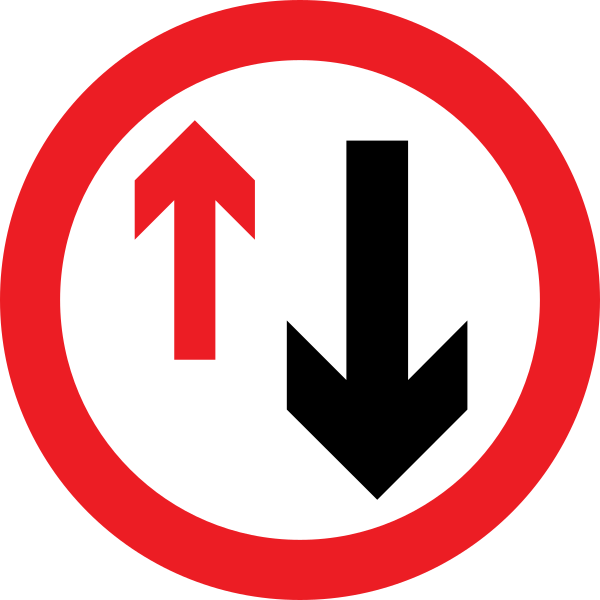 Road narrowing, give way to oncoming drivers.
English • GB diagram 615 • Give way to oncoming vehicles. You must give priority to vehicles approaching from the opposite direction at the narrow section.
Sources
🔗 Commons.wikimedia.org
🔗 Legislation.gov.uk • Traffic Signs Regulations and General Directions • Great Britain
🔗 Gov.uk • Department for Transport • Know your traffic signs
SVG source: UK Government • Public domain • Original revision 2011-01-20. Wikimedia original unmodified.
Does a road-narrows warning automatically give oncoming traffic priority in United Kingdom?
Not necessarily. A warning of a narrow carriageway is not itself the same as an instruction to give way. Check whether there is a separate priority sign, signal or temporary traffic control, and take account of any rules for an obstruction on your side.
🔗 gov.uk • Great Britain Highway Code: Rule 163; Rule 109 and narrow-road controls
🔗 gov.uk • DfT Know Your Traffic Signs: regulatory signs (Great Britain)
What if an oncoming vehicle is already entering a narrow passage in United Kingdom?
Reduce speed and wait where you can do so safely rather than forcing two vehicles into insufficient space. Even if a sign gives your approach priority, that does not justify a collision or endangering another road user.
🔗 gov.uk • Great Britain Highway Code: Rule 163; Rule 109 and narrow-road controls
🔗 gov.uk • DfT Know Your Traffic Signs: regulatory signs (Great Britain)
21. Pedestrian crossing
A pedestrian crossing is a designated place where pedestrians may cross a road. It is commonly indicated by road markings, traffic signs, signals or a combination of these measures.
Drivers must approach with appropriate caution and give way when required by local law. Pedestrians must also observe approaching traffic and follow any pedestrian signals or instructions from authorised traffic controllers.

Wikimedia.org • habiloid • CC BY-SA
When must drivers give way at a pedestrian crossing in Great Britain?
At a zebra crossing, drivers must give way to pedestrians already on the crossing and should give way to people waiting. At a signal-controlled crossing, obey the traffic lights and allow people already crossing to finish.
🔗 gov.uk • Great Britain Highway Code: Rules 191–199: crossings, queues and green signals
Are all pedestrian crossings controlled the same way in Great Britain?
A zebra crossing and a signal-controlled pelican, puffin or toucan crossing do not have the same rules. At a toucan crossing, cyclists can cross with pedestrians when their signal permits it.
🔗 gov.uk • Great Britain Highway Code: Rules 191–199: crossings, queues and green signals
May I enter a pedestrian crossing if the road beyond it is blocked in Great Britain?
Do not queue on the crossing or conceal pedestrians from approaching drivers. Wait before entering until there is space to clear the crossing, and do not overtake or pass a vehicle that has stopped for a pedestrian where that would endanger anyone.
🔗 gov.uk • Great Britain Highway Code: Rules 191–199: crossings, queues and green signals
What should I do if a pedestrian is still crossing when the traffic signal changes in Great Britain?
Allow the pedestrian to finish crossing safely. A green vehicle signal is not permission to drive into someone who is still in the crossing; watch particularly for pedestrians obscured by turning or queued vehicles.
🔗 gov.uk • Great Britain Highway Code: Rules 191–199: crossings, queues and green signals
Does a central island split a British zebra crossing?
Yes. Treat each half separately; check again from the island.
🔗 gov.uk • Great Britain, Highway Code, rules 20, 23, 26, 28 and 29, GOV.UK
How should pedestrians use staggered British pelican or puffin crossings?
Treat them as separate crossings. Press again on the island and await steady green.
🔗 gov.uk • Great Britain, Highway Code, rules 20, 23, 26, 28 and 29, GOV.UK
Where should pedestrians cross at a British school crossing patrol?
In front of the patrol, only when signalled to cross.
🔗 gov.uk • Great Britain, Highway Code, rules 20, 23, 26, 28 and 29, GOV.UK
Does an island split a straight-across British pelican crossing?
No. It remains one crossing; drivers must wait for pedestrians coming from beyond the island.
🔗 gov.uk • Great Britain, Highway Code, rules 195–197, GOV.UK
Should British drivers wave pedestrians across a zebra crossing?
No. Waving, flashing headlights or sounding the horn could invite them into another vehicle’s path.
🔗 gov.uk • Great Britain, Highway Code, rules 195–197, GOV.UK
22. Railway crossing
A railway crossing, also called a level crossing or railroad crossing, is a place where a road or path crosses railway tracks at the same level. It may be protected by barriers, warning lights, bells, traffic signs or a combination of these measures.
Road users must approach carefully and never enter when a train is approaching, warning signals are active or the exit is blocked. They should cross promptly and must never stop, wait or become trapped on the tracks.
Wikimedia.org • Glen Wallace • CC BY-SA
When must I stop at a level crossing in Great Britain?
Stop behind the line when red lights flash, when a barrier is closing or an authorised signal requires you to stop. Do not cross merely because one train has passed if the lights are still flashing.
🔗 gov.uk • Great Britain Highway Code: Rules 291–299: level crossings
🔗 gov.uk • DfT Know Your Traffic Signs: level crossing signs and signals (Great Britain)
Must I stop at every unguarded railway crossing in Great Britain?
At an open crossing with a Give Way sign, look both ways, listen and make sure no train is coming before crossing. Obey any STOP sign. At user-operated crossings without lights, stop, look and listen, and use the railway telephone if provided.
🔗 gov.uk • Great Britain Highway Code: Rules 291–299: level crossings
🔗 gov.uk • DfT Know Your Traffic Signs: level crossing signs and signals (Great Britain)
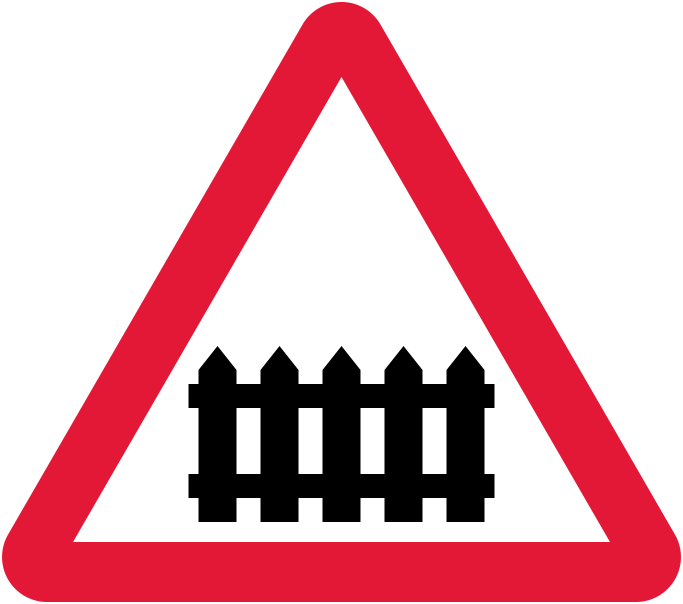 Warning for a railway crossing with barriers.
English • GB diagram 770 • Level crossing with a gate or barrier. A railway level crossing with gates or barriers is ahead.
Sources
🔗 Commons.wikimedia.org
🔗 Legislation.gov.uk • Traffic Signs Regulations and General Directions • Great Britain
🔗 Gov.uk • Department for Transport • Know your traffic signs
SVG source: UK Government • Public domain • Original revision 2024-11-10. Wikimedia original unmodified.
Artwork verified against Legislation.gov.uk • official published diagram 770.
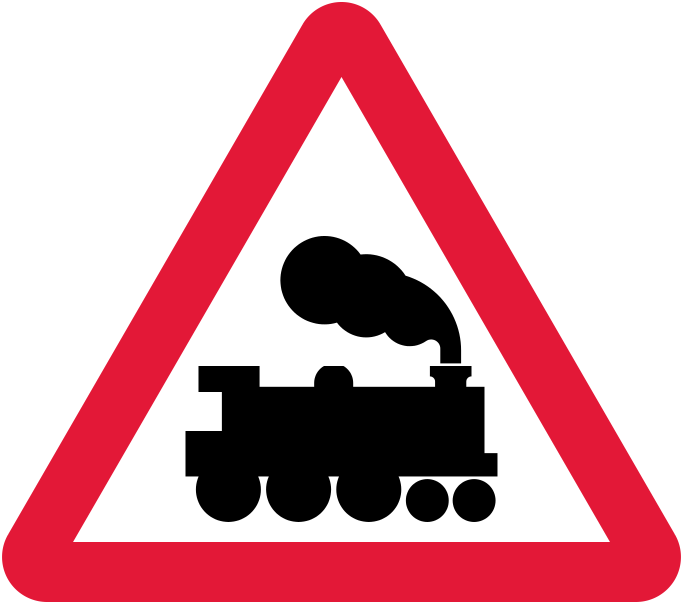 Warning for a railway crossing without barriers.
English • GB diagram 771 • Level crossing without a gate or barrier. A railway level crossing without gates or barriers is ahead.
Sources
🔗 Commons.wikimedia.org
🔗 Legislation.gov.uk • Traffic Signs Regulations and General Directions • Great Britain
🔗 Gov.uk • Department for Transport • Know your traffic signs
SVG source: UK Government • Public domain • Original revision 2024-11-10. Wikimedia original unmodified.
Artwork verified against Legislation.gov.uk • official published diagram 771.
 Warning for a railway crossing with one track.
English • GB diagram 774 • Level crossing without a gate or barrier. This sign marks the location of a railway or tramway level crossing without gates or barriers. It does not indicate a specific number of tracks.
Sources
🔗 Commons.wikimedia.org
🔗 Legislation.gov.uk • Traffic Signs Regulations and General Directions • Great Britain
🔗 Gov.uk • Department for Transport • Know your traffic signs
SVG source: UK Government • Public domain • Original revision 2024-11-10. Wikimedia original unmodified.
Artwork verified against Legislation.gov.uk • official published diagram 774.
What if road traffic is queued beyond a railway crossing in Great Britain?
Wait before the tracks until there is room to take your entire vehicle off the crossing. Do not follow another vehicle onto the tracks without checking the exit. Keep the tracks clear even if no train is visible.
🔗 gov.uk • Great Britain Highway Code: Rules 291–299: level crossings
🔗 gov.uk • DfT Know Your Traffic Signs: level crossing signs and signals (Great Britain)
Can I cross after a train has passed if the warning lights are still active in Great Britain?
No. Remain behind the stopping position until the crossing signals permit travel and barriers are fully clear. Another train may be approaching on a different track.
🔗 gov.uk • Great Britain Highway Code: Rules 291–299: level crossings
🔗 gov.uk • DfT Know Your Traffic Signs: level crossing signs and signals (Great Britain)
23. Mandatory direction
A mandatory-direction sign requires drivers to travel only in the direction or one of the directions indicated by its arrow or arrows. It may require traffic to continue straight ahead, turn, or pass an obstacle on a specified side.
The sign does not itself determine priority or speed. Drivers must still use the appropriate lane, signal when required and give way according to local traffic signs and regulations.
Wikimedia.org • Simon Burchell • CC BY-SA
How is mandatory direction shown in the United Kingdom?
Blue circular signs with white arrows commonly show a compulsory direction or side to pass. Lane markings and turn-only signs can also restrict permitted movements. Follow the control applying to your approach.
🔗 gov.uk • Great Britain Highway Code: Rule 109; lane directions and turn rules
🔗 gov.uk • DfT Know Your Traffic Signs: regulatory signs (Great Britain)
Can I choose another turn if the mandatory-direction arrow is inconvenient in United Kingdom?
No, unless another applicable sign, lane instruction or authorised traffic direction lawfully permits it. Plan a permitted alternative route; do not make an abrupt or prohibited turn to reach your destination.
🔗 gov.uk • Great Britain Highway Code: Rule 109; lane directions and turn rules
🔗 gov.uk • DfT Know Your Traffic Signs: regulatory signs (Great Britain)
Does a mandatory-direction sign give me priority over pedestrians in United Kingdom?
No. It tells you which way to move, not who goes first. Check traffic lights, other priority signs, pedestrians and cyclists, and give way when required before completing the manoeuvre.
🔗 gov.uk • Great Britain Highway Code: Rule 109; lane directions and turn rules
🔗 gov.uk • DfT Know Your Traffic Signs: regulatory signs (Great Britain)
Are lane arrows and compulsory-direction signs always identical in United Kingdom?
Not necessarily. A lane-use arrow can govern a particular lane, while a regulatory turn or direction sign can govern the approach or indicated manoeuvre. Read both together and comply with the active control.
🔗 gov.uk • Great Britain Highway Code: Rule 109; lane directions and turn rules
🔗 gov.uk • DfT Know Your Traffic Signs: regulatory signs (Great Britain)
24. Turn prohibition
A turn prohibition prevents drivers from turning in the direction indicated by a traffic sign. It may prohibit a left turn, a right turn or a U-turn at an intersection or along a specified section of road.
Drivers must continue along a permitted route and follow any lane arrows or mandatory-direction signs. A turn prohibition does not itself determine priority or speed, and any exemption for cyclists, public transport or other road users must be expressly indicated.

Wikimedia.org • Editor5807 • CC0
How do you recognise a prohibited turn in the United Kingdom?
A regulatory No left turn, No right turn or No U-turn sign prohibits the movement shown. A route-direction arrow without a prohibition symbol is not always the same kind of sign.
🔗 gov.uk • Great Britain Highway Code: Rule 109; separate prohibited movements and time plates
🔗 gov.uk • DfT Know Your Traffic Signs: regulatory signs (Great Britain)
Does a no-left-turn sign always prohibit a U-turn in United Kingdom?
Do not assume that a U-turn is allowed or prohibited solely from a no-left-turn sign. Separate U-turn signs and local road rules may apply, and some jurisdictions treat turning restrictions differently. Check the actual control.
🔗 gov.uk • Great Britain Highway Code: Rule 109; separate prohibited movements and time plates
🔗 gov.uk • DfT Know Your Traffic Signs: regulatory signs (Great Britain)
Can a no-turn restriction apply only to certain vehicles or hours in United Kingdom?
Yes, where the local sign system provides a supplementary condition or exemption, such as a vehicle class, time or authorised access. Without a valid exception, comply with the prohibited movement shown.
🔗 gov.uk • Great Britain Highway Code: Rule 109; separate prohibited movements and time plates
🔗 gov.uk • DfT Know Your Traffic Signs: regulatory signs (Great Britain)
If a traffic light permits movement, can I ignore a prohibited-turn sign in United Kingdom?
Not automatically. A green traffic signal normally authorises proceeding only in a lawful direction; an applicable no-turn restriction may still prohibit the manoeuvre. Follow any specific turn signal and authorised traffic direction.
🔗 gov.uk • Great Britain Highway Code: Rule 109; separate prohibited movements and time plates
🔗 gov.uk • DfT Know Your Traffic Signs: regulatory signs (Great Britain)
25. School area
A school area is a road or group of roads near a school where large numbers of children may walk, cycle, cross the road or enter and leave vehicles. It may be identified by warning signs, zone signs, road markings, traffic-calming measures or flashing lights.
Special speed limits, parking restrictions or access rules may apply permanently or only during school arrival and departure times. Drivers should reduce speed, watch carefully for children and be prepared to stop.
Wikimedia.org • Kolforn • CC BY-SA
Is every UK road outside a school limited to 20 mph?
There is no single UK-wide school-zone speed limit. Signed 20 mph limits are common near schools; in Wales, the 20 mph default on many restricted roads is a separate general rule.
🔗 gov.uk • Great Britain Highway Code: Rules 206–208; school warnings, limits and crossing patrols
🔗 gov.uk • DfT Know Your Traffic Signs: warning signs (Great Britain)
🔗 gov.uk • GOV.UK: national speed limits, including the Welsh default
Does a school warning sign in the United Kingdom automatically set the speed limit?
A children or school warning alerts you to a potential hazard; the enforceable numerical speed limit depends on the applicable law, regulatory signs and any time or variable display. Slow further if children are near the road.
🔗 gov.uk • Great Britain Highway Code: Rules 206–208; school warnings, limits and crossing patrols
🔗 gov.uk • DfT Know Your Traffic Signs: warning signs (Great Britain)
🔗 gov.uk • GOV.UK: national speed limits, including the Welsh default
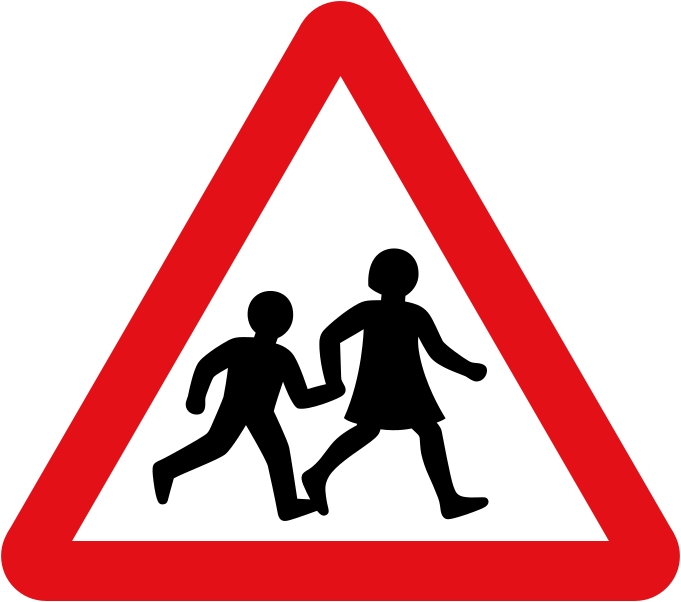 Warning for children.
English • GB diagram 545 • Children. Children may be going to or from a school or playground ahead. Take particular care.
Sources
🔗 Commons.wikimedia.org (Government of the United Kingdom – Department for Transport • Crown copyright • OGL v1.0)
🔗 Legislation.gov.uk • Traffic Signs Regulations and General Directions • Great Britain
🔗 Gov.uk • Department for Transport • Know your traffic signs
SVG source: Government of the United Kingdom – Department for Transport • OGL v1.0 • Original revision 2022-02-20. Wikimedia original unmodified. © Crown copyright. Traffic signs are Crown copyright. You may reproduce traffic signs free of charge and without having to seek permission, but you must reproduce them accurately and not in a misleading context (e.g. not on roadside billboards where they could mislead drivers). (ref [1])
Artwork verified against Gov.uk • official published diagram 545.
Current design and permitted variants verified against Legislation.gov.uk • TSRGD, current text.
How should you pass a school entrance in the United Kingdom?
Watch for children stepping out from between parked vehicles, obey crossings and any school patrol, and follow stopping or parking restrictions. Do not obstruct visibility near a crossing or school entrance; approach at a speed that permits a safe stop.
🔗 gov.uk • Great Britain Highway Code: Rules 206–208; school warnings, limits and crossing patrols
🔗 gov.uk • DfT Know Your Traffic Signs: warning signs (Great Britain)
🔗 gov.uk • GOV.UK: national speed limits, including the Welsh default