


Traffic signsUnited Kingdom
 Traffic rules
 United Kingdom
176. Airbag
An airbag is a vehicle safety device that rapidly inflates during certain collisions to help reduce the risk of an occupant striking the steering wheel, dashboard, doors or other parts of the vehicle interior. Vehicles may have frontal, side, curtain or other types of airbags.
Airbags form part of a supplemental restraint system (SRS) and are designed to work together with seat belts rather than replace them. Occupants should sit correctly, wear their seat belts and follow the vehicle manufacturer's instructions concerning airbags and child-restraint systems.
Wikimedia.org • Transport For NSW • CC BY-SA
What is an airbag?
An airbag is an inflatable vehicle safety device designed to help protect occupants during certain types of collision.
How does an airbag work?
Sensors detect collision conditions and, when the system determines that deployment is required, the airbag inflates extremely quickly to provide additional protection between the occupant and parts of the vehicle interior.
Does an airbag replace a seat belt?
No. Airbags are supplemental restraints and are designed to work together with seat belts. Occupants should always wear their seat belts where required.
What types of airbags can a car have?
Vehicles may have front airbags, side airbags, curtain airbags, knee airbags and other specialised airbags. The number and location depend on the vehicle design.
Does an airbag deploy in every collision?
No. Airbag systems are designed to deploy only when sensors detect collision conditions for which deployment is intended. Different airbags may deploy in different types of crashes.
Can an airbag be dangerous to a rear-facing child seat?
Yes. A rear-facing child restraint must not be placed in front of an active frontal passenger airbag because deployment can cause severe injury. The airbag must be deactivated where the vehicle and local rules permit such installation.
Can you switch off a passenger airbag?
Some vehicles allow the front passenger airbag to be deactivated, particularly when a rear-facing child restraint must be installed there. Follow the vehicle manufacturer's instructions carefully.
What does the airbag warning light mean?
An illuminated airbag or SRS warning light can indicate a fault in the restraint system. The system should be checked and repaired according to the vehicle manufacturer's instructions.
Can an airbag be reused after it deploys?
No. A deployed airbag is normally a single-use component and must be replaced together with any other affected restraint-system components before the system can function correctly again.
Should you sit close to an airbag?
Occupants should use a normal, correctly adjusted seating position and avoid placing themselves unnecessarily close to the airbag cover. Follow the seating and steering-wheel adjustment guidance provided by the vehicle manufacturer.

177. ABS
ABS (Anti-lock Braking System) is an active safety system that helps prevent a vehicle's wheels from locking during hard braking. It automatically adjusts braking pressure at individual wheels so that they continue to rotate sufficiently to maintain directional control.
When ABS operates, the driver may feel rapid pulsing or vibration through the brake pedal. The driver should normally maintain firm braking pressure and continue steering towards a safe path rather than repeatedly releasing and reapplying the brake.

Wikimedia.org • Chris828 • CC0
What does ABS do?
ABS helps prevent the wheels from locking during heavy braking. By controlling wheel slip, it helps the driver retain steering control while braking strongly.
How should you brake when ABS activates?
Apply firm, continuous pressure to the brake pedal and keep steering as necessary. Pulsing or vibration through the pedal is normal while ABS is regulating the braking pressure.
Does ABS always reduce braking distance?
No. The main purpose of ABS is to prevent wheel lock and help maintain vehicle control. Actual stopping distance still depends on speed, tyres, road surface, weather and other conditions.
178. Esp
ESP (Electronic Stability Program), also known as Electronic Stability Control (ESC), is an active safety system designed to help prevent a vehicle from skidding or losing directional control. It compares the driver's intended direction with the vehicle's actual movement and can intervene when instability is detected.
ESP can automatically brake individual wheels and, depending on the vehicle, reduce engine power to help bring the vehicle back towards the intended path. The system operates within the limits of tyre grip and cannot overcome excessive speed or very slippery conditions.

Wikimedia.org • Chris828 • CC0
What does ESP do?
ESP helps maintain vehicle stability when it detects that the vehicle is beginning to deviate from the driver's intended direction. It can selectively brake individual wheels and may reduce engine power to help restore control.
What is the difference between ESP and ESC?
ESP and ESC refer to the same general type of electronic stability-control system. ESP means Electronic Stability Program, while ESC means Electronic Stability Control. Vehicle manufacturers may also use other names for similar systems.
Can ESP prevent every skid?
No. ESP can assist in maintaining stability, but it cannot overcome the physical limits of tyre grip. Excessive speed, worn tyres, ice or other very slippery conditions can still cause a vehicle to lose control.
179. Traction control system
Traction Control System (TCS) is an active safety system that helps prevent the driven wheels from spinning excessively during acceleration. When the system detects loss of traction, it can reduce engine power, apply braking to one or more wheels or use a combination of both.
Traction control is particularly useful when accelerating on wet, icy, snowy or loose surfaces. It helps the vehicle use the available tyre grip more effectively but cannot create grip where little or none is available.

Wikimedia.org • Chris828 • CC0
What does traction control do?
Traction control detects excessive wheel spin during acceleration and intervenes to help the driven wheels regain grip. Depending on the vehicle, it can reduce engine power or apply braking to individual wheels.
When is traction control most useful?
It is particularly useful when accelerating on surfaces with limited grip, such as wet roads, snow, ice, mud or loose gravel.
What is the difference between traction control and ESP?
Traction control primarily limits wheel spin during acceleration. ESP or ESC has a broader function and helps stabilise the vehicle when it begins to deviate from the driver's intended direction. The systems commonly share wheel-speed sensors and braking components.
180. Helmet
A helmet is protective headgear designed to reduce the risk and severity of head injuries during a collision or fall. Different types of helmets are designed for motorcycles, mopeds, bicycles and other activities and may be subject to specific safety standards.
Whether wearing a helmet is compulsory depends on the country, vehicle category, rider and sometimes age. A helmet should be suitable for its intended use, correctly fitted and securely worn so that it can provide the protection for which it was designed.

Wikimedia.org • Stefania Anghelea • CC BY-SA
What is a helmet?
A helmet is protective headgear designed to reduce the risk and severity of head injury if a rider falls or is involved in a collision.
Who should wear a helmet?
Helmet requirements depend on the vehicle and local traffic law. Motorcyclists and moped riders commonly have compulsory helmet requirements, while bicycle rules vary between countries.
Is a motorcycle helmet the same as a bicycle helmet?
No. Motorcycle and bicycle helmets are designed and tested for different conditions and are subject to different safety standards. Use a helmet approved for the type of vehicle concerned.
Should a passenger also wear a helmet?
Yes, where required. Passengers on motorcycles, mopeds and certain other vehicles are generally exposed to the same head-injury risks as the rider and may be subject to the same helmet requirement.
How should a helmet fit?
A helmet should fit securely and comfortably without excessive movement. It should be worn and fastened according to the manufacturer's instructions.
Can you use a damaged helmet?
A helmet that has suffered a significant impact or has visible structural damage may no longer provide its intended protection and should normally be inspected or replaced.
Can any helmet be used on a motorcycle?
No. Where motorcycle helmets are regulated, the helmet must comply with the applicable approval or safety standard. A recreational or ordinary bicycle helmet is generally not an acceptable substitute.
Are bicycle helmets compulsory everywhere?
No. Some countries require helmets for all cyclists, others only for particular age groups or types of bicycle, and some recommend them without making them compulsory.
Do speed pedelecs require a special helmet?
They may. Because speed pedelecs can travel considerably faster than ordinary bicycles, some countries require an approved moped helmet or a bicycle helmet satisfying additional requirements.
Does wearing a helmet replace safe riding?
No. A helmet provides additional protection but does not replace safe speed, observation, correct road position, appropriate clothing or compliance with traffic rules.
181. Bicycle helmet
Abicycle helmet is protective headgear designed to reduce the risk and severity of head injuries if a cyclist falls or is involved in a collision. It normally consists of an impact-absorbing liner, an outer shell and a retention strap that keeps the helmet securely on the head.
A bicycle helmet should fit correctly, sit level on the head and be securely fastened. A damaged helmet should be replaced because its protective performance may have been reduced even when the damage is not immediately visible.

Wikimedia.org • Ildar Sagdejev • CC BY-SA
What is the purpose of a bicycle helmet?
A bicycle helmet is designed to absorb part of the impact energy during a fall or collision and help reduce the risk and severity of head injuries.
How should a bicycle helmet fit?
The helmet should fit snugly, sit level on the head and be secured with the retention strap. It should not move excessively when the cyclist moves their head.
Is wearing a bicycle helmet compulsory everywhere?
No. Helmet requirements vary between countries and may also depend on the cyclist's age or the type of bicycle being used. Riders should check the rules that apply where they are cycling.
182. Hands-free
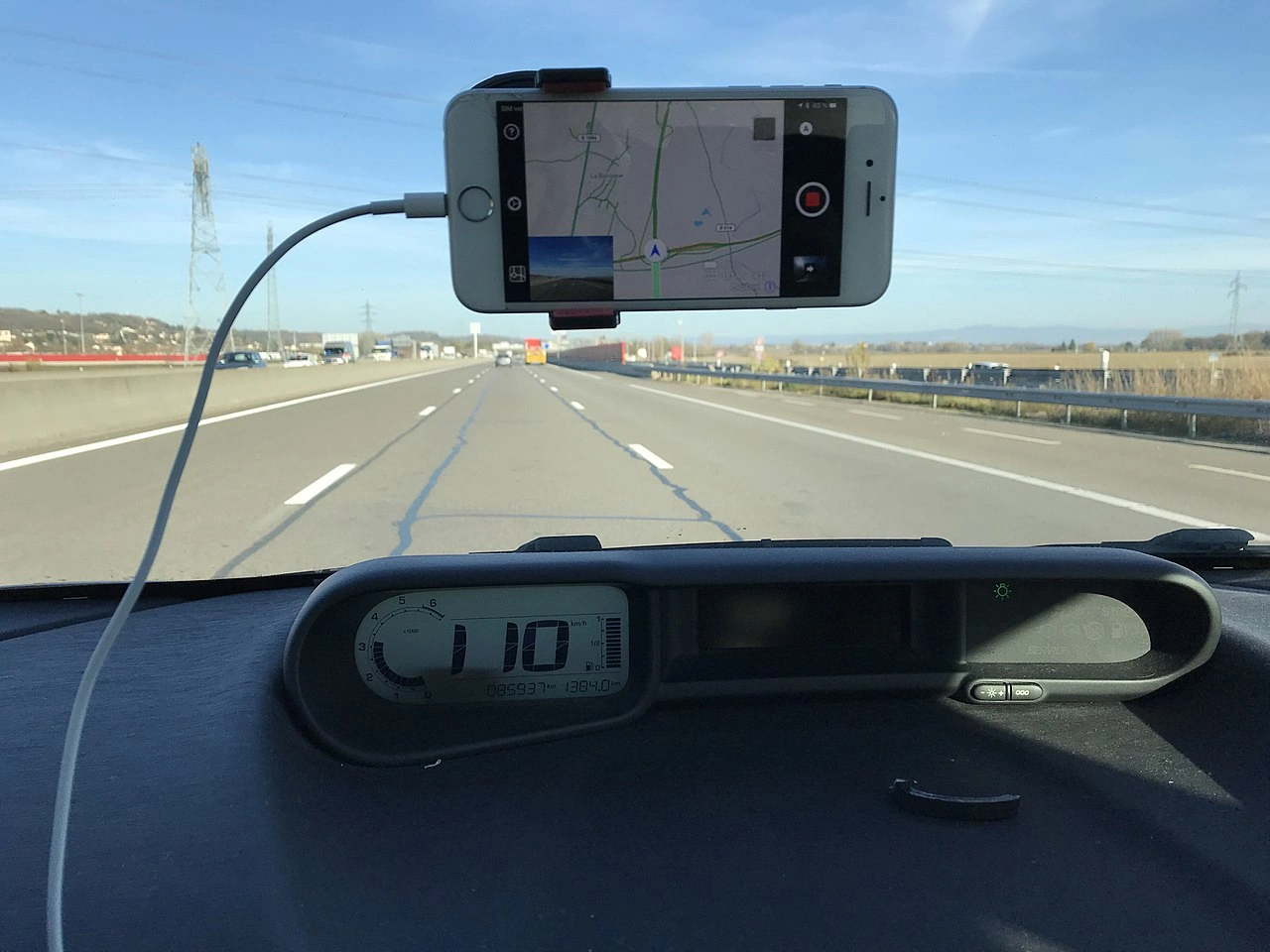
Hands-free refers to using a telephone or communication system without holding the device in the hand. Hands-free operation can use the vehicle's built-in system, a headset, earphones, voice control or a phone secured in an appropriate holder.
Hands-free operation reduces the need to physically handle a device, but a conversation or interaction can still distract the driver. Drivers should therefore minimise device use and keep their attention on the road.
Wikimedia.org • Benoît Prieur • CC0
What does hands-free mean while driving?
Hands-free means using a communication device without holding it. Calls can be handled through a vehicle system, headset, earphones, voice control or another permitted system.
Is hands-free phone use completely distraction-free?
No. Even when the driver does not physically handle the phone, a conversation or interaction with a device can reduce attention to traffic. Drivers should keep such use to a minimum.
Does hands-free use allow you to hold the phone?
No. Holding a telephone while calling is not hands-free use. Whether handheld or mounted-device use is legally permitted depends on the traffic rules of the country.
183. Smartphone
A smartphone is a mobile electronic device that combines telephone, messaging, internet, navigation, camera and application functions. When used in traffic, a smartphone can provide useful functions such as navigation or hands-free communication but can also create significant visual, manual and mental distraction.
Drivers should avoid handling or looking at a smartphone while driving. Where its use is permitted, the device should be positioned and operated in accordance with local traffic rules and without interfering with safe control of the vehicle.

Wikimedia.org • D'Vaughn Bell • CC BY-SA
Why is smartphone use dangerous while driving?
Using a smartphone can take the driver's eyes off the road, hands away from the controls and attention away from traffic. Reading messages, typing or selecting apps can therefore significantly increase distraction.
Can a smartphone be used for navigation while driving?
It may be permitted when the device is properly mounted and used according to local traffic rules. The route should preferably be programmed before starting the journey and interaction with the screen should be kept to a minimum.
Is hands-free smartphone use completely safe?
No. Hands-free operation removes the need to hold the device but conversations, navigation changes and other interactions can still distract the driver.
184. GPS
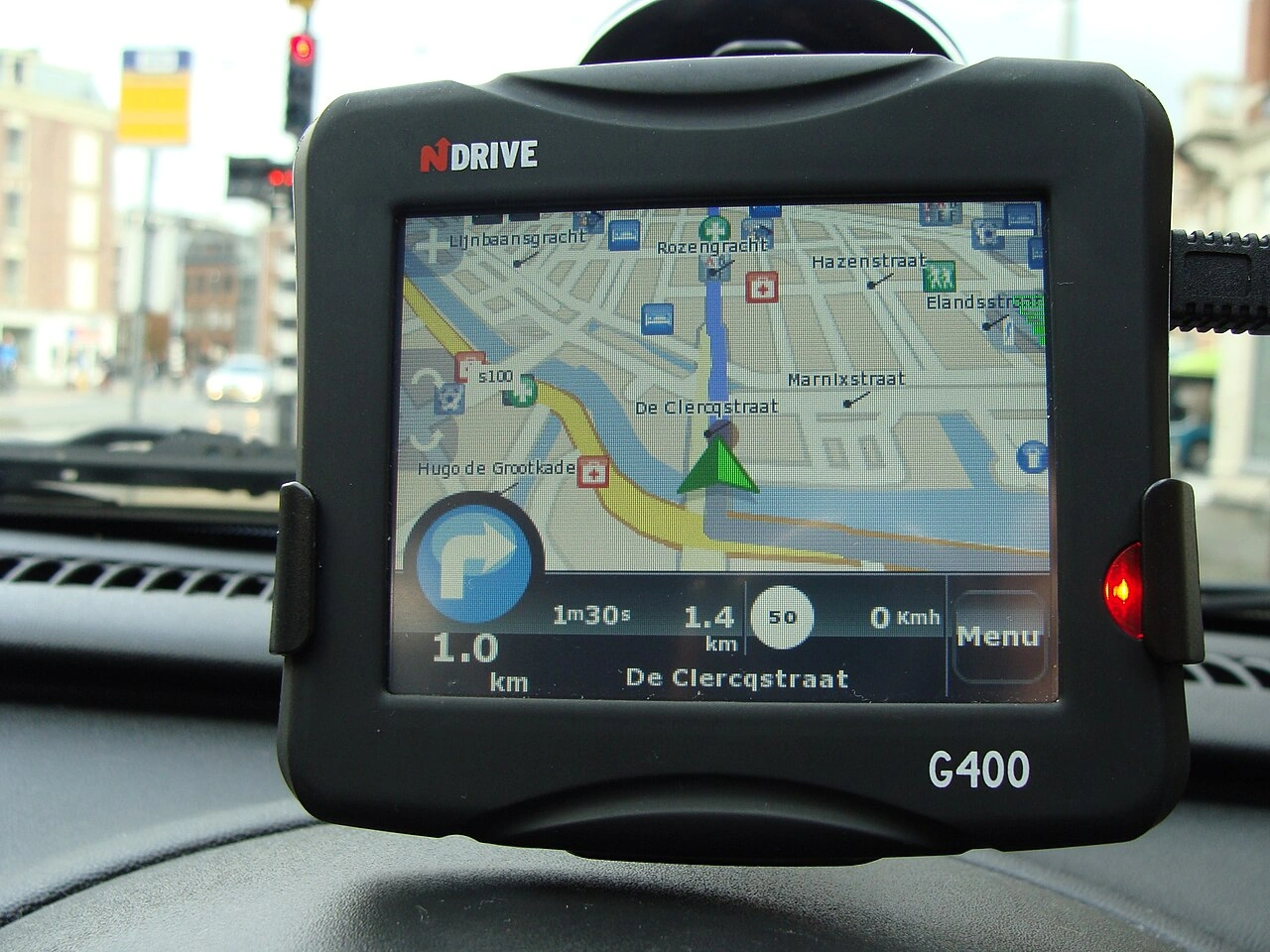
GPS (Global Positioning System) is a satellite-based positioning and navigation system that allows a compatible device to determine its location. In vehicles, GPS navigation can combine positioning information with digital maps to calculate routes and provide visual or spoken directions.
Drivers should preferably set their destination before starting the journey and avoid unnecessary interaction with the navigation system while driving. GPS directions are advisory and should never be followed when they conflict with traffic signs, road rules or actual road conditions.
Wikimedia.org • ines s. • CC BY
What does GPS do in a vehicle?
A GPS navigation system determines the vehicle's position and uses digital map information to calculate routes and provide directions towards a destination.
Should you always follow GPS directions?
No. Traffic signs, signals, road closures and actual road conditions take priority over navigation instructions. A driver remains responsible for choosing a legal and safe route.
Should you program a GPS while driving?
It is safer to enter the destination and adjust the route before starting the journey. If significant changes are needed, stop in a safe and permitted place rather than becoming distracted while driving.
185. Brake
A brake is a vehicle system used to reduce speed, bring the vehicle to a stop or keep it stationary. Most road vehicles use friction brakes at the wheels, while electric and hybrid vehicles may also use regenerative braking to recover energy while slowing down.
The braking system must remain in good working condition. Worn brake components, overheating, mechanical faults or reduced tyre grip can increase braking distance and reduce the driver's ability to control the vehicle safely.

Wikimedia.org • Andrea Volpato • CC BY-SA
What is the purpose of a vehicle's brakes?
The brakes allow the driver to reduce speed and stop the vehicle in a controlled manner. A separate parking brake is normally used to keep the vehicle stationary after it has stopped.
What are signs of a possible brake problem?
Warning signs can include reduced braking performance, unusual noises, vibration, a soft or unusually hard brake pedal, pulling to one side or a brake-system warning light. A suspected brake problem should be inspected promptly.
Can brakes become less effective when they overheat?
Yes. Prolonged or repeated heavy braking can cause brake fade, reducing braking effectiveness. On long descents, appropriate gear selection and engine braking can help reduce excessive use of the service brakes.
186. Handbrake
A handbrake, commonly called the parking brake, is a braking system used to keep a stationary vehicle from moving after it has been parked. Traditional systems use a hand-operated lever, while modern vehicles may use a foot-operated or electronic parking brake.
The parking brake should be applied securely whenever the vehicle is parked, particularly on a slope. It operates separately from the normal service brake so that the vehicle can remain stationary even when the driver is absent.
Wikimedia.org • CC BY-SA
What is a handbrake used for?
The handbrake or parking brake keeps a stationary vehicle from rolling after it has been parked. It is particularly important when parking on a slope.
Is every handbrake operated by a hand lever?
No. Traditional parking brakes use a hand-operated lever, but some vehicles use a foot pedal or an electronic switch. These systems perform the same basic parking-brake function.
Should you use the handbrake every time you park?
Yes. The parking brake should normally be applied whenever the vehicle is parked so that it remains securely stationary. Selecting an appropriate gear or transmission position provides additional security but does not replace the parking brake.
187. Brake fluid
Brake fluid is a hydraulic fluid used in many vehicle braking systems to transmit force from the brake pedal through the hydraulic system to the brakes at the wheels. It must withstand high temperatures and maintain suitable hydraulic properties for reliable braking.
The brake-fluid level and condition should be checked according to the vehicle manufacturer's instructions. Only the specified type of brake fluid should be used, because incompatible or contaminated fluid can impair braking-system performance.

Wikimedia.org • Frettie • CC BY
What does brake fluid do?
Brake fluid transmits hydraulic pressure from the driver's brake input to the braking mechanisms at the wheels, allowing the vehicle to slow or stop.
Can you use any type of brake fluid?
No. The correct specification depends on the vehicle and braking system. Drivers should use only the brake fluid specified by the vehicle manufacturer and should not mix incompatible types.
What does a low brake-fluid level mean?
A low level can indicate brake-system wear, a leak or another problem. If the level is below the specified minimum or a brake warning light appears, the braking system should be checked promptly.
188. Tyres
Tyres are the rubber components fitted around a vehicle's wheels that provide contact with the road. They transmit braking, acceleration and steering forces and play an important role in vehicle stability and road holding.
Tyres should have sufficient tread depth, correct pressure and no serious damage or excessive wear. Drivers should use tyres that are suitable for the vehicle and regularly check their condition, particularly before long journeys or driving in difficult weather.

Wikimedia.org • Ambiguous • CC BY
Why are tyres important for road safety?
Tyres are the vehicle's contact with the road and transmit the forces required for steering, acceleration and braking. Their condition and available grip therefore directly affect vehicle control.
What should you check on your tyres?
Regularly check tyre pressure, tread depth and general condition. Look for excessive or uneven wear, cuts, cracks, bulges or other damage and replace tyres when they are no longer safe or legally compliant.
Should tyres on the same axle match?
Requirements vary between countries, but tyres fitted to the same axle should be compatible in dimensions, construction and performance. National rules may impose specific matching requirements.
189. Tyre code
A tyre code is the series of letters and numbers marked on a tyre's sidewall that identifies important characteristics such as tyre width, aspect ratio, construction, wheel diameter, load capacity and speed rating. A typical example is 205/55 R16 91V.
Drivers should use tyres whose specifications are suitable for the vehicle. The required tyre sizes and ratings can normally be found in the vehicle handbook, certificate of conformity or other manufacturer information.

Wikimedia.org • F l a n k e r • CC BY
What does a tyre code such as 205/55 R16 mean?
205 indicates the nominal tyre width in millimetres, 55 is the aspect ratio between sidewall height and tyre width, R indicates radial construction and 16 indicates the diameter of the wheel rim in inches.
What do numbers and letters such as 91V mean on a tyre?
The number is the load index, which identifies the maximum load the tyre is designed to carry under specified conditions. The letter is the speed rating or speed-category symbol, which indicates the tyre's approved speed capability.
What other markings can appear on a tyre?
Tyres can carry additional markings indicating approval, manufacturer information, production date, suitability for winter conditions, reinforced construction or other technical characteristics. The exact markings depend on the tyre type and applicable standards.
190. Winter tyres
Winter tyres are tyres designed to provide improved traction and braking performance in cold weather, snow and other winter conditions. Their tread pattern and rubber compound are designed to remain effective at lower temperatures and provide better grip than ordinary summer tyres in appropriate winter conditions.
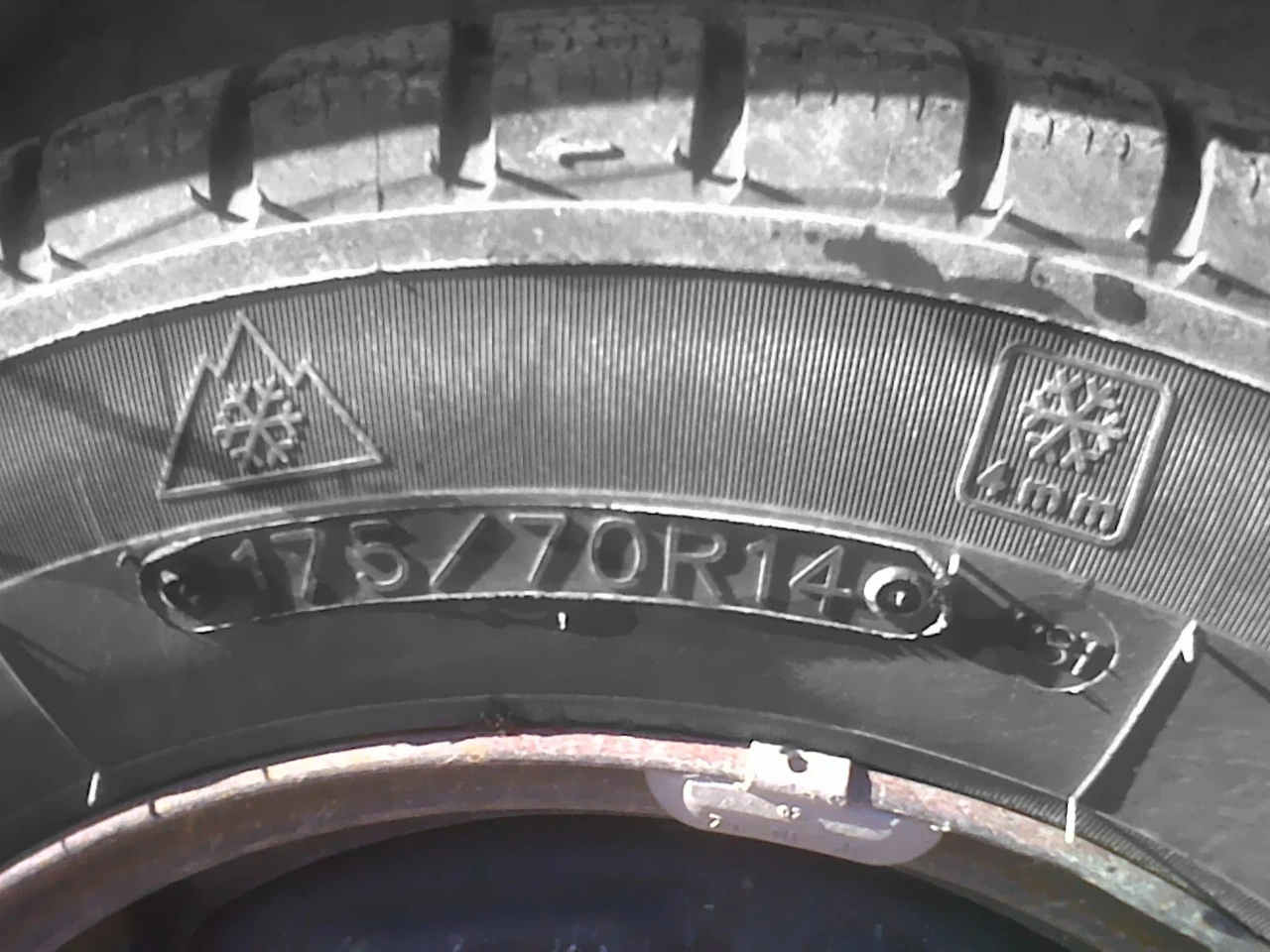
Winter tyres can be identified by markings on the sidewall. The 3PMSF symbol, showing a snowflake inside a three-peaked mountain, indicates that the tyre has met specified performance requirements for severe snow conditions.
Wikimedia.org • A7N8X • CC BY-SA
What is the difference between winter and summer tyres?
Winter tyres use tread patterns and rubber compounds designed to provide better performance in cold temperatures, snow and other winter conditions. Summer tyres are optimised primarily for warmer conditions.
What does the 3PMSF symbol mean?
The Three-Peak Mountain Snowflake symbol identifies a tyre that has met specified performance requirements for use in severe snow conditions. It provides a more specific indication of tested snow performance than an M+S marking alone.
Are winter tyres compulsory everywhere?
No. Some countries require winter tyres during particular months or whenever winter conditions occur, while others have no general requirement. Drivers travelling abroad should check the rules of every country on their route.
191. Tyre pressure
Tyre pressure is the amount of air pressure inside a vehicle's tyre. Correct tyre pressure helps the tyre maintain its intended shape and contact with the road and is important for handling, braking, tyre wear and fuel consumption.
Tyre pressure should be checked regularly and adjusted to the pressure specified by the vehicle manufacturer. The recommended pressure can vary according to the vehicle, tyre size and load, and the front and rear tyres may require different pressures.
Wikimedia.org • JEG14 • CC0
Why is correct tyre pressure important?
Correct tyre pressure helps provide predictable handling, braking and tyre wear. Incorrect pressure can reduce performance, increase tyre wear and increase fuel consumption.
How do you know the correct tyre pressure?
Use the pressure specified by the vehicle manufacturer rather than the maximum pressure marked on the tyre. The recommended values can normally be found in the vehicle handbook or on a vehicle information label.
Should tyre pressure be checked regularly?
Yes. Tyres gradually lose air over time, so their pressure should be checked regularly and before demanding or long journeys. The pressure should be adjusted to the manufacturer's recommended value.
192. Snow chains
Snow chains are traction devices fitted around vehicle tyres to improve grip on roads covered with snow or ice. They are especially useful on steep or mountainous roads where ordinary tyres may not provide sufficient traction.
Snow chains should be fitted according to the vehicle and chain manufacturer's instructions, normally on the driven wheels. They should be removed when they are no longer needed because driving with chains on clear roads can damage the tyres, chains and road surface.

Wikimedia.org • Domitori • CC BY-SA
What are snow chains used for?
Snow chains increase traction when driving on roads covered with snow or ice. They can help a vehicle accelerate, steer and brake where ordinary tyre grip is insufficient.
Which tyres should snow chains be fitted to?
Snow chains are normally fitted to the driven wheels, but the correct arrangement depends on the vehicle and its drivetrain. Drivers should follow the vehicle and chain manufacturer's instructions.
Are snow chains compulsory everywhere in winter?
No. Requirements vary between countries and roads. Some countries require chains to be carried during certain periods or fitted when indicated by traffic signs or winter conditions, while others impose no general requirement.
193. Bicycle tyre
A bicycle tyre is the rubber tyre fitted around a bicycle wheel and provides contact between the bicycle and the road or other riding surface. Its tread, pressure, width and construction affect grip, rolling resistance, comfort and handling.
Bicycle tyres should be properly inflated and regularly checked for wear, cuts, cracks, embedded objects or other damage. The appropriate tyre type and pressure depend on the bicycle, rider, load and riding conditions.

Wikimedia.org • Ivan Radic • CC BY
Why are bicycle tyres important for safety?
Bicycle tyres provide the grip needed for steering and braking and help absorb irregularities in the road surface. Worn, damaged or incorrectly inflated tyres can reduce control and increase the risk of a puncture or loss of grip.
What should you check on a bicycle tyre?
Check the tyre for adequate pressure, excessive tread wear, cuts, cracks, bulges and objects embedded in the tread. The tyre should also be correctly seated on the rim.
Do all bicycles use the same type of tyre?
No. Tyre width, diameter, tread and construction vary according to the bicycle and its intended use. Road bicycles commonly use relatively narrow tyres, while mountain bikes generally use wider tyres with more pronounced tread.
194. Continuous track
Continuous track is a vehicle propulsion system in which a continuous belt or chain runs around a series of wheels or rollers instead of the vehicle travelling on conventional road wheels. It is commonly used on construction machinery, agricultural vehicles, military vehicles and other machines that need good traction on soft or uneven ground.
Continuous tracks spread the vehicle's weight over a relatively large contact area, which can improve traction and reduce ground pressure. Tracks may be made from metal, rubber or a combination of materials, and their suitability for use on public roads depends on the vehicle and applicable regulations.

Wikimedia.org • Ingolfson • CC0
What is a continuous track used for?
Continuous tracks provide traction and distribute a vehicle's weight over a larger contact area than conventional wheels. They are particularly useful on mud, snow, loose soil, construction sites and other difficult terrain.
What are continuous tracks made from?
Tracks can consist of linked metal sections, continuous rubber belts or systems combining metal and rubber components. The design depends on the vehicle and its intended operating conditions.
Can tracked vehicles travel on normal roads?
Some tracked vehicles can use public roads when they meet the applicable vehicle, registration and road-use requirements. Restrictions may apply because certain track designs can damage road surfaces or because the vehicle has unusual dimensions, weight or speed characteristics.
195. Gross Vehicle Weight
Gross Vehicle Weight (GVW) is the actual total weight of a vehicle at a particular moment, including the vehicle itself, driver, passengers, fuel, luggage and other cargo. It changes as people or goods are added or removed.
GVW should not be confused with Gross Vehicle Weight Rating (GVWR) or Maximum Authorised Mass (MAM), which is the maximum permitted total weight specified for the vehicle. The actual gross vehicle weight must not exceed that permitted maximum.
What does Gross Vehicle Weight include?
Gross Vehicle Weight includes the weight of the vehicle itself together with the driver, passengers, fuel, luggage, cargo and other items being carried at that moment.
What is the difference between GVW and GVWR?
GVW is the vehicle's actual weight at a particular moment. GVWR is the maximum total weight the vehicle is designed or legally permitted to have when loaded. The actual GVW must remain within the applicable maximum.
Why is Gross Vehicle Weight important?
Vehicle weight affects braking, handling, tyre and axle loading and legal weight limits. Overloading can reduce safety and may also cause the vehicle to exceed permitted axle or total-mass limits.
196. Gross Vehicle Weight Rating
Gross Vehicle Weight Rating (GVWR) is the maximum total weight at which a vehicle is designed or approved to operate when fully loaded. It includes the vehicle itself together with the driver, passengers, fuel, luggage, cargo and other equipment carried by the vehicle.
GVWR is a fixed maximum value and should not be confused with Gross Vehicle Weight (GVW), which is the vehicle's actual weight at a particular moment. The actual loaded weight of the vehicle must not exceed its permitted maximum.
What does GVWR include?
GVWR represents the permitted maximum total weight of the loaded vehicle, including the vehicle itself, driver, passengers, fuel, luggage, cargo and other equipment carried by the vehicle.
What is the difference between GVWR and GVW?
GVWR is the maximum permitted or rated weight of the vehicle, while GVW is its actual weight at a particular moment. The GVW changes as passengers or cargo are added or removed, while the GVWR remains a fixed limit.
Why is GVWR important?
GVWR determines how heavily a vehicle may be loaded and can affect driving-licence categories, vehicle classification and other legal requirements. Exceeding the permitted maximum can also adversely affect braking, handling, tyres and other vehicle components.
197. Cargo
Cargo is the goods, materials, equipment or other items carried by a vehicle or trailer. Cargo can range from personal luggage and bicycles to commercial goods, machinery or bulk materials.
Cargo must be positioned and secured so that it cannot shift, fall from the vehicle, interfere with the driver's visibility or affect vehicle stability. The total load must also remain within the vehicle's permitted weight and axle-load limits.
Why must cargo be secured?
Unsecured cargo can move during acceleration, braking or cornering and can affect vehicle stability or fall onto the road. Proper securing protects the occupants, other road users and the cargo itself.
Can cargo affect vehicle handling?
Yes. Heavy or poorly distributed cargo can change the vehicle's centre of gravity, braking distance, steering and stability. Loads should therefore be distributed appropriately and kept within the vehicle's permitted limits.
Can cargo extend beyond a vehicle?
In some circumstances it can, but national rules normally limit how far a load may project beyond the front, rear or sides of a vehicle and may require projecting loads to be specially marked.
198. Car body
A car body, also called bodywork, is the outer structure of a car that surrounds the passenger and luggage compartments and gives the vehicle its shape. It includes components such as the roof, doors, bonnet, boot lid, wings, body panels and, on many modern cars, load-bearing structural sections.
The car body helps protect occupants and supports components such as doors, windows, lights and bumpers. Damage, corrosion or poorly repaired structural sections can reduce the vehicle's safety and should be repaired correctly.

Wikimedia.org • Cjp24 • CC BY-SA
What is the car body?
The car body is the structure and exterior bodywork surrounding the vehicle's occupants and cargo areas. It includes visible panels as well as structural sections that can contribute to the strength of the vehicle.
Is the car body the same as the chassis?
Not always. In some vehicles the body is mounted on a separate chassis or frame. Most modern passenger cars use a self-supporting body in which much of the body structure also performs the structural function traditionally provided by a separate chassis.
Why is the condition of the car body important?
The body helps protect occupants and supports many vehicle components. Serious corrosion, deformation, loose panels or structural damage can reduce crash protection or create hazards for other road users.
199. Trunk
A trunk, also called a boot or luggage compartment, is the enclosed storage area of a car used for carrying luggage, tools, shopping and other cargo. It is usually located at the rear of the vehicle, although some vehicles have a front storage compartment.
Items carried in the trunk should be positioned securely so that they cannot shift dangerously during braking, acceleration or cornering. Heavy objects should be placed carefully and the vehicle's permitted load and axle limits must not be exceeded.

Wikimedia.org • Atomic Taco • CC BY-SA
What is a car trunk used for?
A trunk is primarily used for carrying luggage and other cargo separately from the passenger compartment. Its size and location depend on the vehicle's design.
Should items in the trunk be secured?
Yes. Heavy or loose objects can move during sudden braking, acceleration or cornering. Cargo should therefore be positioned and secured so that it cannot affect vehicle stability or cause injury.
Can you overload a car trunk?
No. The combined weight of the vehicle, occupants and cargo must remain within the vehicle's permitted total and axle-load limits. Excessive loading can adversely affect braking, steering and stability.
200. Roof rack
A roof rack is a load-carrying system attached to the roof of a vehicle. It can be used to transport items such as luggage, bicycles, skis, surfboards or a roof box when they cannot conveniently be carried inside the vehicle.
A roof rack and its cargo must be securely attached and must remain within the vehicle manufacturer's permitted roof-load limit. Roof-mounted loads raise the vehicle's centre of gravity and can affect handling, stability, fuel consumption and overall vehicle height.
Wikimedia.org • Matti Blume • CC BY-SA
What can be carried on a roof rack?
A suitable roof rack can carry items such as luggage boxes, bicycles, skis and other equipment, provided the rack and attachments are designed for the load and the vehicle's permitted roof-load limit is respected.
Does a roof rack affect vehicle handling?
Yes. Weight carried high on the vehicle raises its centre of gravity and can affect stability, particularly during cornering or sudden manoeuvres. Drivers should secure the load carefully and adapt their driving accordingly.
How do you know the maximum roof load?
Check the vehicle manufacturer's specifications and the limits of the roof rack itself. The permitted load can vary significantly between vehicles, and the lowest applicable limit should not be exceeded.