


Traffic signsIndia
 Traffic rules
 India
India
101. Vehicle lights
Vehicle lights are lighting and signalling devices fitted to a vehicle to help the driver see, make the vehicle visible and communicate intentions to other road users. They include dipped-beam and main-beam headlights, position lights, daytime running lights, rear lights, brake lights, direction indicators, reversing lights, fog lights and hazard warning lights.
Drivers should use the appropriate lights for the visibility, weather and traffic conditions. Lights must be kept clean and in working condition, and lights that can dazzle other road users should only be used when permitted.
Wikimedia.org • Christopher Ziemnowicz • CC BY-SA
What are the main types of vehicle lights?
Common vehicle lights include dipped-beam and main-beam headlights, position lights, daytime running lights, rear lights, brake lights, direction indicators, reversing lights, fog lights and hazard warning lights.
When should dipped-beam headlights be used?
Dipped-beam headlights are normally used at night and whenever visibility is poor. Unlike main beams, they are designed to illuminate the road while reducing glare for other road users.
When should main-beam headlights not be used?
Main beams should be changed to dipped beams whenever they could dazzle approaching or preceding road users. The precise requirements and distances vary between countries.

102. Street lights
Street lights are fixed lighting installations used to illuminate roads, intersections, crossings, footpaths and other public traffic areas during darkness. They improve visibility of the roadway, road users and potential hazards.
Street lighting does not replace a driver's responsibility to use the vehicle's required lights or to adapt speed to visibility. Lighting levels can vary considerably between roads, and some roads may be only partly illuminated or completely unlit.

Wikimedia.org • Exploringlife • CC BY-SA
What is the purpose of street lights?
Street lights improve visibility during darkness and can help road users see the road layout, intersections, pedestrians, cyclists, obstacles and other traffic more clearly.
Do you still need vehicle lights on a street with street lighting?
Usually yes. Street lighting does not normally replace the vehicle-lighting requirements that apply at night or in poor visibility. Drivers must follow the lighting rules of the country in which they are driving.
Should you use main-beam headlights on a well-lit street?
Main beam should not be used when it could dazzle other road users, and many countries require dipped beam instead on sufficiently illuminated roads. Drivers should use the appropriate lighting for the road and traffic conditions.
103. Dipped beam
Dipped beam is the low-beam setting of a vehicle's headlights. It illuminates the road ahead while directing the light downward so that it is less likely to dazzle drivers and other road users.
Dipped-beam headlights are normally used at night, in poor visibility and whenever main beam could dazzle another road user. They provide less illumination than main beam but are suitable for normal driving when other traffic is nearby.

Wikimedia.org • Ehsnils • CC BY-SA
What is dipped beam?
Dipped beam is the normal low-beam headlight setting. It illuminates the road in front of the vehicle while limiting glare towards approaching and preceding road users.
When should dipped beam be used?
Dipped beam is generally used during darkness, in reduced visibility and whenever main-beam headlights could dazzle another road user. Exact requirements vary between countries.
What is the difference between dipped beam and main beam?
Dipped beam directs light lower and is suitable when other traffic is present. Main beam projects light farther ahead but must be switched off when it could dazzle other road users.
104. High beam
High beam, also called main beam, is the headlight setting designed to illuminate the road a long distance ahead. It provides stronger and farther-reaching illumination than dipped beam but can dazzle other road users if used incorrectly.
High beam is mainly useful on dark roads where there is no nearby traffic that could be dazzled. Drivers must switch to dipped beam whenever required by traffic conditions or national rules.

Wikimedia.org • Ehsnils • CC BY-SA
What is high beam used for?
High beam provides long-range illumination and can help a driver see farther ahead on dark roads where there is little or no other traffic.
When should you switch from high beam to dipped beam?
You should switch to dipped beam whenever high beam could dazzle approaching or preceding road users. Exact requirements and distances vary between countries.
Can high beam be used on a well-lit road?
Often not when the existing road lighting already provides sufficient visibility. National traffic rules may specifically require dipped beam instead in adequately illuminated areas.
105. Fog lights
Fog lights are vehicle lights designed for use in conditions where visibility is seriously reduced by fog, snow or other severe weather. Front fog lights illuminate the road ahead at a low level, while rear fog lights make the vehicle more visible to road users approaching from behind.
Fog lights should only be used in the conditions permitted by local traffic rules. Rear fog lights are particularly bright and can dazzle or distract following drivers when visibility is good.
Wikimedia.org • Ehsnils • CC BY-SA
What are front fog lights used for?
Front fog lights provide additional low-level illumination in poor visibility such as fog, snowfall or heavy rain. Their design helps illuminate the road close to the vehicle.
What are rear fog lights used for?
Rear fog lights produce an intense red light that makes a vehicle easier to see from behind when visibility is seriously reduced.
Should fog lights be used in normal weather?
No. Fog lights should only be used when the applicable traffic rules and weather conditions justify them. Rear fog lights in particular can cause unnecessary glare when visibility is good.
106. Front fog lights
Front fog lights are low-mounted vehicle lights designed to improve illumination of the road immediately ahead when visibility is reduced by fog, snow or heavy rain. Their beam is generally wide and directed low towards the road surface.
Front fog lights should only be used in the weather conditions permitted by local traffic rules. They are supplementary lights and should not be used unnecessarily in normal visibility.

Wikimedia.org • Ehsnils • CC BY-SA
What are front fog lights used for?
Front fog lights provide additional low-level illumination when fog, snow, heavy rain or similar conditions make it difficult to see the road ahead.
Where are front fog lights located?
They are normally mounted relatively low at the front of the vehicle so that their wide beam illuminates the road surface without projecting as much light directly into fog or precipitation.
Should front fog lights be used in normal weather?
No. Front fog lights should only be used when conditions and local traffic rules permit them. Unnecessary use can create glare or distraction for other road users.
107. Rear fog lights
Rear fog lights are bright red lights at the rear of a vehicle that make it easier for following road users to see the vehicle when visibility is severely reduced. They are much brighter than normal rear position lights.
Because rear fog lights can dazzle or distract drivers behind, they should only be used in the weather conditions permitted by local traffic rules and should be switched off when visibility improves.

Wikimedia.org • Ehsnils • CC BY-SA
What are rear fog lights used for?
Rear fog lights make a vehicle more visible from behind when fog, snow, heavy rain or other severe weather significantly reduces visibility.
Why are rear fog lights so bright?
They are designed to remain clearly visible through poor weather. Because of their high intensity, they can cause glare when visibility is normal.
Should rear fog lights be switched off when visibility improves?
Yes. They should only remain on while the conditions that justify their use continue. Exact legal requirements vary between countries.
108. Side lights
Side lights, also called position lights, are low-intensity vehicle lights used to make a vehicle visible and indicate its presence and approximate width. Unlike dipped-beam or high-beam headlights, they are not designed to illuminate the road far enough for normal driving at night.
Side lights are commonly used together with other vehicle lighting and may also be used to make a stationary or parked vehicle visible in darkness. Their required use depends on national traffic rules.

Wikimedia.org • Chris828 • CC0
What are side lights used for?
Side lights make a vehicle easier to see and indicate its position and width. They provide much less road illumination than dipped-beam or high-beam headlights.
Are side lights the same as dipped-beam headlights?
No. Side lights mainly make the vehicle visible, while dipped-beam headlights illuminate the road ahead sufficiently for driving without unnecessarily dazzling other road users.
Can side lights be used when a vehicle is parked?
Yes. In some countries, position or parking lights must be used when a vehicle is parked on the road at night or in poor visibility. The exact requirements depend on local traffic rules.
109. Turn signals
Turn signals, also called direction indicators, are flashing lights used to communicate a driver's intention to turn or move laterally, such as when changing lanes. They normally flash on the side towards which the vehicle intends to move.
Turn signals should be activated early enough to give other road users useful warning and should be cancelled once the intended movement has been completed. Signalling does not itself give the driver priority or make an unsafe manoeuvre permissible.

Wikimedia.org • Ehsnils • CC BY-SA
When should turn signals be used?
Turn signals should be used when turning, changing lanes or making another lateral movement where signalling is required. The signal should be given early enough for other road users to understand the driver's intention.
Does using a turn signal give you priority?
No. A turn signal only communicates an intended movement. The driver must still follow the applicable priority rules and make sure the movement can be completed safely.
When should a turn signal be switched off?
The signal should be cancelled once the turn, lane change or other indicated movement has been completed so that it does not mislead other road users.
110. Hazard lights
Hazard lights, also called hazard warning lights, make all of a vehicle's direction indicators flash simultaneously. They are used to warn other road users that the vehicle or traffic situation presents an unusual or immediate danger.
Hazard lights may be appropriate after a breakdown, collision or when warning following traffic of a sudden hazard. They should not normally be used as a substitute for proper parking, signalling or vehicle lighting.

Wikimedia.org • Ehsnils • CC BY-SA
What are hazard lights used for?
Hazard lights warn other road users of an unusual or potentially dangerous situation involving the vehicle or traffic ahead. Common examples include breakdowns, collisions and sudden obstructions.
Do hazard lights give a driver permission to park anywhere?
No. Switching on hazard lights does not normally make prohibited stopping or parking legal. The driver must still comply with the applicable stopping and parking rules.
Can hazard lights be used to warn drivers behind of sudden congestion?
In many countries they may be used briefly to warn following traffic of an immediate danger such as a sudden queue. The exact rules governing their use vary between countries.
111. Dashboard lights
Dashboard lights are illuminated symbols and indicators on a vehicle's instrument panel that provide information about the vehicle's operation, systems and possible faults. They can show functions such as headlights, turn signals, fuel level, engine condition, tyre pressure, braking systems and safety equipment.
Dashboard lights commonly use different colours to indicate importance. Green or blue usually shows that a system is operating, amber or yellow generally indicates that attention may be required, and red often warns of a serious condition requiring prompt action.
Wikimedia.org • Wiki LIC • CC BY-SA
What do dashboard warning lights mean?
Dashboard warning lights communicate information about vehicle systems. Their exact meaning depends on the symbol, colour and vehicle, so drivers should consult the vehicle handbook when a warning is unfamiliar.
What does a red dashboard warning light usually mean?
A red warning light generally indicates a serious problem or a condition requiring immediate attention. Depending on the warning, the driver may need to stop the vehicle safely and switch off the engine.
What does an amber or yellow dashboard light mean?
An amber or yellow light usually indicates a fault, maintenance requirement or condition that should be checked soon. The vehicle may still be driveable, but the warning should not be ignored.
112. Bicycle lighting
Bicycle lighting refers to lights and reflectors fitted to a bicycle to help the rider see and be seen, especially in darkness or reduced visibility. Required equipment and the circumstances in which bicycle lights must be used vary by country, so riders should follow the applicable local rules.

Wikimedia.org • Santeri Viinamäki • CC BY-SA
113. Bicycle bell
A bicycle bell is a small audible warning device fitted to a bicycle, usually on the handlebars, and used to alert pedestrians, cyclists or other road users when necessary. Requirements to fit or use a bell vary by country and road environment. Riders should use it as a warning device without causing unnecessary disturbance.

Wikimedia.org • Vaikoovery • CC BY
114. Headlight flashing
Headlight flashing means briefly flashing a vehicle's headlights to attract another road user's attention. Its permitted use and meaning vary by country and situation, so drivers should not assume that a flash grants priority or authorises a manoeuvre. Headlights should not be flashed in a way that dazzles or distracts other road users.

Wikimedia.org • A. Bailey • CC BY-SA
115. Seat belt
A seat belt is a restraint system designed to hold a vehicle occupant securely in their seat during sudden braking or a collision. It helps reduce the risk of the occupant striking the vehicle interior or being thrown from the vehicle.
A seat belt should fit firmly across the body, with the lap section positioned low across the hips and the shoulder section across the chest. It should not be twisted, placed behind the back or used in a way that reduces its protective effect.

Wikimedia.org • Jusmar • CC0
Why is wearing a seat belt important?
A seat belt restrains the occupant during sudden deceleration or a collision, helping prevent contact with the vehicle interior and reducing the risk of being thrown from the vehicle.
How should a seat belt be worn?
The belt should fit securely without twists. The lap section should lie low across the hips and the shoulder section should pass across the chest and shoulder rather than behind the back or under the arm.
Do airbags replace the need for a seat belt?
No. Seat belts and airbags are designed to work together. An airbag does not replace the restraint provided by a correctly worn seat belt.
116. Child restraints
Child restraints are safety systems designed to protect children travelling in vehicles. They include rear-facing and forward-facing child seats and booster seats that position and restrain a child according to their size and the restraint system's specifications.
A child restraint should be suitable for the child and vehicle, installed according to the manufacturer's instructions and secured correctly on every journey. Rear-facing restraints must never be placed in front of an active frontal airbag.
Wikimedia.org • Pieter Kuiper • CC BY-SA
What is a child restraint system?
A child restraint system is a safety device designed to secure a child in a vehicle. Depending on the child's size and the system, it can include a child seat, harness or booster seat used together with the vehicle's seat belt or dedicated anchorage system.
How should you choose a child restraint?
The restraint should be approved for the child's size and compatible with the vehicle. The manufacturer's instructions should be followed carefully when selecting, installing and using it.
Can a rear-facing child seat be placed in front of an active airbag?
No. A rear-facing child restraint must not be used on a seat with an active frontal airbag because deployment of the airbag can seriously endanger the child.
117. Head restraints
Head restraints, also called headrests, are vehicle safety devices designed to limit the rearward movement of an occupant's head relative to the body during a collision. They help reduce the risk of injuries to the neck and cervical spine, particularly in rear impacts.
An adjustable head restraint should be positioned so that it supports the back of the head rather than the neck and is as close to the head as practical. Drivers and passengers should adjust the restraint to their body size before travelling.
Wikimedia.org • BrendelSignature • CC BY-SA
What is the purpose of a head restraint?
A head restraint limits excessive rearward movement of the head during a collision, helping reduce the forces acting on the neck and cervical spine.
How should a head restraint be adjusted?
It should be adjusted to support the back of the head rather than the neck and positioned as close to the head as practical. The seat and head restraint should be adjusted together to provide a comfortable and protective driving position.
Are head restraints part of passive safety?
Yes. Head restraints are passive safety devices because their main purpose is to reduce injury when a collision occurs rather than to prevent the collision itself.
118. Airbag
An airbag is a vehicle safety device that rapidly inflates during certain collisions to help reduce the risk of an occupant striking the steering wheel, dashboard, doors or other parts of the vehicle interior. Vehicles may have frontal, side, curtain or other types of airbags.
Airbags form part of a supplemental restraint system (SRS) and are designed to work together with seat belts rather than replace them. Occupants should sit correctly, wear their seat belts and follow the vehicle manufacturer's instructions concerning airbags and child-restraint systems.
Wikimedia.org • Transport For NSW • CC BY-SA
What is an airbag?
An airbag is an inflatable vehicle safety device designed to help protect occupants during certain types of collision.
How does an airbag work?
Sensors detect collision conditions and, when the system determines that deployment is required, the airbag inflates extremely quickly to provide additional protection between the occupant and parts of the vehicle interior.
Does an airbag replace a seat belt?
No. Airbags are supplemental restraints and are designed to work together with seat belts. Occupants should always wear their seat belts where required.
What types of airbags can a car have?
Vehicles may have front airbags, side airbags, curtain airbags, knee airbags and other specialised airbags. The number and location depend on the vehicle design.
Does an airbag deploy in every collision?
No. Airbag systems are designed to deploy only when sensors detect collision conditions for which deployment is intended. Different airbags may deploy in different types of crashes.
Can an airbag be dangerous to a rear-facing child seat?
Yes. A rear-facing child restraint must not be placed in front of an active frontal passenger airbag because deployment can cause severe injury. The airbag must be deactivated where the vehicle and local rules permit such installation.
Can you switch off a passenger airbag?
Some vehicles allow the front passenger airbag to be deactivated, particularly when a rear-facing child restraint must be installed there. Follow the vehicle manufacturer's instructions carefully.
What does the airbag warning light mean?
An illuminated airbag or SRS warning light can indicate a fault in the restraint system. The system should be checked and repaired according to the vehicle manufacturer's instructions.
Can an airbag be reused after it deploys?
No. A deployed airbag is normally a single-use component and must be replaced together with any other affected restraint-system components before the system can function correctly again.
Should you sit close to an airbag?
Occupants should use a normal, correctly adjusted seating position and avoid placing themselves unnecessarily close to the airbag cover. Follow the seating and steering-wheel adjustment guidance provided by the vehicle manufacturer.
119. ABS
ABS (Anti-lock Braking System) is an active safety system that helps prevent a vehicle's wheels from locking during hard braking. It automatically adjusts braking pressure at individual wheels so that they continue to rotate sufficiently to maintain directional control.
When ABS operates, the driver may feel rapid pulsing or vibration through the brake pedal. The driver should normally maintain firm braking pressure and continue steering towards a safe path rather than repeatedly releasing and reapplying the brake.

Wikimedia.org • Chris828 • CC0
What does ABS do?
ABS helps prevent the wheels from locking during heavy braking. By controlling wheel slip, it helps the driver retain steering control while braking strongly.
How should you brake when ABS activates?
Apply firm, continuous pressure to the brake pedal and keep steering as necessary. Pulsing or vibration through the pedal is normal while ABS is regulating the braking pressure.
Does ABS always reduce braking distance?
No. The main purpose of ABS is to prevent wheel lock and help maintain vehicle control. Actual stopping distance still depends on speed, tyres, road surface, weather and other conditions.
120. Esp
ESP (Electronic Stability Program), also known as Electronic Stability Control (ESC), is an active safety system designed to help prevent a vehicle from skidding or losing directional control. It compares the driver's intended direction with the vehicle's actual movement and can intervene when instability is detected.
ESP can automatically brake individual wheels and, depending on the vehicle, reduce engine power to help bring the vehicle back towards the intended path. The system operates within the limits of tyre grip and cannot overcome excessive speed or very slippery conditions.

Wikimedia.org • Chris828 • CC0
What does ESP do?
ESP helps maintain vehicle stability when it detects that the vehicle is beginning to deviate from the driver's intended direction. It can selectively brake individual wheels and may reduce engine power to help restore control.
What is the difference between ESP and ESC?
ESP and ESC refer to the same general type of electronic stability-control system. ESP means Electronic Stability Program, while ESC means Electronic Stability Control. Vehicle manufacturers may also use other names for similar systems.
Can ESP prevent every skid?
No. ESP can assist in maintaining stability, but it cannot overcome the physical limits of tyre grip. Excessive speed, worn tyres, ice or other very slippery conditions can still cause a vehicle to lose control.
121. Traction control system
Traction Control System (TCS) is an active safety system that helps prevent the driven wheels from spinning excessively during acceleration. When the system detects loss of traction, it can reduce engine power, apply braking to one or more wheels or use a combination of both.
Traction control is particularly useful when accelerating on wet, icy, snowy or loose surfaces. It helps the vehicle use the available tyre grip more effectively but cannot create grip where little or none is available.

Wikimedia.org • Chris828 • CC0
What does traction control do?
Traction control detects excessive wheel spin during acceleration and intervenes to help the driven wheels regain grip. Depending on the vehicle, it can reduce engine power or apply braking to individual wheels.
When is traction control most useful?
It is particularly useful when accelerating on surfaces with limited grip, such as wet roads, snow, ice, mud or loose gravel.
What is the difference between traction control and ESP?
Traction control primarily limits wheel spin during acceleration. ESP or ESC has a broader function and helps stabilise the vehicle when it begins to deviate from the driver's intended direction. The systems commonly share wheel-speed sensors and braking components.
122. Helmet
A helmet is protective headgear designed to reduce the risk and severity of head injuries during a collision or fall. Different types of helmets are designed for motorcycles, mopeds, bicycles and other activities and may be subject to specific safety standards.
Whether wearing a helmet is compulsory depends on the country, vehicle category, rider and sometimes age. A helmet should be suitable for its intended use, correctly fitted and securely worn so that it can provide the protection for which it was designed.

Wikimedia.org • Stefania Anghelea • CC BY-SA
What is a helmet?
A helmet is protective headgear designed to reduce the risk and severity of head injury if a rider falls or is involved in a collision.
Who should wear a helmet?
Helmet requirements depend on the vehicle and local traffic law. Motorcyclists and moped riders commonly have compulsory helmet requirements, while bicycle rules vary between countries.
Is a motorcycle helmet the same as a bicycle helmet?
No. Motorcycle and bicycle helmets are designed and tested for different conditions and are subject to different safety standards. Use a helmet approved for the type of vehicle concerned.
Should a passenger also wear a helmet?
Yes, where required. Passengers on motorcycles, mopeds and certain other vehicles are generally exposed to the same head-injury risks as the rider and may be subject to the same helmet requirement.
How should a helmet fit?
A helmet should fit securely and comfortably without excessive movement. It should be worn and fastened according to the manufacturer's instructions.
Can you use a damaged helmet?
A helmet that has suffered a significant impact or has visible structural damage may no longer provide its intended protection and should normally be inspected or replaced.
Can any helmet be used on a motorcycle?
No. Where motorcycle helmets are regulated, the helmet must comply with the applicable approval or safety standard. A recreational or ordinary bicycle helmet is generally not an acceptable substitute.
Are bicycle helmets compulsory everywhere?
No. Some countries require helmets for all cyclists, others only for particular age groups or types of bicycle, and some recommend them without making them compulsory.
Do speed pedelecs require a special helmet?
They may. Because speed pedelecs can travel considerably faster than ordinary bicycles, some countries require an approved moped helmet or a bicycle helmet satisfying additional requirements.
Does wearing a helmet replace safe riding?
No. A helmet provides additional protection but does not replace safe speed, observation, correct road position, appropriate clothing or compliance with traffic rules.
123. Bicycle helmet
Abicycle helmet is protective headgear designed to reduce the risk and severity of head injuries if a cyclist falls or is involved in a collision. It normally consists of an impact-absorbing liner, an outer shell and a retention strap that keeps the helmet securely on the head.
A bicycle helmet should fit correctly, sit level on the head and be securely fastened. A damaged helmet should be replaced because its protective performance may have been reduced even when the damage is not immediately visible.

Wikimedia.org • Ildar Sagdejev • CC BY-SA
What is the purpose of a bicycle helmet?
A bicycle helmet is designed to absorb part of the impact energy during a fall or collision and help reduce the risk and severity of head injuries.
How should a bicycle helmet fit?
The helmet should fit snugly, sit level on the head and be secured with the retention strap. It should not move excessively when the cyclist moves their head.
Is wearing a bicycle helmet compulsory everywhere?
No. Helmet requirements vary between countries and may also depend on the cyclist's age or the type of bicycle being used. Riders should check the rules that apply where they are cycling.
124. Hands-free
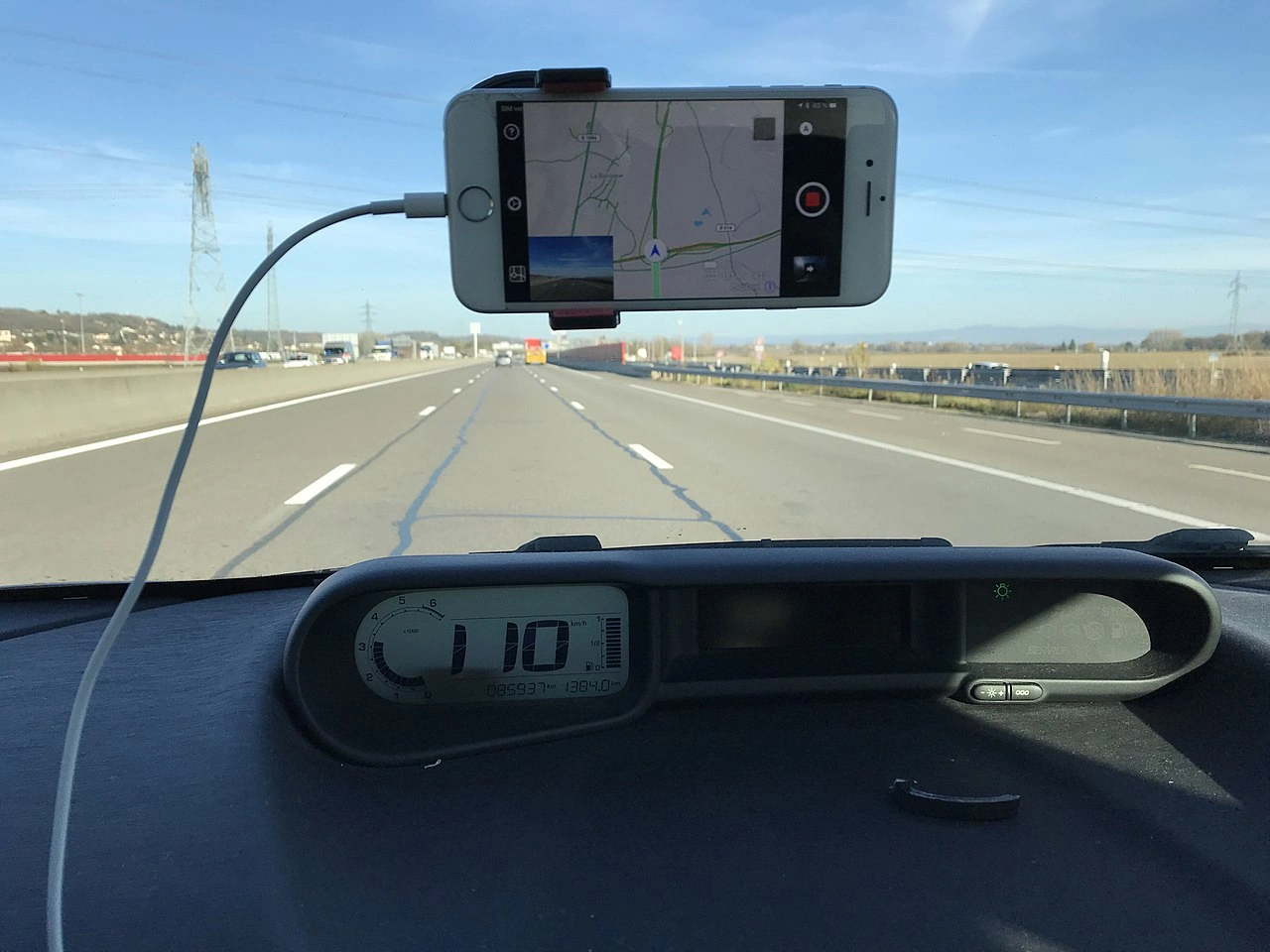
Hands-free refers to using a telephone or communication system without holding the device in the hand. Hands-free operation can use the vehicle's built-in system, a headset, earphones, voice control or a phone secured in an appropriate holder.
Hands-free operation reduces the need to physically handle a device, but a conversation or interaction can still distract the driver. Drivers should therefore minimise device use and keep their attention on the road.
Wikimedia.org • Benoît Prieur • CC0
What does hands-free mean while driving?
Hands-free means using a communication device without holding it. Calls can be handled through a vehicle system, headset, earphones, voice control or another permitted system.
Is hands-free phone use completely distraction-free?
No. Even when the driver does not physically handle the phone, a conversation or interaction with a device can reduce attention to traffic. Drivers should keep such use to a minimum.
Does hands-free use allow you to hold the phone?
No. Holding a telephone while calling is not hands-free use. Whether handheld or mounted-device use is legally permitted depends on the traffic rules of the country.
125. Smartphone
A smartphone is a mobile electronic device that combines telephone, messaging, internet, navigation, camera and application functions. When used in traffic, a smartphone can provide useful functions such as navigation or hands-free communication but can also create significant visual, manual and mental distraction.
Drivers should avoid handling or looking at a smartphone while driving. Where its use is permitted, the device should be positioned and operated in accordance with local traffic rules and without interfering with safe control of the vehicle.

Wikimedia.org • D'Vaughn Bell • CC BY-SA
Why is smartphone use dangerous while driving?
Using a smartphone can take the driver's eyes off the road, hands away from the controls and attention away from traffic. Reading messages, typing or selecting apps can therefore significantly increase distraction.
Can a smartphone be used for navigation while driving?
It may be permitted when the device is properly mounted and used according to local traffic rules. The route should preferably be programmed before starting the journey and interaction with the screen should be kept to a minimum.
Is hands-free smartphone use completely safe?
No. Hands-free operation removes the need to hold the device but conversations, navigation changes and other interactions can still distract the driver.