


Traffic signsPoland
 Traffic rules
 Poland
26. Priority road
A priority road is a road whose traffic is given priority over traffic entering from intersecting roads. It is normally identified by a priority-road sign, while an end sign indicates where that continuing priority status stops.
Drivers on a priority road must still obey traffic lights, authorised officers, speed limits, crossings and turning rules. Having priority never allows a driver to proceed when doing so would create danger or block an intersection.
Wikimedia.org • MOs810 • CC BY
How does priority-road status work in Poland?
Poland calls a signed priority road a droga z pierwszeństwem. A supplementary diagram can show its changing course; the end sign removes that continuing priority status.
🔗 eli.gov.pl • Poland, Road Traffic Law — articles 25; Signs 43 and T6 supplementary panels
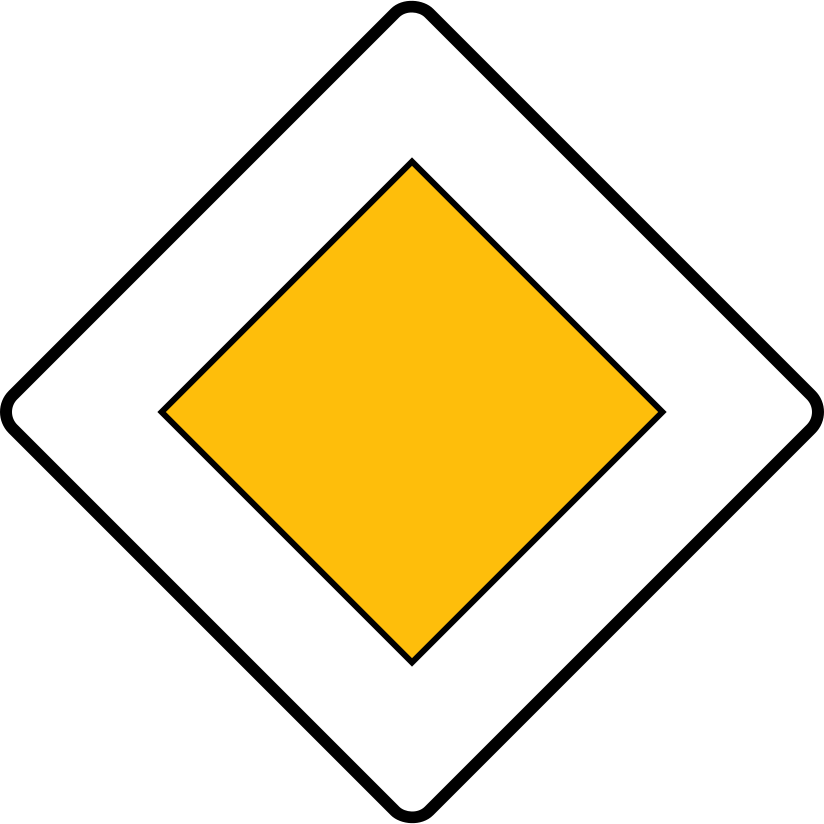 Start of a priority road.
English • Traffic sign D-1 • Priority road. Sign D-1 marks the beginning or continuation of a priority road.
Polski • D-1 • droga z pierwszeństwem. Znak D-1 „droga z pierwszeństwem” oznacza początek lub kontynuację drogi z pierwszeństwem.
Sources
🔗 Commons.wikimedia.org
🔗 Eli.gov.pl • § 43 ust. 1
SVG source: Commons.wikimedia.org • Original SVG
Szczepan dyskusja Mail 18:29, 31 December 2006 (UTC) • Public domain • Original revision 2025-10-11. Wikimedia original unmodified.
Artwork reviewed against the Polish official sign catalogue, Dz.U. 2019 poz. 2310: Eli.gov.pl • D-1, PDF page 44, with amendments 2021/433, 2021/2065, 2022/2372 and 2026/133 checked. Catalogue-equivalent illustration; intentional update from the previous PNG. This is an educational illustration, not a manufacturing specification.
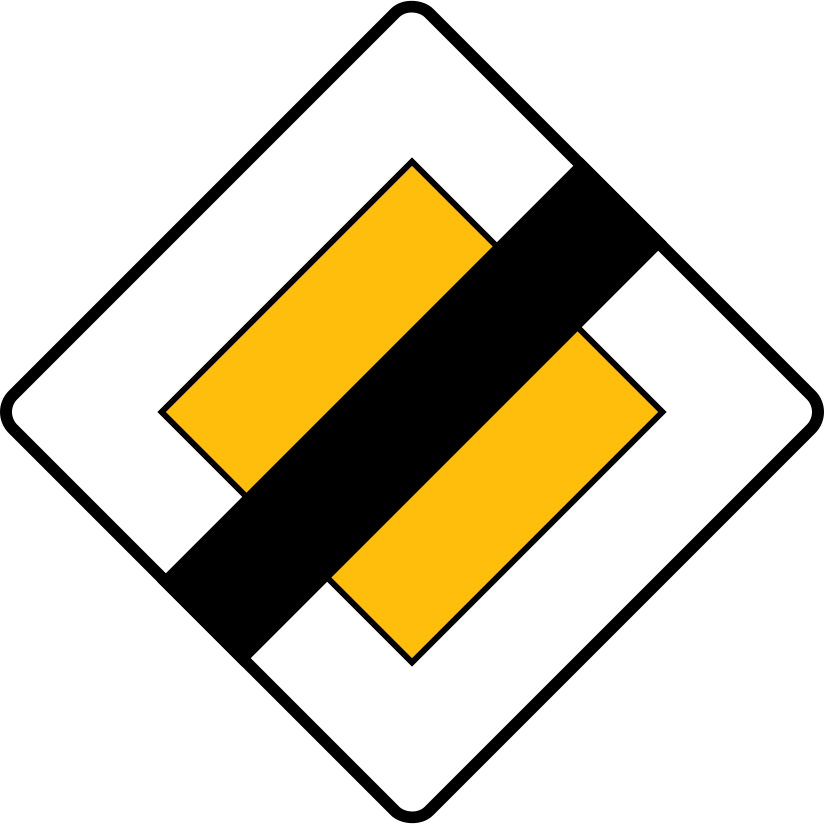 End of the priority road.
English • Traffic sign D-2 • End of the priority road. Sign D-2 marks the end of a priority road.
Polski • D-2 • koniec drogi z pierwszeństwem. Znak D-2 „koniec drogi z pierwszeństwem” oznacza koniec drogi z pierwszeństwem.
Sources
🔗 Commons.wikimedia.org
🔗 Eli.gov.pl • § 43 ust. 3
SVG source: Commons.wikimedia.org • Original SVG
Szczepan dyskusja Mail 18:29, 31 December 2006 (UTC) • Public domain • Original revision 2025-10-11. Wikimedia original unmodified.
Artwork reviewed against the Polish official sign catalogue, Dz.U. 2019 poz. 2310: Eli.gov.pl • D-2, PDF page 44, with amendments 2021/433, 2021/2065, 2022/2372 and 2026/133 checked. Catalogue-equivalent illustration; intentional update from the previous PNG. This is an educational illustration, not a manufacturing specification.
How can you tell where a priority road applies in Poland?
Read the priority-road sign, the corresponding end indication and any supplementary junction diagram. Distinguish a continuing road designation from a sign that regulates only one junction. If a diagram shows the priority route turning, follow that diagram rather than assuming the straight-ahead road has priority.
🔗 eli.gov.pl • Poland, Road Traffic Law — articles 25; Signs 43 and T6 supplementary panels
Does having road priority let you ignore other controls in Poland?
No. Obey the applicable traffic signals and authorised directions, speed limits and crossing rules. Turning or changing lanes can require yielding, and having priority never permits entering a conflict that cannot be crossed safely.
🔗 eli.gov.pl • Poland, Road Traffic Law — articles 25; Signs 43 and T6 supplementary panels

27. Road narrowing
A road narrowing is a section where the available width of the road or carriageway becomes smaller. The narrowing may occur on both sides, on one side only, or because one or more traffic lanes end.
Drivers should reduce speed, observe approaching and adjacent traffic, maintain sufficient lateral clearance and merge when necessary. Warning signs do not always determine priority, so drivers must follow any priority signs, lane markings and local traffic rules.
Wikimedia.org • Grzegorz W. Tężycki • CC BY-SA
What does a road-narrowing warning mean in Poland?
Polish road-narrowing warnings distinguish both-sided and one-sided narrowing. They do not replace the separate priority controls or the statutory rules for a lane that ends.
🔗 eli.gov.pl • Poland, Road Traffic Law — articles 19, 22(4)–(4b), 23; Signs 7 and 72
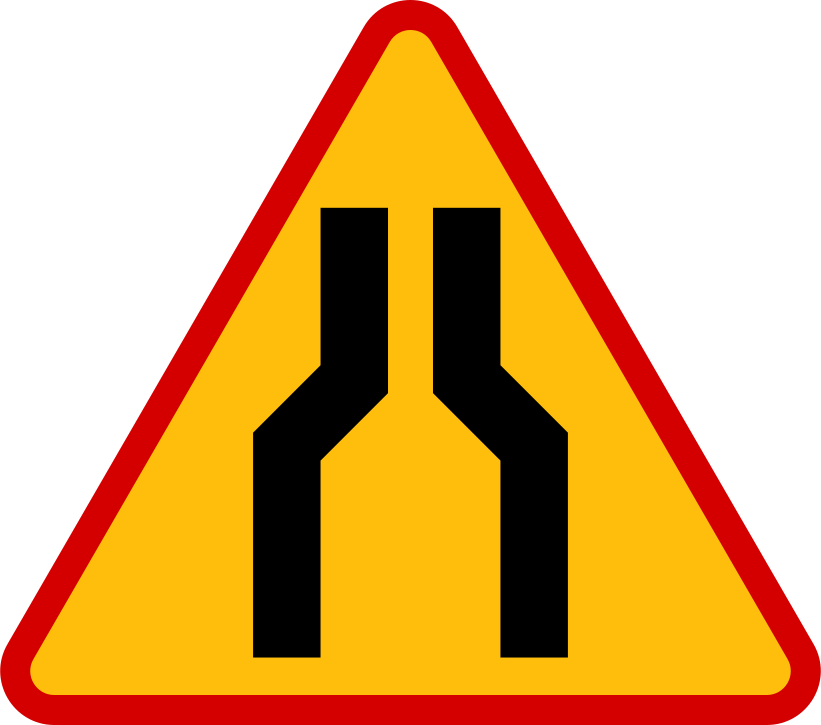 Warning for a road narrowing.
English • Traffic sign A-12a • Road narrows on both sides. Signs A-12a, Road narrows on both sides; A-12b, Road narrows on the right; and A-12c, Road narrows on the left, warn of narrowing on the indicated side that may obstruct traffic.
Polski • A-12a • zwężenie jezdni – dwustronne. Znaki: A-12a „zwężenie jezdni - dwustronne”, A-12b „zwężenie jezdni -prawostronne”, A-12c „zwężenie jezdni - lewostronne” ostrzegają o zwężeniu jezdni po stronie wskazanej na znaku, które może powodować utrudnienia ruchu.
Sources
🔗 Commons.wikimedia.org
🔗 Eli.gov.pl • § 7 ust. 3
SVG source: Commons.wikimedia.org • Original SVG
Author not stated on source page • Public domain • Original revision 2025-10-07. Wikimedia original unmodified.
Artwork reviewed against the Polish official sign catalogue, Dz.U. 2019 poz. 2310: Eli.gov.pl • A-12a, PDF page 41, with amendments 2021/433, 2021/2065, 2022/2372 and 2026/133 checked. Catalogue-equivalent illustration; intentional update from the previous PNG. This is an educational illustration, not a manufacturing specification.
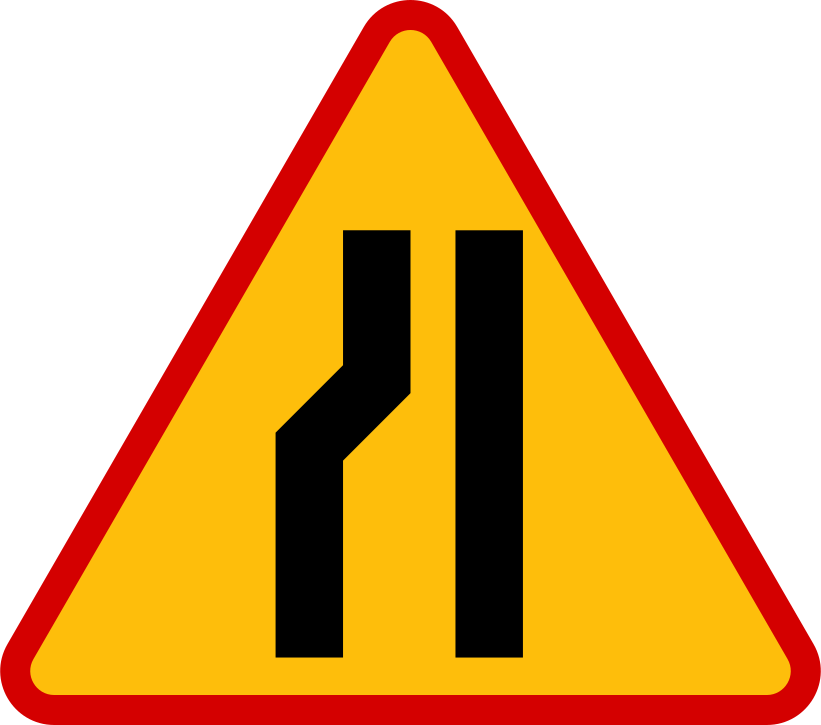 Warning for a road narrowing on the left.
English • Traffic sign A-12c • Road narrows on the left. Signs A-12a, Road narrows on both sides; A-12b, Road narrows on the right; and A-12c, Road narrows on the left, warn of narrowing on the indicated side that may obstruct traffic.
Polski • A-12c • zwężenie jezdni – lewostronne. Znaki: A-12a „zwężenie jezdni - dwustronne”, A-12b „zwężenie jezdni -prawostronne”, A-12c „zwężenie jezdni - lewostronne” ostrzegają o zwężeniu jezdni po stronie wskazanej na znaku, które może powodować utrudnienia ruchu.
Sources
🔗 Commons.wikimedia.org
🔗 Eli.gov.pl • § 7 ust. 3
SVG source: Commons.wikimedia.org • Original SVG
Author not stated on source page • Public domain • Original revision 2025-10-07. Wikimedia original unmodified.
Artwork reviewed against the Polish official sign catalogue, Dz.U. 2019 poz. 2310: Eli.gov.pl • A-12c, PDF page 41, with amendments 2021/433, 2021/2065, 2022/2372 and 2026/133 checked. Catalogue-equivalent illustration; intentional update from the previous PNG. This is an educational illustration, not a manufacturing specification.
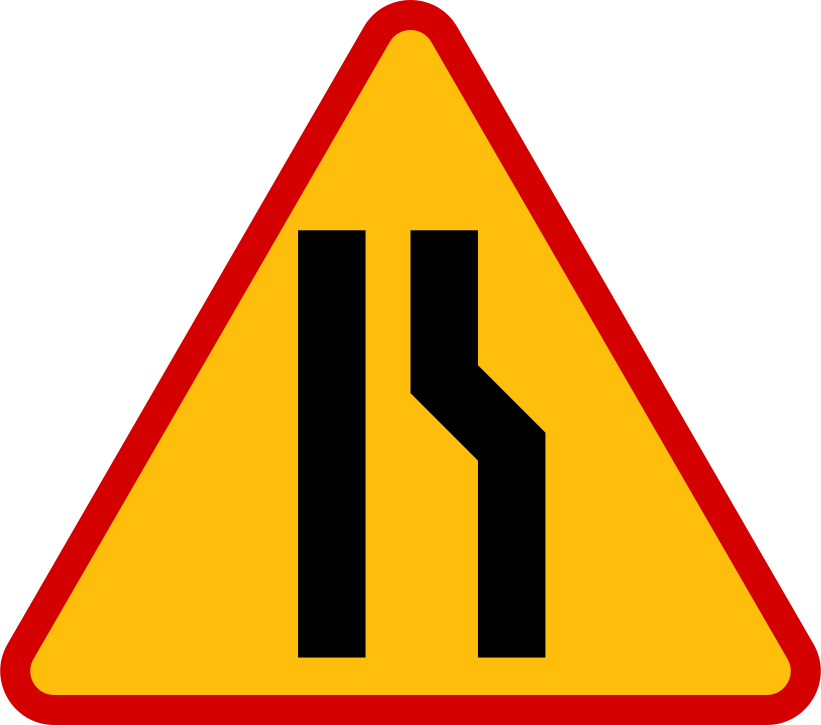 Warning for a road narrowing on the right.
English • Traffic sign A-12b • Road narrows on the right. Signs A-12a, Road narrows on both sides; A-12b, Road narrows on the right; and A-12c, Road narrows on the left, warn of narrowing on the indicated side that may obstruct traffic.
Polski • A-12b • zwężenie jezdni – prawostronne. Znaki: A-12a „zwężenie jezdni - dwustronne”, A-12b „zwężenie jezdni -prawostronne”, A-12c „zwężenie jezdni - lewostronne” ostrzegają o zwężeniu jezdni po stronie wskazanej na znaku, które może powodować utrudnienia ruchu.
Sources
🔗 Commons.wikimedia.org
🔗 Eli.gov.pl • § 7 ust. 3
SVG source: Commons.wikimedia.org • Original SVG
Amada44 • Public domain • Original revision 2025-10-07. Wikimedia original unmodified.
Artwork reviewed against the Polish official sign catalogue, Dz.U. 2019 poz. 2310: Eli.gov.pl • A-12b, PDF page 41, with amendments 2021/433, 2021/2065, 2022/2372 and 2026/133 checked. Catalogue-equivalent illustration; intentional update from the previous PNG. This is an educational illustration, not a manufacturing specification.
Does a narrowing warning give you priority in Poland?
No. A warning describes the reduced width, rather than allocating priority or setting a numerical speed limit. Follow any separate priority signs, signals and meeting rules, and slow enough to pass safely or wait before entering.
🔗 eli.gov.pl • Poland, Road Traffic Law — articles 19, 22(4)–(4b), 23; Signs 7 and 72
What should you do if traffic lanes merge at a narrowing in Poland?
Polish law requires alternating entry from an ending or obstructed lane where speed has been substantially reduced and the statutory lane-reduction conditions apply. The rule operates immediately before the restriction; it is not unconditional priority for every lane change.
🔗 eli.gov.pl • Poland, Road Traffic Law — articles 19, 22(4)–(4b), 23; Signs 7 and 72
28. Priority over oncoming traffic
Priority over oncoming traffic means that drivers travelling in one direction have priority through a narrow section of road over drivers approaching from the opposite direction. The rule is normally indicated by a priority sign facing one direction and a corresponding give-way sign facing the other.
Drivers with priority must still approach cautiously and must not force their way through when the passage is blocked or already occupied. The signs regulate priority through the narrow section, not speed, parking or priority at nearby intersections.
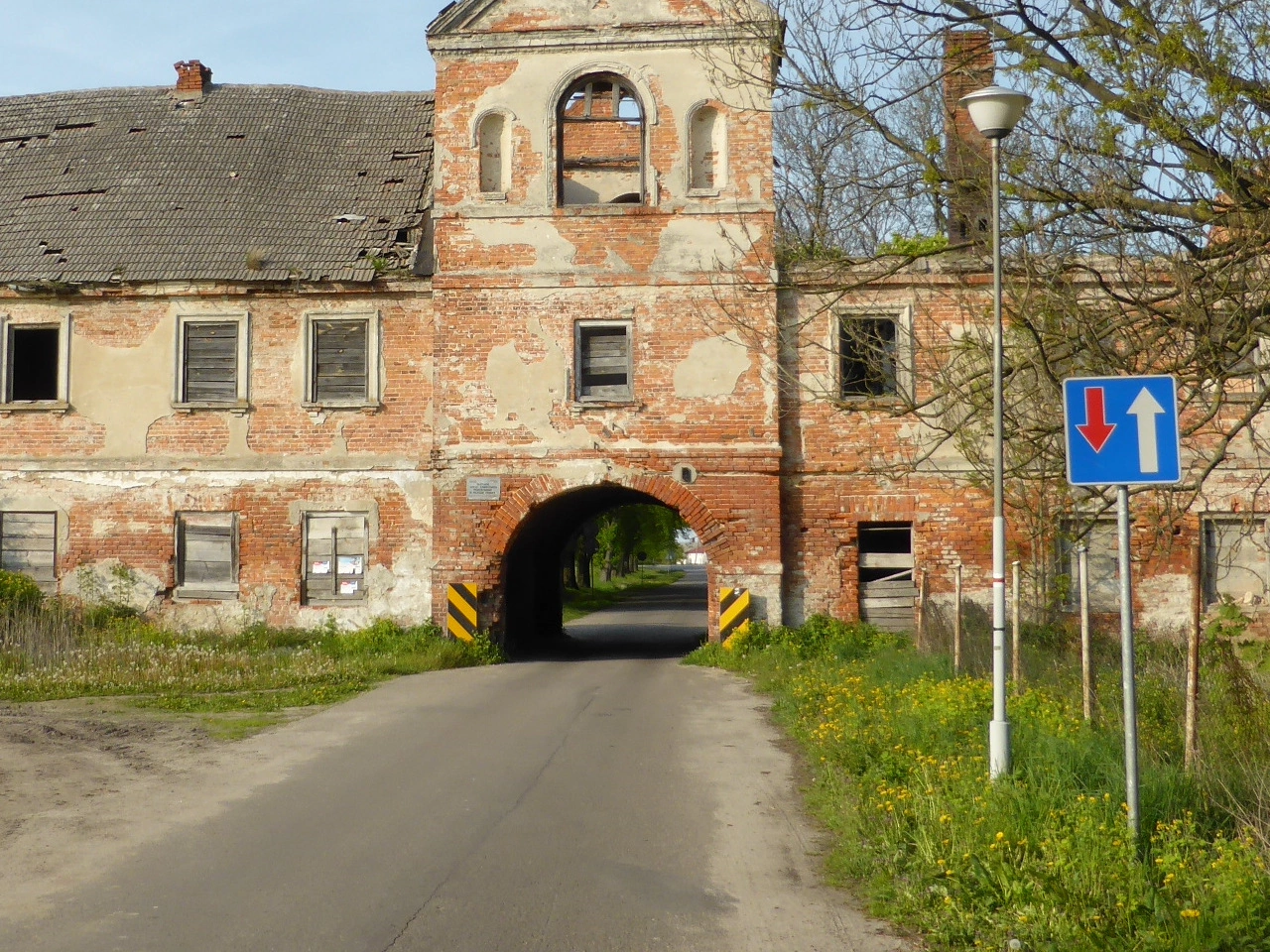
Wikimedia.org • Mkosmul • CC BY-SA
How is priority over oncoming traffic controlled in Poland?
Polish signs distinguish priority for opposing traffic from Pierwszeństwo na zwężonym odcinku jezdni, priority through the narrowed carriageway. Follow the direction controlled by the sign you face.
🔗 eli.gov.pl • Poland, Road Traffic Law — articles 3, 19, 23; Signs 25 and 46
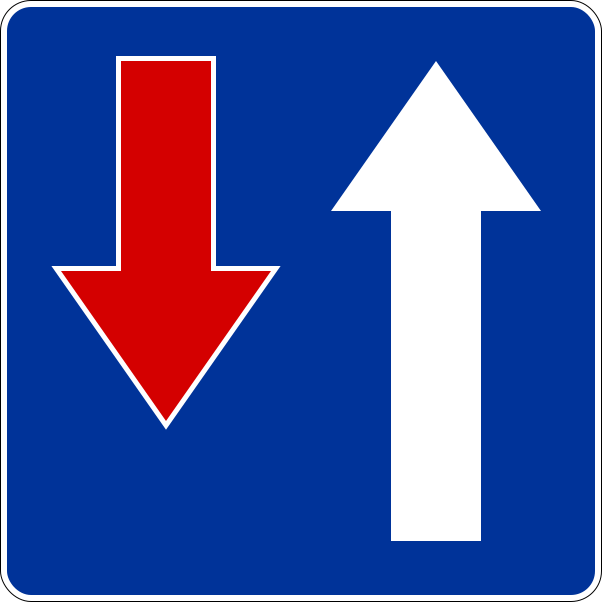 Road narrowing, oncoming drivers have to give way.
English • Traffic sign D-5 • Priority at a narrow section. Sign D-5 means that drivers may drive or walk through before drivers approaching from the opposite direction.
Polski • D-5 • pierwszeństwo na zwężonym odcinku jezdni. Znak D-5 „pierwszeństwo na zwężonym odcinku jezdni” oznacza, że kierujący przejeżdżają lub przechodzą przed kierującymi zbliżającymi się z kierunku przeciwnego.
Sources
🔗 Commons.wikimedia.org
🔗 Eli.gov.pl • § 46 ust.
SVG source: Commons.wikimedia.org • Original SVG
Szczepan dyskusja Mail 18:29, 31 December 2006 (UTC) • Public domain • Original revision 2025-10-10. Wikimedia original unmodified.
Artwork reviewed against the Polish official sign catalogue, Dz.U. 2019 poz. 2310: Eli.gov.pl • D-5, PDF page 44, with amendments 2021/433, 2021/2065, 2022/2372 and 2026/133 checked. Catalogue-equivalent illustration; intentional update from the previous PNG. This is an educational illustration, not a manufacturing specification.
Can you enter an occupied narrow passage when you have priority in Poland?
Do not force a conflict. Check the full available width and let a vehicle already committed to the passage clear it when both vehicles cannot pass safely. A priority control does not permit creating danger or disregarding a red signal or authorised instruction.
🔗 eli.gov.pl • Poland, Road Traffic Law — articles 3, 19, 23; Signs 25 and 46
Does priority through a narrow passage extend to nearby junctions in Poland?
No. A control releasing your direction or giving priority over opposing traffic concerns that passage. Junction priority, speed limits, crossings and any later restriction must be assessed separately from their own signs and rules.
🔗 eli.gov.pl • Poland, Road Traffic Law — articles 3, 19, 23; Signs 25 and 46
29. Give way to oncoming traffic
Give way to oncoming traffic means that drivers must allow vehicles approaching from the opposite direction to pass first through a narrow section of road. The rule is normally indicated by a sign facing the direction that must yield and a corresponding priority sign facing oncoming traffic.
Drivers must reduce speed and stop when necessary before entering the narrow passage. They may continue only when they can do so safely and without obstructing oncoming traffic that has priority.
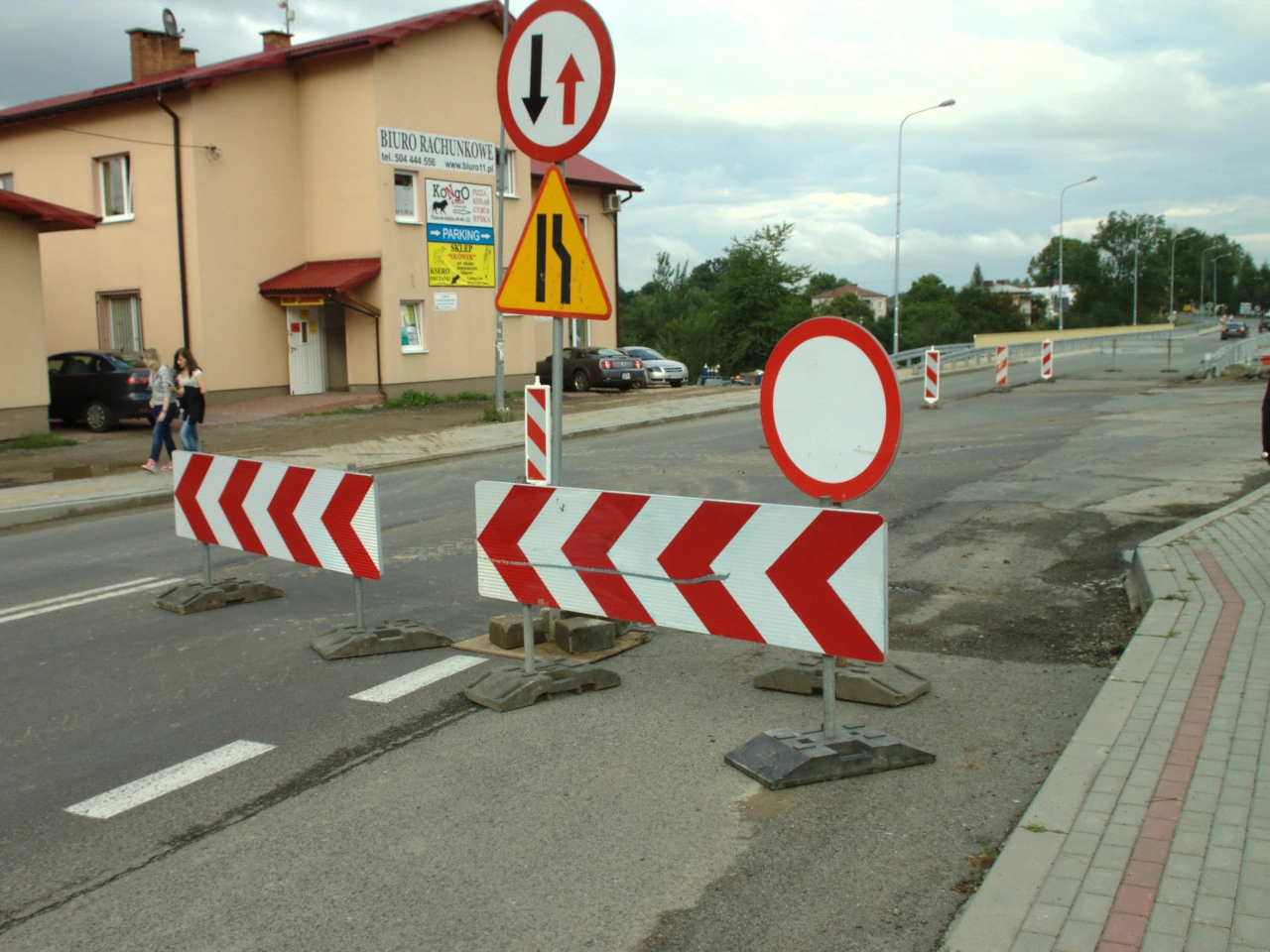
Wikimedia.org • Aktron • CC BY
When must I give way to oncoming traffic in Poland?
Where priority signs, temporary signals or an authorised controller in Poland require your direction to yield at a narrow road or bridge, allow opposing traffic through first. Do not assume every narrowing has the same priority arrangement.
🔗 eli.gov.pl • Poland, Road Traffic Law — articles 3, 19, 23; Signs 25 and 46
 Road narrowing, give way to oncoming drivers.
English • Traffic sign B-31 • Priority for oncoming traffic. Sign B-31 prohibits entering or walking onto a narrow section if doing so would force drivers already on it or approaching from the opposite direction to stop.
Polski • B-31 • pierwszeństwo dla nadjeżdżających z przeciwka. Znak B-31 „pierwszeństwo dla nadjeżdżających z przeciwka” zabrania kierującym wjazdu lub wejścia na zwężony odcinek jezdni, jeżeli zmusiłoby to kierujących znajdujących się na tym odcinku lub zbliżających się do niego z przeciwnej strony do zatrzymania się.
Sources
🔗 Commons.wikimedia.org
🔗 Eli.gov.pl • § 25 ust.
SVG source: Commons.wikimedia.org • Original SVG
Szczepan dyskusja Mail 18:29, 31 December 2006 (UTC) • Public domain • Original revision 2025-09-28. Wikimedia original unmodified.
Artwork reviewed against the Polish official sign catalogue, Dz.U. 2019 poz. 2310: Eli.gov.pl • B-31, PDF page 42, with amendments 2021/433, 2021/2065, 2022/2372 and 2026/133 checked. Catalogue-equivalent illustration; intentional update from the previous PNG. This is an educational illustration, not a manufacturing specification.
Does a road-narrows warning automatically give oncoming traffic priority in Poland?
Not necessarily. A warning of a narrow carriageway is not itself the same as an instruction to give way. Check whether there is a separate priority sign, signal or temporary traffic control, and take account of any rules for an obstruction on your side.
🔗 eli.gov.pl • Poland, Road Traffic Law — articles 3, 19, 23; Signs 25 and 46
What if an oncoming vehicle is already entering a narrow passage in Poland?
Reduce speed and wait where you can do so safely rather than forcing two vehicles into insufficient space. Even if a sign gives your approach priority, that does not justify a collision or endangering another road user.
🔗 eli.gov.pl • Poland, Road Traffic Law — articles 3, 19, 23; Signs 25 and 46
30. Pedestrian crossing
A pedestrian crossing is a designated place where pedestrians may cross a road. It is commonly indicated by road markings, traffic signs, signals or a combination of these measures.
Drivers must approach with appropriate caution and give way when required by local law. Pedestrians must also observe approaching traffic and follow any pedestrian signals or instructions from authorised traffic controllers.
Wikimedia.org • Henryk Borawski • CC BY-SA
When must drivers give way at a pedestrian crossing in Poland?
Drivers must slow down, take particular care and give way to pedestrians on a marked crossing or entering it. Tram drivers must give way to pedestrians already on the crossing, but the crossing-entry priority does not extend to pedestrians entering in front of a tram. Follow applicable signals.
🔗 eli.gov.pl • Poland, Sejm, Road Traffic Act, consolidated working text dated 12 October 2026
Are all pedestrian crossings controlled the same way in Poland?
No. Where traffic is controlled by signals or authorised directions, follow that control. At an uncontrolled marked crossing, drivers must protect pedestrians on it or entering it. A green vehicle light does not permit entry if it would prevent pedestrians from leaving the carriageway.
🔗 eli.gov.pl • Poland, Sejm, Road Traffic Act, consolidated working text dated 12 October 2026; 🔗 eli.gov.pl • Poland, Signs and Signals Regulation, 2019 consolidated text, sections 21, 95–96 and 98–99
May I enter a pedestrian crossing if the road beyond it is blocked in Poland?
Wait before the crossing until there is room to clear it without obstructing pedestrians. Do not pass a vehicle travelling in your direction that has stopped to give way to a pedestrian. Overtaking on a pedestrian crossing or immediately before it is also prohibited, except where traffic at the crossing is controlled.
🔗 eli.gov.pl • Poland, Sejm, Road Traffic Act, consolidated working text dated 12 October 2026
Does an island divide a Polish pedestrian crossing?
Yes. Treat each carriageway separately; the same applies where an island or other device separates vehicle traffic.
🔗 eli.gov.pl • Poland, Sejm, Road Traffic Act, consolidated working text dated 12 October 2026
May Polish pedestrians use a phone while crossing?
Not in a way that limits observation. This applies while entering or crossing carriageways, cycleways and tracks, including marked crossings.
🔗 eli.gov.pl • Poland, Sejm, Road Traffic Act, consolidated working text dated 12 October 2026
May Polish pedestrians run across the road?
No. Article 14 prohibits running across carriageways and cycleways.
🔗 eli.gov.pl • Poland, Sejm, Road Traffic Act, consolidated working text dated 12 October 2026
Must Polish pedestrians use a footbridge or pedestrian tunnel provided on the road?
Yes, including facilities shared by pedestrians and cyclists.
🔗 eli.gov.pl • Poland, Sejm, Road Traffic Act, consolidated working text dated 12 October 2026
How must Polish passengers reach an island connected to a pedestrian crossing?
Use that crossing when entering or leaving the public-transport island.
🔗 eli.gov.pl • Poland, Sejm, Road Traffic Act, consolidated working text dated 12 October 2026
May Polish pedestrians cross a dual carriageway in a built-up area away from a crossing?
No. They must use a pedestrian crossing.
🔗 eli.gov.pl • Poland, Sejm, Road Traffic Act, consolidated working text dated 12 October 2026
Can Polish pedestrians cross where a barrier separates the pedestrian route from the road?
No. The prohibition applies regardless of which side of the carriageway the barrier is on.
🔗 eli.gov.pl • Poland, Sejm, Road Traffic Act, consolidated working text dated 12 October 2026
31. Railway crossing
A railway crossing, also called a level crossing or railroad crossing, is a place where a road or path crosses railway tracks at the same level. It may be protected by barriers, warning lights, bells, traffic signs or a combination of these measures.
Road users must approach carefully and never enter when a train is approaching, warning signals are active or the exit is blocked. They should cross promptly and must never stop, wait or become trapped on the tracks.
Wikimedia.org • Ralf Lotys • CC BY
When must drivers stop at a railway level crossing in Poland?
Approach slowly enough to stop safely and check that no rail vehicle is approaching. Stop for a STOP sign, red warning or authorised stop instruction; do not enter while barriers are down, lowering or not yet fully raised. Do not enter unless there is room beyond the tracks to continue. A train having passed does not cancel an active warning.
🔗 eli.gov.pl • Poland, Sejm, Road Traffic Act, consolidated working text dated 12 October 2026; 🔗 eli.gov.pl • Poland, Signs and Signals Regulation, 2019 consolidated text, sections 21, 95–96 and 98–99
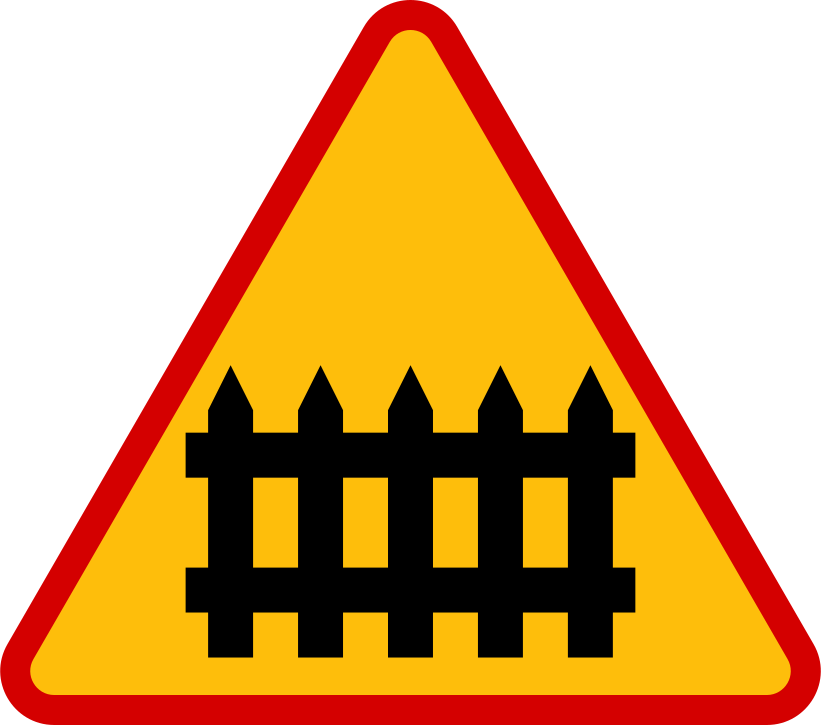 Warning for a railway crossing with barriers.
English • Traffic sign A-9 • Level crossing with barriers. Sign A-9 warns of a railway crossing with full or half barriers.
Polski • A-9 • przejazd kolejowy z zaporami. Znak A-9 „przejazd kolejowy z zaporami” ostrzega o przejeździe kolejowym wyposażonym w zapory lub pół-zapory.
Sources
🔗 Commons.wikimedia.org
🔗 Eli.gov.pl • § 6 ust. 1
SVG source: Commons.wikimedia.org • Original SVG
Author not stated on source page • Public domain • Original revision 2025-10-07. Wikimedia original unmodified.
Artwork reviewed against the Polish official sign catalogue, Dz.U. 2019 poz. 2310: Eli.gov.pl • A-9, PDF page 41, with amendments 2021/433, 2021/2065, 2022/2372 and 2026/133 checked. Catalogue-equivalent illustration; intentional update from the previous PNG. This is an educational illustration, not a manufacturing specification.
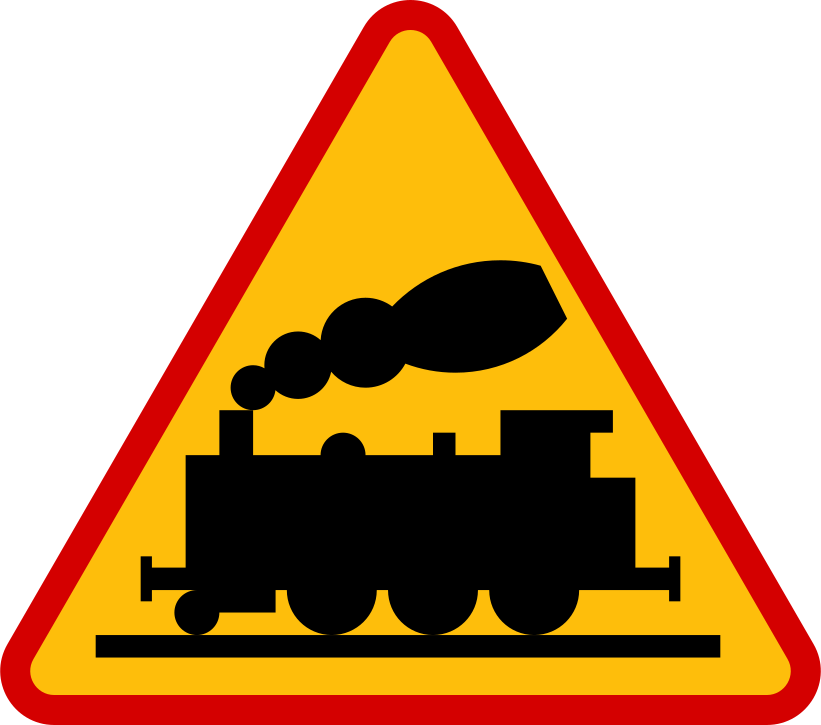 Warning for a railway crossing without barriers.
English • Traffic sign A-10 • Level crossing without barriers. Sign A-10 warns of a railway crossing without full or half barriers.
Polski • A-10 • przejazd kolejowy bez zapór. Znak A-10 „przejazd kolejowy bez zapór” ostrzega o przejeździe kolejowym niewyposażonym ani w zapory, ani w półzapory.
Sources
🔗 Commons.wikimedia.org
🔗 Eli.gov.pl • § 6 ust. 2
SVG source: Commons.wikimedia.org • Original SVG
Paweł Grzywocz • Public domain • Original revision 2025-10-07. Wikimedia original unmodified.
Artwork reviewed against the Polish official sign catalogue, Dz.U. 2019 poz. 2310: Eli.gov.pl • A-10, PDF page 41, with amendments 2021/433, 2021/2065, 2022/2372 and 2026/133 checked. Catalogue-equivalent illustration; intentional update from the previous PNG. This is an educational illustration, not a manufacturing specification.
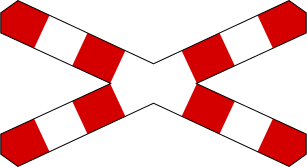 Warning for a railway crossing with one track.
English • Traffic sign G-3 • Crossbuck before a single-track level crossing. Signs G-3, Crossbuck before a single-track level crossing, and G-4, Crossbuck before a multiple-track level crossing, mark where to stop for a train or other rail vehicle at a crossing without full or half barriers. They indicate respectively that the crossing has one track or more than one track.
Polski • G-3 • krzyż św. Andrzeja przed przejazdem kolejowym jednotorowym. Znaki: G-3 „krzyż św. Andrzeja przed przejazdem kolejowym jednotorowym”, G-4 „krzyż św. Andrzeja przed przejazdem kolejowym wielotorowym” wyznaczają miejsce zatrzymania się w związku z ruchem pociągu lub innego pojazdu szynowego na przejeździe kolejowym bez zapór lub półzapór; znaki te informują, że na przejeździe występują odpowiednio jeden lub więcej torów.
Sources
🔗 Commons.wikimedia.org
🔗 Eli.gov.pl • § 78 ust. 5
SVG source: Paweł Grzywocz • Public domain • Original revision 2012-04-14. Wikimedia original unmodified.
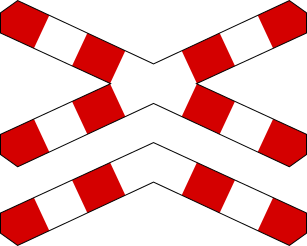 Warning for a railway crossing with two or more tracks.
English • Traffic sign G-4 • Crossbuck before a multiple-track level crossing. Signs G-3, Crossbuck before a single-track level crossing, and G-4, Crossbuck before a multiple-track level crossing, mark where to stop for a train or other rail vehicle at a crossing without full or half barriers. They indicate respectively that the crossing has one track or more than one track.
Polski • G-4 • krzyż św. Andrzeja przed przejazdem kolejowym wielotorowym. Znaki: G-3 „krzyż św. Andrzeja przed przejazdem kolejowym jednotorowym”, G-4 „krzyż św. Andrzeja przed przejazdem kolejowym wielotorowym” wyznaczają miejsce zatrzymania się w związku z ruchem pociągu lub innego pojazdu szynowego na przejeździe kolejowym bez zapór lub półzapór; znaki te informują, że na przejeździe występują odpowiednio jeden lub więcej torów.
Sources
🔗 Commons.wikimedia.org
🔗 Eli.gov.pl • § 78 ust. 5
SVG source: Paweł Grzywocz • Public domain • Original revision 2012-04-14. Wikimedia original unmodified.
Must I stop at every unguarded railway crossing in Poland?
Not merely because there are no barriers. Approach with particular care, check for trains and obey any STOP sign, warning signal or authorised direction. A STOP sign at a railway crossing requires a full stop. A crossbuck identifies the stopping place associated with rail traffic; it is not itself the same instruction as a STOP sign.
🔗 eli.gov.pl • Poland, Sejm, Road Traffic Act, consolidated working text dated 12 October 2026; 🔗 eli.gov.pl • Poland, Signs and Signals Regulation, 2019 consolidated text, sections 21, 95–96 and 98–99
What if road traffic is queued beyond a railway crossing in Poland?
Wait before the tracks until there is room to take your entire vehicle off the crossing. Do not follow another vehicle onto the tracks without checking the exit. Keep the tracks clear even if no train is visible.
🔗 eli.gov.pl • Poland, Sejm, Road Traffic Act, consolidated working text dated 12 October 2026
32. Mandatory direction
A mandatory-direction sign requires drivers to travel only in the direction or one of the directions indicated by its arrow or arrows. It may require traffic to continue straight ahead, turn, or pass an obstacle on a specified side.
The sign does not itself determine priority or speed. Drivers must still use the appropriate lane, signal when required and give way according to local traffic signs and regulations.
Wikimedia.org • MOs810 • CC BY-SA
What does a mandatory-direction sign require in Poland?
Where a compulsory-direction sign is installed in Poland, follow only the arrow direction or permitted combination of directions. The restriction applies at the location or movement it regulates; it is not an instruction to ignore other traffic controls.
🔗 eli.gov.pl • Poland, Road Traffic Law — articles 5, 22–23; Signs 2, 22–24, 35–42
Can I choose another turn if the mandatory-direction arrow is inconvenient in Poland?
No, unless another applicable sign, lane instruction or authorised traffic direction lawfully permits it. Plan a permitted alternative route; do not make an abrupt or prohibited turn to reach your destination.
🔗 eli.gov.pl • Poland, Road Traffic Law — articles 5, 22–23; Signs 2, 22–24, 35–42
Does a mandatory-direction sign give me priority over pedestrians in Poland?
No. It tells you which way to move, not who goes first. Check traffic lights, other priority signs, pedestrians and cyclists, and give way when required before completing the manoeuvre.
🔗 eli.gov.pl • Poland, Road Traffic Law — articles 5, 22–23; Signs 2, 22–24, 35–42
33. Turn prohibition
A turn prohibition prevents drivers from turning in the direction indicated by a traffic sign. It may prohibit a left turn, a right turn or a U-turn at an intersection or along a specified section of road.
Drivers must continue along a permitted route and follow any lane arrows or mandatory-direction signs. A turn prohibition does not itself determine priority or speed, and any exemption for cyclists, public transport or other road users must be expressly indicated.

Wikimedia.org • Panek • CC BY-SA
What does a no-turn sign prohibit in Poland?
It prohibits the left, right or other turn shown at the junction or position controlled by the sign in Poland. Follow any supplementary panel or authorised direction and choose another legal route.
🔗 eli.gov.pl • Poland, Road Traffic Law — articles 5, 22–23; Signs 2, 22–24, 35–42
Does a no-left-turn sign always prohibit a U-turn in Poland?
Yes. Polish Signs Section 22 expressly makes B21, the no-left-turn sign, prohibit a U-turn as well. At a junction it applies at the nearest junction, and, where installed within it, to the nearest carriageway. Separate U-turn bans and other manoeuvring restrictions can also apply; do not assume that the absence of B23 makes a U-turn lawful.
🔗 eli.gov.pl • Poland, Road Traffic Law — articles 5, 22–23; Signs 2, 22–24, 35–42
Can a no-turn restriction apply only to certain vehicles or hours in Poland?
Yes, where the local sign system provides a supplementary condition or exemption, such as a vehicle class, time or authorised access. Without a valid exception, comply with the prohibited movement shown.
🔗 eli.gov.pl • Poland, Road Traffic Law — articles 5, 22–23; Signs 2, 22–24, 35–42
34. School area
A school area is a road or group of roads near a school where large numbers of children may walk, cycle, cross the road or enter and leave vehicles. It may be identified by warning signs, zone signs, road markings, traffic-calming measures or flashing lights.
Special speed limits, parking restrictions or access rules may apply permanently or only during school arrival and departure times. Drivers should reduce speed, watch carefully for children and be prepared to stop.
Wikimedia.org • Aktron • CC BY
What speed rules apply around schools in Poland?
A school or children-warning sign does not itself impose one special nationwide school speed limit; obey any accompanying or zonal speed restriction.
🔗 eli.gov.pl • Poland, Road Traffic Law — articles 3, 19–20, 23–24, 49; Signs 3–12
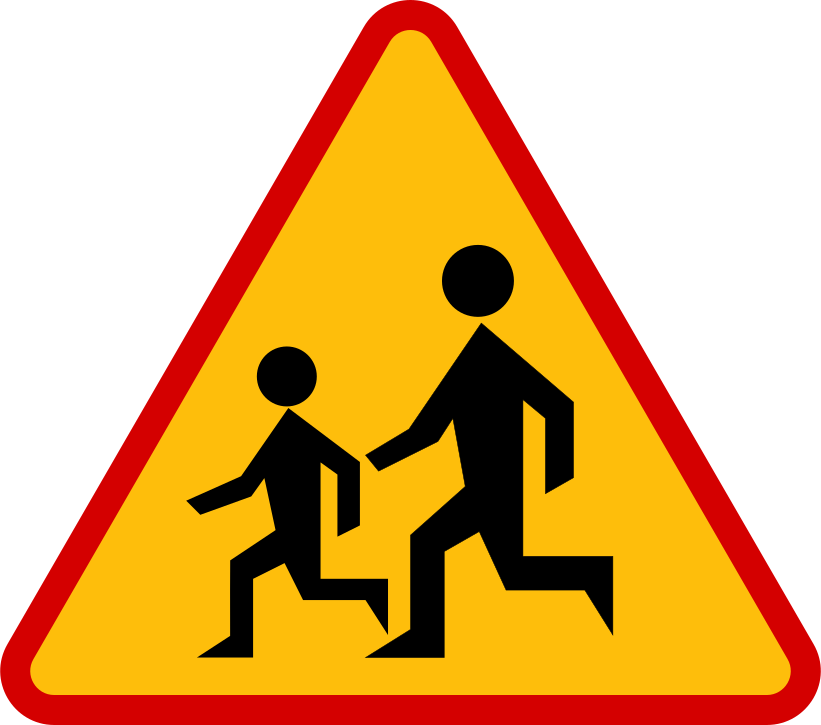 Warning for children.
English • Traffic sign A-17 • Children. Sign A-17 warns of a place on or near the road particularly frequented by children.
Polski • A-17 • dzieci. Znak A-17 „dzieci” ostrzega o miejscu na drodze szczególnie uczęszczanym przez dzieci lub o bliskości takiego miejsca.
Sources
🔗 Commons.wikimedia.org
🔗 Eli.gov.pl • § 8 ust. 2
SVG source: Commons.wikimedia.org • Original SVG
Paweł Grzywocz • Public domain • Original revision 2025-10-07. Wikimedia original unmodified.
Artwork reviewed against the Polish official sign catalogue, Dz.U. 2019 poz. 2310: Eli.gov.pl • A-17, PDF page 41, with amendments 2021/433, 2021/2065, 2022/2372 and 2026/133 checked. Catalogue-equivalent illustration; intentional update from the previous PNG. This is an educational illustration, not a manufacturing specification.
Does a school warning sign in Poland automatically set the speed limit?
A children or school warning alerts you to a potential hazard; the enforceable numerical speed limit depends on the applicable law, regulatory signs and any time or variable display. Slow further if children are near the road.
🔗 eli.gov.pl • Poland, Road Traffic Law — articles 3, 19–20, 23–24, 49; Signs 3–12
How should you pass a school entrance in Poland?
Watch for children stepping out from between parked vehicles, obey crossings and any school patrol, and follow stopping or parking restrictions. Do not obstruct visibility near a crossing or school entrance; approach at a speed that permits a safe stop.
🔗 eli.gov.pl • Poland, Road Traffic Law — articles 3, 19–20, 23–24, 49; Signs 3–12
35. Overtaking
Overtaking is the act of passing another road user travelling in the same direction. It normally involves moving to another position or lane, passing the slower road user and returning to the appropriate position when it is safe.
Before overtaking, a driver should make sure there is sufficient visibility and space, check mirrors and blind spots, signal when required and ensure that no other road user is already overtaking. The manoeuvre must be completed without exceeding the speed limit or endangering other road users.
Wikimedia.org • Michał Bulsa • CC BY-SA
On which side do drivers normally overtake in Poland?
As traffic normally keeps right, drivers ordinarily overtake on the left. This is the general rule, not permission to pass wherever a lane is available; exceptions and restrictions depend on the local law.
🔗 eli.gov.pl • Poland, Road Traffic Law — articles 16, 23–24
When should you avoid overtaking in Poland?
Do not begin if approaching traffic, restricted visibility, road markings, an intersection, a crossing or another road user makes the manoeuvre unsafe or unlawful. Check behind and ahead, allow enough space and never exceed the speed limit to complete the pass.
🔗 eli.gov.pl • Poland, Road Traffic Law — articles 16, 23–24
What extra care is needed when overtaking slower road users in Poland?
In Poland, keep at least 1 metre when overtaking a bicycle. Article 24(2) also lists cycle carts, mopeds, motorcycles, electric scooters, personal transport devices, mobility-assistance users and columns of pedestrians. Keep a safe distance from every road user and comply with the other overtaking rules. The one-metre list should not be presented as a universal fixed-distance rule for every individual pedestrian.
🔗 eli.gov.pl • Poland, Road Traffic Law — articles 16, 23–24
36. Crossing animals
An animals-crossing warning indicates a place or road section where wild animals, livestock or ridden animals may enter or cross the road. Animals may appear suddenly, move unpredictably or be difficult to see in darkness, vegetation or poor weather.
Drivers should reduce speed, scan both sides of the road and remain prepared to stop. The warning sign does not itself give animals priority or impose a numerical speed limit, but drivers must avoid frightening, endangering or colliding with them.
Wikimedia.org • Mariochom • CC BY-SA
Which animals might drivers encounter on roads in Poland?
Depending on the locality, drivers may meet deer, elk and wild boar on wooded rural routes. Roadside animal-warning signs and local hazard information indicate where extra care may be needed; do not assume the hazard ends immediately after a sign.
🔗 eli.gov.pl • Poland, Road Traffic Law — articles 3, 19–20, 23–24, 49; Signs 3–12
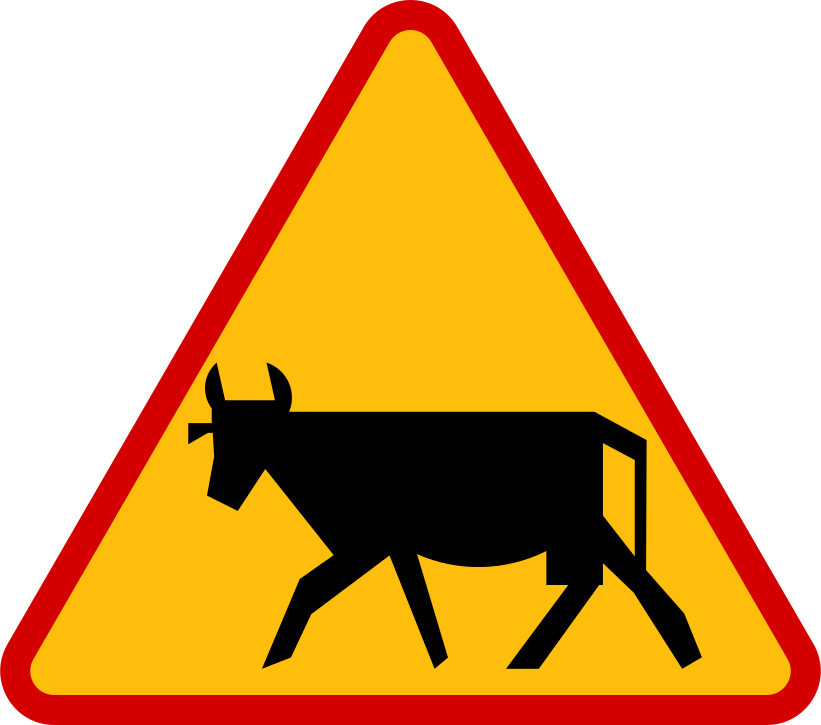 Warning for cattle on the road.
English • Traffic sign A-18a • Livestock. Signs A-18a, Livestock, and A-18b, Wild animals, warn that animals may be encountered on the road.
Polski • A-18a • zwierzęta gospodarskie. Znaki: A-18a „zwierzęta gospodarskie”, A-18b „zwierzęta dzikie” ostrzegają o możliwości napotkania na drodze zwierząt.
Sources
🔗 Commons.wikimedia.org
🔗 Eli.gov.pl • § 9 ust. 3
SVG source: Commons.wikimedia.org • Original SVG
Paweł Grzywocz • Public domain • Original revision 2025-10-07. Wikimedia original unmodified.
Artwork reviewed against the Polish official sign catalogue, Dz.U. 2019 poz. 2310: Eli.gov.pl • A-18a, PDF page 41, with amendments 2021/433, 2021/2065, 2022/2372 and 2026/133 checked. Catalogue-equivalent illustration; intentional update from the previous PNG. This is an educational illustration, not a manufacturing specification.
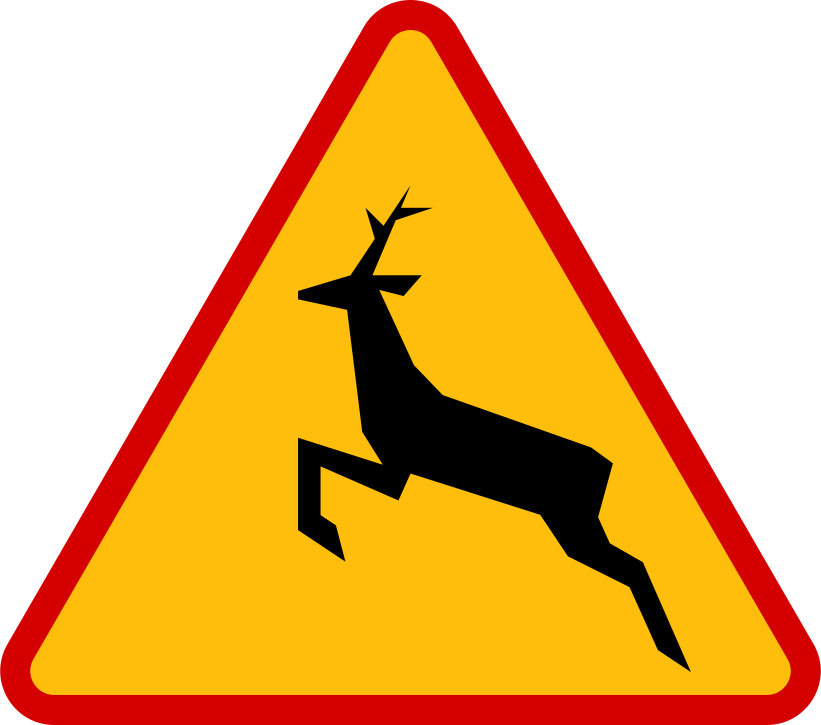 Warning for crossing deer.
English • Traffic sign A-18b • Wild animals. Signs A-18a, Livestock, and A-18b, Wild animals, warn that animals may be encountered on the road.
Polski • A-18b • zwierzęta dzikie. Znaki: A-1 8a „zwierzęta gospodarskie”, A-18b „zwierzęta dzikie” ostrzegają o możliwości napotkania na drodze zwierząt.
Sources
🔗 Commons.wikimedia.org
🔗 Eli.gov.pl • § 9 ust.
SVG source: Commons.wikimedia.org • Original SVG
Paweł Grzywocz • Public domain • Original revision 2025-10-07. Wikimedia original unmodified.
Artwork reviewed against the Polish official sign catalogue, Dz.U. 2019 poz. 2310: Eli.gov.pl • A-18b, PDF page 41, with amendments 2021/433, 2021/2065, 2022/2372 and 2026/133 checked. Catalogue-equivalent illustration; intentional update from the previous PNG. This is an educational illustration, not a manufacturing specification.
Does an animal-crossing warning sign in Poland set a new speed limit?
A warning of animals is not, by itself, a numerical speed-limit sign. Continue to obey the applicable speed limit, but slow down whenever animals could enter the road or visibility is poor. A separate regulatory speed sign must also be obeyed.
🔗 eli.gov.pl • Poland, Road Traffic Law — articles 3, 19–20, 23–24, 49; Signs 3–12
What should you do if an animal enters the road in Poland?
Ease off the accelerator, assess the traffic behind and brake smoothly if necessary. Avoid abrupt swerving into opposing traffic or off the road. Give farm animals and ridden animals room, avoid frightening them with unnecessary horn use, and be alert for more animals following.
🔗 eli.gov.pl • Poland, Road Traffic Law — articles 3, 19–20, 23–24, 49; Signs 3–12
37. Curve
A curve is a section of road that changes direction to the left or right. A sharp, unexpected or poorly visible curve can reduce a driver’s view of approaching traffic, stopped vehicles, pedestrians and other hazards.
Drivers should reduce speed before entering the curve, remain within their lane and use smooth steering, braking and acceleration. Warning signs may indicate the direction of the first curve or a series of successive curves.

Wikimedia.org • Grzegorz W. Tężycki • CC BY-SA
What makes a bend dangerous in Poland?
Curves shorten your view of the road ahead and can reduce the margin for correcting a mistake. Drivers may encounter rural curves where vehicles, pedestrians or cyclists may be hidden from view; the safe speed can be well below the posted maximum. Watch for changing road surfaces and people or vehicles hidden beyond the curve.
🔗 eli.gov.pl • Poland, Road Traffic Law — articles 3, 19–20, 23–24, 49; Signs 3–12
How should you approach a sharp curve in Poland?
Slow down before the bend, select the correct lane position, look through the curve and steer smoothly. Keep enough grip and visible stopping distance for the road and weather conditions.
🔗 eli.gov.pl • Poland, Road Traffic Law — articles 3, 19–20, 23–24, 49; Signs 3–12
Is overtaking safe on a blind bend in Poland?
No. Do not start overtaking where your view of oncoming traffic is obstructed or where signs or road markings prohibit it. Wait until there is a lawful, clear and sufficiently long view ahead.
🔗 eli.gov.pl • Poland, Road Traffic Law — articles 3, 19–20, 23–24, 49; Signs 3–12
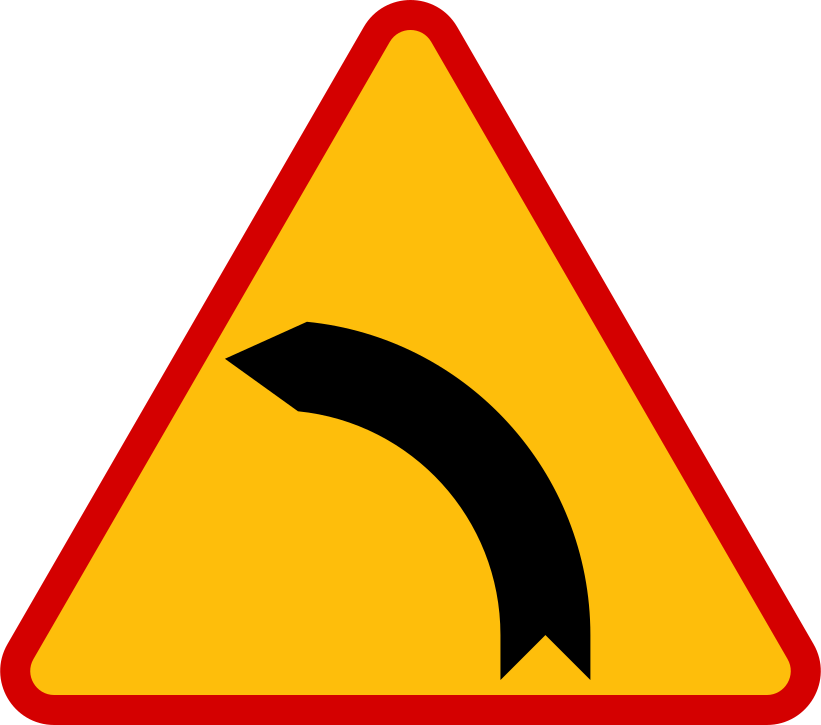 Warning for a curve to the left.
English • Traffic sign A-2 • Dangerous bend to the left. Signs A-1, Dangerous bend to the right, and A-2, Dangerous bend to the left, warn of a dangerous bend in the direction shown.
Polski • A-2 • niebezpieczny zakręt w lewo. Znaki: A-1 „niebezpieczny zakręt w prawo”, A-2 „niebezpieczny zakręt w lewo” ostrzegają o niebezpiecznym zakręcie w kierunku wskazanym na znaku.
Sources
🔗 Commons.wikimedia.org
🔗 Eli.gov.pl • § 4 ust. 1
SVG source: Commons.wikimedia.org • Original SVG
Author not stated on source page • Public domain • Original revision 2025-10-01. Wikimedia original unmodified.
Artwork reviewed against the Polish official sign catalogue, Dz.U. 2019 poz. 2310: Eli.gov.pl • A-2, PDF page 41, with amendments 2021/433, 2021/2065, 2022/2372 and 2026/133 checked. Catalogue-equivalent illustration; intentional update from the previous PNG. This is an educational illustration, not a manufacturing specification.
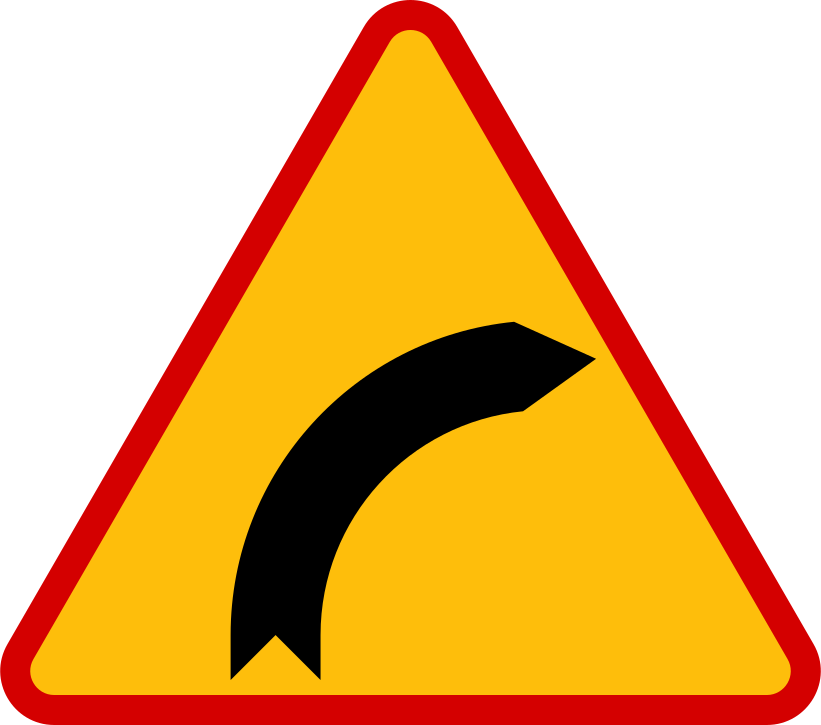 Warning for a curve to the right.
English • Traffic sign A-1 • Dangerous bend to the right. Signs A-1, Dangerous bend to the right, and A-2, Dangerous bend to the left, warn of a dangerous bend in the direction shown.
Polski • A-1 • niebezpieczny zakręt w prawo. Znaki: A-1 „niebezpieczny zakręt w prawo”, A-2 „niebezpieczny zakręt w lewo” ostrzegają o niebezpiecznym zakręcie w kierunku wskazanym na znaku.
Sources
🔗 Commons.wikimedia.org
🔗 Eli.gov.pl • § 4 ust. 1
SVG source: Commons.wikimedia.org • Original SVG
Author not stated on source page • Public domain • Original revision 2025-10-01. Wikimedia original unmodified.
Artwork reviewed against the Polish official sign catalogue, Dz.U. 2019 poz. 2310: Eli.gov.pl • A-1, PDF page 41, with amendments 2021/433, 2021/2065, 2022/2372 and 2026/133 checked. Catalogue-equivalent illustration; intentional update from the previous PNG. This is an educational illustration, not a manufacturing specification.
38. Chevron
A chevron is a V-shaped or arrow-shaped road marker used to show a sharp change in the direction of a road. Chevron boards are normally placed along the outside of a curve so that their points indicate the direction in which the road continues.
Chevrons improve the visibility and alignment of a curve, especially in darkness or poor weather. They do not normally impose a speed limit or determine priority, so drivers must reduce speed before the curve and follow all other signs and road markings.

Wikimedia.org • Grzegorz W. Tężycki • CC BY-SA
What is the purpose of chevron boards on a road in Poland?
Chevron alignment boards help drivers see which way a sharp bend continues, especially in darkness or poor visibility. Their precise shape and colour depend on the local sign system; pay attention to the alignment shown rather than assuming one universal design.
🔗 eli.gov.pl • Poland, Road Traffic Law — articles 3, 19; Signs 1; road guidance devices
Do chevron boards give priority or order a turn at junctions in Poland?
Not ordinary curve-alignment chevrons. They guide you around a bend. Give-way, no-entry, keep-direction and other mandatory traffic signs must be read separately; similar-looking arrows can have different legal meanings.
🔗 eli.gov.pl • Poland, Road Traffic Law — articles 3, 19; Signs 1; road guidance devices
Is the speed shown by a chevron in Poland a compulsory maximum?
A chevron alone does not set a numerical maximum speed. If an advisory-speed panel or a regulatory speed-limit sign is displayed alongside it, identify which type it is and follow the binding speed rules.
🔗 eli.gov.pl • Poland, Road Traffic Law — articles 3, 19; Signs 1; road guidance devices
39. Wrong-way driving
Wrong-way driving occurs when a driver travels against the legally permitted direction of traffic. It may happen on a one-way road, divided road, motorway entrance or exit, or another road section reserved for traffic travelling in one direction.
Wrong-way driving creates an extreme risk of a head-on collision. Drivers must follow direction signs, no-entry signs, lane arrows and road markings. Anyone who accidentally enters a road in the wrong direction should slow down, warn other traffic, stop in the safest available place and contact the emergency services.

Wikimedia.org • Cybularny • CC0
How can you avoid driving the wrong way in Poland?
Traffic normally keeps right here. Keep to the correct side of the road and use no-entry and one-way signs to identify prohibited approaches; do not enter an exit ramp against its permitted direction.
🔗 eli.gov.pl • Poland, Road Traffic Law — articles 5, 16, 22–23, 49; Signs 17, 44
🔗 eli.gov.pl • Poland, 2026/133 — current sign amendments, including P3 on two-way carriageways
What signs can prevent wrong-way driving in Poland?
Read no-entry signs, one-way signs, lane arrows and temporary directions together; a wide road is not automatically two-way. Before entering a motorway, expressway, one-way street or slip road, check the permitted direction rather than relying only on a navigation app.
🔗 eli.gov.pl • Poland, Road Traffic Law — articles 5, 16, 22–23, 49; Signs 17, 44
🔗 eli.gov.pl • Poland, 2026/133 — current sign amendments, including P3 on two-way carriageways
What should you do if you enter a road against traffic in Poland?
Do not keep driving against traffic or try to turn round yourself. Polish police advise stopping on the shoulder or emergency lane if possible, switching on hazard lights and calling 112. Give your location and follow the police instructions for removing the vehicle safely.
🔗 policja.pl • Polish Police, wrong-way motorway response, June2025
40. Roadworks
Roadworks are construction, maintenance, repair or inspection activities carried out on or beside a road. They may temporarily change the road layout, lane widths, speed limits, priority, permitted directions and facilities for pedestrians or cyclists.
Drivers must follow the temporary signs, traffic lights, barriers, road markings and instructions from authorised personnel. They should reduce speed, increase their following distance and remain prepared for narrow lanes, stopped traffic, workers, machinery and sudden changes in the route.

Wikimedia.org • Kamil Czaiński • CC BY-SA
What should you watch for when approaching roadworks in Poland?
Look for temporary warnings, cones, barriers, narrow lanes and construction vehicles. Road layouts can change temporarily, including lane shifts, traffic-light control and short one-way sections. Expect workers and slow or stationary traffic near the worksite.
🔗 eli.gov.pl • Poland, Road Traffic Law — articles 3, 5, 19; Signs 1–3, 12, 95–104
Is a temporary speed limit at roadworks binding in Poland?
Where an authorised temporary regulatory speed limit is in force, you must obey it. A roadworks warning alone should not be mistaken for a new numerical limit, but conditions may require driving more slowly.
🔗 eli.gov.pl • Poland, Road Traffic Law — articles 3, 5, 19; Signs 1–3, 12, 95–104
What if only one lane remains open through roadworks in Poland?
Follow the temporary signals, stop/go instructions, lane arrows and priority signs. Do not enter an opposing traffic lane until permitted, and give vulnerable road users and road workers extra room.
🔗 eli.gov.pl • Poland, Road Traffic Law — articles 3, 5, 19; Signs 1–3, 12, 95–104
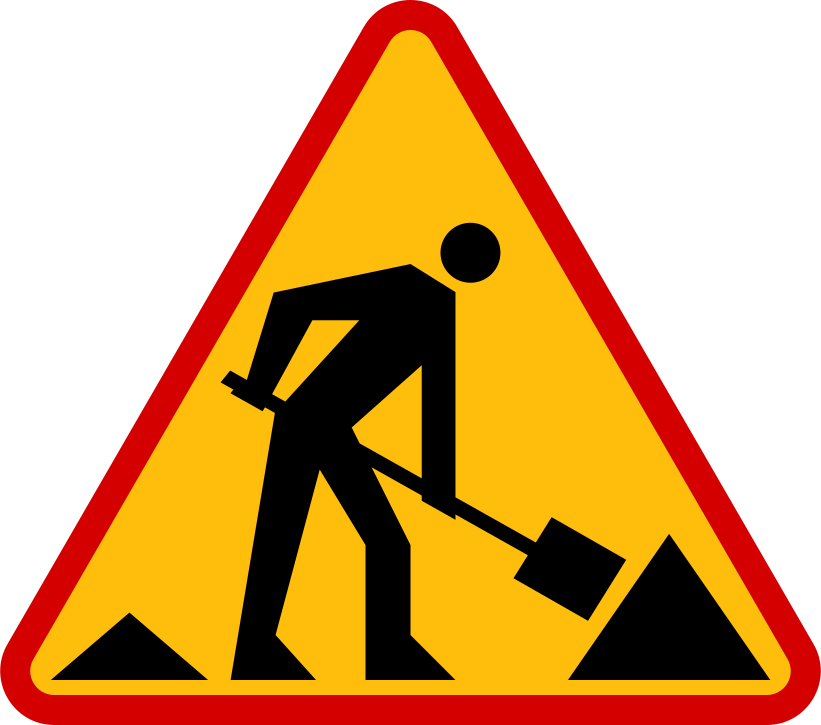 Warning for roadworks.
English • Traffic sign A-14 • Roadworks. Sign A-14 warns of work on the road. Plate T-19 below it indicates that road markings are being painted.
Polski • A-14 • roboty na drodze. Znak A-14 „roboty na drodze” ostrzega o prowadzonych na drodze robotach; umieszczona pod znakiem tabliczka T-19 wskazuje na malowanie znaków poziomych.
Sources
🔗 Commons.wikimedia.org
🔗 Eli.gov.pl • § 7 ust. 5
SVG source: Commons.wikimedia.org • Original SVG
Author not stated on source page • Public domain • Original revision 2025-10-07. Wikimedia original unmodified.
Artwork reviewed against the Polish official sign catalogue, Dz.U. 2019 poz. 2310: Eli.gov.pl • A-14, PDF page 41, with amendments 2021/433, 2021/2065, 2022/2372 and 2026/133 checked. Catalogue-equivalent illustration; intentional update from the previous PNG. This is an educational illustration, not a manufacturing specification.
41. Height limit
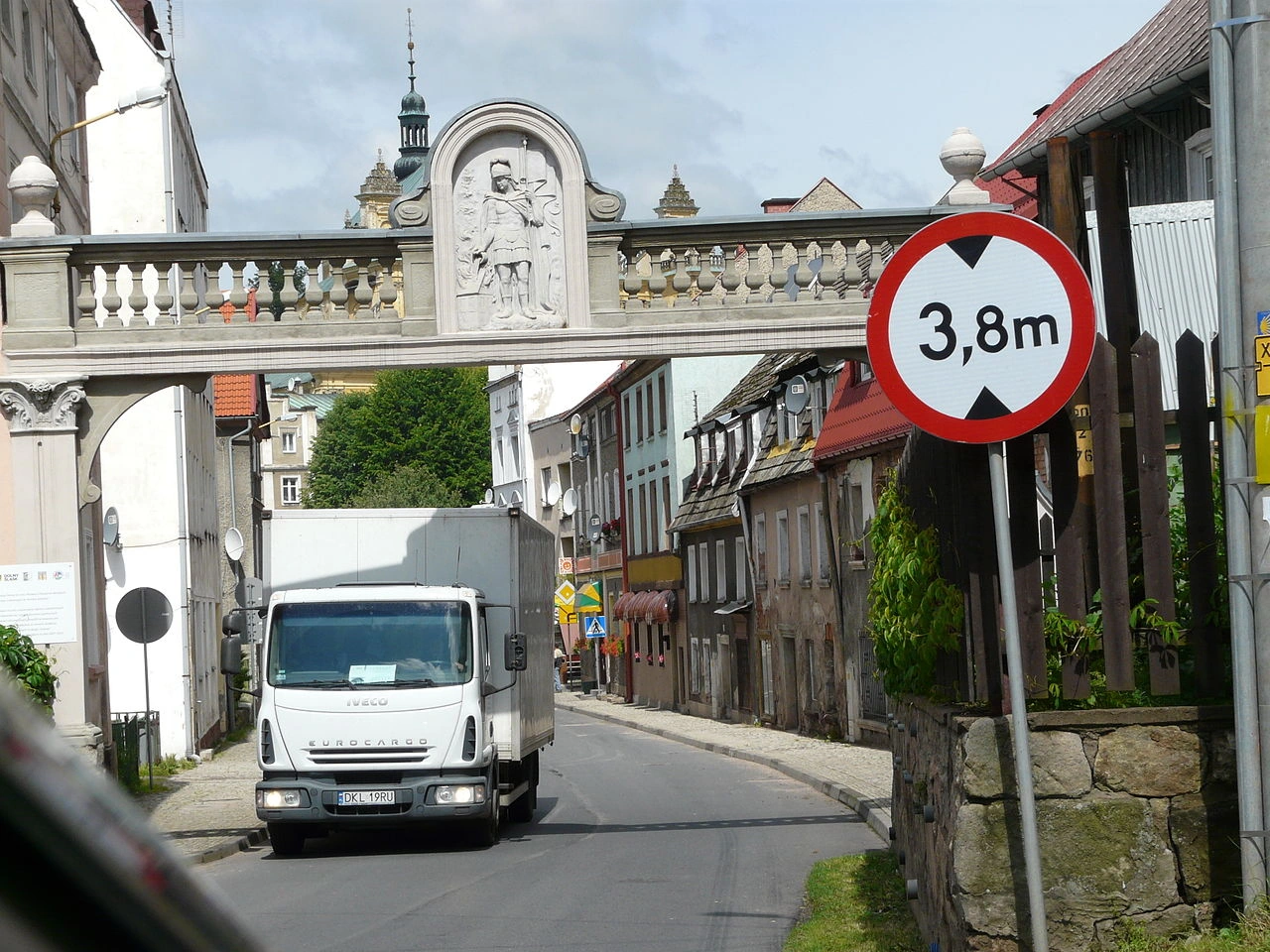
A height limit prohibits vehicles whose total height exceeds the value shown from entering or passing a road section, bridge, tunnel, gateway or other structure. The vehicle’s height includes its load and any equipment attached above it.
Drivers of high vehicles must know their exact height, observe advance warnings and use an alternative route when necessary. They should never rely only on visual judgement or attempt to pass beneath a structure when safe clearance is uncertain.
Wikimedia.org • Piotrus • CC BY-SA
How should you read a low-bridge height restriction in Poland?
Look for the locally prescribed height restriction or clearance warning near older town streets and bridges. The displayed clearance is normally in metres. A warning may describe a hazard ahead; a prohibitory sign indicates a route you cannot enter if your vehicle exceeds the limit.
🔗 eli.gov.pl • Poland, Road Traffic Law — articles 5, 19; Signs 18, 20; 2021/433 axle-load amendment
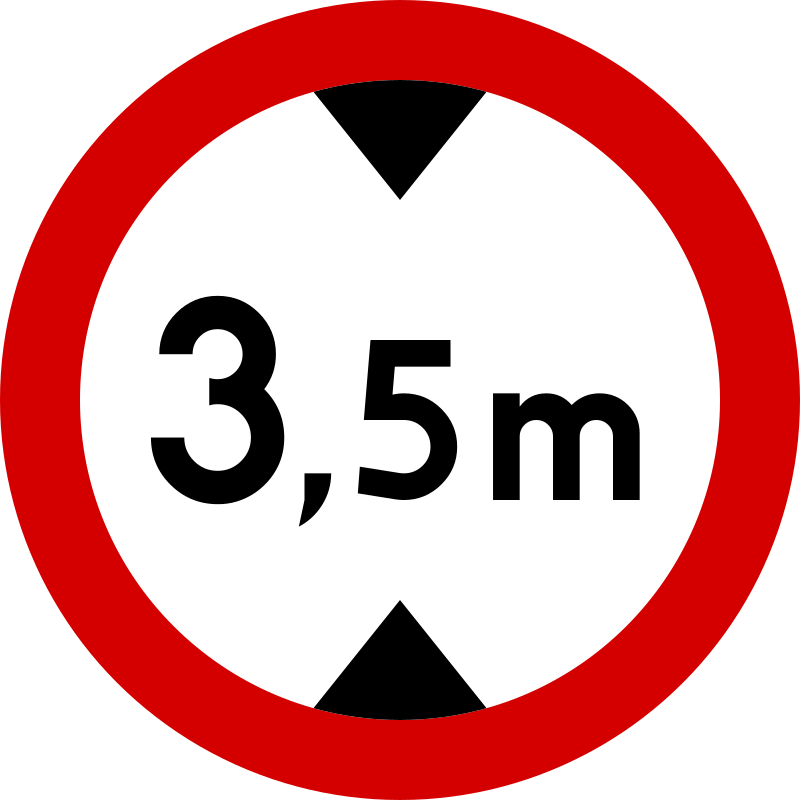 Vehicles higher than indicated prohibited.
English • Traffic sign B-16 • Maximum height in metres. Sign B-16 prohibits vehicles whose height, including their load, exceeds the value shown.
Polski • B-16 • zakaz wjazdu pojazdów o wysokości ponad ... m. Znak B-16 „zakaz wjazdu pojazdów o wysokości ponad......m” oznacza zakaz ruchu pojazdów, których wysokość (również z ładunkiem) jest większa od wartości podanej na znaku.
Sources
🔗 Commons.wikimedia.org
🔗 Eli.gov.pl • § 20 ust. 2
SVG source: Commons.wikimedia.org • Original SVG
Szczepan dyskusja Mail 18:29, 31 December 2006 (UTC) • Public domain • Original revision 2025-10-01. Wikimedia original unmodified.
Artwork reviewed against the Polish official sign catalogue, Dz.U. 2019 poz. 2310: Eli.gov.pl • B-16, PDF page 42, with amendments 2021/433, 2021/2065, 2022/2372 and 2026/133 checked. Catalogue-equivalent illustration; intentional update from the previous PNG. This is an educational illustration, not a manufacturing specification.
Does a roof load count when checking vehicle height in Poland?
Yes for practical clearance: measure the vehicle at its highest point with its load and fitted accessories, such as a roof box, bicycle or roof rack. Check the local legal measurement rules as well; an empty vehicle’s registered height is not enough when equipment has been added.
🔗 eli.gov.pl • Poland, Road Traffic Law — articles 5, 19; Signs 18, 20; 2021/433 axle-load amendment
What should you do if your vehicle is too high for a bridge or tunnel in Poland?
Do not try to squeeze under the structure. Use the signed alternative route and, if you are already close to the obstruction, stop where safe and seek traffic-control assistance rather than reversing unpredictably into moving traffic.
🔗 eli.gov.pl • Poland, Road Traffic Law — articles 5, 19; Signs 18, 20; 2021/433 axle-load amendment
42. Weight limit
A weight limit prohibits vehicles or vehicle combinations whose mass exceeds the value shown from entering or passing a road section, bridge, tunnel or other structure. Depending on local law, the restriction may concern the vehicle’s actual loaded mass, maximum authorised mass or load on an individual axle.
Drivers must know which type of mass the sign refers to and must include the vehicle, passengers, cargo and any trailer where required. A vehicle that exceeds the limit must use another suitable route.
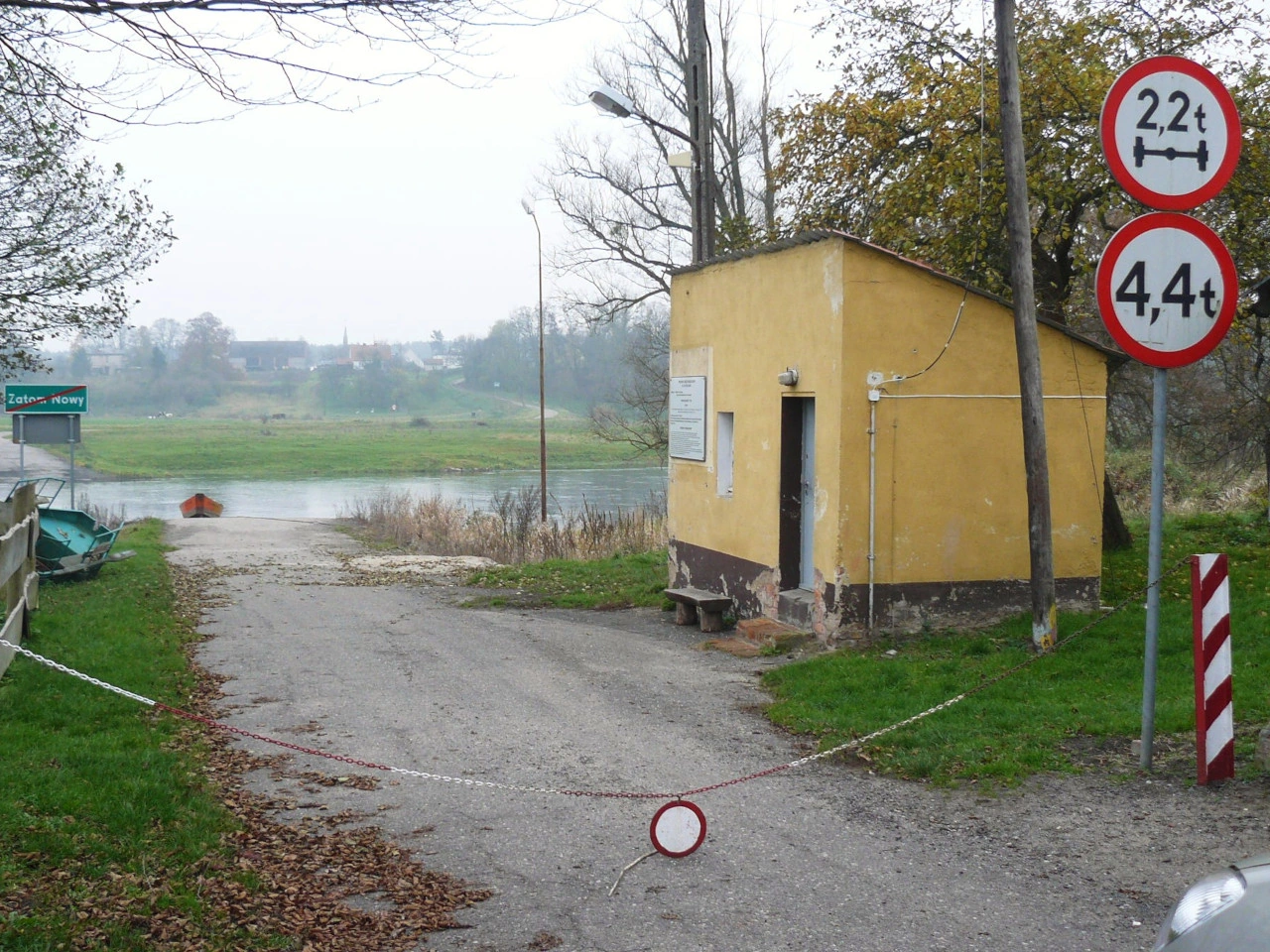
Wikimedia.org • MOs810 • CC BY-SA
Does every weight-limit sign measure the same kind of vehicle weight in Poland?
No. Check whether the particular sign concerns actual loaded mass, authorised maximum mass, axle load or another specified vehicle class. These are different measurements; do not interpret every weight-restriction sign as the same type of limit.
🔗 eli.gov.pl • Poland, Road Traffic Law — articles 5, 19; Signs 18, 20; 2021/433 axle-load amendment
🔗 eli.gov.pl • Poland, 2021/433 — operative sign amendments
🔗 eli.gov.pl • Poland, 2021/2065 — operative sign amendments
🔗 eli.gov.pl • Poland, 2022/2372 — operative sign amendments
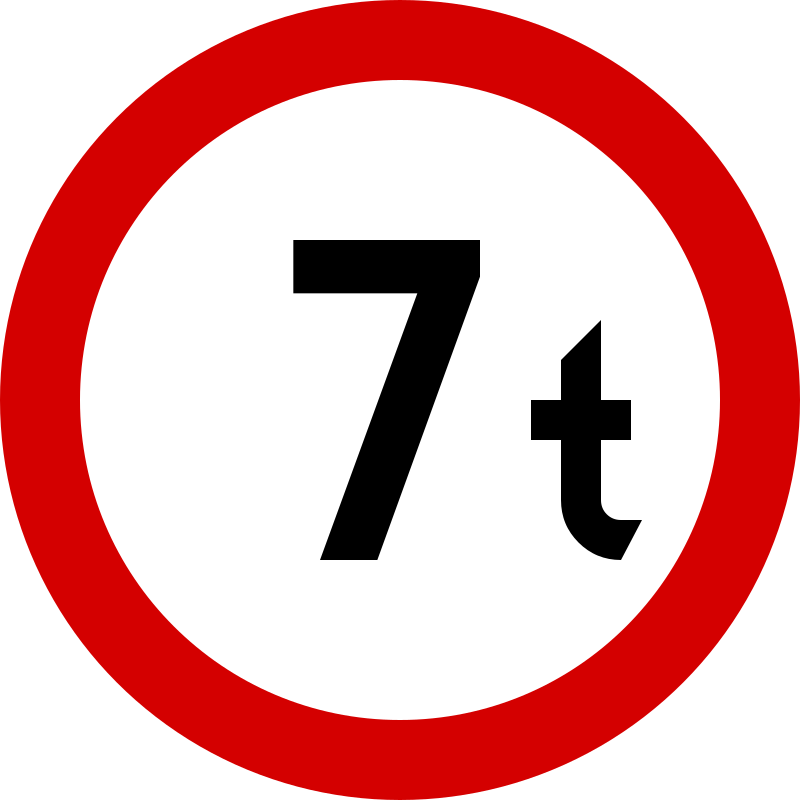 Vehicles heavier than indicated prohibited.
English • Traffic sign B-18 • Maximum actual total mass in tonnes. Sign B-18 prohibits vehicles whose actual total mass exceeds the value shown. For vehicle combinations, the prohibition applies to their combined mass.
Polski • B-18 • zakaz wjazdu pojazdów o rzeczywistej masie całkowitej ponad ... t. Znak B-18 „zakaz wjazdu pojazdów o rzeczywistej masie całkowitej ponad.....t” oznacza zakaz ruchu pojazdów, których rzeczywista masa całkowita jest większa od wartości podanej na znaku; w przypadku zespołu pojazdów zakaz dotyczy ich łącznej masy.
Sources
🔗 Commons.wikimedia.org
🔗 Eli.gov.pl • § 20 ust. 4
SVG source: Commons.wikimedia.org • Original SVG
Szczepan dyskusja Mail 18:29, 31 December 2006 (UTC) • Public domain • Original revision 2025-10-01. Wikimedia original unmodified.
Artwork reviewed against the Polish official sign catalogue, Dz.U. 2019 poz. 2310: Eli.gov.pl • B-18, PDF page 42, with amendments 2021/433, 2021/2065, 2022/2372 and 2026/133 checked. Catalogue-equivalent illustration; intentional update from the previous PNG. This is an educational illustration, not a manufacturing specification.
Do cargo and trailers matter for a posted weight restriction in Poland?
Yes, whenever the rule is based on actual loaded mass or the total mass of a combination. Cargo, passengers and the trailer affect that figure; weight on individual axles may be limited separately. If the sign instead uses authorised maximum mass, an empty vehicle may still be prohibited.
🔗 eli.gov.pl • Poland, Road Traffic Law — articles 5, 19; Signs 18, 20; 2021/433 axle-load amendment
🔗 eli.gov.pl • Poland, 2021/433 — operative sign amendments
🔗 eli.gov.pl • Poland, 2021/2065 — operative sign amendments
🔗 eli.gov.pl • Poland, 2022/2372 — operative sign amendments
What should you do if your vehicle exceeds a bridge weight limit in Poland?
Do not drive onto the bridge. Follow the signed alternative route and check the vehicle’s gross and axle loads as applicable. A general heavy-vehicle permit does not automatically authorise crossing every restricted bridge.
🔗 eli.gov.pl • Poland, Road Traffic Law — articles 5, 19; Signs 18, 20; 2021/433 axle-load amendment
🔗 eli.gov.pl • Poland, 2021/433 — operative sign amendments
🔗 eli.gov.pl • Poland, 2021/2065 — operative sign amendments
🔗 eli.gov.pl • Poland, 2022/2372 — operative sign amendments
43. Radar speed sign
A radar speed sign warns drivers that vehicle speeds may be monitored by a fixed camera, mobile radar, lidar or average-speed enforcement system. It reminds drivers to check and respect the applicable speed limit.
The sign does not normally establish the speed limit itself. Drivers must follow the general, posted or variable speed limit applying to the road and must not brake suddenly merely because speed enforcement is indicated.

Wikimedia.org • Tomasz Sienicki • CC BY
What should a driver understand from a radar or speed-camera warning in Poland?
Polish D-51 warns of an automatic speed check at a point. D-51a marks the start of an average-speed monitoring section and D-51b its end. Follow the applicable speed limit throughout the section; the monitoring notice alone does not establish a new numerical limit.
🔗 eli.gov.pl • Polish ELI, Traffic Signs Regulation, operative text
🔗 eli.gov.pl • Polish Sejm, current Road Traffic Law, Articles 3, 5 and 19–23, 49
🔗 gov.pl • Polish Ministry September2026 experimental average-speed sign and existing limit context
🔗 canard.gitd.gov.pl • CANARD, automatic speed enforcement
🔗 eli.gov.pl • Polish January2026 signing amendment
🔗 eli.gov.pl • Polish signing amendment March2021 D51 average-speed signs
Which speed limit applies when a radar warning is displayed in Poland?
Follow the speed-limit sign, applicable speed zone or statutory road and vehicle limit. A camera symbol or enforcement notice must not be mistaken for a sign raising or ending that limit.
🔗 eli.gov.pl • Polish ELI, Traffic Signs Regulation, operative text
🔗 eli.gov.pl • Polish Sejm, current Road Traffic Law, Articles 3, 5 and 19–23, 49
🔗 gov.pl • Polish Ministry September2026 experimental average-speed sign and existing limit context
🔗 canard.gitd.gov.pl • CANARD, automatic speed enforcement
🔗 eli.gov.pl • Polish January2026 signing amendment
🔗 eli.gov.pl • Polish signing amendment March2021 D51 average-speed signs
Should you brake abruptly when you notice a radar sign in Poland?
No. Adjust to the lawful and safe speed smoothly, leaving adequate space behind and ahead. Enforcement information does not authorise sudden unsafe manoeuvres or stopping to inspect the camera.
🔗 eli.gov.pl • Polish ELI, Traffic Signs Regulation, operative text
🔗 eli.gov.pl • Polish Sejm, current Road Traffic Law, Articles 3, 5 and 19–23, 49
🔗 gov.pl • Polish Ministry September2026 experimental average-speed sign and existing limit context
🔗 canard.gitd.gov.pl • CANARD, automatic speed enforcement
🔗 eli.gov.pl • Polish January2026 signing amendment
🔗 eli.gov.pl • Polish signing amendment March2021 D51 average-speed signs
44. Priority at the next junction
Priority at the next junction means that drivers travelling on a particular road have priority over traffic entering from intersecting roads at the next junction. The priority arrangement is normally indicated by signs facing both the priority traffic and the traffic that must give way.
Unlike a continuing priority road, this priority applies only at the indicated intersection. Drivers must still approach cautiously and obey traffic lights, authorised officers, crossings, turning rules and other applicable signs.

Wikimedia.org • Grzegorz W. Tężycki • CC BY-SA
How is priority at the next junction determined in Poland?
Where a priority-at-the-next-junction sign is recognised and lawfully installed in Poland, it indicates priority at that junction. Its design may differ locally. Do not confuse a junction-specific priority sign with a continuing priority-road designation.
🔗 eli.gov.pl • Poland, Road Traffic Law — articles 25; Signs 43 and T6 supplementary panels
Does priority at one junction automatically continue along the entire road in Poland?
No. One-junction priority and continuing priority-road status are distinct concepts. Check the local signs at each following junction, including any end-of-priority marker, traffic signal or new Give Way or Stop sign.
🔗 eli.gov.pl • Poland, Road Traffic Law — articles 25; Signs 43 and T6 supplementary panels
May a driver with priority ignore pedestrians or another safety obligation at the next junction in Poland?
No. Junction priority does not cancel duties towards pedestrians, traffic signals, emergency vehicles or other road users where the law gives them precedence. Approach at a speed allowing you to stop safely.
🔗 eli.gov.pl • Poland, Road Traffic Law — articles 25; Signs 43 and T6 supplementary panels
45. Traffic lights
Traffic lights use coloured lights, arrows or symbols to regulate when road users may proceed, must prepare to stop or must remain stopped. Separate signals may apply to particular directions, lanes, pedestrians, cyclists or public-transport vehicles.
A green light permits movement only when the route is clear and the movement is otherwise legal. Road users must still follow priority rules, turning restrictions, lane markings and instructions from authorised traffic controllers.
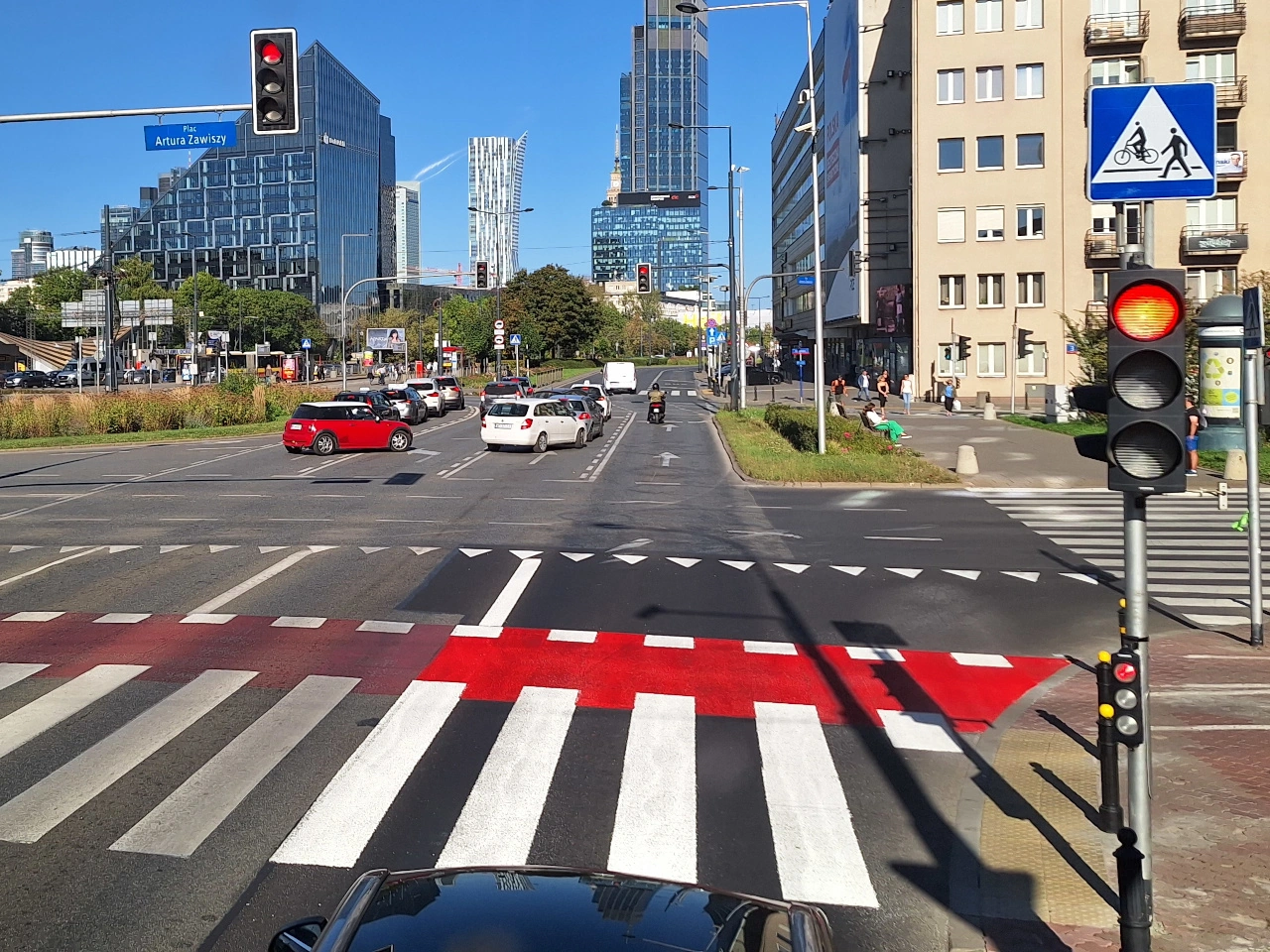
Wikimedia.org • Rakoon • CC0
What must a driver do at red, amber and green signals in Poland?
Red and red-and-amber prohibit passing the signal. Amber also prohibits entry unless you are too close to stop without sharp braking. Green permits entry only if you can clear the junction during green and do not obstruct pedestrians or cyclists leaving the carriageway. Stop at the line or, if absent, the applicable position before the signal.
🔗 eli.gov.pl • Poland, Signs and Signals Regulation, sections 95-96,98-99
May you turn at a red traffic light in Poland?
Red alone does not permit a turn. An illuminated S-2 green arrow alongside red permits its indicated turn only after you stop and provided you do not obstruct other road users. The exception ends when the arrow goes out.
🔗 eli.gov.pl • Poland, Signs and Signals Regulation, sections 95-96,98-99
Can a green light remove the need to give way to pedestrians in Poland?
No. A green vehicle signal does not permit entry if the vehicle would obstruct pedestrians or cyclists leaving the carriageway. Allow them to clear the crossing.
🔗 eli.gov.pl • Poland, Signs and Signals Regulation, sections 95-96,98-99
46. Traffic lights warning
A traffic lights warning is a warning sign that alerts drivers that traffic signals are located ahead. It is commonly used where the signals may be unexpected, difficult to see from a distance or located on a road where drivers need additional time to prepare to stop.
Drivers approaching a traffic lights warning should reduce speed when necessary, watch for the signals ahead and be prepared to stop if the traffic light changes or traffic is waiting at the intersection.

Wikimedia.org • Grzegorz W. Tężycki • CC BY-SA
How are traffic lights ahead warned of in Poland?
The warning-sign system commonly uses a red-bordered triangular sign with a traffic-light symbol. The precise design and placement depend on the national traffic-sign schedule. This warns of a signal ahead; it is not itself a red traffic light.
🔗 eli.gov.pl • Poland, Road Traffic Law — articles 3, 5, 19; Signs 1–3, 12, 95–104
Does a traffic-lights-ahead warning require an immediate stop in Poland?
No. A warning sign is not an automatic STOP instruction and does not create a new numerical speed limit. Reduce speed when necessary, look for a queue or a concealed signal, and obey the traffic lights and any separate speed or stop signs.
🔗 eli.gov.pl • Poland, Road Traffic Law — articles 3, 5, 19; Signs 1–3, 12, 95–104
What should you check if the next traffic lights are difficult to see in Poland?
Allow enough distance to stop before the marked line, watch for vehicles braking suddenly and be ready for a pedestrian or cyclist crossing. If the signals are out of order or flashing, follow the applicable local failure and priority rules rather than guessing from the warning sign.
🔗 eli.gov.pl • Poland, Road Traffic Law — articles 3, 5, 19; Signs 1–3, 12, 95–104
47. Pedestrian lights
Pedestrian lights are traffic signals that regulate when pedestrians may begin crossing a road. They normally display a red standing figure to prohibit starting and a green walking figure to permit crossing.
A flashing signal or countdown may warn that the permitted crossing period is ending. Pedestrians should cross without unnecessary delay, while turning drivers must remain alert and allow pedestrians who entered lawfully to finish crossing safely.
Wikimedia.org • Henryk Borawski • CC BY-SA
What do pedestrian traffic signals mean in Poland?
Green permits entering the crossing; red prohibits entry. Flashing green warns that red will appear shortly and requires pedestrians to leave the crossing as quickly as possible.
🔗 eli.gov.pl • Poland, Signs and Signals Regulation, sections 95-96,98-99
What if the pedestrian signal changes while you are crossing in Poland?
Clear the crossing as quickly as possible when green starts flashing. Do not enter on red. Drivers with a green vehicle signal must not obstruct pedestrians leaving the carriageway.
🔗 eli.gov.pl • Poland, Signs and Signals Regulation, sections 95-96,98-99
May turning drivers ignore pedestrians on a signal-controlled crossing in Poland?
No. A green vehicle signal does not permit entry if the vehicle would obstruct pedestrians or cyclists leaving the carriageway. Allow them to clear the crossing.
🔗 eli.gov.pl • Poland, Signs and Signals Regulation, sections 95-96,98-99
48. Road markings
Road markings are lines, symbols, arrows, words or other markings applied to the road surface to regulate, guide or inform road users. They can separate traffic lanes and opposing directions, indicate where vehicles must stop or give way, mark pedestrian and cyclist crossings and identify areas reserved for particular road users.
Road users should observe the meaning of each road marking and combine it with the applicable traffic signs, signals and traffic rules. Colours, patterns and legal meanings can differ between countries.

Wikimedia.org • Szelasso • CC BY-SA
Which road markings are important to recognise in Poland?
Recognise stop and give-way lines, lane-divider markings, continuous lines, directional arrows and pedestrian-crossing markings. Their colour, shape and exact legal effect come from the local traffic rules; do not assume an overseas convention applies unchanged.
🔗 eli.gov.pl • Poland, 2026/133 — current sign amendments, including P3 on two-way carriageways
May drivers cross a solid road line in Poland?
In Poland, P2 is a single continuous line separating lanes in the same direction and must not be crossed or straddled. P4 is a double continuous line separating opposing traffic and also prohibits crossing or straddling. For mixed P3, the continuous line on your side prohibits crossing, except when returning after overtaking on a two-way carriageway to the lane entered from the broken-line side. That two-way qualification is explicit in the February 2026 amendment. Other safety and overtaking rules still apply.
🔗 eli.gov.pl • Poland, 2026/133 — current sign amendments, including P3 on two-way carriageways
Can painted arrows or stop lines be ignored when signs are not obvious in Poland?
No. Lane arrows, stop lines and give-way markings can direct where to wait or which movement a lane permits. Read them together with traffic lights, vertical signs and directions from authorised traffic controllers; temporary changes may also apply.
🔗 eli.gov.pl • Poland, 2026/133 — current sign amendments, including P3 on two-way carriageways
49. Junction layout
A junction layout is a schematic representation of the layout of an upcoming intersection or junction. It can show how roads branch, cross or continue and may help drivers understand which direction to follow before reaching the intersection.
Crossroad-shape diagrams are commonly used on advance direction signs. Depending on the country's sign system, the diagram may also distinguish the main road, side roads, route numbers or destinations.

Wikimedia.org • Grzegorz W. Tężycki • CC BY-SA
What can a junction-layout diagram tell you in Poland?
Polish T-6 supplementary panels can show the course of a priority road and the arrangement of side roads. Do not confuse the drawn route with permission to ignore priority signs.
🔗 eli.gov.pl • Poland, Road Traffic Law — articles 25; Signs 43 and T6 supplementary panels
Does a junction-layout picture itself give priority at a junction in Poland?
A supplementary diagram helps identify the course of the priority route, but its meaning depends on the accompanying priority sign and local rules. It does not cancel traffic signals or obligations to drive safely.
🔗 eli.gov.pl • Poland, Road Traffic Law — articles 25; Signs 43 and T6 supplementary panels
Should the drawing be treated as an exact map of the junction in Poland?
No. A schematic diagram can omit islands, turning lanes, cycle facilities and minor road details. Slow down, check the actual road layout, and follow lane arrows, signs and signals when you reach the intersection.
🔗 eli.gov.pl • Poland, Road Traffic Law — articles 25; Signs 43 and T6 supplementary panels
50. Driving licence
A driving licence is an official document authorising a person to drive one or more specified categories of motor vehicle. It may contain conditions, restrictions, category codes and expiry dates that determine which vehicles the holder may drive.
Drivers must hold a licence that is valid for the vehicle category and jurisdiction concerned. A licence may be provisional, full, restricted, suspended or withdrawn, and additional qualifications may be required for professional driving.
Wikimedia.org • CC0
Which driving-licence entitlement is needed for an ordinary car in Poland?
In Poland, category B is the usual entitlement for an ordinary passenger car (subject to vehicle-mass, seat and other licence conditions). A different entitlement may be needed for motorcycles, heavy vehicles, trailers or passenger transport.
Can a visitor drive in Poland using a driving licence issued abroad?
A valid, full driving licence issued by another EU country is recognised for the vehicle categories it authorises, subject to the local minimum age. A learner licence or temporary replacement certificate is not automatically recognised across borders. For licences issued outside the EU, check national recognition rules.
Does an International Driving Permit replace the original licence in Poland?
No. A valid full EU driving licence is normally sufficient for driving elsewhere in the EU; an IDP does not replace it. Non-EU licence holders should check national requirements and carry the underlying licence with any recognised permit.