


Traffic rulesPoland
 Traffic rules
 Poland
1. Poland
Poland is a country in Central Europe, bordered by Germany, Czechia, Slovakia, Ukraine, Belarus, Lithuania and Russia. Traffic drives on the right, and the country has a growing network of motorways and expressways connecting its major cities and neighbouring countries. Poland is notable for its relatively high 140 km/h motorway speed limit. Passenger cars do not need a national motorway vignette, although tolls still apply on some concession-operated motorway sections. Drivers must also use dipped headlights or daytime running lights throughout the year.
Polish is the official language and is the main language used on road and destination signs. It uses the Latin alphabet with distinctive letters such as ą, ć, ę, ł, ń, ó, ś, ź and ż. In some municipalities, drivers can also encounter bilingual place-name signs using recognised minority or regional languages, including German, Kashubian, Lithuanian, Belarusian and Lemko. Winter tyres are recommended in cold conditions but are not subject to a general seasonal requirement, while snow chains may be required on particular snow-covered roads.
AI-generated by Traffic-rules.com • WCIT • CC BY-SA
Which number can you call in an emergency in Poland?
Call 112 for urgent emergency assistance. Give the operator your location and explain what happened.
🔗 gov.pl • Polish Government, how to report an emergency to 112
What is the legal alcohol limit for drivers in Poland?
Drivers must keep their blood-alcohol concentration below 0.2‰ (0.2 g/l). Poland therefore has a very low alcohol limit, and the safest approach is not to drink any alcohol before driving.
🔗 europa.eu • Your Europe / national authorities, Poland road rules, Alcohol limits
What speed limits apply to passenger cars in Poland?
Built-up areas: The general maximum speed is 50 km/h, both during the day and at night, unless signs indicate another limit.
Outside built-up areas: For passenger cars, the general maximum speed on an ordinary single-carriageway road outside built-up areas is 90 km/h, unless signs indicate another limit.
Expressways: For passenger cars, the maximum speed is generally 100 km/h on a single-carriageway expressway and 120 km/h on a dual-carriageway expressway, unless signs indicate a lower limit. A non-expressway dual carriageway with at least two lanes in each direction generally has a 100 km/h limit.
Motorways: For passenger cars, the general maximum speed on a motorway is 140 km/h, unless signs indicate a lower limit.
🔗 europa.eu • Your Europe / national authorities, Poland road rules, Speed limits for passenger cars
What are the seat-belt and child-restraint rules in Poland?
Seat belts must be worn by drivers and passengers in vehicles equipped with them, subject to specific legal exemptions.
Children shorter than 150 cm must normally use a suitable approved child restraint. A rear-seat belt may be used for a child at least 135 cm tall only when the child’s height and weight make it impossible to provide an appropriate restraint.
A third child aged 3 or older may use a rear-seat belt when two installed child restraints leave no room for a third. These rear-seat exceptions do not permit a child shorter than 150 cm to use only a belt in front. A rear-facing seat must not face an active frontal airbag; separate taxi and medical exemptions apply.
🔗 europa.eu • Your Europe / national authorities, Poland road rules, Seat belts and child restraints; 🔗 ketrzyn.policja.gov.pl • Polish Police, child-restraint rules and rear-seat exceptions; 🔗 nidzica.policja.gov.pl • Polish Police, child seats and exempt transport
Can you use a handheld mobile phone while driving in Poland?
No. Drivers may not use a phone while driving if doing so requires holding the handset or microphone in the hand. Hands-free use is permitted.
🔗 europa.eu • Your Europe / national authorities, Poland road rules, Mobile telephone
What safety equipment must you carry in a car in Poland?
A passenger car must carry a warning triangle and fire extinguisher. A first-aid kit and reflective safety vest are strongly recommended but are not part of the general mandatory equipment requirement for an ordinary private car.
Must cars use lights during the day in Poland?
Yes. Drivers must use dipped headlights while driving throughout the year. From dawn to dusk in normal visibility, daytime running lights may be used instead.
🔗 europa.eu • Your Europe / national authorities, Poland road rules, Other specific rules, lights
Can a visitor use a driving licence issued in another EU country in Poland?
Yes. A valid, full EU driving licence is recognised for the vehicle categories it covers. You must meet the applicable minimum age. A learner licence or a temporary replacement certificate does not have the same automatic recognition.
Are motorcycle helmets compulsory in Poland?
Yes. On an ordinary, open motorcycle, both the rider and passenger must wear a protective helmet. Use a helmet that meets the applicable approval requirements and fasten it correctly. Check the specific rules before relying on an exemption for an enclosed or specially equipped vehicle.
🔗 europa.eu • Your Europe / national authorities, Poland road rules

2. Motorway
A motorway is a road specially designed and signposted for motor traffic. Motorways normally have separate carriageways for opposing traffic, controlled access through designated entrances and exits, no direct access to neighbouring properties, and no level crossings with other roads, railways or paths.
Special traffic rules apply on motorways. The permitted road users, speed limits, lane rules, tolls and emergency procedures vary between countries, so drivers must follow the local traffic signs and regulations.
Wikimedia.org • Omega933 • CC BY-SA
How do people refer to a motorway in Poland?
The Polish term is autostrada. A droga ekspresowa is an expressway, with separate limits depending on its carriageway layout.
🔗 eli.gov.pl • Poland, Road Traffic Law — articles 2(3)–(4), 16, 19–20, 31, 49
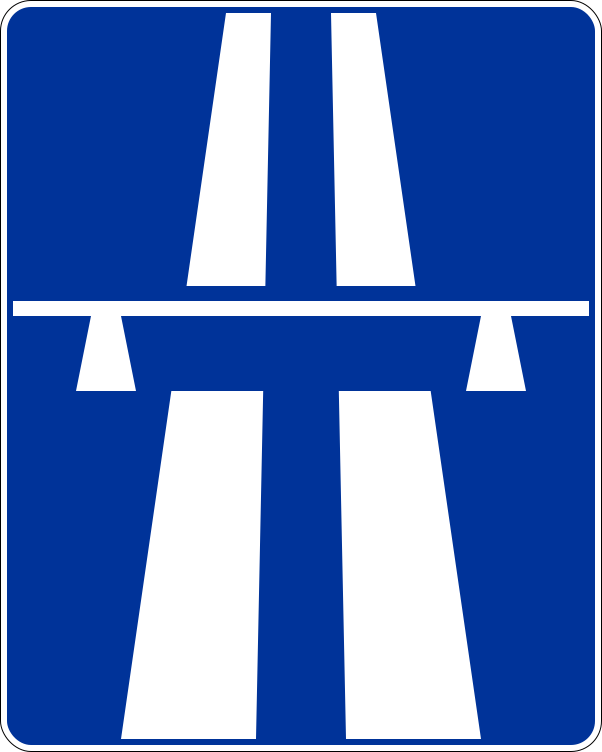 Start of a motorway.
English • Traffic sign D-9 • Motorway. Sign D-9 marks the beginning or continuation of a motorway. Its end is marked by D-10, End of motorway.
Polski • D-9 • autostrada. Znak D-9 „autostrada” oznacza początek lub kontynuację autostrady; koniec autostrady oznaczony jest znakiem D-10 „koniec autostrady”.
Sources
🔗 Commons.wikimedia.org
🔗 Eli.gov.pl • § 48 ust. 2
SVG source: Commons.wikimedia.org • Original SVG
Author not stated on source page • Public domain • Original revision 2025-10-11. Wikimedia original unmodified.
Artwork reviewed against the Polish official sign catalogue, Dz.U. 2019 poz. 2310: Eli.gov.pl • D-9, PDF page 44, with amendments 2021/433, 2021/2065, 2022/2372 and 2026/133 checked. Catalogue-equivalent illustration; intentional update from the previous PNG. This is an educational illustration, not a manufacturing specification.
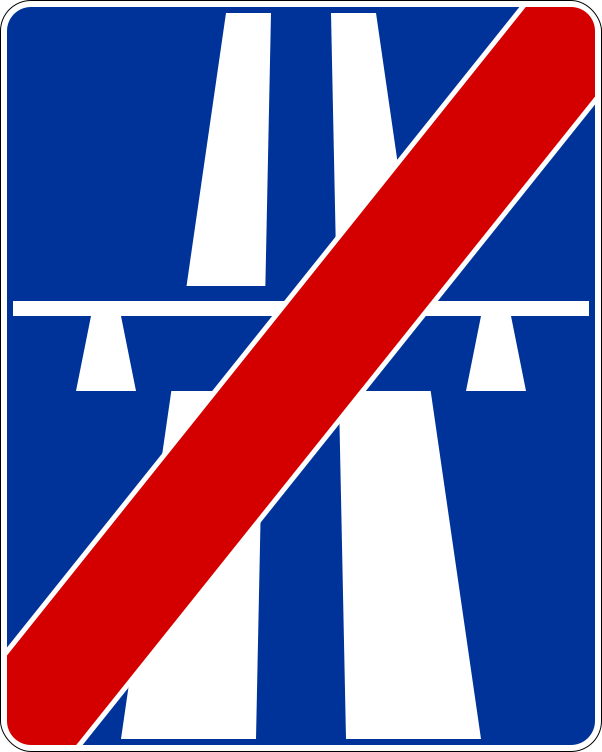 End of the motorway.
English • Traffic sign D-10 • End of motorway. Sign D-9, Motorway, marks the beginning or continuation of a motorway. Its end is marked by D-10.
Polski • D-10 • koniec autostrady. Znak D-9 „autostrada” oznacza początek lub kontynuację autostrady; koniec autostrady oznaczony jest znakiem D-10 „koniec autostrady”.
Sources
🔗 Commons.wikimedia.org
🔗 Eli.gov.pl • § 48 ust. 2
SVG source: Commons.wikimedia.org • Original SVG
Krzysztof Blachnicki • Public domain • Original revision 2025-10-11. Wikimedia original unmodified.
Artwork reviewed against the Polish official sign catalogue, Dz.U. 2019 poz. 2310: Eli.gov.pl • D-10, PDF page 44, with amendments 2021/433, 2021/2065, 2022/2372 and 2026/133 checked. Catalogue-equivalent illustration; intentional update from the previous PNG. This is an educational illustration, not a manufacturing specification.
What speed limit applies to cars on a motorway in Poland?
For an ordinary passenger car without a trailer, the general maximum is 140 km/h. Obey lower posted limits and reduce speed when traffic, weather or visibility requires it. Different limits can apply to other vehicle classes.
🔗 eli.gov.pl • Poland, Road Traffic Law — articles 2(3)–(4), 16, 19–20, 31, 49
Who may use a motorway in Poland?
Motorways are normally reserved for eligible motor vehicles, excluding quadricycles, that can reach at least 40 km/h on a level road, including when towing a trailer. Vehicles performing road cleaning, repair or modernisation work have an access exception and must display yellow flashing lights. Pedestrians and cyclists cannot use them. This is an admission condition, not permission to obstruct faster traffic.
🔗 eli.gov.pl • Poland, Road Traffic Law — articles 2(3)–(4), 16, 19–20, 31, 49
What should I do if I miss a motorway exit in Poland?
Continue to the next exit and choose a safe onward route. Do not reverse, make a U-turn or cross the central reservation to return to a missed exit.
🔗 eli.gov.pl • Poland, Road Traffic Law — articles 2(3)–(4), 16, 19–20, 31, 49
3. Expressway
An expressway is a road intended to carry through traffic efficiently, usually at higher speeds than ordinary roads. Expressways often have limited access, multiple lanes, separated carriageways or grade-separated junctions, but their design and legal status vary between countries.
An expressway is not always a motorway. It may have intersections, traffic lights or direct access, and the permitted road users, speed limits and special rules depend on local signs and regulations.

Wikimedia.org • Crusier • CC BY-SA
How do people refer to an expressway in Poland?
The Polish term is droga ekspresowa. An expressway can have one or two carriageways, which affects its general car speed limit.
🔗 eli.gov.pl • Poland, Road Traffic Law — articles 2(3)–(4), 16, 19–20, 31, 49
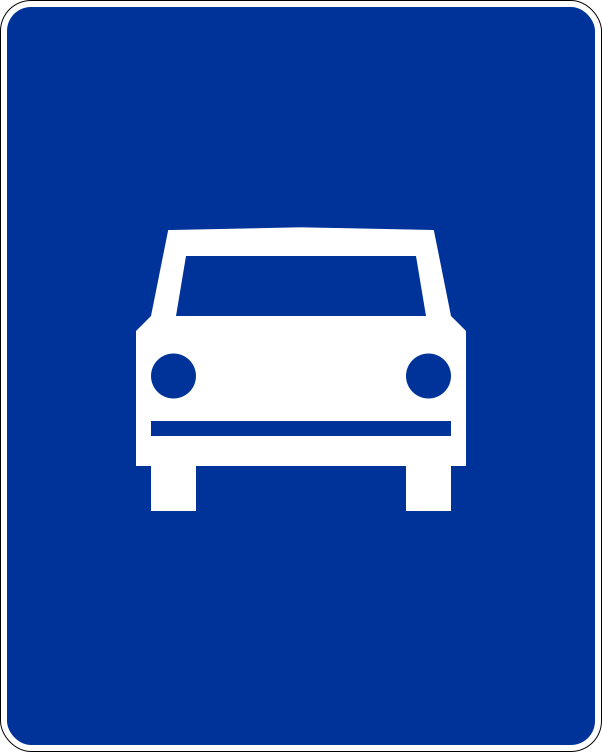 Start of an expressway.
English • Traffic sign D-7 • Expressway. Sign D-7 marks the beginning or continuation of an expressway. Its end is marked by D-8, End of expressway.
Polski • D-7 • droga ekspresowa. Znak D-7 „droga ekspresowa” oznacza początek lub kontynuację drogi ekspresowej; koniec drogi ekspresowej oznaczony jest znakiem D-8 „koniec drogi ekspresowej”.
Sources
🔗 Commons.wikimedia.org
🔗 Eli.gov.pl • § 48 ust. 1
SVG source: Commons.wikimedia.org • Original SVG
Author not stated on source page • Public domain • Original revision 2025-10-11. Wikimedia original unmodified.
Artwork reviewed against the Polish official sign catalogue, Dz.U. 2019 poz. 2310: Eli.gov.pl • D-7, PDF page 44, with amendments 2021/433, 2021/2065, 2022/2372 and 2026/133 checked. Catalogue-equivalent illustration; intentional update from the previous PNG. This is an educational illustration, not a manufacturing specification.
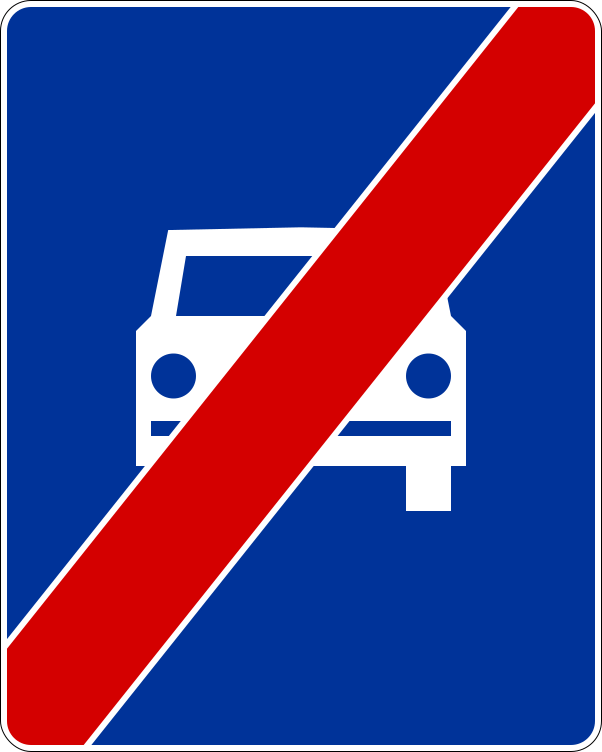 End of the expressway.
English • Traffic sign D-8 • End of expressway. Sign D-7, Expressway, marks the beginning or continuation of an expressway. Its end is marked by D-8.
Polski • D-8 • koniec drogi ekspresowej. Znak D-7 „droga ekspresowa” oznacza początek lub kontynuację drogi ekspresowej; koniec drogi ekspresowej oznaczony jest znakiem D-8 „koniec drogi ekspresowej”.
Sources
🔗 Commons.wikimedia.org
🔗 Eli.gov.pl • § 48 ust. 1
SVG source: Commons.wikimedia.org • Original SVG
Szczepan dyskusja Mail 18:29, 31 December 2006 (UTC) • Public domain • Original revision 2025-10-11. Wikimedia original unmodified.
Artwork reviewed against the Polish official sign catalogue, Dz.U. 2019 poz. 2310: Eli.gov.pl • D-8, PDF page 44, with amendments 2021/433, 2021/2065, 2022/2372 and 2026/133 checked. Catalogue-equivalent illustration; intentional update from the previous PNG. This is an educational illustration, not a manufacturing specification.
What speed limit applies to cars on an expressway in Poland?
For an ordinary car, the maximum is 120 km/h on a dual-carriageway expressway and 100 km/h on a single-carriageway expressway. Lower signs and vehicle-specific restrictions apply.
🔗 eli.gov.pl • Poland, Road Traffic Law — articles 2(3)–(4), 16, 19–20, 31, 49
Who may use an expressway in Poland?
Expressways are reserved for motor vehicles, excluding quadricycles. Pedestrians and bicycles cannot use them. The motorway’s specific design-speed admission wording should not be assumed to be the expressway definition.
🔗 eli.gov.pl • Poland, Road Traffic Law — articles 2(3)–(4), 16, 19–20, 31, 49
Can I reverse on a Polish expressway after missing an exit?
No. Reversing on an expressway is prohibited. Continue to the next permitted exit and choose another route; do not use the shoulder to return to the missed exit.
🔗 eli.gov.pl • Poland, Road Traffic Law — articles 2(3)–(4), 16, 19–20, 31, 49
4. Residential area
A residential area is a street or group of streets where housing and access to local properties are the main functions. Drivers should expect pedestrians, cyclists, children, parked vehicles and vehicles entering or leaving driveways.
Some countries identify particular residential areas with traffic signs and apply special low-speed and residential-area rules. The speed limit, pedestrian rights, parking rules and permitted road users therefore depend on local signs and regulations.
Wikimedia.org • Panek • CC BY-SA
How do people refer to a residential area in Poland?
The Polish term is strefa zamieszkania. It is a specially signposted residential-area category. A speed-limit zone alone is different.
🔗 eli.gov.pl • Poland, Road Traffic Law — articles 2(16), 11(5), 17, 20, 49; Signs 58
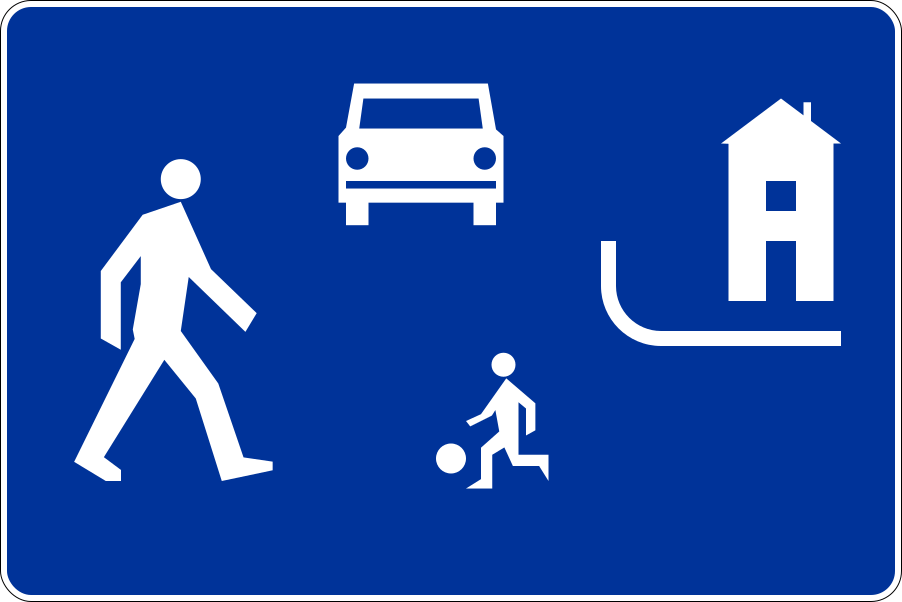 Start of a residential area.
English • Traffic sign D-40 • Residential area. Sign D-40 marks entry to a residential area. Sign D-41, End of the residential area, marks the exit.
Polski • D-40 • strefa zamieszkania. Znak D-40 „strefa zamieszkania” oznacza wjazd do strefy zamieszkania. Znak D-41 „koniec strefy zamieszkania” oznacza wyjazd ze strefy zamieszkania.
Sources
🔗 Commons.wikimedia.org
🔗 Eli.gov.pl • § 58 ust. 1
SVG source: Commons.wikimedia.org • Original SVG
Szczepan • Public domain • Original revision 2025-10-16. Wikimedia original unmodified.
Artwork reviewed against the Polish official sign catalogue, Dz.U. 2019 poz. 2310: Eli.gov.pl • D-40, PDF page 44, with amendments 2021/433, 2021/2065, 2022/2372 and 2026/133 checked. Catalogue-equivalent illustration; intentional update from the previous PNG. This is an educational illustration, not a manufacturing specification.
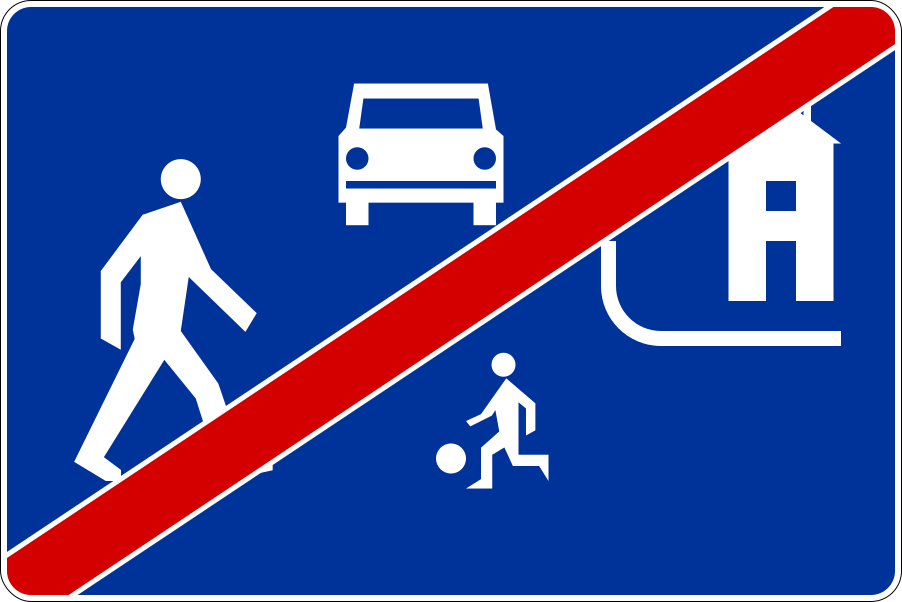 End of the residential area.
English • Traffic sign D-41 • End of the residential area. Sign D-40, Residential area, marks entry to a residential area. Sign D-41 marks the exit.
Polski • D-41 • koniec strefy zamieszkania. Znak D-40 „strefa zamieszkania” oznacza wjazd do strefy zamieszkania. Znak D-41 „koniec strefy zamieszkania” oznacza wyjazd ze strefy zamieszkania.
Sources
🔗 Commons.wikimedia.org
🔗 Eli.gov.pl • § 58 ust. 1
SVG source: Commons.wikimedia.org • Original SVG
Szczepan • Public domain • Original revision 2025-10-16. Wikimedia original unmodified.
Artwork reviewed against the Polish official sign catalogue, Dz.U. 2019 poz. 2310: Eli.gov.pl • D-41, PDF page 44, with amendments 2021/433, 2021/2065, 2022/2372 and 2026/133 checked. Catalogue-equivalent illustration; intentional update from the previous PNG. This is an educational illustration, not a manufacturing specification.
What speed limit applies in a residential area in Poland?
The maximum in the specially signposted category is 20 km/h. Lower speed may be necessary around pedestrians or children.
🔗 eli.gov.pl • Poland, Road Traffic Law — articles 2(16), 11(5), 17, 20, 49; Signs 58
What rights do pedestrians have in a signposted residential area in Poland?
Pedestrians may use the whole road width and have priority over vehicles. Drive so that people can move safely and do not assume that they must use a marked crossing.
🔗 eli.gov.pl • Poland, Road Traffic Law — articles 2(16), 11(5), 17, 20, 49; Signs 58
Where may I park in a residential area in Poland?
Parking is permitted only in places designated for it within the signed category. When leaving the area, the separate rule for joining traffic requires you to give way to other road users.
🔗 eli.gov.pl • Poland, Road Traffic Law — articles 2(16), 11(5), 17, 20, 49; Signs 58
5. Built-up area
A built-up area is an area containing concentrated buildings, streets and regular local activity. Drivers should expect more pedestrians, cyclists, intersections, parked vehicles, public transport and vehicles entering or leaving properties.
Many countries apply special traffic rules and lower default speed limits within built-up areas. The area may be identified by entrance and exit signs, street lighting or other legal criteria, so drivers must follow local signs and regulations.
Wikimedia.org • Damianwiszowaty12 • CC BY-SA
How do people refer to a built-up area in Poland?
The official Polish term is obszar zabudowany. Its beginning and end are marked by the built-up-area traffic signs.
🔗 eli.gov.pl • Poland, Road Traffic Law — articles 2(15)–(16), 19–21; Signs 27, 32, 58–60
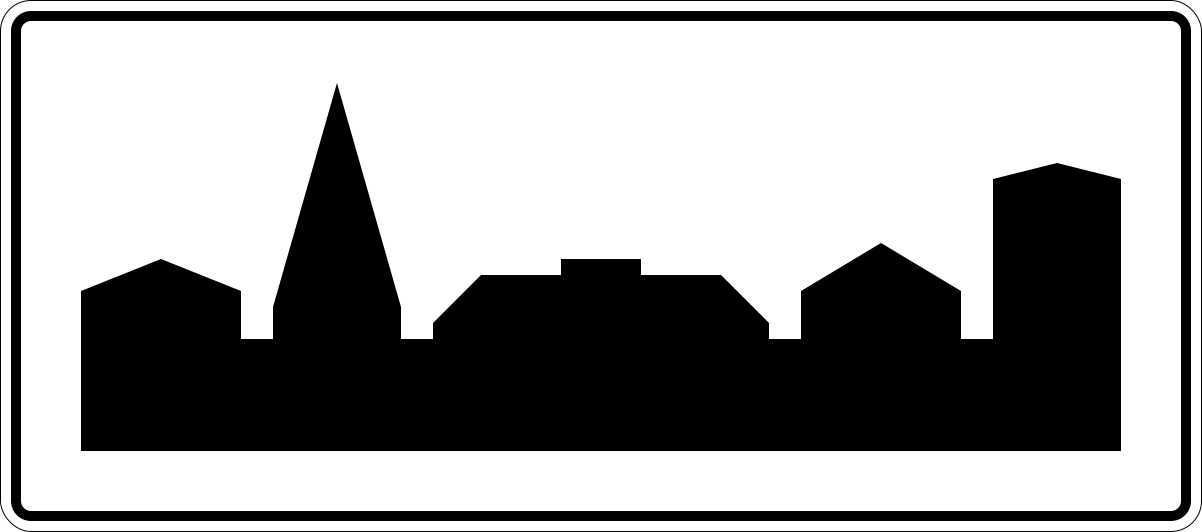 Start of a built-up area.
English • Traffic sign D-42 • Built-up area. Sign D-42 marks entry to a built-up area. Sign D-43, End of the built-up area, marks the exit.
Polski • D-42 • obszar zabudowany. Znak D-42 „obszar zabudowany” oznacza wjazd na obszar zabudowany. Znak D-43 „koniec obszaru zabudowanego” oznacza wyjazd z obszaru zabudowanego.
Sources
🔗 Commons.wikimedia.org
🔗 Eli.gov.pl • § 58 ust. 3
SVG source: Commons.wikimedia.org • Original SVG
Julo • Public domain • Original revision 2025-10-13. Wikimedia original unmodified.
Artwork reviewed against the Polish official sign catalogue, Dz.U. 2019 poz. 2310: Eli.gov.pl • D-42, PDF page 44, with amendments 2021/433, 2021/2065, 2022/2372 and 2026/133 checked. Catalogue-equivalent illustration; intentional update from the previous PNG. This is an educational illustration, not a manufacturing specification.
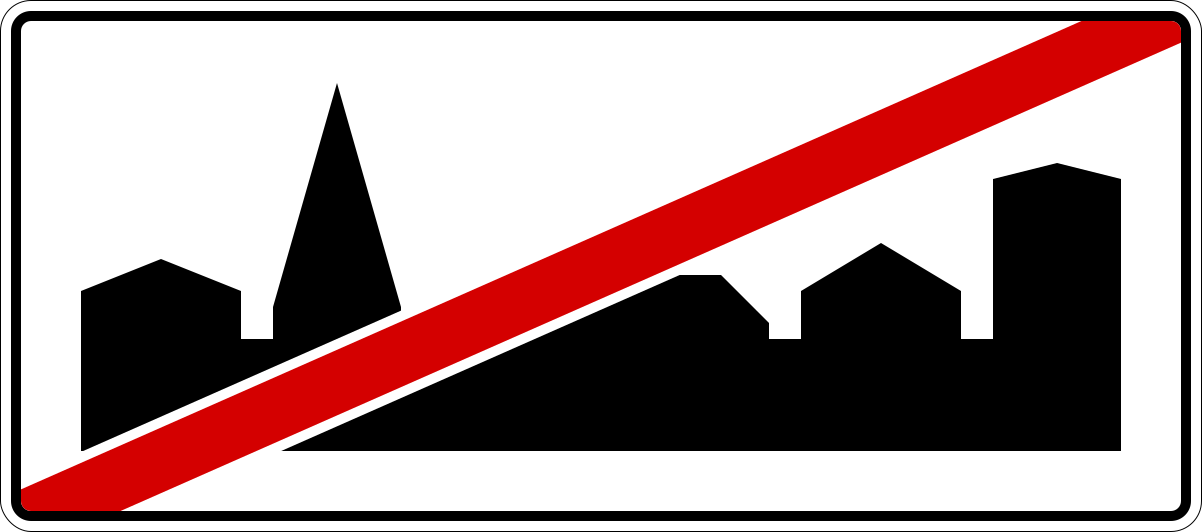 End of the built-up area.
English • Traffic sign D-43 • End of the built-up area. Sign D-42, Built-up area, marks entry to a built-up area. Sign D-43 marks the exit.
Polski • D-43 • koniec obszaru zabudowanego. Znak D-42 „obszar zabudowany” oznacza wjazd na obszar zabudowany. Znak D-43 „koniec obszaru zabudowanego” oznacza wyjazd z obszaru zabudowanego.
Sources
🔗 Commons.wikimedia.org
🔗 Eli.gov.pl • § 58 ust. 3
SVG source: Commons.wikimedia.org • Original SVG
Julo • Public domain • Original revision 2025-10-13. Wikimedia original unmodified.
Artwork reviewed against the Polish official sign catalogue, Dz.U. 2019 poz. 2310: Eli.gov.pl • D-43, PDF page 44, with amendments 2021/433, 2021/2065, 2022/2372 and 2026/133 checked. Catalogue-equivalent illustration; intentional update from the previous PNG. This is an educational illustration, not a manufacturing specification.
How can you recognise a built-up area in Poland?
Look for the white sign with a black silhouette of buildings and its crossed-out end sign. A green town-name sign identifies the locality but does not itself mark entry into the built-up-area speed category.
🔗 eli.gov.pl • Poland, Road Traffic Law — articles 2(15)–(16), 19–21; Signs 27, 32, 58–60
What speed limit applies to cars in a built-up area in Poland?
The ordinary maximum is 50 km/h throughout the day and night, unless another limit applies. Older advice describing a higher urban limit at night is no longer current.
🔗 eli.gov.pl • Poland, Road Traffic Law — articles 2(15)–(16), 19–21; Signs 27, 32, 58–60
Is a Polish built-up area the same as a residential area?
No. A specially signposted strefa zamieszkania has a 20 km/h maximum and additional pedestrian and parking rules. Those rules do not apply throughout every ordinary built-up area.
🔗 eli.gov.pl • Poland, Road Traffic Law — articles 2(15)–(16), 19–21; Signs 27, 32, 58–60
6. Zone
A traffic zone is an area in which a traffic rule applies throughout all included roads or road sections. The rule normally begins at a zone-entry sign and remains applicable until the corresponding end-of-zone sign is passed.
Zones may regulate speed, parking, access, vehicle categories, emissions or other traffic behaviour. The signs used, the roads covered and the effect of intersections or local exceptions depend on local traffic law.
Wikimedia.org • Panek • CC BY-SA
How do people refer to traffic zones in Poland?
A Polish speed zone is a strefa ograniczonej prędkości. It is different from a strefa zamieszkania, the residential-area category with its own 20 km/h limit and additional rules.
🔗 eli.gov.pl • Poland, Road Traffic Law — articles 2(15)–(16), 19–21; Signs 27, 32, 58–60
Where does a zone rule apply in Poland?
The speed shown at the zone entrance continues through junctions until the zone-end sign. Do not apply the ordinary junction-ending rule for a road-specific speed sign to the whole speed zone.
🔗 eli.gov.pl • Poland, Road Traffic Law — articles 2(15)–(16), 19–21; Signs 27, 32, 58–60
Can speed humps inside a Polish speed zone be present without individual warning signs?
Yes. In a speed zone limited to 30 km/h or less, speed humps or other devices requiring slow driving may be present without additional warning signs. Watch the road layout and keep your speed appropriate.
🔗 eli.gov.pl • Poland, Road Traffic Law — articles 2(15)–(16), 19–21; Signs 27, 32, 58–60
How do you know when a traffic zone ends in Poland?
Look for the end-of-speed-zone sign. That ends the zone limit, but the ordinary built-up-area limit, a new signed limit or a different special area can then apply.
🔗 eli.gov.pl • Poland, Road Traffic Law — articles 2(15)–(16), 19–21; Signs 27, 32, 58–60
7. Speed limit
A speed limit is the maximum legal speed permitted on a road, lane or within a designated area. It may be established by general traffic law or indicated by fixed, variable or temporary traffic signs.
A speed limit is a maximum, not a target speed. Drivers must travel more slowly whenever traffic, visibility, weather, road conditions, vulnerable road users or the condition of the vehicle make the maximum permitted speed unsafe.
Wikimedia.org • Yarl • CC BY-SA
Which general speed limits should car drivers know in Poland?
For an ordinary car without a trailer, the general maxima are 50 km/h in built-up areas, 90 km/h on ordinary single-carriageway rural roads, 100 km/h on single-carriageway expressways, 120 km/h on dual-carriageway expressways and 140 km/h on motorways. A non-expressway dual carriageway with at least two lanes in each direction has a 100 km/h general maximum. Obey lower signs.
🔗 eli.gov.pl • Poland, Road Traffic Law — articles 2(15)–(16), 19–21; Signs 27, 32, 58–60
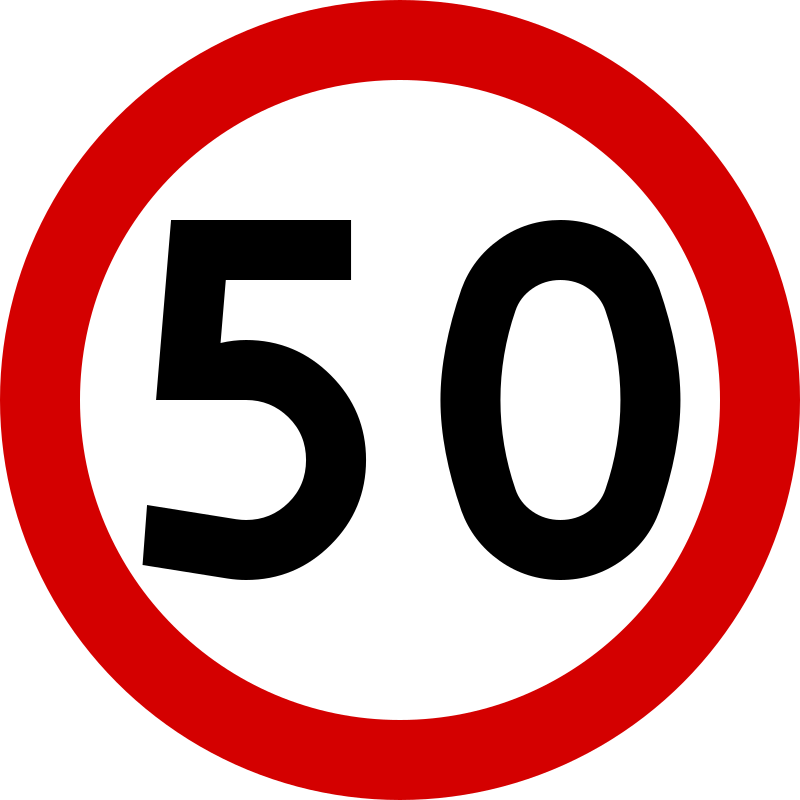 Start of a speed limit.
English • Traffic sign B-33 • Speed limit. Sign B-33 prohibits exceeding the speed shown in kilometres per hour. Subject to subsection 4 and section 32, the limit applies until another limit is introduced by B-33 or B-43; D-40 marks the beginning of a residential area; or signs mark the beginning or end of a built-up area as referred to in section 58(3) and section 114(1), points 1 and 2.
Polski • B-33 • ograniczenie prędkości. Znak B-33 „ograniczenie prędkości” oznacza zakaz przekraczania prędkości określonej na znaku liczbą kilometrów na godzinę. Dopuszczalna prędkość określona na znaku obowiązuje, z zastrzeżeniem ust. 4 i § 32, do miejsca: wprowadzenia innej dopuszczalnej prędkości znakiem B-33 lub B-43; umieszczenia znaku D-40 oznaczającego początek strefy zamieszkania; umieszczenia znaków oznaczających odpowiednio początek lub koniec obszaru zabudowanego, o których mowa w § 58 ust. 3 i w § 114 ust. 1 pkt 1 i 2.
Sources
🔗 Commons.wikimedia.org
🔗 Eli.gov.pl • § 27 ust. 1
SVG source: Commons.wikimedia.org • Original SVG
Miko101 • Public domain • Original revision 2026-03-30. Wikimedia original unmodified.
Artwork reviewed against the Polish official sign catalogue, Dz.U. 2019 poz. 2310: Eli.gov.pl • B-33, PDF page 42, with amendments 2021/433, 2021/2065, 2022/2372 and 2026/133 checked. Catalogue-equivalent illustration; intentional update from the previous PNG. This is an educational illustration, not a manufacturing specification.
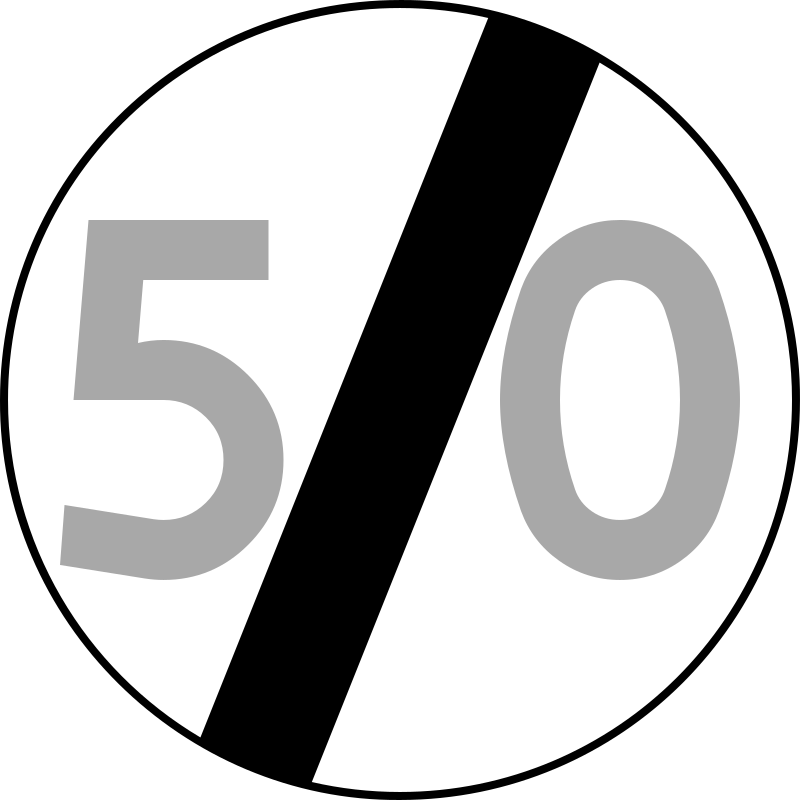 End of the speed limit.
English • Traffic sign B-34 • End of the speed limit. Sign B-34 cancels the speed restriction introduced by B-33.
Polski • B-34 • koniec ograniczenia prędkości. Znak B-34 „koniec ograniczenia prędkości” oznacza odwołanie ograniczenia prędkości wprowadzonego znakiem B-33.
Sources
🔗 Commons.wikimedia.org
🔗 Eli.gov.pl • § 27 ust. 4
SVG source: Commons.wikimedia.org • Original SVG
Szczepan dyskusja Mail 18:29, 31 December 2006 (UTC) • Public domain • Original revision 2025-10-01. Wikimedia original unmodified.
Artwork reviewed against the Polish official sign catalogue, Dz.U. 2019 poz. 2310: Eli.gov.pl • B-34, PDF page 42, with amendments 2021/433, 2021/2065, 2022/2372 and 2026/133 checked. Catalogue-equivalent illustration; intentional update from the previous PNG. This is an educational illustration, not a manufacturing specification.
Does Poland permit a higher general urban speed at night?
No. The general built-up-area maximum is 50 km/h both day and night. The former higher night-time default no longer applies. Follow a different applicable sign or the lower rule for a special area.
🔗 eli.gov.pl • Poland, Road Traffic Law — articles 2(15)–(16), 19–21; Signs 27, 32, 58–60
Why do Polish expressways have both 100 and 120 km/h car limits?
The general maximum depends on the carriageways: 100 km/h on a single-carriageway expressway and 120 km/h on a dual-carriageway expressway. A motorway is a separate category with a general 140 km/h car limit. Lower signs remain binding.
🔗 eli.gov.pl • Poland, Road Traffic Law — articles 2(15)–(16), 19–21; Signs 27, 32, 58–60
8. Footpath
A footpath is a path or part of a road intended primarily for pedestrian traffic. It may run alongside a road, through a park or residential area, or independently from roads used by motor vehicles.
A footpath may be reserved exclusively for pedestrians or may form part of a shared route with cyclists or other permitted users. Access, priority and permitted users depend on the traffic signs and local regulations applying to the path.
Wikimedia.org • Krzysztof Popławski • CC BY-SA
How does Poland distinguish a pavement from the wider pedestrian route?
A droga dla pieszych is a pedestrian route, while a chodnik is its part intended exclusively for pedestrian movement. The terminology was clarified in the road rules. A route designated for both pedestrians and cyclists is a different facility.
🔗 eli.gov.pl • Poland, Road Traffic Law — articles 2, 11, 26–27, 33; Signs 37, 40
When can cyclists use a Polish pavement or pedestrian route?
Exceptions include supervising a child under ten on a bicycle; dangerous weather; or a pavement at least 2 m wide beside a road allowing over 50 km/h, with no suitable cycle facility. These are conditional exceptions, not general pavement-cycling permission.
🔗 eli.gov.pl • Poland, Road Traffic Law — articles 2, 11, 26–27, 33; Signs 37, 40
What duties apply to cyclists using a Polish pedestrian route under an exception?
Ride at a speed close to walking pace, exercise particular care, give way to pedestrians and avoid obstructing them. Permission to use the route does not create equal priority over walkers or allow riding quickly through a crowd.
🔗 eli.gov.pl • Poland, Road Traffic Law — articles 2, 11, 26–27, 33; Signs 37, 40
9. Bike path
A bike path is a part of a road or a separate route intended primarily or exclusively for people riding bicycles. It may be physically separated from motor traffic, marked on the road surface or identified by traffic signs.
Bike paths may be one-way, two-way or shared with other road users. The permitted users, direction of travel, priority rules and obligation to use the path depend on local traffic signs and regulations.
Wikimedia.org • Adrian Grycuk • CC BY-SA
How does Poland distinguish a cycle path from a cycle lane?
A droga dla rowerów is a signed cycling route outside the carriageway. A pas ruchu dla rowerów is a marked carriageway lane for bicycles travelling in one direction. A combined pedestrian-and-cycle route is a separately recognised facility.
🔗 eli.gov.pl • Poland, Road Traffic Law — articles 2, 11, 26–27, 33; Signs 37, 40
Must cyclists use a Polish cycle path or cycle lane?
Yes, where it is designated for the direction in which they are travelling or intend to turn. This obligation also includes the relevant combined walking and cycling route. A facility for another direction does not automatically serve your journey.
🔗 eli.gov.pl • Poland, Road Traffic Law — articles 2, 11, 26–27, 33; Signs 37, 40
Who has priority on a Polish shared walking and cycling route?
Cyclists must exercise particular care and give way to pedestrians. Shared access does not create equal priority over walkers. Where the facility divides users into separate parts, follow the indicated allocation.
🔗 eli.gov.pl • Poland, Road Traffic Law — articles 2, 11, 26–27, 33; Signs 37, 40
10. Shared-use path
A shared-use path is a path or part of a road intended for use by both pedestrians and cyclists. Unlike facilities where pedestrians and cyclists have clearly separated sections, users of a shared-use path normally travel within the same general space.
Because users may travel at very different speeds, cyclists should approach pedestrians carefully, adapt their speed and leave sufficient space when passing. The permitted users, priority rules and any speed restrictions depend on the local traffic signs and regulations.

What does Poland call a combined walking and cycling route?
The official term is droga dla pieszych i rowerów. Check the sign and markings: pedestrians and cyclists may share one surface or have separately allocated parts. The combined designation differs from a bicycle-only facility.
🔗 eli.gov.pl • Poland, Road Traffic Law — articles 2, 11, 26–27, 33; Signs 37, 40
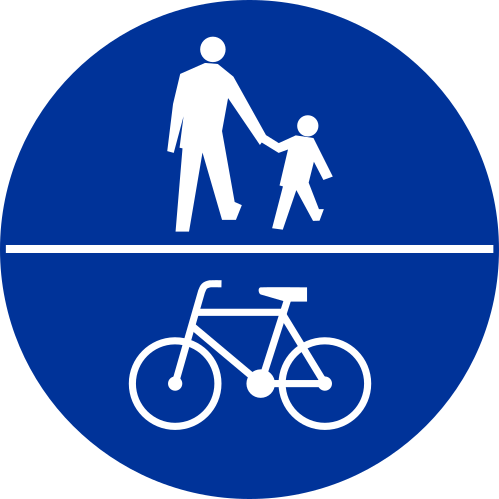 Mandatory shared pedestrian and cycle path.
English • Traffic sign C-13+C-16 • Cycle route and pedestrian route. The symbols of C-13 and C-16 on one sign, separated by a vertical line, indicate adjoining cycle and pedestrian routes on the respective sides shown. Cyclists must use the route if it serves the direction in which they are travelling or intend to turn.
Polski • C-13+C-16 • droga dla rowerów i droga dla pieszych. Umieszczone na jednej tarczy symbole znaków C-13 i C-16 oddzielone kreską pionową oznaczają drogę dla rowerów i drogę dla pieszych położone obok siebie, odpowiednio po stronach wskazanych na znaku. Kierujący rowerami są obowiązani do korzystania z tak oznakowanej drogi, jeżeli jest ona wyznaczona dla kierunku, w którym oni poruszają się lub zamierzają skręcić.
Sources
🔗 Commons.wikimedia.org
🔗 Eli.gov.pl • § 40 ust. 2
SVG source: Pz • Public domain • Original revision 2012-04-16. Wikimedia original unmodified.
Who has priority on an undivided Polish walking and cycling route?
Cyclists must exercise particular care and give way to pedestrians. A shared designation does not give faster users equal or greater priority over walkers. Slow down and leave enough space for safe passage.
🔗 eli.gov.pl • Poland, Road Traffic Law — articles 2, 11, 26–27, 33; Signs 37, 40
Must cyclists use a designated Polish combined walking and cycling route?
Yes, where it is designated for the direction they are travelling or intend to turn. The obligation does not remove pedestrian priority on the shared surface. A facility serving another direction is not automatically the required route for that journey.
🔗 eli.gov.pl • Poland, Road Traffic Law — articles 2, 11, 26–27, 33; Signs 37, 40
11. Separated path
A separated path is a path or part of a road where different categories of road users, typically pedestrians and cyclists, are assigned separate sections of the same overall route. The sections may be distinguished by road markings, different paving materials, a kerb or another physical separation.
Users should remain within the part of the path intended for them and take particular care where the sections cross, merge or connect with roads. The permitted users, priority rules and any speed restrictions depend on the local traffic signs and regulations.
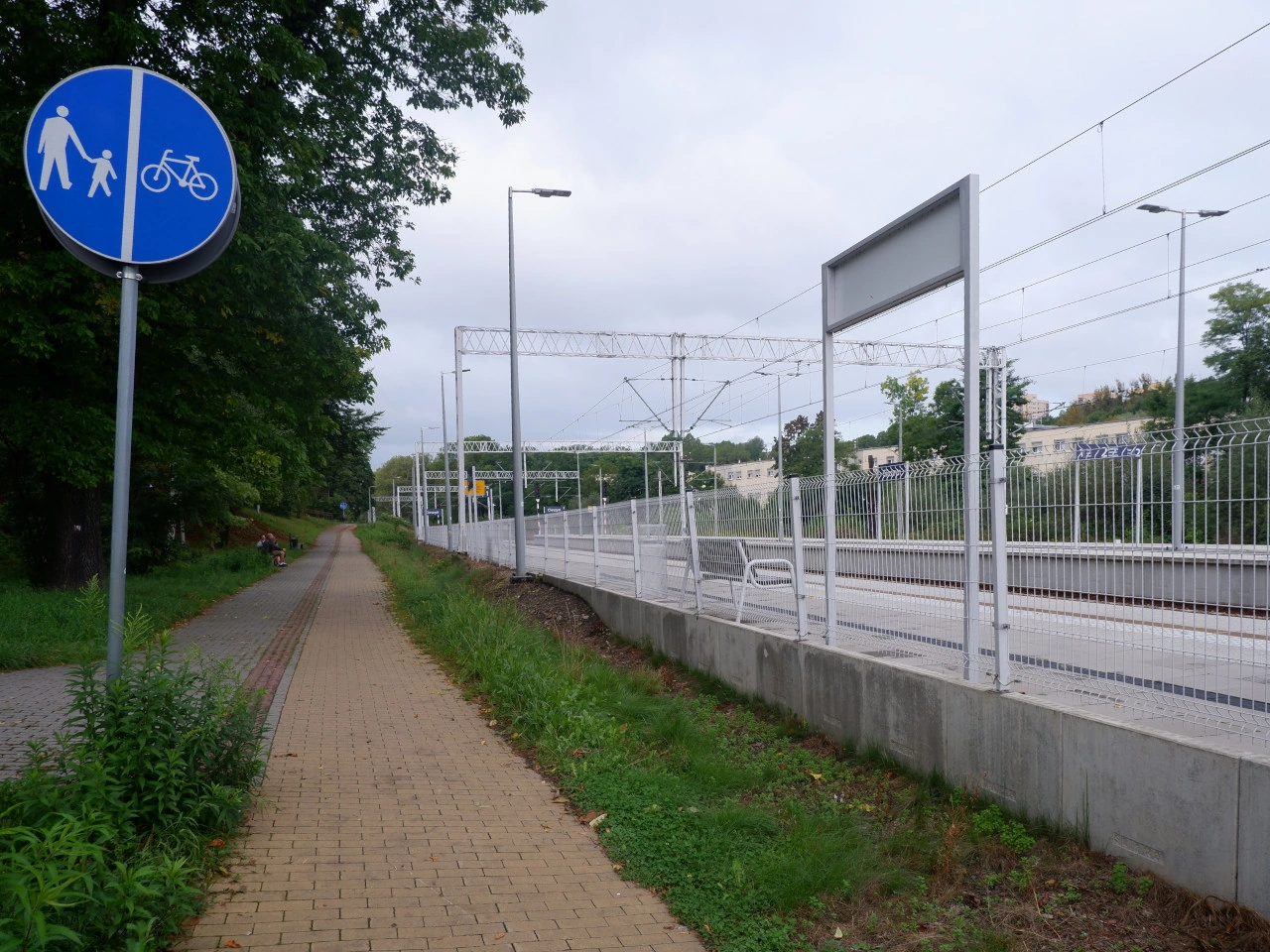
Wikimedia.org • Kamil Czaiński • CC BY-SA
How does Poland sign a cycle path beside a pedestrian path?
The combined blue circular sign has bicycle and pedestrian symbols separated by a vertical line. It indicates a droga dla rowerów beside a droga dla pieszych, on the respective sides shown by the symbols.
🔗 eli.gov.pl • Poland, Road Traffic Law — articles 2, 11, 26–27, 33; Signs 37, 40
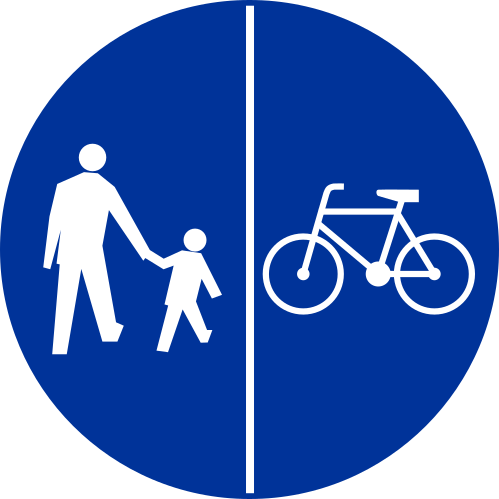 Mandatory divided pedestrian and cycle path.
English • Traffic sign C-13+C-16 • Cycle route and pedestrian route. The symbols of C-13 and C-16 on one sign, separated by a vertical line, indicate adjoining cycle and pedestrian routes on the respective sides shown. Cyclists must use the route if it serves the direction in which they are travelling or intend to turn.
Polski • C-13+C-16 • droga dla rowerów i droga dla pieszych. Umieszczone na jednej tarczy symbole znaków C-13 i C-16 oddzielone kreską pionową oznaczają drogę dla rowerów i drogę dla pieszych położone obok siebie, odpowiednio po stronach wskazanych na znaku. Kierujący rowerami są obowiązani do korzystania z tak oznakowanej drogi, jeżeli jest ona wyznaczona dla kierunku, w którym oni poruszają się lub zamierzają skręcić.
Sources
🔗 Commons.wikimedia.org
🔗 Eli.gov.pl • § 40 ust. 2
SVG source: Pz • Public domain • Original revision 2012-04-16. Wikimedia original unmodified.
Does a horizontal line on Poland’s combined path sign also allocate separate sides?
No. A horizontal line indicates a walking and cycling route where both groups use the whole surface and cyclists give way to pedestrians. A vertical line indicates the adjoining separately allocated facilities. The line’s orientation changes the meaning.
🔗 eli.gov.pl • Poland, Road Traffic Law — articles 2, 11, 26–27, 33; Signs 37, 40
Can I assume the walking section is always on the same side of a Polish divided route?
No. The sign specifies the relative positions of the cycle route and pedestrian route. Use the side corresponding to your symbol and check the actual layout. Do not select a section solely from a left-or-right convention learned elsewhere.
🔗 eli.gov.pl • Poland, Road Traffic Law — articles 2, 11, 26–27, 33; Signs 37, 40
12. Pedestrian warning
A pedestrian warning is a traffic warning indicating that pedestrians may be crossing or entering the roadway ahead. It is commonly used near pedestrian crossings or other locations where drivers need advance notice of frequent pedestrian activity.
Drivers approaching a pedestrian warning should reduce speed when necessary, watch carefully for pedestrians and be prepared to stop. The design of the warning sign and the priority rules at the crossing vary between countries.

Wikimedia.org • Ralf Lotys • CC BY
How should I react to a pedestrian warning in Poland?
Reduce speed, look along both sides of the road and be ready to stop. The warning identifies a pedestrian hazard ahead; children, people with limited mobility or others may enter the road unexpectedly.
🔗 eli.gov.pl • Poland, Road Traffic Law — articles 13–14, 19, 26; Signs 8, 47, 88
Does a pedestrian warning in Poland identify the crossing itself?
Not necessarily. An advance warning alerts you to danger ahead. The actual crossing is identified by its own signs, markings or signals. Apply the crossing rules when you reach it, and follow any supplementary distance information.
🔗 eli.gov.pl • Poland, Road Traffic Law — articles 13–14, 19, 26; Signs 8, 47, 88
What should drivers know about pedestrian crossings in Poland?
At a przejście dla pieszych, use special caution, reduce speed and give way to pedestrians on or entering it. The rule for pedestrians entering a crossing has a tram exception.
🔗 eli.gov.pl • Poland, Road Traffic Law — articles 13–14, 19, 26; Signs 8, 47, 88
13. Tunnel
A tunnel is a covered passage that carries a road through or beneath an obstacle such as a hill, mountain, building, waterway or another transport route. Road tunnels may contain one or more traffic lanes and can carry traffic in one or both directions.
Driving in a tunnel requires particular attention because visibility, available escape routes and space for avoiding hazards are limited. Drivers should follow the applicable lighting, speed, lane and following-distance rules and pay attention to emergency exits, traffic signals and variable-message signs.

Wikimedia.org • Panek • CC BY-SA
What should I check before entering a tunnel in Poland?
Read the entrance signs and keep the statutory tunnel spacing where it applies. Outside built-up areas, a tunnel longer than 500 m normally requires at least 50 m for vehicles up to 3.5 tonnes and buses, and 80 m for vehicle combinations and other vehicles, subject to signed changes.
🔗 eli.gov.pl • Poland, Road Traffic Law — articles 19(4)–(5), 20, 49, 51; Signs 56
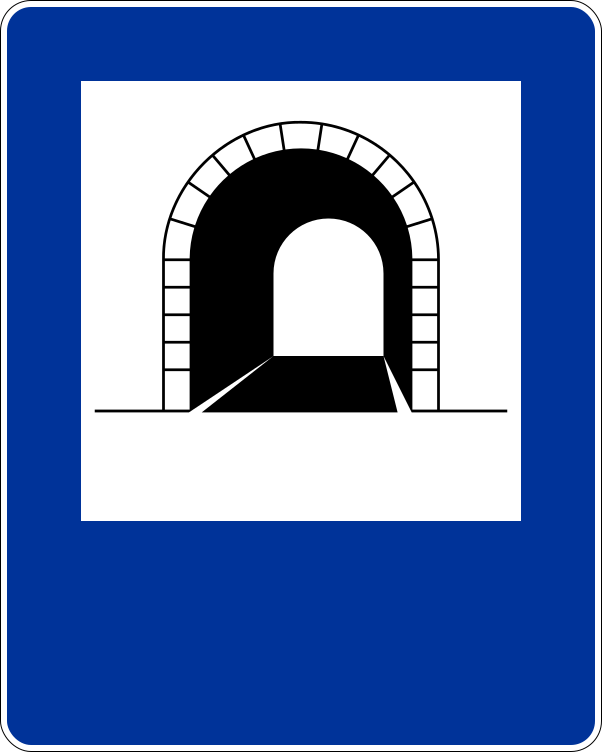 Start of a tunnel.
English • Traffic sign D-37 • Tunnel. Sign D-37 marks entry to a tunnel. The exit is marked by D-38, End of tunnel.
Polski • D-37 • tunel. Znak D-37 „tunel” oznacza wjazd do tunelu. Wyjazd z tunelu jest oznaczony znakiem D-38 „koniec tunelu”.
Sources
🔗 Commons.wikimedia.org
🔗 Eli.gov.pl • § 56 ust. 1
SVG source: Commons.wikimedia.org • Original SVG
No machine-readable author provided. MStankie assumed (based on copyright claims). • Public domain • Original revision 2025-10-16. Wikimedia original unmodified.
Artwork reviewed against the Polish official sign catalogue, Dz.U. 2019 poz. 2310: Eli.gov.pl • D-37, PDF page 44, with amendments 2021/433, 2021/2065, 2022/2372 and 2026/133 checked. Catalogue-equivalent illustration; intentional update from the previous PNG. This is an educational illustration, not a manufacturing specification.
Does a tunnel sign in Poland set a universal speed limit?
No single speed can be read from the tunnel pictogram. Apply the road’s relevant limit and any permanent or electronic speed restriction, and drive more slowly when visibility, queues or another hazard require it.
🔗 eli.gov.pl • Poland, Road Traffic Law — articles 19(4)–(5), 20, 49, 51; Signs 56
Is every tunnel in Poland open to pedestrians and cyclists?
No. Check the road category and access signs before entering. A motorway tunnel, a vehicle-restricted tunnel and a purpose-built walking or cycling underpass have different access arrangements. Emergency evacuation routes do not establish ordinary public access.
🔗 eli.gov.pl • Poland, Road Traffic Law — articles 19(4)–(5), 20, 49, 51; Signs 56
14. Speed bump
A speed bump is a raised traffic-calming device placed across all or part of a road to make drivers reduce their speed. It is commonly used near homes, schools, crossings, parking areas and other places where low vehicle speeds are important.
Speed bumps vary in shape, height and legal status. Drivers should approach them at a low, controlled speed and follow any warning signs or speed limits that apply.

Wikimedia.org • MOs810 • CC BY-SA
How should I recognise and approach a speed bump in Poland?
Look for a raised surface, approach warnings, road markings and any separate speed instruction. A traffic-calming device can be part of a raised crossing or junction, so identify the layout and the road users who may use it.
🔗 eli.gov.pl • Poland, Road Traffic Law — articles 13–14, 19, 26; Signs 8, 47, 88
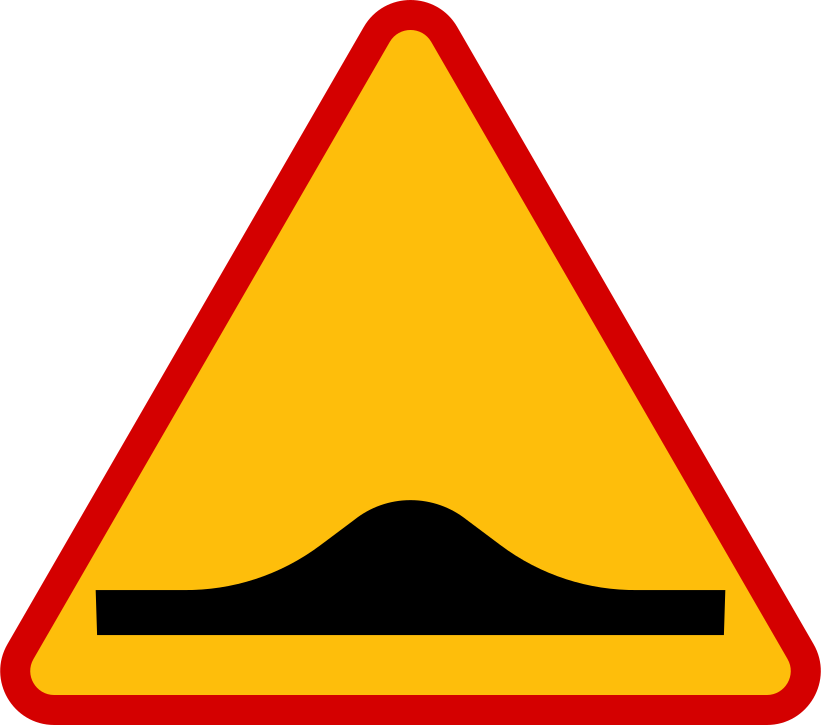 Warning for a speed bump.
English • Traffic sign A-11a • Speed hump. Sign A-11a warns of a raised part of the carriageway intended to slow vehicles.
Polski • A-11a • próg zwalniający. Znak A-11a „próg zwalniający” ostrzega o wypukłości na jezdni zastosowanej w celu spowolnienia ruchu pojazdów.
Sources
🔗 Commons.wikimedia.org
🔗 Eli.gov.pl • § 7 ust. 2
SVG source: Commons.wikimedia.org • Original SVG
Author not stated on source page • Public domain • Original revision 2025-10-07. Wikimedia original unmodified.
Artwork reviewed against the Polish official sign catalogue, Dz.U. 2019 poz. 2310: Eli.gov.pl • A-11a, PDF page 41, with amendments 2021/433, 2021/2065, 2022/2372 and 2026/133 checked. Catalogue-equivalent illustration; intentional update from the previous PNG. This is an educational illustration, not a manufacturing specification.
Which speed should I use at a raised device in Poland?
Obey the applicable speed restriction and slow further for the device, visibility and other road users. Do not assume that a raised device carries the same numerical rule as one in another country; a safe approach can be well below the road’s maximum.
🔗 eli.gov.pl • Poland, Road Traffic Law — articles 13–14, 19, 26; Signs 8, 47, 88
Does a raised road surface give pedestrians priority in Poland?
A raised device alone does not identify pedestrian priority. If it incorporates a crossing, apply the crossing’s controls and the national rules. At a przejście dla pieszych, use special caution, reduce speed and give way to pedestrians on or entering it. The rule for pedestrians entering a crossing has a tram exception.
🔗 eli.gov.pl • Poland, Road Traffic Law — articles 13–14, 19, 26; Signs 8, 47, 88
15. Toll road
A toll road is a road, motorway, bridge, tunnel or other route for which users must pay a charge. The toll may apply to all vehicles or only to particular vehicle categories, and the amount can depend on factors such as distance travelled, vehicle type, weight or emissions.
Tolls may be collected at toll booths, electronically or through a vignette or distance-based charging system. Drivers should check the applicable payment rules before using a toll road, especially when travelling in another country.

Wikimedia.org • Ralf Lotys • CC BY
Which road-charging system should I check in Poland?
Poland distinguishes e-TOLL for qualifying heavier vehicles and buses from concession motorway tolls. From 21 September 2026, a towing vehicle with a maximum authorised mass of no more than 3.5 tonnes is exempt from e-TOLL when towing a trailer, including where the combination exceeds 3.5 tonnes. This does not remove separate concession motorway charges.
What should I check before using a charged road in Poland?
Check the towing vehicle’s maximum authorised mass, the applicable vehicle category and the operator of the road section. From 21 September 2026, towing a trailer does not bring a vehicle of no more than 3.5 tonnes maximum authorised mass into e-TOLL merely because the combination exceeds that threshold. Concession motorway charges remain a separate check.
Does the absence of a toll booth prove that a road is free in Poland?
The absence of a payment booth is not proof that a charged road is free. A vignette, electronic account, vehicle-registration record or another payment procedure may be used where the actual scheme provides for it. Follow the responsible authority or operator’s instructions for that road.
16. Customs
Customs is the government authority responsible for controlling goods entering or leaving a country or customs territory. In road traffic, a customs checkpoint is a place where drivers may be required to stop so officers can inspect the vehicle, luggage, cargo and relevant documents.
Customs controls may take place at borders, ports, ferry terminals, airports or inland control locations. Drivers must follow all traffic signs, lane signals, barriers and instructions from customs officers. Declaration requirements depend on the countries involved and on the type, value, quantity and intended use of the goods being carried.

Wikimedia.org • MOs810 • CC BY-SA
Which customs authority should drivers consult for travel to Poland?
Consult the customs service of Poland’s National Revenue Administration, KAS for the goods, luggage and vehicle-related customs requirements of the journey. Customs controls concern goods and declarations; they must be distinguished from passport checks, a road toll or ordinary traffic control.
Do customs requirements depend on the route and goods when entering Poland?
Yes. Travel within the EU customs territory is treated differently from bringing goods from outside it. Personal use, commercial use, restricted goods and tax or customs special territories can change the requirements. Schengen passport arrangements do not replace customs rules.
What should motorists check before declaring goods in Poland?
Check the official declaration requirements for goods over your applicable allowance, commercial goods, controlled articles and cash or other monetary instruments. These categories have different rules and thresholds. Declare as required and ask customs if unsure; do not assume a duty-free purchase is exempt from all controls.
17. One-way traffic
One-way traffic means that vehicles on a road or carriageway may travel only in one designated direction. The permitted direction is normally indicated by traffic signs, lane arrows or road markings.
Some road users, such as cyclists or public-transport vehicles, may be allowed to travel in the opposite direction when signs expressly permit it. A one-way road does not by itself determine the speed limit, priority or parking rules.

Wikimedia.org • MOs810 • CC BY-SA
How should I read a one-way restriction in Poland?
Follow the direction designated by the street’s one-way signs and any entrance restrictions or lane arrows. A compulsory turn at one junction is different from a restriction applying along the street.
🔗 eli.gov.pl • Poland, Road Traffic Law — articles 16, 22–23; Signs 17, 44
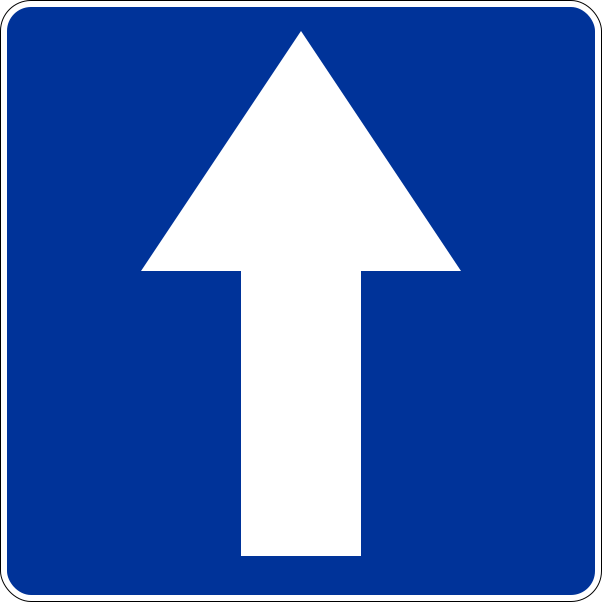 Road with one-way traffic.
English • Traffic sign D-3 • One-way road. Sign D-3 marks the beginning or continuation of a road or carriageway where traffic travels in one direction.
Polski • D-3 • droga jednokierunkowa. Znak D-3 „droga jednokierunkowa” oznacza początek lub kontynuację drogi lub jezdni, na której ruch odbywa się w jednym kierunku.
Sources
🔗 Commons.wikimedia.org
🔗 Eli.gov.pl • § 44 ust. 1
SVG source: Commons.wikimedia.org • Original SVG
Szczepan dyskusja Mail 18:29, 31 December 2006 (UTC) • Public domain • Original revision 2025-10-10. Wikimedia original unmodified.
Artwork reviewed against the Polish official sign catalogue, Dz.U. 2019 poz. 2310: Eli.gov.pl • D-3, PDF page 44, with amendments 2021/433, 2021/2065, 2022/2372 and 2026/133 checked. Catalogue-equivalent illustration; intentional update from the previous PNG. This is an educational illustration, not a manufacturing specification.
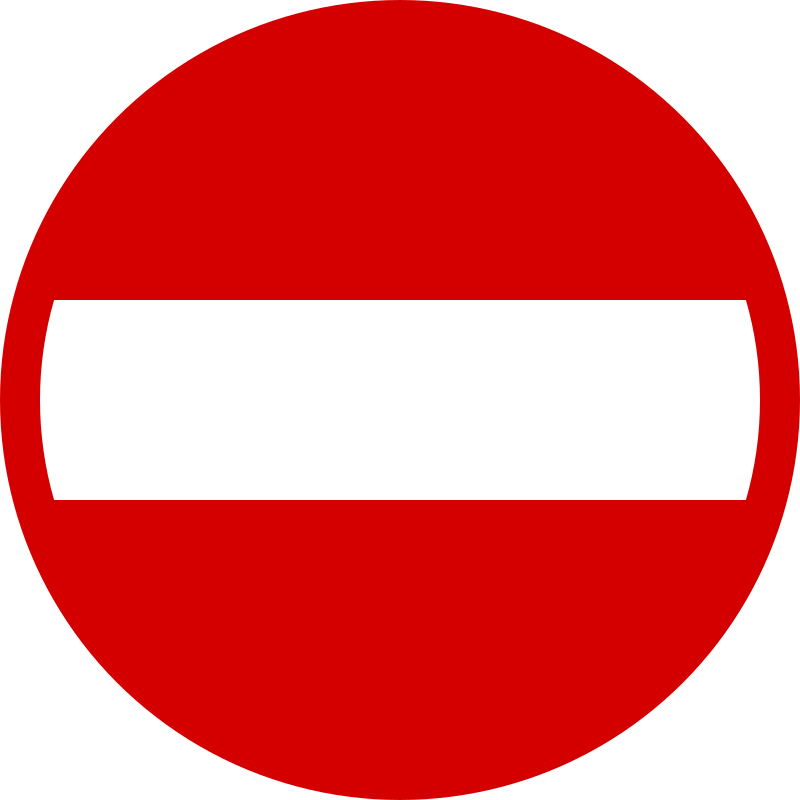 No entry.
English • Traffic sign B-2 • No entry. Sign B-2 prohibits vehicles from entering the road or carriageway from the side where it is installed. The prohibition also applies to organised groups of pedestrians and to people riding or driving animals.
Polski • B-2 • zakaz wjazdu. Znak B-2 „zakaz wjazdu” oznacza zakaz wjazdu pojazdów na drogę lub jezdnię od strony jego umieszczenia; zakaz dotyczy również kolumn pieszych oraz jeźdźców i poganiaczy.
Sources
🔗 Commons.wikimedia.org
🔗 Eli.gov.pl • § 17 ust. 1
SVG source: Commons.wikimedia.org • Original SVG
Author not stated on source page • Public domain • Original revision 2025-09-24. Wikimedia original unmodified.
Artwork reviewed against the Polish official sign catalogue, Dz.U. 2019 poz. 2310: Eli.gov.pl • B-2, PDF page 42, with amendments 2021/433, 2021/2065, 2022/2372 and 2026/133 checked. Catalogue-equivalent illustration; intentional update from the previous PNG. This is an educational illustration, not a manufacturing specification.
May cyclists travel against the general traffic direction in Poland?
Do not assume cyclists are exempt from a road’s direction restriction. Check whether the applicable signs, local traffic arrangement or separately designated cycle facility actually authorise movement in the opposite direction; an ordinary bicycle-route sign is not enough.
🔗 eli.gov.pl • Poland, Road Traffic Law — articles 16, 22–23; Signs 17, 44
Does one-way traffic give me priority or a different speed limit in Poland?
A one-way restriction concerns direction. Continue to follow the applicable speed limit, signals, give-way or stop controls and junction-priority rules. Where authorised counterflow traffic exists, check for it before turning or crossing; your permitted direction is not automatic junction priority.
🔗 eli.gov.pl • Poland, Road Traffic Law — articles 16, 22–23; Signs 17, 44
18. Quay
A quay is a constructed area beside a river, canal, harbour or other body of water, commonly used for loading, unloading, mooring vessels or providing waterside access. A road may run alongside the water or lead directly towards the quay edge.
In road traffic, a quay warning indicates a risk that a vehicle could leave the road and enter the water. Drivers should reduce speed, observe the road layout carefully and keep a safe distance from the waterside edge.

Wikimedia.org • MOs810 • CC BY-SA
What should I watch for near a quay or waterside road in Poland?
Look for an unprotected or poorly protected water’s edge, bends leading towards the water, barriers and local access controls. A quay can be an operational port area or a public waterside road; do not infer the traffic arrangement from the presence of water alone.
🔗 eli.gov.pl • Poland, Road Traffic Law — articles 3, 19–20, 23–24, 49; Signs 3–12
How should I choose a safe speed beside water in Poland?
Use the applicable road or local speed limit and slow further for the foreseeable waterside danger. A hazard warning is not a promise that driving at the maximum is safe. Keep enough visibility and control to avoid the edge, pedestrians, loading activity or a blocked route.
🔗 eli.gov.pl • Poland, Road Traffic Law — articles 3, 19–20, 23–24, 49; Signs 3–12
Does a quay warning allow me to enter or park beside the water in Poland?
Check the actual access and parking restrictions, including any port or dock controls. A waterside warning does not provide permission to enter a restricted facility or park on the edge. Keep the required passage clear and use a permitted place without endangering traffic or people beside the water.
🔗 eli.gov.pl • Poland, Road Traffic Law — articles 3, 19–20, 23–24, 49; Signs 3–12
19. Slope
A slope is a section of road that rises or descends noticeably. A steep slope can affect vehicle speed, braking distance, traction, visibility and the ability of heavy or low-powered vehicles to maintain a steady speed.
Warning signs may indicate a steep ascent or dangerous descent and may show the gradient as a percentage. Drivers should adjust their speed early, select a suitable gear and remain prepared for slow vehicles, bends and changing road conditions.
Wikimedia.org • Karol Szapsza • CC BY-SA
What does a steep-slope warning mean in Poland?
A Polish steep-descent or steep-ascent warning calls attention to the road hazard. A separate speed restriction and the general safe-speed duty continue to apply.
🔗 eli.gov.pl • Poland, Road Traffic Law — articles 3, 19–20, 23–24, 49; Signs 3–12
How should I approach a steep descent in Poland?
Reduce speed before the descent and select a suitable gear to help control the vehicle. Keep enough following distance and avoid building up speed that requires continuous heavy braking. A warning gives no fixed safe descent speed: the gradient, surface, visibility, load and vehicle can require a speed well below the legal maximum.
🔗 eli.gov.pl • Poland, Road Traffic Law — articles 3, 19–20, 23–24, 49; Signs 3–12
What should I check when meeting or overtaking on a slope in Poland?
Overtaking near the crest of a hill is restricted by the Traffic Law. Do not start a manoeuvre without the required visibility and clear space; follow the statutory exceptions and lane arrangement rather than treating a slope sign as permission to pass.
🔗 eli.gov.pl • Poland, Road Traffic Law — articles 3, 19–20, 23–24, 49; Signs 3–12
20. Bus lane
A bus lane is a traffic lane reserved primarily for buses or other authorised public-transport vehicles. It is intended to improve the reliability and flow of public transport by allowing authorised vehicles to avoid general traffic congestion.
Other road users, such as taxis, cyclists, motorcycles or vehicles carrying several occupants, may also be permitted when signs expressly allow them. The operating hours, permitted vehicles, direction of travel and rules for entering or crossing the lane depend on local traffic signs and regulations.

Wikimedia.org • Henryk Borawski • CC BY-SA
Which vehicles may use a bus lane in Poland?
Polish bus-lane signs identify the designated lane and any additionally admitted categories. Current Article 148a also permits legally defined electric vehicles, hydrogen vehicles and motorcycles on designated bus lanes until 1 January 2028. The road manager may impose an occupancy condition on electric vehicles and motorcycles. An ordinary private car does not gain access merely because it carries passengers.
🔗 eli.gov.pl • Poland, Road Traffic Law — articles 5, 16, 49, 148a; Signs 49 and 72
🔗 eli.gov.pl • Poland, 2025/1843 — Article 148a and six-month commencement
May bicycles and motorcycles use a bus lane in Poland?
In Poland, motorcycles receive national permission to use designated bus lanes under Article 148a, as amended with effect from 24 June 2026. The permission runs until 1 January 2028, and the road manager may impose an occupancy condition. Bicycles are a separate category: check whether the actual signs or another applicable authorisation admit them.
🔗 eli.gov.pl • Poland, Road Traffic Law — articles 5, 16, 49, 148a; Signs 49 and 72
🔗 eli.gov.pl • Poland, 2025/1843 — Article 148a and six-month commencement
Does bus-lane access also allow stopping or parking in Poland?
Apply stopping and parking prohibitions separately and keep the public-transport lane usable. A permitted turn or crossing of the lane does not create a parking right.
🔗 eli.gov.pl • Poland, Road Traffic Law — articles 5, 16, 49, 148a; Signs 49 and 72
🔗 eli.gov.pl • Poland, 2025/1843 — Article 148a and six-month commencement
21. Bus stop
A bus stop is a designated place where buses stop to allow passengers to board or leave. It may be identified by a sign, shelter, raised platform, road marking or other public-transport infrastructure and can be located beside the road or in a specially constructed stopping area.
Drivers approaching a bus stop should watch carefully for buses, pedestrians and passengers crossing or entering the roadway. Parking or stopping restrictions may apply around bus stops to keep the area accessible and visible.

Wikimedia.org • Ralf Lotys • CC BY
What stopping or parking restrictions apply at bus stops in Poland?
Stopping is prohibited within 15 metres of the stop post or board. Where the stop has a bay, the prohibition covers the bay’s whole length.
🔗 eli.gov.pl • Poland, Road Traffic Law — articles 18, 49(1)(9); Signs 51
May I briefly drop off a passenger at a bus stop in Poland?
A short passenger pick-up does not create a general exception to that stopping prohibition. Use a lawful place that leaves bus and passenger access clear.
🔗 eli.gov.pl • Poland, Road Traffic Law — articles 18, 49(1)(9); Signs 51
What should I do near a stopped bus in Poland?
In a built-up area, allow a bus that signals to enter traffic from a marked stop, slowing and stopping if necessary. The bus driver must ensure that entering does not endanger traffic.
🔗 eli.gov.pl • Poland, Road Traffic Law — articles 18, 49(1)(9); Signs 51
22. Dead end
A dead-end road is a road that does not provide a through route for some or all vehicles. It may end completely, terminate at a barrier or continue as a path that only certain road users may use.
Drivers may normally enter a dead-end road to reach homes, businesses, parking places or other destinations, but they must be prepared to turn around or leave by the same route. Signs may indicate that pedestrians or cyclists can continue beyond the point where motor traffic cannot.

Wikimedia.org • Grzegorz W. Tężycki • CC BY-SA
What does a dead-end indication mean in Poland?
Polish signs identify a droga bez przejazdu and can give advance information before entering it. The indication describes the road’s lack of a through route.
🔗 eli.gov.pl • Poland, Road Traffic Law — articles 19, 23, 25; Signs 43
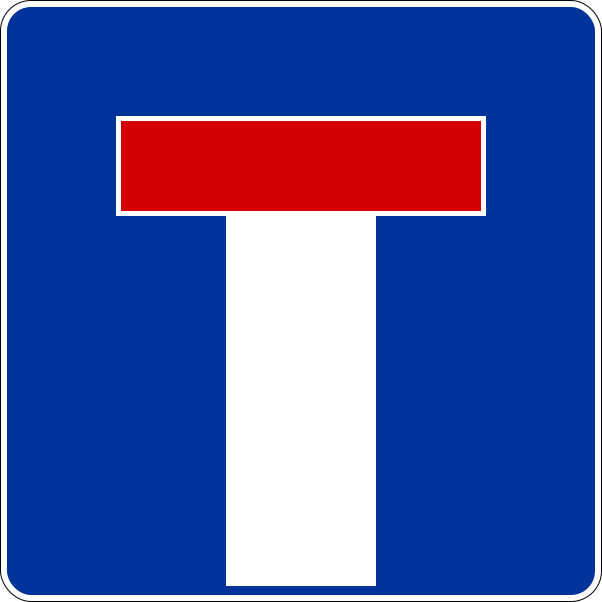 Dead end street.
English • Traffic sign D-4a • Dead-end road. Sign D-4a marks the beginning of a road with no through route.
Polski • D-4a • droga bez przejazdu. Znak D-4a „droga bez przejazdu” oznacza początek drogi bez przejazdu.
Sources
🔗 Commons.wikimedia.org
🔗 Eli.gov.pl • § 45 ust. 1
SVG source: Commons.wikimedia.org • Original SVG
Szczepan dyskusja Mail 18:29, 31 December 2006 (UTC) • Public domain • Original revision 2025-10-10. Wikimedia original unmodified.
Artwork reviewed against the Polish official sign catalogue, Dz.U. 2019 poz. 2310: Eli.gov.pl • D-4a, PDF page 44, with amendments 2021/433, 2021/2065, 2022/2372 and 2026/133 checked. Catalogue-equivalent illustration; intentional update from the previous PNG. This is an educational illustration, not a manufacturing specification.
Can pedestrians or cyclists continue beyond a motor-traffic dead end in Poland?
Check the actual walking or cycling connection and any supplemental information. The lack of a motor exit does not by itself decide whether a cycle or pedestrian route continues.
🔗 eli.gov.pl • Poland, Road Traffic Law — articles 19, 23, 25; Signs 43
Does a dead-end indication change speed or priority rules in Poland?
The no-through information itself does not assign junction priority or a numerical speed limit. Continue to obey the actual speed, access, parking and priority controls. If you need to turn around, use a suitable lawful place, check for pedestrians and cyclists, and do not obstruct the space needed for other vehicles to turn.
🔗 eli.gov.pl • Poland, Road Traffic Law — articles 19, 23, 25; Signs 43
23. Stop sign
A stop sign requires drivers to bring their vehicle to a complete stop and give way before entering or crossing the road ahead. The stop must be made at the stop line or another legally prescribed position.
After stopping, the driver may continue only when this can be done safely and without interfering with traffic that has priority. The sign does not create priority for the driver who has stopped.

Wikimedia.org • Grzegorz W. Tężycki • CC BY-SA
Must I stop completely at a stop sign in Poland?
Yes. Come to a complete stop when the applicable stop sign controls your approach, even when you cannot see another road user. Slowing to a crawl is not a stop. The stopping duty is separate from the duty to give way before continuing.
🔗 eli.gov.pl • Poland, Road Traffic Law — articles 5, 25–27; Signs 5, 21, 43
 Stop and give way.
English • Traffic sign B-20 • Stop. Sign B-20 prohibits entering the junction without stopping before the priority road and requires drivers to give way to traffic on that road.
Polski • B-20 • stop. Znak B-20 „stop” oznacza: zakaz wjazdu na skrzyżowanie bez zatrzymania się przed drogą z pierwszeństwem; obowiązek ustąpienia pierwszeństwa kierującym poruszającym się tą drogą.
Sources
🔗 Commons.wikimedia.org
🔗 Eli.gov.pl • § 21 ust. 1
SVG source: Commons.wikimedia.org • Original SVG
Krzysztof Blachnicki • Public domain • Original revision 2025-09-27. Wikimedia original unmodified.
Artwork reviewed against the Polish official sign catalogue, Dz.U. 2019 poz. 2310: Eli.gov.pl • B-20, PDF page 42, with amendments 2021/433, 2021/2065, 2022/2372 and 2026/133 checked. Catalogue-equivalent illustration; intentional update from the previous PNG. This is an educational illustration, not a manufacturing specification.
Where must I stop at a stop-controlled junction in Poland?
Stop at the mandatory stop line or, where no line identifies the place, at a position with a sufficient view before entering the junction. The stop requirement and the duty to yield must both be satisfied.
🔗 eli.gov.pl • Poland, Road Traffic Law — articles 5, 25–27; Signs 5, 21, 43
Does stopping first give me priority at a stop sign in Poland?
A complete stop does not, by itself, give you priority. Give way to the road users entitled to pass under the junction’s signs and rules, check pedestrians and cyclists, and proceed only when the gap is safe. Do not follow another stopped vehicle through without satisfying your own stopping and yielding duties.
🔗 eli.gov.pl • Poland, Road Traffic Law — articles 5, 25–27; Signs 5, 21, 43
24. Give way
A give-way sign requires drivers to allow traffic with priority to proceed before entering, crossing or joining a road. Drivers must reduce speed, observe approaching traffic and stop when necessary.
Unlike a stop sign, a give-way sign does not always require a complete stop. The driver may continue without stopping only when the route is clearly safe and no road user with priority is forced to change speed or direction.

Wikimedia.org • Koefbac • CC BY-SA
What does giving way mean in Poland?
Polish wording is ustąp pierwszeństwa. Yield to the priority traffic at the junction and read any diagram showing the course of the priority road.
🔗 eli.gov.pl • Poland, Road Traffic Law — articles 5, 25–27; Signs 5, 21, 43
Must you always stop when giving way in Poland?
No. A give-way control requires stopping when necessary to yield or obtain a safe view. A stop sign requires a complete stop even if the road appears empty.
🔗 eli.gov.pl • Poland, Road Traffic Law — articles 5, 25–27; Signs 5, 21, 43
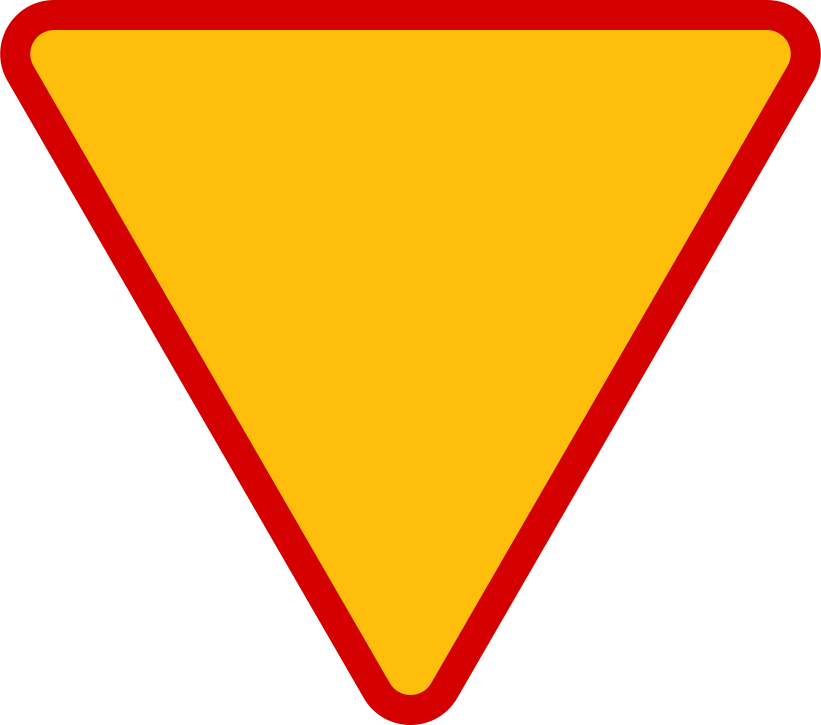 Give way.
English • Traffic sign A-7 • Give way. Sign A-7 warns of a junction with a priority road. Within a junction, A-7 applies only to the nearest carriageway before which it is installed.
Polski • A-7 • ustąp pierwszeństwa. Znak A-7 „ustąp pierwszeństwa” ostrzega o skrzyżowaniu z drogą z pierwszeństwem. Znak A-7 znajdujący się w obrębie skrzyżowania dotyczy tylko najbliższej jezdni, przed którą został umieszczony.
Sources
🔗 Commons.wikimedia.org
🔗 Eli.gov.pl • § 5 ust. 5
SVG source: Commons.wikimedia.org • Original SVG
MStankie • Public domain • Original revision 2025-09-27. Wikimedia original unmodified.
Artwork reviewed against the Polish official sign catalogue, Dz.U. 2019 poz. 2310: Eli.gov.pl • A-7, PDF page 41, with amendments 2021/433, 2021/2065, 2022/2372 and 2026/133 checked. Catalogue-equivalent illustration; intentional update from the previous PNG. This is an educational illustration, not a manufacturing specification.
What should you check before proceeding after giving way in Poland?
Wait until the manoeuvre is safe. Check the priority traffic, the view in both directions and enough space to complete the entry. Giving way to one vehicle does not remove duties towards another driver, a cyclist or a pedestrian.
🔗 eli.gov.pl • Poland, Road Traffic Law — articles 5, 25–27; Signs 5, 21, 43
25. Roundabout
A roundabout is a circular road arrangement in which traffic travels around a central island in one designated direction. Vehicles enter and leave through connecting roads, and traffic signs or local rules determine who has priority.
Drivers should reduce speed, choose a suitable lane, observe all road users and signal as required when leaving. The direction of travel, entry priority, lane use and rules for cyclists and pedestrians depend on local traffic signs and regulations.
Wikimedia.org • Grzegorz W. Tężycki • CC BY-SA
Who has priority at a roundabout in Poland?
The Polish circular-traffic sign together with a give-way sign assigns priority to vehicles already circulating. The circular-traffic sign alone does not remove the ordinary priority-from-the-right rule.
🔗 eli.gov.pl • Poland, Road Traffic Law — articles 22, 25–27; Signs 36
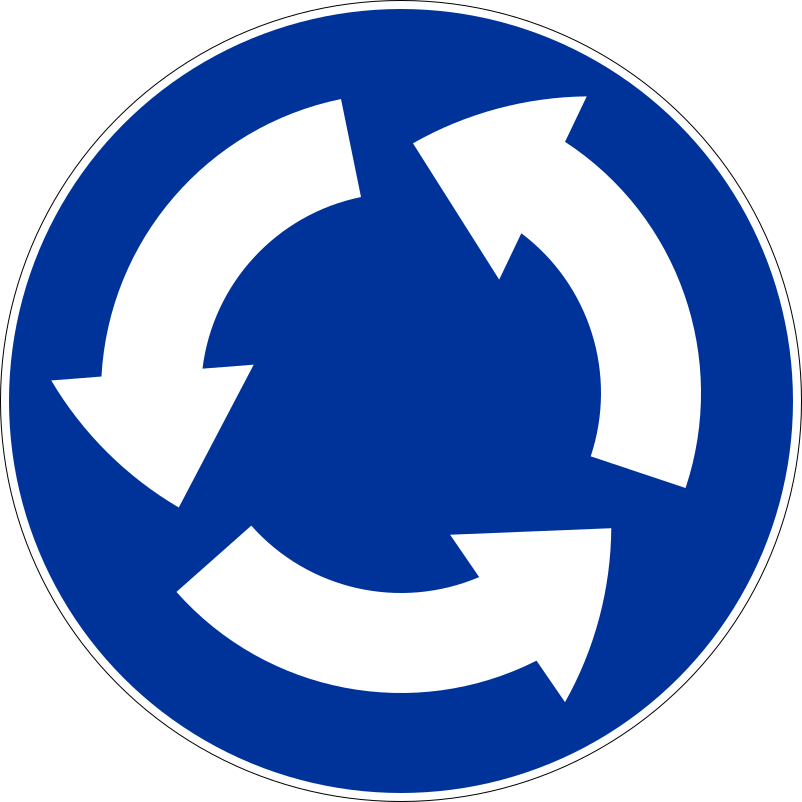 Mandatory roundabout direction.
English • Traffic sign C-12 • Roundabout. Sign C-12 indicates that traffic at the junction circulates around an island or square in the direction shown.
Polski • C-12 • ruch okrężny. Znak C-12 „ruch okrężny” oznacza, że na skrzyżowaniu ruch odbywa się dookoła wyspy lub placu w kierunku wskazanym na znaku.
Sources
🔗 Commons.wikimedia.org
🔗 Eli.gov.pl • § 36 ust. 1
SVG source: Commons.wikimedia.org • Original SVG
Paweł Grzywocz • Public domain • Original revision 2025-09-26. Wikimedia original unmodified.
Artwork reviewed against the Polish official sign catalogue, Dz.U. 2019 poz. 2310: Eli.gov.pl • C-12, PDF page 43, with amendments 2021/433, 2021/2065, 2022/2372 and 2026/133 checked. Catalogue-equivalent illustration; intentional update from the previous PNG. This is an educational illustration, not a manufacturing specification.
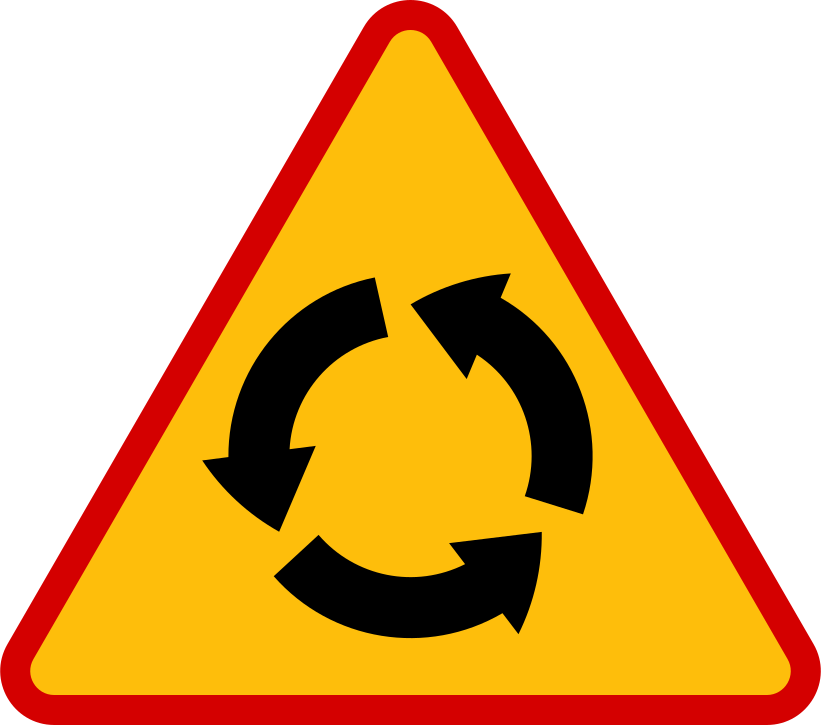 Warning for a roundabout.
English • Traffic sign A-8 • Roundabout. Sign A-8 warns of a junction where traffic circulates around an island or square in the direction shown.
Polski • A-8 • skrzyżowanie o ruchu okrężnym. Znak A-8 „skrzyżowanie o ruchu okrężnym” ostrzega o skrzyżowaniu, na którym ruch odbywa się dookoła wyspy lub placu w kierunku wskazanym na znaku.
Sources
🔗 Commons.wikimedia.org
🔗 Eli.gov.pl • § 5 ust. 8
SVG source: Commons.wikimedia.org • Original SVG
Author not stated on source page • Public domain • Original revision 2025-10-07. Wikimedia original unmodified.
Artwork reviewed against the Polish official sign catalogue, Dz.U. 2019 poz. 2310: Eli.gov.pl • A-8, PDF page 41, with amendments 2021/433, 2021/2065, 2022/2372 and 2026/133 checked. Catalogue-equivalent illustration; intentional update from the previous PNG. This is an educational illustration, not a manufacturing specification.
How should you choose a roundabout lane in Poland?
Choose your intended exit before entering and follow the lane arrows and destination signs. Keep to the marked route and make any permitted lane change only when safe; having priority over entering traffic does not give you priority to change lanes.
🔗 eli.gov.pl • Poland, Road Traffic Law — articles 22, 25–27; Signs 36
What should you check when leaving a roundabout in Poland?
Check the lane you will cross or enter, signal the manoeuvre as required and look for cyclists and pedestrians at the exit. Obey any separate crossing controls and do not force an exit across another vehicle’s path.
🔗 eli.gov.pl • Poland, Road Traffic Law — articles 22, 25–27; Signs 36