


Traffic signsRussia
 Traffic rules
 Russia
26. Curve
A curve is a section of road that changes direction to the left or right. A sharp, unexpected or poorly visible curve can reduce a driver’s view of approaching traffic, stopped vehicles, pedestrians and other hazards.
Drivers should reduce speed before entering the curve, remain within their lane and use smooth steering, braking and acceleration. Warning signs may indicate the direction of the first curve or a series of successive curves.

Wikimedia.org • CC BY-SA
What makes a bend dangerous in Russia?
A bend can shorten the visible road and reduce the margin for correcting an error. Slow before entering and maintain control within the distance you can see to be clear. Grip, traffic and hidden road users can require a speed well below the posted maximum.
How should you approach a sharp curve in Russia?
Slow down before the bend, select the correct lane position, look through the curve and steer smoothly. Keep enough grip and visible stopping distance for the road and weather conditions.
Is overtaking safe on a blind bend in Russia?
No. Do not start overtaking where your view of oncoming traffic is obstructed or where signs or road markings prohibit it. Wait until there is a lawful, clear and sufficiently long view ahead.
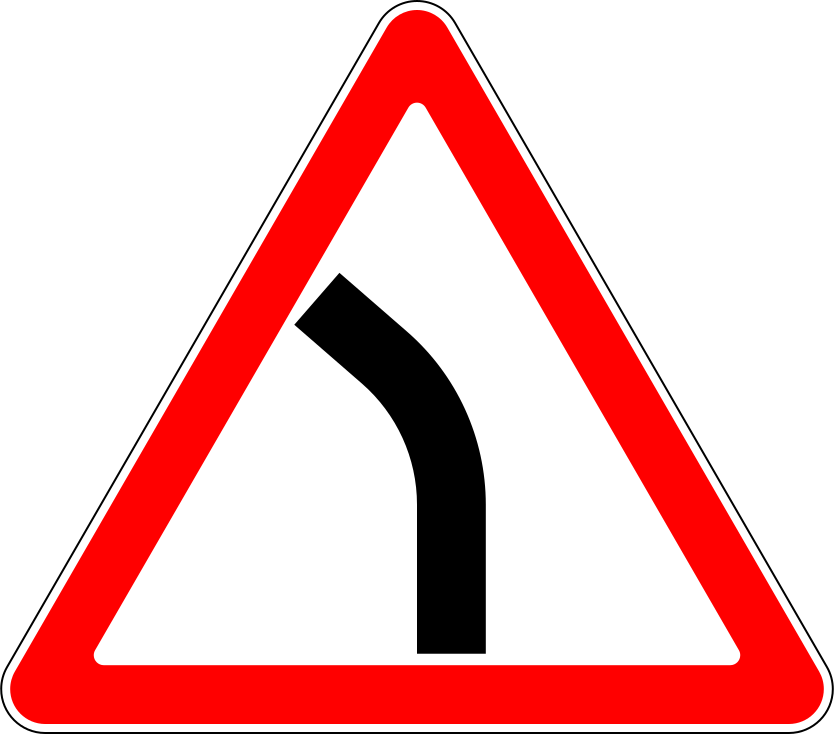 Warning for a curve to the left.
English • Traffic sign 1.11.2 • Dangerous bend. A tight-radius left-hand bend or one with limited visibility is ahead. Choose a safe speed.
Русский • 1.11.2 • Опасный поворот. Впереди поворот налево малого радиуса или с ограниченной видимостью. Выберите безопасную скорость.
Sources
🔗 Commons.wikimedia.org
🔗 Pravo.gov.ru • ПДД РФ • приложение 1 • 1.11.2
🔗 Pravo.gov.ru • Официальная редакция от 28.08.2026
Image via Commons.wikimedia.org
Юкатан • CC BY-SA 3.0 • Source revision 2016-02-28. Wikimedia original unmodified.
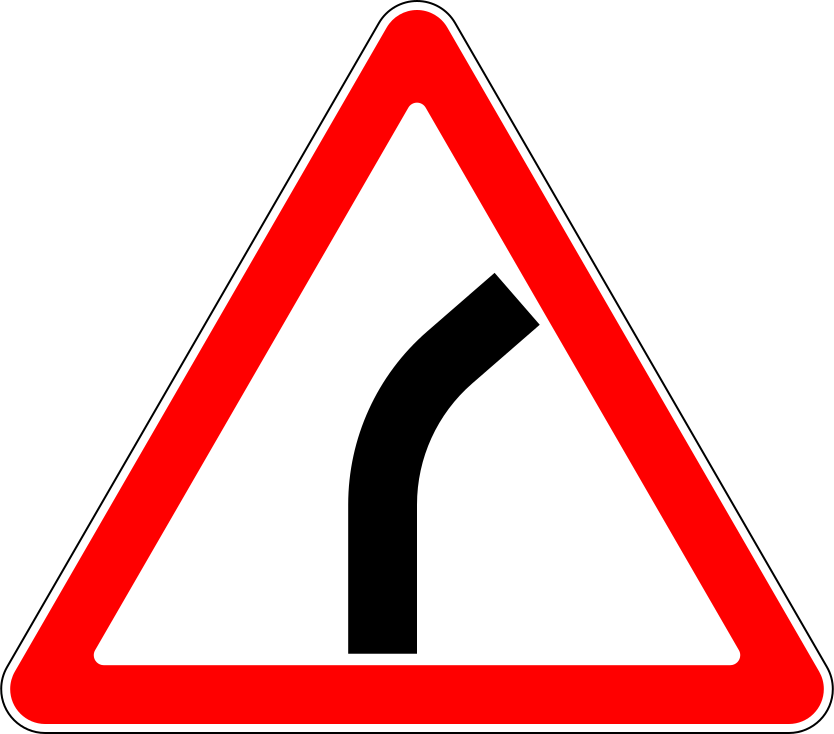 Warning for a curve to the right.
English • Traffic sign 1.11.1 • Dangerous bend. A tight-radius right-hand bend or one with limited visibility is ahead. Choose a safe speed.
Русский • 1.11.1 • Опасный поворот. Впереди поворот направо малого радиуса или с ограниченной видимостью. Выберите безопасную скорость.
Sources
🔗 Commons.wikimedia.org
🔗 Pravo.gov.ru • ПДД РФ • приложение 1 • 1.11.1
🔗 Pravo.gov.ru • Официальная редакция от 28.08.2026
Image via Commons.wikimedia.org
Юкатан • CC BY-SA 3.0 • Source revision 2016-02-28. Wikimedia original unmodified.

27. Wrong-way driving
Wrong-way driving occurs when a driver travels against the legally permitted direction of traffic. It may happen on a one-way road, divided road, motorway entrance or exit, or another road section reserved for traffic travelling in one direction.
Wrong-way driving creates an extreme risk of a head-on collision. Drivers must follow direction signs, no-entry signs, lane arrows and road markings. Anyone who accidentally enters a road in the wrong direction should slow down, warn other traffic, stop in the safest available place and contact the emergency services.

Wikimedia.org • Peterburg23 • CC BY
How can you avoid driving the wrong way in Russia?
Traffic normally keeps right here. Keep to the correct side of the road and use no-entry and one-way signs to identify prohibited approaches; do not enter an exit ramp against its permitted direction.
What signs can prevent wrong-way driving in Russia?
Read no-entry signs, one-way signs, lane arrows and temporary directions together; a wide road is not automatically two-way. Before entering a motorway, expressway, one-way street or slip road, check the permitted direction rather than relying only on a navigation app.
What should you do if you enter a road against traffic in Russia?
Do not continue along the wrong-way lane or try to reverse or make a U-turn across a high-speed road. Reduce speed, warn other traffic if safe, get to a protected stopping place away from moving traffic when possible and contact the police or road operator for assistance.
28. Roadworks
Roadworks are construction, maintenance, repair or inspection activities carried out on or beside a road. They may temporarily change the road layout, lane widths, speed limits, priority, permitted directions and facilities for pedestrians or cyclists.
Drivers must follow the temporary signs, traffic lights, barriers, road markings and instructions from authorised personnel. They should reduce speed, increase their following distance and remain prepared for narrow lanes, stopped traffic, workers, machinery and sudden changes in the route.
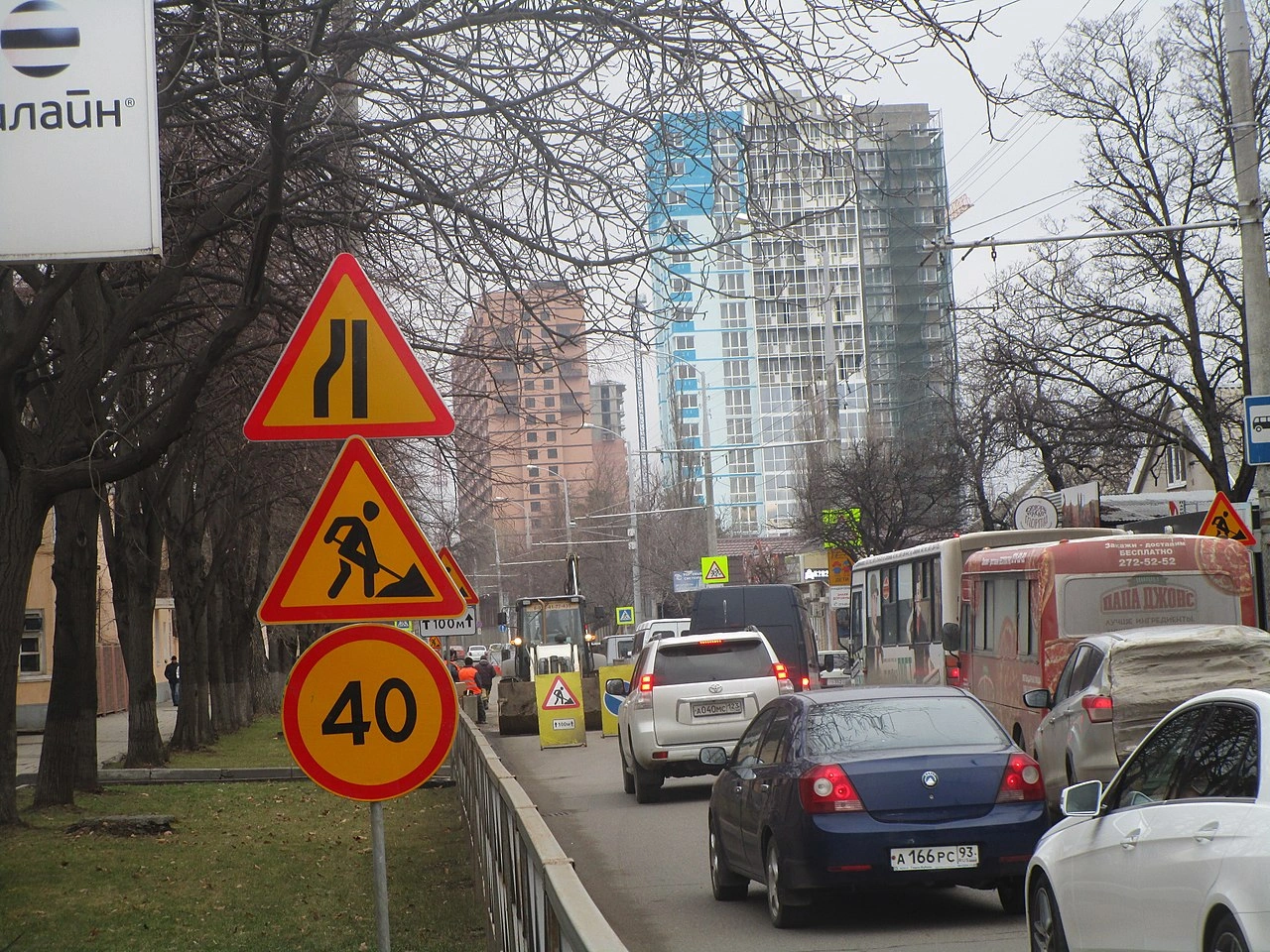
Wikimedia.org • Michaelversatile • CC BY
What should you watch for when approaching roadworks in Russia?
Look for temporary warnings, cones, barriers, narrow lanes and construction vehicles. Road layouts can change temporarily, including lane shifts, traffic-light control and short one-way sections. Expect workers and slow or stationary traffic near the worksite.
Is a temporary speed limit at roadworks binding in Russia?
Where an authorised temporary regulatory speed limit is in force, you must obey it. A roadworks warning alone should not be mistaken for a new numerical limit, but conditions may require driving more slowly.
What if only one lane remains open through roadworks in Russia?
Follow the temporary signals, stop/go instructions, lane arrows and priority signs. Do not enter an opposing traffic lane until permitted, and give vulnerable road users and road workers extra room.
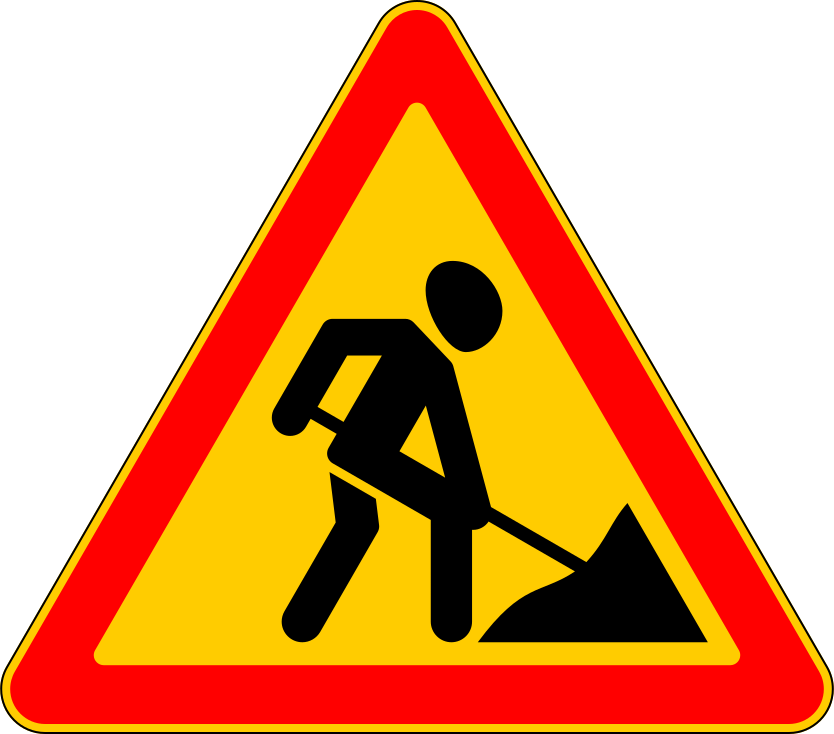 Warning for roadworks.
English • Traffic sign 1.25 • Roadworks. Works are in progress ahead. A yellow background indicates a temporary sign; if it conflicts with permanent signs, follow the temporary sign.
Русский • 1.25 • Дорожные работы. Впереди проводятся дорожные работы. Жёлтый фон обозначает временный знак; при противоречии стационарным знакам руководствуйтесь временным.
Sources
🔗 Commons.wikimedia.org (Nikolaev ec06ffa5 • CC BY-SA 3.0)
🔗 Pravo.gov.ru • ПДД РФ • приложение 1 • 1.25
🔗 Pravo.gov.ru • Официальная редакция от 28.08.2026
Image via Commons.wikimedia.org
Nikolaev ec06ffa5 • CC BY-SA 3.0 • Source revision 2016-05-01. Wikimedia original unmodified.
29. Height limit
A height limit prohibits vehicles whose total height exceeds the value shown from entering or passing a road section, bridge, tunnel, gateway or other structure. The vehicle’s height includes its load and any equipment attached above it.
Drivers of high vehicles must know their exact height, observe advance warnings and use an alternative route when necessary. They should never rely only on visual judgement or attempt to pass beneath a structure when safe clearance is uncertain.
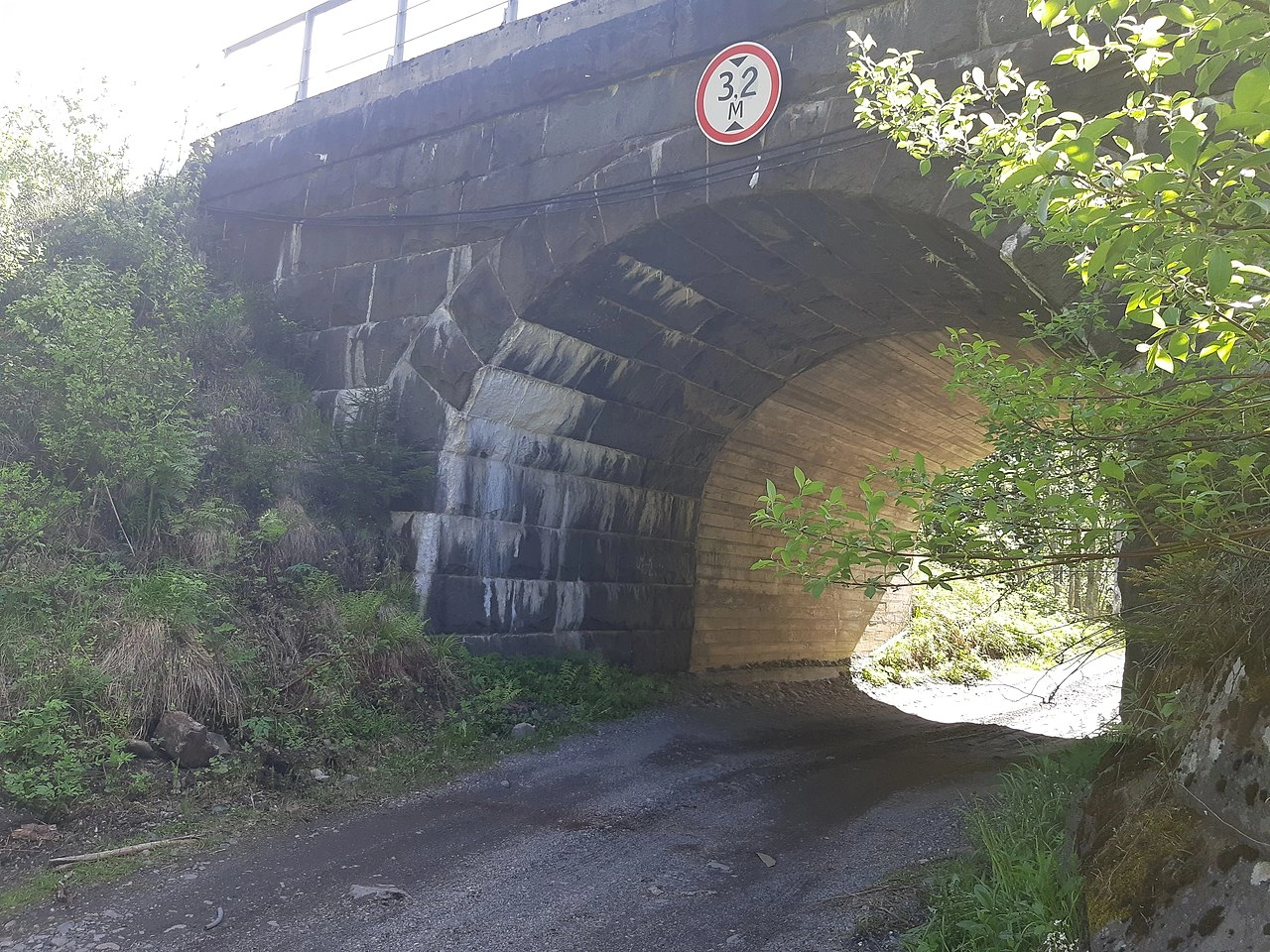
Wikimedia.org • Scaut2002 • CC BY-SA
How should you read a low-bridge height restriction in Russia?
Identify the actual height restriction and any separate advance-clearance warning, and read the measurement and supplementary information. Check the vehicle at its highest point with its load and fitted equipment before entering. A warning describes a hazard; a regulatory restriction controls entry. Use a permitted alternative if the vehicle cannot pass safely and lawfully.
🔗 sh380.krsl.gov.spb.ru • Russia — Annex 1 sign 3.13, height with or without load
Does a roof load count when checking vehicle height in Russia?
Yes for practical clearance: measure the vehicle at its highest point with its load and fitted accessories, such as a roof box, bicycle or roof rack. Check the local legal measurement rules as well; an empty vehicle’s registered height is not enough when equipment has been added.
🔗 sh380.krsl.gov.spb.ru • Russia — Annex 1 sign 3.13, height with or without load
What should you do if your vehicle is too high for a bridge or tunnel in Russia?
Do not try to squeeze under the structure. Use the signed alternative route and, if you are already close to the obstruction, stop where safe and seek traffic-control assistance rather than reversing unpredictably into moving traffic.
🔗 sh380.krsl.gov.spb.ru • Russia — Annex 1 sign 3.13, height with or without load
30. Traffic lights
Traffic lights use coloured lights, arrows or symbols to regulate when road users may proceed, must prepare to stop or must remain stopped. Separate signals may apply to particular directions, lanes, pedestrians, cyclists or public-transport vehicles.
A green light permits movement only when the route is clear and the movement is otherwise legal. Road users must still follow priority rules, turning restrictions, lane markings and instructions from authorised traffic controllers.
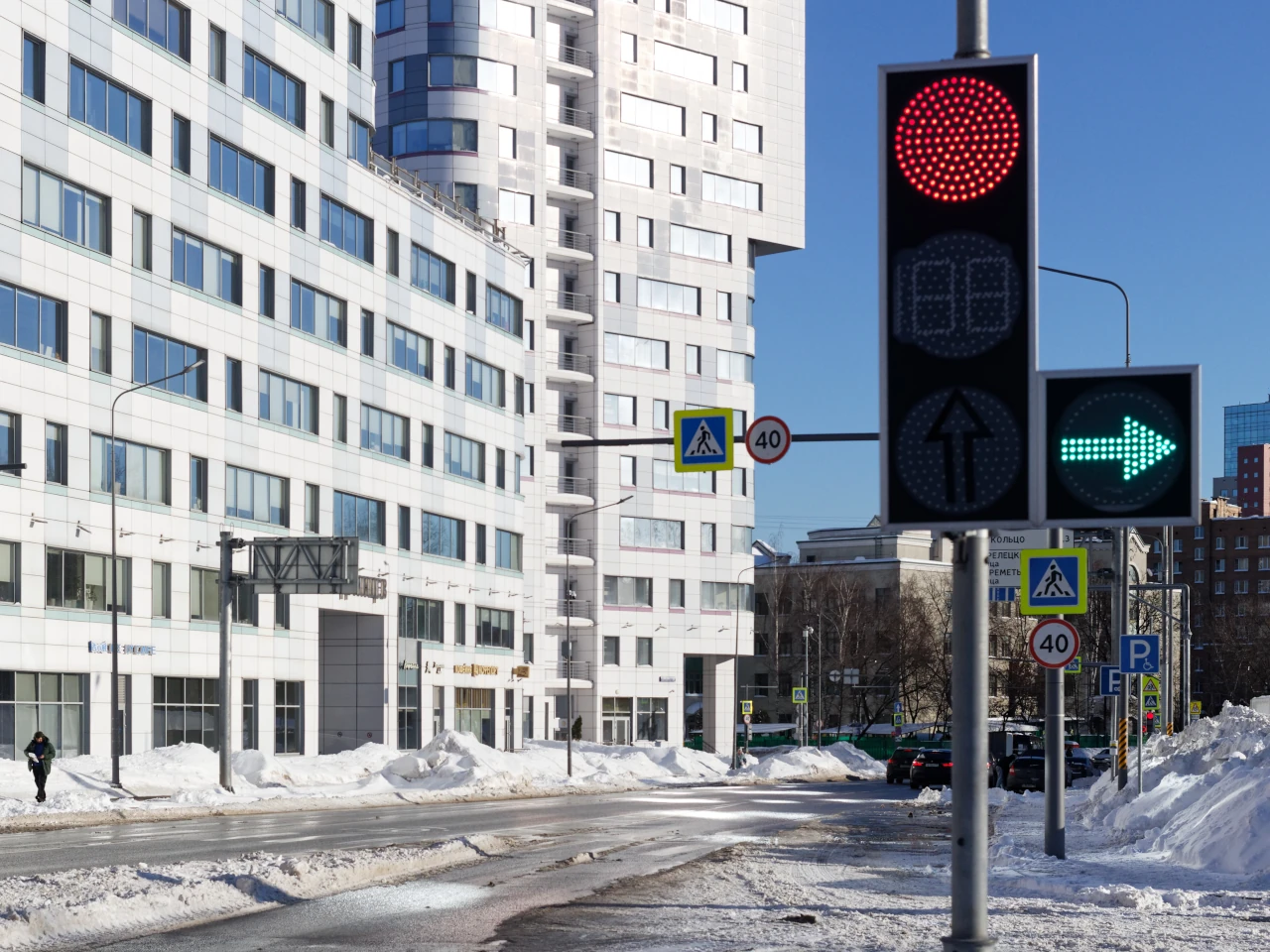
Wikimedia.org • Retired electrician • CC0
What must a driver do at red, amber and green signals in Russia?
Red prohibits movement. Stop at the applicable stop line or prescribed stopping place. Steady amber also prohibits movement, except where a driver cannot stop as required without emergency braking. Green permits movement subject to the other traffic rules. Flashing amber warns of danger and indicates an uncontrolled junction or crossing; it is not a green signal.
May you turn at a red traffic light in Russia?
Do not turn on red unless an applicable signal permits the movement. A green arrow illuminated in an additional signal section can permit movement in its direction while the main signal is red or amber. In that case, give way to vehicles approaching from other directions and comply with the other applicable priority duties.
Can a green light remove the need to give way to pedestrians in Russia?
No. A green signal is not a guarantee that the junction is empty. Check for people already crossing, vehicles completing a movement and any separate pedestrian, bicycle or turning signals. Do not enter if you cannot clear the junction safely.
31. Pedestrian lights
Pedestrian lights are traffic signals that regulate when pedestrians may begin crossing a road. They normally display a red standing figure to prohibit starting and a green walking figure to permit crossing.
A flashing signal or countdown may warn that the permitted crossing period is ending. Pedestrians should cross without unnecessary delay, while turning drivers must remain alert and allow pedestrians who entered lawfully to finish crossing safely.
Wikimedia.org • Krassotkin • CC0
What do pedestrian traffic signals mean in Russia?
For a signal showing a pedestrian silhouette, green permits pedestrian movement and red prohibits it. Follow a traffic controller’s instructions where one is directing movement, and check that it is safe before crossing.
What if the pedestrian signal changes while you are crossing in Russia?
Do not start crossing against a prohibiting signal. If the indication changes while you are crossing, clear the carriageway. If you cannot finish, wait on a refuge island or the line separating opposing traffic, as the rules prescribe. Continue only when safe and permitted by the signal.
May turning drivers ignore pedestrians on a signal-controlled crossing in Russia?
No. Drivers must watch for pedestrians still on the crossing and obey the local rules on giving way when turning. A signal for vehicles does not justify driving into someone who has not yet reached a safe place.
Which signal do Russian pedestrians follow without a pedestrian traffic light?
The vehicle traffic light, unless a traffic controller is directing movement.
32. Road markings
Road markings are lines, symbols, arrows, words or other markings applied to the road surface to regulate, guide or inform road users. They can separate traffic lanes and opposing directions, indicate where vehicles must stop or give way, mark pedestrian and cyclist crossings and identify areas reserved for particular road users.
Road users should observe the meaning of each road marking and combine it with the applicable traffic signs, signals and traffic rules. Colours, patterns and legal meanings can differ between countries.
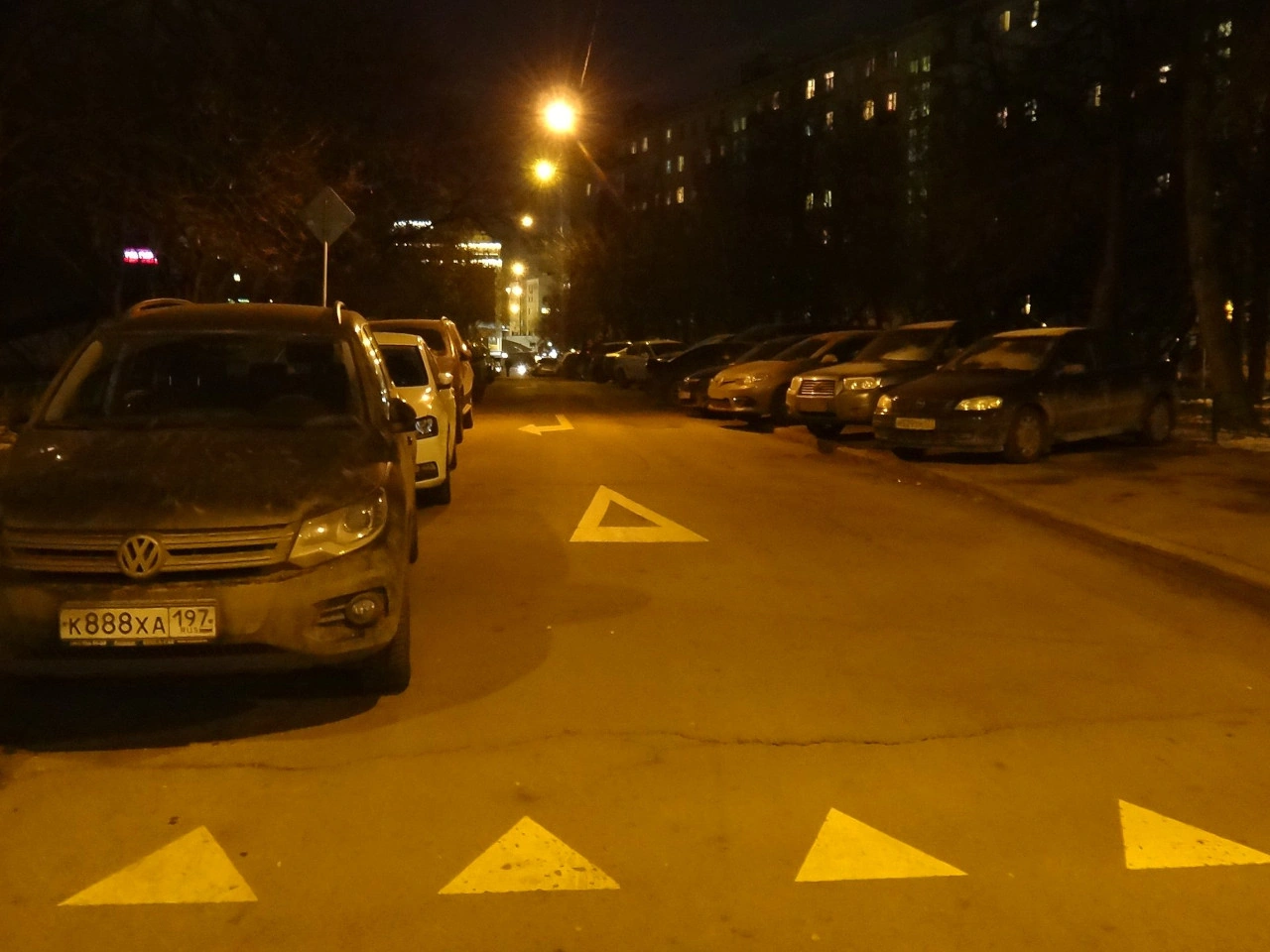
Wikimedia.org • karel291 • CC BY
Which road markings are important to recognise in Russia?
Recognise stop and give-way lines, lane-divider markings, continuous lines, directional arrows and pedestrian-crossing markings. Their colour, shape and exact legal effect come from the local traffic rules; do not assume an overseas convention applies unchanged.
May drivers cross a solid road line in Russia?
Not simply because the road looks clear. A continuous or barrier line normally restricts crossing, but precise restrictions and statutory exceptions depend on the marking and national law. Check the road markings and any associated signs before turning or overtaking.
Can painted arrows or stop lines be ignored when signs are not obvious in Russia?
No. Lane arrows, stop lines and give-way markings can direct where to wait or which movement a lane permits. Read them together with traffic lights, vertical signs and directions from authorised traffic controllers; temporary changes may also apply.
33. Driving licence
A driving licence is an official document authorising a person to drive one or more specified categories of motor vehicle. It may contain conditions, restrictions, category codes and expiry dates that determine which vehicles the holder may drive.
Drivers must hold a licence that is valid for the vehicle category and jurisdiction concerned. A licence may be provisional, full, restricted, suspended or withdrawn, and additional qualifications may be required for professional driving.
Wikimedia.org • CC0
Does an International Driving Permit replace the original licence in Russia?
No. An International Driving Permit accompanies the underlying valid driving licence; it does not replace it. Carry both when using an IDP, and check which permit or translation is accepted for your licence and visit.
🔗 gov.uk • UK Government, IDPs must accompany valid underlying driving licence
34. Location marker
A location marker is a roadside reference showing a measured position along a road. It normally identifies a kilometre, mile or smaller interval measured from an established starting point on that route.
Kilometre and hectometre markers help road users, emergency services, road authorities and maintenance crews identify an exact section of road. They do not impose a speed limit, priority rule or access restriction.
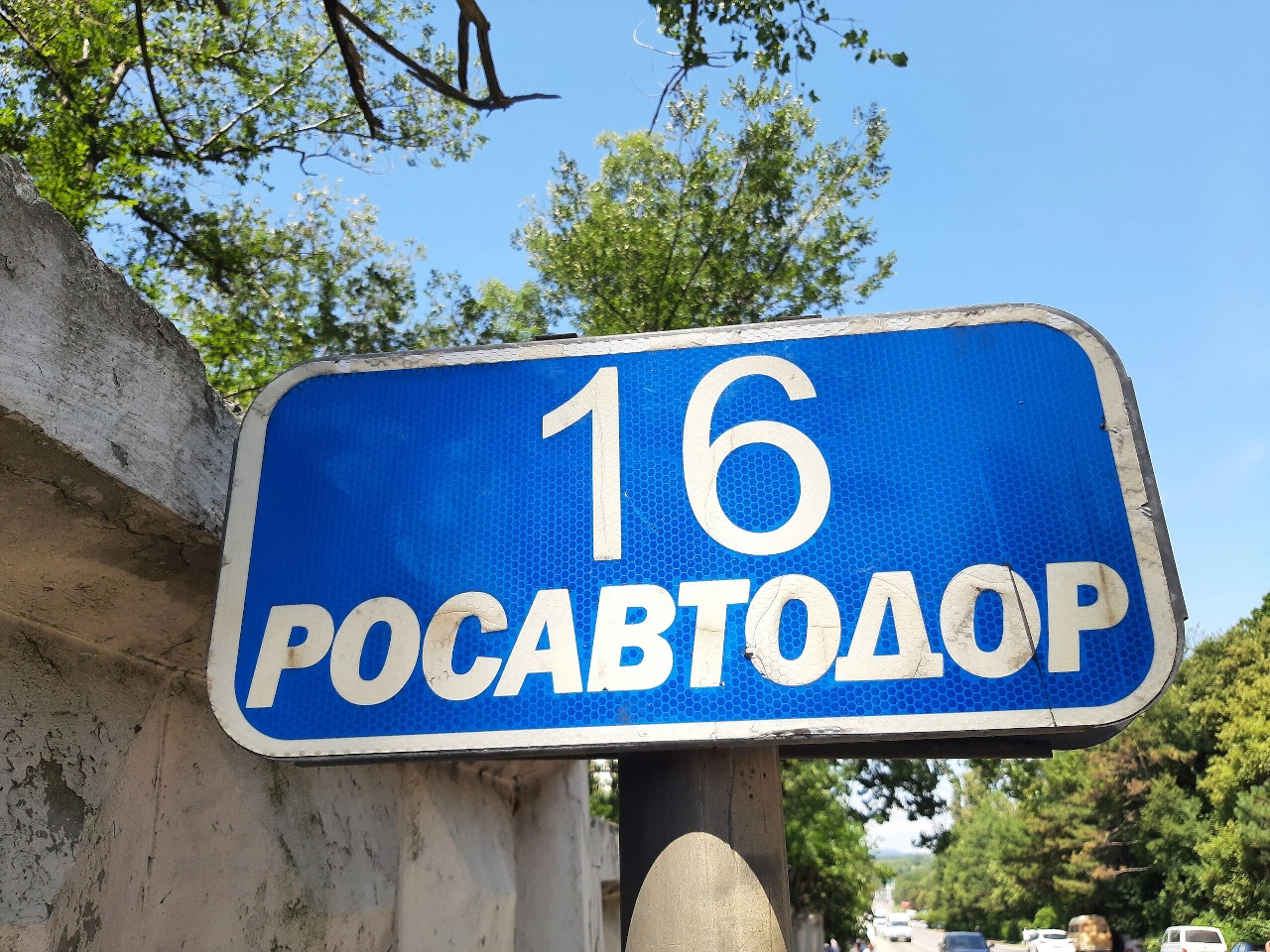
Wikimedia.org • WWBM • CC BY-SA
What does a roadside location marker tell you in Russia?
Where used, a roadside reference marker gives a measured position along a particular road, usually as a kilometre or other chainage reference. Designs and units are determined by the local road authority; the number is not automatically a distance to the next destination.
How can a location marker help in an emergency in Russia?
If you can see a marker safely, give the emergency operator the route number or road name, travel direction and marker reading. Additional landmarks, exits and GPS position can help. Do not leave a safe place or enter traffic to read a post.
Does a location marker set a speed limit or permit stopping in Russia?
No. A location marker is for orientation and road management; it does not itself set a speed limit, change priority or permit parking. Follow the actual traffic signs and stop only where the law and safety allow.
35. Countdown markers
Countdown markers are a sequence of roadside signs that indicate that a particular point, such as a motorway exit, junction or railway crossing, is getting closer. They commonly use a decreasing number of bars or other symbols so drivers can judge their progress toward the upcoming location.
The markers are normally positioned at successively shorter distances from the point ahead. Their design, spacing and meaning vary between countries, so drivers should not assume that each bar always represents the same distance.
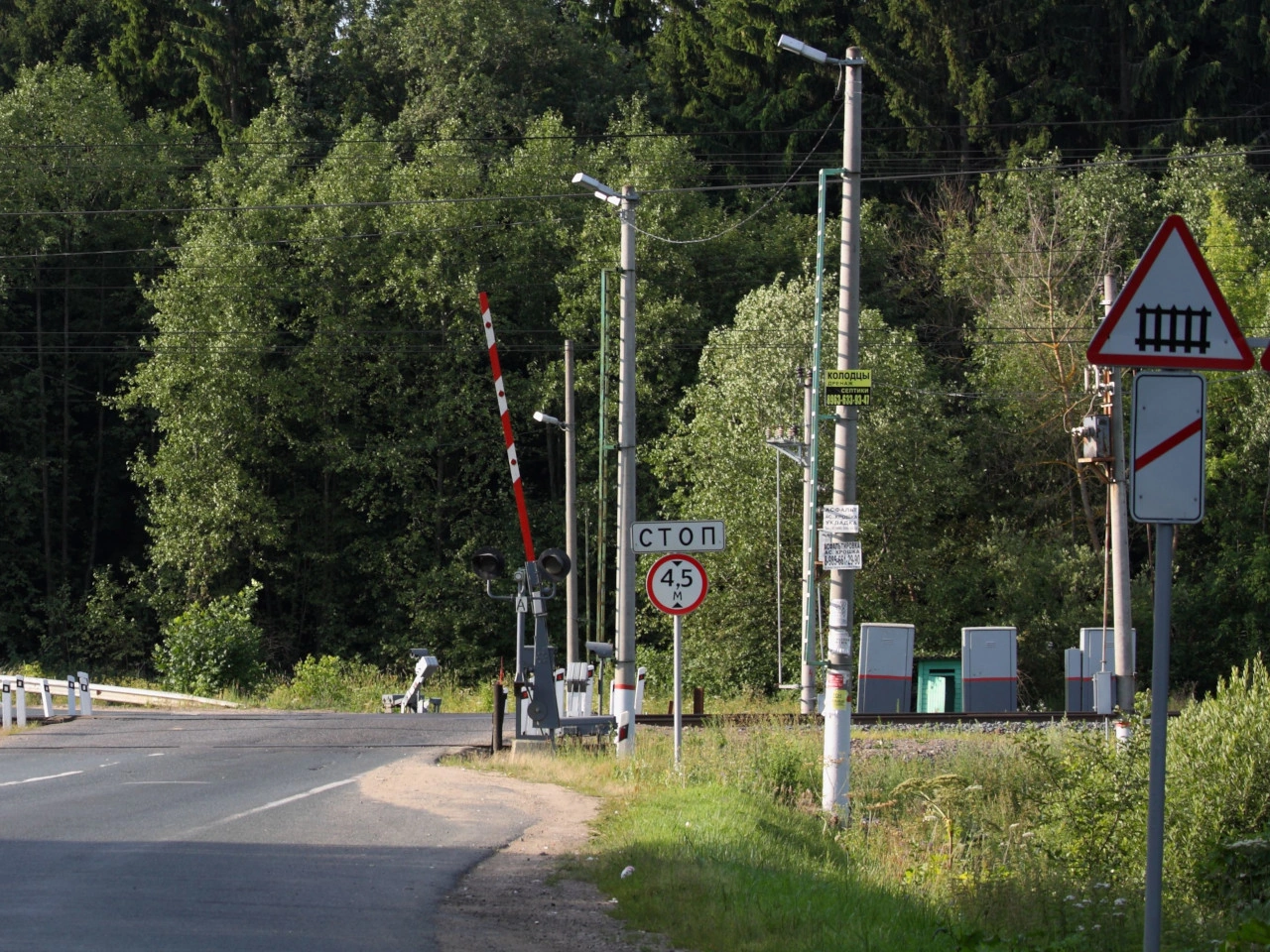
Wikimedia.org • Doomych • CC0
What do countdown or exit-approach markers mean in Russia?
The Traffic Rules include railway-crossing approach signs and separate navigation signs for road junctions and exits. Identify the actual symbol and any stated distance. A striped railway advance warning must not be treated as a universal motorway-exit countdown.
Does each countdown bar always represent the same distance in Russia?
No universal distance can be assumed. Follow the local sign standard and any printed distance; bars used for an exit may not have the same spacing or function as markers approaching a railway crossing.
What should you do if you are too late to take a motorway exit in Russia?
Continue safely to the next lawful exit or junction. Do not stop, reverse, make a U-turn or cross the median to reach a missed exit. Plan lane changes early and follow any lane-control signals.
36. Emergency telephone
An emergency telephone is a dedicated roadside or tunnel telephone that connects road users directly with an emergency, traffic-control or roadside-assistance centre. Emergency telephones are commonly installed in tunnels, along motorways or at other locations where quickly reporting an accident, breakdown or fire is important. They can provide operators with useful information about the caller’s location and may remain available where mobile-phone reception is poor.
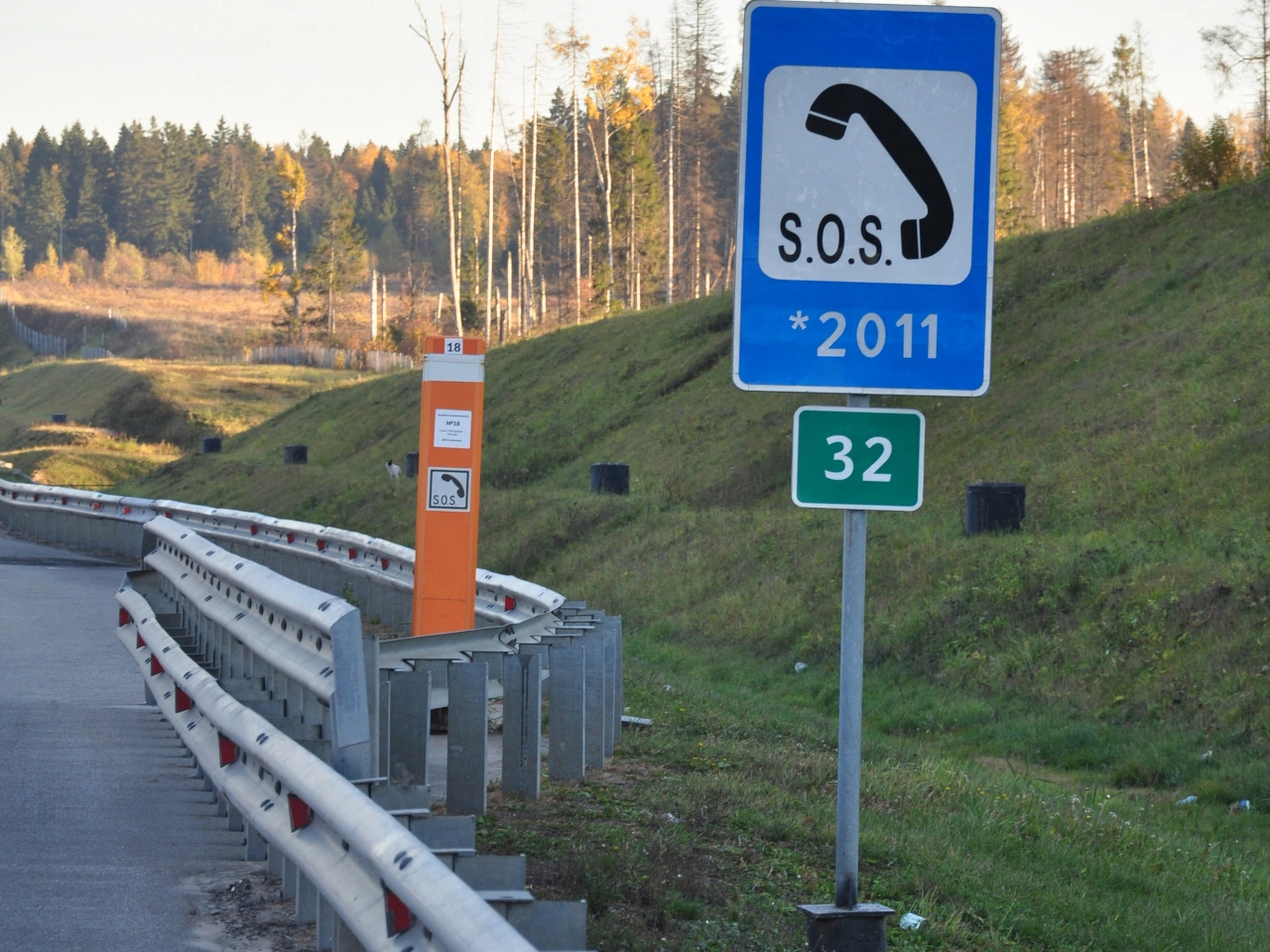
Wikimedia.org • Antonio Kless • CC BY-SA
What is an emergency telephone?
An emergency telephone is a dedicated telephone used to contact emergency services, a traffic-control centre or roadside assistance from the road.
🔗 gov.uk • Great Britain Highway Code, Rules 275–279; national guidance example
🔗 gov.uk • Great Britain Highway Code, Rules 270–274; national guidance example
Where are emergency telephones commonly found?
They are commonly installed in road tunnels, motorway emergency areas and other locations where rapid assistance may be needed.
🔗 gov.uk • Great Britain Highway Code, Rules 275–279; national guidance example
🔗 gov.uk • Great Britain Highway Code, Rules 270–274; national guidance example
When should you use an emergency telephone?
Use an emergency telephone to report situations such as a breakdown, accident, fire or other serious road emergency when assistance is required.
🔗 gov.uk • Great Britain Highway Code, Rules 275–279; national guidance example
🔗 gov.uk • Great Britain Highway Code, Rules 270–274; national guidance example
37. Parking
Parking means leaving a vehicle stationary at a place for a period of time rather than stopping only briefly because of traffic conditions or another immediate necessity. Many countries distinguish parking from a short stop made to pick up or drop off passengers or to load or unload goods, although the exact legal definition varies.
Parking may be permitted, restricted, reserved, time-limited or prohibited by traffic signs, road markings, parking zones and local regulations. Drivers must park without creating a danger or unnecessary obstruction and must comply with any conditions concerning payment, permits, vehicle categories or maximum parking duration.
Wikimedia.org • Mos.ru • CC BY
How soon must you pay after using a paid Moscow street parking space?
Pay within 5 minutes of parking. Check the vehicle registration and parking-zone number.
🔗 parking.mos.ru • Moscow Parking, street-parking rules and tariffs
How long do you have to leave a Moscow street space after ending the parking session?
Leave within 5 minutes after the session ends.
🔗 parking.mos.ru • Moscow Parking, street-parking rules and tariffs
Is every Moscow street parking space free on Sundays?
No. Higher-tariff and dynamic-tariff streets can remain chargeable. Check the current zone information.
🔗 parking.mos.ru • Moscow Parking, street-parking rules and tariffs
Do Moscow’s barrier-controlled car parks follow street-parking free days?
No. The operator states that barrier-controlled car parks remain chargeable every day.
🔗 parking.mos.ru • Moscow Parking, street-parking rules and tariffs
What should you check when a Moscow parking app selects a zone?
Compare the selected zone number with the information board and check the registration number before paying.
🔗 parking.mos.ru • Moscow Parking, avoiding payment mistakes
38. No stopping
No stopping means that vehicles are not permitted to stop voluntarily at the indicated location, even briefly for picking up or dropping off passengers or loading or unloading goods. It is a stricter restriction than a no-parking rule.
A no-stopping restriction may be indicated by a traffic sign, road marking or local traffic regulation. Drivers should continue to a place where stopping is permitted unless they are forced to stop by traffic conditions, an emergency or another legal requirement.
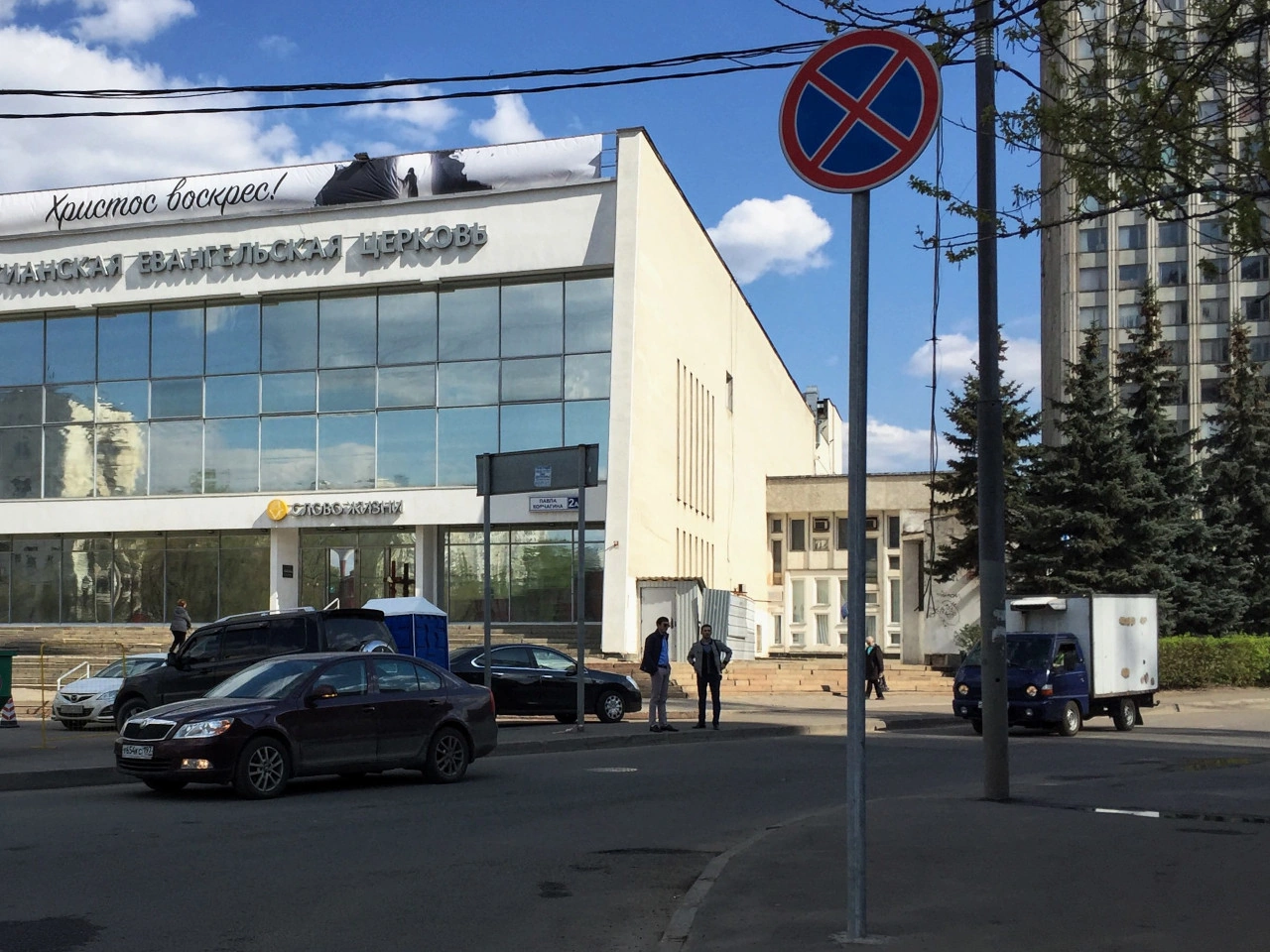
Wikimedia.org • Gennady Grachev • CC BY
What does a no stopping restriction mean?
It means that a driver may not voluntarily stop the vehicle in the restricted area. The prohibition normally includes stopping to pick up or drop off passengers or to load or unload goods.
🔗 ris.bka.gv.at • Austria, StVO sections 2, 23–24 and 52
🔗 gov.uk • Great Britain Highway Code, Rules 238–252; national guidance example
🔗 gov.uk • UK Department for Transport, parking-control signs and road markings
🔗 wegcode.be • Belgium, 1975 Road Code, Articles 2 and 23–27
Can you stop in a no-stopping area during an emergency?
A driver may have to stop because of an emergency, traffic conditions, a red light, police instructions or another situation outside the driver's control. Such compulsory stops are generally different from voluntarily stopping the vehicle.
🔗 ris.bka.gv.at • Austria, StVO sections 2, 23–24 and 52
🔗 gov.uk • Great Britain Highway Code, Rules 238–252; national guidance example
🔗 gov.uk • UK Department for Transport, parking-control signs and road markings
🔗 wegcode.be • Belgium, 1975 Road Code, Articles 2 and 23–27
39. Disabled parking
Disabled parking refers to parking spaces and parking privileges reserved for people with disabilities who meet the applicable eligibility requirements. Reserved spaces are normally identified by the international wheelchair symbol and are positioned to provide easier access to nearby facilities.
Use of a disabled parking space generally requires a valid disabled parking permit or card. The permit normally belongs to the eligible person rather than to a particular vehicle and may only be used when that person is driving or travelling in the vehicle.
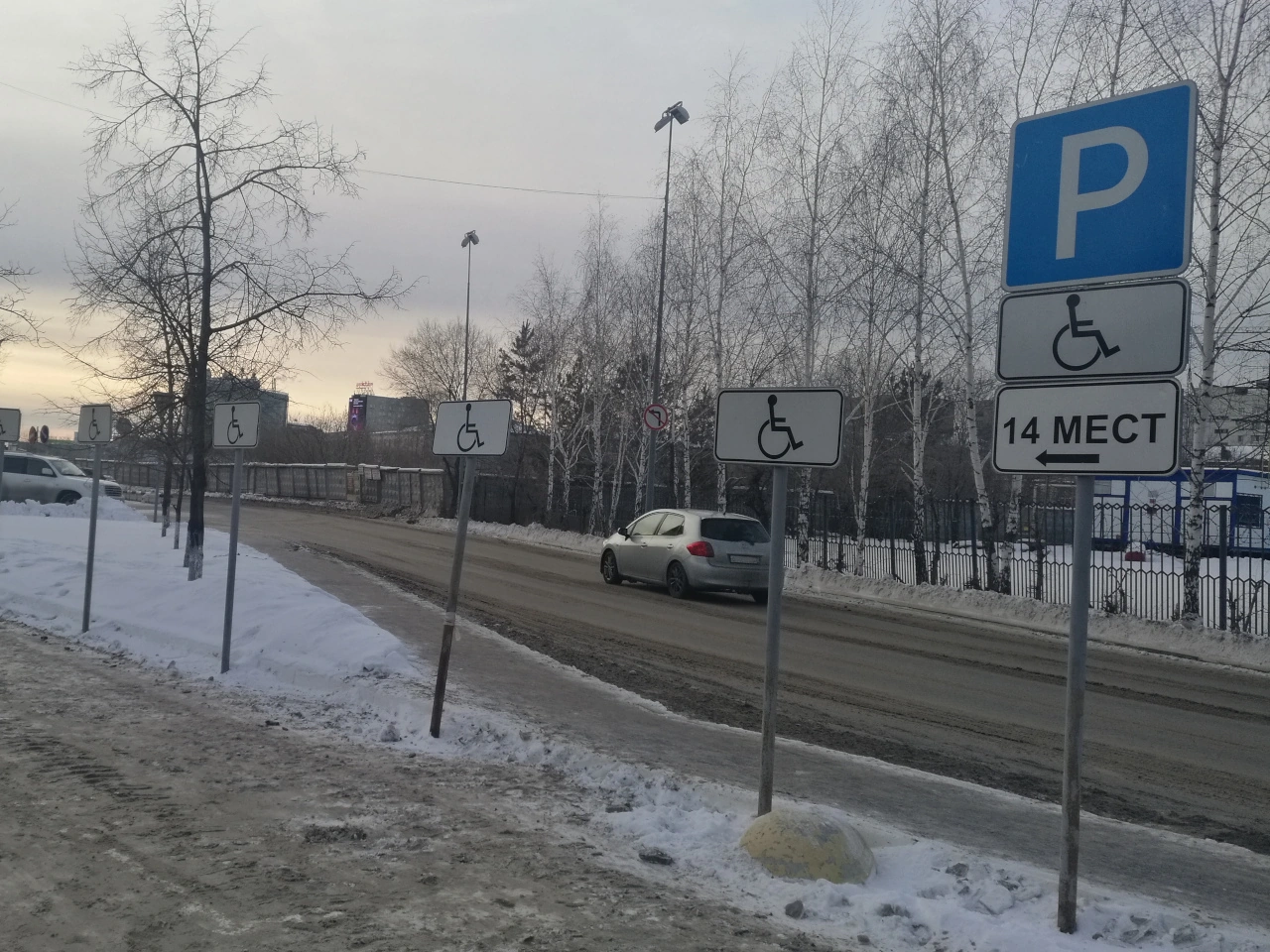
Wikimedia.org • RG72 • CC BY-SA
Does a disability sticker by itself establish free parking entitlement in Moscow’s accessible spaces?
No. The eligible vehicle must also have the required disability parking entitlement recorded in the government system.
🔗 sfr.gov.ru • Russia, Social Fund, disability parking entitlement
Where can you apply to record a vehicle for Russia’s free disability parking entitlement?
The Social Fund directs applicants to an MFC public-services centre or Gosuslugi. Use those current routes rather than an old registry website.
🔗 sfr.gov.ru • Russian Social Fund, disability information systems and parking applications
40. Reversing
Reversing means driving a vehicle backwards. It is commonly used when parking, leaving a confined space or repositioning a vehicle where forward movement is not practical.
Before reversing, the driver should check mirrors and blind spots, look carefully around the vehicle and make sure the area behind is clear. Reversing should be performed slowly and only for as long as necessary because visibility behind the vehicle is often limited.
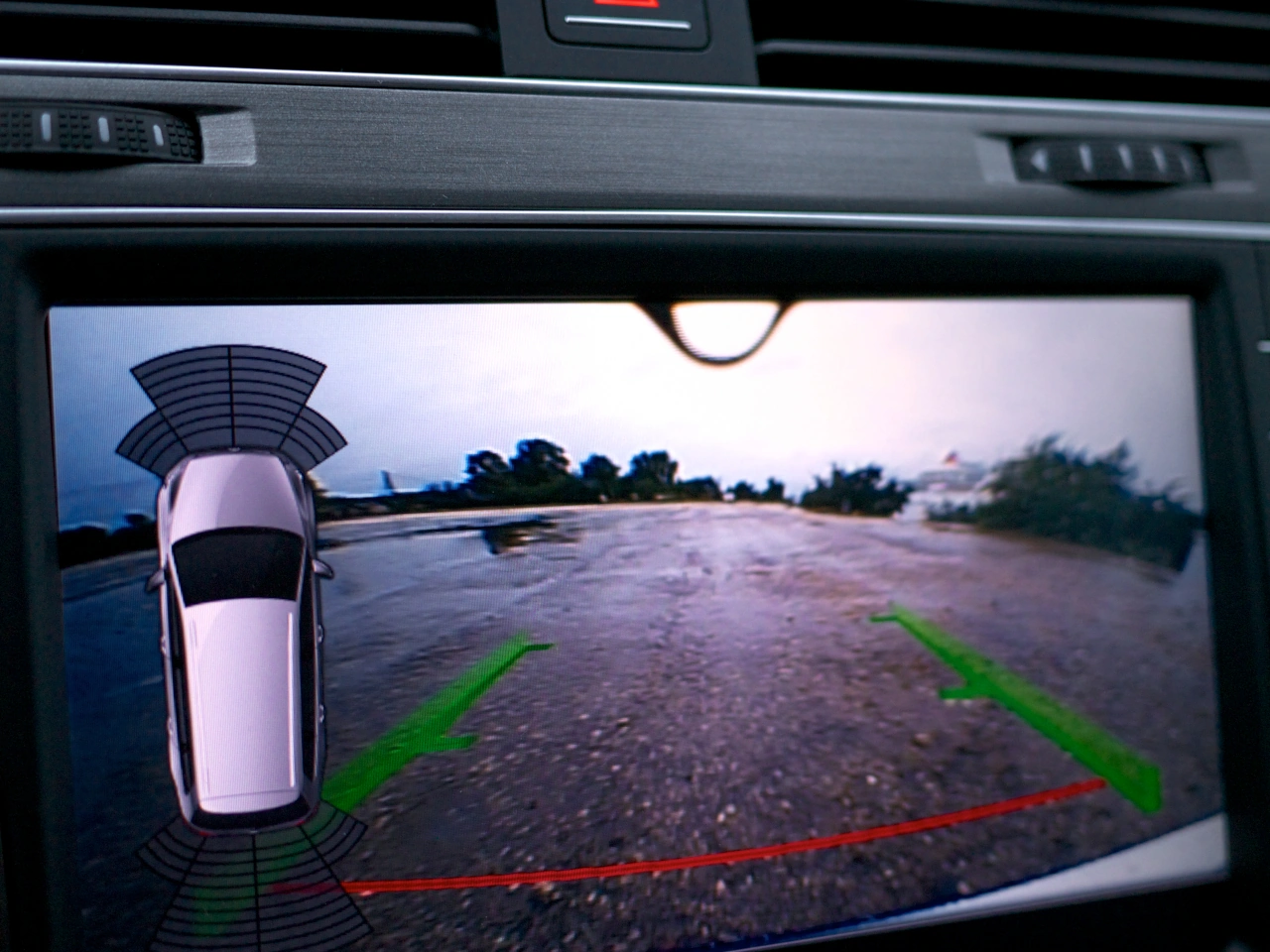
Wikimedia.org • Kārlis Dambrāns • CC BY
When may Russian drivers reverse?
Only safely and without obstructing other road users.
🔗 sh380.krsl.gov.spb.ru • Russia — Sections 8.11–8.12 and 16.1
When must Russian reversing drivers obtain assistance?
Whenever needed to ensure a safe manoeuvre.
🔗 sh380.krsl.gov.spb.ru • Russia — Sections 8.11–8.12 and 16.1
Can you reverse at Russian junctions?
No. Reversing at intersections is prohibited.
🔗 sh380.krsl.gov.spb.ru • Russia — Sections 8.11–8.12 and 16.1
Can you reverse on Russian pedestrian crossings?
No. Reversing is prohibited there.
🔗 sh380.krsl.gov.spb.ru • Russia — Sections 8.11–8.12 and 16.1
Can you reverse in Russian tunnels or under bridges?
No. The ban covers tunnels, bridges, overpasses and beneath them.
🔗 sh380.krsl.gov.spb.ru • Russia — Sections 8.11–8.12 and 16.1
What visibility restriction affects Russian reversing?
It is prohibited where road visibility in either direction is below 100 metres.
🔗 sh380.krsl.gov.spb.ru • Russia — Sections 8.11–8.12 and 16.1
Can you reverse at Russian public-transport stops?
No. Reversing at designated route-service stops is prohibited.
🔗 sh380.krsl.gov.spb.ru • Russia — Sections 8.11–8.12 and 16.1
Can you reverse on Russian motorways?
No. Reversing is prohibited.
🔗 sh380.krsl.gov.spb.ru • Russia — Sections 8.11–8.12 and 16.1
41. Road surface
A road surface warning indicates that the road ahead may be uneven, damaged or in poor condition and could affect the stability, steering or braking of a vehicle. The hazard may include bumps, depressions, potholes, broken pavement or other irregularities in the road surface.
Drivers should reduce speed where necessary, maintain a safe distance and avoid sudden steering or braking when passing over an irregular surface. The exact meaning and appearance of the warning sign vary between countries, so drivers must follow the local traffic signs and regulations.
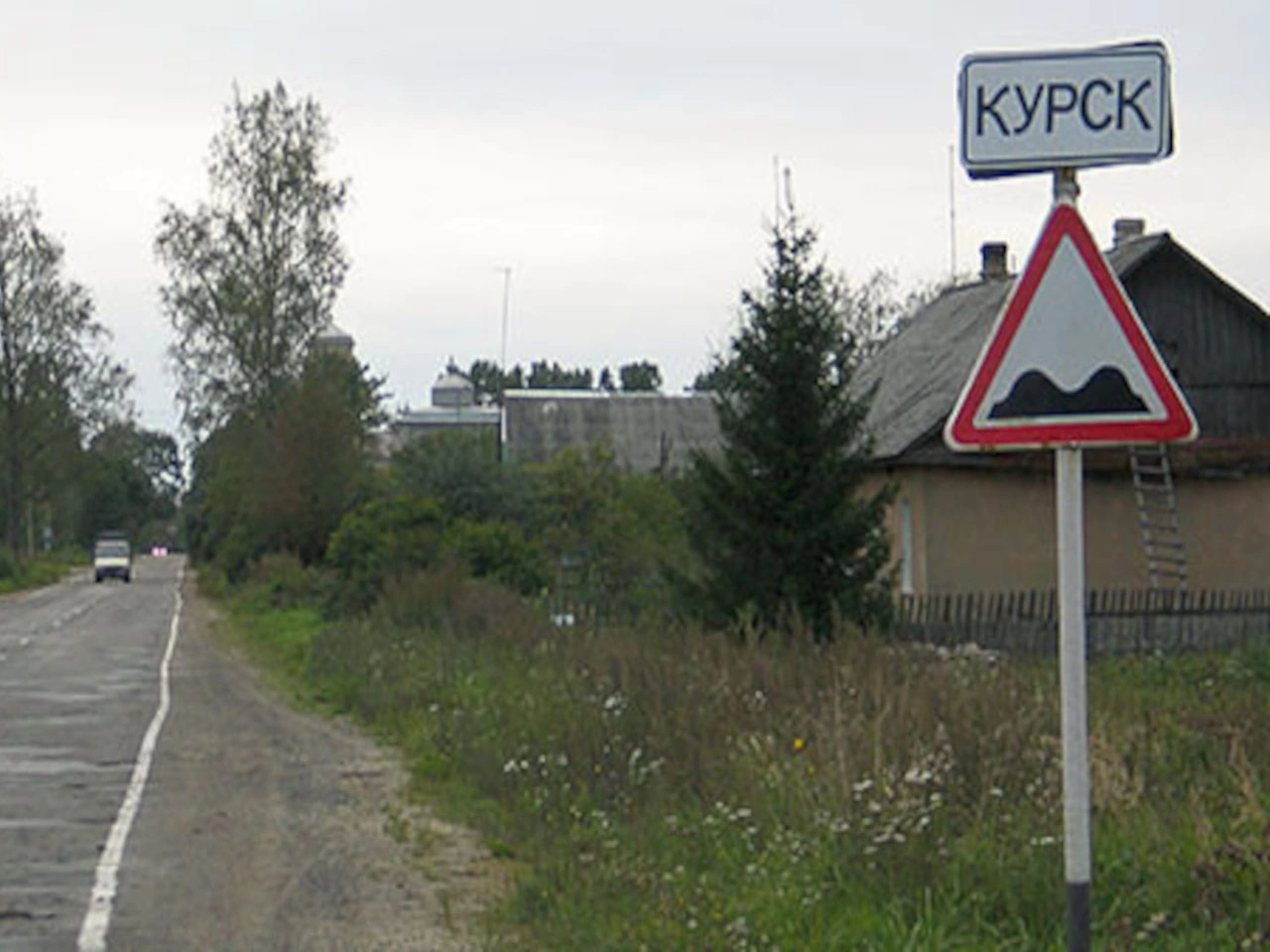
Wikimedia.org • Road Sign Series • CC BY
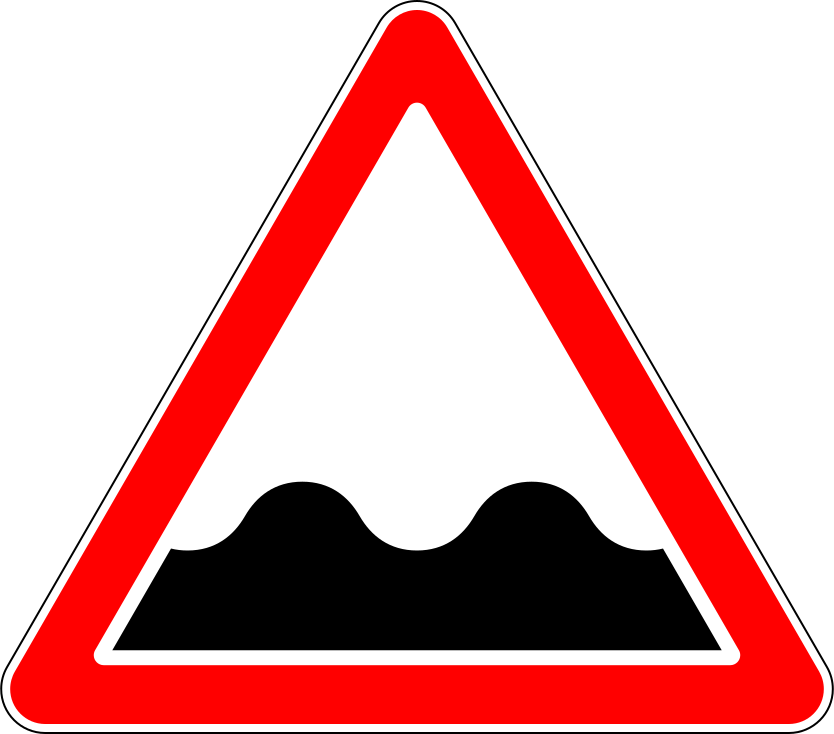
Warning for a bad road surface.
What does a road surface warning mean?
A road surface warning indicates that the surface ahead may be uneven, damaged or otherwise capable of affecting the safe movement of vehicles.
🔗 gov.uk • Great Britain Highway Code, Rules 226–237; national guidance example
 Warning for a bad road surface.
What should you do when you see a road surface warning?
Reduce speed where necessary, increase your awareness of the road ahead and be prepared for changes in the vehicle's stability or direction.
🔗 gov.uk • Great Britain Highway Code, Rules 226–237; national guidance example
Does a road surface warning impose a specific speed limit?
Not normally. A warning sign alerts drivers to a hazard rather than establishing a numerical speed limit. A separate speed-limit sign may be used where a particular maximum speed is required.
🔗 gov.uk • Great Britain Highway Code, Rules 226–237; national guidance example
42. Provisional licence
A provisional licence allows a learner driver to practise driving on public roads before obtaining a full driving licence. The conditions vary between countries and may determine whether the learner must be accompanied by an approved supervisor, which vehicles may be driven, where and when driving is permitted and how long the licence remains valid. A provisional licence is normally subject to stricter rules than a full licence and is intended specifically for learning and gaining practical driving experience.
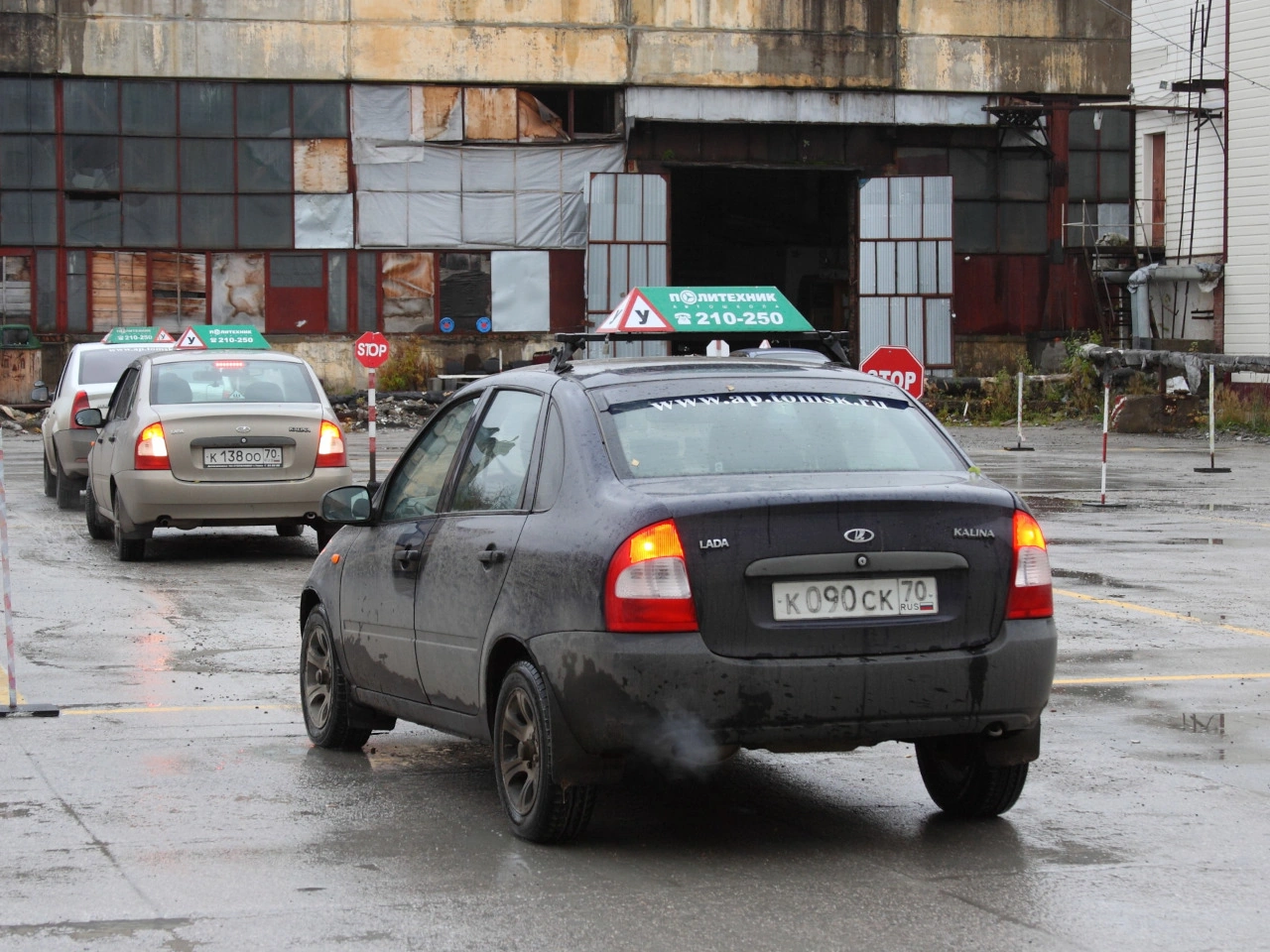
Wikimedia.org • Ilya_p • CC BY-SA
What is a provisional driving licence?
The meaning depends on the jurisdiction. In Great Britain and Flanders, a provisional licence can authorise learning under specified conditions. In the Australian Capital Territory, a provisional licence follows the learner stage and assessment. It is not a universal synonym for a learner licence.
🔗 vlaanderen.be • Flanders, obtaining a category B driving licence; learner provisional licences
🔗 gov.uk • GOV.UK, driving lessons and learning to drive; GB learner rules
Can you drive alone with a provisional licence?
Check the jurisdiction, licence stage and its conditions. In Flanders, some provisional licences require a registered supervisor, while another option permits independent practice after approved training. In Great Britain, car learners must follow the supervision rules. Other countries may use provisional for a later licensing stage.
🔗 vlaanderen.be • Flanders, obtaining a category B driving licence; learner provisional licences
🔗 gov.uk • GOV.UK, driving lessons and learning to drive; GB learner rules
How long is a provisional licence valid?
There is no universal validity period or renewal procedure. Check the issuing authority’s rules for the particular licence. For example, Flanders distinguishes 18-month and 36-month provisional learner licences; another jurisdiction may use provisional for a different stage altogether.
🔗 vlaanderen.be • Flanders, obtaining a category B driving licence; learner provisional licences
🔗 gov.uk • GOV.UK, driving lessons and learning to drive; GB learner rules
43. Emergency exit
An emergency exit is a marked escape route that allows road users to leave a tunnel or other enclosed traffic facility during a serious incident such as a fire, smoke development or another emergency. Emergency exits lead towards a safer area separated from the immediate danger.
In an emergency, occupants should leave their vehicle when evacuation is necessary and follow the emergency-exit signs and instructions. They should move away from the danger rather than remaining inside the tunnel or returning to their vehicle.

Wikimedia.org • Georg Pik • CC0
Should you take your vehicle through an emergency exit?
No. Tunnel emergency exits are intended for people evacuating on foot. Leave the vehicle when necessary and follow the marked escape route towards safety.
🔗 crisiscenter.be • Belgian National Crisis Centre, tunnel evacuation on foot
🔗 merseytravel.gov.uk • Merseytravel, road-tunnel evacuation instructions
🔗 gov.uk • UK DfT, emergency-exit pedestrian signs and information symbols
44. City limit
A city limit is a boundary or roadside indication showing that a driver is entering or leaving a named city, town, village, locality or municipality. It is commonly marked by a place-name or boundary sign.
The meaning of these signs varies between countries. A city-limit or locality sign may identify an administrative boundary, a named settlement or a traffic-related boundary. It does not necessarily mark the beginning or end of a legally defined built-up area, and passing the sign does not always change the applicable speed limit or other traffic rules.
Wikimedia.org • Aleksander Kaasik • CC BY-SA
What is a city limit?
A city limit identifies the boundary of a named city, town or municipality. A roadside place-name or boundary sign may identify that boundary, a locality or a legally defined built-up area; its exact meaning depends on the sign system.
🔗 gov.uk • UK Department for Transport, Know Your Traffic Signs, boundary signs
 City limit.
 End of city limit.
Does a city-limit sign always mark a built-up area?
No. A city-limit or locality sign may simply identify a place or administrative boundary. A legally defined built-up area can use a different sign or definition.
🔗 gov.uk • UK Department for Transport, Know Your Traffic Signs, boundary signs
What is the difference between a city limit and a built-up area?
A city limit identifies the boundary of a named place or administrative area. A built-up area is a traffic-law concept that may affect rules such as default speed limits. The two boundaries can coincide, but they do not have to.
🔗 gov.uk • UK Department for Transport, Know Your Traffic Signs, boundary signs
45. Tourist attraction
A tourist attraction is a place of interest that visitors may travel to for cultural, historical, recreational, natural or entertainment purposes. Examples include monuments, castles, museums, scenic sites, amusement parks and other notable destinations.
Tourist attractions may be indicated by tourist or direction signs that help travellers find the destination. The colours, symbols and types of attractions shown vary between countries.
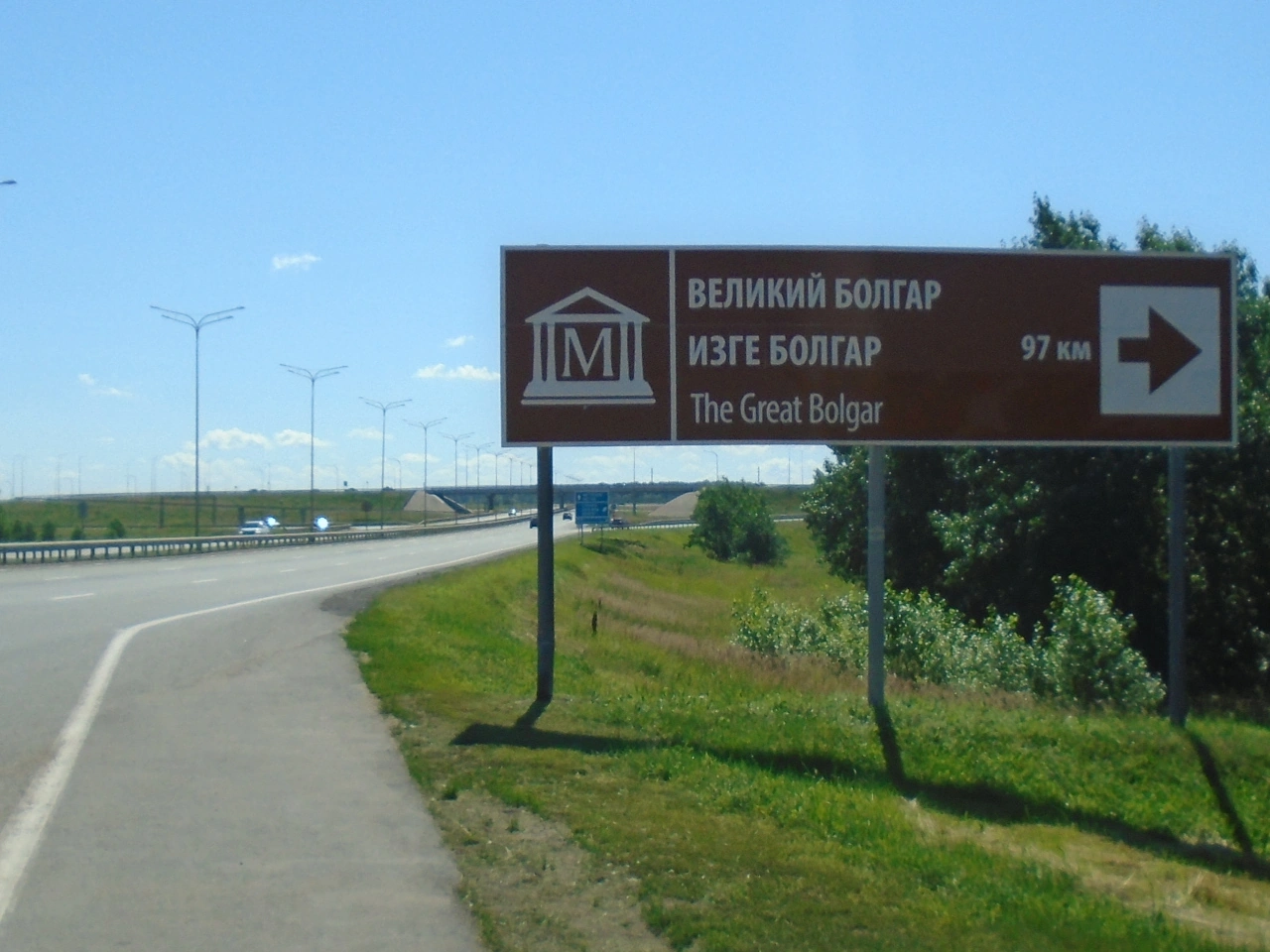
Wikimedia.org • Vyacheslav Kirillin • CC BY-SA
Can tourist attractions be indicated by road signs?
Yes. Many countries use tourist or direction signs to guide travellers toward important attractions and places of interest.
46. Horn
A horn is a sound-producing device used to warn other road users of danger or to attract their attention when necessary for safety. Most motor vehicles are equipped with an electric horn operated from the steering wheel. Traffic laws generally restrict unnecessary or excessive horn use, especially in built-up or residential areas. The horn should therefore be used as a warning device rather than as a way to express frustration or greet other road users.
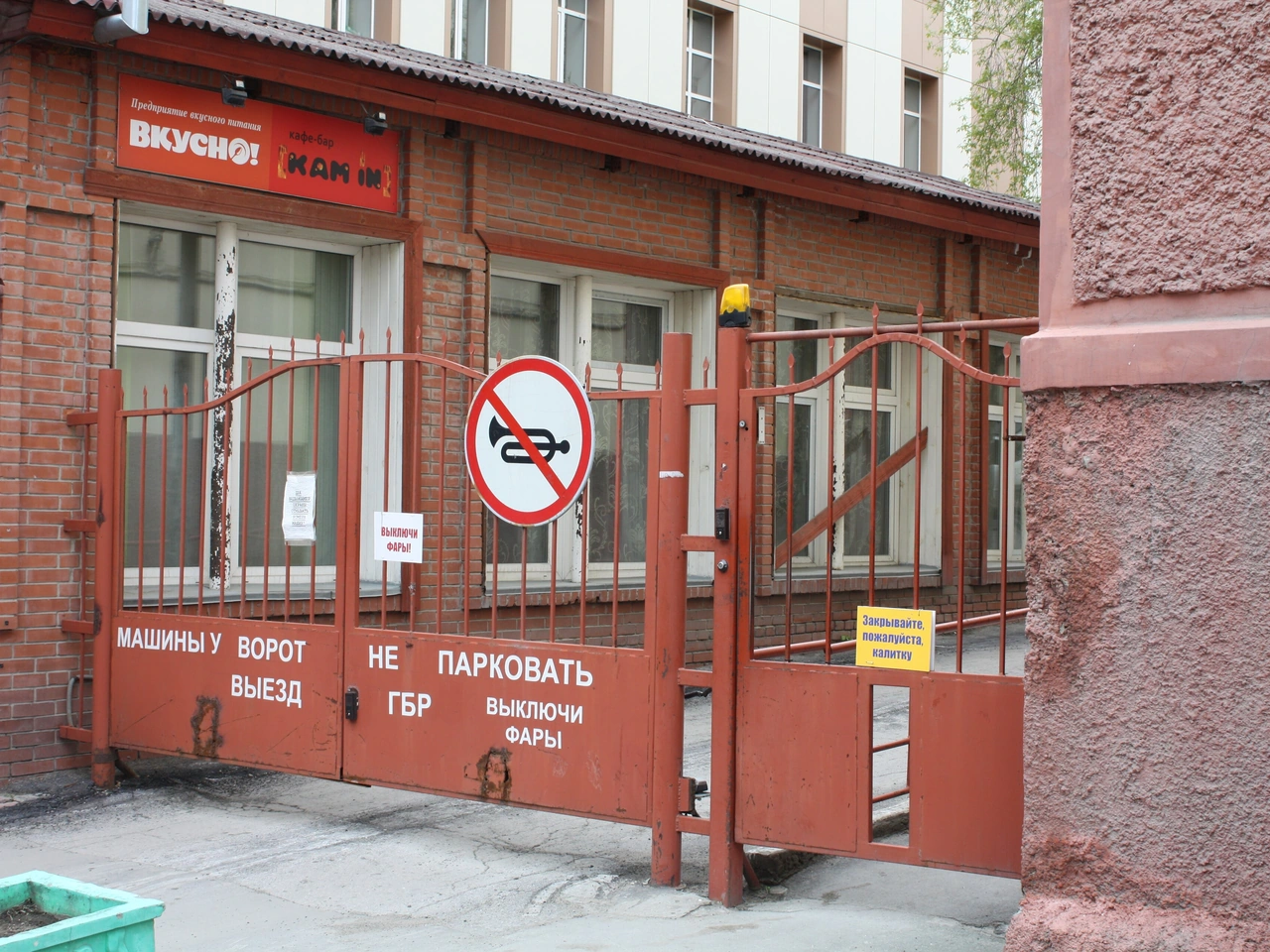
Wikimedia.org • К.Артём.1 • CC BY-SA
What is a car horn?
A car horn is a sound-producing warning device used to alert other road users when their attention is needed for safety.
🔗 gov.uk • Great Britain Highway Code, Rule 112; national guidance example
When should you use the horn?
The horn should generally be used when a sound warning is necessary to help prevent danger or an accident. The exact circumstances in which horn use is permitted depend on local traffic laws.
🔗 gov.uk • Great Britain Highway Code, Rule 112; national guidance example
Can you use the horn to show annoyance?
Generally, no. A horn is intended as a safety warning device, and unnecessary or excessive use may be prohibited by local traffic rules.
🔗 gov.uk • Great Britain Highway Code, Rule 112; national guidance example
47. Licence plate
A licence plate, also called a registration plate or number plate, is a plate displaying a unique registration identifier assigned to a vehicle by the competent registration authority. It allows the vehicle to be identified for purposes such as registration, traffic enforcement, taxation, insurance and parking control.
The appearance, format, placement and number of plates required vary between countries and vehicle categories. Drivers must ensure that required licence plates are correctly fitted, clearly visible and legible and must follow the local rules when a plate is lost, stolen, damaged or replaced.
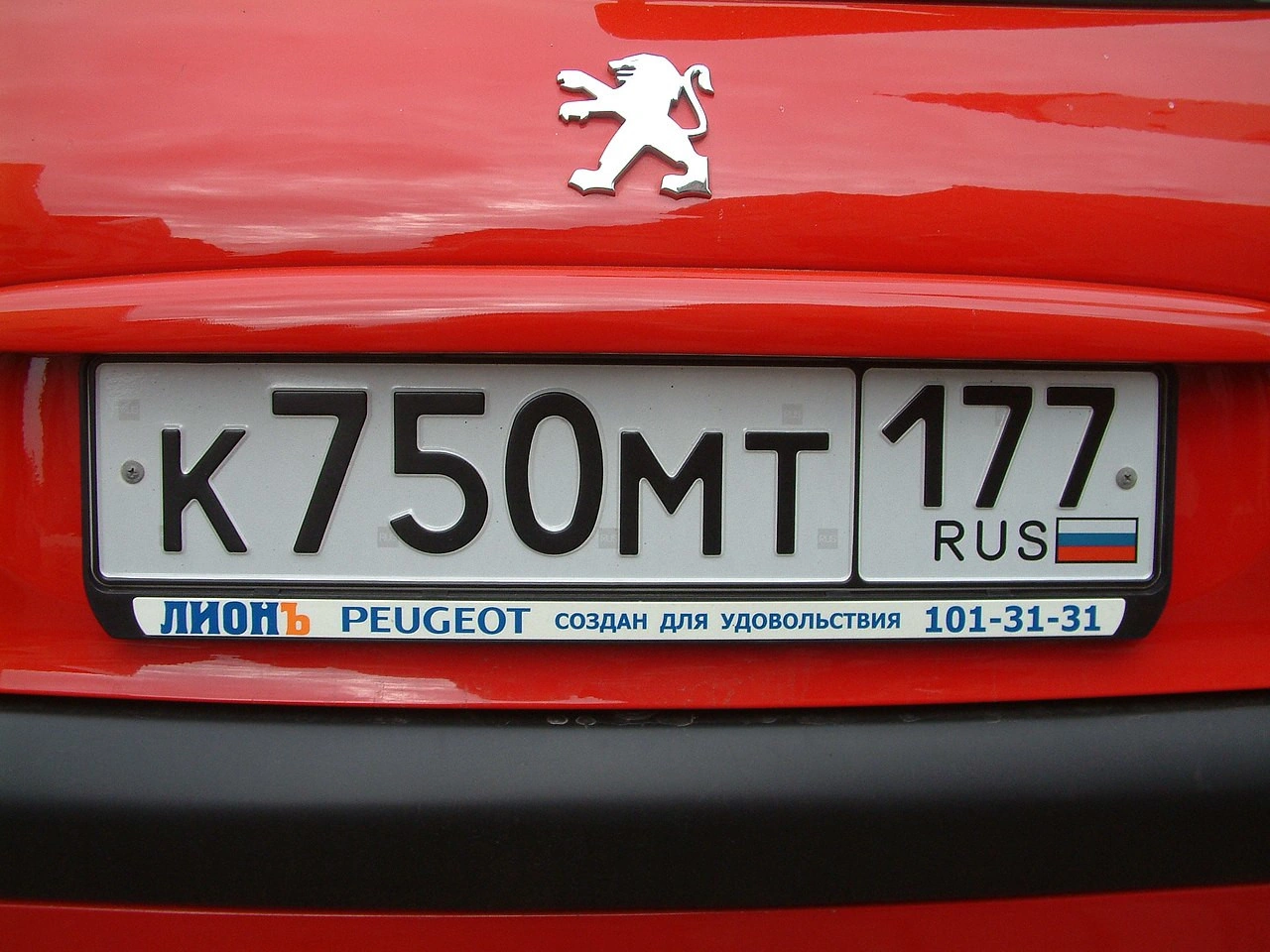
Wikimedia.org • 19petra • CC BY-SA
What is a licence plate?
A licence plate is a plate displaying the registration identifier assigned to a vehicle. It allows authorities and other authorised systems to identify the vehicle's registration.
Is a licence plate the same as a registration plate?
Yes. Licence plate, registration plate and number plate are different terms commonly used for the plate displaying a vehicle's official registration number.
What should you do if a licence plate is lost or stolen?
Follow the local reporting and replacement procedure. For example, UK guidance says stolen plates should be reported to the police and DVLA, and replacement plates are needed before driving. Check the registration authority’s procedure for a lost plate; it may differ from the theft process.
48. Charging station
A charging station is a location equipped with one or more charging points where the battery of an electric or plug-in hybrid vehicle can be connected to an electricity supply and recharged. Charging stations may be located along public roads, in car parks, at service areas or on private property.
Charging spaces may be reserved for vehicles that are charging and can be subject to parking restrictions, time limits, payment requirements or other conditions. Drivers must follow the traffic signs, parking regulations and charging instructions applying at the location.
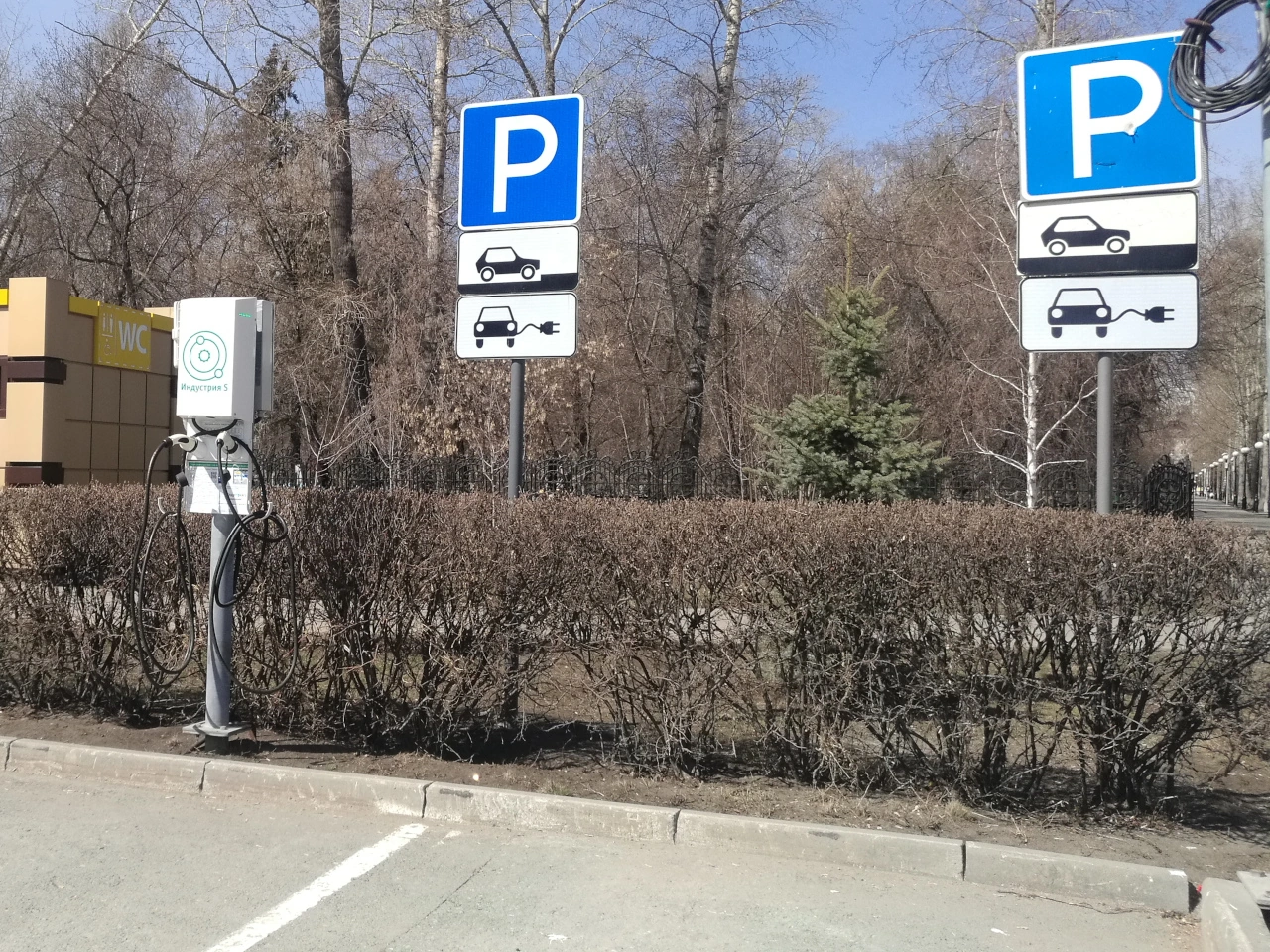
Wikimedia.org • RG72 • CC BY-SA
What is a charging station?
A charging station is a location where electric vehicles can be connected to an electricity supply to recharge their batteries. A station may contain one or several individual charging points.
🔗 tfl.gov.uk • Transport for London, electric vehicles and charging points; London example
Who can use an electric-vehicle charging station?
Charging stations are intended for vehicles that can be externally charged, such as battery-electric vehicles and plug-in hybrid vehicles. The exact vehicle categories permitted may be indicated by local signs or operator conditions.
🔗 tfl.gov.uk • Transport for London, electric vehicles and charging points; London example
Can a charging station have a maximum parking time?
Yes. Traffic signs, parking regulations or charging conditions may establish a maximum duration to encourage drivers to move their vehicles and make the charger available to others.
🔗 tfl.gov.uk • Transport for London, electric vehicles and charging points; London example
49. Cyclist
A cyclist is a person who rides and controls a bicycle. Cyclists are road users and, in many countries, bicycles are legally treated as vehicles, meaning cyclists must follow many of the same traffic rules that apply to other drivers together with rules specifically intended for cycling.
Cyclists should use designated cycling facilities where required, obey traffic signs and signals and ride in a predictable and safe manner. The exact rules governing road position, priority, equipment and permitted cycling areas vary between countries.
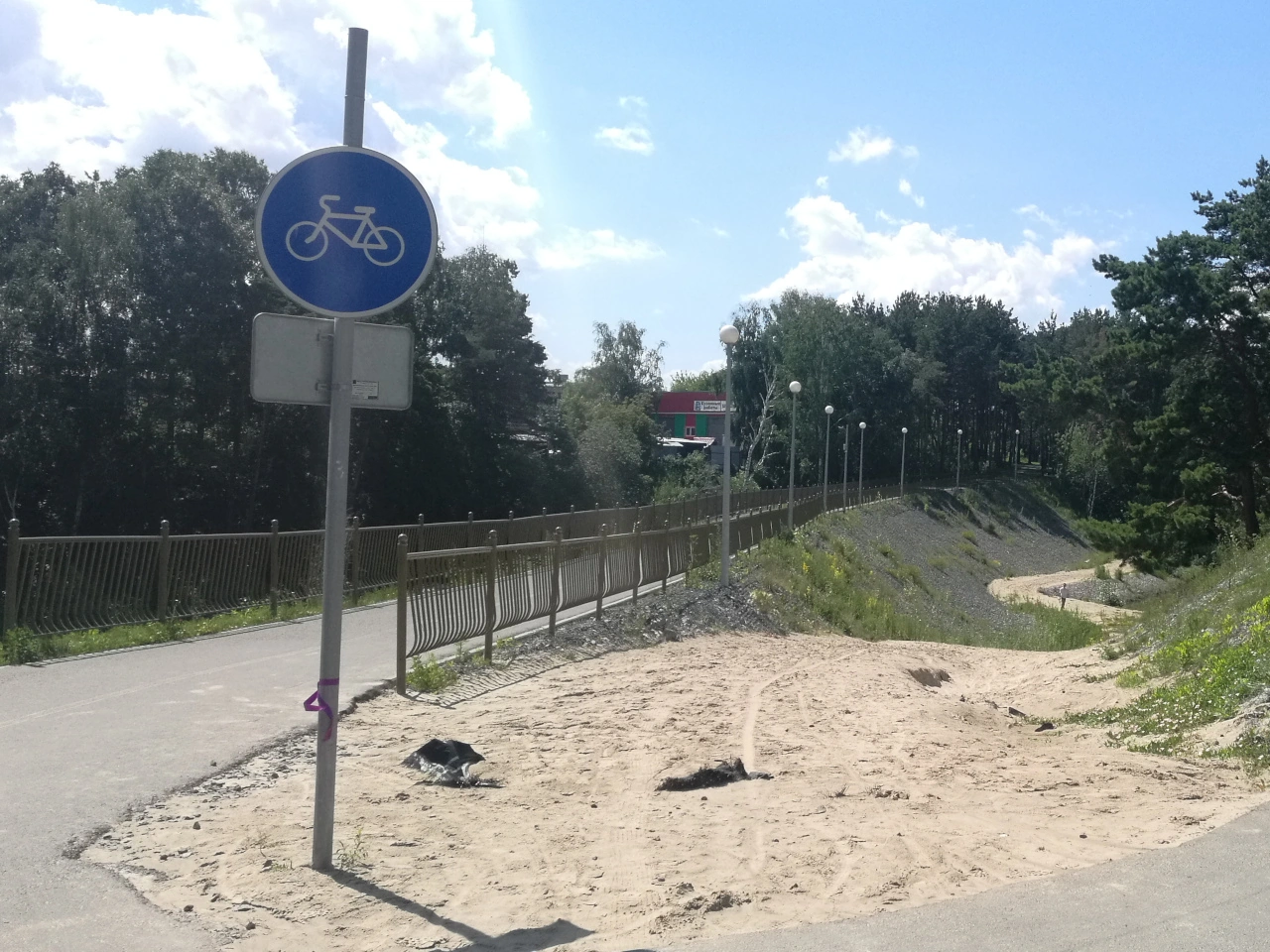
Wikimedia.org • RG72 • CC BY-SA
Where should cyclists ride?
This depends on local rules. Cyclists may be required to use a cycle path or designated cycling facility, while in other situations they may ride on the carriageway.
50. Moped
A moped is a lightweight motor vehicle, usually with two or three wheels, whose power, engine capacity or maximum design speed is limited by law. Mopeds generally occupy a legal category between bicycles and motorcycles, although their exact classification varies between countries.
Special rules may apply concerning the minimum riding age, driving licence, helmet, registration, insurance, maximum speed and use of cycle paths or roadways. Riders must therefore follow the classification and traffic regulations applying in the country where they are travelling.
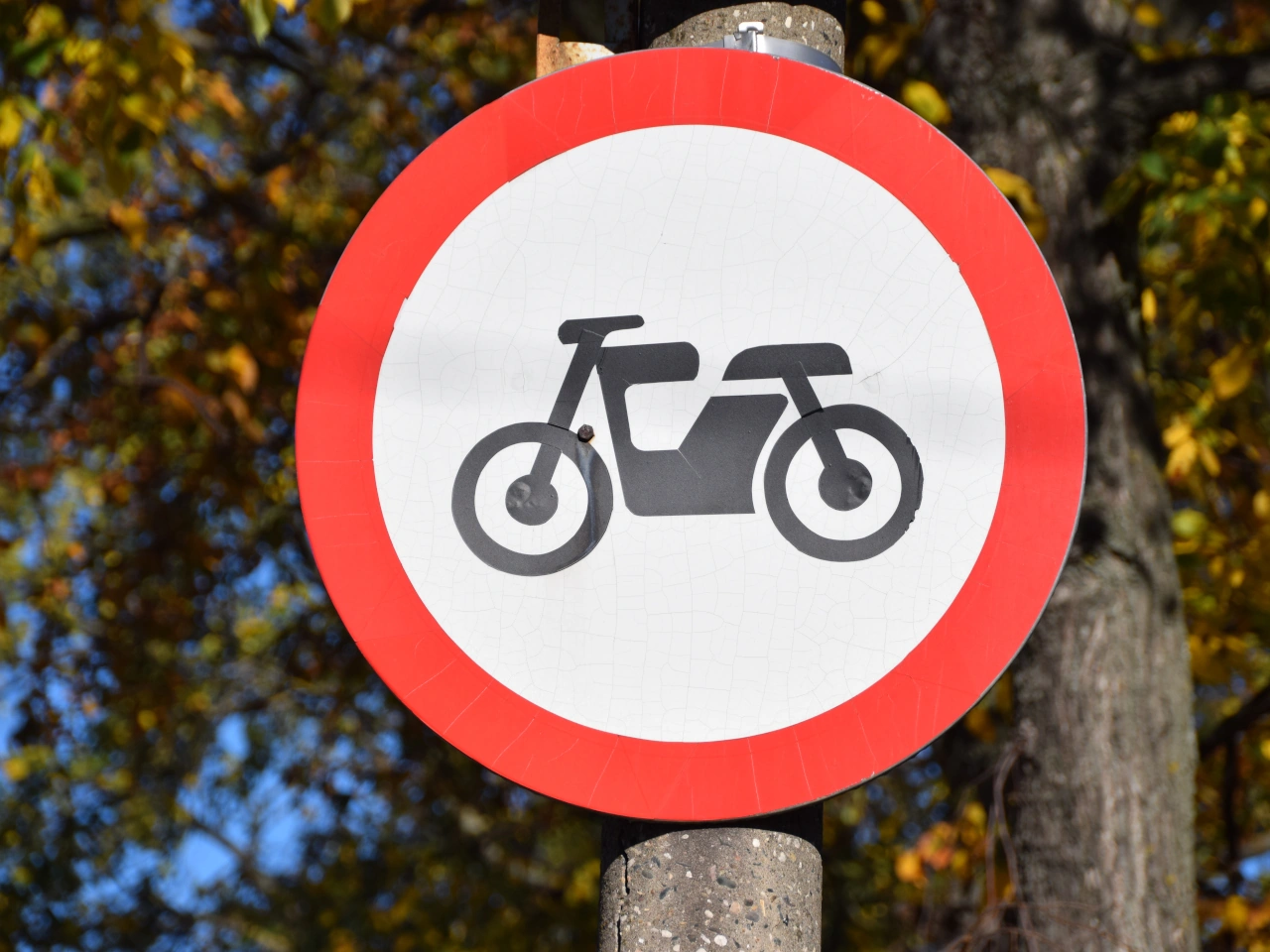
Wikimedia.org • Dickelbers • CC BY-SA
What is a moped?
A moped is a lightweight motor vehicle whose engine power, capacity or maximum design speed is restricted by law. The precise technical definition differs between countries.
🔗 gov.uk • Great Britain Highway Code, Rules 83–88; national guidance example
🔗 gov.uk • Great Britain Highway Code, Rules 221–223; national guidance example
Is a moped the same as a motorcycle?
Mopeds commonly form a lower-speed or lower-power vehicle category, but their legal relationship to motorcycles varies. Some traffic laws treat certain mopeds as motorcycles or apply other special rules. Check the local technical, access and licensing definitions.
🔗 gov.uk • Great Britain Highway Code, Rules 83–88; national guidance example
🔗 gov.uk • Great Britain Highway Code, Rules 221–223; national guidance example
Do moped riders have to wear a helmet?
Helmet requirements vary between countries, but an approved protective helmet is compulsory for moped riders in many jurisdictions. Passengers may also be required to wear one.
🔗 gov.uk • Great Britain Highway Code, Rules 83–88; national guidance example
🔗 gov.uk • Great Britain Highway Code, Rules 221–223; national guidance example