


Traffic rulesRussia
 Traffic rules
 Argentina
 Australia
 Austria
 Bangladesh
 Belgium
 Bosnia and Herzegovina
 Brazil
 Canada
 Chile
 China
 Colombia
 Czechia
 Denmark
 Finland
 France
 Germany
 Greece
 Hungary
 Iceland
 India
 Indonesia
 Ireland
 Italy
 Japan
 Malaysia
 Mexico
 Nepal
 Netherlands
 New Zealand
 Norway
 Panama
 Peru
 Philippines
 Poland
 Portugal
 Romania
 Russia
 Serbia
 Slovakia
 Slovenia
 South Africa
 Spain
 Sweden
 Switzerland
 Thailand
 Turkey
 Ukraine
 United Kingdom
 United States
 Uruguay
 Worldwide
1. Russia
Russia extends across eastern Europe and northern Asia, and its enormous size makes long-distance driving a defining feature of the country. Traffic drives on the right. Roads range from dense urban networks around major cities to federal highways crossing sparsely populated regions where fuel, services and settlements may be separated by considerable distances. Russian is the principal language used on road signs, and destination names and other written information are generally displayed in the Cyrillic alphabet, which is worth preparing for if you cannot read the script.
Seasonal conditions are especially important. Passenger cars must use winter tyres in December, January and February, and severe snow, ice and extreme cold can affect roads for much longer in many regions. Russia has both free and tolled high-speed roads, including sections of the M-4, M-11 and M-12, but there is no nationwide vignette for passenger cars. Another notable difference from much of Europe is the general 60 km/h urban speed limit; on motorways the normal maximum is 110 km/h, although suitably designated sections may permit up to 130 km/h.
AI-generated by Traffic-rules.com • WCIT • CC BY-SA
Can you drive after drinking alcohol in Russia?
Driving while intoxicated is prohibited. Do not drink alcohol before driving or drive while impaired by drugs or medication.
What speed limits apply to passenger cars in Russia?
Built-up areas: The general maximum speed in built-up areas is 60 km/h, unless signs establish another limit. Higher limits may be authorised on suitable signed roads.
Outside built-up areas: For ordinary passenger cars, the general maximum outside built-up areas is 90 km/h, unless another limit is legally established or signed.
Motorways: For ordinary passenger cars, the general motorway maximum is 110 km/h. On suitable motorway sections, the road authority may establish a higher signed limit of up to 130 km/h.
Residential areas: The maximum speed in residential zones, bicycle zones and courtyard areas is 20 km/h.
Are seat belts compulsory in Russia?
Yes. Drivers and passengers must use seat belts where the vehicle is equipped with them.
Can you use a mobile phone while driving in Russia?
A driver must not use a telephone while the vehicle is moving unless it can be used with a hands-free system that does not require holding the phone.
When must children use a child restraint in Russia?
In a passenger car designed with seat belts, children under 7 must use a child-restraint system suitable for their weight and height. Children aged 7 to 11 inclusive may use an appropriate restraint or the seat belt in the rear, but must use an appropriate child restraint in the front passenger seat. Install and use the restraint according to its instructions.
Are motorcycle helmets compulsory in Russia?
Yes. A motorcycle rider must wear a fastened motorcycle helmet and must not carry a passenger who is not wearing a fastened helmet.

2. Motorway
A motorway is a road specially designed and signposted for motor traffic. Motorways normally have separate carriageways for opposing traffic, controlled access through designated entrances and exits, no direct access to neighbouring properties, and no level crossings with other roads, railways or paths.
Special traffic rules apply on motorways. The permitted road users, speed limits, lane rules, tolls and emergency procedures vary between countries, so drivers must follow the local traffic signs and regulations.
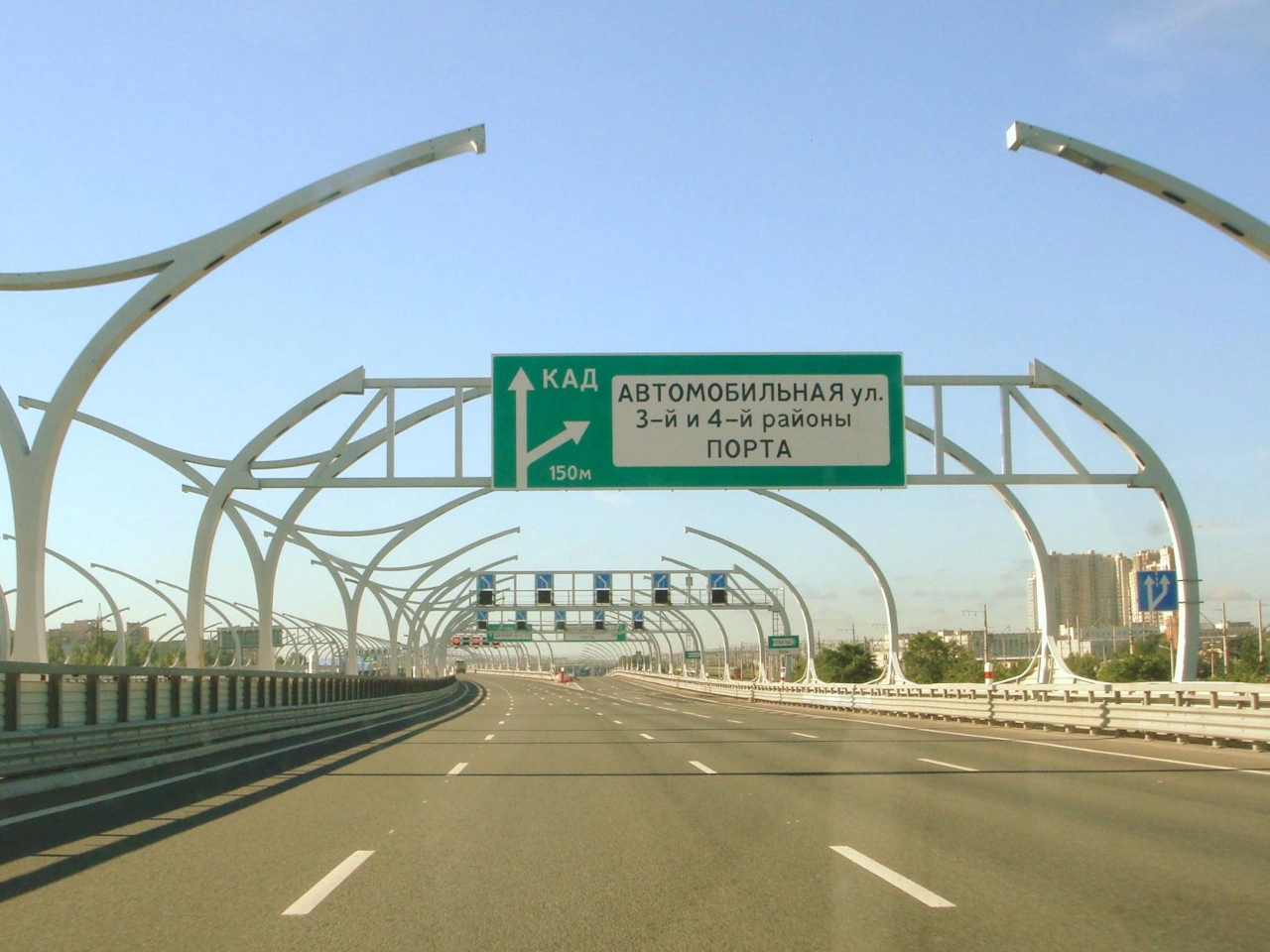
Wikimedia.org • alexyv • CC BY-SA
How do people refer to a motorway in Russia?
The Russian term is автомагистраль (avtomagistral). The motorway designation introduces the special rules in the national traffic regulations.
🔗 sh380.krsl.gov.spb.ru • Russia — Sections 10.3 and 16; motorway definition and sign 5.1
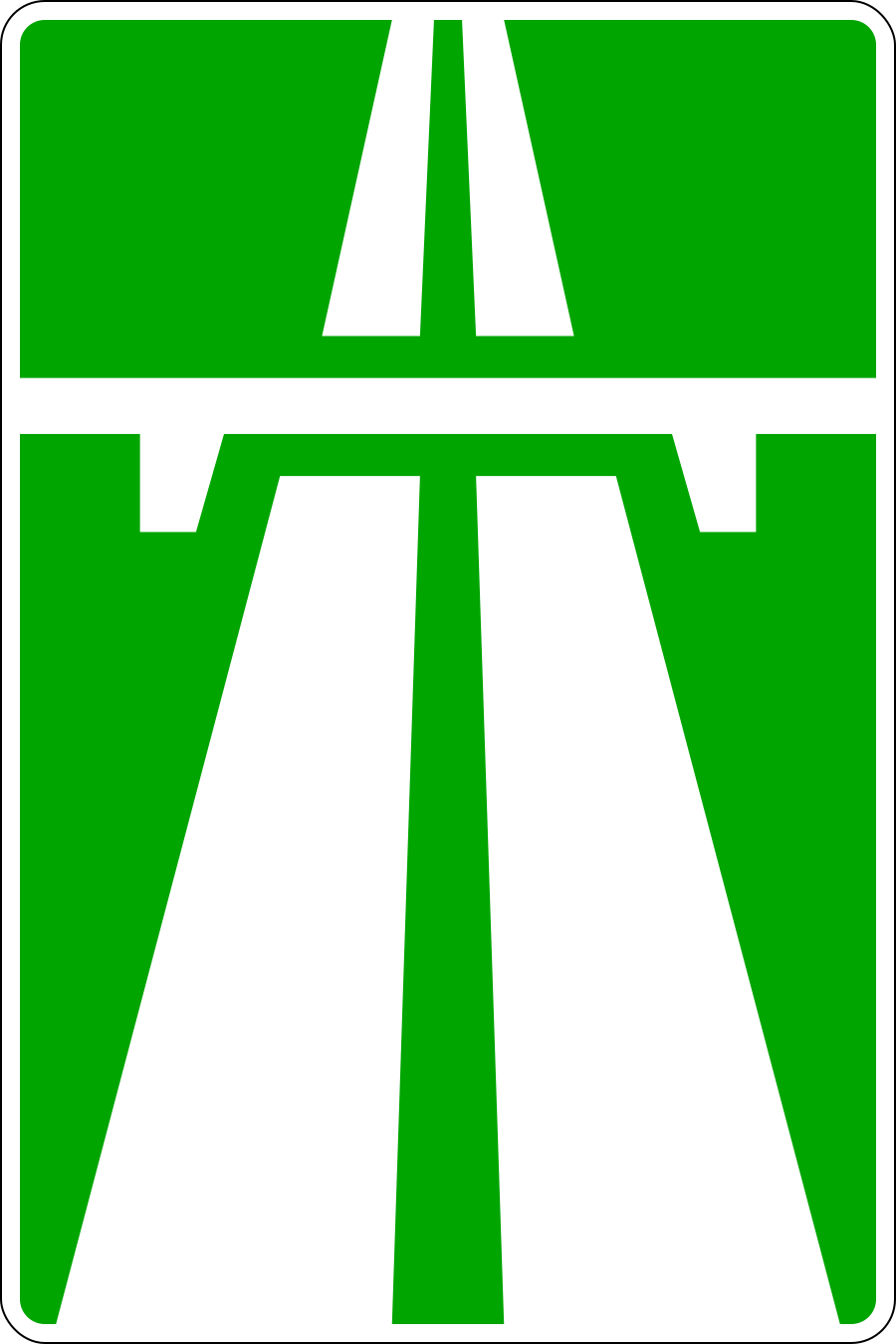 Start of a motorway.
English • Traffic sign 5.1 • Motorway. Section 16 of the traffic rules applies.
Русский • 5.1 • Автомагистраль. На дороге действуют требования раздела 16 ПДД для автомагистралей.
Sources
🔗 Commons.wikimedia.org
🔗 Pravo.gov.ru • ПДД РФ • приложение 1 • 5.1
🔗 Pravo.gov.ru • Официальная редакция от 28.08.2026
SVG source: Gauravjuvekar • CC0 • Original revision 2014-01-26. Wikimedia original unmodified.
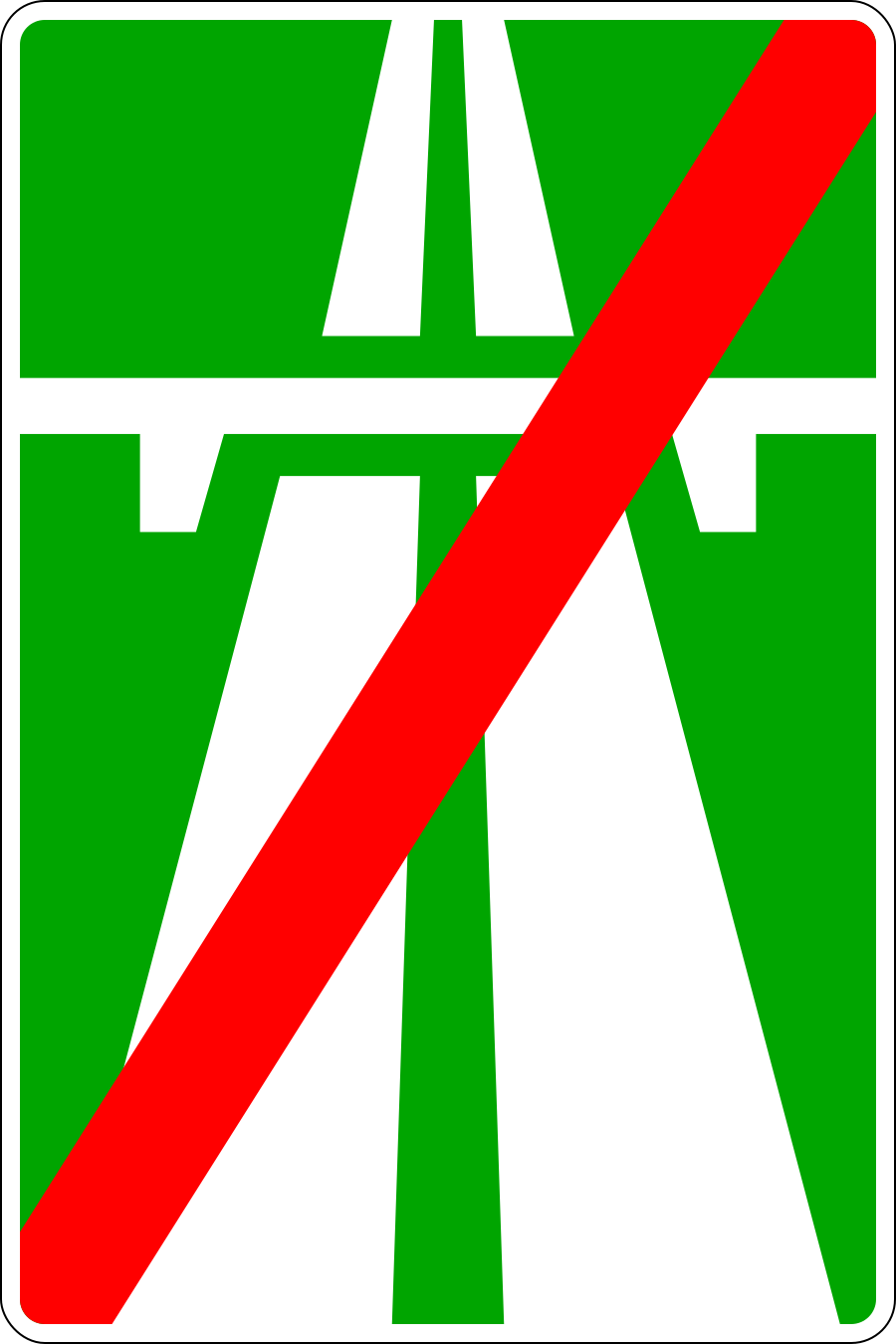 End of the motorway.
English • Traffic sign 5.2 • End of motorway. Ends the motorway marked by 5.1.
Русский • 5.2 • Конец автомагистрали. Оканчивается автомагистраль, обозначенная знаком 5.1.
Sources
🔗 Commons.wikimedia.org
🔗 Pravo.gov.ru • ПДД РФ • приложение 1 • 5.2
🔗 Pravo.gov.ru • Официальная редакция от 28.08.2026
SVG source: Unknown authorUnknown author • Public domain • Original revision 2014-01-26. Wikimedia original unmodified.
What speed limit applies to cars on a motorway in Russia?
For an ordinary passenger car, the general motorway maximum is 110 km/h. Suitable sections may have an authorised, signed limit of up to 130 km/h. Follow the posted limit and any lower vehicle-specific restriction.
🔗 sh380.krsl.gov.spb.ru • Russia — Sections 10.3 and 16; motorway definition and sign 5.1
Who may use a motorway in Russia?
Pedestrians, personal mobility users, domestic animals, bicycles, mopeds, tractors and self-propelled machinery are excluded. Other vehicles are also excluded if their technical characteristics or condition prevent meeting the motorway’s admission speed. Being motorised does not make every vehicle eligible.
🔗 sh380.krsl.gov.spb.ru • Russia — Sections 10.3 and 16; motorway definition and sign 5.1
What should I do if I miss a motorway exit in Russia?
Continue to the next exit and choose a safe onward route. Do not reverse, make a U-turn or cross the central reservation to return to a missed exit.
🔗 sh380.krsl.gov.spb.ru • Russia — Sections 10.3 and 16; motorway definition and sign 5.1
3. Residential area
A residential area is a street or group of streets where housing and access to local properties are the main functions. Drivers should expect pedestrians, cyclists, children, parked vehicles and vehicles entering or leaving driveways.
Some countries identify particular residential areas with traffic signs and apply special low-speed and residential-area rules. The speed limit, pedestrian rights, parking rules and permitted road users therefore depend on local signs and regulations.
Wikimedia.org • Antonio Kless • CC BY-SA
How do people refer to a residential area in Russia?
The Russian term is жилая зона (zhilaya zona). Its entrance and exit signs define the residential area; the special residential-area conduct rules also apply in courtyards.
🔗 sh380.krsl.gov.spb.ru • Russia — Sections 10.2 and 17; signed residential areas and courtyards
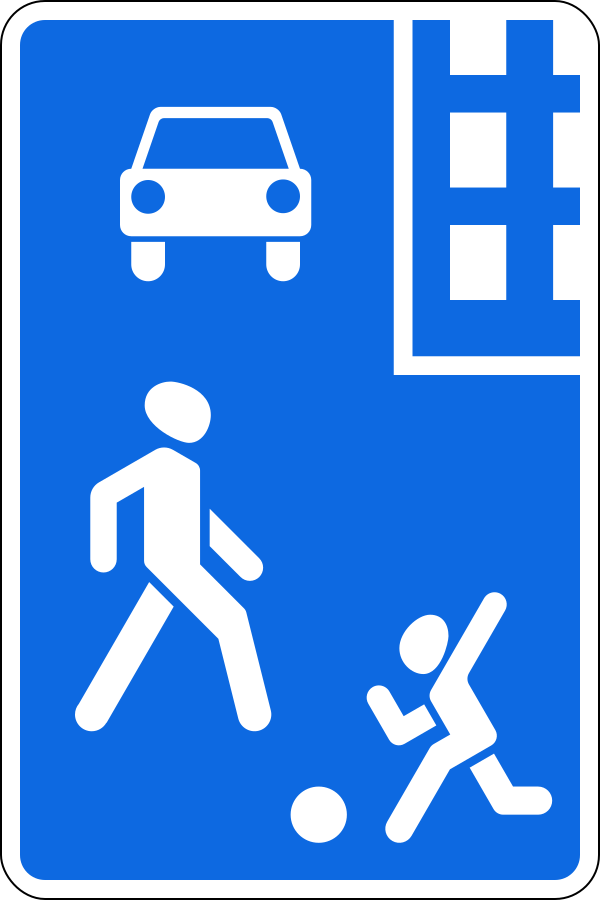 Start of a residential area.
English • Traffic sign 5.21 • Residential area. Pedestrians have priority and speed is limited to 20 km/h. Through motor traffic, learner driving and parking with the engine running are prohibited.
Русский • 5.21 • Жилая зона. Начинается жилая зона: пешеходы имеют преимущество, скорость ограничена 20 км/ч; запрещены сквозное движение механического транспорта, учебная езда и стоянка с работающим двигателем.
Sources
🔗 Commons.wikimedia.org (Nikolaev_ec06ffa5 • CC BY-SA 3.0)
🔗 Pravo.gov.ru • ПДД РФ • приложение 1 • 5.21
🔗 Pravo.gov.ru • Официальная редакция от 28.08.2026
SVG source: Nikolaev_ec06ffa5 • CC BY-SA 3.0 • Original revision 2014-02-04. Wikimedia original unmodified.
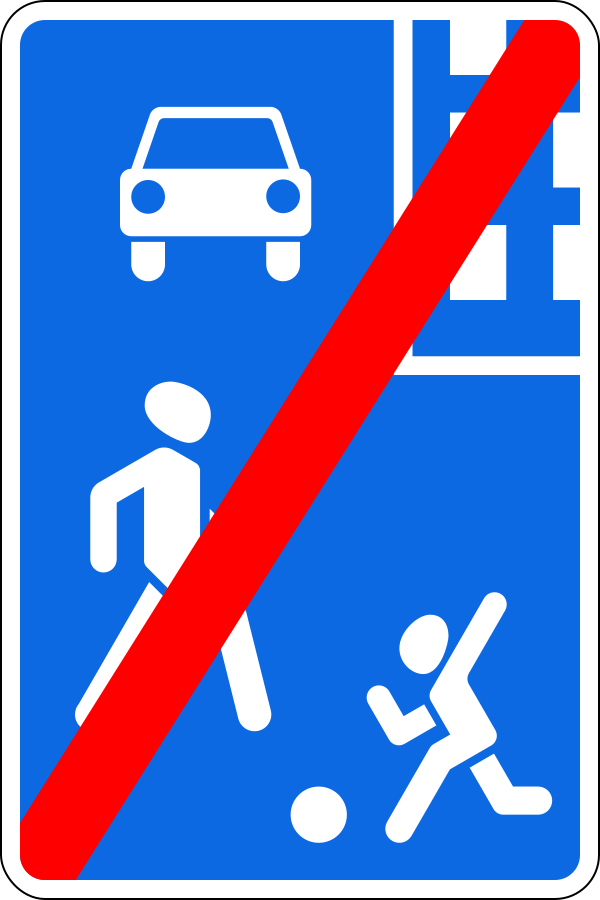 End of the residential area.
English • Traffic sign 5.22 • End of residential area. Give way to other road users when leaving.
Русский • 5.22 • Конец жилой зоны. Оканчивается жилая зона. При выезде уступите дорогу другим участникам движения.
Sources
🔗 Commons.wikimedia.org (Nikolaev_ec06ffa5 • CC BY-SA 3.0)
🔗 Pravo.gov.ru • ПДД РФ • приложение 1 • 5.22
🔗 Pravo.gov.ru • Официальная редакция от 28.08.2026
SVG source: Nikolaev_ec06ffa5 • CC BY-SA 3.0 • Original revision 2014-02-04. Wikimedia original unmodified.
What speed limit applies in a residential area in Russia?
The maximum in residential zones and courtyards is 20 km/h. Drive more slowly where necessary to protect pedestrians.
🔗 sh380.krsl.gov.spb.ru • Russia — Sections 10.2 and 17; signed residential areas and courtyards
What rights do pedestrians have in a signposted residential area in Russia?
Pedestrians may use pavements and the carriageway and have priority. They must not obstruct vehicles unnecessarily; drivers must allow them to move safely.
🔗 sh380.krsl.gov.spb.ru • Russia — Sections 10.2 and 17; signed residential areas and courtyards
May I drive through a Russian residential area as a shortcut?
Motor-vehicle through-traffic is prohibited. The rules also prohibit learner driving and parking with the engine running. When leaving the area, give way to other road users. These residential-area conduct rules also apply in courtyards.
🔗 sh380.krsl.gov.spb.ru • Russia — Sections 10.2 and 17; signed residential areas and courtyards
4. Zone
A traffic zone is an area in which a traffic rule applies throughout all included roads or road sections. The rule normally begins at a zone-entry sign and remains applicable until the corresponding end-of-zone sign is passed.
Zones may regulate speed, parking, access, vehicle categories, emissions or other traffic behaviour. The signs used, the roads covered and the effect of intersections or local exceptions depend on local traffic law.
Wikimedia.org • AntonioK • CC BY-SA
How do people refer to traffic zones in Russia?
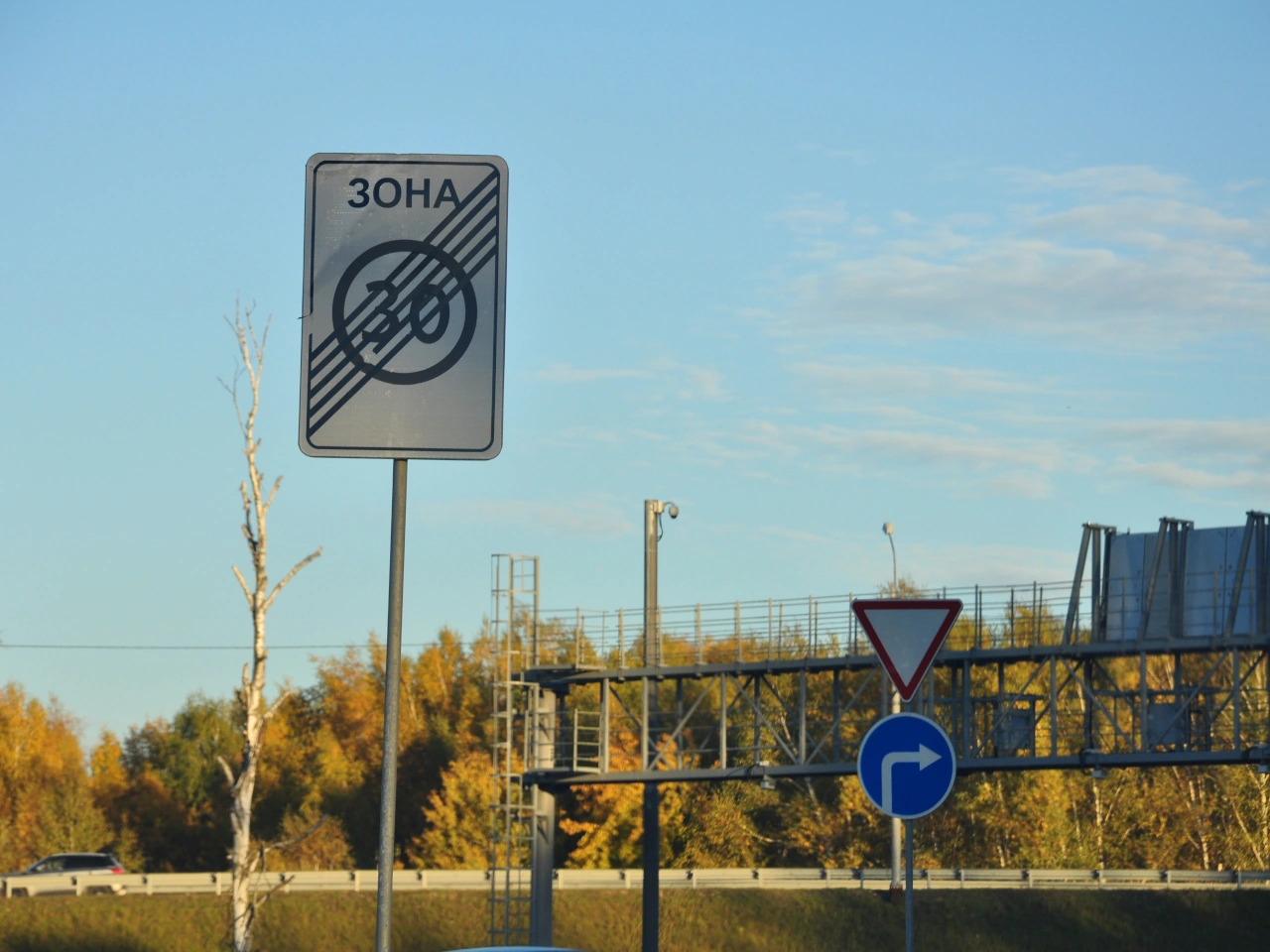
A speed-limit zone is a зона с ограничением максимальной скорости. Russia also distinguishes parking-prohibition zones and regulated-parking zones. The entrance symbol identifies the rule to remember.
🔗 sh380.krsl.gov.spb.ru • Russia — Annex 1 zone entry/end signs; actual restriction
Where does a zone rule apply in Russia?
The speed-zone sign marks the beginning of the territory or road section where the displayed maximum applies. It has a corresponding zone-end sign; do not confuse it with an ordinary road-specific speed restriction.
🔗 sh380.krsl.gov.spb.ru • Russia — Annex 1 zone entry/end signs; actual restriction
How do you know when a traffic zone ends in Russia?
Look for the end sign matching the speed or parking zone you entered. Zones can cover different boundaries, so leaving one does not by itself cancel a separate access or parking restriction.
🔗 sh380.krsl.gov.spb.ru • Russia — Annex 1 zone entry/end signs; actual restriction
5. Speed limit
A speed limit is the maximum legal speed permitted on a road, lane or within a designated area. It may be established by general traffic law or indicated by fixed, variable or temporary traffic signs.
A speed limit is a maximum, not a target speed. Drivers must travel more slowly whenever traffic, visibility, weather, road conditions, vulnerable road users or the condition of the vehicle make the maximum permitted speed unsafe.
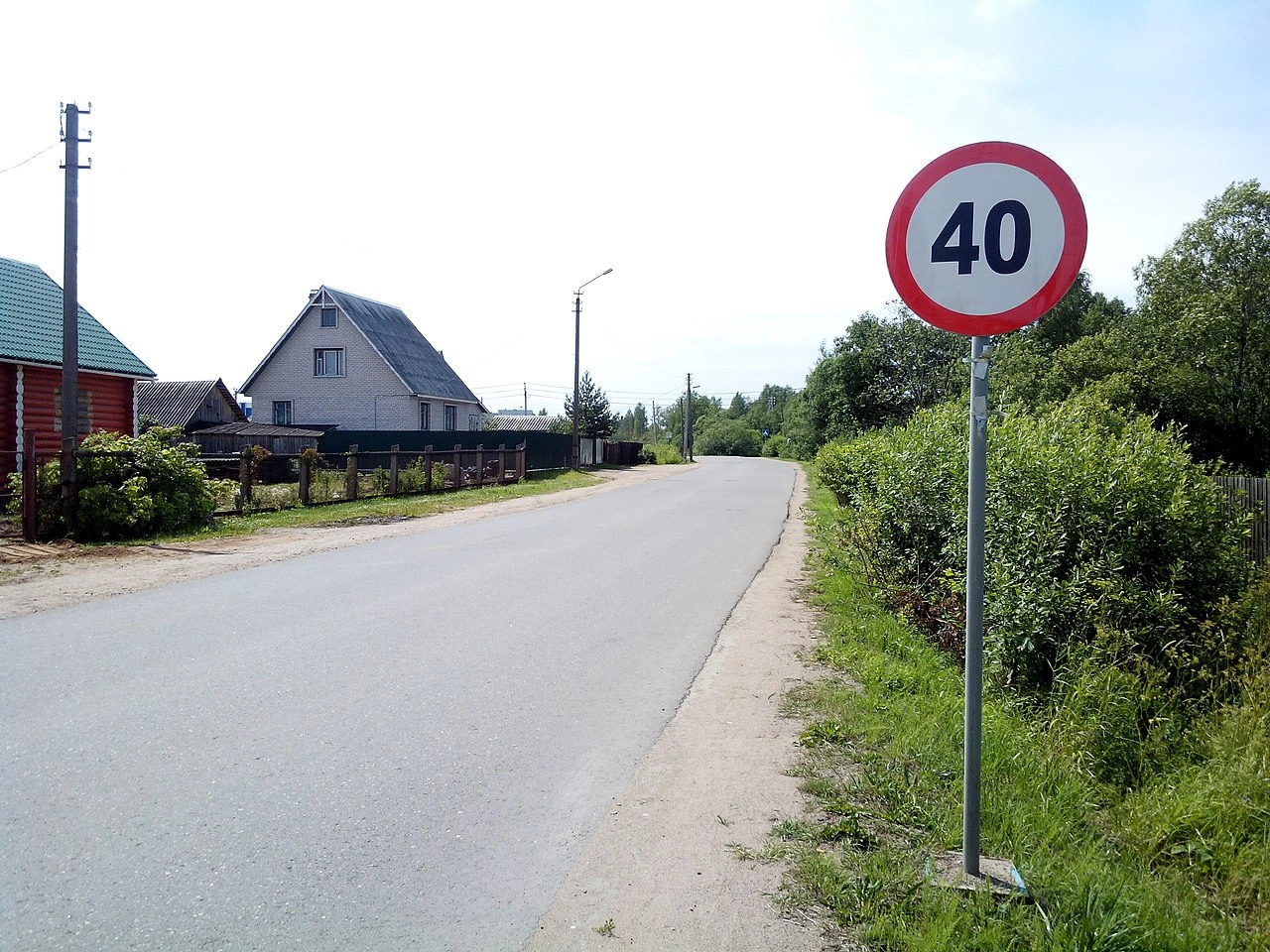
Wikimedia.org • Дмитрий Cкляренко • CC BY
Which general speed limits should car drivers know in Russia?
For an ordinary passenger car without a trailer, the general maxima are 60 km/h in built-up areas, 90 km/h on ordinary roads outside them and 110 km/h on motorways. Suitable motorway sections may be specifically authorised and signed up to 130 km/h. Residential zones, bicycle zones and courtyard areas have a 20 km/h maximum.
Does every Russian motorway allow cars to travel at 130 km/h?
No. The ordinary car motorway maximum is 110 km/h. A suitable section must be specifically authorised and signed for the higher maximum, which can be up to 130 km/h. The motorway entrance sign alone does not grant that higher speed.
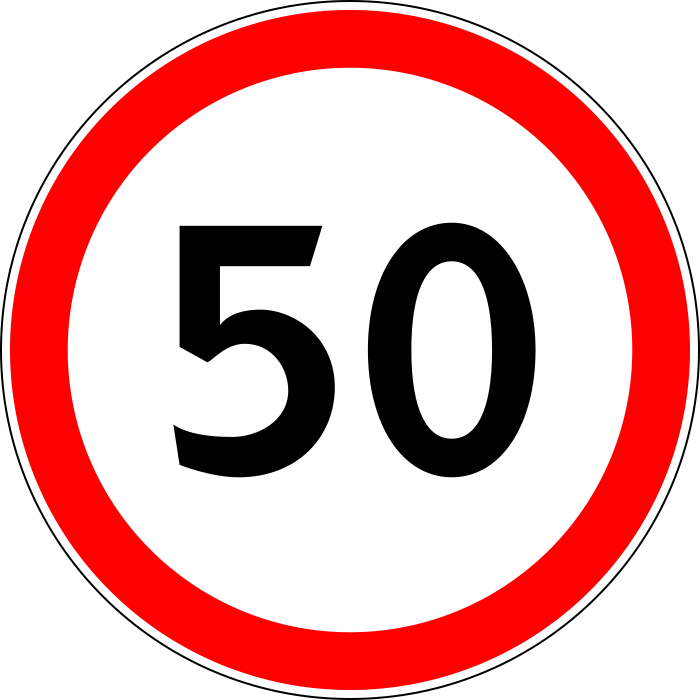 Start of a speed limit.
English • Traffic sign 3.24 • Maximum speed limit. Travelling faster than 50 km/h is prohibited.
Русский • 3.24 • Ограничение максимальной скорости. Движение со скоростью более 50 км/ч запрещено.
Sources
🔗 Commons.wikimedia.org (User:Flrn • CC BY-SA 3.0)
🔗 Pravo.gov.ru • ПДД РФ • приложение 1 • 3.24
🔗 Pravo.gov.ru • Официальная редакция от 28.08.2026
SVG source: User:Flrn • CC BY-SA 3.0 • Original revision 2023-09-05. Wikimedia original unmodified.
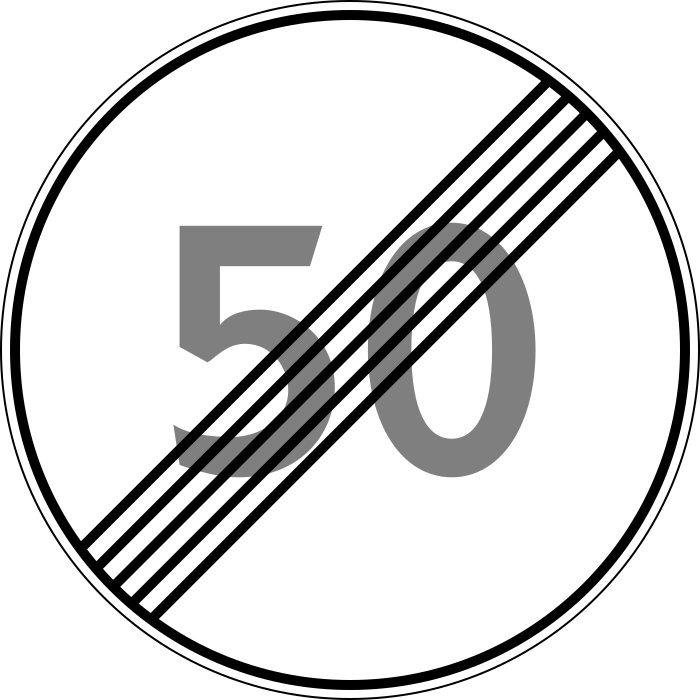 End of the speed limit.
English • Traffic sign 3.25 • End of maximum speed limit. Ends the limit imposed by 3.24. General limits and other applicable requirements remain.
Русский • 3.25 • Конец зоны ограничения максимальной скорости. Оканчивается ограничение скорости, введённое знаком 3.24. Сохраняются общие ограничения и другие действующие предписания.
Sources
🔗 Commons.wikimedia.org (Nikolaev_ec06ffa5, font by Alexander Sapozhnikov • CC BY-SA 3.0)
🔗 Pravo.gov.ru • ПДД РФ • приложение 1 • 3.25
🔗 Pravo.gov.ru • Официальная редакция от 28.08.2026
SVG source: Nikolaev_ec06ffa5, font by Alexander Sapozhnikov • CC BY-SA 3.0 • Original revision 2023-09-05. Wikimedia original unmodified.
Do Russian courtyard areas have a lower maximum even without being an ordinary main road?
Yes. The maximum in residential zones, bicycle zones and courtyard areas is 20 km/h. Treat courtyard access with particular care; the general built-up-area 60 km/h figure is not the applicable maximum there.
6. Footpath
A footpath is a path or part of a road intended primarily for pedestrian traffic. It may run alongside a road, through a park or residential area, or independently from roads used by motor vehicles.
A footpath may be reserved exclusively for pedestrians or may form part of a shared route with cyclists or other permitted users. Access, priority and permitted users depend on the traffic signs and local regulations applying to the path.
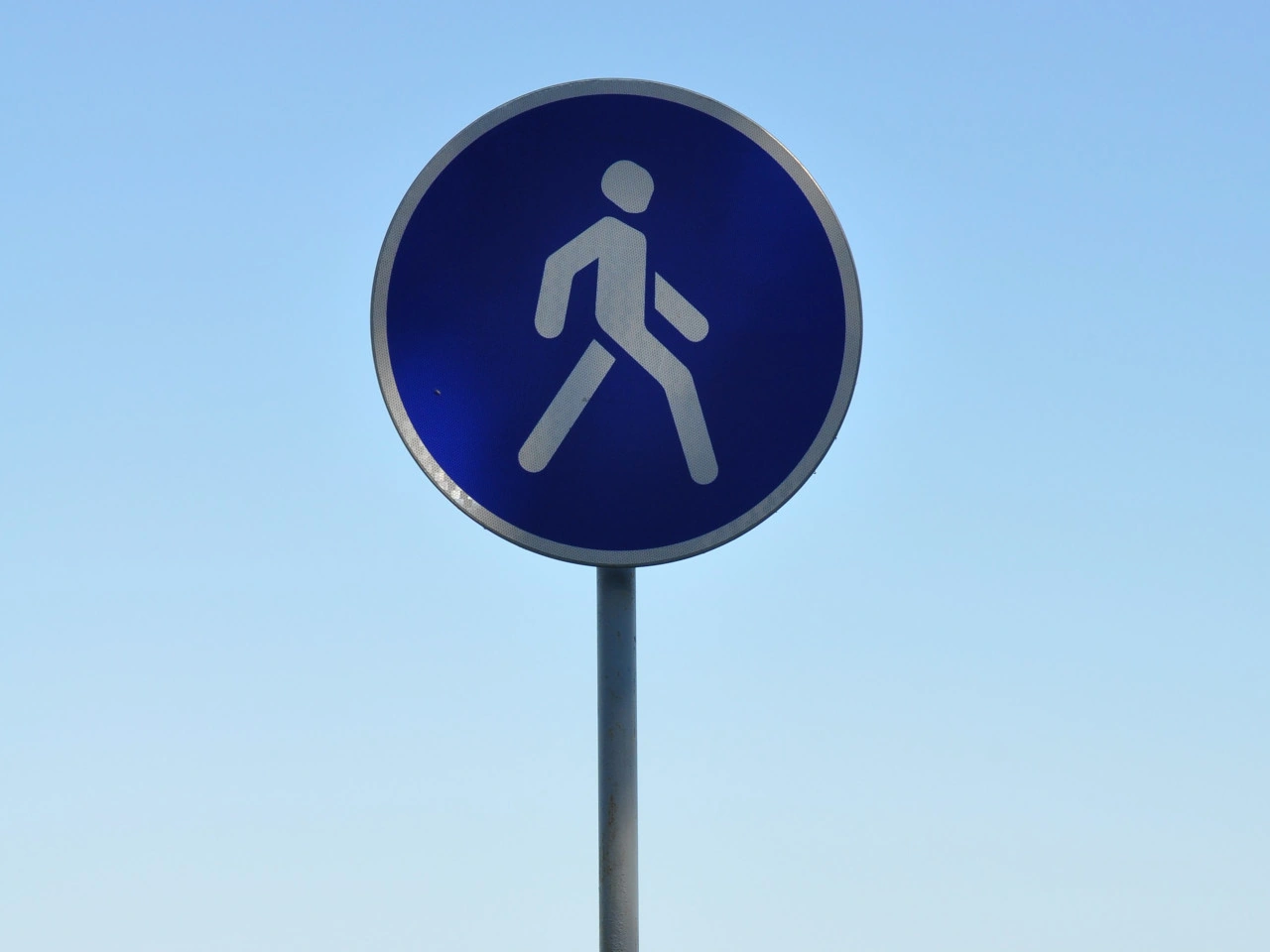
Wikimedia.org • Antonio Kless • CC BY-SA
How does Russia distinguish a pedestrian path from a roadside pavement?
The rules use пешеходная дорожка for a pedestrian path and тротуар for a roadside pavement. A walking and cycling path is a separate category. Check the symbols and any division of the path rather than assuming every walking facility has identical access rules.
🔗 sh380.krsl.gov.spb.ru • Russia — Sections 1.2, 4 and 24.1–24.6; sign 4.5.1 and conditional cycling
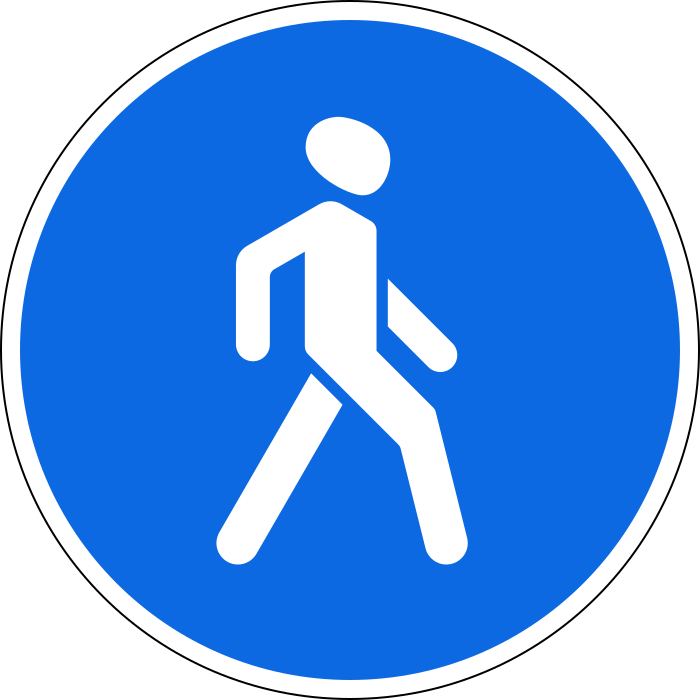 Mandatory path for pedestrians.
English • Traffic sign 4.5.1 • Footpath. Pedestrians and users of personal mobility devices are permitted; cyclists are admitted in the cases specified by traffic rules 24.2–24.4 and 24.6.
Русский • 4.5.1 • Пешеходная дорожка. Разрешены пешеходы и лица на средствах индивидуальной мобильности; велосипедисты допускаются в случаях, предусмотренных пунктами 24.2–24.4 и 24.6 ПДД.
Sources
🔗 Commons.wikimedia.org (Юкатан • CC BY-SA 3.0)
🔗 Pravo.gov.ru • ПДД РФ • приложение 1 • 4.5.1
🔗 Pravo.gov.ru • Официальная редакция от 28.08.2026
SVG source: Юкатан • CC BY-SA 3.0 • Original revision 2017-12-04. Wikimedia original unmodified.
Can cyclists use Russian pavements or pedestrian paths?
The rules provide age-related permissions and conditional exceptions. Riders over 14 may use a pavement or pedestrian path when the specified cycling facilities, carriageway edge and verge cannot be used, or when accompanying a child cyclist under 14 or transporting a child under seven in the permitted way.
🔗 sh380.krsl.gov.spb.ru • Russia — Sections 1.2, 4 and 24.1–24.6; sign 4.5.1 and conditional cycling
What must a cyclist do if riding on a Russian footpath endangers pedestrians?
Dismount and follow the pedestrian rules. The cycling exceptions do not permit endangering or obstructing other users. Where cyclists and pedestrians share the same space, pedestrian priority and the relevant safety duties still apply.
🔗 sh380.krsl.gov.spb.ru • Russia — Sections 1.2, 4 and 24.1–24.6; sign 4.5.1 and conditional cycling
7. Bike path
A bike path is a part of a road or a separate route intended primarily or exclusively for people riding bicycles. It may be physically separated from motor traffic, marked on the road surface or identified by traffic signs.
Bike paths may be one-way, two-way or shared with other road users. The permitted users, direction of travel, priority rules and obligation to use the path depend on local traffic signs and regulations.
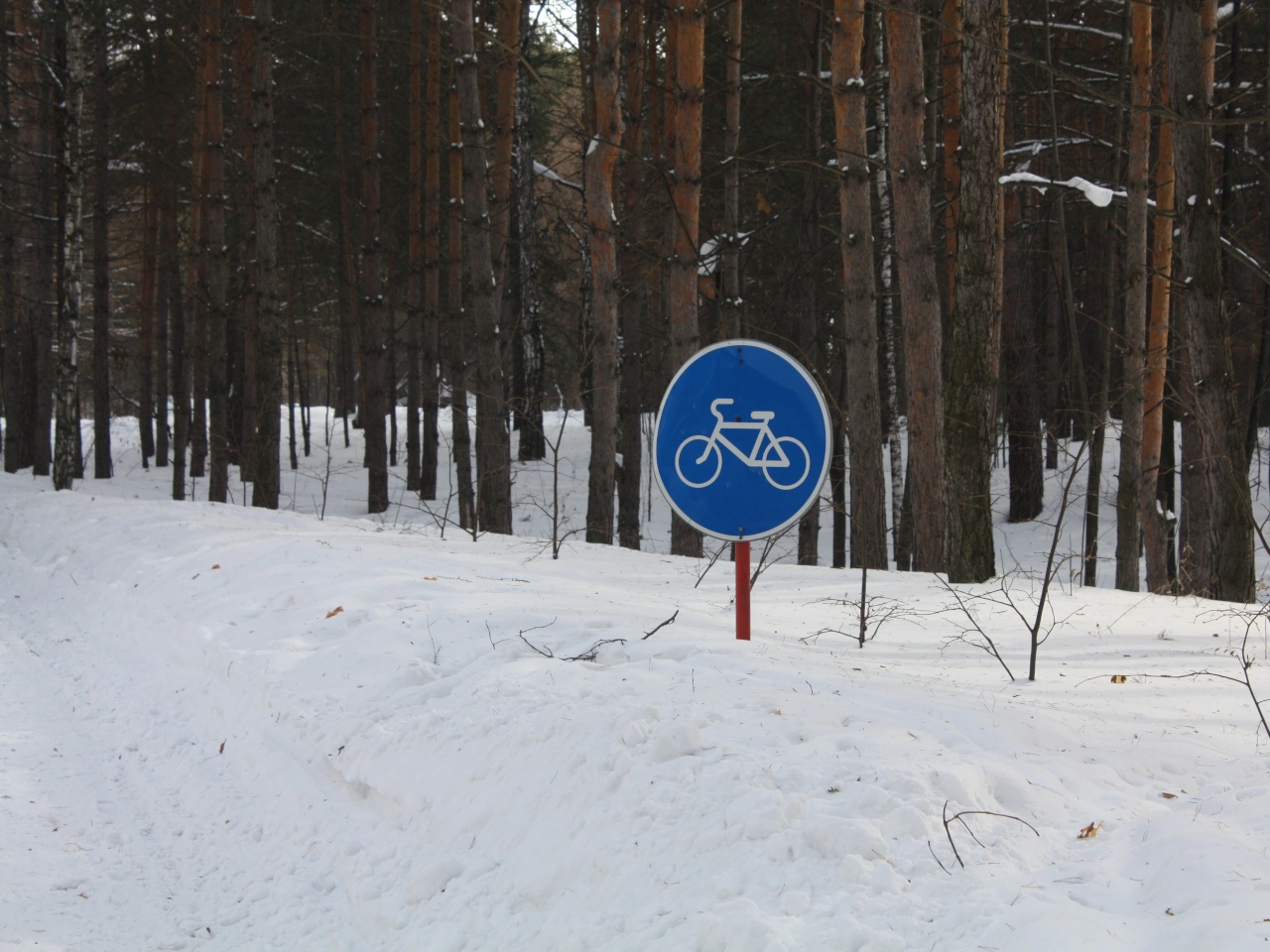
Wikimedia.org • К.Артём.1 • CC BY-SA
Where should cyclists over fourteen normally ride in Russia?
The Rules direct them to cycle paths, shared walking and cycling paths, the carriageway of a cycling zone or cycle lanes. A cycle path is a велосипедная дорожка; a cycle lane is a полоса для велосипедистов. Separate rules apply to younger children.
🔗 sh380.krsl.gov.spb.ru • Russia — Sections 24.1–24.4 and 24.6; age/width/column exceptions
When may an older cyclist leave a Russian cycle path for the carriageway edge?
Permitted cases include an absent or unusable cycling facility, a bicycle, trailer or load wider than one metre, or riding in a column. Ride at the right edge under the applicable rules. These are defined exceptions, rather than a general preference to ignore the path.
🔗 sh380.krsl.gov.spb.ru • Russia — Sections 24.1–24.4 and 24.6; age/width/column exceptions
Does the absence of a Russian cycle path automatically allow pavement cycling?
No. For riders over fourteen, the Rules provide an ordered set of alternatives, including the carriageway edge and shoulder. Pavement use has specific conditions, including certain child-accompaniment cases. The absence of one facility alone does not remove those conditions.
🔗 sh380.krsl.gov.spb.ru • Russia — Sections 24.1–24.4 and 24.6; age/width/column exceptions
8. Bridge
A bridge is a structure that carries a road, path or railway over an obstacle such as a river, valley, railway line or another road. A road bridge may carry one or more roadways together with pedestrian or cycling facilities.
Drivers should follow any speed, weight, height, width or vehicle-access restrictions applying to the bridge. Particular care may be necessary on narrow, exposed or movable bridges and when weather conditions such as wind, rain or ice affect the road surface.
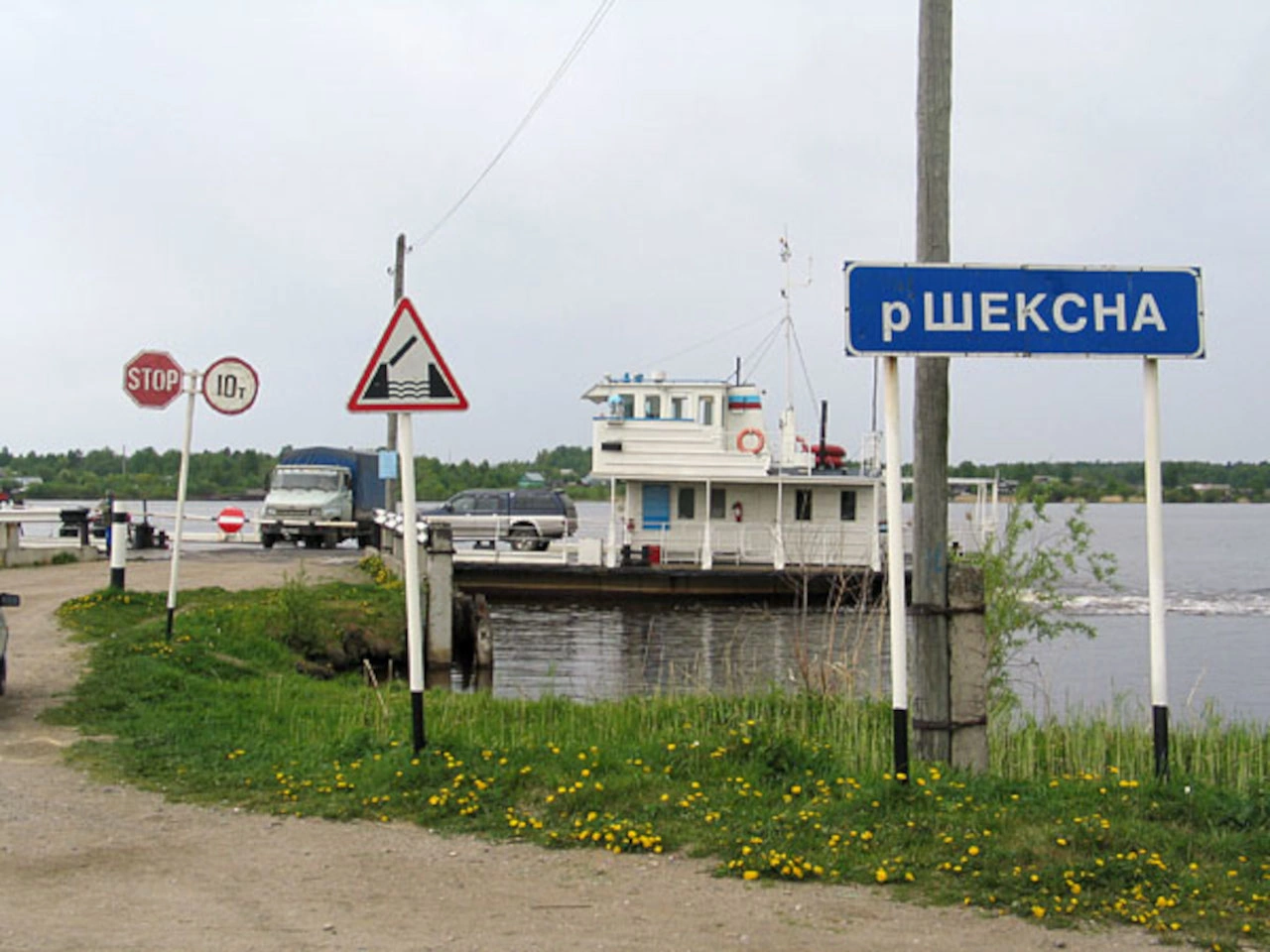
Wikimedia.org • Road Sign Series • CC BY
What should I check before crossing a bridge in Russia?
Check the applicable weight, axle-load, width and height restrictions before committing to the crossing. Include the load, trailer and roof equipment when relevant. A bridge warning and a vehicle restriction serve different purposes; comply with both.
Who goes first on a narrow bridge in Russia?
Follow any traffic lights, give-way controls or signs allocating priority over oncoming traffic. Do not force your way onto a bridge that cannot accommodate both directions safely. A bridge warning alone does not give your direction priority.
May I stop or park on a bridge in Russia?
Stopping is prohibited on bridges, overpasses and flyovers when there are fewer than three lanes in your direction, and beneath them. Parking is also prohibited wherever stopping is prohibited. Other local restrictions may be stricter.
9. Speed bump
A speed bump is a raised traffic-calming device placed across all or part of a road to make drivers reduce their speed. It is commonly used near homes, schools, crossings, parking areas and other places where low vehicle speeds are important.
Speed bumps vary in shape, height and legal status. Drivers should approach them at a low, controlled speed and follow any warning signs or speed limits that apply.
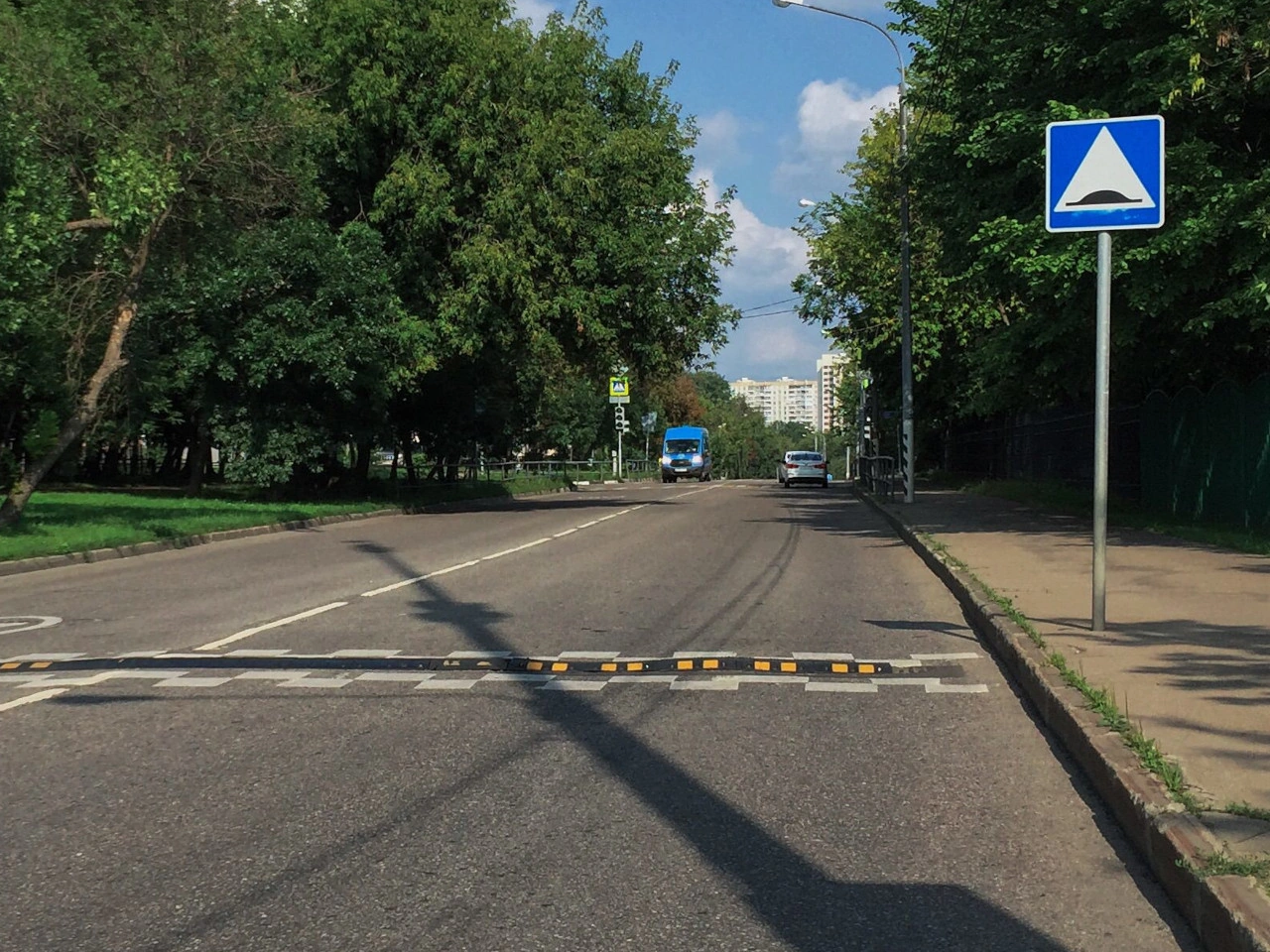
Wikimedia.org • Gennady Grachev • CC BY
How should I recognise and approach a speed bump in Russia?
Look for a raised surface, approach warnings, road markings and any separate speed instruction. A traffic-calming device can be part of a raised crossing or junction, so identify the layout and the road users who may use it.
🔗 sh380.krsl.gov.spb.ru • Russia — Sections 10 and 14; actual crossing controls
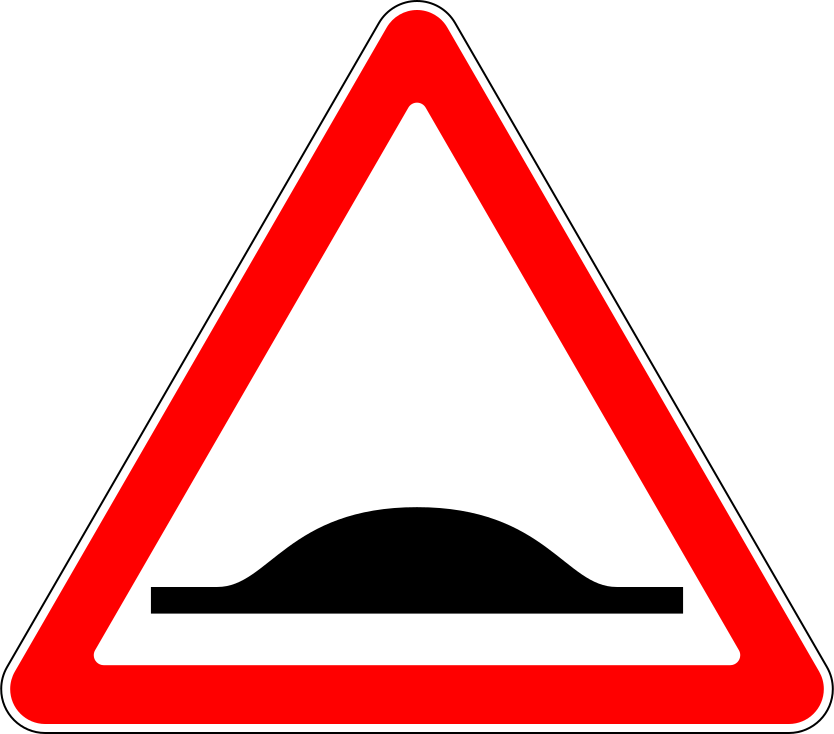 Warning for a speed bump.
English • Traffic sign 1.17 • Artificial hump. A traffic-calming hump is ahead.
Русский • 1.17 • Искусственная неровность. Впереди искусственная неровность для принудительного снижения скорости.
Sources
🔗 Commons.wikimedia.org
🔗 Pravo.gov.ru • ПДД РФ • приложение 1 • 1.17
🔗 Pravo.gov.ru • Официальная редакция от 28.08.2026
Image via Commons.wikimedia.org
Юкатан • CC BY-SA 3.0 • Source revision 2017-11-24. Wikimedia original unmodified.
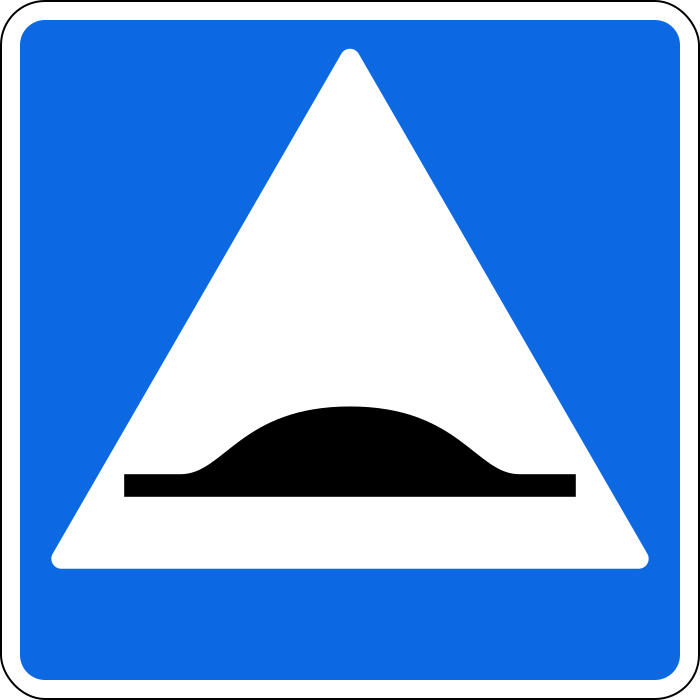 Speed bump.
English • Traffic sign 5.20 • Artificial hump. Marks the nearest edge of an artificial hump.
Русский • 5.20 • Искусственная неровность. Обозначена ближайшая граница искусственной неровности.
Sources
🔗 Commons.wikimedia.org (Nikolaev_ec06ffa5 • CC BY-SA 3.0)
🔗 Pravo.gov.ru • ПДД РФ • приложение 1 • 5.20
🔗 Pravo.gov.ru • Официальная редакция от 28.08.2026
SVG source: Nikolaev_ec06ffa5 • CC BY-SA 3.0 • Original revision 2017-11-24. Wikimedia original unmodified.
Which speed should I use at a raised device in Russia?
Obey the applicable speed restriction and slow further for the device, visibility and other road users. Do not assume that a raised device carries the same numerical rule as one in another country; a safe approach can be well below the road’s maximum.
🔗 sh380.krsl.gov.spb.ru • Russia — Sections 10 and 14; actual crossing controls
Does a raised road surface give pedestrians priority in Russia?
A raised device alone does not identify pedestrian priority. If it incorporates a crossing, apply the crossing’s controls and the national rules. At an uncontrolled crossing, give way to pedestrians crossing or entering the carriageway to cross. If another vehicle has slowed or stopped before it, proceed only after ensuring there are no pedestrians to whom you must give way.
🔗 sh380.krsl.gov.spb.ru • Russia — Sections 10 and 14; actual crossing controls
10. One-way traffic
One-way traffic means that vehicles on a road or carriageway may travel only in one designated direction. The permitted direction is normally indicated by traffic signs, lane arrows or road markings.
Some road users, such as cyclists or public-transport vehicles, may be allowed to travel in the opposite direction when signs expressly permit it. A one-way road does not by itself determine the speed limit, priority or parking rules.
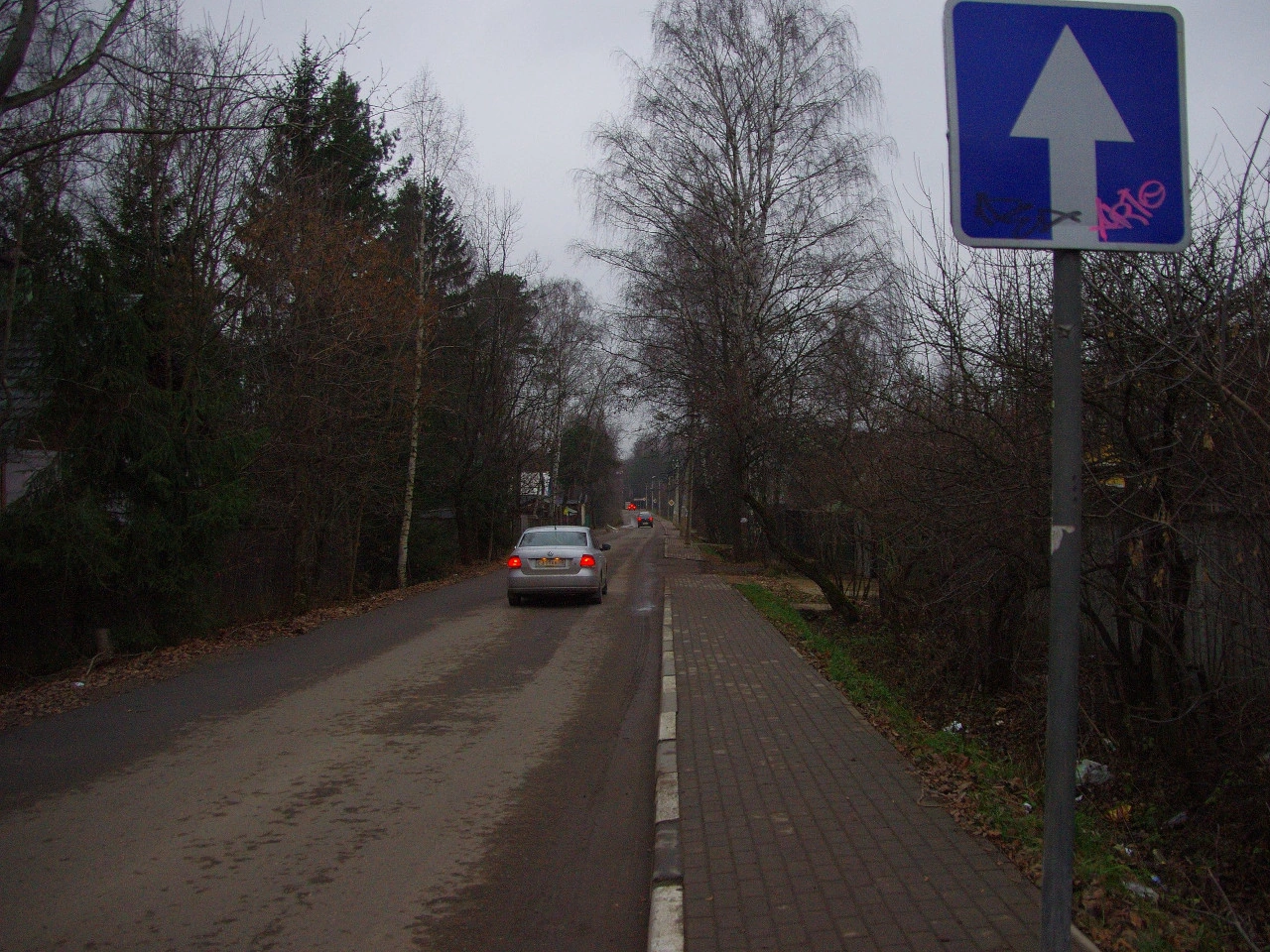
Wikimedia.org • Svetlov Artem • CC BY
How should I read a one-way restriction in Russia?
Follow the direction designated by the street’s one-way signs and any entrance restrictions or lane arrows. A compulsory turn at one junction is different from a restriction applying along the street.
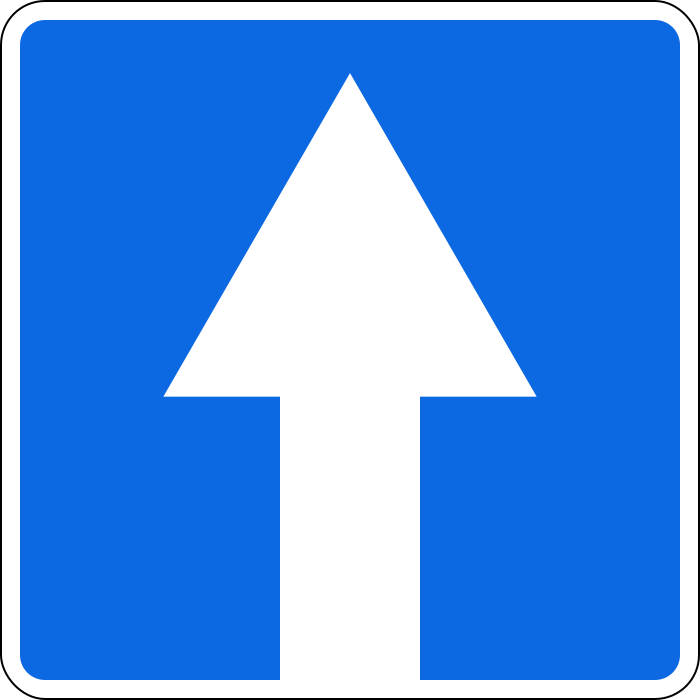 Road with one-way traffic.
English • Traffic sign 5.5 • One-way road. Motor vehicles travel in one direction across the carriageway's full width.
Русский • 5.5 • Дорога с односторонним движением. Механические транспортные средства движутся по всей ширине проезжей части в одном направлении.
Sources
🔗 Commons.wikimedia.org
🔗 Pravo.gov.ru • ПДД РФ • приложение 1 • 5.5
🔗 Pravo.gov.ru • Официальная редакция от 28.08.2026
SVG source: Life of Riley • Public domain • Original revision 2016-01-08. Wikimedia original unmodified.
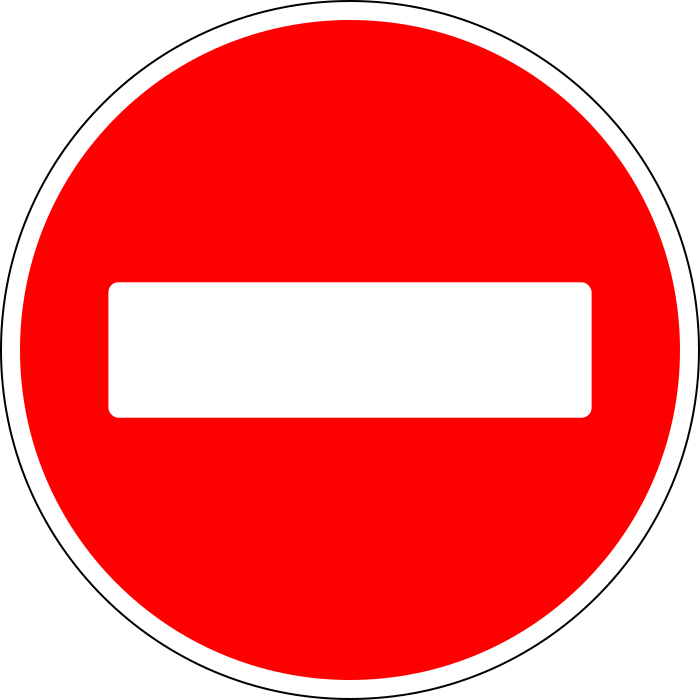 No entry.
English • Traffic sign 3.1 • No entry. Vehicles must not enter from this direction. Scheduled-route vehicles are exempt; accompanying plates specify vehicle types and operating times.
Русский • 3.1 • Въезд запрещён. Въезд транспортных средств в этом направлении запрещён. Предусмотрены исключения для маршрутных транспортных средств; совместные таблички уточняют виды транспорта и время действия.
Sources
🔗 Commons.wikimedia.org
🔗 Pravo.gov.ru • ПДД РФ • приложение 1 • 3.1
🔗 Pravo.gov.ru • Официальная редакция от 28.08.2026
SVG source: User:Flrn • Public domain • Original revision 2022-04-10. Wikimedia original unmodified.
May cyclists travel against the general traffic direction in Russia?
Do not assume cyclists are exempt from a road’s direction restriction. Check whether the applicable signs, local traffic arrangement or separately designated cycle facility actually authorise movement in the opposite direction; an ordinary bicycle-route sign is not enough.
Does one-way traffic give me priority or a different speed limit in Russia?
A one-way restriction concerns direction. Continue to follow the applicable speed limit, signals, give-way or stop controls and junction-priority rules. Where authorised counterflow traffic exists, check for it before turning or crossing; your permitted direction is not automatic junction priority.
11. Bus lane
A bus lane is a traffic lane reserved primarily for buses or other authorised public-transport vehicles. It is intended to improve the reliability and flow of public transport by allowing authorised vehicles to avoid general traffic congestion.
Other road users, such as taxis, cyclists, motorcycles or vehicles carrying several occupants, may also be permitted when signs expressly allow them. The operating hours, permitted vehicles, direction of travel and rules for entering or crossing the lane depend on local traffic signs and regulations.
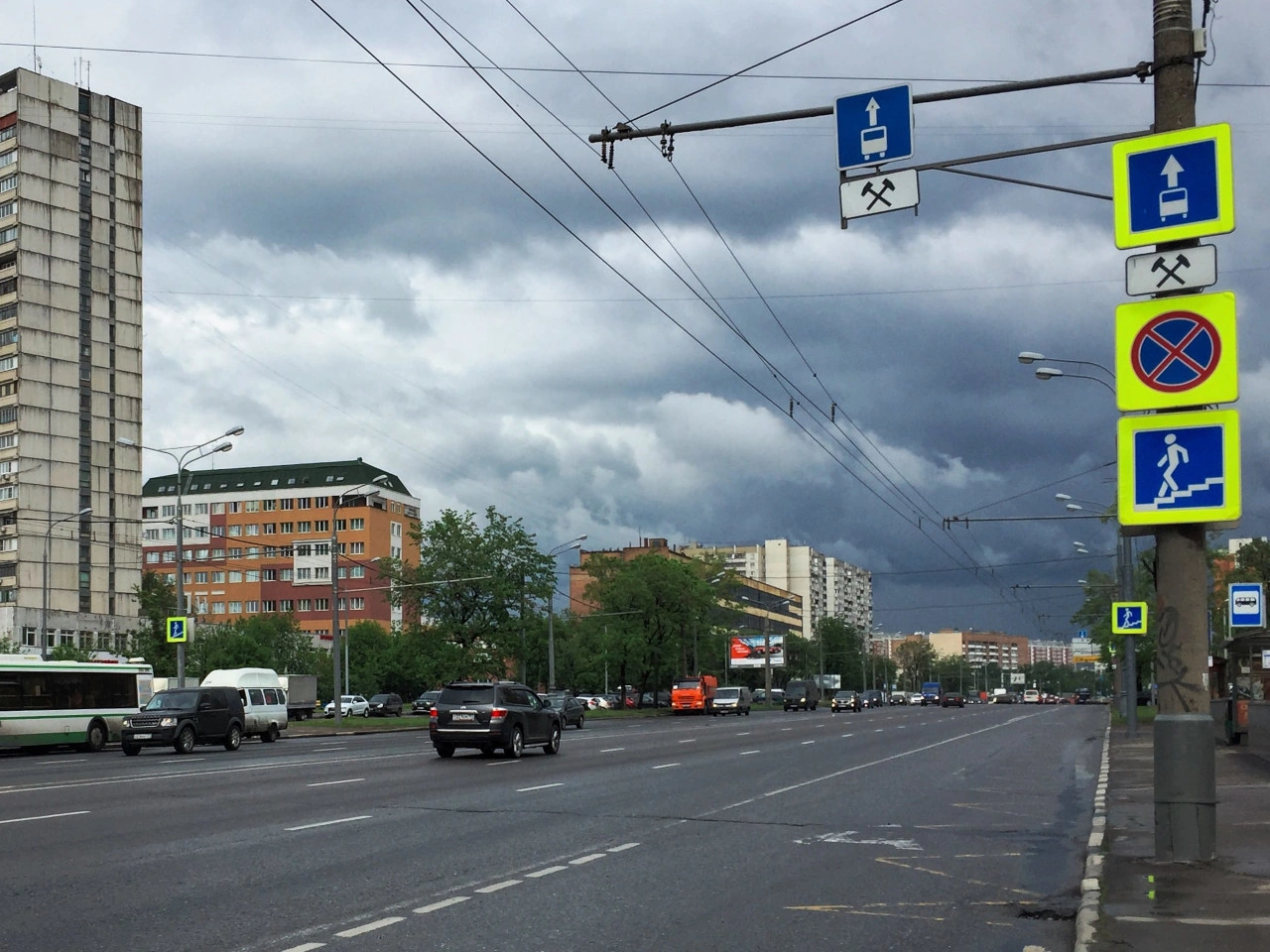
Wikimedia.org • Gennady Grachev • CC BY
Which vehicles may use a bus lane in Russia?
A Russian lane for scheduled public-transport vehicles is subject to the national rules and its signs. The rules specify other permitted categories and conditions, so check the vehicle’s classification and the actual lane arrangement.
May bicycles and motorcycles use a bus lane in Russia?
The cycle exception in the rules depends on the lane’s position at the right edge. It must not be treated as a general permission for cycles to use every reserved lane, or for motorcycles to follow them.
Does bus-lane access also allow stopping or parking in Russia?
Unauthorised traffic may not drive or stop in the reserved lane. Where a broken boundary permits a specified manoeuvre or passenger stop, comply with the conditions and do not obstruct scheduled public transport.
12. Bus stop
A bus stop is a designated place where buses stop to allow passengers to board or leave. It may be identified by a sign, shelter, raised platform, road marking or other public-transport infrastructure and can be located beside the road or in a specially constructed stopping area.
Drivers approaching a bus stop should watch carefully for buses, pedestrians and passengers crossing or entering the roadway. Parking or stopping restrictions may apply around bus stops to keep the area accessible and visible.

Wikimedia.org • Stolbovsky • CC BY-SA
What stopping or parking restrictions apply at bus stops in Russia?
Stopping is prohibited within 15 metres of the designated public-transport stop area or, where the relevant road marking is absent, the stop indicator, subject to the passenger exception.
May I briefly drop off a passenger at a bus stop in Russia?
Passenger boarding or alighting is exempt from this particular restriction if it does not interfere with scheduled public-transport vehicles or the taxi traffic covered by the rule. It is not a permission to park or wait.
What should I do near a stopped bus in Russia?
In a built-up area, give way to buses and trolleybuses starting from a designated stop. Their drivers must first ensure that other traffic is giving way.
13. Stop sign
A stop sign requires drivers to bring their vehicle to a complete stop and give way before entering or crossing the road ahead. The stop must be made at the stop line or another legally prescribed position.
After stopping, the driver may continue only when this can be done safely and without interfering with traffic that has priority. The sign does not create priority for the driver who has stopped.
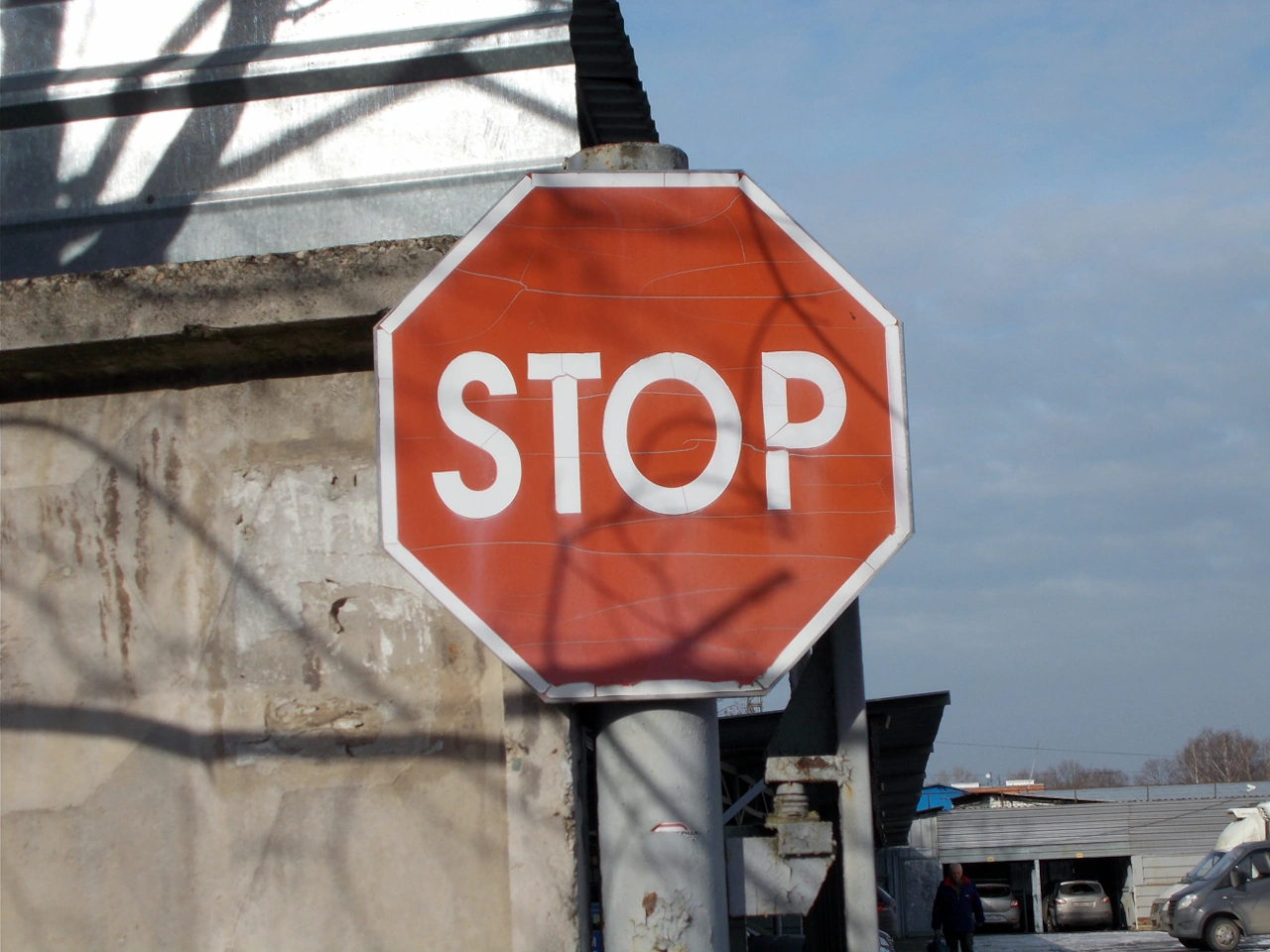
Wikimedia.org • Dmitry Makeev • CC BY-SA
Must I stop completely at a stop sign in Russia?
Yes. Come to a complete stop when the applicable stop sign controls your approach, even when you cannot see another road user. Slowing to a crawl is not a stop. The stopping duty is separate from the duty to give way before continuing.
🔗 sh380.krsl.gov.spb.ru • Russia — Annex 1 sign 2.5 and stopping position
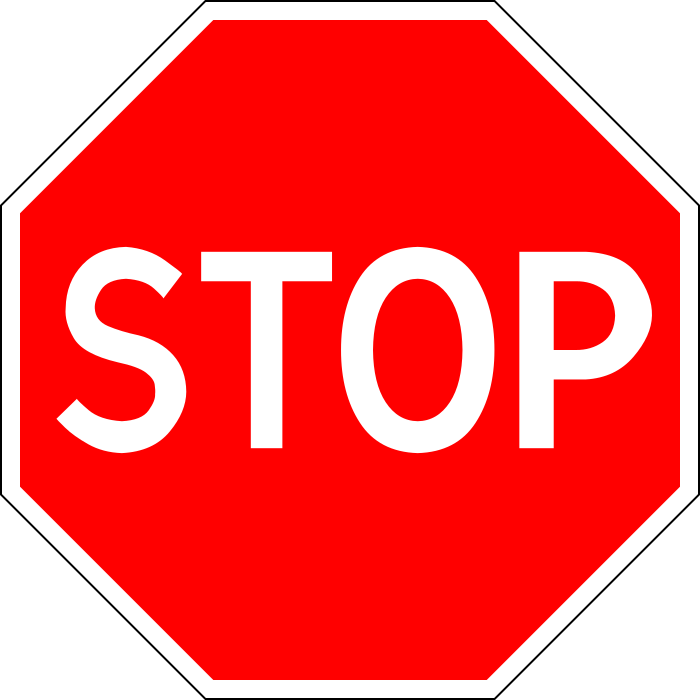 Stop and give way.
English • Traffic sign 2.5 • Do not proceed without stopping. Stop at the stop line or, if none exists, at the edge of the intersecting carriageway, and give way to traffic on the intersecting or designated priority road. Before a railway crossing or quarantine checkpoint without a stop line, stop at the sign.
Русский • 2.5 • Движение без остановки запрещено. Остановитесь перед стоп-линией, а при её отсутствии — перед краем пересекаемой проезжей части, и уступите дорогу движущимся по пересекаемой, либо обозначенной главной, дороге. Перед железнодорожным переездом или карантинным постом при отсутствии стоп-линии остановитесь перед знаком.
Sources
🔗 Commons.wikimedia.org (Nikolaev_ec06ffa5, font by Alexander Sapozhnikov • CC BY-SA 3.0)
🔗 Pravo.gov.ru • ПДД РФ • приложение 1 • 2.5
🔗 Pravo.gov.ru • Официальная редакция от 28.08.2026
SVG source: Nikolaev_ec06ffa5, font by Alexander Sapozhnikov • CC BY-SA 3.0 • Original revision 2014-07-28. Wikimedia original unmodified.
Where must I stop at a stop-controlled junction in Russia?
At a junction, stop before the stop line or, without one, before the edge of the intersecting carriageway. At a railway crossing or quarantine post, the no-line stopping position is at the sign; do not apply the junction rule to every setting.
🔗 sh380.krsl.gov.spb.ru • Russia — Annex 1 sign 2.5 and stopping position
Does stopping first give me priority at a stop sign in Russia?
A complete stop does not, by itself, give you priority. Give way to the road users entitled to pass under the junction’s signs and rules, check pedestrians and cyclists, and proceed only when the gap is safe. Do not follow another stopped vehicle through without satisfying your own stopping and yielding duties.
🔗 sh380.krsl.gov.spb.ru • Russia — Annex 1 sign 2.5 and stopping position
14. Give way
A give-way sign requires drivers to allow traffic with priority to proceed before entering, crossing or joining a road. Drivers must reduce speed, observe approaching traffic and stop when necessary.
Unlike a stop sign, a give-way sign does not always require a complete stop. The driver may continue without stopping only when the route is clearly safe and no road user with priority is forced to change speed or direction.
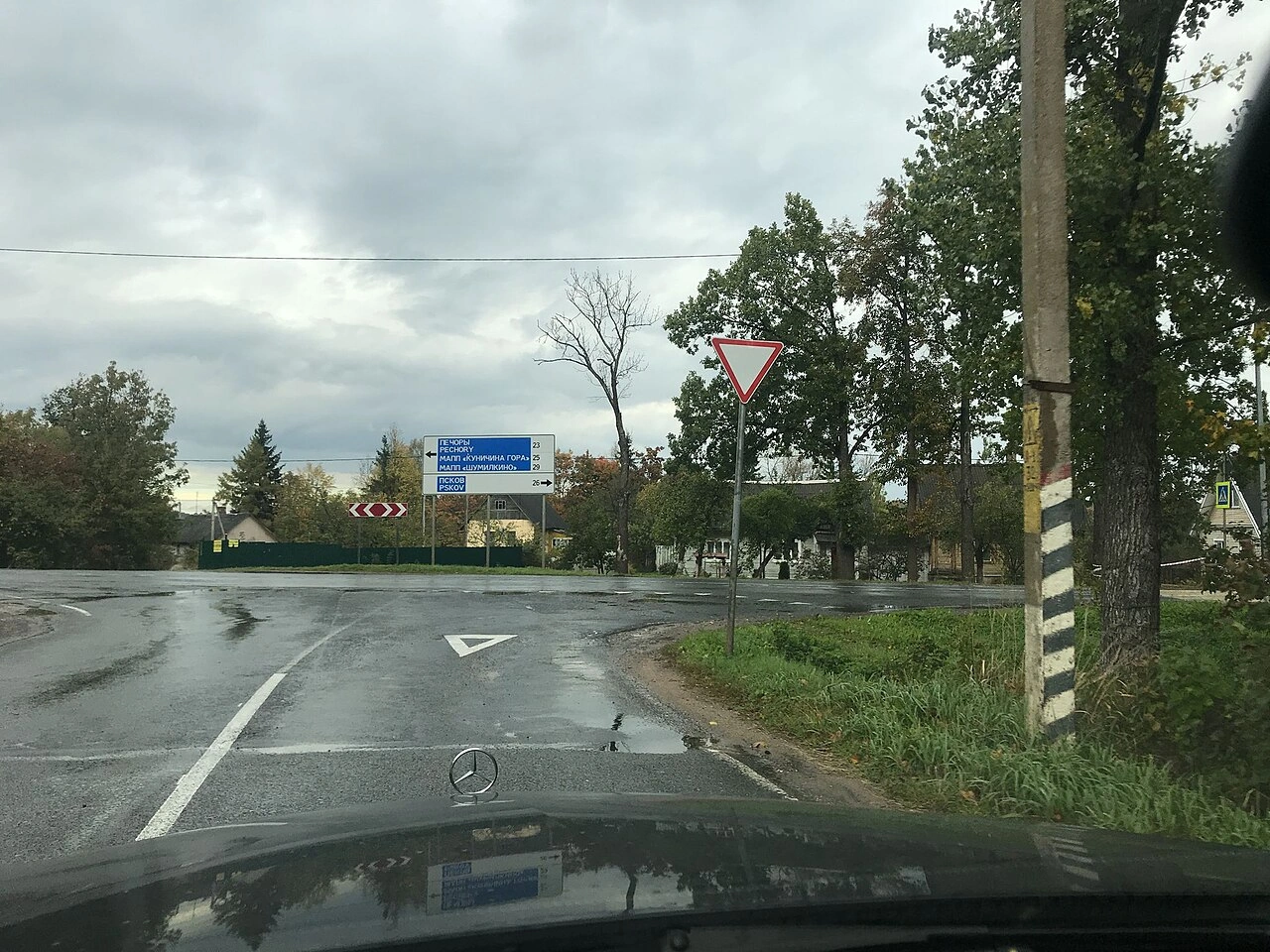
Wikimedia.org • romanshikin • CC BY
What does giving way mean in Russia?
Russian wording is Уступите дорогу. You must not proceed or make a manoeuvre that would force road users with priority to change their speed or direction.
🔗 sh380.krsl.gov.spb.ru • Russia — Section 1.2 give-way definition; Annex 1 sign 2.4
Must you always stop when giving way in Russia?
No. A give-way control requires stopping when necessary to yield or obtain a safe view. A stop sign requires a complete stop even if the road appears empty.
🔗 sh380.krsl.gov.spb.ru • Russia — Section 1.2 give-way definition; Annex 1 sign 2.4
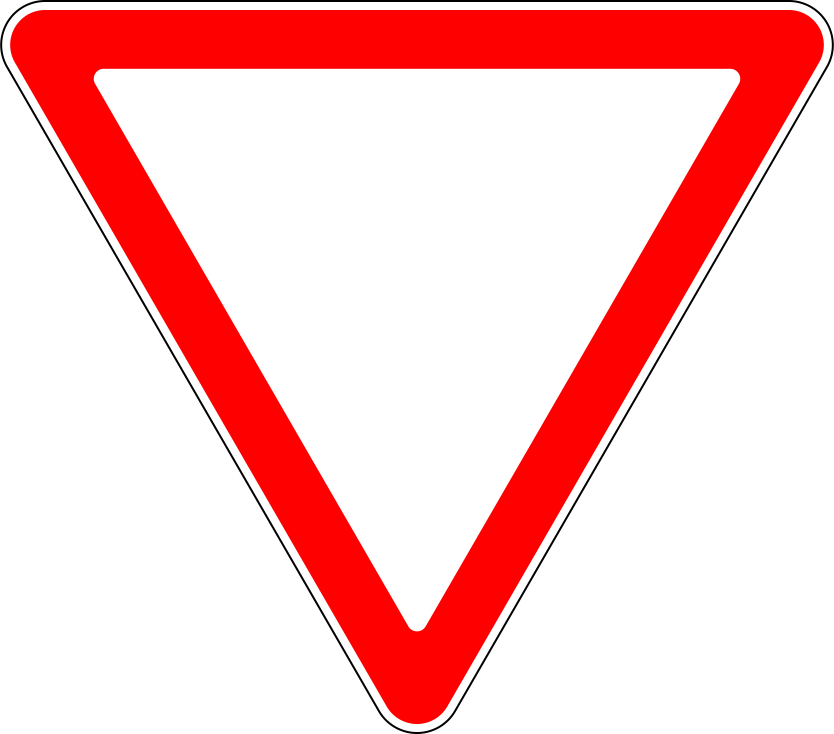 Give way.
English • Traffic sign 2.4 • Give way. Give priority to vehicles on the intersecting road or, with plate 8.13, on the priority road.
Русский • 2.4 • Уступите дорогу. Уступите дорогу транспортным средствам на пересекаемой дороге; при наличии таблички 8.13 — на главной дороге.
Sources
🔗 Commons.wikimedia.org (Юкатан • CC BY-SA 3.0)
🔗 Pravo.gov.ru • ПДД РФ • приложение 1 • 2.4
🔗 Pravo.gov.ru • Официальная редакция от 28.08.2026
SVG source: Юкатан • CC BY-SA 3.0 • Original revision 2021-10-30. Wikimedia original unmodified.
What should you check before proceeding after giving way in Russia?
Wait until the manoeuvre is safe. Check the priority traffic, the view in both directions and enough space to complete the entry. Giving way to one vehicle does not remove duties towards another driver, a cyclist or a pedestrian.
🔗 sh380.krsl.gov.spb.ru • Russia — Section 1.2 give-way definition; Annex 1 sign 2.4
15. Roundabout
A roundabout is a circular road arrangement in which traffic travels around a central island in one designated direction. Vehicles enter and leave through connecting roads, and traffic signs or local rules determine who has priority.
Drivers should reduce speed, choose a suitable lane, observe all road users and signal as required when leaving. The direction of travel, entry priority, lane use and rules for cyclists and pedestrians depend on local traffic signs and regulations.
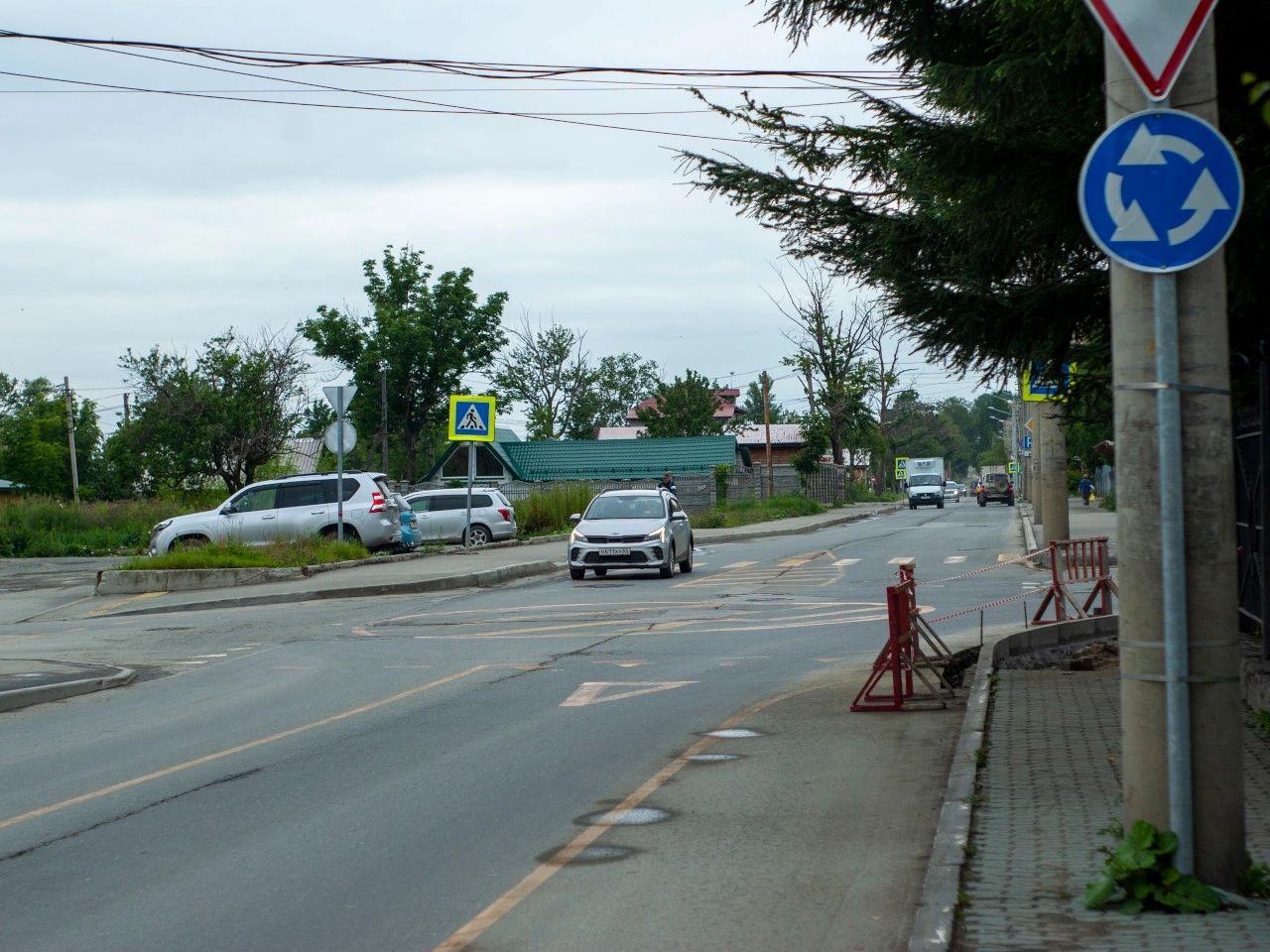
Wikimedia.org • Svetlov Artem • CC0
Who has priority at a roundabout in Russia?
Russian rules specifically require yielding to circulating traffic when entering a signed roundabout from a road that is not the main road. Read the priority-road signs: it is inaccurate to say that every entry always yields regardless of the road’s status.
🔗 sh380.krsl.gov.spb.ru • Russia — Section 13.11(1), entry from non-main road
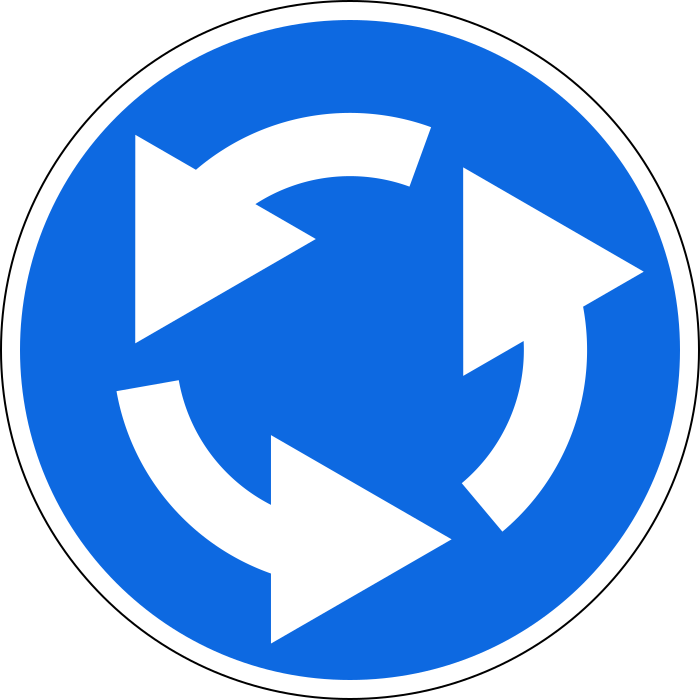 Mandatory roundabout direction.
Sources
🔗 Commons.wikimedia.org (Юкатан • CC BY-SA 3.0)
Image via Commons.wikimedia.org
Юкатан • CC BY-SA 3.0 • Source revision 2023-06-11. Wikimedia original unmodified.
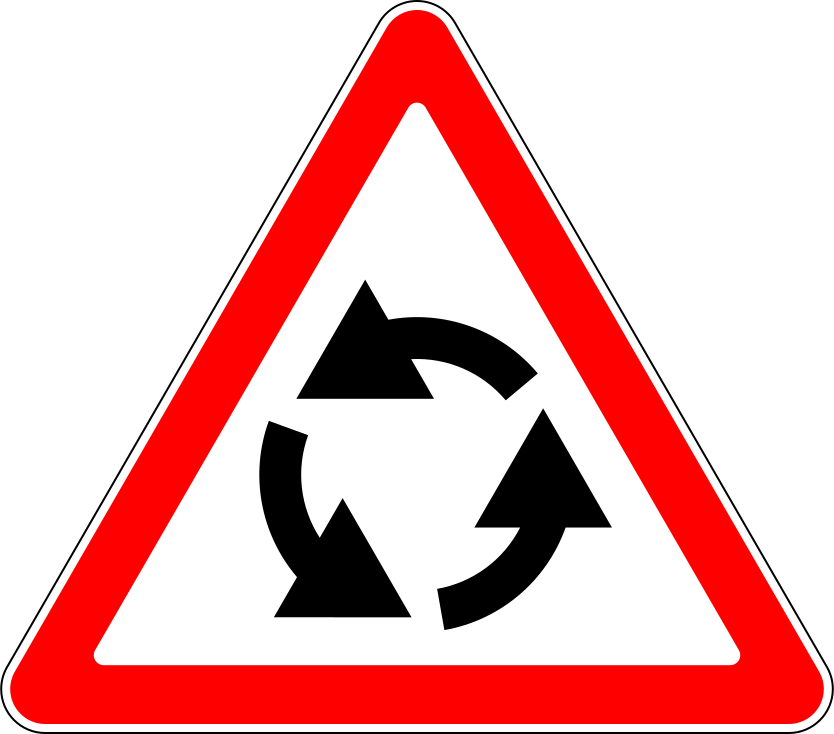 Warning for a roundabout.
Sources
Image via Commons.wikimedia.org
Юкатан • CC BY-SA 3.0 • Source revision 2015-12-13. Wikimedia original unmodified.
How should you choose a roundabout lane in Russia?
Choose your intended exit before entering and follow the lane arrows and destination signs. Keep to the marked route and make any permitted lane change only when safe; having priority over entering traffic does not give you priority to change lanes.
🔗 sh380.krsl.gov.spb.ru • Russia — Section 13.11(1), entry from non-main road
What should you check when leaving a roundabout in Russia?
Check the lane you will cross or enter, signal the manoeuvre as required and look for cyclists and pedestrians at the exit. Obey any separate crossing controls and do not force an exit across another vehicle’s path.
🔗 sh380.krsl.gov.spb.ru • Russia — Section 13.11(1), entry from non-main road
16. Priority road
A priority road is a road whose traffic is given priority over traffic entering from intersecting roads. It is normally identified by a priority-road sign, while an end sign indicates where that continuing priority status stops.
Drivers on a priority road must still obey traffic lights, authorised officers, speed limits, crossings and turning rules. Having priority never allows a driver to proceed when doing so would create danger or block an intersection.
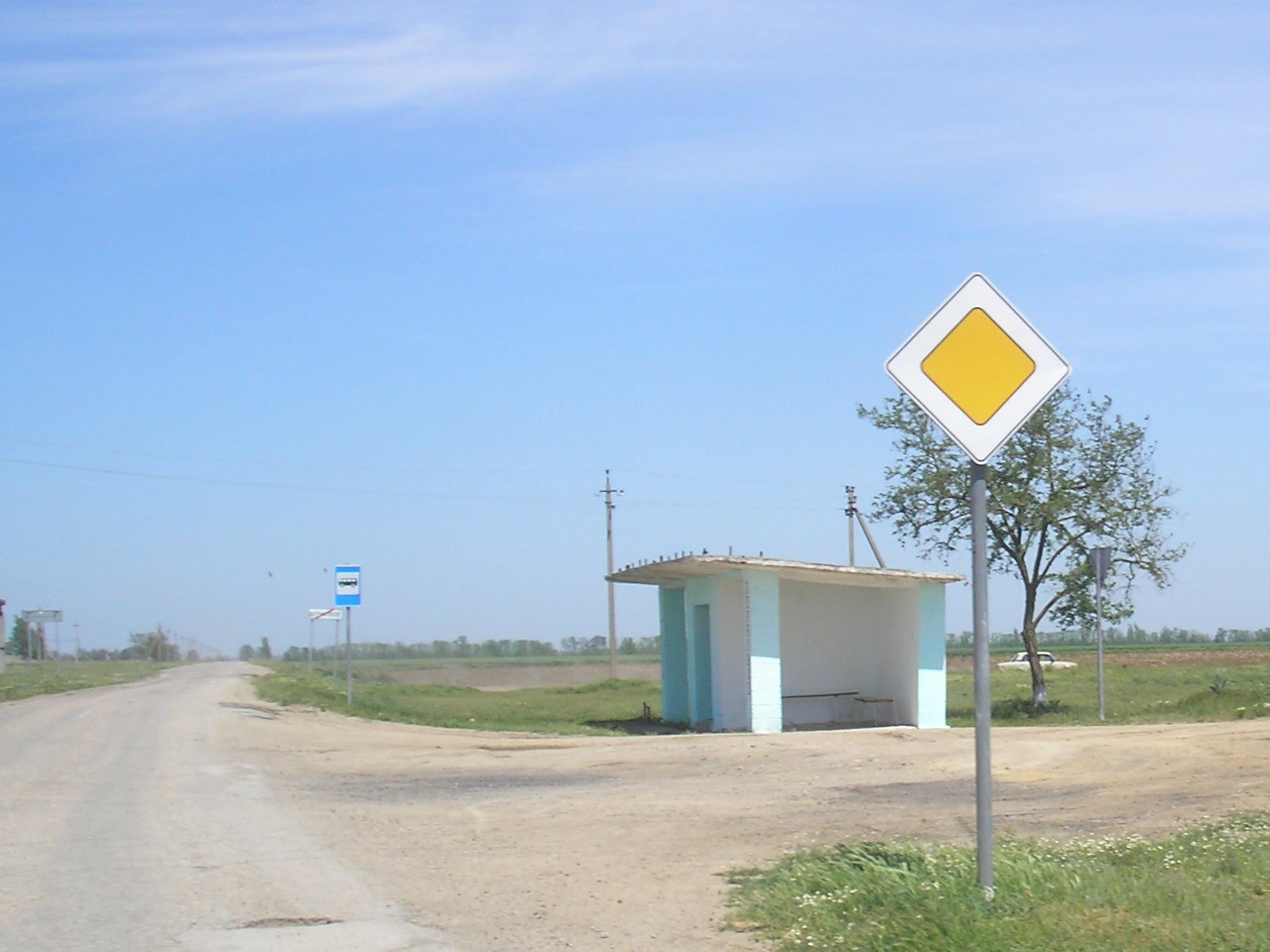
Wikimedia.org • Kosun • CC0
How does priority-road status work in Russia?
Russia’s главная дорога, or main road, can be established by specified signs and by the road-surface relationship defined in the Traffic Rules. A signed priority road and its end sign must be read together with the particular junction controls.
🔗 sh380.krsl.gov.spb.ru • Russia — Sections 1.2 and 13; Annex 1 main-road/end signs
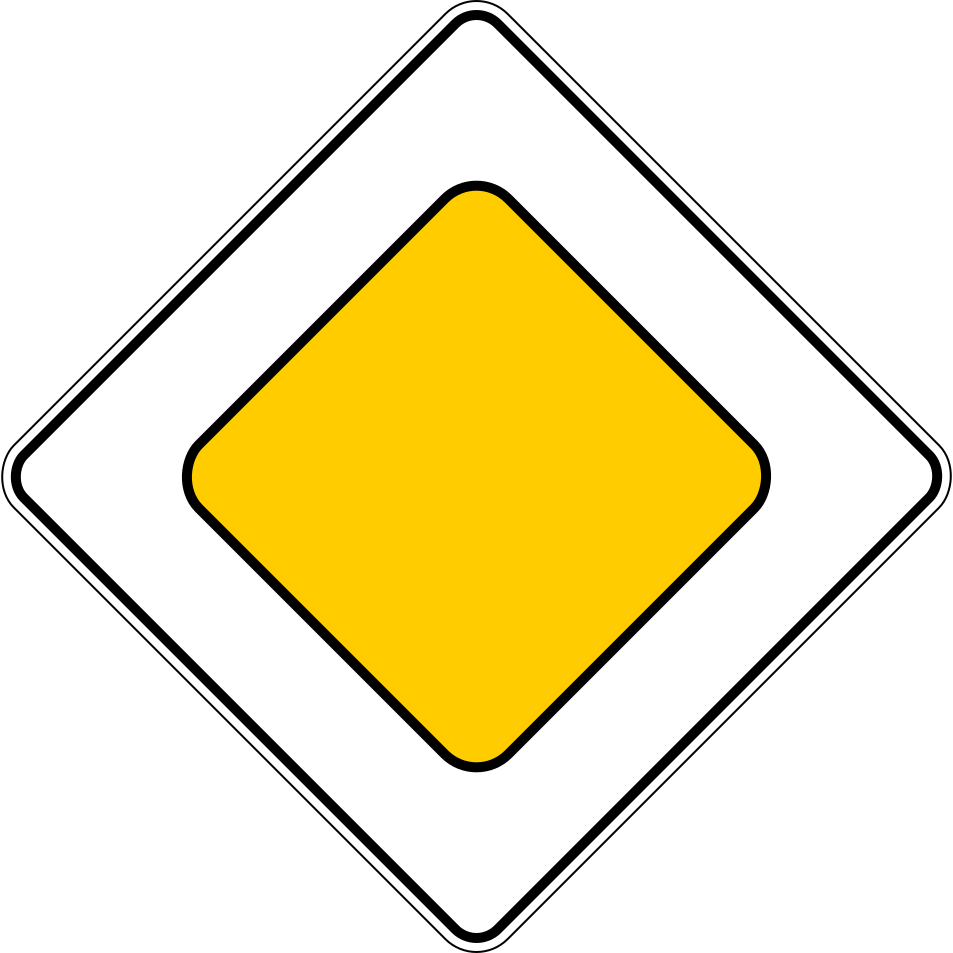 Start of a priority road.
English • Traffic sign 2.1 • Priority road. Gives priority at uncontrolled junctions on this road.
Русский • 2.1 • Главная дорога. На этой дороге предоставлено преимущество при проезде нерегулируемых перекрёстков.
Sources
🔗 Commons.wikimedia.org (Юкатан • CC BY-SA 3.0)
🔗 Pravo.gov.ru • ПДД РФ • приложение 1 • 2.1
🔗 Pravo.gov.ru • Официальная редакция от 28.08.2026
SVG source: Юкатан • CC BY-SA 3.0 • Original revision 2021-11-07. Wikimedia original unmodified.
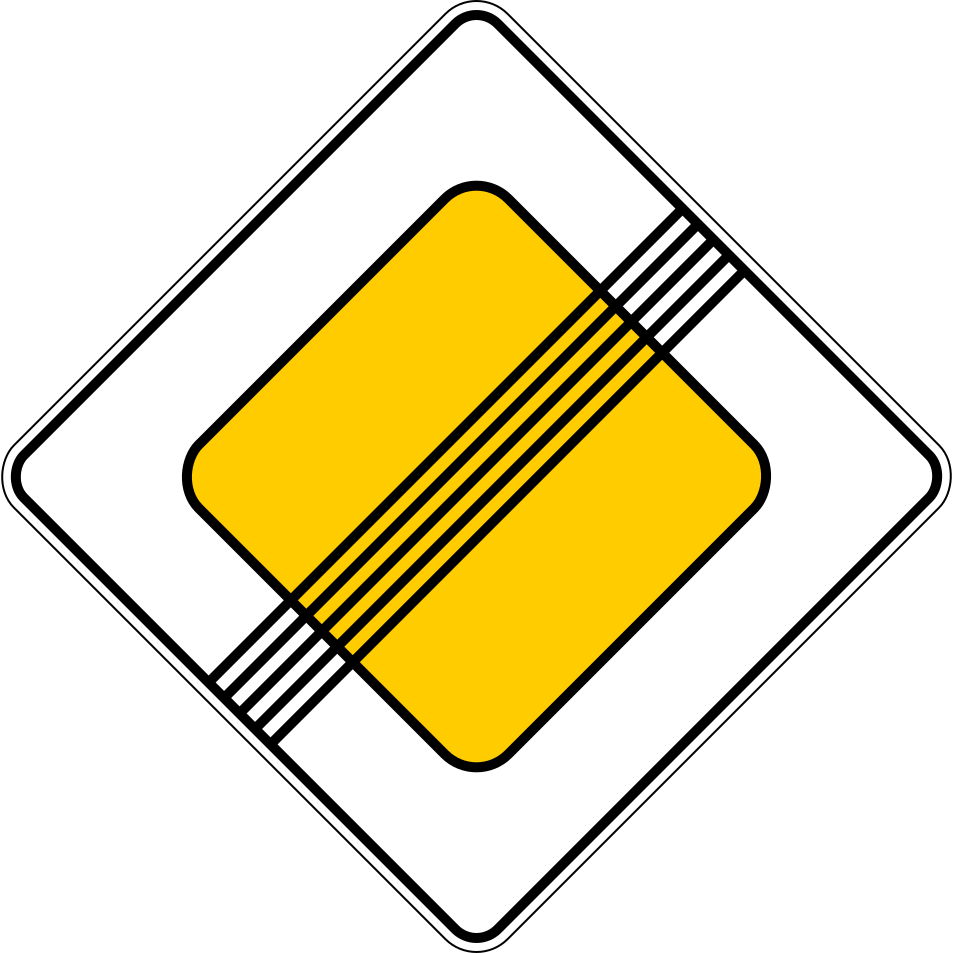 End of the priority road.
English • Traffic sign 2.2 • End of priority road. Ends the road marked by 2.1.
Русский • 2.2 • Конец главной дороги. Оканчивается главная дорога, обозначенная знаком 2.1.
Sources
🔗 Commons.wikimedia.org (Юкатан • CC BY-SA 3.0)
🔗 Pravo.gov.ru • ПДД РФ • приложение 1 • 2.2
🔗 Pravo.gov.ru • Официальная редакция от 28.08.2026
SVG source: Юкатан • CC BY-SA 3.0 • Original revision 2021-11-07. Wikimedia original unmodified.
How can you tell where a priority road applies in Russia?
Read the priority-road sign, the corresponding end indication and any supplementary junction diagram. Distinguish a continuing road designation from a sign that regulates only one junction. If a diagram shows the priority route turning, follow that diagram rather than assuming the straight-ahead road has priority.
🔗 sh380.krsl.gov.spb.ru • Russia — Sections 1.2 and 13; Annex 1 main-road/end signs
Does having road priority let you ignore other controls in Russia?
No. Obey the applicable traffic signals and authorised directions, speed limits and crossing rules. Turning or changing lanes can require yielding, and having priority never permits entering a conflict that cannot be crossed safely.
🔗 sh380.krsl.gov.spb.ru • Russia — Sections 1.2 and 13; Annex 1 main-road/end signs
17. Priority over oncoming traffic
Priority over oncoming traffic means that drivers travelling in one direction have priority through a narrow section of road over drivers approaching from the opposite direction. The rule is normally indicated by a priority sign facing one direction and a corresponding give-way sign facing the other.
Drivers with priority must still approach cautiously and must not force their way through when the passage is blocked or already occupied. The signs regulate priority through the narrow section, not speed, parking or priority at nearby intersections.
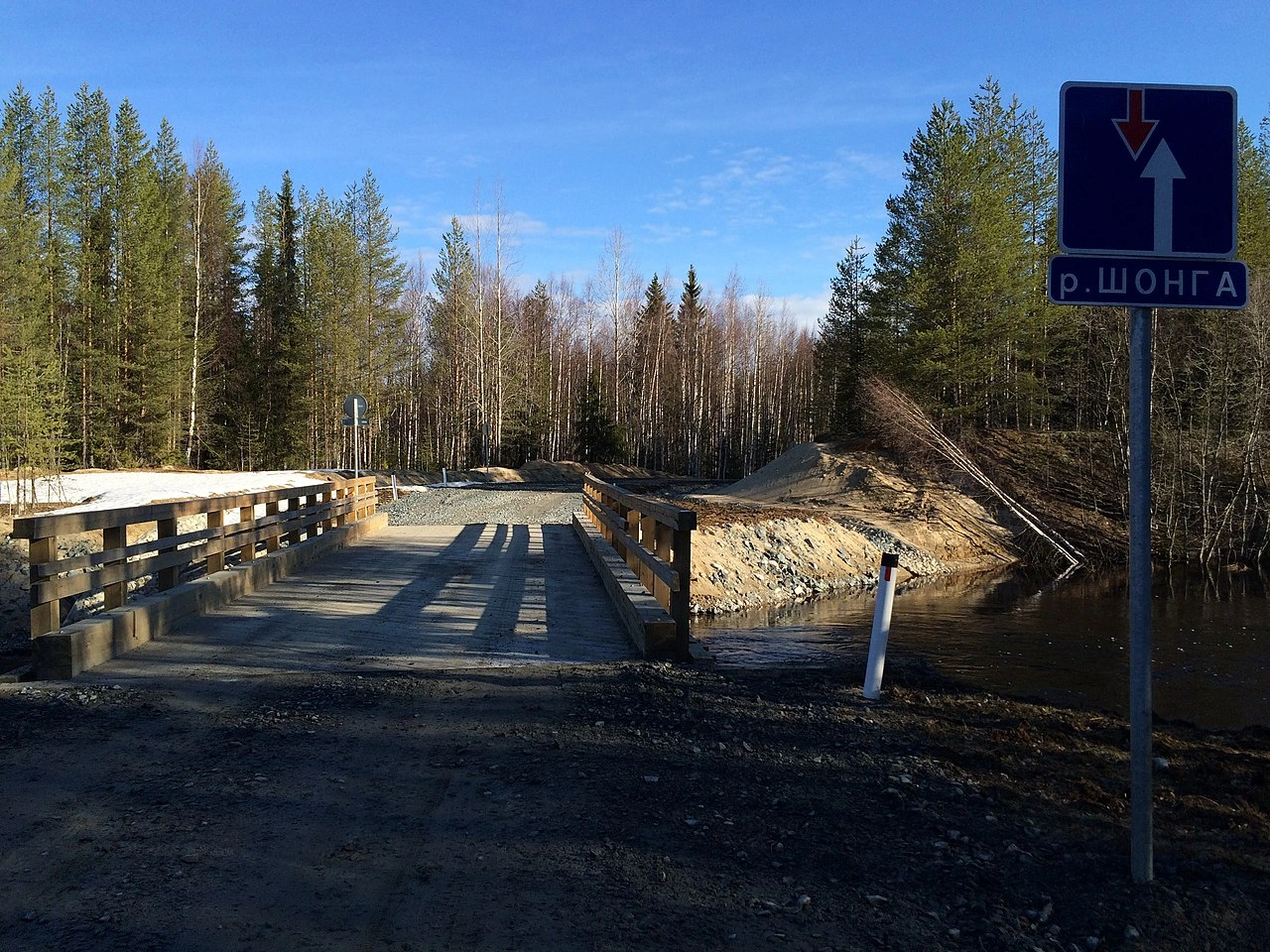
Wikimedia.org • Scaut2002 • CC BY-SA
How is priority over oncoming traffic controlled in Russia?
Russia’s Преимущество перед встречным движением gives priority through a narrow road section over opposing vehicles. The paired opposite control requires giving way; read any separate signal arrangement.
Can you enter an occupied narrow passage when you have priority in Russia?
Do not force a conflict. Check the full available width and let a vehicle already committed to the passage clear it when both vehicles cannot pass safely. A priority control does not permit creating danger or disregarding a red signal or authorised instruction.
Does priority through a narrow passage extend to nearby junctions in Russia?
No. A control releasing your direction or giving priority over opposing traffic concerns that passage. Junction priority, speed limits, crossings and any later restriction must be assessed separately from their own signs and rules.
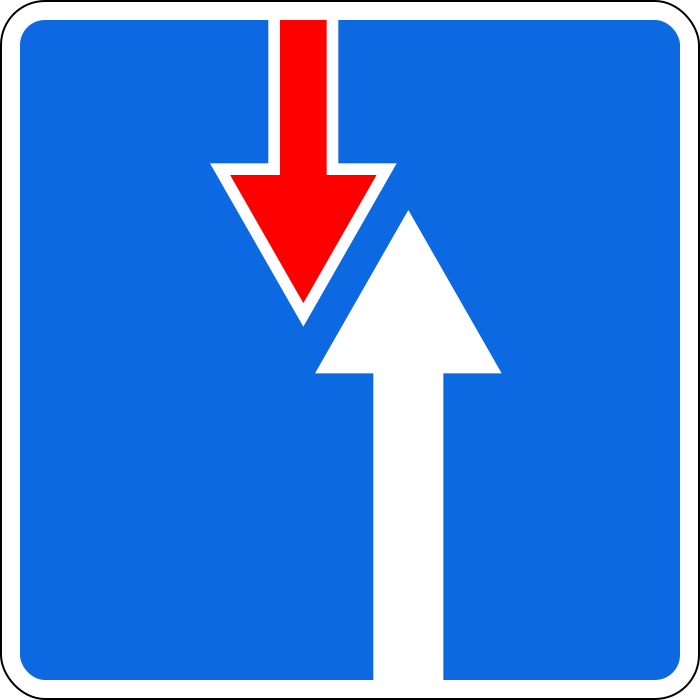 Road narrowing, oncoming drivers have to give way.
English • Traffic sign 2.7 • Priority over oncoming traffic. You have priority on the narrow section.
Русский • 2.7 • Преимущество перед встречным движением. На узком участке у вас преимущество по отношению к встречным транспортным средствам.
Sources
🔗 Commons.wikimedia.org (Юкатан • CC BY-SA 3.0)
🔗 Pravo.gov.ru • ПДД РФ • приложение 1 • 2.7
🔗 Pravo.gov.ru • Официальная редакция от 28.08.2026
SVG source: Юкатан • CC BY-SA 3.0 • Original revision 2022-09-29. Wikimedia original unmodified.
18. Give way to oncoming traffic
Give way to oncoming traffic means that drivers must allow vehicles approaching from the opposite direction to pass first through a narrow section of road. The rule is normally indicated by a sign facing the direction that must yield and a corresponding priority sign facing oncoming traffic.
Drivers must reduce speed and stop when necessary before entering the narrow passage. They may continue only when they can do so safely and without obstructing oncoming traffic that has priority.
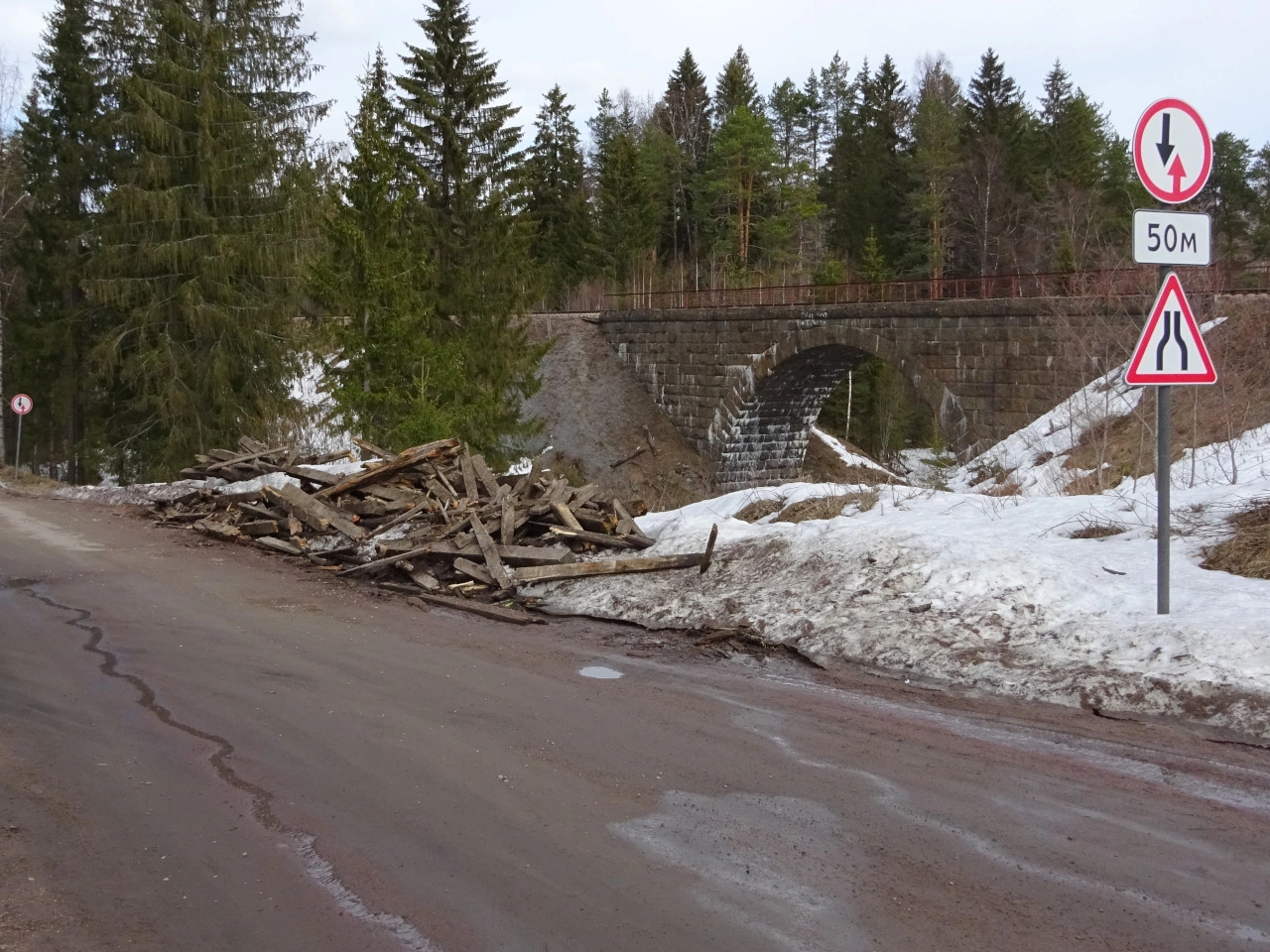
Wikimedia.org • Charoplet • CC BY-SA
When must I give way to oncoming traffic in Russia?
Where priority signs, temporary signals or an authorised controller in Russia require your direction to yield at a narrow road or bridge, allow opposing traffic through first. Do not assume every narrowing has the same priority arrangement.
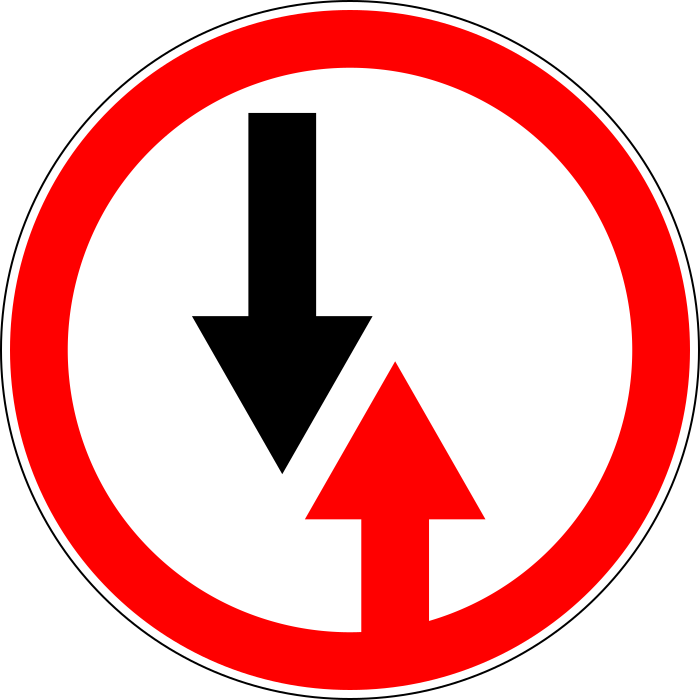 Road narrowing, give way to oncoming drivers.
English • Traffic sign 2.6 • Priority for oncoming traffic. Do not enter the narrow section if this would impede oncoming traffic. Give way to vehicles on the section or approaching it from the opposite end.
Русский • 2.6 • Преимущество встречного движения. Не въезжайте на узкий участок, если это затруднит встречное движение. Уступите встречным транспортным средствам на участке или противоположном подъезде к нему.
Sources
🔗 Commons.wikimedia.org
🔗 Pravo.gov.ru • ПДД РФ • приложение 1 • 2.6
🔗 Pravo.gov.ru • Официальная редакция от 28.08.2026
SVG source: User:Flrn • Public domain • Original revision 2022-09-29. Wikimedia original unmodified.
Does a road-narrows warning automatically give oncoming traffic priority in Russia?
Not necessarily. A warning of a narrow carriageway is not itself the same as an instruction to give way. Check whether there is a separate priority sign, signal or temporary traffic control, and take account of any rules for an obstruction on your side.
What if an oncoming vehicle is already entering a narrow passage in Russia?
Reduce speed and wait where you can do so safely rather than forcing two vehicles into insufficient space. Even if a sign gives your approach priority, that does not justify a collision or endangering another road user.
19. Pedestrian crossing
A pedestrian crossing is a designated place where pedestrians may cross a road. It is commonly indicated by road markings, traffic signs, signals or a combination of these measures.
Drivers must approach with appropriate caution and give way when required by local law. Pedestrians must also observe approaching traffic and follow any pedestrian signals or instructions from authorised traffic controllers.
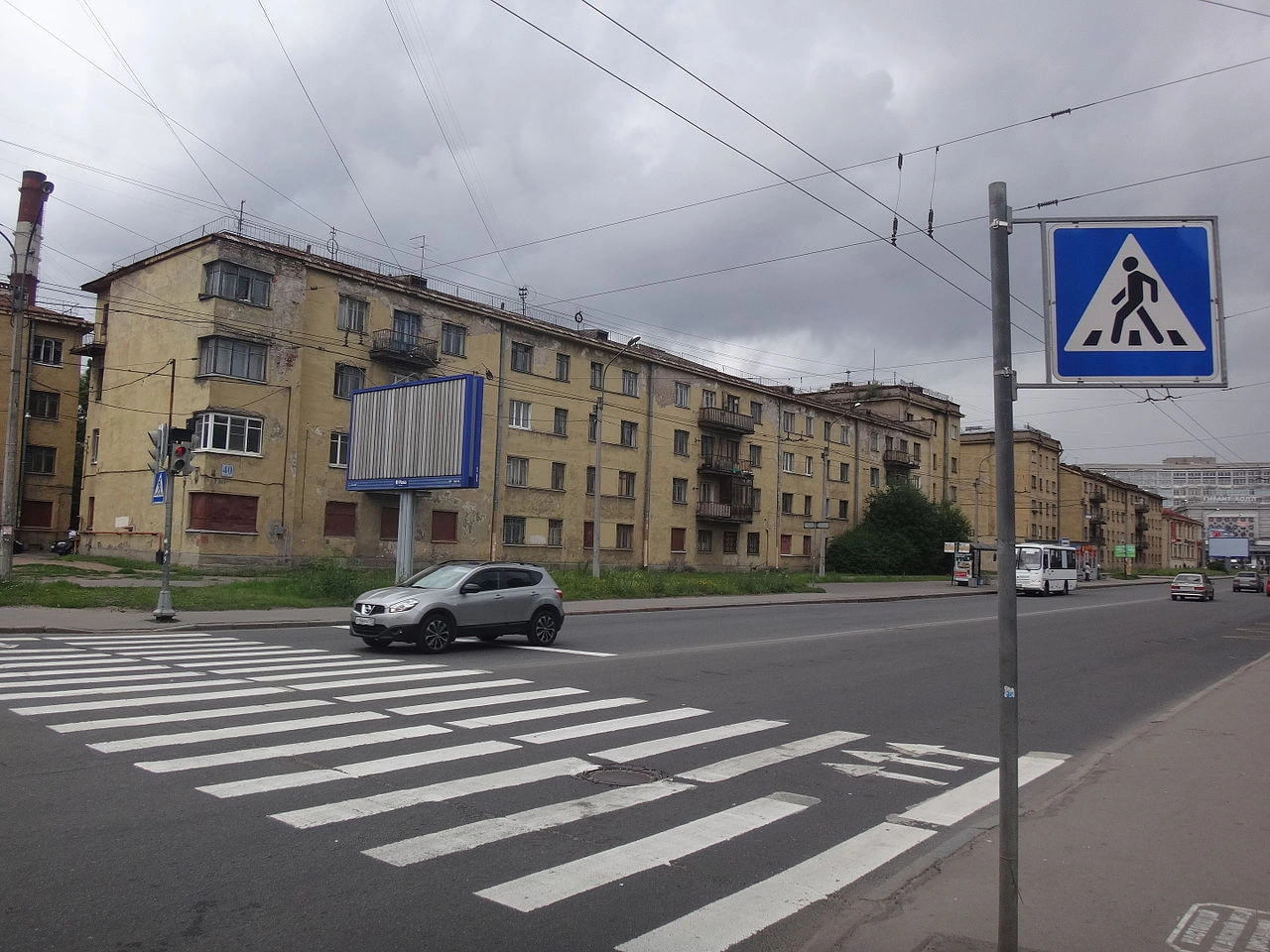
Wikimedia.org • Monoklon • CC BY-SA
When must drivers give way at a pedestrian crossing in Russia?
At an uncontrolled pedestrian crossing, Section 14.1 requires drivers to give way to pedestrians crossing or entering the carriageway or tram tracks to cross. If a vehicle ahead has stopped or slowed before the crossing, drivers in the same direction must also stop or slow and proceed only after satisfying that yielding duty. At a controlled crossing, allow pedestrians to finish when your signal changes to permit movement.
🔗 sh380.krsl.gov.spb.ru • Russia — Sections 4.3–4.7 and 14.1–14.6
Are all pedestrian crossings controlled the same way in Russia?
A warning that pedestrians may cross ahead is different from a marked or signal-controlled crossing. Look for the actual crossing marking, pedestrian signals and any supplemental signs.
🔗 sh380.krsl.gov.spb.ru • Russia — Sections 4.3–4.7 and 14.1–14.6
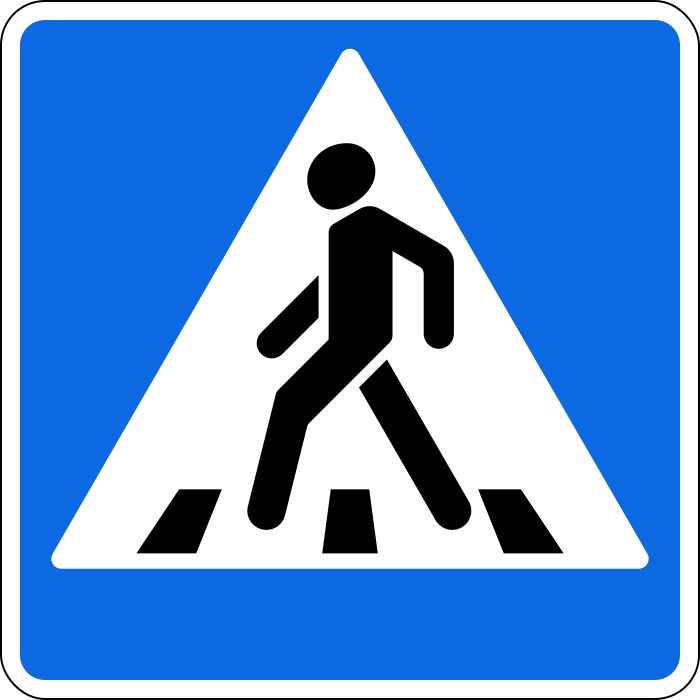 Crossing for pedestrians.
English • Traffic sign 5.19.1–5.19.2 • Pedestrian crossing. Marks a crossing. Without road markings, the signs define its boundaries; observe the crossing rules.
Русский • 5.19.1–5.19.2 • Пешеходный переход. Обозначен пешеходный переход. При отсутствии разметки знаки определяют его границы; соблюдайте правила проезда переходов.
Sources
🔗 Commons.wikimedia.org (Nikolaev ec06ffa5 • CC BY-SA 3.0)
🔗 Pravo.gov.ru • ПДД РФ • приложение 1 • 5.19.1–5.19.2
🔗 Pravo.gov.ru • Официальная редакция от 28.08.2026
SVG source: Nikolaev ec06ffa5 • CC BY-SA 3.0 • Original revision 2017-12-28. Wikimedia original unmodified.
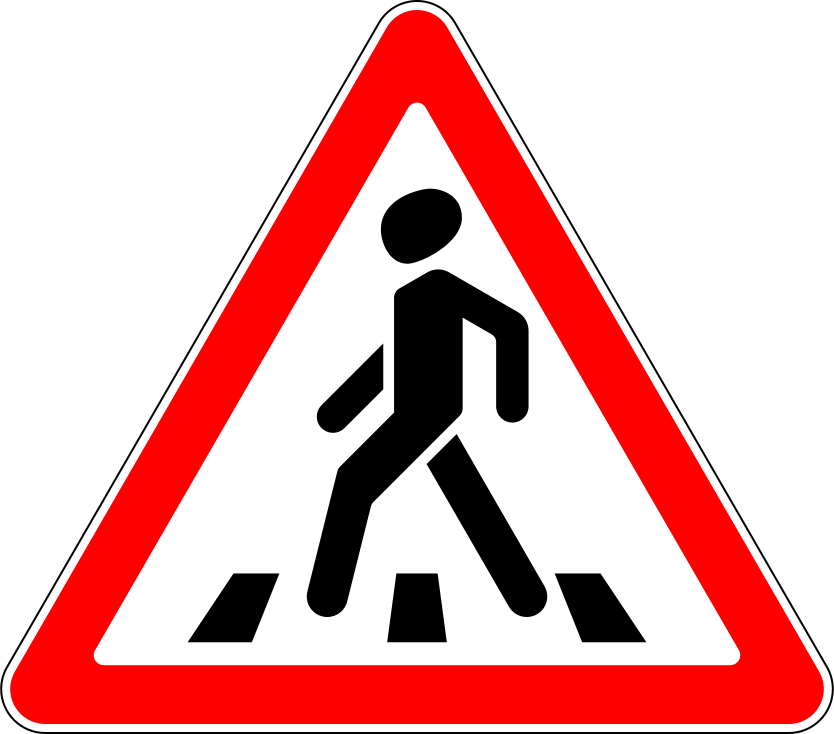 Warning for a pedestrian crossing.
English • Traffic sign 1.22 • Pedestrian crossing. A crossing marked by signs or road markings is ahead.
Русский • 1.22 • Пешеходный переход. Впереди пешеходный переход, обозначенный знаками или разметкой.
Sources
🔗 Commons.wikimedia.org
🔗 Pravo.gov.ru • ПДД РФ • приложение 1 • 1.22
🔗 Pravo.gov.ru • Официальная редакция от 28.08.2026
Image via Commons.wikimedia.org
Юкатан • CC BY-SA 3.0 • Source revision 2017-12-24. Wikimedia original unmodified.
May I enter a pedestrian crossing if the road beyond it is blocked in Russia?
Do not queue on the crossing or conceal pedestrians from approaching drivers. Wait before entering until there is space to clear the crossing, and do not overtake or pass a vehicle that has stopped for a pedestrian where that would endanger anyone.
🔗 sh380.krsl.gov.spb.ru • Russia — Sections 4.3–4.7 and 14.1–14.6
When may Russian pedestrians cross a junction diagonally?
At a controlled junction with markings specifically designating a diagonal pedestrian crossing.
🔗 sh380.krsl.gov.spb.ru • Russia — Sections 4.3–4.7 and 14.1–14.6
Where should Russian pedestrians cross when no pedestrian crossing is provided?
At a junction along the pavement or verge line. Section 4.3 has a separate bicycle-zone exception.
🔗 sh380.krsl.gov.spb.ru • Russia — Sections 4.3–4.7 and 14.1–14.6
When may Russian pedestrians cross away from both crossings and junctions?
When neither is visible: perpendicular to the road, with clear views both ways, and without a central dividing strip or barriers; bicycle zones are excepted.
🔗 sh380.krsl.gov.spb.ru • Russia — Sections 4.3–4.7 and 14.1–14.6
Where must Russian pedestrians wait if they cannot finish crossing?
On a refuge island or the line separating opposing traffic. Continue only when safe and with regard to the signals.
🔗 sh380.krsl.gov.spb.ru • Russia — Sections 4.3–4.7 and 14.1–14.6
What must Russian pedestrians do for emergency vehicles using blue warning lights and a siren?
Refrain from crossing; if already on the carriageway or tram tracks, clear them immediately.
🔗 sh380.krsl.gov.spb.ru • Russia — Sections 4.3–4.7 and 14.1–14.6
20. Railway crossing
A railway crossing, also called a level crossing or railroad crossing, is a place where a road or path crosses railway tracks at the same level. It may be protected by barriers, warning lights, bells, traffic signs or a combination of these measures.
Road users must approach carefully and never enter when a train is approaching, warning signals are active or the exit is blocked. They should cross promptly and must never stop, wait or become trapped on the tracks.
Wikimedia.org • Pesotsky • CC BY-SA
When must drivers stop at a railway level crossing in Russia?
At a crossing in Russia, obey red warning signals, barriers, STOP signs and authorised railway personnel. Stop whenever a train is approaching and it is not safe to cross; rules at an unguarded crossing may differ from a crossing controlled by lights or barriers.
🔗 sh380.krsl.gov.spb.ru • Russia — Section 15; signals, barriers, stopping positions and clear exit
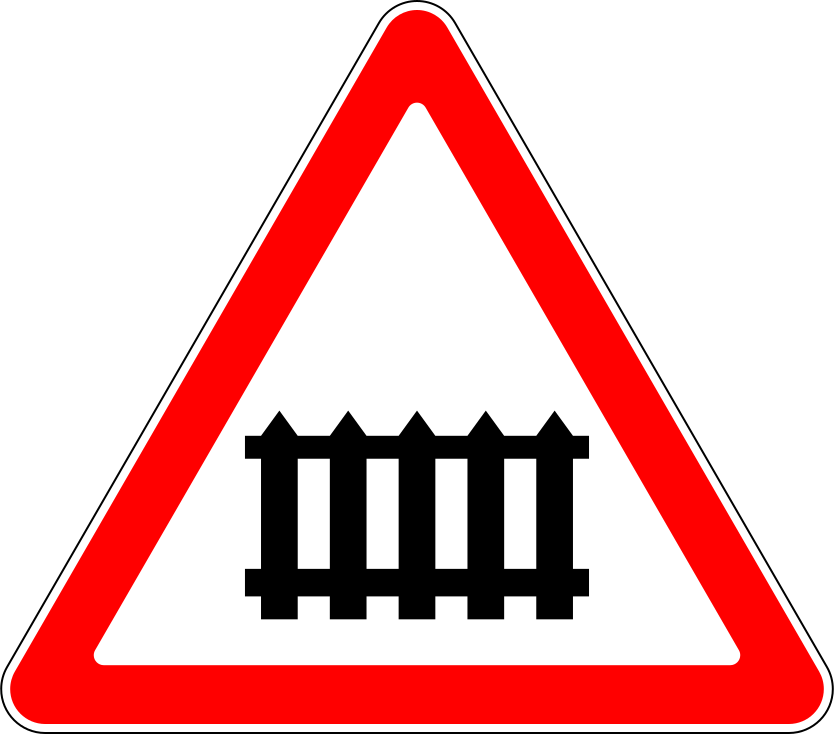 Warning for a railway crossing with barriers.
English • Traffic sign 1.1 • Level crossing with barriers. A railway crossing with a barrier is ahead.
Русский • 1.1 • Железнодорожный переезд со шлагбаумом. Впереди железнодорожный переезд, оборудованный шлагбаумом.
Sources
🔗 Commons.wikimedia.org
🔗 Pravo.gov.ru • ПДД РФ • приложение 1 • 1.1
🔗 Pravo.gov.ru • Официальная редакция от 28.08.2026
Image via Commons.wikimedia.org
Юкатан • Public domain • Source revision 2015-10-16. Wikimedia original unmodified.
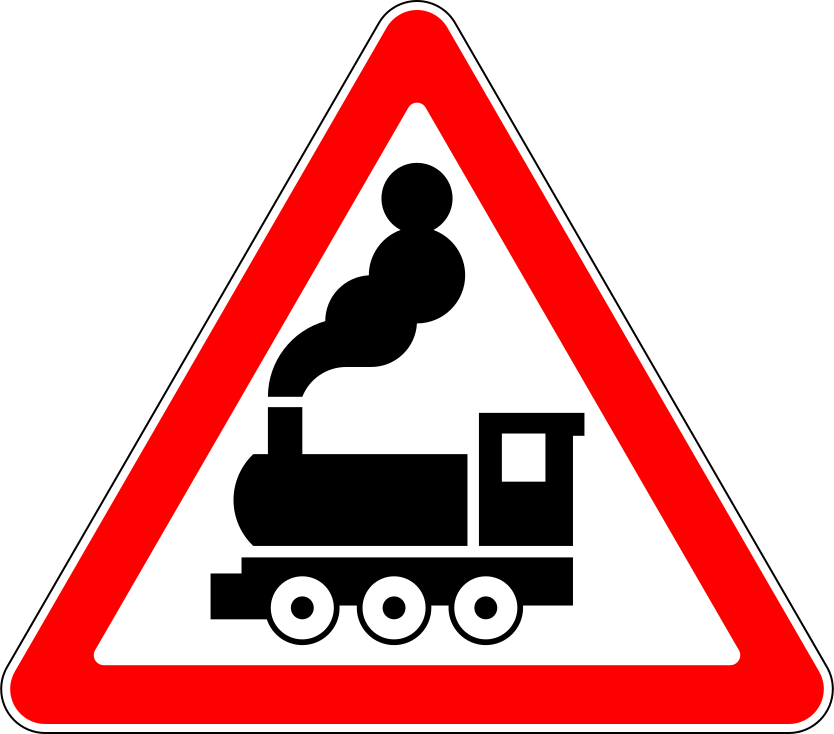 Warning for a railway crossing without barriers.
English • Traffic sign 1.2 • Level crossing without barriers. A railway crossing without a barrier is ahead.
Русский • 1.2 • Железнодорожный переезд без шлагбаума. Впереди железнодорожный переезд без шлагбаума.
Sources
🔗 Commons.wikimedia.org
🔗 Pravo.gov.ru • ПДД РФ • приложение 1 • 1.2
🔗 Pravo.gov.ru • Официальная редакция от 28.08.2026
Image via Commons.wikimedia.org
Юкатан • Public domain • Source revision 2016-02-06. Wikimedia original unmodified.
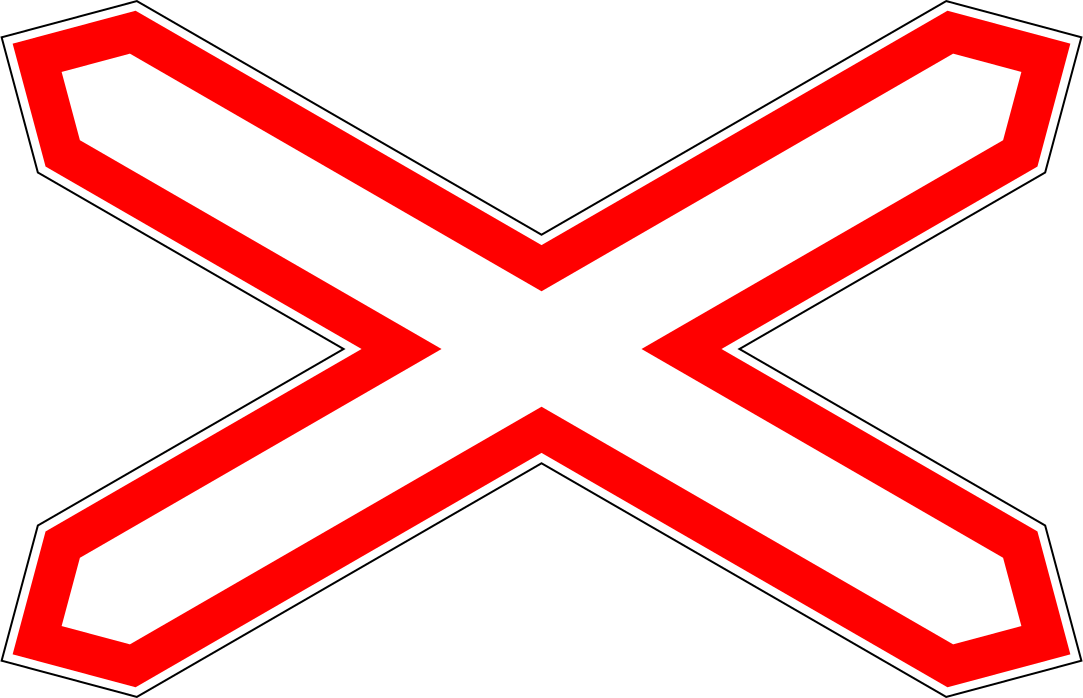 Warning for a railway crossing with one track.
English • Traffic sign 1.3.1 • Single-track railway. Marks a crossing without barriers over one railway track.
Русский • 1.3.1 • Однопутная железная дорога. Обозначен переезд без шлагбаума через железную дорогу с одним путём.
Sources
🔗 Commons.wikimedia.org
🔗 Pravo.gov.ru • ПДД РФ • приложение 1 • 1.3.1
🔗 Pravo.gov.ru • Официальная редакция от 28.08.2026
Image via Commons.wikimedia.org
Meddoc13 • CC BY-SA 3.0 • Source revision 2015-10-24. Wikimedia original unmodified.
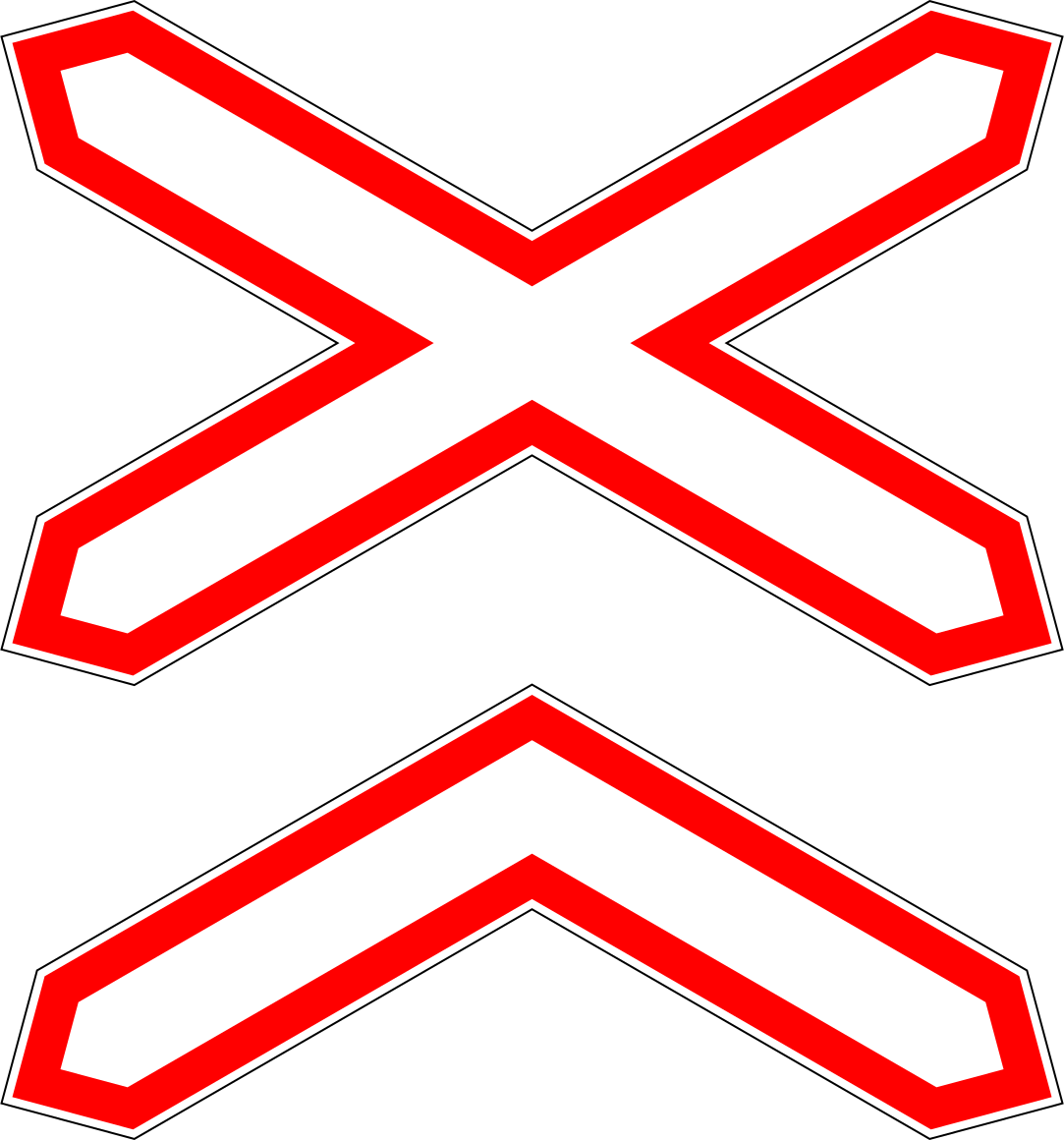 Warning for a railway crossing with two or more tracks.
English • Traffic sign 1.3.2 • Multi-track railway. Marks a crossing without barriers over two or more tracks.
Русский • 1.3.2 • Многопутная железная дорога. Обозначен переезд без шлагбаума через железную дорогу с двумя или более путями.
Sources
🔗 Commons.wikimedia.org
🔗 Pravo.gov.ru • ПДД РФ • приложение 1 • 1.3.2
🔗 Pravo.gov.ru • Официальная редакция от 28.08.2026
SVG source: Meddoc13 • Public domain • Original revision 2015-10-25. Wikimedia original unmodified.
Must I stop at every unguarded railway crossing in Russia?
In Russia, the stopping duty depends on the actual STOP or GIVE WAY controls and any additional national or vehicle-specific rule. Look and listen carefully; do not assume a crossing without barriers is automatically safe or that the same stop rule applies in every country.
🔗 sh380.krsl.gov.spb.ru • Russia — Section 15; signals, barriers, stopping positions and clear exit
What if road traffic is queued beyond a railway crossing in Russia?
Wait before the tracks until there is room to take your entire vehicle off the crossing. Do not follow another vehicle onto the tracks without checking the exit. Keep the tracks clear even if no train is visible.
🔗 sh380.krsl.gov.spb.ru • Russia — Section 15; signals, barriers, stopping positions and clear exit
21. Mandatory direction
A mandatory-direction sign requires drivers to travel only in the direction or one of the directions indicated by its arrow or arrows. It may require traffic to continue straight ahead, turn, or pass an obstacle on a specified side.
The sign does not itself determine priority or speed. Drivers must still use the appropriate lane, signal when required and give way according to local traffic signs and regulations.
Wikimedia.org • К.Артём.1 • CC BY-SA
What does a mandatory-direction sign require in Russia?
Where a compulsory-direction sign is installed in Russia, follow only the arrow direction or permitted combination of directions. The restriction applies at the location or movement it regulates; it is not an instruction to ignore other traffic controls.
Can I choose another turn if the mandatory-direction arrow is inconvenient in Russia?
No, unless another applicable sign, lane instruction or authorised traffic direction lawfully permits it. Plan a permitted alternative route; do not make an abrupt or prohibited turn to reach your destination.
Does a mandatory-direction sign give me priority over pedestrians in Russia?
No. It tells you which way to move, not who goes first. Check traffic lights, other priority signs, pedestrians and cyclists, and give way when required before completing the manoeuvre.
22. School area
A school area is a road or group of roads near a school where large numbers of children may walk, cycle, cross the road or enter and leave vehicles. It may be identified by warning signs, zone signs, road markings, traffic-calming measures or flashing lights.
Special speed limits, parking restrictions or access rules may apply permanently or only during school arrival and departure times. Drivers should reduce speed, watch carefully for children and be prepared to stop.
Wikimedia.org • NVO • CC BY-SA
What speed rules apply around schools in Russia?
Signed restrictions and pedestrian crossings may apply near schools; the mere presence of a school does not establish the same additional speed limit on all roads.
Does a school warning sign in Russia automatically set the speed limit?
A children or school warning alerts you to a potential hazard; the enforceable numerical speed limit depends on the applicable law, regulatory signs and any time or variable display. Slow further if children are near the road.
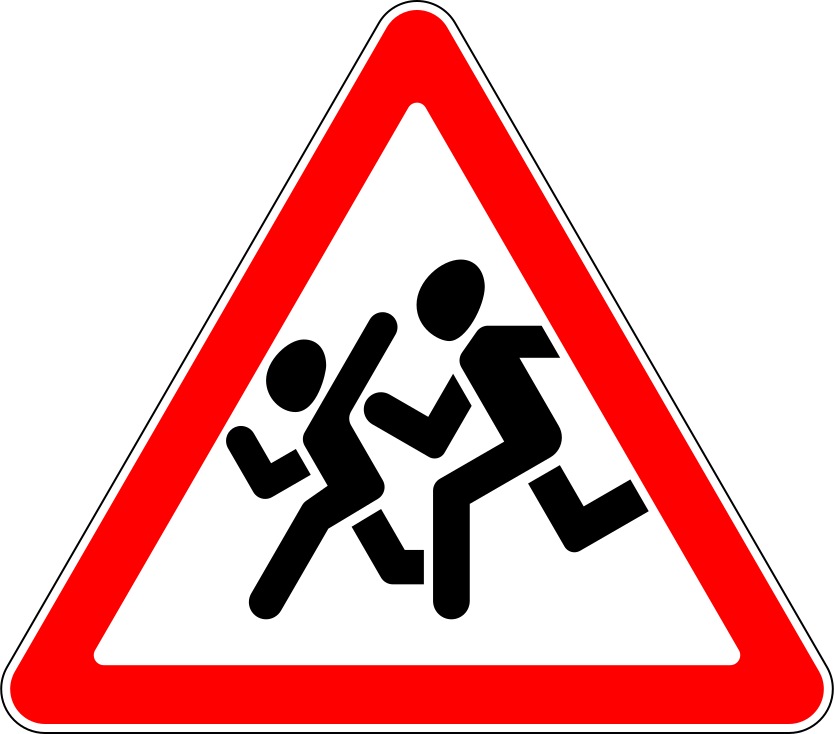 Warning for children.
English • Traffic sign 1.23 • Children. A section beside a children's facility where children may enter the carriageway.
Русский • 1.23 • Дети. Впереди участок у детского учреждения, где на проезжей части могут появиться дети.
Sources
🔗 Commons.wikimedia.org (Юкатан • CC BY-SA 3.0)
🔗 Pravo.gov.ru • ПДД РФ • приложение 1 • 1.23
🔗 Pravo.gov.ru • Официальная редакция от 28.08.2026
Image via Commons.wikimedia.org
Юкатан • CC BY-SA 3.0 • Source revision 2018-01-01. Wikimedia original unmodified.
How should you pass a school entrance in Russia?
Watch for children stepping out from between parked vehicles, obey crossings and any school patrol, and follow stopping or parking restrictions. Do not obstruct visibility near a crossing or school entrance; approach at a speed that permits a safe stop.
23. Overtaking
Overtaking is the act of passing another road user travelling in the same direction. It normally involves moving to another position or lane, passing the slower road user and returning to the appropriate position when it is safe.
Before overtaking, a driver should make sure there is sufficient visibility and space, check mirrors and blind spots, signal when required and ensure that no other road user is already overtaking. The manoeuvre must be completed without exceeding the speed limit or endangering other road users.
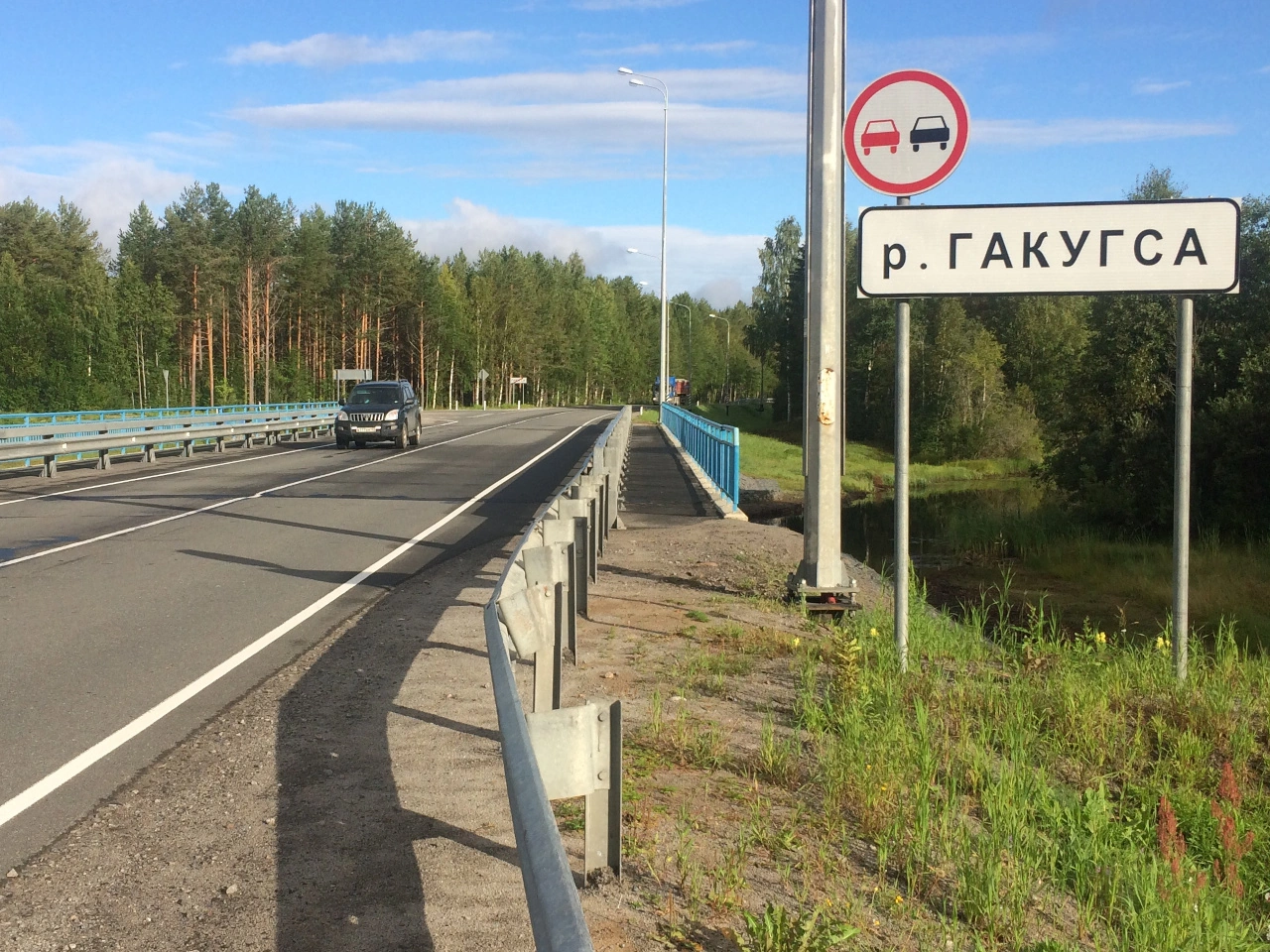
Wikimedia.org • Scaut2002 • CC BY-SA
On which side do drivers normally overtake in Russia?
As traffic normally keeps right, drivers ordinarily overtake on the left. This is the general rule, not permission to pass wherever a lane is available; exceptions and restrictions depend on the local law.
🔗 sh380.krsl.gov.spb.ru • Russia — Sections 9.10 and 11.1–11.7
When should you avoid overtaking in Russia?
Do not begin if approaching traffic, restricted visibility, road markings, an intersection, a crossing or another road user makes the manoeuvre unsafe or unlawful. Check behind and ahead, allow enough space and never exceed the speed limit to complete the pass.
🔗 sh380.krsl.gov.spb.ru • Russia — Sections 9.10 and 11.1–11.7
What extra care is needed when overtaking slower road users in Russia?
Sections 9.10 and 11 require safe lateral clearance, visibility and space when passing. Allow for a cyclist or pedestrian moving unexpectedly and wait if there is insufficient room. Do not squeeze through, cross a prohibited marking or exceed the applicable speed limit to complete a pass.
🔗 sh380.krsl.gov.spb.ru • Russia — Sections 9.10 and 11.1–11.7
24. Crossing animals
An animals-crossing warning indicates a place or road section where wild animals, livestock or ridden animals may enter or cross the road. Animals may appear suddenly, move unpredictably or be difficult to see in darkness, vegetation or poor weather.
Drivers should reduce speed, scan both sides of the road and remain prepared to stop. The warning sign does not itself give animals priority or impose a numerical speed limit, but drivers must avoid frightening, endangering or colliding with them.
Wikimedia.org • Gennady Grachev • CC BY
Which animals might drivers encounter on roads in Russia?
An animal-warning sign identifies a risk of animals entering the road. Read the actual pictogram, supplementary information and local warnings. Slow when animals may be present, leave space and watch for more animals following. The sign does not establish that the hazard ends immediately beyond it.
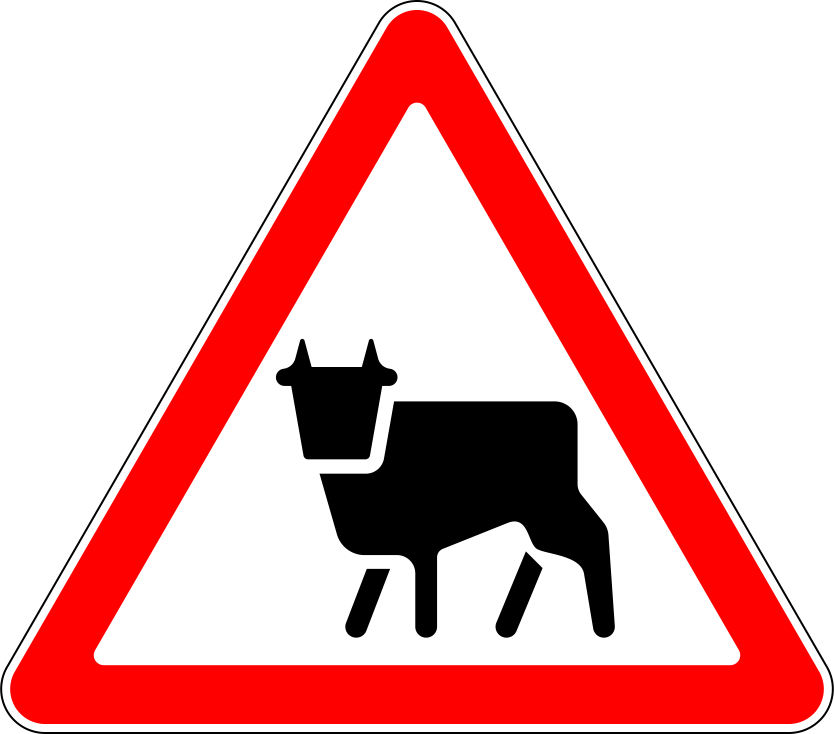 Warning for cattle on the road.
English • Traffic sign 1.26 • Livestock crossing. Livestock may be driven across the road ahead.
Русский • 1.26 • Перегон скота. Впереди возможен перегон скота через дорогу.
Sources
🔗 Commons.wikimedia.org
🔗 Pravo.gov.ru • ПДД РФ • приложение 1 • 1.26
🔗 Pravo.gov.ru • Официальная редакция от 28.08.2026
Image via Commons.wikimedia.org
Юкатан • CC BY-SA 3.0 • Source revision 2022-10-10. Wikimedia original unmodified.
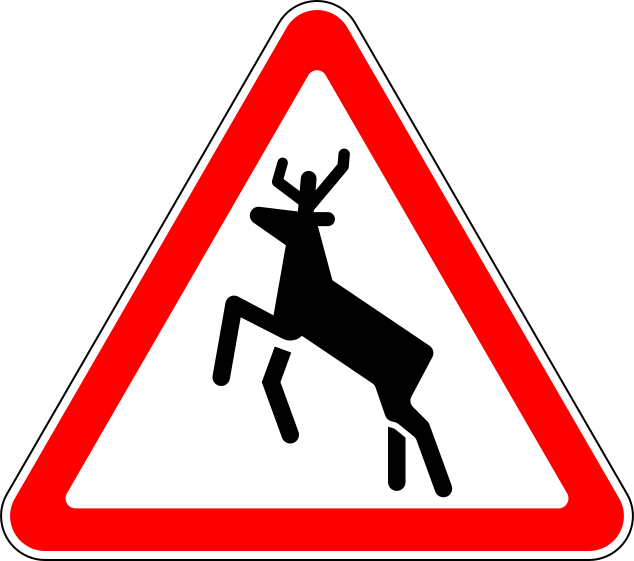 Warning for crossing deer.
English • Traffic sign 1.27 • Wild animals. Wild animals may enter the road ahead.
Русский • 1.27 • Дикие животные. Впереди возможен выход диких животных на дорогу.
Sources
🔗 Commons.wikimedia.org
🔗 Pravo.gov.ru • ПДД РФ • приложение 1 • 1.27
🔗 Pravo.gov.ru • Официальная редакция от 28.08.2026
Image via Commons.wikimedia.org
Юкатан • CC BY-SA 3.0 • Source revision 2014-01-07. Wikimedia original unmodified.
Does an animal-crossing warning sign in Russia set a new speed limit?
A warning of animals is not, by itself, a numerical speed-limit sign. Continue to obey the applicable speed limit, but slow down whenever animals could enter the road or visibility is poor. A separate regulatory speed sign must also be obeyed.
What should you do if an animal enters the road in Russia?
Ease off the accelerator, assess the traffic behind and brake smoothly if necessary. Avoid abrupt swerving into opposing traffic or off the road. Give farm animals and ridden animals room, avoid frightening them with unnecessary horn use, and be alert for more animals following.
25. Slippery road
A slippery road has reduced tyre grip and can make steering, braking and acceleration less effective. Roads may become slippery because of rain, ice, snow, mud, oil, loose material or other substances on the surface. Drivers should reduce speed, increase their following distance and avoid sudden steering, braking or acceleration. Extra caution is needed in bends, on bridges and wherever the road surface changes unexpectedly.
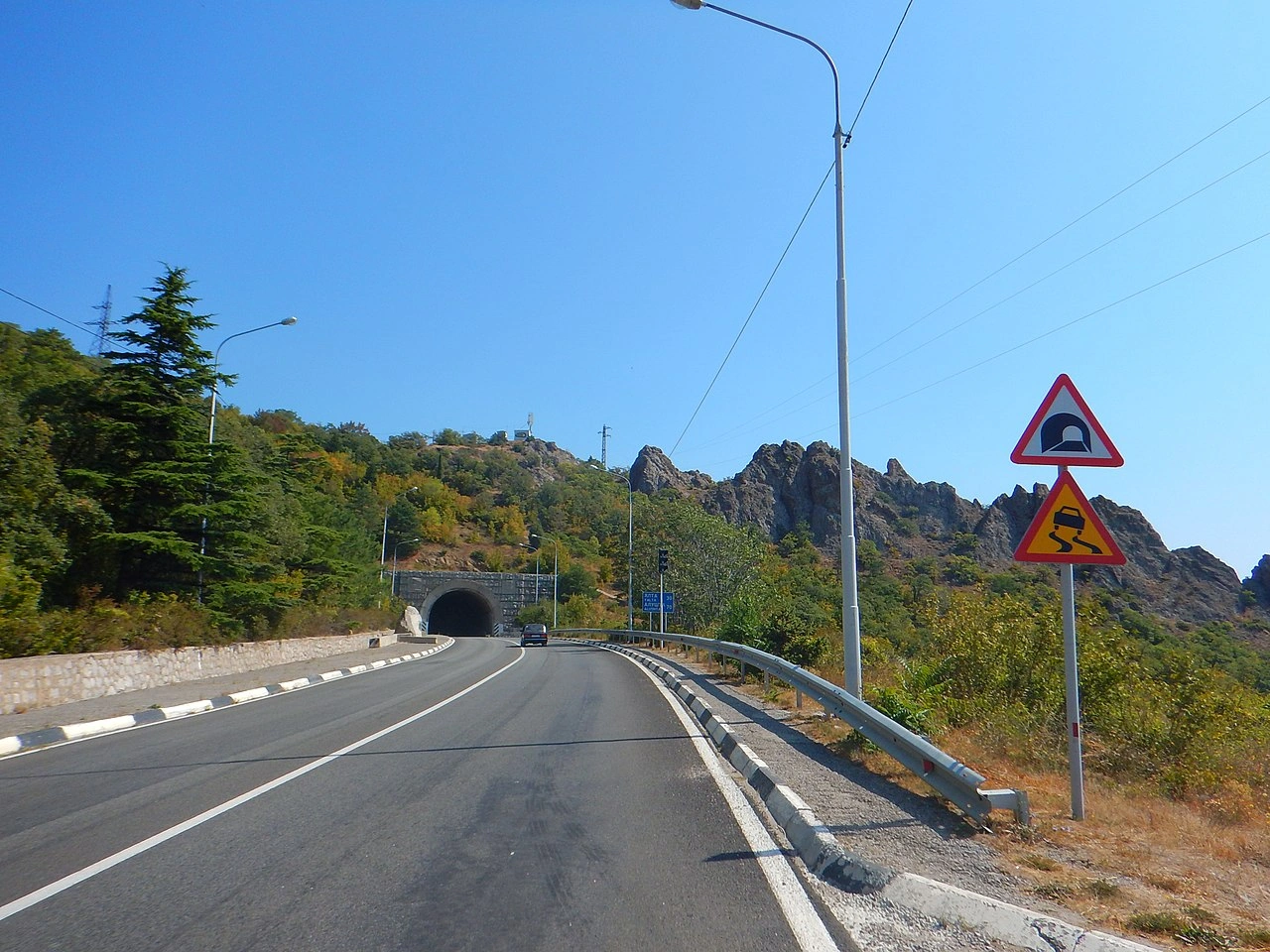
Wikimedia.org • Roma Neus • CC BY
What can make roads slippery in Russia?
Water, ice, mud, oil or other surface contamination can reduce grip where present. Conditions may change along the road, and a surface that looks clear can still be slippery. Reduce speed for the actual grip and visibility and use smooth steering, braking and acceleration.
How should you drive on a slippery road in Russia?
Reduce speed early, increase the gap to the vehicle ahead and use smooth steering, braking and acceleration. Do not rely on the posted maximum as a safe target when grip is poor.
Does a slippery-road warning sign in Russia automatically impose a lower number?
The warning sign highlights a reduced-grip risk; it normally does not itself prescribe a new numerical speed limit. A separate speed-limit sign, temporary restriction or local condition may still apply. Travel below the legal maximum when necessary for safety.
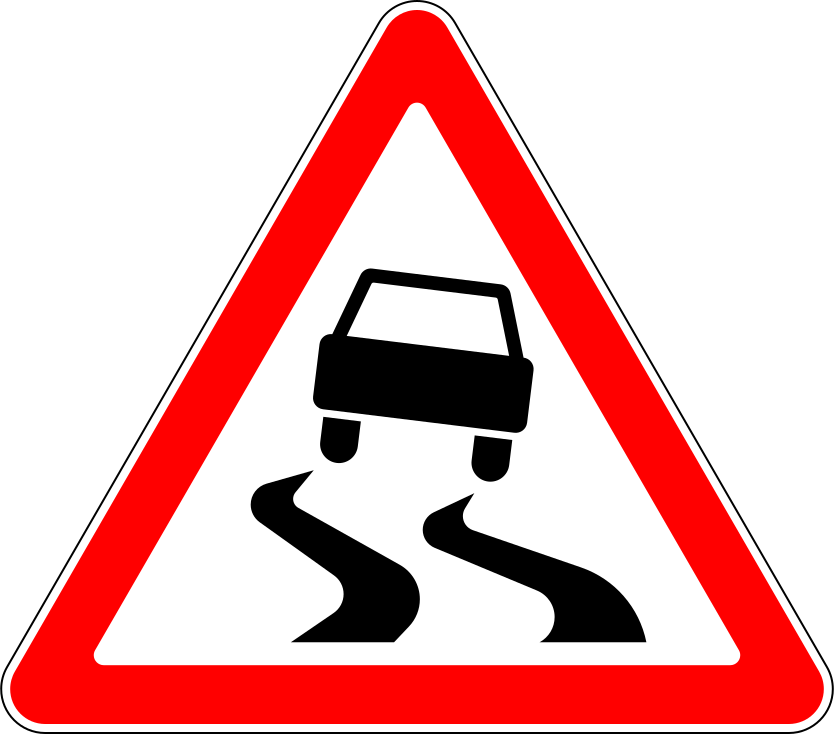 Warning for a slippery road surface.
English • Traffic sign 1.15 • Slippery road. An unusually slippery carriageway section is ahead.
Русский • 1.15 • Скользкая дорога. Впереди участок с повышенной скользкостью проезжей части.
Sources
🔗 Commons.wikimedia.org
🔗 Pravo.gov.ru • ПДД РФ • приложение 1 • 1.15
🔗 Pravo.gov.ru • Официальная редакция от 28.08.2026
Image via Commons.wikimedia.org
Юкатан • CC BY-SA 3.0 • Source revision 2017-11-13. Wikimedia original unmodified.