
Traffic rulesUruguay
Learn the traffic rules of Uruguay with lots of pictures, clear traffic signs and interactive quizzes. Simple, visual and easy to follow.


Driving licence basics in Uruguay
What is the official driving permit called in Uruguay?
It is the Permiso Único Nacional de Conducir, commonly abbreviated to PUNC. It is the national-format permit authorising a person to drive the vehicle categories recorded on it.
Who issues driving licences in Uruguay?
The 19 departmental governments, known as intendencias, manage applications, tests, issuance, renewals and local administration within the national PUNC framework.
Is the PUNC a national or departmental document?
It is a nationally coordinated permit with common categories and core rules, but it is issued and administered by a departmental government.
Can one person hold several separate PUNC documents?
No. The PUNC follows a principle of uniqueness: one person should hold one permit containing all current categories for which that person is authorised.
Can a single PUNC contain more than one category?
Yes. Several authorised categories may be recorded on the same permit.
Must a driver carry the permit while driving?
Yes. A driver must carry a valid permit and present it when required by national or departmental traffic authorities.
Does a PUNC authorise every kind of motor vehicle?
No. It authorises only the vehicle classes corresponding to the categories shown on the permit and any restrictions recorded on it.
Which category is normally used for a private car?
Category A is the ordinary category for cars, light vans and eligible car-and-trailer combinations within its passenger and weight limits.
Is the driving permit the same as the vehicle registration document?
No. The permit authorises the person to drive, while the vehicle registration identifies the vehicle and its registered holder. Both may need to be carried, together with proof of compulsory insurance.
May someone drive a motor vehicle without an appropriate permit?
No. A motor-vehicle driver must hold a valid permit for the relevant category.
Where should a first-time applicant begin?
The applicant should consult the official PUNC procedure for the intendencia handling the application, because booking, fees, accepted medical providers and operational steps can differ by department.
Licence categories and vehicle permissions
What does category A authorise?
Category A covers vehicles carrying up to nine people including the driver, vans and vehicles with a trailer, provided the total maximum weight does not exceed 4,000 kg.
What does category B authorise?
Category B covers vehicles carrying up to 18 people and trucks whose total weight does not exceed 7,000 kg, with a trailer not exceeding 1,500 kg.
What does category C authorise?
Category C covers vehicles carrying up to 18 people and rigid trucks, with a trailer not exceeding 1,500 kg. The practical-test vehicle must exceed category B limits.
What does category D authorise?
Category D covers vehicles carrying up to 18 people and trucks without a cargo-weight limit, including the heavy combinations specified for the category, such as a truck with a trailer over 1,500 kg or a tractor with a semitrailer.
What does category E authorise?
Category E is the professional taxi category. It covers metered hire cars and the same basic vehicle range as category A, up to nine people including the driver and a total maximum weight of 4,000 kg.
What does category F authorise?
Category F covers minibuses, buses and rigid trucks, with a trailer not exceeding 1,500 kg. The practical examination is taken in a bus carrying more than 24 passengers by design.
What does category G1 authorise?
Category G1 covers mopeds of up to 50 cc without gears.
What does category G2 authorise?
Category G2 covers motorcycles and mopeds of up to 200 cc and also authorises G1 vehicles.
What does category G3 authorise?
Category G3 covers motorcycles over 200 cc, effectively removing the G2 engine-capacity limit, and also authorises G2 vehicles.
What does category H authorise?
Category H covers road, agricultural and related machinery. The practical test is taken on machinery appropriate to the authorisation requested.
Does category B include category A permissions?
Yes. Under the PUNC category hierarchy, category B also authorises category A vehicles and category H machinery.
Does category C include lower goods-vehicle permissions?
Yes. Category C also authorises category B vehicles and category H machinery.
Does category D include category C permissions?
Yes. Category D also authorises category C vehicles and category H machinery.
Does category F include category C permissions?
Yes. Category F also authorises category C vehicles and category H machinery.
Does Uruguay use a separate BE-style car-and-trailer category?
Not in the PUNC category list. Trailer permission is built into the relevant A, B, C, D or F category and depends on the combination's weight and vehicle type.
Minimum ages and category progression
What is the minimum age for categories A and B?
The minimum age is 18 for both category A and category B, and neither requires previous seniority in another category.
What is required before applying for category C?
The applicant must be at least 19 and normally have one year of seniority in another non-G category.
What is required before applying for category D?
The applicant must be at least 21 and normally have three years of seniority in another non-G category.
What is required before applying for category E?
The applicant must be at least 21 and normally have two years of seniority in another non-G category.
What is required before applying for category F?
The applicant must be at least 23 and normally have three years of seniority in another non-G category.
What is the minimum age for category G1?
The minimum age is 16. Applicants under 18 require their legal representatives to endorse the application under the PUNC procedure.
What is the minimum age for category G2?
The minimum age is 18, with no previous motorcycle-category seniority required.
What is required before applying for category G3?
The applicant must be at least 21 and have three years of seniority in a category G motorcycle permit.
What is the minimum age for category H?
The minimum age is 18, and category H does not require previous seniority.
Does time held only in a category G permit count toward categories C, D, E or F?
No. The PUNC rules expressly exclude category G when calculating the previous-licence seniority required for those categories.
Applications, documents and driver training
Which authority handles a PUNC application?
The competent intendencia handles the application. Foreign-licence homologation is normally requested from the intendencia where the applicant resides.
Which identity document is normally required?
A current identity document is required. Departmental procedures commonly accept a valid Uruguayan identity card or eligible passport, but the exact list must be checked locally.
Is a medical or psychophysical assessment required?
Yes. National law requires a medical assessment of the applicant's psychophysical fitness before a permit can be issued.
Must existing driving licences be declared or surrendered during a PUNC procedure?
Yes. The PUNC system consolidates a person's current categories into one permit, and the applicant may have to present existing permits or a police report for a lost or stolen document.
Can unpaid fines or an active disqualification block an application?
Yes. Departmental procedures and the national system can prevent completion while relevant fines, sanctions, disqualifications or another pending PUNC procedure remain unresolved.
Are application fees identical in every department?
The PUNC document cost is nationally coordinated, but medical charges, local service items and operational payment arrangements may differ. Applicants should verify the current amount with their intendencia.
Can an applicant prepare through a driving academy?
Yes. Applicants may use an authorised driving academy, subject to the academy and departmental procedure.
Can an applicant learn with a private instructor or accompanying driver?
A department may permit private instruction, but the accompanying driver and training vehicle must satisfy the applicable requirements and be registered or presented as instructed.
Is a fixed number of practical lessons imposed nationally for category A?
The national PUNC text does not set one universal lesson total for every department. Local rules can add a requirement; for example, Montevideo currently requires 15 hours of practical instruction before its category A practical test.
What documents may be required for a privately supplied test vehicle?
Typical requirements include the vehicle registration, valid compulsory motor insurance and any required technical inspection. The controlling departmental procedure must be checked.
In what order are the main licensing stages completed?
The usual sequence is document and fitness approval, theory examination and then practical examination. A failed theory test prevents progression to the practical test.
How long can an unfinished PUNC application remain valid?
The national procedure sets a maximum application validity of 180 calendar days from the start of the process. If it expires, a new procedure and the applicable steps and payments are required.
Theory tests and official preparation
Is a theory test required for a first driving permit?
Yes. National law requires an applicant to pass a theory examination on traffic rules before obtaining a motor-vehicle permit.
Must the theory test be passed before the practical test?
Yes. The theory test is eliminatory, so failure prevents the applicant from taking the practical examination at that stage.
What knowledge does the theory test assess?
It assesses knowledge of traffic rules, road safety and relevant public transport rules needed to act safely as a driver.
Is there one theory test that automatically covers every category?
No. The national procedure provides a theory test for each category, including public-service categories, although departments may organise related modules within their testing system.
Where can candidates find official study material?
UNASEV publishes the Guía Nacional de Conducción and links to national preparation material. Intendencias may also publish category-specific manuals and practice resources.
Does every intendencia use the same number of questions and pass mark?
The national PUNC text defines the purpose and administration of the test but does not prescribe one public nationwide question count or pass mark. Candidates must check the current format with their intendencia.
Can a candidate request information about language or accessibility support?
Yes. A candidate who needs language, reading or disability-related support should contact the intendencia before booking, because available arrangements and required evidence are handled operationally.
What happens if a candidate cheats or consults another person during the theory test?
The test is recorded as failed for cheating and a new date must be assigned under the applicable procedure.
What happens if a candidate does not attend the theory test?
The result is normally recorded as absent and treated as a failure, although a properly justified absence may be reviewed and a new date assigned.
How soon can the theory test be retaken after failures?
Within the national procedure, successive waiting periods are 4, 8, 16, 30, 45 and 60 calendar days after each failure, subject to the application's 180-day maximum validity.
Can the theory test be attempted several times during one application?
Yes, as many times as the retake intervals and the remaining 180-day application period allow.
Does failing one part of a multi-part theory assessment affect the whole test?
Yes. Failure of one required part means failure of the complete theory examination for that attempt.
Practical examinations and test vehicles
Is a practical driving test required?
Yes. National law requires a practical examination demonstrating fitness and skill for the vehicle category requested.
What does the practical examination contain?
The PUNC framework divides it into vehicle-knowledge, closed-course or track, and on-road circulation elements, adapted to the vehicle category.
Must the test vehicle match the requested category?
Yes. The vehicle must meet the category's characteristics and any department-specific test-vehicle rules.
What vehicle is used for a category A test?
The practical test is taken in a vehicle within category A limits: up to nine people including the driver and up to 4,000 kg gross total weight.
What distinguishes the category B test vehicle?
It must exceed category A limits and fall within category B, generally between 10 and 18 occupants or between 4,001 and 7,000 kg gross total weight.
What distinguishes the category C test vehicle?
The practical test is taken in a rigid truck that exceeds category B limits.
What distinguishes the category D test vehicle?
The test uses the heavy combination required by the category, such as a truck over 7,000 kg with a trailer over 1,500 kg or a tractor and semitrailer.
What vehicle is used for the category F practical test?
The practical test is taken in a bus designed for more than 24 passengers.
What requirements apply to an accompanying driver at the test?
The accompanying driver must hold a valid Uruguayan permit authorising the test category and must not have unpaid fines, pending sanctions or disqualifications. A department may impose additional age or seniority rules.
What requirements apply to the test vehicle?
It must comply with circulation requirements and must not have unpaid fines or vehicle-tax debt that prevents its use in the system.
Can a failed practical test be repeated?
Yes. The same national waiting sequence used for retesting applies: 4, 8, 16, 30, 45 and 60 calendar days, within the 180-day life of the application.
Does failing one practical component mean failing the whole practical test?
Yes. Failure of a required part results in failure of the complete practical examination for that attempt.
Are private instructors and private vehicles subject to test-site entry limits?
Yes. The national procedure allows the system to control entries, including a limit of three entries per month or seven per semester for a private instructor or accompanying driver, with corresponding controls for private vehicles.
Can a person with a disability take the test in an adapted vehicle?
Yes. The test may be taken in an appropriately adapted vehicle when the adaptation has been approved and safely compensates for the applicant's functional limitation.
First permits, learner status and novice drivers
How long is a first PUNC valid?
A permit issued for the first time is provisional and may be granted for a maximum of two years.
Does a first permit authorise independent driving?
Yes. Once issued, it authorises driving within its recorded category and restrictions; it is not merely a supervised learner authorisation.
Is supervised practice before the practical test the same as holding a full permit?
No. A learner may practise only under the authorised departmental conditions with an eligible accompanying driver and suitable vehicle.
Does Uruguay impose one national novice-driver curfew?
The national PUNC procedure does not set a general curfew for all first-permit holders. Any restriction printed on the permit or imposed by another applicable rule must still be obeyed.
Does Uruguay impose one national passenger limit solely because a driver is new?
The national PUNC procedure does not create a general novice passenger limit. Vehicle capacity, category limits and any individual restriction remain controlling.
Must a novice driver obey medical or vehicle restrictions shown on the permit?
Yes. Conditions such as corrective lenses, daylight-only driving or use of an adapted vehicle are legally relevant from the first day.
Does the alcohol limit differ for novice drivers?
No. Uruguay's 0.0 alcohol rule applies to all drivers and all vehicle categories, including first-permit holders.
How many points does a first-time driver receive under the points-system decree?
When the national points system is operational for the driver, a first-time permit holder begins with eight points.
How can a new driver's points rise from eight to twelve?
Under the decree, four points are added after two years without an offence that removes points, bringing the balance to twelve.
Can a compliant driver eventually reach more than twelve points?
Yes. After a further three clean years the balance rises to 14, and after another three clean years it rises to the maximum of 15.
Does the two-year first permit automatically become a ten-year permit?
No. The holder must complete the renewal process and satisfy the medical, administrative, age and category requirements. The renewed validity cannot exceed the applicable maximum.
What should a first-permit holder do before the expiry date?
Check the renewal procedure early with the intendencia. A renewal may generally be started up to 30 days before expiry.
Validity, renewal, replacement and category changes
What is the maximum ordinary renewal period for a younger category A, G1 or G2 holder?
For a holder aged up to 55, the administrative maximum is ten years, unless medical findings or another restriction require a shorter period.
How does age reduce the maximum validity of A, G1 and G2?
The maximum becomes nine years at 56, eight at 57, seven at 58, six at 59, five from 60 to 68, four at 69, three from 70 to 78, two at 79 and one at 80.
What is the maximum validity for categories B, C, D, E, F, H and G3 up to age 55?
The administrative maximum is ten years, subject to medical fitness and any category-specific restriction.
How does age reduce the maximum validity of B, C, D, E, F, H and G3?
The maximum becomes nine years at 56, eight at 57, seven at 58, six at 59, five from 60 to 65, four at 66, three at 67, two at 68 and one at 69. Older applicants must confirm continuing eligibility with the intendencia.
Can a medical assessment shorten the permit below the age-based maximum?
Yes. The more restrictive medical or administrative period controls.
If one PUNC contains several categories, can they have separate expiry dates?
The national procedure generally applies one validity period to the permit as a whole, using the most restrictive relevant medical or administrative limit.
How early can a renewal normally be started?
A renewal may generally be processed up to 30 days before the expiry date, subject to any authorised exception.
Can a permit expired for less than two years be renewed without theory and practical tests?
The national procedure allows expired permits to be renewed without imposing theory and practical examinations for up to two years after expiry, although an update course and medical or administrative requirements may still apply.
What may happen when a permit has been expired for more than two years?
The simplified expired-permit renewal protection no longer applies. The person should expect the intendencia to require the applicable examination and new-application steps; the points decree also treats the reissued permit like a beginner's permit for its initial balance.
Must a driver aged 75 or more take a practical test at renewal?
Yes. When the applicant is at least 75 at the start of the renewal procedure, a practical examination and medical assessment are mandatory.
What happens when a PUNC is lost, stolen or damaged?
A duplicate may be issued for the same categories and remaining validity, normally after identity checks and, for loss or theft, the required police report or declaration.
Is adding or removing a category treated as an ordinary renewal?
No. A change affecting at least one category is processed as a category change and requires the corresponding eligibility, medical, theory and practical requirements.
May a person drive after the permit has expired while waiting for renewal?
No. An expired permit does not authorise driving unless a specific valid temporary authorisation has been formally issued.
Foreign licences, tourists and homologation
Can a tourist drive in Uruguay with a foreign licence?
A tourist may generally drive with a current licence valid for the vehicle being used, while complying with immigration, insurance, vehicle and rental requirements. A translation or International Driving Permit may be advisable when the licence is not readily understandable.
Are licences from MERCOSUR countries recognised for temporary tourist driving?
Yes. For temporary or tourist circulation within MERCOSUR, a valid licence issued in the driver's home country remains effective without compulsory exchange.
What documents should a foreign tourist carry when driving?
The driver should carry valid identification, the driving licence, vehicle ownership or authorised-use documentation and valid insurance. Foreign-registered vehicles are also subject to customs and tourist-vehicle rules.
Does an International Driving Permit replace the national licence in Uruguay?
No. An International Driving Permit is a translation and supporting document; it must be carried with the valid national licence and does not create vehicle permissions the national licence lacks.
Where does a resident apply to homologate or exchange a foreign licence?
The person should apply to the intendencia of residence and follow that department's foreign-licence homologation procedure.
Must the foreign licence be current for homologation?
Yes. The foreign permit must be valid when the procedure is started.
What is generally required for a MERCOSUR licence conversion?
The applicant presents the licence and the consular or official certification required by the intendencia. Documents not in Spanish may need translation by a public translator.
What is generally required for a licence from outside MERCOSUR?
The applicant normally needs the original current licence, proof of its validity or driving record, legalisation or apostille as applicable, and a Spanish translation when required.
Do bilateral exchange agreements change the procedure?
Yes. Where Uruguay has a bilateral agreement, the agreement's equivalence table, document rules and any test requirements take priority.
Is the original foreign licence always returned to the applicant?
Not always. The PUNC framework generally avoids retaining a revalidated licence, but a bilateral agreement may require surrender; for example, an exchange under the Spain agreement can require the Spanish permit to be returned to its issuing authority.
Can a foreign licence be recognised only partially?
Yes. The intendencia may recognise it in whole or in part, applying Uruguayan category, validity, medical and restriction rules.
Can theory, practical and medical tests still be required during homologation?
Yes. Tests may be required when the agreement, category equivalence, document evidence or exceptional recognition procedure calls for them.
Motorcycles, professional driving and special categories
What extra approval is needed for a 16- or 17-year-old applying for G1?
The minor's legal representatives must endorse the application together with the applicant and accept the responsibility required by the PUNC procedure.
Can a G1 holder ride a geared motorcycle?
No. G1 is limited to mopeds up to 50 cc without gears.
Why is the G2 practical test taken on a motorcycle with non-automatic gears?
The category standard requires the test on a geared motorcycle up to 200 cc, demonstrating control of the type of machine covered by the full G2 permission.
What motorcycle is required for the G3 practical test?
The test is taken on a motorcycle over 200 cc with non-automatic gears.
Which category is needed to drive a metered taxi?
Category E is required for metered hire cars, together with any separate professional, municipal or service requirements applying to the taxi activity.
Which category is used for buses and minibuses?
Category F is the principal PUNC category for minibuses and buses, and its practical test uses a bus designed for more than 24 passengers.
Which categories cover progressively heavier goods vehicles?
Category B covers trucks up to 7,000 kg, category C covers larger rigid trucks and category D covers unrestricted heavy trucks and the specified heavy trailer or semitrailer combinations.
Are professional-category applicants subject to a more demanding medical assessment?
They can be. The PUNC medical protocol distinguishes ordinary and professional or special driving demands and may require additional tests or shorter validity.
Can professional applications require evidence beyond the standard identity and medical documents?
Yes. Depending on the category and department, applicants may need a health card, laboratory results, proof of previous licence seniority or a criminal-record certificate.
Does category H create seniority for another licence category?
No. Category H does not generate the licence seniority needed to progress to other categories.
Medical fitness, disabilities and licence restrictions
What does the psychophysical assessment consider?
It can assess vision, visual field and colour perception, hearing, physical coordination, relevant diseases, medication, psychological fitness and other factors affecting safe driving.
Can corrective lenses be made a licence condition?
Yes. The permit can require spectacles or contact lenses whenever the medical assessment finds them necessary for safe driving.
Can a permit be limited to daylight driving?
Yes. Daylight-only driving may be imposed as a psychophysical restriction.
Can a person with a physical disability obtain a PUNC?
Yes. A person may be licensed to drive a suitably adapted vehicle when the assessment and practical test establish that the adaptation provides safe control.
Can a medical condition reduce the validity period?
Yes. The medical examiner may recommend a shorter validity period and additional monitoring or specialist evidence.
How long is a standard fitness certificate available for presentation?
Under the national protocol, the certificate is generally valid for a maximum of 30 days after issue for presentation to the licensing office.
Is there a different certificate-presentation period for a person with a disability?
Yes. A certificate issued in a disability-related case may have a presentation validity of up to 90 days.
What must a licence holder do if health deteriorates after issuance?
The holder should request a new medical-psychological assessment when a physical or mental change could affect driving ability, rather than waiting for ordinary renewal.
Can a person reapply after medical denial?
A new assessment may generally be requested after six months, or earlier when the medical professional considers that the disqualifying cause has disappeared or materially improved.
Suspensions, alcohol, points and reinstatement
What is Uruguay's legal alcohol limit for drivers?
The limit is 0.0 g/l. Any alcohol concentration above zero makes a person legally unfit to drive a vehicle of any type or category.
What happens if a driver refuses an alcohol or drug test?
Refusal is treated seriously under traffic law and the points-system decree lists refusal alongside alcohol or drug driving as an offence causing total loss of points when the system applies.
Can driving under the influence lead to permit retention or cancellation?
Yes. Authorities may retain the permit and impose suspension or cancellation through the applicable administrative process.
Is reinstatement automatic after an alcohol- or drug-related cancellation?
No. The driver must complete the prescribed reincorporation process, including the relevant medical protocol and any other required measures, before being authorised again.
Has Uruguay legally created a national points system?
Yes. Decree 181/025 created the national points system associated with the PUNC and set its balances, point deductions, recovery rules and implementation framework.
Was the points system required to be fully operational immediately?
No. The decree allows up to 24 months from 2 September 2025 for full implementation, so drivers should verify the current operational stage with official PUNC or intendencia services.
How many points do existing valid permit holders receive when the system starts?
As a transitional rule, a person holding a valid PUNC when the system begins receives 12 points.
Which offences cause total loss of points under the decree?
Alcohol or drug driving, refusing the relevant test and participating in unauthorised vehicle competitions cause total point loss.
Which other offences remove points?
The decree removes six points for handheld-phone driving or driving at least double the limit, four for driving without the correct PUNC category, and two for specified serious speeding, seat-belt, helmet and child-restraint offences.
What happens when deductions reach or exceed the driver's balance?
The PUNC is temporarily suspended for three months and the driver must complete the compulsory recovery programme.
Can points recover automatically through good conduct?
Yes. A driver with a positive balance recovers up to 12 points after two years without another offence that removes points.
Can a driver recover points through a course?
Yes. A voluntary course can restore six points up to the amount lost and may be taken once per year; a recovery course is compulsory after the balance is exhausted.
Sources and methodology
Which source was used for the national PUNC structure and procedures?
The official Consolidated PUNC text published by the Congress of Intendants was used for the one-permit principle, categories, foreign conversion, examinations, retakes, validity, medical rules and reinstatement.
Which source was used for category descriptions and minimum ages?
The official Montevideo category table, checked against the national PUNC text, was used for category vehicles, ages, seniority and test-vehicle distinctions.
Which source was used for first-time category A procedures?
The current Montevideo first category A procedure was used only for clearly identified local examples such as its 15-hour instruction rule and accompanying-driver documents.
Which source was used for the legal examination requirement?
The official article 26 of Law 18.191 was used to confirm the medical, theory and practical examinations and the obligation to hold the correct category.
Which source was used for foreign-licence recognition?
The official Congress of Intendants homologation guidance and the foreign-conversion article in the PUNC text were used for residence, validity, legalisation, translation and bilateral agreements.
Which source was used for the points system?
The official Decree 181/025 in the IMPO legal database was used for initial balances, deductions, recovery, suspension and the 24-month implementation window.
Which source was used for the zero-alcohol rule?
The official Law 19.360 was used to confirm the 0.0 g/l alcohol limit for every driver and vehicle category.
When was this FAQ last reviewed?
This English master was last reviewed on 4 August 2026. Applicants should still check the current procedure of the relevant intendencia because fees, appointments, accepted documents, test format, training arrangements and the operational rollout of the points system can change.

1. What does this traffic sign mean?
This traffic sign indicates a warning for tractors or other agricultural vehicles. Slow-moving agricultural vehicles may enter, cross or travel along the road ahead. Reduce speed and overtake only where it is permitted and clearly safe.
English • Traffic sign P-30 • Agricultural machinery. Agricultural machinery may travel along or cross the road.
Español • P-30 • Maquinaria agrícola. Advierte la posible circulación o cruce de maquinaria agrícola.
Sources
🔗 Commons.wikimedia.org
🔗 Gub.uy • MTOP, Norma Uruguaya de Señalización Vertical, PDF p. 98
🔗 Gub.uy • MTOP, significado, PDF p. 45
Image via Commons.wikimedia.org
Intendencia de Durazno • Public domain • Source revision 2014-03-12. Wikimedia original unmodified.

2. What does this traffic sign mean?
This traffic sign indicates that cyclists are prohibited. Cyclists may not enter or continue beyond the sign. Other road users may still be permitted unless another restriction applies.
English • Traffic sign R-12 · family • No bicycles. Bicycle traffic is prohibited on the signed section. The R-12 family is identified. The drawing includes a rider; the national catalogue shows a bicycle without a rider.
Español • R-12 · familia • No bicicletas. Prohíbe el tránsito de bicicletas en el tramo señalado. Identificación de la familia R-12. El dibujo mostrado incluye un ciclista; el catálogo nacional representa una bicicleta sin conductor.
Sources
🔗 Commons.wikimedia.org
🔗 Gub.uy • MTOP, Norma Uruguaya de Señalización Vertical, PDF p. 87
🔗 Gub.uy • MTOP, significado, PDF p. 23
Image via Commons.wikimedia.org
Intendencia de Durazno • Public domain • Source revision 2014-03-12. Wikimedia original unmodified.
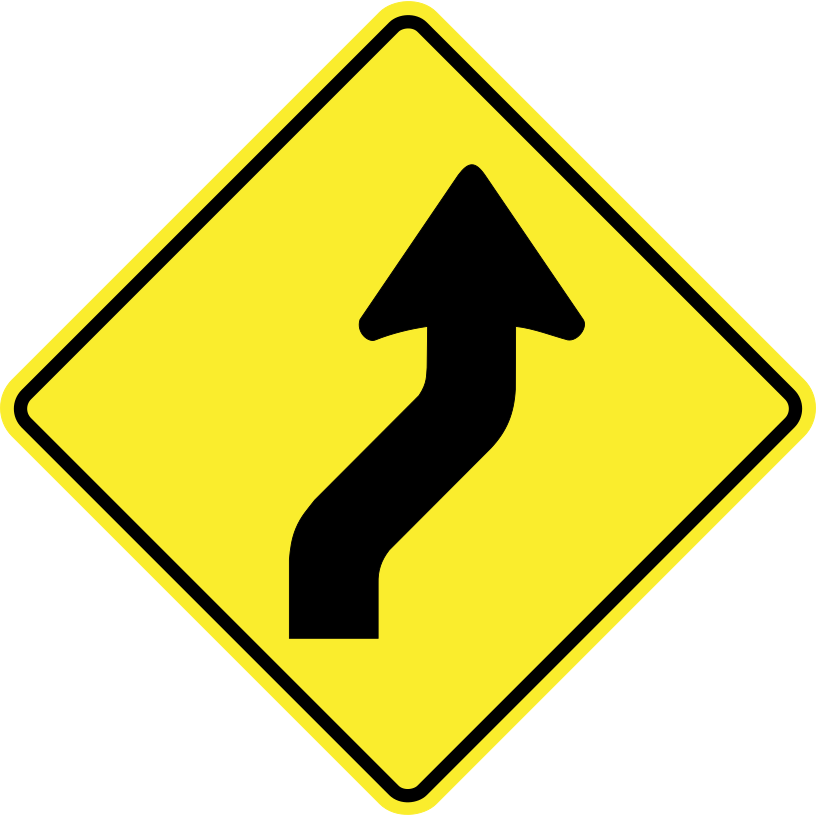
3. What does this traffic sign mean?
This traffic sign indicates a warning for successive curves, with the first curve to the right. Reduce speed before entering the winding section, maintain your lane position and be prepared for further changes in direction.
English • Traffic sign P-4b • Double bend, first to the right. Warns of two successive bends, first to the right.
Español • P-4b • Curva y contracurva a la derecha. Advierte dos curvas sucesivas, la primera hacia la derecha.
Sources
🔗 Commons.wikimedia.org
🔗 Gub.uy • MTOP, Norma Uruguaya de Señalización Vertical, PDF p. 93
🔗 Gub.uy • MTOP, significado, PDF p. 37
Replacement SVG: Commons.wikimedia.org • Wikimedia Commons original • Original: Vialidad Nacional - Ministerio de Transporte - Presidencia de la Nación Vectorization: Civitas13 • Public domain • Original revision 2020-01-31. Wikimedia original unmodified.
Image via Commons.wikimedia.org
Original: Vialidad Nacional - Ministerio de Transporte - Presidencia de la Nación Vectorization: Civitas13 • Public domain • Source revision 2020-01-31. Wikimedia original unmodified.

4. What does this traffic sign mean?
This traffic sign indicates that motorcycles are prohibited. Motorcyclists may not enter or continue beyond the sign. Other road users may still be permitted unless another restriction applies.
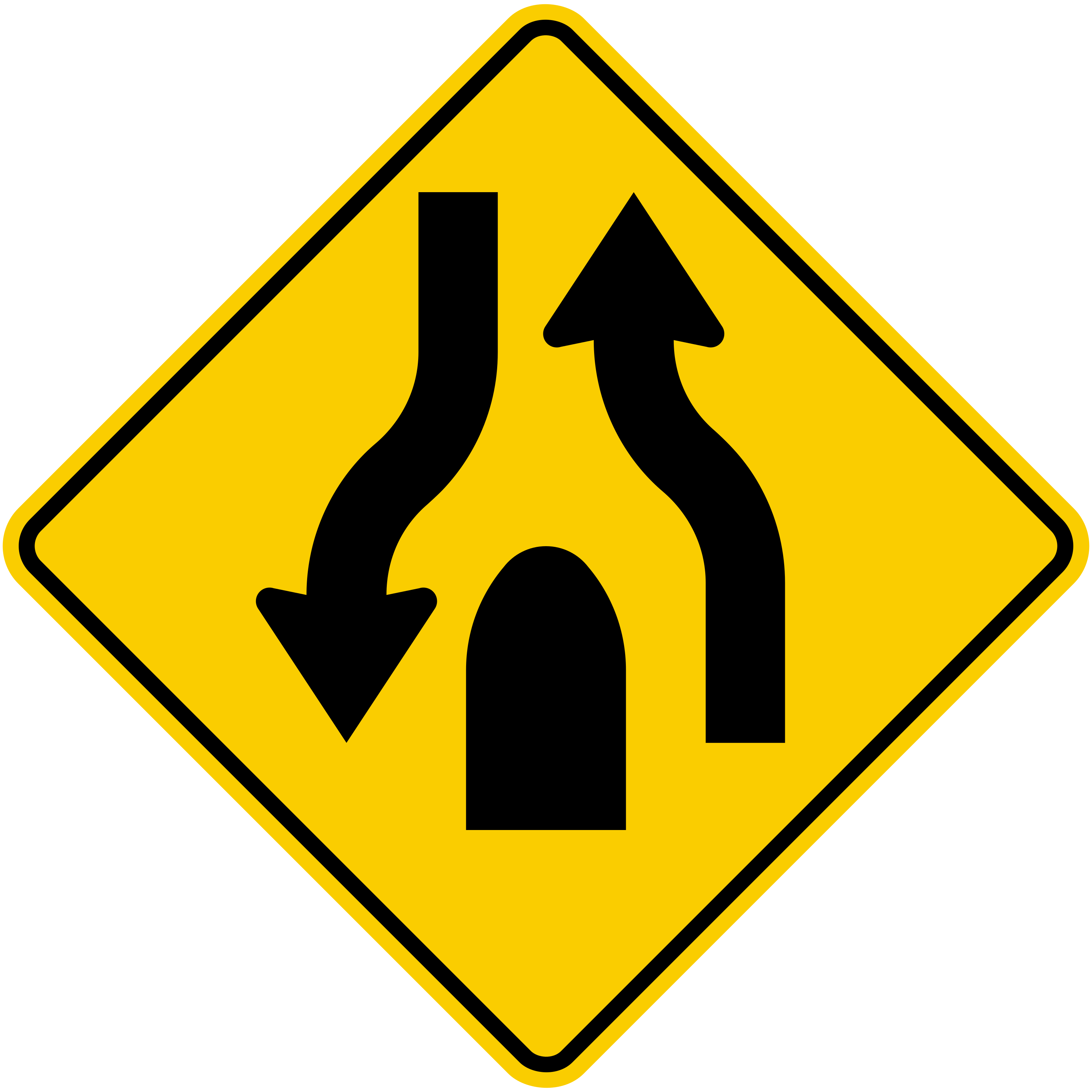
5. What does this traffic sign mean?
This traffic sign indicates a warning for the end of a divided road. The separation between opposing directions of traffic ends ahead, and oncoming traffic will no longer be divided by a central reservation. Reduce speed and adjust to the new road layout.
English • Traffic sign P-41b • Divided road ends. Physical separation between opposing traffic streams ends.
Español • P-41b • Fin de camino dividido. Advierte que termina la separación física entre los sentidos de circulación.
Sources
🔗 Commons.wikimedia.org
🔗 Gub.uy • MTOP, Norma Uruguaya de Señalización Vertical, PDF p. 100
🔗 Gub.uy • MTOP, significado, PDF p. 49
Replacement SVG: Commons.wikimedia.org • Wikimedia Commons original • Gobierno de Colombia • Public domain • Original revision 2017-09-14. Wikimedia original unmodified.
Image via Commons.wikimedia.org
Gobierno de Colombia • Public domain • Source revision 2017-09-14. Wikimedia original unmodified.

6. What does this traffic sign mean?
This traffic sign indicates that parking and stopping are prohibited. Vehicles may not stop or park voluntarily where the restriction applies, except where an applicable rule provides an exemption or stopping is required by traffic conditions.
English • Traffic sign R-6c • No parking or stopping. Parking and voluntary stopping are prohibited at the indicated location or section.
Español • R-6c • Prohibido estacionar y detenerse. Prohíbe tanto estacionar como detener voluntariamente el vehículo en el lugar o tramo indicado.
Sources
🔗 Commons.wikimedia.org
🔗 Gub.uy • MTOP, Norma Uruguaya de Señalización Vertical, PDF p. 86
🔗 Gub.uy • MTOP, significado, PDF p. 22
SVG source: Commons.wikimedia.org • Original SVG
Intendencia de Durazno • Public domain • Original revision 2025-07-09. Wikimedia original unmodified.
Artwork reviewed against the Uruguayan MTOP Norma Uruguaya de Señalización Vertical, currently published standard: Gub.uy • R-6c, PDF page 86. Intentional educational illustration update from the previous PNG; original SVG unmodified.
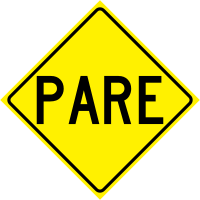
7. What does this traffic sign mean?
This traffic sign indicates stop and give way ahead. A stop sign applies at the location ahead. Reduce speed in good time and be prepared to come to a complete stop.
English • Traffic sign P-15 • Stop ahead. Prepare to stop. The standard requires a supplementary distance plate. The drawing shows only the main sign, so the distance cannot be determined.
Español • P-15 • Proximidad de señal Pare. Advierte que más adelante hay una señal Pare. Prepárate para detenerte. La norma exige una placa complementaria de distancia. El dibujo mostrado solo representa la señal principal y no permite conocer esa distancia.
Sources
🔗 Commons.wikimedia.org
🔗 Gub.uy • MTOP, Norma Uruguaya de Señalización Vertical, PDF p. 95
🔗 Gub.uy • MTOP, significado, PDF p. 40
SVG source: Commons.wikimedia.org • Original SVG
Intendencia de Durazno • Public domain • Original revision 2025-07-03. Wikimedia original unmodified.
Artwork reviewed against the Uruguayan MTOP Norma Uruguaya de Señalización Vertical, currently published standard: Gub.uy • P-15, PDF page 95. Intentional educational illustration update from the previous PNG; original SVG unmodified.

8. What does this traffic sign mean?
This traffic sign indicates that drivers may not enter the road from either direction.
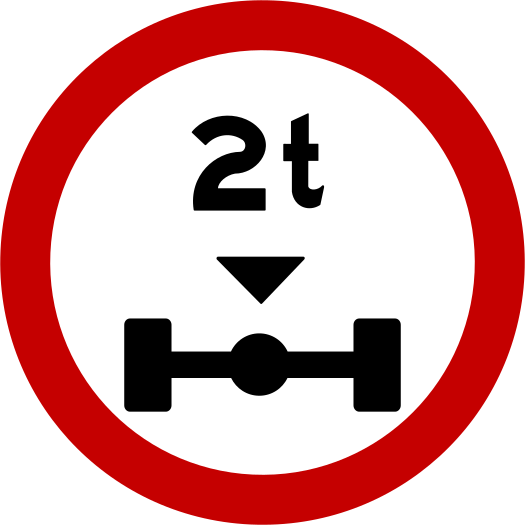
9. What does this traffic sign mean?
This traffic sign indicates that vehicles exceeding the indicated axle-load limit are prohibited. A vehicle whose load on an axle exceeds the displayed limit may not continue beyond the sign.
English • Traffic sign R-17 • Maximum axle load: 2 t. Vehicles exceeding 2 tonnes on an axle must not pass.
Español • R-17 • Peso máximo por eje: 2 t. Prohíbe el paso de vehículos cuya carga sobre un eje supere 2 toneladas.
Sources
🔗 Commons.wikimedia.org
🔗 Gub.uy • MTOP, Norma Uruguaya de Señalización Vertical, PDF p. 88
🔗 Gub.uy • MTOP, significado, PDF p. 25
Replacement SVG: Commons.wikimedia.org • Wikimedia Commons original • Amateria1121 • CC BY-SA 3.0 • Original revision 2014-04-09. Wikimedia original unmodified.
Image via Commons.wikimedia.org
Amateria1121 • CC BY-SA 3.0 • Source revision 2014-04-09. Wikimedia original unmodified.

10. What does this traffic sign mean?
This traffic sign indicates a warning for a playground. Children may be playing close to the road and may enter or cross it unexpectedly. Reduce speed, watch the roadside carefully and be prepared to stop.
English • Traffic sign P-33 • Children. Children may enter the carriageway. Reduce speed and take extra care.
Español • P-33 • Niños. Advierte un lugar donde pueden aparecer niños en la calzada. Reduce la velocidad y extrema la atención.
Sources
🔗 Commons.wikimedia.org
🔗 Gub.uy • MTOP, Norma Uruguaya de Señalización Vertical, PDF p. 99
🔗 Gub.uy • MTOP, significado, PDF p. 46
Image via Commons.wikimedia.org
Intendencia de Durazno • Public domain • Source revision 2014-03-12. Wikimedia original unmodified.

11. What does this traffic sign mean?
This traffic sign indicates a warning for a narrowing ahead. The available road width decreases ahead. Reduce speed when necessary and be prepared for less lateral space between vehicles, obstacles or the road edge.
English • Traffic sign P-22 • Narrow bridge. The bridge is narrower than the approach carriageway. Reduce speed before entering.
Español • P-22 • Puente angosto. Advierte un puente más estrecho que la calzada de acceso. Reduce la velocidad antes de entrar.
Sources
🔗 Commons.wikimedia.org
🔗 Gub.uy • MTOP, Norma Uruguaya de Señalización Vertical, PDF p. 97
🔗 Gub.uy • MTOP, significado, PDF p. 43
Image via Commons.wikimedia.org
Intendencia de Durazno • Public domain • Source revision 2014-03-12. Wikimedia original unmodified.
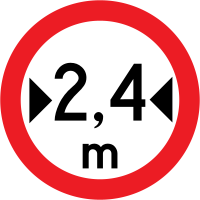
12. What does this traffic sign mean?
This traffic sign indicates that vehicles wider than indicated are prohibited. A vehicle or vehicle combination whose overall width, including its load, exceeds the displayed limit may not continue beyond the sign.
English • Traffic sign R-16 • Maximum width: 1.8 m. Vehicles wider than 1.8 m overall must not pass.
Español • R-16 • Ancho máximo: 1,8 m. Prohíbe el paso de vehículos cuyo ancho total supere 1,8 metros.
Sources
🔗 Commons.wikimedia.org
🔗 Gub.uy • MTOP, Norma Uruguaya de Señalización Vertical, PDF p. 88
🔗 Gub.uy • MTOP, significado, PDF p. 25
Image via Commons.wikimedia.org
Intendencia de Durazno • Public domain • Source revision 2025-07-14. Wikimedia original unmodified.
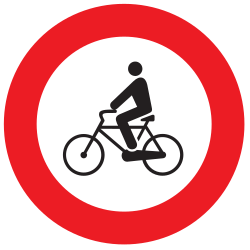
13. What does this traffic sign mean?
This traffic sign indicates a mandatory path for cyclists. Cyclists must use the designated path where the sign applies. Other road users may use the path only where the applicable signs or local rules permit them to do so.
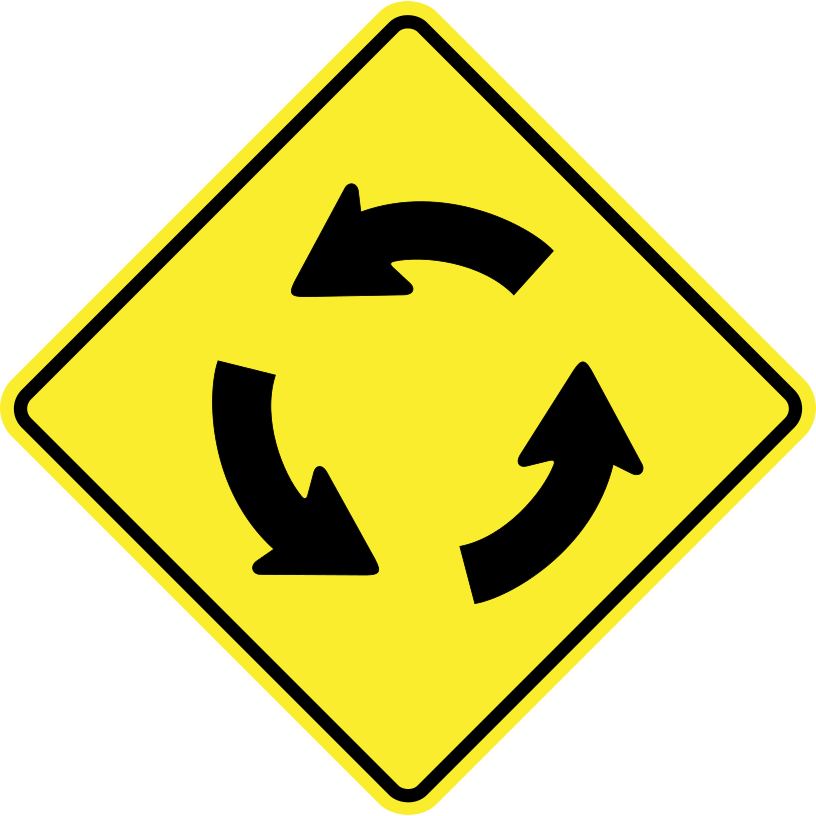
14. What does this traffic sign mean?
This traffic sign indicates a warning for a roundabout. A roundabout lies ahead. Reduce speed and follow the applicable priority signs, traffic signals and local roundabout rules when approaching and entering it.
English • Traffic sign P-12 • Roundabout. Warns of a junction with roundabout circulation.
Español • P-12 • Rotonda. Advierte la proximidad de una intersección con circulación en rotonda.
Sources
🔗 Commons.wikimedia.org
🔗 Gub.uy • MTOP, Norma Uruguaya de Señalización Vertical, PDF p. 95
🔗 Gub.uy • MTOP, significado, PDF p. 39
Replacement SVG: Commons.wikimedia.org • Wikimedia Commons original • Original: Vialidad Nacional - Ministerio de Transporte - Presidencia de la Nación Vectorization: Civitas13 • Public domain • Original revision 2022-08-06. Wikimedia original unmodified.
Image via Commons.wikimedia.org
Original: Vialidad Nacional - Ministerio de Transporte - Presidencia de la Nación Vectorization: Civitas13 • Public domain • Source revision 2022-08-06. Wikimedia original unmodified.

15. What does this traffic sign mean?
This traffic sign indicates a warning for an obstacle where you have to pass left or right. It alerts drivers to a fixed obstacle in the roadway—such as a traffic island, bollard, or construction zone—where vehicles are permitted to pass on either side.
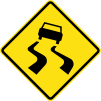
16. What does this traffic sign mean?
This traffic sign indicates a warning for a slippery road surface. The road ahead may provide reduced tyre grip because of water, ice, mud, oil or another surface condition. Reduce speed and avoid sudden braking, acceleration or steering movements.
English • Traffic sign P-27 • Slippery surface. Avoid harsh braking or steering changes.
Español • P-27 • Pavimento resbaladizo. Advierte una superficie que puede resultar resbaladiza. Evita frenadas y cambios de dirección bruscos.
Sources
🔗 Commons.wikimedia.org
🔗 Gub.uy • MTOP, Norma Uruguaya de Señalización Vertical, PDF p. 98
🔗 Gub.uy • MTOP, significado, PDF p. 45
Replacement SVG: Commons.wikimedia.org • Wikimedia Commons original • Gobierno de Chile • Public domain • Original revision 2012-12-11. Wikimedia original unmodified.
Image via Commons.wikimedia.org
Gobierno de Chile • Public domain • Source revision 2012-12-11. Wikimedia original unmodified.

17. What does this traffic sign mean?
This traffic sign indicates a warning for crossing deer. Deer or other wild animals may enter the road unexpectedly, especially around dawn or dusk. Reduce speed, watch the roadside carefully and be prepared for more than one animal to cross.
English • Traffic sign P-35 • Wild animals. Wild animals may be on the road.
Español • P-35 • Animales salvajes. Advierte la posible presencia de animales salvajes en la vía.
Sources
🔗 Commons.wikimedia.org
🔗 Gub.uy • MTOP, Norma Uruguaya de Señalización Vertical, PDF p. 99
🔗 Gub.uy • MTOP, significado, PDF p. 47
Image via Commons.wikimedia.org
Intendencia de Durazno • Public domain • Source revision 2014-03-12. Wikimedia original unmodified.

18. What does this traffic sign mean?
This traffic sign indicates a warning for falling rocks. Rocks or stones may fall from nearby slopes or may already be lying on the road. Reduce speed, scan the road ahead and be prepared to avoid or stop for fallen material.
English • Traffic sign P-26 • Falling rocks. Rocks and other material may fall onto the carriageway.
Español • P-26 • Desprendimientos. Advierte posibles desprendimientos de rocas y material sobre la calzada.
Sources
🔗 Commons.wikimedia.org
🔗 Gub.uy • MTOP, Norma Uruguaya de Señalización Vertical, PDF p. 98
🔗 Gub.uy • MTOP, significado, PDF p. 44
Image via Commons.wikimedia.org
Intendencia de Durazno • Public domain • Source revision 2014-03-12. Wikimedia original unmodified.
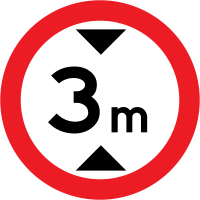
19. What does this traffic sign mean?
This traffic sign indicates that vehicles higher than indicated are prohibited. A vehicle or vehicle combination whose overall height, including its load, exceeds the displayed limit may not continue beyond the sign.
English • Traffic sign R-15 • Maximum height: 3 m. Vehicles exceeding 3 m overall height including the load must not pass.
Español • R-15 • Altura máxima: 3 m. Prohíbe el paso de vehículos cuya altura total, incluida la carga, supere 3 metros.
Sources
🔗 Commons.wikimedia.org
🔗 Gub.uy • MTOP, Norma Uruguaya de Señalización Vertical, PDF p. 87
🔗 Gub.uy • MTOP, significado, PDF p. 25
SVG source: Commons.wikimedia.org • Original SVG
Intendencia de Durazno • Public domain • Original revision 2025-07-14. Wikimedia original unmodified.
Artwork reviewed against the Uruguayan MTOP Norma Uruguaya de Señalización Vertical, currently published standard: Gub.uy • R-15, PDF page 87. Intentional educational illustration update from the previous PNG; original SVG unmodified.

20. What does this traffic sign mean?
This traffic sign indicates that turning around (making a U-turn) is prohibited. A U-turn may not be made where the prohibition applies. Other movements may still be permitted unless another restriction applies.
English • Traffic sign R-5 • No U-turns. Turning around to travel in the opposite direction is prohibited.
Español • R-5 • No dar vuelta en U. Prohíbe efectuar un giro de retorno para circular en sentido contrario.
Sources
🔗 Commons.wikimedia.org
🔗 Gub.uy • MTOP, Norma Uruguaya de Señalización Vertical, PDF p. 85
🔗 Gub.uy • MTOP, significado, PDF p. 21
SVG source: Commons.wikimedia.org • Original SVG
Intendencia de Durazno • Public domain • Original revision 2025-07-03. Wikimedia original unmodified.
Artwork reviewed against the Uruguayan MTOP Norma Uruguaya de Señalización Vertical, currently published standard: Gub.uy • R-5, PDF page 85. Intentional educational illustration update from the previous PNG; original SVG unmodified.

21. What does this traffic sign mean?
This traffic sign indicates a warning for roadworks. Construction or maintenance work is taking place on or beside the road. Reduce speed where necessary and be prepared for workers, machinery, temporary traffic signals, changed lane layouts or uneven road surfaces.
English • Traffic sign P-24 · family • Workers ahead. Warns of works, people or equipment on the road. Reduce speed and follow work-zone signs. The yellow drawing matches P-24 in the national 1999 catalogue and driving guide. For work-zone warning signs, Series 302 introduced in 2026 requires an orange background; this drawing does not reproduce that current colour.
Español • P-24 · familia • Hombres trabajando. Advierte trabajos y presencia de personas o equipos en la vía. Reduce la velocidad y sigue la señalización de la obra. El dibujo amarillo corresponde al P-24 del catálogo nacional de 1999 y de la guía de conducción. Para la señalización preventiva de obras, la Serie 302 incorporada en 2026 establece fondo naranja; este dibujo no reproduce ese color vigente.
Sources
🔗 Commons.wikimedia.org
🔗 Gub.uy • MTOP, Norma Uruguaya de Señalización Vertical, PDF p. 97
🔗 Gub.uy • MTOP, significado, PDF p. 44
🔗 Gub.uy • UNASEV, Guía nacional de conducción, PDF p. 127
🔗 Gub.uy • MTOP, Serie 302, señalización preventiva de obras, PDF p. 9
Image via Commons.wikimedia.org
Intendencia de Durazno • Public domain • Source revision 2014-03-12. Wikimedia original unmodified.
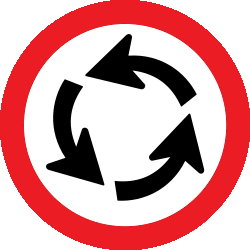
22. What does this traffic sign mean?
This traffic sign indicates the mandatory direction around a roundabout. Traffic must circulate in the direction shown by the arrows. The sign does not itself determine priority; follow the applicable priority signs, traffic signals and local rules.
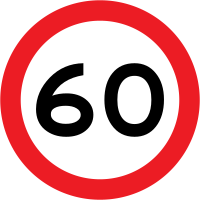
23. What does this traffic sign mean?
This traffic sign indicates the start of a speed limit. The displayed value is the maximum permitted speed from this point. The limit remains in force until it ends or is replaced according to the applicable traffic signs and local rules.
English • Traffic sign R-19 • Maximum speed: 60 km/h. Do not exceed 60 km/h. Reduce speed further when conditions require.
Español • R-19 • Velocidad máxima: 60 km/h. No superes los 60 kilómetros por hora. Reduce más la velocidad cuando las condiciones lo exijan.
Sources
🔗 Commons.wikimedia.org
🔗 Gub.uy • MTOP, Norma Uruguaya de Señalización Vertical, PDF p. 88
🔗 Gub.uy • MTOP, significado, PDF p. 26
🔗 Gub.uy • UNASEV, Guía nacional de conducción, PDF p. 125
SVG source: Commons.wikimedia.org • Original SVG
Intendencia de Durazno • Public domain • Original revision 2025-07-03. Wikimedia original unmodified.
Artwork reviewed against the Uruguayan MTOP Norma Uruguaya de Señalización Vertical, currently published standard: Gub.uy • R-19, PDF page 88. Intentional educational illustration update from the previous PNG; original SVG unmodified.
Exact 60 km/h illustration also reviewed against Gub.uy • UNASEV Guía nacional de conducción, PDF page 125.

24. What does this traffic sign mean?
This traffic sign indicates a warning for a width restriction. The available passage ahead is limited in width. Drivers of wide vehicles should check their vehicle width and use another route if the vehicle cannot pass safely.
English • Traffic sign P-37 • Width limit: 3 m. Warns of a passage with clearance limited to 3 m. Check total vehicle width.
Español • P-37 • Ancho limitado: 3 m. Advierte un paso con ancho libre limitado a 3 metros. Comprueba el ancho total del vehículo.
Sources
🔗 Commons.wikimedia.org
🔗 Gub.uy • MTOP, Norma Uruguaya de Señalización Vertical, PDF p. 100
🔗 Gub.uy • MTOP, significado, PDF p. 48
Image via Commons.wikimedia.org
Intendencia de Durazno • Public domain • Source revision 2014-03-12. Wikimedia original unmodified.

25. What does this traffic sign mean?
This traffic sign means no entry. Drivers may not enter from the direction in which the sign is placed.
English • Traffic sign UNASEV · annex • Wrong way. Do not enter from this side because traffic travels in the opposite direction.
Español • UNASEV · anexo • Contramano. Prohíbe entrar desde este lado de la vía porque el sentido de circulación es contrario al de tu aproximación.
Sources
🔗 Commons.wikimedia.org
🔗 Gub.uy • UNASEV, Guía nacional de conducción, PDF p. 125
Image via Commons.wikimedia.org
Intendencia de Durazno • Public domain • Source revision 2025-07-03. Wikimedia original unmodified.

26. What does this traffic sign mean?
This traffic sign indicates that parking is permitted. Vehicles may park in the area covered by the sign, subject to any conditions shown on supplementary signs or road markings.
English • Traffic sign R-6b • Regulated parking. Parking is permitted under the local conditions. Check supplementary hours and other information.
Español • R-6b • Estacionamiento reglamentado. Permite estacionar bajo las condiciones establecidas para ese lugar. Comprueba los horarios y otras indicaciones complementarias.
Sources
🔗 Commons.wikimedia.org
🔗 Gub.uy • MTOP, Norma Uruguaya de Señalización Vertical, PDF p. 86
🔗 Gub.uy • MTOP, significado, PDF p. 22
SVG source: Commons.wikimedia.org • Original SVG
Intendencia de Durazno • Public domain • Original revision 2025-07-09. Wikimedia original unmodified.
Artwork reviewed against the Uruguayan MTOP Norma Uruguaya de Señalización Vertical, currently published standard: Gub.uy • R-6b, PDF page 86. Intentional educational illustration update from the previous PNG; original SVG unmodified.

27. What does this traffic sign mean?
This traffic sign indicates a warning for a dip in the road. A sudden depression in the road surface lies ahead and may affect vehicle stability or visibility. Reduce speed before reaching the dip and be prepared for water or other hazards that may collect in the lowered section.
English • Traffic sign P-19 • Depression. Warns of a transverse depression in the carriageway. Reduce speed before crossing it.
Español • P-19 • Depresión. Advierte una depresión transversal de la calzada. Reduce la velocidad antes de atravesarla.
Sources
🔗 Commons.wikimedia.org
🔗 Gub.uy • MTOP, Norma Uruguaya de Señalización Vertical, PDF p. 96
🔗 Gub.uy • MTOP, significado, PDF p. 41
Replacement SVG: Commons.wikimedia.org • Wikimedia Commons original • Original: Vialidad Nacional - Ministerio de Transporte - Presidencia de la Nación Vectorization: Civitas13 • Public domain • Original revision 2020-01-14. Wikimedia original unmodified.
Image via Commons.wikimedia.org
Original: Vialidad Nacional - Ministerio de Transporte - Presidencia de la Nación Vectorization: Civitas13 • Public domain • Source revision 2020-01-14. Wikimedia original unmodified.
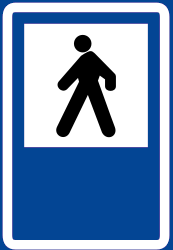
28. What does this traffic sign mean?
This traffic sign indicates a crossing for pedestrians. It marks a designated place where pedestrians cross the road. Priority and crossing rules depend on the applicable traffic signs, signals and local regulations.

29. What does this traffic sign mean?
This traffic sign indicates a warning for a bad or uneven road surface. Potholes, bumps, depressions or other surface irregularities may affect vehicle stability and braking. Reduce speed and avoid sudden manoeuvres.
English • Traffic sign P-17 • Rough road. Warns of repeated surface irregularities. Reduce speed.
Español • P-17 • Camino áspero. Advierte irregularidades repetidas en la superficie de la calzada. Reduce la velocidad.
Sources
🔗 Commons.wikimedia.org
🔗 Gub.uy • MTOP, Norma Uruguaya de Señalización Vertical, PDF p. 96
🔗 Gub.uy • MTOP, significado, PDF p. 41
Image via Commons.wikimedia.org
Intendencia de Durazno • Public domain • Source revision 2014-03-12. Wikimedia original unmodified.

30. What does this traffic sign mean?
This traffic sign indicates that parking is allowed. Vehicles may be parked in the area covered by the sign subject to any indicated conditions, restrictions or local parking rules.
English • Traffic sign I-12 • Parking. Marks a parking place; the arrow shows its direction.
Español • I-12 • Estacionamiento. Indica la ubicación de un lugar destinado al estacionamiento; la flecha señala su dirección.
Sources
🔗 Commons.wikimedia.org
🔗 Gub.uy • MTOP, Norma Uruguaya de Señalización Vertical, PDF p. 109
🔗 Gub.uy • MTOP, significado, PDF p. 56
SVG source: Commons.wikimedia.org • Original SVG
Intendencia de Durazno • Public domain • Original revision 2014-04-09. Wikimedia original unmodified.
Artwork reviewed against the Uruguayan MTOP Norma Uruguaya de Señalización Vertical, currently published standard: Gub.uy • I-12, PDF page 109. Intentional educational illustration update from the previous PNG; original SVG unmodified.

31. What does this traffic sign mean?
This traffic sign indicates a warning for a steep descent. A steep downhill gradient lies ahead and the vehicle may gain speed quickly. Reduce speed before the descent, select a suitable gear and use engine braking where appropriate. Allow extra distance for heavy or towing vehicles.
English • Traffic sign P-20a • Steep descent. Control speed and use a suitable gear. The standard requires a supplementary plate showing the affected length; the drawing omits it.
Español • P-20a • Pendiente descendente. Advierte una bajada pronunciada. Controla la velocidad y utiliza una marcha adecuada. La norma exige una placa complementaria con la longitud del tramo afectado. El dibujo mostrado no incluye esa placa.
Sources
🔗 Commons.wikimedia.org
🔗 Gub.uy • MTOP, Norma Uruguaya de Señalización Vertical, PDF p. 96
🔗 Gub.uy • MTOP, significado, PDF p. 42
Image via Commons.wikimedia.org
Intendencia de Durazno • Public domain • Source revision 2014-03-12. Wikimedia original unmodified.
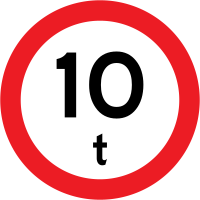
32. What does this traffic sign mean?
This traffic sign indicates that vehicles heavier than indicated are prohibited. Vehicles or vehicle combinations exceeding the displayed mass limit may not continue beyond the sign. The legally relevant mass is determined by the applicable local rules.
English • Traffic sign R-14 • Maximum mass: 10 t. Vehicles exceeding 10 tonnes total mass must not pass.
Español • R-14 • Peso máximo: 10 t. Prohíbe el paso de vehículos cuyo peso total supere 10 toneladas.
Sources
🔗 Commons.wikimedia.org
🔗 Gub.uy • MTOP, Norma Uruguaya de Señalización Vertical, PDF p. 87
🔗 Gub.uy • MTOP, significado, PDF p. 25
SVG source: Commons.wikimedia.org • Original SVG
Intendencia de Durazno • Public domain • Original revision 2025-07-03. Wikimedia original unmodified.
Artwork reviewed against the Uruguayan MTOP Norma Uruguaya de Señalización Vertical, currently published standard: Gub.uy • R-14, PDF page 87. Intentional educational illustration update from the previous PNG; original SVG unmodified.
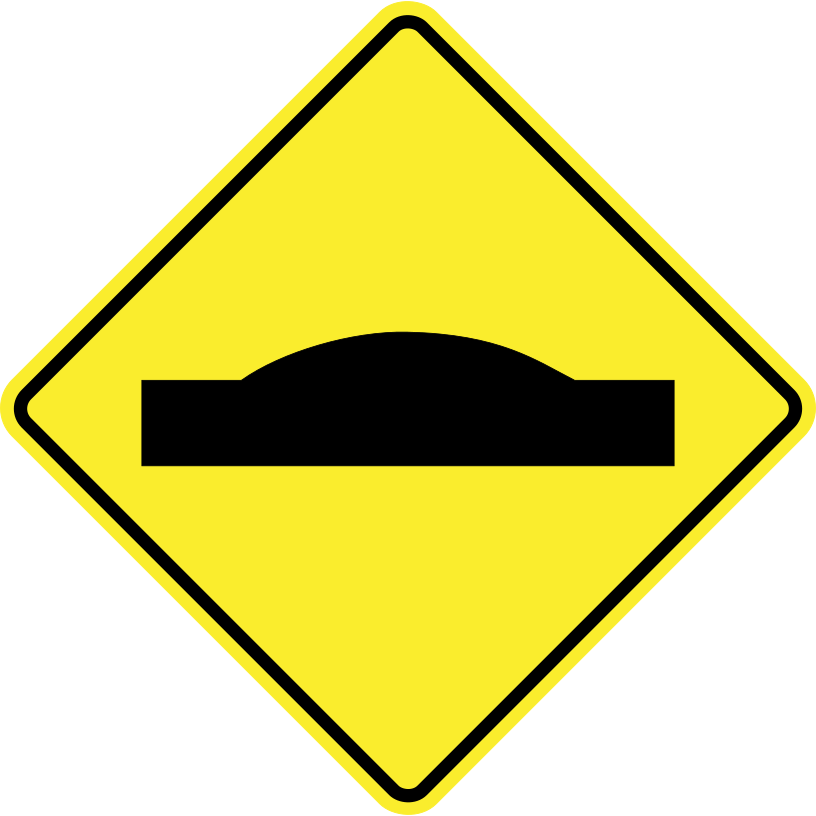
33. What does this traffic sign mean?
This traffic sign indicates a warning for a speed bump. A raised traffic-calming feature lies ahead. Reduce speed before reaching it to maintain vehicle control and avoid damage or discomfort.
English • Traffic sign P-18 • Road hump. Warns of a transverse rise in the carriageway. Reduce speed before crossing it.
Español • P-18 • Resalto. Advierte una elevación transversal de la calzada. Reduce la velocidad antes de pasar sobre ella.
Sources
🔗 Commons.wikimedia.org
🔗 Gub.uy • MTOP, Norma Uruguaya de Señalización Vertical, PDF p. 96
🔗 Gub.uy • MTOP, significado, PDF p. 41
Replacement SVG: Commons.wikimedia.org • Wikimedia Commons original • Original: Vialidad Nacional - Ministerio de Transporte - Presidencia de la Nación Vectorization: Civitas13 • Public domain • Original revision 2020-01-14. Wikimedia original unmodified.
Image via Commons.wikimedia.org
Original: Vialidad Nacional - Ministerio de Transporte - Presidencia de la Nación Vectorization: Civitas13 • Public domain • Source revision 2020-01-14. Wikimedia original unmodified.
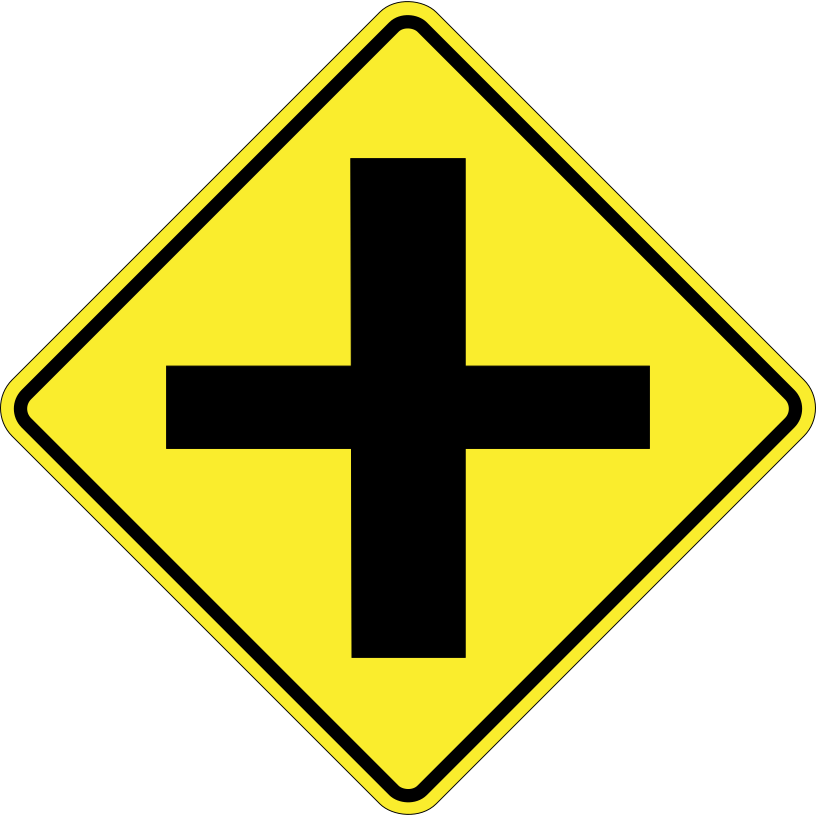
34. What does this traffic sign mean?
This traffic sign indicates a warning for an uncontrolled crossroad. An intersection without traffic signals or signs assigning priority lies ahead. Reduce speed, watch for traffic approaching from other directions and follow the applicable local priority rules.
English • Traffic sign P-6 • Crossroads. Warns of a four-arm junction. Reduce speed and check crossing traffic.
Español • P-6 • Cruce de caminos. Advierte una intersección de cuatro ramales. Reduce la velocidad y comprueba el tránsito transversal.
Sources
🔗 Commons.wikimedia.org
🔗 Gub.uy • MTOP, Norma Uruguaya de Señalización Vertical, PDF p. 93
🔗 Gub.uy • MTOP, significado, PDF p. 38
Replacement SVG: Commons.wikimedia.org • Wikimedia Commons original • Original: Vialidad Nacional - Ministerio de Transporte - Presidencia de la Nación Vectorization: Civitas13 • Public domain • Original revision 2020-01-14. Wikimedia original unmodified.
Image via Commons.wikimedia.org
Original: Vialidad Nacional - Ministerio de Transporte - Presidencia de la Nación Vectorization: Civitas13 • Public domain • Source revision 2020-01-14. Wikimedia original unmodified.
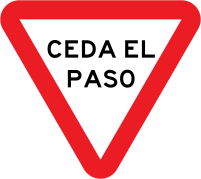
35. What does this traffic sign mean?
This traffic sign means give way. Slow down and give way to traffic that has priority. Stop if necessary and proceed only when it is safe.
English • Traffic sign R-2 • Give way. Give priority to vehicles on the priority road; stop if necessary.
Español • R-2 • Ceda el paso. Cede el paso a los vehículos que circulan por la vía preferente; detente si es necesario.
Sources
🔗 Commons.wikimedia.org
🔗 Gub.uy • MTOP, Norma Uruguaya de Señalización Vertical, PDF p. 85
🔗 Gub.uy • MTOP, significado, PDF p. 20
SVG source: Commons.wikimedia.org • Original SVG
Intendencia de Durazno • Public domain • Original revision 2025-07-03. Wikimedia original unmodified.
Artwork reviewed against the Uruguayan MTOP Norma Uruguaya de Señalización Vertical, currently published standard: Gub.uy • R-2, PDF page 85. Intentional educational illustration update from the previous PNG; original SVG unmodified.

36. What does this traffic sign mean?
This traffic sign indicates that parking is prohibited. Vehicles may not be parked in the area covered by the sign unless an exception applies. Brief stopping to pick up or drop off passengers or to load or unload goods may still be permitted where local rules allow it.
English • Traffic sign R-6a • No parking. Parking is prohibited at the indicated location or section.
Español • R-6a • Prohibido estacionar. Prohíbe estacionar en el lugar o tramo indicado.
Sources
🔗 Commons.wikimedia.org
🔗 Gub.uy • MTOP, Norma Uruguaya de Señalización Vertical, PDF p. 86
🔗 Gub.uy • MTOP, significado, PDF p. 22
SVG source: Commons.wikimedia.org • Original SVG
Intendencia de Durazno • Public domain • Original revision 2025-07-09. Wikimedia original unmodified.
Artwork reviewed against the Uruguayan MTOP Norma Uruguaya de Señalización Vertical, currently published standard: Gub.uy • R-6a, PDF page 86. Intentional educational illustration update from the previous PNG; original SVG unmodified.
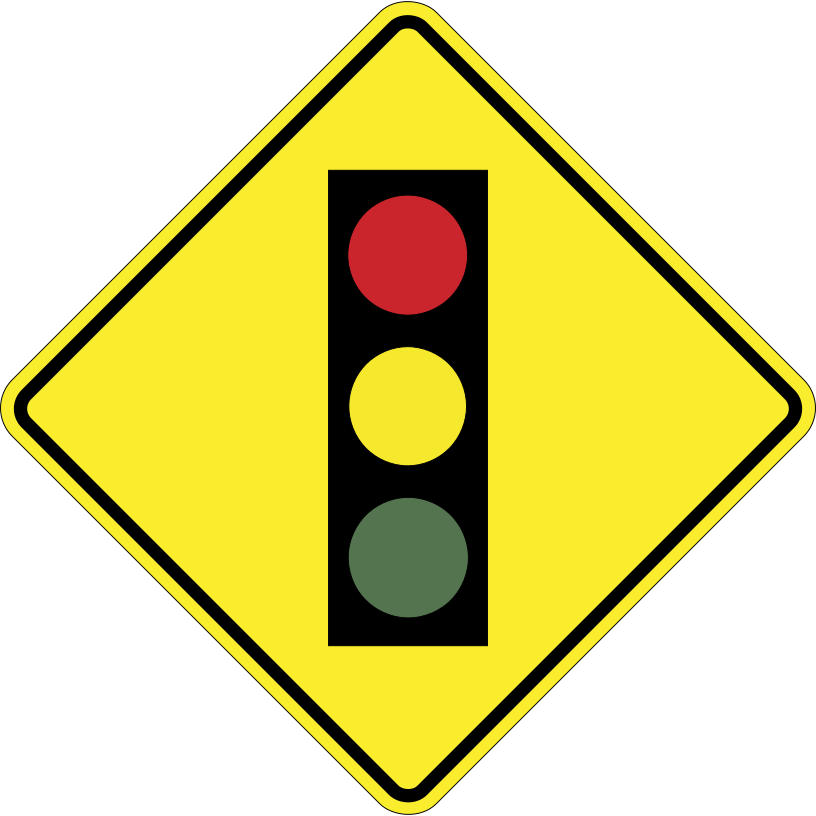
37. What does this traffic sign mean?
This traffic sign indicates a warning for traffic lights ahead. Traffic signals are located ahead and may not be visible early enough without advance warning. Reduce speed and be prepared to stop if the signal requires it.
English • Traffic sign P-14 • Traffic signals ahead. Warns of a signal-controlled junction. Be ready to obey the signals.
Español • P-14 • Proximidad de semáforo. Advierte una intersección regulada por semáforos. Prepárate para obedecer sus indicaciones.
Sources
🔗 Commons.wikimedia.org
🔗 Gub.uy • MTOP, Norma Uruguaya de Señalización Vertical, PDF p. 95
🔗 Gub.uy • MTOP, significado, PDF p. 40
🔗 Gub.uy • UNASEV, Guía nacional de conducción, PDF p. 126
Replacement SVG: Commons.wikimedia.org • Wikimedia Commons original • Original: Vialidad Nacional - Ministerio de Transporte - Presidencia de la Nación Vectorization: Civitas13 • Public domain • Original revision 2020-01-14. Wikimedia original unmodified.
Image via Commons.wikimedia.org
Original: Vialidad Nacional - Ministerio de Transporte - Presidencia de la Nación Vectorization: Civitas13 • Public domain • Source revision 2020-01-14. Wikimedia original unmodified.

38. What does this traffic sign mean?
This traffic sign indicates that trucks are prohibited. Trucks covered by the sign may not enter or continue beyond it. Any applicable weight threshold or vehicle-category limitation is determined by the sign, supplementary information and local rules.
English • Traffic sign R-9 • No lorries. Lorries are prohibited on the signed section.
Español • R-9 • No camiones. Prohíbe el tránsito de camiones en el tramo señalado.
Sources
🔗 Commons.wikimedia.org
🔗 Gub.uy • MTOP, Norma Uruguaya de Señalización Vertical, PDF p. 86
🔗 Gub.uy • MTOP, significado, PDF p. 23
Image via Commons.wikimedia.org
Intendencia de Durazno • Public domain • Source revision 2014-03-12. Wikimedia original unmodified.
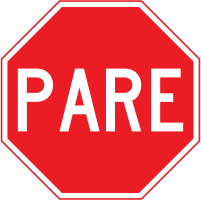
39. What does this traffic sign mean?
This traffic sign means stop and give way. You must come to a complete stop before entering the intersection and give way to traffic that has priority. Proceed only when it is safe.
English • Traffic sign R-1 • Stop. Stop completely before entering the junction and give way before continuing.
Español • R-1 • Pare. Detén completamente el vehículo antes de entrar en la intersección y cede el paso antes de continuar.
Sources
🔗 Commons.wikimedia.org
🔗 Gub.uy • MTOP, Norma Uruguaya de Señalización Vertical, PDF p. 85
🔗 Gub.uy • MTOP, significado, PDF p. 19
SVG source: Commons.wikimedia.org • Original SVG
Intendencia de Durazno • Public domain • Original revision 2025-07-03. Wikimedia original unmodified.
Artwork reviewed against the Uruguayan MTOP Norma Uruguaya de Señalización Vertical, currently published standard: Gub.uy • R-1, PDF page 85. Intentional educational illustration update from the previous PNG; original SVG unmodified.

40. What does this traffic sign mean?
This traffic sign indicates a warning for a railway crossing without barriers. It alerts drivers to an upcoming level crossing where railway tracks cross the road and no barriers or gates are present to stop traffic. Drivers should slow down and look both ways for trains.
English • Traffic sign P-38 • Level crossing without barriers. Reduce speed, check both directions and do not cross if a train approaches.
Español • P-38 • Paso a nivel sin barreras. Advierte un cruce ferroviario sin barreras. Reduce la velocidad, comprueba ambas direcciones y no cruces si se aproxima un tren.
Sources
🔗 Commons.wikimedia.org
🔗 Gub.uy • MTOP, Norma Uruguaya de Señalización Vertical, PDF p. 100
🔗 Gub.uy • MTOP, significado, PDF p. 48
Image via Commons.wikimedia.org
Intendencia de Durazno • Public domain • Source revision 2014-03-12. Wikimedia original unmodified.

41. What does this traffic sign mean?
This traffic sign indicates a checkpoint with restricted entry. Road users may not proceed beyond the checkpoint unless they are authorised or permitted to continue according to the applicable rules and instructions.
English • Traffic sign R-21 • Customs or checkpoint. Stop at the indicated customs, inspection or other checkpoint before continuing.
Español • R-21 • Aduana o puesto de control. Exige detenerse en el puesto de aduana, fiscalización u otro control señalado antes de continuar.
Sources
🔗 Commons.wikimedia.org
🔗 Gub.uy • MTOP, Norma Uruguaya de Señalización Vertical, PDF p. 88
🔗 Gub.uy • MTOP, significado, PDF p. 26
SVG source: Commons.wikimedia.org • Original SVG
Intendencia de Durazno • Public domain • Original revision 2025-07-03. Wikimedia original unmodified.
Artwork reviewed against the Uruguayan MTOP Norma Uruguaya de Señalización Vertical, currently published standard: Gub.uy • R-21, PDF page 88. Intentional educational illustration update from the previous PNG; original SVG unmodified.

42. What does this traffic sign mean?
This traffic sign indicates a warning for a road narrowing on the right. The available road width decreases from the right side ahead. Reduce speed, follow the lane markings and maintain sufficient clearance from other traffic and the road edge.
English • Traffic sign P-21b • Road narrows on the right. The right edge moves inward, reducing available width.
Español • P-21b • Estrechamiento por la derecha. Advierte que el borde derecho de la calzada se aproxima y disminuye el ancho disponible.
Sources
🔗 Commons.wikimedia.org
🔗 Gub.uy • MTOP, Norma Uruguaya de Señalización Vertical, PDF p. 97
🔗 Gub.uy • MTOP, significado, PDF p. 42
Image via Commons.wikimedia.org
Intendencia de Durazno • Public domain • Source revision 2014-03-12. Wikimedia original unmodified.

43. What does this traffic sign mean?
This traffic sign indicates a warning for a railway crossing with one track. It alerts drivers to a level crossing where a single railway track crosses the road. Drivers should approach with caution and be prepared to stop, even if no barriers or warning lights are active.
English • Traffic sign P-40 • Crossbuck. Marks a railway level crossing. Give way to trains and check that you can cross safely.
Español • P-40 • Cruz de San Andrés. Señala la ubicación de un cruce ferroviario a nivel. Cede el paso a los trenes y comprueba que puedes cruzar con seguridad.
Sources
🔗 Commons.wikimedia.org
🔗 Gub.uy • MTOP, Norma Uruguaya de Señalización Vertical, PDF p. 100
🔗 Gub.uy • MTOP, significado, PDF p. 48
SVG source: Commons.wikimedia.org • Original SVG
Intendencia de Durazno • Public domain • Original revision 2018-04-10. Wikimedia original unmodified.
Artwork reviewed against the Uruguayan MTOP Norma Uruguaya de Señalización Vertical, currently published standard: Gub.uy • P-40, PDF page 100. Intentional educational illustration update from the previous PNG; original SVG unmodified.
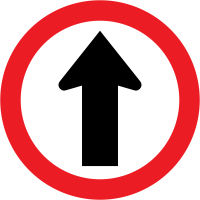
44. What does this traffic sign mean?
This traffic sign indicates that driving straight ahead is mandatory. Traffic must continue straight ahead and may not turn left or right at the location to which the sign applies.
English • Traffic sign R-26 • Straight ahead. Continue straight ahead at the indicated location.
Español • R-26 • Siga de frente. Obliga a continuar de frente en el lugar señalado.
Sources
🔗 Commons.wikimedia.org
🔗 Gub.uy • MTOP, Norma Uruguaya de Señalización Vertical, PDF p. 89
🔗 Gub.uy • MTOP, significado, PDF p. 30
SVG source: Commons.wikimedia.org • Original SVG
Intendencia de Durazno • Public domain • Original revision 2025-07-09. Wikimedia original unmodified.
Artwork reviewed against the Uruguayan MTOP Norma Uruguaya de Señalización Vertical, currently published standard: Gub.uy • R-26, PDF page 89. Intentional educational illustration update from the previous PNG; original SVG unmodified.

45. What does this traffic sign mean?
This traffic sign indicates a warning for a road narrowing. The available width of the road or carriageway decreases ahead. Reduce speed, maintain sufficient lateral clearance and watch carefully for approaching or adjacent traffic.
English • Traffic sign P-21a • Road narrows. The carriageway narrows on both sides. Reduce speed and maintain a safe clearance.
Español • P-21a • Estrechamiento de calzada. Advierte que la calzada se estrecha por ambos lados. Reduce la velocidad y conserva una separación segura.
Sources
🔗 Commons.wikimedia.org
🔗 Gub.uy • MTOP, Norma Uruguaya de Señalización Vertical, PDF p. 97
🔗 Gub.uy • MTOP, significado, PDF p. 42
Image via Commons.wikimedia.org
Intendencia de Durazno • Public domain • Source revision 2014-03-12. Wikimedia original unmodified.

46. What does this traffic sign mean?
This traffic sign indicates a warning for a divided road. The road ahead separates into carriageways for opposing directions of traffic, usually divided by a central reservation or traffic island. Follow the lane markings and adjust your position to the new road layout.
English • Traffic sign P-41a • Divided road begins. Physical separation between opposing traffic streams begins.
Español • P-41a • Comienzo de camino dividido. Advierte el comienzo de una separación física entre los sentidos de circulación.
Sources
🔗 Commons.wikimedia.org
🔗 Gub.uy • MTOP, Norma Uruguaya de Señalización Vertical, PDF p. 100
🔗 Gub.uy • MTOP, significado, PDF p. 48
Replacement SVG: Commons.wikimedia.org • Wikimedia Commons original • Departamento Nacional de Infraestrutura de Transportes • Public domain • Original revision 2014-01-17. Wikimedia original unmodified.
Image via Commons.wikimedia.org
Departamento Nacional de Infraestrutura de Transportes • Public domain • Source revision 2014-01-17. Wikimedia original unmodified.

47. What does this traffic sign mean?
This traffic sign indicates that pedestrians are prohibited. Pedestrians may not enter or continue beyond the sign. Other road users may still be permitted unless another restriction applies.
English • Traffic sign R-29 • No pedestrians. Pedestrian traffic is prohibited on the signed section.
Español • R-29 • No peatones. Prohíbe el tránsito de peatones en el tramo señalado.
Sources
🔗 Commons.wikimedia.org
🔗 Gub.uy • MTOP, Norma Uruguaya de Señalización Vertical, PDF p. 90
🔗 Gub.uy • MTOP, significado, PDF p. 31
Image via Commons.wikimedia.org
Intendencia de Durazno • Public domain • Source revision 2014-03-12. Wikimedia original unmodified.

48. What does this traffic sign mean?
This traffic sign warns of a hairpin bend to the right. The road ahead makes a very sharp turn, so reduce speed and be prepared to steer sharply to the right.

49. What does this traffic sign mean?
This traffic sign indicates a warning for cyclists. Cyclists may be riding along or crossing the road ahead. Reduce speed, watch carefully for cyclists and maintain the passing distance required by the applicable local rules.
English • Traffic sign P-29 • Cyclists. Cyclists may be on the road. Maintain a safe clearance.
Español • P-29 • Ciclistas. Advierte la posible presencia de ciclistas en la vía. Mantén una separación segura.
Sources
🔗 Commons.wikimedia.org
🔗 Gub.uy • MTOP, Norma Uruguaya de Señalización Vertical, PDF p. 98
🔗 Gub.uy • MTOP, significado, PDF p. 45
🔗 Gub.uy • UNASEV, Guía nacional de conducción, PDF p. 127
Image via Commons.wikimedia.org
Intendencia de Durazno • Public domain • Source revision 2014-03-12. Wikimedia original unmodified.
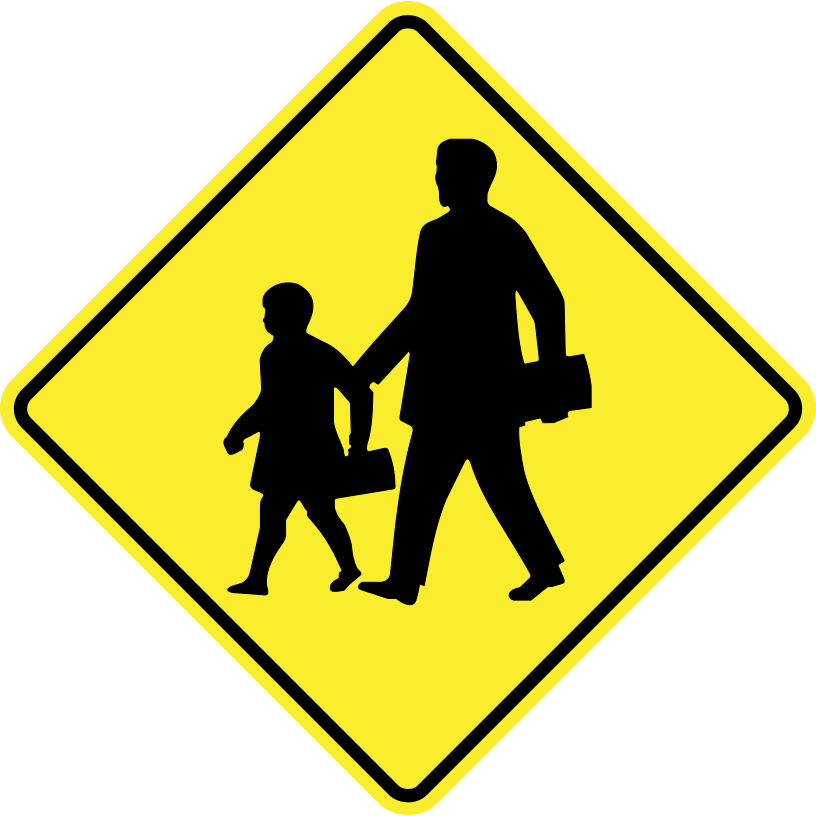
50. What does this traffic sign mean?
This traffic sign indicates a warning for children. Children may be present on or near the road and may cross unexpectedly. Reduce speed, scan both sides of the road carefully and be prepared to stop.
English • Traffic sign P-32 • Schoolchildren. Warns of a school area and possible pupil crossings.
Español • P-32 • Escolares. Advierte la proximidad de una zona escolar y posibles cruces de escolares.
Sources
🔗 Commons.wikimedia.org
🔗 Gub.uy • MTOP, Norma Uruguaya de Señalización Vertical, PDF p. 99
🔗 Gub.uy • MTOP, significado, PDF p. 46
Replacement SVG: Commons.wikimedia.org • Wikimedia Commons original • Original: Vialidad Nacional - Ministerio de Transporte - Presidencia de la Nación Vectorization: Civitas13 • Public domain • Original revision 2020-01-14. Wikimedia original unmodified.
Image via Commons.wikimedia.org
Original: Vialidad Nacional - Ministerio de Transporte - Presidencia de la Nación Vectorization: Civitas13 • Public domain • Source revision 2020-01-14. Wikimedia original unmodified.