


Traffic signsWorldwide
 Traffic rules
 Worldwide
51. Width limit
A width limit prohibits vehicles or vehicle combinations whose total width exceeds the value shown from entering or passing a road section, bridge, tunnel, gateway or other narrow passage. The width includes the vehicle’s load and any equipment or objects extending from its sides.
Drivers must know the maximum travelling width of their vehicle and load, observe advance warnings and use an alternative route when necessary. They should never enter when sufficient lateral clearance is uncertain.
Wikimedia.org • Marc Mongenet • CC BY-SA
What does a width-limit sign mean?
It prohibits vehicles or vehicle combinations whose total width exceeds the displayed value from continuing beyond the sign.
 Vehicles wider than indicated prohibited.
How can you recognise a width-limit sign?
It is commonly a circular regulatory sign showing a width in metres, feet or another local unit between horizontal arrowheads.
What is included in the vehicle’s total width?
Check the local measurement rules for the restriction. Allow for the vehicle, its load and any projecting equipment, and do not assume that the body width shown in a brochure is the relevant overall width. Whether particular fittings are counted can depend on national law and the sign concerned.
Does the sign change priority?
No. Traffic lights, priority signs and the ordinary priority rules remain applicable.
What should you do when your vehicle is too wide?
Do not continue. Stop where safe and use the signed diversion or another suitable route.

52. Length limit
A length limit is a restriction that prohibits vehicles or vehicle combinations longer than a specified maximum length from entering a road or area. The stated length normally includes the complete vehicle combination and any load where national rules specify this.
Length restrictions are commonly used where long vehicles cannot safely negotiate narrow streets, tight bends, bridges, tunnels or other constrained road layouts. Drivers whose vehicle exceeds the indicated limit must use another permitted route.
Wikimedia.org • Kleeblatt187 • CC BY-SA
What does a vehicle length limit mean?
A length limit indicates the maximum vehicle or vehicle-combination length permitted beyond the restriction. Vehicles exceeding the displayed value may not proceed.
Why are vehicle length limits used?
They are used where long vehicles could have difficulty negotiating the road safely, such as on narrow streets, tight bends, constrained junctions or other locations with limited manoeuvring space.
53. Weight limit
A weight limit prohibits vehicles or vehicle combinations whose mass exceeds the value shown from entering or passing a road section, bridge, tunnel or other structure. Depending on local law, the restriction may concern the vehicle’s actual loaded mass, maximum authorised mass or load on an individual axle.
Drivers must know which type of mass the sign refers to and must include the vehicle, passengers, cargo and any trailer where required. A vehicle that exceeds the limit must use another suitable route.
Wikimedia.org • Bybbisch94 • CC BY
What does a weight-limit sign mean?
It prohibits vehicles or vehicle combinations whose relevant mass exceeds the value displayed on the sign.
 Vehicles heavier than indicated prohibited.
How can you recognise a weight-limit sign?
It is commonly a circular regulatory sign showing a mass in tonnes, kilograms or another local unit.
How can a driver determine the actual mass?
Use a suitable weighing facility to establish the vehicle’s current loaded mass, or axle loads where those are relevant. Check the vehicle documents for rated capacities and legal limits; those figures are not necessarily its actual mass on the journey.
Can a temporary weight limit apply?
Yes. Temporary restrictions may protect a damaged bridge, weakened road, roadworks structure or road affected by flooding or thawing.
Does the sign change priority?
No. Traffic lights, priority signs and ordinary priority rules remain applicable.
54. Radar speed sign
A radar speed sign warns drivers that vehicle speeds may be monitored by a fixed camera, mobile radar, lidar or average-speed enforcement system. It reminds drivers to check and respect the applicable speed limit.
The sign does not normally establish the speed limit itself. Drivers must follow the general, posted or variable speed limit applying to the road and must not brake suddenly merely because speed enforcement is indicated.
Wikimedia.org • Dalibor Z. Chvatal • CC BY
What does a radar speed sign mean?
It warns that vehicle speeds may be measured or enforced on the road ahead or throughout a specified section.
🔗 gov.uk • Great Britain Highway Code, Rules 124–126; national guidance example
Is a radar speed sign the same as a speed-limit sign?
No. A speed-limit sign establishes the maximum legal speed. A radar sign only warns that compliance with an applicable limit may be monitored.
🔗 gov.uk • Great Britain Highway Code, Rules 124–126; national guidance example
Where can the applicable speed limit be found?
Check the most recent speed-limit sign, variable sign, speed-zone sign or general limit applying to the road and vehicle category.
🔗 gov.uk • Great Britain Highway Code, Rules 124–126; national guidance example
Does the radar sign end the speed limit?
No. Passing a camera or radar sign does not end the applicable speed restriction.
🔗 gov.uk • Great Britain Highway Code, Rules 124–126; national guidance example
What should you do when you are already exceeding the limit?
Release the accelerator and reduce speed smoothly and safely. Do not brake harshly or make an abrupt lane change.
🔗 gov.uk • Great Britain Highway Code, Rules 124–126; national guidance example
55. Selective barriers
Selective barriers are physical access-control devices that allow certain road users or authorised vehicles to pass while restricting other traffic. They may include fixed, removable, folding or retractable bollards, gates, barriers and width-filtering installations.
The permitted users are determined by traffic signs, access conditions and local regulations, not by the barrier alone. Drivers should approach slowly, verify that they are authorised and wait until any moving barrier is fully open or retracted before continuing.
Wikimedia.org • EACC80 • CC BY
What is a selective barrier?
A selective barrier is a physical access-control device that blocks some traffic while allowing specified road users or authorised vehicles to pass.
🔗 manchester.gov.uk • Manchester City Council, using automatic bollards
May cyclists pass through a selective barrier?
Only when cycling is permitted and sufficient safe space is provided. Cyclists must follow the signs applying to the road or path.
🔗 content.tfl.gov.uk • Transport for London, access-control barriers and legal path status
What should you do when the barrier is moving?
Keep clear while a barrier is moving. Wait at a safe distance and follow the installation’s signals and instructions before passing. Moving gates can strike or trap people; do not try to squeeze through an opening or cross over a rising bollard.
🔗 hse.gov.uk • HSE, powered-gate risks
🔗 manchester.gov.uk • Manchester City Council, using automatic bollards
Does a selective barrier impose a speed limit?
Not by itself. Drivers must follow the applicable speed limit and approach slowly enough to stop before the installation.
Does it change priority?
No. Traffic lights, priority signs and ordinary priority rules remain applicable unless another traffic arrangement indicates otherwise.
56. Low-emission zone
A low-emission zone, or LEZ, is a defined area where access by more polluting vehicles is restricted in order to reduce traffic-related air pollution. Vehicles that do not satisfy the required emission criteria may be prohibited from entering or may require a temporary permit, exemption or day pass.
Access rules commonly depend on factors such as the vehicle category, fuel type and Euro emission standard. Low-emission-zone requirements vary between countries and cities, so drivers should check the applicable rules before entering the zone.
Wikimedia.org • David Hawgood • CC BY-SA
What is a low-emission zone?
A low-emission zone is an area where access by more polluting vehicles is restricted in order to improve air quality.
🔗 vmm.vlaanderen.be • Flemish Environment Agency, low-emission zones; Flemish example
Which vehicles can be restricted in a low-emission zone?
Restrictions may apply to cars, vans, trucks, buses, motorcycles or other motor vehicles, depending on the local regulations.
🔗 vmm.vlaanderen.be • Flemish Environment Agency, low-emission zones; Flemish example
57. Intersection direction sign
An intersection direction sign shows the destinations and routes available at an approaching or current intersection. Arrows, road numbers, symbols and place names help drivers choose the correct direction and, where indicated, the correct traffic lane.
The sign provides route guidance but does not normally establish priority, permission to turn or a speed limit. Drivers must still obey traffic lights, regulatory signs, lane arrows, road markings and local traffic rules.
Wikimedia.org • Frank Vincentz • CC BY-SA
What is an intersection direction sign?
It is a sign that shows the destinations and routes available at an intersection.
🔗 rijksoverheid.nl • Dutch Government, reading motorway location markers; Dutch example
What is an advance direction sign?
An advance direction sign is placed before an intersection so drivers can identify their route and choose the correct lane in good time.
🔗 rijksoverheid.nl • Dutch Government, reading motorway location markers; Dutch example
Does the sign determine priority?
No. Priority is determined by traffic lights, priority signs and the applicable intersection rules.
🔗 rijksoverheid.nl • Dutch Government, reading motorway location markers; Dutch example
Does it impose a speed limit?
No. Drivers must follow the applicable general, zonal, posted or vehicle-specific speed limit.
🔗 rijksoverheid.nl • Dutch Government, reading motorway location markers; Dutch example
What should you do after missing the indicated turn?
Continue safely and find another legal route. Do not reverse, stop suddenly or cut across traffic lanes.
🔗 rijksoverheid.nl • Dutch Government, reading motorway location markers; Dutch example
58. Priority at the next junction
Priority at the next junction means that drivers travelling on a particular road have priority over traffic entering from intersecting roads at the next junction. The priority arrangement is normally indicated by signs facing both the priority traffic and the traffic that must give way.
Unlike a continuing priority road, this priority applies only at the indicated intersection. Drivers must still approach cautiously and obey traffic lights, authorised officers, crossings, turning rules and other applicable signs.
Wikimedia.org • Pieter Delicaat • CC BY-SA
What does priority at the next junction mean?
It means that drivers travelling on the indicated road have priority over traffic entering from intersecting roads at the next junction.
Is this the same as a priority road?
No. Priority at the next junction applies to one particular junction. A priority road normally keeps its priority across several junction until its status ends.
Does priority from the right still apply?
Not when legally placed signs establish another priority arrangement at that junction. Drivers must follow the actual signs rather than the ordinary default rule.
Does the sign impose a speed limit?
No. The applicable general, zonal, posted or vehicle-specific speed limit remains in force.
Does it give priority over pedestrians?
No. Drivers must still yield to pedestrians where crossings, traffic signals or turning rules require it.
59. Traffic lights
Traffic lights use coloured lights, arrows or symbols to regulate when road users may proceed, must prepare to stop or must remain stopped. Separate signals may apply to particular directions, lanes, pedestrians, cyclists or public-transport vehicles.
A green light permits movement only when the route is clear and the movement is otherwise legal. Road users must still follow priority rules, turning restrictions, lane markings and instructions from authorised traffic controllers.
Wikimedia.org • Im Fokus • CC BY-SA
What are traffic lights?
Traffic lights are signals that use coloured lights, arrows or road-user symbols to regulate traffic movements.
🔗 wetten.overheid.nl • Vienna Convention on Road Signs and Signals
Does green mean that you have priority over everyone?
No. You may still have to give way to pedestrians, cyclists, oncoming traffic or other road users when turning or following a conditional arrow.
🔗 wetten.overheid.nl • Vienna Convention on Road Signs and Signals
What should you do when the normal lights are flashing amber?
Reduce speed, observe the intersection carefully and follow the applicable priority signs or default priority rules.
🔗 wetten.overheid.nl • Vienna Convention on Road Signs and Signals
Can separate lights apply to cyclists?
Yes. A signal displaying a bicycle symbol applies to the road users legally covered by that signal rather than to general motor traffic.
🔗 wetten.overheid.nl • Vienna Convention on Road Signs and Signals
Does a green light impose a minimum speed?
No. Drivers may proceed but must continue at a safe and legal speed.
🔗 wetten.overheid.nl • Vienna Convention on Road Signs and Signals
60. Traffic lights warning
A traffic lights warning is a warning sign that alerts drivers that traffic signals are located ahead. It is commonly used where the signals may be unexpected, difficult to see from a distance or located on a road where drivers need additional time to prepare to stop.
Drivers approaching a traffic lights warning should reduce speed when necessary, watch for the signals ahead and be prepared to stop if the traffic light changes or traffic is waiting at the intersection.
Wikimedia.org • Baden de • CC BY
What does a traffic lights warning mean?
A traffic lights warning alerts drivers that traffic signals are located ahead.
🔗 gov.uk • Great Britain Highway Code, Rules 204–218; national guidance example
🔗 gov.uk • UK Department for Transport, Know Your Traffic Signs, warning signs
 Warning for traffic lights ahead.
How should you react to a traffic lights warning?
Remain alert, reduce speed when necessary and be prepared to stop at the traffic lights or behind waiting traffic.
🔗 gov.uk • Great Britain Highway Code, Rules 204–218; national guidance example
🔗 gov.uk • UK Department for Transport, Know Your Traffic Signs, warning signs
61. Pedestrian lights
Pedestrian lights are traffic signals that regulate when pedestrians may begin crossing a road. They normally display a red standing figure to prohibit starting and a green walking figure to permit crossing.
A flashing signal or countdown may warn that the permitted crossing period is ending. Pedestrians should cross without unnecessary delay, while turning drivers must remain alert and allow pedestrians who entered lawfully to finish crossing safely.
Wikimedia.org • Romainbehar • CC0
What are pedestrian lights?
Pedestrian lights are traffic signals that indicate when pedestrians may begin crossing a road.
How can you recognise pedestrian lights?
They commonly display a red standing person and a green walking person. Their design may vary between countries.
What does the red pedestrian light mean?
It means that pedestrians must not begin crossing.
Must drivers allow pedestrians to finish crossing?
Yes. Drivers should allow pedestrians who entered lawfully to complete the crossing safely, even when vehicle traffic receives permission to proceed.
Do pedestrian lights apply to cyclists?
Not normally. A cyclist riding a bicycle must follow the applicable cycle or vehicle signal unless a combined pedestrian-and-cycle signal applies.
62. Road markings
Road markings are lines, symbols, arrows, words or other markings applied to the road surface to regulate, guide or inform road users. They can separate traffic lanes and opposing directions, indicate where vehicles must stop or give way, mark pedestrian and cyclist crossings and identify areas reserved for particular road users.
Road users should observe the meaning of each road marking and combine it with the applicable traffic signs, signals and traffic rules. Colours, patterns and legal meanings can differ between countries.
Wikimedia.org • TouN • CC BY-SA
Are road markings the same in every country?
No. Many markings are internationally similar, but their colours, designs and exact legal meanings can vary between countries.
🔗 gov.uk • Great Britain Highway Code, Rules 174, 178 and 191–199; national guidance example
63. All-way stop
An all-way stop is an intersection where traffic approaching from every direction is required to stop before entering. It is usually indicated by a stop sign on each approach and is commonly used where traffic from intersecting roads needs to be controlled without traffic lights.
Every driver must come to a complete stop and proceed only when it is safe and permitted. The rules determining which vehicle may proceed first differ between countries, so drivers should follow the local priority rules rather than assuming that the first vehicle to arrive always has priority.
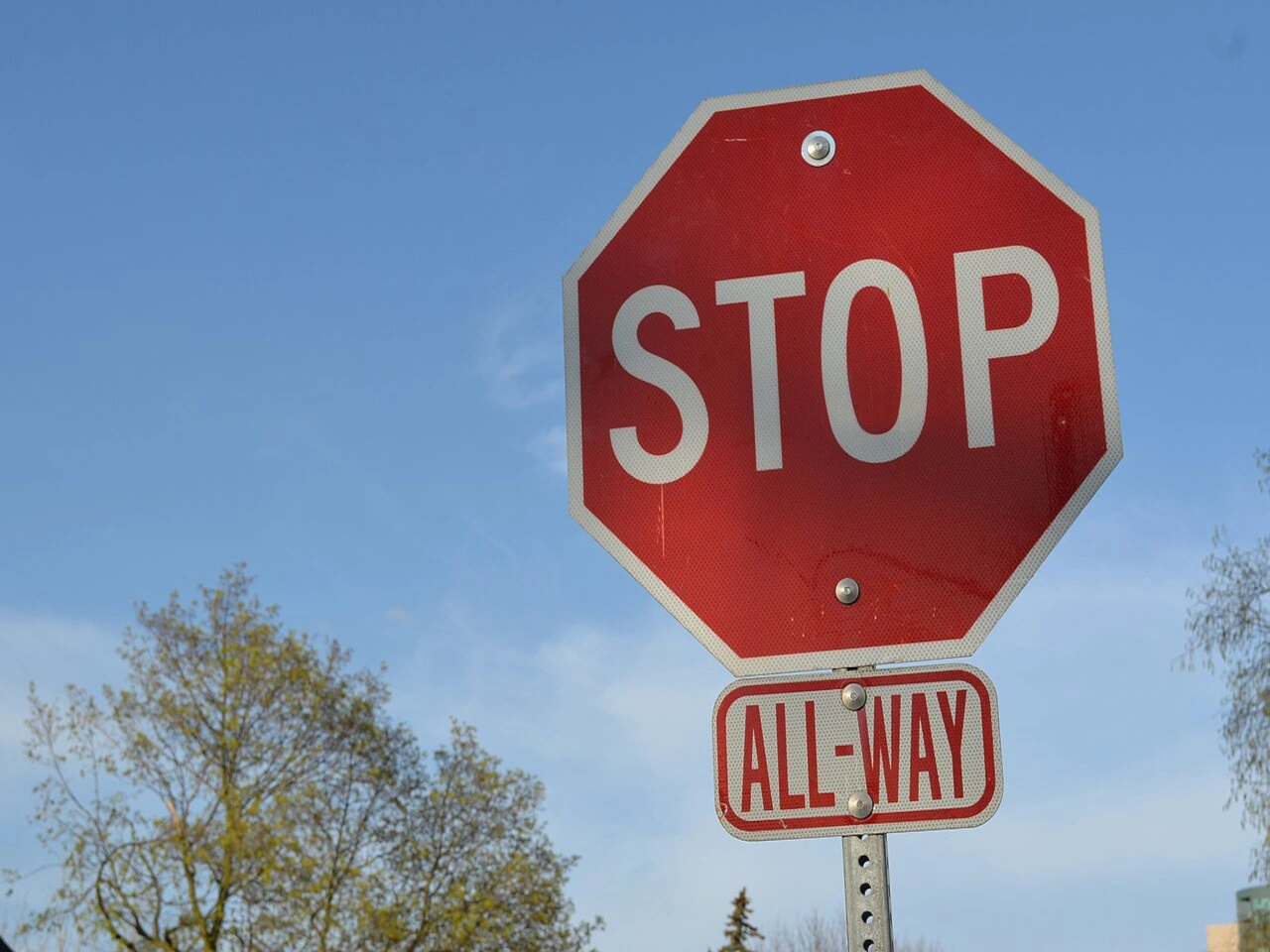
Wikimedia.org • Raysonho • CC BY-SA
Do you still have to stop when no other traffic is present?
Yes. Where a stop sign requires a complete stop, the driver must stop even when no other vehicles or road users are visible.
Does first arrival always determine priority at an intersection where everyone has a STOP sign?
Do not rely on arrival order alone. Follow the local all-way-STOP rules and check for pedestrians and other conflicts. California’s handbook, for example, uses arrival order, requires yielding to the right for simultaneous arrivals, and gives pedestrians priority. Stop fully and proceed only when it is safe.
🔗 dmv.ca.gov • California DMV, Driver Handbook, right-of-way at four-way stops
64. Junction layout
A junction layout is a schematic representation of the layout of an upcoming intersection or junction. It can show how roads branch, cross or continue and may help drivers understand which direction to follow before reaching the intersection.
Crossroad-shape diagrams are commonly used on advance direction signs. Depending on the country's sign system, the diagram may also distinguish the main road, side roads, route numbers or destinations.
Wikimedia.org • Grzegorz W. Tężycki • CC BY-SA
Does a crossroad-shape diagram always show every physical detail?
No. These diagrams are normally simplified and may omit features such as traffic islands, medians or other minor road details so that the important directions remain easy to understand.
🔗 rijksoverheid.nl • Dutch Government, reading motorway location markers; Dutch example
65. Climbing lane
A climbing lane is an additional traffic lane provided on an uphill section of road for vehicles that travel significantly slower while climbing, particularly heavy or less powerful vehicles. It allows faster traffic to pass without having to move into a lane used by opposing traffic.
Drivers using a climbing lane should follow the signs and road markings that determine who may use the lane and merge back into the normal traffic lane safely when the climbing lane ends. The exact rules and permitted users vary between countries.
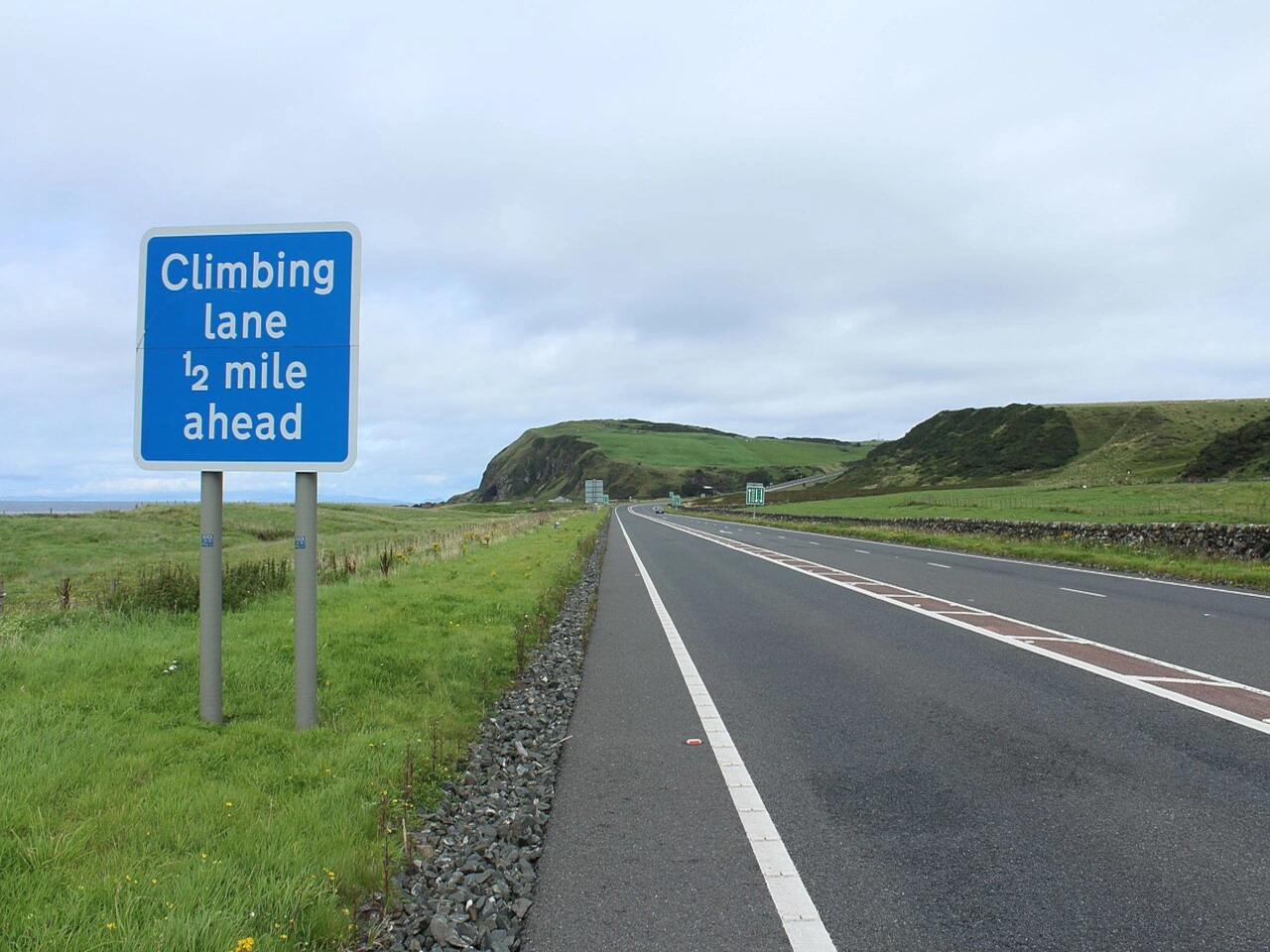
Wikimedia.org • Billy McCrorie • CC BY-SA
What should you do when a climbing lane ends?
Follow the road markings and signs, check surrounding traffic and merge safely into the continuing traffic lane without forcing other road users to brake or change direction suddenly.
🔗 gov.uk • Great Britain Highway Code, Rules 133–134; national guidance example
🔗 gov.uk • Great Britain Highway Code, Rules 257–258; national guidance example
🔗 gov.uk • UK Department for Transport, Know Your Traffic Signs, information signs
66. Bike box
A bike box, also called an advanced stop area, is a marked space at a signal-controlled intersection where cyclists can wait ahead of motor vehicles while the traffic light is red. It is usually positioned between two stop lines and may display a bicycle symbol.
A bike box helps increase cyclist visibility and allows cyclists to position themselves clearly before traffic starts moving. The exact users, markings and traffic-light rules vary between countries.
Wikimedia.org • Petr Vilgus • CC BY-SA
Can cars stop inside a bike box?
Motor vehicles should keep the designated cyclist waiting area clear and stop at the line provided for them when required. Follow local rules if the signal changes after you have crossed that line: Great Britain’s Highway Code says to stop as soon as possible and at the second line in that situation.
🔗 gov.uk • Great Britain Highway Code, Rules 174, 178 and 191–199; national guidance example
67. Left-hand traffic
Left-hand traffic is a traffic system in which vehicles normally travel on the left side of the road. In countries using left-hand traffic, vehicles usually overtake on the right and most cars have the steering wheel on the right-hand side.
Drivers who are unfamiliar with left-hand traffic should pay particular attention at intersections, roundabouts, when turning and when entering or leaving roads, because familiar traffic movements are reversed compared with right-hand traffic.
Wikimedia.org • NFH • CC0
What does left-hand traffic mean?
Left-hand traffic means that vehicles normally drive on the left side of a two-way road. Traffic approaching from the opposite direction therefore passes on the driver's right.
🔗 gov.uk • Great Britain Highway Code, Rules 160–169; national guidance example
🔗 gov.uk • Great Britain Highway Code, Rules 135–138; national guidance example
Which side is the steering wheel on in countries with left-hand traffic?
A right-hand-drive vehicle has its controls on the right and is intended for driving on the left side of the road. Wheel position is not an absolute rule: UK guidance also provides an approval process for imported left-hand-drive vehicles. Check the actual vehicle and local requirements.
🔗 dictionary.cambridge.org • Cambridge Dictionary, right-hand-drive vehicle definition
🔗 gov.uk • UK Government, approval of imported left-hand-drive vehicles
68. Speed feedback
Speed feedback is a traffic-safety system that measures an approaching vehicle's speed and displays it back to the driver. The display may show the measured speed together with a message, colour or symbol indicating whether the vehicle is travelling within the applicable speed limit.
Speed feedback displays are intended primarily to make drivers aware of their speed and encourage them to slow down when necessary. They normally serve a preventive or educational purpose rather than establishing a new speed limit.
Wikimedia.org • Donald_Trung • CC BY-SA
Does a speed feedback display set the speed limit?
Normally, no. The legally applicable speed is determined by the traffic rules and regulatory speed-limit signs, while the feedback display simply informs the driver of their measured speed.
69. Driving licence
A driving licence is an official document authorising a person to drive one or more specified categories of motor vehicle. It may contain conditions, restrictions, category codes and expiry dates that determine which vehicles the holder may drive.
Drivers must hold a licence that is valid for the vehicle category and jurisdiction concerned. A licence may be provisional, full, restricted, suspended or withdrawn, and additional qualifications may be required for professional driving.
Wikimedia.org • Tony Webster • CC BY
What is a driving licence?
A driving licence is an official authorisation to drive specified categories of motor vehicle.
🔗 gov.uk • GOV.UK, upgrading an automatic car licence to a manual licence; GB example
Is a driving licence the same as a driving permit?
Not necessarily. A learner or instruction permit can authorise supervised practice rather than independent driving; California’s instruction permit is one example. An International Driving Permit is also a different document and accompanies the underlying licence. Check the document’s purpose and the rules of the issuing country.
🔗 dmv.ca.gov • California DMV, learner instruction permits
🔗 gov.uk • UK Government, International Driving Permits accompany a driving licence
Must the licence be valid for the vehicle being driven?
Yes. Holding a licence for one category does not normally authorise driving a vehicle belonging to another category.
🔗 gov.uk • GOV.UK, upgrading an automatic car licence to a manual licence; GB example
What is the difference between an automatic and manual licence?
Some countries restrict a licence obtained after an automatic-vehicle test to automatic vehicles. For example, Great Britain requires a manual-car driving test to upgrade an automatic-only car licence. Check the categories and restrictions on the actual licence.
🔗 gov.uk • GOV.UK, upgrading an automatic car licence to a manual licence; GB example
Is there a universal minimum driving age?
No. Minimum ages differ between countries and vehicle categories.
🔗 gov.uk • GOV.UK, upgrading an automatic car licence to a manual licence; GB example
70. Location marker
A location marker is a roadside reference showing a measured position along a road. It normally identifies a kilometre, mile or smaller interval measured from an established starting point on that route.
Kilometre and hectometre markers help road users, emergency services, road authorities and maintenance crews identify an exact section of road. They do not impose a speed limit, priority rule or access restriction.
Wikimedia.org • Radosław Drożdżewski • CC BY-SA
What is a road location marker?
A road location marker is a numbered reference point identifying a measured position along a particular road or route.
🔗 rijksoverheid.nl • Dutch Government, reading motorway location markers; Dutch example
What is a kilometre marker?
A kilometre marker indicates the number of kilometres measured from an established starting point on the road.
🔗 rijksoverheid.nl • Dutch Government, reading motorway location markers; Dutch example
Is the marker the distance to the next town?
No. It normally measures the position along the road from a fixed reference origin rather than the remaining distance to a destination.
🔗 rijksoverheid.nl • Dutch Government, reading motorway location markers; Dutch example
Does it impose a speed limit?
No. The applicable speed comes from general traffic rules and regulatory speed signs.
🔗 rijksoverheid.nl • Dutch Government, reading motorway location markers; Dutch example
Does it change priority?
No. Traffic lights, priority signs and ordinary intersection rules remain applicable.
🔗 rijksoverheid.nl • Dutch Government, reading motorway location markers; Dutch example
71. Road number
A road number is a number or combination of letters and numbers used to identify a particular road or route within a road network. Road numbers help drivers follow routes, distinguish between different types of roads and navigate between cities, regions and countries.
Road numbers are commonly displayed on route markers and direction signs. Their format, colour and prefixes vary between countries and may indicate whether a route is a motorway, national road, regional road or international route.
Wikimedia.org • Tabl-trai • CC BY-SA
Do road-number systems differ between countries?
Yes. Countries use different prefixes, colours and numbering systems to distinguish motorways, national roads, regional roads and international routes.
🔗 rijksoverheid.nl • Dutch Government, reading motorway location markers; Dutch example
72. Countdown markers
Countdown markers are a sequence of roadside signs that indicate that a particular point, such as a motorway exit, junction or railway crossing, is getting closer. They commonly use a decreasing number of bars or other symbols so drivers can judge their progress toward the upcoming location.
The markers are normally positioned at successively shorter distances from the point ahead. Their design, spacing and meaning vary between countries, so drivers should not assume that each bar always represents the same distance.
Wikimedia.org • Marc Mongenet • CC BY-SA
Where are countdown markers commonly used?
They are commonly associated with motorway exits, major junctions and railway crossings, although their use and design differ between countries.
🔗 rijksoverheid.nl • Dutch Government, reading motorway location markers; Dutch example
73. Public toilet
A public toilet is a toilet facility available for use by travellers or the general public. Along roads, public toilets are commonly found at service areas, rest areas, filling stations, parking facilities and tourist locations.
Public toilets may be indicated by a facility or service symbol showing a toilet pictogram. The exact sign design and whether the facility is free, paid or accessible at particular times depend on the country and location.
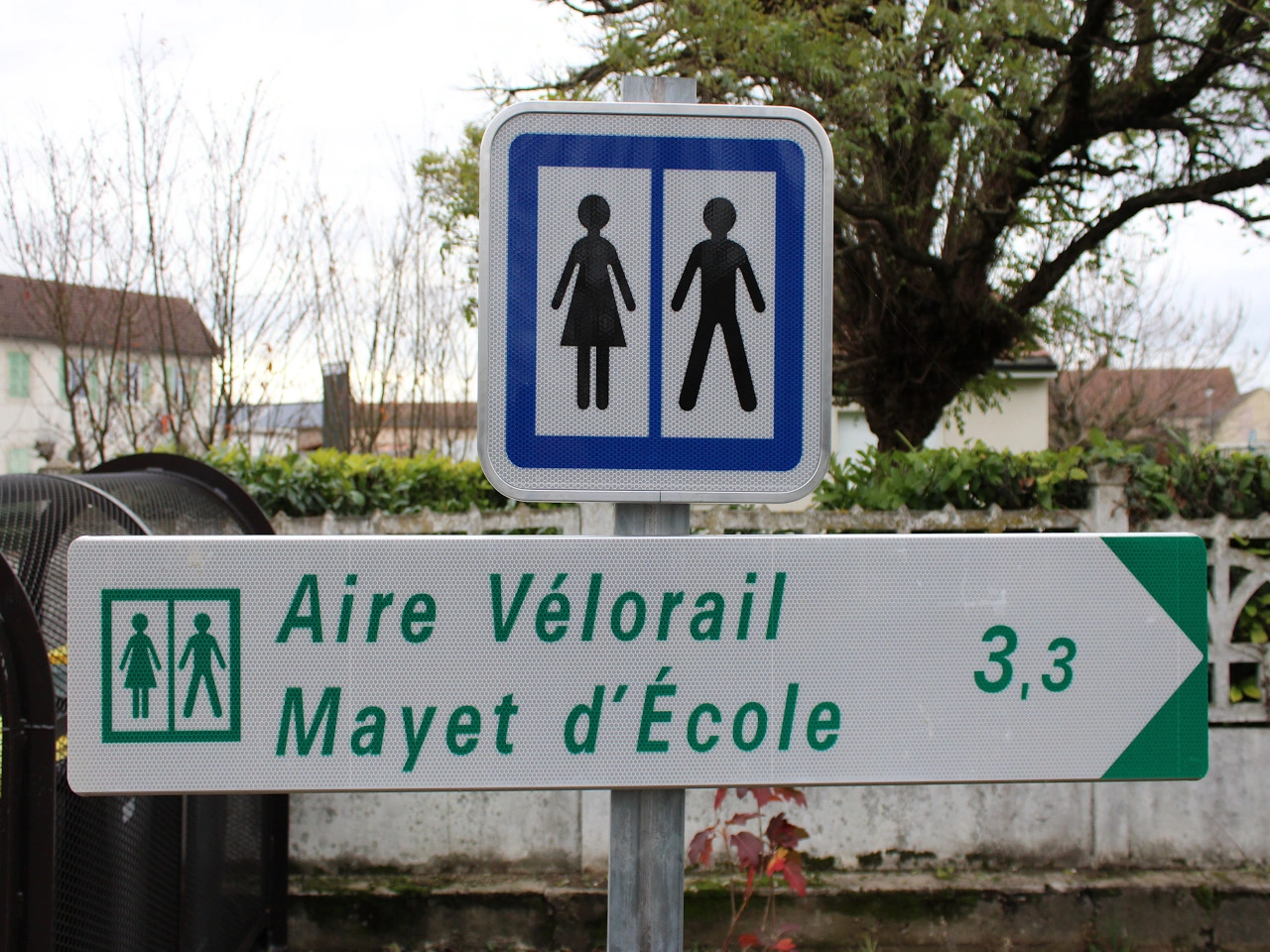
Wikimedia.org • Tabl-trai • CC BY-SA
Where can public toilets be found along major roads?
They are commonly available at rest areas, motorway service areas, filling stations and other traveller facilities.
74. Rest area
A rest area is a designated place beside a road or motorway where drivers can leave the main traffic flow and stop for a break. Rest areas may provide parking spaces and, depending on the location, facilities such as toilets, picnic areas, food, fuel or charging stations.
Rest areas allow drivers and passengers to pause their journey in a safer location away from moving traffic. The facilities available and the signs used to indicate them vary between countries.

Wikimedia.org • Marc Mongenet • CC BY-SA
Why are rest areas important?
Rest areas give drivers a suitable place to stop, rest and reduce fatigue without stopping on the main traffic lanes or roadside.
🔗 gov.uk • Great Britain Highway Code, Rule 262, motorway rest stops; national guidance example
75. Traffic mirror
A traffic mirror is a convex mirror installed near an intersection, driveway, bend or other location with restricted visibility. Its curved surface provides a wider view of approaching road users than an ordinary flat mirror.
A traffic mirror is only a visibility aid. It may distort distance, speed and direction and may be affected by darkness, weather, dirt or damage. Drivers must continue to observe the road directly, obey all priority rules and proceed only when it is safe.
Wikimedia.org • Frank Vincentz • CC BY-SA
What is a traffic mirror?
A traffic mirror is a roadside visibility aid that can help users see around a blind corner or obstruction. It gives an indirect view, which may be restricted or distorted; it does not replace checking whether it is safe to proceed.
🔗 monmouthshire.gov.uk • Monmouthshire Council, roadside visibility mirrors
🔗 devon.gov.uk • Devon County Council, mirrors on the highway
Does a traffic mirror show an exact image?
No. The reflected image can be distorted, and glare, bad weather or dirt can restrict the view. Judging an approaching vehicle’s speed from a mirror can be difficult. Do not rely on the mirror alone.
🔗 monmouthshire.gov.uk • Monmouthshire Council, roadside visibility mirrors
🔗 devon.gov.uk • Devon County Council, mirrors on the highway
Does seeing an empty mirror mean the road is clear?
No. Another road user may be outside the reflected area, hidden by glare or too small to notice. Always check the road directly before proceeding.
🔗 monmouthshire.gov.uk • Monmouthshire Council, roadside visibility mirrors
🔗 devon.gov.uk • Devon County Council, mirrors on the highway