


Traffic signsWorldwide
 Traffic rules
 Worldwide
76. Emergency telephone
An emergency telephone is a dedicated roadside or tunnel telephone that connects road users directly with an emergency, traffic-control or roadside-assistance centre. Emergency telephones are commonly installed in tunnels, along motorways or at other locations where quickly reporting an accident, breakdown or fire is important. They can provide operators with useful information about the caller’s location and may remain available where mobile-phone reception is poor.
Wikimedia.org • Nesnad • CC BY-SA
What is an emergency telephone?
An emergency telephone is a dedicated telephone used to contact emergency services, a traffic-control centre or roadside assistance from the road.
🔗 gov.uk • Great Britain Highway Code, Rules 275–279; national guidance example
🔗 gov.uk • Great Britain Highway Code, Rules 270–274; national guidance example
Where are emergency telephones commonly found?
They are commonly installed in road tunnels, motorway emergency areas and other locations where rapid assistance may be needed.
🔗 gov.uk • Great Britain Highway Code, Rules 275–279; national guidance example
🔗 gov.uk • Great Britain Highway Code, Rules 270–274; national guidance example
When should you use an emergency telephone?
Use an emergency telephone to report situations such as a breakdown, accident, fire or other serious road emergency when assistance is required.
🔗 gov.uk • Great Britain Highway Code, Rules 275–279; national guidance example
🔗 gov.uk • Great Britain Highway Code, Rules 270–274; national guidance example

77. International border
An international border is the legal boundary between two countries. A border sign may identify the country being entered and remind drivers that different traffic laws, speed limits, road signs, vehicle requirements and document rules may apply.
The border sign itself does not normally require drivers to stop. Passport, immigration or customs controls may take place at a checkpoint, but some international borders can be crossed without routine controls under regional agreements.
Wikimedia.org • ErichJacobi • CC BY-SA
What is an international border?
An international border is the legal boundary between two countries.
🔗 dictionary.cambridge.org • Cambridge Dictionary, international border definition
Does a border sign require you to stop?
Not normally. Stop only when required by traffic lights, barriers, officers, customs signs, passport controls or another instruction.
🔗 europa.eu • Your Europe, travel documents for EU nationals; EU example
Can speed limits change at the border?
Yes. The destination country may have different general limits for motorways, built-up areas, rural roads and particular vehicle categories.
🔗 europa.eu • Your Europe, travel documents for EU nationals; EU example
78. Pedestrian underpass
A pedestrian underpass is a passage that allows pedestrians to travel beneath a road, railway or other obstacle without crossing the traffic route at the same level. It is a form of grade-separated pedestrian crossing.
Pedestrian underpasses may be reached by stairs, ramps or lifts and can form part of a wider footpath or pedestrian network. Cyclists and other users may use the underpass only when the design, signs and local regulations permit them to do so.
Wikimedia.org • Enric • CC BY-SA
What is a pedestrian underpass?
A pedestrian underpass is a passage that allows pedestrians to cross beneath a road, railway or other obstacle without entering the traffic route above.
Why are pedestrian underpasses used?
They separate pedestrians from motor vehicles, trains or other traffic, reducing direct conflicts at busy or high-speed crossings.
Does an underpass give pedestrians priority over traffic above?
The underpass physically separates the movements, so pedestrians do not directly cross the traffic route above. Priority rules still apply wherever the pedestrian route later crosses another roadway or cycle facility.
79. Cycling route
A cycling route is a planned or signposted route intended to guide cyclists between places or through a particular area. It may follow cycle paths, quiet streets, shared roads, greenways or other routes considered suitable for cycling.
A cycling route does not necessarily give cyclists exclusive use of the road or path and should not be confused with a cycle path or cycle lane. The traffic rules, priority rules and permitted road users depend on the individual roads and paths that form the route and on the local signs and regulations.
Wikimedia.org • MlibFR • CC BY-SA
How can you recognise a cycling route?
Cycling routes are commonly indicated by direction signs, bicycle symbols, route numbers, colours or destination markers. The design of the signs and route-numbering system varies between countries and regions.
Do cyclists have priority on a cycling route?
Not automatically. Being on a designated cycling route does not normally change the priority rules. Cyclists must continue to obey traffic lights, give-way and stop signs, crossing rules and other applicable traffic regulations.
What should you do when a cycling-route sign conflicts with a traffic sign?
Always follow the official traffic signs, signals and road markings. A route marker provides navigation and does not override a prohibition, mandatory direction, road closure or other traffic regulation.
80. End of restriction
End of restriction means the end of one or more local traffic restrictions that applied to vehicles on the preceding section of road. It may be indicated by a specific end-of-restriction sign, by the crossed-out version of an earlier restriction sign or by another sign that establishes a new rule.
After a de-restriction sign, drivers must follow the normal traffic rules and any new restrictions that apply. It does not mean that there are no speed limits or traffic rules beyond the sign.
Wikimedia.org • Nilo1926 • CC BY-SA
What does de-restriction mean?
De-restriction means that a previously imposed local traffic restriction has ended.
How is the end of a restriction indicated?
Depending on the country, it may be indicated by an end-of-restriction sign, a crossed-out restriction sign or another sign introducing a new rule.
 End of local restrictions.
81. Parking
Parking means leaving a vehicle stationary at a place for a period of time rather than stopping only briefly because of traffic conditions or another immediate necessity. Many countries distinguish parking from a short stop made to pick up or drop off passengers or to load or unload goods, although the exact legal definition varies.
Parking may be permitted, restricted, reserved, time-limited or prohibited by traffic signs, road markings, parking zones and local regulations. Drivers must park without creating a danger or unnecessary obstruction and must comply with any conditions concerning payment, permits, vehicle categories or maximum parking duration.
Wikimedia.org • Marc Mongenet • CC BY-SA
What is the difference between parking and stopping?
Parking generally means leaving a vehicle stationary for longer than a brief stop required for passengers, loading or unloading. A vehicle stopped because of traffic lights, congestion, an emergency or another traffic condition is normally not considered parked. The precise legal definitions vary between countries.
🔗 wegcode.be • Belgian Road Code, articles 2, 23–27 and 70; 🔗 gesetze-im-internet.de • Germany, StVO, sections 12–13 and 19; 🔗 ris.bka.gv.at • Austria, StVO, sections 2, 23–25 and 52
How does paid parking work?
Where parking is subject to payment, drivers must follow the instructions displayed locally. Payment may be made through a parking meter, ticket machine, mobile application or another authorised system. The permitted duration and charging periods vary by location.
🔗 wegcode.be • Belgian Road Code, articles 2, 23–27 and 70; 🔗 gesetze-im-internet.de • Germany, StVO, sections 12–13 and 19; 🔗 paris.fr • City of Paris, parking payment FAQ
Can you leave a vehicle parked for an unlimited time?
Not necessarily. Local rules may impose a maximum parking duration, even where parking is otherwise permitted. Different limits may apply to abandoned, commercial, heavy or recreational vehicles.
🔗 wegcode.be • Belgian Road Code, articles 2, 23–27 and 70; 🔗 service-public.gouv.fr • French Government, prohibited and excessive parking
82. No parking
No parking indicates that vehicles may not be left parked at the location or along the section of road covered by the restriction. Depending on local law, a driver may still be allowed to stop briefly to pick up or drop off passengers or to load or unload goods, provided stopping itself is not prohibited.
A no-parking restriction may apply continuously or only during specified times, days, vehicle categories or sections of road. Its exact extent and exceptions are determined by the traffic sign, supplementary panels, road markings and local traffic regulations.
Wikimedia.org • Lionel Allorge • CC BY-SA
What does a no-parking sign mean?
A no-parking sign prohibits leaving a vehicle parked in the area or along the section of road to which the restriction applies. The exact legal definition of parking and the extent of the prohibition vary between countries.
🔗 wegcode.be • Belgian Road Code, articles 2, 23–27 and 70; 🔗 gov.uk • Great Britain, official parking-control signs and road markings
 Parking prohibited.
Is no parking the same as no stopping?
No. A no-parking restriction commonly still permits certain brief stops, such as picking up or dropping off passengers or loading or unloading goods. A no-stopping restriction is stricter and generally prohibits voluntary stopping as well as parking.
🔗 wegcode.be • Belgian Road Code, articles 2, 23–27 and 70; 🔗 gov.uk • Great Britain, official parking-control signs and road markings
Can you wait in your vehicle where parking is prohibited?
Remaining inside the vehicle does not necessarily mean that it is not parked. If the vehicle remains stationary beyond what local law permits as a brief stop, it may legally be considered parked even when the driver stays inside.
🔗 wegcode.be • Belgian Road Code, articles 2, 23–27 and 70; 🔗 gesetze-im-internet.de • Germany, StVO, sections 12–13 and 19
83. No stopping
No stopping means that vehicles are not permitted to stop voluntarily at the indicated location, even briefly for picking up or dropping off passengers or loading or unloading goods. It is a stricter restriction than a no-parking rule.
A no-stopping restriction may be indicated by a traffic sign, road marking or local traffic regulation. Drivers should continue to a place where stopping is permitted unless they are forced to stop by traffic conditions, an emergency or another legal requirement.
Wikimedia.org • Marc Mongenet • CC BY-SA
What does a no stopping restriction mean?
It means that a driver may not voluntarily stop the vehicle in the restricted area. The prohibition normally includes stopping to pick up or drop off passengers or to load or unload goods.
🔗 ris.bka.gv.at • Austria, StVO sections 2, 23–24 and 52
🔗 gov.uk • Great Britain Highway Code, Rules 238–252; national guidance example
🔗 gov.uk • UK Department for Transport, parking-control signs and road markings
🔗 wegcode.be • Belgium, 1975 Road Code, Articles 2 and 23–27
Can you stop in a no-stopping area during an emergency?
A driver may have to stop because of an emergency, traffic conditions, a red light, police instructions or another situation outside the driver's control. Such compulsory stops are generally different from voluntarily stopping the vehicle.
🔗 ris.bka.gv.at • Austria, StVO sections 2, 23–24 and 52
🔗 gov.uk • Great Britain Highway Code, Rules 238–252; national guidance example
🔗 gov.uk • UK Department for Transport, parking-control signs and road markings
🔗 wegcode.be • Belgium, 1975 Road Code, Articles 2 and 23–27
84. Parallel parking
Parallel parking is a method of parking a vehicle parallel to the edge of the road, usually in a space between two parked vehicles. It is commonly used where parking spaces are arranged along the side of a street.
Parallel parking normally involves positioning the vehicle beside the available space and reversing into it while carefully checking mirrors, blind spots and surrounding traffic. The vehicle should finish within the permitted parking area and close enough to the road edge without obstructing other road users.
Wikimedia.org • Ralf.treinen • CC BY-SA
How should a vehicle be positioned after parallel parking?
The vehicle should be completely within the permitted parking area, reasonably close to the road edge and positioned so that it does not unnecessarily obstruct traffic or access to other vehicles.
🔗 ris.bka.gv.at • Austria, StVO sections 2, 23–24 and 52
🔗 gov.uk • Great Britain Highway Code, Rules 238–252; national guidance example
🔗 gov.uk • UK Department for Transport, parking-control signs and road markings
🔗 wegcode.be • Belgium, 1975 Road Code, Articles 2 and 23–27
85. Park and ride
Park and ride is a parking facility where drivers leave their vehicle and continue their journey using public transport, a bicycle or another mode of transport. These facilities are commonly located near the edge of a city or close to major transport routes.
Park-and-ride facilities can reduce traffic and parking demand in busy urban areas by encouraging drivers to complete part of their journey without a car. Parking charges, maximum stay and public transport connections vary between locations.
Wikimedia.org • Geof Sheppard • CC BY-SA
What does P+R mean?
P+R stands for park and ride. It indicates a facility where drivers can park their vehicle and continue their journey using public transport or another form of transport.
🔗 transportnsw.info • Transport for NSW, Transport Park&Ride conditions; NSW example
🔗 amsterdam.nl • City of Amsterdam, P+R conditions and prices; Amsterdam example
Is parking at a park-and-ride always free?
No. Some facilities are free, while others charge for parking or offer special combined parking and public-transport fares. Conditions depend on the individual facility and local authority.
🔗 transportnsw.info • Transport for NSW, Transport Park&Ride conditions; NSW example
🔗 amsterdam.nl • City of Amsterdam, P+R conditions and prices; Amsterdam example
86. Kiss and ride
A Kiss and Ride area is a designated place where drivers may stop briefly to drop off or pick up passengers. These areas are commonly provided near schools, railway stations, airports and other busy destinations to allow passengers to enter or leave a vehicle without occupying ordinary parking spaces.
A Kiss and Ride area is intended for very short stops rather than waiting or parking. Drivers should remain only as long as necessary for passengers to get in or out and must follow any traffic signs, time limits, road markings or local regulations applying to the area.
Wikimedia.org • Radosław Drożdżewski • CC BY-SA
What is a Kiss and Ride area?
A Kiss and Ride area is a designated place where drivers can briefly stop to drop off or pick up passengers. It is intended to keep passenger transfers quick and reduce unnecessary parking or congestion near busy destinations.
🔗 education.nsw.gov.au • NSW Education, safe travel and Kiss and Ride zones
🔗 revesby-p.schools.nsw.gov.au • NSW Revesby Public School, Kiss and Ride operating instructions
Can you leave your vehicle unattended in a Kiss and Ride area?
Normally this should be avoided. Kiss and Ride areas are designed for rapid passenger transfers, and leaving the vehicle unattended can obstruct other users. Specific local rules may expressly prohibit parking or unattended vehicles.
🔗 education.nsw.gov.au • NSW Education, safe travel and Kiss and Ride zones
🔗 revesby-p.schools.nsw.gov.au • NSW Revesby Public School, Kiss and Ride operating instructions
What should you do if your passenger is not ready?
Move to a suitable parking or waiting area and return when the passenger is ready to be collected. Remaining in the Kiss and Ride area unnecessarily can block the facility and contribute to congestion.
🔗 education.nsw.gov.au • NSW Education, safe travel and Kiss and Ride zones
🔗 revesby-p.schools.nsw.gov.au • NSW Revesby Public School, Kiss and Ride operating instructions
87. Alternate-side parking
Alternate-side parking is a parking system in which vehicles must park on different sides of a street at different times or on different dates. The system may be used to keep streets accessible, distribute parking or allow activities such as street cleaning or maintenance.
The applicable side may change daily, weekly, monthly or according to another schedule. Drivers must check the local signs and rules carefully, because the timing and method of changing sides differ between countries and municipalities.
Wikimedia.org • KiwiNeko14 • CC BY-SA
When must you move a vehicle to the other side?
The changeover time depends on the local rules. Drivers should check the signs carefully because some systems require vehicles to change sides at a particular time or on specific dates.
🔗 wegcode.be • Belgium, 1975 Road Code, Articles 26–27
🔗 portal.311.nyc.gov • NYC311, alternate-side parking and street cleaning; NYC example
88. Parking meter
A parking meter is a device used to regulate and usually collect payment for parking in a designated parking space or area. It may require drivers to pay for a particular parking period, enter a vehicle registration number or obtain a ticket that must be displayed in the vehicle.
Parking meters may accept coins, payment cards, contactless payments or electronic payment methods, depending on the local system. Drivers must follow the instructions, operating hours, maximum parking duration and tariffs indicated on the meter, nearby signs or other official parking information.
Wikimedia.org • Tomasz Sienicki • CC BY
What is a parking meter?
A parking meter is a device used to regulate parking and, in many cases, collect payment for the time a vehicle occupies a parking space or parking area.
🔗 wegcode.be • Belgian Road Code, articles 2, 23–27 and 70; 🔗 gesetze-im-internet.de • Germany, StVO, sections 12–13 and 19
How does a parking meter work?
The driver normally selects or pays for a permitted parking period according to the instructions on the machine. Depending on the system, the driver may receive a ticket, enter the vehicle registration number or activate parking electronically.
🔗 gesetze-im-internet.de • Germany, StVO, sections 12–13 and 19; 🔗 paris.fr • City of Paris, parking payment FAQ
Can a parking meter limit how long you may park?
Yes. Paid parking areas may have a maximum parking duration. Paying additional money does not necessarily allow you to remain beyond the maximum period specified by the parking rules.
🔗 wegcode.be • Belgian Road Code, articles 2, 23–27 and 70; 🔗 gesetze-im-internet.de • Germany, StVO, sections 12–13 and 19
89. Parking disc
A parking disc is a device used to indicate the time a vehicle was parked in an area where parking duration is limited. The driver sets the disc to the required arrival time and displays it clearly inside the vehicle.
Parking-disc systems are commonly used in blue zones or other time-limited parking areas. The permitted parking duration, operating hours and method for setting the disc depend on national or local rules and the traffic signs in place.
Wikimedia.org • Santeri Viinamäki • CC BY-SA
Can you change the time on a parking disc without moving the vehicle?
Generally no where the applicable rules prohibit extending the parking period in this way. The vehicle normally has to leave the parking space before a new parking period can begin.
🔗 wegcode.be • Belgium, 1975 Road Code, Articles 26–27
🔗 portal.311.nyc.gov • NYC311, alternate-side parking and street cleaning; NYC example
90. Disabled parking
Disabled parking refers to parking spaces and parking privileges reserved for people with disabilities who meet the applicable eligibility requirements. Reserved spaces are normally identified by the international wheelchair symbol and are positioned to provide easier access to nearby facilities.
Use of a disabled parking space generally requires a valid disabled parking permit or card. The permit normally belongs to the eligible person rather than to a particular vehicle and may only be used when that person is driving or travelling in the vehicle.
Wikimedia.org • Tdmalone • CC BY-SA
Who may use a disabled parking space?
Disabled parking spaces are intended for eligible people who hold a valid disabled parking permit or card. The exact eligibility requirements and permit system depend on the country.
🔗 epan.gov.gr • Greek Government, Blue Disability Parking Card; Greek example
🔗 europa.eu • Your Europe, disability parking in Hungary; Hungarian example
Does a disabled parking permit always provide free parking?
No. A permit may provide access to reserved spaces or exemptions from certain parking restrictions, but rules concerning parking charges and time limits vary between countries and local authorities.
🔗 epan.gov.gr • Greek Government, Blue Disability Parking Card; Greek example
🔗 europa.eu • Your Europe, disability parking in Hungary; Hungarian example
91. Traffic management
Traffic management is the organised control, regulation and guidance of road users to improve safety, traffic flow and the efficient use of roads. It can include traffic lights, road signs, road markings, lane controls, variable speed limits, diversions and directions given by authorised persons.
Traffic management may be permanent or temporary. Temporary measures are commonly introduced during roadworks, congestion, collisions, public events or other incidents. Drivers and other road users must follow the signs, signals and instructions applying at the location, even when they differ from the normal traffic arrangement.
Wikimedia.org • Marc Mongenet • CC BY-SA
What is traffic management?
Traffic management is the organised control and guidance of traffic using signs, signals, road markings, lane controls, speed restrictions, diversions and other measures.
🔗 gov.uk • Great Britain Highway Code, Rules 133–134; national guidance example
🔗 gov.uk • Great Britain Highway Code, Rules 257–258; national guidance example
🔗 gov.uk • UK Department for Transport, Know Your Traffic Signs, information signs
Can traffic management change the normal speed limit?
Yes. Temporary or variable speed-limit signs may impose a different maximum speed because of congestion, roadworks, weather, incidents or other conditions. Drivers must follow the limit currently displayed.
🔗 gov.uk • Great Britain Highway Code, Rules 133–134; national guidance example
🔗 gov.uk • Great Britain Highway Code, Rules 257–258; national guidance example
🔗 gov.uk • UK Department for Transport, Know Your Traffic Signs, information signs
What should you do when a traffic lane is closed?
Follow the signs and signals governing where the closure begins and how to merge. Move safely into an open lane at the instructed point; local merge-in-turn rules may apply in congestion. Do not drive beyond a signal or marking that prohibits use of the lane.
🔗 gov.uk • Great Britain Highway Code, Rules 133–134; national guidance example
🔗 gov.uk • Great Britain Highway Code, Rules 257–258; national guidance example
🔗 gov.uk • UK Department for Transport, Know Your Traffic Signs, information signs
92. Merging
Merging is the process of joining a stream of traffic from another lane or road, such as when an entry lane joins a motorway or when two traffic lanes become one. The merging driver must observe surrounding traffic, signal when required and enter an appropriate gap safely.
Drivers already in the continuing traffic lane should remain alert to merging vehicles and avoid unnecessarily preventing them from joining. Special zipper-merging rules may apply when traffic is heavily congested and a lane ends.
Wikimedia.org • Adrian Grycuk • CC BY-SA
What does merging mean in traffic?
Merging means joining another stream or lane of traffic, usually where an entry lane, acceleration lane or another traffic lane connects with the continuing roadway.
🔗 gov.uk • Great Britain Highway Code, Rules 133–134; national guidance example
🔗 gov.uk • Great Britain Highway Code, Rules 257–258; national guidance example
🔗 gov.uk • UK Department for Transport, Know Your Traffic Signs, information signs
What is zipper merging?
Zipper merging is a system used where a lane ends during congested traffic. Drivers use both lanes up to the merging point and then enter the continuing lane alternately, one vehicle from each traffic stream.
🔗 gov.uk • Great Britain Highway Code, Rules 133–134; national guidance example
🔗 gov.uk • Great Britain Highway Code, Rules 257–258; national guidance example
🔗 gov.uk • UK Department for Transport, Know Your Traffic Signs, information signs
93. Reversing
Reversing means driving a vehicle backwards. It is commonly used when parking, leaving a confined space or repositioning a vehicle where forward movement is not practical.
Before reversing, the driver should check mirrors and blind spots, look carefully around the vehicle and make sure the area behind is clear. Reversing should be performed slowly and only for as long as necessary because visibility behind the vehicle is often limited.
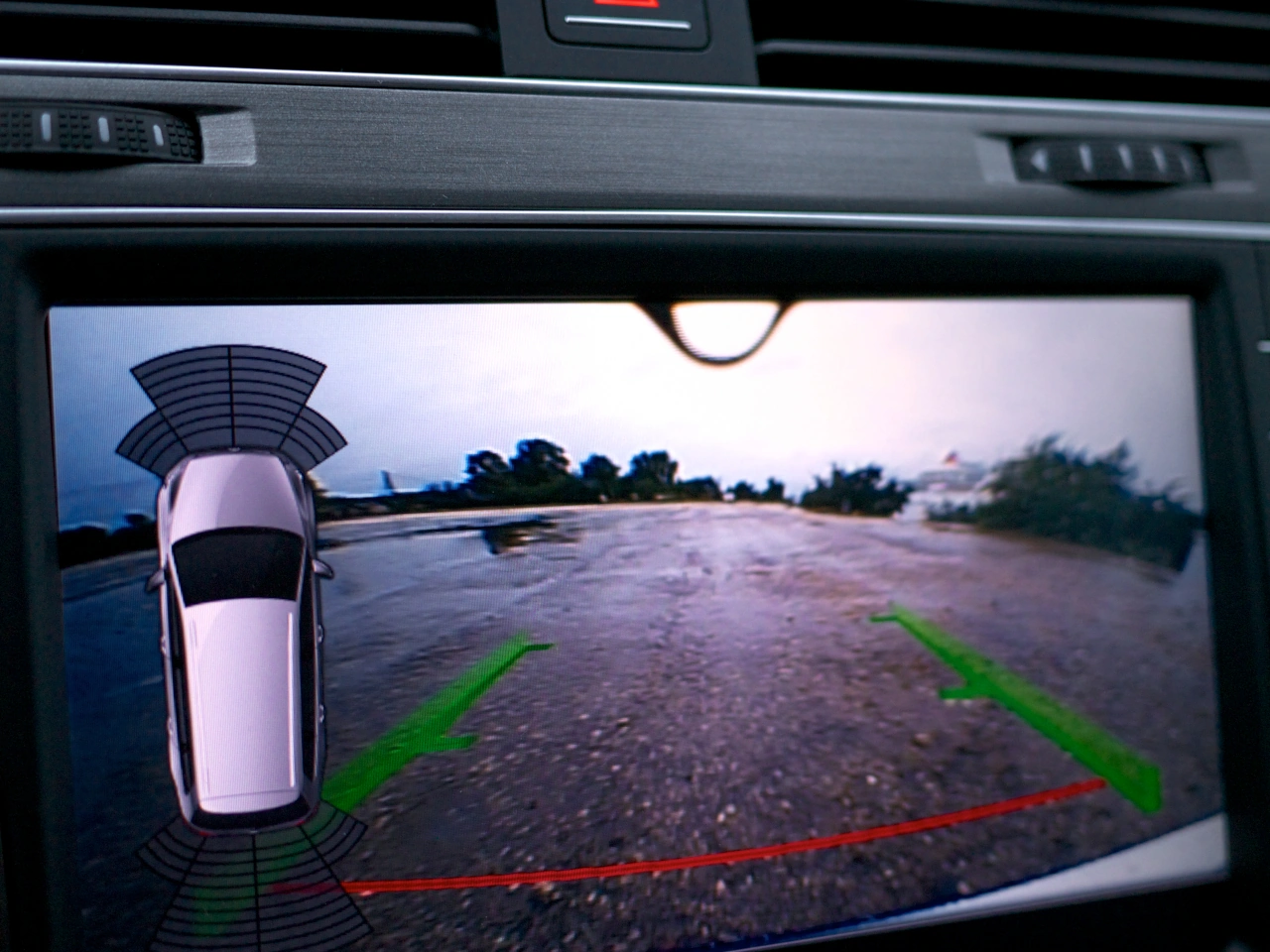
Wikimedia.org • Kārlis Dambrāns • CC BY
What should you check before reversing?
Check behind and around the vehicle for pedestrians, cyclists, other vehicles and obstacles. Use mirrors and cameras where available, but also look directly because monitoring systems can have blind spots.
🔗 gov.uk • Great Britain Highway Code, Rules 200–203; national guidance example
Should you reverse for a long distance?
No. Reversing should normally be limited to the distance necessary to complete the manoeuvre safely. Driving forward generally provides better visibility and vehicle control.
🔗 gov.uk • Great Britain Highway Code, Rules 200–203; national guidance example
94. U-turn
A U-turn is a driving manoeuvre in which a vehicle turns around to travel in the opposite direction. It normally involves crossing part of the roadway and re-entering traffic facing the direction from which the vehicle came.
Before making a U-turn, the driver should check surrounding traffic, pedestrians and cyclists, signal when required and make sure there is enough visibility and space to complete the manoeuvre safely. U-turns may be prohibited by traffic signs or on particular types of roads.
Wikimedia.org • Limsduwmc HOWMAR • CC BY-SA
Can you make a U-turn anywhere?
No. U-turns may be prohibited by traffic signs or road rules and should never be attempted where visibility, road layout or traffic conditions make the manoeuvre unsafe.
🔗 gov.uk • Great Britain Highway Code, Rules 200–203; national guidance example
95. Carpool
Carpool means sharing a car journey with one or more other people who are travelling in the same direction. The occupants may share travel costs or simply travel together to reduce the number of separate vehicles making the same journey.
Carpooling is commonly used for commuting, school journeys and longer-distance travel. Some road networks provide dedicated carpool parking areas where travellers can meet, leave one vehicle and continue their journey together.
Wikimedia.org • KiwiNeko14 • CC BY-SA
Is carpooling the same as carsharing?
No. Carpooling means several people travelling together in the same vehicle, while carsharing means different users having access to the same shared vehicle at different times.
96. Traffic jam
A traffic jam is a situation where traffic becomes heavily congested and vehicles move very slowly or stop for extended periods. Traffic jams are commonly caused by high traffic volumes, accidents, roadworks, lane closures or poor weather. Drivers should remain patient, keep a safe distance, avoid unnecessary lane changes and watch for motorcycles, emergency vehicles and sudden braking. Where lanes merge during congestion, local rules may require drivers to use a zipper-merging system.
Wikimedia.org • Marc Mongenet • CC BY-SA
What is a traffic jam?
A traffic jam occurs when traffic becomes congested and vehicles move slowly or remain stationary because the road cannot accommodate the normal flow of traffic.
🔗 gov.uk • Great Britain Highway Code, Rules 126 and 133–134; national guidance example
🔗 gov.uk • Great Britain Highway Code, Rules 174 and 192; national guidance example
What causes traffic jams?
Common causes include heavy traffic, accidents, roadworks, lane closures, bottlenecks and poor weather.
🔗 gov.uk • Great Britain Highway Code, Rules 126 and 133–134; national guidance example
🔗 gov.uk • Great Britain Highway Code, Rules 174 and 192; national guidance example
How should you drive in a traffic jam?
Keep a safe distance, avoid sudden braking and unnecessary lane changes, and remain alert for changing traffic conditions and emergency vehicles.
🔗 gov.uk • Great Britain Highway Code, Rules 126 and 133–134; national guidance example
🔗 gov.uk • Great Britain Highway Code, Rules 174 and 192; national guidance example
97. Detour
A detour, also called a diversion, is a temporary alternative route used when the normal road is closed, blocked or unavailable. Detours are commonly introduced during roadworks, accidents, public events, flooding or other disruptions. Drivers should follow the temporary direction signs carefully, reduce speed where necessary and expect unfamiliar roads, changed priorities or additional traffic along the alternative route.
Wikimedia.org • Marc Mongenet • CC BY-SA
What is a detour?
A detour is an alternative route that directs traffic around a closed, blocked or restricted section of road.
🔗 gov.uk • Great Britain Highway Code, Rules 259 and 263–274; national guidance example
Why are detours used?
Detours may be introduced because of roadworks, accidents, flooding, public events or other temporary obstructions that prevent normal use of the road.
🔗 gov.uk • Great Britain Highway Code, Rules 259 and 263–274; national guidance example
What is the difference between a detour and a diversion?
Detour and diversion generally describe the same concept: an alternative route around a road that cannot be used normally. The preferred term varies between countries and languages.
🔗 gov.uk • Great Britain Highway Code, Rules 259 and 263–274; national guidance example
98. Uncontrolled crossroad
An uncontrolled crossroad is an intersection where traffic priority is not specifically regulated by traffic lights, an authorised person or signs assigning priority to particular approaches. Drivers must therefore determine who has priority using the default traffic rules that apply in that country.
The applicable rule varies between countries and may include priority from the right, priority from the left or another default right-of-way rule. Drivers should approach an uncontrolled crossroad carefully, observe traffic from every direction and never assume that a wider or busier road automatically has priority.
Wikimedia.org • Tabl-trai • CC BY-SA
What is an uncontrolled crossroad?
An uncontrolled crossroad is an intersection where priority is not specifically assigned by traffic lights, an authorised person or priority signs. Drivers must use the default priority rules of the country.
Who has priority at an uncontrolled crossroad?
This depends on the local traffic law. Some countries use priority from the right, while others use different rules. Drivers should know the default intersection rule of the country in which they are driving.
What should you do if you are unsure who has priority?
Reduce speed and be prepared to stop. Never force your way through an intersection simply because the priority situation is unclear.
99. Road surface
A road surface warning indicates that the road ahead may be uneven, damaged or in poor condition and could affect the stability, steering or braking of a vehicle. The hazard may include bumps, depressions, potholes, broken pavement or other irregularities in the road surface.
Drivers should reduce speed where necessary, maintain a safe distance and avoid sudden steering or braking when passing over an irregular surface. The exact meaning and appearance of the warning sign vary between countries, so drivers must follow the local traffic signs and regulations.
Wikimedia.org • Lukas Beck • CC BY
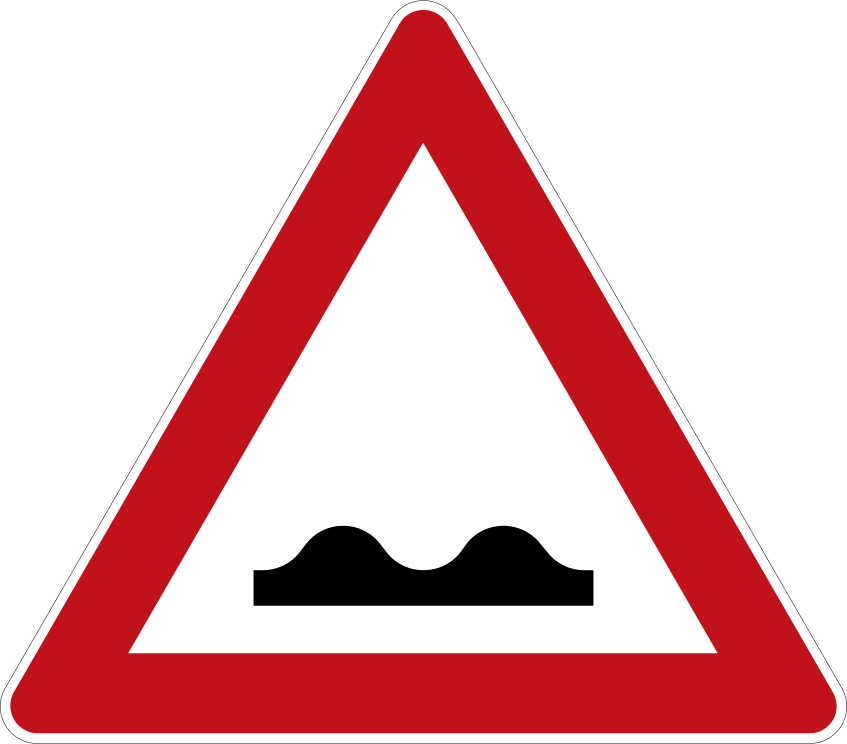
Warning for a bad road surface.
What does a road surface warning mean?
A road surface warning indicates that the surface ahead may be uneven, damaged or otherwise capable of affecting the safe movement of vehicles.
🔗 gov.uk • Great Britain Highway Code, Rules 226–237; national guidance example
 Warning for a bad road surface.
What should you do when you see a road surface warning?
Reduce speed where necessary, increase your awareness of the road ahead and be prepared for changes in the vehicle's stability or direction.
🔗 gov.uk • Great Britain Highway Code, Rules 226–237; national guidance example
Does a road surface warning impose a specific speed limit?
Not normally. A warning sign alerts drivers to a hazard rather than establishing a numerical speed limit. A separate speed-limit sign may be used where a particular maximum speed is required.
🔗 gov.uk • Great Britain Highway Code, Rules 226–237; national guidance example
100. Advisory cycle lane
A advisory cycle lane is a visually marked strip along the edge of a roadway that indicates a suggested position for cyclists and reminds other road users that cyclists may be present. It may be distinguished from the rest of the roadway by colour, surface material or bicycle symbols.
A bicycle suggestion strip is not necessarily a legally reserved cycle lane or cycle path. Motor vehicles may therefore be permitted to drive across or along it, depending on local law. Cyclists and drivers must continue to follow the ordinary road-position, passing, parking and priority rules.

Wikimedia.org • Maurits90 • CC0
What is a bicycle suggestion strip?
A bicycle suggestion strip is a visually marked part of the roadway intended to highlight the expected position or presence of cyclists.
🔗 politie.be • Belgian Local Police Schoten, bicycle suggestion strips; Belgian example
🔗 politie.be • Belgian Local Police ZARA, parking on bicycle suggestion strips; Belgian example
Must cyclists use a bicycle suggestion strip?
Not necessarily. Because it is generally an advisory road feature rather than a compulsory cycle facility, cyclists follow the normal road-position rules unless local law provides otherwise.
🔗 politie.be • Belgian Local Police Schoten, bicycle suggestion strips; Belgian example
🔗 politie.be • Belgian Local Police ZARA, parking on bicycle suggestion strips; Belgian example
Can vehicles stop or park on a bicycle suggestion strip?
This depends on the ordinary stopping and parking rules applying at the location. The strip itself may not create a parking prohibition unless local law gives it that effect.
🔗 politie.be • Belgian Local Police Schoten, bicycle suggestion strips; Belgian example
🔗 politie.be • Belgian Local Police ZARA, parking on bicycle suggestion strips; Belgian example