Panel direccionalFlandes

Aprende normas de tráfico con explicaciones claras y ejemplos visuales en nuestro libro ilustrado, diseñado para que estudiar sea sencillo y ameno.


33. Panel direccional

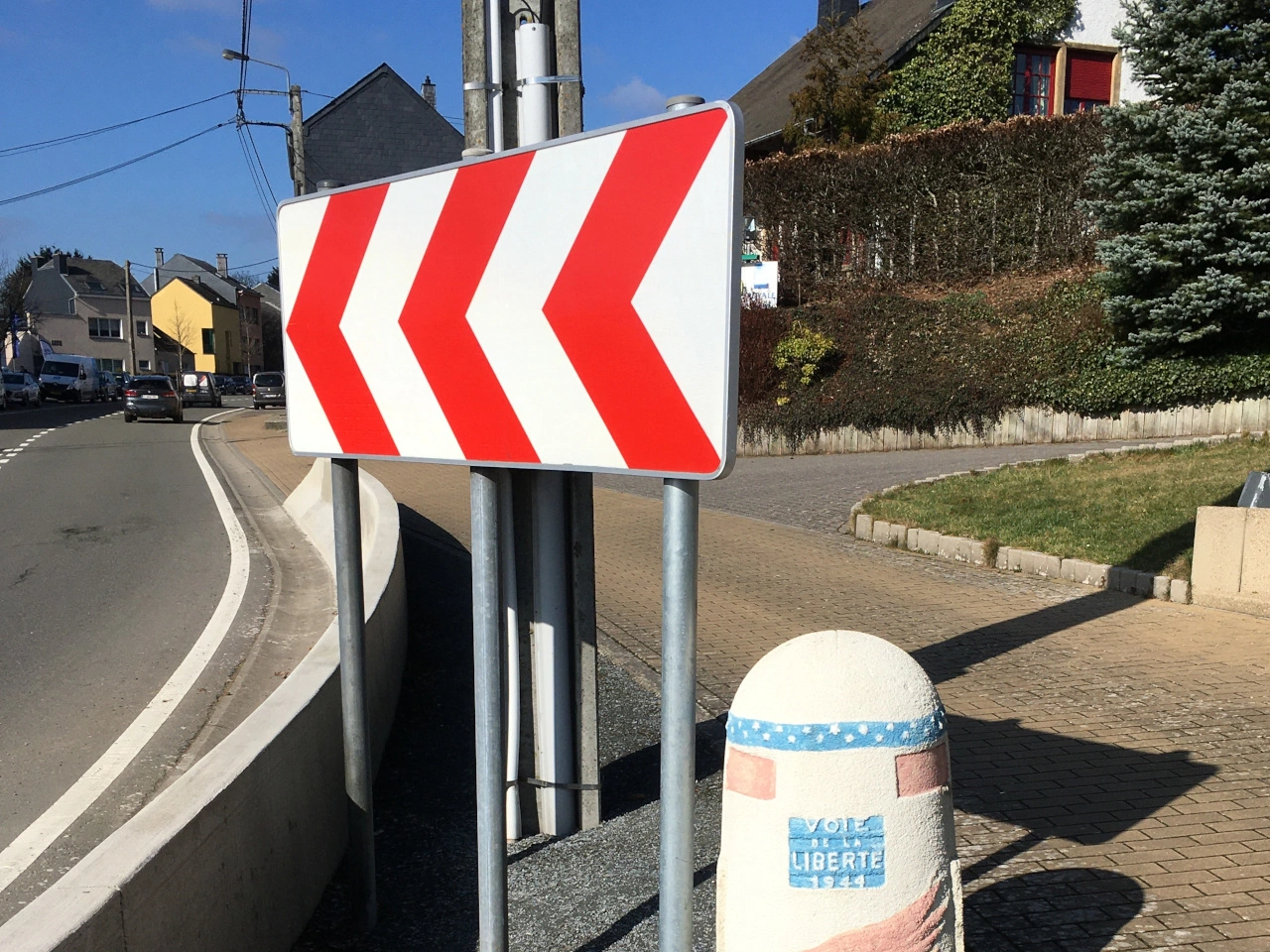
Un panel direccional es un marcador vial en forma de V o flecha utilizado para mostrar un cambio pronunciado en la dirección de una carretera. Los paneles suelen colocarse a lo largo del exterior de una curva de modo que sus puntas indiquen la dirección en la que continúa la vía.

Estos paneles mejoran la visibilidad y alineación de una curva, especialmente de noche o con mal tiempo. Normalmente no imponen un límite de velocidad ni determinan la prioridad, por lo que los conductores deben reducir la velocidad antes de la curva y respetar todas las demás señales y marcas viales.
Panel direccional
What is a chevron board in Belgium?

A Belgian chevron board is a rectangular road-alignment panel displaying a large red chevron on a contrasting light background. It helps drivers follow the direction of a curve.

Which direction does a Belgian chevron point?

The point of the red chevron indicates the direction in which the curve continues. A left-pointing chevron marks a curve to the left and a right-pointing chevron marks a curve to the right.

Is a Belgian chevron an official A1 curve-warning sign?

No. The official dangerous-curve warning signs are A1a, A1b, A1c and A1d. Chevron boards are road-alignment devices used to make the curve itself more visible.

What is the difference between A1 and chevron boards?

An A1 sign warns before the dangerous curve. Chevron boards are placed in or around the curve to show its alignment and guide drivers while they negotiate it.

Do Belgian chevrons have a traffic-sign number?

No separate Highway Code number is assigned to them like A1a or A1b. They are technical road-signing and delineation equipment installed by the road authority.

Where are Belgian chevrons placed?

They are normally positioned along the outside of the curve so that approaching drivers can clearly see the direction of the road.

Must the first chevrons be visible before the curve?

Yes. Belgian regional guidance recommends that the first chevrons be visible while drivers are still approaching the curve.

Are chevrons normally repeated throughout the curve?

Yes. They generally guide drivers along the full length of the curve and continue towards its exit, unless the danger is limited to only part of it.

What is a single-chevron board?

A single-chevron board displays one large chevron. Several individual boards may be spaced along the curve to trace its alignment.

What is a multiple-chevron board?

A multiple-chevron board displays several chevrons on one longer panel. In Belgian regional practice, these are used less frequently than separate single-chevron boards.

When may a multiple-chevron board be useful?

It may be useful at a short curve, beside a particular obstacle or immediately before a critical tightening of the curve.

Does the spacing between Belgian chevrons remain constant?

Not always. Their spacing depends on the radius and layout of the curve. Sharper curves may require the boards to be placed closer together.

How large are Belgian single-chevron boards?

The normal basic format used in Walloon technical guidance is approximately 900 × 900 mm. Smaller formats may be used on lower-speed roads, inside built-up areas or where available space is limited.

Can Belgian chevrons have a fluorescent border?

Yes. On a particularly high-risk curve, a fluorescent yellow surround may be used to increase their visibility.

Can Belgian chevrons be illuminated?

Yes. Illuminated chevrons may be used as an additional measure at curves with a significant safety risk.

Do Belgian chevrons impose a speed limit?

No. They guide drivers through the curve. Only an applicable C43 sign, speed zone or general road rule establishes the legal maximum speed.

Must you still reduce speed?

Yes, when necessary. Belgian drivers must adapt their speed to the road layout, visibility, weather, traffic and vehicle condition and remain able to stop before a foreseeable obstruction.

Do chevrons give you priority?

No. They do not change priority at an intersection or against oncoming traffic.

May you cross a continuous centre line beside chevrons?

No. Drivers may not cross a continuous white line or drive to its left when it separates opposing directions of traffic.

May you overtake in a curve marked by chevrons?

Specified left-side overtaking is prohibited when visibility in the curve is insufficient. The chevrons themselves do not create the prohibition, but they often identify a location where overtaking would be unsafe.

May you stop or park in a chevron-marked curve?

Stopping and parking on the carriageway are prohibited where visibility in the curve is insufficient. A vehicle may also not create danger or unnecessary obstruction.

How should motorcyclists follow Belgian chevrons?

Look through the curve, select a suitable speed beforehand and maintain a stable line. Both the rider and motorcycle must remain within the correct part of the carriageway.

Does a chevron show the exact shape of the curve?

No. It provides directional guidance. Drivers must still observe the road because the curve may tighten, open out or change gradient.

Will Belgium’s new road code change the meaning of chevrons?

Chevron boards remain road-alignment equipment rather than a separate numbered regulatory sign. The general obligations to adapt speed, remain within the correct road position and obey curve signs and markings continue to apply.

1 Flandes 2 Autopista 3 Vía rápida 4 Zona residencial 5 Zona urbana 6 Zona 7 Límite de velocidad 8 Carril bici 9 Calle ciclista 10 Zona peatonal 11 Resalto 12 Aduana 13 Sentido único 14 Muelle 15 Pendiente 16 Carril bus 17 Calle sin salida 18 Señal de STOP 19 Ceda el paso 20 Glorieta 21 Vía con prioridad 22 Estrechamiento de calzada 23 Prioridad sobre el tráfico en sentido contrario 24 Ceda el paso al tráfico en sentido contrario 25 Paso de peatones 26 Paso a nivel 27 Dirección obligatoria 28 Prohibición de giro 29 Zona escolar 30 Cruce de animales 31 Desprendimiento de rocas 32 Curva 33 Panel direccional 34 Circulación en sentido contrario 35 Obras 36 Límite de altura 37 Límite de anchura 38 Límite de peso 39 Señal de control de velocidad 40 Barreras selectivas 41 Señal de dirección en intersección 42 Prioridad en la próxima intersección 43 Semáforos 44 Semáforos peatonales 45 Permiso de conducir 46 Marcador de ubicación 47 Espejo de tráfico 48 Frontera internacional 49 Ruta ciclista 50 Estacionamiento 51 Prohibido estacionar 52 Kiss and Ride 53 Parquímetro 54 Gestión del tráfico 55 Marcha atrás 56 Intersección sin regulación 57 Estado de la calzada 58 Circunvalación 59 Autopista ciclista 60 Matrícula 61 Estación de carga 62 Peligros 63 Giro con semáforo rojo 64 Documento de identidad 65 Riesgo de incendio 66 Peatón 67 Ciclomotor 68 Turismo 69 Camión 70 Autobús 71 Policía 72 Ambulancia 73 Semáforos para tranvías 74 Norma europea de emisiones 75 Bache 76 Plaza 77 Camino 78 Partículas 79 Contaminación del aire 80 Hora punta 81 Código de circulación 82 Canaleta de la calle 83 Bicicleta de carga 84 Vehículo forestal 85 Vehículo de construcción 86 Camión articulado 87 Trolebús 88 Speed pedelec 89 Vehículo de reparto 90 Motor al ralentí 91 Grúa 92 Tracción a las cuatro ruedas 93 Prohibido el paso de vehículos 94 Bicicleta 95 Equipamiento de motocicleta 96 Automotor ferroviario 97 Vía férrea 98 Transporte público 99 Caravana 100 Remolque ...