
Traffic rulesBrazil
Learn the traffic rules of Brazil with lots of pictures, clear traffic signs and interactive quizzes. Simple, visual and easy to follow.




The driver-licensing system in Brazil
What is the main driving licence in Brazil?
Brazil’s national driving licence is the Carteira Nacional de Habilitação (CNH). It records the categories of vehicle the holder may drive, the document’s validity and any medical or administrative restrictions.
Which authorities regulate driver licensing?
The National Traffic Council (Contran) issues national rules, the National Traffic Secretariat (Senatran) manages national systems and standards, and each state or the Federal District operates services through its Detran.
Which law governs Brazilian driving licences?
The principal law is the Brazilian Traffic Code (Código de Trânsito Brasileiro or CTB), supplemented by Contran resolutions, Senatran ordinances and state-level service procedures.
What is Renach?
The Registro Nacional de Carteiras de Habilitação (Renach) is the national driver record containing identification data, examinations, licence events, restrictions and traffic-related entries.
What is the CNH do Brasil platform?
CNH do Brasil is the federal digital platform and app used for services such as starting a first-licence process, taking the federal theory course, viewing digital documents and consulting driver information.
Is the digital CNH legally valid?
Yes. The official digital CNH has the same legal validity as the physical document when displayed through an authorised government application.
Did the first-licence process change in 2025 and 2026?
Yes. Contran Resolution 1,020/2025 introduced a more flexible process, including a federal online theory course, no nationally fixed minimum duration for theory training, a minimum of two practical hours for categories A and B, authorised independent instructors and an open-ended application period.
Where should an applicant confirm local instructions?
Applicants should check the official website or service portal of the Detran in their state or the Federal District, together with the CNH do Brasil platform.
Eligibility and starting a first licence
What is the minimum age for a first CNH?
A candidate must be criminally responsible in Brazil, which normally means being at least 18 years old.
Must an applicant know how to read and write?
Yes. The CTB requires a first-licence candidate to know how to read and write.
Which identification is normally required?
The candidate must have an accepted identity document or equivalent and a CPF. The Detran may request additional documents to confirm residence and civil data.
Which documents can be obtained as a first licence?
A first-time candidate may apply for category A, category B, both AB, or the ACC authorisation for ciclomotors.
Can category C, D or E be obtained as the first licence?
No. Those categories require previous driving experience in a lower category and other eligibility conditions.
Is biometric registration required?
Yes. The candidate must attend the competent Detran or authorised service point for collection or confirmation of a facial image, signature and fingerprints.
What are the main first-licence stages?
The national sequence includes the initial request, theory course, Renach and biometrics, psychological assessment, physical and mental fitness examination, theory test, practical instruction, practical test, issue of the provisional permit and later issue of the definitive document.
Does the first-licence process expire after 12 months?
Under Resolution 1,020/2025, the process remains open for an indefinite period and ends only in the circumstances specified by the regulation.
Can an applicant obtain both A and B together?
Yes. A candidate may pursue categories A and B concurrently, but must complete the category-specific practical requirements and practical test for each.
Is a driving school compulsory for the entire process?
No. The current national model allows theory study through different authorised channels and practical instruction with an authorised independent instructor or an instructor linked to an authorised organisation.
Can low-income candidates receive financial support?
Brazilian law permits fine revenue to fund first-licence costs for eligible low-income candidates included in CadÚnico. Availability and selection depend on government programmes and local implementation.
Theory training and the theory examination
Is a theory course still required?
Yes. Completion of an approved theory course remains a stage of the first-licence process.
Is there a mandatory minimum number of theory hours?
No. Resolution 1,020/2025 removed a nationally predetermined minimum duration for the first-licence theory course.
Where can the theory course be taken?
It may be offered by Senatran through its digital platform, by authorised driving schools, specialised distance-learning providers, public traffic schools or other authorised traffic-system bodies.
Is the federal online theory course free?
The theory course supplied directly through the federal CNH do Brasil platform is intended as a free public option.
What subjects are covered?
The syllabus includes traffic law, road signs, safe and defensive driving, first aid, citizenship, environmental responsibility and the safe operation of vehicles.
How many questions are on the theory examination?
The national examination contains 30 questions drawn from the National Question Bank.
How many correct answers are required?
The candidate must obtain at least 20 correct answers.
How long is the theory examination?
The examination lasts at least one hour. The permitted time is doubled for candidates with dyslexia, ADHD or autism-spectrum disorder under the national rule.
In which language is the theory test provided?
The national regulation provides the examination content in Portuguese, which the candidate must understand regardless of nationality.
What happens after failing the theory test?
The candidate may retake the examination without a limit on the number of attempts until passing.
Is the second theory-test attempt free?
The national regulation permits the second attempt without an additional examination fee. Other costs or scheduling conditions should be checked with the Detran.
Medical, psychological and toxicological assessments
Is a medical examination required for a first licence?
Yes. The candidate must pass an examination of physical and mental fitness performed by an authorised traffic-medicine examiner.
Is a psychological assessment required?
Yes. A psychological assessment is part of the first-licence process.
Can a licence contain medical restrictions?
Yes. The examiner may impose restrictions or adaptations, such as corrective lenses, hearing support, an adapted vehicle, an automatic transmission or a shorter medical-validity period.
Does a medical condition automatically prevent licensing?
No. Fitness is assessed individually. A candidate may be found fit, fit with restrictions, temporarily unfit or permanently unfit depending on the condition and the applicable medical standards.
Can a candidate appeal an adverse medical or psychological result?
Yes. Review and appeal procedures are available under Detran and Contran rules. The candidate should follow the deadline and procedure stated in the result notice.
Must category A and B first-time candidates take a toxicological test?
Yes. Current federal law requires a negative long-window toxicological test as a condition for obtaining the first provisional licence in categories A and B.
Is a periodic toxicological test required for ordinary category A or B holders?
No. The 2-year-and-6-month periodic testing rule applies to category C, D and E holders under 70, not to ordinary A or B holders.
What detection window is used for the toxicological test?
The CTB requires a detection window of at least 90 days for the relevant long-window examination.
Must category C, D and E applicants take a toxicological test?
Yes. A negative result is required for obtaining and renewing categories C, D and E, together with the periodic testing rules applicable to those drivers.
How often must a C, D or E holder under 70 take the periodic toxicological test?
A new examination is required every 2 years and 6 months, counted from issue or renewal, regardless of the ordinary medical-validity date.
Must a person who drives for payment undergo additional psychological assessment?
Yes. A driver with the Exerce Atividade Remunerada (EAR) annotation is subject to psychological assessment at the intervals and procedures required for that status.
Practical training and the learning licence
What is the Licença de Aprendizagem?
It is the official digital learning authorisation issued after theory-test approval, allowing practical instruction in the requested category under direct supervision.
May a learner drive alone?
No. Practical driving on public roads must be continuously supervised by an authorised traffic instructor.
Who may provide practical instruction?
Training may be provided by an authorised independent instructor or by an authorised instructor linked to a driving school, public traffic school or traffic-system body.
Is a traditional driving school compulsory for practical lessons?
No. An authorised independent instructor is permitted under the national framework.
What is the minimum practical training for category B?
The national minimum is two hours of practical driving instruction.
How much practical training is required for a combined AB application?
At least two hours must be completed for category A and at least two hours for category B.
Is two hours always enough to become test-ready?
Not necessarily. It is only the statutory minimum. The candidate and instructor should arrange enough practice to achieve safe, consistent control and meet the examination standard.
Can a candidate use a private vehicle for lessons?
Yes. The vehicle may be supplied by the instructor or the candidate, provided it satisfies the legal, identification and safety requirements for instruction.
Are unsupervised lessons with a relative allowed?
No. A relative may supervise only if that person is also an authorised traffic instructor acting under the required procedure.
When can the practical examination be booked?
After the required practical instruction has been recorded in Renach. For ACC, the specific route under the national regulation may permit the test after theory approval without mandatory practical lessons.
Can practical training be taken in an adapted vehicle?
Yes. A candidate who requires adaptations should train and test in a vehicle that complies with the medical restrictions and Detran requirements.
The practical driving examination
Who administers the practical driving test?
The Detran with jurisdiction over the candidate’s declared residence or domicile administers the examination under national standards.
Who evaluates the test?
The final evaluation belongs to an examination commission appointed by the competent authority. The candidate may be accompanied in the vehicle by an authorised representative who gives route instructions and records relevant events.
Can the test be electronically monitored?
Yes. The authority may use cameras, sensors or other monitoring systems under the national rules.
Can the candidate provide the test vehicle?
Yes. The authority or the candidate may provide the vehicle, and a third party’s vehicle may also be used if it satisfies all requirements.
How is the practical test scored?
The candidate starts at zero and receives penalty points for traffic infringements committed during the examination.
How are examination penalty points weighted?
A light infringement has weight 1, a medium infringement weight 2, a serious infringement weight 4 and a very serious infringement weight 6.
What score is required to pass?
The final score must be 10 points or less.
Can the exam be stopped before the route is completed?
Yes. The commission may stop it if repeated lack of technical control makes continuation unsafe or if the candidate shows severe emotional instability or incompatible behaviour.
What happens after passing?
The result is entered in Renach and the provisional Permissão para Dirigir (PPD) is issued automatically.
What happens after failing?
The candidate may take further practical examinations without a national limit on attempts.
Can the candidate challenge the result?
Yes. The candidate may use the Detran review or appeal procedure and should preserve the result sheet and any available electronic evidence.
The provisional permit and new drivers
What is the Permissão para Dirigir?
The PPD is the provisional driving document issued after first-licence approval, before the definitive CNH or ACC.
How long is the PPD valid?
It is valid for one year from its issue date.
May a PPD holder drive without an instructor?
Yes. Once the PPD has been issued, the holder may drive vehicles in the authorised category without instructor supervision.
Which offences can prevent the definitive CNH?
During the 12-month provisional period, the driver must not commit a serious or very serious offence and must not be a repeat offender for medium offences.
Does one light offence prevent the definitive licence?
No. A light offence alone is not one of the statutory disqualifying events for the PPD.
Does one medium offence prevent the definitive licence?
Normally no. The statutory restriction concerns repetition of medium offences during the provisional period.
Does one serious offence prevent the definitive licence?
Yes, once the infringement is finally confirmed through the administrative process.
Does one very serious offence prevent the definitive licence?
Yes, once it becomes administratively final.
What if a disqualifying fine is still under appeal when the PPD expires?
The definitive document may be issued automatically while there is no final administrative decision. If the offence is later finally confirmed, the definitive document can be cancelled.
Is the definitive CNH issued automatically?
Yes. Under the current national regulation, it replaces the PPD automatically after the one-year period when the legal conditions are met.
What happens if the PPD conditions are not met?
The driver must restart the complete first-licence process to obtain a new driving qualification.
Licence categories and professional driving
What does ACC authorise?
The Autorização para Conduzir Ciclomotor authorises the driving of vehicles legally classified as ciclomotors. Category A also covers them.
What does category A authorise?
Category A covers motorised vehicles with two or three wheels, with or without a sidecar.
What does category B authorise?
Category B covers motor vehicles outside category A with a gross vehicle weight not exceeding 3,500 kg and no more than eight passenger seats, excluding the driver.
Can category B cover a motorhome over 3,500 kg?
Yes. A category B holder may drive a motorhome with a weight up to 6,000 kg, provided its passenger capacity does not exceed eight places excluding the driver.
Can a category B driver tow a trailer?
Yes, within the combination rules. The towing vehicle must remain within category B and the coupled unit must be below the threshold that requires category E, while all registration and maximum train-weight limits must be respected.
What does category C authorise?
Category C includes category B vehicles and motor vehicles used for freight transport with a gross vehicle weight above 3,500 kg.
What does category D authorise?
Category D includes vehicles in categories B and C and passenger vehicles with more than eight passenger seats, excluding the driver.
What does category E authorise?
Category E covers specified vehicle combinations where the tractor unit is in B, C or D and the coupled unit has a gross weight of at least 6,000 kg, has more than eight passenger seats, or the combination has more than one trailed unit.
How can a category B holder move to category C?
The driver must have held category B for at least one year, meet the serious-offence record condition, pass the required toxicological and medical checks, complete the specialised practical training and pass the category test.
What is the minimum age for category D or E?
The candidate must be at least 21 years old.
What experience is required for category D?
The driver must normally have held category B for at least two years or category C for at least one year.
What experience is required for category E?
The driver must normally have held category C for at least one year.
How much practical training is required for a C, D or E category change?
Resolution 1,020/2025 sets a minimum of 10 hours for the specialised practical course used in a category change.
What is EAR?
Exerce Atividade Remunerada is the annotation showing that the driver uses a vehicle for paid work. It is not a separate vehicle category.
Does EAR alone authorise bus, school, emergency or dangerous-goods driving?
No. The driver must also hold the correct category, satisfy the minimum age and experience rules, and complete any mandatory specialised course.
Issue, validity, renewal and replacement
Is the CNH issued digitally or physically?
Brazilian law permits the document to be issued in digital or physical form according to the driver’s choice and the applicable service procedure.
How long is a CNH normally valid for a driver under 50?
The physical and mental fitness examination is normally valid for 10 years for a driver under 50.
How long is it normally valid from age 50 to 69?
The normal period is five years.
How long is it normally valid from age 70?
The normal period is three years.
Can the displayed licence validity be shorter?
Yes. A medical examiner may set an earlier expiry where a health condition requires more frequent review.
May a driver continue after the CNH expiry date?
The CTB classifies driving with a licence expired for more than 30 days as a very serious offence. The driver should renew promptly rather than treating the grace period as an extension of fitness.
What usually happens during renewal?
The driver updates the registration where required, completes the physical and mental fitness examination and any additional assessment or toxicological requirement applicable to the licence and occupation.
Must an EAR driver repeat psychological assessment at renewal?
Yes. A driver who exercises remunerated activity is subject to the psychological-assessment requirement at renewal.
What special renewal requirements apply to C, D and E?
A valid negative toxicological result is required, and the driver must also remain compliant with the periodic 2-year-and-6-month test when under 70.
What is automatic renewal for a good driver?
A driver registered in the Registro Nacional Positivo de Condutores (RNPC) may receive an automatically processed renewal when the statutory conditions are met.
Does automatic renewal remove the medical examination?
No. Under Law 15,428/2026, the physical and mental fitness examination remains required even where the licence is renewed automatically through the good-driver mechanism.
Can a lost or stolen CNH be replaced?
Yes. The driver can request a second copy or use the valid digital document while arranging the replacement, subject to Detran procedures.
Can a CNH be transferred to another state?
Yes. The driver can transfer the record to the Detran of the new residence or domicile, which may require updated identification, address and biometric data.
Foreign licences, visitors and international permits
Can a visitor drive in Brazil with a foreign licence?
A driver licensed in a country covered by an applicable convention, agreement or reciprocity arrangement may drive for up to 180 days from entry into Brazil, provided the foreign licence remains valid.
When does the 180-day period start?
It starts on the date the driver enters Brazilian territory.
Which documents should a foreign driver carry?
The driver should carry the valid foreign licence, an identity document and proof of the date of entry. A valid International Driving Permit must accompany the foreign licence where required under the applicable convention or practical circumstances.
Does an International Driving Permit replace the foreign licence?
No. It is a translation and standardised international document that must be used together with the underlying national licence.
Can a foreign resident continue driving after 180 days?
To continue, a recognised foreign-licence holder must normally complete the Brazilian physical and mental fitness examination and psychological assessment and obtain a CNH corresponding to the recognised category.
What if the foreign licence is from a country not recognised by Brazil?
The driver may have to exchange it through a procedure that includes the physical and mental fitness examination, psychological assessment and practical driving examination.
Does a foreign driver have to follow Brazilian traffic law?
Yes. Foreign drivers are subject to the CTB, local traffic rules, enforcement measures and penalties while driving in Brazil.
Can Brazil suspend a foreign visitor’s right to drive?
Yes. Brazilian authorities can restrict the use of the foreign licence in Brazil and retain the document under the procedures applicable to a suspension-triggering offence.
Can a Brazilian citizen use a licence obtained abroad?
Yes, subject to the foreign-licence rules, but the person must prove normal residence in the issuing country for at least six months when the foreign licence was issued.
What is Brazil’s international driving document called?
It is the Permissão Internacional para Dirigir (PID).
How long is a Brazilian PID valid?
It is generally valid for up to three years or until the underlying CNH expires, whichever occurs first.
Penalty points, suspension, cassation and rehabilitation
How many points does each type of offence carry?
A light offence carries 3 points, a medium offence 4, a serious offence 5 and a very serious offence 7, unless the offence is excluded from point counting by law.
Over what period are points counted for suspension?
The ordinary threshold is assessed over a rolling 12-month period.
What is the ordinary suspension threshold with no very serious offence?
The threshold is 40 points.
What is the threshold with one very serious offence?
The threshold is 30 points.
What is the threshold with two or more very serious offences?
The threshold is 20 points.
What threshold applies to a professional driver with EAR?
For a driver exercising remunerated activity, the point threshold is 40 points regardless of the number of very serious offences, subject to the statutory conditions.
Can one offence suspend the licence without reaching the point threshold?
Yes. Several offences carry a specific, direct suspension penalty, such as drink-driving, refusing the required alcohol test and certain extreme-speed or dangerous-driving offences.
Is a recycling course required after suspension?
Yes. The driver must complete the required curso de reciclagem before the licence is returned or the right to drive is restored.
Do points disappear immediately after paying a fine?
No. Payment does not erase points. They remain relevant for the statutory counting period unless removed through a successful challenge or the legally defined process.
Can a driver challenge a fine or point assignment?
Yes. The notification provides deadlines for identifying the actual driver where applicable, submitting a defence and lodging administrative appeals.
What is cassation of the CNH?
Cassation is a more serious cancellation of the driving qualification, distinct from a temporary suspension.
When can cassation occur?
It can occur if a person drives while suspended, repeats certain specified serious offences within 12 months, or is judicially convicted of a traffic crime in circumstances covered by the CTB.
How long after cassation can a person seek rehabilitation?
After two years, the person may apply for rehabilitation and must complete the examinations required by law.
Alcohol, drugs and ongoing medical fitness
What is Brazil’s alcohol limit for drivers?
Brazil applies a zero-tolerance rule: any alcohol concentration can trigger the administrative drink-driving provisions, subject only to technical measurement margins.
What is the administrative penalty for drink-driving?
It is a very serious offence carrying a ten-times fine, a 12-month suspension, collection of the driving document and retention of the vehicle until a qualified driver is presented.
What happens for a repeat drink-driving offence within 12 months?
The fine is doubled, in addition to the other applicable legal consequences.
Can a driver refuse a breath test?
A person may physically refuse, but refusal itself is a very serious administrative offence carrying the same ten-times fine and 12-month suspension framework.
Can impairment be proved without a breath test?
Yes. Authorities may use clinical examination, video, witness observations, behavioural signs and other legally accepted evidence.
When can alcohol-impaired driving become a crime?
Driving with psychomotor capacity altered by alcohol or another dependence-producing substance may constitute a criminal offence, with detention, a fine and suspension or prohibition from licensing.
Does the zero-tolerance rule apply to PPD holders?
Yes. It applies to all drivers, and a final very serious drink-driving offence during the PPD year also threatens the definitive CNH.
Are illegal drugs treated differently from alcohol?
Driving under the influence of another psychoactive substance that causes dependence is also prohibited and can lead to administrative and criminal consequences.
Should a driver use prescribed medicine before driving?
A driver should follow medical advice and medicine warnings. Sedatives, opioids, some antihistamines and other medicines can impair reaction time even when legally prescribed.
What happens if a driver develops a condition that affects safety?
The driver should stop driving where necessary, seek medical advice and contact the Detran if a new examination, restriction or adapted vehicle may be required.
What happens if a C, D or E driver misses the periodic toxicological test?
Failing to complete the test after the statutory deadline is a very serious infringement, and driving after the additional 30-day period can trigger further penalties.
Sources and methodology
How was this FAQ prepared?
This FAQ was prepared from the consolidated Brazilian Traffic Code, current federal legislation, Contran Resolution 1,020/2025, Senatran material and official Detran guidance. State-specific fees and appointment workflows were treated as variable rather than presented as uniform national rules.
Which official sources are most useful?
- Presidency of the Republic: consolidated Brazilian Traffic Code
- Contran Resolution 1,020/2025: learning, licensing and driver documents
- Senatran Ordinance 923/2025: course content and training requirements
- Ministry of Transport: CNH do Brasil
- Law 15,153/2025: low-income licensing support and toxicological testing
- Law 15,428/2026: driver documents, examinations and good-driver renewal
- Senatran: foreign licences and international driving documents
- Brazilian Manual of Driving Examinations
- Ministry of Transport: 18 years of the Lei Seca
Last reviewed: 4 August 2026.
Is this website affiliated with a Brazilian authority?
This website is an independent educational resource and is not affiliated with Senatran, Contran, a Detran, an examination authority, clinic, instructor or driving school.
The information is general guidance and does not replace the CTB, official notices or instructions issued for an individual application.
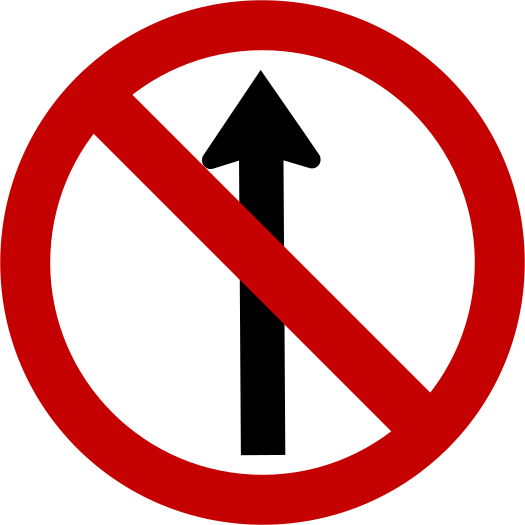
1. What does this traffic sign mean?
This traffic sign indicates that driving straight ahead is prohibited. Traffic may not continue straight ahead where the sign applies. Other movements may still be permitted unless another restriction applies.
English • Traffic sign R-3 • Prohibited direction. Vehicles must not travel on the road or carriageway in the direction indicated.
Português • R-3 • Sentido proibido. Proíbe o trânsito de veículos na via ou pista no sentido indicado pelo sinal.
Sources
🔗 Commons.wikimedia.org (Amateria1121 • CC BY-SA 3.0)
🔗 Gov.br • CONTRAN/SENATRAN: MBST, Volume I, página PDF 60
SVG source: Amateria1121 • CC BY-SA 3.0 • Original revision 2014-04-09. Wikimedia original unmodified.

2. What does this traffic sign mean?
This traffic sign indicates a warning for crossing deer. Deer or other wild animals may enter the road unexpectedly, especially around dawn or dusk. Reduce speed, watch the roadside carefully and be prepared for more than one animal to cross.
English • Traffic sign A-36 • Wild animals. Wild animals may be on the carriageway. Reduce speed and be prepared to stop.
Português • A-36 • Animais selvagens. Adverte sobre a possibilidade de animais selvagens na pista. Reduza a velocidade e esteja preparado para parar.
Sources
🔗 Commons.wikimedia.org
🔗 Gov.br • CONTRAN/SENATRAN: MBST, Volume II, página PDF 102
SVG source: Commons.wikimedia.org • Original SVG
Departamento Nacional de Infraestrutura de Transportes • Public domain • Original revision 2014-01-17. Wikimedia original unmodified.
Artwork reviewed against the Brazilian Manual Brasileiro de Sinalização de Trânsito (current SENATRAN catalogue): Gov.br • A-36, PDF page 102. Intentional educational illustration update from the previous PNG; original SVG unmodified.
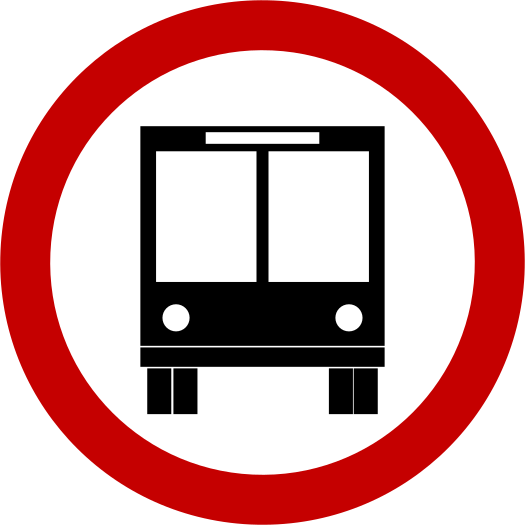
3. What does this traffic sign mean?
This traffic sign indicates a mandatory lane for buses. Buses must use the designated lane where the sign applies. Other road users may use the lane only where the applicable signs or local rules permit them to do so.
English • Traffic sign R-32 • Public passenger transport only. Observe supplementary hours, services and authorised exceptions.
Português • R-32 • Circulação exclusiva de veículos de transporte público coletivo. Indica circulação exclusiva de veículos de transporte público coletivo. Respeite eventuais informações complementares de horário, serviço e exceções autorizadas.
Sources
🔗 Commons.wikimedia.org (Amateria1121 • CC BY-SA 3.0)
🔗 Gov.br • CONTRAN/SENATRAN: MBST, Volume I, página PDF 107
🔗 Gov.br • Resolução CONTRAN nº986/2022, significado atualizado de R-32
SVG source: Amateria1121 • CC BY-SA 3.0 • Original revision 2014-04-09. Wikimedia original unmodified.

4. What does this traffic sign mean?
This traffic sign indicates a warning for roadworks. Construction or maintenance work is taking place on or beside the road. Reduce speed where necessary and be prepared for workers, machinery, temporary traffic signals, changed lane layouts or uneven road surfaces.
English • Traffic sign A-24 • Roadworks. Reduce speed and follow temporary signs and traffic controllers' instructions.
Português • A-24 • Obras. Adverte sobre obras ou serviços na via. Reduza a velocidade e siga a sinalização temporária e as orientações dos responsáveis pelo controle do trânsito.
Sources
🔗 Commons.wikimedia.org
🔗 Gov.br • CONTRAN/SENATRAN: MBST, Volume II, página PDF 90
🔗 Gov.br • MBST, Volume VII, sinalização de obras
SVG source: Commons.wikimedia.org • Original SVG
Departamento Nacional de Infraestrutura de Transportes • Public domain • Original revision 2014-01-17. Wikimedia original unmodified.
Artwork reviewed against the Brazilian Manual Brasileiro de Sinalização de Trânsito (current SENATRAN catalogue): Gov.br • A-24, PDF page 52. Intentional educational illustration update from the previous PNG; original SVG unmodified.

5. What does this traffic sign mean?
This traffic sign indicates a warning for a playground. Children may be playing close to the road and may enter or cross it unexpectedly. Reduce speed, watch the roadside carefully and be prepared to stop.
English • Traffic sign A-34 • Children. Children may be near the road. Reduce speed and be prepared to stop.
Português • A-34 • Crianças. Adverte sobre a presença de crianças nas proximidades da via. Reduza a velocidade e esteja preparado para parar.
Sources
🔗 Commons.wikimedia.org
🔗 Gov.br • CONTRAN/SENATRAN: MBST, Volume II, página PDF 113
SVG source: Commons.wikimedia.org • Original SVG
Departamento Nacional de Infraestrutura de Transportes • Public domain • Original revision 2014-01-17. Wikimedia original unmodified.
Artwork reviewed against the Brazilian Manual Brasileiro de Sinalização de Trânsito (current SENATRAN catalogue): Gov.br • A-34, PDF page 113. Intentional educational illustration update from the previous PNG; original SVG unmodified.

6. What does this traffic sign mean?
This traffic sign indicates a checkpoint with restricted entry. Road users may not proceed beyond the checkpoint unless they are authorised or permitted to continue according to the applicable rules and instructions.
English • Traffic sign R-21 • Customs. Indicates a customs office and compulsory stop. Stop and follow the officials' instructions.
Português • R-21 • Alfândega. Indica a presença de uma repartição alfandegária e a obrigatoriedade de parada. Pare e siga as instruções do controle.
Sources
🔗 Commons.wikimedia.org (Amateria1121 • CC BY-SA 3.0)
🔗 Gov.br • CONTRAN/SENATRAN: MBST, Volume I, página PDF 119
SVG source: Amateria1121 • CC BY-SA 3.0 • Original revision 2014-04-09. Wikimedia original unmodified.

7. What does this traffic sign mean?
This traffic sign indicates a warning for cyclists. Cyclists may be riding along or crossing the road ahead. Reduce speed, watch carefully for cyclists and maintain the passing distance required by the applicable local rules.
English • Traffic sign A-30a • Cyclists. Cyclists may be present ahead. Reduce speed and maintain a safe distance.
Português • A-30a • Trânsito de ciclistas. Adverte sobre a presença ou circulação de ciclistas adiante. Reduza a velocidade e mantenha distância segura.
Sources
🔗 Commons.wikimedia.org
🔗 Gov.br • CONTRAN/SENATRAN: MBST, Volume II, página PDF 106
SVG source: Commons.wikimedia.org • Original SVG
Departamento Nacional de Infraestrutura de Transportes • Public domain • Original revision 2014-01-17. Wikimedia original unmodified.
Artwork reviewed against the Brazilian Manual Brasileiro de Sinalização de Trânsito (current SENATRAN catalogue): Gov.br • A-30a, PDF page 106. Intentional educational illustration update from the previous PNG; original SVG unmodified.

8. What does this traffic sign mean?
This traffic sign indicates a warning for a railway crossing with barriers. It alerts drivers to an upcoming level crossing with gates or barriers that close when a train approaches. Drivers should be ready to stop when the barriers are down or flashing lights activate. Never attempt to cross when gates are closing or closed.
English • Traffic sign A-40 • Level crossing with barriers. Obey the controls and never cross while barriers are closed or moving.
Português • A-40 • Passagem de nível com barreira. Adverte sobre um cruzamento rodoferroviário em nível com barreira. Respeite os controles e nunca atravesse com a barreira fechada ou em movimento.
Sources
🔗 Commons.wikimedia.org
🔗 Gov.br • CONTRAN/SENATRAN: MBST, Volume II, página PDF 69
SVG source: Commons.wikimedia.org • Original SVG
Departamento Nacional de Infraestrutura de Transportes • Public domain • Original revision 2014-01-17. Wikimedia original unmodified.
Artwork reviewed against the Brazilian Manual Brasileiro de Sinalização de Trânsito (current SENATRAN catalogue): Gov.br • A-40, PDF page 69. Intentional educational illustration update from the previous PNG; original SVG unmodified.
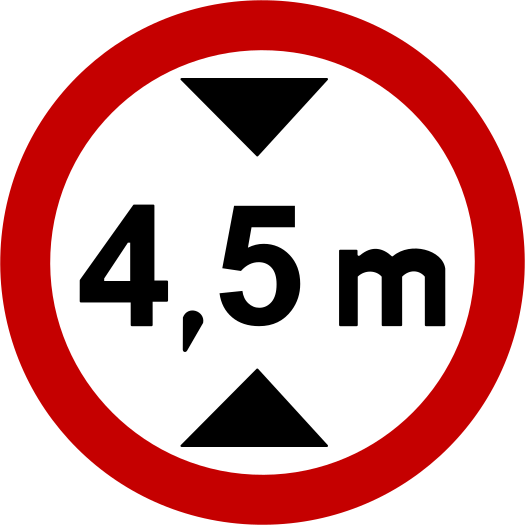
9. What does this traffic sign mean?
This traffic sign indicates that vehicles higher than indicated are prohibited. A vehicle or vehicle combination whose overall height, including its load, exceeds the displayed limit may not continue beyond the sign.
English • Traffic sign R-15 • Maximum permitted height. Vehicles higher than the illustrated 4.5 m, including the load, are prohibited.
Português • R-15 • Altura máxima permitida. Proíbe a passagem de veículos cuja altura, incluindo a carga, ultrapasse 4,5 m, valor mostrado na ilustração.
Sources
🔗 Commons.wikimedia.org (Amateria1121 • CC BY-SA 3.0)
🔗 Gov.br • CONTRAN/SENATRAN: MBST, Volume I, página PDF 123
SVG source: Amateria1121 • CC BY-SA 3.0 • Original revision 2014-04-09. Wikimedia original unmodified.

10. What does this traffic sign mean?
This traffic sign indicates a warning for a railway crossing with two or more tracks. It alerts drivers to a level crossing where more than one railway track crosses the road. More than one train may pass in succession or from different directions, so drivers should check carefully before crossing and never proceed until all tracks are clear.
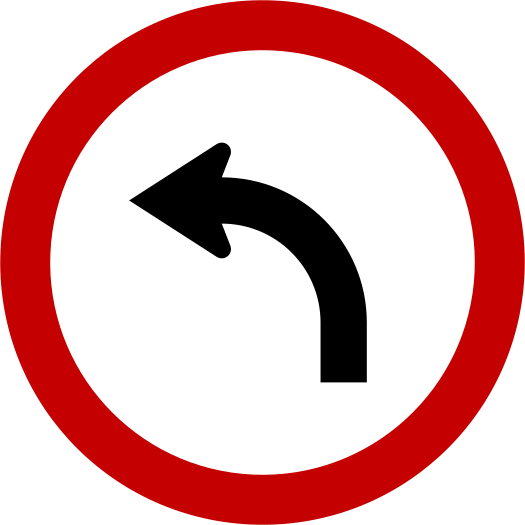
11. What does this traffic sign mean?
This traffic sign indicates that turning left is mandatory at the junction ahead. Traffic must turn left and may not continue straight ahead or turn right.
English • Traffic sign R-25a • Turn left. Turning left at the signed location is compulsory.
Português • R-25a • Vire à esquerda. Determina a conversão à esquerda no local sinalizado.
Sources
🔗 Commons.wikimedia.org (Amateria1121 • CC BY-SA 3.0)
🔗 Gov.br • CONTRAN/SENATRAN: MBST, Volume I, página PDF 73
SVG source: Amateria1121 • CC BY-SA 3.0 • Original revision 2014-04-09. Wikimedia original unmodified.

12. What does this traffic sign mean?
This traffic sign indicates a warning for an obstacle that may be passed on either side. A fixed obstacle or traffic island lies ahead. Pass on either permitted side while following the lane markings and any additional signs.
English • Traffic sign A-42c • Divided carriageway. An obstacle or central reservation divides the carriageway. Follow the signs and traffic channelisation.
Português • A-42c • Pista dividida. Adverte sobre a divisão da pista por um obstáculo ou canteiro. Siga a sinalização e a canalização do trânsito.
Sources
🔗 Commons.wikimedia.org
🔗 Gov.br • CONTRAN/SENATRAN: MBST, Volume II, página PDF 87
SVG source: Commons.wikimedia.org • Original SVG
Departamento Nacional de Infraestrutura de Transportes • Public domain • Original revision 2014-01-17. Wikimedia original unmodified.
Artwork reviewed against the Brazilian Manual Brasileiro de Sinalização de Trânsito (current SENATRAN catalogue): Gov.br • A-42c, PDF page 87. Intentional educational illustration update from the previous PNG; original SVG unmodified.

13. What does this traffic sign mean?
This traffic sign indicates a warning for trams. Tram tracks cross or run along the road ahead, and trams may enter the traffic path. Reduce speed, watch carefully for approaching trams and follow the applicable traffic signals, priority signs and local rules.
English • Traffic sign A-16 • Tram or light rail. Rail vehicles may travel along or cross the road. Watch them and obey local controls.
Português • A-16 • Bonde ou VLT. Adverte sobre a circulação ou o cruzamento de bonde ou veículo leve sobre trilhos. Observe os veículos ferroviários e respeite os controles do local.
Sources
🔗 Commons.wikimedia.org
🔗 Gov.br • CONTRAN/SENATRAN: MBST, Volume II, página PDF 67
SVG source: Commons.wikimedia.org • Original SVG
Departamento Nacional de Infraestrutura de Transportes • Public domain • Original revision 2014-01-17. Wikimedia original unmodified.
Artwork reviewed against the Brazilian Manual Brasileiro de Sinalização de Trânsito (current SENATRAN catalogue): Gov.br • A-16, PDF page 67. Intentional educational illustration update from the previous PNG; original SVG unmodified.
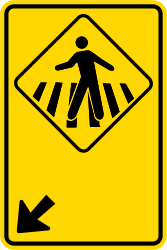
14. What does this traffic sign mean?
This traffic sign indicates a crossing for pedestrians. It marks a designated place where pedestrians cross the road. Priority and crossing rules depend on the applicable traffic signs, signals and local regulations.

15. What does this traffic sign mean?
This traffic sign indicates a warning for children. Children may be present on or near the road and may cross unexpectedly. Reduce speed, scan both sides of the road carefully and be prepared to stop.
English • Traffic sign A-33a • School area. Pupils may be on or near the road. Reduce speed and take extra care.
Português • A-33a • Área escolar. Adverte sobre uma área escolar, com possível presença de estudantes na via ou em suas proximidades. Reduza a velocidade e redobre a atenção.
Sources
🔗 Commons.wikimedia.org
🔗 Gov.br • CONTRAN/SENATRAN: MBST, Volume II, página PDF 111
SVG source: Commons.wikimedia.org • Original SVG
Departamento Nacional de Infraestrutura de Transportes • Public domain • Original revision 2014-01-17. Wikimedia original unmodified.
Artwork reviewed against the Brazilian Manual Brasileiro de Sinalização de Trânsito (current SENATRAN catalogue): Gov.br • A-33a, PDF page 111. Intentional educational illustration update from the previous PNG; original SVG unmodified.

16. What does this traffic sign mean?
This traffic sign indicates a warning for a roundabout. A roundabout lies ahead. Reduce speed and follow the applicable priority signs, traffic signals and local roundabout rules when approaching and entering it.
English • Traffic sign A-12 • Circular junction. Warns of a junction such as a roundabout. Reduce speed and observe the entry priority signs.
Português • A-12 • Interseção em círculo. Adverte sobre uma interseção em círculo, como uma rotatória. Reduza a velocidade e respeite a sinalização de preferência do acesso.
Sources
🔗 Commons.wikimedia.org
🔗 Gov.br • CONTRAN/SENATRAN: MBST, Volume II, página PDF 62
SVG source: Commons.wikimedia.org • Original SVG
Departamento Nacional de Infraestrutura de Transportes • Public domain • Original revision 2014-01-17. Wikimedia original unmodified.
Artwork reviewed against the Brazilian Manual Brasileiro de Sinalização de Trânsito (current SENATRAN catalogue): Gov.br • A-12, PDF page 62. Intentional educational illustration update from the previous PNG; original SVG unmodified.
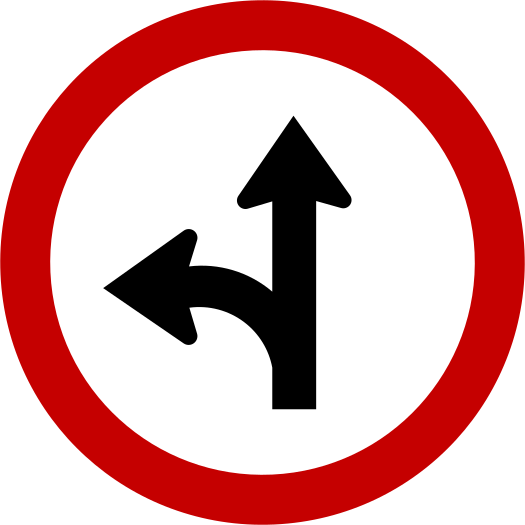
17. What does this traffic sign mean?
This traffic sign indicates that traffic must continue straight ahead or turn left. One of the indicated directions must be followed; turning right is prohibited.
English • Traffic sign R-25c • Straight ahead or left. These movements are permitted at the signed location; other movements are prohibited.
Português • R-25c • Siga em frente ou à esquerda. Permite seguir em frente ou virar à esquerda no local sinalizado; os demais movimentos não são permitidos.
Sources
🔗 Commons.wikimedia.org (Amateria1121 • CC BY-SA 3.0)
🔗 Gov.br • CONTRAN/SENATRAN: MBST, Volume I, página PDF 77
SVG source: Amateria1121 • CC BY-SA 3.0 • Original revision 2014-04-09. Wikimedia original unmodified.
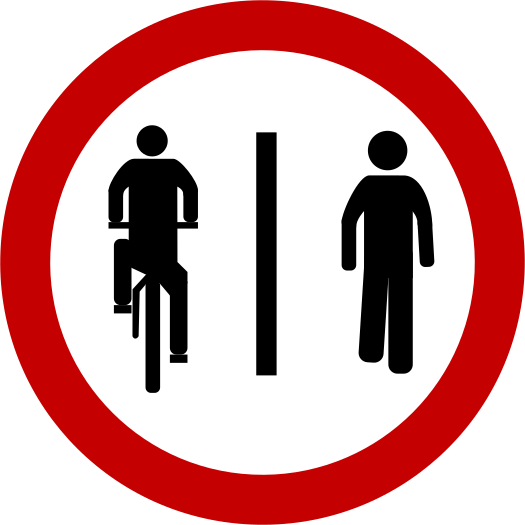
18. What does this traffic sign mean?
This traffic sign indicates a mandatory divided path for pedestrians and cyclists. Pedestrians and cyclists must use the section designated for them. Other road users may use the path only where the applicable signs or local rules permit them to do so.
English • Traffic sign R-36a • Cyclists on the left, pedestrians on the right. These groups must use the indicated sides of the signed area, road, carriageway or pavement.
Português • R-36a • Ciclistas à esquerda, pedestres à direita. Determina que os ciclistas circulem pelo lado esquerdo e os pedestres pelo lado direito da área, via, pista ou passeio sinalizado.
Sources
🔗 Commons.wikimedia.org (Amateria1121 • CC BY-SA 3.0)
🔗 Gov.br • CONTRAN/SENATRAN: MBST, Volume I, página PDF 149
SVG source: Amateria1121 • CC BY-SA 3.0 • Original revision 2014-05-02. Wikimedia original unmodified.
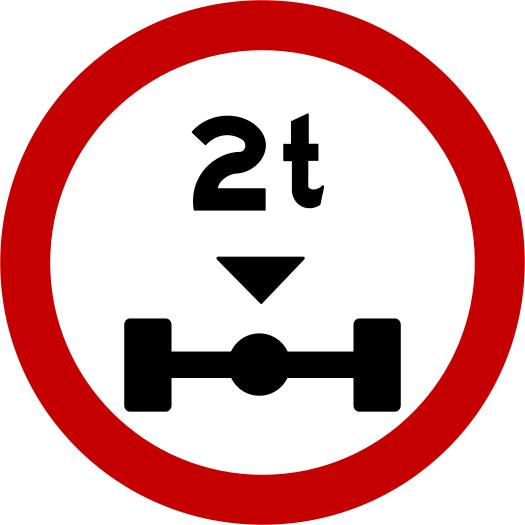
19. What does this traffic sign mean?
This traffic sign indicates that vehicles exceeding the indicated axle-load limit are prohibited. A vehicle whose load on an axle exceeds the displayed limit may not continue beyond the sign.
English • Traffic sign R-17 • Maximum permitted axle load. Vehicles whose axle load exceeds the illustrated 2 t are prohibited.
Português • R-17 • Peso máximo permitido por eixo. Proíbe a passagem de veículos cujo peso por eixo ultrapasse 2 t, valor mostrado na ilustração.
Sources
🔗 Commons.wikimedia.org (Amateria1121 • CC BY-SA 3.0)
🔗 Gov.br • CONTRAN/SENATRAN: MBST, Volume I, página PDF 127
SVG source: Amateria1121 • CC BY-SA 3.0 • Original revision 2014-04-09. Wikimedia original unmodified.
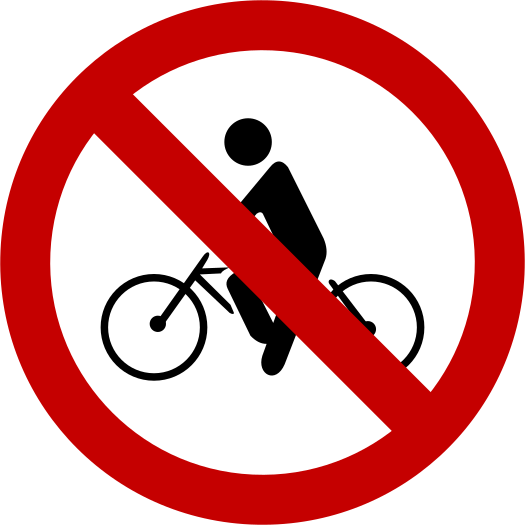
20. What does this traffic sign mean?
This traffic sign indicates that cyclists are prohibited. Cyclists may not enter or continue beyond the sign. Other road users may still be permitted unless another restriction applies.
English • Traffic sign R-12 • No bicycles. Bicycle traffic is prohibited in the signed area, road, carriageway or lane.
Português • R-12 • Proibido trânsito de bicicletas. Proíbe o trânsito de bicicletas na área, via, pista ou faixa sinalizada.
Sources
🔗 Commons.wikimedia.org (Amateria1121 • CC BY-SA 3.0)
🔗 Gov.br • CONTRAN/SENATRAN: MBST, Volume I, página PDF 103
SVG source: Amateria1121 • CC BY-SA 3.0 • Original revision 2014-04-09. Wikimedia original unmodified.

21. What does this traffic sign mean?
This traffic sign indicates a warning for merging traffic from the right. Traffic travelling in the same general direction may join your traffic stream from the right. Stay alert for entering vehicles and follow the applicable priority signs and local rules.
English • Traffic sign A-13b • Merging traffic from the right. Another traffic stream merges from the right. Adjust speed and maintain a safe distance.
Português • A-13b • Confluência à direita. Adverte sobre a confluência de outra corrente de trânsito pela direita. Ajuste a velocidade e mantenha uma distância segura.
Sources
🔗 Commons.wikimedia.org
🔗 Gov.br • CONTRAN/SENATRAN: MBST, Volume II, página PDF 55
SVG source: Commons.wikimedia.org • Original SVG
Departamento Nacional de Infraestrutura de Transportes • Public domain • Original revision 2014-01-17. Wikimedia original unmodified.
Artwork reviewed against the Brazilian Manual Brasileiro de Sinalização de Trânsito (current SENATRAN catalogue): Gov.br • A-13b, PDF page 55. Intentional educational illustration update from the previous PNG; original SVG unmodified.
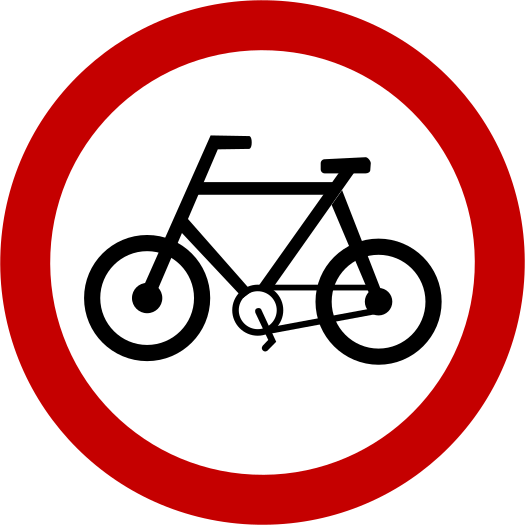
22. What does this traffic sign mean?
This traffic sign indicates a mandatory path for cyclists. Cyclists must use the designated path where the sign applies. Other road users may use the path only where the applicable signs or local rules permit them to do so.
English • Traffic sign R-34 • Bicycles only. Reserves the area, road, carriageway or lane for bicycles.
Português • R-34 • Circulação exclusiva de bicicletas. Reserva a área, via, pista ou faixa à circulação de bicicletas.
Sources
🔗 Commons.wikimedia.org (Amateria1121 • CC BY-SA 3.0)
🔗 Gov.br • CONTRAN/SENATRAN: MBST, Volume I, página PDF 109
SVG source: Amateria1121 • CC BY-SA 3.0 • Original revision 2014-05-02. Wikimedia original unmodified.
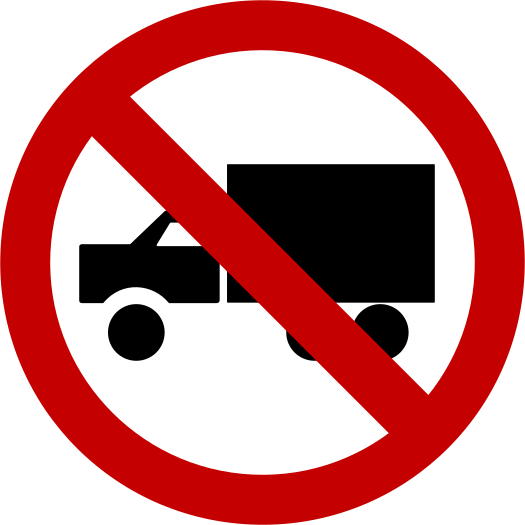
23. What does this traffic sign mean?
This traffic sign indicates that trucks are prohibited. Trucks covered by the sign may not enter or continue beyond it. Any applicable weight threshold or vehicle-category limitation is determined by the sign, supplementary information and local rules.
English • Traffic sign R-9 • No lorries. Lorries are prohibited in the signed area, road, carriageway or lane.
Português • R-9 • Proibido trânsito de caminhões. Proíbe o trânsito de caminhões na área, via, pista ou faixa sinalizada.
Sources
🔗 Commons.wikimedia.org (Amateria1121 • CC BY-SA 3.0)
🔗 Gov.br • CONTRAN/SENATRAN: MBST, Volume I, página PDF 97
SVG source: Amateria1121 • CC BY-SA 3.0 • Original revision 2014-04-09. Wikimedia original unmodified.
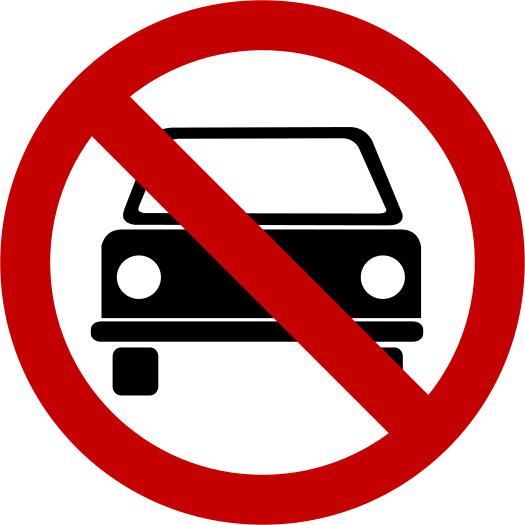
24. What does this traffic sign mean?
This traffic sign indicates that cars are prohibited. Cars may not enter or continue beyond the sign. Other road users may still be permitted unless another restriction applies.
English • Traffic sign R-10 • No motor vehicles. Motor vehicles are prohibited in the signed area, road, carriageway or lane.
Português • R-10 • Proibido trânsito de veículos automotores. Proíbe o trânsito de veículos automotores na área, via, pista ou faixa sinalizada.
Sources
🔗 Commons.wikimedia.org (Amateria1121 • CC BY-SA 3.0)
🔗 Gov.br • CONTRAN/SENATRAN: MBST, Volume I, página PDF 99
SVG source: Amateria1121 • CC BY-SA 3.0 • Original revision 2014-04-09. Wikimedia original unmodified.

25. What does this traffic sign mean?
This traffic sign indicates a warning for a speed bump. A raised traffic-calming feature lies ahead. Reduce speed before reaching it to maintain vehicle control and avoid damage or discomfort.
English • Traffic sign A-18 • Hump. Reduce speed before passing over the raised surface.
Português • A-18 • Saliência ou lombada. Adverte sobre uma saliência ou lombada na pista. Reduza a velocidade antes de passar pelo local.
Sources
🔗 Commons.wikimedia.org
🔗 Gov.br • CONTRAN/SENATRAN: MBST, Volume II, página PDF 75
SVG source: Commons.wikimedia.org • Original SVG
Departamento Nacional de Infraestrutura de Transportes • Public domain • Original revision 2014-01-17. Wikimedia original unmodified.
Artwork reviewed against the Brazilian Manual Brasileiro de Sinalização de Trânsito (current SENATRAN catalogue): Gov.br • A-18, PDF page 75. Intentional educational illustration update from the previous PNG; original SVG unmodified.

26. What does this traffic sign mean?
This traffic sign indicates a warning for an unpaved road surface. The paved surface ends or changes to gravel, dirt or another loose material. Reduce speed and be prepared for reduced grip, uneven surfaces, dust and loose stones.

27. What does this traffic sign mean?
This traffic sign indicates a warning for a sharp curve to the right. A tight right-hand bend lies ahead. Reduce speed before entering the curve, remain within your lane and use smooth steering, particularly when visibility or road grip is reduced.
English • Traffic sign A-1b • Sharp right-hand bend. Reduce speed in advance.
Português • A-1b • Curva acentuada à direita. Adverte sobre uma curva acentuada à direita. Reduza a velocidade com antecedência.
Sources
🔗 Commons.wikimedia.org
🔗 Gov.br • CONTRAN/SENATRAN: MBST, Volume II, página PDF 35
SVG source: Commons.wikimedia.org • Original SVG
Departamento Nacional de Infraestrutura de Transportes • Public domain • Original revision 2014-01-17. Wikimedia original unmodified.
Artwork reviewed against the Brazilian Manual Brasileiro de Sinalização de Trânsito (current SENATRAN catalogue): Gov.br • A-1b, PDF page 35. Intentional educational illustration update from the previous PNG; original SVG unmodified.

28. What does this traffic sign mean?
This traffic sign indicates a warning for loose chippings. Loose stones or gravel may reduce tyre grip and can be thrown up by passing vehicles. Reduce speed, increase your following distance and avoid sudden braking, acceleration or steering movements.
English • Traffic sign A-29 • Flying gravel. Gravel or stones may be thrown up. Reduce speed and keep clear of other vehicles.
Português • A-29 • Projeção de cascalho. Adverte sobre a possibilidade de projeção de cascalho ou pedras. Reduza a velocidade e mantenha distância dos outros veículos.
Sources
🔗 Commons.wikimedia.org
🔗 Gov.br • CONTRAN/SENATRAN: MBST, Volume II, página PDF 100
SVG source: Commons.wikimedia.org • Original SVG
Departamento Nacional de Infraestrutura de Transportes • Public domain • Original revision 2014-01-17. Wikimedia original unmodified.
Artwork reviewed against the Brazilian Manual Brasileiro de Sinalização de Trânsito (current SENATRAN catalogue): Gov.br • A-29, PDF page 100. Intentional educational illustration update from the previous PNG; original SVG unmodified.

29. What does this traffic sign mean?
This traffic sign indicates a warning for a weight restriction. A maximum permitted vehicle weight applies ahead. Drivers of heavy vehicles should check the applicable vehicle weight and use another route if the limit would be exceeded.
English • Traffic sign A-46 • Gross mass limit ahead. The illustration shows 10 t. Observe the restriction and local regulatory signs.
Português • A-46 • Peso bruto total limitado. Adverte sobre uma limitação de peso bruto total adiante; a ilustração indica 10 t. Observe a restrição e a sinalização de regulamentação do local.
Sources
🔗 Commons.wikimedia.org
🔗 Gov.br • CONTRAN/SENATRAN: MBST, Volume II, página PDF 117
SVG source: Commons.wikimedia.org • Original SVG
Departamento Nacional de Infraestrutura de Transportes • Public domain • Original revision 2014-01-17. Wikimedia original unmodified.
Artwork reviewed against the Brazilian Manual Brasileiro de Sinalização de Trânsito (current SENATRAN catalogue): Gov.br • A-46, PDF page 117. Intentional educational illustration update from the previous PNG; original SVG unmodified.

30. What does this traffic sign mean?
This traffic sign means stop and give way. You must come to a complete stop before entering the intersection and give way to traffic that has priority. Proceed only when it is safe.
English • Traffic sign R-1 • Compulsory stop. Stop completely before entering or crossing the road. Proceed only when safe.
Português • R-1 • Parada obrigatória. Pare completamente antes de entrar ou cruzar a via. Prossiga somente quando houver segurança.
Sources
🔗 Commons.wikimedia.org (Amateria1121 • CC BY-SA 3.0)
🔗 Gov.br • CONTRAN/SENATRAN: MBST, Volume I, página PDF 29
SVG source: Amateria1121 • CC BY-SA 3.0 • Original revision 2014-04-09. Wikimedia original unmodified.

31. What does this traffic sign mean?
This traffic sign indicates a warning for a road narrowing on the right. The available road width decreases from the right side ahead. Reduce speed, follow the lane markings and maintain sufficient clearance from other traffic and the road edge.
English • Traffic sign A-21c • Road narrows on the right. The carriageway narrows on the right ahead.
Português • A-21c • Estreitamento de pista à direita. Adverte que a pista se estreita pelo lado direito adiante.
Sources
🔗 Commons.wikimedia.org
🔗 Gov.br • CONTRAN/SENATRAN: MBST, Volume II, página PDF 80
SVG source: Commons.wikimedia.org • Original SVG
Departamento Nacional de Infraestrutura de Transportes • Public domain • Original revision 2014-01-17. Wikimedia original unmodified.
Artwork reviewed against the Brazilian Manual Brasileiro de Sinalização de Trânsito (current SENATRAN catalogue): Gov.br • A-21c, PDF page 80. Intentional educational illustration update from the previous PNG; original SVG unmodified.

32. What does this traffic sign mean?
This traffic sign indicates that parking is permitted. Vehicles may park in the area covered by the sign, subject to any conditions shown on supplementary signs or road markings.
English • Traffic sign R-6b • Regulated parking. Parking is permitted under the specified conditions. Observe supplementary hours, duration and authorised categories.
Português • R-6b • Estacionamento regulamentado. Indica um local onde o estacionamento é permitido nas condições estabelecidas. Respeite as informações complementares, como horários, duração ou categorias autorizadas.
Sources
🔗 Commons.wikimedia.org (Amateria1121 • CC BY-SA 3.0)
🔗 Gov.br • CONTRAN/SENATRAN: MBST, Volume I, página PDF 137
SVG source: Amateria1121 • CC BY-SA 3.0 • Original revision 2014-04-09. Wikimedia original unmodified.

33. What does this traffic sign mean?
This traffic sign indicates a warning for a slippery road surface. The road ahead may provide reduced tyre grip because of water, ice, mud, oil or another surface condition. Reduce speed and avoid sudden braking, acceleration or steering movements.
English • Traffic sign A-28 • Slippery carriageway. Reduce speed and avoid harsh braking or abrupt manoeuvres.
Português • A-28 • Pista escorregadia. Adverte sobre uma pista que pode estar escorregadia. Reduza a velocidade e evite frenagens ou manobras bruscas.
Sources
🔗 Commons.wikimedia.org
🔗 Gov.br • CONTRAN/SENATRAN: MBST, Volume II, página PDF 98
SVG source: Commons.wikimedia.org • Original SVG
Departamento Nacional de Infraestrutura de Transportes • Public domain • Original revision 2014-01-17. Wikimedia original unmodified.
Artwork reviewed against the Brazilian Manual Brasileiro de Sinalização de Trânsito (current SENATRAN catalogue): Gov.br • A-28, PDF page 98. Intentional educational illustration update from the previous PNG; original SVG unmodified.

34. What does this traffic sign mean?
This traffic sign indicates a warning for two-way traffic. Oncoming traffic will use the same road or carriageway ahead. Keep to the correct side of the road and overtake only where it is permitted and clearly safe.
English • Traffic sign A-25 • Two-way traffic ahead. Keep right and watch for oncoming vehicles.
Português • A-25 • Mão dupla adiante. Adverte que, adiante, a circulação passa a ocorrer nos dois sentidos. Mantenha-se à direita e observe os veículos em sentido contrário.
Sources
🔗 Commons.wikimedia.org
🔗 Gov.br • CONTRAN/SENATRAN: MBST, Volume II, página PDF 92
SVG source: Commons.wikimedia.org • Original SVG
Departamento Nacional de Infraestrutura de Transportes • Public domain • Original revision 2014-01-17. Wikimedia original unmodified.
Artwork reviewed against the Brazilian Manual Brasileiro de Sinalização de Trânsito (current SENATRAN catalogue): Gov.br • A-25, PDF page 92. Intentional educational illustration update from the previous PNG; original SVG unmodified.

35. What does this traffic sign mean?
This traffic sign indicates a warning for a height restriction. The available clearance ahead is limited, for example at a bridge, tunnel or other overhead structure. Drivers of tall vehicles should check their vehicle height and use another route if the vehicle cannot pass safely.
English • Traffic sign A-37 • Height limit ahead. The illustration shows 4.5 m. Check vehicle and load height before proceeding.
Português • A-37 • Altura limitada. Adverte sobre uma limitação de altura adiante; a ilustração indica 4,5 m. Verifique a altura do veículo e da carga antes de prosseguir.
Sources
🔗 Commons.wikimedia.org
🔗 Gov.br • CONTRAN/SENATRAN: MBST, Volume II, página PDF 115
SVG source: Commons.wikimedia.org • Original SVG
Departamento Nacional de Infraestrutura de Transportes • Public domain • Original revision 2022-12-25. Wikimedia original unmodified.
Artwork reviewed against the Brazilian Manual Brasileiro de Sinalização de Trânsito (current SENATRAN catalogue): Gov.br • A-37, PDF page 115. Intentional educational illustration update from the previous PNG; original SVG unmodified.

36. What does this traffic sign mean?
This traffic sign indicates that turning right is mandatory at the junction ahead. Traffic must turn right and may not continue straight ahead or turn left.
English • Traffic sign R-25b • Turn right. Turning right at the signed location is compulsory.
Português • R-25b • Vire à direita. Determina a conversão à direita no local sinalizado.
Sources
🔗 Commons.wikimedia.org (Amateria1121 • CC BY-SA 3.0)
🔗 Gov.br • CONTRAN/SENATRAN: MBST, Volume I, página PDF 75
SVG source: Amateria1121 • CC BY-SA 3.0 • Original revision 2014-04-09. Wikimedia original unmodified.
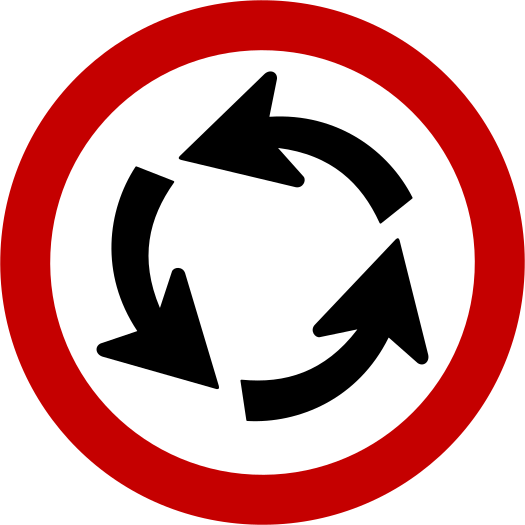
37. What does this traffic sign mean?
This traffic sign indicates the mandatory direction around a roundabout. Traffic must circulate in the direction shown by the arrows. The sign does not itself determine priority; follow the applicable priority signs, traffic signals and local rules.
English • Traffic sign R-33 • Roundabout direction. Traffic must circulate anticlockwise as shown by the arrows.
Português • R-33 • Sentido de circulação na rotatória. Determina que a circulação na rotatória deve ocorrer no sentido anti-horário indicado pelas setas.
Sources
🔗 Commons.wikimedia.org (Amateria1121 • CC BY-SA 3.0)
🔗 Gov.br • CONTRAN/SENATRAN: MBST, Volume I, página PDF 58
SVG source: Amateria1121 • CC BY-SA 3.0 • Original revision 2014-04-09. Wikimedia original unmodified.

38. What does this traffic sign mean?
This traffic sign indicates a warning for a side road from the right. A side road joins the road ahead from the right at an uncontrolled junction. Reduce speed, watch for traffic entering from the side road and follow the applicable default priority rules.
English • Traffic sign A-7b • Side road on the right. Warns of a road joining the carriageway from the right.
Português • A-7b • Via lateral à direita. Adverte sobre uma via lateral que se liga à pista pela direita.
Sources
🔗 Commons.wikimedia.org
🔗 Gov.br • CONTRAN/SENATRAN: MBST, Volume II, página PDF 51
SVG source: Commons.wikimedia.org • Original SVG
Departamento Nacional de Infraestrutura de Transportes • Public domain • Original revision 2014-01-17. Wikimedia original unmodified.
Artwork reviewed against the Brazilian Manual Brasileiro de Sinalização de Trânsito (current SENATRAN catalogue): Gov.br • A-7b, PDF page 51. Intentional educational illustration update from the previous PNG; original SVG unmodified.
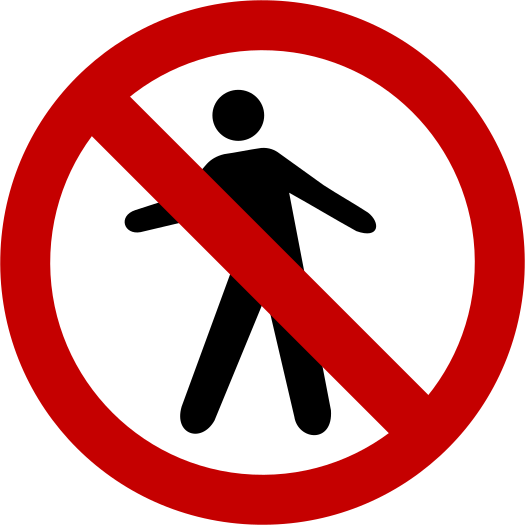
39. What does this traffic sign mean?
This traffic sign indicates that pedestrians are prohibited. Pedestrians may not enter or continue beyond the sign. Other road users may still be permitted unless another restriction applies.
English • Traffic sign R-29 • No pedestrians. Pedestrian traffic is prohibited in the signed area, road or carriageway.
Português • R-29 • Proibido trânsito de pedestres. Proíbe o trânsito de pedestres na área, via ou pista sinalizada.
Sources
🔗 Commons.wikimedia.org (Amateria1121 • CC BY-SA 3.0)
🔗 Gov.br • CONTRAN/SENATRAN: MBST, Volume I, página PDF 144
SVG source: Amateria1121 • CC BY-SA 3.0 • Original revision 2014-04-09. Wikimedia original unmodified.

40. What does this traffic sign mean?
This traffic sign indicates a warning for a narrowing ahead. The available road width decreases ahead. Reduce speed when necessary and be prepared for less lateral space between vehicles, obstacles or the road edge.
English • Traffic sign A-22 • Narrow bridge. The bridge is narrower than the approach carriageway. Reduce speed and take care when meeting other vehicles.
Português • A-22 • Ponte estreita. Adverte sobre uma ponte cuja largura é menor que a da pista de aproximação. Reduza a velocidade e tenha cuidado ao cruzar com outros veículos.
Sources
🔗 Commons.wikimedia.org
🔗 Gov.br • CONTRAN/SENATRAN: MBST, Volume II, página PDF 84
SVG source: Commons.wikimedia.org • Original SVG
Departamento Nacional de Infraestrutura de Transportes • Public domain • Original revision 2014-01-17. Wikimedia original unmodified.
Artwork reviewed against the Brazilian Manual Brasileiro de Sinalização de Trânsito (current SENATRAN catalogue): Gov.br • A-22, PDF page 84. Intentional educational illustration update from the previous PNG; original SVG unmodified.
41. What does this traffic sign mean?
This traffic sign indicates a warning for a curve to the right. A right-hand bend lies ahead. Reduce speed before entering the curve, maintain your lane position and use smooth steering.
English • Traffic sign A-2b • Right-hand bend. Reduce speed before the bend.
Português • A-2b • Curva à direita. Adverte sobre uma curva à direita. Reduza a velocidade antes de entrar na curva.
Sources
🔗 Commons.wikimedia.org
🔗 Gov.br • CONTRAN/SENATRAN: MBST, Volume II, página PDF 38
SVG source: Commons.wikimedia.org • Original SVG
Departamento Nacional de Infraestrutura de Transportes • Public domain • Original revision 2014-01-17. Wikimedia original unmodified.
Artwork reviewed against the Brazilian Manual Brasileiro de Sinalização de Trânsito (current SENATRAN catalogue): Gov.br • A-2b, PDF page 38. Intentional educational illustration update from the previous PNG; original SVG unmodified.
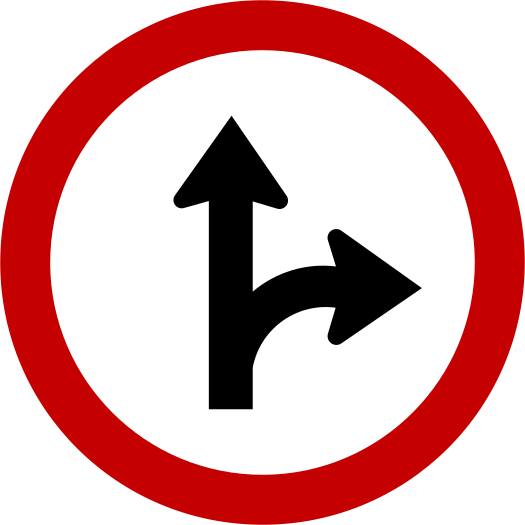
42. What does this traffic sign mean?
This traffic sign indicates that traffic must continue straight ahead or turn right. One of the indicated directions must be followed; turning left is prohibited.
English • Traffic sign R-25d • Straight ahead or right. These movements are permitted at the signed location; other movements are prohibited.
Português • R-25d • Siga em frente ou à direita. Permite seguir em frente ou virar à direita no local sinalizado; os demais movimentos não são permitidos.
Sources
🔗 Commons.wikimedia.org (Amateria1121 • CC BY-SA 3.0)
🔗 Gov.br • CONTRAN/SENATRAN: MBST, Volume I, página PDF 80
SVG source: Amateria1121 • CC BY-SA 3.0 • Original revision 2014-04-09. Wikimedia original unmodified.
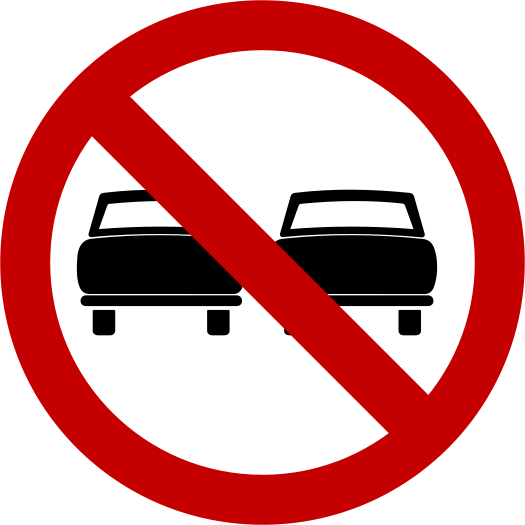
43. What does this traffic sign mean?
This traffic sign indicates that overtaking is prohibited. The vehicles covered by the prohibition and any categories that may still be overtaken depend on the applicable local rules.
English • Traffic sign R-7 • No overtaking. Prohibits overtaking using the lane for opposing traffic on the regulated section.
Português • R-7 • Proibido ultrapassar. Proíbe ultrapassar utilizando a faixa destinada ao sentido oposto de circulação, no trecho regulamentado.
Sources
🔗 Commons.wikimedia.org (Amateria1121 • CC BY-SA 3.0)
🔗 Gov.br • CONTRAN/SENATRAN: MBST, Volume I, página PDF 85
SVG source: Amateria1121 • CC BY-SA 3.0 • Original revision 2014-04-09. Wikimedia original unmodified.

44. What does this traffic sign mean?
This traffic sign indicates that traffic must pass an obstacle on the right. Keep to the right of the obstacle and follow any accompanying signs or road markings.
English • Traffic sign R-24b • Compulsory passage. Pass on the arrow's side, here to the right of the obstacle or central reservation.
Português • R-24b • Passagem obrigatória. Determina a passagem pelo lado indicado pela seta, neste caso à direita do obstáculo ou canteiro.
Sources
🔗 Commons.wikimedia.org (Amateria1121 • CC BY-SA 3.0)
🔗 Gov.br • CONTRAN/SENATRAN: MBST, Volume I, página PDF 71
SVG source: Amateria1121 • CC BY-SA 3.0 • Original revision 2014-04-09. Wikimedia original unmodified.

45. What does this traffic sign mean?
This traffic sign means give way. Slow down and give way to traffic that has priority. Stop if necessary and proceed only when it is safe.
English • Traffic sign R-2 • Give way. Give priority to vehicles on the road you are entering or crossing. Slow down or stop if necessary.
Português • R-2 • Dê a preferência. Dê a preferência aos veículos que circulam na via que você vai entrar ou cruzar. Reduza a velocidade ou pare, se necessário.
Sources
🔗 Commons.wikimedia.org (Amateria1121 • CC BY-SA 3.0)
🔗 Gov.br • CONTRAN/SENATRAN: MBST, Volume I, página PDF 32
SVG source: Amateria1121 • CC BY-SA 3.0 • Original revision 2014-04-09. Wikimedia original unmodified.
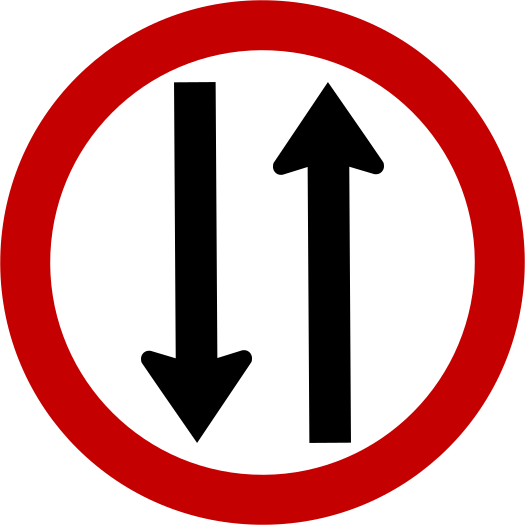
46. What does this traffic sign mean?
This traffic sign indicates the start of two-way traffic. From this point, traffic may travel in both directions on the road. Be prepared for oncoming vehicles.
English • Traffic sign R-28 • Two-way traffic. The road or carriageway begins carrying traffic in both directions.
Português • R-28 • Duplo sentido de circulação. Indica que a via ou pista passa a ter circulação nos dois sentidos.
Sources
🔗 Commons.wikimedia.org (Amateria1121 • CC BY-SA 3.0)
🔗 Gov.br • CONTRAN/SENATRAN: MBST, Volume I, página PDF 56
SVG source: Amateria1121 • CC BY-SA 3.0 • Original revision 2014-04-09. Wikimedia original unmodified.

47. What does this traffic sign mean?
This traffic sign indicates a warning for a railway crossing without barriers. It alerts drivers to an upcoming level crossing where railway tracks cross the road and no barriers or gates are present to stop traffic. Drivers should slow down and look both ways for trains.
English • Traffic sign A-39 • Level crossing without barriers. Reduce speed, check the tracks and obey crossing controls.
Português • A-39 • Passagem de nível sem barreira. Adverte sobre um cruzamento rodoferroviário em nível sem barreira. Reduza a velocidade, observe a linha férrea e respeite os controles do cruzamento.
Sources
🔗 Commons.wikimedia.org
🔗 Gov.br • CONTRAN/SENATRAN: MBST, Volume II, página PDF 69
SVG source: Commons.wikimedia.org • Original SVG
Departamento Nacional de Infraestrutura de Transportes • Public domain • Original revision 2014-01-17. Wikimedia original unmodified.
Artwork reviewed against the Brazilian Manual Brasileiro de Sinalização de Trânsito (current SENATRAN catalogue): Gov.br • A-39, PDF page 69. Intentional educational illustration update from the previous PNG; original SVG unmodified.
48. What does this traffic sign mean?
This traffic sign indicates a warning for a series of curves. One or more changes in direction lie ahead and may occur in quick succession. Reduce speed before entering the winding section, maintain your lane position and use smooth steering.
English • Traffic sign A-3b • Winding road, first to the right. Warns of a series of bends, first to the right.
Português • A-3b • Pista sinuosa à direita. Adverte sobre uma sequência de curvas, sendo a primeira à direita.
Sources
🔗 Commons.wikimedia.org
🔗 Gov.br • CONTRAN/SENATRAN: MBST, Volume II, página PDF 41
SVG source: Commons.wikimedia.org • Original SVG
Departamento Nacional de Infraestrutura de Transportes • Public domain • Original revision 2014-01-17. Wikimedia original unmodified.
Artwork reviewed against the Brazilian Manual Brasileiro de Sinalização de Trânsito (current SENATRAN catalogue): Gov.br • A-3b, PDF page 41. Intentional educational illustration update from the previous PNG; original SVG unmodified.
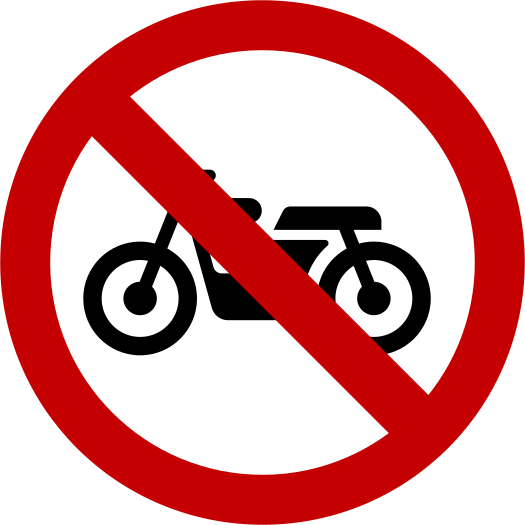
49. What does this traffic sign mean?
This traffic sign indicates that motorcycles are prohibited. Motorcyclists may not enter or continue beyond the sign. Other road users may still be permitted unless another restriction applies.
English • Traffic sign R-37 • No motorcycles, scooters or mopeds. These vehicles are prohibited in the signed area, road, carriageway or lane.
Português • R-37 • Proibido trânsito de motocicletas, motonetas e ciclomotores. Proíbe o trânsito de motocicletas, motonetas e ciclomotores na área, via, pista ou faixa sinalizada.
Sources
🔗 Commons.wikimedia.org (Amateria1121 • CC BY-SA 3.0)
🔗 Gov.br • CONTRAN/SENATRAN: MBST, Volume I, página PDF 111
SVG source: Amateria1121 • CC BY-SA 3.0 • Original revision 2014-04-29. Wikimedia original unmodified.

50. What does this traffic sign mean?
This traffic sign indicates a warning for the end of a divided road. The separation between opposing directions of traffic ends ahead, and oncoming traffic will no longer be divided by a central reservation. Reduce speed and adjust to the new road layout.
English • Traffic sign A-42b • Dual carriageway ends. Physical separation between opposing streams ends. Prepare for oncoming traffic on the same carriageway.
Português • A-42b • Fim de pista dupla. Adverte que termina a separação física entre os sentidos de circulação. Prepare-se para o trânsito em sentidos opostos na mesma pista.
Sources
🔗 Commons.wikimedia.org
🔗 Gov.br • CONTRAN/SENATRAN: MBST, Volume II, página PDF 85
SVG source: Commons.wikimedia.org • Original SVG
Departamento Nacional de Infraestrutura de Transportes • Public domain • Original revision 2014-01-17. Wikimedia original unmodified.
Artwork reviewed against the Brazilian Manual Brasileiro de Sinalização de Trânsito (current SENATRAN catalogue): Gov.br • A-42b, PDF page 85. Intentional educational illustration update from the previous PNG; original SVG unmodified.