

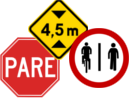
Speed bumpBrazil
 Traffic rules
 Brazil
3. Speed bump
A speed bump is a raised traffic-calming device placed across all or part of a road to make drivers reduce their speed. It is commonly used near homes, schools, crossings, parking areas and other places where low vehicle speeds are important.
Speed bumps vary in shape, height and legal status. Drivers should approach them at a low, controlled speed and follow any warning signs or speed limits that apply.

Wikimedia.org • Py4nf • CC BY-SA
How should I recognise and approach a speed bump in Brazil?
Brazil’s Traffic Code addresses ondulações transversais, commonly called lombadas, as physical speed-reduction devices subject to the national traffic authority’s criteria. Distinguish one from a raised pedestrian crossing.
🔗 gov.br • National auxiliary-device manual — sections 5.1 humps and 5.2 raised crossings
 Warning for a speed bump.
English • Traffic sign A-18 • Hump. Reduce speed before passing over the raised surface.
Português • A-18 • Saliência ou lombada. Adverte sobre uma saliência ou lombada na pista. Reduza a velocidade antes de passar pelo local.
Sources
🔗 Commons.wikimedia.org
🔗 Gov.br • CONTRAN/SENATRAN: MBST, Volume II, página PDF 75
SVG source: Commons.wikimedia.org • Original SVG
Departamento Nacional de Infraestrutura de Transportes • Public domain • Original revision 2014-01-17. Wikimedia original unmodified.
Artwork reviewed against the Brazilian Manual Brasileiro de Sinalização de Trânsito (current SENATRAN catalogue): Gov.br • A-18, PDF page 75. Intentional educational illustration update from the previous PNG; original SVG unmodified.
Which speed should I use at a raised device in Brazil?
Read the accompanying speed restriction and reduce speed before the device. A numerical limit is a maximum; the height, profile, visibility and presence of pedestrians can require a slower approach.
🔗 gov.br • National auxiliary-device manual — sections 5.1 humps and 5.2 raised crossings
Does a raised road surface give pedestrians priority in Brazil?
A raised device alone does not identify pedestrian priority. If it incorporates a crossing, apply the crossing’s controls and the national rules. Pedestrians on a marked crossing have priority, subject to signal-controlled rules. If the signal changes before they finish, let them complete the crossing. At an unsignalised junction, pedestrians already crossing also have priority.
🔗 gov.br • National auxiliary-device manual — sections 5.1 humps and 5.2 raised crossings


