

Priority signsTurkey
 Traffic rules
 Turkey
 Priority signs
 Warning signs
 Prohibitory signs
 Mandatory signs
 Information signs
 Additional signs
Priority signs
A priority sign is a traffic sign that indicates the order in which vehicles shall pass intersection points. Vehicles often come into conflict with other vehicles and pedestrians because their intended courses of travel intersect, and thus interfere with each other's routes. The general principle that establishes who has the right to go first is called 'right of way' or 'priority'. It establishes who has the right to use the conflicting part of the road and who has to wait until the other does so. The vehicle that does not need to wait is said to 'have the right of way' or to 'have priority.'
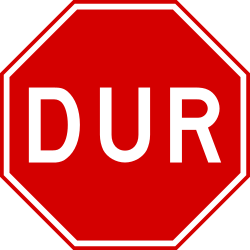








1. Stop and give way
This traffic sign means stop and give way. You must come to a complete stop before entering the intersection and give way to traffic that has priority. Proceed only when it is safe.
2. Give way
This traffic sign means give way. Slow down and give way to traffic that has priority. Stop if necessary and proceed only when it is safe.
3. Warning for an uncontrolled crossroad
This traffic sign indicates a warning for an uncontrolled crossroad. An intersection without traffic signals or signs assigning priority lies ahead. Reduce speed, watch for traffic approaching from other directions and follow the applicable local priority rules.
4. Warning for a roundabout
This traffic sign indicates a warning for a roundabout. A roundabout lies ahead. Reduce speed and follow the applicable priority signs, traffic signals and local roundabout rules when approaching and entering it.
5. Priority at the junction
This traffic sign indicates that you have priority at the next intersection. A side road joins from the left, and traffic entering from that side road must give way.
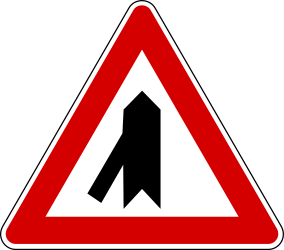
6. Warning for merging traffic from the left
This traffic sign indicates a warning for merging traffic from the left. Traffic travelling in the same general direction may join your traffic stream from the left. Stay alert and adjust your speed or position when necessary to allow traffic to merge safely.
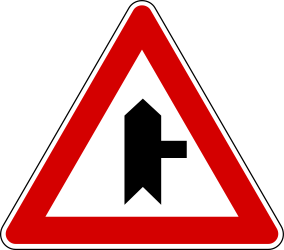
7. Priority at the junction
This traffic sign indicates that you have priority at the next intersection. A side road joins from the right, and traffic entering from that side road must give way.
8. Warning for merging traffic from the right
This traffic sign indicates a warning for merging traffic from the right. Traffic travelling in the same general direction may join your traffic stream from the right. Stay alert and adjust your speed or position when necessary to allow traffic to merge safely.
9. Priority at the junction
This traffic sign indicates that you have priority at the next intersection. Side roads join from the left and right, and traffic entering from those side roads must give way.
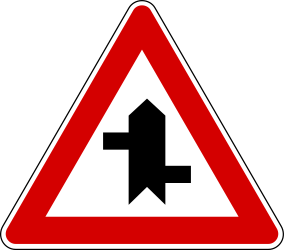
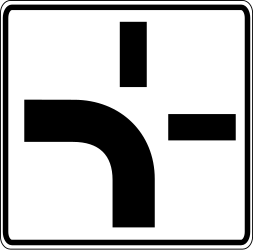
10. Warning for a staggered junction
This traffic sign indicates a warning for a staggered junction. Side roads join the main road at different points rather than directly opposite each other. Reduce speed and watch carefully for vehicles entering, leaving or crossing the main road.
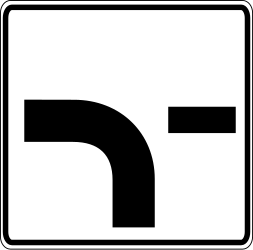
11. Warning for a staggered junction
This traffic sign indicates a warning for a staggered junction. Side roads join the main road at different points rather than directly opposite each other. Reduce speed and watch carefully for vehicles entering, leaving or crossing the main road.
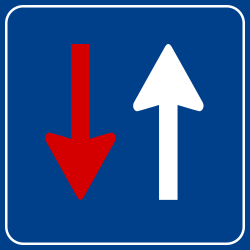
12. Road narrowing, give way to oncoming drivers
This traffic sign indicates a road narrowing where you must give way to oncoming traffic. Allow approaching traffic to pass before entering or continuing through the narrow section when required.
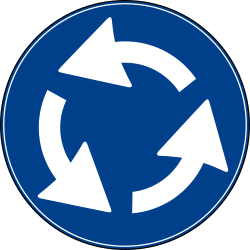
13. Mandatory roundabout direction
This traffic sign indicates the mandatory direction around a roundabout. Traffic must circulate in the direction shown by the arrows. The sign does not itself determine priority; follow the applicable priority signs, traffic signals and local rules.
14. Start of a priority road
This traffic sign indicates the start of a priority road. Drivers on the priority road normally have priority over traffic entering from side roads until the priority road ends, unless traffic lights, other signs or applicable traffic rules indicate otherwise.
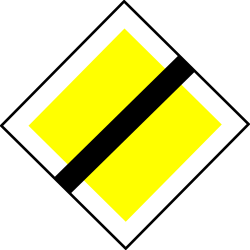
15. End of the priority road
This traffic sign indicates the end of the priority road. The road no longer has continuing priority at subsequent intersections. Follow the applicable traffic lights, priority signs and default priority rules.
16. Road narrowing, oncoming drivers have to give way
This traffic sign indicates a road narrowing where oncoming drivers have to give way.
17. Crossroad shape
This traffic sign shows the shape or layout of an upcoming junction. The diagram indicates how the approaching road and connecting roads are arranged.
18. Crossroad shape
This traffic sign shows the shape or layout of an upcoming junction. The diagram indicates how the approaching road and connecting roads are arranged.
