Rétrécissement de chausséeSlovénie

Apprenez les règles de circulation avec des explications claires et des exemples visuels dans notre livre illustré, simple et agréable à étudier.


17. Rétrécissement de chaussée

Un rétrécissement de chaussée est une section où la largeur disponible de la route ou de la chaussée diminue. Le rétrécissement peut se produire des deux côtés, d’un seul côté, ou parce qu’une ou plusieurs voies se terminent.

Les conducteurs doivent réduire leur vitesse, observer les véhicules arrivant en sens inverse et ceux circulant à côté, maintenir un dégagement latéral suffisant et s’insérer si nécessaire. Les panneaux d’avertissement ne déterminent pas toujours la priorité ; les conducteurs doivent donc respecter les panneaux de priorité, marquages de voie et règles locales de circulation.
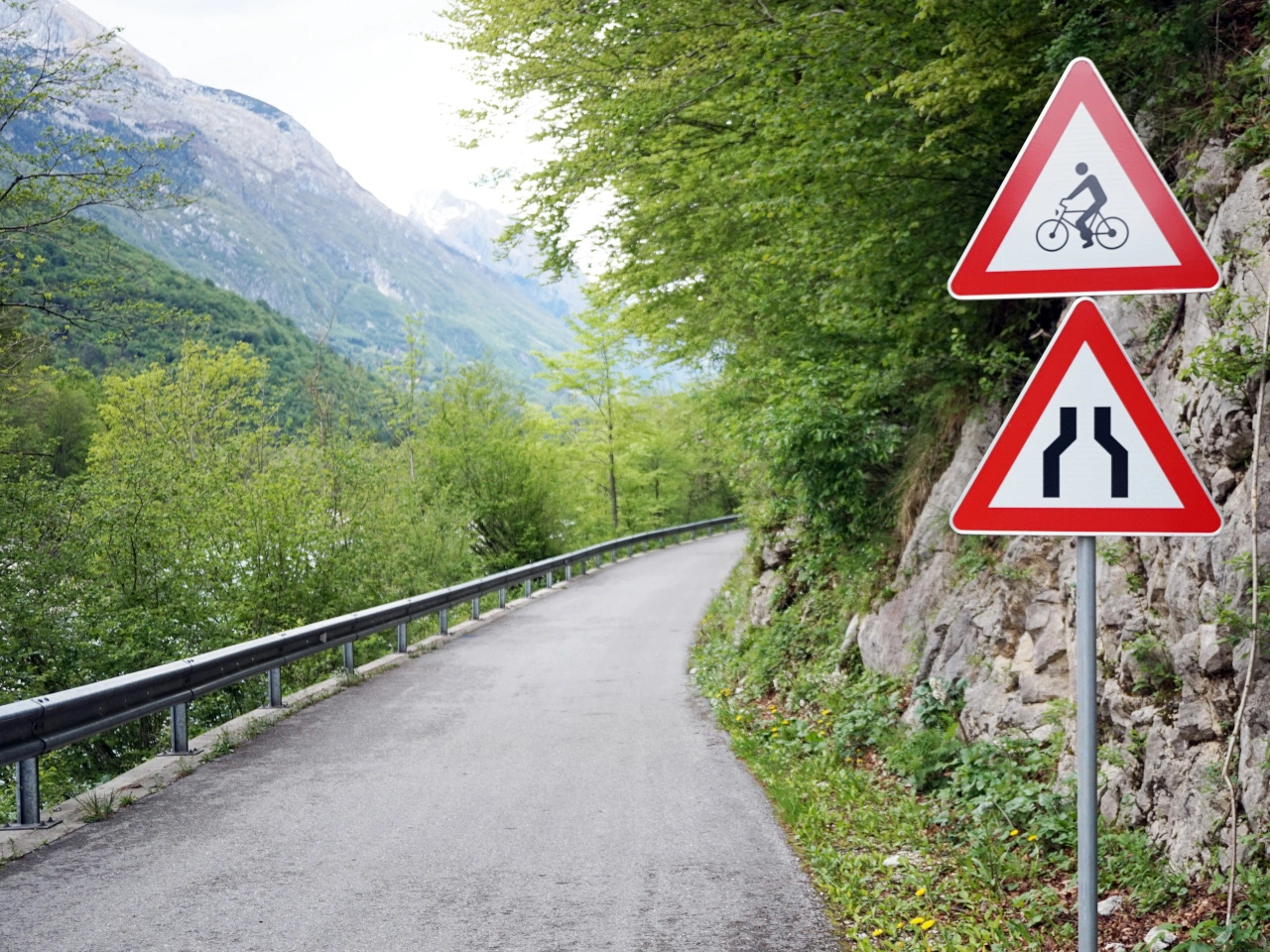
Rétrécissement de chaussée
What is a road narrowing?

A road narrowing is a section where the usable width of the road becomes smaller. Traffic may have less space to pass, merge or travel beside other road users.

How can you recognise a road narrowing?

It may be indicated by a triangular warning sign showing the road edges moving closer together. The symbol may show narrowing on both sides, the left side or the right side.

What can cause a road to narrow?

A road may narrow because of a bridge, tunnel, barrier, traffic-calming measure, roadworks, parked vehicles, landslide, damaged road edge or reduction in the number of lanes.

Does a narrowing sign impose a speed limit?

No. It normally warns of danger rather than setting a numerical speed limit. Drivers must still reduce speed when necessary to pass safely.

Does a narrowing sign determine who has priority?

Not by itself. Priority may be established by separate signs, signals or local rules. Without them, drivers should approach cautiously and cooperate.

Who has priority when the obstruction is on one side?

In many countries, the driver whose side is obstructed must give way to approaching traffic. The precise rule depends on local law and any priority signs displayed.

What if the road narrows equally from both sides?

Neither direction necessarily has automatic priority. Drivers should reduce speed, assess who can pass safely and avoid entering when doing so would block approaching traffic.

What do priority signs at a narrow section mean?

One sign may require you to give way to oncoming traffic, while the corresponding sign may indicate that you have priority. Drivers must still avoid entering when the passage is already occupied or blocked.

Does having priority mean you must continue?

No. Priority is not an obligation to proceed. Slow down or stop when another vehicle is already in the narrow section or when continuing would create danger.

What should you do when another vehicle is already in the narrowing?

Allow it enough room to leave the narrow section. Do not enter if the available width is insufficient for both vehicles to pass safely.

How should you approach a road narrowing?

Check mirrors, reduce speed smoothly and observe oncoming traffic, cyclists, pedestrians and vehicles beside you. Be prepared to stop or merge.

Must you use an indicator when the road narrows?

Use an indicator when you must change lanes or move laterally. Merely following a lane that bends with the road may not require a signal under local law.

What should you do when your lane ends?

Check the adjacent lane, signal and merge safely according to the local merging rules. Do not force another driver to brake or leave the road.

What is zipper merging?

Zipper merging means that vehicles from an ending or blocked lane merge alternately with vehicles in the continuing lane, usually immediately before the narrowing during congestion.

Should you merge early during heavy congestion?

Where zipper merging applies, continue using both lanes and merge alternately near the narrowing. In free-flowing traffic, change lanes safely when a suitable gap is available.

May you overtake near a road narrowing?

A narrowing sign does not always prohibit overtaking, but overtaking should be avoided when there is insufficient width, visibility or distance to complete the manoeuvre safely.

How should you pass cyclists at a narrowing?

Wait behind the cyclist when the required passing distance cannot be maintained. Do not squeeze past or force the cyclist towards a kerb, barrier or damaged road edge.

How should large vehicles use a narrow section?

Large vehicles may need additional width and may cross lane or centre markings where legally permitted. Other drivers should leave sufficient space and avoid passing alongside them in the narrowing.

May pedestrians be present at a road narrowing?

Yes. Pavements or verges may also become narrow or blocked. Drivers should expect pedestrians or wheelchair users to enter the carriageway to pass an obstruction.

May you stop or park in a road narrowing?

Only where it is permitted and enough width remains for traffic to pass safely. Never stop or park where the vehicle would create danger, obstruct visibility or prevent other vehicles from passing.

What should you do at a temporary roadworks narrowing?

Follow temporary signs, signals, barriers and instructions from authorised workers. Temporary traffic controls may replace the normal priority or lane arrangement.

What should you do in poor visibility?

Reduce speed further, increase the following distance and be prepared for a stopped vehicle beyond the narrowing. Use the required lights without dazzling approaching road users.

1 Slovénie 2 Autoroute 3 Zone 4 Limitation de vitesse 5 Piste cyclable 6 Tunnel 7 Zone piétonne 8 Ralentisseur 9 Douane 10 Circulation à sens unique 11 Pente 12 Voie de bus 13 Impasse 14 Panneau Stop 15 Rond-point 16 Route prioritaire 17 Rétrécissement de chaussée 18 Passage pour piétons 19 Passage à niveau 20 Direction obligatoire 21 Zone scolaire 22 Traversée d’animaux 23 Chutes de pierres 24 Chevron 25 Circulation à contresens 26 Travaux routiers 27 Limitation de hauteur 28 Limitation de poids 29 Feux de circulation 30 Feux pour piétons 31 Miroir routier 32 Frontière internationale 33 Itinéraire cyclable 34 Stationnement 35 Arrêt interdit 36 Disque de stationnement 37 Marche arrière 38 Issue de secours 39 Limite d’agglomération 40 Plaque d’immatriculation 41 Station de recharge 42 Dangers 43 Creux 44 Piéton 45 Cycliste 46 Camion 47 Autobus 48 Police 49 Ambulance 50 Taxi 51 Norme européenne d’émissions 52 Nid-de-poule 53 Chemin 54 Particules 55 Pollution de l’air 56 Heure de pointe 57 Code de la route 58 Caniveau 59 Vélo cargo 60 Véhicule forestier 61 Véhicule de chantier 62 Ensemble semi-remorque 63 Trolleybus 64 Speed pedelec 65 Véhicule de livraison 66 Moteur au ralenti 67 Dépanneuse 68 Quatre roues motrices 69 Accès interdit à tous les véhicules 70 Vélo 71 Équipement de moto 72 Voie ferrée 73 Caravane 74 Remorque 75 Attelage 76 Camion de pompiers 77 Sirène 78 Convoi 79 Feux des véhicules d’urgence 80 Machines agricoles 81 Vélo électrique 82 Véhicule électrique 83 Pedelec 84 Quadricycle 85 Voiturette 86 Véhicule tout-terrain 87 Fourgonnette 88 Véhicule de loisirs 89 Scooter 90 Trikke 91 Engin de déplacement personnel 92 Skateboard 93 Segway 94 Trottinette 95 Patins à roulettes 96 Facteur 97 Auto-stoppeur 98 Jeune enfant 99 Enfant 100 Handicap ...