

勾配ワロン
 交通ルール
交通ルール
 ワロン
ワロン
15. 勾配
勾配は、道路が上りまたは下りに傾いている程度を示します。急勾配では車両の速度、制動距離、加速、安定性、重い車両の性能に大きな影響があります。
運転者は下り坂の前に適切な速度とギアを選び、長時間ブレーキだけに頼らず、前方の交通に十分な間隔を取る必要があります。狭い坂道では上り・下り車両の優先規則が地域法で定められている場合があります。
Which Belgian signs warn of a steep slope?
Traffic sign A3 warns of a dangerous descent, while traffic sign A5 warns of a steep ascent.
 急な下り坂に注意。
Signal routier A3 • Descente dangereuse.
Verkeersbord A3 • Gevaarlijke daling.
 急な上り坂に注意。
Signal routier A5 • Montée à forte inclinaison.
Verkeersbord A5 • Steile helling.
What changes for steep ascents and descents under Belgium’s new Road Code?
Belgium’s new Code of the Public Road takes effect on 1 June 2027. The warning signs keep their existing numbers: traffic sign A3 warns of a dangerous descent and traffic sign A5 warns of a dangerous ascent. The percentage shown on the sign indicates the gradient of the slope. Under the new Road Code, the meaning of A5 is broadened from a “steep ascent” to a dangerous ascent.
 急な下り坂に注意。
Signal routier A3 • Descente dangereuse. Le pourcentage indique l’inclinaison de la pente.
Verkeersbord A3 • Gevaarlijke daling. Het percentage duidt de hellingsgraad aan.
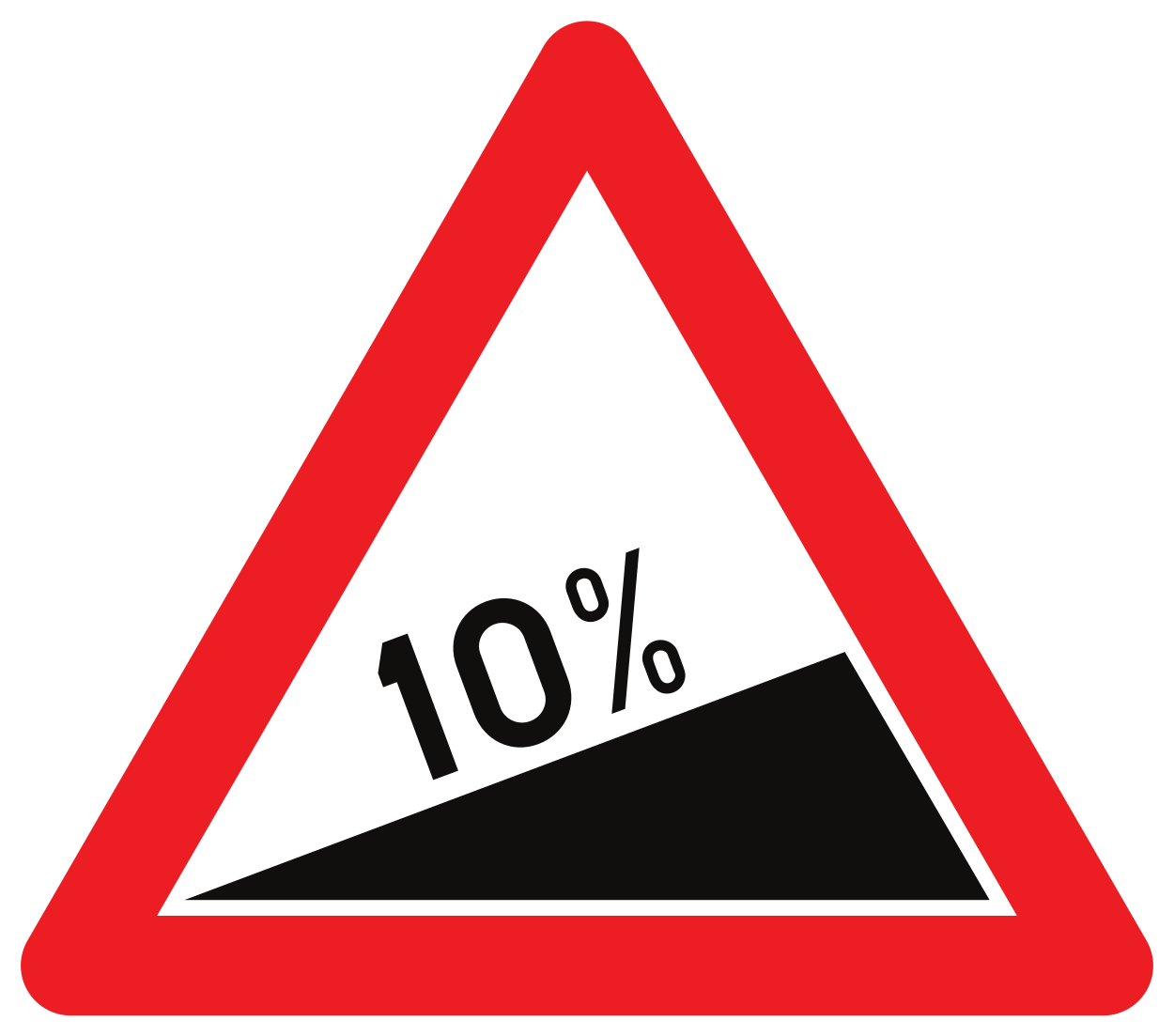 急な上り坂に注意。
Signal routier A5 • Montée dangereuse. Le pourcentage indique l’inclinaison de la pente.
Verkeersbord A5 • Steile helling. Het percentage duidt de hellingsgraad aan.
What does Belgian traffic sign A3 mean?
Sign A3 warns that the road ahead descends steeply or dangerously in the direction of travel.
What does Belgian traffic sign A5 mean?
Sign A5 warns that the road ahead rises steeply in the direction of travel.
What does the percentage on a Belgian slope sign mean?
A displayed gradient of 10% means that the road rises or falls approximately 10 metres over a horizontal distance of 100 metres. It does not represent an angle of 10 degrees.
When may A3 or A5 be installed in Belgium?
Under the current Belgian placement rules, these signs may be used for carriageways with an ascent or descent of at least 7%.
Does A3 or A5 impose a speed limit?
No. They are warning signs. Drivers must respect the applicable maximum speed and reduce their speed sufficiently for the gradient, visibility, traffic and road conditions.
How should you drive down a steep Belgian road?
Reduce speed before the descent, select a suitable gear and keep the vehicle under control. Drivers must always be able to stop before a foreseeable obstruction.
Should you descend in neutral?
No. Keep the transmission engaged so that engine braking helps control the vehicle. Coasting can allow the vehicle to gain speed and places more demand on the brakes.
How should you drive uphill?
Select a suitable gear early and maintain a controlled speed. Expect heavy vehicles, agricultural vehicles or vehicles towing trailers to travel more slowly.
May you overtake near the top of a Belgian slope?
Left-side overtaking of a team, a two-wheeled motor vehicle or a vehicle with more than two wheels is prohibited when approaching the crest of a slope with insufficient visibility. An exception applies where overtaking can be completed without crossing the continuous line separating opposing traffic.
May you stop or park near the crest of a slope?
No, when visibility is insufficient. Stopping and parking on the carriageway near the top of a slope are prohibited where the vehicle would be difficult for approaching road users to see.
Does uphill traffic automatically have priority in Belgium?
No. Belgian law does not give uphill traffic a universal priority solely because of the slope. Drivers must follow priority signs and the ordinary crossing rules.
Who must give way when an obstruction narrows the road?
The driver whose passage is obstructed must slow down and, when necessary, stop to allow approaching road users to pass.
Does a slope sign change priority at an intersection?
No. Signs A3 and A5 warn of the gradient but do not alter intersection priority. Traffic lights, priority signs and the ordinary priority rules remain applicable.
Must you reduce speed below the posted limit?
Yes, when necessary. Belgian drivers must adapt their speed to the road layout, visibility, traffic, weather, vehicle condition and load.
Why should heavy vehicles leave additional distance?
Heavy vehicles require more distance to slow down and their brakes may heat up during long descents. Additional following distance provides more time to react and brake progressively.
How should cyclists be passed on a Belgian slope?
Drivers must leave at least one metre inside a built-up area and 1.5 metres outside a built-up area. They should wait when the crest, bend or oncoming traffic prevents a safe pass.
How should you secure a parked vehicle on a slope?
Apply the parking brake firmly, select a gear or the transmission’s parking position and take every necessary precaution to prevent the vehicle from moving or being misused.


