Geschlossene OrtschaftFlandern

Lerne Verkehrsregeln mit klaren Erklärungen und visuellen Beispielen in unserem illustrierten Buch – einfach, verständlich und anschaulich.


5. Geschlossene Ortschaft

Eine geschlossene Ortschaft ist ein Gebiet mit konzentrierter Bebauung, Straßennetz und regelmäßiger lokaler Aktivität. Fahrer müssen mit mehr Fußgängern, Radfahrern, Kreuzungen, geparkten Fahrzeugen, öffentlichen Verkehrsmitteln sowie Fahrzeugen rechnen, die Grundstücke verlassen oder anfahren.

Viele Länder wenden innerhalb geschlossener Ortschaften besondere Verkehrsregeln und niedrigere allgemeine Geschwindigkeitsbegrenzungen an. Der Bereich kann durch Ortseingangs- und Ortsausgangsschilder, Straßenbeleuchtung oder andere gesetzliche Kriterien bestimmt werden; Fahrer müssen daher die örtlichen Verkehrszeichen und Vorschriften beachten.

How can you recognise a built-up area in Belgium?

A Belgian built-up area begins at traffic sign F1a or F1b, which normally displays the name of the place together with a built-up-area symbol. It ends at traffic sign F3a or F3b. After the end sign, the speed limits and other rules applicable outside built-up areas take effect unless another sign indicates otherwise.

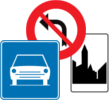
Beginn einer geschlossenen Ortschaft. Beginn einer geschlossenen Ortschaft.

Signal routier F1b • Commencement d'une agglomération. Ce signal est placé à droite, à chaque accès d'une agglomération; il peut être répété à gauche.

Verkeersbord F1b • Begin van een bebouwde kom. Dit verkeersbord wordt rechts geplaatst op elke toegangsweg tot een bebouwde kom; het mag links herhaald worden.

Ende der geschlossenen Ortschaft. Ende der geschlossenen Ortschaft.

Signal routier F3b • Fin d'une agglomération. Ce signal est placé à droite, à chaque sortie d'une agglomération; il peut être répété à gauche.

Verkeersbord F3b • Einde van een bebouwde kom. Dit verkeersbord wordt rechts geplaatst op elke uitvalsweg van een bebouwde kom; het mag links herhaald worden.

What changes for built-up areas under Belgium’s new Road Code?

Belgium’s new Code of the Public Road takes effect on 1 June 2027. The current traffic signs F1a and F1b marking the beginning of a built-up area are replaced by traffic sign R25, while the current traffic signs F3a and F3b marking the end are replaced by traffic sign R27. The new signs may be vertical or horizontal and may appear with or without the name of the built-up area and with or without an indication of the applicable speed limit.

Beginn einer geschlossenen Ortschaft. Beginn einer geschlossenen Ortschaft.

Signal routier R25 • Début d’une agglomération. Le nom de l’agglomération peut être indiqué sur le signal, en haut au milieu. La vitesse maximale qui s’y applique peut être indiquée à titre informatif sur le signal en bas à droite.

Verkeersbord R25 • Begin van een bebouwde kom. De naam van de bebouwde kom kan, bovenaan in het midden, op het verkeersbord aangeduid zijn. De maximale snelheid die er geldt, kan rechtsonder als aanwijzing op het verkeersbord aangeduid zijn.

Ende der geschlossenen Ortschaft. Ende der geschlossenen Ortschaft.

Signal routier R27 • Fin d’une agglomération.

Verkeersbord R27 • Einde van een bebouwde kom.

Do buildings alone make a road part of a Belgian built-up area?

No. Under Belgian traffic law, a built-up area is an area with buildings whose entrances are marked by F1a or F1b signs and whose exits are marked by F3a or F3b signs. Drivers should therefore rely on the official signs rather than the appearance of the road alone.

What is the speed limit in a Belgian built-up area?

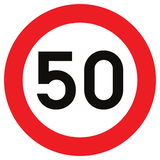
The general maximum speed is 30 km/h in the Brussels-Capital Region and 50 km/h in the Flemish and Walloon Regions. A traffic sign may impose or permit another speed, and lower vehicle-specific limits may still apply.

Is every road in Brussels limited to 30 km/h?

No. The general limit inside Brussels built-up areas is 30 km/h, but traffic sign C43 may indicate a lower or higher limit on a particular road.

Can another speed limit apply inside a Belgian built-up area?

Yes. Traffic sign C43 may impose or permit another maximum speed. A signed speed zone, Zone 30, school environment, woonerf or erf may also apply its own limit.

What happens to a local speed limit after an intersection?

When an ordinary C43 sign indicates another speed inside a built-up area, the general limit normally applies again after the next intersection: 30 km/h in Brussels and 50 km/h in Flanders and Wallonia. A zonal speed limit continues until its end-of-zone sign.

What speed applies after leaving a Zone 30, school environment, woonerf or erf?

If you remain inside the built-up area, the normal built-up-area limit applies again: 30 km/h in Brussels or 50 km/h in Flanders and Wallonia, unless another sign indicates a different limit.

Is a built-up area the same as a Zone 30 or woonerf?

No. A built-up area may contain roads with different speed limits. A Zone 30 imposes a maximum speed of 30 km/h, while a woonerf or erf has a 20 km/h limit and additional pedestrian, playing and parking rules.

Must you allow a bus to leave its stop?

Yes. Inside a built-up area, a driver travelling in the same direction must allow a bus or trolleybus to leave its stop when its driver indicates the intention to move off. You must slow down and stop if necessary.

How much space must you leave when passing a cyclist?

Inside a built-up area, a car or motorcycle driver must leave at least one metre between the vehicle and a cyclist or rider of a two-wheeled moped. Outside a built-up area, the minimum distance is 1.5 metres.

How much space must you leave when passing a pedestrian on the road?

Inside a built-up area, a driver must leave at least one metre when passing a pedestrian who is legally using the carriageway. Outside a built-up area, the minimum distance is 1.5 metres. If the required distance cannot be maintained, the driver may travel only at walking pace and must stop if necessary.

May cyclists ride two abreast inside a built-up area?

Yes. Cyclists and speed-pedelec riders using the carriageway may ride two abreast unless this makes it impossible for traffic travelling in the opposite direction to pass. The additional obligation to ride single file when a vehicle approaches from behind applies outside built-up areas.

May you stop or park on a raised verge inside a built-up area?

Stopping and parking on a pavement are prohibited. Inside a built-up area, stopping or parking on a raised verge is also prohibited unless local regulations expressly allow it.

Where should you place a warning triangle inside a built-up area?

The warning triangle is normally placed at least 30 metres behind the vehicle on an ordinary road. Inside a built-up area, when that distance cannot be maintained, it may be placed closer to the vehicle or, when necessary, on the vehicle.

1 Flandern 2 Autobahn 3 Schnellstraße 4 Wohngebiet 5 Geschlossene Ortschaft 6 Zone 7 Geschwindigkeitsbegrenzung 8 Radweg 9 Fahrradstraße 10 Fußgängerzone 11 Bremsschwelle 12 Zoll 13 Einbahnverkehr 14 Kaianlage 15 Steigung oder Gefälle 16 Busspur 17 Sackgasse 18 Stoppschild 19 Vorfahrt gewähren 20 Kreisverkehr 21 Vorfahrtstraße 22 Fahrbahnverengung 23 Vorrang vor dem Gegenverkehr 24 Gegenverkehr Vorrang gewähren 25 Fußgängerüberweg 26 Bahnübergang 27 Vorgeschriebene Fahrtrichtung 28 Abbiegeverbot 29 Schulbereich 30 Wild- oder Viehwechsel 31 Steinschlag 32 Kurve 33 Richtungstafel 34 Falschfahrt 35 Straßenarbeiten 36 Höhenbegrenzung 37 Breitenbegrenzung 38 Gewichtsbeschränkung 39 Geschwindigkeitskontrolle 40 Selektive Sperren 41 Wegweiser an einer Kreuzung 42 Vorfahrt an der nächsten Kreuzung 43 Ampeln 44 Fußgängerampeln 45 Führerschein 46 Kilometrierungsmarkierung 47 Verkehrsspiegel 48 Staatsgrenze 49 Radroute 50 Parken 51 Parkverbot 52 Kiss and Ride 53 Parkuhr 54 Verkehrsmanagement 55 Rückwärtsfahren 56 Ungeregelte Kreuzung 57 Fahrbahnschäden 58 Ringstraße 59 Radschnellweg 60 Kennzeichen 61 Ladestation 62 Allgemeine Gefahr 63 Abbiegen bei Rot 64 Personalausweis 65 Brandgefahr 66 Fußgänger 67 Moped 68 Pkw 69 Lkw 70 Bus 71 Polizei 72 Krankenwagen 73 Straßenbahnsignale 74 Europäische Abgasnorm 75 Schlagloch 76 Platz 77 Weg 78 Feinstaub 79 Luftverschmutzung 80 Hauptverkehrszeit 81 Straßenverkehrsordnung 82 Straßenrinne 83 Lastenfahrrad 84 Forstfahrzeug 85 Baufahrzeug 86 Sattelzug 87 Oberleitungsbus 88 Speed-Pedelec 89 Lieferfahrzeug 90 Leerlauf 91 Abschleppwagen 92 Allradantrieb 93 Verbot für Fahrzeuge 94 Fahrrad 95 Motorradausrüstung 96 Triebwagen 97 Gleis 98 Öffentlicher Verkehr 99 Wohnwagen 100 Anhänger ...