
Traffic rulesCanada
Learn the traffic rules of Canada with lots of pictures, clear traffic signs and interactive quizzes. Simple, visual and easy to follow.


The driver-licensing system in Canada
Is there one national Canadian driver's licence?
No. Driver licensing is administered by Canada's ten provinces and three territories. Each jurisdiction sets its own licence classes, graduated-licensing stages, tests, fees, renewal procedures and driver-improvement rules.
Which level of government issues an ordinary driver's licence?
The government or designated licensing authority of the province or territory where the driver resides issues the licence.
Can a provincial or territorial licence be used throughout Canada?
Yes. A valid licence issued by one Canadian province or territory is normally recognised for driving throughout Canada, subject to its class, conditions and restrictions.
Does the federal government regulate any driving matters?
Yes. Federal law governs matters such as Criminal Code impaired-driving offences, vehicle safety standards, border and immigration matters and parts of interprovincial and international commercial transport. Ordinary driver licensing remains provincial or territorial.
What is the usual licence for a passenger car?
It is called Class 5 in most provinces and territories. Ontario uses Class G. The exact vehicles included and trailer limits vary by jurisdiction.
Do all jurisdictions use graduated licensing?
Every province and territory has a staged or restricted route for new passenger-vehicle drivers, although the names, duration and restrictions differ. Nunavut's route is shorter and structurally different from the multi-year systems used in most other jurisdictions.
Do licence class numbers mean the same thing everywhere?
No. A Class 5 passenger licence is common, but commercial, motorcycle, taxi, bus and trailer classes are not fully harmonised. Ontario mainly uses lettered classes, and several jurisdictions define numbered classes differently.
Must a driver carry the licence while driving?
Generally yes. The driver must be able to produce the valid licence when required by police or another authorised officer. The precise offence and production period differ by jurisdiction.
Where should a driver confirm a rule?
The controlling source is the official licensing authority and legislation of the province or territory where the licence is issued or where the person is becoming resident.
Passenger-vehicle pathways by province and territory
What is Ontario's passenger-vehicle pathway?
A new driver starts with G1, advances after a road test to G2, and passes a second road test for a full G licence. The complete process must normally be finished within five years.
What is Ontario's minimum learner age?
A person may apply for G1 at 16, subject to identification, vision and knowledge-test requirements and parental consent rules for minors.
How long must an Ontario driver hold G1?
Normally 12 months. The period may be reduced to eight months after an approved beginner driver education course.
How long must an Ontario driver hold G2 before the full-G test?
At least 12 months. Ontario's graduated process therefore takes at least 20 months when the approved-course reduction is used, or 24 months without it.
What is Quebec's passenger-vehicle pathway?
A candidate completes the mandatory driving course, holds a Class 5 learner's licence, passes the SAAQ knowledge and road tests, then holds a probationary licence for 24 months before obtaining the regular Class 5 licence.
What is Quebec's minimum learner age?
Normally 16. A candidate under 18 requires parental or guardian consent.
How long is Quebec's learner stage?
At least 12 months, alongside completion of the mandatory driving course and its phases.
Is driver education mandatory in Quebec?
Yes. The recognised passenger-vehicle driving course is a required component of the first-licence process.
What is British Columbia's current pathway?
A new driver receives a Class 7L learner licence, passes the Class 7 road test for a Class 7 novice licence marked N, and under the rules in force on 4 August 2026 normally passes a Class 5 road test for full privileges.
What is British Columbia's minimum learner age?
A person can obtain an L licence from 16 after passing the knowledge and vision requirements.
How long is British Columbia's learner stage?
At least 12 months before the Class 7 road test.
How long is British Columbia's novice stage under the current system?
Normally at least 24 consecutive months without a driving prohibition. An approved GLP course can reduce the qualifying period to 18 months.
What changes in British Columbia on 19 October 2026?
The second road test is replaced for eligible drivers by a Driving Record Assessment. Age, safe-driving time, course completion and the absence of specified convictions, suspensions or prohibitions determine eligibility.
What is Alberta's passenger-vehicle pathway?
A new driver starts with a Class 7 learner licence, passes a basic road test for a Class 5 GDL probationary licence, then graduates to full Class 5 after satisfying age, time and driving-record conditions.
What is Alberta's minimum learner age?
Alberta permits a Class 7 learner licence from 14, making it the earliest standard learner age in Canada.
How long must an Alberta learner hold Class 7?
At least one year, and the driver must be at least 16 before taking the Class 5 road test.
How long is Alberta's probationary stage?
Normally 24 months. Approved driver training may reduce it by up to six months. The driver must be at least 18 and suspension- and demerit-free for the preceding 12 months to graduate.
Does Alberta still require an advanced road test to leave GDL?
No. The advanced road test was removed in 2023. Graduation is based on the statutory age, experience and driving-record conditions.
What is Saskatchewan's passenger-vehicle pathway?
The stages are Class 7 Learner, Class 5 Novice 1, Class 5 Novice 2 and experienced Class 5.
How long are Saskatchewan's stages?
The learner stage is at least nine months, Novice 1 at least six months and Novice 2 at least 12 incident-free months. A qualifying incident restarts the Novice 2 incident-free period.
Is driver education mandatory in Saskatchewan?
Yes. A new Class 7 driver must complete the approved high-school programme or the required commercial training with an SGI-certified instructor.
What is Manitoba's passenger-vehicle pathway?
The stages are Class 5L Learner, Class 5I Intermediate and Class 5F Full, with special zero-alcohol and zero-drug conditions continuing through the first 36 months of the full stage.
How long are Manitoba's learner and intermediate stages?
The learner stage lasts at least nine months and the intermediate stage at least 15 months, excluding periods when the licence is not active.
What is New Brunswick's passenger-vehicle pathway?
A new driver holds Class 7 Level 1, passes a road test to enter Class 7 Level 2, and later receives a full Class 5 after completing the required graduated period.
How long is New Brunswick's graduated period?
The combined Level 1 and Level 2 period is at least 24 months, including at least 12 months in Level 2. Approved training can shorten the Level 1 wait but not the overall 24-month minimum.
What is Nova Scotia's passenger-vehicle pathway?
The stages are Class 7 Learner, Class 5N Newly Licensed, the Restricted Individual stage and finally experienced Class 5.
How long do Nova Scotia's later stages last?
The newly licensed stage lasts at least two years and requires recognised driver training or a six-hour defensive-driving course for graduation. The restricted-individual stage then lasts two further years.
What is Prince Edward Island's pathway?
PEI uses a three-stage GDL programme: Stage 1 L with an instruction permit, followed by Stage 2 G and Stage 3 G. A standard Class 5 follows successful completion.
How long does PEI's programme take?
At least three years. Certified driver education can reduce the first stage from 365 days to 275 days, making the minimum two years and 275 days.
What is Newfoundland and Labrador's pathway?
A driver starts with Class 5 Level I, passes the road test for Class 5 Level II, and receives full Class 5 after the novice period.
How long are Newfoundland and Labrador's stages?
Level I lasts at least 12 months, reduced to eight months with approved driver education. Level II lasts 12 months.
What is Yukon's passenger-vehicle pathway?
A new driver completes a learner stage of at least six months and a novice stage of at least 18 months before applying for a full licence.
What is Yukon's minimum learner age?
A person may obtain the learner licence from 15, and must be at least 16 before the road test.
What is the Northwest Territories pathway?
A driver holds Class 7 Learner for at least one year, passes the road test for Class 5P Probationary, then completes 12 suspension-free months before applying in person for full Class 5.
What is the Northwest Territories minimum learner age?
A person may apply from 15.
What is Nunavut's basic first-licence pathway?
A first-time driver generally obtains a Class 7 learner permit, practises under supervision and passes the required road examination for Class 5. Nunavut does not use the same multi-year GDL structure as most provinces.
What is Nunavut's minimum learner age and practice period?
The learner age is 15. The published territorial manual specifies at least four weeks of practice before a first Class 5 or 6 road test, but applicants should confirm current local scheduling and eligibility with Motor Vehicles.
Eligibility, identification and applications
Must an applicant be a resident of the issuing jurisdiction?
Generally yes. A province or territory issues a licence to a person who can establish residence there, subject to special rules for students, temporary residents, military personnel and other categories.
What identification is normally required?
Applicants usually need original documents proving legal name, date of birth, identity, signature and lawful status in Canada, plus proof of provincial or territorial residence.
Can a temporary resident obtain a licence?
Yes, if the person meets the jurisdiction's residence, immigration-document, identity and testing requirements. The licence expiry may be limited by the person's authorised stay.
Can a visitor apply for a provincial licence?
Ordinary licences are generally intended for residents. A visitor normally drives under a valid home-jurisdiction licence for the period allowed locally.
Is parental consent required for a minor?
Yes in most jurisdictions when the applicant is below the locally specified age, commonly 18 or 19. The parent or guardian may need to attend and show identification.
Must an applicant disclose previous licences?
Yes. The person must disclose licences, suspensions, cancellations and relevant driving history from other jurisdictions. False information can invalidate the application.
Must an applicant provide an English or French translation?
A certified translation may be required when an identity, driving-experience or foreign-licence document is not in English or French.
Do licence suspensions stop the graduated-licensing clock?
Generally yes. Suspended, cancelled, refused or unlicensed periods commonly do not count, and some jurisdictions restart the stage after a suspension.
Knowledge tests, vision and medical fitness
What does the passenger-vehicle knowledge test cover?
It normally covers road signs, right-of-way rules, speed and stopping rules, safe-driving practices, sharing the road, emergencies, impaired driving and licence responsibilities.
Are knowledge tests offered in multiple languages?
Many jurisdictions offer several languages or approved interpreter arrangements, but availability differs and some specialised tests may be available only in English or French.
Can a knowledge test be taken online?
Some jurisdictions offer online testing. British Columbia, for example, introduced online passenger-vehicle and motorcycle knowledge testing in June 2026. Other authorities require attendance.
Must a new driver pass a vision screening?
Yes. Vision screening is a standard first-licence requirement across Canada.
What happens if the applicant fails the screening?
The authority normally requires a report or further examination by an optometrist, ophthalmologist or physician before deciding fitness.
Is a medical examination required for every ordinary first licence?
Not always. Most ordinary young Class 5 or G applicants complete a declaration and vision screening, while a medical report is requested for a disclosed condition, an age-based review or a commercial class.
Must medical conditions be disclosed?
Yes. Applicants and licensed drivers must provide truthful information about conditions that may affect safe driving when required by law, a form or the licensing authority.
Can the authority order a road or functional assessment?
Yes. A driver may be required to complete a medical review, cognitive screening, occupational-therapy assessment, road test or specialised functional evaluation.
Can a driver appeal a medical suspension?
Usually yes through an internal review, medical appeal process, tribunal or court route. Deadlines and the effect of an appeal differ.
Learner supervision and practice restrictions
May a learner drive alone?
No. A learner must be accompanied by a supervisor who satisfies the issuing jurisdiction's licence, experience, seating, sobriety and other conditions.
How much experience must a supervisor have?
It varies. Examples include at least four years for Ontario and PEI, at least two years of full-Class-5 experience in Yukon and the Northwest Territories, and a full licence for at least three years in Manitoba.
Can a novice or probationary driver supervise a learner?
Usually not. The supervisor normally needs a full, non-probationary licence of the correct class.
Must the supervisor be sober?
Yes. Jurisdictions impose a low or zero alcohol requirement and prohibit drug impairment for supervisors.
Must a learner display a sign?
Some jurisdictions require an L, novice or other decal. British Columbia, PEI, Yukon and Newfoundland and Labrador are prominent examples. The exact position and approved design matter.
What hours can an Ontario G1 driver drive?
A G1 driver cannot drive between midnight and 5 a.m..
Can an Ontario G1 driver use a 400-series highway?
Generally not, nor other high-speed expressways listed by regulation, unless accompanied by a qualified driving instructor in an authorised instructional setting.
What hours can a British Columbia L driver drive?
Between 5 a.m. and midnight.
Can a British Columbia L driver use electronic devices?
No. The prohibition covers hand-held and hands-free electronic devices.
What hours can an Alberta Class 7 learner drive?
The learner cannot drive between midnight and 5 a.m..
What restrictions apply to a Saskatchewan learner?
A supervisor must sit in the front passenger seat, passengers are limited by seat belts, electronic communication devices are prohibited, and the learner cannot operate a right-hand-drive vehicle.
What restrictions apply to a Yukon learner?
The learner must drive between 5 a.m. and midnight, log at least 50 hours, display an L sign, avoid all hand-held and hands-free electronic devices and not tow a trailer.
What restrictions apply to a Northwest Territories learner?
The learner may not drive from 11 p.m. to 6 a.m., may carry no passenger other than the supervisor, and both learner and supervisor must maintain zero BAC.
Driver education and road examinations
Is professional driver training recommended?
Yes. Even where optional, structured instruction helps candidates learn local observation routines, manoeuvres, defensive driving and road-test standards.
Can an approved course shorten a learner stage?
In several jurisdictions. Examples include Ontario, British Columbia, Alberta, Nova Scotia, PEI and Newfoundland and Labrador, but the reduction and qualifying course differ.
Who conducts road tests?
The provincial or territorial authority, its public insurer, an authorised registry system or a contracted testing organisation conducts the examination.
What must the road-test vehicle have?
Valid registration, insurance, licence plates, functioning seat belts, lights, signals, horn, brakes, mirrors, tyres and other legally required equipment.
Can an examiner refuse the vehicle?
Yes. A vehicle can be refused for a safety defect, warning light, obstructed view, illegal equipment, missing insurance, unsuitable load or another condition.
What skills are tested?
Typical tasks include observation, intersections, lane changes, speed control, stops, turns, parking, reversing, hill parking, highway entry and exit, hazard response and compliance with signs.
Does one mistake always mean failure?
No. Scoring systems distinguish minor errors from dangerous actions, traffic-law violations or repeated deficiencies. A serious unsafe act can cause immediate failure.
What happens after a failed road test?
The examiner normally provides a result and areas for improvement. The driver must observe the local retest waiting period and pay any required fee.
Does British Columbia currently require two road tests?
Yes on 4 August 2026: one for the N stage and one for full Class 5. The second test is replaced for eligible drivers by the new record-assessment system from 19 October 2026.
Novice, probationary and restricted drivers
May a novice driver drive alone?
Usually yes after passing the first road test, but the driver remains subject to alcohol, drug, passenger, night, device, towing or vehicle-class restrictions.
Do all novice drivers have zero-alcohol restrictions?
Zero alcohol is a standard feature of graduated licensing across Canada. Some jurisdictions extend zero-alcohol or zero-drug rules by age or for a period after full-class graduation.
Can an Ontario G2 driver drive without a supervisor?
Yes. A G2 holder may drive a Class G vehicle alone, subject to zero alcohol and drugs and the passenger restrictions that apply to young G2 drivers at night.
What night-passenger limits apply to an Ontario G2 driver aged 19 or younger?
During the first six months, only one passenger aged 19 or younger is allowed between midnight and 5 a.m.; afterward, up to three such passengers are allowed until the driver turns 20 or obtains full G. Immediate family and a qualified accompanying driver create exemptions.
Can a British Columbia N driver drive alone?
Yes, while displaying the N sign and complying with the passenger, zero-alcohol, zero-drug and electronic-device restrictions.
How many passengers may a British Columbia N driver carry?
Normally one passenger, unless the additional passengers are immediate family or a qualified supervisor aged 25 or older is present.
Can a British Columbia N driver use hands-free technology?
No. The novice restriction prohibits hand-held and hands-free electronic-device use.
What demerit threshold applies to an Alberta GDL driver?
A GDL licence is suspended at eight demerit points within the applicable two-year period, compared with 15 for a fully licensed driver.
When does Manitoba's zero-alcohol and zero-drug condition end?
It continues throughout learner and intermediate stages and for the first 36 months of the full Class 5F stage.
What curfew applies to Nova Scotia's newly licensed driver?
The driver cannot drive between midnight and 5 a.m. unless accompanied by a qualified supervisor or granted the prescribed employment exemption.
What restrictions apply in Yukon's novice stage?
A co-driver is required from midnight to 5 a.m., zero alcohol and drugs apply, electronic devices and trailer towing are prohibited, and the vehicle is subject to the novice weight and seating limits.
Licence classes, motorcycles and commercial driving
Is Class 5 always the ordinary passenger-vehicle class?
It is the standard class in most jurisdictions, but Ontario uses Class G. Vehicle weight, passenger capacity, trailer and motorhome provisions differ.
Does a passenger licence include motorcycles?
No. A motorcycle class or endorsement is required.
What does a Class 1 licence commonly cover?
In many western, Atlantic and northern jurisdictions, Class 1 covers tractor-trailer combinations. Ontario instead uses Class A, and Quebec's heavy-vehicle structure should be checked through the SAAQ.
What does a Class 2 licence commonly cover?
It commonly covers larger buses, but passenger thresholds and included lower classes differ.
What do Classes 3 and 4 commonly cover?
Class 3 commonly covers heavy straight trucks, while Class 4 often covers taxis, ambulances and smaller buses. These descriptions are not nationally interchangeable.
Is an air-brake endorsement required?
Yes when operating a vehicle equipped with air brakes unless the driver already holds a class that includes the privilege. The endorsement letter and course or test requirements differ.
What is mandatory entry-level training?
MELT is prescribed training for new tractor-trailer or commercial drivers in jurisdictions that have adopted it. Course length, approved providers and exemptions differ.
Must a commercial driver pass a medical examination?
Yes for the relevant commercial classes, with periodic reports required at age- and class-based intervals.
Licence issue, renewal, replacement and medical reviews
How long is a Canadian driver's licence valid?
There is no national term. Five-year cards are common, but licence-payment cycles, photo-renewal cycles, temporary-status expiries and medical review periods differ.
Can a licence be renewed online?
Many authorities allow eligible ordinary drivers to renew online, but a new photo, medical report, address change, expired licence or other condition can require attendance.
Is there a grace period after expiry?
A driver should assume no authority to drive after the expiry date unless legislation expressly provides otherwise. Renewal grace for administrative purposes does not necessarily permit driving.
What happens after a long-expired licence?
The authority can require a knowledge test, vision test, road test or re-entry into graduated licensing. The length of expiry determines the process.
Can a lost or stolen licence be replaced?
Yes. The driver must satisfy identity requirements and pay the replacement fee. A police report is prudent after theft and may be required in some circumstances.
Can licence conditions be removed?
Yes where the authority is satisfied that the condition is no longer medically or legally necessary. A new vision, medical, functional or road assessment may be required.
Can any driver be reviewed before the normal renewal date?
Yes. A collision, police report, medical report, family concern, court event or observed driving problem can lead to an early review.
Can a suspended licence be renewed?
Renewal of the card does not restore driving privileges. Reinstatement conditions must be completed and the official record must show that the suspension has ended.
Visitors, newcomers and licence exchanges
Can a tourist drive in Canada with a foreign licence?
Usually for a limited period if the licence is valid and covers the vehicle. The visitor must check the province or territory being visited.
Should a visitor obtain an International Driving Permit?
It is strongly recommended when the home licence is not in English or French and may be required by a rental company or local rule. It must accompany, not replace, the original licence.
Can an IDP be used as a standalone licence?
No. It is a translation and international format that is valid only with the underlying licence.
Are newcomer exchange periods identical elsewhere?
No. Alberta, Saskatchewan, Manitoba, Quebec, the Atlantic provinces and the territories each set their own deadline.
Can a Canadian provincial licence be exchanged in another province without tests?
A valid equivalent licence is normally exchanged without repeating ordinary passenger tests, although identity, residence, vision, medical and status checks still apply.
Does novice status transfer between provinces?
Usually the receiving authority gives credit for verified experience and places the driver in the locally equivalent stage. Restrictions and remaining time may change.
Which foreign countries have reciprocal exchange agreements?
The list differs by province or territory and can change. Agreements commonly cover selected countries and sometimes only passenger or motorcycle classes.
How is foreign driving experience proved?
The authority may require the original licence and an official authentication or experience letter showing first-licence date, class, status and expiry.
Demerits, suspensions, alcohol, drugs and enforcement
Is there one national demerit-point system?
No. Provinces and territories assign different point values, intervention thresholds, record periods and consequences.
Are novice thresholds lower?
Usually yes. Examples include eight demerits for Alberta GDL drivers and six points for novice drivers in Newfoundland and Labrador and the Northwest Territories.
Can a licence be suspended without any demerit points?
Yes. Impaired driving, street racing, excessive speeding, dangerous driving, medical unfitness, unpaid judgments or fines and court orders can operate independently of points.
Does paying a ticket remove the demerits?
No. Payment normally amounts to a conviction or resolution and the points remain for the statutory period.
Can a driver dispute a ticket?
Yes through the procedure and deadline stated on the ticket or notice. The driver should not ignore it because default conviction can affect the licence.
Can a suspension from one province be ignored in another?
No. Canadian jurisdictions share information, and an unresolved suspension can prevent issue or renewal elsewhere.
What is Canada's federal criminal alcohol limit?
Operating a conveyance with a blood-alcohol concentration of 80 milligrams or more per 100 millilitres of blood within the statutory period is a Criminal Code offence.
Can a driver be penalised below 0.08?
Yes. Provinces and territories impose administrative roadside sanctions at lower concentrations, commonly in a warn range beginning around 0.04 or 0.05, depending on the jurisdiction.
Can a driver refuse a breath demand?
Refusal or failure without a reasonable excuse is a criminal offence and can also trigger immediate provincial or territorial sanctions.
Do novice drivers have a zero-alcohol rule?
Yes throughout graduated stages, and several jurisdictions extend zero alcohol by age or into an early full-licence period.
Can police suspend a licence at the roadside?
Yes. Immediate administrative suspensions or prohibitions can be imposed for alcohol, drugs, refusal, excessive speed and other specified conduct.
Can a criminal driving prohibition and a provincial suspension overlap?
Yes. The driver must satisfy both the federal court prohibition and every provincial reinstatement condition.
Insurance, vehicle ownership and practice vehicles
Is automobile insurance mandatory in Canada?
Yes. Every vehicle operated on a public road must carry the insurance required by the province or territory where it is registered.
Does a driver's licence automatically provide insurance?
No. Licensing and vehicle insurance are separate. A valid licence does not create coverage for a particular vehicle or use.
Can a learner practise in a family vehicle?
Yes if the owner consents, the vehicle is properly registered and insured, and the policy permits the learner. The learner must still obey every supervision restriction.
Must a learner be listed on the insurance policy?
That depends on the insurer and jurisdiction. The owner should disclose regular or household learner drivers and follow any listing or rating requirement.
Can a traffic conviction affect both licence status and insurance?
Yes. The licensing authority can assign points or suspend the licence, while the insurer can separately adjust premiums, eligibility or coverage.
Sources and methodology
How was this Canada FAQ prepared?
This FAQ was prepared from federal information and the official licensing pages, driver handbooks and graduated-licensing material of Canada's provinces and territories. Because licensing is not national, statements were labelled as general only where the underlying rule is broadly shared, and exact stage durations were assigned to the relevant jurisdiction.
Which official sources are most useful?
- Government of Canada: Driving in Canada
- Justice Laws: Criminal Code
- Ontario: Get a G driver's licence
- Quebec SAAQ: Obtaining a Class 5 licence
- British Columbia ICBC: Graduated licensing
- British Columbia ICBC: October 2026 programme changes
- Alberta: Steps to getting a driver's licence
- Saskatchewan SGI: Graduated Driver Licensing
- Manitoba Public Insurance: Graduated Driver Licensing
- New Brunswick: Graduated driver's licences
- Nova Scotia: Graduated Driver Licence system
- Prince Edward Island: Graduated Driver Licensing
- Newfoundland and Labrador: Graduated Driver Licensing
- Yukon: Get a driver's licence
- Northwest Territories: First driver's licence
- Nunavut: Driver's Manual
Last reviewed: 4 August 2026.
Is this website affiliated with a Canadian licensing authority?
This website is an independent educational resource and is not affiliated with the Government of Canada, a province or territory, a licensing authority, testing organisation, public insurer, registry agent or driving school.
The information is general guidance. The current legislation and instructions of the relevant provincial or territorial authority always take precedence.
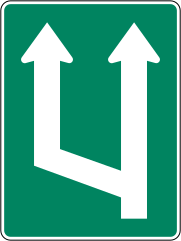
1. What does this traffic sign mean?
This traffic sign indicates the start of a new traffic lane. The displayed road layout shows where the additional lane begins and how the traffic lanes continue.
English • Québec I-417-1 family • Passing lane. An additional passing lane is indicated. Use it to pass only when safe and follow the lane markings. No distance is shown in this illustration. The sign family is confirmed; some details of this illustration were not fully matched to the reviewed standard.
Sources
🔗 Commons.wikimedia.org
🔗 Cdn-contenu.quebec.ca • Québec MTMD · Information signs poster 1, April 2026, p. 1
SVG source: Transports Québec • Public domain • Original revision 2013-09-23. Wikimedia original unmodified.
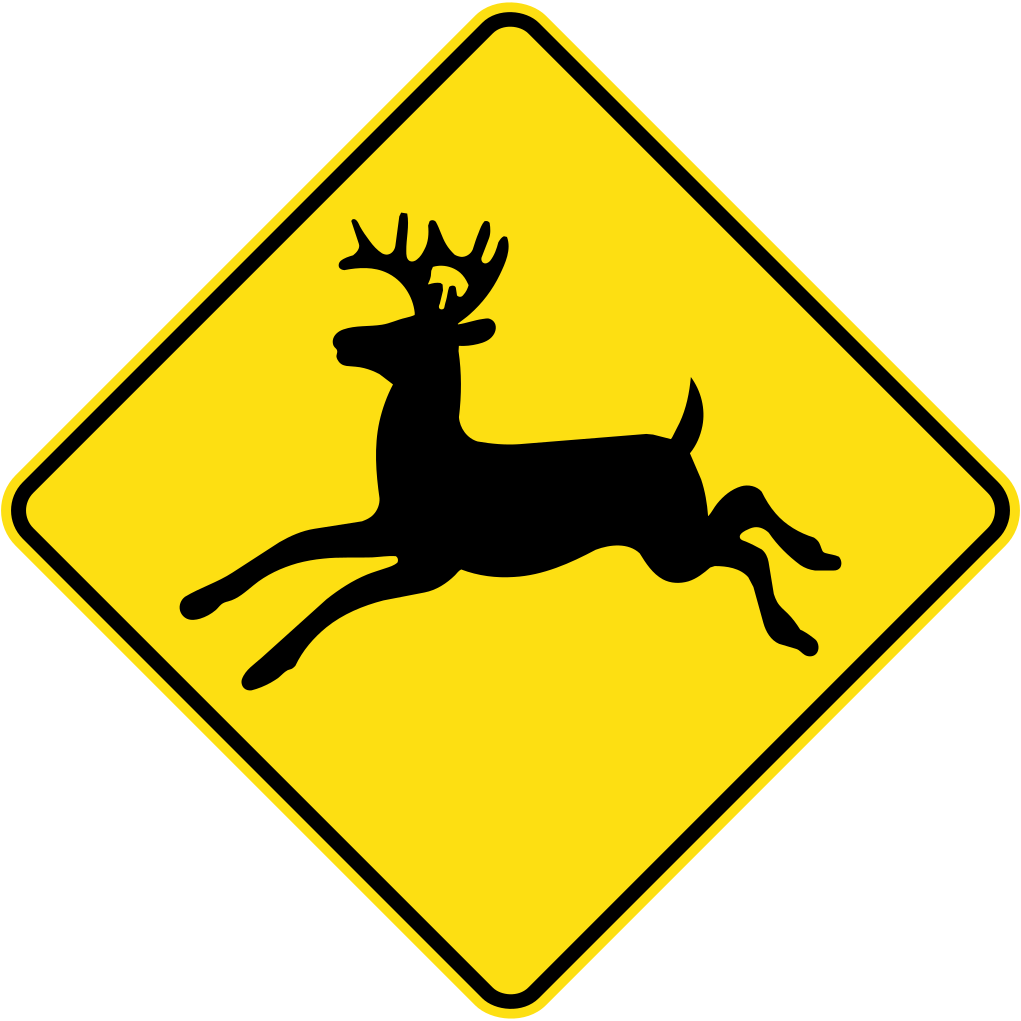
2. What does this traffic sign mean?
This traffic sign indicates a warning for crossing deer. Deer or other wild animals may enter the road unexpectedly, especially around dawn or dusk. Reduce speed, watch the roadside carefully and be prepared for more than one animal to cross.
English • Québec D-270-13 • Deer. Deer may be on or crossing the road ahead.
Sources
🔗 Commons.wikimedia.org
🔗 Cdn-contenu.quebec.ca • Québec MTMD · Danger signs poster, April 2026, p. 1
SVG source: Transports Quebec — Government of Quebec • Public domain • Original revision 2024-11-13. Wikimedia original unmodified.
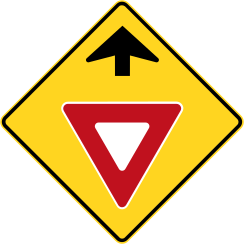
3. What does this traffic sign mean?
This traffic sign indicates yield ahead. A yield requirement applies at the location ahead. Reduce speed in good time and be prepared to stop if necessary.
English • Québec D-20 • Give way ahead. A give-way sign is ahead. Be prepared to give way and stop if necessary.
Sources
🔗 Commons.wikimedia.org
🔗 Cdn-contenu.quebec.ca • Québec MTMD · Danger signs poster, April 2026, p. 1
SVG source: Transports Québec • Public domain • Original revision 2013-08-08. Wikimedia original unmodified.
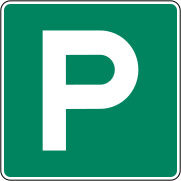
4. What does this traffic sign mean?
This traffic sign indicates that parking is allowed. Vehicles may be parked in the area covered by the sign subject to any indicated conditions, restrictions or local parking rules.
English • Québec I-350-1 • Parking area. A parking area is indicated. Follow any local parking conditions, charges or time limits.
Sources
🔗 Commons.wikimedia.org
🔗 Cdn-contenu.quebec.ca • Québec MTMD · Information signs poster 1, April 2026, p. 1
SVG source: Transports Québec • Public domain • Original revision 2013-09-20. Wikimedia original unmodified.
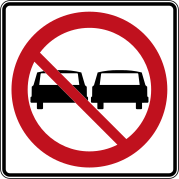
5. What does this traffic sign mean?
This traffic sign indicates that passing is prohibited. The vehicles covered by the prohibition and any categories that may still be passed depend on the applicable local rules.
English • Québec P-140-1 • No overtaking. Do not overtake in the zone indicated by the sign.
Sources
🔗 Commons.wikimedia.org
🔗 Cdn-contenu.quebec.ca • Québec MTMD · Regulatory signs poster, April 2026, p. 1
🔗 Legisquebec.gouv.qc.ca • Québec · Road signs regulation C-24.2, r. 41, section 28 (official consolidation, 1 May 2026) (FR)
SVG source: Transports Québec • Public domain • Original revision 2013-08-03. Wikimedia original unmodified.
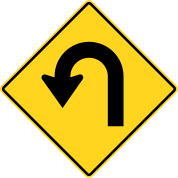
6. What does this traffic sign mean?
This traffic sign warns of a hairpin curve to the left. The road ahead makes a very sharp turn, so reduce speed and be prepared to steer sharply to the left.
English • Québec D-110-6-G • Hairpin bend to the left. A very tight left-hand bend is ahead. Reduce speed before the bend.
Sources
🔗 Commons.wikimedia.org
🔗 Cdn-contenu.quebec.ca • Québec MTMD · Danger signs poster, April 2026, p. 1
SVG source: Transports Québec • Public domain • Original revision 2013-08-09. Wikimedia original unmodified.
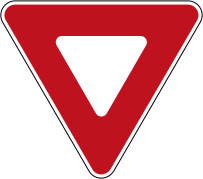
7. What does this traffic sign mean?
This traffic sign means yield. Slow down and yield to traffic that has the right-of-way. Stop if necessary and proceed only when it is safe.
English • Québec P-20-1 • Give way. Give way to traffic on the priority road. Slow down and stop if needed before entering safely.
Sources
🔗 Commons.wikimedia.org
🔗 Cdn-contenu.quebec.ca • Québec MTMD · Regulatory signs poster, April 2026, p. 1
🔗 Legisquebec.gouv.qc.ca • Québec · Road signs regulation C-24.2, r. 41, section 8 (official consolidation, 1 May 2026) (FR)
SVG source: Transports Québec • Public domain • Original revision 2013-07-29. Wikimedia original unmodified.
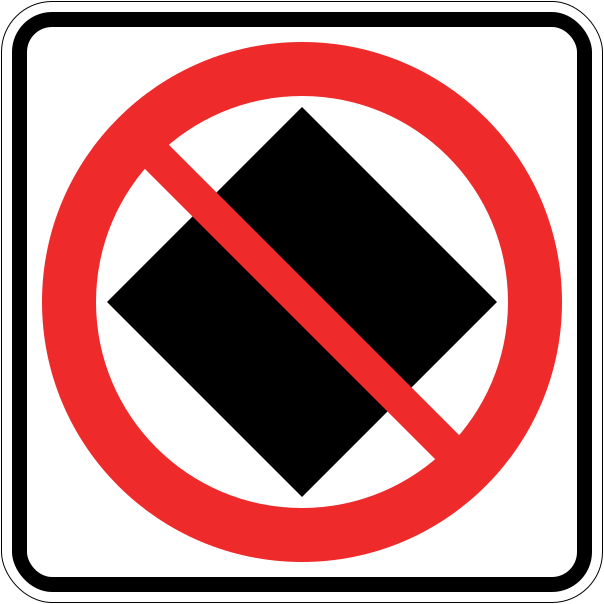
8. What does this traffic sign mean?
This traffic sign indicates that vehicles carrying dangerous goods are prohibited. Vehicles carrying the dangerous goods covered by the sign may not enter or continue beyond it.
English • Québec P-130-3 • Dangerous goods carriers prohibited. Vehicles carrying the regulated dangerous goods covered by this sign must not use the indicated road or tunnel. The black diamond refers to dangerous goods, not a general prohibition on all loads.
Sources
🔗 Commons.wikimedia.org
🔗 Cdn-contenu.quebec.ca • Québec MTMD · Regulatory signs poster, April 2026, p. 1
🔗 Legisquebec.gouv.qc.ca • Québec · Road signs regulation C-24.2, r. 41, section 22 (official consolidation, 1 May 2026) (FR)
SVG source: Transports Quebec — Government of Quebec • Public domain • Original revision 2024-12-26. Wikimedia original unmodified.
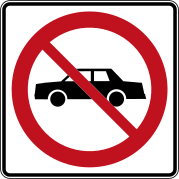
9. What does this traffic sign mean?
This traffic sign indicates that cars are prohibited. Cars may not enter or continue beyond the sign. Other road users may still be permitted unless another restriction applies.
English • Québec P-130-4 • No motor cars. The indicated road or route is closed to motor cars. Read any accompanying exception or time plate.
Sources
🔗 Commons.wikimedia.org
🔗 Cdn-contenu.quebec.ca • Québec MTMD · Regulatory signs poster, April 2026, p. 1
SVG source: Transports Québec • Public domain • Original revision 2013-08-02. Wikimedia original unmodified.
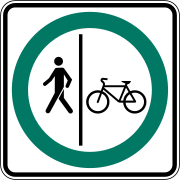
10. What does this traffic sign mean?
This traffic sign indicates a mandatory divided path for pedestrians and cyclists. Pedestrians and cyclists must use the section designated for them. Other road users may use the path only where the applicable signs or local rules permit them to do so.
English • Québec P-120-10 family • Separate routes for pedestrians and cyclists. Use the side indicated by the symbols: pedestrians on the left and cyclists on the right. The dividing line separates the two compulsory routes. The sign family is confirmed; some details of this illustration were not fully matched to the reviewed standard.
Sources
🔗 Commons.wikimedia.org
🔗 Rsr.transports.gouv.qc.ca • Québec MTMD · Road sign directory, indexed sign description
SVG source: Transports Québec • Public domain • Original revision 2013-09-26. Wikimedia original unmodified.
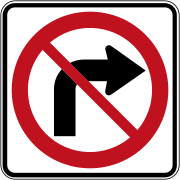
11. What does this traffic sign mean?
This traffic sign indicates that turning right is prohibited. A right turn may not be made where the sign applies. Other movements may still be permitted unless another restriction applies.
English • Québec P-110-6-D • No right turn. Do not turn right at the indicated junction.
Sources
🔗 Commons.wikimedia.org
🔗 Cdn-contenu.quebec.ca • Québec MTMD · Regulatory signs poster, April 2026, p. 1
🔗 Legisquebec.gouv.qc.ca • Québec · Road signs regulation C-24.2, r. 41, section 20 (official consolidation, 1 May 2026) (FR)
SVG source: Transports Québec • Public domain • Original revision 2013-08-01. Wikimedia original unmodified.
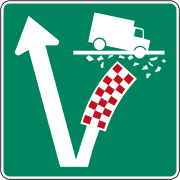
12. What does this traffic sign mean?
This traffic sign indicates a runaway truck ramp. The emergency escape ramp is intended for vehicles that are unable to slow or stop normally, particularly following a loss of braking capability.
English • Québec I-415-2 • Emergency escape lane. An emergency escape lane is indicated to the right. It is intended to help stop an out-of-control vehicle, particularly after brake failure on a steep descent.
Sources
🔗 Commons.wikimedia.org
🔗 Cdn-contenu.quebec.ca • Québec MTMD · Information signs poster 1, April 2026, p. 1
SVG source: Transports Québec • Public domain • Original revision 2013-09-22. Wikimedia original unmodified.
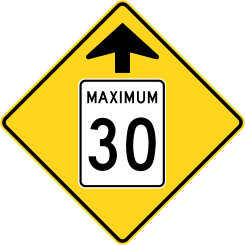
13. What does this traffic sign mean?
This traffic sign indicates a warning for a speed limit ahead. It warns drivers that a speed limit will apply shortly. Reduce speed in good time so that you comply with the indicated limit when you reach the speed limit sign.
English • Québec D-70 • 30 km/h speed limit ahead. A maximum speed limit of 30 km/h is ahead. Adjust speed before reaching the regulatory speed-limit sign.
Sources
🔗 Commons.wikimedia.org
🔗 Cdn-contenu.quebec.ca • Québec MTMD · Danger signs poster, April 2026, p. 1
SVG source: Transports Québec • Public domain • Original revision 2013-08-08. Wikimedia original unmodified.
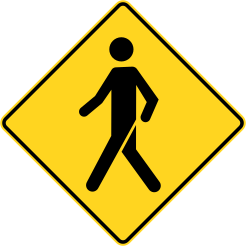
14. What does this traffic sign mean?
This traffic sign indicates a warning for pedestrians. Pedestrians may be walking near or crossing the road ahead. Reduce speed, watch carefully and be prepared to stop.
English • Québec D-270-2-D • Pedestrian crossing ahead. A pedestrian crossing is ahead. Slow down and be prepared to stop for people crossing.
Sources
🔗 Commons.wikimedia.org
🔗 Cdn-contenu.quebec.ca • Québec MTMD · Danger signs poster, April 2026, p. 1
SVG source: Transports Québec • Public domain • Original revision 2013-08-12. Wikimedia original unmodified.
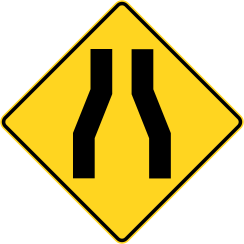
15. What does this traffic sign mean?
This traffic sign indicates a warning for a road narrowing. The available width of the road or roadway decreases ahead. Reduce speed, maintain sufficient lateral clearance and watch carefully for approaching or adjacent traffic.
English • Québec D-210-1 • Road narrows on both sides. The road narrows from both sides ahead.
Sources
🔗 Commons.wikimedia.org
🔗 Cdn-contenu.quebec.ca • Québec MTMD · Danger signs poster, April 2026, p. 1
SVG source: Transports Québec • Public domain • Original revision 2013-08-11. Wikimedia original unmodified.
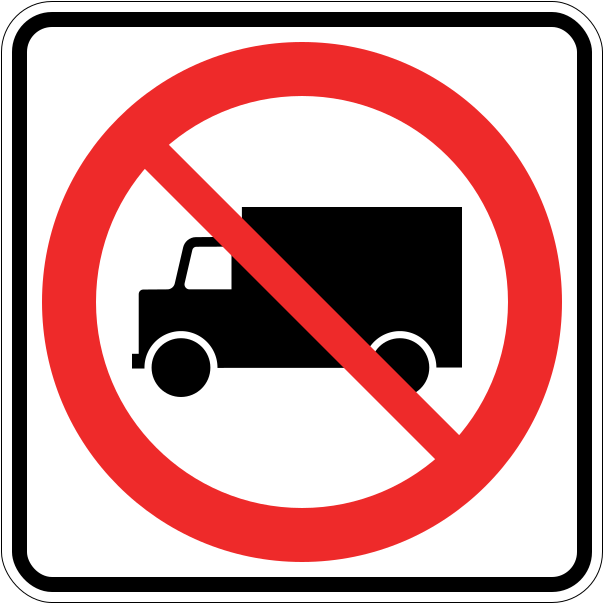
16. What does this traffic sign mean?
This traffic sign indicates that trucks are prohibited. Trucks covered by the sign may not enter or continue beyond it. Any applicable weight threshold or vehicle-category limitation is determined by the sign, supplemental information and local rules.
English • Québec P-130-1 • No trucks. Trucks must not use the indicated road. In Québec, the rule uses a defined truck category and has specific statutory exemptions; any local-delivery exception must be displayed on the sign or an accompanying plate.
Sources
🔗 Commons.wikimedia.org
🔗 Cdn-contenu.quebec.ca • Québec MTMD · Regulatory signs poster, April 2026, p. 1
🔗 Legisquebec.gouv.qc.ca • Québec · Road signs regulation C-24.2, r. 41, section 25 (official consolidation, 1 May 2026) (FR)
SVG source: Transports Quebec — Government of Quebec • Public domain • Original revision 2024-12-26. Wikimedia original unmodified.
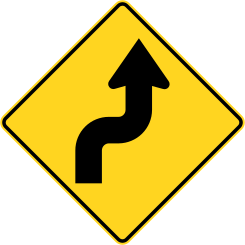
17. What does this traffic sign mean?
This traffic sign indicates a warning for successive sharp curves, with the first curve to the right. Reduce speed before entering the winding section and be prepared for rapid changes in direction.
English • Québec D-110-3-D • Reverse turns: right then left. Two successive sharp turns are ahead, first to the right and then to the left.
Sources
🔗 Commons.wikimedia.org
🔗 Cdn-contenu.quebec.ca • Québec MTMD · Danger signs poster, April 2026, p. 1
SVG source: Transports Québec • Public domain • Original revision 2013-08-09. Wikimedia original unmodified.
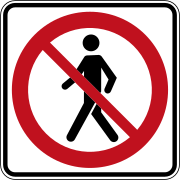
18. What does this traffic sign mean?
This traffic sign indicates that pedestrians are prohibited. Pedestrians may not enter or continue beyond the sign. Other road users may still be permitted unless another restriction applies.
English • Québec P-130-12 • No pedestrians. The indicated road or route is closed to pedestrians. Read any accompanying exception or time plate.
Sources
🔗 Commons.wikimedia.org
🔗 Cdn-contenu.quebec.ca • Québec MTMD · Regulatory signs poster, April 2026, p. 1
SVG source: Transports Québec • Public domain • Original revision 2013-08-02. Wikimedia original unmodified.
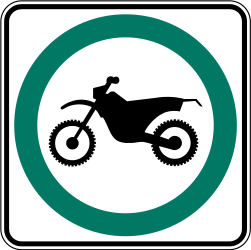
19. What does this traffic sign mean?
This traffic sign indicates a mandatory path for mopeds. The moped categories covered by the sign must use the designated path. Other road users may use it only where the applicable signs or local rules permit them to do so.
English • Québec P-120-3 • Compulsory route for motorcycles. Motorcyclists must follow the indicated route. The drawing is a motorcycle, although the shared key says moped.
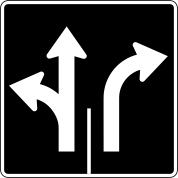
20. What does this traffic sign mean?
This traffic sign gives an overview of the lanes and their direction. The arrows or other indications show how the lanes continue and which directions or destinations they serve.
English • Québec P-100 family • Lane directions at a junction. As illustrated, the left lane may continue straight ahead or turn left; the right lane must turn right. Use the appropriate lane and follow its arrow. The sign family is confirmed; some details of this illustration were not fully matched to the reviewed standard.
Sources
🔗 Commons.wikimedia.org
🔗 Cdn-contenu.quebec.ca • Québec MTMD · Regulatory signs poster, April 2026, p. 1
🔗 Legisquebec.gouv.qc.ca • Québec · Road signs regulation C-24.2, r. 41, section 16 (official consolidation, 1 May 2026) (FR)
SVG source: Transports Québec • Public domain • Original revision 2013-07-30. Wikimedia original unmodified.
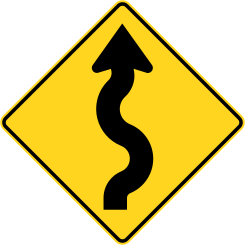
21. What does this traffic sign mean?
This traffic sign indicates a warning for a series of curves. One or more changes in direction lie ahead and may occur in quick succession. Reduce speed before entering the winding section, maintain your lane position and use smooth steering.
English • Québec D-110-5-D • Winding road. Several curves are ahead, beginning to the right. Reduce speed.
Sources
🔗 Commons.wikimedia.org
🔗 Cdn-contenu.quebec.ca • Québec MTMD · Danger signs poster, April 2026, p. 1
SVG source: Transports Québec • Public domain • Original revision 2013-08-09. Wikimedia original unmodified.
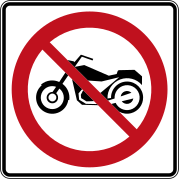
22. What does this traffic sign mean?
This traffic sign indicates that motorcycles are prohibited. Motorcyclists may not enter or continue beyond the sign. Other road users may still be permitted unless another restriction applies.
English • Québec P-130-5 • No motorcycles. The indicated road or route is closed to motorcycles. Read any accompanying exception or time plate.
Sources
🔗 Commons.wikimedia.org
🔗 Cdn-contenu.quebec.ca • Québec MTMD · Regulatory signs poster, April 2026, p. 1
SVG source: Transports Québec • Public domain • Original revision 2013-08-02. Wikimedia original unmodified.
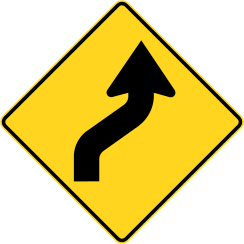
23. What does this traffic sign mean?
This traffic sign indicates a warning for successive curves, with the first curve to the right. Reduce speed before entering the winding section, maintain your lane position and be prepared for further changes in direction.
English • Québec D-110-4-D • Reverse curves: right then left. Two successive curves are ahead, first to the right and then to the left.
Sources
🔗 Commons.wikimedia.org
🔗 Cdn-contenu.quebec.ca • Québec MTMD · Danger signs poster, April 2026, p. 1
SVG source: Transports Québec • Public domain • Original revision 2013-08-09. Wikimedia original unmodified.
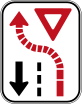
24. What does this traffic sign mean?
This traffic sign indicates a road narrowing where you must yield to oncoming traffic. Allow approaching traffic to pass before entering or continuing through the narrow section when required.
English • Québec P-30 • Give way to oncoming traffic. The available space does not permit traffic in both directions at once. Give way to traffic coming towards you before entering the narrow section.
Sources
🔗 Commons.wikimedia.org
🔗 Cdn-contenu.quebec.ca • Québec MTMD · Regulatory signs poster, April 2026, p. 1
🔗 Legisquebec.gouv.qc.ca • Québec · Road signs regulation C-24.2, r. 41, section 9 (official consolidation, 1 May 2026) (FR)
SVG source: Transports Québec • Public domain • Original revision 2013-07-29. Wikimedia original unmodified.
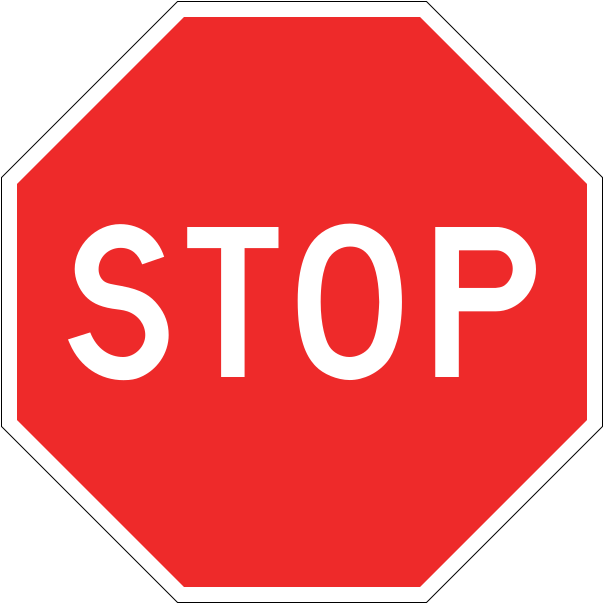
25. What does this traffic sign mean?
This traffic sign means stop and yield. You must come to a complete stop before entering the intersection and yield to traffic that has the right-of-way. Proceed only when it is safe.
English • Québec P-10 • Stop. Come to a complete stop at the stop line or before entering the junction, and proceed only when safe. The Québec catalogue also permits the word STOP.
Sources
🔗 Commons.wikimedia.org
🔗 Cdn-contenu.quebec.ca • Québec MTMD · Regulatory signs poster, April 2026, p. 1
🔗 Legisquebec.gouv.qc.ca • Québec · Road signs regulation C-24.2, r. 41, section 7 (official consolidation, 1 May 2026) (FR)
SVG source: Transports Quebec — Government of Quebec • Public domain • Original revision 2025-01-21. Wikimedia original unmodified.
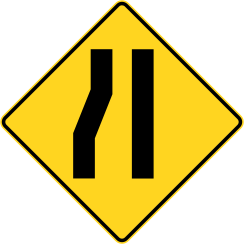
26. What does this traffic sign mean?
This traffic sign indicates a warning for a road narrowing on the left. The available road width decreases from the left side ahead. Reduce speed, follow the lane markings and maintain sufficient clearance from other traffic and the road edge.
English • Québec D-210-2-G • Road narrows from the left. The road narrows from the left ahead.
Sources
🔗 Commons.wikimedia.org
🔗 Cdn-contenu.quebec.ca • Québec MTMD · Danger signs poster, April 2026, p. 1
SVG source: Transports Québec • Public domain • Original revision 2013-08-11. Wikimedia original unmodified.
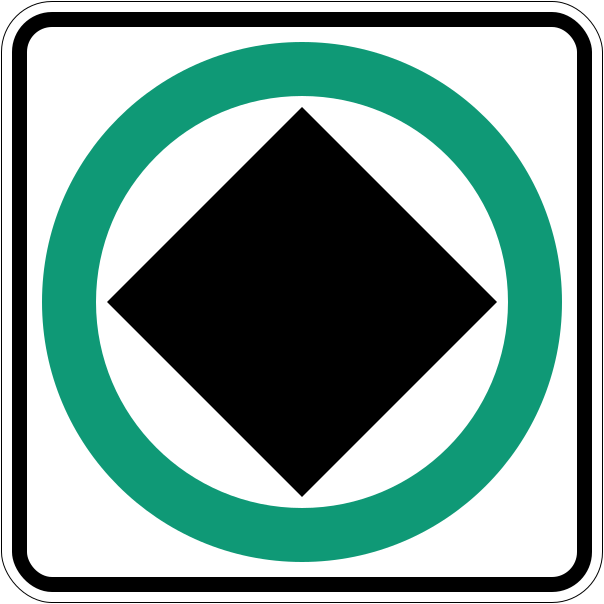
27. What does this traffic sign mean?
This traffic sign indicates a mandatory route for vehicles carrying dangerous goods. Vehicles carrying dangerous goods must use the route indicated by the sign.
English • Québec P-120-4 • Compulsory route for dangerous goods carriers. Carriers transporting dangerous goods that require vehicle placards must follow the indicated route. The black diamond represents dangerous goods; it is not an HOV-lane symbol.
Sources
🔗 Commons.wikimedia.org
🔗 Cdn-contenu.quebec.ca • Québec MTMD · Regulatory signs poster, April 2026, p. 1
SVG source: Transports Quebec — Government of Quebec • Public domain • Original revision 2024-12-26. Wikimedia original unmodified.
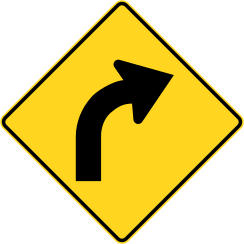
28. What does this traffic sign mean?
This traffic sign indicates a warning for a curve to the right. A right-hand curve lies ahead. Reduce speed before entering the curve, maintain your lane position and use smooth steering.
English • Québec D-110-2-D • Curve to the right. The road curves to the right ahead.
Sources
🔗 Commons.wikimedia.org
🔗 Cdn-contenu.quebec.ca • Québec MTMD · Danger signs poster, April 2026, p. 1
SVG source: Transports Québec • Public domain • Original revision 2013-08-09. Wikimedia original unmodified.
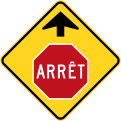
29. What does this traffic sign mean?
This traffic sign indicates stop and yield ahead. A stop sign applies at the location ahead. Reduce speed in good time and be prepared to come to a complete stop.
English • Québec D-10-1 • Stop ahead. A stop sign is ahead. Be prepared to make a complete stop at the signed stopping point.
Sources
🔗 Commons.wikimedia.org
🔗 Cdn-contenu.quebec.ca • Québec MTMD · Danger signs poster, April 2026, p. 1
SVG source: Transports Québec • Public domain • Original revision 2013-08-02. Wikimedia original unmodified.
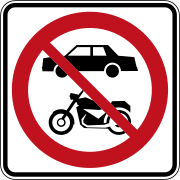
30. What does this traffic sign mean?
This traffic sign indicates that motorcycles and cars are prohibited. Motorcycles and cars may not enter or continue beyond the sign. Other road users may still be permitted unless another restriction applies.
English • Québec P-130-8 • No motor cars and motorcycles. The indicated road or route is closed to motor cars and motorcycles. Read any accompanying exception or time plate.
Sources
🔗 Commons.wikimedia.org
🔗 Cdn-contenu.quebec.ca • Québec MTMD · Regulatory signs poster, April 2026, p. 1
SVG source: Transports Québec • Public domain • Original revision 2013-08-03. Wikimedia original unmodified.
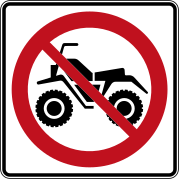
31. What does this traffic sign mean?
This traffic sign indicates that quads are prohibited. Quad riders may not enter or continue beyond the sign.
English • Québec P-130-7 • No quad bikes. The indicated road or route is closed to quad bikes. Read any accompanying exception or time plate.
Sources
🔗 Commons.wikimedia.org
🔗 Cdn-contenu.quebec.ca • Québec MTMD · Regulatory signs poster, April 2026, p. 1
SVG source: Transports Québec • Public domain • Original revision 2013-08-03. Wikimedia original unmodified.
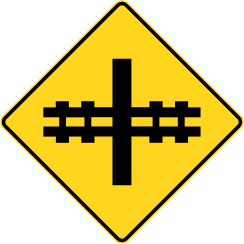
32. What does this traffic sign mean?
This traffic sign indicates a warning for a railway crossing without barriers. It alerts drivers to an upcoming level crossing where railway tracks cross the road and no barriers or gates are present to stop traffic. Drivers should slow down and look both ways for trains.
English • Québec D-180-1 • Railway crossing ahead. A railway crossing is ahead. Look for trains, signals and any stop or give-way controls at the crossing.
Sources
🔗 Commons.wikimedia.org
🔗 Cdn-contenu.quebec.ca • Québec MTMD · Danger signs poster, April 2026, p. 1
SVG source: Transports Québec • Public domain • Original revision 2013-08-11. Wikimedia original unmodified.
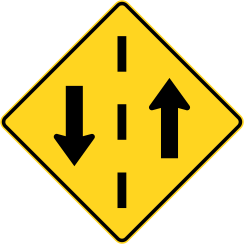
33. What does this traffic sign mean?
This traffic sign indicates a warning for two-way traffic. Oncoming traffic will use the same road or roadway ahead. Keep to the correct side of the road and pass only where it is permitted and clearly safe.
English • Québec D-80-1 • Two-way traffic ahead. Traffic travelling in the opposite direction will be encountered ahead. Keep to your side of the road.
Sources
🔗 Commons.wikimedia.org
🔗 Cdn-contenu.quebec.ca • Québec MTMD · Danger signs poster, April 2026, p. 1
SVG source: Transports Québec • Public domain • Original revision 2013-08-08. Wikimedia original unmodified.
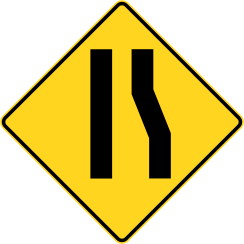
34. What does this traffic sign mean?
This traffic sign indicates a warning for a road narrowing on the right. The available road width decreases from the right side ahead. Reduce speed, follow the lane markings and maintain sufficient clearance from other traffic and the road edge.
English • Québec D-210-2-D • Road narrows from the right. The road narrows from the right ahead.
Sources
🔗 Commons.wikimedia.org
🔗 Cdn-contenu.quebec.ca • Québec MTMD · Danger signs poster, April 2026, p. 1
SVG source: Transports Québec • Public domain • Original revision 2013-08-11. Wikimedia original unmodified.
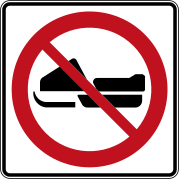
35. What does this traffic sign mean?
This traffic sign indicates that snowmobiles are prohibited. Snowmobiles may not enter or continue beyond the sign. Other road users may still be permitted unless another restriction applies.
English • Québec P-130-14 • No snowmobiles. The indicated road or route is closed to snowmobiles. Read any accompanying exception or time plate.
Sources
🔗 Commons.wikimedia.org
🔗 Cdn-contenu.quebec.ca • Québec MTMD · Regulatory signs poster, April 2026, p. 1
SVG source: Transports Québec • Public domain • Original revision 2013-08-02. Wikimedia original unmodified.
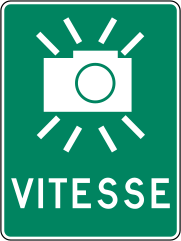
36. What does this traffic sign mean?
This traffic sign indicates average-speed enforcement. A vehicle’s average speed is measured over a defined section of road and compared with the applicable speed limit.
English • Québec I-413-1 • Speed-camera enforcement. You are approaching a location monitored by a speed camera. Obey the posted speed limit. This sign does not by itself establish average-speed enforcement.
Sources
🔗 Commons.wikimedia.org
🔗 Cdn-contenu.quebec.ca • Québec MTMD · Information signs poster 1, April 2026, p. 1
SVG source: Transports Québec • Public domain • Original revision 2013-09-21. Wikimedia original unmodified.
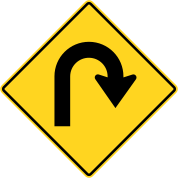
37. What does this traffic sign mean?
This traffic sign warns of a hairpin curve to the right. The road ahead makes a very sharp turn, so reduce speed and be prepared to steer sharply to the right.
English • Québec D-110-6-D • Hairpin bend to the right. A very tight right-hand bend is ahead. Reduce speed before the bend.
Sources
🔗 Commons.wikimedia.org
🔗 Cdn-contenu.quebec.ca • Québec MTMD · Danger signs poster, April 2026, p. 1
SVG source: Transports Québec • Public domain • Original revision 2013-08-09. Wikimedia original unmodified.
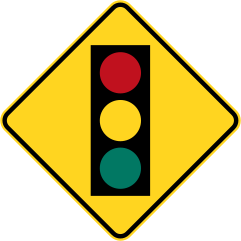
38. What does this traffic sign mean?
This traffic sign indicates a warning for traffic signals ahead. Traffic signals are located ahead and may not be visible early enough without advance warning. Reduce speed and be prepared to stop if the signal requires it.
English • Québec D-50-1 • Traffic lights ahead. Traffic lights are ahead. Be prepared to stop.
Sources
🔗 Commons.wikimedia.org
🔗 Cdn-contenu.quebec.ca • Québec MTMD · Danger signs poster, April 2026, p. 1
SVG source: Transports Québec • Public domain • Original revision 2013-08-08. Wikimedia original unmodified.
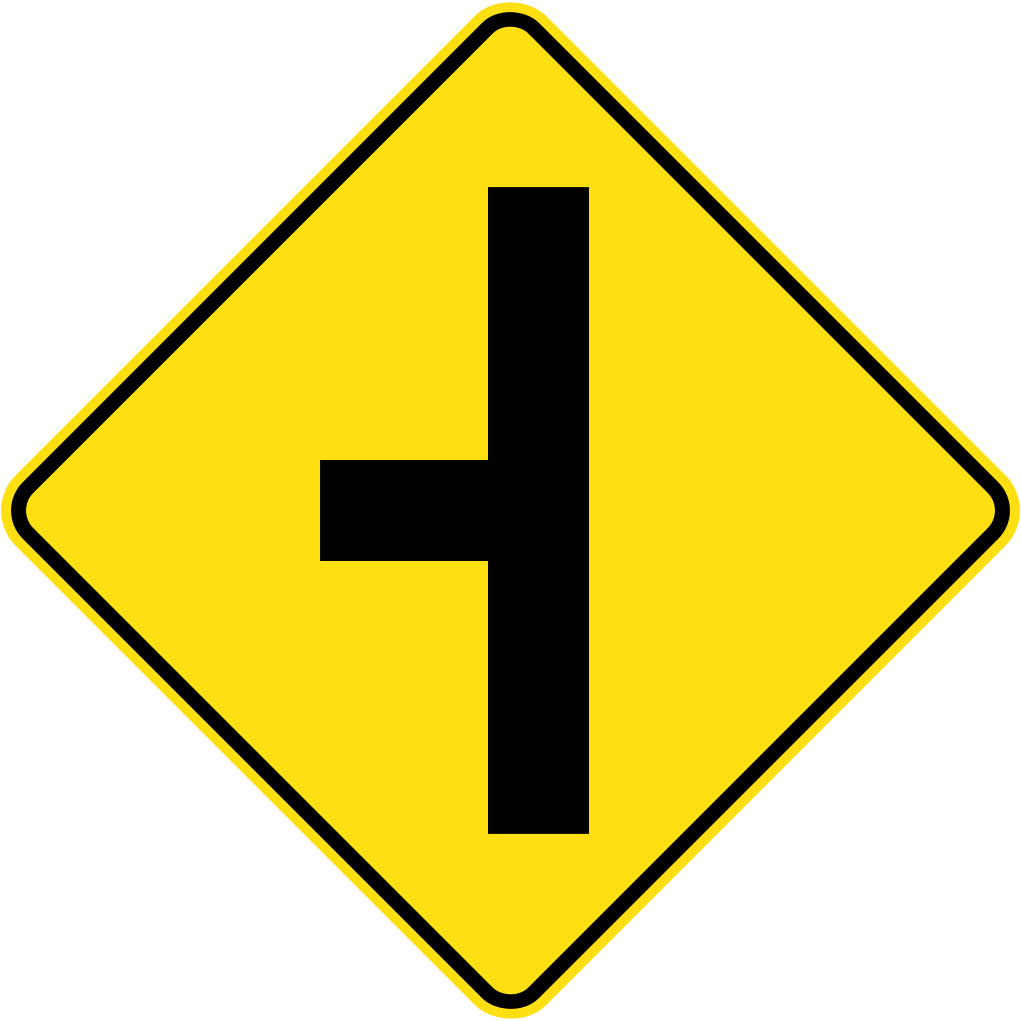
39. What does this traffic sign mean?
This traffic sign indicates a warning for a side road from the left. A side road joins the road ahead from the left at an uncontrolled intersection. Reduce speed, watch for traffic entering from the side road and follow the applicable default right-of-way rules.
English • Québec D-170-3 • Side road on the left. A side road joins from the left ahead.
Sources
🔗 Commons.wikimedia.org
🔗 Cdn-contenu.quebec.ca • Québec MTMD · Danger signs poster, April 2026, p. 1
SVG source: Transports Quebec — Government of Quebec • Public domain • Original revision 2024-11-13. Wikimedia original unmodified.
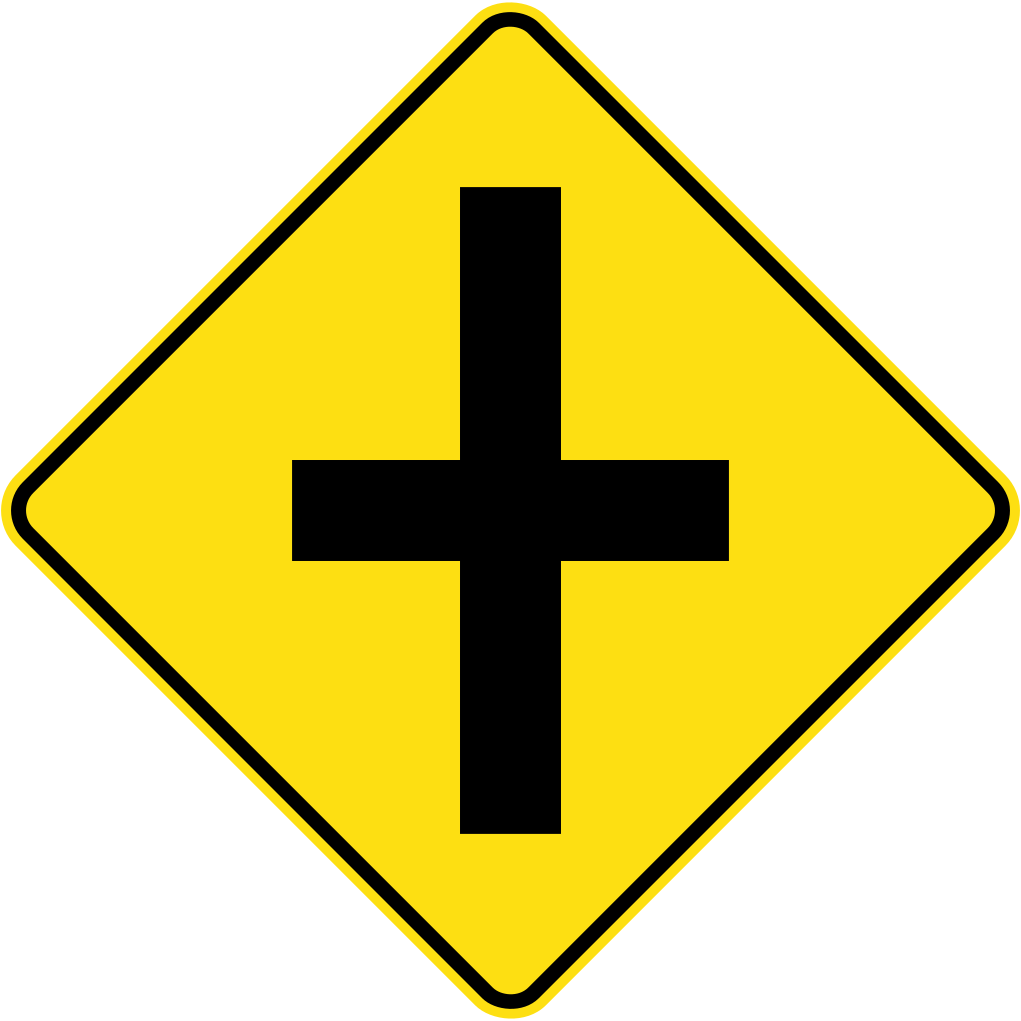
40. What does this traffic sign mean?
This traffic sign indicates a warning for an uncontrolled intersection. An intersection without traffic signals or signs assigning priority lies ahead. Reduce speed, watch for traffic approaching from other directions and follow the applicable local right-of-way rules.
English • Québec D-170-1 • Crossroad. A crossroad is ahead. The warning does not itself assign right of way.
Sources
🔗 Commons.wikimedia.org
🔗 Cdn-contenu.quebec.ca • Québec MTMD · Danger signs poster, April 2026, p. 1
SVG source: Transports Quebec — Government of Quebec • Public domain • Original revision 2024-11-13. Wikimedia original unmodified.
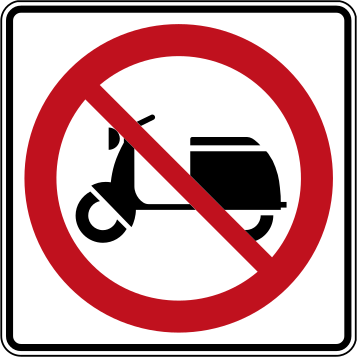
41. What does this traffic sign mean?
This traffic sign indicates that mopeds are prohibited. Moped riders may not enter or continue beyond the sign. The affected moped categories depend on the applicable local rules. Other road users may still be permitted unless another restriction applies.
English • Québec P-130-59 • No mopeds. The indicated road or route is closed to mopeds. Read any accompanying exception or time plate.
Sources
🔗 Commons.wikimedia.org
🔗 Cdn-contenu.quebec.ca • Québec MTMD · Regulatory signs poster, April 2026, p. 1
SVG source: Transports Québec • Public domain • Original revision 2013-08-02. Wikimedia original unmodified.
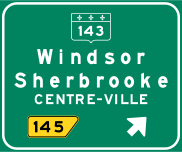
42. What does this traffic sign mean?
This traffic sign gives information about the next exit. It may show the exit number, destination, direction or distance to the exit.
English • Québec I-30 family • Exit direction. The illustrated exit leads towards Windsor, Sherbrooke and the town centre via route 143. Follow the arrow to the right. The displayed destination names and exit number 145 are examples, not confirmation of present-day routing. The sign family is confirmed; some details of this illustration were not fully matched to the reviewed standard.
Sources
🔗 Commons.wikimedia.org
🔗 Cdn-contenu.quebec.ca • Québec MTMD · Information signs poster 1, April 2026, p. 1
Image via Commons.wikimedia.org
Transports Québec • Public domain • Source revision 2013-08-15. Wikimedia original unmodified.
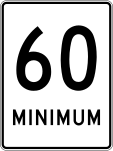
43. What does this traffic sign mean?
This traffic sign indicates the start of a minimum speed. Road users covered by the sign must travel at or above the indicated speed when conditions allow. Driving more slowly may still be necessary because of traffic, weather, road conditions or another safety-related reason.
English • Québec P-70-1 • Minimum speed: 60 km/h. This sign prescribes a minimum speed of 60 km/h for the road where it applies. It is not a nationwide minimum for all Canadian roads.
Sources
🔗 Commons.wikimedia.org
🔗 Cdn-contenu.quebec.ca • Québec MTMD · Regulatory signs poster, April 2026, p. 1
🔗 Legisquebec.gouv.qc.ca • Québec · Road signs regulation C-24.2, r. 41, section 12 (official consolidation, 1 May 2026) (FR)
SVG source: Transports Québec • Public domain • Original revision 2013-07-29. Wikimedia original unmodified.
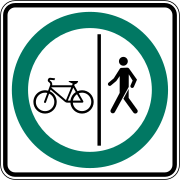
44. What does this traffic sign mean?
This traffic sign indicates a mandatory divided path for pedestrians and cyclists. Pedestrians and cyclists must use the section designated for them. Other road users may use the path only where the applicable signs or local rules permit them to do so.
English • Québec P-120-10 family • Separate routes for pedestrians and cyclists. Use the side indicated by the symbols: cyclists on the left and pedestrians on the right. The dividing line separates the two compulsory routes. The sign family is confirmed; some details of this illustration were not fully matched to the reviewed standard.
Sources
🔗 Commons.wikimedia.org
🔗 Rsr.transports.gouv.qc.ca • Québec MTMD · Road sign directory, indexed sign description
SVG source: Transports Québec • Public domain • Original revision 2013-09-26. Wikimedia original unmodified.
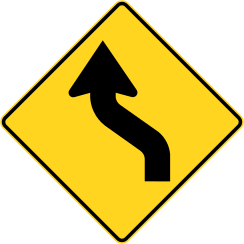
45. What does this traffic sign mean?
This traffic sign indicates a warning for successive curves, with the first curve to the left. Reduce speed before entering the winding section, maintain your lane position and be prepared for further changes in direction.
English • Québec D-110-4-G • Reverse curves: left then right. Two successive curves are ahead, first to the left and then to the right.
Sources
🔗 Commons.wikimedia.org
🔗 Cdn-contenu.quebec.ca • Québec MTMD · Danger signs poster, April 2026, p. 1
SVG source: Transports Québec • Public domain • Original revision 2013-08-09. Wikimedia original unmodified.
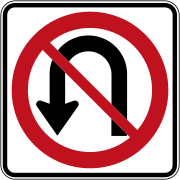
46. What does this traffic sign mean?
This traffic sign indicates that turning around (making a U-turn) is prohibited. A U-turn may not be made where the prohibition applies. Other movements may still be permitted unless another restriction applies.
English • Québec P-110-5 • No U-turn. Do not turn around to travel in the opposite direction here.
Sources
🔗 Commons.wikimedia.org
🔗 Cdn-contenu.quebec.ca • Québec MTMD · Regulatory signs poster, April 2026, p. 1
SVG source: Transports Québec • Public domain • Original revision 2013-08-01. Wikimedia original unmodified.
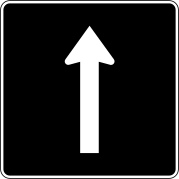
47. What does this traffic sign mean?
This traffic sign indicates a road with one-way traffic. Vehicular traffic may travel only in the permitted direction, subject to any exceptions indicated by traffic signs or local rules.
English • Québec P-100-1 • Straight-ahead lane. Vehicles in the lane controlled by this sign must continue straight ahead. This vertical lane arrow is distinct from the one-way street sign.
Sources
🔗 Commons.wikimedia.org
🔗 Cdn-contenu.quebec.ca • Québec MTMD · Regulatory signs poster, April 2026, p. 1
🔗 Legisquebec.gouv.qc.ca • Québec · Road signs regulation C-24.2, r. 41, section 16 (official consolidation, 1 May 2026) (FR)
SVG source: Transports Québec • Public domain • Original revision 2013-07-30. Wikimedia original unmodified.
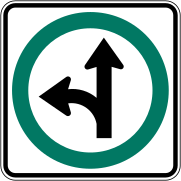
48. What does this traffic sign mean?
This traffic sign indicates that traffic must continue straight ahead or turn left. One of the indicated directions must be followed; turning right is prohibited.
English • Québec P-110-3-G • Straight ahead or left. Continue straight ahead or turn left at the indicated junction.
Sources
🔗 Commons.wikimedia.org
🔗 Cdn-contenu.quebec.ca • Québec MTMD · Regulatory signs poster, April 2026, p. 1
🔗 Legisquebec.gouv.qc.ca • Québec · Road signs regulation C-24.2, r. 41, section 18 (official consolidation, 1 May 2026) (FR)
Image via Commons.wikimedia.org
Transports Québec • Public domain • Source revision 2013-08-01. Wikimedia original unmodified.
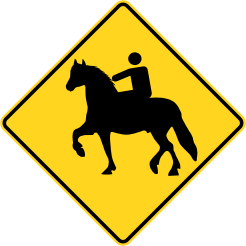
49. What does this traffic sign mean?
This traffic sign indicates a warning for equestrians. Horse riders may be on or near the road ahead. Reduce speed, allow plenty of space and avoid unnecessary use of the horn or sudden movements that could startle a horse.
English • Québec D-270-12 • Horse riders crossing. Horse riders may cross the road ahead.
Sources
🔗 Commons.wikimedia.org
🔗 Cdn-contenu.quebec.ca • Québec MTMD · Danger signs poster, April 2026, p. 1
SVG source: Transports Québec • Public domain • Original revision 2013-08-11. Wikimedia original unmodified.
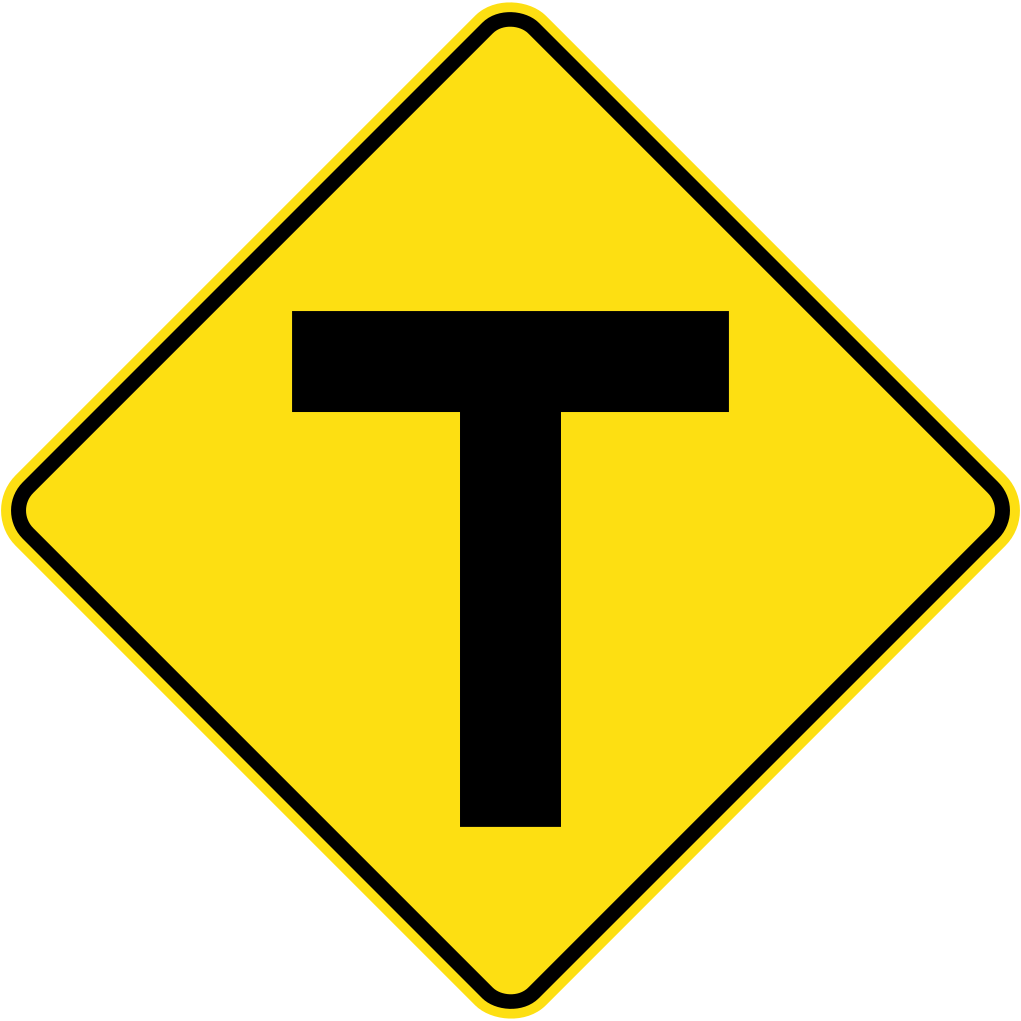
50. What does this traffic sign mean?
This traffic sign indicates a warning for an uncontrolled T-intersection. The road ends at an intersection where no traffic signs or signals assign priority. Reduce speed and follow the applicable default right-of-way rules.
English • Québec D-170-2 • T-junction. The road ends at a T-junction ahead.
Sources
🔗 Commons.wikimedia.org
🔗 Cdn-contenu.quebec.ca • Québec MTMD · Danger signs poster, April 2026, p. 1
SVG source: Transports Quebec — Government of Quebec • Public domain • Original revision 2024-11-13. Wikimedia original unmodified.