


Railway crossingCanada
 Traffic rules
 Canada
19. Railway crossing
A railway crossing, also called a level crossing or railroad crossing, is a place where a road or path crosses railway tracks at the same level. It may be protected by barriers, warning lights, bells, traffic signs or a combination of these measures.
Road users must approach carefully and never enter when a train is approaching, warning signals are active or the exit is blocked. They should cross promptly and must never stop, wait or become trapped on the tracks.

Wikimedia.org • Rick Cordeiro • CC0
When must drivers stop at a railroad crossing in Canada?
Rules vary across Canada. In Ontario, slow down and check both directions; stop for an approaching train, active crossing warnings or a STOP sign, subject to authorised flagman directions. Do not drive through, under or around a gate that is down, lowering or rising. School buses and certain other buses or public vehicles have additional stopping duties.
🔗 ontario.ca • Canada, Ontario MTO Driver’s Handbook, Stopping
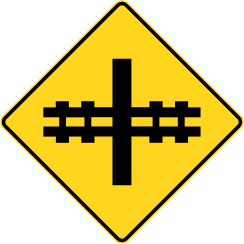 Warning for a railway crossing without barriers.
English • Québec D-180-1 • Railway crossing ahead. A railway crossing is ahead. Look for trains, signals and any stop or give-way controls at the crossing.
Sources
🔗 Commons.wikimedia.org
🔗 Cdn-contenu.quebec.ca • Québec MTMD · Danger signs poster, April 2026, p. 1
SVG source: Transports Québec • Public domain • Original revision 2013-08-11. Wikimedia original unmodified.
 Warning for a railway crossing with one track.
English • Railway crossbuck • Railway crossing. This sign marks a railway crossing. Give way to trains, check both directions and stop when necessary or when required by crossing controls. Do not enter unless you can clear the tracks.
Sources
🔗 Commons.wikimedia.org
🔗 Sgi.sk.ca • SGI · Saskatchewan Driver’s Handbook 2025
SVG source: Transportation Association of Canada • Public domain • Original revision 2019-12-15. Wikimedia original unmodified.
Must I stop at every unguarded railway crossing in Canada?
Not merely because barriers are absent. In Ontario, slow down, look and listen; stop for a STOP sign, an approaching train or active warning, subject to authorised directions. School buses must stop at railway crossings, and most other buses or public vehicles have additional duties at unprotected crossings. Check the applicable province or territory elsewhere.
🔗 ontario.ca • Canada, Ontario MTO Driver’s Handbook, Stopping
What if road traffic is queued beyond a railway crossing in Canada?
In Ontario, wait before the tracks until your whole vehicle can clear the crossing. Check the exit yourself before following another vehicle, even if no train is visible. Keeping the tracks clear is essential; check the applicable provincial or territorial rules elsewhere in Canada.
🔗 ontario.ca • Canada, Ontario MTO Driver’s Handbook, Stopping
Can I cross after a train has passed if the warning lights are still active in Canada?
In Ontario, no. Wait until the lights stop flashing and any gate is fully raised. Never go around, under or through a gate while it is down, lowering or rising. Check that all trains have passed before crossing. Follow the applicable provincial or territorial rules elsewhere.
🔗 ontario.ca • Canada, Ontario MTO Driver’s Handbook, Stopping


