


YieldCanada
 Traffic rules
 Canada
15. Yield
A yield sign requires drivers to allow traffic with priority to proceed before entering, crossing or joining a road. Drivers must reduce speed, observe approaching traffic and stop when necessary.
Unlike a stop sign, a yield sign does not always require a complete stop. The driver may continue without stopping only when the route is clearly safe and no road user with priority is forced to change speed or direction.

Wikimedia.org • Adam Moss • CC BY-SA
What does giving way mean in Canada?
Canadian rules vary by province. In Ontario, a Yield sign requires slowing or stopping when necessary and waiting until the way is clear before proceeding.
🔗 ontario.ca • Ontario MTO — STOP, YIELD, simultaneous arrival and all-way stops
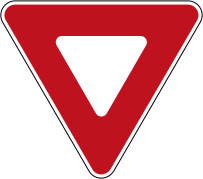 Yield.
English • Québec P-20-1 • Give way. Give way to traffic on the priority road. Slow down and stop if needed before entering safely.
Sources
🔗 Commons.wikimedia.org
🔗 Cdn-contenu.quebec.ca • Québec MTMD · Regulatory signs poster, April 2026, p. 1
🔗 Legisquebec.gouv.qc.ca • Québec · Road signs regulation C-24.2, r. 41, section 8 (official consolidation, 1 May 2026) (FR)
SVG source: Transports Québec • Public domain • Original revision 2013-07-29. Wikimedia original unmodified.
Must you always stop when giving way in Canada?
In Ontario, a Yield sign requires slowing or stopping if necessary until you can proceed safely. A Stop sign requires a complete stop. Check the applicable provincial rules elsewhere in Canada.
🔗 ontario.ca • Ontario MTO — STOP, YIELD, simultaneous arrival and all-way stops
What should you check before proceeding after giving way in Canada?
Wait until the manoeuvre is safe. Check the priority traffic, the view in both directions and enough space to complete the entry. Giving way to one vehicle does not remove duties towards another driver, a cyclist or a pedestrian.
🔗 ontario.ca • Ontario MTO — STOP, YIELD, simultaneous arrival and all-way stops


