


Traffic signsCanada
 Traffic rules
 Canada
26. Curve
A curve is a section of road that changes direction to the left or right. A sharp, unexpected or poorly visible curve can reduce a driver’s view of approaching traffic, stopped vehicles, pedestrians and other hazards.
Drivers should reduce speed before entering the curve, remain within their lane and use smooth steering, braking and acceleration. Warning signs may indicate the direction of the first curve or a series of successive curves.
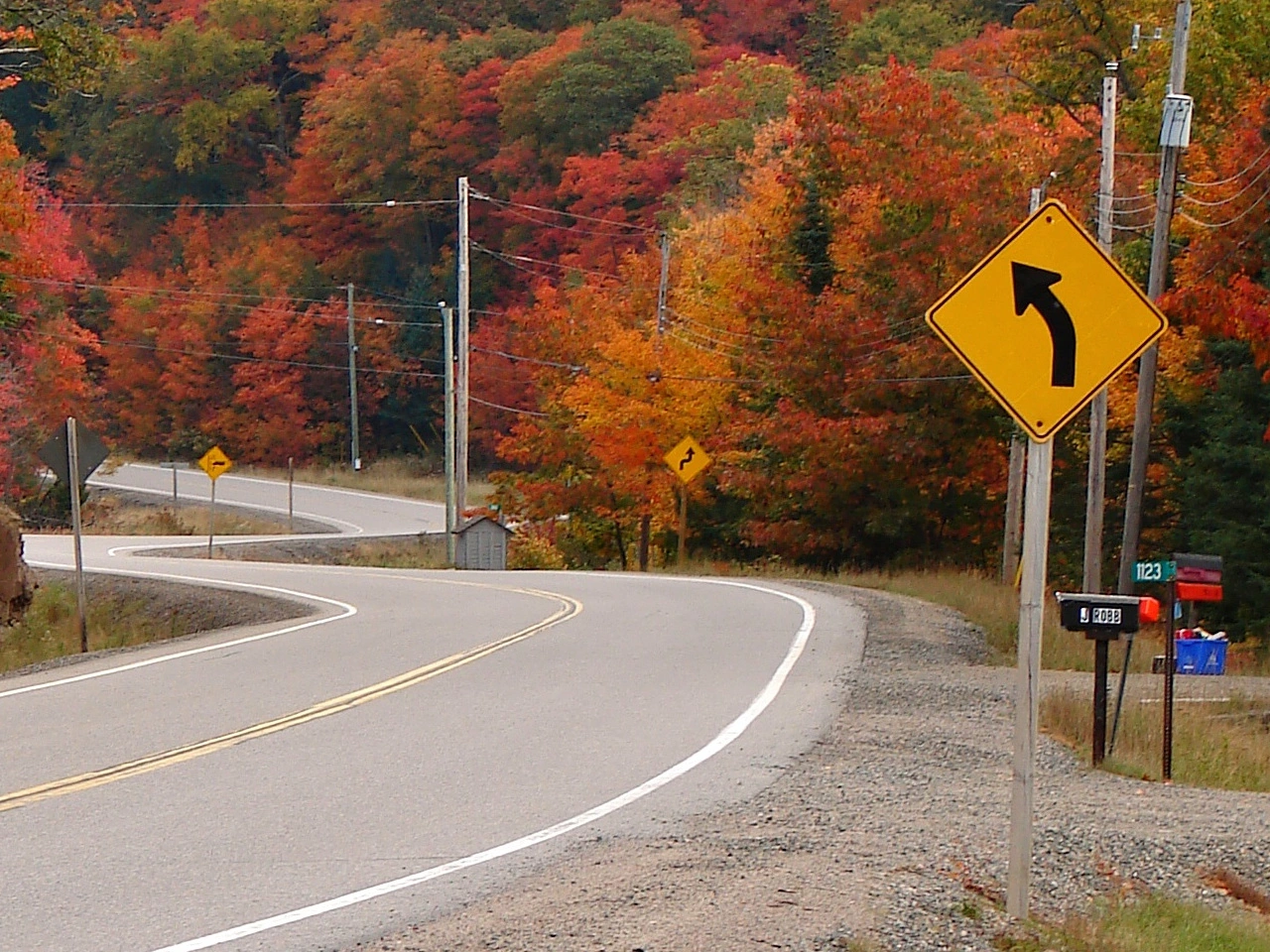
Wikimedia.org • P199 • CC BY-SA
What makes a bend dangerous in Canada?
Curves shorten your view of the road ahead and can reduce the margin for correcting a mistake. Drivers may encounter forest or mountain curves affected by snow, ice and wildlife; the safe speed can be well below the posted maximum. Watch for changing road surfaces and people or vehicles hidden beyond the curve.
How should you approach a sharp curve in Canada?
Slow down before the bend, select the correct lane position, look through the curve and steer smoothly. Keep enough grip and visible stopping distance for the road and weather conditions.
Is overtaking safe on a blind bend in Canada?
No. Do not start overtaking where your view of oncoming traffic is obstructed or where signs or road markings prohibit it. Wait until there is a lawful, clear and sufficiently long view ahead.
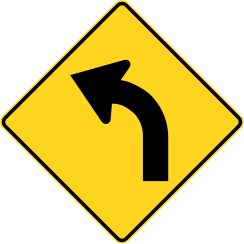 Warning for a curve to the left.
English • Québec D-110-2-G • Curve to the left. The road curves to the left ahead.
Sources
🔗 Commons.wikimedia.org
🔗 Cdn-contenu.quebec.ca • Québec MTMD · Danger signs poster, April 2026, p. 1
SVG source: Transports Québec • Public domain • Original revision 2013-08-09. Wikimedia original unmodified.
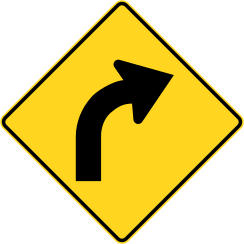 Warning for a curve to the right.
English • Québec D-110-2-D • Curve to the right. The road curves to the right ahead.
Sources
🔗 Commons.wikimedia.org
🔗 Cdn-contenu.quebec.ca • Québec MTMD · Danger signs poster, April 2026, p. 1
SVG source: Transports Québec • Public domain • Original revision 2013-08-09. Wikimedia original unmodified.

27. Wrong-way driving
Wrong-way driving occurs when a driver travels against the legally permitted direction of traffic. It may happen on a one-way road, divided road, freeway entrance or exit, or another road section reserved for traffic travelling in one direction.
Wrong-way driving creates an extreme risk of a head-on collision. Drivers must follow direction signs, no-entry signs, lane arrows and pavement markings. Anyone who accidentally enters a road in the wrong direction should slow down, warn other traffic, stop in the safest available place and contact the emergency services.
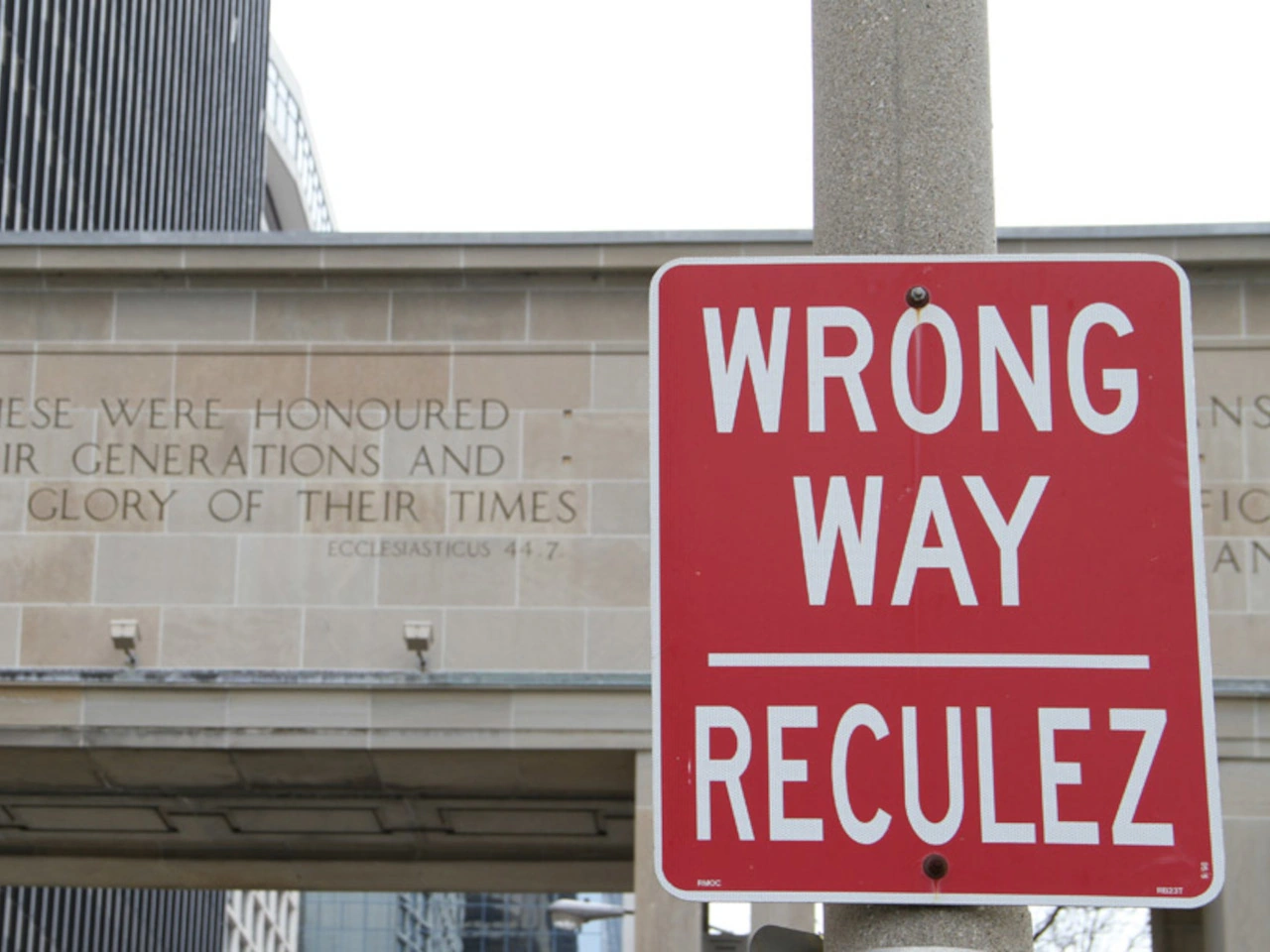
Wikimedia.org • Ken Banks • CC BY
How can you avoid driving the wrong way in Canada?
Traffic normally keeps right here. Keep to the correct side of the road and use no-entry and one-way signs to identify prohibited approaches; do not enter an exit ramp against its permitted direction.
🔗 icbc.com • ICBC — Learn to Drive Smart, March2026; subject guidance
What signs can prevent wrong-way driving in Canada?
No-entry and one-way controls are set under the relevant province or territory; do not assume every junction is arranged identically. Before entering a motorway, expressway, one-way street or slip road, check the permitted direction rather than relying only on a navigation app.
🔗 icbc.com • ICBC — Learn to Drive Smart, March2026; subject guidance
28. Road work
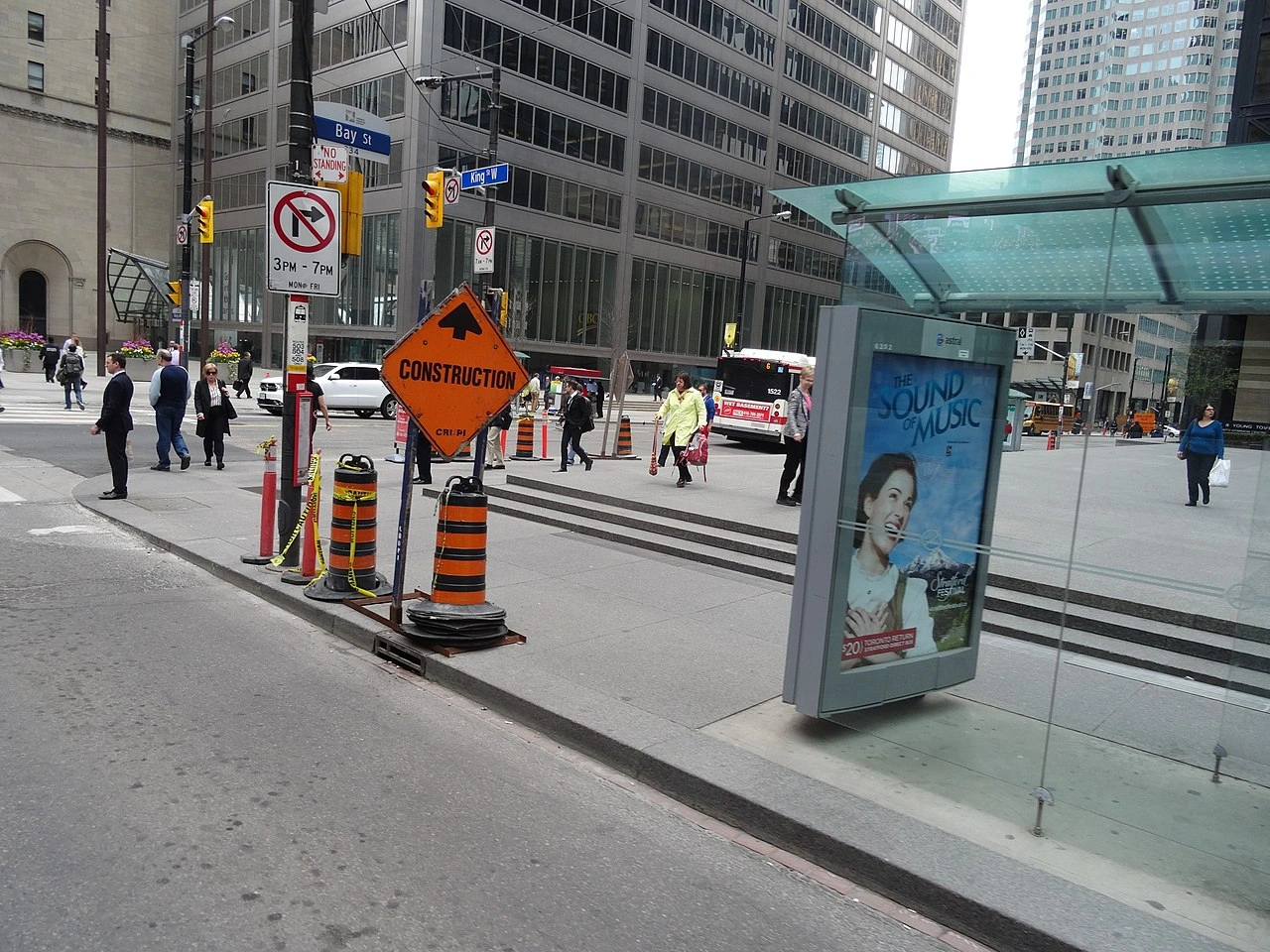
Road work refers to construction, maintenance, repair or inspection activities carried out on or beside a road. They may temporarily change the road layout, lane widths, speed limits, priority, permitted directions and facilities for pedestrians or cyclists.
Drivers must follow the temporary signs, traffic signals, barriers, pavement markings and instructions from authorized personnel. They should reduce speed, increase their following distance and remain prepared for narrow lanes, stopped traffic, workers, machinery and sudden changes in the route.
Wikimedia.org • booledozer • CC BY-SA
What should you watch for when approaching roadworks in Canada?
Look for temporary warnings, cones, barriers, narrow lanes and construction vehicles. The legal work-zone arrangements and any special fines vary by province or territory; check the posted controls. Expect workers and slow or stationary traffic near the worksite.
Is a temporary speed limit at roadworks binding in Canada?
Where an authorised temporary regulatory speed limit is in force, you must obey it. A roadworks warning alone should not be mistaken for a new numerical limit, but conditions may require driving more slowly.
What if only one lane remains open through roadworks in Canada?
Follow the temporary signals, stop/go instructions, lane arrows and priority signs. Do not enter an opposing traffic lane until permitted, and give vulnerable road users and road workers extra room.
29. Height limit
A height limit prohibits vehicles whose total height exceeds the value shown from entering or passing a road section, bridge, tunnel, gateway or other structure. The vehicle’s height includes its load and any equipment attached above it.
Drivers of high vehicles must know their exact height, observe advance warnings and use an alternative route when necessary. They should never rely only on visual judgement or attempt to pass beneath a structure when safe clearance is uncertain.
Wikimedia.org • Lesmatt • CC BY-SA
How should you read a low-bridge height restriction in Canada?
Look for the locally prescribed height restriction or clearance warning near older bridges, tunnels and remote routes. The displayed clearance is normally in metres. A warning may describe a hazard ahead; a prohibitory sign indicates a route you cannot enter if your vehicle exceeds the limit.
Does a roof load count when checking vehicle height in Canada?
Yes for practical clearance: measure the vehicle at its highest point with its load and fitted accessories, such as a roof box, bicycle or roof rack. Check the local legal measurement rules as well; an empty vehicle’s registered height is not enough when equipment has been added.
What should you do if your vehicle is too high for a bridge or tunnel in Canada?
Do not try to squeeze under the structure. Use the signed alternative route and, if you are already close to the obstruction, stop where safe and seek traffic-control assistance rather than reversing unpredictably into moving traffic.
30. Weight limit
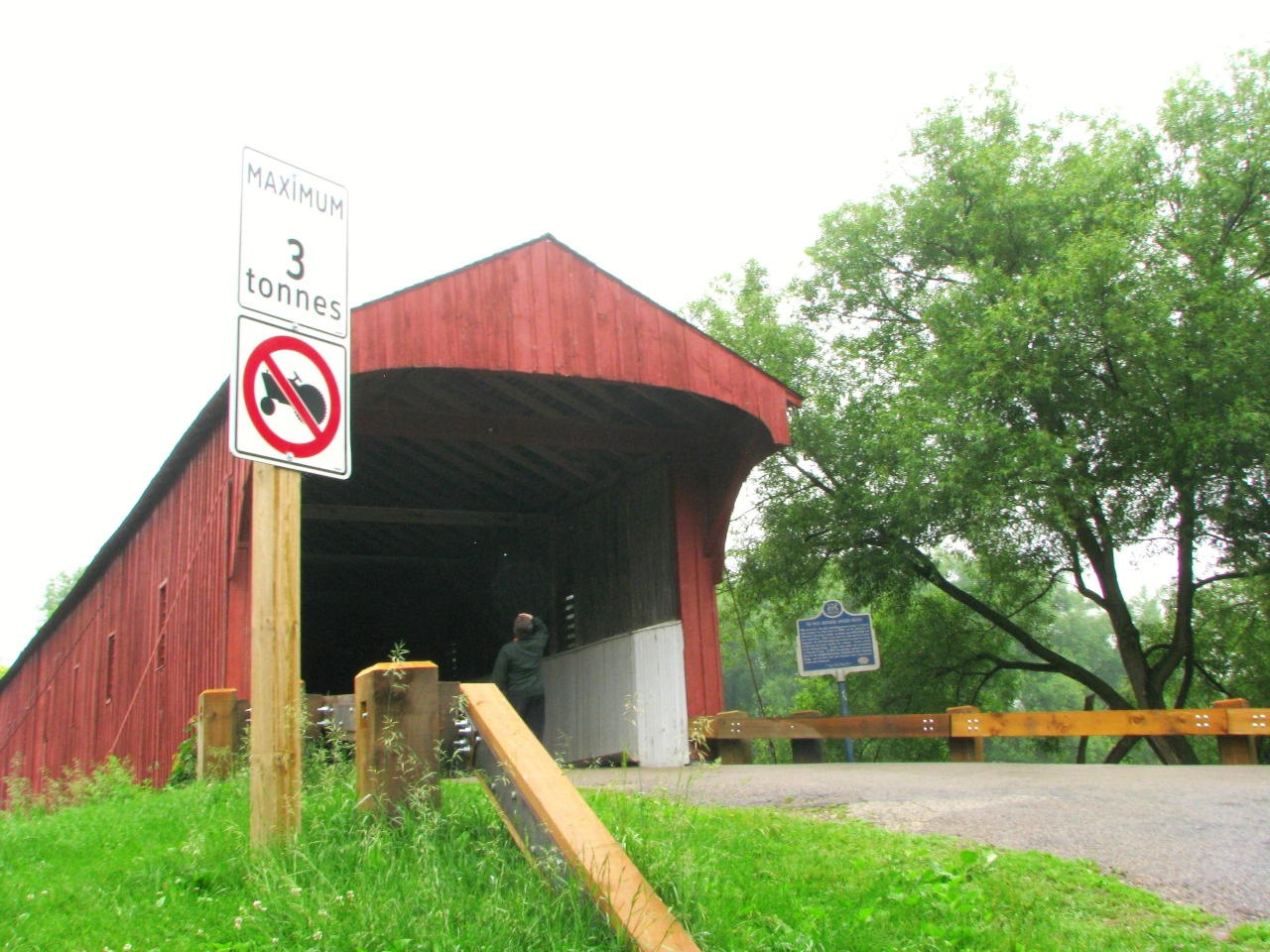
A weight limit prohibits vehicles or vehicle combinations whose mass exceeds the value shown from entering or passing a road section, bridge, tunnel or other structure. Depending on local law, the restriction may concern the vehicle’s actual loaded mass, maximum authorized mass or load on an individual axle.
Drivers must know which type of mass the sign refers to and must include the vehicle, passengers, cargo and any trailer where required. A vehicle that exceeds the limit must use another suitable route.
Wikimedia.org • Laurel L. Russwurm • CC BY-SA
Does every weight-limit sign measure the same kind of vehicle weight in Canada?
No. Canadian weight controls can distinguish total vehicle mass and axle or axle-group loads. Provincial and territorial weight regulations and bridge signs can differ; the rule for one province or bridge must not be assumed everywhere.
Do cargo and trailers matter for a posted weight restriction in Canada?
Yes, whenever the rule is based on actual loaded mass or the total mass of a combination. Cargo, passengers and the trailer affect that figure; weight on individual axles may be limited separately. If the sign instead uses authorised maximum mass, an empty vehicle may still be prohibited.
What should you do if your vehicle exceeds a bridge weight limit in Canada?
Do not drive onto the bridge. Follow the signed alternative route and check the vehicle’s gross and axle loads as applicable. A general heavy-vehicle permit does not automatically authorise crossing every restricted bridge.
31. Radar speed sign
A radar speed sign warns drivers that vehicle speeds may be monitored by a fixed camera, mobile radar, lidar or average-speed enforcement system. It reminds drivers to check and respect the applicable speed limit.
The sign does not normally establish the speed limit itself. Drivers must follow the general, posted or variable speed limit applying to the road and must not brake suddenly merely because speed enforcement is indicated.
Wikimedia.org • Mario Hains • CC BY-SA
Should you brake abruptly when you notice a radar sign in Canada?
No. Adjust to the lawful and safe speed smoothly, leaving adequate space behind and ahead. Enforcement information does not authorise sudden unsafe manoeuvres or stopping to inspect the camera.
🔗 icbc.com • ICBC, Learn to Drive Smart full current guide
🔗 bclaws.gov.bc.ca • British Columbia, current Motor Vehicle Act
32. Selective barriers
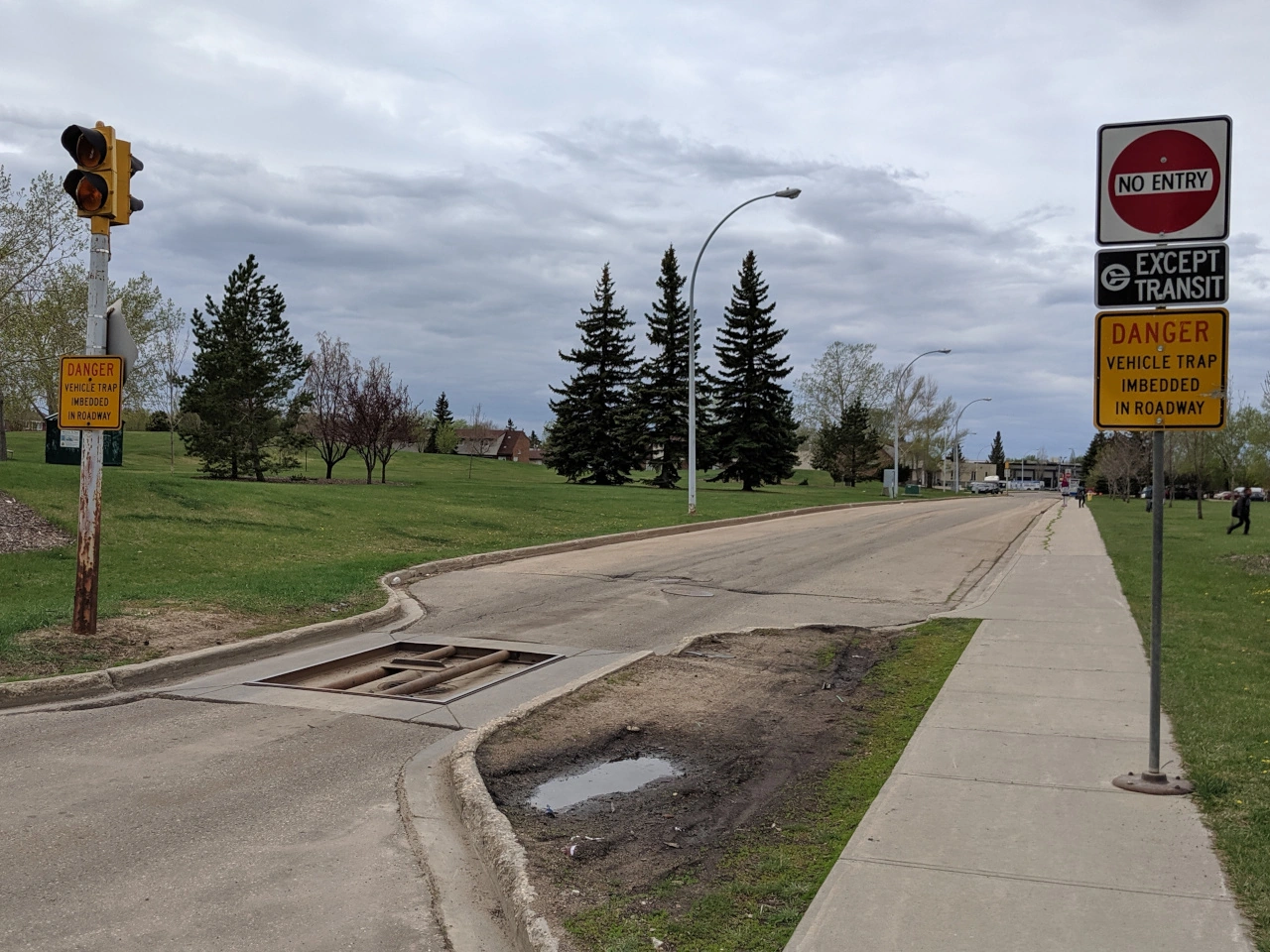
Selective barriers are physical access-control devices that allow certain road users or authorized vehicles to pass while restricting other traffic. They may include fixed, removable, folding or retractable bollards, gates, barriers and width-filtering installations.
The permitted users are determined by traffic signs, access conditions and local regulations, not by the barrier alone. Drivers should approach slowly, verify that they are authorized and wait until any moving barrier is fully open or retracted before continuing.
Wikimedia.org • Vanstrat • CC BY-SA
33. Priority at the next intersection
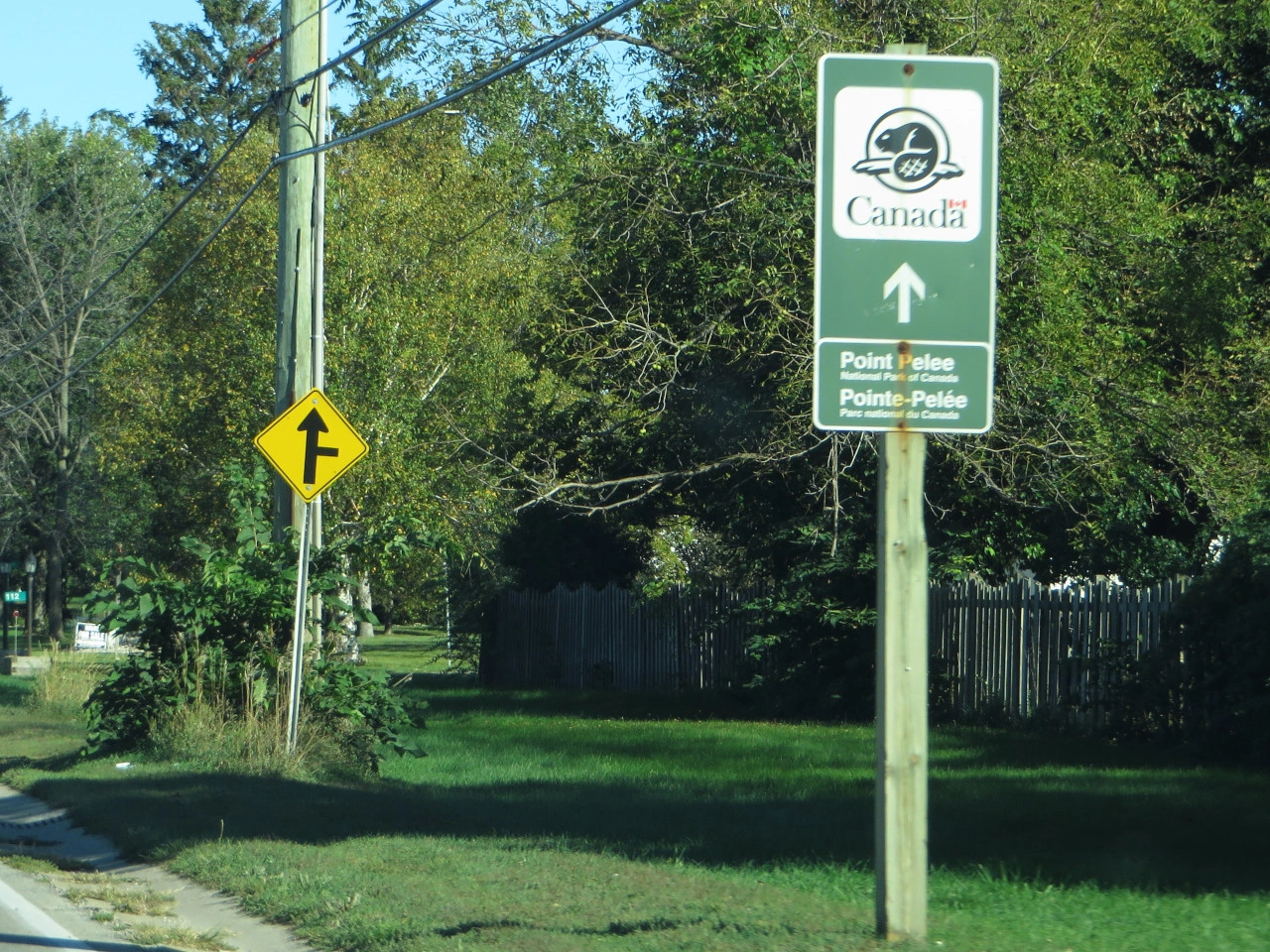
Priority at the next intersection means that drivers travelling on a particular road have the right-of-way over traffic entering from intersecting roads at the next intersection. The priority arrangement is normally indicated by signs facing both the priority traffic and the traffic that must yield.
Unlike a continuing priority road, this priority applies only at the indicated intersection. Drivers must still approach cautiously and obey traffic signals, authorized officers, crossings, turning rules and other applicable signs.
Wikimedia.org • Ken Lund • CC BY-SA
How is priority at the next junction determined in Canada?
There is no safe universal rule that a road with more lanes or heavier traffic has priority. At an intersection in Canada, identify the applicable Stop or Give Way signs, traffic lights and local right-of-way rules.
Does priority at one junction automatically continue along the entire road in Canada?
No. One-junction priority and continuing priority-road status are distinct concepts. Check the local signs at each following junction, including any end-of-priority marker, traffic signal or new Give Way or Stop sign.
May a driver with priority ignore pedestrians or another safety obligation at the next junction in Canada?
No. Junction priority does not cancel duties towards pedestrians, traffic signals, emergency vehicles or other road users where the law gives them precedence. Approach at a speed allowing you to stop safely.
34. Traffic signals
Traffic signals use coloured lights, arrows or symbols to regulate when road users may proceed, must prepare to stop or must remain stopped. Separate signals may apply to particular directions, lanes, pedestrians, cyclists or public transit vehicles.
A green light permits movement only when the route is clear and the movement is otherwise legal. Road users must still follow right-of-way rules, turning restrictions, lane markings and instructions from authorized traffic controllers.
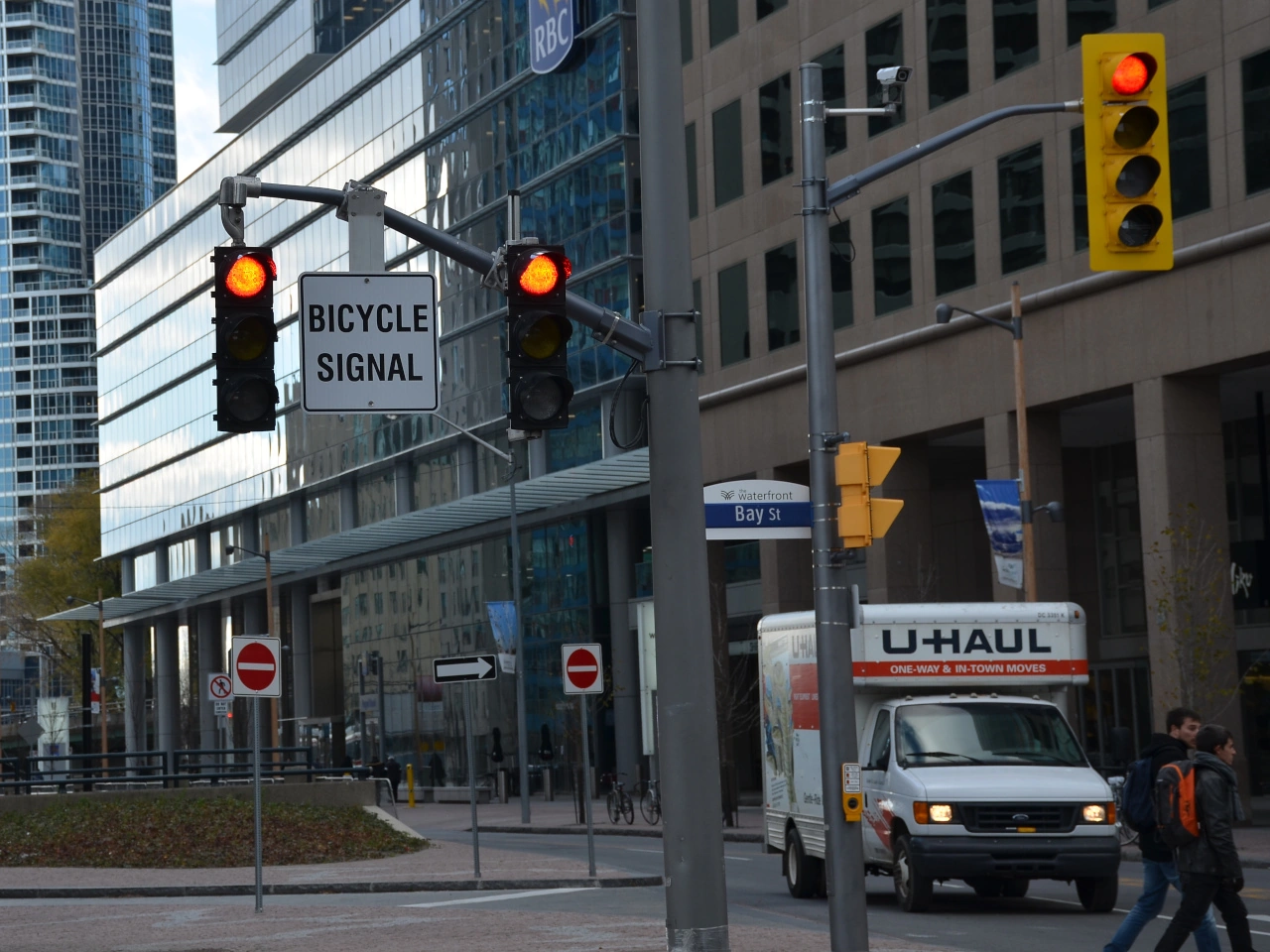
Wikimedia.org • shankar s. • CC BY
What must a driver do at red, amber and green signals in Canada?
Check the provincial or territorial rules. In British Columbia, steady red requires a stop; steady yellow requires stopping unless it cannot be done safely; green permits proceeding when the junction is clear, subject to yielding duties. Flashing red means stop and proceed only when safe; flashing yellow requires caution.
🔗 bclaws.gov.bc.ca • British Columbia, current Motor Vehicle Act
May you turn at a red traffic light in Canada?
Rules vary by province and territory. In British Columbia, a right turn on red is generally permitted after a complete stop, unless a sign prohibits it. Give way to pedestrians and vehicles lawfully proceeding through the junction. Check the rules where you are driving.
🔗 bclaws.gov.bc.ca • British Columbia, current Motor Vehicle Act
Can a green light remove the need to give way to pedestrians in Canada?
No. For example, British Columbia requires drivers facing green to give way to pedestrians and vehicles lawfully in the junction. A green light permits proceeding only when it is safe and the way is clear. Observe any separate turning or pedestrian signals.
🔗 bclaws.gov.bc.ca • British Columbia, current Motor Vehicle Act
35. Traffic signals ahead
A traffic signals ahead sign warns drivers that traffic signals are located ahead. It is commonly used where the signals may be unexpected, difficult to see from a distance or located on a road where drivers need additional time to prepare to stop.
Drivers approaching this sign should reduce speed when necessary, watch for the signals ahead and be prepared to stop if the traffic signal changes or traffic is waiting at the intersection.
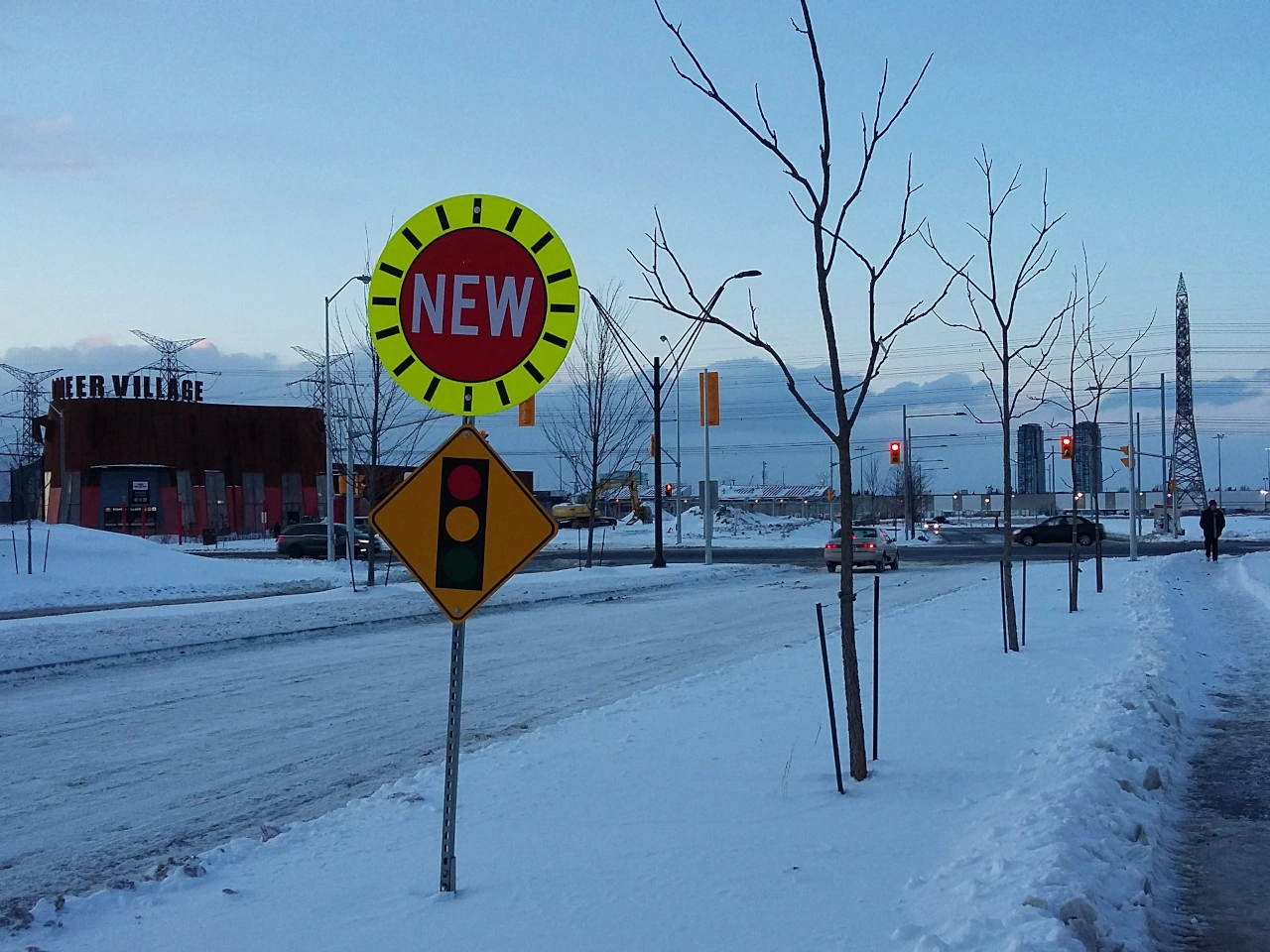
Wikimedia.org • Enoch Leung • CC BY-SA
How are traffic lights ahead warned of in Canada?
A yellow warning sign showing a traffic-signal symbol can alert drivers to traffic lights ahead; the exact shape and application follow local sign standards. It warns of a potential need to stop, but does not replace the actual signals.
Does a traffic-lights-ahead warning require an immediate stop in Canada?
No. A warning sign is not an automatic STOP instruction and does not create a new numerical speed limit. Reduce speed when necessary, look for a queue or a concealed signal, and obey the traffic lights and any separate speed or stop signs.
What should you check if the next traffic lights are difficult to see in Canada?
Allow enough distance to stop before the marked line, watch for vehicles braking suddenly and be ready for a pedestrian or cyclist crossing. If the signals are out of order or flashing, follow the applicable local failure and priority rules rather than guessing from the warning sign.
36. Pedestrian lights
Pedestrian lights are traffic signals that regulate when pedestrians may begin crossing a road. They normally display a red standing figure to prohibit starting and a green walking figure to permit crossing.
A flashing signal or countdown may warn that the permitted crossing period is ending. Pedestrians should cross without unnecessary delay, while turning drivers must remain alert and allow pedestrians who entered lawfully to finish crossing safely.
Wikimedia.org • Ken Lund • CC BY-SA
What do pedestrian traffic signals mean in Canada?
In Toronto, the walking-person signal permits you to start after checking that cross traffic has stopped. A flashing orange hand means do not start, but finish a crossing already begun on WALK. A steady orange hand means do not enter. Check the rules for the province or territory you visit.
What if the pedestrian signal changes while you are crossing in Canada?
In Toronto, if you began on WALK, continue to the opposite pavement or a safety island when the orange hand starts flashing. Do not begin a new crossing during that phase. The countdown shows the time remaining to complete the crossing; rules elsewhere in Canada must be checked locally.
May turning drivers ignore pedestrians on a signal-controlled crossing in Canada?
No. For example, British Columbia requires a turning driver facing green to give way to pedestrians lawfully crossing. A permitted turn on red also requires yielding to pedestrians and traffic lawfully proceeding. Check the provincial or territorial rules and the actual signals.
🔗 bclaws.gov.bc.ca • British Columbia, current Motor Vehicle Act
37. All-way stop
An all-way stop is an intersection where traffic approaching from every direction is required to stop before entering. It is usually indicated by a stop sign on each approach and is commonly used where traffic from intersecting roads needs to be controlled without traffic signals.
Every driver must come to a complete stop and proceed only when it is safe and permitted. The rules determining which vehicle may proceed first differ between countries, so drivers should follow the local right-of-way rules rather than assuming that the first vehicle to arrive always has the right-of-way.
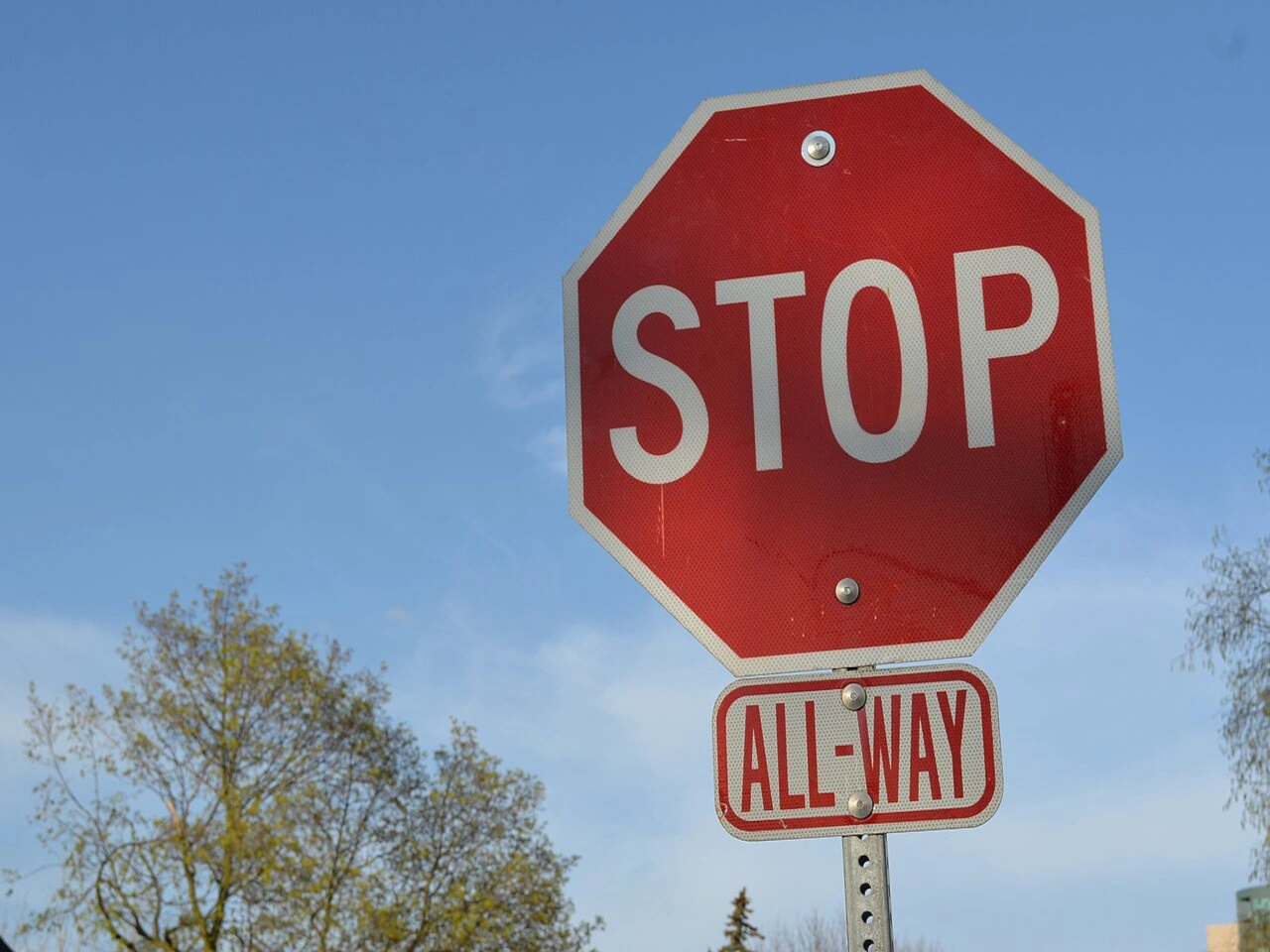
Wikimedia.org • Raysonho • CC BY-SA
Are four-way STOP intersections used in Canada?
Yes. They are used in Canadian jurisdictions, but priority and enforcement are governed by provincial and territorial law. The Ontario driver handbook, for example, explains all-way-stop priority.
🔗 ontario.ca • Ontario MTO — STOP, YIELD, simultaneous arrival and all-way stops
Who goes first at an all-way STOP in Ontario?
The vehicle that comes to a complete stop first generally proceeds first. When two vehicles stop at the same time, the vehicle on the left gives way to the vehicle on the right. Give way to pedestrians and comply with turning rules.
🔗 ontario.ca • Ontario MTO — STOP, YIELD, simultaneous arrival and all-way stops
Can you roll through a four-way STOP in Canada?
No. A STOP sign requires a complete stop. For example, British Columbia requires drivers at a four-way stop to give way to vehicles already in the intersection and enter only when safe.
🔗 icbc.com • ICBC Learn to Drive Smart, Chapter4 — complete stop and four-way priority
38. Emergency telephone
An emergency telephone is a dedicated roadside or tunnel telephone that connects road users directly with an emergency, traffic-control or roadside-assistance centre. Emergency telephones are commonly installed in tunnels, along freeways or at other locations where quickly reporting an accident, breakdown or fire is important. They can provide operators with useful information about the caller’s location and may remain available where mobile-phone reception is poor.
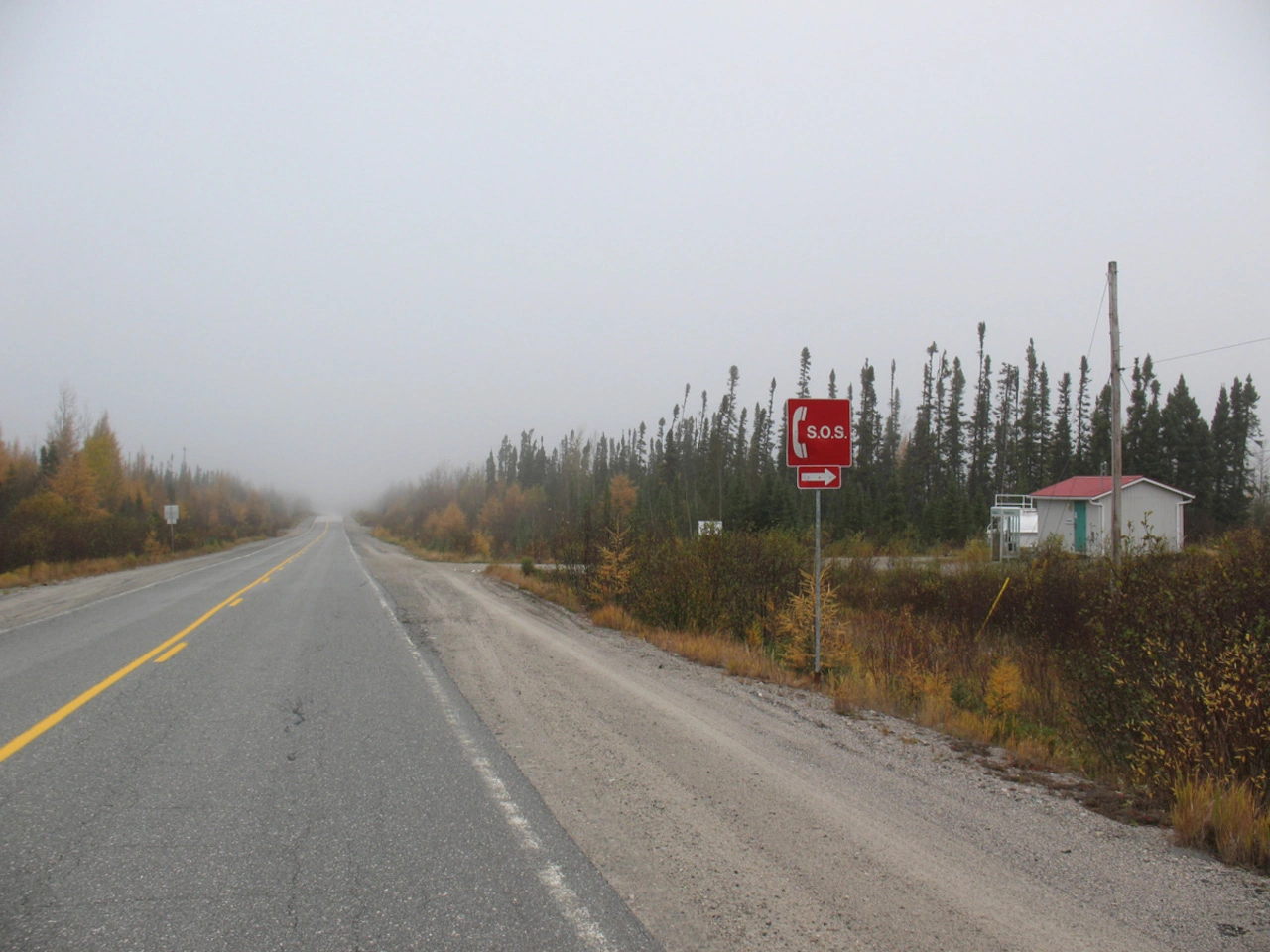
Wikimedia.org • Fenerty • CC BY-SA
What is an emergency telephone?
An emergency telephone is a dedicated telephone used to contact emergency services, a traffic-control centre or roadside assistance from the road.
🔗 gov.uk • Great Britain Highway Code, Rules 275–279; national guidance example
🔗 gov.uk • Great Britain Highway Code, Rules 270–274; national guidance example
Where are emergency telephones commonly found?
They are commonly installed in road tunnels, motorway emergency areas and other locations where rapid assistance may be needed.
🔗 gov.uk • Great Britain Highway Code, Rules 275–279; national guidance example
🔗 gov.uk • Great Britain Highway Code, Rules 270–274; national guidance example
When should you use an emergency telephone?
Use an emergency telephone to report situations such as a breakdown, accident, fire or other serious road emergency when assistance is required.
🔗 gov.uk • Great Britain Highway Code, Rules 275–279; national guidance example
🔗 gov.uk • Great Britain Highway Code, Rules 270–274; national guidance example
39. No parking
No parking indicates that vehicles may not be left parked at the location or along the section of road covered by the restriction. Depending on local law, a driver may still be allowed to stop briefly to pick up or drop off passengers or to load or unload goods, provided stopping itself is not prohibited.
A no-parking restriction may apply continuously or only during specified times, days, vehicle categories or sections of road. Its exact extent and exceptions are determined by the traffic sign, supplemental panels, pavement markings and local traffic regulations.
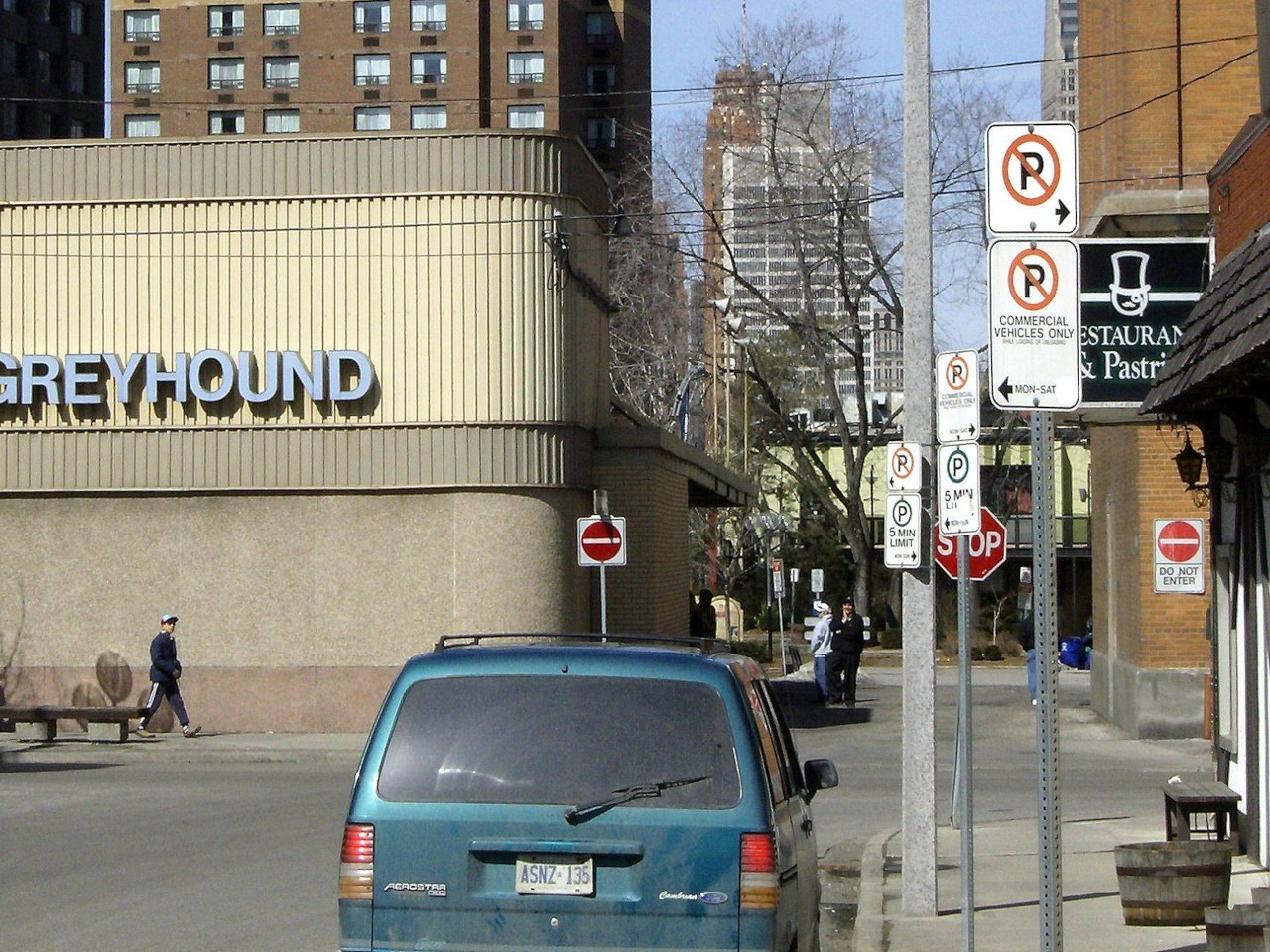
Wikimedia.org • Mikerussell • CC BY-SA
Can Ontario drivers assume parking is legal if no No Parking sign is visible?
No. The Ontario Driver’s Handbook warns that not all parking by-laws are shown on signs. Rules also restrict parking near hydrants, intersections, access points and other hazards.
🔗 ontario.ca • Ontario Government, Driver’s Handbook, parking along roads
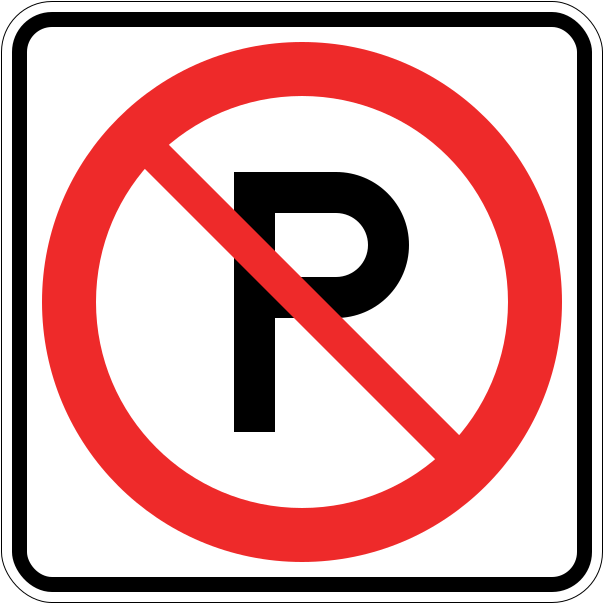 Parking prohibited.
English • Québec P-150-1 • No parking. Do not park in the area controlled by the sign. Read any arrows, times or exceptions on additional plates.
Sources
🔗 Commons.wikimedia.org
🔗 Cdn-contenu.quebec.ca • Québec MTMD · Regulatory signs poster, April 2026, p. 1
🔗 Legisquebec.gouv.qc.ca • Québec · Road signs regulation C-24.2, r. 41, section 29 (official consolidation, 1 May 2026) (FR)
SVG source: Transports Quebec — Government of Quebec • Public domain • Original revision 2024-12-28. Wikimedia original unmodified.
Can you park where you would prevent another vehicle leaving in Ontario?
No. Do not block an already parked vehicle, a pedestrian route or a road entrance.
🔗 ontario.ca • Ontario Ministry of Transportation, parking along roadways
What clearance does Ontario’s handbook specify around a bridge?
Do not park on a bridge or within 100 metres of it.
🔗 ontario.ca • Ontario Ministry of Transportation, parking along roadways
How close to an open hotel or theatre entrance may you park in Ontario?
Keep 6 metres clear of its public entrance. The handbook also applies this rule to an open public hall.
🔗 ontario.ca • Ontario Ministry of Transportation, parking along roadways
40. No stopping
No stopping means that vehicles are not permitted to stop voluntarily at the indicated location, even briefly for picking up or dropping off passengers or loading or unloading goods. It is a stricter restriction than a no-parking rule.
A no-stopping restriction may be indicated by a traffic sign, road marking or local traffic regulation. Drivers should continue to a place where stopping is permitted unless they are forced to stop by traffic conditions, an emergency or another legal requirement.
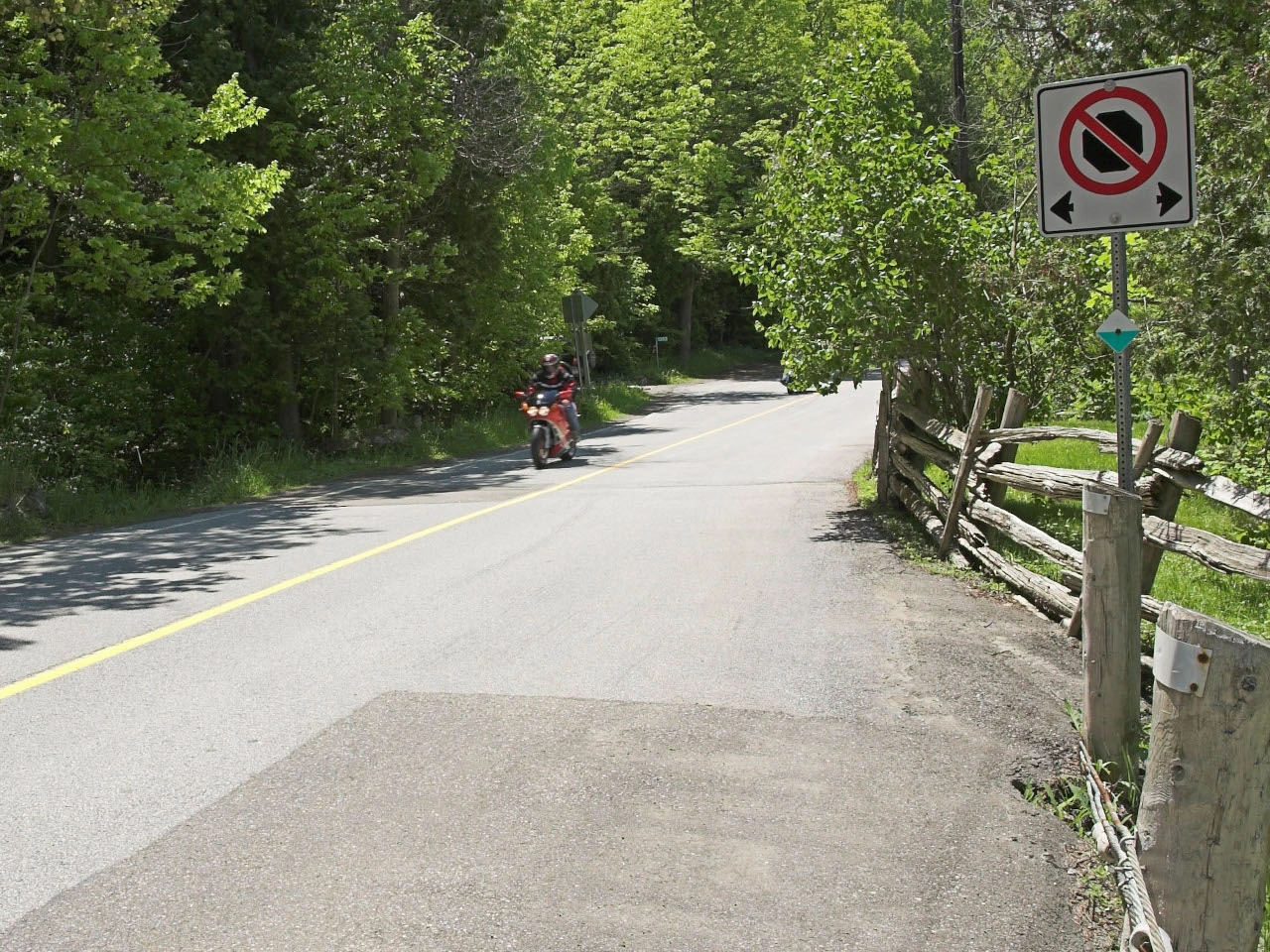
Wikimedia.org • Gary J. Wood • CC BY-SA
Does an Ontario No Stopping sign allow a brief passenger drop-off?
No. During its stated restriction, you may not stop even to load or unload passengers or goods.
🔗 ontario.ca • Ontario Ministry of Transportation, regulatory signs
41. Parallel parking
Parallel parking is a method of parking a vehicle parallel to the edge of the road, usually in a space between two parked vehicles. It is commonly used where parking spaces are arranged along the side of a street.
Parallel parking normally involves positioning the vehicle beside the available space and backing up into it while carefully checking mirrors, blind spots and surrounding traffic. The vehicle should finish within the permitted parking area and close enough to the road edge without obstructing other road users.
Wikimedia.org • Tdevries • CC BY-SA
How should a vehicle be positioned after parallel parking?
The vehicle should be completely within the permitted parking area, reasonably close to the road edge and positioned so that it does not unnecessarily obstruct traffic or access to other vehicles.
🔗 ris.bka.gv.at • Austria, StVO sections 2, 23–24 and 52
🔗 gov.uk • Great Britain Highway Code, Rules 238–252; national guidance example
🔗 gov.uk • UK Department for Transport, parking-control signs and road markings
🔗 wegcode.be • Belgium, 1975 Road Code, Articles 2 and 23–27
42. Disabled parking
Disabled parking refers to parking spaces and parking privileges reserved for people with disabilities who meet the applicable eligibility requirements. Reserved spaces are normally identified by the international wheelchair symbol and are positioned to provide easier access to nearby facilities.
Use of a disabled parking space generally requires a valid disabled parking permit or card. The permit normally belongs to the eligible person rather than to a particular vehicle and may only be used when that person is driving or travelling in the vehicle.
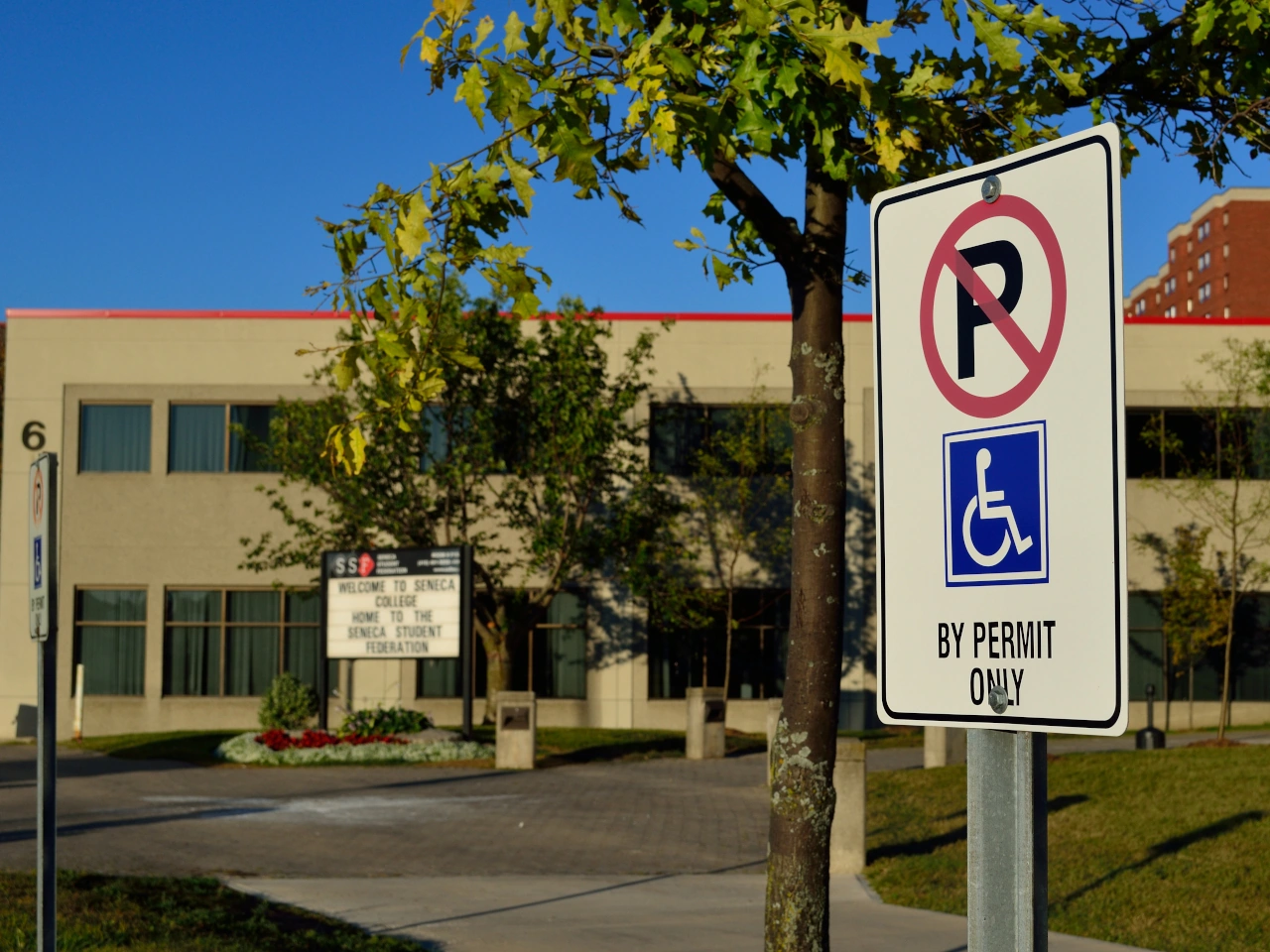
Wikimedia.org • Raysonho • CC0
How must an Ontario Accessible Parking Permit be displayed?
Display it on the dashboard or sun visor, with the permit number and expiry date clearly visible.
🔗 ontario.ca • Ontario Government, Accessible Parking Permits
Does an Ontario accessible permit provide identical parking concessions in every municipality?
No. Each municipality sets its parking privileges through by-laws. Check the local rules before assuming a payment or time-limit exemption.
🔗 ontario.ca • Ontario Government, Accessible Parking Permits
43. Traffic management
Traffic management is the organized control, regulation and guidance of road users to improve safety, traffic flow and the efficient use of roads. It can include traffic signals, road signs, pavement markings, lane controls, variable speed limits, detours and directions given by authorized persons.
Traffic management may be permanent or temporary. Temporary measures are commonly introduced during road work, congestion, collisions, public events or other incidents. Drivers and other road users must follow the signs, signals and instructions applying at the location, even when they differ from the normal traffic arrangement.
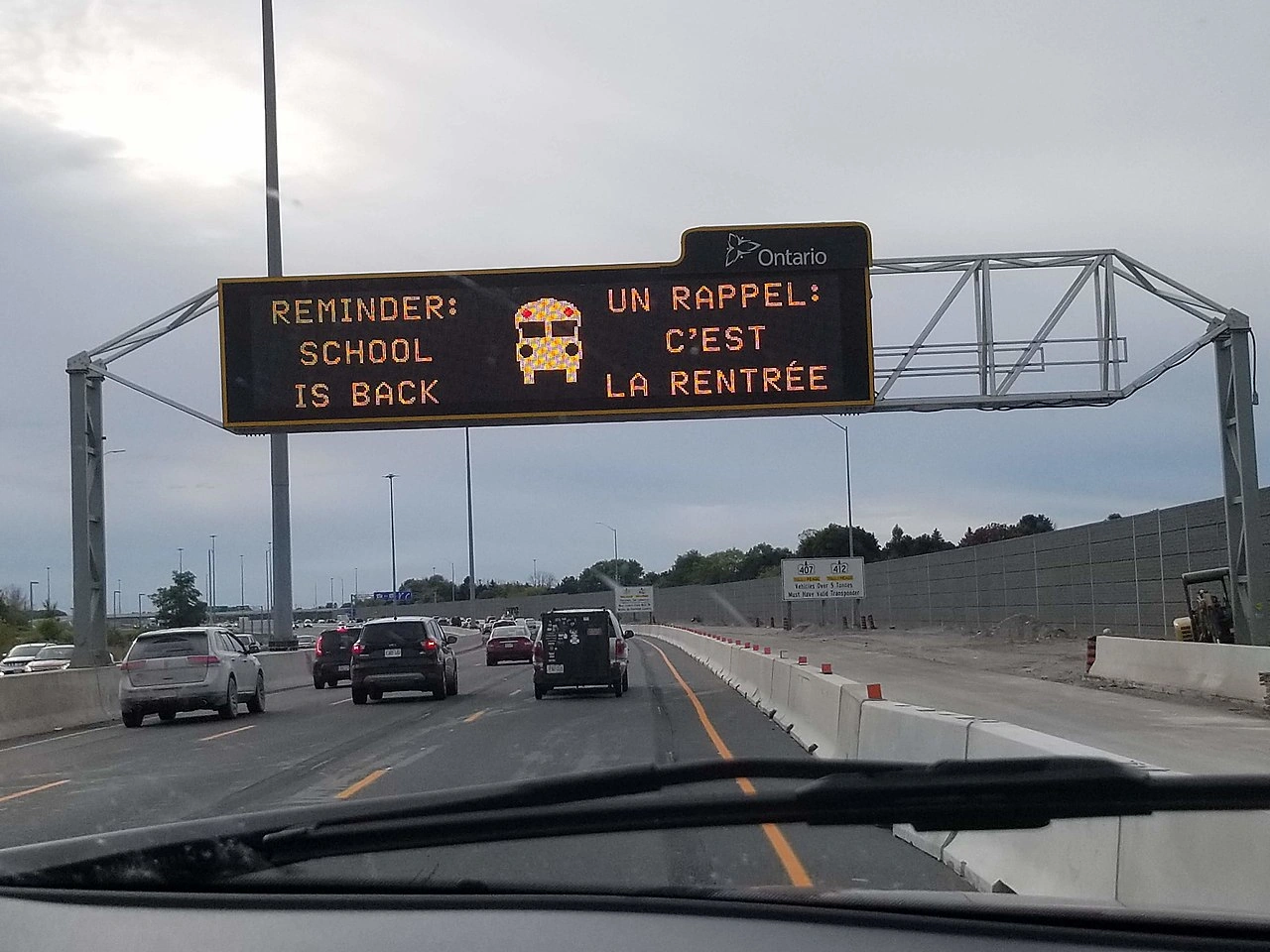
Wikimedia.org • Vhayes1992 • CC BY-SA
What is traffic management?
Traffic management is the organised control and guidance of traffic using signs, signals, road markings, lane controls, speed restrictions, diversions and other measures.
🔗 gov.uk • Great Britain Highway Code, Rules 133–134; national guidance example
🔗 gov.uk • Great Britain Highway Code, Rules 257–258; national guidance example
🔗 gov.uk • UK Department for Transport, Know Your Traffic Signs, information signs
Can traffic management change the normal speed limit?
Yes. Temporary or variable speed-limit signs may impose a different maximum speed because of congestion, roadworks, weather, incidents or other conditions. Drivers must follow the limit currently displayed.
🔗 gov.uk • Great Britain Highway Code, Rules 133–134; national guidance example
🔗 gov.uk • Great Britain Highway Code, Rules 257–258; national guidance example
🔗 gov.uk • UK Department for Transport, Know Your Traffic Signs, information signs
What should you do when a traffic lane is closed?
Follow the signs and signals governing where the closure begins and how to merge. Move safely into an open lane at the instructed point; local merge-in-turn rules may apply in congestion. Do not drive beyond a signal or marking that prohibits use of the lane.
🔗 gov.uk • Great Britain Highway Code, Rules 133–134; national guidance example
🔗 gov.uk • Great Britain Highway Code, Rules 257–258; national guidance example
🔗 gov.uk • UK Department for Transport, Know Your Traffic Signs, information signs
44. Backing up
Backing up means driving a vehicle backwards. It is commonly used when parking, leaving a confined space or repositioning a vehicle where forward movement is not practical.
Before backing up, the driver should check mirrors and blind spots, look carefully around the vehicle and make sure the area behind is clear. Backing up should be performed slowly and only for as long as necessary because visibility behind the vehicle is often limited.
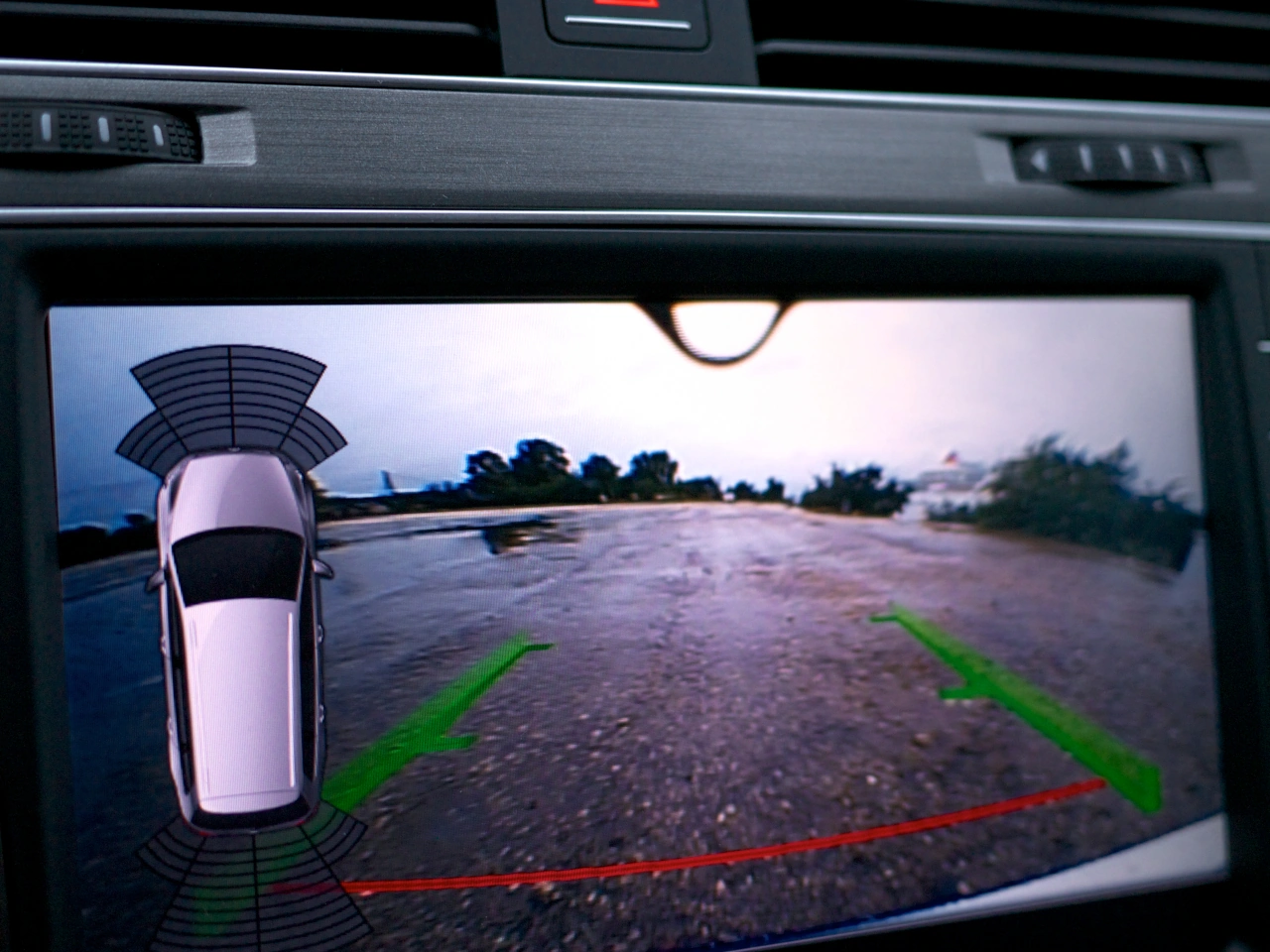
Wikimedia.org • Kārlis Dambrāns • CC BY
Is reversing allowed on a high-speed divided road in Ontario?
Ontario prohibits driving in reverse on a divided road with a speed limit above 80 km/h, on both the travelled portion and the shoulder, except when trying to help someone in trouble. Ordinary parking-related reversing is subject to separate safe-driving requirements.
Which checks does Manitoba recommend before reversing?
Use mirrors and look over your shoulder for people and obstacles behind the vehicle.
Why do Manitoba reversing checks need particular care around children?
Small children may be below your direct line of sight.
Where should you look when reversing straight back or right in Manitoba?
Check the mirrors and look over your right shoulder.
Where should you look when reversing left in Manitoba?
Use the mirrors and look over your left shoulder.
How should you select reverse according to Manitoba’s handbook?
Keep your foot on the brake while putting the vehicle in reverse.
Must Manitoba drivers watch side clearance while reversing around a turn?
Yes. Ensure the vehicle does not strike anything alongside it.
45. U-turn
A U-turn is a driving manoeuvre in which a vehicle turns around to travel in the opposite direction. It normally involves crossing part of the roadway and re-entering traffic facing the direction from which the vehicle came.
Before making a U-turn, the driver should check surrounding traffic, pedestrians and cyclists, signal when required and make sure there is enough visibility and space to complete the manoeuvre safely. U-turns may be prohibited by traffic signs or on particular types of roads.

Wikimedia.org • Adam Moss • CC BY-SA
What sight distance does Ontario require for a U-turn?
In Ontario, the Driver’s Handbook says you must be able to see at least 150 metres in both directions. U-turns are prohibited on curves or near railway crossings, hilltops, bridges and tunnels where visibility is obstructed.
🔗 ontario.ca • Ontario MTO — roundabout controls and150m U-turn visibility
Does a U-turn sign override the need to check for traffic in Ontario?
No. First check that no sign prohibits a U-turn. Even where the manoeuvre is allowed, do not turn unless the required visibility is available and both directions are clear.
🔗 ontario.ca • Ontario MTO — roundabout controls and150m U-turn visibility
46. Detour
A detour is a temporary alternative route used when the normal road is closed, blocked or unavailable. Detours are commonly introduced during road work, accidents, public events, flooding or other disruptions. Drivers should follow the temporary direction signs carefully, reduce speed where necessary and expect unfamiliar roads, changed priorities or additional traffic along the alternative route.

Wikimedia.org • Ken Lund • CC BY-SA
What is a detour?
A detour is an alternative route that directs traffic around a closed, blocked or restricted section of road.
🔗 gov.uk • Great Britain Highway Code, Rules 259 and 263–274; national guidance example
Why are detours used?
Detours may be introduced because of roadworks, accidents, flooding, public events or other temporary obstructions that prevent normal use of the road.
🔗 gov.uk • Great Britain Highway Code, Rules 259 and 263–274; national guidance example
What is the difference between a detour and a diversion?
Detour and diversion generally describe the same concept: an alternative route around a road that cannot be used normally. The preferred term varies between countries and languages.
🔗 gov.uk • Great Britain Highway Code, Rules 259 and 263–274; national guidance example
47. Uncontrolled intersection
An uncontrolled intersection is an intersection where traffic priority is not specifically regulated by traffic signals, an authorized person or signs assigning priority to particular approaches. Drivers must therefore determine who has the right-of-way using the default traffic rules that apply in that country.
The applicable rule varies between countries and may include priority from the right, priority from the left or another default right-of-way rule. Drivers should approach an uncontrolled intersection carefully, observe traffic from every direction and never assume that a wider or busier road automatically has the right-of-way.

Wikimedia.org • Adam Moss • CC BY-SA
Who normally has priority at an uncontrolled junction in Ontario?
If two vehicles arrive from different roads at the same time, the driver on the left must yield to the driver on the right. A vehicle already approaching or occupying the intersection may need to be allowed through first.
🔗 ontario.ca • Ontario MTO — STOP, YIELD, simultaneous arrival and all-way stops
Is an all-way stop the same as an uncontrolled intersection in Ontario?
No. At an all-way stop, the driver who first comes to a complete stop normally proceeds first; if vehicles stop together, the driver on the left yields to the one on the right.
🔗 ontario.ca • Ontario MTO — STOP, YIELD, simultaneous arrival and all-way stops
48. Road surface
A road surface warning indicates that the road ahead may be uneven, damaged or in poor condition and could affect the stability, steering or braking of a vehicle. The hazard may include bumps, depressions, potholes, broken pavement or other irregularities in the road surface.
Drivers should reduce speed where necessary, maintain a safe distance and avoid sudden steering or braking when passing over an irregular surface. The exact meaning and appearance of the warning sign vary between countries, so drivers must follow the local traffic signs and regulations.
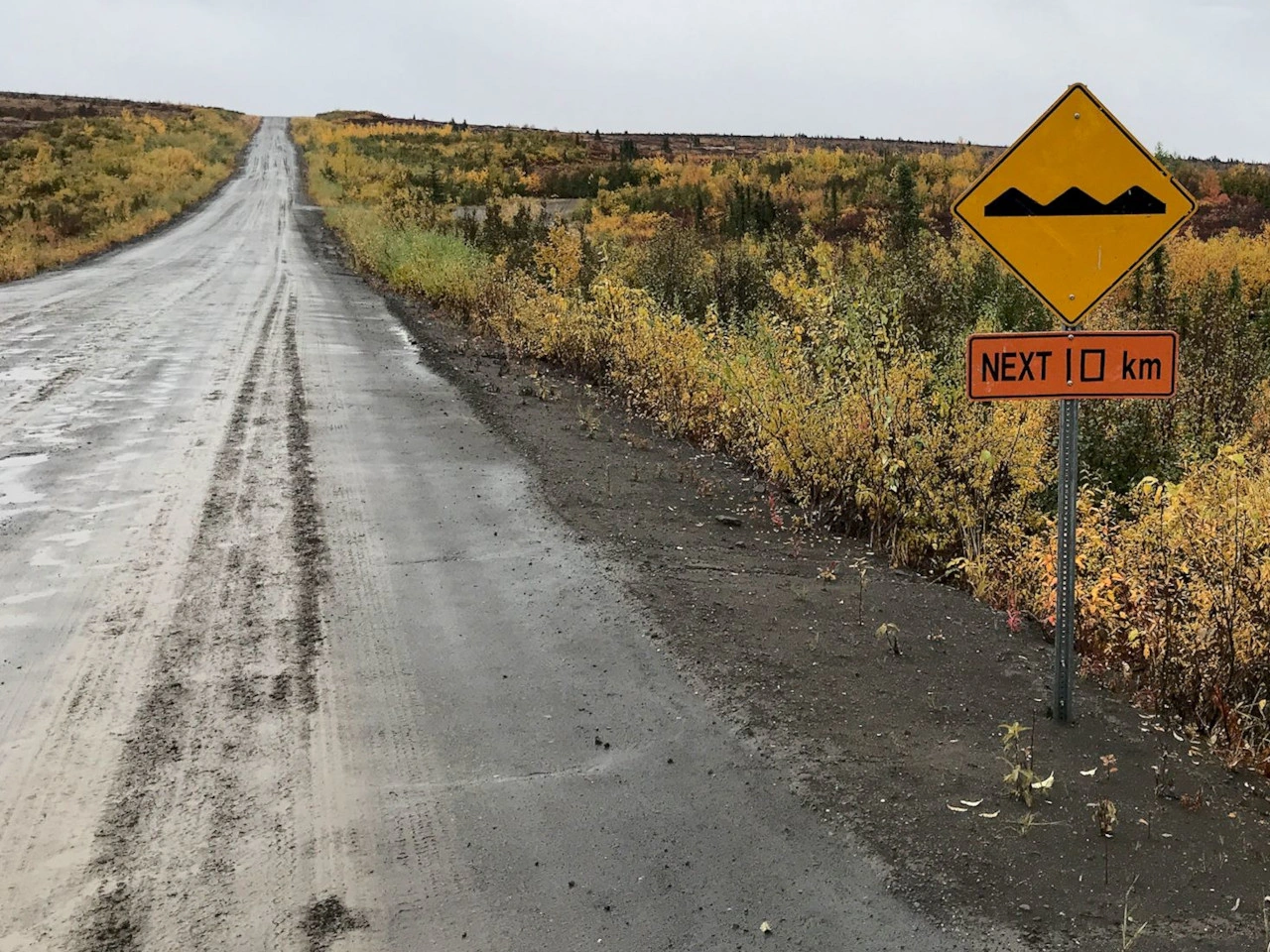
Wikimedia.org • dvs • CC BY
What does a road surface warning mean?
A road surface warning indicates that the surface ahead may be uneven, damaged or otherwise capable of affecting the safe movement of vehicles.
🔗 gov.uk • Great Britain Highway Code, Rules 226–237; national guidance example
 Warning for a bad road surface.
What should you do when you see a road surface warning?
Reduce speed where necessary, increase your awareness of the road ahead and be prepared for changes in the vehicle's stability or direction.
🔗 gov.uk • Great Britain Highway Code, Rules 226–237; national guidance example
Does a road surface warning impose a specific speed limit?
Not normally. A warning sign alerts drivers to a hazard rather than establishing a numerical speed limit. A separate speed-limit sign may be used where a particular maximum speed is required.
🔗 gov.uk • Great Britain Highway Code, Rules 226–237; national guidance example
49. Emergency lane
An emergency lane is a strip alongside the main traffic lanes of a freeway or other high-speed road that is normally kept free from regular traffic. It provides a place for vehicles that have broken down or are involved in an emergency and may also be used by emergency or authorized service vehicles where local rules permit.
Drivers should not use an emergency lane as a normal traffic lane. If a vehicle must stop there because of an emergency, occupants should follow the applicable safety procedures and remain as far away from moving traffic as possible.
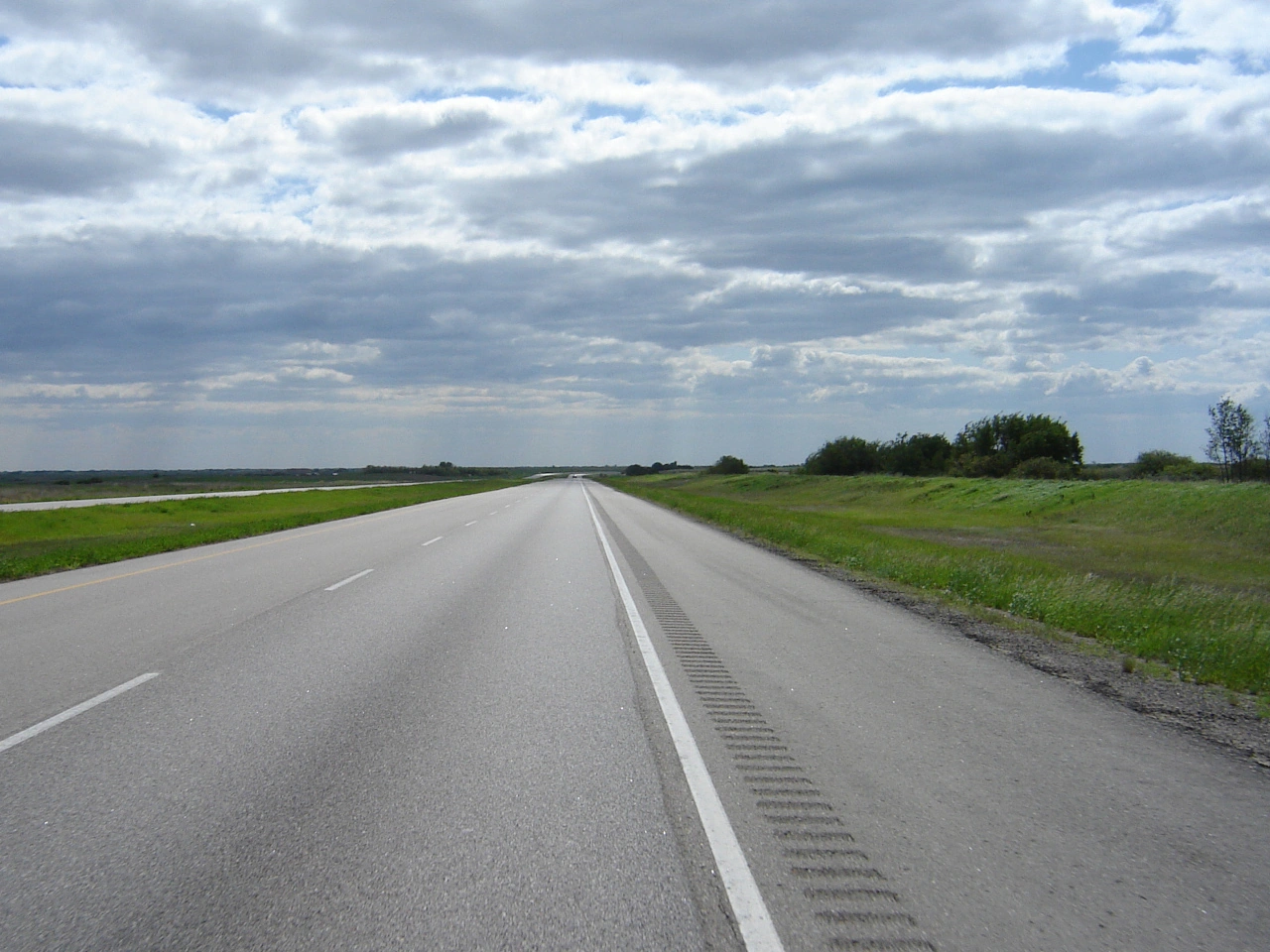
Wikimedia.org • SriMesh • CC BY-SA
What should you do if your vehicle breaks down in an emergency lane?
Stop as far from moving traffic as safely possible, switch on hazard warning lights and follow local breakdown procedures. Leave the vehicle only if you can reach a safer place away from traffic. If you cannot get out safely, remain belted and call emergency help.
🔗 gov.uk • Great Britain Highway Code, Rules 275–279; national guidance example
🔗 gov.uk • Great Britain Highway Code, Rules 270–274; national guidance example
50. Provisional licence
A provisional licence allows a learner driver to practise driving on public roads before obtaining a full driver's licence. The conditions vary between countries and may determine whether the learner must be accompanied by an approved supervisor, which vehicles may be driven, where and when driving is permitted and how long the licence remains valid. A provisional licence is normally subject to stricter rules than a full licence and is intended specifically for learning and gaining practical driving experience.

Wikimedia.org • Bull-Doser • CC0
What is a provisional driving licence?
The meaning depends on the jurisdiction. In Great Britain and Flanders, a provisional licence can authorise learning under specified conditions. In the Australian Capital Territory, a provisional licence follows the learner stage and assessment. It is not a universal synonym for a learner licence.
🔗 vlaanderen.be • Flanders, obtaining a category B driving licence; learner provisional licences
🔗 gov.uk • GOV.UK, driving lessons and learning to drive; GB learner rules
Can you drive alone with a provisional licence?
Check the jurisdiction, licence stage and its conditions. In Flanders, some provisional licences require a registered supervisor, while another option permits independent practice after approved training. In Great Britain, car learners must follow the supervision rules. Other countries may use provisional for a later licensing stage.
🔗 vlaanderen.be • Flanders, obtaining a category B driving licence; learner provisional licences
🔗 gov.uk • GOV.UK, driving lessons and learning to drive; GB learner rules
How long is a provisional licence valid?
There is no universal validity period or renewal procedure. Check the issuing authority’s rules for the particular licence. For example, Flanders distinguishes 18-month and 36-month provisional learner licences; another jurisdiction may use provisional for a different stage altogether.
🔗 vlaanderen.be • Flanders, obtaining a category B driving licence; learner provisional licences
🔗 gov.uk • GOV.UK, driving lessons and learning to drive; GB learner rules