


Traffic rulesCanada
 Traffic rules
 Argentina
 Australia
 Austria
 Bangladesh
 Belgium
 Bosnia and Herzegovina
 Brazil
 Canada
 Chile
 China
 Colombia
 Czechia
 Denmark
 Finland
 France
 Germany
 Greece
 Hungary
 Iceland
 India
 Indonesia
 Ireland
 Italy
 Japan
 Malaysia
 Mexico
 Nepal
 Netherlands
 New Zealand
 Norway
 Panama
 Peru
 Philippines
 Poland
 Portugal
 Romania
 Russia
 Serbia
 Slovakia
 Slovenia
 South Africa
 Spain
 Sweden
 Switzerland
 Thailand
 Turkey
 Ukraine
 United Kingdom
 United States
 Uruguay
 Worldwide
1. Canada
Canada stretches across northern North America from the Atlantic to the Pacific and Arctic oceans, and traffic drives on the right. Its enormous size creates very different driving environments, from congested metropolitan motorways to mountain passes in the west and long, sparsely populated highways through forests and northern regions. Snow, ice and extreme winter temperatures are major seasonal hazards in much of the country, while wildlife such as deer, moose and bears can also appear on rural roads.
Traffic law is primarily the responsibility of Canada's provinces and territories, so speed limits, child-restraint rules, novice-driver restrictions and foreign-licence requirements are not completely uniform nationwide. Canada has no road vignette and most highways are free, although individual toll roads, bridges and facilities exist. Road-sign language also varies: English predominates in many provinces, French is prominent in Québec, and federal signage is generally bilingual in English and French.
AI-generated by Traffic-rules.com • WCIT • CC BY-SA
What alcohol limits apply to drivers in Canada?
Under federal criminal law, a BAC of 80 mg per 100 ml of blood (0.08%) or more within two hours after driving is generally an offence, subject to the statutory exception. Driving while impaired by alcohol or drugs is separately prohibited. Also check the driving rules of the province or territory where you will drive; the federal figure alone is not a complete guide to your obligations.
🔗 laws-lois.justice.gc.ca • Canadian Criminal Code, section 320.14(1)(a)–(b) and (5), official consolidation current to 30 September 2026; 🔗 canada.ca • Government of Canada, Driving in Canada, provincial and territorial rules
What speed limits apply to passenger cars in Canada?
Check the rules of the province or territory. For example, British Columbia generally sets 50 km/h within municipalities and 80 km/h outside them, subject to posted limits and special rules. A municipal bylaw can impose 20 km/h on lanes no wider than 8 m without signs. These are BC examples, not nationwide defaults.
🔗 bclaws.gov.bc.ca • British Columbia Government, Motor Vehicle Act, section 146, consolidation current to 13 October 2026; 🔗 canada.ca • Government of Canada, Driving in Canada, provincial and territorial driving rules
Are seat belts compulsory in Canada?
Yes. Every province and territory requires vehicle occupants to wear seat belts. Check the law where you are driving for the detailed requirements; children must use the appropriate restraint.
🔗 tc.canada.ca • Transport Canada, Air Bag Deactivation, Introduction, occupant restraint legislation in every province and territory; 🔗 icbc.com • ICBC, Seatbelts, legal requirement; 🔗 canada.ca • Government of Canada, Driving in Canada, provincial and territorial driving rules
Can you use a mobile phone while driving in Canada?
Check the province or territory. In British Columbia, handheld phone use is prohibited while driving, including at red lights. Qualified hands-free use is permitted for fully licensed drivers, but the exemption does not apply to Class 7 or 7L drivers. Statutory exceptions include contacting emergency services about an emergency.
🔗 bclaws.gov.bc.ca • British Columbia Government, Motor Vehicle Act, sections 214.2–214.41, current to 13 October 2026; 🔗 icbc.com • ICBC, Distracted driving, Rules of the road; 🔗 canada.ca • Government of Canada, Driving in Canada, provincial and territorial driving rules
When must children use a child seat in Canada?
Use the child seat or booster required by the province or territory where you are driving. The legal transition to a seat belt depends on its age, weight or height rules. Seats must meet Canadian safety standards; follow the manufacturer’s instructions. Transport Canada recommends continuing with a booster if the vehicle belt does not fit properly.
🔗 tc.canada.ca • Transport Canada, Stage 4: seat belts, provincial and territorial age, weight and height requirements; 🔗 tc.canada.ca • Transport Canada, Expiry dates on child car seats and booster seats, provincial safety standards and manufacturer instructions
Can a visitor drive in Canada with a foreign licence?
The rules and permitted period depend on the province or territory. Check the local licensing authority before travelling. The Canadian Government recommends obtaining an International Driving Permit in your home country to provide an English and French translation of your national licence.
🔗 canada.ca • Government of Canada, provincial and territorial driving requirements

2. Freeway
A freeway is a road specially designed and signposted for motor traffic. Freeways normally have separate roadways for opposing traffic, controlled access through designated entrances and exits, no direct access to neighbouring properties, and no level crossings with other roads, railways or paths.
Special traffic rules apply on freeways. The permitted road users, speed limits, lane rules, tolls and emergency procedures vary between countries, so drivers must follow the local traffic signs and regulations.
Wikimedia.org • formulanone • CC BY-SA
Does every Canadian highway operate as a freeway?
No. British Columbia’s official driver guide describes freeway entrances with ramps, acceleration lanes and merging areas. Check the road’s actual layout, signs and provincial or territorial restrictions rather than relying on the word highway.
🔗 icbc.com • ICBC — Learn to Drive Smart, Chapter4, freeway entry and road layout
What speed limit applies to cars on a freeway in Canada?
There is no nationwide freeway speed limit. Provinces and territories set the applicable rules, and the posted limit on your road controls. Do not assume that a limit used in Ontario applies in another province.
🔗 icbc.com • ICBC — Learn to Drive Smart, Chapter4, freeway entry and road layout
How should I enter a Canadian freeway?
British Columbia’s official driver guide advises using the acceleration lane to match traffic speed within the limit, indicating and choosing a safe gap in the merging area. Give way to traffic already occupying the lane. Apply the rules of the province or territory where you are driving.
🔗 icbc.com • ICBC — Learn to Drive Smart, Chapter4, freeway entry and road layout
3. Speed limit
A speed limit is the maximum legal speed permitted on a road, lane or within a designated area. It may be established by general traffic law or indicated by fixed, variable or temporary traffic signs.
A speed limit is a maximum, not a target speed. Drivers must travel more slowly whenever traffic, visibility, weather, road conditions, vulnerable road users or the condition of the vehicle make the maximum permitted speed unsafe.
Wikimedia.org • Laslovarga • CC BY-SA
Which general speed limits should car drivers know in Canada?
Limits are set by provinces and territories. As a British Columbia example, the general maxima are 50 km/h within municipalities and 80 km/h outside them, subject to different applicable limits. Special zones, narrow lanes and vehicle restrictions can have lower limits. Follow the signs and drive more slowly when conditions require it.
🔗 bclaws.gov.bc.ca • British Columbia, current Motor Vehicle Act
🔗 icbc.com • ICBC, Learn to Drive Smart full current guide
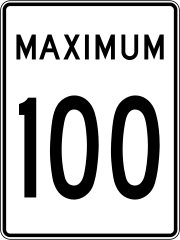 Start of a speed limit.
English • Québec P-70-2 • Maximum speed: 100 km/h. Do not exceed 100 km/h. Drive more slowly when road, traffic or weather conditions require.
Sources
🔗 Commons.wikimedia.org
🔗 Cdn-contenu.quebec.ca • Québec MTMD · Regulatory signs poster, April 2026, p. 1
🔗 Legisquebec.gouv.qc.ca • Québec · Road signs regulation C-24.2, r. 41, section 12 (official consolidation, 1 May 2026) (FR)
SVG source: Transports Québec • Public domain • Original revision 2013-07-29. Wikimedia original unmodified.
4. Advisory speed
An advisory speed is a recommended speed for a particular road section or hazard rather than a legally imposed maximum speed. It may be shown near curves, intersections, steep gradients, road work or other locations where a lower speed can help drivers negotiate the road safely.
Drivers should treat an advisory speed as guidance for safe driving conditions and should travel even more slowly when weather, visibility, traffic or road conditions require it. A separate legally binding speed limit must still be obeyed.

Wikimedia.org • Estabiano • CC BY-SA
What does a Canadian yellow bend-speed sign mean?
For example, Ontario distinguishes a yellow advisory-speed sign for a bend or hazard from a regulatory maximum-speed sign. The advisory number recommends a suitable speed; it does not replace the legal maximum. Canadian road-speed signs use km/h.
🔗 ontario.ca • Ontario MTO — curve advisory speed versus legal maximum; safe conditions
Does Ontario’s advisory bend speed remove a lower legal limit?
No. The applicable legal maximum remains binding. Follow the lower maximum and choose a still lower speed if conditions require it. Ontario’s example should be read alongside the actual rules and signs of the province or territory where you are driving.
🔗 ontario.ca • Ontario MTO — curve advisory speed versus legal maximum; safe conditions
Must I maintain an Ontario advisory speed on an icy bend?
No. The handbook requires adjusting speed to weather, road and traffic conditions. An advisory number is not a minimum or an assurance of safe grip. Slow further on ice, snow or a wet surface and allow more stopping distance.
🔗 ontario.ca • Ontario MTO — curve advisory speed versus legal maximum; safe conditions
5. Bike path
A bike path is a part of a road or a separate route intended primarily or exclusively for people riding bicycles. It may be physically separated from motor traffic, marked on the road surface or identified by traffic signs.
Bike paths may be one-way, two-way or shared with other road users. The permitted users, direction of travel, right-of-way rules and obligation to use the path depend on local traffic signs and regulations.

Wikimedia.org • Kaz Ish • CC BY-SA
How does Ontario describe bicycle lanes in its official driving guidance?
Ontario’s handbook describes bike lanes as reserved for cyclists. Drivers must take particular care where their route crosses one. This is an Ontario example; use the relevant provincial and municipal rules for cycling facilities elsewhere in Canada.
🔗 ontario.ca • Ontario MTO — bicycle lanes, door checks and stopping behind bike boxes
May a driver cross an Ontario bicycle lane to turn?
Sometimes a driver needs to enter or cross a bike lane to turn at a corner or driveway. The handbook directs drivers to check mirrors and blind spots and ensure no cyclist is approaching before crossing. A turning manoeuvre must not cut across a cyclist’s path.
🔗 ontario.ca • Ontario MTO — bicycle lanes, door checks and stopping behind bike boxes
What should a driver check when opening a door beside an Ontario bicycle lane?
Look for cyclists before opening the door. Ontario’s handbook warns that an opening door can strike a rider or force them into traffic. A marked lane beside parked vehicles does not remove this danger or the need to check carefully.
🔗 ontario.ca • Ontario MTO — bicycle lanes, door checks and stopping behind bike boxes
6. Pedestrian warning
A pedestrian warning is a traffic warning indicating that pedestrians may be crossing or entering the roadway ahead. It is commonly used near crosswalks or other locations where drivers need advance notice of frequent pedestrian activity.
Drivers approaching a pedestrian warning should reduce speed when necessary, watch carefully for pedestrians and be prepared to stop. The design of the warning sign and the right-of-way rules at the crossing vary between countries.

Wikimedia.org • erik forsberg • CC BY
How should I react to a pedestrian warning in Canada?
Reduce speed, look along both sides of the road and be ready to stop. The warning identifies a pedestrian hazard ahead; children, people with limited mobility or others may enter the road unexpectedly.
🔗 ontario.ca • Ontario MTO Driver’s Handbook — sharing the road, cyclists, crossings and bike boxes
Does a pedestrian warning in Canada identify the crossing itself?
Not necessarily. An advance warning alerts you to danger ahead. The actual crossing is identified by its own signs, markings or signals. Apply the crossing rules when you reach it, and follow any supplementary distance information.
🔗 ontario.ca • Ontario MTO Driver’s Handbook — sharing the road, cyclists, crossings and bike boxes
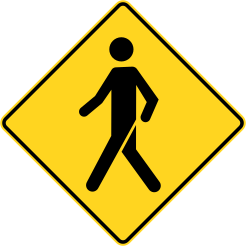 Warning for pedestrians.
English • Québec D-270-2-D • Pedestrian crossing ahead. A pedestrian crossing is ahead. Slow down and be prepared to stop for people crossing.
Sources
🔗 Commons.wikimedia.org
🔗 Cdn-contenu.quebec.ca • Québec MTMD · Danger signs poster, April 2026, p. 1
SVG source: Transports Québec • Public domain • Original revision 2013-08-12. Wikimedia original unmodified.
What should drivers know about pedestrian crossings in Canada?
In Ontario, at a pedestrian crossover, drivers and cyclists must stop and yield the whole roadway until pedestrians have finished crossing. A traffic-light-controlled crosswalk is a different facility with its own signals.
🔗 ontario.ca • Ontario MTO — pedestrian crossover versus signal-controlled crossing
7. Bridge
A bridge is a structure that carries a road, path or railway over an obstacle such as a river, valley, railway line or another road. A road bridge may carry one or more roadways together with pedestrian or cycling facilities.
Drivers should follow any speed, weight, height, width or vehicle-access restrictions applying to the bridge. Particular care may be necessary on narrow, exposed or movable bridges and when weather conditions such as wind, rain or ice affect the road surface.

Wikimedia.org • Joe Mabel • CC BY-SA
What should I check before crossing a bridge in Canada?
Check the applicable weight, axle-load, width and height restrictions before committing to the crossing. Include the load, trailer and roof equipment when relevant. A bridge warning and a vehicle restriction serve different purposes; comply with both.
Who goes first on a narrow bridge in Canada?
Follow any traffic lights, give-way controls or signs allocating priority over oncoming traffic. Do not force your way onto a bridge that cannot accommodate both directions safely. A bridge warning alone does not give your direction priority.
May I stop or park on a bridge in Canada?
Rules vary by province and locality. In Ontario, obey stopping and parking signs and do not obstruct the roadway. Do not infer a Canada-wide bridge-parking rule from one province’s highway law.
8. Speed bump
A speed bump is a raised traffic-calming device placed across all or part of a road to make drivers reduce their speed. It is commonly used near homes, schools, crossings, parking areas and other places where low vehicle speeds are important.
Speed bumps vary in shape, height and legal status. Drivers should approach them at a low, controlled speed and follow any warning signs or speed limits that apply.

Wikimedia.org • Coastal Elite • CC BY-SA
How should I recognise and approach a speed bump in Canada?
Canadian traffic-calming measures are designed and regulated locally. In Ontario, distinguish the raised surface from the markings and signs of a pedestrian crossover or signal-controlled crossing; provincial and municipal arrangements vary.
Which speed should I use at a raised device in Canada?
Use the local speed signs and a controlled approach. An Ontario example does not establish one mandatory hump speed for every Canadian province or every design of traffic-calming device.
Does a raised road surface give pedestrians priority in Canada?
A raised surface alone does not establish pedestrian priority in Canada. Identify whether it incorporates a pedestrian crossover, a signal-controlled crosswalk or another crossing, and apply the province or territory’s rules. In Ontario, drivers and cyclists must stop and let pedestrians completely cross the road at a pedestrian crossover. A traffic-light-controlled crosswalk has its own signal rules.
🔗 ontario.ca • Ontario MTO — pedestrian crossover versus signal-controlled crossing
9. Toll road
A toll road is a road, freeway, bridge, tunnel or other route for which users must pay a charge. The toll may apply to all vehicles or only to particular vehicle categories, and the amount can depend on factors such as distance travelled, vehicle type, weight or emissions.
Tolls may be collected at toll booths, electronically or through a vignette or distance-based charging system. Drivers should check the applicable payment rules before using a toll road, especially when travelling in another country.

Wikimedia.org • Ken Lund • CC BY-SA
Which road-charging system should I check in Canada?
Canadian tolls depend on the province and facility. Ontario removed tolls from the provincially owned Highway 407 East in 2025; the privately operated 407 ETR is a different section and remains a separate toll facility.
What should I check before using a charged road in Canada?
Check the precise route and operator, not just the highway number. A statement that 407 East is free must not be applied to 407 ETR or to toll bridges and roads in other Canadian provinces.
Does the absence of a toll booth prove that a road is free in Canada?
The absence of a payment booth is not proof that a charged road is free. A vignette, electronic account, vehicle-registration record or another payment procedure may be used where the actual scheme provides for it. Follow the responsible authority or operator’s instructions for that road.
10. One-way traffic
One-way traffic means that vehicles on a road or roadway may travel only in one designated direction. The permitted direction is normally indicated by traffic signs, lane arrows or pavement markings.
Some road users, such as cyclists or public transit vehicles, may be allowed to travel in the opposite direction when signs expressly permit it. A one-way road does not by itself determine the speed limit, priority or parking rules.

Wikimedia.org • CC0
How should I read a one-way restriction in Canada?
One-way streets follow provincial and local traffic arrangements. In Ontario, the Driver’s Handbook distinguishes one-way roads and directional signs; other provinces have their own legislation.
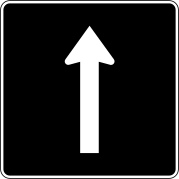 Road with one-way traffic.
English • Québec P-100-1 • Straight-ahead lane. Vehicles in the lane controlled by this sign must continue straight ahead. This vertical lane arrow is distinct from the one-way street sign.
Sources
🔗 Commons.wikimedia.org
🔗 Cdn-contenu.quebec.ca • Québec MTMD · Regulatory signs poster, April 2026, p. 1
🔗 Legisquebec.gouv.qc.ca • Québec · Road signs regulation C-24.2, r. 41, section 16 (official consolidation, 1 May 2026) (FR)
SVG source: Transports Québec • Public domain • Original revision 2013-07-30. Wikimedia original unmodified.
May cyclists travel against the general traffic direction in Canada?
Check the local traffic restriction and any authorised contraflow cycle lane. An Ontario or municipal arrangement does not establish a country-wide Canadian exception for all cyclists or all one-way streets.
Does one-way traffic give me priority or a different speed limit in Canada?
A one-way restriction concerns direction. Continue to follow the applicable speed limit, signals, give-way or stop controls and junction-priority rules. Where authorised counterflow traffic exists, check for it before turning or crossing; your permitted direction is not automatic junction priority.
11. Bus lane
A bus lane is a traffic lane reserved primarily for buses or other authorized public transit vehicles. It is intended to improve the reliability and flow of public transit by allowing authorized vehicles to avoid general traffic congestion.
Other road users, such as taxis, cyclists, motorcycles or vehicles carrying several occupants, may also be permitted when signs expressly allow them. The operating hours, permitted vehicles, direction of travel and rules for entering or crossing the lane depend on local traffic signs and regulations.

Wikimedia.org • Secondarywaltz • CC BY-SA
Which vehicles may use a bus lane in Canada?
Canadian reserved-lane rules vary by province and municipality. In Ontario, lane signs identify the permitted vehicle classes and whether the reservation applies continuously or during stated hours.
May bicycles and motorcycles use a bus lane in Canada?
Check the bus, taxi, bicycle or occupancy symbol on the actual Ontario sign. Permission under one municipal arrangement must not be assumed to apply to every Canadian bus lane.
Does bus-lane access also allow stopping or parking in Canada?
Apply the separate local stopping and parking restrictions. An Ontario lane sign permitting your vehicle during certain hours does not by itself authorise parking at a bus stop or within the lane.
12. Bus stop
A bus stop is a designated place where buses stop to allow passengers to board or leave. It may be identified by a sign, shelter, raised platform, road marking or other public-transport infrastructure and can be located beside the road or in a specially constructed stopping area.
Drivers approaching a bus stop should watch carefully for buses, pedestrians and passengers crossing or entering the roadway. Parking or stopping restrictions may apply around bus stops to keep the area accessible and visible.

Wikimedia.org • TagaSanPedroAko • CC BY-SA
What stopping or parking restrictions apply at bus stops in Canada?
Canadian stop and parking restrictions vary by province and municipality. In Ontario, read the local stop, no-standing and parking signs rather than assuming one national bus-stop distance.
May I briefly drop off a passenger at a bus stop in Canada?
An immediate passenger stop may be treated differently from parking under some controls, but must still be permitted by the actual Ontario sign and rule. Do not apply that distinction as a blanket exemption across Canada.
What should I do near a stopped bus in Canada?
In Ontario, yield to a municipal bus signalling to re-enter traffic from a bus bay, as provided by the provincial rule. The driver of the bus also has to ensure that the manoeuvre can be completed safely.
🔗 ontario.ca • Ontario MTO — municipal buses leaving bus bays
13. Dead end
A dead-end road is a road that does not provide a through route for some or all vehicles. It may end completely, terminate at a barrier or continue as a path that only certain road users may use.
Drivers may normally enter a dead-end road to reach homes, businesses, parking places or other destinations, but they must be prepared to turn around or leave by the same route. Signs may indicate that pedestrians or cyclists can continue beyond the point where motor traffic cannot.
Wikimedia.org • Larry • CC BY
What does a dead-end indication mean in Canada?
Canadian sign rules vary by province. In Ontario, dead-end information describes a street without a through motor route and is separate from an entry prohibition.
Can pedestrians or cyclists continue beyond a motor-traffic dead end in Canada?
Read the actual pedestrian or cycle connection and the local signs. Do not assume that every Canadian dead-end street either ends all access or provides the same type of path through.
Does a dead-end indication change speed or priority rules in Canada?
In the Ontario example, the no-through information itself does not assign junction priority or a numerical speed limit. Continue to obey the actual speed, access, parking and priority controls. If you need to turn around, use a suitable lawful place, check for pedestrians and cyclists, and do not obstruct the space needed for other vehicles to turn.
14. Stop sign
A stop sign requires drivers to bring their vehicle to a complete stop and yield before entering or crossing the road ahead. The stop must be made at the stop line or another legally prescribed position.
After stopping, the driver may continue only when this can be done safely and without interfering with traffic that has the right-of-way. The sign does not create priority for the driver who has stopped.
Wikimedia.org • awmcphee • CC0
Must I stop completely at a stop sign in Canada?
In the Ontario example, yes. Come to a complete stop when the applicable stop sign controls your approach, even when you cannot see another road user. Slowing to a crawl is not a stop. The stopping duty is separate from the duty to give way before continuing. Check the rules for another state, province or territory separately.
🔗 ontario.ca • Ontario MTO — STOP, YIELD, simultaneous arrival and all-way stops
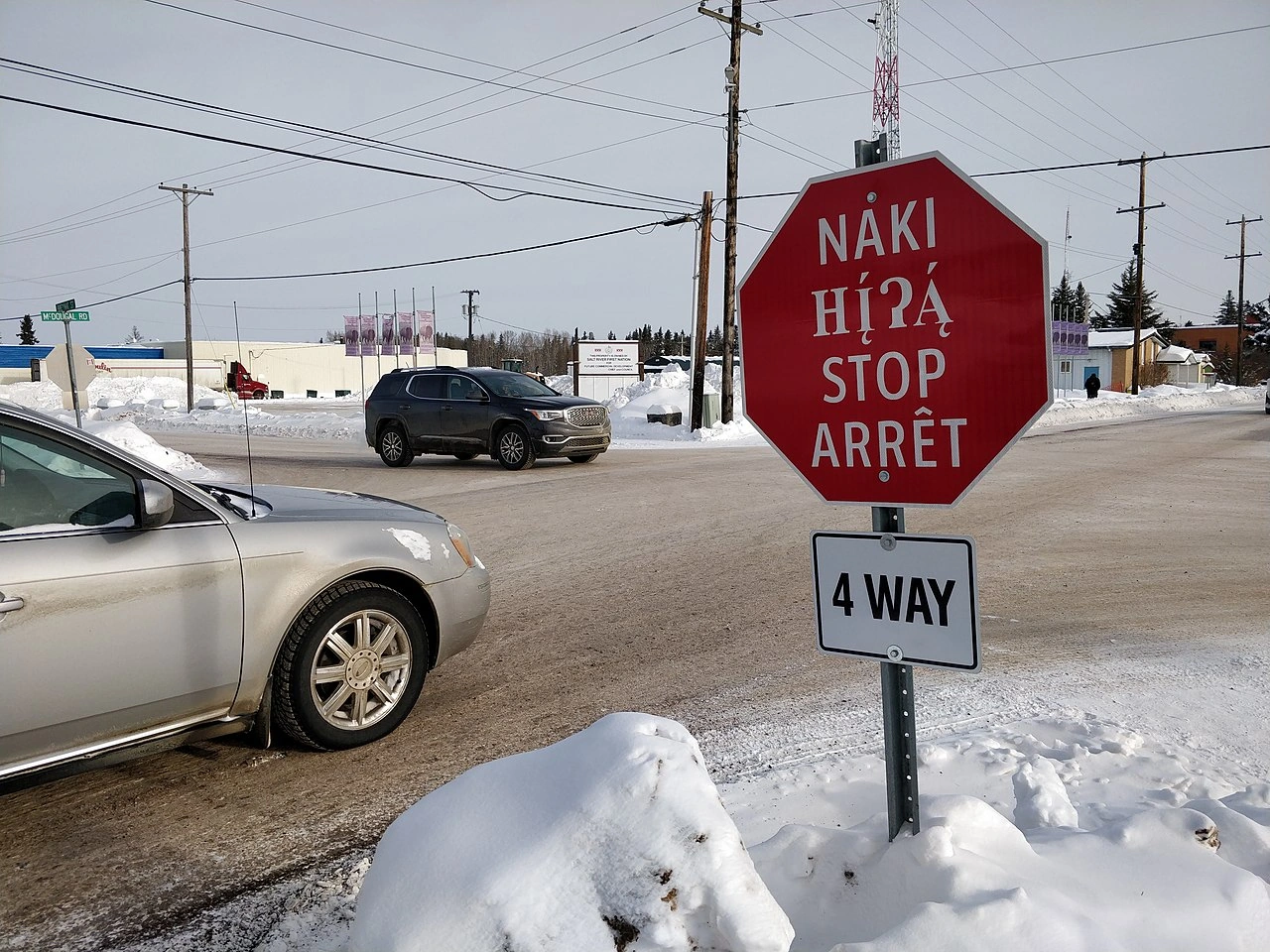
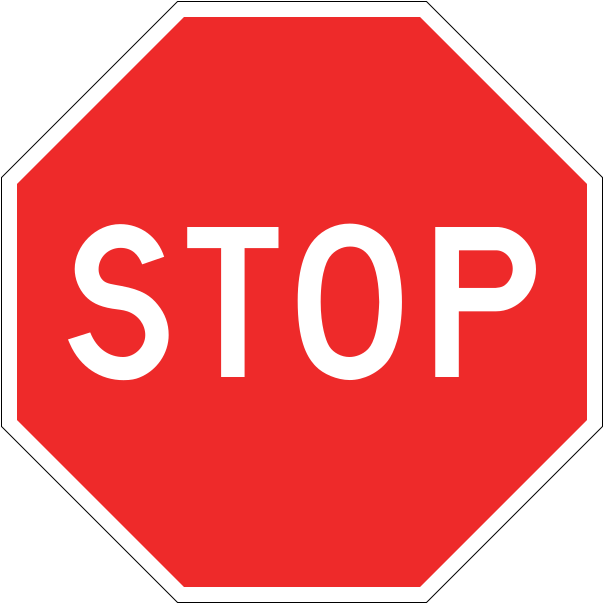 Stop and yield.
English • Québec P-10 • Stop. Come to a complete stop at the stop line or before entering the junction, and proceed only when safe. The Québec catalogue also permits the word STOP.
Sources
🔗 Commons.wikimedia.org
🔗 Cdn-contenu.quebec.ca • Québec MTMD · Regulatory signs poster, April 2026, p. 1
🔗 Legisquebec.gouv.qc.ca • Québec · Road signs regulation C-24.2, r. 41, section 7 (official consolidation, 1 May 2026) (FR)
SVG source: Transports Quebec — Government of Quebec • Public domain • Original revision 2025-01-21. Wikimedia original unmodified.
Where must I stop at a stop-controlled junction in Canada?
In Ontario, stop completely at the marked stop line. If there is no stop line, stop at the crosswalk, marked or unmarked; if there is no crosswalk, stop at the edge of the sidewalk. If there is no sidewalk, stop at the edge of the intersection. Check the corresponding rules separately in other Canadian provinces and territories.
🔗 ontario.ca • Ontario MTO — stop line, crosswalk, sidewalk and intersection sequence
Does stopping first give me priority at a stop sign in Canada?
In Ontario, an ordinary stop requires giving way to the traffic entitled to pass. At an all-way stop, the first vehicle to come to a complete stop goes first; when vehicles arrive together, apply the right-hand and turning rules. Continue to protect pedestrians and cyclists. Do not present this provincial example as one national Canadian rule.
🔗 ontario.ca • Ontario MTO — STOP, YIELD, simultaneous arrival and all-way stops
15. Yield
A yield sign requires drivers to allow traffic with priority to proceed before entering, crossing or joining a road. Drivers must reduce speed, observe approaching traffic and stop when necessary.
Unlike a stop sign, a yield sign does not always require a complete stop. The driver may continue without stopping only when the route is clearly safe and no road user with priority is forced to change speed or direction.

Wikimedia.org • Adam Moss • CC BY-SA
What does giving way mean in Canada?
Canadian rules vary by province. In Ontario, a Yield sign requires slowing or stopping when necessary and waiting until the way is clear before proceeding.
🔗 ontario.ca • Ontario MTO — STOP, YIELD, simultaneous arrival and all-way stops
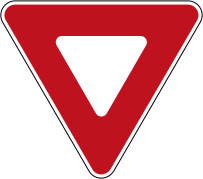 Yield.
English • Québec P-20-1 • Give way. Give way to traffic on the priority road. Slow down and stop if needed before entering safely.
Sources
🔗 Commons.wikimedia.org
🔗 Cdn-contenu.quebec.ca • Québec MTMD · Regulatory signs poster, April 2026, p. 1
🔗 Legisquebec.gouv.qc.ca • Québec · Road signs regulation C-24.2, r. 41, section 8 (official consolidation, 1 May 2026) (FR)
SVG source: Transports Québec • Public domain • Original revision 2013-07-29. Wikimedia original unmodified.
Must you always stop when giving way in Canada?
In Ontario, a Yield sign requires slowing or stopping if necessary until you can proceed safely. A Stop sign requires a complete stop. Check the applicable provincial rules elsewhere in Canada.
🔗 ontario.ca • Ontario MTO — STOP, YIELD, simultaneous arrival and all-way stops
What should you check before proceeding after giving way in Canada?
Wait until the manoeuvre is safe. Check the priority traffic, the view in both directions and enough space to complete the entry. Giving way to one vehicle does not remove duties towards another driver, a cyclist or a pedestrian.
🔗 ontario.ca • Ontario MTO — STOP, YIELD, simultaneous arrival and all-way stops
16. Roundabout
A roundabout is a circular road arrangement in which traffic travels around a central island in one designated direction. Vehicles enter and leave through connecting roads, and traffic signs or local rules determine who has the right-of-way.
Drivers should reduce speed, choose a suitable lane, observe all road users and signal as required when leaving. The direction of travel, entry priority, lane use and rules for cyclists and pedestrians depend on local traffic signs and regulations.
Wikimedia.org • formulanone • CC BY-SA
Who has priority at a roundabout in Canada?
In Ontario, entering drivers yield to traffic already circulating, which approaches from the left. The handbook distinguishes modern roundabouts from older traffic circles, where different controls can apply. Other provinces have their own rules.
🔗 ontario.ca • Ontario MTO — roundabout controls and150m U-turn visibility
How should you choose a roundabout lane in Canada?
In Ontario, choose the lane for your exit before entering, follow the lane markings and allow room for large vehicles. Do not assume an older traffic circle follows the same arrangement as a modern roundabout.
🔗 ontario.ca • Ontario MTO — roundabout controls and150m U-turn visibility
What should you check when leaving a roundabout in Canada?
Check the lane you will cross or enter, signal the manoeuvre as required and look for cyclists and pedestrians at the exit. Obey any separate crossing controls and do not force an exit across another vehicle’s path.
🔗 ontario.ca • Ontario MTO — roundabout controls and150m U-turn visibility
17. Road narrowing
A road narrowing is a section where the available width of the road or roadway becomes smaller. The narrowing may occur on both sides, on one side only, or because one or more traffic lanes end.
Drivers should reduce speed, observe approaching and adjacent traffic, maintain sufficient lateral clearance and merge when necessary. Warning signs do not always determine priority, so drivers must follow any right-of-way signs, lane markings and local traffic rules.

Wikimedia.org • Adam Moss • CC BY-SA
What does a road-narrowing warning mean in Canada?
In Ontario, the handbook includes a narrow-bridge warning and lane-related warnings. These describe hazards rather than giving a driver unrestricted right of way. Other Canadian provinces use their own rules.
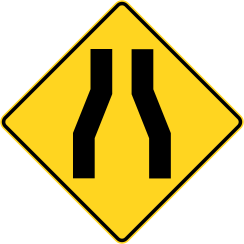 Warning for a road narrowing.
English • Québec D-210-1 • Road narrows on both sides. The road narrows from both sides ahead.
Sources
🔗 Commons.wikimedia.org
🔗 Cdn-contenu.quebec.ca • Québec MTMD · Danger signs poster, April 2026, p. 1
SVG source: Transports Québec • Public domain • Original revision 2013-08-11. Wikimedia original unmodified.
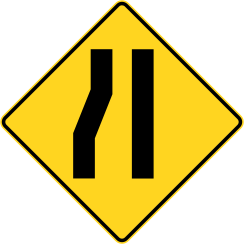 Warning for a road narrowing on the left.
English • Québec D-210-2-G • Road narrows from the left. The road narrows from the left ahead.
Sources
🔗 Commons.wikimedia.org
🔗 Cdn-contenu.quebec.ca • Québec MTMD · Danger signs poster, April 2026, p. 1
SVG source: Transports Québec • Public domain • Original revision 2013-08-11. Wikimedia original unmodified.
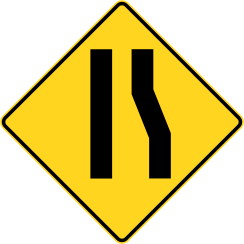 Warning for a road narrowing on the right.
English • Québec D-210-2-D • Road narrows from the right. The road narrows from the right ahead.
Sources
🔗 Commons.wikimedia.org
🔗 Cdn-contenu.quebec.ca • Québec MTMD · Danger signs poster, April 2026, p. 1
SVG source: Transports Québec • Public domain • Original revision 2013-08-11. Wikimedia original unmodified.
Does a narrowing warning give you priority in Canada?
No. A warning describes the reduced width, rather than allocating priority or setting a numerical speed limit. Follow any separate priority signs, signals and meeting rules, and slow enough to pass safely or wait before entering.
What should you do if traffic lanes merge at a narrowing in Canada?
In Ontario, signal and change lanes only when there is a safe gap, following the lane-ending signs and markings. A narrowing warning does not itself give the ending lane priority; check the relevant provincial rules elsewhere.
🔗 ontario.ca • Ontario MTO — lane changes and restricted-visibility passing
18. Crosswalk
A crosswalk is a designated place where pedestrians may cross a road. It is commonly indicated by pavement markings, traffic signs, signals or a combination of these measures.
Drivers must approach with appropriate caution and yield when required by local law. Pedestrians must also observe approaching traffic and follow any pedestrian signals or instructions from authorized traffic controllers.

Wikimedia.org • Andrevruas • CC BY-SA
When must drivers give way at a pedestrian crossing in Canada?
Rules vary by province and territory. In Ontario, drivers and cyclists must stop for pedestrians at a designated pedestrian crossover and wait until they have reached the pavement safely. School-crossing guards and pedestrians must clear the whole roadway before traffic proceeds at a guarded school crossing. Follow the signals at signal-controlled crossings.
🔗 ontario.ca • Canada, Ontario MTO Driver’s Handbook, Stopping
Are all pedestrian crossings controlled the same way in Canada?
No. In Ontario, nearly all intersections have crosswalks, including ones without painted markings. A designated pedestrian crossover has its own signs and stopping rules; it is different from an advance warning sign or an ordinary signal-controlled crosswalk. Other provinces and territories have their own definitions and controls.
🔗 ontario.ca • Canada, Ontario MTO Driver’s Handbook, Sharing the road with other road users; 🔗 ontario.ca • Canada, Ontario MTO Driver’s Handbook, Stopping
May I enter a pedestrian crossing if the road beyond it is blocked in Canada?
Keep the crossing clear until there is room beyond it. In Ontario, do not pass another vehicle within 30 metres of a pedestrian crossover, and never pass a vehicle stopped to let pedestrians cross. Do not treat a clear-looking adjacent lane as permission to pass. Check the applicable provincial or territorial rules elsewhere.
🔗 ontario.ca • Canada, Ontario MTO Truck Handbook, Stopping for pedestrian crossovers; 🔗 files.ontario.ca • Canada, Ontario Ministry of Transportation, Cycling Skills, 2021 edition
19. Railway crossing
A railway crossing, also called a level crossing or railroad crossing, is a place where a road or path crosses railway tracks at the same level. It may be protected by barriers, warning lights, bells, traffic signs or a combination of these measures.
Road users must approach carefully and never enter when a train is approaching, warning signals are active or the exit is blocked. They should cross promptly and must never stop, wait or become trapped on the tracks.

Wikimedia.org • Rick Cordeiro • CC0
When must drivers stop at a railroad crossing in Canada?
Rules vary across Canada. In Ontario, slow down and check both directions; stop for an approaching train, active crossing warnings or a STOP sign, subject to authorised flagman directions. Do not drive through, under or around a gate that is down, lowering or rising. School buses and certain other buses or public vehicles have additional stopping duties.
🔗 ontario.ca • Canada, Ontario MTO Driver’s Handbook, Stopping
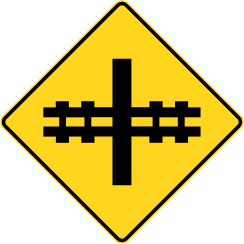 Warning for a railway crossing without barriers.
English • Québec D-180-1 • Railway crossing ahead. A railway crossing is ahead. Look for trains, signals and any stop or give-way controls at the crossing.
Sources
🔗 Commons.wikimedia.org
🔗 Cdn-contenu.quebec.ca • Québec MTMD · Danger signs poster, April 2026, p. 1
SVG source: Transports Québec • Public domain • Original revision 2013-08-11. Wikimedia original unmodified.
 Warning for a railway crossing with one track.
English • Railway crossbuck • Railway crossing. This sign marks a railway crossing. Give way to trains, check both directions and stop when necessary or when required by crossing controls. Do not enter unless you can clear the tracks.
Sources
🔗 Commons.wikimedia.org
🔗 Sgi.sk.ca • SGI · Saskatchewan Driver’s Handbook 2025
SVG source: Transportation Association of Canada • Public domain • Original revision 2019-12-15. Wikimedia original unmodified.
Must I stop at every unguarded railway crossing in Canada?
Not merely because barriers are absent. In Ontario, slow down, look and listen; stop for a STOP sign, an approaching train or active warning, subject to authorised directions. School buses must stop at railway crossings, and most other buses or public vehicles have additional duties at unprotected crossings. Check the applicable province or territory elsewhere.
🔗 ontario.ca • Canada, Ontario MTO Driver’s Handbook, Stopping
What if road traffic is queued beyond a railway crossing in Canada?
In Ontario, wait before the tracks until your whole vehicle can clear the crossing. Check the exit yourself before following another vehicle, even if no train is visible. Keeping the tracks clear is essential; check the applicable provincial or territorial rules elsewhere in Canada.
🔗 ontario.ca • Canada, Ontario MTO Driver’s Handbook, Stopping
Can I cross after a train has passed if the warning lights are still active in Canada?
In Ontario, no. Wait until the lights stop flashing and any gate is fully raised. Never go around, under or through a gate while it is down, lowering or rising. Check that all trains have passed before crossing. Follow the applicable provincial or territorial rules elsewhere.
🔗 ontario.ca • Canada, Ontario MTO Driver’s Handbook, Stopping
20. Mandatory direction
A mandatory-direction sign requires drivers to travel only in the direction or one of the directions indicated by its arrow or arrows. It may require traffic to continue straight ahead, turn, or pass an obstacle on a specified side.
The sign does not itself determine priority or speed. Drivers must still use the appropriate lane, signal when required and yield according to local traffic signs and regulations.

Wikimedia.org • Loozrboy • CC BY-SA
How can a mandatory turn be indicated in Canada?
Mandatory movements in Canada may be shown by regulatory signs, lane-direction arrows or turn-only indications. Do not expect the sign shape to be identical to the European blue circular sign system.
Can I choose another turn if the mandatory-direction arrow is inconvenient in Canada?
No, unless another applicable sign, lane instruction or authorised traffic direction lawfully permits it. Plan a permitted alternative route; do not make an abrupt or prohibited turn to reach your destination.
Does a mandatory-direction sign give me priority over pedestrians in Canada?
No. It tells you which way to move, not who goes first. Check traffic lights, other priority signs, pedestrians and cyclists, and give way when required before completing the manoeuvre.
21. Turn prohibition
A turn prohibition prevents drivers from turning in the direction indicated by a traffic sign. It may prohibit a left turn, a right turn or a U-turn at an intersection or along a specified section of road.
Drivers must continue along a permitted route and follow any lane arrows or mandatory-direction signs. A turn prohibition does not itself determine priority or speed, and any exemption for cyclists, public transit or other road users must be expressly indicated.

Wikimedia.org • GTD Aquitaine • CC0
What does a no-turn sign prohibit in Canada?
It prohibits the left, right or other turn shown at the junction or position controlled by the sign in Canada. Follow any supplementary panel or authorised direction and choose another legal route.
Does a no-left-turn sign always prohibit a U-turn in Canada?
Do not decide whether a U-turn is permitted from a no-left-turn sign alone. Check separate U-turn signs and the provincial and local rules. For example, British Columbia restricts U-turns at traffic lights and in other specified circumstances, even without a separate no-U-turn sign.
🔗 icbc.com • ICBC, Learn to Drive Smart full current guide
🔗 bclaws.gov.bc.ca • British Columbia, current Motor Vehicle Act
Can a no-turn restriction apply only to certain vehicles or hours in Canada?
Yes, where the local sign system provides a supplementary condition or exemption, such as a vehicle class, time or authorised access. Without a valid exception, comply with the prohibited movement shown.
22. School area
A school area is a road or group of roads near a school where large numbers of children may walk, cycle, cross the road or enter and leave vehicles. It may be identified by warning signs, zone signs, pavement markings, traffic-calming measures or flashing lights.
Special speed limits, parking restrictions or access rules may apply permanently or only during school arrival and departure times. Drivers should reduce speed, watch carefully for children and be prepared to stop.
Wikimedia.org • Richard1990 • CC BY-SA
What speed rules apply around schools in Canada?
School-area limits are set by provinces, territories and local authorities. A school-zone number or timetable in one province should not be assumed elsewhere in Canada.
Does a school warning sign in Canada automatically set the speed limit?
A children or school warning alerts you to a potential hazard; the enforceable numerical speed limit depends on the applicable law, regulatory signs and any time or variable display. Slow further if children are near the road.
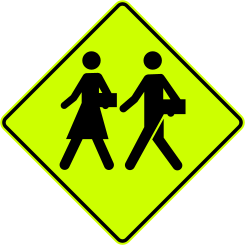 Warning for children.
English • Québec D-270-1-D • School crossing or school zone ahead. A school zone or a school crossing is ahead. Watch for children. Obey any separately posted speed limit and operating times; the warning symbol alone does not give one nationwide limit.
Sources
🔗 Commons.wikimedia.org
🔗 Cdn-contenu.quebec.ca • Québec MTMD · Danger signs poster, April 2026, p. 1
🔗 Icbc.com • ICBC · Learn to Drive Smart, signs chapter, PDF p. 6 / printed p. 34 (EN)
SVG source: Transports Québec • Public domain • Original revision 2020-10-27. Wikimedia original unmodified.
How should you pass a school entrance in Canada?
Watch for children stepping out from between parked vehicles, obey crossings and any school patrol, and follow stopping or parking restrictions. Do not obstruct visibility near a crossing or school entrance; approach at a speed that permits a safe stop.
23. Crossing animals
An animals-crossing warning indicates a place or road section where wild animals, livestock or ridden animals may enter or cross the road. Animals may appear suddenly, move unpredictably or be difficult to see in darkness, vegetation or poor weather.
Drivers should reduce speed, scan both sides of the road and remain prepared to stop. The warning sign does not itself give animals priority or impose a numerical speed limit, but drivers must avoid frightening, endangering or colliding with them.
Wikimedia.org • Darren Kirby • CC BY-SA
Which animals might drivers encounter on roads in Canada?
Depending on the locality, drivers may meet deer, moose, elk and other wildlife on rural and northern roads. Roadside animal-warning signs and local hazard information indicate where extra care may be needed; do not assume the hazard ends immediately after a sign.
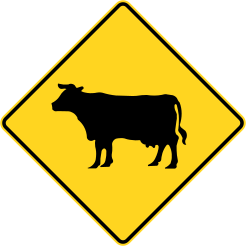 Warning for cattle on the road.
English • Québec D-270-17 • Farm animals crossing. Farm animals, shown here as cattle, may cross the road ahead.
Sources
🔗 Commons.wikimedia.org
🔗 Cdn-contenu.quebec.ca • Québec MTMD · Danger signs poster, April 2026, p. 1
SVG source: Transports Québec • Public domain • Original revision 2013-08-11. Wikimedia original unmodified.
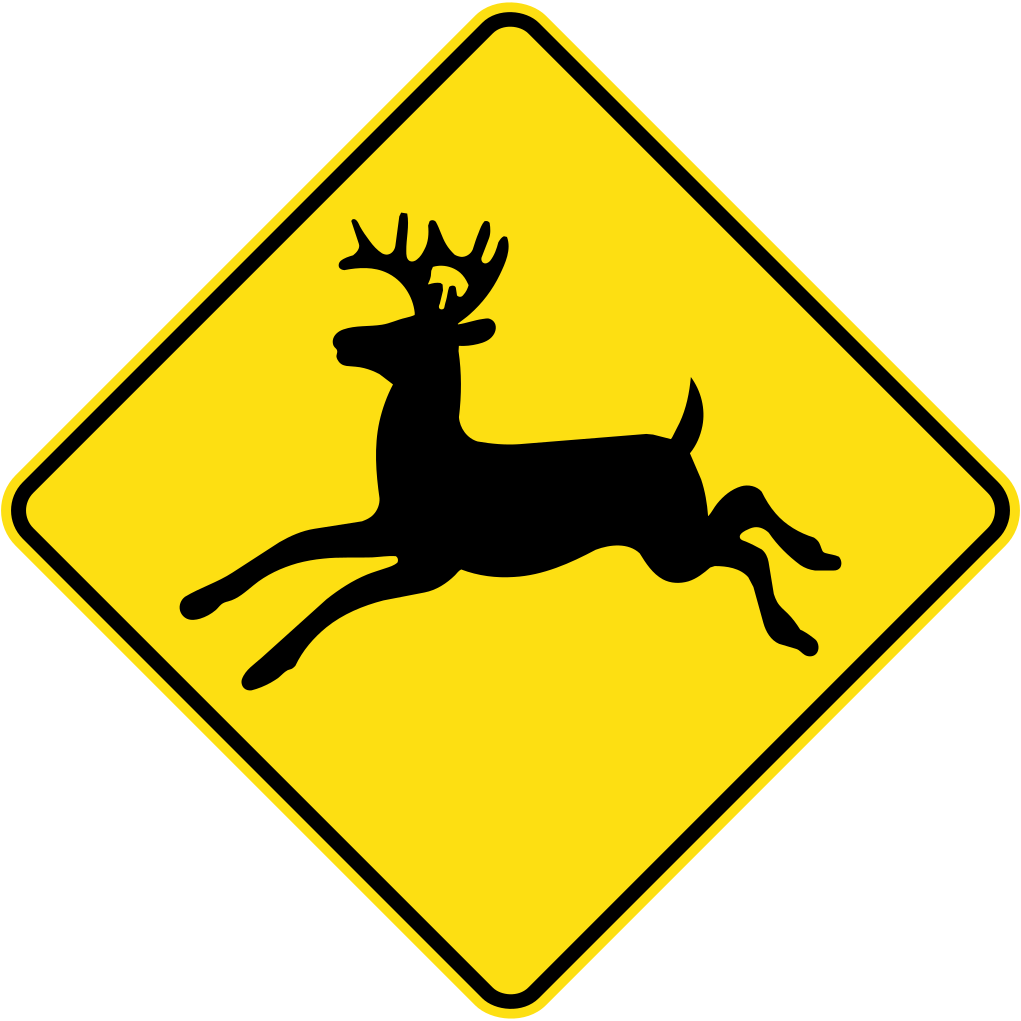 Warning for crossing deer.
English • Québec D-270-13 • Deer. Deer may be on or crossing the road ahead.
Sources
🔗 Commons.wikimedia.org
🔗 Cdn-contenu.quebec.ca • Québec MTMD · Danger signs poster, April 2026, p. 1
SVG source: Transports Quebec — Government of Quebec • Public domain • Original revision 2024-11-13. Wikimedia original unmodified.
Does an animal-crossing warning sign in Canada set a new speed limit?
A warning of animals is not, by itself, a numerical speed-limit sign. Continue to obey the applicable speed limit, but slow down whenever animals could enter the road or visibility is poor. A separate regulatory speed sign must also be obeyed.
What should you do if an animal enters the road in Canada?
Ease off the accelerator, assess the traffic behind and brake smoothly if necessary. Avoid abrupt swerving into opposing traffic or off the road. Give farm animals and ridden animals room, avoid frightening them with unnecessary horn use, and be alert for more animals following.
24. Slippery road
A slippery road has reduced tire grip and can make steering, braking and acceleration less effective. Roads may become slippery because of rain, ice, snow, mud, oil, loose material or other substances on the surface. Drivers should reduce speed, increase their following distance and avoid sudden steering, braking or acceleration. Extra caution is needed in curves, on bridges and wherever the road surface changes unexpectedly.

Wikimedia.org • Mario Hains • CC BY-SA
What can make roads slippery in Canada?
Be prepared for snow, black ice, freezing rain and slush. A surface can become slippery even if it looks clear, and different parts of the road may have very different grip.
How should you drive on a slippery road in Canada?
Reduce speed early, increase the gap to the vehicle ahead and use smooth steering, braking and acceleration. Do not rely on the posted maximum as a safe target when grip is poor.
Does a slippery-road warning sign in Canada automatically impose a lower number?
The warning sign highlights a reduced-grip risk; it normally does not itself prescribe a new numerical speed limit. A separate speed-limit sign, temporary restriction or local condition may still apply. Travel below the legal maximum when necessary for safety.
25. Rockfall
A rockfall warning indicates a road section where rocks or stones may fall from a cliff, cutting or steep slope, or where fallen material may already be present on the road. The danger may affect the full roadway and can appear suddenly.
Drivers should reduce speed, scan the road and slopes ahead, increase their following distance and remain prepared to stop. They should avoid unnecessary stopping in the exposed section and never attempt to move unstable rocks themselves.

Wikimedia.org • Quinn Desilets • CC BY-SA
Where might falling rocks be a hazard on roads in Canada?
Pay extra attention around Rocky Mountain and other steep highway cuttings. After heavy rain, freeze–thaw cycles or work on a steep slope, the hazard may increase depending on local conditions.
Does a falling-rocks warning sign in Canada impose a speed limit?
A falling-rocks sign is a hazard warning, not normally a numerical speed-limit sign. Follow any separate speed or closure signs, slow down to match visibility and conditions, and watch for material already on the road.
What should you do if rocks are blocking the road in Canada?
Slow or stop in a safe place away from the exposed slope if possible. Do not drive over unstable debris or stop beneath a cliff unnecessarily. Follow any closure or traffic-control instructions and report a dangerous obstruction through the appropriate road authority or emergency channel.