

Mandatory signsSwitzerland
 Traffic rules
 Switzerland
 Priority signs
 Warning signs
 Prohibitory signs
 Mandatory signs
 Information signs
 Additional signs
Mandatory signs
A mandatory sign is a traffic sign that tells drivers what they must do. Instead of prohibiting actions, these signs impose obligations such as following a specific direction, using a particular lane, or keeping a minimum speed. Their purpose is to guide traffic safely and efficiently by ensuring that all road users follow the same required behaviour in places where it is necessary for order and safety.















How are compulsory instructions shown in Switzerland?
2.xx regulatory signs also cover driving instructions and designated routes; they do not consist solely of prohibitions.
🔗 fedlex.admin.ch • Switzerland: OSR articles 16,24,33-34; OCR article 6
🔗 fedlex.admin.ch • Switzerland: Traffic Rules Ordinance, state 1 October 2026
🔗 fedlex.admin.ch • Switzerland: Road Traffic Act, state 1 July 2026
What does a mandatory-direction sign require in Switzerland?
Where a compulsory-direction sign is installed in Switzerland, follow only the arrow direction or permitted combination of directions. The restriction applies at the location or movement it regulates; it is not an instruction to ignore other traffic controls.
🔗 fedlex.admin.ch • Switzerland: OSR articles 16,24,33-34; OCR article 6
🔗 fedlex.admin.ch • Switzerland: Traffic Rules Ordinance, state 1 October 2026
🔗 fedlex.admin.ch • Switzerland: Road Traffic Act, state 1 July 2026
Does a mandatory-direction sign give me priority over pedestrians in Switzerland?
No. The arrow prescribes direction. At an uncontrolled pedestrian crossing, give way to pedestrians already crossing or waiting with a clear intention to cross. Obey traffic signals and the separate rules for turning and crossing other traffic.
🔗 fedlex.admin.ch • Switzerland: OSR articles 16,24,33-34; OCR article 6
🔗 fedlex.admin.ch • Switzerland: Traffic Rules Ordinance, state 1 October 2026
🔗 fedlex.admin.ch • Switzerland: Road Traffic Act, state 1 July 2026

1. Mandatory roundabout direction
This traffic sign indicates the mandatory direction around a roundabout. Traffic must circulate in the direction shown by the arrows. The sign does not itself determine priority; follow the applicable priority signs, traffic signals and local rules.
English • Traffic sign 2.41.1 • Roundabout.
Deutsch • Verkehrssignal 2.41.1 • Kreisverkehrsplatz.
Français • Signal 2.41.1 • Carrefour à sens giratoire.
Italiano • Segnale 2.41.1 • Area con percorso rotatorio obbligato.
Sources
🔗 Commons.wikimedia.org
🔗 Fedlex.admin.ch • SSV, Anhang 2 (DE)
🔗 Fedlex.admin.ch • OSR, annexe 2 (FR)
🔗 Fedlex.admin.ch • OSStr, allegato 2 (IT)
SVG source: Commons.wikimedia.org • Original SVG
Bundesamt für Strassen (ASTRA) • Public domain • Original revision 2017-07-05. Wikimedia original unmodified.
Artwork reviewed against the Swiss signalling ordinance, version 1 October 2026, annex 2: Fedlex.admin.ch • Signal 2.41.1, PDF page 107. Catalogue-equivalent illustration; intentional update from the previous PNG. This is an educational illustration, not a manufacturing specification.
2. Turning left mandatory
This traffic sign indicates that turning left is mandatory at the junction ahead. Traffic must turn left and may not continue straight ahead or turn right.
English • Traffic sign 2.38 • Turn left.
Deutsch • Verkehrssignal 2.38 • Linksabbiegen.
Français • Signal 2.38 • Obliquer à gauche.
Italiano • Segnale 2.38 • Svoltare a sinistra.
Sources
🔗 Commons.wikimedia.org
🔗 Fedlex.admin.ch • SSV, Anhang 2 (DE)
🔗 Fedlex.admin.ch • OSR, annexe 2 (FR)
🔗 Fedlex.admin.ch • OSStr, allegato 2 (IT)
SVG source: Commons.wikimedia.org • Original SVG
Bundesamt für Strassen (ASTRA) • Public domain • Original revision 2017-07-05. Wikimedia original unmodified.
Artwork reviewed against the Swiss signalling ordinance, version 1 October 2026, annex 2: Fedlex.admin.ch • Signal 2.38, PDF page 106. Catalogue-equivalent illustration; intentional update from the previous PNG. This is an educational illustration, not a manufacturing specification.
3. Turning left or right mandatory
This traffic sign indicates that turning left or right is mandatory at the junction ahead. Traffic may turn either left or right but may not continue straight ahead.
English • Traffic sign 2.39 • Turn right or left.
Deutsch • Verkehrssignal 2.39 • Rechts- oder Linksabbiegen.
Français • Signal 2.39 • Obliquer à droite ou à gauche.
Italiano • Segnale 2.39 • Svoltare a destra o a sinistra.
Sources
🔗 Commons.wikimedia.org
🔗 Fedlex.admin.ch • SSV, Anhang 2 (DE)
🔗 Fedlex.admin.ch • OSR, annexe 2 (FR)
🔗 Fedlex.admin.ch • OSStr, allegato 2 (IT)
SVG source: Commons.wikimedia.org • Original SVG
Bundesamt für Strassen (ASTRA) • Public domain • Original revision 2017-07-05. Wikimedia original unmodified.
Artwork reviewed against the Swiss signalling ordinance, version 1 October 2026, annex 2: Fedlex.admin.ch • Signal 2.39, PDF page 106. Catalogue-equivalent illustration; intentional update from the previous PNG. This is an educational illustration, not a manufacturing specification.
4. Turning right mandatory
This traffic sign indicates that turning right is mandatory at the junction ahead. Traffic must turn right and may not continue straight ahead or turn left.
English • Traffic sign 2.37 • Turn right.
Deutsch • Verkehrssignal 2.37 • Rechtsabbiegen.
Français • Signal 2.37 • Obliquer à droite.
Italiano • Segnale 2.37 • Svoltare a destra.
Sources
🔗 Commons.wikimedia.org
🔗 Fedlex.admin.ch • SSV, Anhang 2 (DE)
🔗 Fedlex.admin.ch • OSR, annexe 2 (FR)
🔗 Fedlex.admin.ch • OSStr, allegato 2 (IT)
SVG source: Commons.wikimedia.org • Original SVG
Bundesamt für Strassen (ASTRA) • Public domain • Original revision 2017-07-05. Wikimedia original unmodified.
Artwork reviewed against the Swiss signalling ordinance, version 1 October 2026, annex 2: Fedlex.admin.ch • Signal 2.37, PDF page 106. Catalogue-equivalent illustration; intentional update from the previous PNG. This is an educational illustration, not a manufacturing specification.
5. Pass obstacle on the left
This traffic sign indicates that traffic must pass an obstacle on the left. Keep to the left of the obstacle and follow any accompanying signs or road markings.
English • Traffic sign 2.35 • Pass the obstacle on the left.
Deutsch • Verkehrssignal 2.35 • Hindernis links umfahren.
Français • Signal 2.35 • Obstacle à contourner par la gauche.
Italiano • Segnale 2.35 • Ostacolo da scansare a sinistra.
Sources
🔗 Commons.wikimedia.org
🔗 Fedlex.admin.ch • SSV, Anhang 2 (DE)
🔗 Fedlex.admin.ch • OSR, annexe 2 (FR)
🔗 Fedlex.admin.ch • OSStr, allegato 2 (IT)
SVG source: Commons.wikimedia.org • Original SVG
Bundesamt für Strassen (ASTRA) • Public domain • Original revision 2017-07-05. Wikimedia original unmodified.
Artwork reviewed against the Swiss signalling ordinance, version 1 October 2026, annex 2: Fedlex.admin.ch • Signal 2.35, PDF page 106. Catalogue-equivalent illustration; intentional update from the previous PNG. This is an educational illustration, not a manufacturing specification.
6. Pass obstacle on the right
This traffic sign indicates that traffic must pass an obstacle on the right. Keep to the right of the obstacle and follow any accompanying signs or road markings.
English • Traffic sign 2.34 • Pass the obstacle on the right.
Deutsch • Verkehrssignal 2.34 • Hindernis rechts umfahren.
Français • Signal 2.34 • Obstacle à contourner par la droite.
Italiano • Segnale 2.34 • Ostacolo da scansare a destra.
Sources
🔗 Commons.wikimedia.org
🔗 Fedlex.admin.ch • SSV, Anhang 2 (DE)
🔗 Fedlex.admin.ch • OSR, annexe 2 (FR)
🔗 Fedlex.admin.ch • OSStr, allegato 2 (IT)
SVG source: Commons.wikimedia.org • Original SVG
Bundesamt für Strassen (ASTRA) • Public domain • Original revision 2017-07-05. Wikimedia original unmodified.
Artwork reviewed against the Swiss signalling ordinance, version 1 October 2026, annex 2: Fedlex.admin.ch • Signal 2.34, PDF page 106. Catalogue-equivalent illustration; intentional update from the previous PNG. This is an educational illustration, not a manufacturing specification.
7. Driving straight ahead or turning left mandatory
This traffic sign indicates that traffic must continue straight ahead or turn left. One of the indicated directions must be followed; turning right is prohibited.
English • Traffic sign 2.41 • Go straight ahead or turn left.
Deutsch • Verkehrssignal 2.41 • Geradeaus oder Linksabbiegen.
Français • Signal 2.41 • Circuler tout droit ou obliquer à gauche.
Italiano • Segnale 2.41 • Circolare diritto o svoltare a sinistra.
Sources
🔗 Commons.wikimedia.org
🔗 Fedlex.admin.ch • SSV, Anhang 2 (DE)
🔗 Fedlex.admin.ch • OSR, annexe 2 (FR)
🔗 Fedlex.admin.ch • OSStr, allegato 2 (IT)
SVG source: Commons.wikimedia.org • Original SVG
Bundesamt für Strassen (ASTRA) • Public domain • Original revision 2017-07-05. Wikimedia original unmodified.
Artwork reviewed against the Swiss signalling ordinance, version 1 October 2026, annex 2: Fedlex.admin.ch • Signal 2.41, PDF page 107. Catalogue-equivalent illustration; intentional update from the previous PNG. This is an educational illustration, not a manufacturing specification.
8. Driving straight ahead or turning right mandatory
This traffic sign indicates that traffic must continue straight ahead or turn right. One of the indicated directions must be followed; turning left is prohibited.
English • Traffic sign 2.40 • Go straight ahead or turn right.
Deutsch • Verkehrssignal 2.40 • Geradeaus oder Rechtsabbiegen.
Français • Signal 2.40 • Circuler tout droit ou obliquer à droite.
Italiano • Segnale 2.40 • Circolare diritto o svoltare a destra.
Sources
🔗 Commons.wikimedia.org
🔗 Fedlex.admin.ch • SSV, Anhang 2 (DE)
🔗 Fedlex.admin.ch • OSR, annexe 2 (FR)
🔗 Fedlex.admin.ch • OSStr, allegato 2 (IT)
SVG source: Commons.wikimedia.org • Original SVG
Bundesamt für Strassen (ASTRA) • Public domain • Original revision 2017-07-05. Wikimedia original unmodified.
Artwork reviewed against the Swiss signalling ordinance, version 1 October 2026, annex 2: Fedlex.admin.ch • Signal 2.40, PDF page 106. Catalogue-equivalent illustration; intentional update from the previous PNG. This is an educational illustration, not a manufacturing specification.
9. Mandatory left
This traffic sign indicates a mandatory direction to the left. Traffic must proceed to the left at the sign and may not continue straight ahead or to the right.
English • Traffic sign 2.33 • Mandatory direction to the left.
Deutsch • Verkehrssignal 2.33 • Fahrtrichtung links.
Français • Signal 2.33 • Sens obligatoire à gauche.
Italiano • Segnale 2.33 • Direzione obbligatoria a sinistra.
Sources
🔗 Commons.wikimedia.org
🔗 Fedlex.admin.ch • SSV, Anhang 2 (DE)
🔗 Fedlex.admin.ch • OSR, annexe 2 (FR)
🔗 Fedlex.admin.ch • OSStr, allegato 2 (IT)
SVG source: Commons.wikimedia.org • Original SVG
Bundesamt für Strassen (ASTRA) • Public domain • Original revision 2017-07-05. Wikimedia original unmodified.
Artwork reviewed against the Swiss signalling ordinance, version 1 October 2026, annex 2: Fedlex.admin.ch • Signal 2.33, PDF page 106. Catalogue-equivalent illustration; intentional update from the previous PNG. This is an educational illustration, not a manufacturing specification.
10. Mandatory right
This traffic sign indicates a mandatory direction to the right. Traffic must proceed to the right at the sign and may not continue straight ahead or to the left.
English • Traffic sign 2.32 • Mandatory direction to the right.
Deutsch • Verkehrssignal 2.32 • Fahrtrichtung rechts.
Français • Signal 2.32 • Sens obligatoire à droite.
Italiano • Segnale 2.32 • Direzione obbligatoria a destra.
Sources
🔗 Commons.wikimedia.org
🔗 Fedlex.admin.ch • SSV, Anhang 2 (DE)
🔗 Fedlex.admin.ch • OSR, annexe 2 (FR)
🔗 Fedlex.admin.ch • OSStr, allegato 2 (IT)
SVG source: Commons.wikimedia.org • Original SVG
Bundesamt für Strassen (ASTRA) • Public domain • Original revision 2017-07-05. Wikimedia original unmodified.
Artwork reviewed against the Swiss signalling ordinance, version 1 October 2026, annex 2: Fedlex.admin.ch • Signal 2.32, PDF page 106. Catalogue-equivalent illustration; intentional update from the previous PNG. This is an educational illustration, not a manufacturing specification.
11. Driving straight ahead mandatory
This traffic sign indicates that driving straight ahead is mandatory. Traffic must continue straight ahead and may not turn left or right at the location to which the sign applies.
English • Traffic sign 2.36 • Go straight ahead.
Deutsch • Verkehrssignal 2.36 • Geradeausfahren.
Français • Signal 2.36 • Circuler tout droit.
Italiano • Segnale 2.36 • Circolare diritto.
Sources
🔗 Commons.wikimedia.org
🔗 Fedlex.admin.ch • SSV, Anhang 2 (DE)
🔗 Fedlex.admin.ch • OSR, annexe 2 (FR)
🔗 Fedlex.admin.ch • OSStr, allegato 2 (IT)
SVG source: Commons.wikimedia.org • Original SVG
Bundesamt für Strassen (ASTRA) • Public domain • Original revision 2017-07-05. Wikimedia original unmodified.
Artwork reviewed against the Swiss signalling ordinance, version 1 October 2026, annex 2: Fedlex.admin.ch • Signal 2.36, PDF page 106. Catalogue-equivalent illustration; intentional update from the previous PNG. This is an educational illustration, not a manufacturing specification.
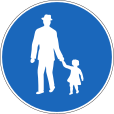
12. Mandatory path for pedestrians
This traffic sign indicates the start of a mandatory path for pedestrians. Pedestrians must use the designated path, while other road users may use it only where the applicable signs or local rules permit them to do so.
English • Traffic sign 2.61 • Footpath.
Deutsch • Verkehrssignal 2.61 • Fussweg.
Français • Signal 2.61 • Chemin pour piétons.
Italiano • Segnale 2.61 • Strada pedonale.
Sources
🔗 Commons.wikimedia.org
🔗 Fedlex.admin.ch • SSV, Anhang 2 (DE)
🔗 Fedlex.admin.ch • OSR, annexe 2 (FR)
🔗 Fedlex.admin.ch • OSStr, allegato 2 (IT)
SVG source: Commons.wikimedia.org • Original SVG
Bundesamt für Strassen (ASTRA) • Public domain • Original revision 2017-07-08. Wikimedia original unmodified.
Artwork reviewed against the Swiss signalling ordinance, version 1 October 2026, annex 2: Fedlex.admin.ch • Signal 2.61, PDF page 110. Catalogue-equivalent illustration; intentional update from the previous PNG. This is an educational illustration, not a manufacturing specification.
13. Mandatory path for cyclists
This traffic sign indicates a mandatory path for cyclists. Cyclists must use the designated path where the sign applies. Other road users may use the path only where the applicable signs or local rules permit them to do so.
English • Traffic sign 2.60 • Cycle track.
Deutsch • Verkehrssignal 2.60 • Radweg.
Français • Signal 2.60 • Piste cyclable.
Italiano • Segnale 2.60 • Ciclopista.
Sources
🔗 Commons.wikimedia.org
🔗 Fedlex.admin.ch • SSV, Anhang 2 (DE)
🔗 Fedlex.admin.ch • OSR, annexe 2 (FR)
🔗 Fedlex.admin.ch • OSStr, allegato 2 (IT)
SVG source: Commons.wikimedia.org • Original SVG
Bundesamt für Strassen (ASTRA) • Public domain • Original revision 2017-07-08. Wikimedia original unmodified.
Artwork reviewed against the Swiss signalling ordinance, version 1 October 2026, annex 2: Fedlex.admin.ch • Signal 2.60, PDF page 110. Catalogue-equivalent illustration; intentional update from the previous PNG. This is an educational illustration, not a manufacturing specification.
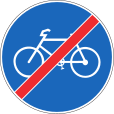
14. End of mandatory path for cyclists
This traffic sign indicates the end of the mandatory path for cyclists. The requirement associated with the designated path ends at this point. Cyclists must continue according to the road layout, other traffic signs and applicable local rules.
English • Traffic sign 2.60.1 • End of cycle track.
Deutsch • Verkehrssignal 2.60.1 • Ende des Radweges.
Français • Signal 2.60.1 • Fin de la piste cyclable.
Italiano • Segnale 2.60.1 • Fine della ciclopista.
Sources
🔗 Commons.wikimedia.org
🔗 Fedlex.admin.ch • SSV, Anhang 2 (DE)
🔗 Fedlex.admin.ch • OSR, annexe 2 (FR)
🔗 Fedlex.admin.ch • OSStr, allegato 2 (IT)
SVG source: Commons.wikimedia.org • Original SVG
Bundesamt für Strassen (ASTRA) • Public domain • Original revision 2017-07-08. Wikimedia original unmodified.
Artwork reviewed against the Swiss signalling ordinance, version 1 October 2026, annex 2: Fedlex.admin.ch • Signal 2.60.1, PDF page 110. Catalogue-equivalent illustration; intentional update from the previous PNG. This is an educational illustration, not a manufacturing specification.
15. Mandatory path for equestrians
This traffic sign indicates a mandatory path for equestrians. Equestrians must use the designated path where the sign applies. Other road users may use it only where the applicable signs or local rules permit them to do so.
English • Traffic sign 2.62 • Bridleway.
Deutsch • Verkehrssignal 2.62 • Reitweg.
Français • Signal 2.62 • Allée d’équitation.
Italiano • Segnale 2.62 • Strada per cavalli da sella.
Sources
🔗 Commons.wikimedia.org
🔗 Fedlex.admin.ch • SSV, Anhang 2 (DE)
🔗 Fedlex.admin.ch • OSR, annexe 2 (FR)
🔗 Fedlex.admin.ch • OSStr, allegato 2 (IT)
SVG source: Commons.wikimedia.org • Original SVG
Bundesamt für Strassen (ASTRA) • Public domain • Original revision 2017-07-08. Wikimedia original unmodified.
Artwork reviewed against the Swiss signalling ordinance, version 1 October 2026, annex 2: Fedlex.admin.ch • Signal 2.62, PDF page 110. Catalogue-equivalent illustration; intentional update from the previous PNG. This is an educational illustration, not a manufacturing specification.
16. Mandatory lane for buses
This traffic sign indicates a mandatory lane for buses. Buses must use the designated lane where the sign applies. Other road users may use the lane only where the applicable signs or local rules permit them to do so.
English • Traffic sign 2.64 • Roadway reserved for buses.
Deutsch • Verkehrssignal 2.64 • Busfahrbahn.
Français • Signal 2.64 • Chaussée réservée aux bus.
Italiano • Segnale 2.64 • Carreggiata riservata agli autobus.
Sources
🔗 Commons.wikimedia.org
🔗 Fedlex.admin.ch • SSV, Anhang 2 (DE)
🔗 Fedlex.admin.ch • OSR, annexe 2 (FR)
🔗 Fedlex.admin.ch • OSStr, allegato 2 (IT)
SVG source: Commons.wikimedia.org • Original SVG
Bundesamt für Strassen (ASTRA) • Public domain • Original revision 2017-07-08. Wikimedia original unmodified.
Artwork reviewed against the Swiss signalling ordinance, version 1 October 2026, annex 2: Fedlex.admin.ch • Signal 2.64, PDF page 110. Catalogue-equivalent illustration; intentional update from the previous PNG. This is an educational illustration, not a manufacturing specification.
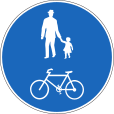
17. Mandatory shared pedestrian and cycle path
This traffic sign indicates a mandatory shared path for pedestrians and cyclists. Pedestrians and cyclists must use the same designated path rather than separate sections. They must share the space safely and follow the applicable local rules.
English • Traffic sign 2.63.1 • Shared cycle track and footpath without separation of the traffic space (example).
Deutsch • Verkehrssignal 2.63.1 • Gemeinsamer Rad- und Fussweg (Beispiel).
Français • Signal 2.63.1 • Piste cyclable et chemin pour piétons sans partage de l’aire de circulation (exemple).
Italiano • Segnale 2.63.1 • Ciclopista e strada pedonale (esempio).
Sources
🔗 Commons.wikimedia.org
🔗 Fedlex.admin.ch • SSV, Anhang 2 (DE)
🔗 Fedlex.admin.ch • OSR, annexe 2 (FR)
🔗 Fedlex.admin.ch • OSStr, allegato 2 (IT)
SVG source: Commons.wikimedia.org • Original SVG
Bundesamt für Strassen (ASTRA) • Public domain • Original revision 2017-07-08. Wikimedia original unmodified.
Artwork reviewed against the Swiss signalling ordinance, version 1 October 2026, annex 2: Fedlex.admin.ch • Signal 2.63.1, PDF page 110. Catalogue-equivalent illustration; intentional update from the previous PNG. This is an educational illustration, not a manufacturing specification.
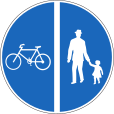
18. Mandatory divided pedestrian and cycle path
This traffic sign indicates a mandatory divided path for pedestrians and cyclists. Pedestrians and cyclists must use the section designated for them. Other road users may use the path only where the applicable signs or local rules permit them to do so.
English • Traffic sign 2.63 • Cycle track and footpath with separation of the traffic space (example).
Deutsch • Verkehrssignal 2.63 • Rad- und Fussweg mit getrennten Verkehrsflächen (Beispiel).
Français • Signal 2.63 • Piste cyclable et chemin pour piétons, avec partage de l’aire de circulation (exemple).
Italiano • Segnale 2.63 • Ciclopista e strada pedonale divise per categoria (esempio).
Sources
🔗 Commons.wikimedia.org
🔗 Fedlex.admin.ch • SSV, Anhang 2 (DE)
🔗 Fedlex.admin.ch • OSR, annexe 2 (FR)
🔗 Fedlex.admin.ch • OSStr, allegato 2 (IT)
SVG source: Commons.wikimedia.org • Original SVG
Bundesamt für Strassen (ASTRA) • Public domain • Original revision 2017-07-08. Wikimedia original unmodified.
Artwork reviewed against the Swiss signalling ordinance, version 1 October 2026, annex 2: Fedlex.admin.ch • Signal 2.63, PDF page 110. Catalogue-equivalent illustration; intentional update from the previous PNG. This is an educational illustration, not a manufacturing specification.
19. Snow chains mandatory
This traffic sign indicates that snow chains are mandatory. Vehicles covered by the sign must use snow chains from this point as required by the applicable rules. Follow any supplementary signs or local instructions specifying the affected vehicles, wheels or conditions.
English • Traffic sign 2.48 • Snow chains compulsory.
Deutsch • Verkehrssignal 2.48 • Schneeketten obligatorisch.
Français • Signal 2.48 • Chaînes à neige obligatoires.
Italiano • Segnale 2.48 • Catene per la neve obbligatorie.
Sources
🔗 Commons.wikimedia.org
🔗 Fedlex.admin.ch • SSV, Anhang 2 (DE)
🔗 Fedlex.admin.ch • OSR, annexe 2 (FR)
🔗 Fedlex.admin.ch • OSStr, allegato 2 (IT)
SVG source: Commons.wikimedia.org • Original SVG
Bundesamt für Strassen (ASTRA) • Public domain • Original revision 2017-07-05. Wikimedia original unmodified.
Artwork reviewed against the Swiss signalling ordinance, version 1 October 2026, annex 2: Fedlex.admin.ch • Signal 2.48, PDF page 108. Catalogue-equivalent illustration; intentional update from the previous PNG. This is an educational illustration, not a manufacturing specification.
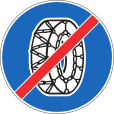
20. End of the snow-chain requirement
This traffic sign indicates the end of the snow-chain requirement. The requirement imposed by the preceding snow-chain sign ends at this point. Other winter-equipment requirements may still apply under the applicable local rules or road conditions.
English • Traffic sign 2.57 • End of compulsory use of snow chains.
Deutsch • Verkehrssignal 2.57 • Ende des Schneeketten-Obligatoriums.
Français • Signal 2.57 • Fin de l’obligation d’utiliser des chaînes à neige.
Italiano • Segnale 2.57 • Fine dell’obbligo di utilizzare le catene per la neve.
Sources
🔗 Commons.wikimedia.org
🔗 Fedlex.admin.ch • SSV, Anhang 2 (DE)
🔗 Fedlex.admin.ch • OSR, annexe 2 (FR)
🔗 Fedlex.admin.ch • OSStr, allegato 2 (IT)
SVG source: Commons.wikimedia.org • Original SVG
Bundesamt für Strassen (ASTRA) • Public domain • Original revision 2017-07-08. Wikimedia original unmodified.
Artwork reviewed against the Swiss signalling ordinance, version 1 October 2026, annex 2: Fedlex.admin.ch • Signal 2.57, PDF page 108. Catalogue-equivalent illustration; intentional update from the previous PNG. This is an educational illustration, not a manufacturing specification.
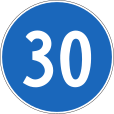
21. Start of a minimum speed
This traffic sign indicates the start of a minimum speed. Road users covered by the sign must travel at or above the indicated speed when conditions allow. Driving more slowly may still be necessary because of traffic, weather, road conditions or another safety-related reason.
English • Traffic sign 2.31 • Minimum speed.
Deutsch • Verkehrssignal 2.31 • Mindestgeschwindigkeit.
Français • Signal 2.31 • Vitesse minimale.
Italiano • Segnale 2.31 • Velocità minima.
Sources
🔗 Commons.wikimedia.org
🔗 Fedlex.admin.ch • SSV, Anhang 2 (DE)
🔗 Fedlex.admin.ch • OSR, annexe 2 (FR)
🔗 Fedlex.admin.ch • OSStr, allegato 2 (IT)
SVG source: Commons.wikimedia.org • Original SVG
Bundesamt für Strassen (ASTRA) • Public domain • Original revision 2017-07-05. Wikimedia original unmodified.
Artwork reviewed against the Swiss signalling ordinance, version 1 October 2026, annex 2: Fedlex.admin.ch • Signal 2.31, PDF page 106. Catalogue-equivalent illustration; intentional update from the previous PNG. This is an educational illustration, not a manufacturing specification.
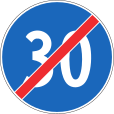
22. End of the minimum speed
This traffic sign indicates the end of the minimum speed. The previously indicated minimum speed no longer applies beyond this point. Continue to follow any other posted speed requirements and the applicable traffic rules.
English • Traffic sign 2.54 • End of minimum speed.
Deutsch • Verkehrssignal 2.54 • Ende der Mindestgeschwindigkeit.
Français • Signal 2.54 • Fin de la vitesse minimale.
Italiano • Segnale 2.54 • Fine della velocità minima.
Sources
🔗 Commons.wikimedia.org
🔗 Fedlex.admin.ch • SSV, Anhang 2 (DE)
🔗 Fedlex.admin.ch • OSR, annexe 2 (FR)
🔗 Fedlex.admin.ch • OSStr, allegato 2 (IT)
SVG source: Commons.wikimedia.org • Original SVG
Bundesamt für Strassen (ASTRA) • Public domain • Original revision 2017-07-08. Wikimedia original unmodified.
Artwork reviewed against the Swiss signalling ordinance, version 1 October 2026, annex 2: Fedlex.admin.ch • Signal 2.54, PDF page 108. Catalogue-equivalent illustration; intentional update from the previous PNG. This is an educational illustration, not a manufacturing specification.
