

Traffic rulesBrazil
 Traffic rules
 Argentina
 Australia
 Austria
 Bangladesh
 Belgium
 Bosnia and Herzegovina
 Brazil
 Canada
 Chile
 China
 Colombia
 Czechia
 Denmark
 Finland
 France
 Germany
 Greece
 Hungary
 Iceland
 India
 Indonesia
 Ireland
 Italy
 Japan
 Malaysia
 Mexico
 Nepal
 Netherlands
 New Zealand
 Norway
 Panama
 Peru
 Philippines
 Poland
 Portugal
 Romania
 Russia
 Serbia
 Slovakia
 Slovenia
 South Africa
 Spain
 Sweden
 Switzerland
 Thailand
 Turkey
 Ukraine
 United Kingdom
 United States
 Uruguay
 Worldwide
1. Brazil
Brazil occupies a vast part of South America, and traffic drives on the right. Its size makes road conditions exceptionally varied, from heavily travelled urban expressways and major intercity highways to long routes through agricultural regions, tropical forest and remote interior areas. Some rural journeys cover very large distances between services, while intense rainfall can cause flooding, landslides and road closures in susceptible regions.
Brazil has a national traffic framework under the Código de Trânsito Brasileiro (CTB), although local authorities can set and sign road-specific rules such as speed limits. There is no nationwide vignette; selected concessioned highways charge tolls through conventional plazas or increasingly through barrier-free Free Flow electronic collection. Written road signs are primarily in Portuguese. Brazil also has a zero-alcohol driving policy, and daytime headlight requirements apply in several specific situations, including certain single-carriageway highways.
AI-generated by Traffic-rules.com • WCIT • CC BY-SA
What is the alcohol limit for drivers in Brazil?
Brazil applies a zero-alcohol policy. The CTB provides that any alcohol concentration can subject a driver to drink-driving penalties, subject to the technical measurement tolerances used in enforcement. The safest rule is therefore do not drink before driving.
🔗 planalto.gov.br • Brazilian Presidency, Brazilian Traffic Code, Alcohol and impairment
What speed limits apply to passenger cars in Brazil?
Built-up areas: Where no regulatory speed sign is present, the CTB sets defaults according to road class: 80 km/h on urban express roads, 60 km/h on arterial roads, 40 km/h on collector roads and 30 km/h on local roads.
Divided roads: On a paved rural highway with divided carriageways and no different posted limit, the maximum is 110 km/h for cars, motorcycles, pickup trucks and similar light vehicles, and 90 km/h for other vehicles.
Single-carriageway rural highways: On a paved single-carriageway rural highway without a different posted limit, the maximum is 100 km/h for cars, motorcycles, pickup trucks and similar light vehicles, and 90 km/h for other vehicles.
Unpaved rural roads: The CTB defines an estrada as an unpaved rural road. Where no other limit is signed, the maximum is 60 km/h.
Posted limits: The authority responsible for the road may establish higher or lower signed limits according to the road's characteristics and traffic conditions. The posted limit takes precedence.
🔗 planalto.gov.br • Brazilian Presidency, Brazilian Traffic Code, Speed limits for passenger cars
Are seat belts compulsory in Brazil?
Yes. Drivers and passengers must wear seat belts on roads throughout Brazil, subject only to specific regulated exceptions.
🔗 planalto.gov.br • Brazilian Presidency, Brazilian Traffic Code, Seat belts and occupant protection
Can you use a mobile phone while driving in Brazil?
Driving while holding or handling a mobile phone is prohibited. The CTB also restricts driving while using a phone or headphones connected to audio equipment.
🔗 planalto.gov.br • Brazilian Presidency, Brazilian Traffic Code, Mobile devices and attention
Are motorcycle helmets compulsory in Brazil?
Yes. Both the motorcycle rider and passenger must wear a safety helmet. Riders must also comply with the rules concerning visors or protective eyewear.
🔗 planalto.gov.br • Brazilian Presidency, Brazilian Traffic Code
Who has priority at a roundabout in Brazil?
At an unsigned roundabout, a vehicle already circulating has priority over a vehicle entering. Follow traffic lights, signs and an officer’s instructions wherever they control the junction.
🔗 planalto.gov.br • Brazilian Presidency, Brazilian Traffic Code

2. Speed limit
A speed limit is the maximum legal speed permitted on a road, lane or within a designated area. It may be established by general traffic law or indicated by fixed, variable or temporary traffic signs.
A speed limit is a maximum, not a target speed. Drivers must travel more slowly whenever traffic, visibility, weather, road conditions, vulnerable road users or the condition of the vehicle make the maximum permitted speed unsafe.
Wikimedia.org • Agencia CNT de Noticias • CC BY
Which general speed limits should car drivers know in Brazil?
Without another regulatory sign, Brazil’s urban defaults are 80 km/h on rapid-transit roads, 60 km/h on arterial roads, 40 km/h on collector roads and 30 km/h on local roads. For ordinary cars, unsigned paved rural-highway maxima are 110 km/h on divided roads and 100 km/h on single-carriageway roads; unpaved rural roads have a 60 km/h default. Authorised signed limits can differ.
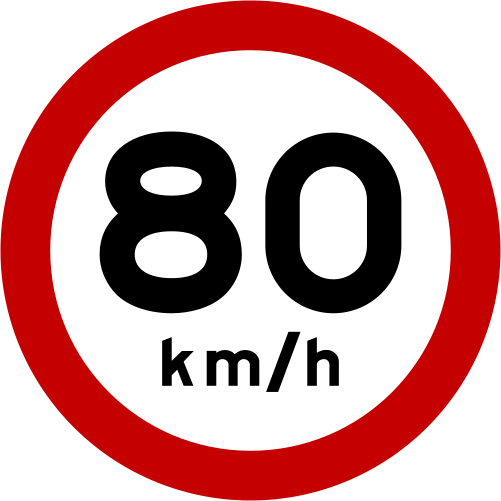 Start of a speed limit.
English • Traffic sign R-19 • Maximum permitted speed. Sets an 80 km/h maximum, as illustrated. Reduce speed when conditions require.
Português • R-19 • Velocidade máxima permitida. Estabelece a velocidade máxima de 80 km/h, valor mostrado na ilustração. Reduza a velocidade quando as condições exigirem.
Sources
🔗 Commons.wikimedia.org (Amateria1121 • CC BY-SA 3.0)
🔗 Gov.br • CONTRAN/SENATRAN: MBST, Volume I, página PDF 35
SVG source: Commons.wikimedia.org • Original SVG
Amateria1121 • CC BY-SA 3.0 • Original revision 2022-12-29. Wikimedia original unmodified.
Artwork reviewed against the Brazilian Manual Brasileiro de Sinalização de Trânsito (current SENATRAN catalogue): Gov.br • R-19, PDF page 35. Intentional educational illustration update from the previous PNG; original SVG unmodified.
Does an unsigned Brazilian urban road always have a 50 km/h default?
No. The Traffic Code uses the road classes via de trânsito rápido, via arterial, via coletora and via local, with defaults of 80, 60, 40 and 30 km/h respectively. The actual road classification matters when no regulatory speed sign is present.
Can a Brazilian road authority sign a different limit from the default?
Yes. The authority responsible for the road can establish a higher or lower signed limit according to its characteristics and traffic conditions. Follow that restriction and any vehicle-specific rule; the unsigned default does not override an authorised regulatory sign.
3. Speed bump
A speed bump is a raised traffic-calming device placed across all or part of a road to make drivers reduce their speed. It is commonly used near homes, schools, crossings, parking areas and other places where low vehicle speeds are important.
Speed bumps vary in shape, height and legal status. Drivers should approach them at a low, controlled speed and follow any warning signs or speed limits that apply.

Wikimedia.org • Py4nf • CC BY-SA
How should I recognise and approach a speed bump in Brazil?
Brazil’s Traffic Code addresses ondulações transversais, commonly called lombadas, as physical speed-reduction devices subject to the national traffic authority’s criteria. Distinguish one from a raised pedestrian crossing.
🔗 gov.br • National auxiliary-device manual — sections 5.1 humps and 5.2 raised crossings
 Warning for a speed bump.
English • Traffic sign A-18 • Hump. Reduce speed before passing over the raised surface.
Português • A-18 • Saliência ou lombada. Adverte sobre uma saliência ou lombada na pista. Reduza a velocidade antes de passar pelo local.
Sources
🔗 Commons.wikimedia.org
🔗 Gov.br • CONTRAN/SENATRAN: MBST, Volume II, página PDF 75
SVG source: Commons.wikimedia.org • Original SVG
Departamento Nacional de Infraestrutura de Transportes • Public domain • Original revision 2014-01-17. Wikimedia original unmodified.
Artwork reviewed against the Brazilian Manual Brasileiro de Sinalização de Trânsito (current SENATRAN catalogue): Gov.br • A-18, PDF page 75. Intentional educational illustration update from the previous PNG; original SVG unmodified.
Which speed should I use at a raised device in Brazil?
Read the accompanying speed restriction and reduce speed before the device. A numerical limit is a maximum; the height, profile, visibility and presence of pedestrians can require a slower approach.
🔗 gov.br • National auxiliary-device manual — sections 5.1 humps and 5.2 raised crossings
Does a raised road surface give pedestrians priority in Brazil?
A raised device alone does not identify pedestrian priority. If it incorporates a crossing, apply the crossing’s controls and the national rules. Pedestrians on a marked crossing have priority, subject to signal-controlled rules. If the signal changes before they finish, let them complete the crossing. At an unsignalised junction, pedestrians already crossing also have priority.
🔗 gov.br • National auxiliary-device manual — sections 5.1 humps and 5.2 raised crossings
4. Slope
A slope is a section of road that rises or descends noticeably. A steep slope can affect vehicle speed, braking distance, traction, visibility and the ability of heavy or low-powered vehicles to maintain a steady speed.
Warning signs may indicate a steep ascent or dangerous descent and may show the gradient as a percentage. Drivers should adjust their speed early, select a suitable gear and remain prepared for slow vehicles, bends and changing road conditions.
Wikimedia.org • Governo do Estado de São Paulo • CC BY
What does a steep-slope warning mean in Brazil?
Brazilian steep-road warnings describe the hazard. The Traffic Code also treats driving downhill with the vehicle disengaged or in neutral as an offence; keep an appropriate gear engaged.
🔗 gov.br • National warning manual — relevant hazard and advance-warning criteria
 Warning for a steep ascent.
English • Traffic sign A-20b • Steep ascent. Select a suitable gear and maintain control.
Português • A-20b • Aclive acentuado. Adverte sobre uma subida acentuada adiante. Utilize uma marcha adequada e mantenha o controle do veículo.
Sources
🔗 Commons.wikimedia.org
🔗 Gov.br • CONTRAN/SENATRAN: MBST, Volume II, página PDF 77
SVG source: Commons.wikimedia.org • Original SVG
Departamento Nacional de Infraestrutura de Transportes • Public domain • Original revision 2014-01-17. Wikimedia original unmodified.
Artwork reviewed against the Brazilian Manual Brasileiro de Sinalização de Trânsito (current SENATRAN catalogue): Gov.br • A-20b, PDF page 77. Intentional educational illustration update from the previous PNG; original SVG unmodified.
How should I approach a steep descent in Brazil?
Reduce speed before the descent and select a suitable gear to help control the vehicle. Keep enough following distance and avoid building up speed that requires continuous heavy braking. A warning gives no fixed safe descent speed: the gradient, surface, visibility, load and vehicle can require a speed well below the legal maximum.
🔗 gov.br • National warning manual — relevant hazard and advance-warning criteria
What should I check when meeting or overtaking on a slope in Brazil?
Do not overtake on a two-way single-carriageway road at a crest with insufficient visibility unless the applicable signs permit the manoeuvre under the Code. A slope warning alone does not permit unsafe overtaking.
🔗 gov.br • National warning manual — relevant hazard and advance-warning criteria
5. Stop sign
A stop sign requires drivers to bring their vehicle to a complete stop and give way before entering or crossing the road ahead. The stop must be made at the stop line or another legally prescribed position.
After stopping, the driver may continue only when this can be done safely and without interfering with traffic that has priority. The sign does not create priority for the driver who has stopped.
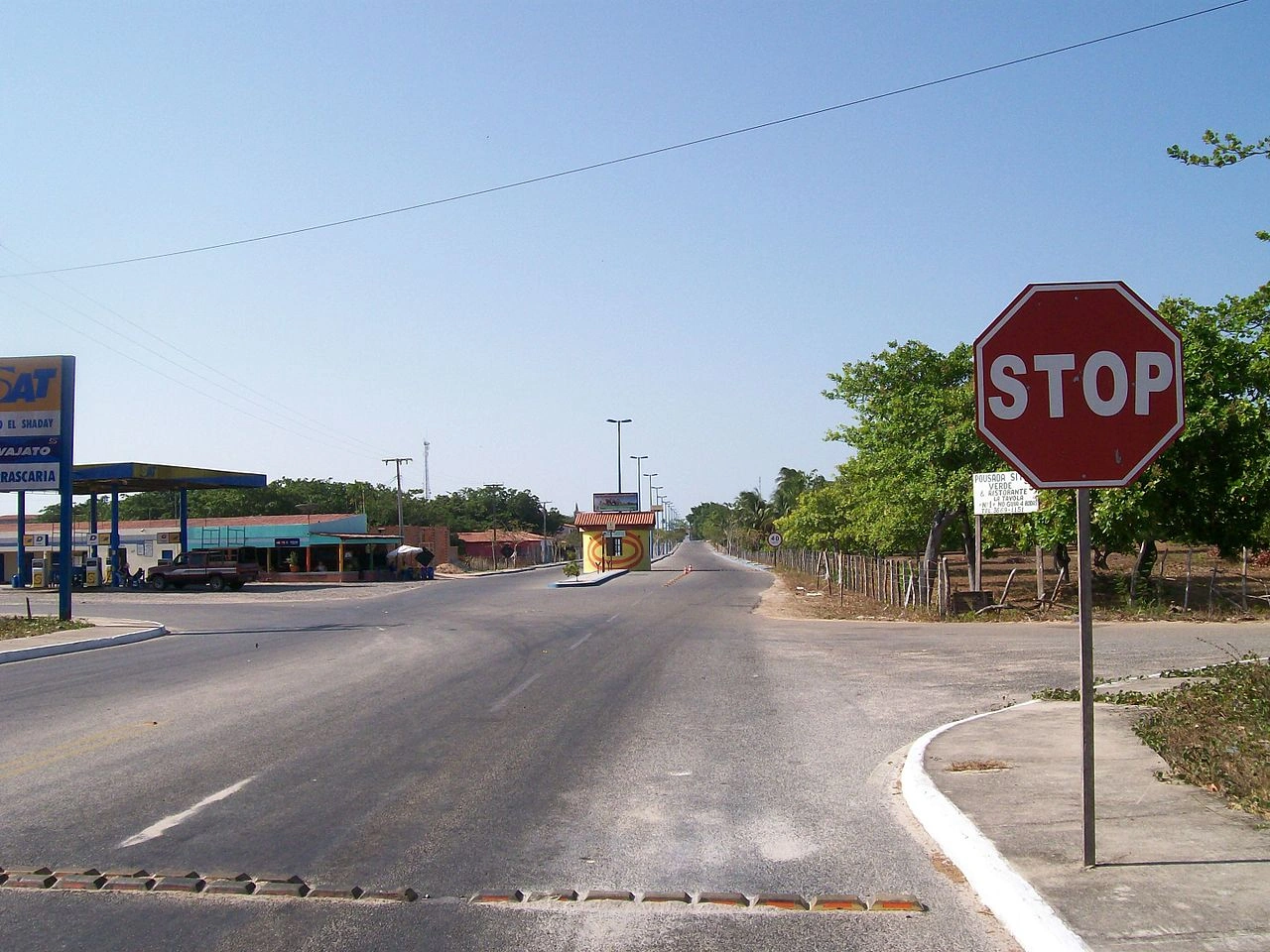
Wikimedia.org • Claudio Oliveira Lim • CC BY-SA
Must I stop completely at a stop sign in Brazil?
Yes. Come to a complete stop when the applicable stop sign controls your approach, even when you cannot see another road user. Slowing to a crawl is not a stop. The Brazilian stop indication uses PARE.
🔗 gov.br • Brazil, CONTRAN, Sign Manual Volume I, 2007 edition hosted by DNIT; 🔗 planalto.gov.br • Brazil, Traffic Code, Law 9,503, compiled text
 Stop and give way.
English • Traffic sign R-1 • Compulsory stop. Stop completely before entering or crossing the road. Proceed only when safe.
Português • R-1 • Parada obrigatória. Pare completamente antes de entrar ou cruzar a via. Prossiga somente quando houver segurança.
Sources
🔗 Commons.wikimedia.org (Amateria1121 • CC BY-SA 3.0)
🔗 Gov.br • CONTRAN/SENATRAN: MBST, Volume I, página PDF 29
SVG source: Amateria1121 • CC BY-SA 3.0 • Original revision 2014-04-09. Wikimedia original unmodified.
Where must I stop at a stop-controlled junction in Brazil?
Stop before the prescribed stop line. Where no line is provided, stop before entering the junction at the applicable safe position. Give way to the traffic controlled as having priority and keep the pedestrian route clear.
🔗 gov.br • Brazil, CONTRAN, Sign Manual Volume I, 2007 edition hosted by DNIT; 🔗 planalto.gov.br • Brazil, Traffic Code, Law 9,503, compiled text
Does stopping first give me priority at a stop sign in Brazil?
A complete stop does not, by itself, give you priority. Give way to the road users entitled to pass under the junction’s signs and rules, check pedestrians and cyclists, and proceed only when the gap is safe. Do not follow another stopped vehicle through without satisfying your own stopping and yielding duties.
🔗 gov.br • Brazil, CONTRAN, Sign Manual Volume I, 2007 edition hosted by DNIT; 🔗 planalto.gov.br • Brazil, Traffic Code, Law 9,503, compiled text
6. Roundabout
A roundabout is a circular road arrangement in which traffic travels around a central island in one designated direction. Vehicles enter and leave through connecting roads, and traffic signs or local rules determine who has priority.
Drivers should reduce speed, choose a suitable lane, observe all road users and signal as required when leaving. The direction of travel, entry priority, lane use and rules for cyclists and pedestrians depend on local traffic signs and regulations.

Wikimedia.org • Luis Dantas • CC0
Who has priority at a roundabout in Brazil?
At an unsigned Brazilian rotatória, the Traffic Code gives priority to vehicles already circulating. Follow the actual signs or signals where they regulate the junction.
🔗 planalto.gov.br • Brazil, Traffic Code, Law 9,503, compiled text
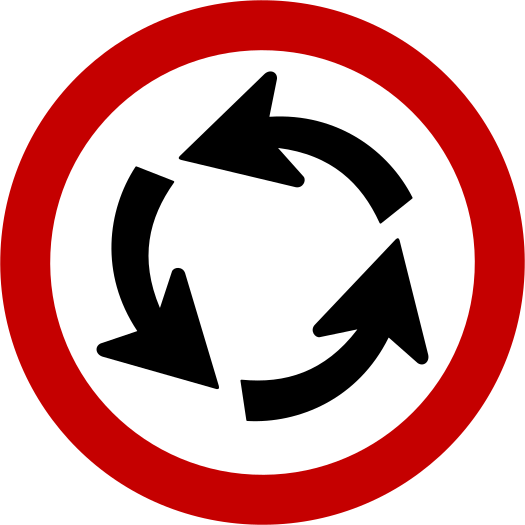 Mandatory roundabout direction.
English • Traffic sign R-33 • Roundabout direction. Traffic must circulate anticlockwise as shown by the arrows.
Português • R-33 • Sentido de circulação na rotatória. Determina que a circulação na rotatória deve ocorrer no sentido anti-horário indicado pelas setas.
Sources
🔗 Commons.wikimedia.org (Amateria1121 • CC BY-SA 3.0)
🔗 Gov.br • CONTRAN/SENATRAN: MBST, Volume I, página PDF 58
SVG source: Amateria1121 • CC BY-SA 3.0 • Original revision 2014-04-09. Wikimedia original unmodified.
 Warning for a roundabout.
English • Traffic sign A-12 • Circular junction. Warns of a junction such as a roundabout. Reduce speed and observe the entry priority signs.
Português • A-12 • Interseção em círculo. Adverte sobre uma interseção em círculo, como uma rotatória. Reduza a velocidade e respeite a sinalização de preferência do acesso.
Sources
🔗 Commons.wikimedia.org
🔗 Gov.br • CONTRAN/SENATRAN: MBST, Volume II, página PDF 62
SVG source: Commons.wikimedia.org • Original SVG
Departamento Nacional de Infraestrutura de Transportes • Public domain • Original revision 2014-01-17. Wikimedia original unmodified.
Artwork reviewed against the Brazilian Manual Brasileiro de Sinalização de Trânsito (current SENATRAN catalogue): Gov.br • A-12, PDF page 62. Intentional educational illustration update from the previous PNG; original SVG unmodified.
How should you choose a roundabout lane in Brazil?
Choose your intended exit before entering and follow the lane arrows and destination signs. Keep to the marked route and make any permitted lane change only when safe; having priority over entering traffic does not give you priority to change lanes.
🔗 planalto.gov.br • Brazil, Traffic Code, Law 9,503, compiled text
What should you check when leaving a roundabout in Brazil?
Check the lane you will cross or enter, signal the manoeuvre as required and look for cyclists and pedestrians at the exit. Obey any separate crossing controls and do not force an exit across another vehicle’s path.
🔗 planalto.gov.br • Brazil, Traffic Code, Law 9,503, compiled text
7. Pedestrian crossing
A pedestrian crossing is a designated place where pedestrians may cross a road. It is commonly indicated by road markings, traffic signs, signals or a combination of these measures.
Drivers must approach with appropriate caution and give way when required by local law. Pedestrians must also observe approaching traffic and follow any pedestrian signals or instructions from authorised traffic controllers.
Wikimedia.org • Mariordo • CC BY-SA
When must drivers give way at a pedestrian crossing in Brazil?
Pedestrians on marked crossings have priority, subject to the applicable traffic signals. A pedestrian who has not finished crossing keeps priority even when the vehicle light turns green. Drivers must also yield to pedestrians already crossing without markings and to pedestrians crossing a side road the driver is entering.
🔗 planalto.gov.br • Brazil, Traffic Code, Law 9,503, compiled text
Are all pedestrian crossings controlled the same way in Brazil?
A warning that pedestrians may cross ahead is different from a marked or signal-controlled crossing. Look for the actual crossing marking, pedestrian signals and any supplemental signs.
🔗 planalto.gov.br • Brazilian Presidency, Brazilian Traffic Code
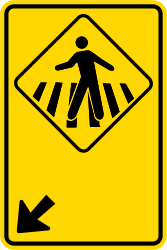 Crossing for pedestrians.
 Warning for a pedestrian crossing.
English • Traffic sign A-32b • Marked pedestrian crossing. Reduce speed and respect pedestrians' priority.
Português • A-32b • Passagem sinalizada de pedestres. Adverte sobre uma faixa de travessia de pedestres adiante. Reduza a velocidade e respeite a preferência dos pedestres.
Sources
🔗 Commons.wikimedia.org
🔗 Gov.br • CONTRAN/SENATRAN: MBST, Volume II, página PDF 110
SVG source: Commons.wikimedia.org • Original SVG
Departamento Nacional de Infraestrutura de Transportes • Public domain • Original revision 2014-01-17. Wikimedia original unmodified.
Artwork reviewed against the Brazilian Manual Brasileiro de Sinalização de Trânsito (current SENATRAN catalogue): Gov.br • A-32b, PDF page 110. Intentional educational illustration update from the previous PNG; original SVG unmodified.
May I enter a pedestrian crossing if the road beyond it is blocked in Brazil?
Wait before the crossing until there is space beyond it; at junctions, do not enter if you would obstruct crossing traffic even on green. On a two-way road with a single carriageway, overtaking at a pedestrian crossing is prohibited unless signs permit it. Always respect pedestrian priority and do not pass a vehicle stopped for pedestrians merely because an adjacent lane appears clear.
🔗 planalto.gov.br • Brazil, Traffic Code, Law 9,503, compiled text
8. Railway crossing
A railway crossing, also called a level crossing or railroad crossing, is a place where a road or path crosses railway tracks at the same level. It may be protected by barriers, warning lights, bells, traffic signs or a combination of these measures.
Road users must approach carefully and never enter when a train is approaching, warning signals are active or the exit is blocked. They should cross promptly and must never stop, wait or become trapped on the tracks.
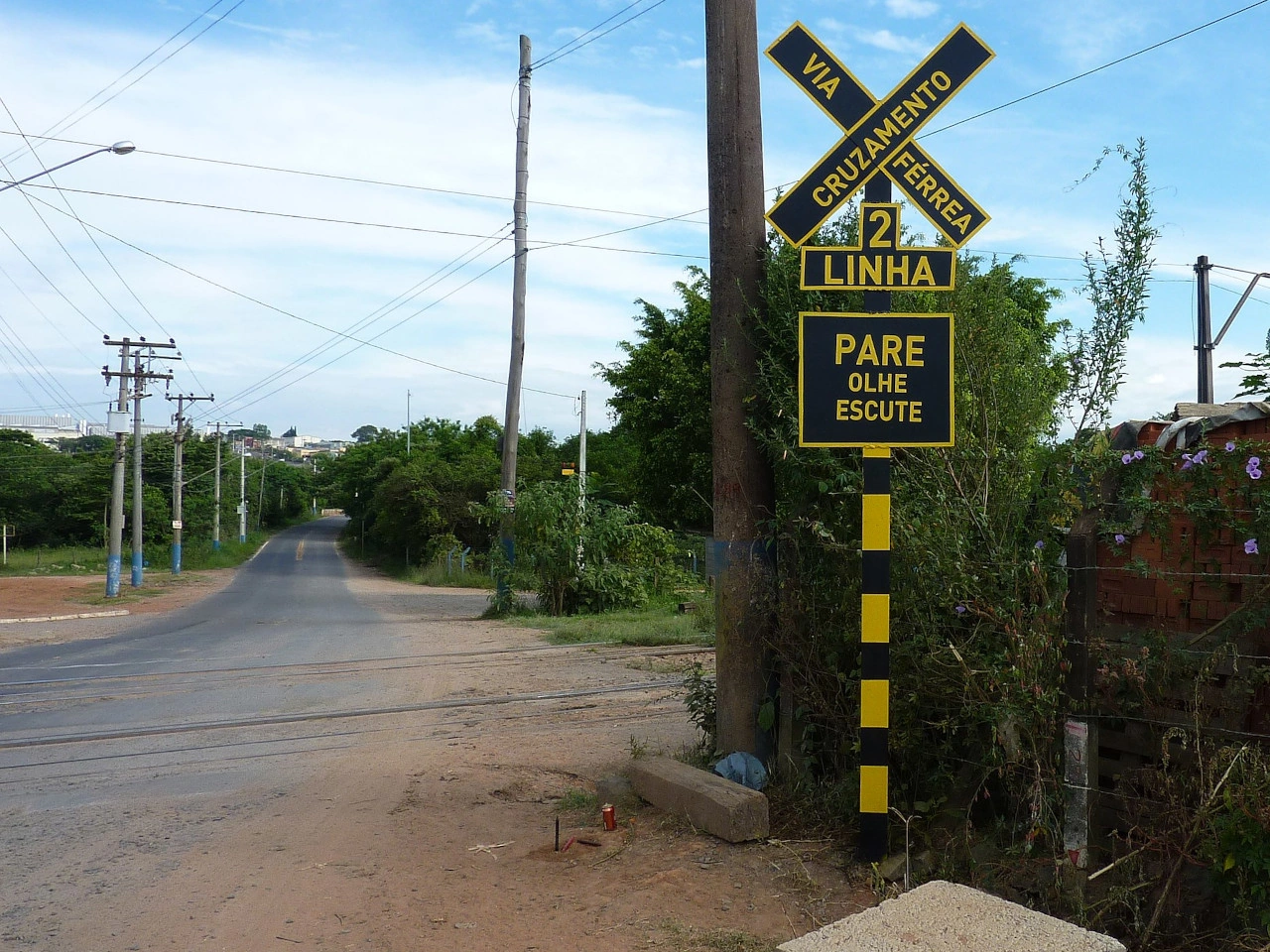
Wikimedia.org • Amauri Aparecido Zardeto • CC BY
When must drivers stop at a railway level crossing in Brazil?
Stop before crossing railway tracks. Article 212 of Brazil’s Traffic Code requires a stop independently of a separate STOP sign. Check for trains and obey the crossing’s warnings, barriers and authorised directions before proceeding safely.
🔗 planalto.gov.br • Brazil, Traffic Code, Law 9,503, compiled text
 Warning for a railway crossing with barriers.
English • Traffic sign A-40 • Level crossing with barriers. Obey the controls and never cross while barriers are closed or moving.
Português • A-40 • Passagem de nível com barreira. Adverte sobre um cruzamento rodoferroviário em nível com barreira. Respeite os controles e nunca atravesse com a barreira fechada ou em movimento.
Sources
🔗 Commons.wikimedia.org
🔗 Gov.br • CONTRAN/SENATRAN: MBST, Volume II, página PDF 69
SVG source: Commons.wikimedia.org • Original SVG
Departamento Nacional de Infraestrutura de Transportes • Public domain • Original revision 2014-01-17. Wikimedia original unmodified.
Artwork reviewed against the Brazilian Manual Brasileiro de Sinalização de Trânsito (current SENATRAN catalogue): Gov.br • A-40, PDF page 69. Intentional educational illustration update from the previous PNG; original SVG unmodified.
 Warning for a railway crossing without barriers.
English • Traffic sign A-39 • Level crossing without barriers. Reduce speed, check the tracks and obey crossing controls.
Português • A-39 • Passagem de nível sem barreira. Adverte sobre um cruzamento rodoferroviário em nível sem barreira. Reduza a velocidade, observe a linha férrea e respeite os controles do cruzamento.
Sources
🔗 Commons.wikimedia.org
🔗 Gov.br • CONTRAN/SENATRAN: MBST, Volume II, página PDF 69
SVG source: Commons.wikimedia.org • Original SVG
Departamento Nacional de Infraestrutura de Transportes • Public domain • Original revision 2014-01-17. Wikimedia original unmodified.
Artwork reviewed against the Brazilian Manual Brasileiro de Sinalização de Trânsito (current SENATRAN catalogue): Gov.br • A-39, PDF page 69. Intentional educational illustration update from the previous PNG; original SVG unmodified.
 Warning for a railway crossing with one track.
 Warning for a railway crossing with two or more tracks.
Must I stop at every unguarded railway crossing in Brazil?
Yes. Article 212 requires drivers to stop before crossing railway tracks; the duty does not depend on a separate STOP sign or barriers. Look and listen for trains and proceed only when the crossing is safe and the applicable controls allow it.
🔗 planalto.gov.br • Brazil, Traffic Code, Law 9,503, compiled text
What if road traffic is queued beyond a railway crossing in Brazil?
Wait before the tracks until there is room to take your entire vehicle off the crossing. Do not follow another vehicle onto the tracks without checking the exit. Keep the tracks clear even if no train is visible.
🔗 planalto.gov.br • Brazil, Traffic Code, Law 9,503, compiled text
9. Turn prohibition
A turn prohibition prevents drivers from turning in the direction indicated by a traffic sign. It may prohibit a left turn, a right turn or a U-turn at an intersection or along a specified section of road.
Drivers must continue along a permitted route and follow any lane arrows or mandatory-direction signs. A turn prohibition does not itself determine priority or speed, and any exemption for cyclists, public transport or other road users must be expressly indicated.
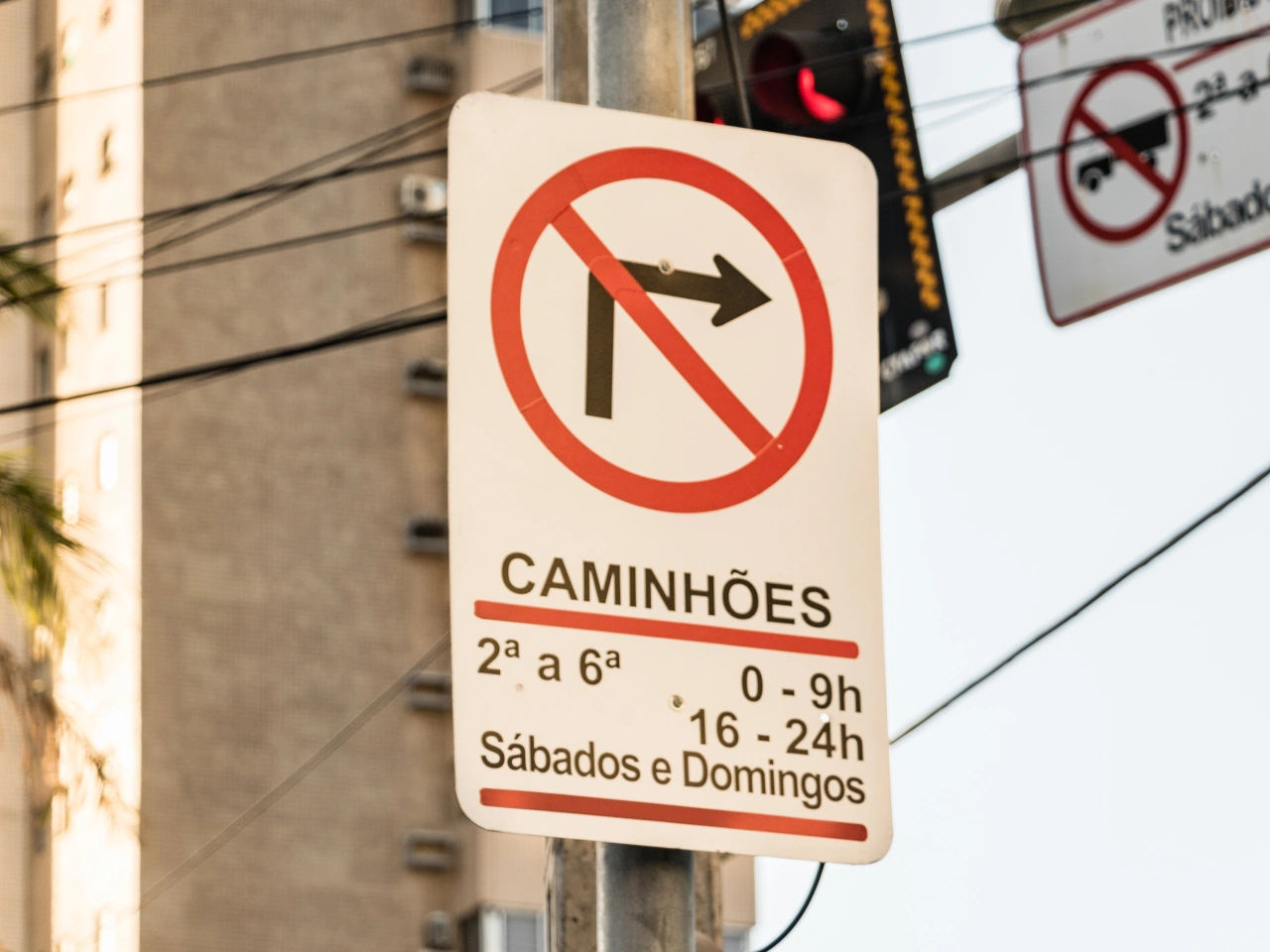
Wikimedia.org • Paul R. Burley • CC BY-SA
What does a no-turn sign prohibit in Brazil?
It prohibits the left, right or other turn shown at the junction or position controlled by the sign in Brazil. Follow any supplementary panel or authorised direction and choose another legal route.
🔗 planalto.gov.br • Brazilian Traffic Code — 35–39, 89 and 206; R-4a/b distinct from R-5a/b
Does a no-left-turn sign always prohibit a U-turn in Brazil?
No. Brazil’s national manual expressly states that the no-left-turn sign does not itself prohibit a U-turn. A separate no-U-turn sign is needed to prohibit that movement by signing. The Traffic Code’s other U-turn prohibitions and safety requirements still apply.
🔗 planalto.gov.br • Brazilian Traffic Code — 35–39, 89 and 206; R-4a/b distinct from R-5a/b
Can a no-turn restriction apply only to certain vehicles or hours in Brazil?
Yes, where the local sign system provides a supplementary condition or exemption, such as a vehicle class, time or authorised access. Without a valid exception, comply with the prohibited movement shown.
🔗 planalto.gov.br • Brazilian Traffic Code — 35–39, 89 and 206; R-4a/b distinct from R-5a/b
10. School area
A school area is a road or group of roads near a school where large numbers of children may walk, cycle, cross the road or enter and leave vehicles. It may be identified by warning signs, zone signs, road markings, traffic-calming measures or flashing lights.
Special speed limits, parking restrictions or access rules may apply permanently or only during school arrival and departure times. Drivers should reduce speed, watch carefully for children and be prepared to stop.
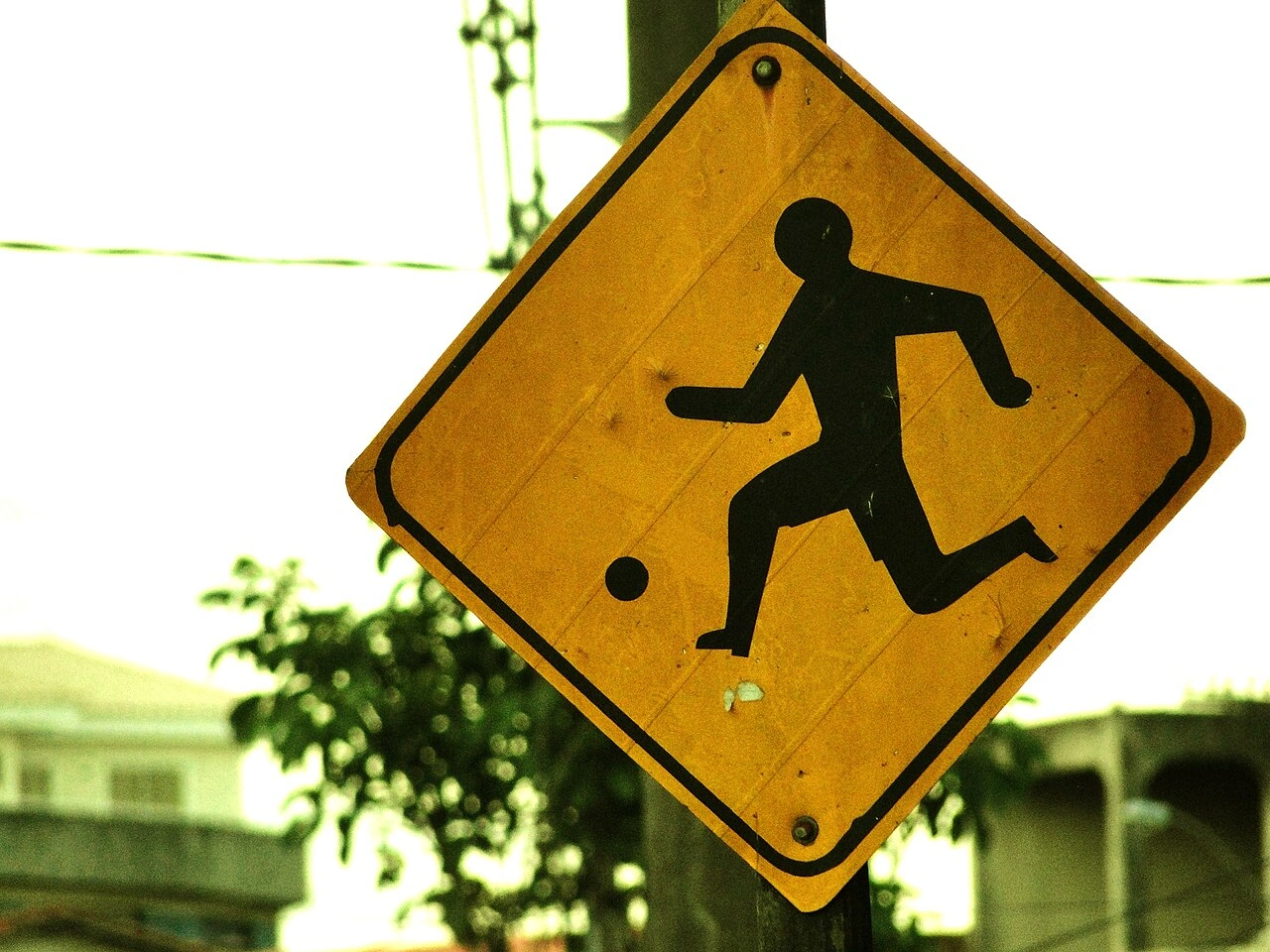
Wikimedia.org • Vinicius • CC BY-SA
What speed rules apply around schools in Brazil?
The applicable speed is determined by the road classification and any posted local restriction. A school warning alone does not establish a single nationwide school speed.
🔗 gov.br • National warning manual — relevant hazard and advance-warning criteria
Does a school warning sign in Brazil automatically set the speed limit?
A children or school warning alerts you to a potential hazard; the enforceable numerical speed limit depends on the applicable law, regulatory signs and any time or variable display. Slow further if children are near the road.
🔗 gov.br • National warning manual — relevant hazard and advance-warning criteria
 Warning for children.
English • Traffic sign A-33a • School area. Pupils may be on or near the road. Reduce speed and take extra care.
Português • A-33a • Área escolar. Adverte sobre uma área escolar, com possível presença de estudantes na via ou em suas proximidades. Reduza a velocidade e redobre a atenção.
Sources
🔗 Commons.wikimedia.org
🔗 Gov.br • CONTRAN/SENATRAN: MBST, Volume II, página PDF 111
SVG source: Commons.wikimedia.org • Original SVG
Departamento Nacional de Infraestrutura de Transportes • Public domain • Original revision 2014-01-17. Wikimedia original unmodified.
Artwork reviewed against the Brazilian Manual Brasileiro de Sinalização de Trânsito (current SENATRAN catalogue): Gov.br • A-33a, PDF page 111. Intentional educational illustration update from the previous PNG; original SVG unmodified.
How should you pass a school entrance in Brazil?
Watch for children stepping out from between parked vehicles, obey crossings and any school patrol, and follow stopping or parking restrictions. Do not obstruct visibility near a crossing or school entrance; approach at a speed that permits a safe stop.
🔗 gov.br • National warning manual — relevant hazard and advance-warning criteria
11. Traffic lights
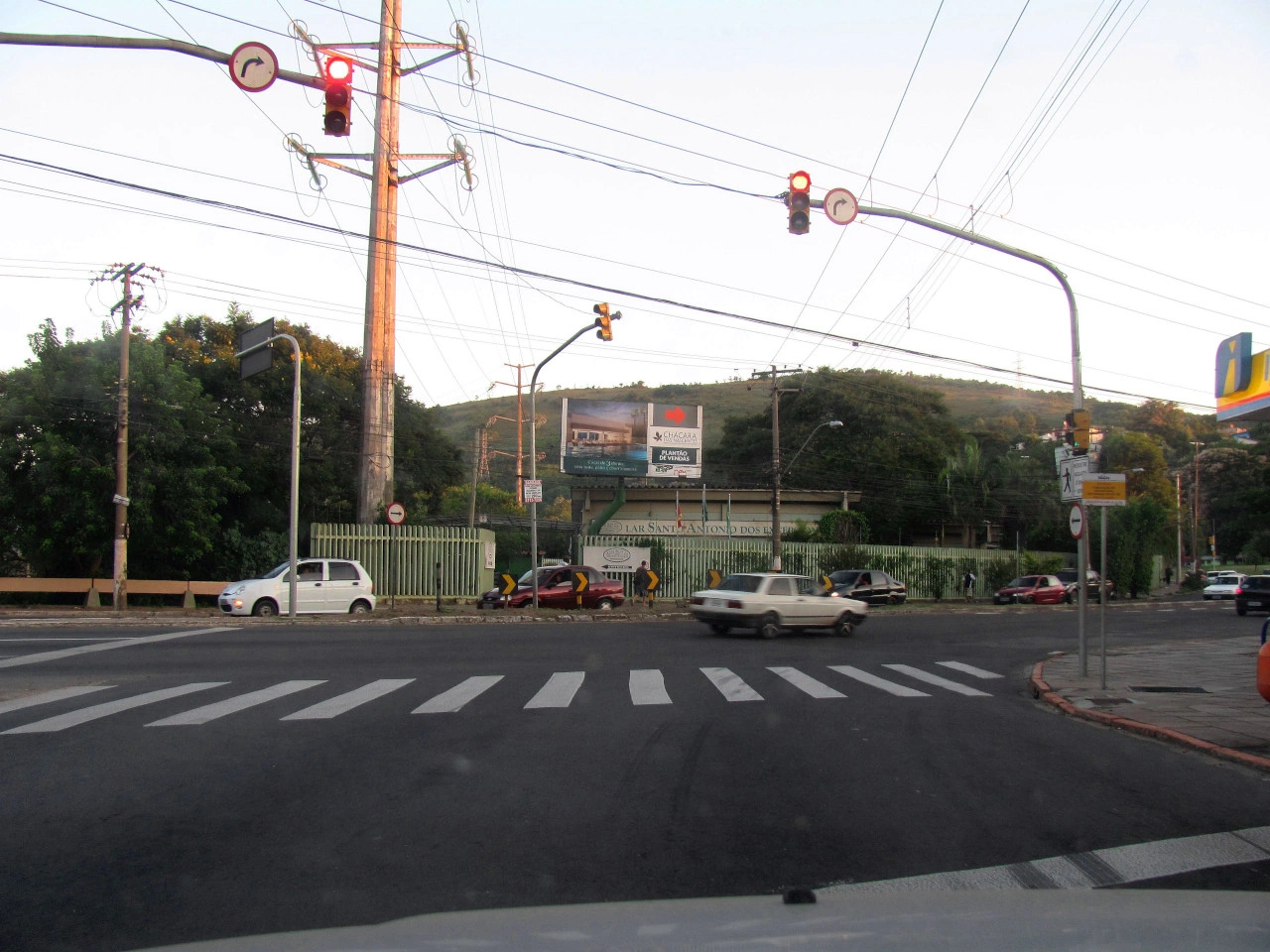
Traffic lights use coloured lights, arrows or symbols to regulate when road users may proceed, must prepare to stop or must remain stopped. Separate signals may apply to particular directions, lanes, pedestrians, cyclists or public-transport vehicles.
A green light permits movement only when the route is clear and the movement is otherwise legal. Road users must still follow priority rules, turning restrictions, lane markings and instructions from authorised traffic controllers.
Wikimedia.org • Paulo_rsmenezes • CC BY-SA
What must a driver do at red, amber and green signals in Brazil?
Red requires a stop. Amber requires stopping unless doing so would create danger; do not accelerate to beat it. Green permits movement subject to the normal priority and safety rules, and you must not enter a blocked junction. A right turn on red needs the specific permission signage required by article 44-A.
🔗 detraneduca.pr.gov.br • Brazil, DETRAN-PR, traffic-light meanings; 🔗 planalto.gov.br • Brazil, Traffic Code, Law 9,503, compiled text
May you turn at a red traffic light in Brazil?
Do not assume a turn is permitted on red. The Brazilian Traffic Code provides an exception for a right turn on red where authorised by specific signage; pedestrians and other users must be protected.
🔗 planalto.gov.br • Brazil, Traffic Code, Law 9,503, compiled text
Can a green light remove the need to give way to pedestrians in Brazil?
No. A green signal is not a guarantee that the junction is empty. Check for people already crossing, vehicles completing a movement and any separate pedestrian, bicycle or turning signals. Do not enter if you cannot clear the junction safely.
🔗 planalto.gov.br • Brazil, Traffic Code, Law 9,503, compiled text
12. Traffic lights warning
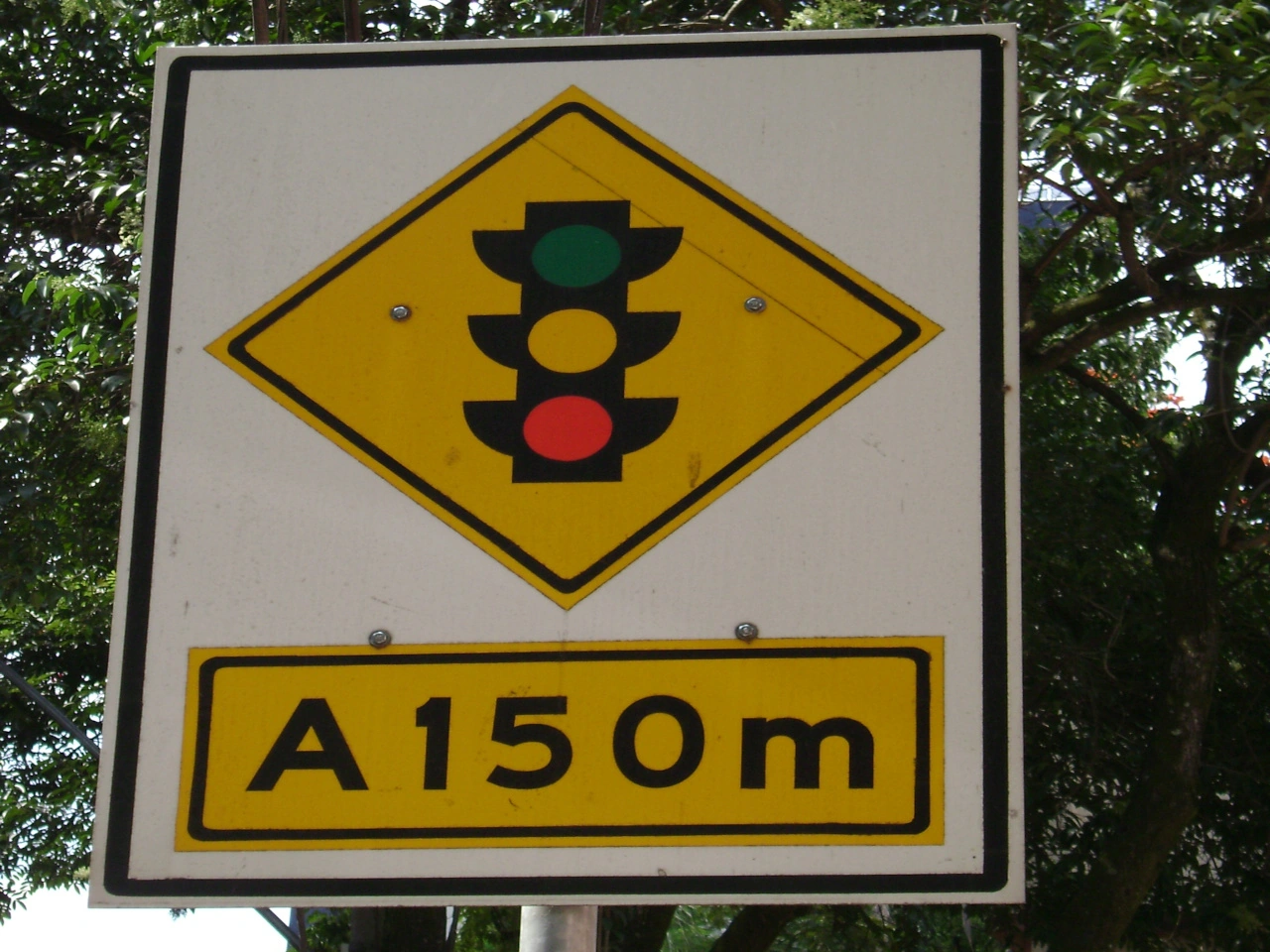
A traffic lights warning is a warning sign that alerts drivers that traffic signals are located ahead. It is commonly used where the signals may be unexpected, difficult to see from a distance or located on a road where drivers need additional time to prepare to stop.
Drivers approaching a traffic lights warning should reduce speed when necessary, watch for the signals ahead and be prepared to stop if the traffic light changes or traffic is waiting at the intersection.
Wikimedia.org • Andrevruas • CC BY
How are traffic lights ahead warned of in Brazil?
A yellow warning sign showing a traffic-signal symbol can alert drivers to traffic lights ahead; the exact shape and application follow local sign standards. It warns of a potential need to stop, but does not replace the actual signals.
🔗 planalto.gov.br • Brazilian Traffic Code — 43, 89; warning A-14 separate from actual signals
Does a traffic-lights-ahead warning require an immediate stop in Brazil?
No. A warning sign is not an automatic STOP instruction and does not create a new numerical speed limit. Reduce speed when necessary, look for a queue or a concealed signal, and obey the traffic lights and any separate speed or stop signs.
🔗 planalto.gov.br • Brazilian Traffic Code — 43, 89; warning A-14 separate from actual signals
What should you check if the next traffic lights are difficult to see in Brazil?
Allow enough distance to stop before the marked line, watch for vehicles braking suddenly and be ready for a pedestrian or cyclist crossing. If the signals are out of order or flashing, follow the applicable local failure and priority rules rather than guessing from the warning sign.
🔗 planalto.gov.br • Brazilian Traffic Code — 43, 89; warning A-14 separate from actual signals
13. Pedestrian lights
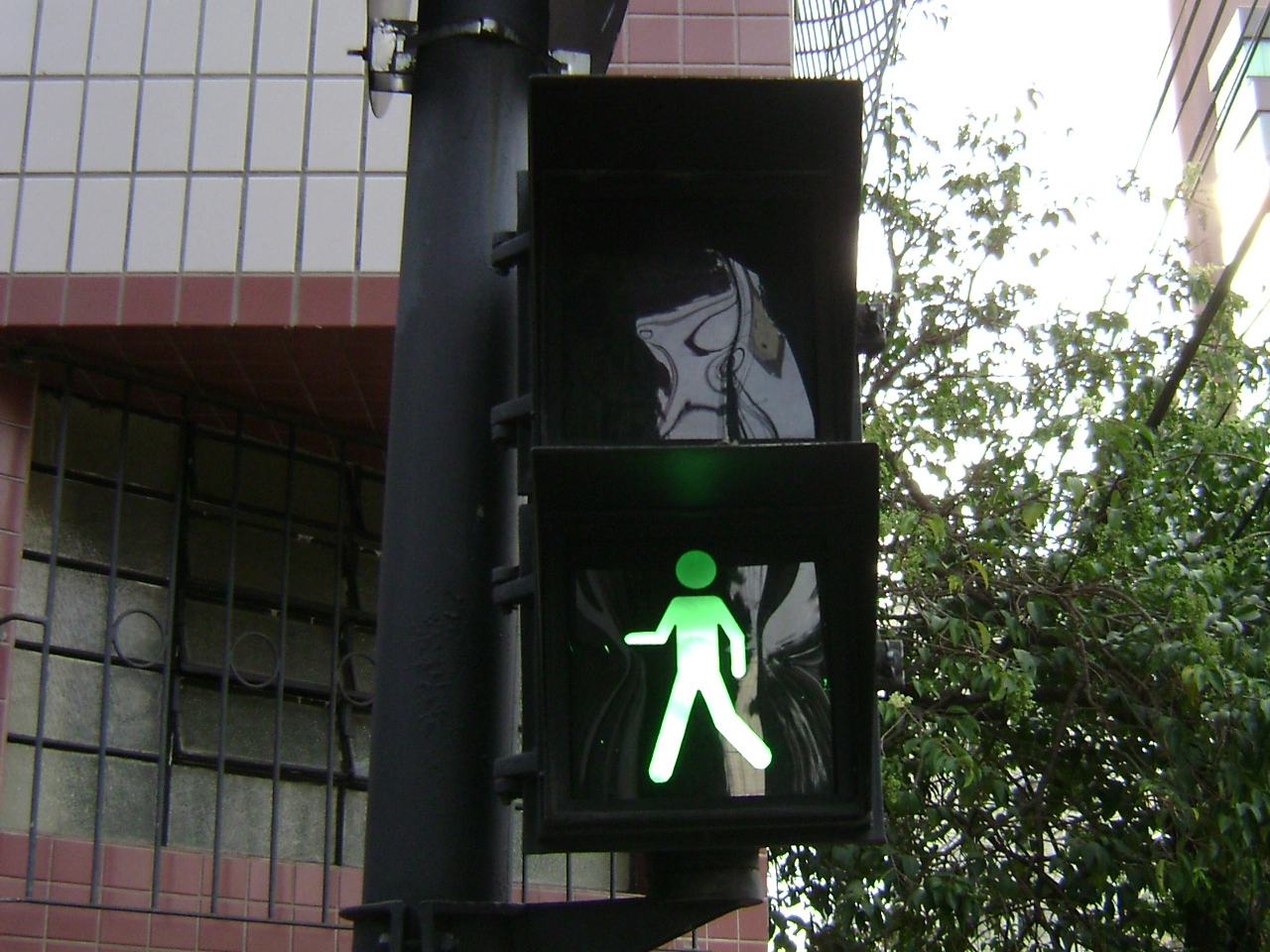
Pedestrian lights are traffic signals that regulate when pedestrians may begin crossing a road. They normally display a red standing figure to prohibit starting and a green walking figure to permit crossing.
A flashing signal or countdown may warn that the permitted crossing period is ending. Pedestrians should cross without unnecessary delay, while turning drivers must remain alert and allow pedestrians who entered lawfully to finish crossing safely.
Wikimedia.org • Andrevruas • CC BY
What do pedestrian traffic signals mean in Brazil?
Where fitted, a green walking-person symbol indicates when pedestrians may begin to cross, and a red standing-person symbol means do not begin. Check that traffic has stopped and follow the exact locally displayed symbol or audible instruction.
What if the pedestrian signal changes while you are crossing in Brazil?
Do not begin a new crossing when the signal prohibits it. If you started lawfully and the indication changes, continue to a safe place promptly rather than stopping unexpectedly in traffic. Local flashing and countdown indications can vary.
May turning drivers ignore pedestrians on a signal-controlled crossing in Brazil?
No. Drivers must watch for pedestrians still on the crossing and obey the local rules on giving way when turning. A signal for vehicles does not justify driving into someone who has not yet reached a safe place.
14. Driving licence
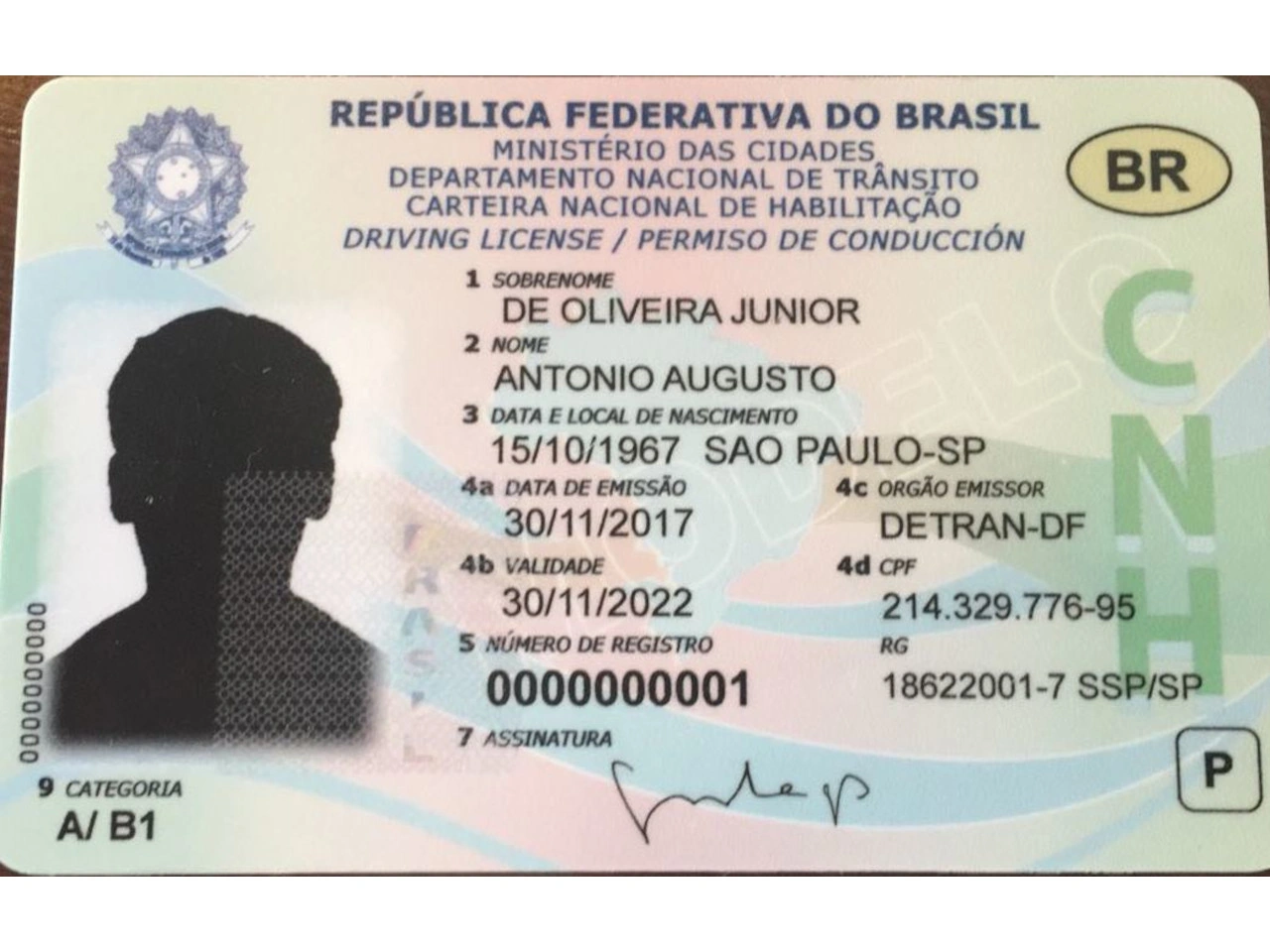
A driving licence is an official document authorising a person to drive one or more specified categories of motor vehicle. It may contain conditions, restrictions, category codes and expiry dates that determine which vehicles the holder may drive.
Drivers must hold a licence that is valid for the vehicle category and jurisdiction concerned. A licence may be provisional, full, restricted, suspended or withdrawn, and additional qualifications may be required for professional driving.
Wikimedia.org • G1 • CC BY-SA
Which driving-licence entitlement is needed for an ordinary car in Brazil?
In Brazil, ordinary passenger cars generally require category B. A different entitlement may be needed for motorcycles, heavy vehicles, trailers or passenger transport.
Can a visitor drive in Brazil using a driving licence issued abroad?
An eligible driver with a recognised, valid foreign licence may generally drive for up to 180 days from entering Brazil, subject to the applicable convention, agreement or reciprocity conditions and the licence category. Carry the original licence, identification and proof of entry, plus the accompanying IDP where required. International agreements and further licensing conditions can affect recognition; check with DETRAN before driving.
🔗 gov.br • SENATRAN — current foreign licence and IDP guidance, updated 11 May 2026
Does an International Driving Permit replace the original licence in Brazil?
No. An International Driving Permit (IDP) is not a standalone driving licence. Where it is recognised or required, carry the underlying valid licence as well and check the accepted convention or translation requirements. An IDP cannot override a suspension, unsuitable vehicle category or local minimum age.
🔗 gov.br • SENATRAN — current foreign licence and IDP guidance, updated 11 May 2026
15. Location marker
A location marker is a roadside reference showing a measured position along a road. It normally identifies a kilometre, mile or smaller interval measured from an established starting point on that route.
Kilometre and hectometre markers help road users, emergency services, road authorities and maintenance crews identify an exact section of road. They do not impose a speed limit, priority rule or access restriction.

Wikimedia.org • Py4nf • CC0
What does a roadside location marker tell you in Brazil?
Brazilian highways commonly identify points by a road reference such as BR-101 km 50. Road section, direction and state may also be important.
How can a location marker help in an emergency in Brazil?
If you can see a marker safely, give the emergency operator the route number or road name, travel direction and marker reading. Additional landmarks, exits and GPS position can help. Do not leave a safe place or enter traffic to read a post.
Does a location marker set a speed limit or permit stopping in Brazil?
No. A location marker is for orientation and road management; it does not itself set a speed limit, change priority or permit parking. Follow the actual traffic signs and stop only where the law and safety allow.
16. No stopping
No stopping means that vehicles are not permitted to stop voluntarily at the indicated location, even briefly for picking up or dropping off passengers or loading or unloading goods. It is a stricter restriction than a no-parking rule.
A no-stopping restriction may be indicated by a traffic sign, road marking or local traffic regulation. Drivers should continue to a place where stopping is permitted unless they are forced to stop by traffic conditions, an emergency or another legal requirement.
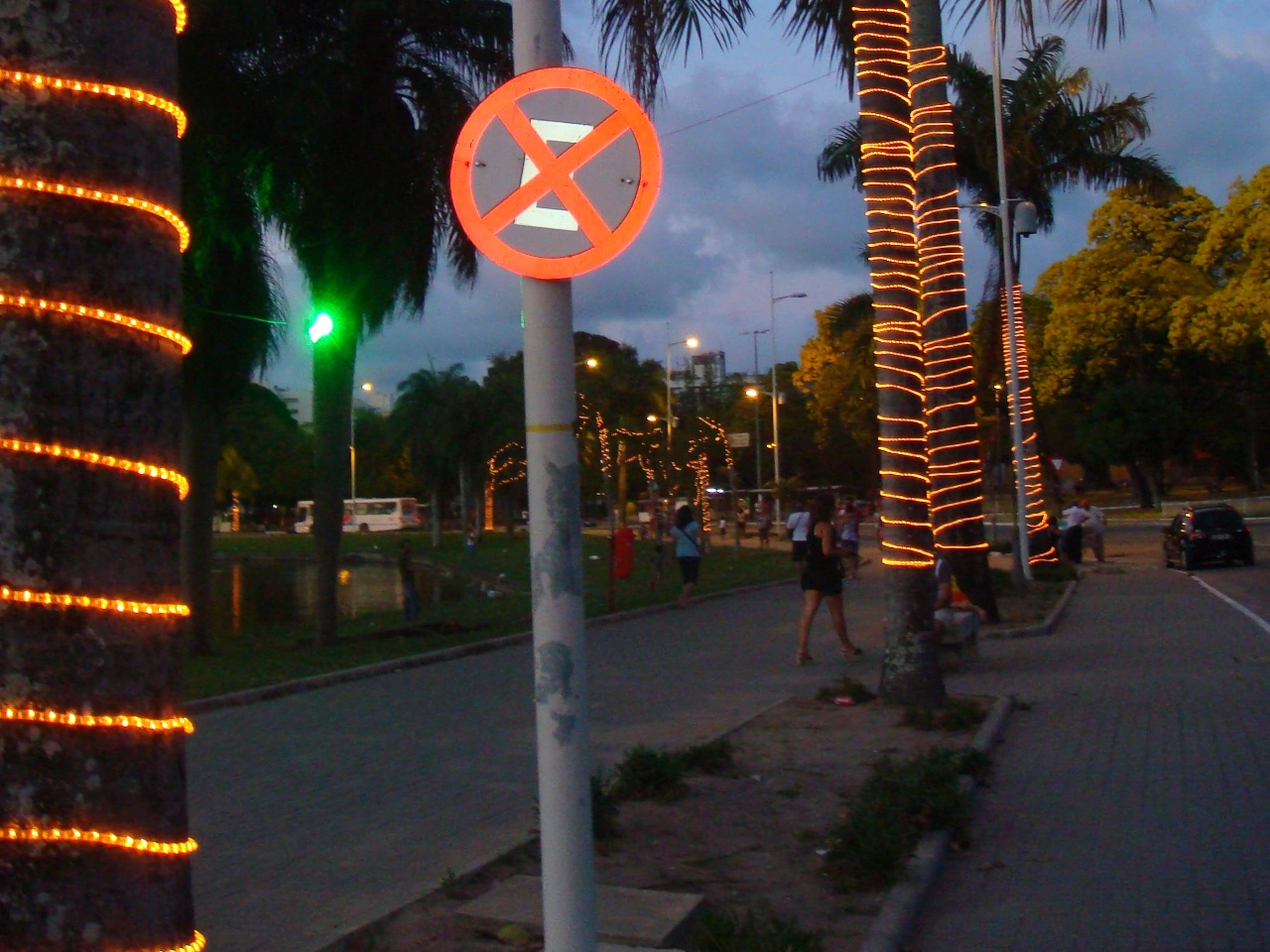
Wikimedia.org • Zelma Brito • CC BY-SA
What does a no stopping restriction mean?
It means that a driver may not voluntarily stop the vehicle in the restricted area. The prohibition normally includes stopping to pick up or drop off passengers or to load or unload goods.
🔗 ris.bka.gv.at • Austria, StVO sections 2, 23–24 and 52
🔗 gov.uk • Great Britain Highway Code, Rules 238–252; national guidance example
🔗 gov.uk • UK Department for Transport, parking-control signs and road markings
🔗 wegcode.be • Belgium, 1975 Road Code, Articles 2 and 23–27
Can you stop in a no-stopping area during an emergency?
A driver may have to stop because of an emergency, traffic conditions, a red light, police instructions or another situation outside the driver's control. Such compulsory stops are generally different from voluntarily stopping the vehicle.
🔗 ris.bka.gv.at • Austria, StVO sections 2, 23–24 and 52
🔗 gov.uk • Great Britain Highway Code, Rules 238–252; national guidance example
🔗 gov.uk • UK Department for Transport, parking-control signs and road markings
🔗 wegcode.be • Belgium, 1975 Road Code, Articles 2 and 23–27
17. Disabled parking
Disabled parking refers to parking spaces and parking privileges reserved for people with disabilities who meet the applicable eligibility requirements. Reserved spaces are normally identified by the international wheelchair symbol and are positioned to provide easier access to nearby facilities.
Use of a disabled parking space generally requires a valid disabled parking permit or card. The permit normally belongs to the eligible person rather than to a particular vehicle and may only be used when that person is driving or travelling in the vehicle.
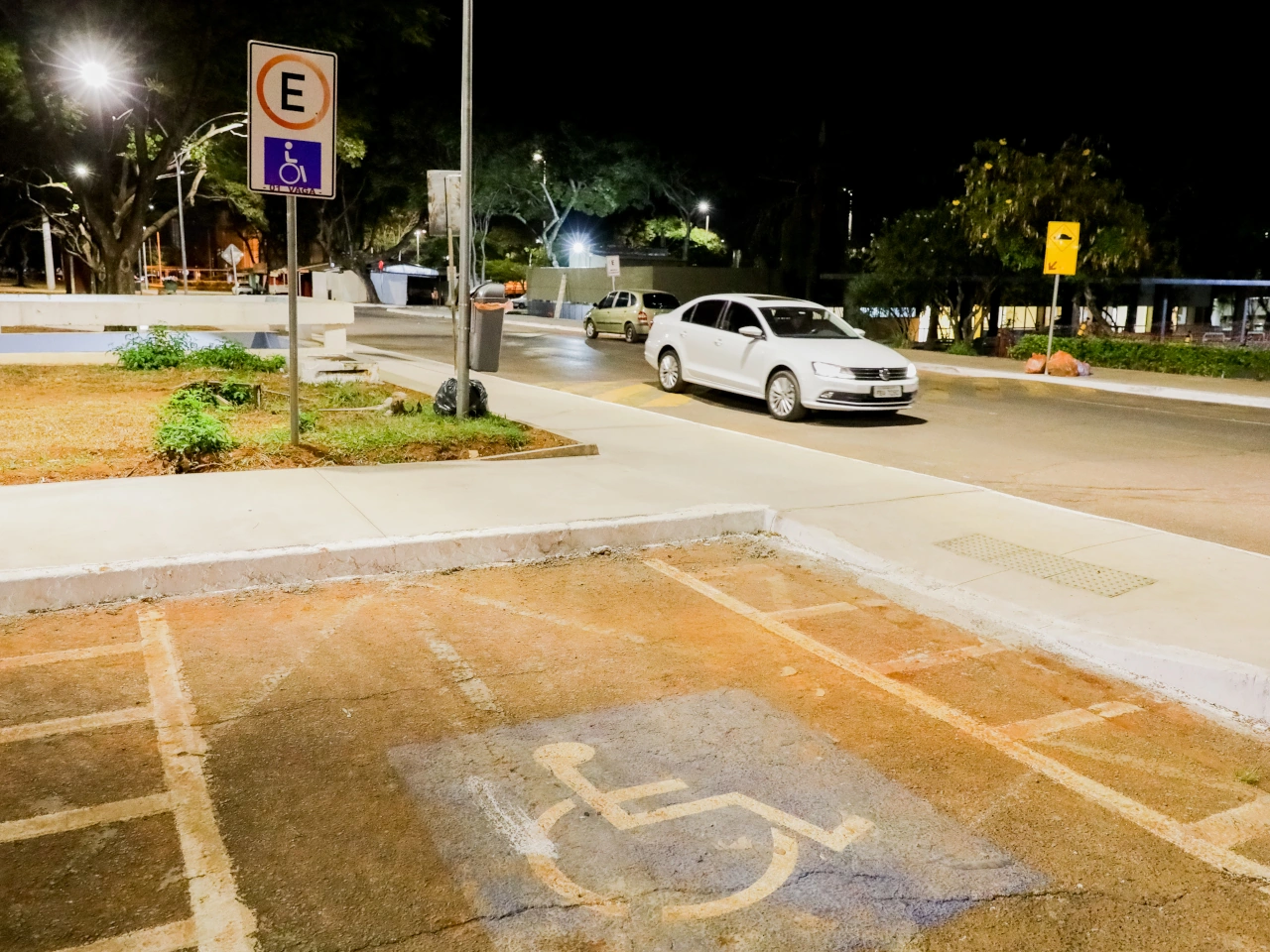
Wikimedia.org • Agência Brasília • CC BY
Is a parking credential required for Brazil’s designated disability spaces?
Yes. SENATRAN states that the credential is compulsory for reserved spaces on public roads and in private establishments.
🔗 gov.br • Brazil, SENATRAN, digital parking credential service
Can eligible Brazilian drivers obtain a disability parking credential digitally?
Yes. SENATRAN provides issuance through its service portal and the Carteira Digital de Trânsito app, subject to the service’s eligibility checks.
🔗 gov.br • Brazil, SENATRAN, digital parking credential service
18. Reversing
Reversing means driving a vehicle backwards. It is commonly used when parking, leaving a confined space or repositioning a vehicle where forward movement is not practical.
Before reversing, the driver should check mirrors and blind spots, look carefully around the vehicle and make sure the area behind is clear. Reversing should be performed slowly and only for as long as necessary because visibility behind the vehicle is often limited.
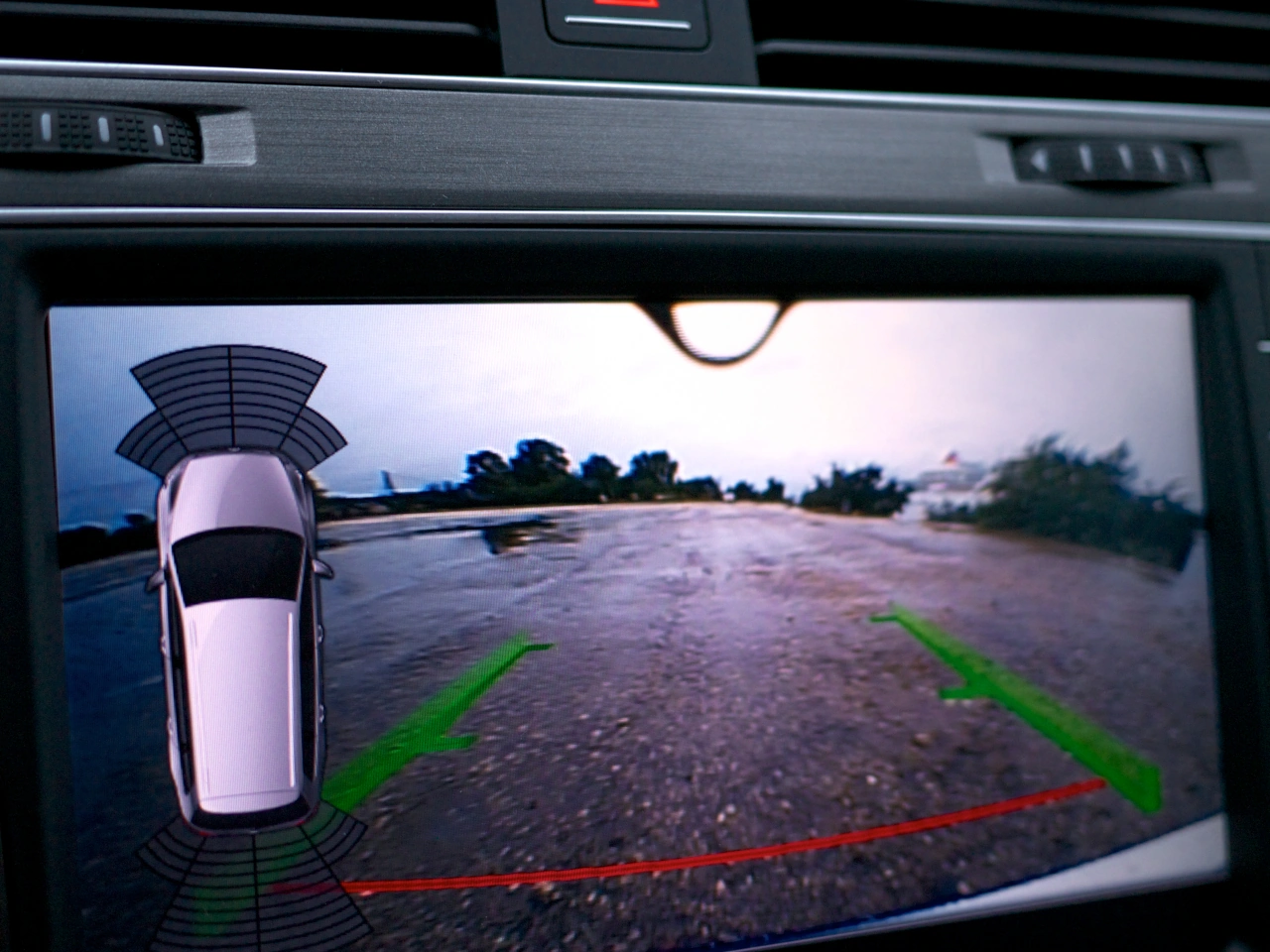
Wikimedia.org • Kārlis Dambrāns • CC BY
When is reversing permitted in Brazil?
Only the distance necessary for small manoeuvres, without creating safety risks.
19. Oversize load
An oversize load is a load that causes a vehicle or vehicle combination to exceed the normally permitted dimensions for road traffic, such as maximum length, width or height. Oversize loads often involve large machinery, construction components or other items that cannot reasonably be divided into smaller loads.
Transporting an oversize load may require a special permit, an approved route, warning signs, lights or escort vehicles. Drivers must comply with the conditions imposed by the authorities responsible for the roads on which the transport takes place.

Wikimedia.org • Fotos GOVBA • CC BY
Why might an oversize load need an escort vehicle?
An escort can warn other road users and help an unusually large vehicle negotiate its planned route. The required escorts depend on local rules and the transport’s dimensions and weight. Do not assume a private escort has police powers to stop or direct traffic; British guidance expressly distinguishes those roles.
🔗 assets.publishing.service.gov.uk • Highways England, abnormal-load self-escort guidance
20. Tourist attraction
A tourist attraction is a place of interest that visitors may travel to for cultural, historical, recreational, natural or entertainment purposes. Examples include monuments, castles, museums, scenic sites, amusement parks and other notable destinations.
Tourist attractions may be indicated by tourist or direction signs that help travellers find the destination. The colours, symbols and types of attractions shown vary between countries.
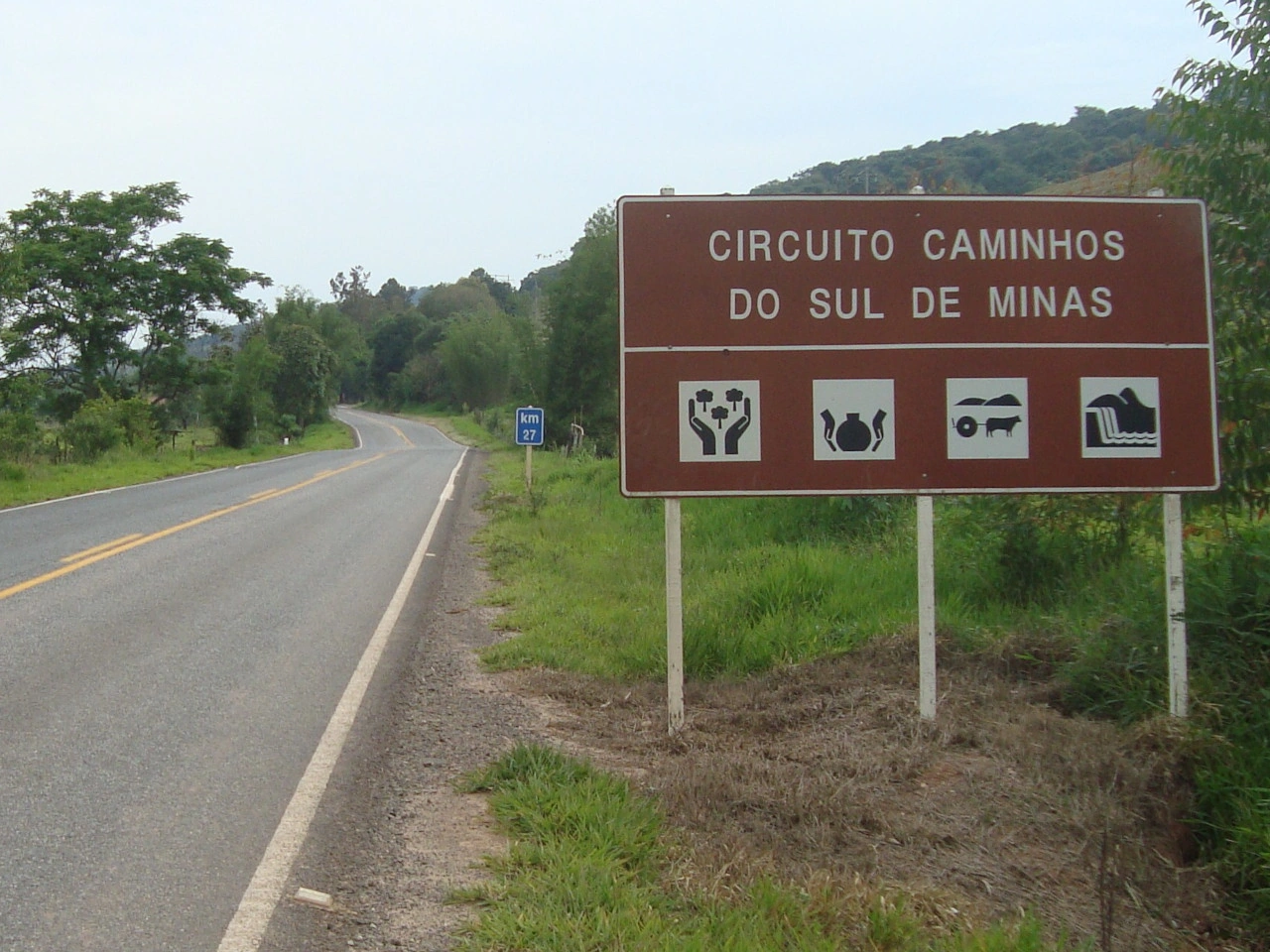
Wikimedia.org • Py4nf • CC BY-SA
Can tourist attractions be indicated by road signs?
Yes. Many countries use tourist or direction signs to guide travellers toward important attractions and places of interest.
21. Horn
A horn is a sound-producing device used to warn other road users of danger or to attract their attention when necessary for safety. Most motor vehicles are equipped with an electric horn operated from the steering wheel. Traffic laws generally restrict unnecessary or excessive horn use, especially in built-up or residential areas. The horn should therefore be used as a warning device rather than as a way to express frustration or greet other road users.
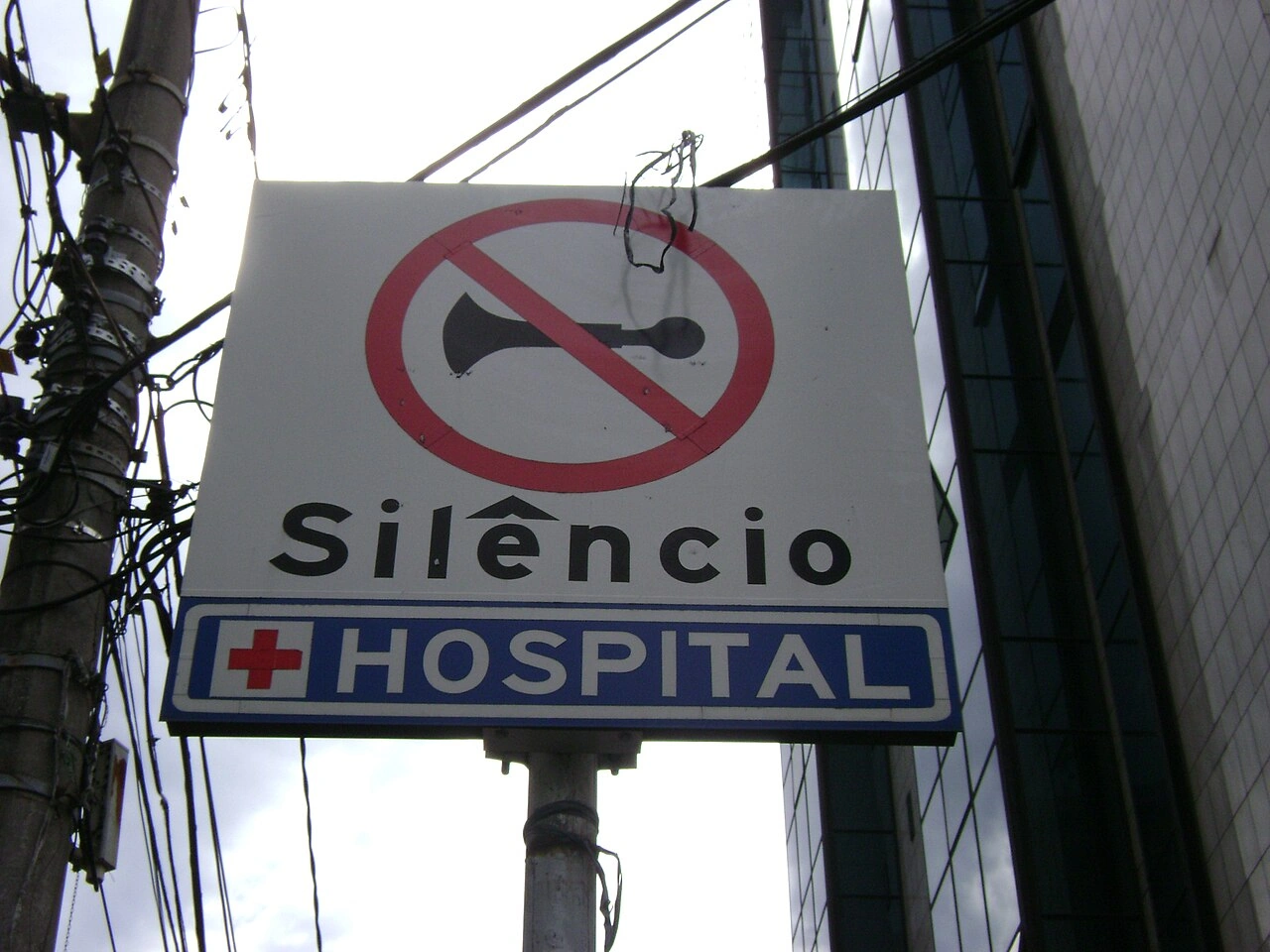
Wikimedia.org • Andrevruas • CC BY
What is a car horn?
A car horn is a sound-producing warning device used to alert other road users when their attention is needed for safety.
🔗 gov.uk • Great Britain Highway Code, Rule 112; national guidance example
When should you use the horn?
The horn should generally be used when a sound warning is necessary to help prevent danger or an accident. The exact circumstances in which horn use is permitted depend on local traffic laws.
🔗 gov.uk • Great Britain Highway Code, Rule 112; national guidance example
Can you use the horn to show annoyance?
Generally, no. A horn is intended as a safety warning device, and unnecessary or excessive use may be prohibited by local traffic rules.
🔗 gov.uk • Great Britain Highway Code, Rule 112; national guidance example
22. Charging station
A charging station is a location equipped with one or more charging points where the battery of an electric or plug-in hybrid vehicle can be connected to an electricity supply and recharged. Charging stations may be located along public roads, in car parks, at service areas or on private property.
Charging spaces may be reserved for vehicles that are charging and can be subject to parking restrictions, time limits, payment requirements or other conditions. Drivers must follow the traffic signs, parking regulations and charging instructions applying at the location.

Wikimedia.org • Mariordo • CC BY-SA
What is a charging station?
A charging station is a location where electric vehicles can be connected to an electricity supply to recharge their batteries. A station may contain one or several individual charging points.
🔗 tfl.gov.uk • Transport for London, electric vehicles and charging points; London example
Who can use an electric-vehicle charging station?
Charging stations are intended for vehicles that can be externally charged, such as battery-electric vehicles and plug-in hybrid vehicles. The exact vehicle categories permitted may be indicated by local signs or operator conditions.
🔗 tfl.gov.uk • Transport for London, electric vehicles and charging points; London example
Can a charging station have a maximum parking time?
Yes. Traffic signs, parking regulations or charging conditions may establish a maximum duration to encourage drivers to move their vehicles and make the charger available to others.
🔗 tfl.gov.uk • Transport for London, electric vehicles and charging points; London example
23. Cyclist
A cyclist is a person who rides and controls a bicycle. Cyclists are road users and, in many countries, bicycles are legally treated as vehicles, meaning cyclists must follow many of the same traffic rules that apply to other drivers together with rules specifically intended for cycling.
Cyclists should use designated cycling facilities where required, obey traffic signs and signals and ride in a predictable and safe manner. The exact rules governing road position, priority, equipment and permitted cycling areas vary between countries.
Wikimedia.org • Guilherme B Alves • CC BY-SA
Where should cyclists ride?
This depends on local rules. Cyclists may be required to use a cycle path or designated cycling facility, while in other situations they may ride on the carriageway.
24. Bus
A bus is a motor vehicle designed to transport multiple passengers, usually along roads as part of public transport, school transport, private transport or another passenger service. Buses generally have more passenger capacity than cars and may be designed to carry seated passengers, standing passengers or both.
Special rules may apply to buses concerning the driving licence, passenger capacity, speed limits, seat belts, bus lanes, stops and passenger boarding. The legal classification of buses and coaches and the rules applying to them vary between countries, so drivers and passengers must follow the local traffic regulations.
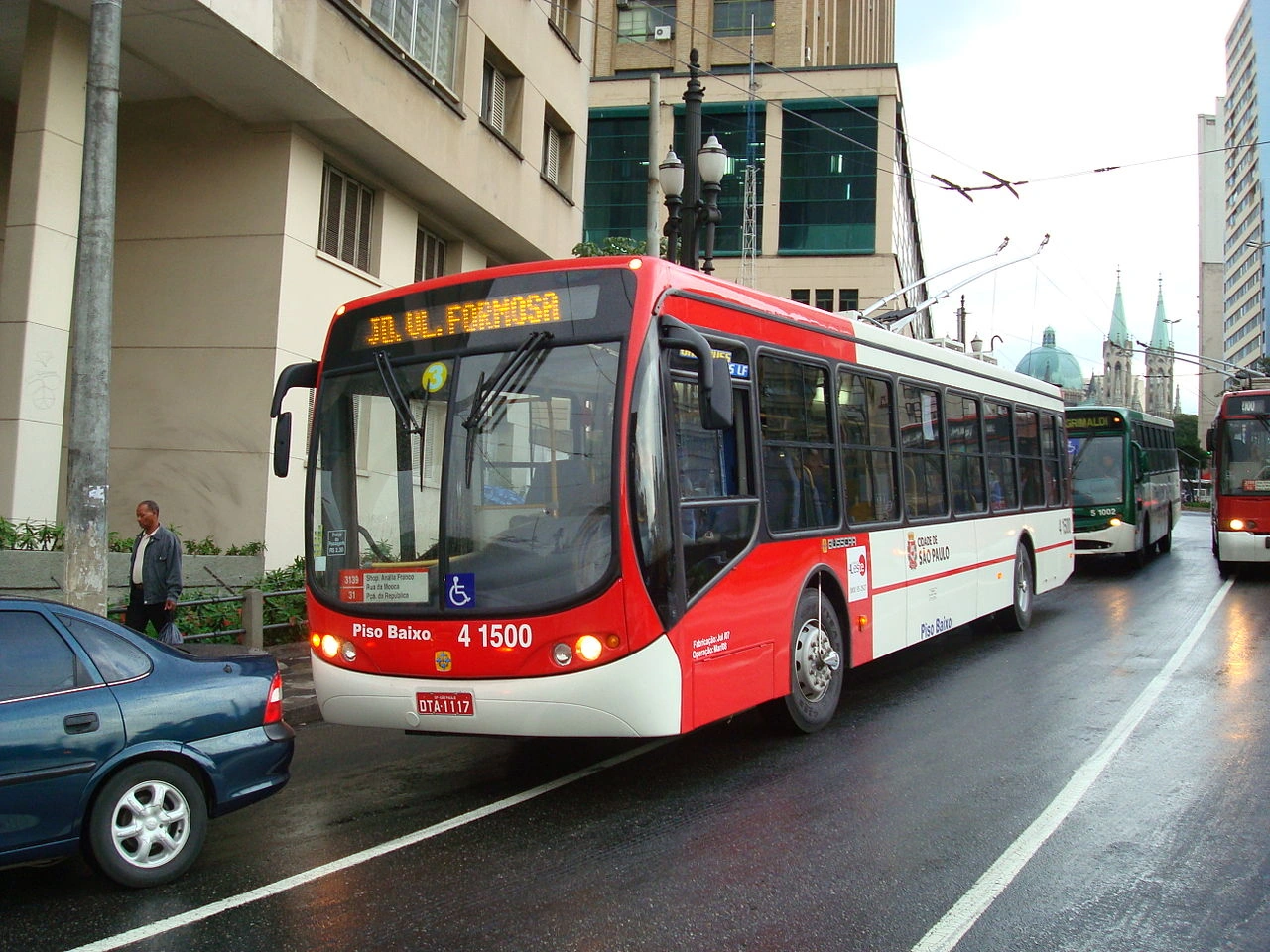
Wikimedia.org • Rafael-CDHT • CC0
What is a bus?
A bus is a motor vehicle designed to transport a relatively large number of passengers. It may be used for public transport, school transport, private services or other passenger transport.
🔗 gov.uk • Great Britain Highway Code, Rules 83–88; national guidance example
🔗 gov.uk • Great Britain Highway Code, Rules 221–223; national guidance example
Do buses always have priority when leaving a bus stop?
No. Some countries require other drivers to give way to buses leaving designated stops, particularly in urban areas, while others apply the normal merging rules.
🔗 gov.uk • Great Britain Highway Code, Rules 83–88; national guidance example
🔗 gov.uk • Great Britain Highway Code, Rules 221–223; national guidance example
Do buses have special speed limits?
They can. Some countries impose lower maximum speeds on buses than on passenger cars, particularly on high-speed roads. Different limits may apply to buses and coaches.
🔗 gov.uk • Great Britain Highway Code, Rules 83–88; national guidance example
🔗 gov.uk • Great Britain Highway Code, Rules 221–223; national guidance example
25. Police
Police are public authorities responsible for enforcing laws, maintaining public safety and managing situations that may affect road traffic. In traffic, police officers may control vehicles, enforce traffic rules, investigate collisions, direct traffic and respond to emergencies.
Road users must follow lawful instructions given by police officers or other authorised traffic-control personnel. Police directions may temporarily override traffic lights, road signs or normal traffic arrangements, depending on local law.
Wikimedia.org • André Gustavo Stumpf • CC BY
What is the role of police in road traffic?
Police help enforce traffic law, investigate collisions and respond to risks on the road. For example, Greater Manchester Police describe targeted road enforcement, a round-the-clock roads-policing response and specialist serious-collision investigation. Exact responsibilities and powers vary by jurisdiction.
🔗 gmp.police.uk • Greater Manchester Police, Roads Policing Strategy2024–2026
Must you obey a police officer directing traffic?
Yes. Lawful directions given by an authorised police officer must be followed. In many countries, those directions take precedence over traffic lights, road signs and normal priority rules.
What should you do if police signal you to stop?
Slow down, follow the officer's directions and stop at a safe location as instructed. Do not make sudden movements or continue driving unless directed to do so.