

Bus laneFlanders
 Traffic rules
 Flanders
16. Bus lane
A bus lane is a traffic lane reserved primarily for buses or other authorised public-transport vehicles. It is intended to improve the reliability and flow of public transport by allowing authorised vehicles to avoid general traffic congestion.
Other road users, such as taxis, cyclists, motorcycles or vehicles carrying several occupants, may also be permitted when signs expressly allow them. The operating hours, permitted vehicles, direction of travel and rules for entering or crossing the lane depend on local traffic signs and regulations.
Wikimedia.org • Jeanhousen • CC BY-SA
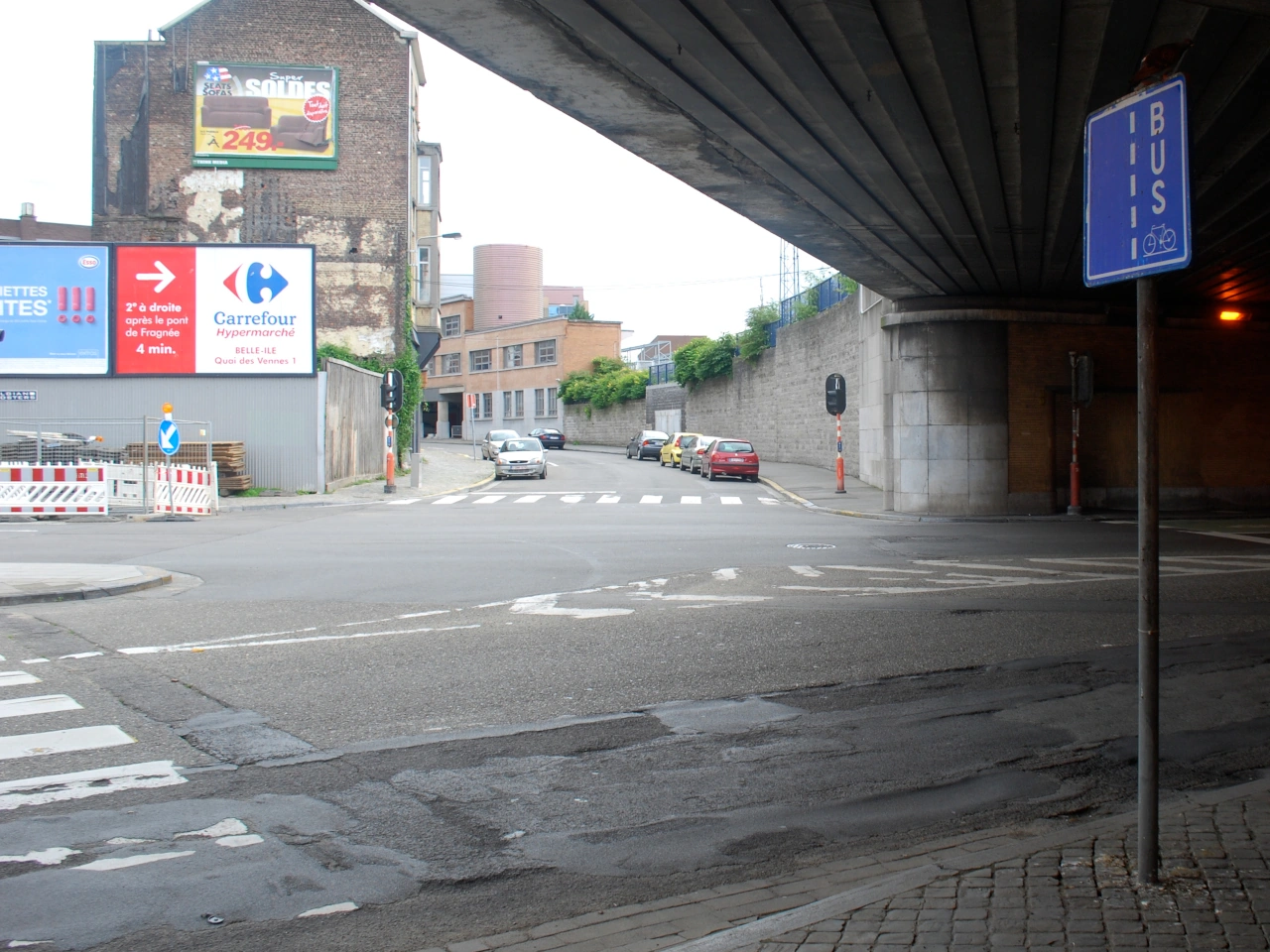
How can you recognise a bus lane in Belgium?
A Belgian bus lane is indicated by traffic sign F17 or traffic sign F18. A lane indicated by F17 is reserved for regular public-transport vehicles and is separated from the rest of the carriageway by one or two broad white broken lines. A special passable lane indicated by F18 is marked by a checkerboard pattern of white squares and may also be used by other categories of road users when this is permitted by the sign.
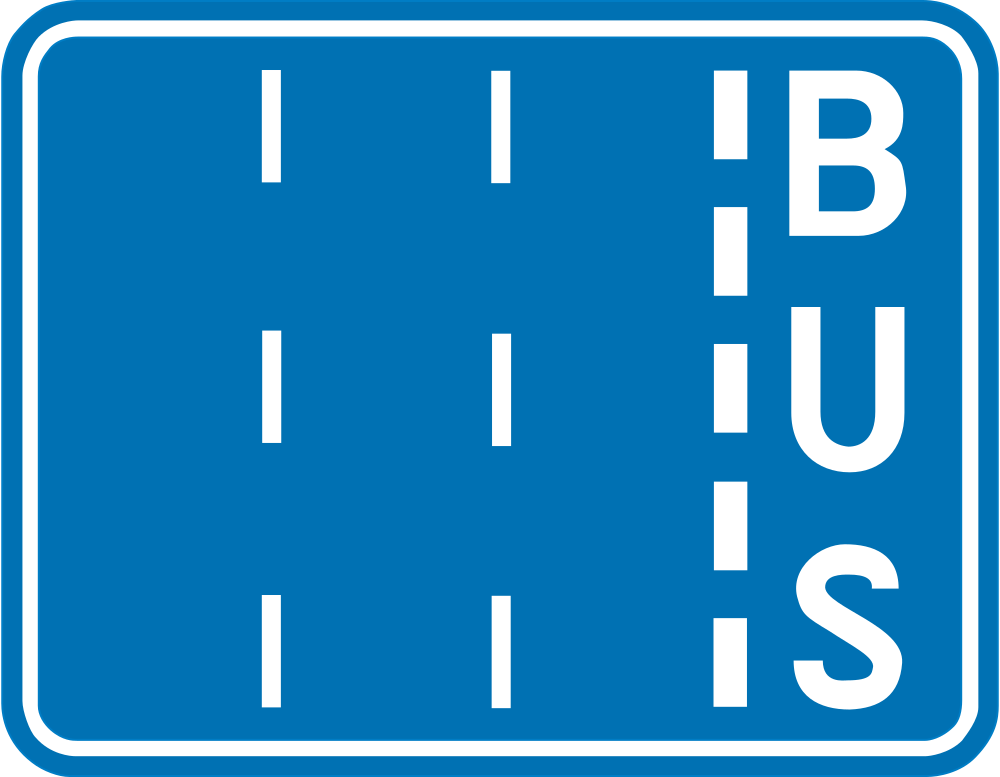 Lane for buses.
Signal routier F17 • Indication des bandes de circulation d'une chaussée parmi lesquelles une est réservée aux autobus.
Verkeersbord F17 • Aanduiding van de rijstroken van een rijbaan met een strook voorbehouden voor autobussen.
 Lane for buses and trams.
Signal routier F18 • Indication d'un site spécial franchissable réservé à la circulation des véhicules des services réguliers de transport en commun.
Verkeersbord F18 • Aanwijzing van een bijzondere overrijdbare bedding, voorbehouden aan het verkeer van voertuigen van geregelde diensten voor gemeenschappelijk vervoer.
What changes for bus lanes under Belgium’s new Road Code?
Belgium’s new Code of the Public Road takes effect on 1 June 2027. The current distinction between the bus lane indicated by traffic sign F17 and the special passable lane indicated by traffic sign F18 disappears. Both are combined into a single system indicated by a redesigned traffic sign F17. The new bus lane may be separated by continuous or broken markings; where the continuous marking changes to a broken marking, other vehicles may enter the bus lane to change direction at the next intersection. The old F17 and F18 signs and their associated road markings may remain in use until 1 June 2030.
 Lane for buses.
Signal routier F17 • Bande bus. Les flèches apposées sur le signal indiquent le sens de circulation sur la partie de la voie publique concernée. Ce signal peut aussi reprendre le marquage des bandes de circulation. Selon le cas, ces marques routières peuvent être soit continues, soit discontinues, soit les deux.
Verkeersbord F17 • Busbaan. De pijlen op het verkeersbord geven de rijrichting aan op het betrokken weggedeelte. Dit verkeersbord kan ook de rijstrookmarkeringen weergeven. Naargelang het geval zijn deze wegmarkeringen doorlopend, onderbroken of beide.
Is a Belgian bus lane part of the carriageway?
No. Under the current Belgian Highway Code, a bus lane does not legally form part of the carriageway.
Which vehicles may always use a Belgian bus lane?
Vehicles operating scheduled public-transport services may use the bus lane.
May school-transport vehicles use a Belgian bus lane?
Yes. Under the current transitional rule, school-transport vehicles may use bus lanes until 31 May 2027 even when their symbol is not displayed. The new road code continues this transitional permission until 1 June 2030.
May taxis use a Belgian bus lane?
Yes. Taxis may currently use bus lanes even when the word or symbol for taxis is absent. This transitional permission continues under the new road code until 1 June 2030.
Which other vehicles may be permitted?
When their word, symbol or identification sign appears on F17 or an additional panel, the lane may also be used by cyclists, mopeds, motorcycles, coaches, buses, commuter vehicles, high-occupancy vehicles, sustainable-mobility vehicles or vehicles transporting people with disabilities.
May an ordinary private car use a Belgian bus lane?
Normally not. A private car may use it only when the signs expressly permit its category or in one of the limited situations allowed by the Highway Code.
May you use the bus lane to pass a traffic queue?
No. An unauthorised driver may not use the bus lane merely to overtake congestion or reach the front of a queue.
May an ordinary driver enter the bus lane to avoid an obstruction?
Yes. Another vehicle may temporarily use the bus lane when necessary to pass around an obstruction on the carriageway, provided the manoeuvre can be completed safely.
May you enter a Belgian bus lane to turn?
Yes, in the immediate vicinity of an intersection. The driver may use the bus lane to change direction but must first check for buses, cyclists and all other authorised users.
May you cross a bus lane at an intersection?
Yes. Other vehicles may cross the bus lane at an intersection when following their permitted route.
May you cross a bus lane to enter a property or parking place?
Yes. A driver may cross it to enter or leave a property or parking place situated beside the bus lane. The driver must give way where required and must not endanger authorised lane users.
May you drive along the bus lane to reach a property?
Only the necessary crossing movement is permitted. A driver may not continue along the bus lane for convenience unless another legal exception applies.
May cyclists use every Belgian bus lane?
No. Cyclists may use a bus lane only when the bicycle symbol or another legally valid indication permits them.
Must cyclists ride in single file in a Belgian bus lane?
Yes, under the current Highway Code. Cyclists using an authorised bus lane must ride one behind another.
May mopeds or speed pedelecs use a bus lane?
Only when the applicable moped class or speed-pedelec indication permits them. Drivers must check the F17 sign and its additional panel carefully.
What is the difference between F17 and F18?
F17 indicates a bus lane. F18 indicates a special traversable public-transport site, which is normally separated by broad continuous markings or checkerboard markings. The permitted movements for ordinary vehicles are more limited on an F18 site.
May you stop or park in a Belgian bus lane?
An unauthorised driver may not use a bus lane as a stopping or parking place. Separate bus-stop, parking and local signs must also be respected, and the passage of authorised vehicles may not be obstructed.
What is the speed limit in a Belgian bus lane?
There is no special general speed limit solely because it is a bus lane. The applicable road, regional, zonal, signed and vehicle-specific speed limits remain in force.
Does a bus have priority at every intersection?
No. The bus lane does not itself give buses automatic priority. Drivers must follow traffic lights, priority signs and the ordinary priority rules.
Must you allow a bus to leave its stop?
Yes, inside a built-up area. A driver travelling in the same direction must allow an autobus or trolleybus to leave its stop when its driver signals the intention to move off. The approaching driver must slow down and stop if necessary.
Can a Belgian bus lane carry traffic against the normal direction?
Yes. A contraflow arrangement may reserve a lane for public transport in the opposite direction. The arrows on F17 and any supplementary signs indicate the authorised direction.
What should you check before turning across a bus lane?
Check mirrors and blind spots and look for buses, taxis, cyclists, mopeds, motorcycles and other authorised vehicles. The bus lane may remain active while general traffic is stationary.


