

School areaFlanders
 Traffic rules
 Flanders
29. School area
A school area is a road or group of roads near a school where large numbers of children may walk, cycle, cross the road or enter and leave vehicles. It may be identified by warning signs, zone signs, road markings, traffic-calming measures or flashing lights.
Special speed limits, parking restrictions or access rules may apply permanently or only during school arrival and departure times. Drivers should reduce speed, watch carefully for children and be prepared to stop.

Wikimedia.org • Alain Rouiller • CC BY-SA
What is legally considered a school area in Belgium?
A Belgian schoolomgeving is a zone consisting of one or more public roads or road sections that includes an entrance to a school and is marked by the legally prescribed entrance and exit signs.
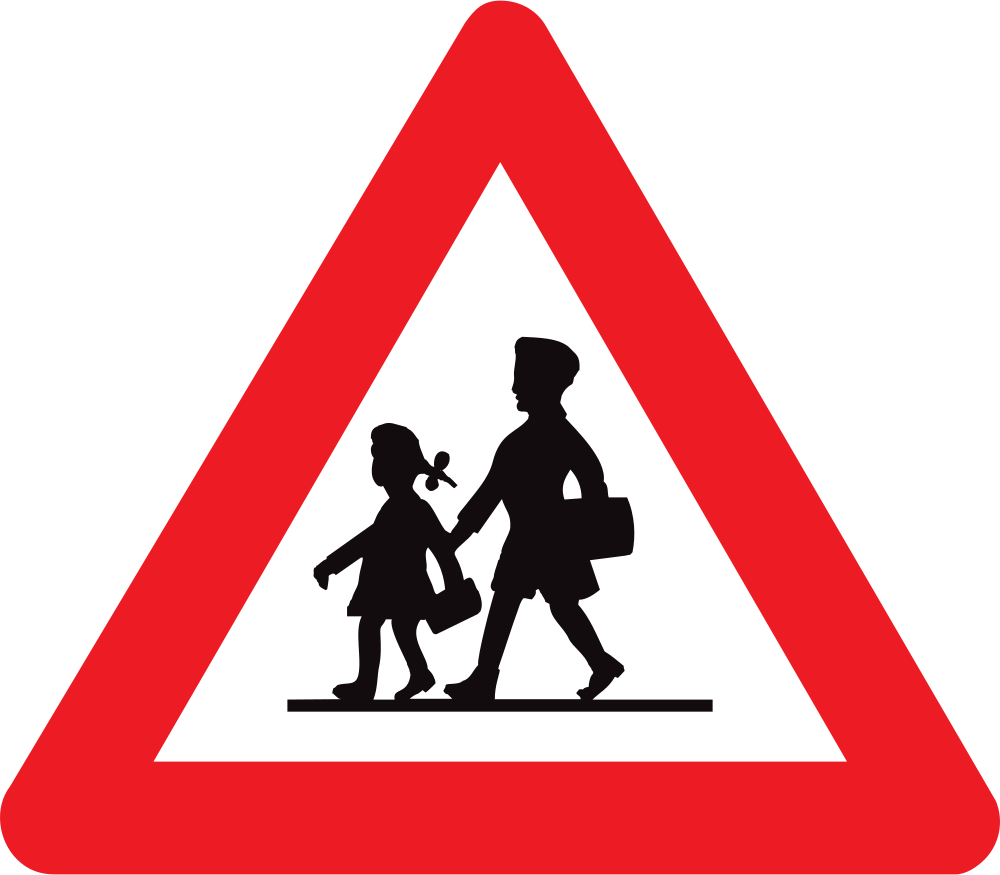 Warning for children.
Signal routier A23 • Endroit spécialement fréquenté par des enfants.
Verkeersbord A23 • Plaats waar speciaal veel kinderen komen.
 Start of a zone with speed limit.
Signal routier F4a • Commencement d'une zone dans laquelle la vitesse est limitée à 30 km à l'heure. Ce signal est placé à droite de chaque accès à une zone dans laquelle la vitesse est limitée à 30 km à l'heure; il peut être répété à gauche.
Verkeersbord F4a • Begin van een zone met een snelheidsbeperking van 30 km per uur. Dit verkeersbord wordt rechts geplaatst aan elke toegang tot een zone met een snelheidsbeperking van 30 km per uur; het mag links herhaald worden.
 End of the zone with speed limit.
Signal routier F4b • Fin d'une zone dans laquelle la vitesse est limitée à 30 km à l'heure. Ce signal est placé à droite de chaque sortie d'une zone dans laquelle la vitesse est limitée à 30 km à l'heure; il peut être répété à gauche.
Verkeersbord F4b • Einde van een zone met een snelheidsbeperking van 30 km per uur. Dit verkeersbord wordt rechts geplaatst aan elke uitgang van een zone met een snelheidsbeperking van 30 km per uur; het mag links herhaald worden.
How can you recognise a Belgian school area?
It currently begins with traffic sign F4a combined with warning sign A23 and ends with traffic sign F4b.
What does Belgian traffic sign A23 mean?
Traffic sign A23 warns of a place where children are especially likely to be present.
Does A23 alone create a school area?
No. A23 alone is a warning sign. A legally marked school environment currently uses A23 together with F4a and is ended by F4b.
What is the speed limit in a Belgian school area?
The maximum speed between F4a and F4b is 30 km/h.
Does the 30 km/h limit apply to every driver?
Yes. Every driver must respect the maximum speed, although a lower vehicle-specific or locally imposed limit may still apply.
Must you always drive at 30 km/h?
No. Thirty kilometres per hour is the maximum. Drivers must slow down further when children, congestion, visibility, weather or other circumstances require it.
Can a Belgian school-area limit be permanent?
Yes. When the F4a school-area sign is permanently displayed, the 30 km/h limit applies at all times, including outside ordinary school hours.
Can the 30 km/h limit be displayed by a variable sign?
Yes. Belgium permits F4a school-area signage with variable information. It may be activated during the periods when children arrive at or leave the school.
What applies when the variable school sign is inactive?
When the variable restriction is not displayed, the otherwise applicable road, regional, zonal or signed speed limit applies.
Does an intersection end a Belgian school area?
No. The school-area rules continue through intersections until the driver passes F4b.
When does the Belgian school area end?
It ends at traffic sign F4b. The speed limit applying to the surrounding road or zone then resumes.
What speed applies after leaving a school area inside another speed zone?
The speed limit of the surrounding larger speed zone resumes after F4b without its original zone sign normally having to be repeated.
Is a Belgian school area the same as an ordinary Zone 30?
No. Both impose a maximum speed of 30 km/h, but a school environment specifically includes a school entrance and is identified by A23 together with F4a.
Is a school area the same as a Belgian school street?
No. A school area is principally a signed 30 km/h environment. A schoolstraat temporarily restricts motor-vehicle access during specified periods.
How is a Belgian school street indicated?
A school street is currently indicated by traffic sign C3 with a supplementary panel displaying the word Schoolstraat.
Who may normally use a Belgian school street?
The road is reserved for pedestrians, bicycles and speed pedelecs. Priority vehicles carrying out an appropriate assignment and vehicles holding a permit from the road authority may also enter.
How fast may authorised vehicles travel in a school street?
Authorised drivers must travel at walking pace, leave pedestrians and cyclists free passage, give way to them and stop when necessary.
Must drivers take special care around children?
Yes. Belgian drivers must be especially cautious around children, reduce speed and stop when necessary.
Does a school area give children priority at every location?
No. The ordinary pedestrian, cyclist, crossing and priority rules remain applicable. Drivers still have a heightened duty of caution around children.
Does entering a school area change intersection priority?
No. Drivers must continue to follow traffic lights, priority signs and the ordinary priority rules.
Must you obey an authorised crossing supervisor?
Yes. Road users must follow instructions given by an authorised supervisor protecting children, pupils, older people or persons with disabilities while crossing.
How does a crossing supervisor stop traffic?
The authorised supervisor uses a hand-held disc displaying traffic sign C3. Road users must stop when directed.
May you drive through a supervised group of children?
No. Road users may not break through a group of children or pupils walking in rows with a leader or crossing under the control of a leader, youth traffic brigade or authorised supervisor.
What must you do near a Belgian school-transport vehicle?
Approach with extra caution. When the marked school-transport vehicle operates all its direction indicators to show that children are boarding or leaving, drivers must reduce speed considerably and stop when necessary.
Does the school-area sign create a pedestrian crossing?
No. A pedestrian crossing must be indicated separately by its road markings and, where used, its traffic signs or signals.
May you stop or park in a Belgian school area?
The school-area signs do not create a general parking prohibition. Drivers must follow all ordinary stopping and parking rules and any local signs or markings.
May you stop on a pedestrian crossing while dropping off a child?
No. Stopping and parking are prohibited on a pedestrian crossing and on the carriageway within five metres before it.
May you stop on a bike path or pavement?
No. Stopping or parking on a bike path or pavement is prohibited and can force children into moving traffic.
Does a school area prohibit overtaking?
No general overtaking prohibition is created solely by the school-area signs. Drivers must still respect crossing-related prohibitions, road markings and the general requirement not to overtake dangerously.
Must most Belgian school environments be signposted?
Yes. Belgian placement rules state that, except in exceptional cases justified by local conditions, each school environment should be marked by A23 with F4a and by F4b at its exit.
What changes on 1 June 2027?
Belgium’s new Code of the Public Road introduces traffic signs R1 and R3 for the beginning and end of a school environment. The current F4a, A23 and F4b signs remain legally recognised during the general transitional period, normally until 1 January 2045.


