

Give way to oncoming trafficFlanders
 Traffic rules
 Flanders
24. Give way to oncoming traffic
Give way to oncoming traffic means that drivers must allow vehicles approaching from the opposite direction to pass first through a narrow section of road. The rule is normally indicated by a sign facing the direction that must yield and a corresponding priority sign facing oncoming traffic.
Drivers must reduce speed and stop when necessary before entering the narrow passage. They may continue only when they can do so safely and without obstructing oncoming traffic that has priority.
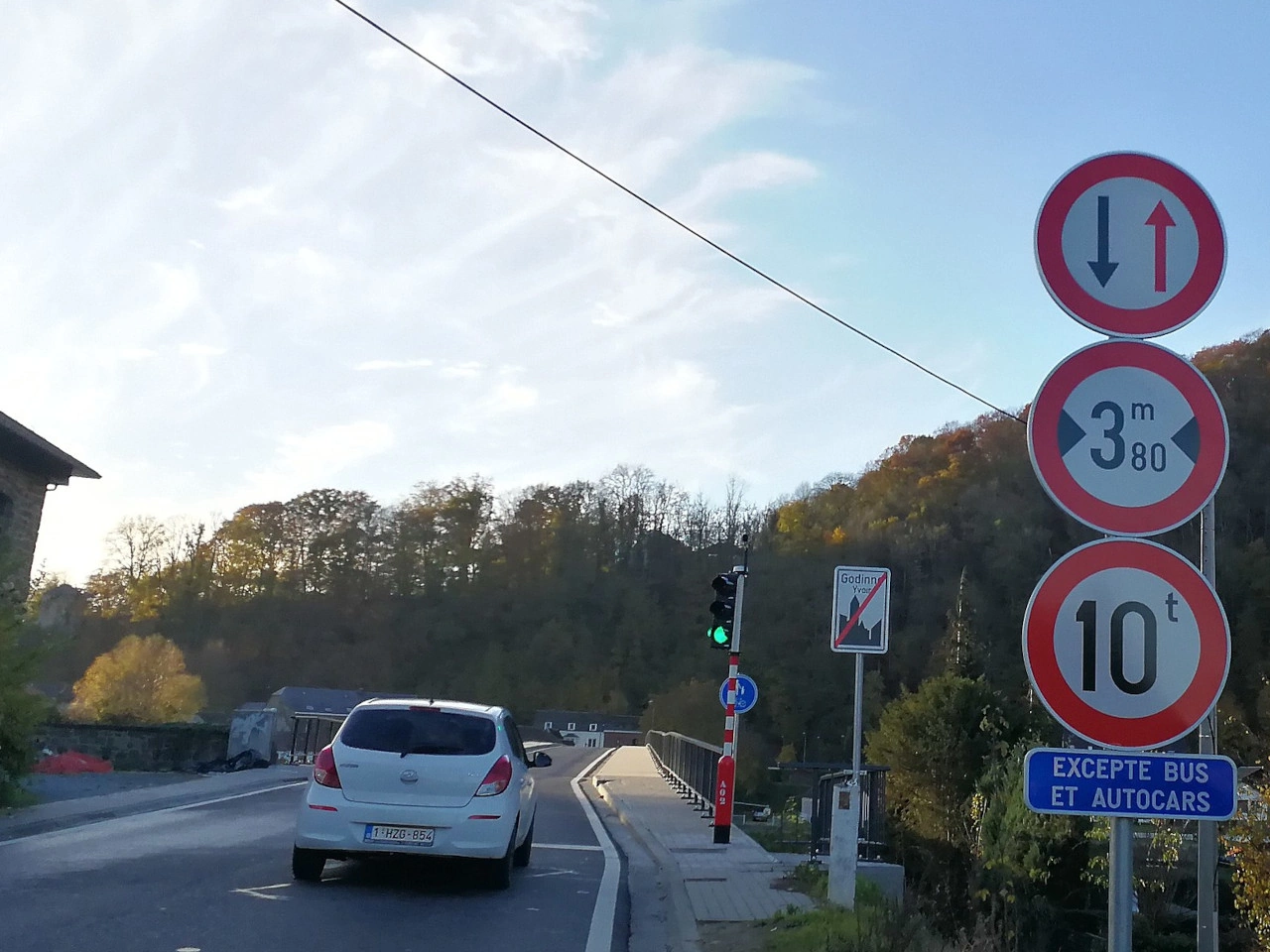
Wikimedia.org • Miguel Tremblay • CC0
Which Belgian sign means give way to oncoming traffic?
Traffic sign B19 requires drivers to give way to drivers approaching from the opposite direction through a narrow passage.
 Road narrowing, give way to oncoming drivers.
Signal routier B19 • Passage étroit. Obligation de céder le passage aux conducteurs venant en sens opposé.
Verkeersbord B19 • Smalle doorgang. Gebod voorrang te verlenen aan de bestuurders die uit de tegenovergestelde richting komen.
 Road narrowing, oncoming drivers have to give way.
Signal routier B21 • Passage étroit. Priorité de passage par rapport aux conducteurs venant en sens opposé.
Verkeersbord B21 • Smalle doorgang. Voorrang ten opzichte van de bestuurders die uit de tegenovergestelde richting komen.
Which sign does traffic at the opposite end see?
Drivers approaching from the other direction normally see traffic sign B21, which gives them priority over oncoming traffic.
Are B19 and B21 used together?
Yes. When B19 is installed for one direction, B21 is installed for traffic approaching from the opposite direction.
When may B19 and B21 be installed in Belgium?
Under the current placement rules, they may be used when two cars cannot pass one another and the entire narrow passage is visible from one end to the other.
Does B19 make the road one-way?
No. Traffic may continue in both directions, but the direction facing B19 must allow opposing traffic to pass first.
Must you always stop at B19?
No. You must slow down and stop when necessary to give way. You may continue cautiously when the passage is clear and no oncoming driver with priority will be hindered.
Where should you wait?
Wait before entering the narrow passage and leave sufficient space for oncoming vehicles to exit safely.
When may you enter the narrow passage?
You may enter only when you can clear it without forcing an oncoming driver to slow down, stop, reverse or alter course.
Does reaching the passage first override B19?
No. The sign determines priority. You must not enter when a driver facing B21 is approaching closely enough to be hindered.
What if an oncoming vehicle is already inside?
You must wait and allow it to leave the passage. Do not enter and block its route.
What if you entered before noticing the oncoming vehicle?
Avoid making the situation more dangerous. Stop or leave the passage when possible and cooperate with the other driver, but remember that the B19 obligation applied before you entered.
May the driver facing B21 force you to reverse?
Priority does not permit either driver to cause an accident. However, the driver facing B19 must normally avoid entering while priority traffic is approaching.
Does B19 apply to cyclists?
Yes. Cyclists are drivers under Belgian traffic law and must give way when B19 applies to their direction of travel.
Must you give way to an oncoming cyclist?
Yes. If the passage is too narrow to pass while maintaining the required lateral distance, wait until the cyclist has cleared it.
What passing distance applies to cyclists?
Drivers must leave at least one metre inside a built-up area and 1.5 metres outside a built-up area. When this is impossible, they must not pass.
What should you do when a bus or truck approaches?
Wait before the narrowing when necessary. Large vehicles may require the entire passage and additional room to manoeuvre.
Does B19 impose a speed limit?
No. The applicable regional, zonal, posted and vehicle-specific speed limits remain in force. You must still approach at a speed that allows you to stop safely.
Does B19 affect priority at an intersection?
No. It regulates priority only between opposing drivers at the narrow passage. Intersection priority is governed by other signs and rules.
May you overtake near B19?
B19 does not itself prohibit overtaking, but the manoeuvre is not permitted when the width, visibility or presence of oncoming traffic makes it unsafe.
May you stop or park in the narrow passage?
B19 creates no separate stopping or parking rule, but a vehicle may not create danger, obstruct opposing traffic or leave insufficient free passage.
How much free carriageway must remain when parking?
At least three metres of free carriageway must remain available. Parking is prohibited when this minimum passage cannot be maintained.
What if an obstruction is on your side of the road?
Even without B19, a driver whose passage is obstructed must slow down and, when necessary, stop to allow oncoming road users to pass.
What if temporary traffic lights are installed?
Follow the active traffic lights controlling the alternating traffic flow. Traffic-light signals take precedence over the fixed priority signs at that location.
What if an authorised person directs traffic?
Follow the instructions of the authorised person. Those instructions take precedence over traffic lights, signs, markings and ordinary traffic rules.
Will B19 remain under Belgium’s new road code?
Yes. The Code of the Public Road taking effect on 1 June 2027 retains B19 for the direction that must give way and B21 for the direction with priority. The arrow design is adjusted for greater clarity and international harmonisation.


