

QuayFlanders
 Traffic rules
 Flanders
14. Quay
A quay is a constructed area beside a river, canal, harbour or other body of water, commonly used for loading, unloading, mooring vessels or providing waterside access. A road may run alongside the water or lead directly towards the quay edge.
In road traffic, a quay warning indicates a risk that a vehicle could leave the road and enter the water. Drivers should reduce speed, observe the road layout carefully and keep a safe distance from the waterside edge.

Wikimedia.org • Mark Ahsmann • CC BY-SA
Which Belgian sign warns of a quay or riverbank?
Belgian warning sign A11 indicates that the road leads onto a quay or riverbank.
 Warning for a quayside or riverbank.
Signal routier A11 • Débouché sur un quai ou une berge.
Verkeersbord A11 • Uitweg op een kaai of een oever.
What changes for quays under Belgium’s new Road Code?
Belgium’s new Code of the Public Road takes effect on 1 June 2027. The warning sign for an exit onto a quay or bank keeps its existing number: traffic sign A11. The design of the sign is updated to make it clearer that the danger involves water, but its meaning remains the same.
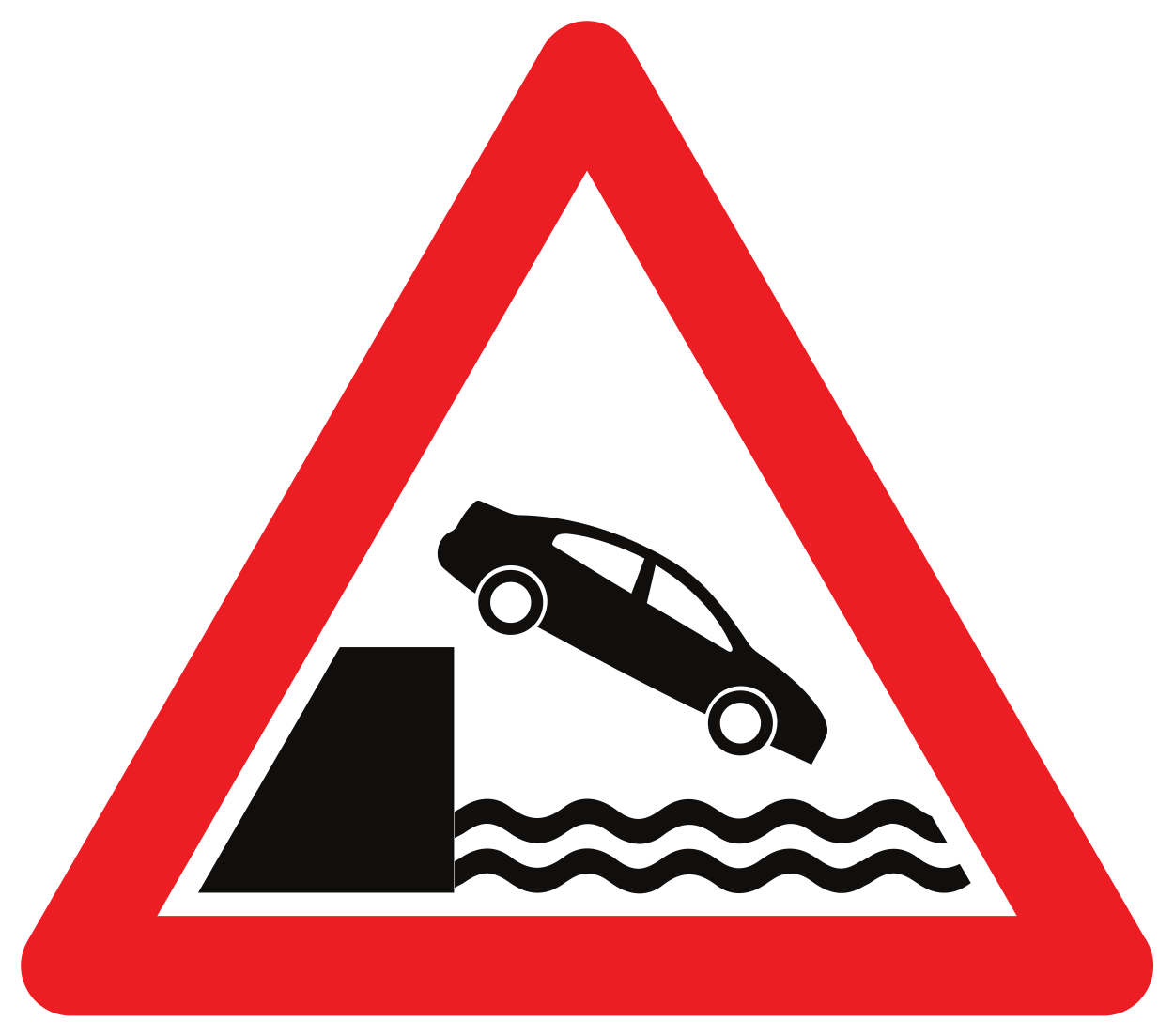 Warning for a quayside or riverbank.
Signal routier A11 • Débouché sur un quai ou une berge.
Verkeersbord A11 • Uitweg op kaai of oever.
What does Belgian traffic sign A11 mean?
It warns that drivers are approaching a waterside edge where the road may lead directly towards or alongside a quay, bank, canal, harbour or similar body of water.
Does A11 mean that the road definitely ends?
Not necessarily. The road may end at the water, turn near it or continue along the quay. Drivers must slow down and observe the actual layout.
Does A11 prohibit vehicles from continuing?
No. A11 is a warning sign and does not itself prohibit access. A barrier, prohibition sign or instruction from an authorised person may impose an additional restriction.
Does A11 impose a speed limit?
No fixed numerical limit is created by A11. Drivers must respect the applicable speed limit and reduce their speed sufficiently to approach the danger safely.
How far before the quay is A11 placed?
In Brussels and Flanders, warning signs are normally placed approximately 150 metres before the danger. When the sign is placed at another distance, a supplementary panel indicates the approximate distance.
Must you be able to stop before the quay edge?
Yes. Drivers must adjust their speed so they remain able to stop before a foreseeable obstruction or danger, including the end or edge of the road.
Does A11 change the priority rules?
No. Drivers must continue to obey traffic lights, priority signs and the normal priority rules at nearby intersections.
May you stop or park near a Belgian quay?
A11 does not create an automatic stopping or parking prohibition. However, stopping or parking is prohibited wherever the vehicle would clearly create danger or unnecessarily obstruct other road users.
May local signs prohibit parking on a quay?
Yes. Parking signs, road markings, port regulations or access conditions may reserve areas for loading, authorised vehicles, emergency access or other specific purposes.
May you overtake after passing A11?
A11 does not create a specific overtaking prohibition. Overtaking is nevertheless unsafe when the road is narrow, visibility is limited or insufficient space remains beside the waterside edge.
What road users should you expect on a Belgian quay?
Drivers may encounter pedestrians, cyclists, dock workers, trucks, forklifts, cranes, railway vehicles and other port equipment. Their movements may be difficult to predict.
Must you obey instructions from port or customs personnel?
You must obey instructions given by persons who are legally authorised to regulate traffic. Gates, lights, temporary signs and marked traffic routes within a port or controlled site must also be respected.
Why can a Belgian quay be especially slippery?
Rain, frost, water, mud, algae, oil and cargo residue can reduce grip. Railway tracks, metal covers and painted surfaces may also become slippery when wet.
How should you park a vehicle near the water?
Use only an authorised parking place, keep a safe distance from the edge and secure the vehicle properly with its parking brake. Follow all local signs, markings and instructions.
Should you reverse towards a quay edge?
Only when necessary and after checking that the route is completely clear. Use assistance from another person where available, particularly with a truck, trailer or vehicle with restricted rear visibility.
Does the absence of A11 mean there is no waterside danger?
No. Drivers remain responsible for observing the road and adapting their speed. A quay, canal or riverbank may still require additional caution even when no A11 sign is present.


