

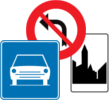
ExpresswayFlanders
 Traffic rules
 Flanders
3. Expressway
An expressway is a road intended to carry through traffic efficiently, usually at higher speeds than ordinary roads. Expressways often have limited access, multiple lanes, separated carriageways or grade-separated junctions, but their design and legal status vary between countries.
An expressway is not always a motorway. It may have intersections, traffic lights or direct access, and the permitted road users, speed limits and special rules depend on local signs and regulations.
How can you recognise an expressway in Belgium?
A Belgian expressway, legally called an autoweg, begins at traffic sign F9. The special autoweg rules continue until traffic sign F11 indicates its end.
 Start of an expressway.
Signal routier F9 • Route pour automobiles. Les règles spéciales de circulation sur les routes pour automobiles s'appliquent à partir de l'endroit où le signal est placé.
Verkeersbord F9 • Autoweg. De bijzondere verkeersregelen op de autowegen gelden vanaf de plaats waar het verkeersbord is aangebracht. Dit verkeersbord wordt rechts geplaatst en mag links herhaald worden.
 End of the expressway.
Signal routier F11 • Fin de route pour automobiles. Ce signal est placé à droite et peut être répété à gauche.
Verkeersbord F11 • Einde van een autoweg. Dit verkeersbord wordt rechts geplaatst en mag links herhaald worden.
What changes for expressways under Belgium’s new Road Code?
Belgium’s new Code of the Public Road takes effect on 1 June 2027. The expressway signs are renumbered: the current traffic sign F9 for the beginning of an expressway becomes traffic sign R33, while traffic sign F11 for the end of an expressway becomes traffic sign R35. The special rules for expressways continue to apply between the beginning and end signs. During the transition period, drivers may encounter both the current and new expressway signs.
 Start of an expressway.
Signal routier R33 • Début d’une route pour automobiles. La réglementation particulière vaut jusqu’au prochain carrefour.
Verkeersbord R33 • Begin van een autoweg. De bijzondere voorschriften gelden tot het volgend kruispunt.
 End of the expressway.
Signal routier R35 • Fin d’une route pour automobiles.
Verkeersbord R35 • Einde van een autoweg.
What is the difference between an expressway and a motorway in Belgium?
A Belgian motorway is indicated by signs F5 and F7 and is subject to the full motorway rules. An autoweg is indicated by signs F9 and F11 and may have ordinary intersections, traffic lights or direct entrances. Its road design does not have to meet motorway standards.
 Start of a motorway.
Signal routier F5 • Commencement d'une autoroute ou accès à une autoroute. Les règles spéciales de circulation sur les autoroutes s'appliquent à partir de l'endroit où le signal est placé.
Verkeersbord F5 • Begin of oprit van een autosnelweg. De bijzondere verkeersregelen op de autosnelwegen gelden vanaf de plaats waar het verkeersbord aangebracht is. Dit verkeersbord wordt rechts geplaatst en mag links herhaald worden.
Start of an expressway.
Signal routier F9 • Route pour automobiles. Les règles spéciales de circulation sur les routes pour automobiles s'appliquent à partir de l'endroit où le signal est placé.
Verkeersbord F9 • Autoweg. De bijzondere verkeersregelen op de autowegen gelden vanaf de plaats waar het verkeersbord is aangebracht. Dit verkeersbord wordt rechts geplaatst en mag links herhaald worden.
Who may use a Belgian expressway?
Only motor vehicles and their trailers may use a Belgian autoweg. Mopeds, agricultural vehicles, fairground vehicle combinations and motorised quadricycles without a passenger compartment are prohibited. Pedestrians, cyclists and animals may not use the autoweg itself.
What is the speed limit on a Belgian expressway?
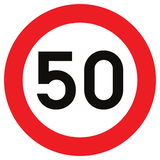
The F9 autoweg sign does not impose one fixed speed limit. Inside a built-up area, the general limit is normally 30 km/h in Brussels and 50 km/h in Flanders and Wallonia unless signs indicate otherwise. Outside built-up areas, a physically divided road with at least two lanes in each direction may allow up to 120 km/h. On other roads, the general limit is normally 70 km/h in Brussels and Flanders and 90 km/h in Wallonia, although traffic signs and vehicle-specific limits may impose another speed.
Is there a minimum speed on Belgian expressways?
There is no expressway-specific minimum speed of 70 km/h. That rule applies to motorways, not autowegen. Drivers may nevertheless not obstruct normal traffic by driving abnormally slowly without a valid reason.
Can a Belgian expressway have intersections or traffic lights?
Yes. A Belgian autoweg may contain level intersections, roundabouts and traffic lights. Drivers must observe the applicable priority signs, signals and general intersection rules.
Do drivers entering a Belgian expressway automatically have to give way?
There is no special priority rule solely because a road is an autoweg. Drivers must follow the traffic signs, road markings and normal priority rules at the entrance or intersection.
Which lane should you use on a Belgian expressway?
Drivers must normally keep as close as possible to the right-hand side of the carriageway and return to the right after overtaking. Lane arrows, destination signs and other local traffic signs may require a different lane.
May you stop or park on a Belgian expressway?
Voluntary stopping and parking are prohibited except on parking strips indicated by traffic sign E9a. An unavoidable stop caused by congestion, a breakdown or another emergency must be handled according to the applicable safety procedures.
May you reverse or make a U-turn on a Belgian expressway?
No. Making a U-turn, reversing, driving against the direction of traffic and using connections through a central reservation are prohibited. If you miss a turn or exit, continue until you can change direction legally.
May you tow a broken-down vehicle on a Belgian expressway?
A vehicle may not be towed on an autoweg using only an emergency or auxiliary coupling. A professional recovery vehicle or another legally permitted towing method must be used.
May you drive on the emergency lane?
No. Where an autoweg has an emergency lane, ordinary drivers may not use it to overtake congestion or continue their journey. It is reserved for authorised emergency vehicles, recovery vehicles and specified services in legally permitted circumstances.
How do you form an emergency corridor on a Belgian expressway?
When congestion forms on a carriageway with at least two lanes, drivers must create an emergency corridor. Vehicles in the leftmost lane move as far left as possible, while vehicles in all other lanes move as far right as possible.
What should you do after a breakdown on a Belgian expressway?
Move the vehicle away from traffic when possible and activate the hazard warning lights. If the vehicle cannot be moved from a place where stopping or parking is prohibited, place the warning triangle at least 30 metres behind the vehicle. The driver must wear a retro-reflective safety vest when leaving a broken-down vehicle stopped at such a location.


