

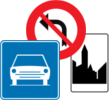
Circulación en sentido contrarioValonia
 Normas de tráfico
 Valonia
34. Circulación en sentido contrario
La circulación en sentido contrario se produce cuando un conductor circula contra el sentido legalmente permitido del tráfico. Puede ocurrir en una calle de sentido único, carretera de calzadas separadas, entrada o salida de autopista u otro tramo reservado al tráfico de una sola dirección.
Circular en sentido contrario genera un riesgo extremo de colisión frontal. Los conductores deben respetar las señales de dirección, las de entrada prohibida, las flechas de carril y las marcas viales. Quien entre accidentalmente en una vía en sentido incorrecto debe reducir la velocidad, advertir al resto del tráfico, detenerse en el lugar más seguro disponible y contactar con los servicios de emergencia.

What is wrong-way driving called in Belgium?
The Dutch term is spookrijden. In Belgian road-safety usage, it normally refers specifically to driving in the wrong direction on a motorway.
Which Belgian sign prohibits entry from one direction?
Traffic sign C1 means that entry in that direction is prohibited for every driver, unless a supplementary sign expressly provides an exception.
 Entrada prohibida.
Signal routier C1 • Sens interdit à tout conducteur.
Verkeersbord C1 • Verboden richting voor iedere bestuurder.
 Vía de sentido único.
Signal routier F19 • Voie publique à sens unique.
Verkeersbord F19 • Openbare weg met eenrichtingsverkeer.
Which Belgian sign indicates one-way traffic?
Traffic sign F19 indicates a public road with one-way traffic. Drivers may travel only in the direction shown.
How are C1 and F19 normally used together?
C1 is placed at the prohibited entrance, while F19 is normally placed at the opposite end to indicate the legally permitted direction.
Does passing C1 always make someone a wrong-way driver?
Normally, yes. A driver entering past C1 travels in a prohibited direction unless the vehicle category is expressly exempted by a supplementary sign.
May cyclists travel in the opposite direction on a Belgian one-way road?
Yes, when supplementary signs permit it. Drivers must therefore check for authorised contraflow cyclists even though general motor traffic travels in only one direction.
May class A mopeds or speed pedelecs use the contraflow direction?
They may do so when the appropriate supplementary signs expressly include their vehicle category.
Is an authorised contraflow cyclist a wrong-way driver?
No. When the signs permit two-way cycling, the cyclist is travelling legally and retains the rights and duties applying to that direction.
What does Belgian traffic sign F85 mean?
Traffic sign F85 indicates that traffic is temporarily permitted in both directions on part of a carriageway that normally carries one-way traffic.
Can roadworks send traffic onto the opposite carriageway?
Yes. Temporary signs and markings may guide traffic through a central-reservation crossing or onto another carriageway. This is legal when drivers follow the temporary arrangement.
Is driving against the direction prohibited on Belgian motorways?
Yes. Belgian motorway rules expressly prohibit driving in the opposite direction.
May you reverse on a Belgian motorway?
No. Reversing on a motorway is prohibited.
May you make a U-turn on a Belgian motorway?
No. Turning around is prohibited, even when you have missed an exit or entered the wrong route.
May you use a central-reservation connection to turn around?
No. Ordinary drivers may not use motorway connections through the central reservation.
Do the same prohibitions apply on Belgian expressways?
Yes. The current motorway prohibitions concerning turning around, reversing and driving in the opposite direction also apply on Belgian autowegen.
What should you do when a wrong-way driver is reported?
Reduce speed and keep as far right as safely possible. Stop overtaking, create additional distance and follow electronic signs, radio warnings and police instructions.
May you use the emergency lane to avoid a wrong-way driver?
Belgian road-safety guidance advises moving extremely far right and, when necessary to avoid the immediate danger, using the emergency lane. Do so cautiously and only for the emergency.
Should you flash your headlights at the wrong-way driver?
You may briefly flash them when actually passing the vehicle, but avoid doing so far in advance because the driver could panic or react unpredictably.
Whom should you notify?
Notify the police as soon as possible. A passenger should make the call where possible; otherwise, stop safely before using a handheld telephone.
What should you do if you enter a Belgian motorway in the wrong direction?
Slow down immediately, switch on the dipped headlights and hazard warning lights and do not accelerate towards another entrance or exit.
Where should you stop?
When there is no approaching traffic, move to the emergency lane and stop. When oncoming vehicles are present, remain as far right as possible so they have more room to avoid you.
Should you attempt to turn around yourself?
No. Do not make a U-turn, reverse or cross the central reservation. Stop and contact the police, who can help return the vehicle to the correct direction safely.
What location information should you give the police?
Provide the motorway number, direction normally shown on signs, kilometre marker, nearby exit, tunnel, bridge or service area and a description of the vehicle involved.
Does C1 prohibit pedestrians?
C1 applies to drivers. Pedestrian access is governed separately by the road layout and any pedestrian prohibition signs.
Does wrong-way driving change priority rules?
No. A person travelling illegally in the wrong direction does not acquire priority. Other road users must nevertheless take every reasonable action to avoid a collision.
Does a green traffic light allow entry past C1?
No. A green light permits movement only in a direction that is otherwise legally allowed. C1 and mandatory-direction signs remain applicable.
Can police instructions permit a movement that signs normally prohibit?
Yes. Instructions from an authorised person take precedence over traffic lights, signs, markings and ordinary traffic rules.
Will C1 and F19 remain under Belgium’s new road code?
Yes. The Code of the Public Road taking effect on 1 June 2027 retains C1 for a prohibited direction and F19 for a one-way public road.


