

Limitation de poidsWallonie
 Règles de circulation
 Wallonie
38. Limitation de poids
Une limitation de poids interdit l’accès ou le passage aux véhicules ou ensembles de véhicules dont la masse dépasse la valeur indiquée sur une section de route, un pont, un tunnel ou un autre ouvrage. Selon la législation locale, la restriction peut concerner la masse réelle en charge du véhicule, sa masse maximale autorisée ou la charge sur un essieu particulier.
Les conducteurs doivent savoir à quel type de masse le panneau fait référence et inclure, lorsque cela est requis, le véhicule, les passagers, le chargement et toute remorque. Un véhicule dépassant la limite doit emprunter un autre itinéraire approprié.
Which Belgian sign indicates a weight limit?
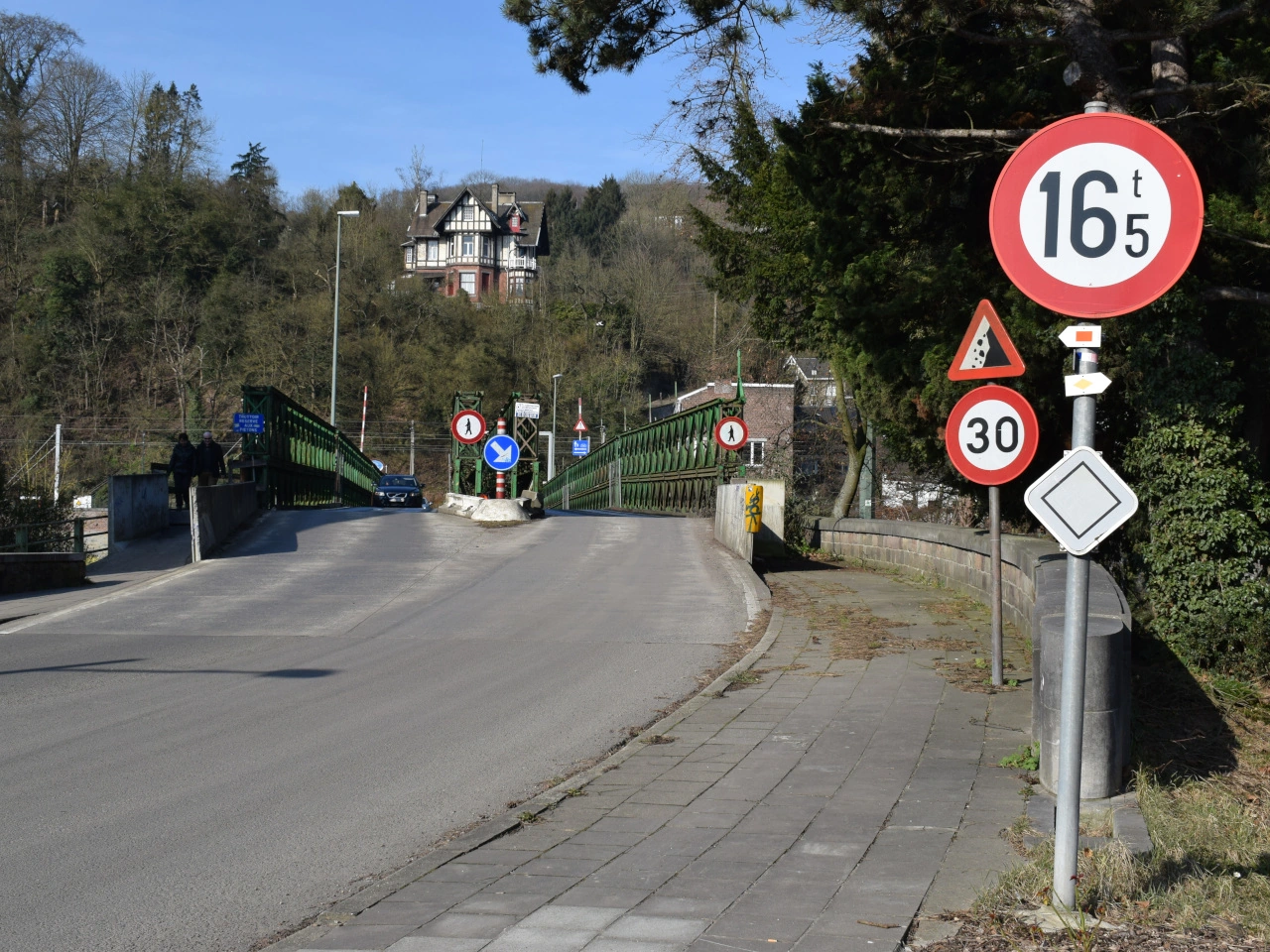
Traffic sign C21 prohibits access for drivers of vehicles whose actual loaded mass exceeds the mass displayed on the sign.
 Véhicules de plus du poids indiqué interdits.
Signal routier C21 • Accès interdit aux conducteurs de véhicules dont la masse en charge dépasse la masse indiquée.
Verkeersbord C21 • Verboden toegang voor bestuurders van voertuigen waarvan de massa in beladen toestand hoger is dan de aangeduide massa.
How can you recognise Belgian sign C21?
C21 is a circular prohibition sign displaying a maximum mass, normally expressed in tonnes.
What does actual loaded mass mean in Belgium?
The massa in beladen toestand is the combined mass of the vehicle itself, its load, the driver and every other person being transported.
Does the driver’s mass count for C21?
Yes. The driver and all passengers are included in the vehicle’s actual loaded mass.
Does cargo count for C21?
Yes. All goods, equipment and other load carried by the vehicle contribute to its actual loaded mass.
Is C21 based on the maximum authorised mass in the vehicle documents?
No. C21 concerns the vehicle’s actual mass while loaded, which may be lower than its maximum authorised mass.
What is the difference between actual mass and maximum authorised mass?
Actual loaded mass is what the vehicle currently weighs. Maximum authorised mass is the highest total mass for which the vehicle is legally approved.
Can an empty heavy truck pass a C21 sign?
It may pass when its actual loaded mass does not exceed the displayed value, unless another sign separately prohibits its vehicle category.
Can a small vehicle be prohibited by C21?
Yes. C21 applies to every vehicle whose actual loaded mass exceeds the displayed limit, not only to trucks.
Does the current C21 expressly refer to vehicle combinations?
The current sign description refers to vehicles. From 1 June 2027, the wording expressly includes vehicles and vehicle combinations.
What if a towing vehicle and trailer are used together?
The driver must consider how the applicable restriction treats the vehicle combination and must not continue when the relevant loaded mass exceeds the displayed limit.
What is the difference between C21 and C23?
C21 restricts every vehicle according to its actual loaded mass. C23 prohibits goods vehicles and combinations as a category and may use a supplementary mass inscription based on their maximum authorised mass.
Can a lightly loaded goods vehicle still be prohibited by C23?
Yes. Where C23 applies according to vehicle category or maximum authorised mass, reducing the current load may not remove the prohibition.
Does Belgium currently have a separate axle-load sign?
Under the current Highway Code, C22 is the sign prohibiting coaches, not an axle-load sign. A separate C22 axle-load restriction is introduced by the new Code of the Public Road from 1 June 2027.
What will the new Belgian C22 mean?
From 1 June 2027, C22 prohibits vehicles or vehicle combinations whose actual loaded mass per axle exceeds the value displayed.
Why can an axle-load restriction apply?
It may protect a bridge, road surface or other structure from a load concentrated too heavily on one axle, even when the vehicle’s total mass is otherwise permitted.
May a vehicle exactly equal to the C21 value pass?
C21 prohibits vehicles whose actual loaded mass is higher than the displayed mass. The driver must be certain that the limit is not exceeded.
How can a Belgian driver determine the actual mass?
The vehicle can be weighed on a suitable weighbridge. Registration documents normally provide technical and authorised limits rather than the current mass of the loaded vehicle.
Can redistributing cargo make a vehicle comply with C21?
Redistributing cargo does not reduce the vehicle’s total loaded mass. It may, however, change individual axle loads and become relevant to the new C22 axle restriction.
Can unloading cargo make the vehicle comply?
Yes. The vehicle may continue only after sufficient weight has been removed, the remaining load is secured and all other legal requirements are respected.
May an overloaded vehicle be required to unload?
Yes. When legal loading or technical mass requirements are violated, the driver may be required to unload, uncouple or move the vehicle to the nearest suitable place. The vehicle may otherwise be detained.
Does C21 apply only to permanent restrictions?
No. C21 may also be installed temporarily to protect a damaged bridge, weakened road or temporary roadworks structure.
Can C21 have zonal validity?
Yes. A zonal C21 restriction may prohibit vehicles above the displayed actual loaded mass throughout the signed area until the corresponding end-zone sign.
Does an intersection end a zonal C21 restriction?
No. The restriction continues across intersections until the end-zone sign is passed.
Must C21 be placed where another route is available?
Yes. Belgian placement rules require C21 to be installed at a location where affected drivers can still choose an alternative route.
What if no alternative route remains at the restriction itself?
A similar advance C21 sign with a supplementary distance panel must be placed earlier where the driver can still select another route.
Can C21 apply only to one lane?
Yes. A prohibition sign placed above or clearly associated with a particular lane applies to that lane or indicated part of the public road.
Does C21 impose a speed limit?
No. The applicable regional, zonal, posted and vehicle-specific speed limits remain in force.
Does C21 change priority?
No. Drivers must continue to obey traffic lights, priority signs and the ordinary priority rules.
What should you do when your vehicle exceeds C21?
Do not pass the sign. Stop where safe and use the indicated diversion or another route suitable for the vehicle’s actual loaded mass.
May you reverse away from C21?
Reversing is a manoeuvre, so the driver must give way to every other road user. Assistance may be necessary for a long or heavy vehicle combination.
Do priority vehicles have to respect the new C21 and C22 restrictions?
Yes. The Code of the Public Road retains C21 and the new axle-load sign C22 among the restrictions that priority vehicles may not disregard merely because they are carrying out a priority assignment.
What changes on 1 June 2027?
The new Belgian code expressly applies C21 to vehicles and vehicle combinations according to their actual loaded mass and introduces C22 for actual loaded mass per axle.


