

Route prioritaireWallonie
 Règles de circulation
 Wallonie
21. Route prioritaire
Une route prioritaire est une route dont les usagers ont priorité sur les véhicules arrivant des routes qui la croisent. Elle est normalement identifiée par un panneau de route prioritaire, tandis qu’un panneau de fin indique où ce statut de priorité continue cesse.
Les conducteurs circulant sur une route prioritaire doivent néanmoins respecter les feux de circulation, les agents habilités, les limitations de vitesse, les passages et les règles de changement de direction. Avoir la priorité ne permet jamais de s’engager si cela crée un danger ou bloque une intersection.
Which Belgian traffic signs indicate the beginning and end of a priority road?
Traffic sign B9 indicates the beginning of a priority road. Traffic sign B11 indicates the end of a priority road.
 Début d'une route prioritaire.
Signal routier B9 • Voie prioritaire.
Verkeersbord B9 • Voorrangsweg.
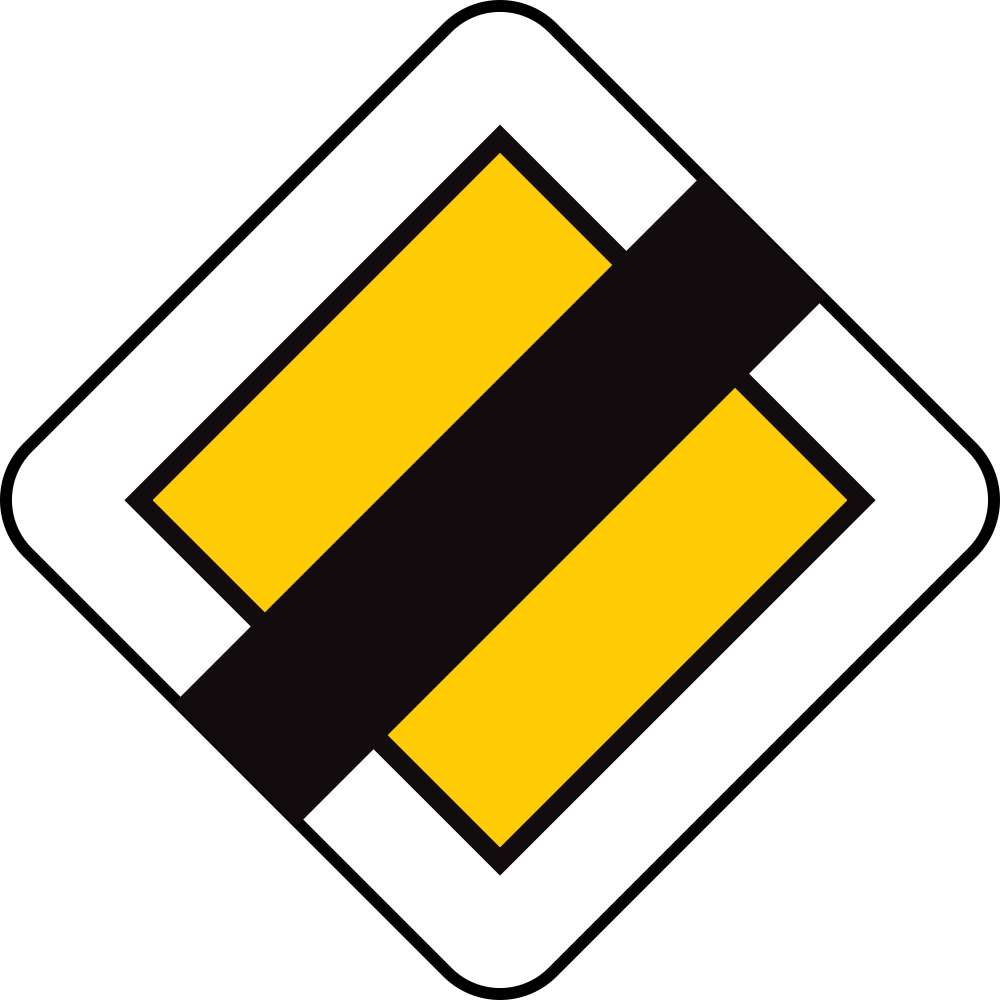 Fin de la route prioritaire.
Signal routier B11 • Fin de voie prioritaire.
Verkeersbord B11 • Einde van voorrangsweg.
What changes for priority roads under Belgium’s new Road Code?
Belgium’s new Code of the Public Road takes effect on 1 June 2027. The priority-road signs keep their existing numbers: traffic sign B9 continues to indicate a priority road, while traffic sign B11 continues to indicate the end of a priority road. Their basic meaning therefore remains unchanged under the new Road Code.
 Début d'une route prioritaire.
Signal routier B9 • Voie prioritaire.
Verkeersbord B9 • Voorrangsweg.
 Fin de la route prioritaire.
Signal routier B11 • Fin de voie prioritaire.
Verkeersbord B11 • Einde van voorrangsweg.
What does Belgian traffic sign B9 mean?
B9 means that drivers following the priority road have priority at intersections over drivers entering from controlled side roads.
Where does a Belgian priority road begin?
The priority road begins at traffic sign B9. Belgian placement rules require the sign to be installed at the beginning of the priority road.
Must B9 be repeated after an intersection?
Yes. Under the current Belgian placement rules, B9 must be repeated after every intersection while the road continues as a priority road.
Does a Belgian priority road end at every intersection?
No. Its priority status continues until sign B11 indicates the end. The repetition of B9 after intersections confirms that continuing status.
Which signs are normally placed on the side roads?
Drivers entering the priority road are normally controlled by traffic sign B1, meaning give way, or B5, meaning stop and give way.
Must traffic from both sides give way?
Yes. Drivers entering from controlled side roads must give way whether they approach from the left or the right.
Does priority from the right apply to drivers entering a B9 road?
No. A driver facing B1 or B5 must give way to traffic on the priority road, including traffic approaching from the left.
Does a Belgian priority road always continue straight ahead?
No. The priority road may bend or follow another branch at an intersection. A supplementary diagram may show the route followed by the priority road.
Must you use an indicator when the priority road bends?
Use the indicators whenever following the priority route causes an actual change of direction or lateral movement. Having priority does not remove the obligation to signal.
What is the difference between B9 and B15?
B9 indicates a continuing priority road and is repeated after intersections. B15 indicates priority only at the next intersection.
What is the difference between B9 and B17?
B9 indicates a priority road. B17 warns of an intersection where priority from the right applies.
Can B9 be placed on a Belgian roundabout?
No. Belgian placement rules prohibit B9 on a roundabout indicated by D5. Priority at the roundabout is established through the signs controlling its entrances.
Does B9 give priority at traffic lights?
When the traffic lights are functioning, the priority signs placed on the same road do not apply at that location. Drivers must follow the traffic lights.
What happens when the traffic lights flash orange-yellow?
The flashing orange-yellow light requires extra caution but does not suspend the priority arrangement. The B9 priority signs therefore remain relevant.
What if an authorised officer directs traffic?
Follow the officer’s instructions. Orders from an authorised person take precedence over traffic lights, traffic signs and ordinary traffic rules.
Does B9 give you priority over pedestrians?
No. B9 primarily regulates priority between drivers at intersections. Drivers must still give way to pedestrians at crossings and when turning where Belgian rules require it.
Must you give way to cyclists when turning?
Yes, where the cyclist continues lawfully along another part of the same public road or uses a bike path you cross. The priority-road sign does not remove these turning and crossing obligations.
Does B9 impose a speed limit?
No. The applicable regional, built-up-area, zonal, posted and vehicle-specific speed limits remain in force.
May you overtake on a Belgian priority road?
B9 does not itself authorise or prohibit overtaking. Drivers must respect the ordinary overtaking rules, road markings, visibility and any local prohibition signs.
May you park on a Belgian priority road outside a built-up area?
No, not on the carriageway. Parking on the carriageway of a B9 priority road outside a built-up area is prohibited.
May you briefly stop outside a built-up area?
The B9-specific rule prohibits parking on the carriageway, not every brief stop. General stopping prohibitions still apply wherever stopping would be dangerous, obstructive or otherwise prohibited.
May you park on a priority road inside a built-up area?
B9 alone does not create a general parking prohibition inside a built-up area. Drivers must follow the ordinary parking rules, signs and road markings.
Does a vehicle leaving a driveway have priority because it enters a B9 road?
No. A driver entering from a driveway, property or parking place is performing a manoeuvre and must give way to other road users.
May you block an intersection when driving on the priority road?
No. Priority does not allow you to enter an intersection when congestion would probably force you to stop and obstruct it.
Which Belgian sign ends a priority road?
Traffic sign B11 indicates the end of the priority road.
What does Belgian traffic sign B13 mean?
Traffic sign B13 announces that B11 is ahead and displays the approximate distance to the end of the priority road.
What priority rule applies after B11?
At the intersection where the priority road loses its status, the applicable rule must be indicated by B1, B5 or B17. Drivers must follow that sign rather than assume they still have priority.


