

Rétrécissement de chausséeWallonie
 Règles de circulation
 Wallonie
22. Rétrécissement de chaussée
Un rétrécissement de chaussée est une section où la largeur disponible de la route ou de la chaussée diminue. Le rétrécissement peut se produire des deux côtés, d’un seul côté, ou parce qu’une ou plusieurs voies se terminent.
Les conducteurs doivent réduire leur vitesse, observer les véhicules arrivant en sens inverse et ceux circulant à côté, maintenir un dégagement latéral suffisant et s’insérer si nécessaire. Les panneaux d’avertissement ne déterminent pas toujours la priorité ; les conducteurs doivent donc respecter les panneaux de priorité, marquages de voie et règles locales de circulation.
Which Belgian signs warn of a road narrowing?
Belgian warning signs A7a, A7b and A7c indicate a narrowing of the carriageway.
 Avertissement pour un rétrécissement de la chaussée.
Signal routier A7a • Rétrécissement de la chaussée.
Verkeersbord A7a • Rijbaanversmalling.
 Avertissement pour un rétrécissement à gauche.
Signal routier A7b • Rétrécissement de la chaussée.
Verkeersbord A7b • Rijbaanversmalling.
 Avertissement pour un rétrécissement à droite.
Signal routier A7c • Rétrécissement de la chaussée.
Verkeersbord A7c • Rijbaanversmalling.
 Rétrécissement : cédez le passage au trafic opposé.
Signal routier B19 • Passage étroit. Obligation de céder le passage aux conducteurs venant en sens opposé.
Verkeersbord B19 • Smalle doorgang. Gebod voorrang te verlenen aan de bestuurders die uit de tegenovergestelde richting komen.
 Rétrécissement : priorité sur le trafic opposé.
Signal routier B21 • Passage étroit. Priorité de passage par rapport aux conducteurs venant en sens opposé.
Verkeersbord B21 • Smalle doorgang. Voorrang ten opzichte van de bestuurders die uit de tegenovergestelde richting komen.
What changes for road narrowing under Belgium’s new Road Code?
Belgium’s new Code of the Public Road takes effect on 1 June 2027. The warning signs for a road narrowing keep their existing numbers: traffic sign A7a warns that the carriageway narrows on both sides, traffic sign A7b indicates a narrowing on the left, and traffic sign A7c indicates a narrowing on the right. Their basic meaning therefore remains unchanged under the new Road Code.
 Avertissement pour un rétrécissement de la chaussée.
Signal routier A7a • Rétrécissement de la chaussée.
Verkeersbord A7a • Rijbaanversmalling.
 Avertissement pour un rétrécissement à gauche.
Signal routier A7b • Rétrécissement de la chaussée.
Verkeersbord A7b • Rijbaanversmalling.
 Avertissement pour un rétrécissement à droite.
Signal routier A7c • Rétrécissement de la chaussée.
Verkeersbord A7c • Rijbaanversmalling.
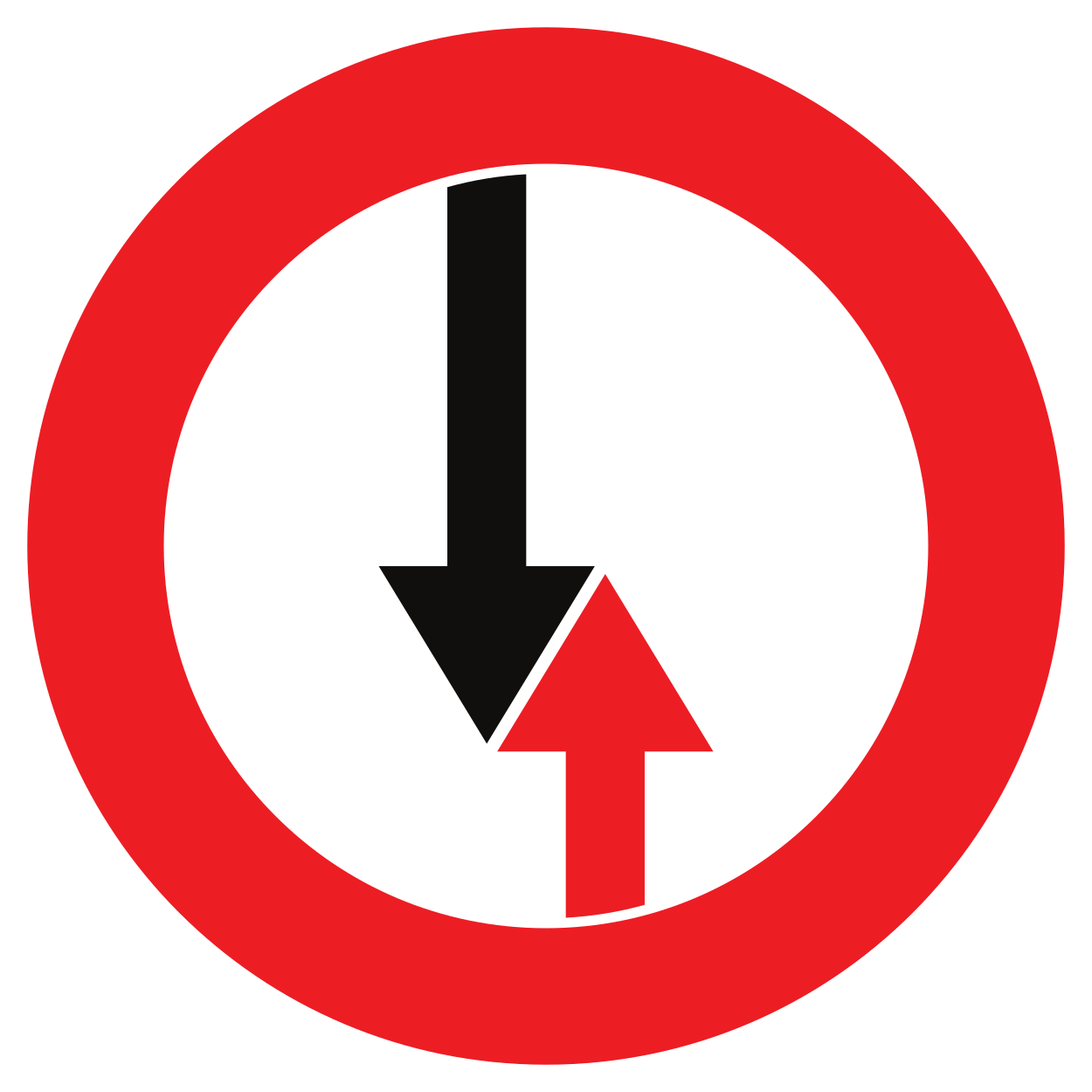 Rétrécissement : cédez le passage au trafic opposé.
Signal routier B19 • Passage étroit. Céder le passage aux conducteurs venant en sens opposé.
Verkeersbord B19 • Smalle doorgang. Voorrang verlenen aan de bestuurders die uit de tegenovergestelde richting komen.
 Rétrécissement : priorité sur le trafic opposé.
Signal routier B21 • Passage étroit. Priorité de passage par rapport aux conducteurs venant en sens opposé.
Verkeersbord B21 • Smalle doorgang. Voorrang ten opzichte van de bestuurders die uit de tegenovergestelde richting komen.
What does Belgian sign A7a mean?
Traffic sign A7a warns that the carriageway narrows from both sides.
What does Belgian sign A7b mean?
Traffic sign A7b warns that the carriageway narrows on the left side in the direction of travel.
What does Belgian sign A7c mean?
Traffic sign A7c warns that the carriageway narrows on the right side in the direction of travel.
Does an A7 sign determine priority?
No. A7a, A7b and A7c are warning signs. They do not indicate which direction has priority through the narrow section.
Does an A7 sign impose a speed limit?
No. Drivers must respect the applicable speed limit and reduce their speed further when necessary for the width, visibility and traffic conditions.
How far before the narrowing is an A7 sign placed?
In Brussels and Flanders, warning signs are normally placed approximately 150 metres before the danger. A supplementary panel indicates another approximate distance when necessary.
Which Belgian sign requires you to give way at a narrow passage?
Traffic sign B19 requires drivers to give way to drivers approaching from the opposite direction.
Which Belgian sign gives you priority at a narrow passage?
Traffic sign B21 indicates that you have priority over drivers approaching from the opposite direction.
Are B19 and B21 normally used together?
Yes. B19 is placed for one direction and B21 for the opposite direction. Under the current placement rules, they may be used where two cars cannot pass and the entire narrow section is visible from one end to the other.
Must you always stop at B19?
No. You must slow down and give way when an oncoming driver is approaching. You may continue cautiously when the passage is free and no priority traffic will be hindered.
May you enter first when facing B19?
You should not enter when a driver with priority is approaching closely enough to be hindered. The B19 obligation does not disappear merely because you reach or enter the narrow section first.
May a driver facing B21 enter without checking?
No. Even with priority, the driver must approach cautiously and avoid entering when another vehicle is already in the passage or when continuing would cause an accident.
Who gives way when there are no B19 or B21 signs?
A driver whose passage is obstructed by an obstacle or another road user must slow down and, when necessary, stop to allow approaching road users to pass.
What if the narrowing is symmetrical and there are no priority signs?
There is no automatic priority solely because one driver reaches the narrowing first. Both drivers must approach cautiously and avoid entering when they cannot pass one another safely.
Must you use an indicator to pass an obstruction?
Yes, when the movement requires a lateral displacement. Signal in time, check for following and approaching traffic and stop signalling when the movement is completed.
What if your traffic lane ends at the narrowing?
When traffic is flowing normally, changing into the adjacent lane is a manoeuvre and you must give way to its users. During strongly slowed traffic, the Belgian zipper-merging rule applies.
How does zipper merging work in Belgium?
During strongly slowed traffic, drivers in the ending or blocked lane must merge only immediately before the narrowing. Drivers in the continuing lane must alternately allow one merging driver to enter.
What if lanes end on both sides?
Drivers in the continuing lane first allow one vehicle from the right-hand lane to merge and then one vehicle from the left-hand lane.
Must you indicate while zipper merging?
Under the current Highway Code, zipper merging is not legally classified as a manoeuvre, but drivers should use their indicators in time to make their intention clear and merge predictably.
May you overtake at a Belgian road narrowing?
An A7 sign does not itself prohibit overtaking. Overtaking is permitted only when sufficient width and visibility are available and no other prohibition, marking or safety rule prevents it.
May you squeeze past a cyclist in a narrowing?
No. Drivers must maintain at least one metre inside a built-up area and 1.5 metres outside a built-up area when passing a cyclist. When this is impossible, they must wait.
What if pedestrians must walk around an obstruction?
Drivers passing an obstruction around which pedestrians must enter the carriageway must leave at least one metre of free space. If this is impossible while a pedestrian is present, the driver may pass only at walking pace.
May you stop or park in a Belgian road narrowing?
The A7 sign does not create an automatic prohibition, but stopping or parking is prohibited where it would clearly create danger or unnecessarily obstruct other road users.
How much road width must remain when parking?
Parking is prohibited when it would leave less than three metres of free passage on the carriageway.
May you park opposite another vehicle near a narrowing?
On a two-way carriageway, parking opposite another stationary or parked vehicle is prohibited when this would make it difficult for two other vehicles to pass one another.
When must a dangerous Belgian narrowing be signposted?
Under the current placement rules, A7 signs may be used for dangerous carriageway narrowings of at least one metre. A lane-sized narrowing must normally be signposted, except in residential areas and Zone 30 areas.
Will the narrowing signs remain in Belgium’s new road code?
Yes. The Code of the Public Road taking effect on 1 June 2027 retains A7a, A7b and A7c for carriageway narrowing and B19 and B21 for priority at a narrow passage. It also retains zipper merging.


