


OnderbordenItalië
 Verkeersregels
 Italië
 Voorrangsborden
 Waarschuwingsborden
 Verbodsborden
 Gebodsborden
 Informatieborden
 Onderborden
Een onderbord is een verkeersbord dat rechtstreeks onder een ander bord wordt geplaatst om extra informatie te geven of te verduidelijken hoe het hoofdbord moet worden begrepen. Het kan voorwaarden aangeven zoals afstand, tijdsperioden, betrokken weggebruikers, richtingen of bijzondere omstandigheden. Onderborden creëren op zichzelf geen nieuwe regels maar wijzigen, beperken of verduidelijken de betekenis van het bord erboven zodat bestuurders de regel in die specifieke situatie correct kunnen toepassen.
























1. Voor reinigingsvoertuigen
Dit onderbord geeft aan dat het hoofdverkeersbord specifiek op voertuigen van reinigingsdiensten van toepassing is. Welke voertuigen eronder vallen, hangt af van de toepasselijke plaatselijke definities.
English • Model II.6/q1 • Mechanical street cleaning. Indicates mechanical carriageway cleaning on the signposted section. Used with the no-parking sign. The plate supplements the main sign and must be read together with it.
Italiano • Modello II.6/q1 • Pulizia meccanica della strada. Indica operazioni di pulizia meccanica della carreggiata sul tratto segnalato. È abbinato al segnale di divieto di sosta. Il pannello integra il segnale principale e deve essere interpretato insieme a esso.
Bronnen
🔗 Commons.wikimedia.org
🔗 Normattiva.it • D.P.R. 495/1992 • testo vigente • art. 83, comma 10
🔗 Gazzettaufficiale.it • Gazzetta Ufficiale • Modello II.6/q1 • pagina 242
Image via Commons.wikimedia.org
Gigillo83 • Public domain • Source revision 2011-06-23. Wikimedia original unmodified.
2. Voor gelede vrachtwagens
Dit onderbord geeft aan dat het hoofdverkeersbord specifiek op gelede vrachtwagens van toepassing is. Welke voertuigcombinaties eronder vallen, hangt af van de toepasselijke plaatselijke definities.
English • Model II.4/a • Restriction — articulated lorries. Limits the main sign’s requirement to the vehicle category shown, in this case articulated lorries. The plate supplements the main sign and must be read together with it.
Italiano • Modello II.4/a • Limitazione — autoarticolati. Limita la prescrizione del segnale principale alla categoria di veicoli rappresentata, in questo caso gli autoarticolati. Il pannello integra il segnale principale e deve essere interpretato insieme a esso.
Bronnen
🔗 Commons.wikimedia.org
🔗 Normattiva.it • D.P.R. 495/1992 • testo vigente • art. 83, comma 7
🔗 Gazzettaufficiale.it • Gazzetta Ufficiale • Modello II.4/a • pagina 238
SVG source: Gigillo83 • Public domain • Original revision 2024-01-07. Wikimedia original unmodified.
3. Bussen toegestaan
Dit onderbord geeft aan dat bussen zijn toegestaan waar het hoofdverkeersbord hun toegang of gebruik anders zou beperken. Welke buscategorieën eronder vallen, hangt af van de toepasselijke plaatselijke definities.
English • Model II.4/b • Exception — buses or coaches. The word ‘except’ exempts the buses or coaches shown from the main sign's requirement. The plate supplements the main sign and must be read together with it.
Italiano • Modello II.4/b • Eccezione — autobus. La parola «eccetto» concede agli autobus rappresentati una deroga alla prescrizione del segnale principale. Il pannello integra il segnale principale e deve essere interpretato insieme a esso.
Bronnen
🔗 Commons.wikimedia.org
🔗 Normattiva.it • D.P.R. 495/1992 • testo vigente • art. 83, comma 7
🔗 Gazzettaufficiale.it • Gazzetta Ufficiale • Modello II.4/b • pagina 238
SVG source: Gigillo83 • Public domain • Original revision 2024-01-07. Wikimedia original unmodified.
4. Naar links
Dit onderbord geeft aan dat het hoofdverkeersbord geldt in de richting van de pijl, naar links.
English • Model II.5/b1 • Beginning. Marks the beginning of the requirement, danger or information in the arrow's direction. The plate supplements the main sign and must be read together with it.
Italiano • Modello II.5/b1 • Inizio. Indica l’inizio della prescrizione, del pericolo o dell’indicazione nel senso mostrato dalla freccia. Il pannello integra il segnale principale e deve essere interpretato insieme a esso.
Bronnen
🔗 Commons.wikimedia.org
🔗 Normattiva.it • D.P.R. 495/1992 • testo vigente • art. 83, comma 8
🔗 Gazzettaufficiale.it • Gazzetta Ufficiale • Modello II.5/b1 • pagina 238
Image via Commons.wikimedia.org
Original: Ministero dei Lavori Pubblici Vectorization: Arbalete • CC BY-SA 4.0 • Source revision 2024-01-10. Wikimedia original unmodified.
5. Naar links of rechts
Dit onderbord geeft aan dat het hoofdverkeersbord geldt in beide door de pijlen aangegeven richtingen, naar links en rechts.
English • Model II.5/b2 • Continuation. Indicates continuation of the requirement, danger or information. The plate supplements the main sign and must be read together with it.
Italiano • Modello II.5/b2 • Continuazione. Indica la continuazione della prescrizione, del pericolo o dell’indicazione. Il pannello integra il segnale principale e deve essere interpretato insieme a esso.
Bronnen
🔗 Commons.wikimedia.org
🔗 Normattiva.it • D.P.R. 495/1992 • testo vigente • art. 83, comma 8
🔗 Gazzettaufficiale.it • Gazzetta Ufficiale • Modello II.5/b2 • pagina 238
Image via Commons.wikimedia.org
Original: Ministero dei Lavori Pubblici Vectorization: Arbalete • CC BY-SA 4.0 • Source revision 2024-01-10. Wikimedia original unmodified.
6. Naar rechts
Dit onderbord geeft aan dat het hoofdverkeersbord geldt in de richting van de pijl, naar rechts.
English • Model II.5/b3 • End. Marks where the requirement, danger or information ends. The plate supplements the main sign and must be read together with it.
Italiano • Modello II.5/b3 • Fine. Indica il punto in cui termina la prescrizione, il pericolo o l’indicazione. Il pannello integra il segnale principale e deve essere interpretato insieme a esso.
Bronnen
🔗 Commons.wikimedia.org
🔗 Normattiva.it • D.P.R. 495/1992 • testo vigente • art. 83, comma 8
🔗 Gazzettaufficiale.it • Gazzetta Ufficiale • Modello II.5/b3 • pagina 238
Image via Commons.wikimedia.org
Original: Ministero dei Lavori Pubblici Vectorization: Arbalete • CC BY-SA 4.0 • Source revision 2024-01-10. Wikimedia original unmodified.
7. Begin van de regeling
Dit onderbord geeft het begin van de regel op het hoofdverkeersbord aan. De regel begint op dit punt.
English • Model II.5/a1 • Beginning. Marks the beginning of the requirement, danger or information. The plate supplements the main sign and must be read together with it.
Italiano • Modello II.5/a1 • Inizio. Indica l’inizio della prescrizione, del pericolo o dell’indicazione. Il pannello integra il segnale principale e deve essere interpretato insieme a esso.
Bronnen
🔗 Commons.wikimedia.org
🔗 Normattiva.it • D.P.R. 495/1992 • testo vigente • art. 83, comma 8
🔗 Gazzettaufficiale.it • Gazzetta Ufficiale • Modello II.5/a1 • pagina 238
SVG source: Original: Ministero dei Lavori Pubblici Vectorization: Arbalete • Public domain • Original revision 2024-01-10. Wikimedia original unmodified.
8. Voortzetting van de regeling
Dit onderbord geeft de voortzetting of herhaling van de regel op het hoofdverkeersbord aan.
English • Model II.5/a2 • Continuation. Indicates continuation of the requirement, danger or information. The plate supplements the main sign and must be read together with it.
Italiano • Modello II.5/a2 • Continuazione. Indica la continuazione della prescrizione, del pericolo o dell’indicazione. Il pannello integra il segnale principale e deve essere interpretato insieme a esso.
Bronnen
🔗 Commons.wikimedia.org
🔗 Normattiva.it • D.P.R. 495/1992 • testo vigente • art. 83, comma 8
🔗 Gazzettaufficiale.it • Gazzetta Ufficiale • Modello II.5/a2 • pagina 238
SVG source: Original: Ministero dei Lavori Pubblici Vectorization: Arbalete • Public domain • Original revision 2024-01-10. Wikimedia original unmodified.
9. Einde van de regeling
Dit onderbord geeft het einde van de regel op het hoofdverkeersbord aan. De regel eindigt op dit punt.
English • Model II.5/a3 • End. Marks where the requirement, danger or information ends. The plate supplements the main sign and must be read together with it.
Italiano • Modello II.5/a3 • Fine. Indica il punto in cui termina la prescrizione, il pericolo o l’indicazione. Il pannello integra il segnale principale e deve essere interpretato insieme a esso.
Bronnen
🔗 Commons.wikimedia.org
🔗 Normattiva.it • D.P.R. 495/1992 • testo vigente • art. 83, comma 8
🔗 Gazzettaufficiale.it • Gazzetta Ufficiale • Modello II.5/a3 • pagina 238
SVG source: Original: Ministero dei Lavori Pubblici Vectorization: Arbalete • Public domain • Original revision 2024-01-10. Wikimedia original unmodified.
10. Geldt voor de aangegeven rijstrook
Dit onderbord geeft aan dat het hoofdverkeersbord specifiek op de aangegeven rijstrook van toepassing is.
English • Model II.6/n • Lane sign. The downward arrow identifies the lane to which the sign above applies. The plate supplements the main sign and must be read together with it.
Italiano • Modello II.6/n • Segnale di corsia. La freccia rivolta verso il basso indica la corsia alla quale si riferisce il segnale sovrastante. Il pannello integra il segnale principale e deve essere interpretato insieme a esso.
Bronnen
🔗 Commons.wikimedia.org
🔗 Normattiva.it • D.P.R. 495/1992 • testo vigente • art. 83, comma 10
🔗 Gazzettaufficiale.it • Gazzetta Ufficiale • Modello II.6/n • pagina 241
Image via Commons.wikimedia.org
Original: Ministero dei Lavori Pubblici Vectorization: Arbalete • CC BY-SA 4.0 • Source revision 2024-07-12. Wikimedia original unmodified.
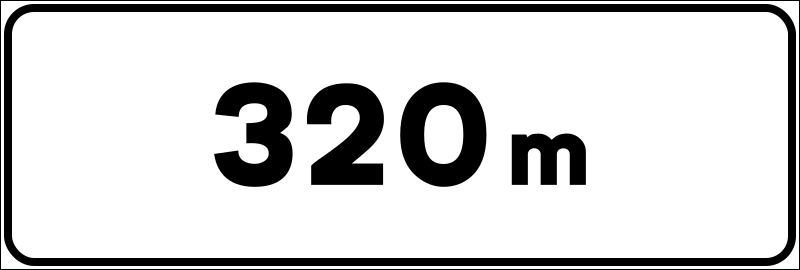
11. meter verderop
Dit onderbord geeft de afstand aan van het hoofdverkeersbord tot het punt waar het aangegeven gevaar, de regel of informatie begint. De afstand wordt in meter weergegeven.
English • Model II.1/a • Distance. Shows the distance in metres from the sign to the danger point, the beginning of the requirement or the indicated point. Example: 320 m. The plate supplements the main sign and must be read together with it.
Italiano • Modello II.1/a • Distanza. Indica la distanza in metri tra il segnale e il punto pericoloso, l’inizio della prescrizione o il punto indicato. Nell’esempio: 320 m. Il pannello integra il segnale principale e deve essere interpretato insieme a esso.
Bronnen
🔗 Commons.wikimedia.org (F l a n k e r • CC BY-SA 3.0)
🔗 Normattiva.it • D.P.R. 495/1992 • testo vigente • art. 83, comma 4
🔗 Gazzettaufficiale.it • Gazzetta Ufficiale • Modello II.1/a • pagina 237
Image via Commons.wikimedia.org
F l a n k e r • CC BY-SA 3.0 • Source revision 2024-01-07. Wikimedia original unmodified.
12. kilometer verderop
Dit onderbord geeft de afstand aan van het hoofdverkeersbord tot het punt waar het aangegeven gevaar, de regel of informatie begint. De afstand wordt in kilometer weergegeven.
English • Model II.1/b • Distance. Shows the distance in kilometres from the sign to the danger point, the beginning of the requirement or the indicated point. Example: 3.8 km. The plate supplements the main sign and must be read together with it.
Italiano • Modello II.1/b • Distanza. Indica la distanza in chilometri tra il segnale e il punto pericoloso, l’inizio della prescrizione o il punto indicato. Nell’esempio: 3,8 km. Il pannello integra il segnale principale e deve essere interpretato insieme a esso.
Bronnen
🔗 Commons.wikimedia.org
🔗 Normattiva.it • D.P.R. 495/1992 • testo vigente • art. 83, comma 4
🔗 Gazzettaufficiale.it • Gazzetta Ufficiale • Modello II.1/b • pagina 237
Image via Commons.wikimedia.org
Gigillo83 • Public domain • Source revision 2024-01-07. Wikimedia original unmodified.
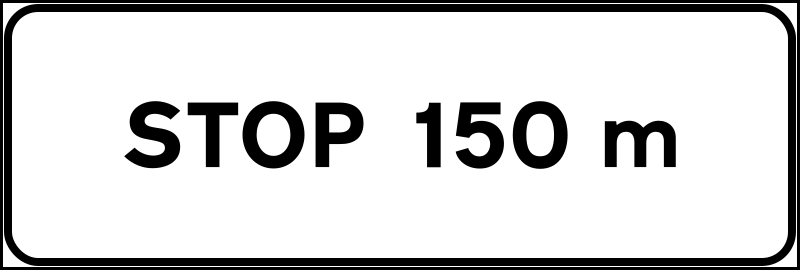
13. Stop over meter
Dit onderbord kondigt een STOP-bord aan op de aangegeven afstand verderop. De weergegeven waarde geeft de afstand tot het komende STOP-bord aan.
English • Traffic sign II.39 / Model II.1 • Advance warning to stop and give way. Used with a give-way sign to warn of a STOP sign and show the distance to its stop line; example: 150 m. The plate supplements the main sign and must be read together with it.
Italiano • Figura II.39 / Modello II.1 • Preavviso di fermarsi e dare precedenza. Abbinato al segnale di dare precedenza, preavvisa un segnale STOP e indica la distanza dalla sua striscia di arresto; nell’esempio 150 m. Il pannello integra il segnale principale e deve essere interpretato insieme a esso.
Bronnen
🔗 Commons.wikimedia.org (F l a n k e r • CC BY-SA 3.0)
🔗 Normattiva.it • D.P.R. 495/1992 • testo vigente • art. 108, comma 1, 3
🔗 Gazzettaufficiale.it • Gazzetta Ufficiale • Figura II.39 / Modello II.1 • pagina 256
Image via Commons.wikimedia.org
F l a n k e r • CC BY-SA 3.0 • Source revision 2013-07-28. Wikimedia original unmodified.
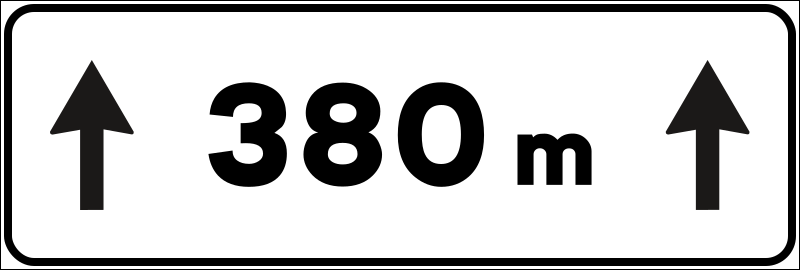
14. Over meter
Dit onderbord geeft de lengte aan van het gedeelte waarop het hoofdverkeersbord van toepassing is. De lengte wordt in meter weergegeven.
English • Model II.2/a • Length. Shows in metres the length of the hazardous or regulated section. Example: 380 m. The plate supplements the main sign and must be read together with it.
Italiano • Modello II.2/a • Estesa. Indica in metri la lunghezza del tratto pericoloso o soggetto alla prescrizione. Nell’esempio: 380 m. Il pannello integra il segnale principale e deve essere interpretato insieme a esso.
Bronnen
🔗 Commons.wikimedia.org (F l a n k e r • CC BY-SA 3.0)
🔗 Normattiva.it • D.P.R. 495/1992 • testo vigente • art. 83, comma 5
🔗 Gazzettaufficiale.it • Gazzetta Ufficiale • Modello II.2/a • pagina 237
Image via Commons.wikimedia.org
F l a n k e r • CC BY-SA 3.0 • Source revision 2024-01-07. Wikimedia original unmodified.
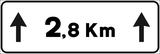
15. Over kilometer
Dit onderbord geeft de lengte aan van het gedeelte waarop het hoofdverkeersbord van toepassing is. De lengte wordt in kilometer weergegeven.
English • Model II.2/b • Length. Shows in kilometres the length of the hazardous or regulated section. Example: 2.8 km. The plate supplements the main sign and must be read together with it.
Italiano • Modello II.2/b • Estesa. Indica in chilometri la lunghezza del tratto pericoloso o soggetto alla prescrizione. Nell’esempio: 2,8 km. Il pannello integra il segnale principale e deve essere interpretato insieme a esso.
Bronnen
🔗 Commons.wikimedia.org
🔗 Normattiva.it • D.P.R. 495/1992 • testo vigente • art. 83, comma 5
🔗 Gazzettaufficiale.it • Gazzetta Ufficiale • Modello II.2/b • pagina 237
Image via Commons.wikimedia.org
Gigillo83 • Public domain • Source revision 2024-01-07. Wikimedia original unmodified.
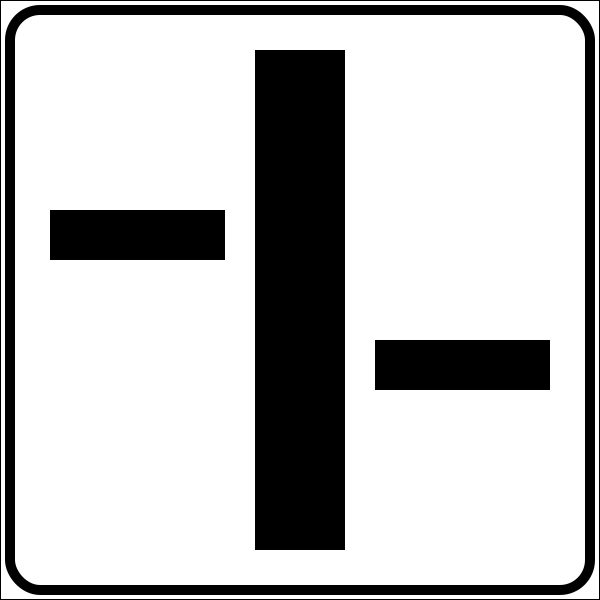
16. Vorm van het kruispunt
Dit onderbord toont de vorm of indeling van het komende kruispunt.
English • Model II.7 • Course of the priority road. The thicker line represents the priority road; narrower branches represent non-priority roads. Read it together with the priority sign. The plate supplements the main sign and must be read together with it.
Italiano • Modello II.7 • Andamento della strada principale. La striscia più larga rappresenta la strada con precedenza; i rami più stretti rappresentano le strade subordinate. Va interpretato insieme al segnale di precedenza. Il pannello integra il segnale principale e deve essere interpretato insieme a esso.
Bronnen
🔗 Commons.wikimedia.org
🔗 Normattiva.it • D.P.R. 495/1992 • testo vigente • art. 83, comma 11
🔗 Gazzettaufficiale.it • Gazzetta Ufficiale • Modello II.7 • pagina 243
SVG source: Original: Ministero dei Lavori Pubblici Vectorization: Arbalete • Public domain • Original revision 2024-07-12. Wikimedia original unmodified.
17. Vorm van het kruispunt
Dit onderbord toont de vorm of indeling van het komende kruispunt.
English • Model II.7 • Course of the priority road. The thicker line represents the priority road; narrower branches represent non-priority roads. Read it together with the priority sign. The plate supplements the main sign and must be read together with it.
Italiano • Modello II.7 • Andamento della strada principale. La striscia più larga rappresenta la strada con precedenza; i rami più stretti rappresentano le strade subordinate. Va interpretato insieme al segnale di precedenza. Il pannello integra il segnale principale e deve essere interpretato insieme a esso.
Bronnen
🔗 Commons.wikimedia.org
🔗 Normattiva.it • D.P.R. 495/1992 • testo vigente • art. 83, comma 11
🔗 Gazzettaufficiale.it • Gazzetta Ufficiale • Modello II.7 • pagina 243
SVG source: Original: Ministero dei Lavori Pubblici Vectorization: Arbalete • Public domain • Original revision 2024-07-12. Wikimedia original unmodified.
18. Vorm van het kruispunt
Dit onderbord toont de vorm of indeling van het komende kruispunt.
English • Model II.7 • Course of the priority road. The thicker line represents the priority road; narrower branches represent non-priority roads. Read it together with the priority sign. The plate supplements the main sign and must be read together with it.
Italiano • Modello II.7 • Andamento della strada principale. La striscia più larga rappresenta la strada con precedenza; i rami più stretti rappresentano le strade subordinate. Va interpretato insieme al segnale di precedenza. Il pannello integra il segnale principale e deve essere interpretato insieme a esso.
Bronnen
🔗 Commons.wikimedia.org
🔗 Normattiva.it • D.P.R. 495/1992 • testo vigente • art. 83, comma 11
🔗 Gazzettaufficiale.it • Gazzetta Ufficiale • Modello II.7 • pagina 243
SVG source: Original: Ministero dei Lavori Pubblici Vectorization: Arbalete • Public domain • Original revision 2024-07-12. Wikimedia original unmodified.
19. Vorm van het kruispunt
Dit onderbord toont de vorm of indeling van het komende kruispunt.
English • Model II.7 • Course of the priority road. The thicker line represents the priority road; narrower branches represent non-priority roads. Read it together with the priority sign. The plate supplements the main sign and must be read together with it.
Italiano • Modello II.7 • Andamento della strada principale. La striscia più larga rappresenta la strada con precedenza; i rami più stretti rappresentano le strade subordinate. Va interpretato insieme al segnale di precedenza. Il pannello integra il segnale principale e deve essere interpretato insieme a esso.
Bronnen
🔗 Commons.wikimedia.org
🔗 Normattiva.it • D.P.R. 495/1992 • testo vigente • art. 83, comma 11
🔗 Gazzettaufficiale.it • Gazzetta Ufficiale • Modello II.7 • pagina 243
SVG source: Original: Ministero dei Lavori Pubblici Vectorization: Arbalete • Public domain • Original revision 2024-07-12. Wikimedia original unmodified.
20. Vorm van het kruispunt
Dit onderbord toont de vorm of indeling van het komende kruispunt.
English • Model II.7 • Course of the priority road. The thicker line represents the priority road; narrower branches represent non-priority roads. Read it together with the priority sign. The plate supplements the main sign and must be read together with it.
Italiano • Modello II.7 • Andamento della strada principale. La striscia più larga rappresenta la strada con precedenza; i rami più stretti rappresentano le strade subordinate. Va interpretato insieme al segnale di precedenza. Il pannello integra il segnale principale e deve essere interpretato insieme a esso.
Bronnen
🔗 Commons.wikimedia.org
🔗 Normattiva.it • D.P.R. 495/1992 • testo vigente • art. 83, comma 11
🔗 Gazzettaufficiale.it • Gazzetta Ufficiale • Modello II.7 • pagina 243
SVG source: Original: Ministero dei Lavori Pubblici Vectorization: Arbalete • Public domain • Original revision 2024-07-12. Wikimedia original unmodified.
21. Foutgeparkeerde voertuigen kunnen worden weggesleept
Dit onderbord waarschuwt dat fout geparkeerde voertuigen kunnen worden weggesleept.
English • Model II.6/m • Tow-away zone. Indicates that parking causes a serious obstruction or danger and the vehicle may be removed. Applies during the same hours as the prohibition sign. The plate supplements the main sign and must be read together with it.
Italiano • Modello II.6/m • Zona rimozione coatta. Indica che la sosta costituisce grave intralcio o pericolo e che il veicolo può essere rimosso. Ha la stessa validità oraria del segnale di divieto. Il pannello integra il segnale principale e deve essere interpretato insieme a esso.
Bronnen
🔗 Commons.wikimedia.org
🔗 Normattiva.it • D.P.R. 495/1992 • testo vigente • art. 83, comma 10
🔗 Gazzettaufficiale.it • Gazzetta Ufficiale • Modello II.6/m • pagina 241
Image via Commons.wikimedia.org
Original: Ministero dei Lavori Pubblici Vectorization: Arbalete • CC BY-SA 4.0 • Source revision 2024-07-12. Wikimedia original unmodified.
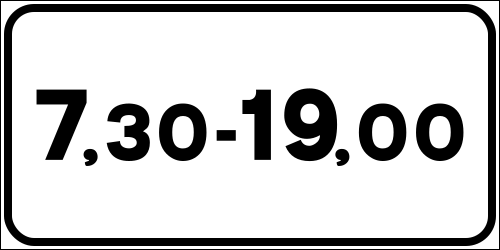
22. Tijdens de aangegeven tijd
Dit onderbord geeft aan dat het hoofdverkeersbord tijdens de weergegeven tijd geldt.
English • Model II.3/b • Daily hours of application. Shows the hours when the requirement or danger applies each day; example: 7:30 to 19:00. The plate supplements the main sign and must be read together with it.
Italiano • Modello II.3/b • Validità oraria. Indica le ore in cui vale la prescrizione o il pericolo ogni giorno; nell’esempio dalle 7:30 alle 19:00. Il pannello integra il segnale principale e deve essere interpretato insieme a esso.
Bronnen
🔗 Commons.wikimedia.org
🔗 Normattiva.it • D.P.R. 495/1992 • testo vigente • art. 83, comma 6
🔗 Gazzettaufficiale.it • Gazzetta Ufficiale • Modello II.3/b • pagina 237
SVG source: Gigillo83 • Public domain • Original revision 2024-01-07. Wikimedia original unmodified.
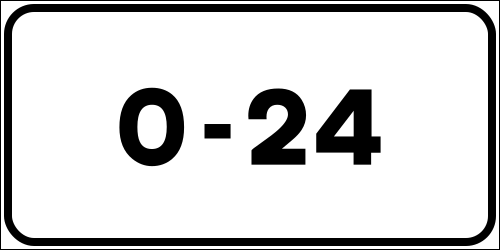
23. Gedurende het aangegeven aantal uren
Dit onderbord geeft aan dat het hoofdverkeersbord gedurende het weergegeven aantal uren geldt.
English • Model II.3/a • Applies at all times. The indication 0–24 means that the requirement or danger applies throughout the day. The plate supplements the main sign and must be read together with it.
Italiano • Modello II.3/a • Validità permanente. L’indicazione 0–24 significa che la prescrizione o il pericolo vale durante l’intera giornata. Il pannello integra il segnale principale e deve essere interpretato insieme a esso.
Bronnen
🔗 Commons.wikimedia.org
🔗 Normattiva.it • D.P.R. 495/1992 • testo vigente • art. 83, comma 6
🔗 Gazzettaufficiale.it • Gazzetta Ufficiale • Modello II.3/a • pagina 237
SVG source: Gigillo83 • Public domain • Original revision 2024-01-07. Wikimedia original unmodified.
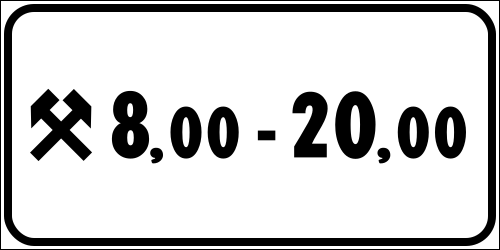
24. Op werkdagen tijdens de aangegeven tijd
Dit onderbord geeft aan dat het hoofdverkeersbord op werkdagen tijdens de weergegeven tijd geldt.
English • Model II.3/d • Applies on working days. The hammer symbol limits application to working days during the hours shown; example: 8:00 to 20:00. The plate supplements the main sign and must be read together with it.
Italiano • Modello II.3/d • Validità nei giorni lavorativi. Il simbolo dei martelli limita la validità ai giorni lavorativi, nelle ore indicate; nell’esempio dalle 8:00 alle 20:00. Il pannello integra il segnale principale e deve essere interpretato insieme a esso.
Bronnen
🔗 Commons.wikimedia.org
🔗 Normattiva.it • D.P.R. 495/1992 • testo vigente • art. 83, comma 6
🔗 Gazzettaufficiale.it • Gazzetta Ufficiale • Modello II.3/d • pagina 237
SVG source: Gigillo83 • Public domain • Original revision 2024-01-07. Wikimedia original unmodified.
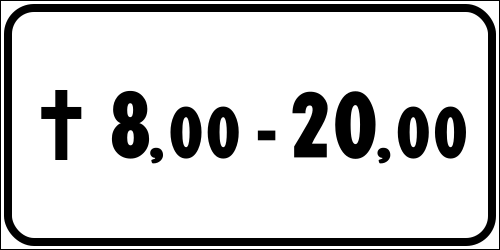
25. Op feestdagen tijdens de aangegeven tijd
Dit onderbord geeft aan dat het hoofdverkeersbord op feestdagen tijdens de weergegeven tijd geldt.
English • Model II.3/c • Applies on public holidays. The cross limits application to public holidays during the hours shown; example: 8:00 to 20:00. The plate supplements the main sign and must be read together with it.
Italiano • Modello II.3/c • Validità nei giorni festivi. La croce limita la validità ai giorni festivi, nelle ore indicate; nell’esempio dalle 8:00 alle 20:00. Il pannello integra il segnale principale e deve essere interpretato insieme a esso.
Bronnen
🔗 Commons.wikimedia.org
🔗 Normattiva.it • D.P.R. 495/1992 • testo vigente • art. 83, comma 6
🔗 Gazzettaufficiale.it • Gazzetta Ufficiale • Modello II.3/c • pagina 237
SVG source: Gigillo83 • Public domain • Original revision 2024-01-07. Wikimedia original unmodified.
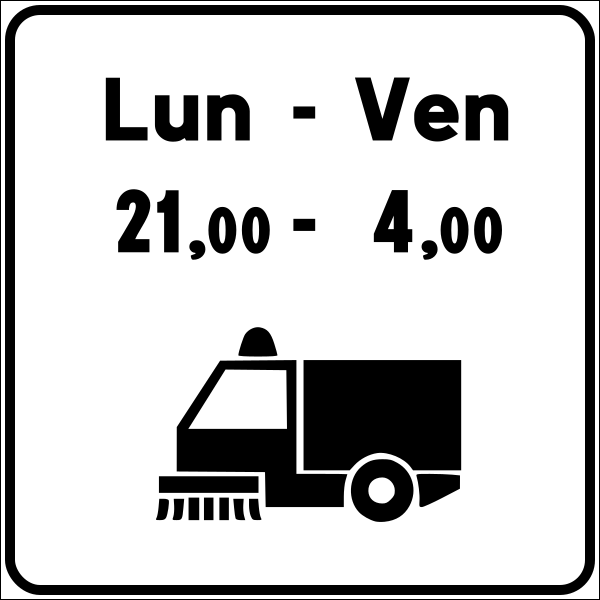
26. Straatreiniging op de aangegeven datum en tijd
Dit onderbord geeft aan dat het hoofdverkeersbord voor straatreiniging geldt op de weergegeven datum en tijdens de weergegeven tijd.
English • Model II.6/q2 • Mechanical street cleaning. Used with the no-parking sign to show street-cleaning days and hours. Example: Monday to Friday, 21:00 to 4:00. The plate supplements the main sign and must be read together with it.
Italiano • Modello II.6/q2 • Pulizia meccanica della strada. Abbinato al divieto di sosta, indica i giorni e gli orari delle operazioni di pulizia della strada. Nell’esempio: dal lunedì al venerdì, dalle 21:00 alle 4:00. Il pannello integra il segnale principale e deve essere interpretato insieme a esso.
Bronnen
🔗 Commons.wikimedia.org
🔗 Normattiva.it • D.P.R. 495/1992 • testo vigente • art. 83, comma 10
🔗 Gazzettaufficiale.it • Gazzetta Ufficiale • Modello II.6/q2 • pagina 242
SVG source: This vector image includes elements that have been taken or adapted from this file: • Public domain • Original revision 2024-08-25. Wikimedia original unmodified.
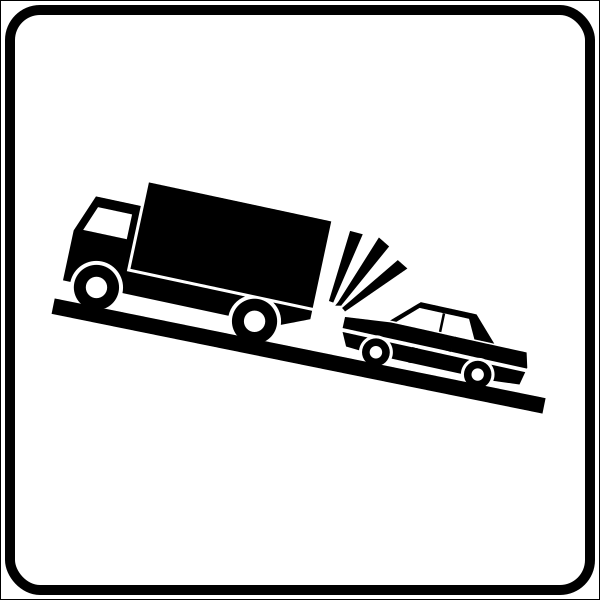
27. Steile helling omhoog
Dit onderbord geeft aan dat het hoofdverkeersbord betrekking heeft op een steile helling omhoog.
English • Model II.6/l • Slow-moving lorries. Indicates a section where slow-moving lorries are likely. The gradient shown may be adapted for downhill sections. The plate supplements the main sign and must be read together with it.
Italiano • Modello II.6/l • Autocarri in rallentamento. Indica un tratto con probabili autocarri in lento movimento. La pendenza raffigurata può essere adattata per i tratti in discesa. Il pannello integra il segnale principale e deve essere interpretato insieme a esso.
Bronnen
🔗 Commons.wikimedia.org
🔗 Normattiva.it • D.P.R. 495/1992 • testo vigente • art. 83, comma 10
🔗 Gazzettaufficiale.it • Gazzetta Ufficiale • Modello II.6/l • pagina 241
Image via Commons.wikimedia.org
Original: Ministero dei Lavori Pubblici Vectorization: Arbalete • CC BY-SA 4.0 • Source revision 2024-08-25. Wikimedia original unmodified.
28. Smalle rijbaan
Dit onderbord waarschuwt dat de rijbaan verderop smal is.
English • Model II.6 — inscription • Reduced-width lanes. The inscription specifies that lanes on the signposted section are narrower. The plate supplements the main sign and must be read together with it.
Italiano • Modello II.6 — iscrizione • Corsie a larghezza ridotta. L’iscrizione precisa che le corsie del tratto segnalato hanno larghezza ridotta. Il pannello integra il segnale principale e deve essere interpretato insieme a esso.
Bronnen
🔗 Commons.wikimedia.org
🔗 Normattiva.it • D.P.R. 495/1992 • testo vigente • art. 83, comma 9
Image via Commons.wikimedia.org
Original: Ministero delle Infrastrutture e dei Trasporti Vector: Pav03 • Public domain • Source revision 2025-05-09. Wikimedia original unmodified.
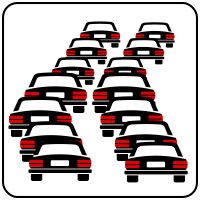
29. Files
Dit onderbord waarschuwt dat files of langzaam rijdend verkeer verderop kunnen voorkomen.
English • Model II.6/f • Traffic queue. Indicates the possibility of slow-moving or stationary queuing traffic. The plate supplements the main sign and must be read together with it.
Italiano • Modello II.6/f • Coda. Indica la possibilità di incontrare traffico in lento movimento o fermo in colonna. Il pannello integra il segnale principale e deve essere interpretato insieme a esso.
Bronnen
🔗 Commons.wikimedia.org
🔗 Normattiva.it • D.P.R. 495/1992 • testo vigente • art. 83, comma 10
🔗 Gazzettaufficiale.it • Gazzetta Ufficiale • Modello II.6/f • pagina 240
SVG source: Samuele on English Wikipedia Samuele nella Wikipedia Italiana • Public domain • Original revision 2023-11-20. Wikimedia original unmodified.
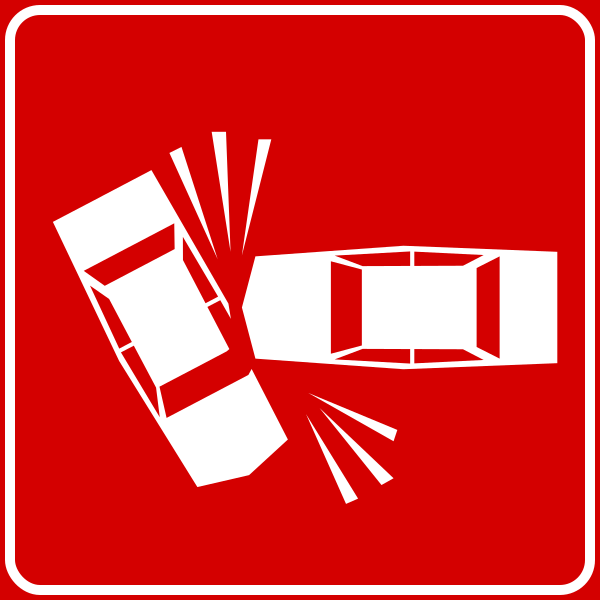
30. Ongevalsrisico
Dit onderbord waarschuwt voor een verhoogd ongevalsrisico op het betreffende weggedeelte.
English • Model II.6/b • Accident. Indicates that vehicles involved in a collision obstruct the carriageway. The plate supplements the main sign and must be read together with it.
Italiano • Modello II.6/b • Incidente. Indica l’ingombro della carreggiata da parte di veicoli coinvolti in una collisione. Il pannello integra il segnale principale e deve essere interpretato insieme a esso.
Bronnen
🔗 Commons.wikimedia.org
🔗 Normattiva.it • D.P.R. 495/1992 • testo vigente • art. 83, comma 10
🔗 Gazzettaufficiale.it • Gazzetta Ufficiale • Modello II.6/b • pagina 239
SVG source: Original: Ministero dei Lavori Pubblici Vectorization: Arbalete • Public domain • Original revision 2024-08-25. Wikimedia original unmodified.
31. Aanbrengen van wegmarkeringen
Dit onderbord waarschuwt dat wegmarkeringen verderop worden aangebracht of vernieuwd.
English • Model II.6/a • Road markings being renewed. Indicates temporarily missing road markings or marking work in progress on the signposted section. The plate supplements the main sign and must be read together with it.
Italiano • Modello II.6/a • Segni orizzontali in rifacimento. Indica la temporanea mancanza della segnaletica orizzontale oppure lavori di tracciamento in corso sul tratto segnalato. Il pannello integra il segnale principale e deve essere interpretato insieme a esso.
Bronnen
🔗 Commons.wikimedia.org
🔗 Normattiva.it • D.P.R. 495/1992 • testo vigente • art. 83, comma 10
🔗 Gazzettaufficiale.it • Gazzetta Ufficiale • Modello II.6/a • pagina 239
Image via Commons.wikimedia.org
Original: Ministero dei Lavori Pubblici Vectorization: Arbalete • CC BY-SA 4.0 • Source revision 2024-08-25. Wikimedia original unmodified.
32. Verplichte uitrit
Dit onderbord geeft aan dat bestuurders de aangegeven afrit moeten nemen en de huidige route niet mogen blijven volgen.
English • Model II.6 — inscription • Compulsory exit. The inscription specifies the obligation to exit in accordance with the accompanying main sign. The plate supplements the main sign and must be read together with it.
Italiano • Modello II.6 — iscrizione • Uscita obbligatoria. L’iscrizione precisa l’obbligo di uscire secondo la segnalazione principale cui è abbinata. Il pannello integra il segnale principale e deve essere interpretato insieme a esso.
Bronnen
🔗 Commons.wikimedia.org
🔗 Normattiva.it • D.P.R. 495/1992 • testo vigente • art. 83, comma 9
Image via Commons.wikimedia.org
Original: Ministero delle Infrastrutture e dei Trasporti Vector: Pav03 • Public domain • Source revision 2025-05-09. Wikimedia original unmodified.
33. IJs
Dit onderbord waarschuwt dat het wegdek glad door ijs kan zijn.
English • Model II.6/h • Slippery road due to ice. Indicates that ice may form on the surface under particular weather conditions. The plate supplements the main sign and must be read together with it.
Italiano • Modello II.6/h • Strada sdrucciolevole per ghiaccio. Indica la possibilità di formazione di ghiaccio sulla pavimentazione in particolari condizioni atmosferiche. Il pannello integra il segnale principale e deve essere interpretato insieme a esso.
Bronnen
🔗 Commons.wikimedia.org
🔗 Normattiva.it • D.P.R. 495/1992 • testo vigente • art. 83, comma 10
🔗 Gazzettaufficiale.it • Gazzetta Ufficiale • Modello II.6/h • pagina 240
Image via Commons.wikimedia.org
F l a n k e r • Public domain • Source revision 2023-11-30. Wikimedia original unmodified.
34. Sneeuwploeg
Dit onderbord waarschuwt dat sneeuwploegen op de weg verderop aan het werk kunnen zijn.
English • Model II.6/d • Snow clearance in progress. Indicates snow-clearing machinery working on the road. The plate supplements the main sign and must be read together with it.
Italiano • Modello II.6/d • Sgombraneve in azione. Indica la presenza di macchine sgombraneve al lavoro sulla strada. Il pannello integra il segnale principale e deve essere interpretato insieme a esso.
Bronnen
🔗 Commons.wikimedia.org
🔗 Normattiva.it • D.P.R. 495/1992 • testo vigente • art. 83, comma 10
🔗 Gazzettaufficiale.it • Gazzetta Ufficiale • Modello II.6/d • pagina 239
Image via Commons.wikimedia.org
Gigillo83 • Public domain • Source revision 2025-05-24. Wikimedia original unmodified.
35. Nat
Dit onderbord waarschuwt dat het wegdek nat en glad kan zijn.
English • Model II.6/i • Slippery road in rain. Indicates a section whose surface becomes dangerously slippery when it rains. The plate supplements the main sign and must be read together with it.
Italiano • Modello II.6/i • Strada sdrucciolevole per pioggia. Indica un tratto con pavimentazione pericolosamente sdrucciolevole in caso di pioggia. Il pannello integra il segnale principale e deve essere interpretato insieme a esso.
Bronnen
🔗 Commons.wikimedia.org (Gigillo83 • CC BY-SA 3.0)
🔗 Normattiva.it • D.P.R. 495/1992 • testo vigente • art. 83, comma 10
🔗 Gazzettaufficiale.it • Gazzetta Ufficiale • Modello II.6/i • pagina 241
Image via Commons.wikimedia.org
Gigillo83 • CC BY-SA 3.0 • Source revision 2010-06-29. Wikimedia original unmodified.
36. Hoogwater of overstroming
Dit onderbord waarschuwt dat de weg bij hoogtij of hoogwater overstroomd of onder water kan staan.
English • Model II.6/e • Area liable to flooding. Indicates a section that may flood under particular weather conditions. The plate supplements the main sign and must be read together with it.
Italiano • Modello II.6/e • Zona soggetta ad allagamento. Indica un tratto che, in particolari condizioni atmosferiche, può essere soggetto ad allagamento. Il pannello integra il segnale principale e deve essere interpretato insieme a esso.
Bronnen
🔗 Commons.wikimedia.org
🔗 Normattiva.it • D.P.R. 495/1992 • testo vigente • art. 83, comma 10
🔗 Gazzettaufficiale.it • Gazzetta Ufficiale • Modello II.6/e • pagina 240
Image via Commons.wikimedia.org
F l a n k e r • Public domain • Source revision 2023-11-30. Wikimedia original unmodified.
37. Werfverkeer
Dit onderbord waarschuwt dat bouwvoertuigen de weg kunnen oprijden, verlaten of erop rijden.
English • Model II.6/g • Work vehicles operating. Indicates machinery, mechanical shovels, excavators or lorries that may interfere with ordinary traffic. The plate supplements the main sign and must be read together with it.
Italiano • Modello II.6/g • Mezzi di lavoro in azione. Indica macchine operatrici, pale meccaniche, escavatori o autocarri che possono interferire con il traffico ordinario. Il pannello integra il segnale principale e deve essere interpretato insieme a esso.
Bronnen
🔗 Commons.wikimedia.org
🔗 Normattiva.it • D.P.R. 495/1992 • testo vigente • art. 83, comma 10
🔗 Gazzettaufficiale.it • Gazzetta Ufficiale • Modello II.6/g • pagina 240
Image via Commons.wikimedia.org
F l a n k e r • Public domain • Source revision 2006-12-07. Wikimedia original unmodified.
